THE CONSTITUTION OF INDIA   and     PROFESSIONAL ETHICS CIP 81 Constitution and Constituent Assembly C lass # 01  Week :Feb 04-09
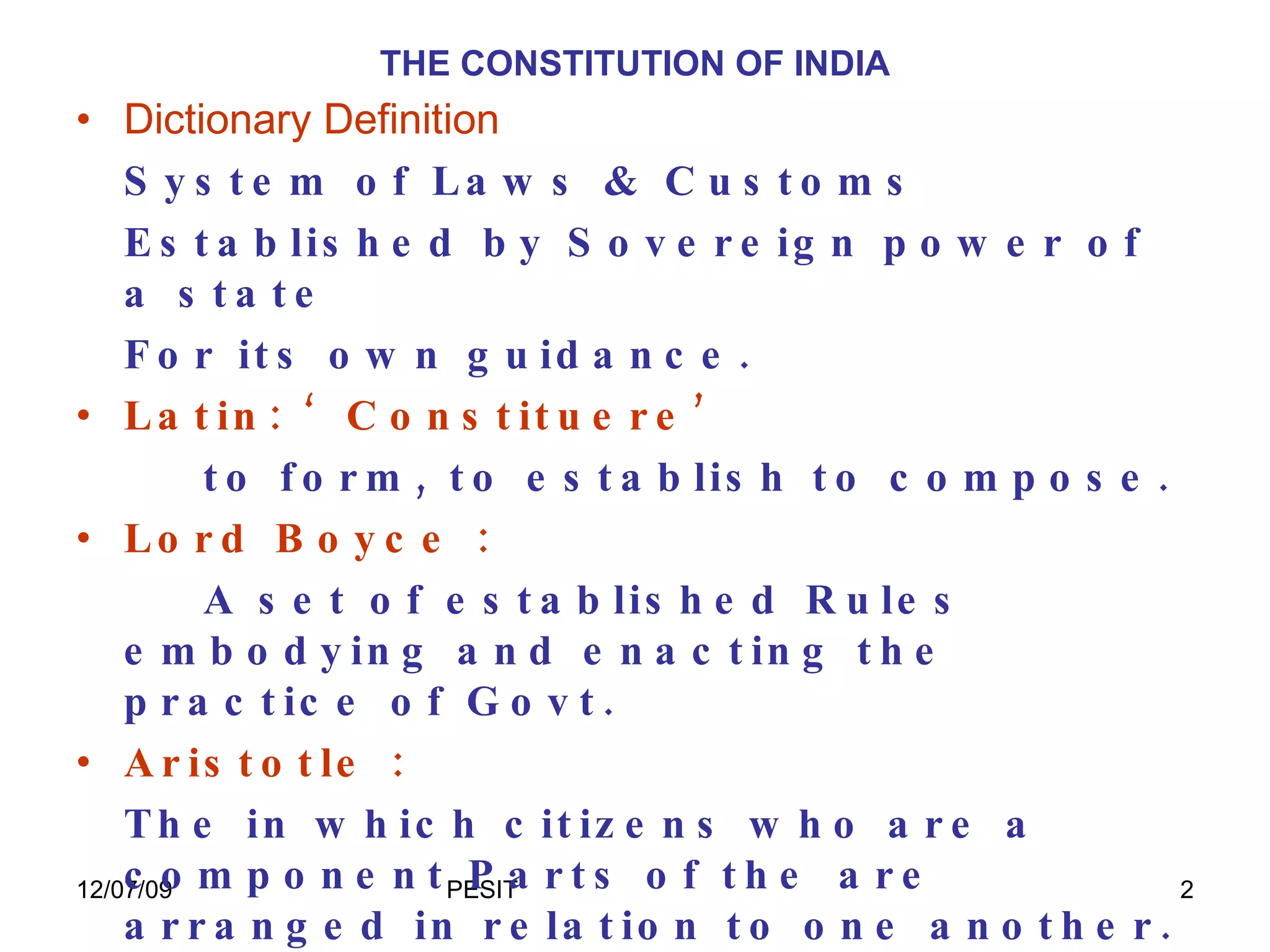
THE CONSTITUTION OF INDIA Dictionary Definition System of Laws & Customs Established by Sovereign power of a state For its own guidance. Latin: ‘Constituere’ to form, to establish to compose. Lord Boyce : A set of established Rules embodying and enacting the practice of Govt. Aristotle : The in which citizens who are a component Parts of the  are arranged in relation to one another. Constitution is built on a foundation of Constitutional LAW.
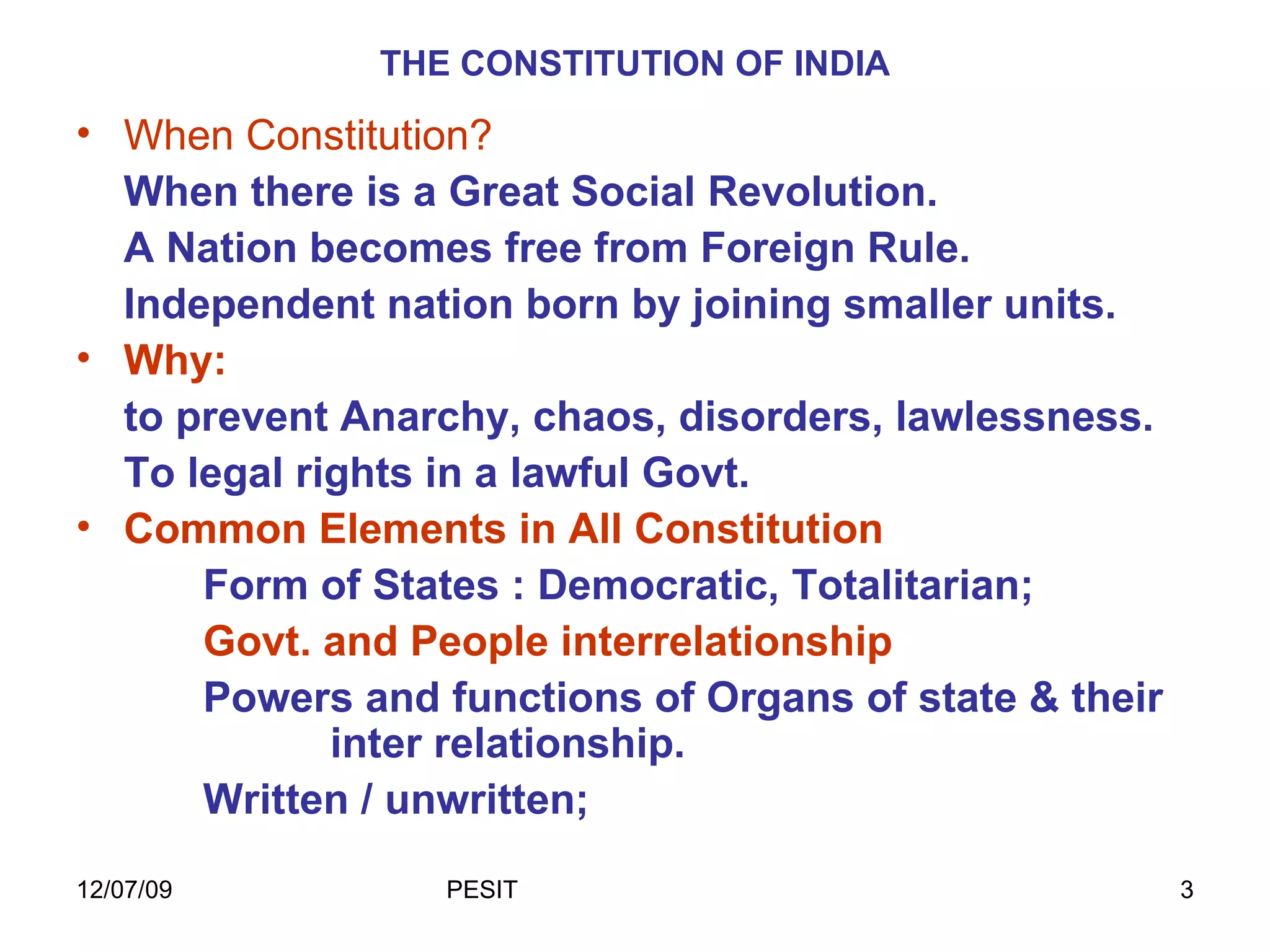
THE CONSTITUTION OF INDIA When Constitution?  When there is a Great Social Revolution. A Nation becomes free from Foreign Rule. Independent nation born by joining smaller units. Why:  to prevent Anarchy, chaos, disorders, lawlessness. To legal rights in a lawful Govt. Common Elements in All Constitution Form of States : Democratic, Totalitarian; Govt. and People interrelationship Powers and functions of Organs of state & their  inter relationship. Written / unwritten;
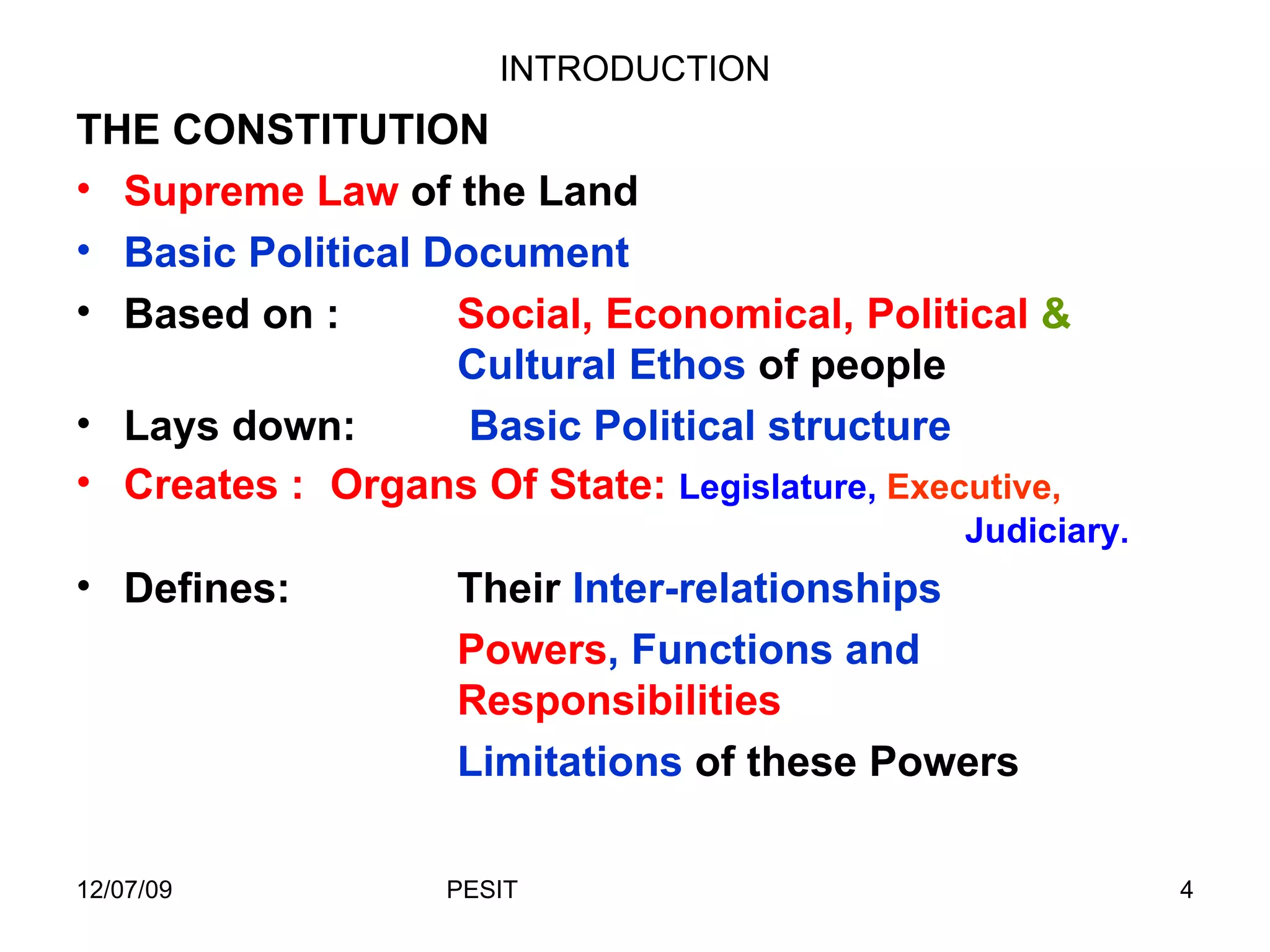
INTRODUCTION THE CONSTITUTION Supreme Law  of the Land Basic Political Document Based on : Social, Economical, Political  &  Cultural Ethos  of people Lays down:   Basic Political structure Creates :  Organs Of State:  Legislature,  Executive,   Judiciary . Defines: Their  Inter-relationships Powers , Functions and  Responsibilities Limitations  of these Powers
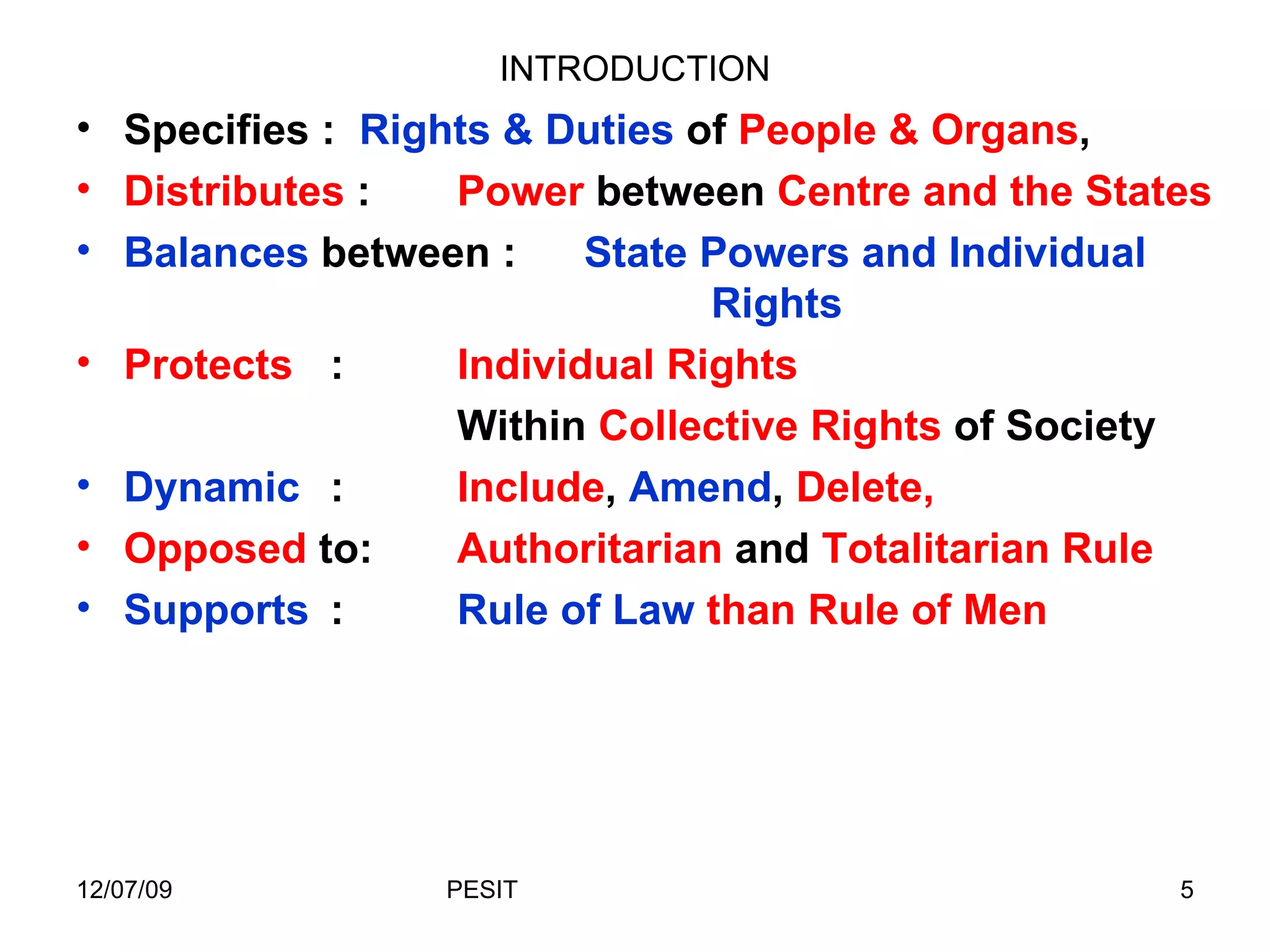
INTRODUCTION Specifies :  Rights & Duties  of  People & Organs , Distributes  : Power  between  Centre and the States Balances  between :  State Powers and Individual  Rights Protects : Individual Rights   Within  Collective Rights  of Society Dynamic : Include ,  Amend ,  Delete, Opposed  to: Authoritarian  and  Totalitarian Rule Supports  : Rule of Law   than Rule of Men
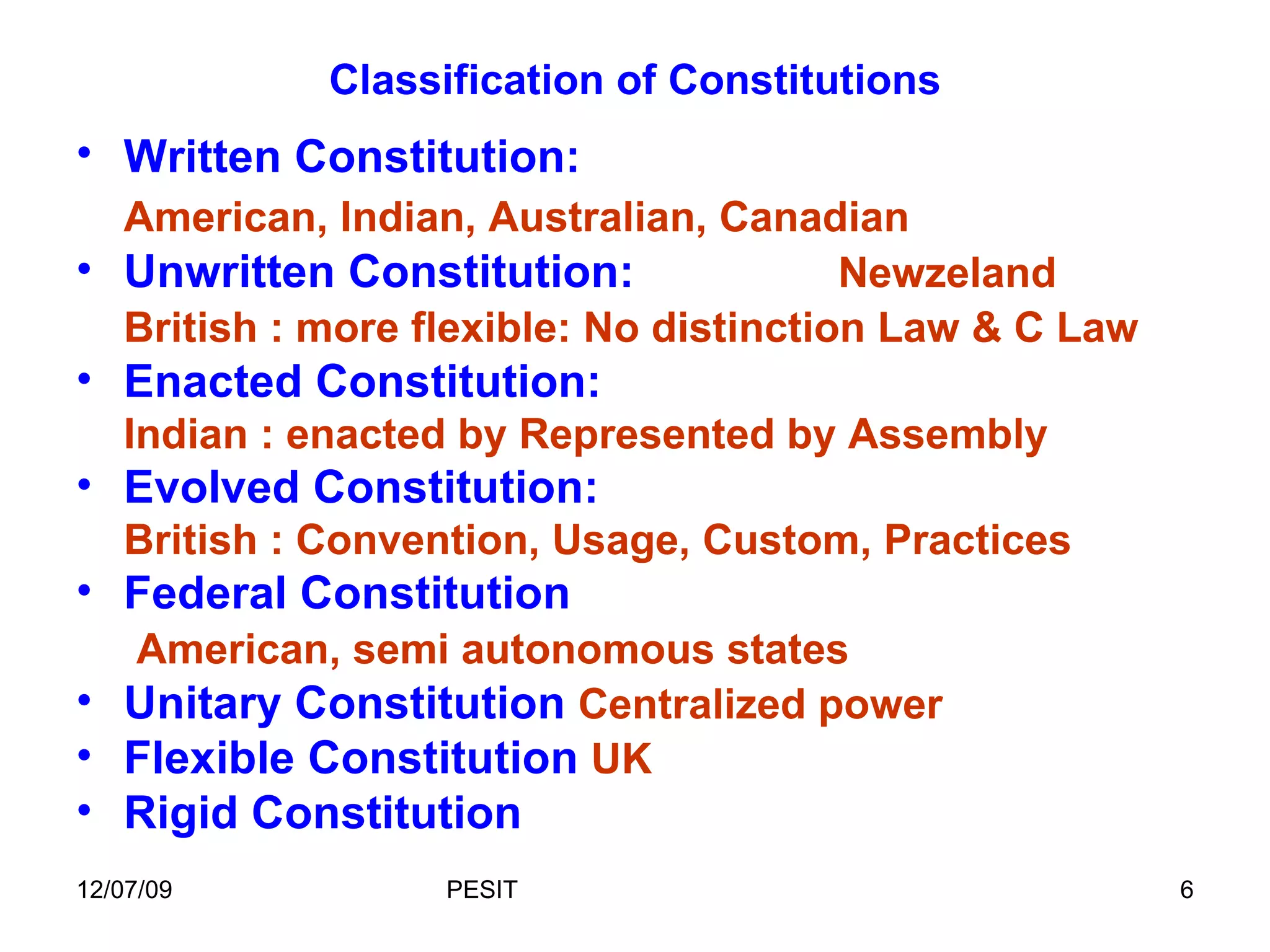
Classification of Constitutions Written Constitution:   American, Indian, Australian, Canadian Unwritten Constitution:  Newzeland British : more flexible: No distinction Law & C Law Enacted Constitution: Indian : enacted by Represented by Assembly Evolved Constitution: British : Convention, Usage, Custom, Practices Federal Constitution   American, semi autonomous states Unitary Constitution  Centralized power Flexible Constitution  UK Rigid Constitution
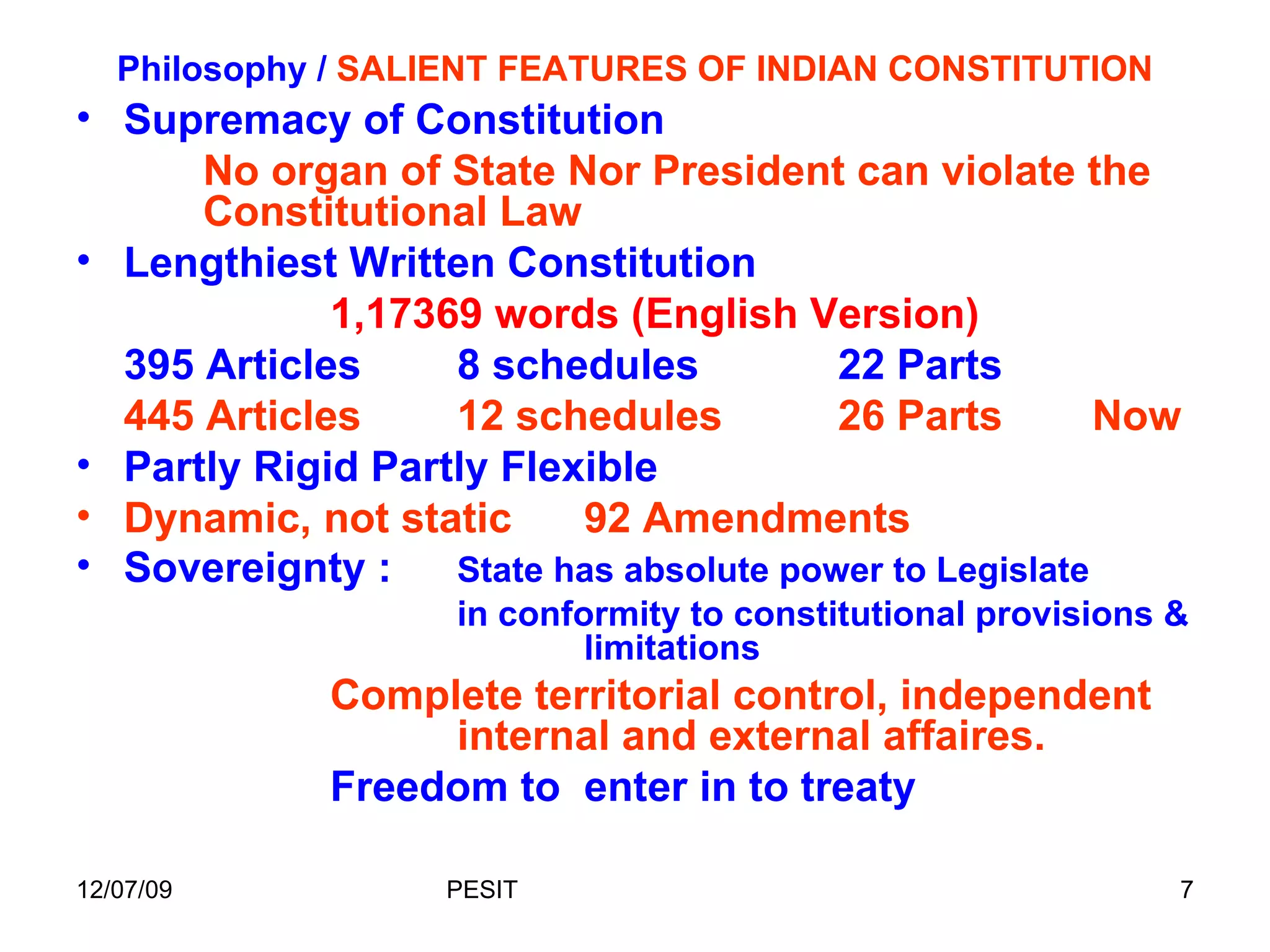
Philosophy /  SALIENT FEATURES OF INDIAN CONSTITUTION Supremacy of Constitution No organ of State Nor President can violate the  Constitutional Law Lengthiest Written Constitution 1,17369 words (English Version)  395 Articles 8 schedules 22 Parts 445 Articles 12 schedules 26 Parts Now Partly Rigid Partly Flexible Dynamic, not static 92 Amendments Sovereignty : State has absolute power to Legislate in conformity to constitutional provisions &  limitations Complete territorial control, independent  internal and external affaires. Freedom to  enter in to treaty
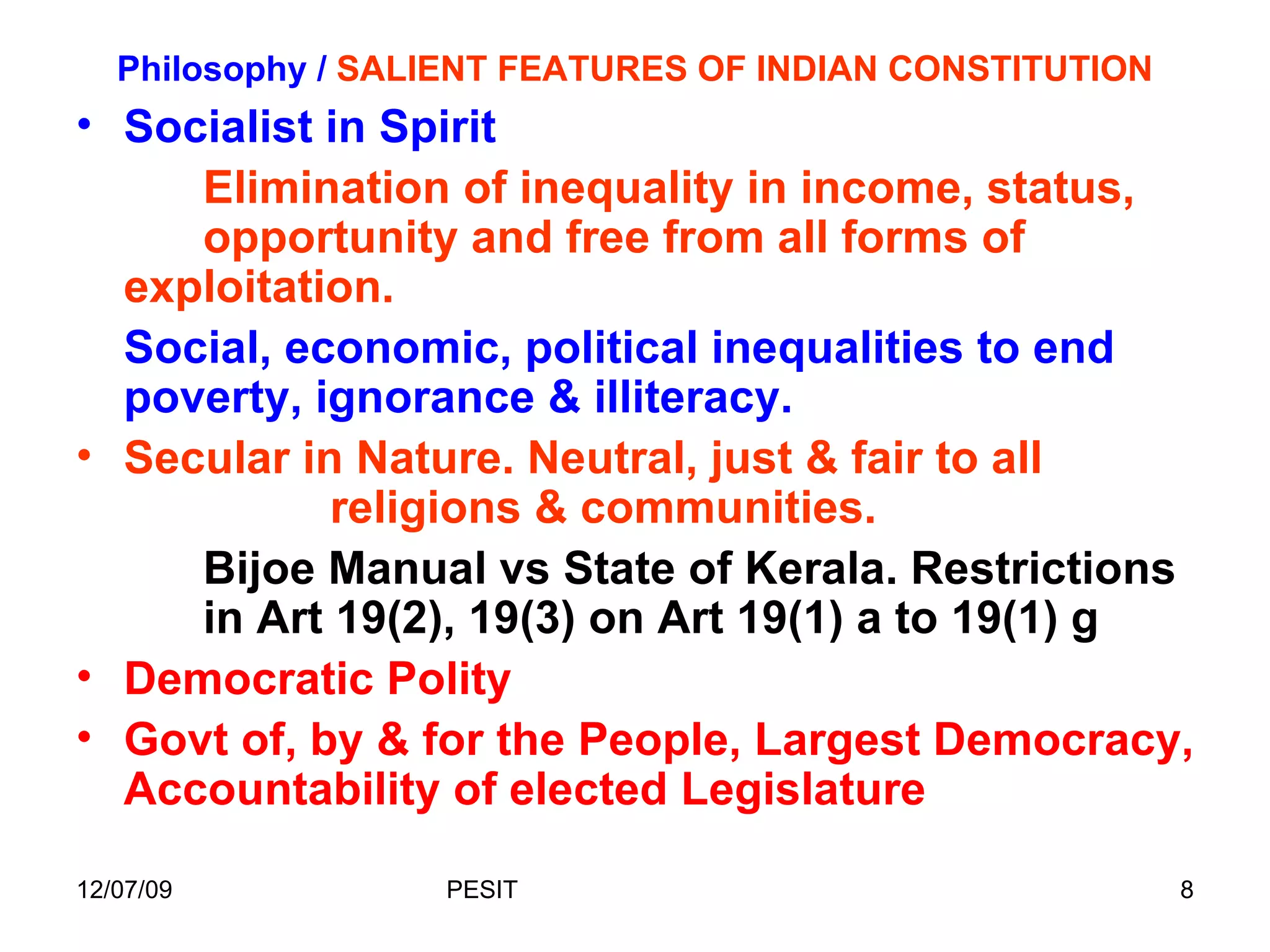
Philosophy /  SALIENT FEATURES OF INDIAN CONSTITUTION Socialist in Spirit Elimination of inequality in income, status,  opportunity and free from all forms of  exploitation. Social, economic, political inequalities to end poverty, ignorance & illiteracy.  Secular in Nature. Neutral, just & fair to all  religions & communities.  Bijoe Manual vs State of Kerala. Restrictions  in Art 19(2), 19(3) on Art 19(1) a to 19(1) g  Democratic Polity  Govt of, by & for the People, Largest Democracy, Accountability of elected Legislature
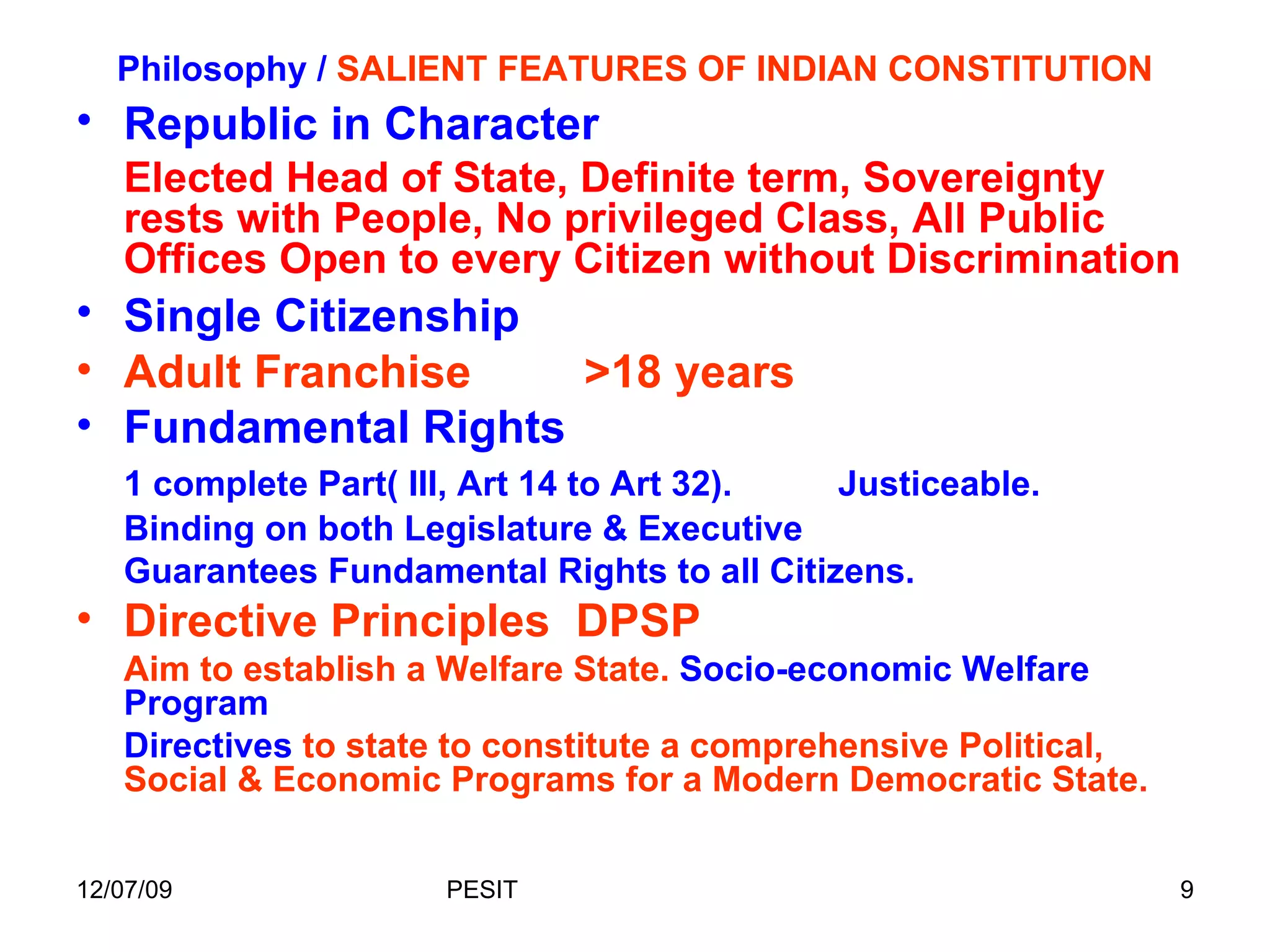
Philosophy /  SALIENT FEATURES OF INDIAN CONSTITUTION Republic in Character Elected Head of State, Definite term, Sovereignty rests with People, No privileged Class, All Public Offices Open to every Citizen without Discrimination Single Citizenship Adult Franchise  >18 years Fundamental Rights 1 complete Part( III, Art 14 to Art 32).  Justiceable.  Binding on both Legislature & Executive  Guarantees Fundamental Rights to all Citizens. Directive Principles  DPSP Aim to establish a Welfare State.  Socio-economic Welfare Program Directives  to state to constitute a comprehensive Political, Social & Economic Programs for a Modern Democratic State.
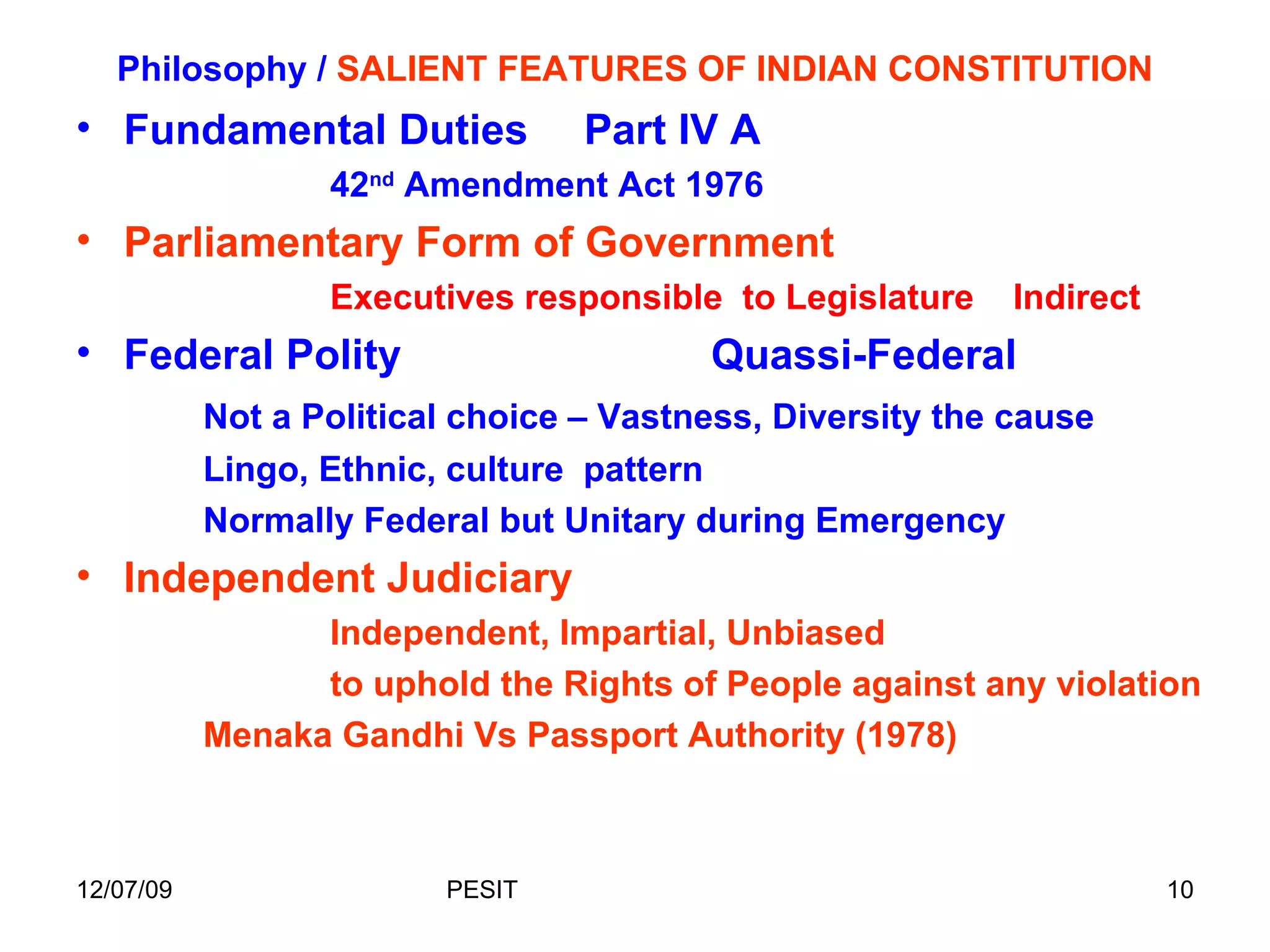
Philosophy /  SALIENT FEATURES OF INDIAN CONSTITUTION Fundamental Duties Part IV A 42 nd  Amendment Act 1976 Parliamentary Form of Government Executives responsible  to Legislature  Indirect  Federal Polity  Quassi-Federal Not a Political choice – Vastness, Diversity the cause  Lingo, Ethnic, culture  pattern Normally Federal but Unitary during Emergency Independent Judiciary Independent, Impartial, Unbiased to uphold the Rights of People against any violation  Menaka Gandhi Vs Passport Authority (1978)
Preamble WE, THE PEOPLE OF INDIA,   having solemnly resolved to constitute India into a   SOVEREIGN  SOCIALIST SECULAR  DEMOCRATIC REPUBLIC   and to secure to all its citizens:  JUSTICE,   social, economic and political;   LIBERTY  of thought, expression, belief, faith and worship;  EQUALITY  of status and of opportunity;  and to promote among them all  FRATERNITY  assuring the dignity of the individual and the  unity and integrity  of the Nation;  IN OUR CONSTITUENT ASSEMBLY   this twenty-sixth day of November, 1949,  do  HEREBY ADOPT, ENACT AND GIVE TO OURSELVES THIS CONSTITUTION . [1]
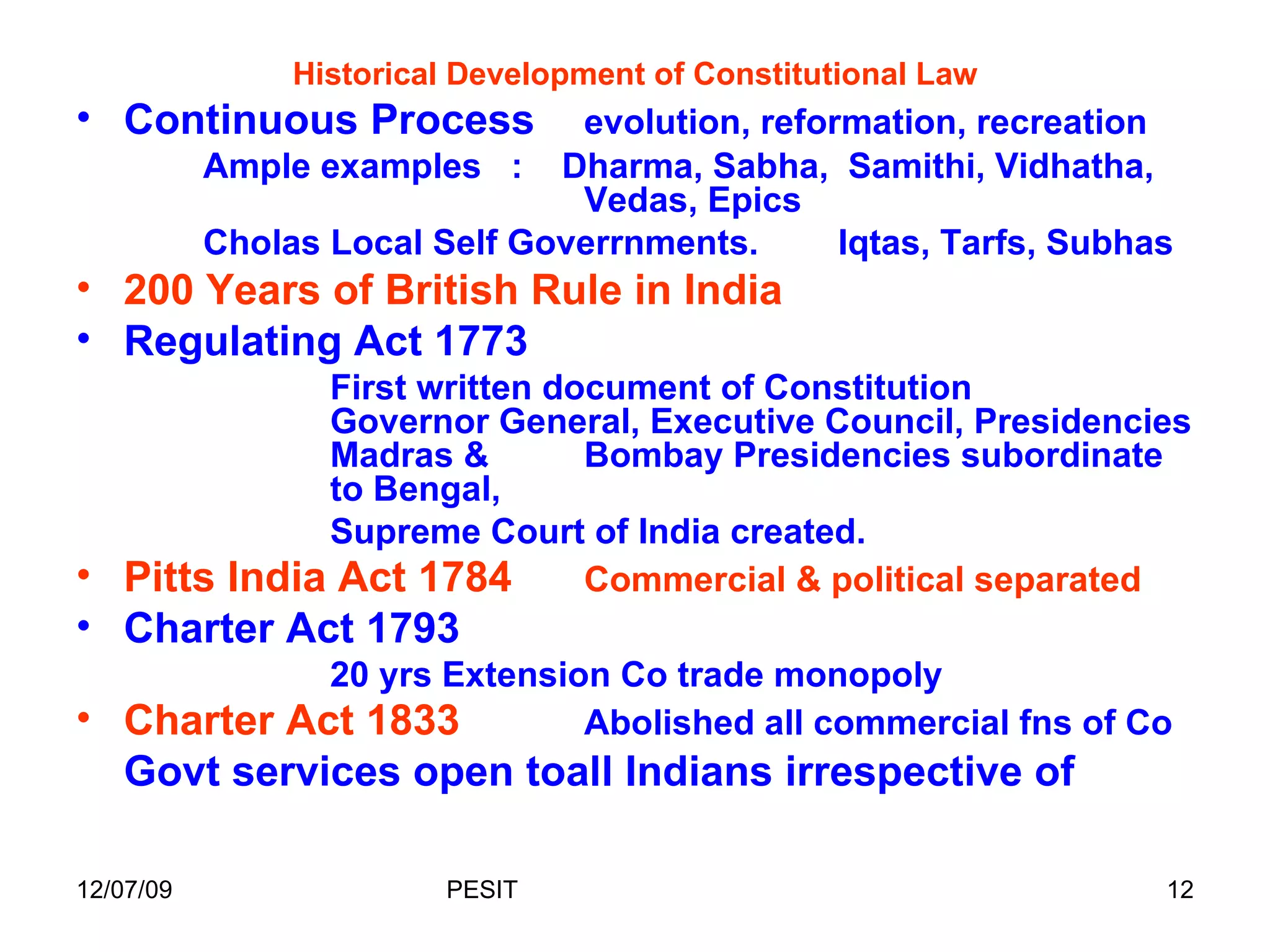
Historical Development of Constitutional Law Continuous Process evolution, reformation, recreation Ample examples  :  Dharma, Sabha,  Samithi, Vidhatha,  Vedas, Epics Cholas Local Self Goverrnments. Iqtas, Tarfs, Subhas 200 Years of British Rule in India Regulating Act 1773  First written document of Constitution  Governor General, Executive Council, Presidencies  Madras &  Bombay Presidencies subordinate  to Bengal,  Supreme Court of India created. Pitts India Act 1784 Commercial & political separated Charter Act 1793 20 yrs Extension Co trade monopoly Charter Act 1833   Abolished all commercial fns of Co Govt services open toall Indians irrespective of
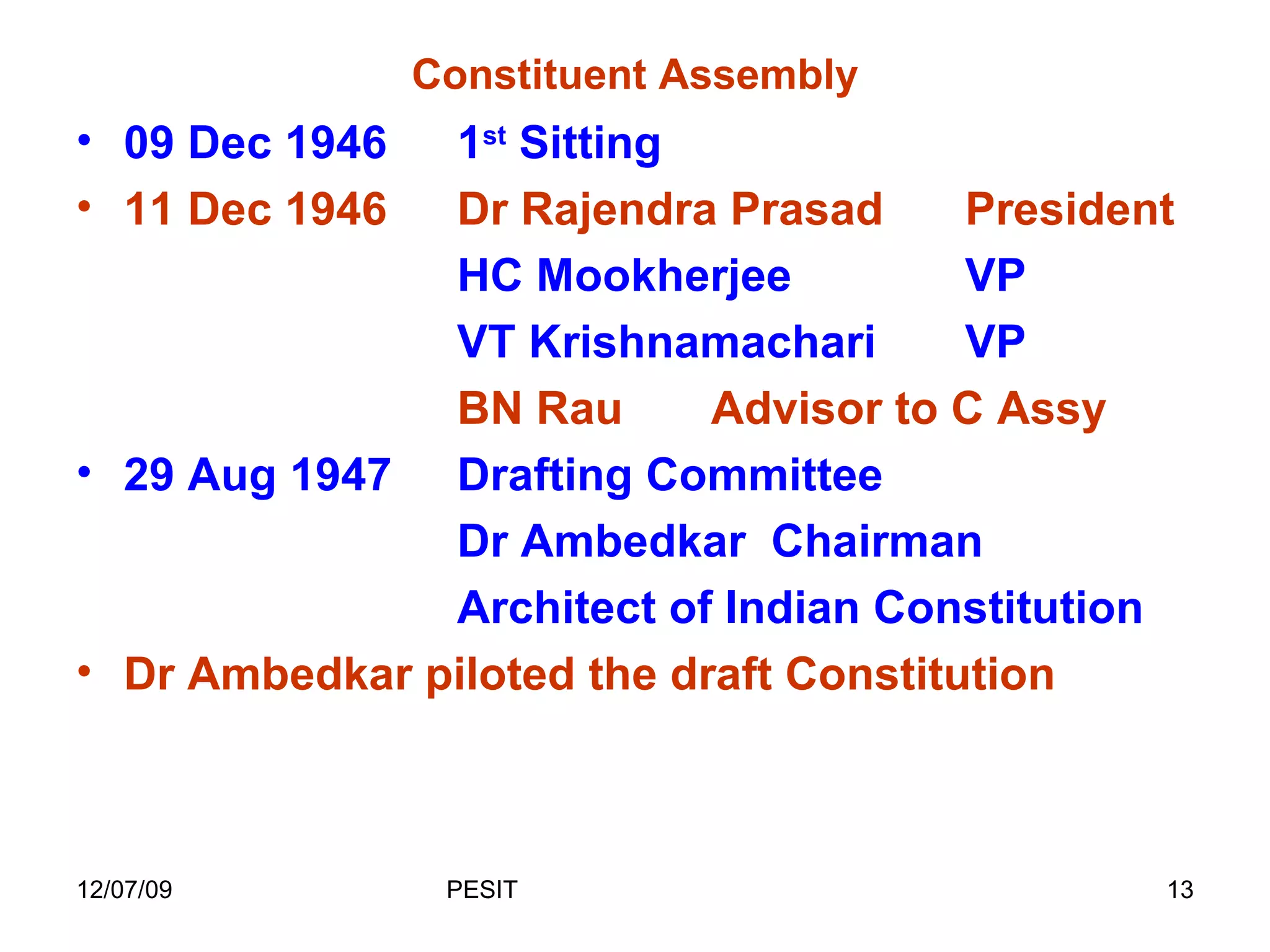
Constituent Assembly 09 Dec 1946 1 st  Sitting 11 Dec 1946 Dr Rajendra Prasad President HC Mookherjee VP VT Krishnamachari VP BN Rau  Advisor to C Assy 29 Aug 1947 Drafting Committee Dr Ambedkar  Chairman Architect of Indian Constitution Dr Ambedkar piloted the draft Constitution
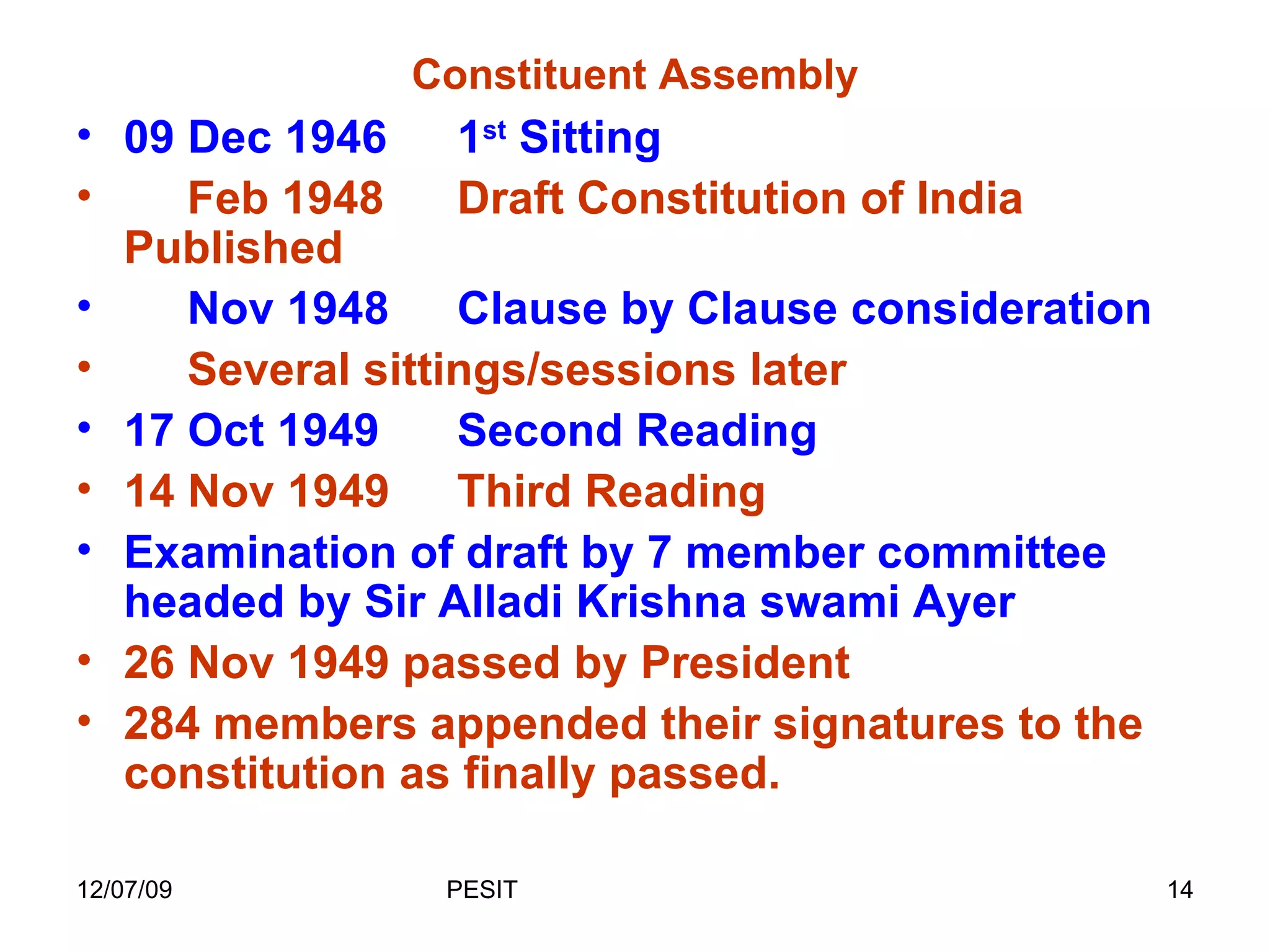
Constituent Assembly 09 Dec 1946 1 st  Sitting Feb 1948 Draft Constitution of India Published Nov 1948 Clause by Clause consideration Several sittings/sessions later 17 Oct 1949 Second Reading 14 Nov 1949 Third Reading Examination of draft by 7 member committee headed by Sir Alladi Krishna swami Ayer 26 Nov 1949 passed by President 284 members appended their signatures to the constitution as finally passed.
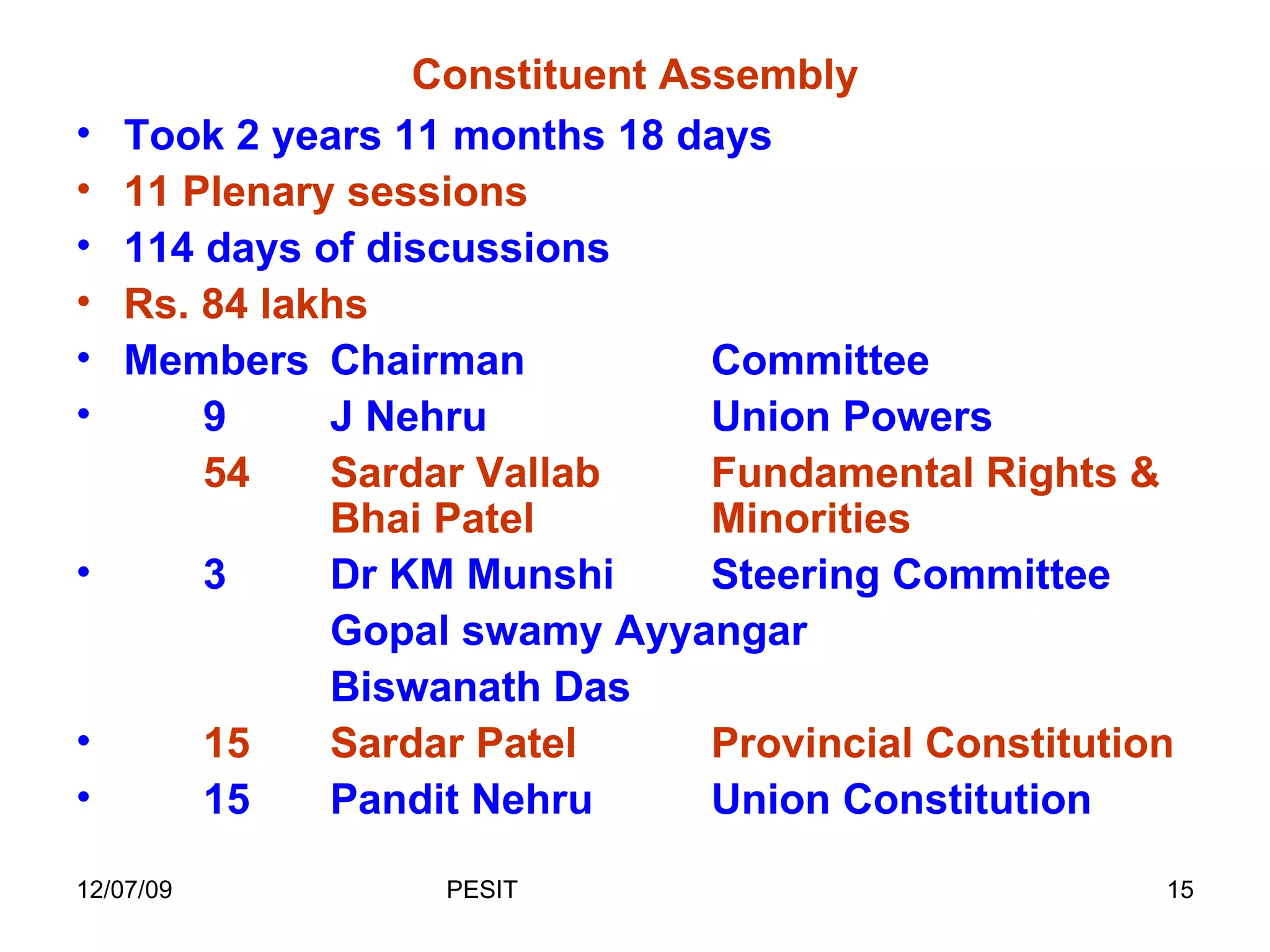
Constituent Assembly Took 2 years 11 months 18 days 11 Plenary sessions 114 days of discussions Rs. 84 lakhs Members Chairman Committee 9 J Nehru Union Powers 54 Sardar Vallab  Fundamental Rights &  Bhai Patel Minorities 3 Dr KM Munshi Steering Committee Gopal swamy Ayyangar Biswanath Das 15 Sardar Patel Provincial Constitution 15 Pandit Nehru Union Constitution

Class1a Constituent Assy

  • 1.
    THE CONSTITUTION OFINDIA and PROFESSIONAL ETHICS CIP 81 Constitution and Constituent Assembly C lass # 01 Week :Feb 04-09
  • 2.
    THE CONSTITUTION OFINDIA Dictionary Definition System of Laws & Customs Established by Sovereign power of a state For its own guidance. Latin: ‘Constituere’ to form, to establish to compose. Lord Boyce : A set of established Rules embodying and enacting the practice of Govt. Aristotle : The in which citizens who are a component Parts of the are arranged in relation to one another. Constitution is built on a foundation of Constitutional LAW.
  • 3.
    THE CONSTITUTION OFINDIA When Constitution? When there is a Great Social Revolution. A Nation becomes free from Foreign Rule. Independent nation born by joining smaller units. Why: to prevent Anarchy, chaos, disorders, lawlessness. To legal rights in a lawful Govt. Common Elements in All Constitution Form of States : Democratic, Totalitarian; Govt. and People interrelationship Powers and functions of Organs of state & their inter relationship. Written / unwritten;
  • 4.
    INTRODUCTION THE CONSTITUTIONSupreme Law of the Land Basic Political Document Based on : Social, Economical, Political & Cultural Ethos of people Lays down: Basic Political structure Creates : Organs Of State: Legislature, Executive, Judiciary . Defines: Their Inter-relationships Powers , Functions and Responsibilities Limitations of these Powers
  • 5.
    INTRODUCTION Specifies : Rights & Duties of People & Organs , Distributes : Power between Centre and the States Balances between : State Powers and Individual Rights Protects : Individual Rights Within Collective Rights of Society Dynamic : Include , Amend , Delete, Opposed to: Authoritarian and Totalitarian Rule Supports : Rule of Law than Rule of Men
  • 6.
    Classification of ConstitutionsWritten Constitution: American, Indian, Australian, Canadian Unwritten Constitution: Newzeland British : more flexible: No distinction Law & C Law Enacted Constitution: Indian : enacted by Represented by Assembly Evolved Constitution: British : Convention, Usage, Custom, Practices Federal Constitution American, semi autonomous states Unitary Constitution Centralized power Flexible Constitution UK Rigid Constitution
  • 7.
    Philosophy / SALIENT FEATURES OF INDIAN CONSTITUTION Supremacy of Constitution No organ of State Nor President can violate the Constitutional Law Lengthiest Written Constitution 1,17369 words (English Version) 395 Articles 8 schedules 22 Parts 445 Articles 12 schedules 26 Parts Now Partly Rigid Partly Flexible Dynamic, not static 92 Amendments Sovereignty : State has absolute power to Legislate in conformity to constitutional provisions & limitations Complete territorial control, independent internal and external affaires. Freedom to enter in to treaty
  • 8.
    Philosophy / SALIENT FEATURES OF INDIAN CONSTITUTION Socialist in Spirit Elimination of inequality in income, status, opportunity and free from all forms of exploitation. Social, economic, political inequalities to end poverty, ignorance & illiteracy. Secular in Nature. Neutral, just & fair to all religions & communities. Bijoe Manual vs State of Kerala. Restrictions in Art 19(2), 19(3) on Art 19(1) a to 19(1) g Democratic Polity Govt of, by & for the People, Largest Democracy, Accountability of elected Legislature
  • 9.
    Philosophy / SALIENT FEATURES OF INDIAN CONSTITUTION Republic in Character Elected Head of State, Definite term, Sovereignty rests with People, No privileged Class, All Public Offices Open to every Citizen without Discrimination Single Citizenship Adult Franchise >18 years Fundamental Rights 1 complete Part( III, Art 14 to Art 32). Justiceable. Binding on both Legislature & Executive Guarantees Fundamental Rights to all Citizens. Directive Principles DPSP Aim to establish a Welfare State. Socio-economic Welfare Program Directives to state to constitute a comprehensive Political, Social & Economic Programs for a Modern Democratic State.
  • 10.
    Philosophy / SALIENT FEATURES OF INDIAN CONSTITUTION Fundamental Duties Part IV A 42 nd Amendment Act 1976 Parliamentary Form of Government Executives responsible to Legislature Indirect Federal Polity Quassi-Federal Not a Political choice – Vastness, Diversity the cause Lingo, Ethnic, culture pattern Normally Federal but Unitary during Emergency Independent Judiciary Independent, Impartial, Unbiased to uphold the Rights of People against any violation Menaka Gandhi Vs Passport Authority (1978)
  • 11.
    Preamble WE, THEPEOPLE OF INDIA, having solemnly resolved to constitute India into a SOVEREIGN SOCIALIST SECULAR DEMOCRATIC REPUBLIC and to secure to all its citizens: JUSTICE, social, economic and political; LIBERTY of thought, expression, belief, faith and worship; EQUALITY of status and of opportunity; and to promote among them all FRATERNITY assuring the dignity of the individual and the unity and integrity of the Nation; IN OUR CONSTITUENT ASSEMBLY this twenty-sixth day of November, 1949, do HEREBY ADOPT, ENACT AND GIVE TO OURSELVES THIS CONSTITUTION . [1]
  • 12.
    Historical Development ofConstitutional Law Continuous Process evolution, reformation, recreation Ample examples : Dharma, Sabha, Samithi, Vidhatha, Vedas, Epics Cholas Local Self Goverrnments. Iqtas, Tarfs, Subhas 200 Years of British Rule in India Regulating Act 1773 First written document of Constitution Governor General, Executive Council, Presidencies Madras & Bombay Presidencies subordinate to Bengal, Supreme Court of India created. Pitts India Act 1784 Commercial & political separated Charter Act 1793 20 yrs Extension Co trade monopoly Charter Act 1833 Abolished all commercial fns of Co Govt services open toall Indians irrespective of
  • 13.
    Constituent Assembly 09Dec 1946 1 st Sitting 11 Dec 1946 Dr Rajendra Prasad President HC Mookherjee VP VT Krishnamachari VP BN Rau Advisor to C Assy 29 Aug 1947 Drafting Committee Dr Ambedkar Chairman Architect of Indian Constitution Dr Ambedkar piloted the draft Constitution
  • 14.
    Constituent Assembly 09Dec 1946 1 st Sitting Feb 1948 Draft Constitution of India Published Nov 1948 Clause by Clause consideration Several sittings/sessions later 17 Oct 1949 Second Reading 14 Nov 1949 Third Reading Examination of draft by 7 member committee headed by Sir Alladi Krishna swami Ayer 26 Nov 1949 passed by President 284 members appended their signatures to the constitution as finally passed.
  • 15.
    Constituent Assembly Took2 years 11 months 18 days 11 Plenary sessions 114 days of discussions Rs. 84 lakhs Members Chairman Committee 9 J Nehru Union Powers 54 Sardar Vallab Fundamental Rights & Bhai Patel Minorities 3 Dr KM Munshi Steering Committee Gopal swamy Ayyangar Biswanath Das 15 Sardar Patel Provincial Constitution 15 Pandit Nehru Union Constitution