Arteries Veins
It carries oxygenated blood
from heart to body parts
It carries deoxygenated
blood from heart to body
parts
Valves are absent Valves are present
Walls thick and elastic and
muscular
Thin, non muscular and less
elastic
Blood flows in greater
pressure
Blood flows in less pressure
Exceptional:
Pulmonary artery carry
deoxygenated blood
from heart to body parts
Pulmonary veins carry
oxygenated blood from
body parts to heart
2.Difference between Xylem and Pholem
Transport water and
minerals from the roots
to upper parts of the
plants
Transports products of
photosynthesis from
leaves to ariel parts of a
plant
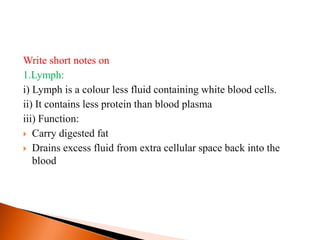
Write short notes on
1.Lymph:
i) Lymph is a colour less fluid containing white blood cells.
ii) It contains less protein than blood plasma
iii) Function:
 Carry digested fat
 Drains excess fluid from extra cellular space back into the
blood
write short note o villiVilli
 It is present in the walls of the small intestine
 It has large surface area for the absorption of digested food
 It is richly supplied with blood vessels and also absorbs water.
write the.Role s of HCL & MUCUS
HCL
 To kill microbes in the food makes the medium acidic
 It activates the enzyme pepsin
MUCUS
 Mucus protect the inner lining of the stomach from the action
of acid
4.Difference between Aerobic respiration and Anaerobic
respiration
Aerobic respiration Anaerobic respiration
Oxygen is utilized for the
break down of respiratory
substrate
Oxygen is not required
It takes place in cytoplasm
and mitochondria
It takes place in cytoplasm
only
End products are Co2 and
H2o
End products are lactic acid
(or) ethanol and co2
More energy is released Less energy is released
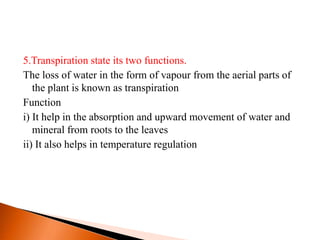
5.Transpiration state its two functions.
The loss of water in the form of vapour from the aerial parts of
the plant is known as transpiration
Function
i) It help in the absorption and upward movement of water and
mineral from roots to the leaves
ii) It also helps in temperature regulation
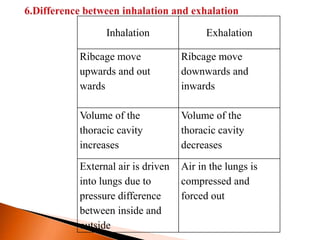
Inhalation Exhalation
Ribcage move
upwards and out
wards
Ribcage move
downwards and
inwards
Volume of the
thoracic cavity
increases
Volume of the
thoracic cavity
decreases
External air is driven
into lungs due to
pressure difference
between inside and
outside
Air in the lungs is
compressed and
forced out
7.i) Name the extensively coiled structure of alimentary canal.
ii) Compare length of the small intestine in herbivores and
carnivores.
Ans:
i) Small intestine
ii) Herbivores have longer, small intestine for digestion of
cellulose while carnivores have a shorter small intestine for
early digestion of meat.
8.Name the following
i) Where food is completely digested?
ii) Juice that contains trypsin enzyme.
iii) Who secretes bile juice?
iv) That absorbs water from unabsorbed food.
v) Two secretions released by gastric glands.
Ans:
i) Small intestine
ii) Pancreatic juice
iii) Liver
iv) Large intestine
v) HCL and Enzymes – pepsin,mucus.
9.Name the enzyme present in pancreatic juice and give their
functions.
Ans:
i) Trypsin + Proteins Amino acids
ii) Amylase + Carbohydrates Simple sugars
iii) Lipase + Fats Fatty acids + Glycerol
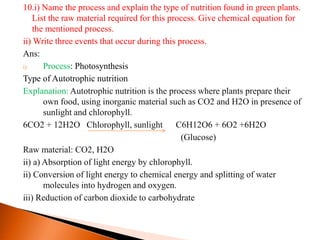
10.i) Name the process and explain the type of nutrition found in green plants.
List the raw material required for this process. Give chemical equation for
the mentioned process.
ii) Write three events that occur during this process.
Ans:
i) Process: Photosynthesis
Type of Autotrophic nutrition
Explanation: Autotrophic nutrition is the process where plants prepare their
own food, using inorganic material such as CO2 and H2O in presence of
sunlight and chlorophyll.
6CO2 + 12H2O Chlorophyll, sunlight C6H12O6 + 6O2 +6H2O
(Glucose)
Raw material: CO2, H2O
ii) a) Absorption of light energy by chlorophyll.
ii) Conversion of light energy to chemical energy and splitting of water
molecules into hydrogen and oxygen.
iii) Reduction of carbon dioxide to carbohydrate
11.List three characteristic of lungs which make it an efficient
respiratory surface.
i) It has large surface area and are branched.
ii) Contain an extensive network of blood vessels.
iii) It is thin, delicate and fine.
12.Explain:
i) Blood goes only once through the heart in fishes.
ii) Plants have low energy needs.
iii) What are capillaries?
Ans:
i) Because fish has two chambered heart. The blood is
pumped to the gills for oxygenation from where it is passed
directly to the rest of the body and de – oxygenated blood
returns to the heart to be pumped into gills again.
ii) Because plant bodies have a large proportion of dead cells.
iii) Capillaries are smallest vessels which have one cell thick
wall. The exchange of material between the blood and the
surrounding take place through capillaries.

Class x biology life processes

  • 2.
    Arteries Veins It carriesoxygenated blood from heart to body parts It carries deoxygenated blood from heart to body parts Valves are absent Valves are present Walls thick and elastic and muscular Thin, non muscular and less elastic Blood flows in greater pressure Blood flows in less pressure
  • 3.
    Exceptional: Pulmonary artery carry deoxygenatedblood from heart to body parts Pulmonary veins carry oxygenated blood from body parts to heart
  • 4.
    2.Difference between Xylemand Pholem Transport water and minerals from the roots to upper parts of the plants Transports products of photosynthesis from leaves to ariel parts of a plant
  • 5.
    Write short noteson 1.Lymph: i) Lymph is a colour less fluid containing white blood cells. ii) It contains less protein than blood plasma iii) Function:  Carry digested fat  Drains excess fluid from extra cellular space back into the blood
  • 6.
    write short noteo villiVilli  It is present in the walls of the small intestine  It has large surface area for the absorption of digested food  It is richly supplied with blood vessels and also absorbs water. write the.Role s of HCL & MUCUS HCL  To kill microbes in the food makes the medium acidic  It activates the enzyme pepsin MUCUS  Mucus protect the inner lining of the stomach from the action of acid
  • 7.
    4.Difference between Aerobicrespiration and Anaerobic respiration Aerobic respiration Anaerobic respiration Oxygen is utilized for the break down of respiratory substrate Oxygen is not required It takes place in cytoplasm and mitochondria It takes place in cytoplasm only End products are Co2 and H2o End products are lactic acid (or) ethanol and co2 More energy is released Less energy is released
  • 8.
    5.Transpiration state itstwo functions. The loss of water in the form of vapour from the aerial parts of the plant is known as transpiration Function i) It help in the absorption and upward movement of water and mineral from roots to the leaves ii) It also helps in temperature regulation
  • 9.
    Inhalation Exhalation Ribcage move upwardsand out wards Ribcage move downwards and inwards Volume of the thoracic cavity increases Volume of the thoracic cavity decreases External air is driven into lungs due to pressure difference between inside and outside Air in the lungs is compressed and forced out
  • 10.
    7.i) Name theextensively coiled structure of alimentary canal. ii) Compare length of the small intestine in herbivores and carnivores. Ans: i) Small intestine ii) Herbivores have longer, small intestine for digestion of cellulose while carnivores have a shorter small intestine for early digestion of meat.
  • 11.
    8.Name the following i)Where food is completely digested? ii) Juice that contains trypsin enzyme. iii) Who secretes bile juice? iv) That absorbs water from unabsorbed food. v) Two secretions released by gastric glands. Ans: i) Small intestine ii) Pancreatic juice iii) Liver iv) Large intestine v) HCL and Enzymes – pepsin,mucus.
  • 12.
    9.Name the enzymepresent in pancreatic juice and give their functions. Ans: i) Trypsin + Proteins Amino acids ii) Amylase + Carbohydrates Simple sugars iii) Lipase + Fats Fatty acids + Glycerol
  • 13.
    10.i) Name theprocess and explain the type of nutrition found in green plants. List the raw material required for this process. Give chemical equation for the mentioned process. ii) Write three events that occur during this process. Ans: i) Process: Photosynthesis Type of Autotrophic nutrition Explanation: Autotrophic nutrition is the process where plants prepare their own food, using inorganic material such as CO2 and H2O in presence of sunlight and chlorophyll. 6CO2 + 12H2O Chlorophyll, sunlight C6H12O6 + 6O2 +6H2O (Glucose) Raw material: CO2, H2O ii) a) Absorption of light energy by chlorophyll. ii) Conversion of light energy to chemical energy and splitting of water molecules into hydrogen and oxygen. iii) Reduction of carbon dioxide to carbohydrate
  • 14.
    11.List three characteristicof lungs which make it an efficient respiratory surface. i) It has large surface area and are branched. ii) Contain an extensive network of blood vessels. iii) It is thin, delicate and fine.
  • 15.
    12.Explain: i) Blood goesonly once through the heart in fishes. ii) Plants have low energy needs. iii) What are capillaries? Ans: i) Because fish has two chambered heart. The blood is pumped to the gills for oxygenation from where it is passed directly to the rest of the body and de – oxygenated blood returns to the heart to be pumped into gills again. ii) Because plant bodies have a large proportion of dead cells. iii) Capillaries are smallest vessels which have one cell thick wall. The exchange of material between the blood and the surrounding take place through capillaries.