Class Notes - Critical Thinking and The Nature of Knowledge
This document discusses the nature of philosophy and critical thinking. It begins by defining philosophy as the love of wisdom and lists some common philosophical questions. It then outlines the main branches of philosophy: metaphysics, epistemology, logic, and axiology. For each branch, it provides examples of the types of questions examined. The document also discusses the five pillars of critical thinking: logic, argument, rhetoric, background knowledge, and attitudes/values. It defines key terms like claims, truth, knowledge, and belief. Overall, the document provides a high-level overview of philosophy and critical thinking concepts.
Philosophy
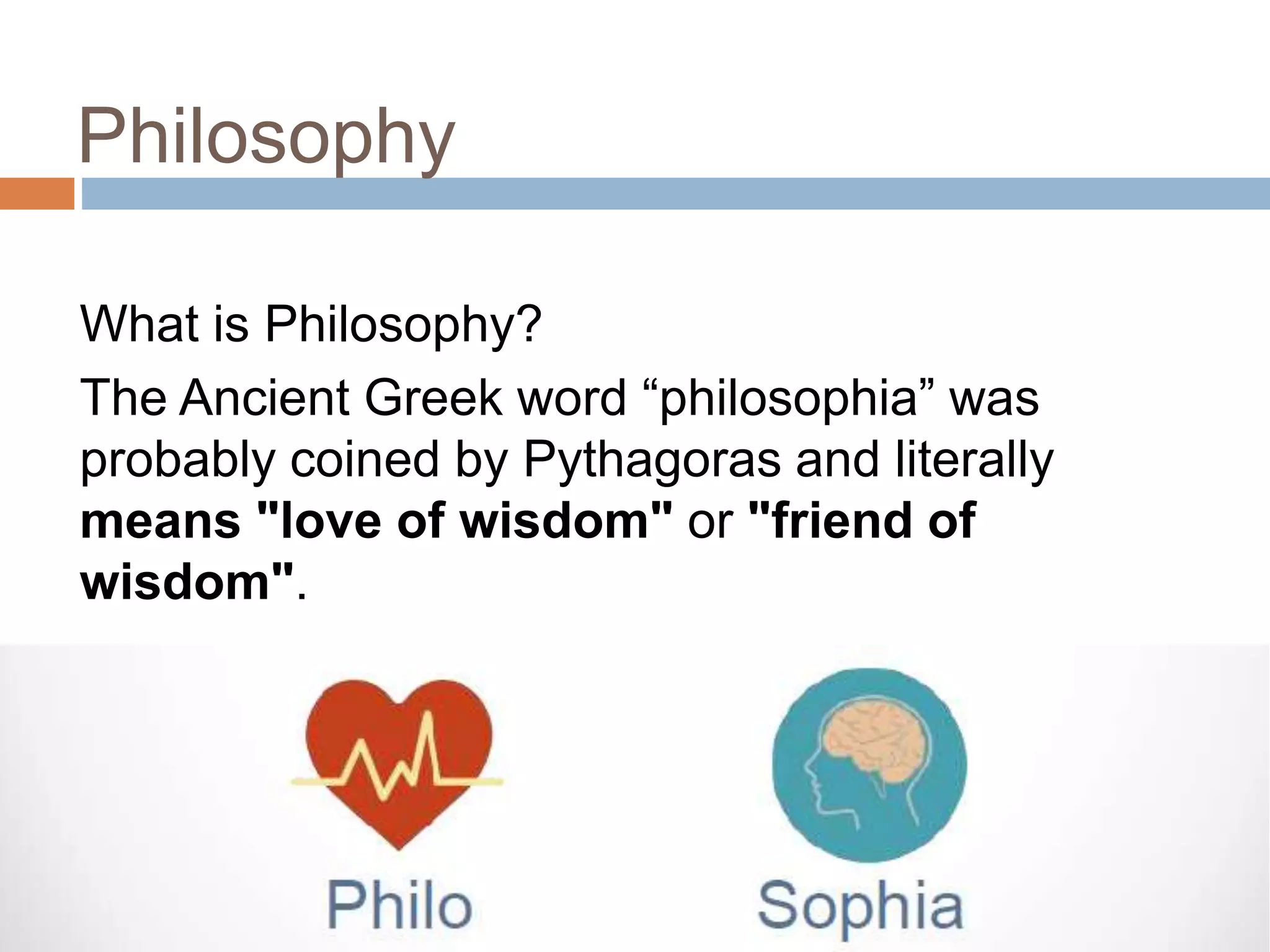
What is Philosophy?
TheAncient Greek word “philosophia” was
probably coined by Pythagoras and literally
means "love of wisdom" or "friend of
wisdom".
2
3.
Philosophy
What isgood?
What is evil?
What is beauty?
Do we have free will?
Does the world around us exist?
What is a person?
What is truth?
3
Some Philosophical questions
4.
Philosophy
4
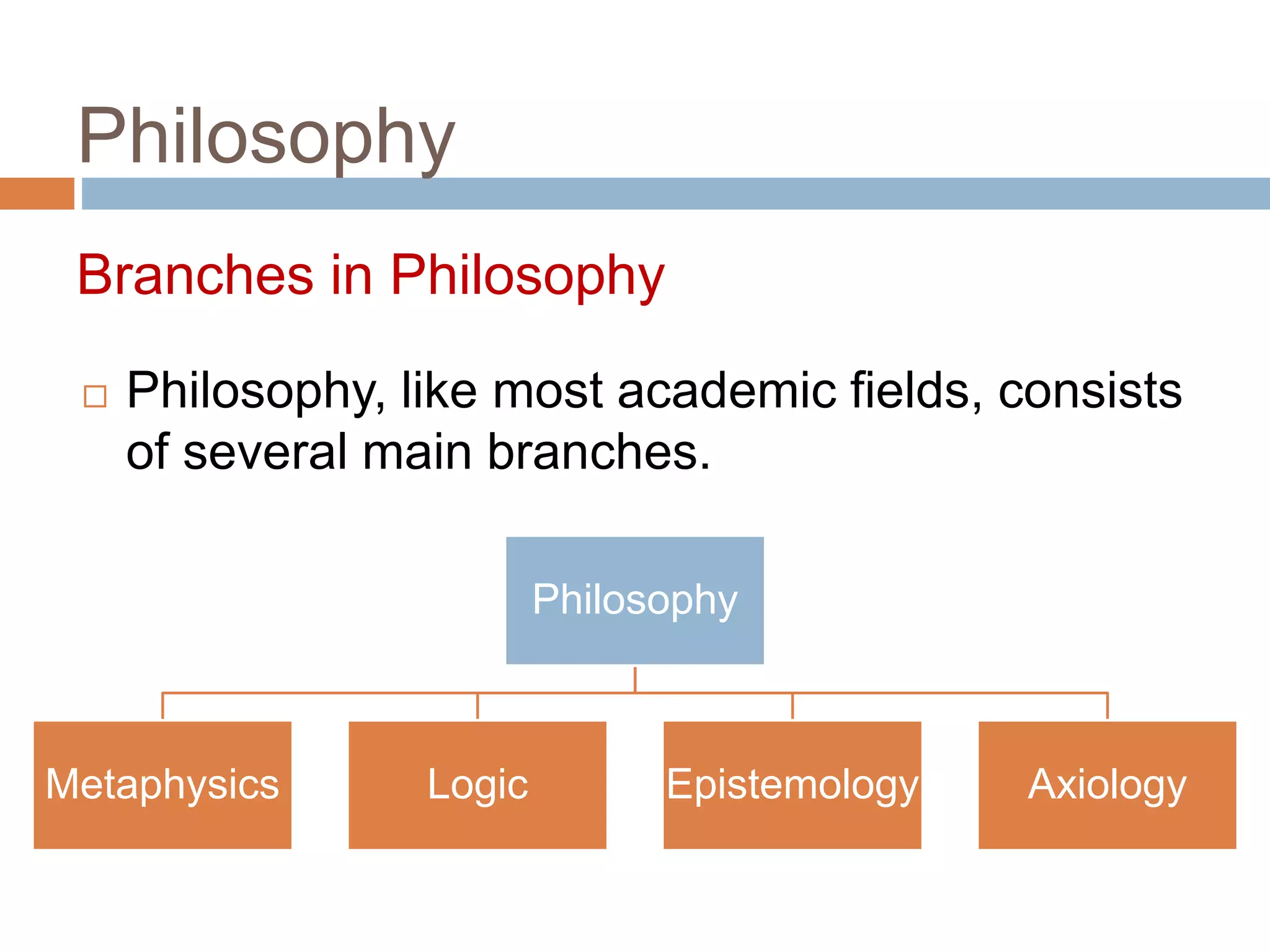
Branches in Philosophy
Philosophy, like most academic fields, consists
of several main branches.
Philosophy
Metaphysics Logic Epistemology Axiology
5.
5
Branches in Philosophy
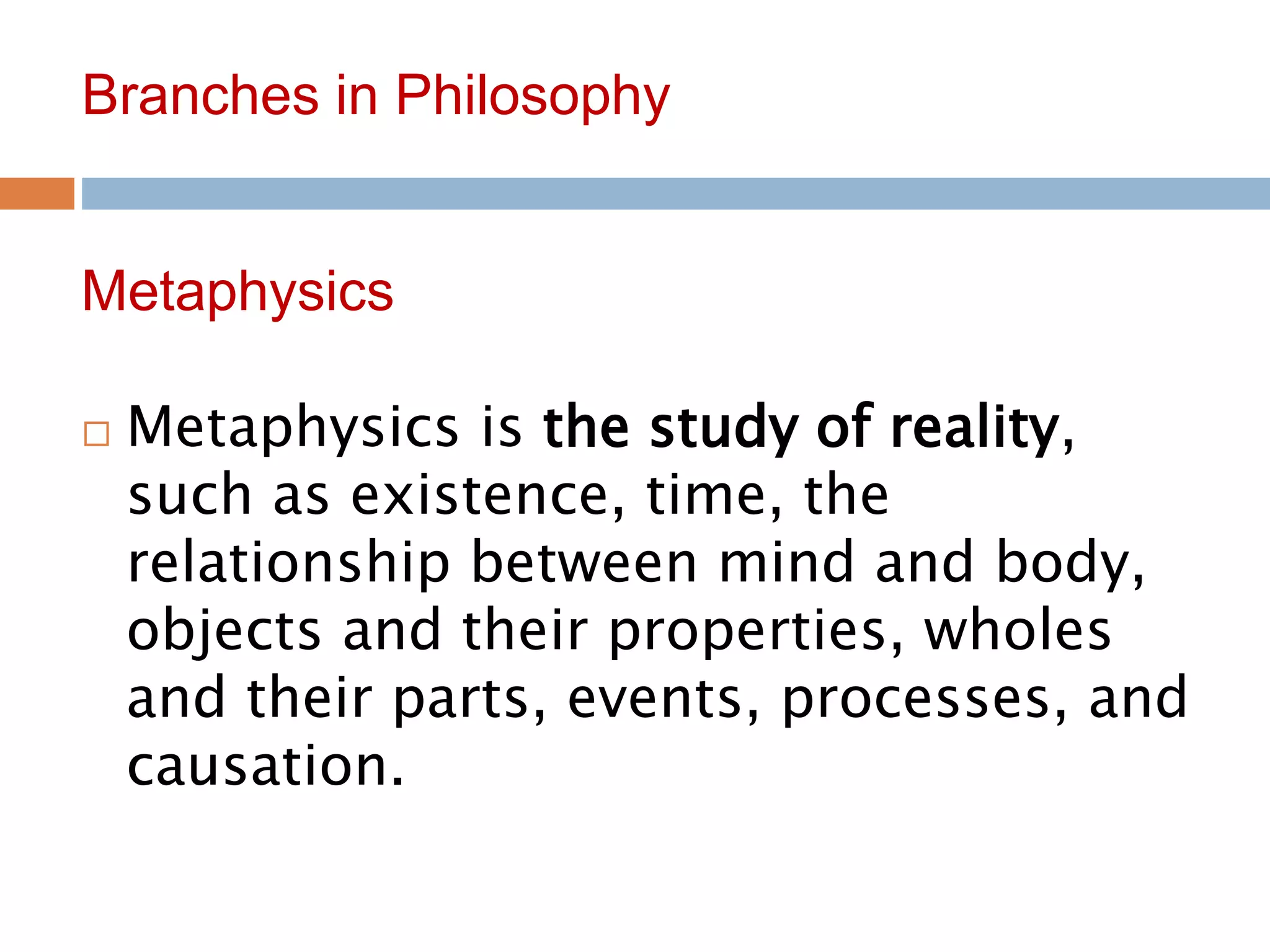
Metaphysics is the study of reality,
such as existence, time, the
relationship between mind and body,
objects and their properties, wholes
and their parts, events, processes, and
causation.
Metaphysics
6.
6
Branches in Philosophy
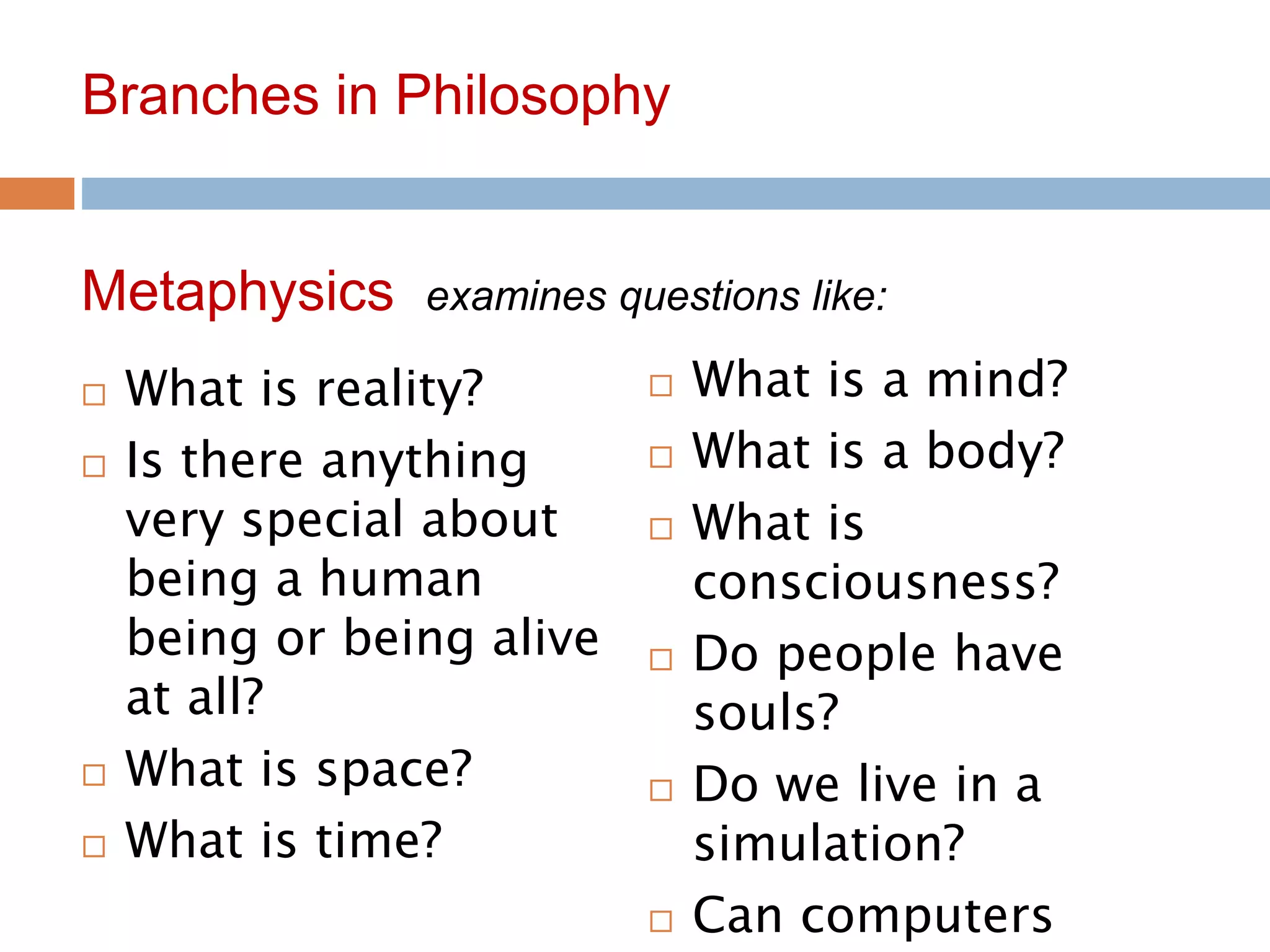
What is reality?
Is there anything
very special about
being a human
being or being alive
at all?
What is space?
What is time?
Metaphysics examines questions like:
What is a mind?
What is a body?
What is
consciousness?
Do people have
souls?
Do we live in a
simulation?
Can computers
7.
7
Branches in Philosophy
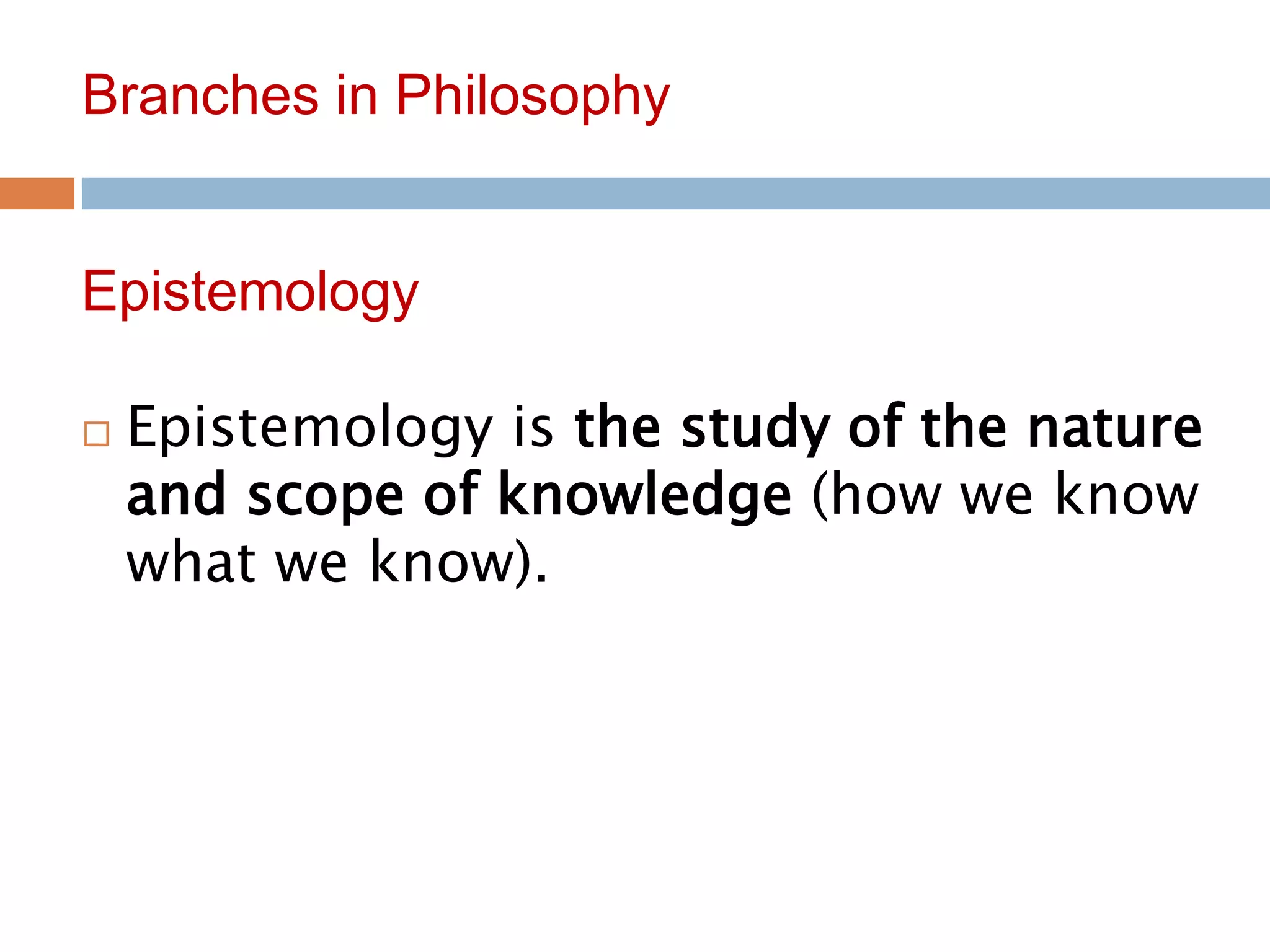
Epistemology is the study of the nature
and scope of knowledge (how we know
what we know).
Epistemology
8.
8
Branches in Philosophy
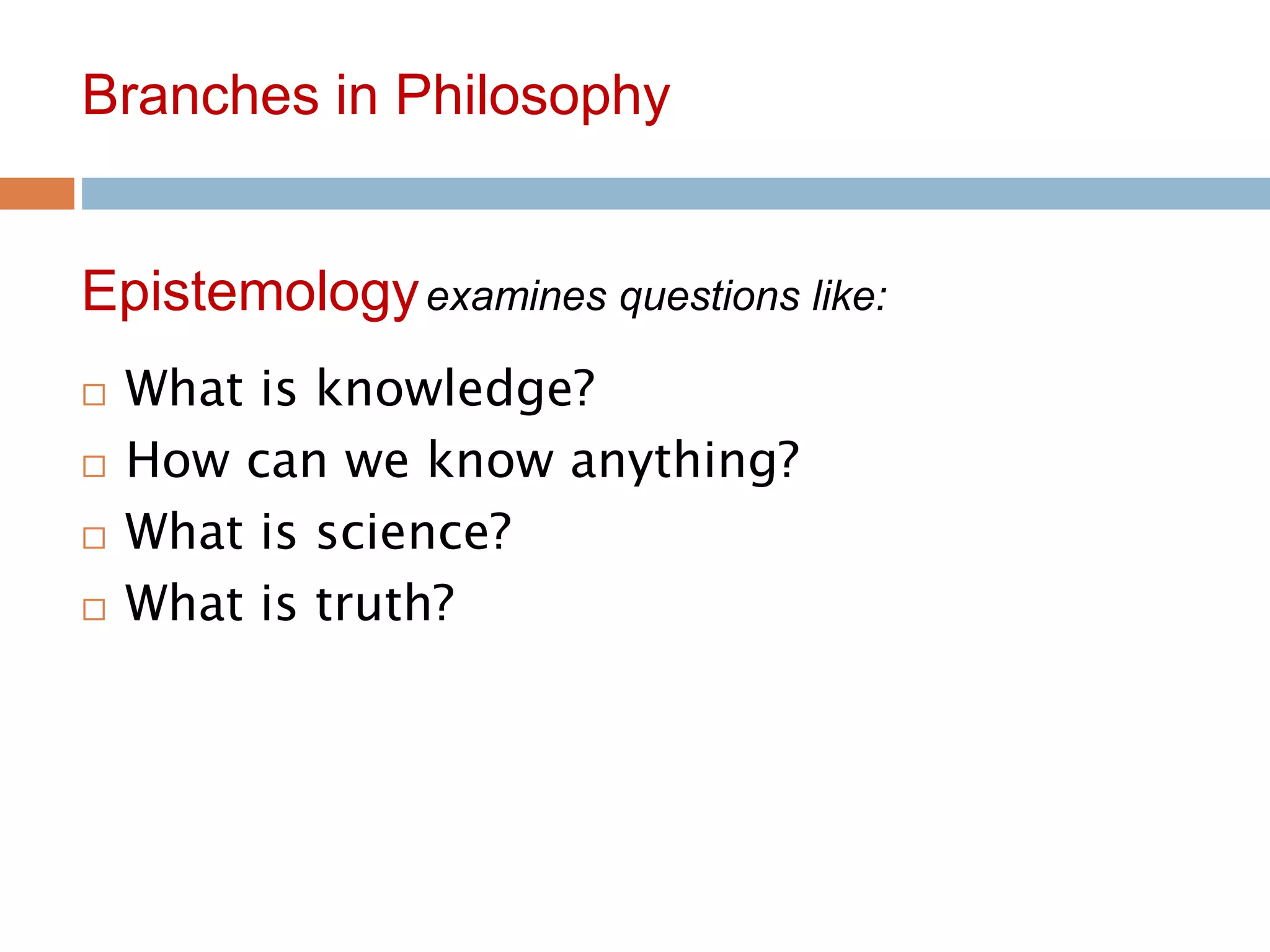
What is knowledge?
How can we know anything?
What is science?
What is truth?
Epistemologyexamines questions like:
9.
9
Branches in Philosophy
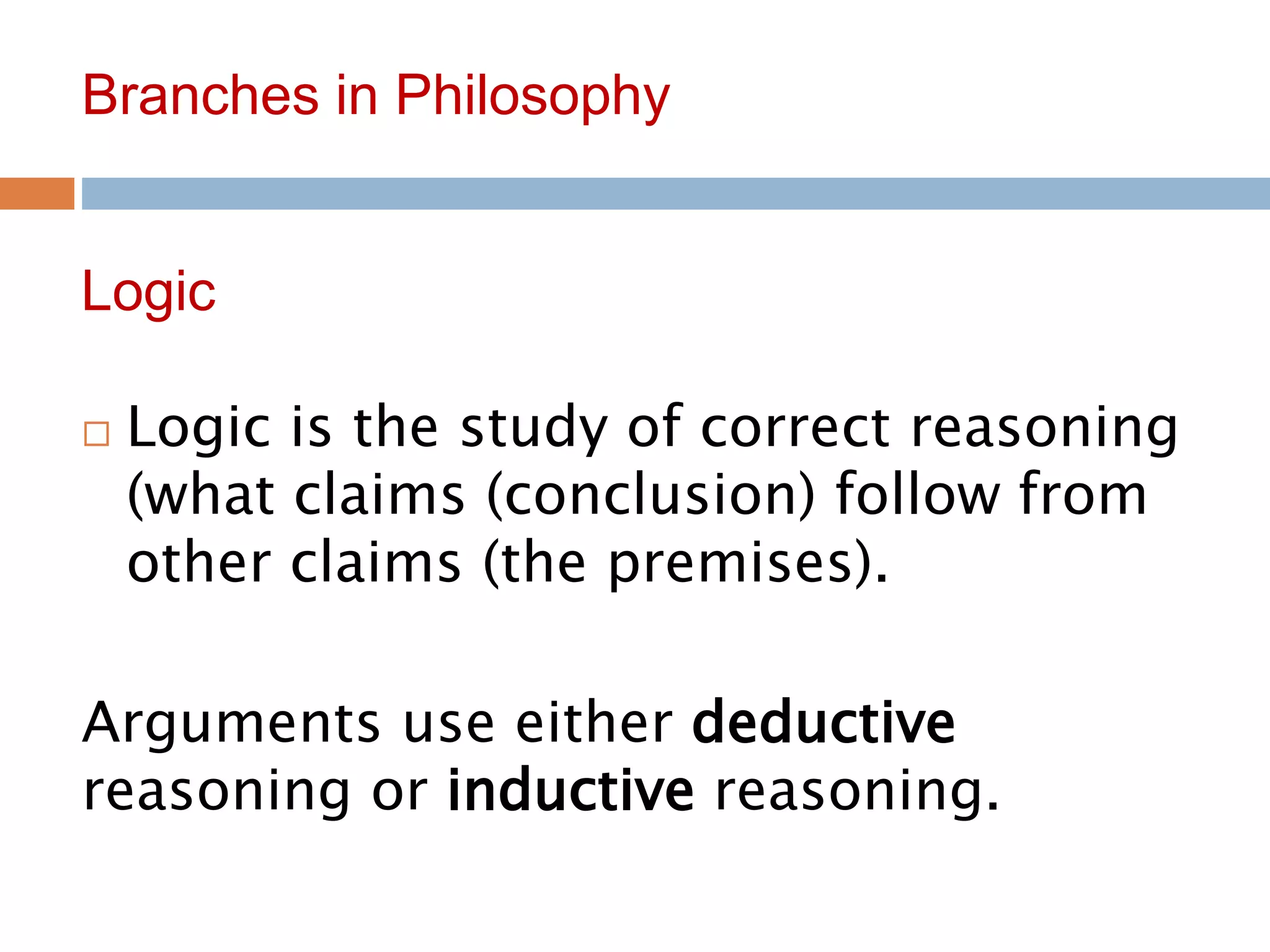
Logic is the study of correct reasoning
(what claims (conclusion) follow from
other claims (the premises).
Arguments use either deductive
reasoning or inductive reasoning.
Logic
10.
10
Branches in Philosophy
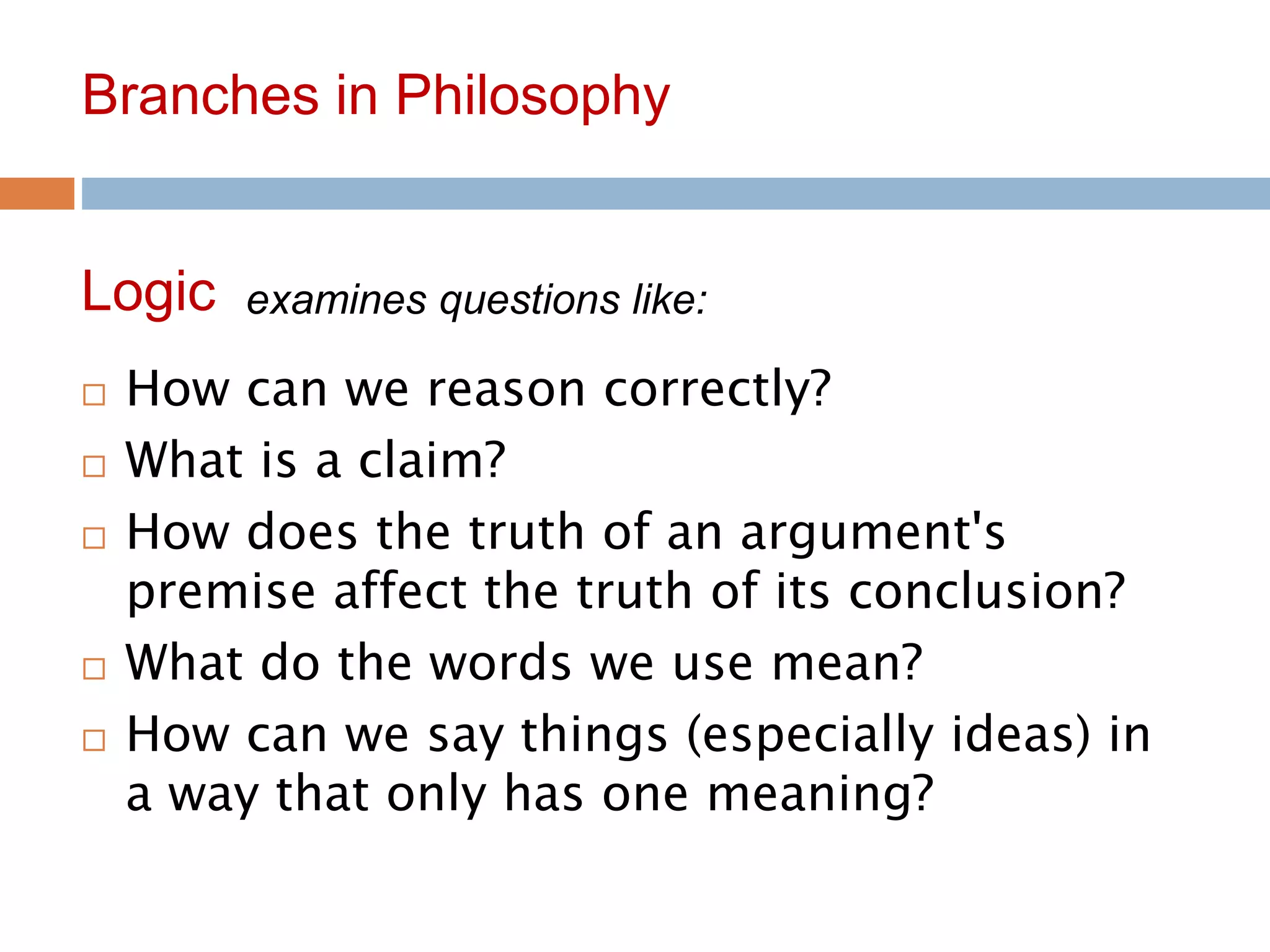
How can we reason correctly?
What is a claim?
How does the truth of an argument's
premise affect the truth of its conclusion?
What do the words we use mean?
How can we say things (especially ideas) in
a way that only has one meaning?
Logic examines questions like:
11.
11
Branches in Philosophy
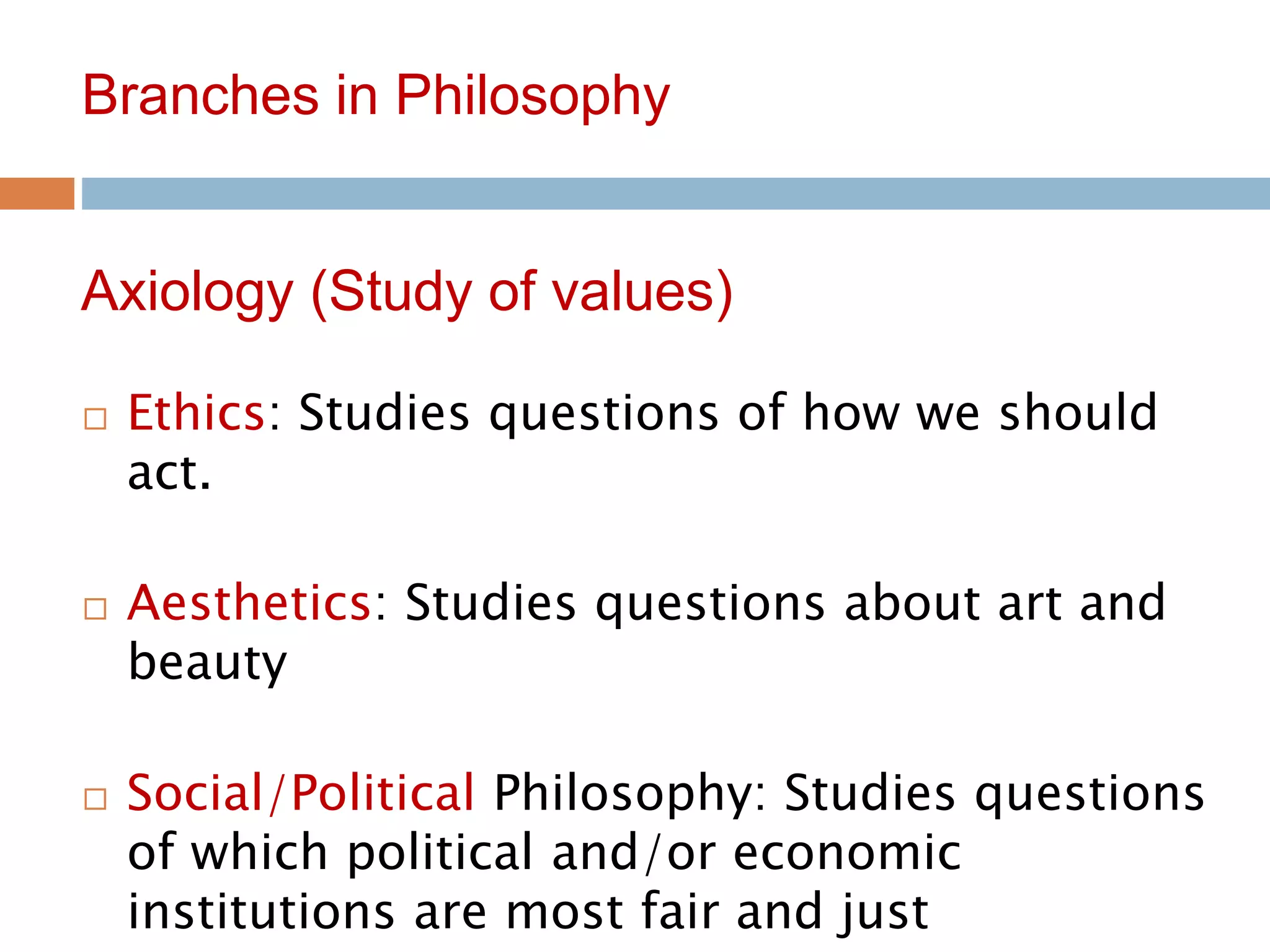
Ethics: Studies questions of how we should
act.
Aesthetics: Studies questions about art and
beauty
Social/Political Philosophy: Studies questions
of which political and/or economic
institutions are most fair and just
Axiology (Study of values)
12.
12
Branches in Philosophy
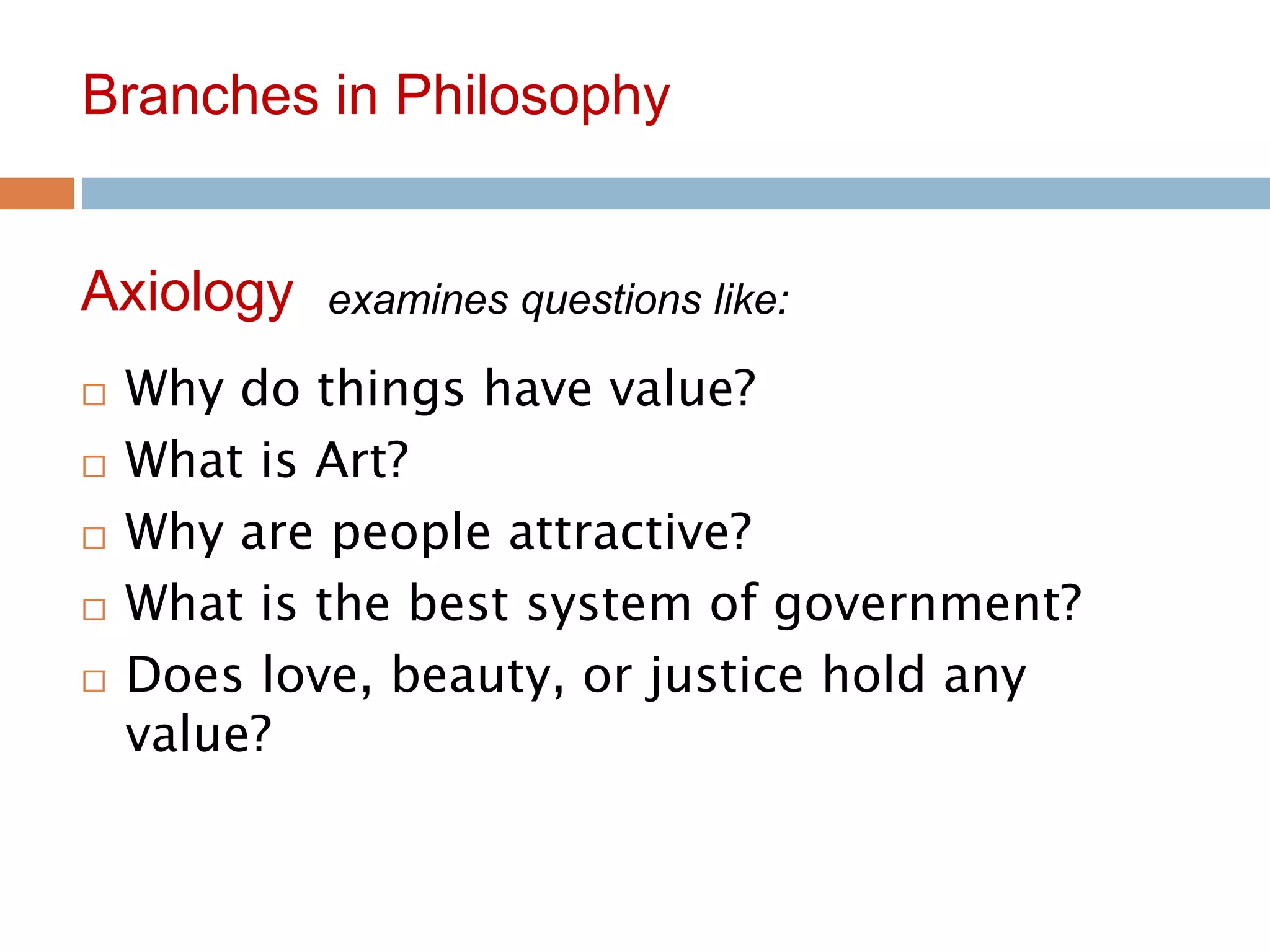
Why do things have value?
What is Art?
Why are people attractive?
What is the best system of government?
Does love, beauty, or justice hold any
value?
Axiology examines questions like:
13.
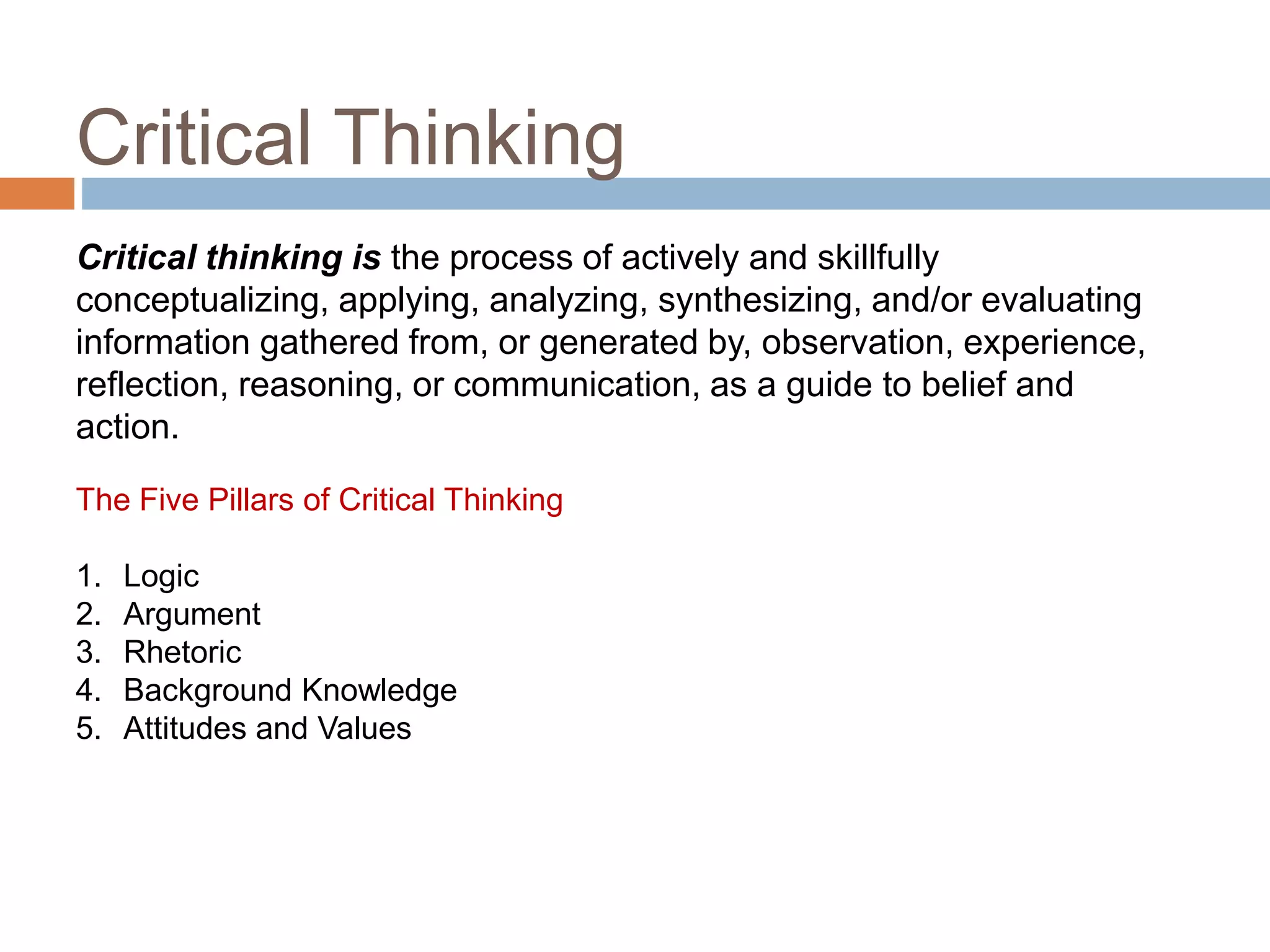
Critical Thinking
13
The FivePillars of Critical Thinking
1. Logic
2. Argument
3. Rhetoric
4. Background Knowledge
5. Attitudes and Values
Critical thinking is the process of actively and skillfully
conceptualizing, applying, analyzing, synthesizing, and/or evaluating
information gathered from, or generated by, observation, experience,
reflection, reasoning, or communication, as a guide to belief and
action.
14.
1. LOGIC
The FivePillars of Critical Thinking
The discipline that deals with the
question of what claim (the
conclusion) follows from previous
claims (the premises).
15.
2. ARGUMENTATION
The FivePillars of Critical Thinking
Logical analysis that is also
concerned with assessing the truth
or falsity of the claims (evidence
and conclusion).
16.
3. RHETORIC
The FivePillars of Critical Thinking
Using language and/or media to
persuade.
17.
4. BACKGROUND
KNOWLEDGE
The FivePillars of Critical Thinking
All the logic and argumentation skills in the
world will not make up for ignorance -- if you
don’t know what you’re talking about, your
arguments are going to suck, no matter how
good your skills at logical analysis.
18.
5. ATTITUDES andVALUES
The Five Pillars of Critical Thinking
Attitudes toward:
• yourself and to other people
• uncertainty and doubt
• the value of truth and knowledge
19.
Claims
19
A Claim isa statement (no ?’s) that
asserts something to be true.
It’s going to rain today.
Columbus is in Ohio.
The planet Mars is inside the Sun.
What time does the movie start?
Seventh graders have stinky feet.
I like big butts and I can not lie.
20.
What is Truth?
Existence:
Allthat is. The entire natural world/universe…
known and unknown.
Reality:
Everything that exists materially (can be sensed
or detected).
Truth:
Concepts (in our minds) that accurately map to the
natural world/universe.
20
21.
Types of Claims
21
Type1: Claims of Fact or Definition
Type 2: Claims About Value or
Judgment
Type 3: Claims About Solutions or
Policies
What is thedifference between
Knowledge and Belief?
FLASHcard Check
24.
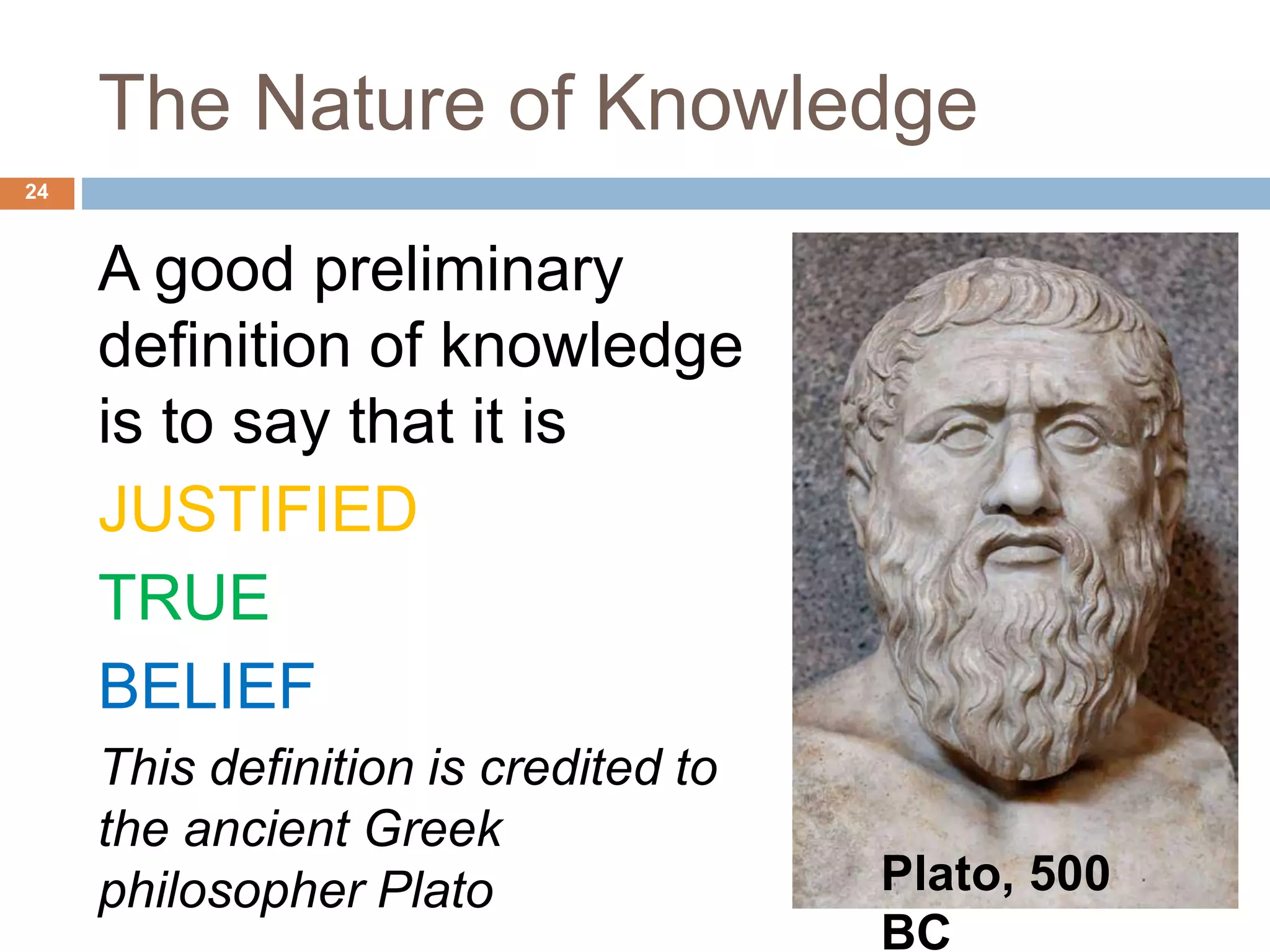
The Nature ofKnowledge
A good preliminary
definition of knowledge
is to say that it is
JUSTIFIED
TRUE
BELIEF
This definition is credited to
the ancient Greek
philosopher Plato
24
Plato, 500
BC
25.
The Nature ofKnowledge
Knowledge vs BELIEF
The most obvious thing that distinguishes
knowledge from belief is TRUTH.
If you know something, then what you claim to
know must be true; BUT if you merely believe
it, then it may be true or it may be false.
Truth is independent of what anyone happens
to believe is true - simply believing that
something is true does not make it true.
25
26.
The Nature ofKnowledge
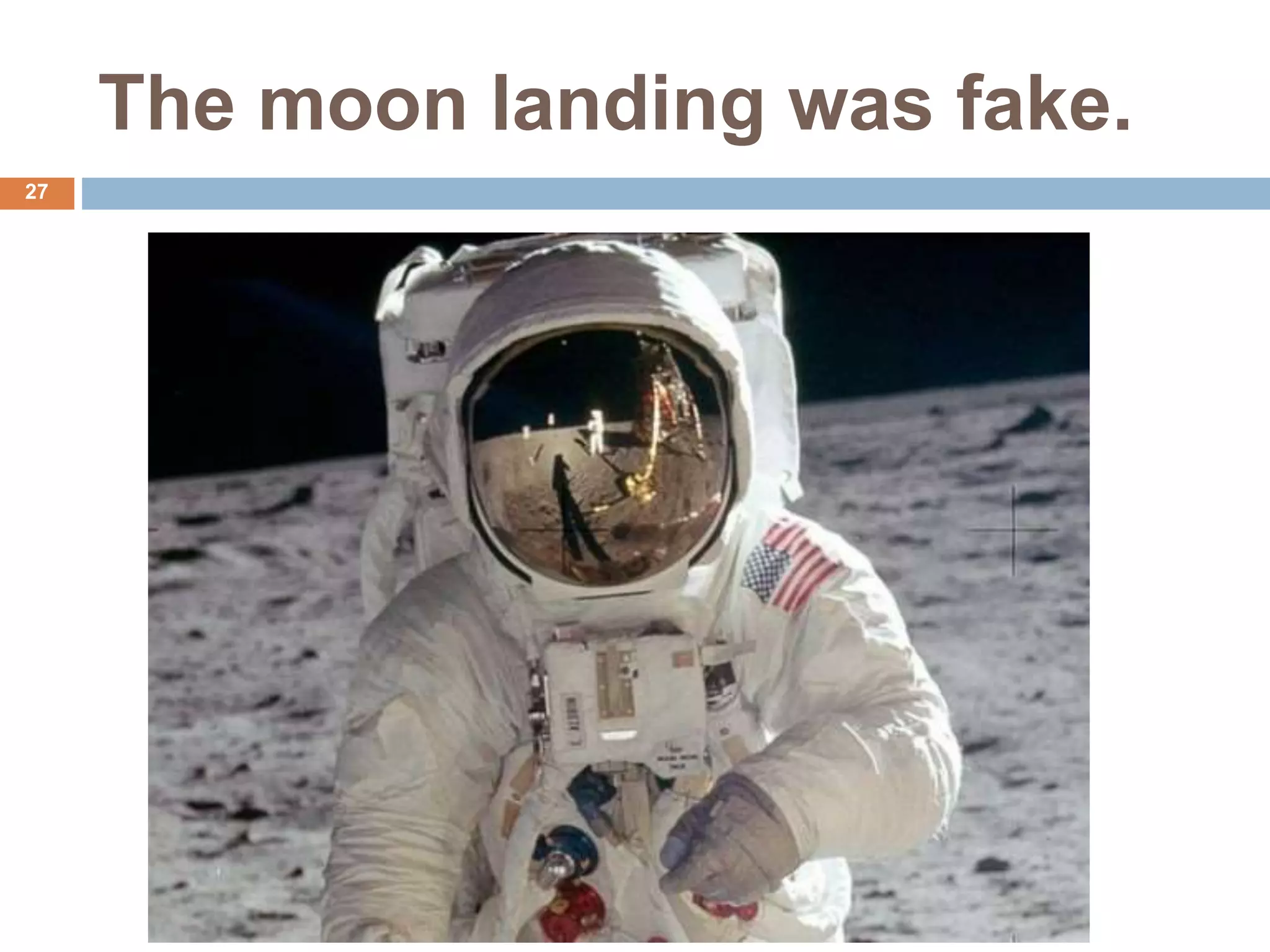
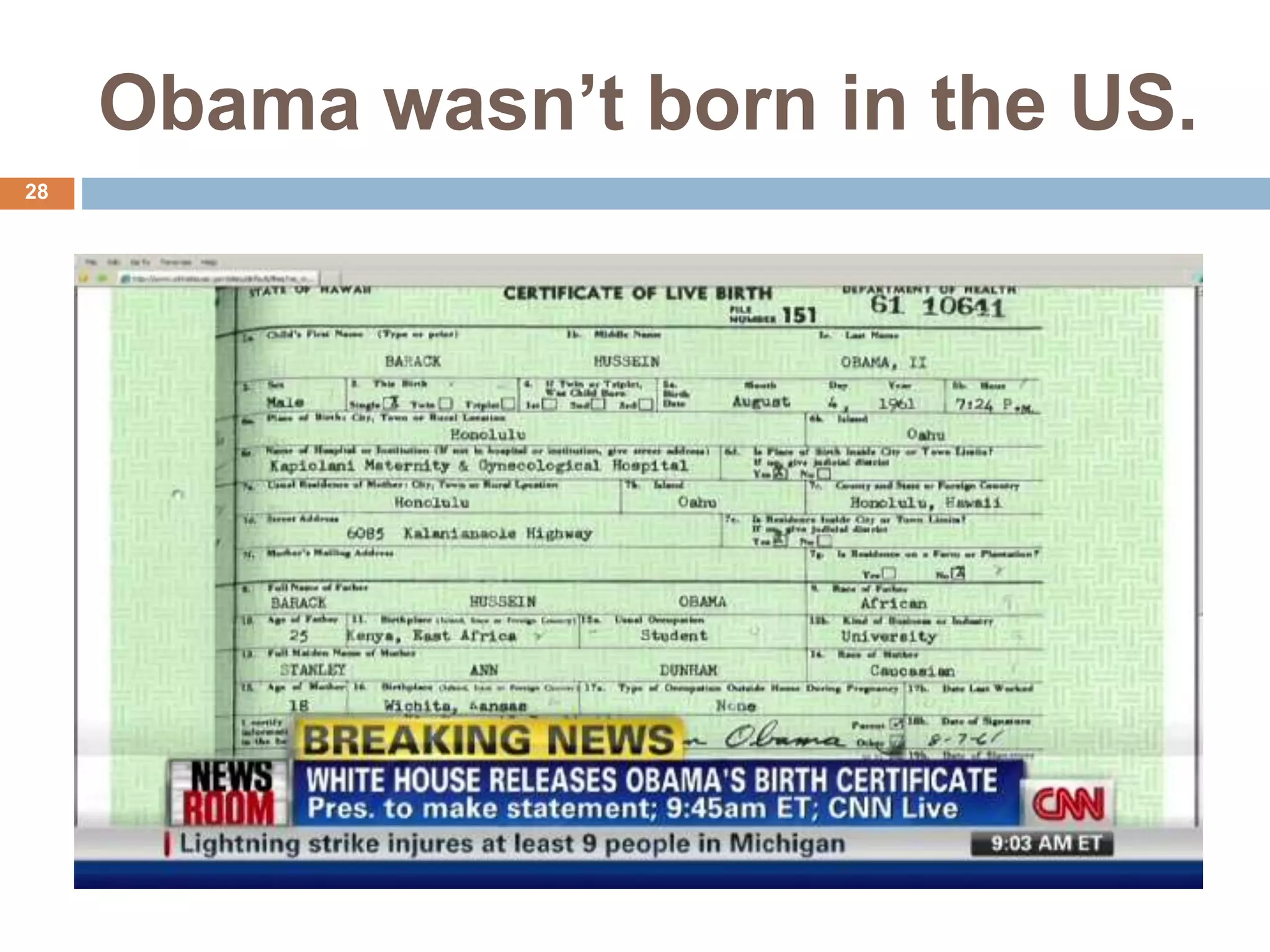
The question is: how can we
ever be sure that what we think
we know really is true?
26
The Nature ofKnowledge
BELIEF
If you know something, then what you claim to know
must not only be true, but you must also believe it to be
true. If you don't have conscious awareness of
something, then it makes little sense to say that you
know it.
Questions:
1. Can you think of any cases in which someone
might be said to know something without knowing that
they know it?
2. As technology develops, do you think it will ever
make sense to say that a computer knows things?
30
31.
The Nature ofKnowledge
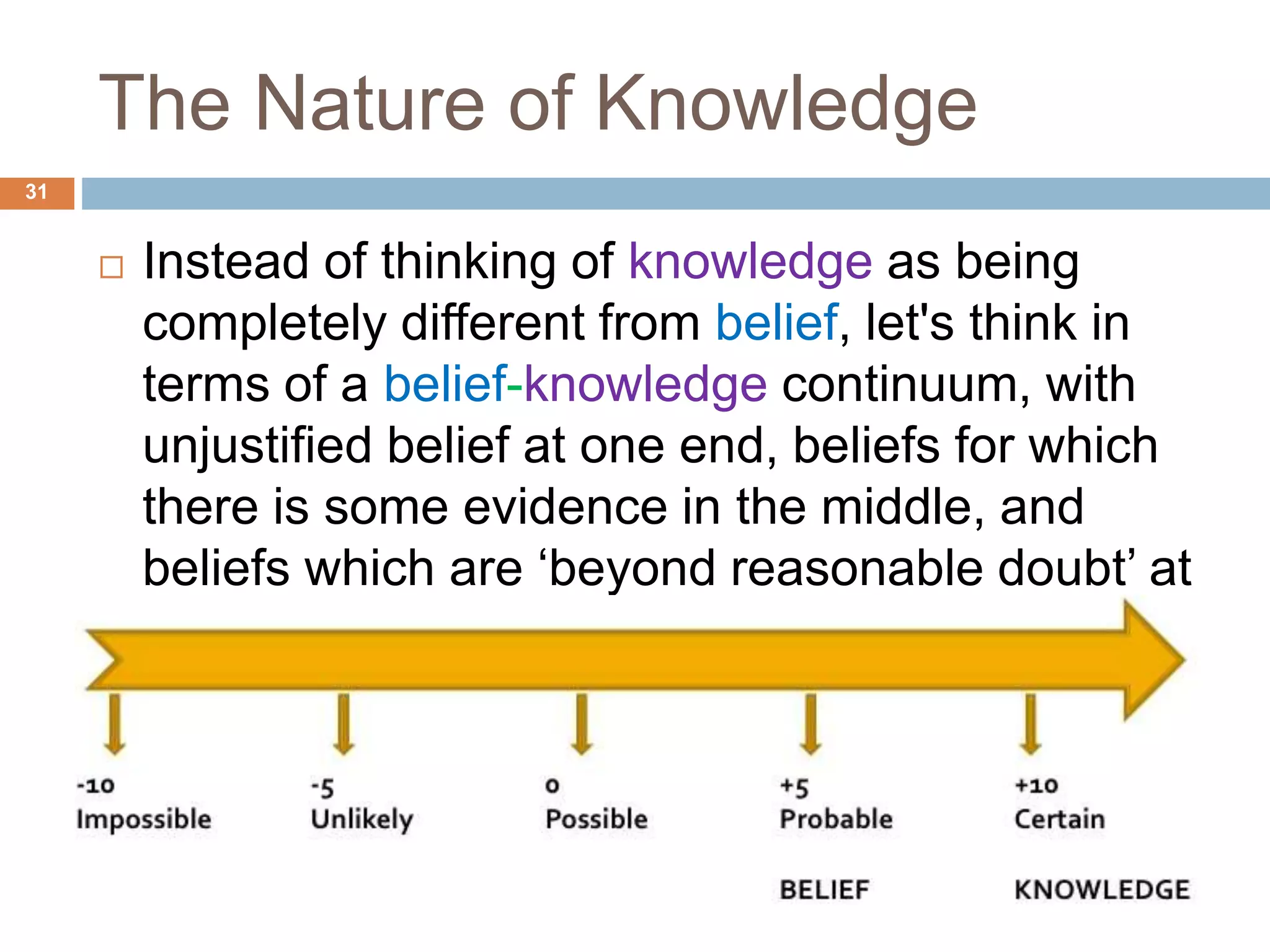
Instead of thinking of knowledge as being
completely different from belief, let's think in
terms of a belief-knowledge continuum, with
unjustified belief at one end, beliefs for which
there is some evidence in the middle, and
beliefs which are ‘beyond reasonable doubt’ at
the other end.
31
The Nature ofKnowledge
3. JUSTIFICATION
In order to be able to say that you know
something you must be able to justify your belief,
and your justification must be of the right kind.
We usually justify our knowledge claims by
appealing to one of the four ways of knowing. If
someone asks you how you know, you might
reply:
1. ‘Someone told me’ – language
2. ‘I saw it’ – perception
3. ‘I worked it out’ – reason
4. ‘It’s intuitively obvious’ – emotion
33
34.
The Nature ofKnowledge
Now, the key thing that distinguishes acceptable
from unacceptable justifications seems to be
reliability.
Although perception isn’t infallible, it is generally
reliable source of knowledge; on the other hand,
telepathy is unreliable, and the scientific evidence
to date suggests that psychics do no better than
chance when it comes to trying to read other
people’s minds.
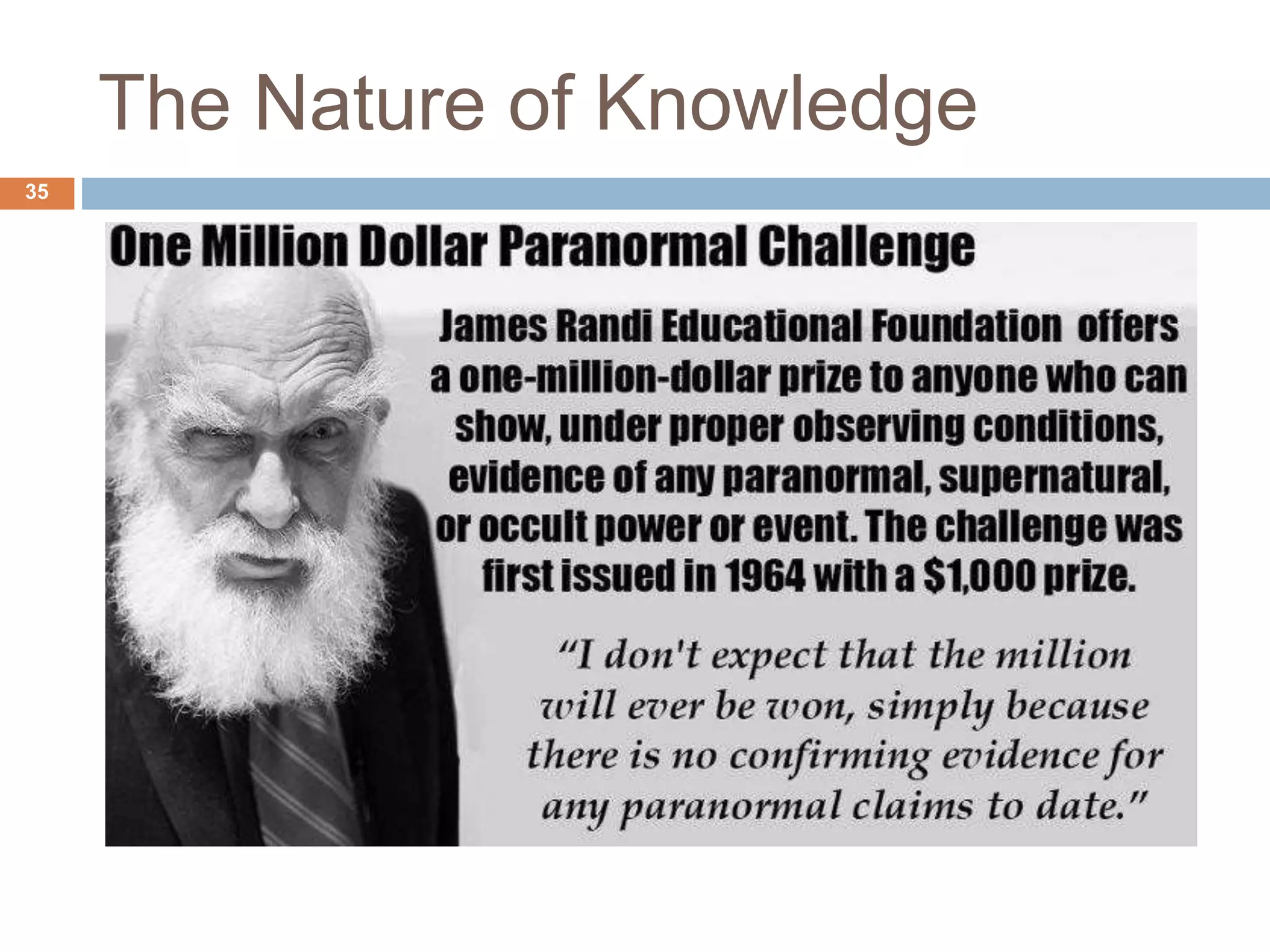
Magician and skeptic James Randi has offered $1
million prize to anyone who can demonstrate
psychic powers; the prize still remains unclaimed.
34
The Nature ofKnowledge
KNOWLEDGE & INFORMATION
Person with genuine knowledge of a subject does not
merely have information about it, but understands how
the various parts are related to one another to form a
meaningful whole – information is to a knowledge as
bricks are to a building – you cannot have a building
without bricks, but building is more than just a heap of
bricks.
So, to understand something, it is not enough to
merely acquire information about it – you also need to
think about the information and see how it hangs
together.
Moreover, we can sometimes acquire knowledge
simply by reflecting information we already have at
our disposal rather than by looking for more
information.
36
Editor's Notes
#25 *This definition is credited to the ancient Greek philosopher Plato
#26 *For example, during the Middle Ages everyone thought they knew that there were seven ‘planets’ orbiting the earth (Sun, Moon, Mercury, Venus, Mars, Saturn and Jupiter).