PHILOSOPHY
Prepared by Raizza Corpuz
INTRODUCTION TO PHILOSOPHY
• MEANING
• NATURE
• SCOPE
• GOALS
• IMPORTANCE
• BRANCHES
• EPOCH
WHAT IS PHILOSOPHY? WHERE IT
BEGINS?
REMEMBER
• In studying PHILOSOPHY one should KNOW
the :
1.Contextualize/ation
2.Basis
In this way one can distinguish both VALIDITY
and TRUTH, GENUINE and ESSENTIAL ideals.
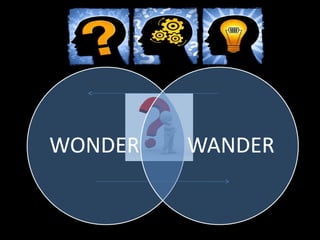
FROM WONDER
TO WANDER
“Wasn’t it extraordinary to be in
the world right now, wandering
around in a wonderful
adventure!”
― Jostein Gaarder, Sophie's World
Wonder
• To be filled with curiosity or doubt
• An event inexplicable by the laws of nature; a
miracle.
• A feeling of puzzlement or doubt.
Source: Thesaurus Dictionary
Wander: Verb
• Walk or move in a leisurely, casual, or aimless
way.
• An act or instance of wandering.
verb. roam - ramble - rove -
straynoun. wandering - stroll - saunter -
ramble
Source: Thesaurus Dictionary
• Philosophers’ definition-arises out of wonder, out of
curiosity, out of desire to learn, and to understand
things.
• According to the Philosopher, Philosophy is a process
of analysis, criticism, interpretation and speculation
• Analysis-if we know how to synthesis and antithesis.
• Synthesis- put idea together or event of the same
characteristic.
• Antithesis- remove from or put it out, removing ideas
• Criticism- is a process of commenting or giving a
judgment, even if its positive or negative.
• Interpretation-demonstration of ideas.
• Speculation-being satisfied.
Etymology- or etymological definition of Philosophy
-derived for Greek words etimos and logos
Etimos-root, origin, cause, basis, history
Logos-study
Etymology-study of the history of the word
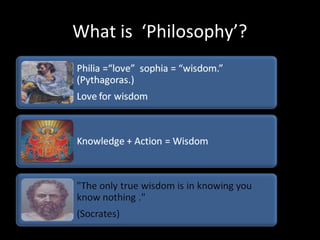
Philosophy comes from the Geek Words Philia and Sofia.
Sofia-wisdom
Philia-love, desire for, interest in
Philia and Sofia join by Pythagoras-600 B.C.
Episteme-means knowledge
Wisdom-defining deeply, wise, according to etymology
-is an awareness of something which is basic.
-knowledge of the basic principle.
Knowledge-is only a million formation
-simple data that comes from the outside that pass to our
senses.
Etymology
A. Meaning of Philosophy
What is Philosophy as aWhat is Philosophy as a
TERM/WORD?TERM/WORD?
The term “philosophy” comes from the Greek
language. It consists of two words :
• philos, (love, or philia )– friendship, affection
• sophos (learned scholar, sage, or
• sophia - wisdom, knowledge, talent)
““philo” - lovephilo” - love
““sophia” - wisdomsophia” - wisdom
THUS:THUS:
1.1. Philosophy is the love of wisdomPhilosophy is the love of wisdom
2.2. Philosophy attempts to answer life's BigPhilosophy attempts to answer life's Big
QuestionsQuestions
3.3. Philosophy is about QuestionsPhilosophy is about Questions
4.4. Philosophers ask Questions about what peoplePhilosophers ask Questions about what people
BelieveBelieve
5.5. Philosophy is about Examining Ourselves & OurPhilosophy is about Examining Ourselves & Our
BeliefsBeliefs
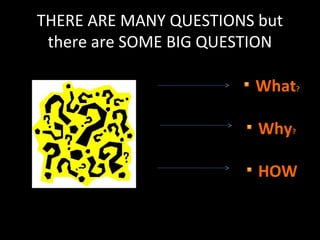
THERE ARE MANY QUESTIONS but
there are SOME BIG QUESTION
WhatWhat??
WhyWhy??
HOWHOW
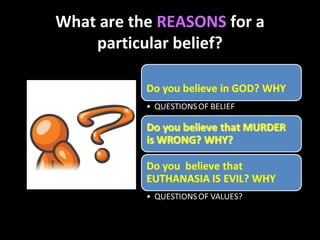
What are theWhat are the REASONSREASONS for afor a
particular belief?particular belief?
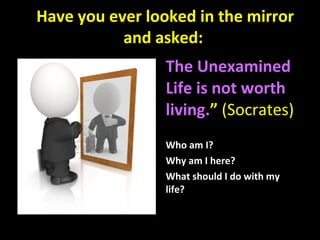
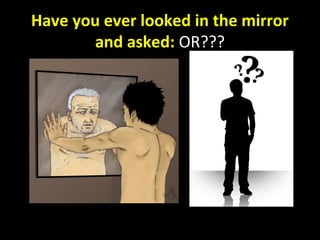
Have you ever looked in the mirrorHave you ever looked in the mirror
and asked:and asked:
The UnexaminedThe Unexamined
Life is not worthLife is not worth
living.living.”” (Socrates)(Socrates)
Who am I?Who am I?
Why am I here?Why am I here?
What should I do with myWhat should I do with my
life?life?
Have you ever looked in the mirrorHave you ever looked in the mirror
and asked:and asked: OR???
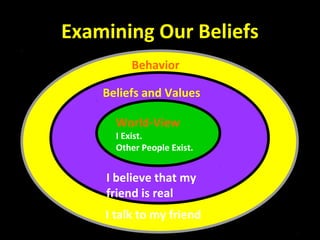
Examining Our BeliefsExamining Our Beliefs
Behavior
I talk to my friend
Beliefs and Values
I believe that my
friend is real
World-View
I Exist.
Other People Exist.
What is ‘Philosophy’?
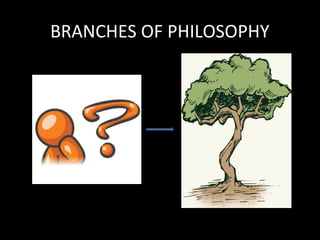
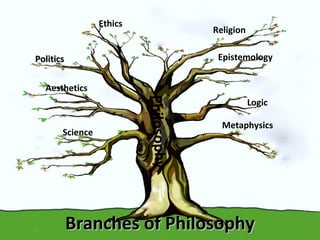
BRANCHES OF PHILOSOPHY
Branches of PhilosophyBranches of Philosophy
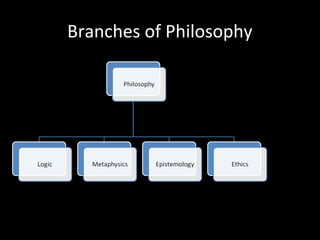
Ethics
PoliticsPolitics
Religion
Metaphysics
Logic
Epistemology
Aesthetics
Science
Philosophy
Branches of Philosophy
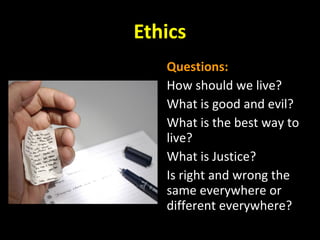
Ethics
Questions:
How should we live?
What is good and evil?
What is the best way to
live?
What is Justice?
Is right and wrong the
same everywhere or
different everywhere?
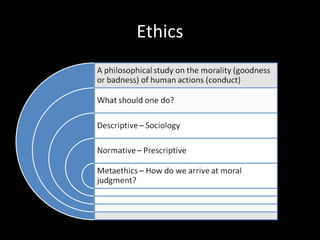
Ethics
Epistemology
Knowledge Science
Explores the nature
and limitations of
knowledge
Definition of knowledge
Investigates how knowledge
is obtained
Explores the relationship
between belief, truth and
knowledge
Epistemology
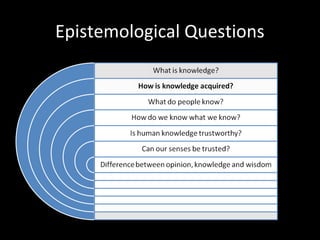
Questions:
What is knowledge?
How is knowledge
acquired?
How do we know what
we know?
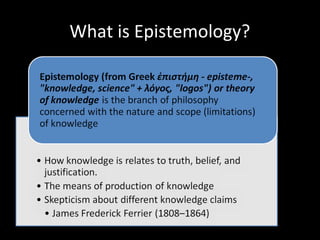
What is Epistemology?
Epistemological Questions
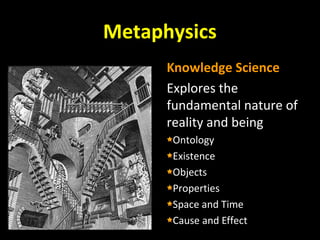
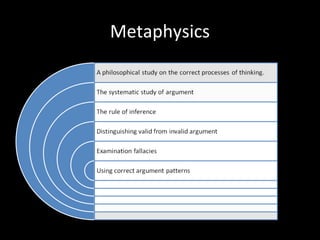
Metaphysics
Knowledge Science
Explores the
fundamental nature of
reality and being
Ontology
Existence
Objects
Properties
Space and Time
Cause and Effect
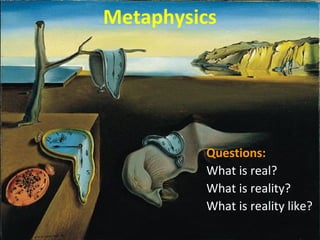
Metaphysics
Questions:
What is real?
What is reality?
What is reality like?
Metaphysics
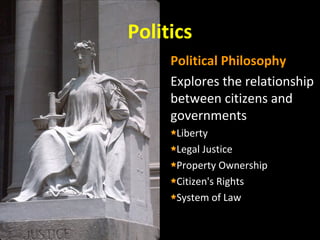
Politics
Political Philosophy
Explores the relationship
between citizens and
governments
Liberty
Legal Justice
Property Ownership
Citizen's Rights
System of Law
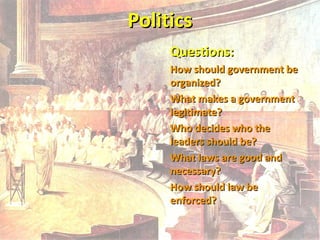
PoliticsPolitics
Questions:Questions:
How should government beHow should government be
organized?organized?
What makes a governmentWhat makes a government
legitimate?legitimate?
Who decides who theWho decides who the
leaders should be?leaders should be?
What laws are good andWhat laws are good and
necessary?necessary?
How should law beHow should law be
enforced?enforced?
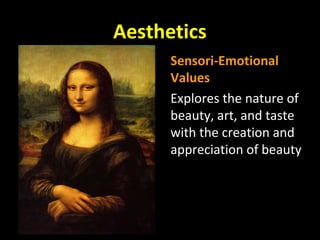
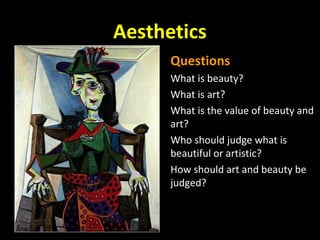
Aesthetics
Sensori-Emotional
Values
Explores the nature of
beauty, art, and taste
with the creation and
appreciation of beauty
Aesthetics
Questions
What is beauty?
What is art?
What is the value of beauty and
art?
Who should judge what is
beautiful or artistic?
How should art and beauty be
judged?
Aesthetics
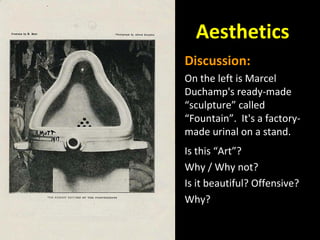
Discussion:
On the left is Marcel
Duchamp's ready-made
“sculpture” called
“Fountain”. It's a factory-
made urinal on a stand.
Is this “Art”?
Why / Why not?
Is it beautiful? Offensive?
Why?
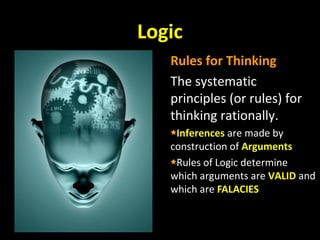
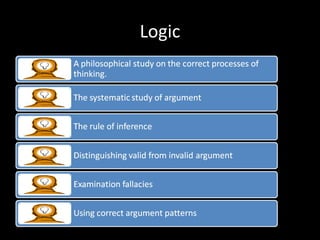
Logic
Rules for Thinking
The systematic
principles (or rules) for
thinking rationally.
Inferences are made by
construction of Arguments
Rules of Logic determine
which arguments are VALID and
which are FALACIES
Logic
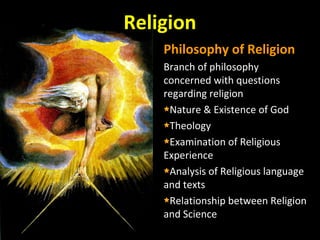
Religion
Philosophy of Religion
Branch of philosophy
concerned with questions
regarding religion
Nature & Existence of God
Theology
Examination of Religious
Experience
Analysis of Religious language
and texts
Relationship between Religion
and Science
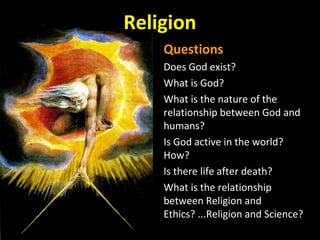
Religion
Questions
Does God exist?
What is God?
What is the nature of the
relationship between God and
humans?
Is God active in the world?
How?
Is there life after death?
What is the relationship
between Religion and
Ethics? ...Religion and Science?
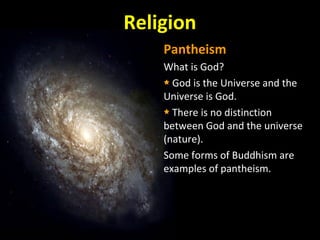
Religion
Pantheism
What is God?
God is the Universe and the
Universe is God.
There is no distinction
between God and the universe
(nature).
Some forms of Buddhism are
examples of pantheism.
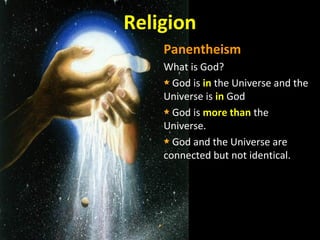
Religion
Panentheism
What is God?
God is in the Universe and the
Universe is in God
God is more than the
Universe.
God and the Universe are
connected but not identical.
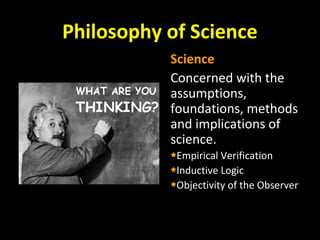
Philosophy of Science
Science
Concerned with the
assumptions,
foundations, methods
and implications of
science.
Empirical Verification
Inductive Logic
Objectivity of the Observer
Philosophy of Science
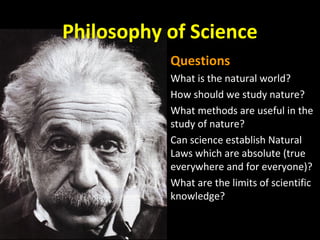
Questions
What is the natural world?
How should we study nature?
What methods are useful in the
study of nature?
Can science establish Natural
Laws which are absolute (true
everywhere and for everyone)?
What are the limits of scientific
knowledge?
THANK YOU!!! –END--

Lecture2philosophy rpc-131206133146-phpapp02

  • 1.
  • 2.
    INTRODUCTION TO PHILOSOPHY •MEANING • NATURE • SCOPE • GOALS • IMPORTANCE • BRANCHES • EPOCH
  • 3.
    WHAT IS PHILOSOPHY?WHERE IT BEGINS?
  • 4.
    REMEMBER • In studyingPHILOSOPHY one should KNOW the : 1.Contextualize/ation 2.Basis In this way one can distinguish both VALIDITY and TRUTH, GENUINE and ESSENTIAL ideals.
  • 5.
  • 6.
    “Wasn’t it extraordinaryto be in the world right now, wandering around in a wonderful adventure!” ― Jostein Gaarder, Sophie's World
  • 7.
    Wonder • To befilled with curiosity or doubt • An event inexplicable by the laws of nature; a miracle. • A feeling of puzzlement or doubt. Source: Thesaurus Dictionary
  • 8.
    Wander: Verb • Walkor move in a leisurely, casual, or aimless way. • An act or instance of wandering. verb. roam - ramble - rove - straynoun. wandering - stroll - saunter - ramble Source: Thesaurus Dictionary
  • 10.
    • Philosophers’ definition-arisesout of wonder, out of curiosity, out of desire to learn, and to understand things. • According to the Philosopher, Philosophy is a process of analysis, criticism, interpretation and speculation • Analysis-if we know how to synthesis and antithesis. • Synthesis- put idea together or event of the same characteristic. • Antithesis- remove from or put it out, removing ideas • Criticism- is a process of commenting or giving a judgment, even if its positive or negative. • Interpretation-demonstration of ideas. • Speculation-being satisfied.
  • 11.
    Etymology- or etymologicaldefinition of Philosophy -derived for Greek words etimos and logos Etimos-root, origin, cause, basis, history Logos-study Etymology-study of the history of the word Philosophy comes from the Geek Words Philia and Sofia. Sofia-wisdom Philia-love, desire for, interest in Philia and Sofia join by Pythagoras-600 B.C. Episteme-means knowledge Wisdom-defining deeply, wise, according to etymology -is an awareness of something which is basic. -knowledge of the basic principle. Knowledge-is only a million formation -simple data that comes from the outside that pass to our senses. Etymology A. Meaning of Philosophy
  • 12.
    What is Philosophyas aWhat is Philosophy as a TERM/WORD?TERM/WORD? The term “philosophy” comes from the Greek language. It consists of two words : • philos, (love, or philia )– friendship, affection • sophos (learned scholar, sage, or • sophia - wisdom, knowledge, talent)
  • 13.
    ““philo” - lovephilo”- love ““sophia” - wisdomsophia” - wisdom THUS:THUS: 1.1. Philosophy is the love of wisdomPhilosophy is the love of wisdom 2.2. Philosophy attempts to answer life's BigPhilosophy attempts to answer life's Big QuestionsQuestions 3.3. Philosophy is about QuestionsPhilosophy is about Questions 4.4. Philosophers ask Questions about what peoplePhilosophers ask Questions about what people BelieveBelieve 5.5. Philosophy is about Examining Ourselves & OurPhilosophy is about Examining Ourselves & Our BeliefsBeliefs
  • 14.
    THERE ARE MANYQUESTIONS but there are SOME BIG QUESTION WhatWhat?? WhyWhy?? HOWHOW
  • 15.
    What are theWhatare the REASONSREASONS for afor a particular belief?particular belief?
  • 16.
    Have you everlooked in the mirrorHave you ever looked in the mirror and asked:and asked: The UnexaminedThe Unexamined Life is not worthLife is not worth living.living.”” (Socrates)(Socrates) Who am I?Who am I? Why am I here?Why am I here? What should I do with myWhat should I do with my life?life?
  • 17.
    Have you everlooked in the mirrorHave you ever looked in the mirror and asked:and asked: OR???
  • 18.
    Examining Our BeliefsExaminingOur Beliefs Behavior I talk to my friend Beliefs and Values I believe that my friend is real World-View I Exist. Other People Exist.
  • 19.
  • 20.
  • 21.
    Branches of PhilosophyBranchesof Philosophy Ethics PoliticsPolitics Religion Metaphysics Logic Epistemology Aesthetics Science Philosophy
  • 22.
  • 23.
    Ethics Questions: How should welive? What is good and evil? What is the best way to live? What is Justice? Is right and wrong the same everywhere or different everywhere?
  • 24.
  • 25.
    Epistemology Knowledge Science Explores thenature and limitations of knowledge Definition of knowledge Investigates how knowledge is obtained Explores the relationship between belief, truth and knowledge
  • 26.
    Epistemology Questions: What is knowledge? Howis knowledge acquired? How do we know what we know?
  • 27.
  • 28.
  • 29.
    Metaphysics Knowledge Science Explores the fundamentalnature of reality and being Ontology Existence Objects Properties Space and Time Cause and Effect
  • 30.
    Metaphysics Questions: What is real? Whatis reality? What is reality like?
  • 31.
  • 32.
    Politics Political Philosophy Explores therelationship between citizens and governments Liberty Legal Justice Property Ownership Citizen's Rights System of Law
  • 33.
    PoliticsPolitics Questions:Questions: How should governmentbeHow should government be organized?organized? What makes a governmentWhat makes a government legitimate?legitimate? Who decides who theWho decides who the leaders should be?leaders should be? What laws are good andWhat laws are good and necessary?necessary? How should law beHow should law be enforced?enforced?
  • 34.
    Aesthetics Sensori-Emotional Values Explores the natureof beauty, art, and taste with the creation and appreciation of beauty
  • 35.
    Aesthetics Questions What is beauty? Whatis art? What is the value of beauty and art? Who should judge what is beautiful or artistic? How should art and beauty be judged?
  • 36.
    Aesthetics Discussion: On the leftis Marcel Duchamp's ready-made “sculpture” called “Fountain”. It's a factory- made urinal on a stand. Is this “Art”? Why / Why not? Is it beautiful? Offensive? Why?
  • 37.
    Logic Rules for Thinking Thesystematic principles (or rules) for thinking rationally. Inferences are made by construction of Arguments Rules of Logic determine which arguments are VALID and which are FALACIES
  • 38.
  • 39.
    Religion Philosophy of Religion Branchof philosophy concerned with questions regarding religion Nature & Existence of God Theology Examination of Religious Experience Analysis of Religious language and texts Relationship between Religion and Science
  • 40.
    Religion Questions Does God exist? Whatis God? What is the nature of the relationship between God and humans? Is God active in the world? How? Is there life after death? What is the relationship between Religion and Ethics? ...Religion and Science?
  • 41.
    Religion Pantheism What is God? Godis the Universe and the Universe is God. There is no distinction between God and the universe (nature). Some forms of Buddhism are examples of pantheism.
  • 42.
    Religion Panentheism What is God? Godis in the Universe and the Universe is in God God is more than the Universe. God and the Universe are connected but not identical.
  • 43.
    Philosophy of Science Science Concernedwith the assumptions, foundations, methods and implications of science. Empirical Verification Inductive Logic Objectivity of the Observer
  • 44.
    Philosophy of Science Questions Whatis the natural world? How should we study nature? What methods are useful in the study of nature? Can science establish Natural Laws which are absolute (true everywhere and for everyone)? What are the limits of scientific knowledge?
  • 45.