INTRODUCTION
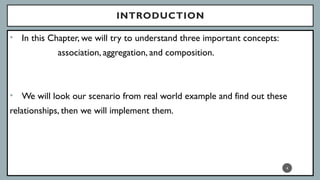
• In thisChapter, we will try to understand three important concepts:
association, aggregation, and composition.
• We will look our scenario from real world example and find out these
relationships, then we will implement them.
4
5.
SCENARIO AND REQUIREMENTS
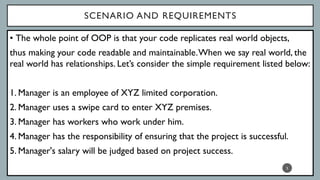
•The whole point of OOP is that your code replicates real world objects,
thus making your code readable and maintainable.When we say real world, the
real world has relationships. Let’s consider the simple requirement listed below:
1. Manager is an employee of XYZ limited corporation.
2. Manager uses a swipe card to enter XYZ premises.
3. Manager has workers who work under him.
4. Manager has the responsibility of ensuring that the project is successful.
5. Manager's salary will be judged based on project success.
5
6.
EXTRACTING REAL WORLDRELATIONSHIPS FROM REQUIREMENTS
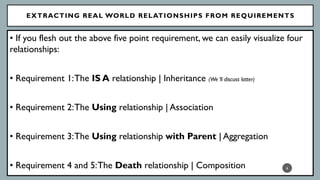
• If you flesh out the above five point requirement, we can easily visualize four
relationships:
• Requirement 1:The IS A relationship | Inheritance (We ‘ll discuss latter)
• Requirement 2:The Using relationship | Association
• Requirement 3:The Using relationship with Parent | Aggregation
• Requirement 4 and 5:The Death relationship | Composition 6
7.
REQUIREMENT : ASSOCIATION
Requirement2 is an interesting requirement (Manager uses a swipe card to
enter XYZ premises). In this requirement, the manager object and the swipe
card object use each other but they have their own object life time. In other
words, they can exist without each other.The most important point in this
relationship is that there is no single owner.
7
class Student {
voidstudy() {
System.out.println("Student is studying.");
}
}
classTeacher {
void teach(Student s) { // Association
System.out.println("Teacher is teaching.");
s.study();
}
}
public class Main {
public static void main(String[] args) {
Student st = new Student();
Teacher t = newTeacher();
t.teach(st); // Association
}
} 9
10.
S0 ASSOCIATION IS
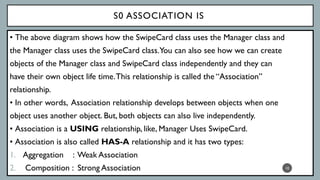
•The above diagram shows how the SwipeCard class uses the Manager class and
the Manager class uses the SwipeCard class.You can also see how we can create
objects of the Manager class and SwipeCard class independently and they can
have their own object life time.This relationship is called the “Association”
relationship.
• In other words, Association relationship develops between objects when one
object uses another object. But, both objects can also live independently.
• Association is a USING relationship, like, Manager Uses SwipeCard.
• Association is also called HAS-A relationship and it has two types:
1. Aggregation : Weak Association
2. Composition : Strong Association 10
11.
REQUIREMENT : AGGREGATION
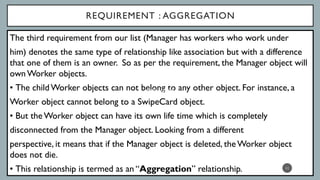
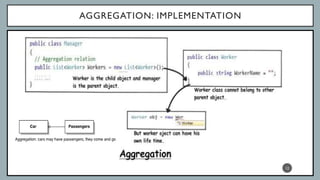
Thethird requirement from our list (Manager has workers who work under
him) denotes the same type of relationship like association but with a difference
that one of them is an owner. So as per the requirement, the Manager object will
ownWorker objects.
• The child Worker objects can not belong to any other object. For instance, a
Worker object cannot belong to a SwipeCard object.
• But theWorker object can have its own life time which is completely
disconnected from the Manager object. Looking from a different
perspective, it means that if the Manager object is deleted, theWorker object
does not die.
• This relationship is termed as an “Aggregation” relationship. 11
Association
import java.util.ArrayList;
class Player{
String name;
Player(String name) {
this.name = name;
}
}
classTeam {
private ArrayList<Player> players = new ArrayList<>(); //
Aggregation
public void addPlayer(Player p) { // Player created
outside
players.add(p);
}
public void showPlayers() {
for (Player p : players) {
System.out.println(p.name);
}
}
}
public class Main {
public static void main(String[] args) {
Player p1 = new Player("Ali"); // created
outside
Player p2 = new Player("Usman");
Team team = newTeam();
team.addPlayer(p1); // Aggregation
team.addPlayer(p2);
team.showPlayers();
}
}
13
14.
SO AGGREGATION IS
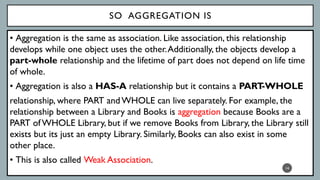
•Aggregation is the same as association. Like association, this relationship
develops while one object uses the other.Additionally, the objects develop a
part-whole relationship and the lifetime of part does not depend on life time
of whole.
• Aggregation is also a HAS-A relationship but it contains a PART
-WHOLE
relationship, where PART and WHOLE can live separately. For example, the
relationship between a Library and Books is aggregation because Books are a
PART ofWHOLE Library, but if we remove Books from Library, the Library still
exists but its just an empty Library. Similarly, Books can also exist in some
other place.
• This is also called Weak Association.
14
Association
15.
REQUIREMENT: COMPOSITION
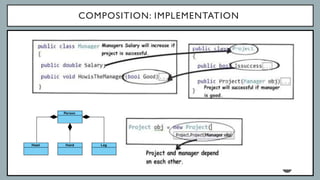
The lasttwo requirements are actually logically one. If you read closely, the
requirements are as follows:
1. Manager has the responsibility of ensuring that the project is successful.
2. Manager's salary will be judged based on project success.
Below is the conclusion from analyzing the above requirements:
1. Manager and the project objects are dependent on each other.
2.The lifetimes of both the objects are the same. In other words, the project
will not be successful if the manager is not good, and the manager will not
get good increments if the project has issues.
• This relationship is termed as the “composition” relationship. 15
• class Engine{
• void start() {
• System.out.println("Engine started");
• }
• }
•
• class Car {
• private Engine engine = new Engine(); // Composition
•
• void startCar() {
• engine.start();
• }
• } 17
18.
SO COMPOSITION IS
•In this relationship, both objects are heavily dependent on each other.
In other words, if one goes for garbage collection the other also has to be garbage
collected, or putting from a different perspective, the lifetime of the objects are the
same.That’s why I have put in the
heading “Death” relationship.
• Composition is also a HAS-A relationship but it contains a PART-WHOLE
relationship, where PART and WHOLE can not live separately. For
example, the relationship between a Book and its Pages is composition
because Pages are a PART of WHOLE Book, but if we remove Pages
from Book, the Book does not exists anymore and so are the pages.
• It is also called Strong Association. 18
Association
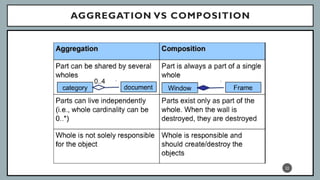
SUMMARY
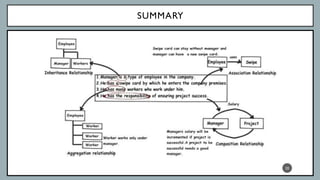
To avoid confusionhenceforth for these three terms, I have put forward a table
below which will help us compare them from three angles: owner, lifetime, and
child object.
23
Association




![class Student {
void study() {
System.out.println("Student is studying.");
}
}
classTeacher {
void teach(Student s) { // Association
System.out.println("Teacher is teaching.");
s.study();
}
}
public class Main {
public static void main(String[] args) {
Student st = new Student();
Teacher t = newTeacher();
t.teach(st); // Association
}
} 9](https://image.slidesharecdn.com/classdiagramtocode-260111160059-efbd0d65/85/How-ClassDiagram-is-used-to-convert-in-code-9-320.jpg)
![import java.util.ArrayList;
class Player {
String name;
Player(String name) {
this.name = name;
}
}
classTeam {
private ArrayList<Player> players = new ArrayList<>(); //
Aggregation
public void addPlayer(Player p) { // Player created
outside
players.add(p);
}
public void showPlayers() {
for (Player p : players) {
System.out.println(p.name);
}
}
}
public class Main {
public static void main(String[] args) {
Player p1 = new Player("Ali"); // created
outside
Player p2 = new Player("Usman");
Team team = newTeam();
team.addPlayer(p1); // Aggregation
team.addPlayer(p2);
team.showPlayers();
}
}
13](https://image.slidesharecdn.com/classdiagramtocode-260111160059-efbd0d65/85/How-ClassDiagram-is-used-to-convert-in-code-13-320.jpg)







![5G Explained! A High Level Overview [Introduction]](https://cdn.slidesharecdn.com/ss_thumbnails/5gexplainedahighleveloverview-260119165306-cc137a3e-thumbnail.jpg?width=640&height=640&fit=bounds)


