PRAYER
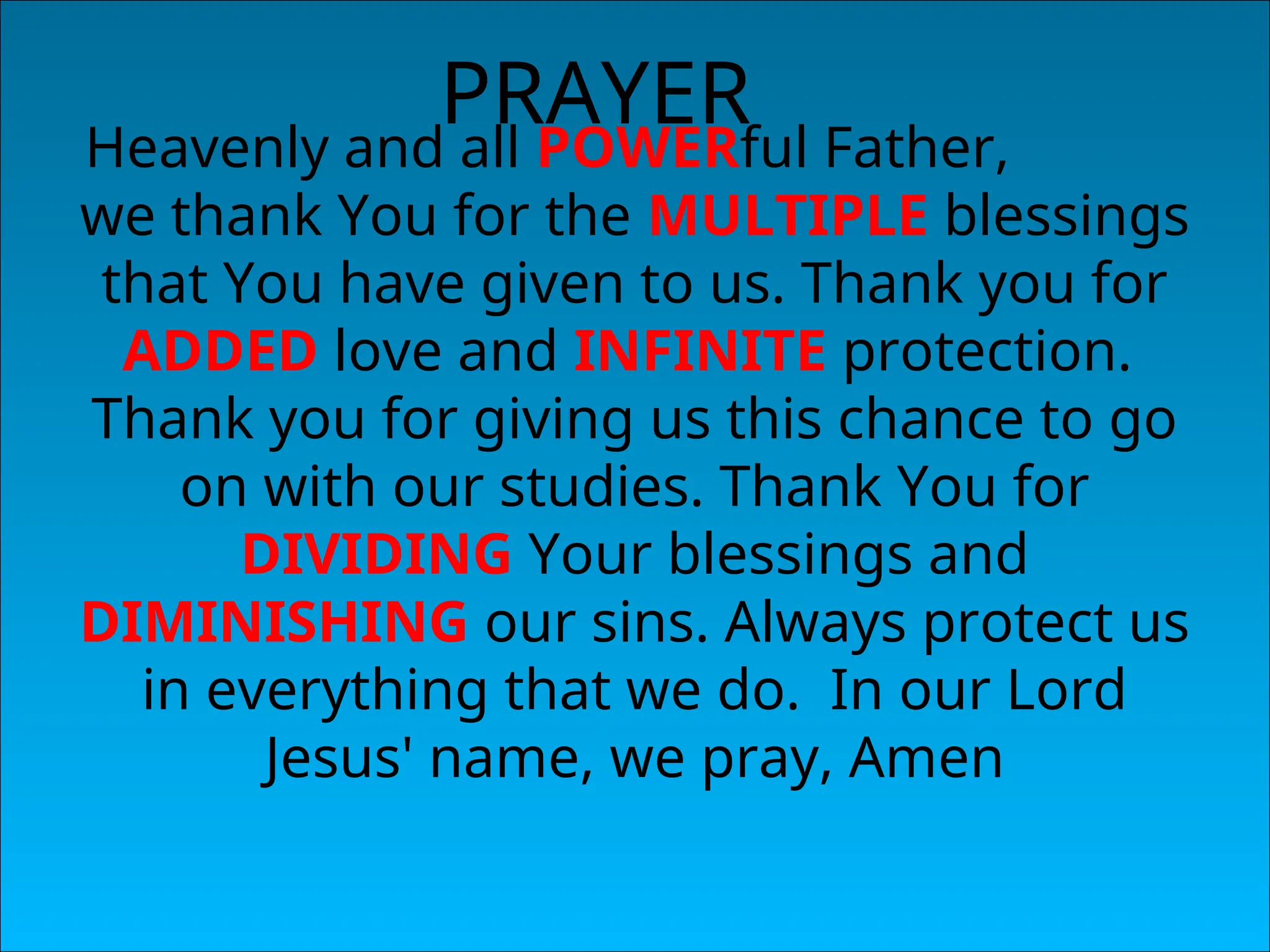
Heavenly and all POWERful Father,
we thank You for the MULTIPLE blessings
that You have given to us. Thank you for
ADDED love and INFINITE protection.
Thank you for giving us this chance to go
on with our studies. Thank You for
DIVIDING Your blessings and
DIMINISHING our sins. Always protect us
in everything that we do. In our Lord
Jesus' name, we pray, Amen
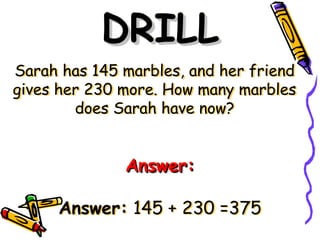
Sarah has 145 marbles, and her friend
gives her 230 more. How many marbles
does Sarah have now?
DRILL
DRILL
Answer:
Answer:
Answer: 145 + 230 =375
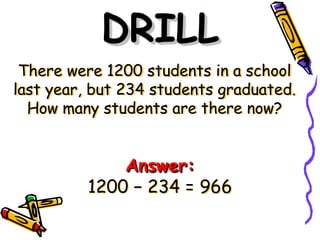
There were 1200 students in a school
last year, but 234 students graduated.
How many students are there now?
DRILL
DRILL
Answer:
Answer:
1200 − 234 = 966
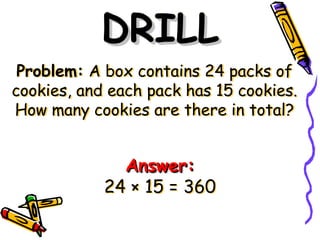
Problem: A box contains 24 packs of
cookies, and each pack has 15 cookies.
How many cookies are there in total?
DRILL
DRILL
Answer:
Answer:
24 × 15 = 360
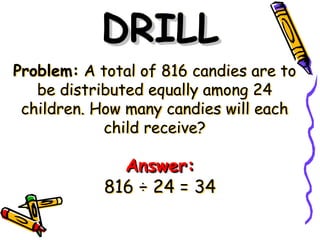
Problem: A total of 816 candies are to
be distributed equally among 24
children. How many candies will each
child receive?
DRILL
DRILL
Answer:
Answer:
816 ÷ 24 = 34
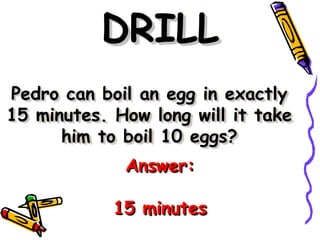
Pedro can boil an egg in exactly
15 minutes. How long will it take
him to boil 10 eggs?
DRILL
DRILL
Answer:
Answer:
15 minutes
15 minutes
INTEGERS
INTEGERS
What is an
Integer?
• An integer is a positive or
negative whole number,
including 0.
…-3, -2, -1, 0, 1, 2, 3…
There are
“4”
Integer
Operations
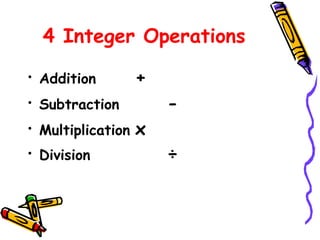
4 Integer Operations
• Addition +
• Subtraction -
• Multiplication x
• Division ÷
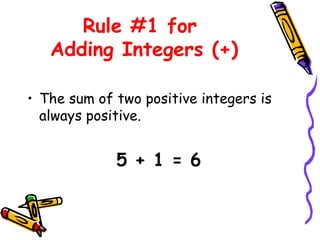
Rule #1 for
Adding Integers (+)
• The sum of two positive integers is
always positive.
5 + 1 = 6
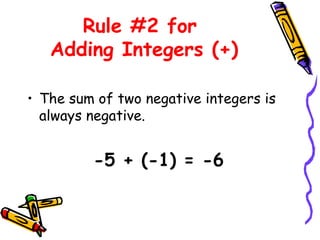
Rule #2 for
Adding Integers (+)
• The sum of two negative integers is
always negative.
-5 + (-1) = -6
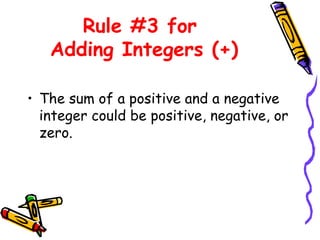
Rule #3 for
Adding Integers (+)
• The sum of a positive and a negative
integer could be positive, negative, or
zero.
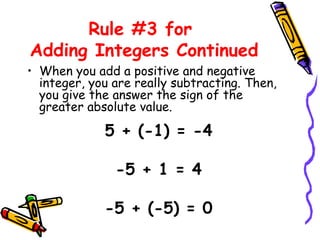
Rule #3 for
Adding Integers Continued
• When you add a positive and negative
integer, you are really subtracting. Then,
you give the answer the sign of the
greater absolute value.
5 + (-1) = -4
-5 + 1 = 4
-5 + (-5) = 0
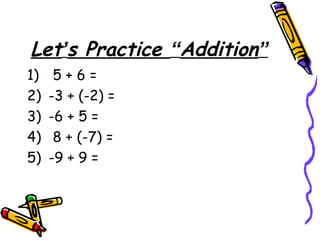
Let’s Practice “Addition”
1) 5 + 6 =
2) -3 + (-2) =
3) -6 + 5 =
4) 8 + (-7) =
5) -9 + 9 =
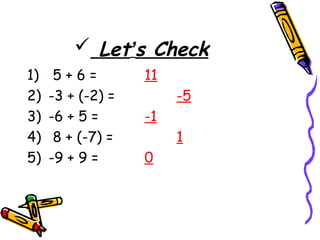
 Let’s Check
1) 5 + 6 = 11
2) -3 + (-2) = -5
3) -6 + 5 = -1
4) 8 + (-7) = 1
5) -9 + 9 = 0
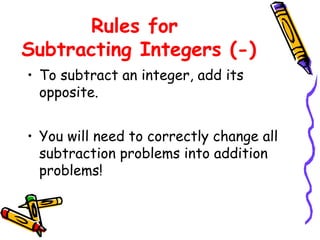
Rules for
Subtracting Integers (-)
• To subtract an integer, add its
opposite.
• You will need to correctly change all
subtraction problems into addition
problems!
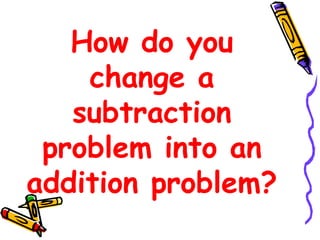
How do you
change a
subtraction
problem into an
addition problem?
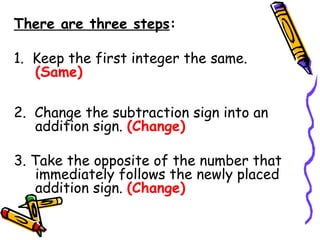
There are three steps:
1. Keep the first integer the same.
(Same)
2. Change the subtraction sign into an
addition sign. (Change)
3. Take the opposite of the number that
immediately follows the newly placed
addition sign. (Change)
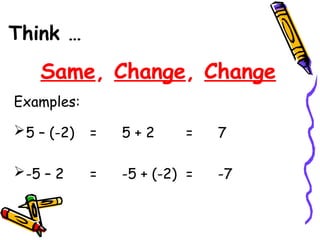
Examples:
5 – (-2) = 5 + 2 = 7
-5 – 2 = -5 + (-2) = -7
Think …
Same, Change, Change
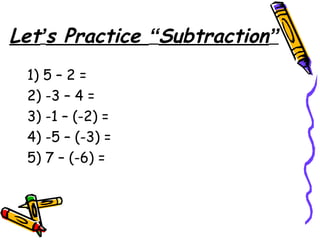
Let’s Practice “Subtraction”
1) 5 – 2 =
2) -3 – 4 =
3) -1 – (-2) =
4) -5 – (-3) =
5) 7 – (-6) =
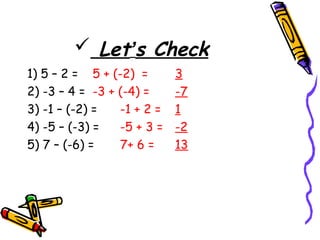
 Let’s Check
1) 5 – 2 = 5 + (-2) = 3
2) -3 – 4 = -3 + (-4) = -7
3) -1 – (-2) = -1 + 2 = 1
4) -5 – (-3) = -5 + 3 = -2
5) 7 – (-6) = 7+ 6 = 13
Rules for
Multiplying Integers (x)
• The product of two integers with the
same signs is POSITIVE.
• The product of two integers with
different signs is NEGATIVE.
Rules Summary for
Multiplication
• Positive x Positive = Positive
• Negative x Negative = Positive
• Positive x Negative= Negative
• Negative x Positive = Negative
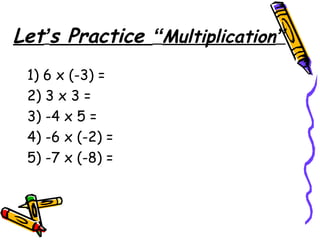
Let’s Practice “Multiplication”
1) 6 x (-3) =
2) 3 x 3 =
3) -4 x 5 =
4) -6 x (-2) =
5) -7 x (-8) =
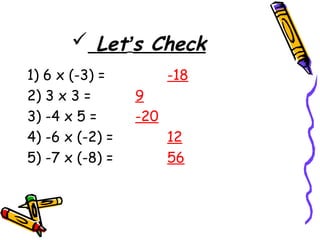
 Let’s Check
1) 6 x (-3) = -18
2) 3 x 3 = 9
3) -4 x 5 = -20
4) -6 x (-2) = 12
5) -7 x (-8) = 56
Did you know that
the rules for
multiplication and
division are the
same?
Guess what….
They are!
The rules for division are exactly
the same as those for multiplication.
If we were to take the rules for
multiplication and change the
multiplication signs to division signs,
we would have an accurate set of
rules for division.
Rules for
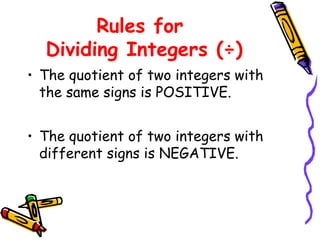
Dividing Integers (÷)
• The quotient of two integers with
the same signs is POSITIVE.
• The quotient of two integers with
different signs is NEGATIVE.
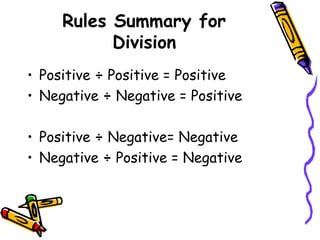
Rules Summary for
Division
• Positive ÷ Positive = Positive
• Negative ÷ Negative = Positive
• Positive ÷ Negative= Negative
• Negative ÷ Positive = Negative
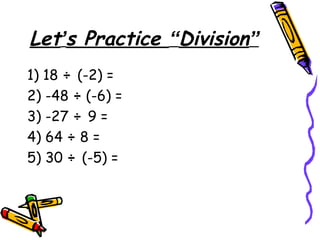
Let’s Practice “Division”
1) 18 ÷ (-2) =
2) -48 ÷ (-6) =
3) -27 ÷ 9 =
4) 64 ÷ 8 =
5) 30 ÷ (-5) =
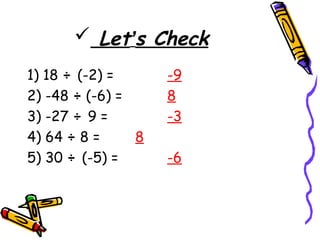
 Let’s Check
1) 18 ÷ (-2) = -9
2) -48 ÷ (-6) = 8
3) -27 ÷ 9 = -3
4) 64 ÷ 8 = 8
5) 30 ÷ (-5) = -6
Let’s Review…
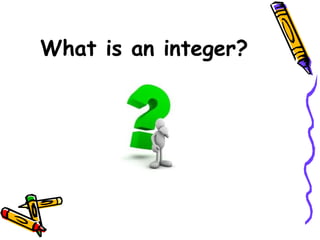
What is an integer?
ANSWER
• An integer is a positive or
negative whole number,
including 0.
Can you give an example
of an integer?
ANSWER
• …-3, -2, -1, 0, 1, 2, 3…
What are the four
operations?
ANSWER
• The four operations are:
addition, subtraction,
multiplication, and division.
How do you add
integers?
ANSWER
• The sum of two positive integers is always
positive.
• The sum of two negative integers is always
negative.
• When you add a positive and negative
integer, you are really subtracting. Then, you
give the answer the sign of the greater
absolute value.
How do you
subtract integers?
ANSWER
• To subtract an integer, add its
opposite.
• Same, Change, Change
How do you multiply
integers?
ANSWER
• If the signs are the same, your answer
is always positive.
• If the signs are different, your answer
is always negative.
How do you divide
integers?
ANSWER
• If the signs are the same, your answer is
always positive.
• If the signs are different, your answer is
always negative.
*Multiplication and Division Rules are the
same!
Integers - Addition, Subtraction, Multiplication and Divsision .ppt

Integers - Addition, Subtraction, Multiplication and Divsision .ppt

  • 1.
    PRAYER Heavenly and allPOWERful Father, we thank You for the MULTIPLE blessings that You have given to us. Thank you for ADDED love and INFINITE protection. Thank you for giving us this chance to go on with our studies. Thank You for DIVIDING Your blessings and DIMINISHING our sins. Always protect us in everything that we do. In our Lord Jesus' name, we pray, Amen
  • 2.
    Sarah has 145marbles, and her friend gives her 230 more. How many marbles does Sarah have now? DRILL DRILL Answer: Answer: Answer: 145 + 230 =375
  • 3.
    There were 1200students in a school last year, but 234 students graduated. How many students are there now? DRILL DRILL Answer: Answer: 1200 − 234 = 966
  • 4.
    Problem: A boxcontains 24 packs of cookies, and each pack has 15 cookies. How many cookies are there in total? DRILL DRILL Answer: Answer: 24 × 15 = 360
  • 5.
    Problem: A totalof 816 candies are to be distributed equally among 24 children. How many candies will each child receive? DRILL DRILL Answer: Answer: 816 ÷ 24 = 34
  • 6.
    Pedro can boilan egg in exactly Pedro can boil an egg in exactly 15 minutes. How long will it take 15 minutes. How long will it take him to boil 10 eggs? him to boil 10 eggs? DRILL DRILL Answer: Answer: 15 minutes 15 minutes
  • 7.
  • 8.
  • 9.
    • An integeris a positive or negative whole number, including 0. …-3, -2, -1, 0, 1, 2, 3…
  • 10.
  • 15.
    4 Integer Operations •Addition + • Subtraction - • Multiplication x • Division ÷
  • 16.
    Rule #1 for AddingIntegers (+) • The sum of two positive integers is always positive. 5 + 1 = 6
  • 17.
    Rule #2 for AddingIntegers (+) • The sum of two negative integers is always negative. -5 + (-1) = -6
  • 18.
    Rule #3 for AddingIntegers (+) • The sum of a positive and a negative integer could be positive, negative, or zero.
  • 19.
    Rule #3 for AddingIntegers Continued • When you add a positive and negative integer, you are really subtracting. Then, you give the answer the sign of the greater absolute value. 5 + (-1) = -4 -5 + 1 = 4 -5 + (-5) = 0
  • 20.
    Let’s Practice “Addition” 1)5 + 6 = 2) -3 + (-2) = 3) -6 + 5 = 4) 8 + (-7) = 5) -9 + 9 =
  • 21.
     Let’s Check 1)5 + 6 = 11 2) -3 + (-2) = -5 3) -6 + 5 = -1 4) 8 + (-7) = 1 5) -9 + 9 = 0
  • 22.
    Rules for Subtracting Integers(-) • To subtract an integer, add its opposite. • You will need to correctly change all subtraction problems into addition problems!
  • 23.
    How do you changea subtraction problem into an addition problem?
  • 24.
    There are threesteps: 1. Keep the first integer the same. (Same) 2. Change the subtraction sign into an addition sign. (Change) 3. Take the opposite of the number that immediately follows the newly placed addition sign. (Change)
  • 28.
    Examples: 5 – (-2)= 5 + 2 = 7 -5 – 2 = -5 + (-2) = -7 Think … Same, Change, Change
  • 29.
    Let’s Practice “Subtraction” 1)5 – 2 = 2) -3 – 4 = 3) -1 – (-2) = 4) -5 – (-3) = 5) 7 – (-6) =
  • 30.
     Let’s Check 1)5 – 2 = 5 + (-2) = 3 2) -3 – 4 = -3 + (-4) = -7 3) -1 – (-2) = -1 + 2 = 1 4) -5 – (-3) = -5 + 3 = -2 5) 7 – (-6) = 7+ 6 = 13
  • 31.
    Rules for Multiplying Integers(x) • The product of two integers with the same signs is POSITIVE. • The product of two integers with different signs is NEGATIVE.
  • 32.
    Rules Summary for Multiplication •Positive x Positive = Positive • Negative x Negative = Positive • Positive x Negative= Negative • Negative x Positive = Negative
  • 33.
    Let’s Practice “Multiplication” 1)6 x (-3) = 2) 3 x 3 = 3) -4 x 5 = 4) -6 x (-2) = 5) -7 x (-8) =
  • 34.
     Let’s Check 1)6 x (-3) = -18 2) 3 x 3 = 9 3) -4 x 5 = -20 4) -6 x (-2) = 12 5) -7 x (-8) = 56
  • 35.
    Did you knowthat the rules for multiplication and division are the same?
  • 36.
  • 37.
    The rules fordivision are exactly the same as those for multiplication. If we were to take the rules for multiplication and change the multiplication signs to division signs, we would have an accurate set of rules for division.
  • 38.
    Rules for Dividing Integers(÷) • The quotient of two integers with the same signs is POSITIVE. • The quotient of two integers with different signs is NEGATIVE.
  • 39.
    Rules Summary for Division •Positive ÷ Positive = Positive • Negative ÷ Negative = Positive • Positive ÷ Negative= Negative • Negative ÷ Positive = Negative
  • 40.
    Let’s Practice “Division” 1)18 ÷ (-2) = 2) -48 ÷ (-6) = 3) -27 ÷ 9 = 4) 64 ÷ 8 = 5) 30 ÷ (-5) =
  • 41.
     Let’s Check 1)18 ÷ (-2) = -9 2) -48 ÷ (-6) = 8 3) -27 ÷ 9 = -3 4) 64 ÷ 8 = 8 5) 30 ÷ (-5) = -6
  • 42.
  • 43.
    What is aninteger?
  • 44.
    ANSWER • An integeris a positive or negative whole number, including 0.
  • 45.
    Can you givean example of an integer?
  • 46.
    ANSWER • …-3, -2,-1, 0, 1, 2, 3…
  • 47.
    What are thefour operations?
  • 48.
    ANSWER • The fouroperations are: addition, subtraction, multiplication, and division.
  • 49.
    How do youadd integers?
  • 50.
    ANSWER • The sumof two positive integers is always positive. • The sum of two negative integers is always negative. • When you add a positive and negative integer, you are really subtracting. Then, you give the answer the sign of the greater absolute value.
  • 51.
  • 52.
    ANSWER • To subtractan integer, add its opposite. • Same, Change, Change
  • 53.
    How do youmultiply integers?
  • 54.
    ANSWER • If thesigns are the same, your answer is always positive. • If the signs are different, your answer is always negative.
  • 55.
    How do youdivide integers?
  • 56.
    ANSWER • If thesigns are the same, your answer is always positive. • If the signs are different, your answer is always negative. *Multiplication and Division Rules are the same!