CHEMISTRY
CHEMISTRY
CHEMISTRY
INVESTIGATORY
INVESTIGATORY
INVESTIGATORY
PROJECT
PROJECT
PROJECT
This is to certify that
HARSHIT
has successfully completed her
Chemistry
project titled,
FOAMING CAPACITY OF SOAP
under the supervision and guidance of
Piyali mam
in the partial fulfilment of the
chemistry
practical
assessment conducted during the
academic year
2023-2024.
CERTIFICATE
CERTIFICATE
I would like to express my immense
gratitude to
my chemistry teacher Piyali mam for
the
help and guidance she provided for
completing this
project.
I also thank my parents who gave gheir
ideas and
inputs in making this projec!. Most of
all I thank
our school management,for providing
us the
facilities and opportunity to do this
project.
Lastly, I would like to thanks my
classmates who
have done this project along with me.
Their
support made this project fruitful.
-HARSHIT
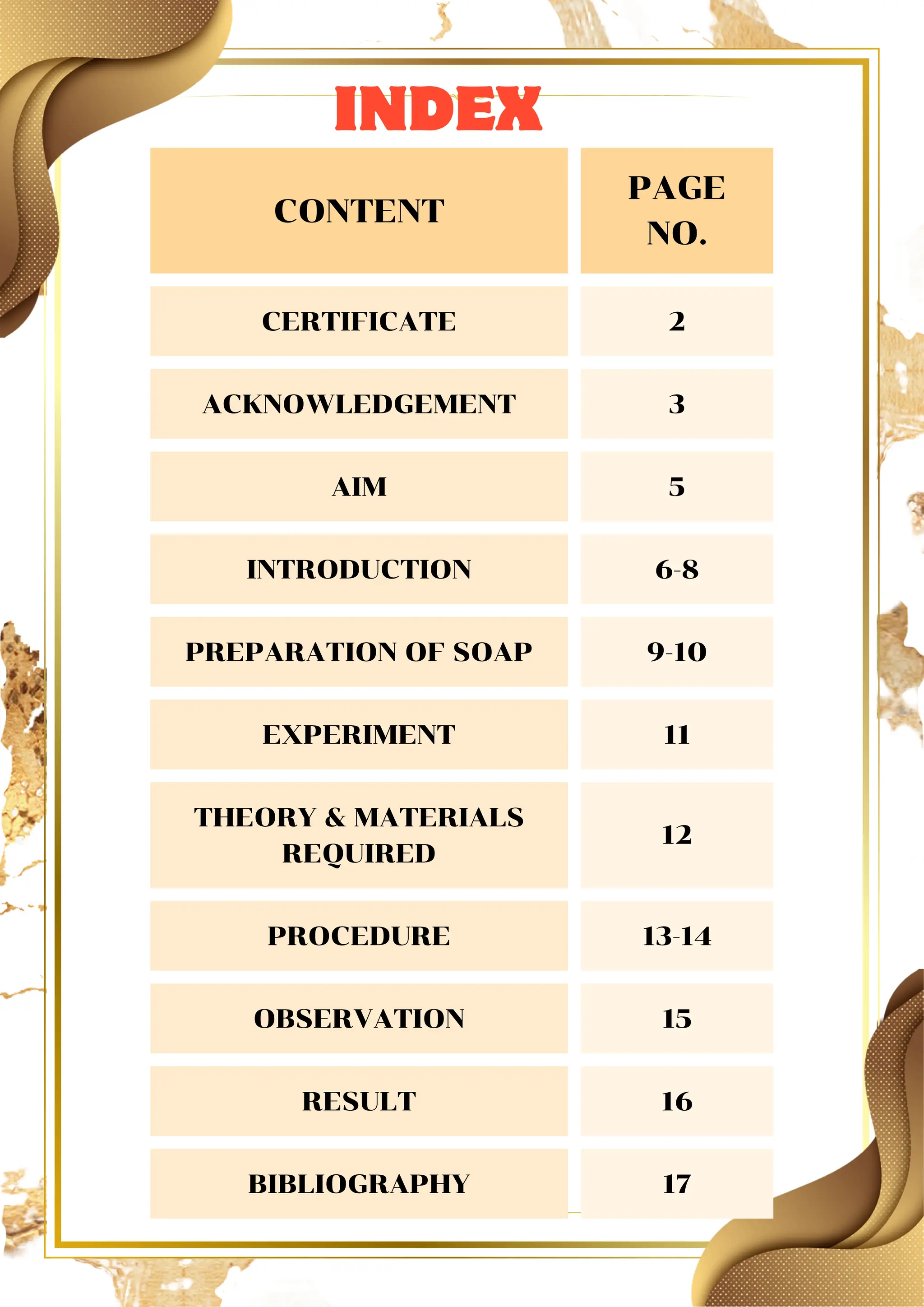
CONTENT
PAGE
NO.
CERTIFICATE 2
ACKNOWLEDGEMENT 3
AIM 5
INTRODUCTION 6-8
PREPARATION OF SOAP 9-10
EXPERIMENT 11
THEORY & MATERIALS
REQUIRED
12
PROCEDURE 13-14
OBSERVATION 15
RESULT 16
BIBLIOGRAPHY 17
INDEX
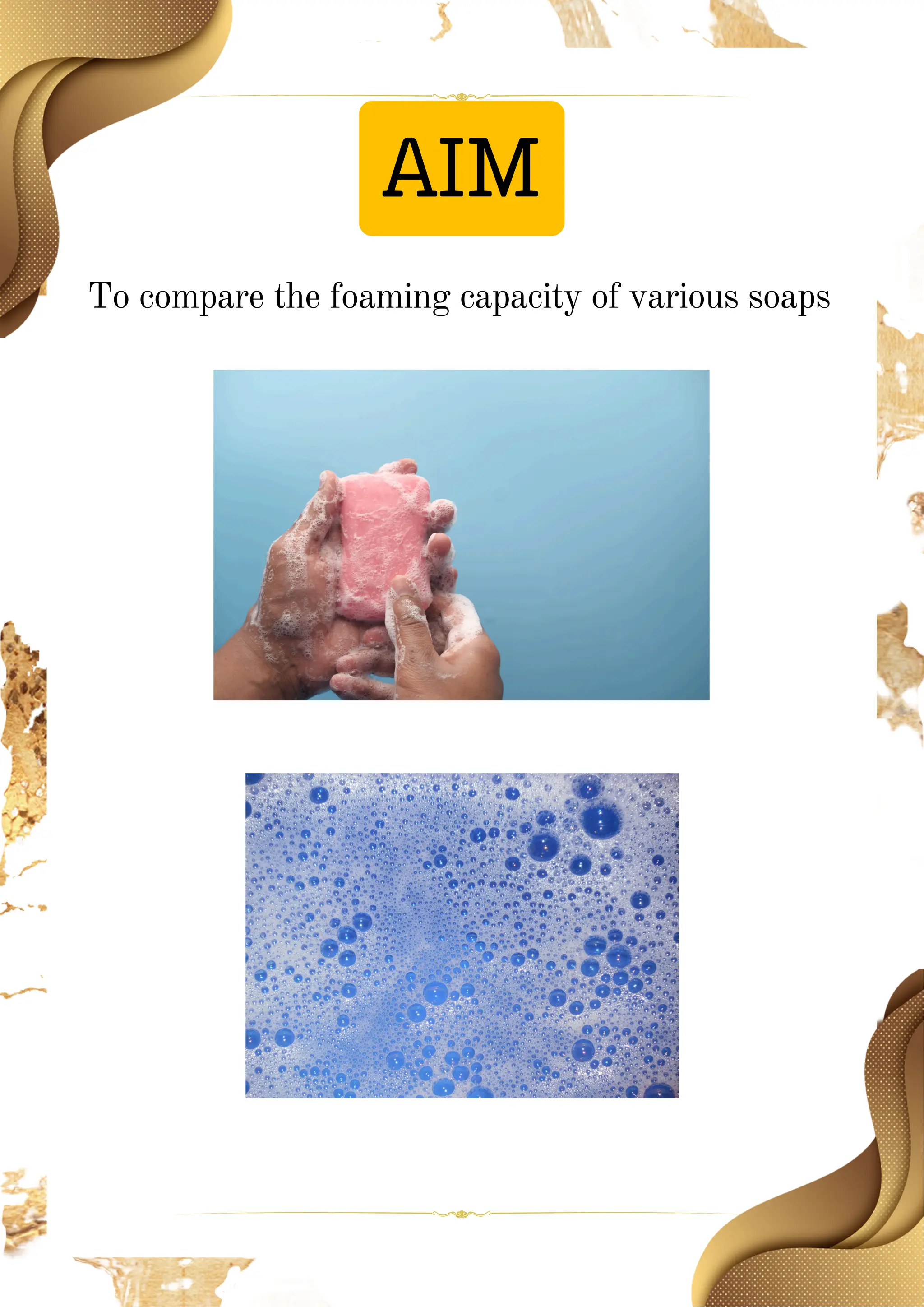
AIM
To compare the foaming capacity of various soaps
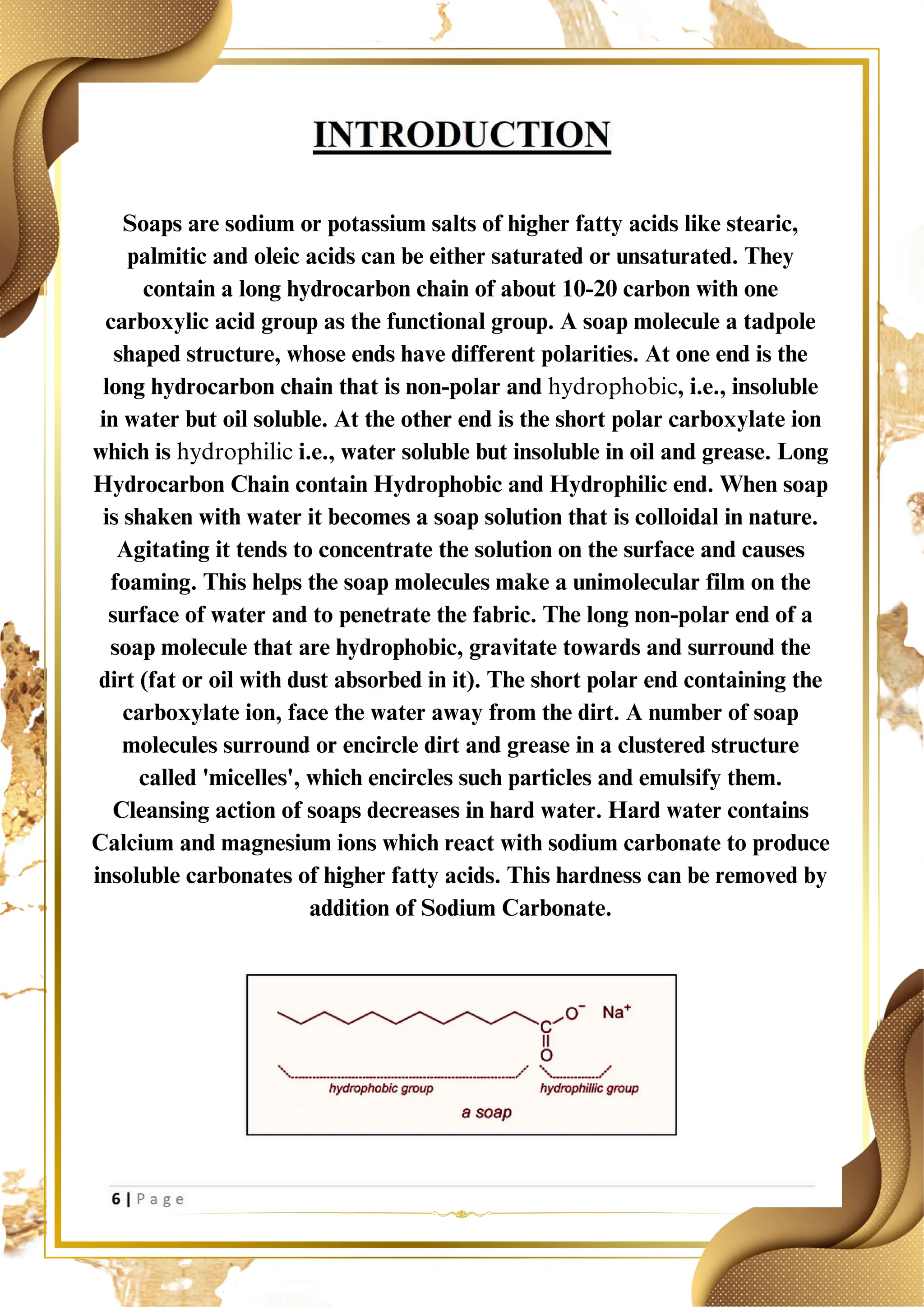
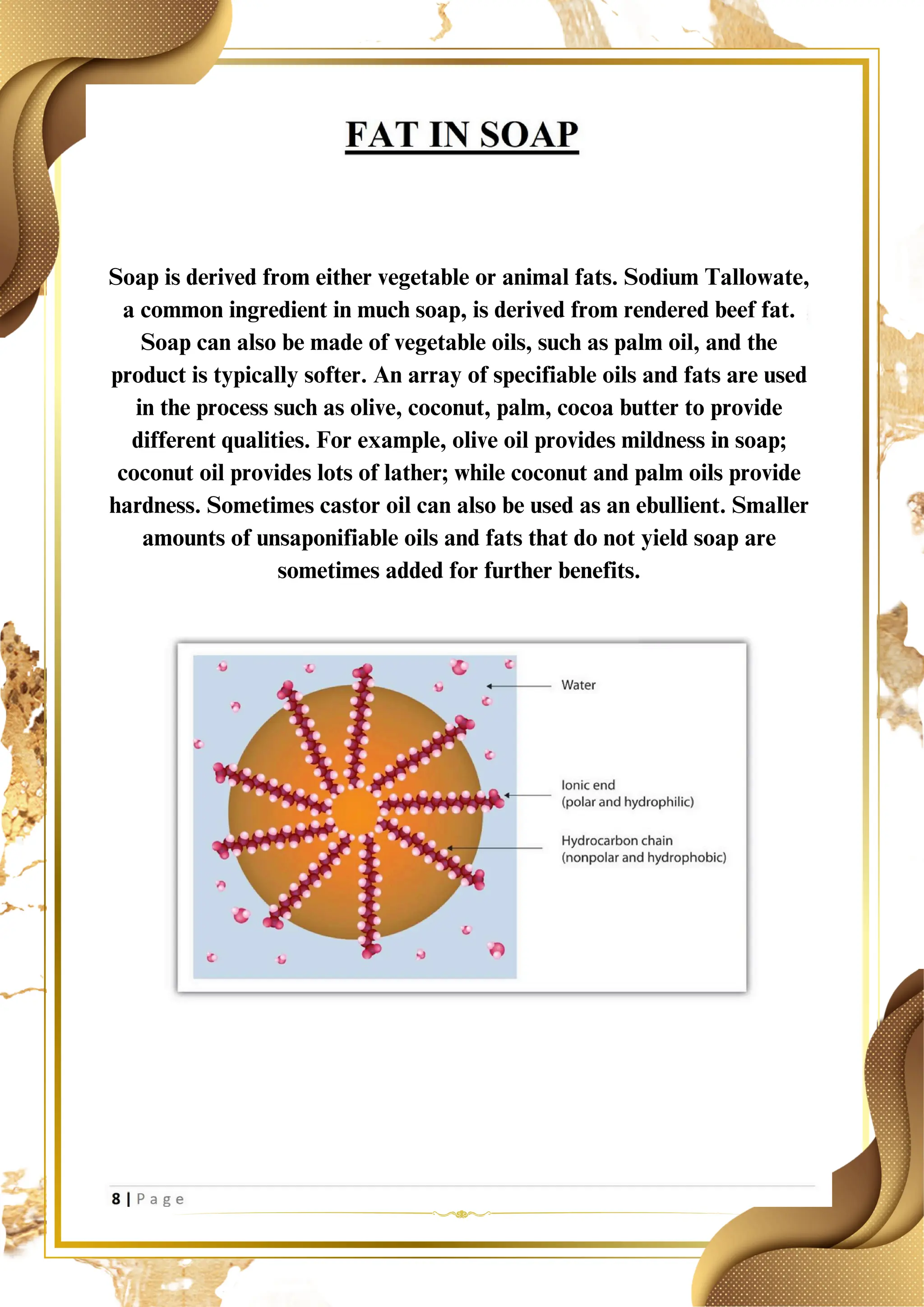
Soaps are sodium or potassium salts of higher fatty acids like stearic,
palmitic and oleic acids can be either saturated or unsaturated. They
contain a long hydrocarbon chain of about 10-20 carbon with one
carboxylic acid group as the functional group. A soap molecule a tadpole
shaped structure, whose ends have different polarities. At one end is the
long hydrocarbon chain that is non-polar and hydrophobic, i.e., insoluble
in water but oil soluble. At the other end is the short polar carboxylate ion
which is hydrophilic i.e., water soluble but insoluble in oil and grease. Long
Hydrocarbon Chain contain Hydrophobic and Hydrophilic end. When soap
is shaken with water it becomes a soap solution that is colloidal in nature.
Agitating it tends to concentrate the solution on the surface and causes
foaming. This helps the soap molecules make a unimolecular film on the
surface of water and to penetrate the fabric. The long non-polar end of a
soap molecule that are hydrophobic, gravitate towards and surround the
dirt (fat or oil with dust absorbed in it). The short polar end containing the
carboxylate ion, face the water away from the dirt. A number of soap
molecules surround or encircle dirt and grease in a clustered structure
called 'micelles', which encircles such particles and emulsify them.
Cleansing action of soaps decreases in hard water. Hard water contains
Calcium and magnesium ions which react with sodium carbonate to produce
insoluble carbonates of higher fatty acids. This hardness can be removed by
addition of Sodium Carbonate.
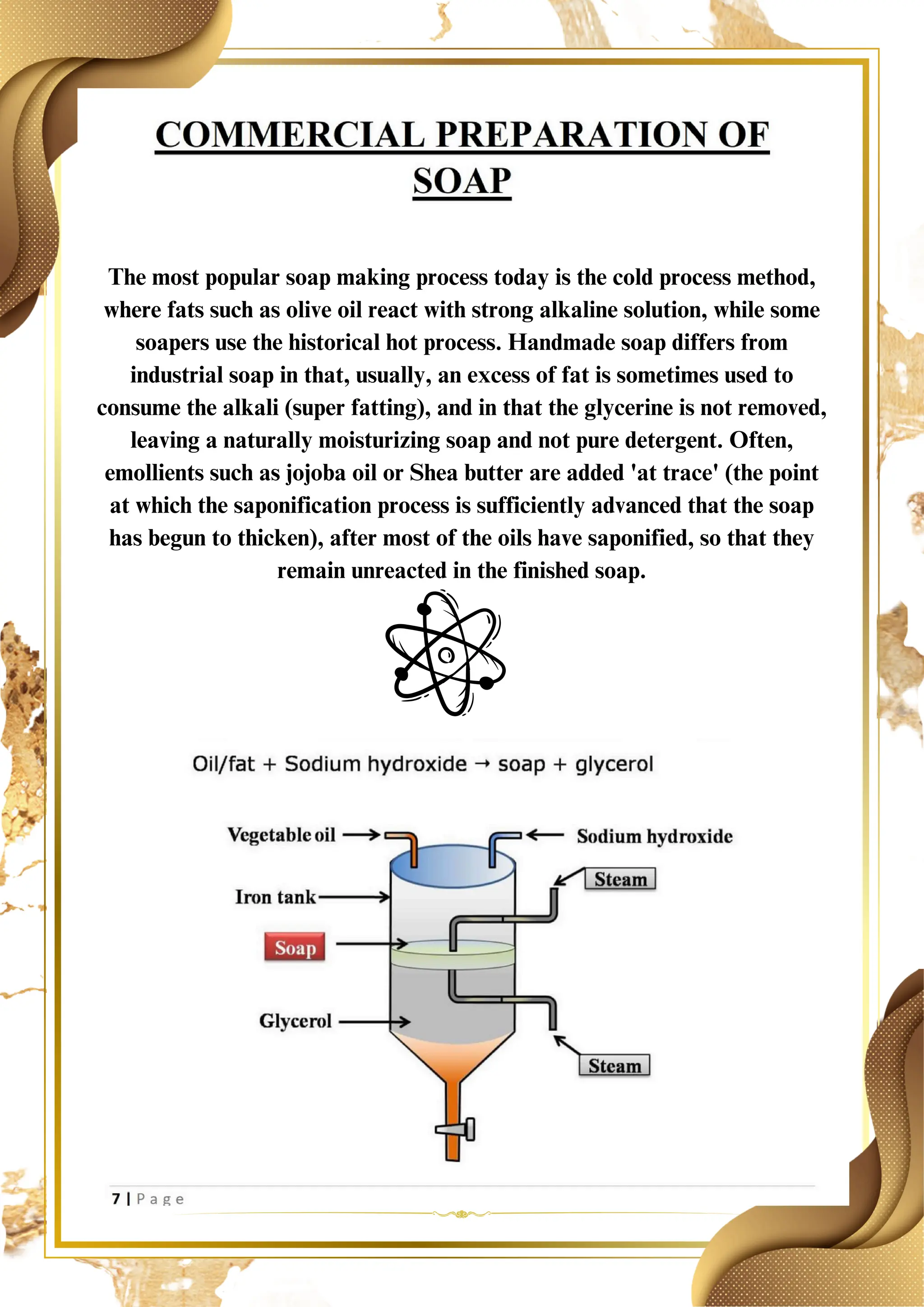
The most popular soap making process today is the cold process method,
where fats such as olive oil react with strong alkaline solution, while some
soapers use the historical hot process. Handmade soap differs from
industrial soap in that, usually, an excess of fat is sometimes used to
consume the alkali (super fatting), and in that the glycerine is not removed,
leaving a naturally moisturizing soap and not pure detergent. Often,
emollients such as jojoba oil or Shea butter are added 'at trace' (the point
at which the saponification process is sufficiently advanced that the soap
has begun to thicken), after most of the oils have saponified, so that they
remain unreacted in the finished soap.
Soap is derived from either vegetable or animal fats. Sodium Tallowate,
a common ingredient in much soap, is derived from rendered beef fat.
Soap can also be made of vegetable oils, such as palm oil, and the
product is typically softer. An array of specifiable oils and fats are used
in the process such as olive, coconut, palm, cocoa butter to provide
different qualities. For example, olive oil provides mildness in soap;
coconut oil provides lots of lather; while coconut and palm oils provide
hardness. Sometimes castor oil can also be used as an ebullient. Smaller
amounts of unsaponifiable oils and fats that do not yield soap are
sometimes added for further benefits.
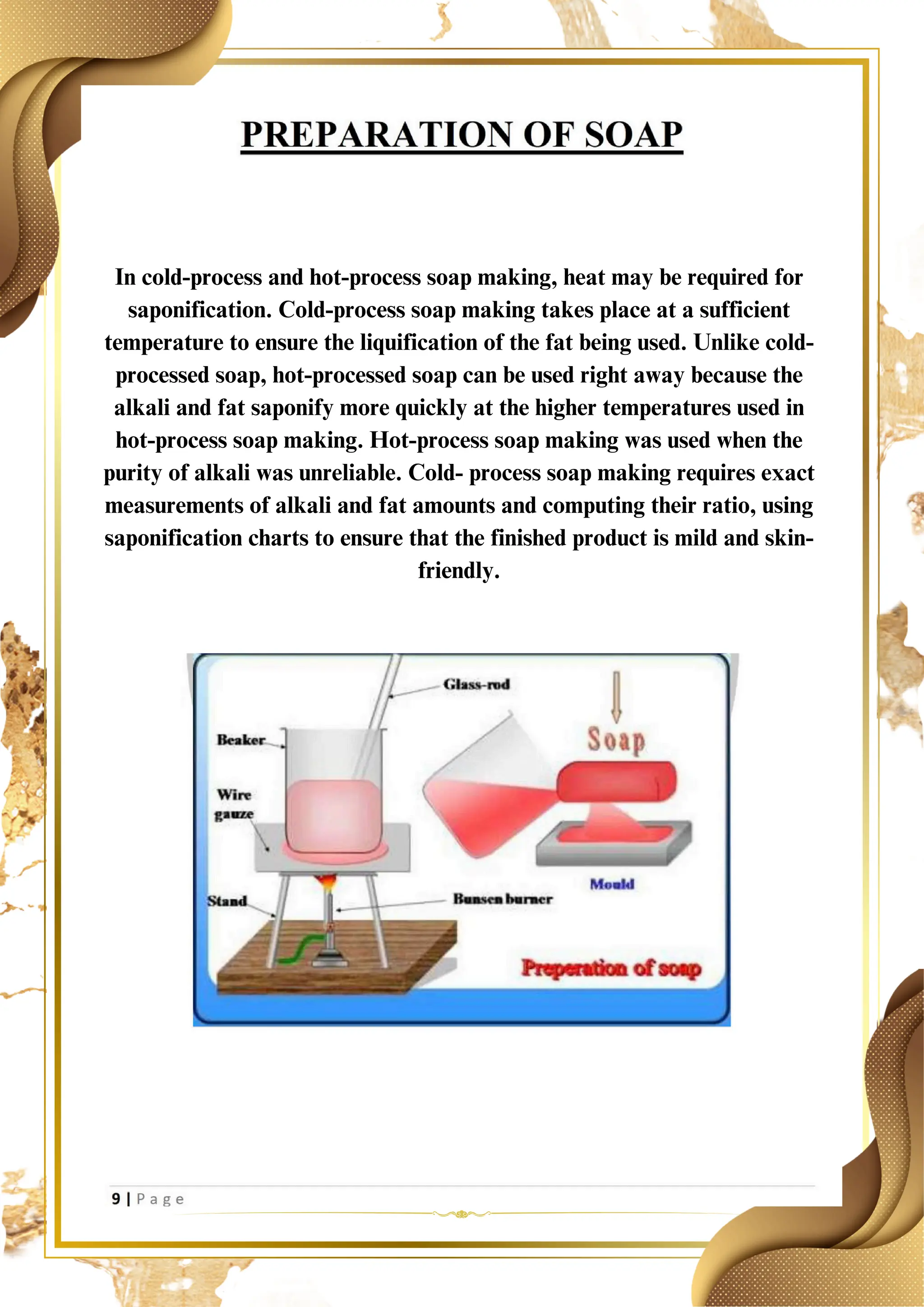
In cold-process and hot-process soap making, heat may be required for
saponification. Cold-process soap making takes place at a sufficient
temperature to ensure the liquification of the fat being used. Unlike cold-
processed soap, hot-processed soap can be used right away because the
alkali and fat saponify more quickly at the higher temperatures used in
hot-process soap making. Hot-process soap making was used when the
purity of alkali was unreliable. Cold- process soap making requires exact
measurements of alkali and fat amounts and computing their ratio, using
saponification charts to ensure that the finished product is mild and skin-
friendly.
A cold-process soap maker first looks up the saponification value
of the fats being used on a saponification chart, which is then
used to calculate the appropriate amount of alkali. Excess
unreacted alkali in the soap will result in a very high pH and can
burn or irritate skin. Not enough alkali and the soap are greasy.
The alkali is dissolved in water. Then oils are heated, or melted if
they are solid at room temperature. Once both substances have
cooled to approximately 100- 110°F (37-43°C), and are no more
than 10°F (~5.5°C) apart, they may be combined. This alkali-fat
mixture is stirred until "trace". There are varying levels of trace.
After much stirring, the mixture turns to the consistency of a thin
pudding. "Trace" corresponds roughly to viscosity. Essential and
fragrance oils are added at light trace. Samples to are taken and
their foaming capacity is noticed. Various soap samples are taken
separately and their foaming capacity is observed. The soap with
the maximum foaming capacity is thus, said to be having the best
cleaning capacity.
Cold process:
Soap samples of various brands are taken and their foaming capacity is
noticed. Various soap samples are taken separately and their foaming
capacity is observed. The soap with the maximum foaming capacity is thus,
said to be having the best cleaning capacity. The test requires to be done
with distilled water as well as with tap water. The test of soap on distilled
water gives the actual strength of the soaps cleaning capacity. The second
test with tap water tests the effect of Ca²+ and Mg²+ salts on their foaming
capacities.
Objective:
To compare the foaming capacities of various soaps
The foaming capacity of soap depends upon the nature of the soap and
its concentration. This may be compared by shaking equal volumes of
solutions of different samples having the same concentration with same
force for the same amount of time. The solutions are then allowed to
stand when the foam produced during shaking disappears gradually.
The time taken for the foam to disappear in each sample is determined.
The longer the time taken for the disappearance of the foam for the
given sample of soap, greater is its foaming capacity or cleansing
action.
Apparatus requirement:
Five 100ml conical flasks, five test tubes, 100ml measuring cylinder,
test tube stand, weighing machine, stop watch.
Chemical requirement:
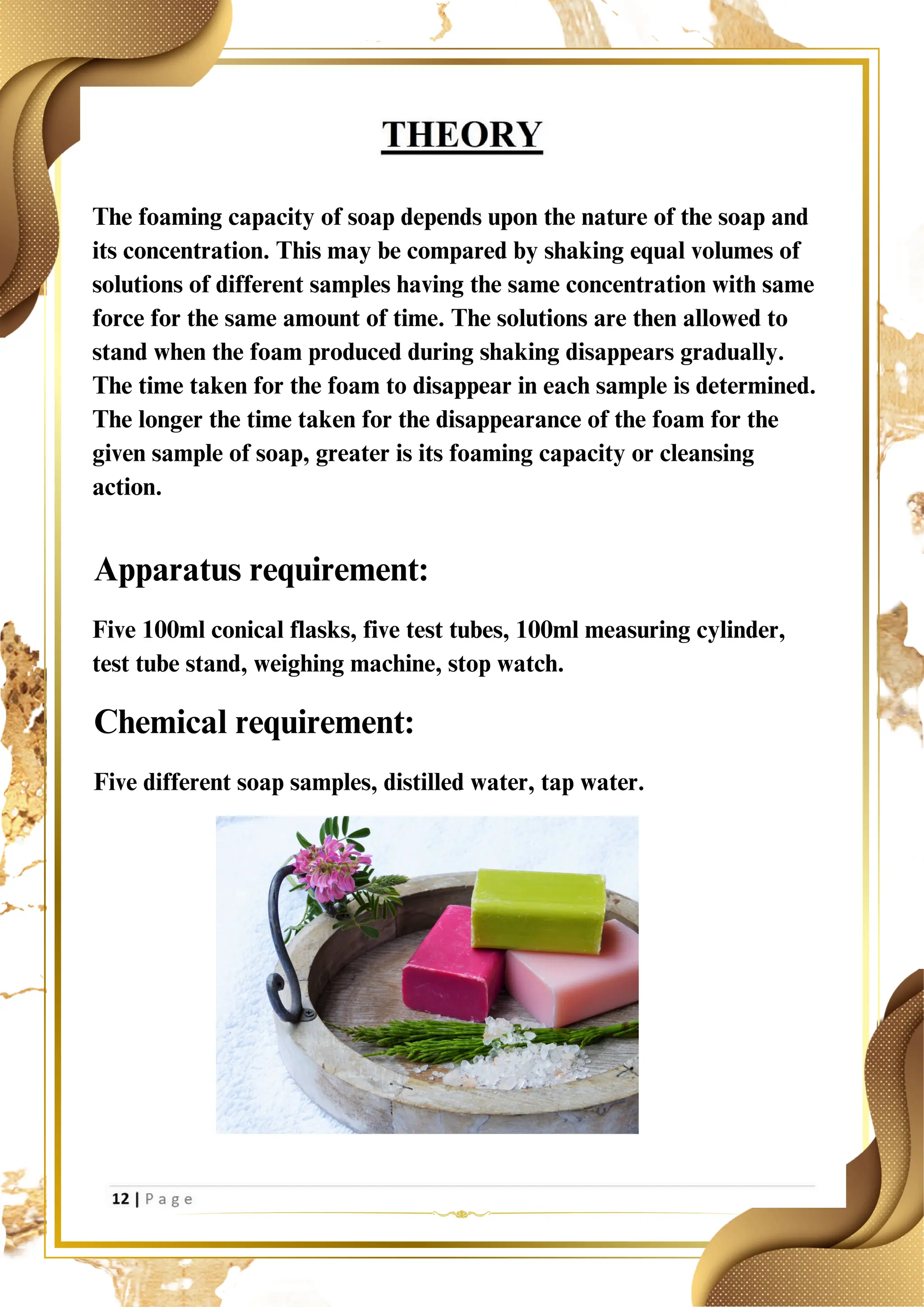
Five different soap samples, distilled water, tap water.
Five 100ml conical flasks, five test tubes, 100ml measuring
cylinder, test tube stand, weighing machine, stop watch.
1.
Warm the contents to get a solution.
2.
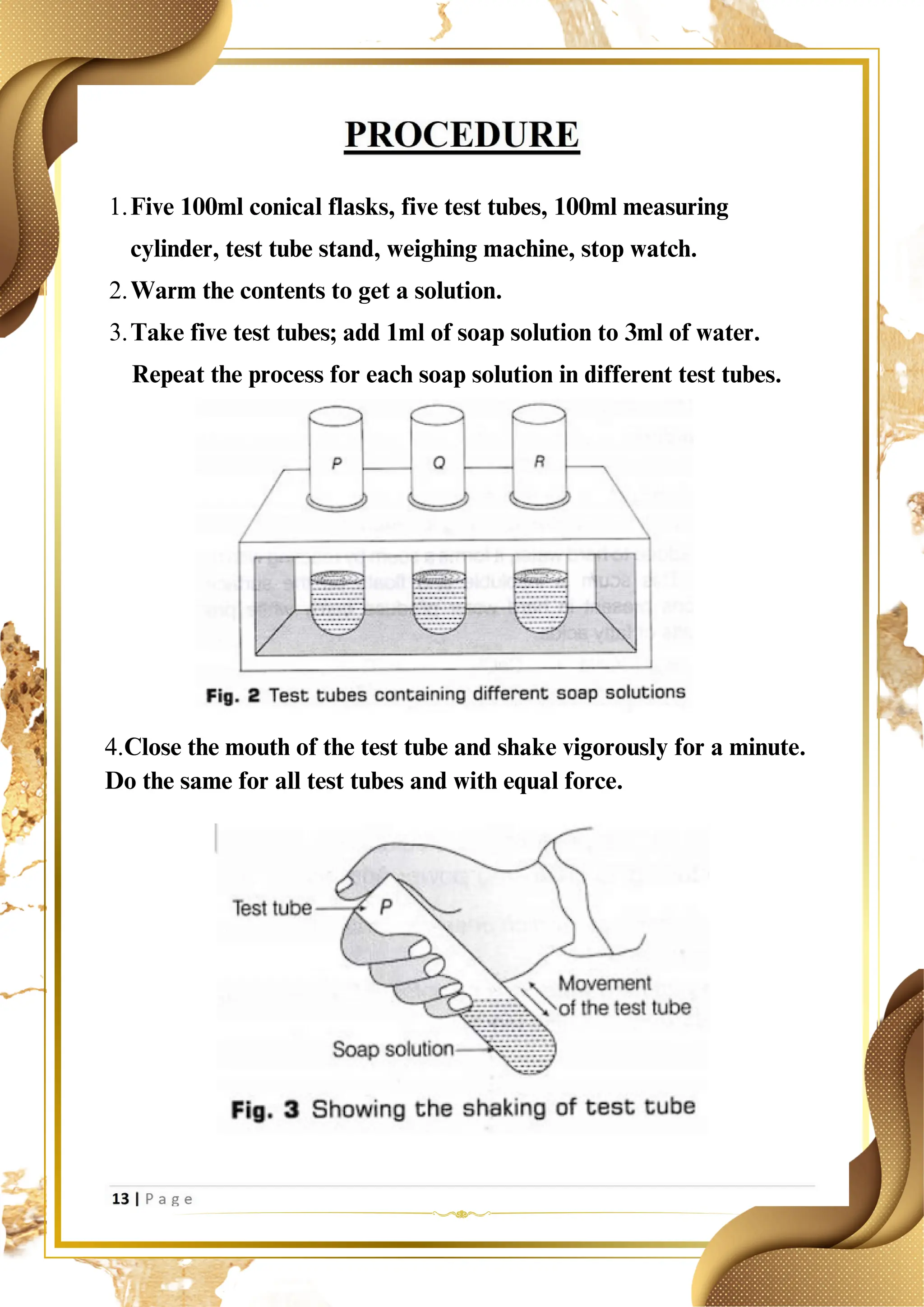
Take five test tubes; add 1ml of soap solution to 3ml of water.
3.
Repeat the process for each soap solution in different test tubes.
4.Close the mouth of the test tube and shake vigorously for a minute.
Do the same for all test tubes and with equal force.
5.Start the timer immediately and notice the rate of disappearance
of 2mm of froth.
6.Record the observation in tabular form
Test tube
no.
Volume
of
soap
solution
Volume
of
water
added
Time taken for
disappearance
(sec)
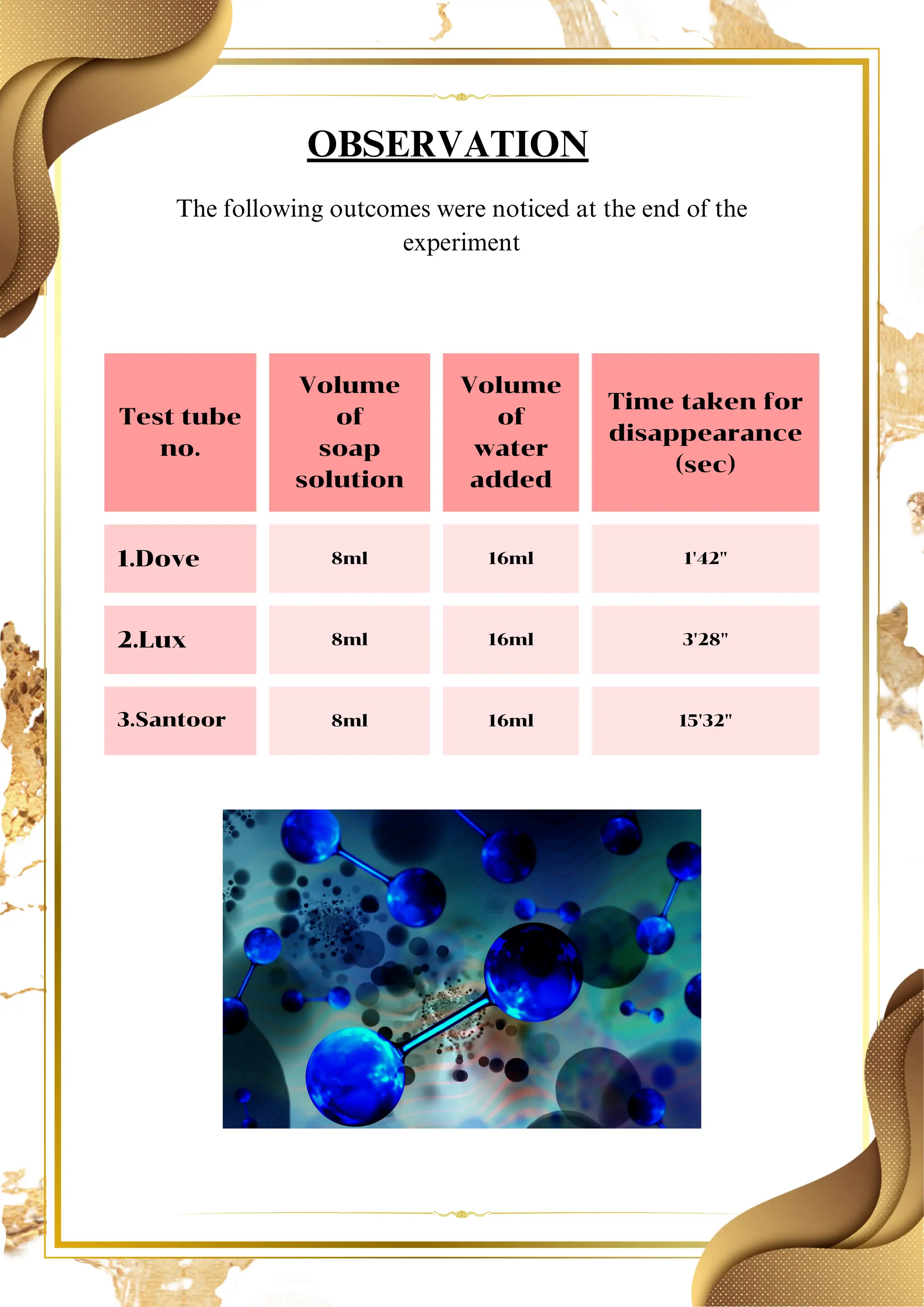
1.Dove 8ml 16ml 1'42"
2.Lux 8ml 16ml 3'28"
3.Santoor 8ml 16ml 15'32"
OBSERVATION
The following outcomes were noticed at the end of the
experiment
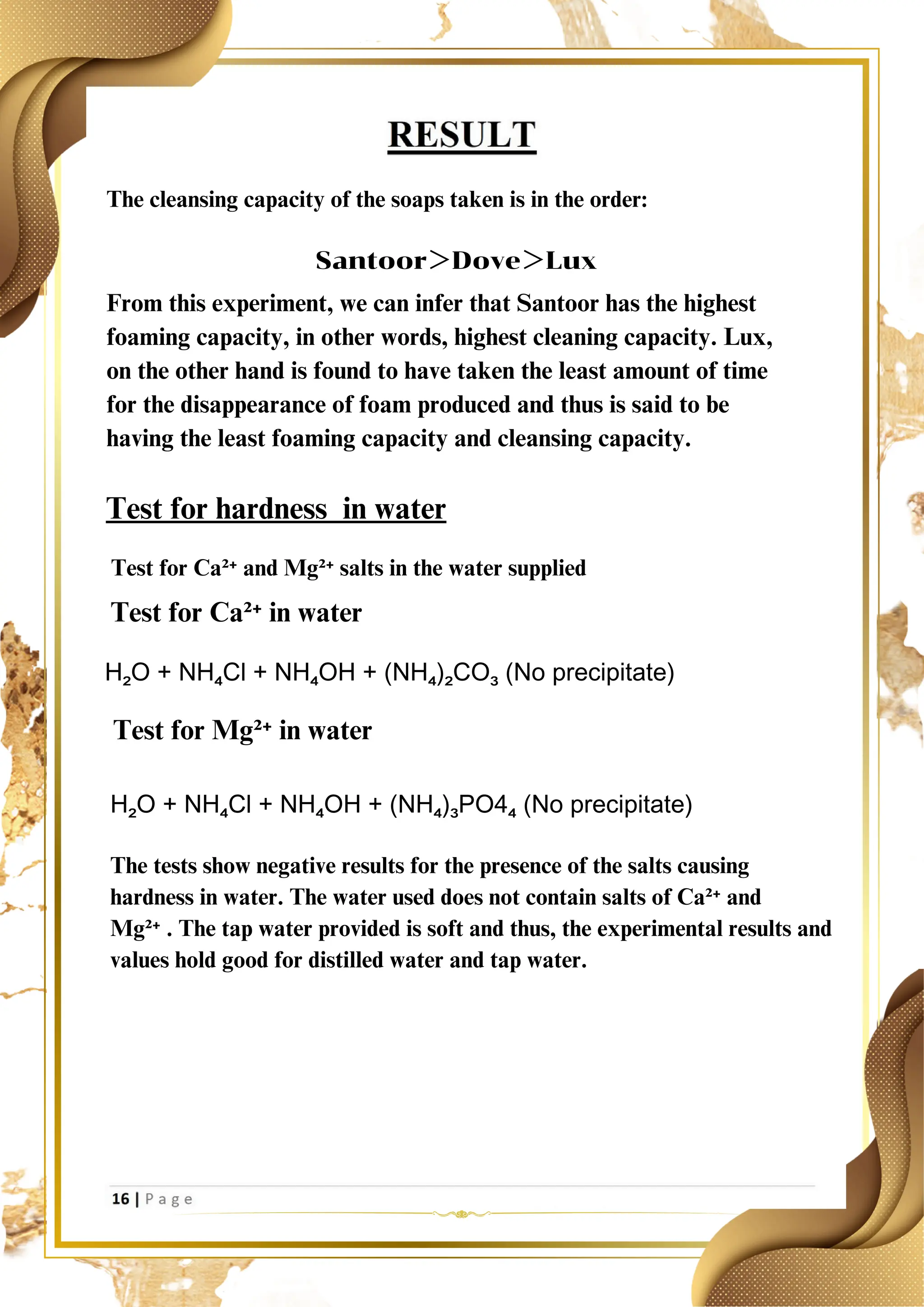
The cleansing capacity of the soaps taken is in the order:
Santoor>Dove>Lux
From this experiment, we can infer that Santoor has the highest
foaming capacity, in other words, highest cleaning capacity. Lux,
on the other hand is found to have taken the least amount of time
for the disappearance of foam produced and thus is said to be
having the least foaming capacity and cleansing capacity.
Test for hardness in water
Test for Ca²⁺ and Mg²⁺ salts in the water supplied
Test for Ca²⁺ in water
H₂O + NH₄Cl + NH₄OH + (NH₄)₂CO₃ (No precipitate)
Test for Mg²⁺ in water
H₂O + NH₄Cl + NH₄OH + (NH₄)₃PO4₄ (No precipitate)
The tests show negative results for the presence of the salts causing
hardness in water. The water used does not contain salts of Ca²⁺ and
Mg²⁺ . The tap water provided is soft and thus, the experimental results and
values hold good for distilled water and tap water.
Biblio
Bibliography
graphy
Books:
Lab Manual Chemistry-XI
Comprehensive Chemistry - 11
Internet sources:
www.wikipedia.org
www.google.com
www.yahoo.com
https://www.icbse.com

chemistry project on foaming capacity of soap class 11

  • 1.
  • 2.
    This is tocertify that HARSHIT has successfully completed her Chemistry project titled, FOAMING CAPACITY OF SOAP under the supervision and guidance of Piyali mam in the partial fulfilment of the chemistry practical assessment conducted during the academic year 2023-2024. CERTIFICATE CERTIFICATE
  • 3.
    I would liketo express my immense gratitude to my chemistry teacher Piyali mam for the help and guidance she provided for completing this project. I also thank my parents who gave gheir ideas and inputs in making this projec!. Most of all I thank our school management,for providing us the facilities and opportunity to do this project. Lastly, I would like to thanks my classmates who have done this project along with me. Their support made this project fruitful. -HARSHIT
  • 4.
    CONTENT PAGE NO. CERTIFICATE 2 ACKNOWLEDGEMENT 3 AIM5 INTRODUCTION 6-8 PREPARATION OF SOAP 9-10 EXPERIMENT 11 THEORY & MATERIALS REQUIRED 12 PROCEDURE 13-14 OBSERVATION 15 RESULT 16 BIBLIOGRAPHY 17 INDEX
  • 5.
    AIM To compare thefoaming capacity of various soaps
  • 6.
    Soaps are sodiumor potassium salts of higher fatty acids like stearic, palmitic and oleic acids can be either saturated or unsaturated. They contain a long hydrocarbon chain of about 10-20 carbon with one carboxylic acid group as the functional group. A soap molecule a tadpole shaped structure, whose ends have different polarities. At one end is the long hydrocarbon chain that is non-polar and hydrophobic, i.e., insoluble in water but oil soluble. At the other end is the short polar carboxylate ion which is hydrophilic i.e., water soluble but insoluble in oil and grease. Long Hydrocarbon Chain contain Hydrophobic and Hydrophilic end. When soap is shaken with water it becomes a soap solution that is colloidal in nature. Agitating it tends to concentrate the solution on the surface and causes foaming. This helps the soap molecules make a unimolecular film on the surface of water and to penetrate the fabric. The long non-polar end of a soap molecule that are hydrophobic, gravitate towards and surround the dirt (fat or oil with dust absorbed in it). The short polar end containing the carboxylate ion, face the water away from the dirt. A number of soap molecules surround or encircle dirt and grease in a clustered structure called 'micelles', which encircles such particles and emulsify them. Cleansing action of soaps decreases in hard water. Hard water contains Calcium and magnesium ions which react with sodium carbonate to produce insoluble carbonates of higher fatty acids. This hardness can be removed by addition of Sodium Carbonate.
  • 7.
    The most popularsoap making process today is the cold process method, where fats such as olive oil react with strong alkaline solution, while some soapers use the historical hot process. Handmade soap differs from industrial soap in that, usually, an excess of fat is sometimes used to consume the alkali (super fatting), and in that the glycerine is not removed, leaving a naturally moisturizing soap and not pure detergent. Often, emollients such as jojoba oil or Shea butter are added 'at trace' (the point at which the saponification process is sufficiently advanced that the soap has begun to thicken), after most of the oils have saponified, so that they remain unreacted in the finished soap.
  • 8.
    Soap is derivedfrom either vegetable or animal fats. Sodium Tallowate, a common ingredient in much soap, is derived from rendered beef fat. Soap can also be made of vegetable oils, such as palm oil, and the product is typically softer. An array of specifiable oils and fats are used in the process such as olive, coconut, palm, cocoa butter to provide different qualities. For example, olive oil provides mildness in soap; coconut oil provides lots of lather; while coconut and palm oils provide hardness. Sometimes castor oil can also be used as an ebullient. Smaller amounts of unsaponifiable oils and fats that do not yield soap are sometimes added for further benefits.
  • 9.
    In cold-process andhot-process soap making, heat may be required for saponification. Cold-process soap making takes place at a sufficient temperature to ensure the liquification of the fat being used. Unlike cold- processed soap, hot-processed soap can be used right away because the alkali and fat saponify more quickly at the higher temperatures used in hot-process soap making. Hot-process soap making was used when the purity of alkali was unreliable. Cold- process soap making requires exact measurements of alkali and fat amounts and computing their ratio, using saponification charts to ensure that the finished product is mild and skin- friendly.
  • 10.
    A cold-process soapmaker first looks up the saponification value of the fats being used on a saponification chart, which is then used to calculate the appropriate amount of alkali. Excess unreacted alkali in the soap will result in a very high pH and can burn or irritate skin. Not enough alkali and the soap are greasy. The alkali is dissolved in water. Then oils are heated, or melted if they are solid at room temperature. Once both substances have cooled to approximately 100- 110°F (37-43°C), and are no more than 10°F (~5.5°C) apart, they may be combined. This alkali-fat mixture is stirred until "trace". There are varying levels of trace. After much stirring, the mixture turns to the consistency of a thin pudding. "Trace" corresponds roughly to viscosity. Essential and fragrance oils are added at light trace. Samples to are taken and their foaming capacity is noticed. Various soap samples are taken separately and their foaming capacity is observed. The soap with the maximum foaming capacity is thus, said to be having the best cleaning capacity. Cold process:
  • 11.
    Soap samples ofvarious brands are taken and their foaming capacity is noticed. Various soap samples are taken separately and their foaming capacity is observed. The soap with the maximum foaming capacity is thus, said to be having the best cleaning capacity. The test requires to be done with distilled water as well as with tap water. The test of soap on distilled water gives the actual strength of the soaps cleaning capacity. The second test with tap water tests the effect of Ca²+ and Mg²+ salts on their foaming capacities. Objective: To compare the foaming capacities of various soaps
  • 12.
    The foaming capacityof soap depends upon the nature of the soap and its concentration. This may be compared by shaking equal volumes of solutions of different samples having the same concentration with same force for the same amount of time. The solutions are then allowed to stand when the foam produced during shaking disappears gradually. The time taken for the foam to disappear in each sample is determined. The longer the time taken for the disappearance of the foam for the given sample of soap, greater is its foaming capacity or cleansing action. Apparatus requirement: Five 100ml conical flasks, five test tubes, 100ml measuring cylinder, test tube stand, weighing machine, stop watch. Chemical requirement: Five different soap samples, distilled water, tap water.
  • 13.
    Five 100ml conicalflasks, five test tubes, 100ml measuring cylinder, test tube stand, weighing machine, stop watch. 1. Warm the contents to get a solution. 2. Take five test tubes; add 1ml of soap solution to 3ml of water. 3. Repeat the process for each soap solution in different test tubes. 4.Close the mouth of the test tube and shake vigorously for a minute. Do the same for all test tubes and with equal force.
  • 14.
    5.Start the timerimmediately and notice the rate of disappearance of 2mm of froth. 6.Record the observation in tabular form
  • 15.
    Test tube no. Volume of soap solution Volume of water added Time takenfor disappearance (sec) 1.Dove 8ml 16ml 1'42" 2.Lux 8ml 16ml 3'28" 3.Santoor 8ml 16ml 15'32" OBSERVATION The following outcomes were noticed at the end of the experiment
  • 16.
    The cleansing capacityof the soaps taken is in the order: Santoor>Dove>Lux From this experiment, we can infer that Santoor has the highest foaming capacity, in other words, highest cleaning capacity. Lux, on the other hand is found to have taken the least amount of time for the disappearance of foam produced and thus is said to be having the least foaming capacity and cleansing capacity. Test for hardness in water Test for Ca²⁺ and Mg²⁺ salts in the water supplied Test for Ca²⁺ in water H₂O + NH₄Cl + NH₄OH + (NH₄)₂CO₃ (No precipitate) Test for Mg²⁺ in water H₂O + NH₄Cl + NH₄OH + (NH₄)₃PO4₄ (No precipitate) The tests show negative results for the presence of the salts causing hardness in water. The water used does not contain salts of Ca²⁺ and Mg²⁺ . The tap water provided is soft and thus, the experimental results and values hold good for distilled water and tap water.
  • 17.
    Biblio Bibliography graphy Books: Lab Manual Chemistry-XI ComprehensiveChemistry - 11 Internet sources: www.wikipedia.org www.google.com www.yahoo.com https://www.icbse.com