Lean Startup Victoria
This meetup is not about how to write a business plan. The end result is not a PowerPoint slide deck for a VC presentation.
Instead, we want to get our hands dirty talking to customers, partners, and competitors to leap into the chaos and uncertainly of how a startup actually works.
We’ll learn how to use  a  business model  to brainstorm each part of a company,  customer development  to get out of the building and see whether anyone would want and use your product, and  agile development  to help us rapidly iterate our products into something customers will use and buy.
The goal is to have a  validated  business model that can bootstrap profitably or raise capital
Engineering 245 The Lean LaunchPad Session 1: Overview/Business Models/Customer Development Professors Steve Blank, Ann Miura-Ko, Jon Feiber http://e245.stanford.edu/
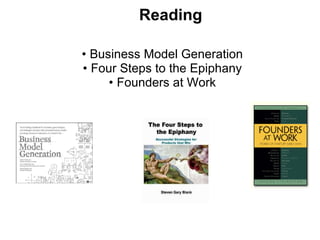
Reading Business Model Generation Four Steps to the Epiphany Founders at Work
How to Build A Startup Idea Size Opportunity Business Model Customer Development
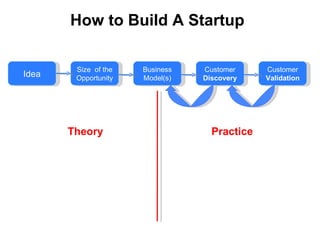
How to Build A Startup Idea Size  of the Opportunity Business Model(s) Customer  Discovery Customer  Validation Theory Practice
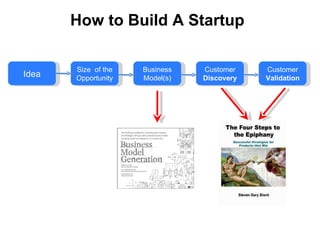
How to Build A Startup Idea Size  of the Opportunity Business Model(s) Customer  Discovery Customer  Validation
An Idea is _Not_ a  Company
Size of Opportunity
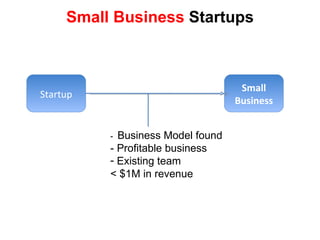
Small Business  Startups Small Business Startup -  Business Model found - Profitable business Existing team < $1M in revenue
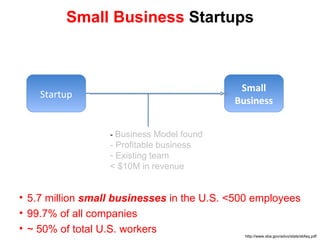
Small Business  Startups -  Business Model found - Profitable business Existing team < $10M in revenue 5.7 million  small businesses  in the U.S. <500 employees 99.7% of all companies ~ 50% of total U.S. workers http://www.sba.gov/advo/stats/sbfaq.pdf Small Business Startup
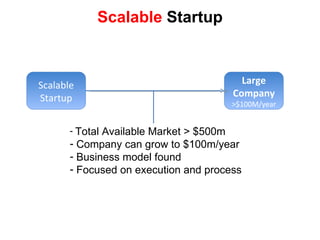
Scalable  Startup Scalable Startup Large Company >$100M/year Total Available Market > $500m Company can grow to $100m/year Business model found Focused on execution and process
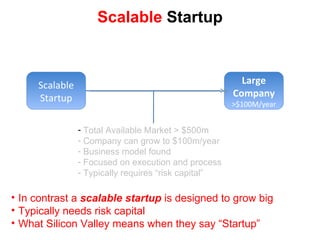
Scalable  Startup Scalable Startup Large Company >$100M/year Total Available Market > $500m Company can grow to $100m/year Business model found Focused on execution and process Typically requires “risk capital” In contrast a  scalable startup  is designed to grow big Typically needs risk capital What Silicon Valley means when they say “Startup”
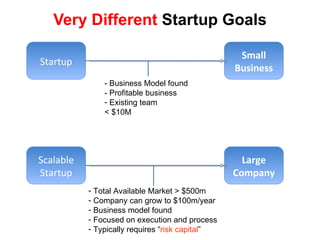
Very Different  Startup Goals Small Business Startup - Business Model found - Profitable business Existing team < $10M Scalable Startup Large Company Total Available Market > $500m Company can grow to $100m/year Business model found Focused on execution and process Typically requires “ risk capital ”
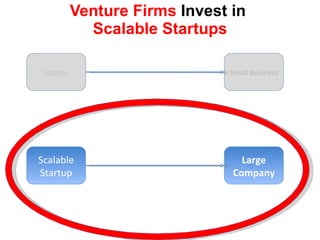
Venture Firms  Invest in  Scalable Startups Small Business Startup Scalable Startup Large Company
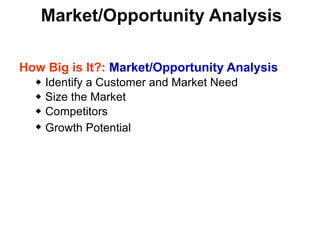
Market/Opportunity Analysis How Big is It?:  Market/Opportunity Analysis Identify a Customer and Market Need Size the Market Competitors Growth Potential
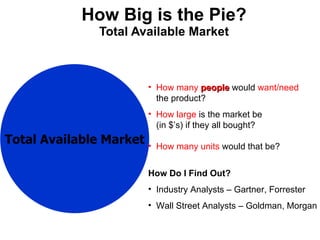
How Big is the Pie? Total Available Market Total Available Market How many   people  would  want/need   the product? How large  is the market be  (in $ ’s) if they all bought? How many units  would that be? How Do I Find Out? Industry Analysts – Gartner, Forrester Wall Street Analysts – Goldman, Morgan
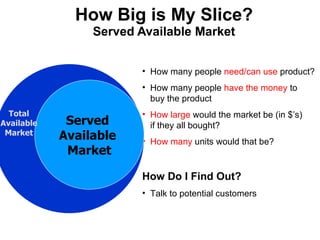
How Big is My Slice? Served Available Market How many people  need/can use  product? How many people  have the money  to  buy the product  How large  would the market be (in $ ’s)  if they all bought? How many  units would that be? How Do I Find Out? Talk to potential customers Served  Available  Market Total Available Market
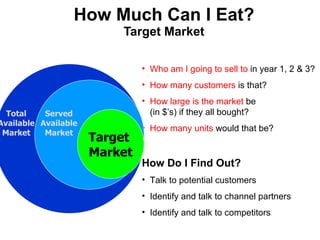
How Much Can I Eat? Target Market Who am I going to sell to  in year 1, 2 & 3?  How many customers  is that? How large   is the market  be  (in $ ’s) if they all bought? How many units  would that be? How Do I Find Out? Talk to potential customers Identify and talk to channel partners Identify and talk to competitors Total Available Market Target  Market Served Available Market
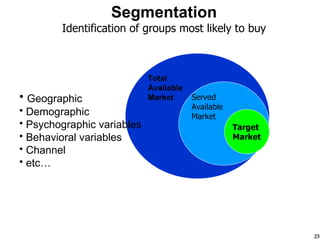
Segmentation Identification of groups most likely to buy Target  Market Geographic Demographic Psychographic variables Behavioral variables Channel etc… Total Available Market Served Available Market
Market Size: Summary Market Size Questions: How big can this market be?  How much of it can we get? Market growth rate Market structure (Mature or in flux?) Most important : Talk to Customers and Sales Channel Next important: Market size by competitive approximation Wall Street analyst reports are great And :  Market research firms  Like Forester, Gartner
Business Model
What Is a Business  Model ? Diagram  of flows between company and customers Scorecard  of hypotheses testing Rapid change  with each iteration and pivot Founder- driven * Alex Osterwalder
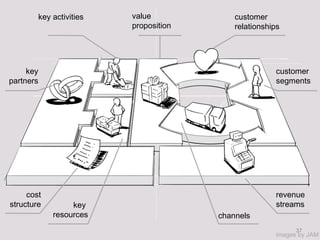
9 building blocks  of a business model:
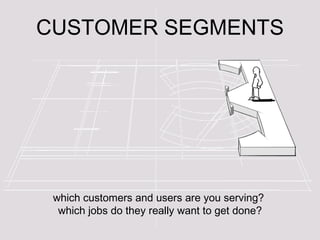
CUSTOMER SEGMENTS which customers and users are you serving?  which jobs do they really want to get done?
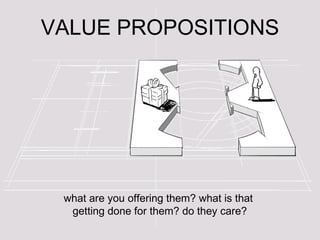
VALUE PROPOSITIONS what are you offering them? what is that  getting done for them? do they care?
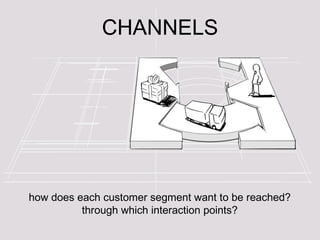
CHANNELS how does each customer segment want to be reached? through which interaction points?
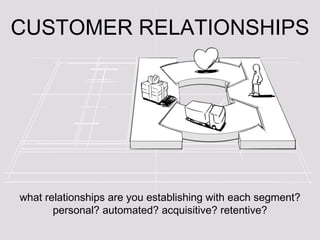
CUSTOMER RELATIONSHIPS what relationships are you establishing with each segment? personal? automated? acquisitive? retentive?
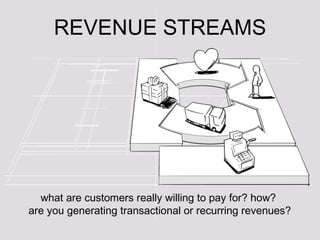
REVENUE STREAMS what are customers really willing to pay for? how?  are you generating transactional or recurring revenues?
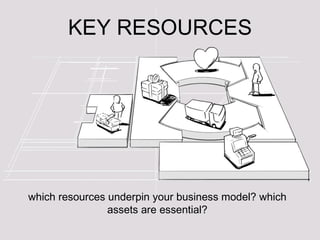
KEY RESOURCES which resources underpin your business model? which assets are essential?
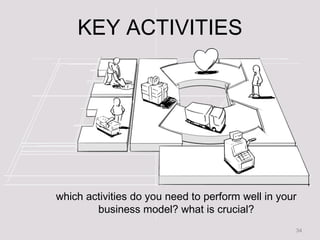
KEY ACTIVITIES which activities do you need to perform well in your business model? what is crucial?
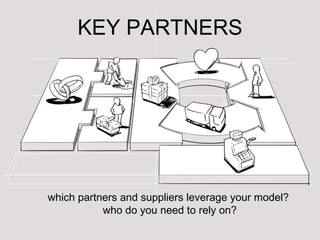
KEY PARTNERS which partners and suppliers leverage your model?  who do you need to rely on?
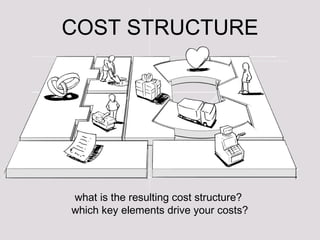
COST STRUCTURE what is the resulting cost structure?  which key elements drive your costs?
images by JAM customer segments key partners cost structure revenue streams channels customer relationships key activities key  resources value proposition
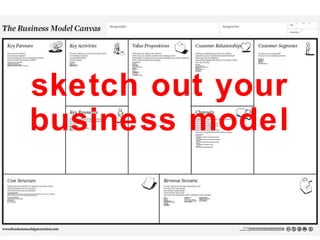
sketch out your business model
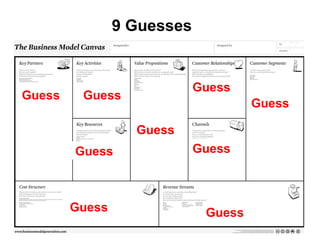
9 Guesses Guess Guess Guess Guess Guess Guess Guess Guess Guess
But, Realize They ’re Hypotheses
More startups  fail from  a lack of customers  than from a failure of product development (focus on “who” more than “what”)
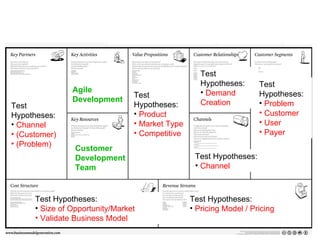
Test Hypotheses: Problem Customer User Payer Test Hypotheses: Demand Creation Test Hypotheses: Channel Test Hypotheses: Product Market Type Competitive Test Hypotheses: Pricing Model / Pricing Test Hypotheses: Size of Opportunity/Market Validate Business Model Test Hypotheses: Channel (Customer) (Problem) Customer Development Team Agile Development
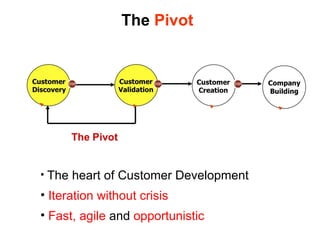
The  Pivot The heart of Customer Development Iteration without crisis Fast, agile  and  opportunistic

Lean startup Victoria 01 Introduction to Lean Startup

  • 1.
  • 2.
    This meetup isnot about how to write a business plan. The end result is not a PowerPoint slide deck for a VC presentation.
  • 3.
    Instead, we wantto get our hands dirty talking to customers, partners, and competitors to leap into the chaos and uncertainly of how a startup actually works.
  • 4.
    We’ll learn howto use a business model to brainstorm each part of a company, customer development to get out of the building and see whether anyone would want and use your product, and agile development to help us rapidly iterate our products into something customers will use and buy.
  • 5.
    The goal isto have a validated business model that can bootstrap profitably or raise capital
  • 6.
    Engineering 245 TheLean LaunchPad Session 1: Overview/Business Models/Customer Development Professors Steve Blank, Ann Miura-Ko, Jon Feiber http://e245.stanford.edu/
  • 7.
    Reading Business ModelGeneration Four Steps to the Epiphany Founders at Work
  • 8.
    How to BuildA Startup Idea Size Opportunity Business Model Customer Development
  • 9.
    How to BuildA Startup Idea Size of the Opportunity Business Model(s) Customer Discovery Customer Validation Theory Practice
  • 10.
    How to BuildA Startup Idea Size of the Opportunity Business Model(s) Customer Discovery Customer Validation
  • 11.
    An Idea is_Not_ a Company
  • 12.
  • 13.
    Small Business Startups Small Business Startup - Business Model found - Profitable business Existing team < $1M in revenue
  • 14.
    Small Business Startups - Business Model found - Profitable business Existing team < $10M in revenue 5.7 million small businesses in the U.S. <500 employees 99.7% of all companies ~ 50% of total U.S. workers http://www.sba.gov/advo/stats/sbfaq.pdf Small Business Startup
  • 15.
    Scalable StartupScalable Startup Large Company >$100M/year Total Available Market > $500m Company can grow to $100m/year Business model found Focused on execution and process
  • 16.
    Scalable StartupScalable Startup Large Company >$100M/year Total Available Market > $500m Company can grow to $100m/year Business model found Focused on execution and process Typically requires “risk capital” In contrast a scalable startup is designed to grow big Typically needs risk capital What Silicon Valley means when they say “Startup”
  • 17.
    Very Different Startup Goals Small Business Startup - Business Model found - Profitable business Existing team < $10M Scalable Startup Large Company Total Available Market > $500m Company can grow to $100m/year Business model found Focused on execution and process Typically requires “ risk capital ”
  • 18.
    Venture Firms Invest in Scalable Startups Small Business Startup Scalable Startup Large Company
  • 19.
    Market/Opportunity Analysis HowBig is It?: Market/Opportunity Analysis Identify a Customer and Market Need Size the Market Competitors Growth Potential
  • 20.
    How Big isthe Pie? Total Available Market Total Available Market How many people would want/need the product? How large is the market be (in $ ’s) if they all bought? How many units would that be? How Do I Find Out? Industry Analysts – Gartner, Forrester Wall Street Analysts – Goldman, Morgan
  • 21.
    How Big isMy Slice? Served Available Market How many people need/can use product? How many people have the money to buy the product How large would the market be (in $ ’s) if they all bought? How many units would that be? How Do I Find Out? Talk to potential customers Served Available Market Total Available Market
  • 22.
    How Much CanI Eat? Target Market Who am I going to sell to in year 1, 2 & 3? How many customers is that? How large is the market be (in $ ’s) if they all bought? How many units would that be? How Do I Find Out? Talk to potential customers Identify and talk to channel partners Identify and talk to competitors Total Available Market Target Market Served Available Market
  • 23.
    Segmentation Identification ofgroups most likely to buy Target Market Geographic Demographic Psychographic variables Behavioral variables Channel etc… Total Available Market Served Available Market
  • 24.
    Market Size: SummaryMarket Size Questions: How big can this market be? How much of it can we get? Market growth rate Market structure (Mature or in flux?) Most important : Talk to Customers and Sales Channel Next important: Market size by competitive approximation Wall Street analyst reports are great And : Market research firms Like Forester, Gartner
  • 25.
  • 26.
    What Is aBusiness Model ? Diagram of flows between company and customers Scorecard of hypotheses testing Rapid change with each iteration and pivot Founder- driven * Alex Osterwalder
  • 27.
    9 building blocks of a business model:
  • 28.
    CUSTOMER SEGMENTS whichcustomers and users are you serving? which jobs do they really want to get done?
  • 29.
    VALUE PROPOSITIONS whatare you offering them? what is that getting done for them? do they care?
  • 30.
    CHANNELS how doeseach customer segment want to be reached? through which interaction points?
  • 31.
    CUSTOMER RELATIONSHIPS whatrelationships are you establishing with each segment? personal? automated? acquisitive? retentive?
  • 32.
    REVENUE STREAMS whatare customers really willing to pay for? how? are you generating transactional or recurring revenues?
  • 33.
    KEY RESOURCES whichresources underpin your business model? which assets are essential?
  • 34.
    KEY ACTIVITIES whichactivities do you need to perform well in your business model? what is crucial?
  • 35.
    KEY PARTNERS whichpartners and suppliers leverage your model? who do you need to rely on?
  • 36.
    COST STRUCTURE whatis the resulting cost structure? which key elements drive your costs?
  • 37.
    images by JAMcustomer segments key partners cost structure revenue streams channels customer relationships key activities key resources value proposition
  • 38.
    sketch out yourbusiness model
  • 39.
    9 Guesses GuessGuess Guess Guess Guess Guess Guess Guess Guess
  • 40.
    But, Realize They’re Hypotheses
  • 41.
    More startups fail from a lack of customers than from a failure of product development (focus on “who” more than “what”)
  • 42.
    Test Hypotheses: ProblemCustomer User Payer Test Hypotheses: Demand Creation Test Hypotheses: Channel Test Hypotheses: Product Market Type Competitive Test Hypotheses: Pricing Model / Pricing Test Hypotheses: Size of Opportunity/Market Validate Business Model Test Hypotheses: Channel (Customer) (Problem) Customer Development Team Agile Development
  • 43.
    The PivotThe heart of Customer Development Iteration without crisis Fast, agile and opportunistic