Which of the following civil liberties would you be most willing to sacrifice in the interest of promoting national security?  Freedom of speech Freedom of the press Freedom to carry a firearm/gun Freedom of assembly None of the above
Civil Liberties Dr. Christopher S. Rice
Civil Liberties Individuals’ freedoms and legal protections that cannot be denied or hindered by the actions of government.
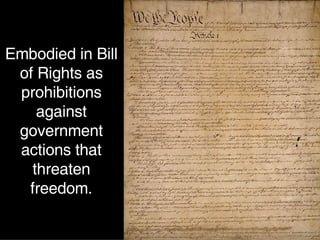
Embodied in Bill of Rights as prohibitions against government actions that threaten freedom.
Liberties in the Constitution Writ of  Habeas Corpus Prohibition on  Bills of Attainder Prohibition on  ex post facto  laws Prohibition on states from  impairing the obligation of contracts .
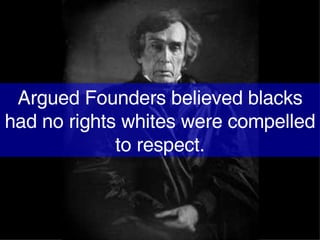
Dred Scott v. Sandford (1857)
Rights of Property in Human Beings
Argued Founders believed blacks had no rights whites were compelled to respect.
The Fourteenth Amendment, preventing states from “abridg[ing] the privileges or immunities of citizens of the United States” was enacted: during Thomas Jefferson’s administration. soon after the Civil War. during Lyndon Johnson’s administration. in the wake of the Civil Rights movement.
Civil War Amendments 13 th  Amendment  – outlawed slavery 14 th  Amendment  – reversed Dred Scott; Due Process and Equal Protection Clauses 15 th  Amendment  – States couldn’t deny right to vote based on “race, color or previous condition of servitude.”
On paper vs. reality… Civil Rights Cases of 1883  – Equal Protection clause did not include racial discrimination by private parties. Plessy v. Ferguson (1896)  – States could require separation of the races on intrastate railways if “equal” facilities for the races were provided.
Incorporation The process used by the Supreme Court to protect individuals from actions by state and local government by interpreting the due process clause of the 14th Amendment as containing selected provisions of the Bill of Rights.
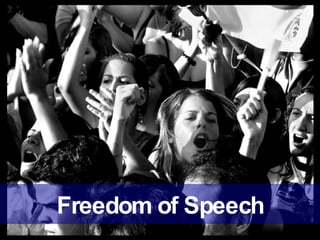
Freedom of Speech
Gitlow v. New York  (1925)
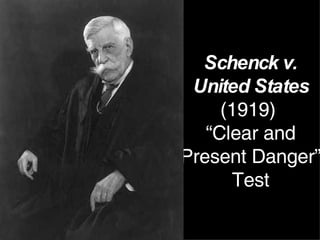
Schenck v. United States  (1919)  “Clear and Present Danger” Test
Limitations on Speech Speech mixed with conduct may be restricted under certain conditions. Symbolic Expression Use of profanity or “fighting words” Hate Speech has generally not been as restricted.
Limitations on free speech Imminent-lawless action test  – Brandenburg v. Ohio (1969): can’t incite harmful actions Libel   – published false and harmful information Slander   – spoken false and harmful information Classified information  – national security documents
Limitations on free speech Certain types of obscenity “ Fire!” Where you may protest Any others?
The right to privacy, while not specifically listed in the Constitution, was first upheld in which court case? Griswold v. Connecticut US v. Miller Doe v. Bolton Cox Broadcasting v. Cohn
Right to Privacy?
Right to Privacy 3 rd  Amendment – prohibition against quartering of soldiers in our homes. 4 th  Amendment – prohibition against unreasonable search and seizure. 1st Amendment Rights 9th Amendment – Protection of non-enumerated rights.
Right to Privacy Griswold v. Connecticut  (1965) – ruled a right to privacy exists as basis for striking down laws making birth control illegal. Roe v. Wade  (1973) – also decided on the basis of this right to privacy. Lawrence and Garner v. Texas  (2003) – Court decided 6-3 that Texas sodomy laws violated due process clause of 14 th  Amendment. (“State cannot demean their existence or control their destiny by making their private sexual conduct a crime.”
“ Strict Constructionism”

Civil Liberties

  • 1.
    Which of thefollowing civil liberties would you be most willing to sacrifice in the interest of promoting national security? Freedom of speech Freedom of the press Freedom to carry a firearm/gun Freedom of assembly None of the above
  • 2.
    Civil Liberties Dr.Christopher S. Rice
  • 3.
    Civil Liberties Individuals’freedoms and legal protections that cannot be denied or hindered by the actions of government.
  • 4.
    Embodied in Billof Rights as prohibitions against government actions that threaten freedom.
  • 5.
    Liberties in theConstitution Writ of Habeas Corpus Prohibition on Bills of Attainder Prohibition on ex post facto laws Prohibition on states from impairing the obligation of contracts .
  • 6.
    Dred Scott v.Sandford (1857)
  • 7.
    Rights of Propertyin Human Beings
  • 8.
    Argued Founders believedblacks had no rights whites were compelled to respect.
  • 9.
    The Fourteenth Amendment,preventing states from “abridg[ing] the privileges or immunities of citizens of the United States” was enacted: during Thomas Jefferson’s administration. soon after the Civil War. during Lyndon Johnson’s administration. in the wake of the Civil Rights movement.
  • 10.
    Civil War Amendments13 th Amendment – outlawed slavery 14 th Amendment – reversed Dred Scott; Due Process and Equal Protection Clauses 15 th Amendment – States couldn’t deny right to vote based on “race, color or previous condition of servitude.”
  • 11.
    On paper vs.reality… Civil Rights Cases of 1883 – Equal Protection clause did not include racial discrimination by private parties. Plessy v. Ferguson (1896) – States could require separation of the races on intrastate railways if “equal” facilities for the races were provided.
  • 12.
    Incorporation The processused by the Supreme Court to protect individuals from actions by state and local government by interpreting the due process clause of the 14th Amendment as containing selected provisions of the Bill of Rights.
  • 13.
  • 14.
    Gitlow v. NewYork (1925)
  • 15.
    Schenck v. UnitedStates (1919) “Clear and Present Danger” Test
  • 16.
    Limitations on SpeechSpeech mixed with conduct may be restricted under certain conditions. Symbolic Expression Use of profanity or “fighting words” Hate Speech has generally not been as restricted.
  • 17.
    Limitations on freespeech Imminent-lawless action test – Brandenburg v. Ohio (1969): can’t incite harmful actions Libel – published false and harmful information Slander – spoken false and harmful information Classified information – national security documents
  • 18.
    Limitations on freespeech Certain types of obscenity “ Fire!” Where you may protest Any others?
  • 19.
    The right toprivacy, while not specifically listed in the Constitution, was first upheld in which court case? Griswold v. Connecticut US v. Miller Doe v. Bolton Cox Broadcasting v. Cohn
  • 20.
  • 21.
    Right to Privacy3 rd Amendment – prohibition against quartering of soldiers in our homes. 4 th Amendment – prohibition against unreasonable search and seizure. 1st Amendment Rights 9th Amendment – Protection of non-enumerated rights.
  • 22.
    Right to PrivacyGriswold v. Connecticut (1965) – ruled a right to privacy exists as basis for striking down laws making birth control illegal. Roe v. Wade (1973) – also decided on the basis of this right to privacy. Lawrence and Garner v. Texas (2003) – Court decided 6-3 that Texas sodomy laws violated due process clause of 14 th Amendment. (“State cannot demean their existence or control their destiny by making their private sexual conduct a crime.”
  • 23.