Sir Thomas More`s
By Anastasia Kytsenko
Utopia
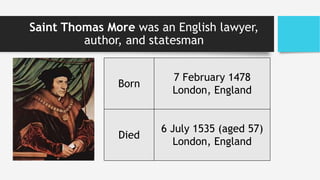
Saint Thomas More was an English lawyer,
author, and statesman
Born
7 February 1478
London, England
Died
6 July 1535 (aged 57)
London, England
Early life about Thomas More
Thomas More was born in Milk Street, London, son of Sir John More, a prominent judge.
He was educated at St Anthony's School in London.
More went on to study at Oxford under Thomas Linacre and William Grocyn.
During this time, he wrote comedies and studied Greek and Latin literature
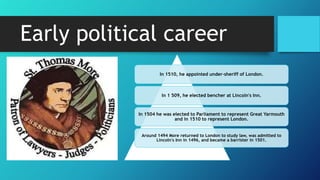
Early political career
In 1510, he appointed under-sheriff of London.
In 1 509, he elected bencher at Lincoln's Inn.
In 1504 he was elected to Parliament to represent Great Yarmouth
and in 1510 to represent London.
Around 1494 More returned to London to study law, was admitted to
Lincoln's Inn in 1496, and became a barrister in 1501.
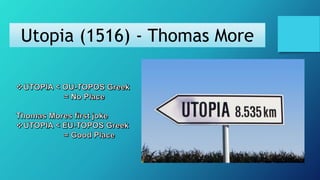
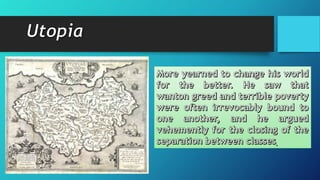
Utopia (1516) - Thomas More
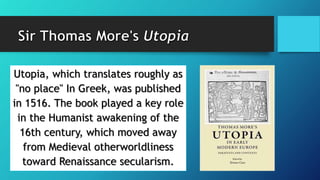
Utopia, which translates roughly as
"no place" In Greek, was published
in 1516. The book played a key role
in the Humanist awakening of the
16th century, which moved away
from Medieval otherworldliness
toward Renaissance secularism.
THE NOVEL: UTOPIA
No private ownership
Women and men work equally - agriculture for 2 yrs at a time and must learn one other trade
6 hr working day, scholars rule
Households have 2 slaves each - slaves are criminals
Free medical care - euthanasia
Community meals
Tolerant of religions except atheism
Sir Thomas More`s Utopia

Sir Thomas More`s Utopia

  • 1.
    Sir Thomas More`s ByAnastasia Kytsenko Utopia
  • 2.
    Saint Thomas Morewas an English lawyer, author, and statesman Born 7 February 1478 London, England Died 6 July 1535 (aged 57) London, England
  • 3.
    Early life aboutThomas More Thomas More was born in Milk Street, London, son of Sir John More, a prominent judge. He was educated at St Anthony's School in London. More went on to study at Oxford under Thomas Linacre and William Grocyn. During this time, he wrote comedies and studied Greek and Latin literature
  • 4.
    Early political career In1510, he appointed under-sheriff of London. In 1 509, he elected bencher at Lincoln's Inn. In 1504 he was elected to Parliament to represent Great Yarmouth and in 1510 to represent London. Around 1494 More returned to London to study law, was admitted to Lincoln's Inn in 1496, and became a barrister in 1501.
  • 5.
    Utopia (1516) -Thomas More
  • 6.
    Utopia, which translatesroughly as "no place" In Greek, was published in 1516. The book played a key role in the Humanist awakening of the 16th century, which moved away from Medieval otherworldliness toward Renaissance secularism.
  • 11.
    THE NOVEL: UTOPIA Noprivate ownership Women and men work equally - agriculture for 2 yrs at a time and must learn one other trade 6 hr working day, scholars rule Households have 2 slaves each - slaves are criminals Free medical care - euthanasia Community meals Tolerant of religions except atheism