AGENDA
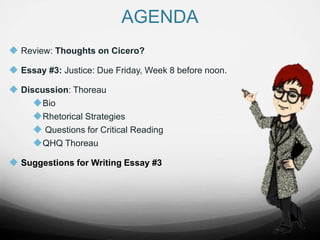
 Review: Thoughts on Cicero?
 Essay #3: Justice: Due Friday, Week 8 before noon.
 Discussion: Thoreau
Bio
Rhetorical Strategies
 Questions for Critical Reading
QHQ Thoreau
 Suggestions for Writing Essay #3
Thoughts on, or
Questions about,
Cicero?
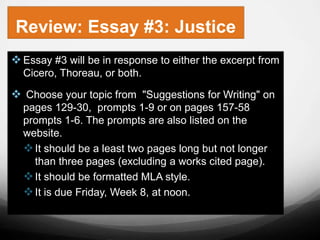
Review: Essay #3: Justice
 Essay #3 will be in response to either the excerpt from
Cicero, Thoreau, or both.
 Choose your topic from "Suggestions for Writing" on
pages 129-30, prompts 1-9 or on pages 157-58
prompts 1-6. The prompts are also listed on the
website.
It should be a least two pages long but not longer
than three pages (excluding a works cited page).
It should be formatted MLA style.
It is due Friday, Week 8, at noon.
on
Thoreau
Please get out paper and pencil for a
Biography
What do you
know about
Henry David
Thoreau?
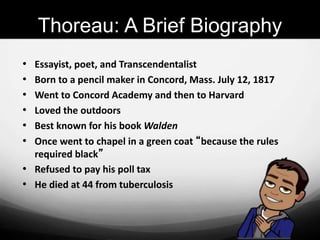
Thoreau: A Brief Biography
• Essayist, poet, and Transcendentalist
• Born to a pencil maker in Concord, Mass. July 12, 1817
• Went to Concord Academy and then to Harvard
• Loved the outdoors
• Best known for his book Walden
• Once went to chapel in a green coat “because the rules
required black”
• Refused to pay his poll tax
• He died at 44 from tuberculosis
 Transcendentalism is an American literary,
political, and philosophical movement of the
early nineteenth century, centered around
Ralph Waldo Emerson.
 Transcendentalists were critics of their
contemporary society for its unthinking
conformity, and they urged that each person
find, in Emerson's words, “an original relation
to the universe.”
 Emerson and Thoreau sought this relation in
solitude amidst nature and in their writing. By
the 1840s, they were engaged in the social
experiments of Brook Farm, Fruitlands, and
Walden; and, by the 1850s in an increasingly
urgent critique of American slavery.
Get into your groups
 Spend 10 minutes preparing for our discussion: rhetorical
strategies and “Questions for Critical Reading”: (page 157)
 Thoreau uses balanced
sentence structure to
emphasize the ways that a
supposedly democratic and
representative government can
be corrupted through the
influence of powerful persons:
 “[Government] has not the
vitality and force of a single
living man; for a single man
can bend it to his will.”
 Thoreau uses a metaphor to
suggest that democratic
government, as it exists in his
day, is actually a sham:
 “It is a sort of wooden gun to
the people themselves.”
 In other words, Thoreau
suggests that government gives
people the mere illusion of power
while actually leaving them
powerless.
The rhetorical question, "Unjust laws exist: shall we be content to obey them, or
shall we endeavor to amend them, and obey them until we have succeeded, or
shall we transgress them at once? ..... Why is it not more apt to anticipate and
provide for reform? Why does it not cherish its wise minority? Why does it cry and
resist before it is hurt?
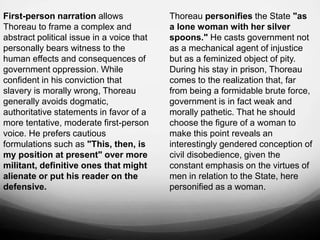
First-person narration allows
Thoreau to frame a complex and
abstract political issue in a voice that
personally bears witness to the
human effects and consequences of
government oppression. While
confident in his conviction that
slavery is morally wrong, Thoreau
generally avoids dogmatic,
authoritative statements in favor of a
more tentative, moderate first-person
voice. He prefers cautious
formulations such as "This, then, is
my position at present" over more
militant, definitive ones that might
alienate or put his reader on the
defensive.
Thoreau personifies the State "as
a lone woman with her silver
spoons." He casts government not
as a mechanical agent of injustice
but as a feminized object of pity.
During his stay in prison, Thoreau
comes to the realization that, far
from being a formidable brute force,
government is in fact weak and
morally pathetic. That he should
choose the figure of a woman to
make this point reveals an
interestingly gendered conception of
civil disobedience, given the
constant emphasis on the virtues of
men in relation to the State, here
personified as a woman.
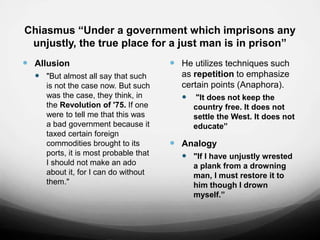
Chiasmus “Under a government which imprisons any
unjustly, the true place for a just man is in prison”
 Allusion
 "But almost all say that such
is not the case now. But such
was the case, they think, in
the Revolution of '75. If one
were to tell me that this was
a bad government because it
taxed certain foreign
commodities brought to its
ports, it is most probable that
I should not make an ado
about it, for I can do without
them."
 He utilizes techniques such
as repetition to emphasize
certain points (Anaphora).
 "It does not keep the
country free. It does not
settle the West. It does not
educate”
 Analogy
 "If I have unjustly wrested
a plank from a drowning
man, I must restore it to
him though I drown
myself.”
Rhetorical Strategies
 Paradox
 “It is truly enough said, that a
corporation has no
conscience; but a
corporation of conscientious
men is a corporation with a
conscience.”
• Aphorism:
• “the progress from an
absolute to a limited
monarchy, from a limited
monarchy to a democracy, is
a progress toward a true
respect for the individual”
• “If a plant cannot live
according to its nature it dies
and so a man.”
Questions for Critical
Reading
How would you
characterize the tone of
Thoreau’s address?
 Is he chastising his audience? Is he
praising it? What opinion do you
think he has of his audience?
Explain what Thoreau means when
he says, “But a government in which
the majority rule in all
cases cannot be based on justice,
even as far as men understand it.”
How is injustice “part of the
necessary friction of the
machine of government?”
Why does Thoreau provide us with
“the whole history of ‘My Prisons’”?
Describe what being in jail taught
Thoreau. Why do you think Thoreau
reacted so strongly to being in a
local jail for a single day?
Choose an example of
Thoreau’s use of irony, and
comment on its
effectiveness.
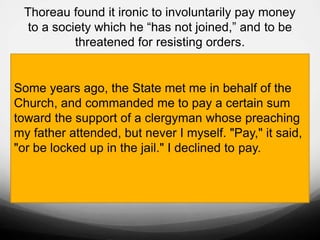
Thoreau found it ironic to involuntarily pay money
to a society which he “has not joined,” and to be
threatened for resisting orders.
Some years ago, the State met me in behalf of the
Church, and commanded me to pay a certain sum
toward the support of a clergyman whose preaching
my father attended, but never I myself. "Pay," it said,
"or be locked up in the jail." I declined to pay.
How might Thoreau view the
responsibility of the majority to
a minority within the sphere of
government?
 “It is not a man's duty, as a matter of course, to
devote himself to the eradication of any, even the
most enormous, wrong; he may still properly have
other concerns to engage him; but it is his duty, at
least, to wash his hands of it, and, if he gives it no
thought longer, not to give it practically his support.”
 Unjust laws exist: shall we be content to obey them, or shall we
endeavor to amend them, and obey them until we have
succeeded, or shall we transgress them at once? Men, generally,
under such a government as this, think that they ought to wait
until they have persuaded the majority to alter them. They think
that, if they should resist, the remedy would be worse than the
evil. But it is the fault of the government itself that the remedy is
worse than the evil. It makes it worse. Why is it not more apt to
anticipate and provide for reform? Why does it not cherish its
wise minority? Why does it cry and resist before it is hurt? Why
does it not encourage its citizens to put out its faults, and do
better than it would have them? Why does it always crucify Christ
and excommunicate Copernicus and Luther, and pronounce
Washington and Franklin rebels?
 Under a government which imprisons unjustly, the true place for
a just man is also a prison.
How clear are Thoreau’s
concepts of justice? On
what are they based?
Is it possible that when
Thoreau mentions “the
Chinese philosopher" he
means Lao-tzu? Would Lao-
tzu agree that the individual is
“the basis of the empire”?
Thoreau
QHQ Discussion
Why does Thoreau dislike the
government?
QHQ: Is Thoreau
more motivated
to do nothing
against unjust
laws after his
experience in
prison?
• In teams, discuss the
essay questions from
"Suggestions for Writing"
pages 129-30, prompts 1-
9 or pages 157-58,
prompts 1-6
• Choose one to answer
Time Permitting
HOMEWORK
 Remember:
 Include a thesis statement for your essay
 Respond to all parts of the prompt
 Choose an original title
 Include a works cited page
 Use MLA style formatting (TNR 12)
 Include page numbers after quotations
• Essay #3 (2-3 pages): Choose your
topic from "Suggestions for Writing"
pages 129-30, prompts 1-9 or pages
157-58, prompts 1-6
• Post #23 The introduction and
thesis for Essay #3
• Post #24 How can we apply the
philosophy of Cicero and/or Thoreau
to A Game of Thrones?

Ewrt 2 class 14 thoreau

  • 2.
    AGENDA  Review: Thoughtson Cicero?  Essay #3: Justice: Due Friday, Week 8 before noon.  Discussion: Thoreau Bio Rhetorical Strategies  Questions for Critical Reading QHQ Thoreau  Suggestions for Writing Essay #3
  • 3.
  • 4.
    Review: Essay #3:Justice  Essay #3 will be in response to either the excerpt from Cicero, Thoreau, or both.  Choose your topic from "Suggestions for Writing" on pages 129-30, prompts 1-9 or on pages 157-58 prompts 1-6. The prompts are also listed on the website. It should be a least two pages long but not longer than three pages (excluding a works cited page). It should be formatted MLA style. It is due Friday, Week 8, at noon.
  • 5.
    on Thoreau Please get outpaper and pencil for a
  • 6.
    Biography What do you knowabout Henry David Thoreau?
  • 7.
    Thoreau: A BriefBiography • Essayist, poet, and Transcendentalist • Born to a pencil maker in Concord, Mass. July 12, 1817 • Went to Concord Academy and then to Harvard • Loved the outdoors • Best known for his book Walden • Once went to chapel in a green coat “because the rules required black” • Refused to pay his poll tax • He died at 44 from tuberculosis
  • 8.
     Transcendentalism isan American literary, political, and philosophical movement of the early nineteenth century, centered around Ralph Waldo Emerson.  Transcendentalists were critics of their contemporary society for its unthinking conformity, and they urged that each person find, in Emerson's words, “an original relation to the universe.”  Emerson and Thoreau sought this relation in solitude amidst nature and in their writing. By the 1840s, they were engaged in the social experiments of Brook Farm, Fruitlands, and Walden; and, by the 1850s in an increasingly urgent critique of American slavery.
  • 9.
    Get into yourgroups  Spend 10 minutes preparing for our discussion: rhetorical strategies and “Questions for Critical Reading”: (page 157)
  • 11.
     Thoreau usesbalanced sentence structure to emphasize the ways that a supposedly democratic and representative government can be corrupted through the influence of powerful persons:  “[Government] has not the vitality and force of a single living man; for a single man can bend it to his will.”  Thoreau uses a metaphor to suggest that democratic government, as it exists in his day, is actually a sham:  “It is a sort of wooden gun to the people themselves.”  In other words, Thoreau suggests that government gives people the mere illusion of power while actually leaving them powerless. The rhetorical question, "Unjust laws exist: shall we be content to obey them, or shall we endeavor to amend them, and obey them until we have succeeded, or shall we transgress them at once? ..... Why is it not more apt to anticipate and provide for reform? Why does it not cherish its wise minority? Why does it cry and resist before it is hurt?
  • 12.
    First-person narration allows Thoreauto frame a complex and abstract political issue in a voice that personally bears witness to the human effects and consequences of government oppression. While confident in his conviction that slavery is morally wrong, Thoreau generally avoids dogmatic, authoritative statements in favor of a more tentative, moderate first-person voice. He prefers cautious formulations such as "This, then, is my position at present" over more militant, definitive ones that might alienate or put his reader on the defensive. Thoreau personifies the State "as a lone woman with her silver spoons." He casts government not as a mechanical agent of injustice but as a feminized object of pity. During his stay in prison, Thoreau comes to the realization that, far from being a formidable brute force, government is in fact weak and morally pathetic. That he should choose the figure of a woman to make this point reveals an interestingly gendered conception of civil disobedience, given the constant emphasis on the virtues of men in relation to the State, here personified as a woman.
  • 13.
    Chiasmus “Under agovernment which imprisons any unjustly, the true place for a just man is in prison”  Allusion  "But almost all say that such is not the case now. But such was the case, they think, in the Revolution of '75. If one were to tell me that this was a bad government because it taxed certain foreign commodities brought to its ports, it is most probable that I should not make an ado about it, for I can do without them."  He utilizes techniques such as repetition to emphasize certain points (Anaphora).  "It does not keep the country free. It does not settle the West. It does not educate”  Analogy  "If I have unjustly wrested a plank from a drowning man, I must restore it to him though I drown myself.”
  • 14.
    Rhetorical Strategies  Paradox “It is truly enough said, that a corporation has no conscience; but a corporation of conscientious men is a corporation with a conscience.” • Aphorism: • “the progress from an absolute to a limited monarchy, from a limited monarchy to a democracy, is a progress toward a true respect for the individual” • “If a plant cannot live according to its nature it dies and so a man.”
  • 15.
  • 16.
    How would you characterizethe tone of Thoreau’s address?  Is he chastising his audience? Is he praising it? What opinion do you think he has of his audience?
  • 17.
    Explain what Thoreaumeans when he says, “But a government in which the majority rule in all cases cannot be based on justice, even as far as men understand it.”
  • 18.
    How is injustice“part of the necessary friction of the machine of government?”
  • 19.
    Why does Thoreauprovide us with “the whole history of ‘My Prisons’”? Describe what being in jail taught Thoreau. Why do you think Thoreau reacted so strongly to being in a local jail for a single day?
  • 20.
    Choose an exampleof Thoreau’s use of irony, and comment on its effectiveness.
  • 21.
    Thoreau found itironic to involuntarily pay money to a society which he “has not joined,” and to be threatened for resisting orders. Some years ago, the State met me in behalf of the Church, and commanded me to pay a certain sum toward the support of a clergyman whose preaching my father attended, but never I myself. "Pay," it said, "or be locked up in the jail." I declined to pay.
  • 22.
    How might Thoreauview the responsibility of the majority to a minority within the sphere of government?
  • 23.
     “It isnot a man's duty, as a matter of course, to devote himself to the eradication of any, even the most enormous, wrong; he may still properly have other concerns to engage him; but it is his duty, at least, to wash his hands of it, and, if he gives it no thought longer, not to give it practically his support.”
  • 24.
     Unjust lawsexist: shall we be content to obey them, or shall we endeavor to amend them, and obey them until we have succeeded, or shall we transgress them at once? Men, generally, under such a government as this, think that they ought to wait until they have persuaded the majority to alter them. They think that, if they should resist, the remedy would be worse than the evil. But it is the fault of the government itself that the remedy is worse than the evil. It makes it worse. Why is it not more apt to anticipate and provide for reform? Why does it not cherish its wise minority? Why does it cry and resist before it is hurt? Why does it not encourage its citizens to put out its faults, and do better than it would have them? Why does it always crucify Christ and excommunicate Copernicus and Luther, and pronounce Washington and Franklin rebels?  Under a government which imprisons unjustly, the true place for a just man is also a prison.
  • 25.
    How clear areThoreau’s concepts of justice? On what are they based?
  • 26.
    Is it possiblethat when Thoreau mentions “the Chinese philosopher" he means Lao-tzu? Would Lao- tzu agree that the individual is “the basis of the empire”?
  • 27.
    Thoreau QHQ Discussion Why doesThoreau dislike the government?
  • 28.
    QHQ: Is Thoreau moremotivated to do nothing against unjust laws after his experience in prison?
  • 29.
    • In teams,discuss the essay questions from "Suggestions for Writing" pages 129-30, prompts 1- 9 or pages 157-58, prompts 1-6 • Choose one to answer Time Permitting
  • 30.
    HOMEWORK  Remember:  Includea thesis statement for your essay  Respond to all parts of the prompt  Choose an original title  Include a works cited page  Use MLA style formatting (TNR 12)  Include page numbers after quotations • Essay #3 (2-3 pages): Choose your topic from "Suggestions for Writing" pages 129-30, prompts 1-9 or pages 157-58, prompts 1-6 • Post #23 The introduction and thesis for Essay #3 • Post #24 How can we apply the philosophy of Cicero and/or Thoreau to A Game of Thrones?