Title: Citizen’s Charter
OBJECTIVES OF THE
PRESENTATION
At the end of the presentation, participants will be
able to:
 Describe the concepts of citizen’s charter
 Identify principles of citizen’s charter
 Analyze the significance of citizen’s charter
 Develop conceptual skills on how to design
citizen’s charter
TABLE OF CONTENTS
1.What is citizen’s charter(CC)?
2. The basic principles of the citizen’s charter
3. The significance of CC
4. How to develop CC
5.Conditions under which CC is likely to be
successful
6. Characteristics of effective CC
WHAT IS CITIZEN’S
CHARTER(CC)?
 It is a kind of contract between service users and
service providers.
 public agreements between citizens and service
delivery providers that clearly codify expectations
and standards in the realm of service delivery.
 an official document of commitment symbolizing a
systematic effort of government to improve the
public services
WHAT IS CITIZEN’S CHARTER?
 It provides the essential information for citizen and
stakeholders regarding service delivery
 It would inform citizens of their entitlements to public
services
 It is a significant milestone in public service reform.
 CC was introduced by the United Kingdom in 1991, it
was being used in a wide range of countries—including
the United States, Portugal, Kenya, India, Jamaica,
Mexico, etc.
THE BASIC PRINCIPLES OF THE
CITIZEN CHARTER
 Standards: explicit standards, published and
prominently displayed at the point of delivery
 Openness: elimination of secrecy about
organizational arrangements, costs of service,
etc. Staff to be identified by name badges.
 Information: full, accurate information
should be readily available, in plain language,
about what services are being provided.
 Choice: the public sector should provide
choice wherever practicable
THE BASIC PRINCIPLES OF THE CITIZEN
CHARTER
 Courtesy and helpfulness: a culture of courteous
and helpful service is expected from public servants.
 Non-discrimination: services should be available
regardless of race or sex.
 Accessibility: services should be run to suit the
convenience of customers, not staff.
 Proper redress when things go wrong: there
should be a well-publicized and readily available
complaints procedure.
THE SIGNIFICANCE OF CC
 Enhances the quality of service delivery
 Enhances accountability by providing citizens
with a clear understanding of service delivery
standards
 Creates transparency
 Reduces opportunities for corruption
 Increase organizational effectiveness
 foster greater public satisfaction
THE SIGNIFICANCE OF CC
 Helps to monitor service delivery performance
 Helps to continuously re-engineer service processes
 Creates a more professional and client-responsive
environment for service delivery
 Changes culture and attitude at work place by
focusing efforts to customer satisfaction
 Empowers citizens to hold institutions and individual
officers accountable for quality, timely and responsive
services
HOW TO DEVELOP CC
 Step 1: Preparatory Work Step
 Step 2: Conduct Consultations with Stakeholders
 Step 3: Draft the Citizen Charter
 Step 4: Develop a Grievance Redress Mechanism
 Step 5: Train Staff, Launch the Charter, and
Publicize the Charter
 Step 6: Monitor, Evaluate and Improve
STEP 1: PREPARATORY WORK STEP
 Obtaining the support of the senior management
 Forming a team to lead the design and
implementation process
Develop action plan
Identify resources required
SWOT to implement CC
Develop communication strategy including
awareness training program for the staff
STEP 2: CONDUCT CONSULTATIONS WITH
STAKEHOLDERS
 Consultations should target a wide range of users
 Before getting input, devise a rough draft of a
proposal in advance of the consultations
 obtain input from stakeholders, users and civil
society organizations (CSOs) before drafting the
CC.
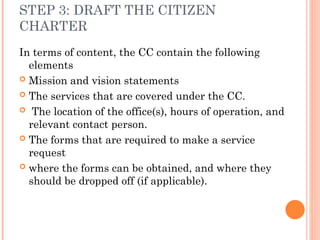
STEP 3: DRAFT THE CITIZEN
CHARTER
In terms of content, the CC contain the following
elements
 Mission and vision statements
 The services that are covered under the CC.
 The location of the office(s), hours of operation, and
relevant contact person.
 The forms that are required to make a service
request
 where the forms can be obtained, and where they
should be dropped off (if applicable).
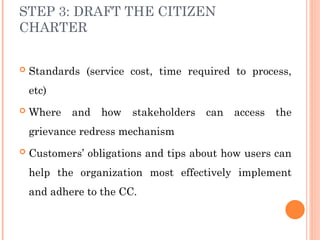
STEP 3: DRAFT THE CITIZEN
CHARTER
 Standards (service cost, time required to process,
etc)
 Where and how stakeholders can access the
grievance redress mechanism
 Customers’ obligations and tips about how users can
help the organization most effectively implement
and adhere to the CC.
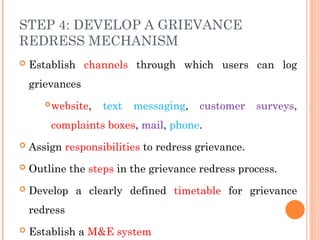
STEP 4: DEVELOP A GRIEVANCE
REDRESS MECHANISM
 Establish channels through which users can log
grievances
website, text messaging, customer surveys,
complaints boxes, mail, phone.
 Assign responsibilities to redress grievance.
 Outline the steps in the grievance redress process.
 Develop a clearly defined timetable for grievance
redress
 Establish a M&E system
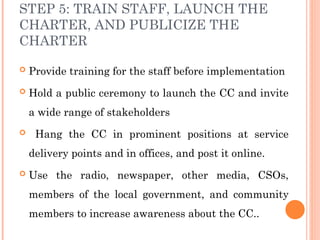
STEP 5: TRAIN STAFF, LAUNCH THE
CHARTER, AND PUBLICIZE THE
CHARTER
 Provide training for the staff before implementation
 Hold a public ceremony to launch the CC and invite
a wide range of stakeholders
 Hang the CC in prominent positions at service
delivery points and in offices, and post it online.
 Use the radio, newspaper, other media, CSOs,
members of the local government, and community
members to increase awareness about the CC..
CONDITIONS UNDER WHICH CC IS
LIKELY TO BE SUCCESSFUL
 There should be strong management support
for the CC initiative.
 The CC should be developed with input from
both internal and external stakeholders
 There should be an incentive in achieving the
service standard
 A culture of accepting customers’ feed back & criticism
CONDITIONS UNDER WHICH CC IS
LIKELY TO BE SUCCESSFUL
 There should be continuous awareness
program of employees and citizens about the
CC initiative
 There should be M&E system and linked to
other social accountability interventions
 Establish an efficient feedback mechanism
and feedback loop.
CHARACTERISTICS OF EFFECTIVE
CC
Effective CCs typically share a number of key
characteristics, among these
 clear and simple language
 realistic and measurable performance
standards
 a dedicated grievance redress
mechanism
 an effective public relations strategy to
increase users’ awareness about the CC.
WEAKNESS OF IMPLEMENTING CC
 Less participatory: staff members and
stakeholders are not properly participated
 Weak/ limited communication: poor knowledge
about CC and its content
 Not implemented as per the standard
 No incentive for achieving the standard
 No M&E system
THANK YOU FOR
YOUR ATTENTION

citizen charter final.powerull point presentaion

  • 1.
  • 2.
    OBJECTIVES OF THE PRESENTATION Atthe end of the presentation, participants will be able to:  Describe the concepts of citizen’s charter  Identify principles of citizen’s charter  Analyze the significance of citizen’s charter  Develop conceptual skills on how to design citizen’s charter
  • 3.
    TABLE OF CONTENTS 1.Whatis citizen’s charter(CC)? 2. The basic principles of the citizen’s charter 3. The significance of CC 4. How to develop CC 5.Conditions under which CC is likely to be successful 6. Characteristics of effective CC
  • 4.
    WHAT IS CITIZEN’S CHARTER(CC)? It is a kind of contract between service users and service providers.  public agreements between citizens and service delivery providers that clearly codify expectations and standards in the realm of service delivery.  an official document of commitment symbolizing a systematic effort of government to improve the public services
  • 5.
    WHAT IS CITIZEN’SCHARTER?  It provides the essential information for citizen and stakeholders regarding service delivery  It would inform citizens of their entitlements to public services  It is a significant milestone in public service reform.  CC was introduced by the United Kingdom in 1991, it was being used in a wide range of countries—including the United States, Portugal, Kenya, India, Jamaica, Mexico, etc.
  • 6.
    THE BASIC PRINCIPLESOF THE CITIZEN CHARTER  Standards: explicit standards, published and prominently displayed at the point of delivery  Openness: elimination of secrecy about organizational arrangements, costs of service, etc. Staff to be identified by name badges.  Information: full, accurate information should be readily available, in plain language, about what services are being provided.  Choice: the public sector should provide choice wherever practicable
  • 7.
    THE BASIC PRINCIPLESOF THE CITIZEN CHARTER  Courtesy and helpfulness: a culture of courteous and helpful service is expected from public servants.  Non-discrimination: services should be available regardless of race or sex.  Accessibility: services should be run to suit the convenience of customers, not staff.  Proper redress when things go wrong: there should be a well-publicized and readily available complaints procedure.
  • 8.
    THE SIGNIFICANCE OFCC  Enhances the quality of service delivery  Enhances accountability by providing citizens with a clear understanding of service delivery standards  Creates transparency  Reduces opportunities for corruption  Increase organizational effectiveness  foster greater public satisfaction
  • 9.
    THE SIGNIFICANCE OFCC  Helps to monitor service delivery performance  Helps to continuously re-engineer service processes  Creates a more professional and client-responsive environment for service delivery  Changes culture and attitude at work place by focusing efforts to customer satisfaction  Empowers citizens to hold institutions and individual officers accountable for quality, timely and responsive services
  • 10.
    HOW TO DEVELOPCC  Step 1: Preparatory Work Step  Step 2: Conduct Consultations with Stakeholders  Step 3: Draft the Citizen Charter  Step 4: Develop a Grievance Redress Mechanism  Step 5: Train Staff, Launch the Charter, and Publicize the Charter  Step 6: Monitor, Evaluate and Improve
  • 11.
    STEP 1: PREPARATORYWORK STEP  Obtaining the support of the senior management  Forming a team to lead the design and implementation process Develop action plan Identify resources required SWOT to implement CC Develop communication strategy including awareness training program for the staff
  • 12.
    STEP 2: CONDUCTCONSULTATIONS WITH STAKEHOLDERS  Consultations should target a wide range of users  Before getting input, devise a rough draft of a proposal in advance of the consultations  obtain input from stakeholders, users and civil society organizations (CSOs) before drafting the CC.
  • 13.
    STEP 3: DRAFTTHE CITIZEN CHARTER In terms of content, the CC contain the following elements  Mission and vision statements  The services that are covered under the CC.  The location of the office(s), hours of operation, and relevant contact person.  The forms that are required to make a service request  where the forms can be obtained, and where they should be dropped off (if applicable).
  • 14.
    STEP 3: DRAFTTHE CITIZEN CHARTER  Standards (service cost, time required to process, etc)  Where and how stakeholders can access the grievance redress mechanism  Customers’ obligations and tips about how users can help the organization most effectively implement and adhere to the CC.
  • 15.
    STEP 4: DEVELOPA GRIEVANCE REDRESS MECHANISM  Establish channels through which users can log grievances website, text messaging, customer surveys, complaints boxes, mail, phone.  Assign responsibilities to redress grievance.  Outline the steps in the grievance redress process.  Develop a clearly defined timetable for grievance redress  Establish a M&E system
  • 16.
    STEP 5: TRAINSTAFF, LAUNCH THE CHARTER, AND PUBLICIZE THE CHARTER  Provide training for the staff before implementation  Hold a public ceremony to launch the CC and invite a wide range of stakeholders  Hang the CC in prominent positions at service delivery points and in offices, and post it online.  Use the radio, newspaper, other media, CSOs, members of the local government, and community members to increase awareness about the CC..
  • 17.
    CONDITIONS UNDER WHICHCC IS LIKELY TO BE SUCCESSFUL  There should be strong management support for the CC initiative.  The CC should be developed with input from both internal and external stakeholders  There should be an incentive in achieving the service standard  A culture of accepting customers’ feed back & criticism
  • 18.
    CONDITIONS UNDER WHICHCC IS LIKELY TO BE SUCCESSFUL  There should be continuous awareness program of employees and citizens about the CC initiative  There should be M&E system and linked to other social accountability interventions  Establish an efficient feedback mechanism and feedback loop.
  • 19.
    CHARACTERISTICS OF EFFECTIVE CC EffectiveCCs typically share a number of key characteristics, among these  clear and simple language  realistic and measurable performance standards  a dedicated grievance redress mechanism  an effective public relations strategy to increase users’ awareness about the CC.
  • 20.
    WEAKNESS OF IMPLEMENTINGCC  Less participatory: staff members and stakeholders are not properly participated  Weak/ limited communication: poor knowledge about CC and its content  Not implemented as per the standard  No incentive for achieving the standard  No M&E system
  • 21.