“Course Logistics”
• OfficeHours: TuTh 1-2pm or by appointment
• Course Prerequisites: ISYE 6650 (Familiarity with probability, stochastic modeling and basic
queueing theory) and ISYE 6669 (Familiarity with optimization concepts and formulations, and
basic Linear Programming theory)
• Grading policy:
– Homework: 20%
– Project: 5% (based on Littlefield technologies: please, make sure that you buy from the
bookstore the necessary permit for accessing the software - $15.00)
– Midterm I: 20%
– Midterm II: 20%
– Final: 35%
– Exams closed-book, with 2 pages of notes per midterm exam and 6 pages for the final.
• Reading Materials:
– Course Textbook: W. Hopp and M. Spearman, Factory Physics, 2nd Ed., McGraw Hill /
IRWIN
– Course slides and any other material posted at my homepage or the library electronic
reserves.
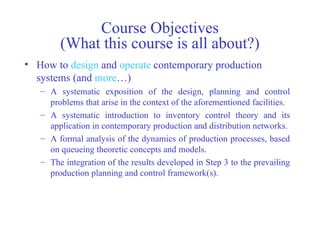
3.
Course Objectives
(What thiscourse is all about?)
• How to design and operate contemporary production
systems (and more…)
– A systematic exposition of the design, planning and control
problems that arise in the context of the aforementioned facilities.
– A systematic introduction to inventory control theory and its
application in contemporary production and distribution networks.
– A formal analysis of the dynamics of production processes, based
on queueing theoretic concepts and models.
– The integration of the results developed in Step 3 to the prevailing
production planning and control framework(s).
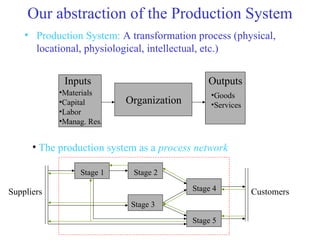
4.
Our abstraction ofthe Production System
• Production System: A transformation process (physical,
locational, physiological, intellectual, etc.)
Organization
Inputs Outputs
•Materials
•Capital
•Labor
•Manag. Res.
•Goods
•Services
• The production system as a process network
Stage 5
Stage 4
Stage 3
Stage 2
Stage 1
Suppliers Customers
5.
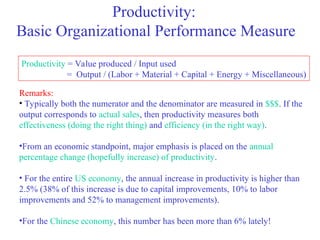
Productivity:
Basic Organizational PerformanceMeasure
Productivity = Value produced / Input used
= Output / (Labor + Material + Capital + Energy + Miscellaneous)
Remarks:
• Typically both the numerator and the denominator are measured in $$$. If the
output corresponds to actual sales, then productivity measures both
effectiveness (doing the right thing) and efficiency (in the right way).
•From an economic standpoint, major emphasis is placed on the annual
percentage change (hopefully increase) of productivity.
• For the entire US economy, the annual increase in productivity is higher than
2.5% (38% of this increase is due to capital improvements, 10% to labor
improvements and 52% to management improvements).
•For the Chinese economy, this number has been more than 6% lately!
6.
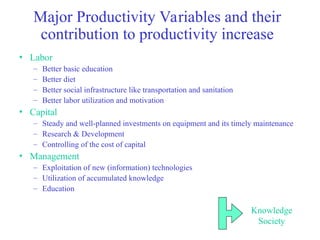
Major Productivity Variablesand their
contribution to productivity increase
• Labor
– Better basic education
– Better diet
– Better social infrastructure like transportation and sanitation
– Better labor utilization and motivation
• Capital
– Steady and well-planned investments on equipment and its timely maintenance
– Research & Development
– Controlling of the cost of capital
• Management
– Exploitation of new (information) technologies
– Utilization of accumulated knowledge
– Education
Knowledge
Society
7.
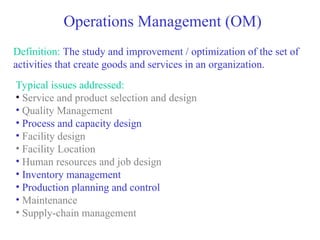
Operations Management (OM)
Definition:The study and improvement / optimization of the set of
activities that create goods and services in an organization.
Typical issues addressed:
• Service and product selection and design
• Quality Management
• Process and capacity design
• Facility design
• Facility Location
• Human resources and job design
• Inventory management
• Production planning and control
• Maintenance
• Supply-chain management
8.
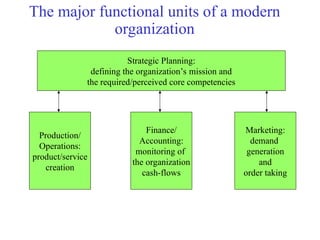
The major functionalunits of a modern
organization
Strategic Planning:
defining the organization’s mission and
the required/perceived core competencies
Production/
Operations:
product/service
creation
Finance/
Accounting:
monitoring of
the organization
cash-flows
Marketing:
demand
generation
and
order taking
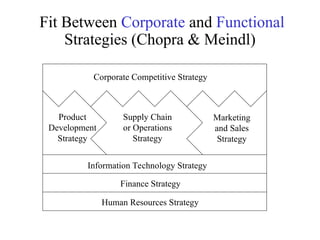
Fit Between Corporateand Functional
Strategies (Chopra & Meindl)
Corporate Competitive Strategy
Supply Chain
or Operations
Strategy
Product
Development
Strategy
Marketing
and Sales
Strategy
Information Technology Strategy
Finance Strategy
Human Resources Strategy
11.
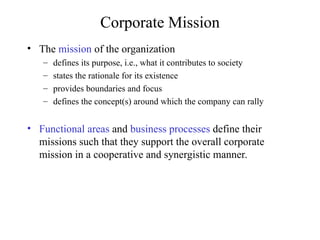
Corporate Mission
• Themission of the organization
– defines its purpose, i.e., what it contributes to society
– states the rationale for its existence
– provides boundaries and focus
– defines the concept(s) around which the company can rally
• Functional areas and business processes define their
missions such that they support the overall corporate
mission in a cooperative and synergistic manner.
12.
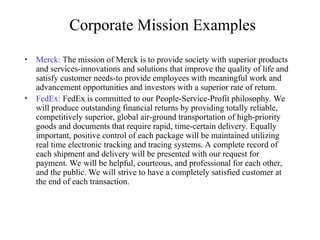
Corporate Mission Examples
•Merck: The mission of Merck is to provide society with superior products
and services-innovations and solutions that improve the quality of life and
satisfy customer needs-to provide employees with meaningful work and
advancement opportunities and investors with a superior rate of return.
• FedEx: FedEx is committed to our People-Service-Profit philosophy. We
will produce outstanding financial returns by providing totally reliable,
competitively superior, global air-ground transportation of high-priority
goods and documents that require rapid, time-certain delivery. Equally
important, positive control of each package will be maintained utilizing
real time electronic tracking and tracing systems. A complete record of
each shipment and delivery will be presented with our request for
payment. We will be helpful, courteous, and professional for each other,
and the public. We will strive to have a completely satisfied customer at
the end of each transaction.
13.
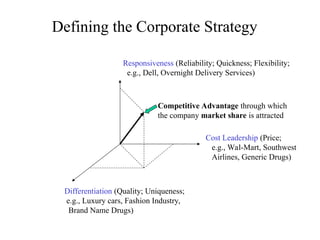
Defining the CorporateStrategy
Differentiation (Quality; Uniqueness;
e.g., Luxury cars, Fashion Industry,
Brand Name Drugs)
Cost Leadership (Price;
e.g., Wal-Mart, Southwest
Airlines, Generic Drugs)
Responsiveness (Reliability; Quickness; Flexibility;
e.g., Dell, Overnight Delivery Services)
Competitive Advantage through which
the company market share is attracted
14.
Defining the CorporateStrategy
• Corporate Strategy: The organization’s positioning in terms of
– responsiveness,
– cost leadership and
– product differentiation
requirements, i.e., the sought competitive advantage(s).
• The corporate strategy dictates the detailed strategies for each functional
area (i.e., Operations, Finance, Marketing) but it is also affected by
those areas.
• Collectively, all these strategies seek to exploit (external) opportunities
and (internal) strengths, neutralize (external) threats, and address
(internal) weaknesses
15.
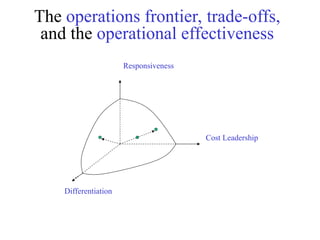
The operations frontier,trade-offs,
and the operational effectiveness
Differentiation
Cost Leadership
Responsiveness
16.
Factors affecting CorporateStrategy
• External
– Emerging strengths and weaknesses of competitors => new threats and
opportunities, respectively
– New industry entrants
– Development of substitute products
– Development of new technologies
– Legal developments (e.g., environmental concerns and regulations)
– Economic and political developments (e.g., new international agreements,
political crises)
• Internal
– Company politics and restructuring
– Modified relationships with customers and suppliers
– Product Life Cycle
17.
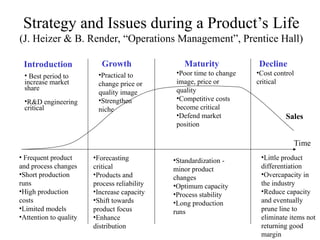
Strategy and Issuesduring a Product’s Life
(J. Heizer & B. Render, “Operations Management”, Prentice Hall)
Introduction Growth Maturity Decline
Time
Sales
• Best period to
increase market
share
•R&D engineering
critical
• Frequent product
and process changes
•Short production
runs
•High production
costs
•Limited models
•Attention to quality
•Practical to
change price or
quality image
•Strengthen
niche
•Forecasting
critical
•Products and
process reliability
•Increase capacity
•Shift towards
product focus
•Enhance
distribution
•Poor time to change
image, price or
quality
•Competitive costs
become critical
•Defend market
position
•Standardization -
minor product
changes
•Optimum capacity
•Process stability
•Long production
runs
•Cost control
critical
•Little product
differentiation
•Overcapacity in
the industry
•Reduce capacity
and eventually
prune line to
eliminate items not
returning good
margin
18.
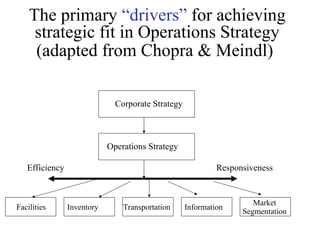
The primary “drivers”for achieving
strategic fit in Operations Strategy
(adapted from Chopra & Meindl)
Corporate Strategy
Operations Strategy
Efficiency Responsiveness
Facilities Inventory Transportation Information
Market
Segmentation
19.
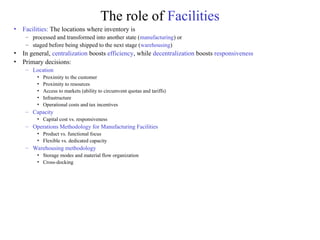
The role ofFacilities
• Facilities: The locations where inventory is
– processed and transformed into another state (manufacturing) or
– staged before being shipped to the next stage (warehousing)
• In general, centralization boosts efficiency, while decentralization boosts responsiveness
• Primary decisions:
– Location
• Proximity to the customer
• Proximity to resources
• Access to markets (ability to circumvent quotas and tariffs)
• Infrastructure
• Operational costs and tax incentives
– Capacity
• Capital cost vs. responsiveness
– Operations Methodology for Manufacturing Facilities
• Product vs. functional focus
• Flexible vs. dedicated capacity
– Warehousing methodology
• Storage modes and material flow organization
• Cross-docking
20.
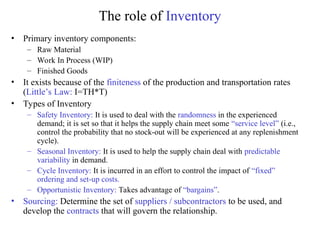
The role ofInventory
• Primary inventory components:
– Raw Material
– Work In Process (WIP)
– Finished Goods
• It exists because of the finiteness of the production and transportation rates
(Little’s Law: I=TH*T)
• Types of Inventory
– Safety Inventory: It is used to deal with the randomness in the experienced
demand; it is set so that it helps the supply chain meet some “service level” (i.e.,
control the probability that no stock-out will be experienced at any replenishment
cycle).
– Seasonal Inventory: It is used to help the supply chain deal with predictable
variability in demand.
– Cycle Inventory: It is incurred in an effort to control the impact of “fixed”
ordering and set-up costs.
– Opportunistic Inventory: Takes advantage of “bargains”.
• Sourcing: Determine the set of suppliers / subcontractors to be used, and
develop the contracts that will govern the relationship.
21.
The role ofTransportation
• Transportation: The SC element that moves product between its different
stages.
• Primary decisions:
– Mode(s) of Transportation
• Air: fastest but most expensive
• Truck: Relatively quick, inexpensive and very flexible mode
• Rail: Inexpensive mode to be used for large quantities
• Ship: Slowest but often the most economical choice for large overseas shipments
• Pipeline: Used (primarily) for oil and gas
• Electronic transportation: for goods as music and movies
– Route and Network Selection
– In-house or Outsource to some 3PL provider
22.
The role ofInformation
• Information exchange is necessary for the most extensive modes of
coordination sought in contemporary supply chains. It allows the supply chain
to improve simultaneously its efficiency and responsiveness.
• Information-related decisions
– Push vs. pull
– Extent and modes of information sharing and coordination
– Forecasting and Aggregate Planning schemes
– Pricing and revenue management policies
– Enabling Technologies:
• Electronic Data Interchange (EDI): Enables paperless transactions, primarily for
“backend” operations of the SC.
• The Internet and the WWW.
• Enterprise Resource Planning (ERP): enables transactional tracking and global visibility
of information in the SC.
• Supply Chain Management (SCM) software: decision support tools.
23.
The role ofMarket Segmentation
• Need to develop different strategies for different geographical or market
segments that align to the preferences and attitudes of the corresponding
customer bases.
• Need to align the provided products and services, as well as the deployed
production and business functions, to the local culture and ethics.
• Supporting practices
– broader product lines
– globalized operations
– (mass-)customization
• Need to manage the resulting complexity.
– Modularity
– Combinatorial customization
– Design for postponement
24.
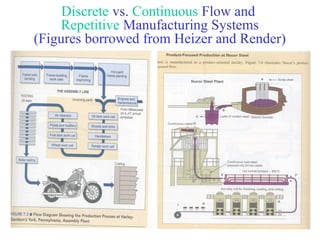
Discrete vs. ContinuousFlow and
Repetitive Manufacturing Systems
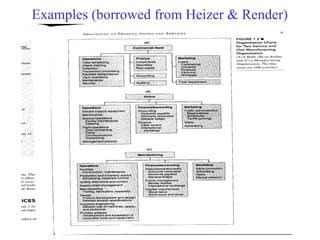
(Figures borrowed from Heizer and Render)
25.
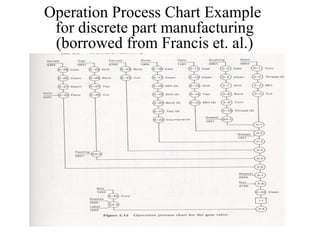
Operation Process ChartExample
for discrete part manufacturing
(borrowed from Francis et. al.)
26.
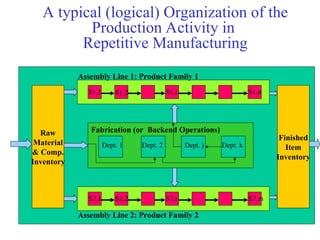
A typical (logical)Organization of the
Production Activity in
Repetitive Manufacturing
Raw
Material
& Comp.
Inventory
Finished
Item
Inventory
S1,2
S1,1 S1,n
S2,1 S2,2 S2,m
Assembly Line 1: Product Family 1
Assembly Line 2: Product Family 2
Fabrication (or Backend Operations)
Dept. 1 Dept. 2 Dept. k
S1,i
S2,i
Dept. j
27.
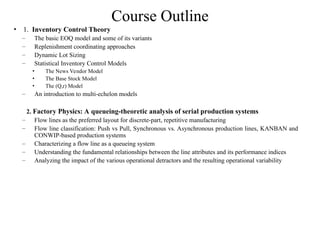
Course Outline
• 1.Inventory Control Theory
– The basic EOQ model and some of its variants
– Replenishment coordinating approaches
– Dynamic Lot Sizing
– Statistical Inventory Control Models
• The News Vendor Model
• The Base Stock Model
• The (Q,r) Model
– An introduction to multi-echelon models
2. Factory Physics: A queueing-theoretic analysis of serial production systems
– Flow lines as the preferred layout for discrete-part, repetitive manufacturing
– Flow line classification: Push vs Pull, Synchronous vs. Asynchronous production lines, KANBAN and
CONWIP-based production systems
– Characterizing a flow line as a queueing system
– Understanding the fundamental relationships between the line attributes and its performance indices
– Analyzing the impact of the various operational detractors and the resulting operational variability
28.
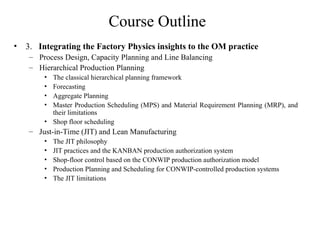
Course Outline
• 3.Integrating the Factory Physics insights to the OM practice
– Process Design, Capacity Planning and Line Balancing
– Hierarchical Production Planning
• The classical hierarchical planning framework
• Forecasting
• Aggregate Planning
• Master Production Scheduling (MPS) and Material Requirement Planning (MRP), and
their limitations
• Shop floor scheduling
– Just-in-Time (JIT) and Lean Manufacturing
• The JIT philosophy
• JIT practices and the KANBAN production authorization system
• Shop-floor control based on the CONWIP production authorization model
• Production Planning and Scheduling for CONWIP-controlled production systems
• The JIT limitations


![Chapter 3 Performance Measures [Autosaved].ppt](https://cdn.slidesharecdn.com/ss_thumbnails/chapter3performancemeasuresautosaved-250911043631-784e40fa-thumbnail.jpg?width=640&height=640&fit=bounds)
![Chapter 3 Performance Measures [Autosaved].ppt](https://cdn.slidesharecdn.com/ss_thumbnails/chapter3performancemeasuresautosaved-250911044211-e0023b94-thumbnail.jpg?width=640&height=640&fit=bounds)
![Chapter 3 Performance Measures [Autosaved].ppt](https://cdn.slidesharecdn.com/ss_thumbnails/chapter3performancemeasuresautosaved-250911045149-875c1566-thumbnail.jpg?width=640&height=640&fit=bounds)


![Effective_Communication_and_Active_Listening_Skills[1].ppt](https://cdn.slidesharecdn.com/ss_thumbnails/effectivecommunicationandactivelisteningskills1-241231080043-5212db1b-thumbnail.jpg?width=640&height=640&fit=bounds)


