Clinical Information System
(CIS)
 According to McGonigle & Mastrain (2009), “a
  CIS is a technology based system that is
  applied at the point of care and is designed to
  support the acquisition and the processing of
  information as well as providing storage and
  processing capabilities” (p.193).
 A CIS is a complete, comprehensive electronic
  health record system (EHR).

                        McGonigle, D. & Mastrian, K., 2009
What are some benefits of a
CIS?

 Ease of obtaining patient data at the point of care
 Ability to search patient data easily
 There is no concern with legibility of charting
 Ability to analyze data easily
 Enhanced patient safety


                                   McGonigle, D. & Mastrian, K. (2009).
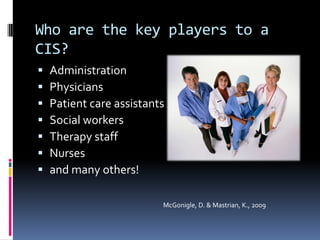
Who are the key players to a
CIS?
   Administration
   Physicians
   Patient care assistants
   Social workers
   Therapy staff
   Nurses
   and many others!

                          McGonigle, D. & Mastrian, K., 2009
Key players continued:

 You need to include everyone from those who
  will run reports, to most importantly, the end
  users.
 Ensuring everyone is involved, will provide “a
  consistency in the charting done by different
  clinicians, while enabling their pathways to
  be designed according to their specific needs”
  (McGonigle & Mastrian. 2009, p.194).
What are the components of the
EHR?
 health information and data
 order entry management
 results management
 decision support
 electronic communication and connectivity
 patient support
 administrative processes
 reporting and population health management
 The entire health care team should have access to the EHR.
                                     McGonigle, D. & Mastrian, K. (2009).
What is a CDS?
 CDS is an abbreviation for the
  Clinical Decision System.
   A software program that allows
    health care professionals with many
    tasks related to health care.
       Diagnoses
       Course of treatment
       Statistics related to disease
       And much more!
What are the functions of a CDS?

 There are four functions of an electronic clinical decision
  support systems:
   Administrative: Supporting clinical coding and
    documentation, authorization of procedures, and referrals.
   Managing clinical complexity and details: Keeping patients on
    research and chemotherapy protocols; tracking orders, referrals
    follow-up, and preventive care.
   Cost control: Monitoring medication orders; avoiding duplicate
    or unnecessary tests.
   Decision support: Supporting clinical diagnosis and treatment
    plan processes; and promoting use of best practices, condition-
    specific guidelines, and population-based management. "
                                     [Perreault & Metzger, 1999]
Comparing the two types of CDS:
How should it be structured?
     Knowledge-Based        Non Knowledge-Based
 Provide clinicians with    Also known as machine
  accurate data such as       learning
    Drugs                   This allows clinicians to use
    Drug Interactions        data from past experiences
    Patient Data               Symptoms of diseases
                                Algorithms
                                Solutions to problems
                                Results in more narrow
                                 results
Incorporating EBP (Evidence
Based Practice) in a CDS
   “EBP should be embedded in computerized
  documentation of a CIS, providing both prompts
  for intervention and/or different questions based
              on a charted assessment…
references supporting EBP should be available for
     review at the click of a mouse or by a few
 keystrokes…the CIS prompting capabilities will
 reinforce the practice of looking for evidence to
         support nursing interventions…”

     (McGonigle, D. & Mastrian, K. (2009).
Interested in a    DiagnosisOne
CDS for your         Diagnosisone.com
Health System?     DSS
                     www.vxvista.org
                   Eclipsys
                     Allscripts.com
Check out          Zynx Health
    these            Zynxhealth.com
companies!!!
                     AND MANY MORE…
                          @MEDICEXCHANGE.COM

                               http://medicexchange.com/
Safety and Security

 The safety and security of a CIS is one of the
  most important things to keep in mind when
  evaluating an EHR system.
 The main areas of safety and security in a CIS
  are:
     Confidentiality
     Availability
     Integrity
    (McGonigle & Mastrian 2009)
Safety and Security:
Confidentiality
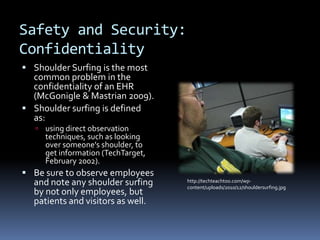
 Shoulder Surfing is the most
  common problem in the
  confidentiality of an EHR
  (McGonigle & Mastrian 2009).
 Shoulder surfing is defined
  as:
    using direct observation
     techniques, such as looking
     over someone's shoulder, to
     get information (TechTarget,
     February 2002).
 Be sure to observe employees
  and note any shoulder surfing     http://techteachtoo.com/wp-
                                    content/uploads/2010/12/shouldersurfing.jpg
  by not only employees, but
  patients and visitors as well.
Safety and Security:
Availability
 One way for organizations to protect the availability
  of their network is to institute an acceptable use
  policy. This policy outlines what employees can and
  cannot do on the hospital network.
 For example: Are employees allowed to download
  personal pictures or music?
 Limiting downloads limits the chances for
  downloading a virus, which could potentially
  compromise the information on the CIS (McGonigle
  & Mastrian 2009).
 When evaluating a CIS, read the hospitals acceptable
  use policy and note any areas that could use
  improvement.
Safety and Security: Integrity
                                                       Integrity: firm adherence
                                                        to a code of especially
                                                        moral or artistic values
                                                        (Merriam-Webster 2011)
                                                       Because employees rely on
                                                        the information on an
                                                        EHR, the integrity of the
                                                        content is crucial.
                                                       When evaluating a
                                                        CIS, make sure there are
                                                        references for
                                                        information, and that they
                                                        can be verified as truthful
                                                        or factual.
 http://i.dailymail.co.uk/i/pix/2010/03/25/article-
 1260760-08DDFB31000005DC-84_233x317.jpg
Costs Involved in Implementing
an EHR
 “…federal health information technology
  spending will grow from $3.2 billion in 2008 to
  over $4.5 billion in 2013” (McGonigle, D. &
  Mastrian, K., 2009)


 2 Categories of costs involved
   System Costs
   Induced Costs
System Costs

  Vary markedly depending
  on software, institution,
  needs, contracts.


  Software and Hardware
  Training
  Implementation
  Ongoing Maintenance and Support
Induced Costs

 Costs involved in transitioning from a paper
  to an electronic system, such as the
  temporary decrease in productivity during
  the implementation phase
Cost Savings

 Decreased Labor
 Decreased billing errors
 Increased capture of charges
 Decreased medical errors
 Increased productivity, information
     sharing, and patient satisfaction
 Medicare and Medicaid incentives if
     qualify
Educating Staff

 Federal initiatives are pushing the adoption
  of electronic health records (EHRs)
  throughout all health care institutions by the
  year 2014.
 Staff must have the knowledge and skills to
  practice in a technology-rich environment.
 Information technology competencies must
  be mandatory for staff to ensure patient
  safety and quality of data input.
Education

 Who Should provide Education?
  Should be managed by a Nursing
   Informatics Specialist, defined as:
   “A specialist with training in Nursing
     science and the study/application of
     technology and the relationship
     between the technology and its use
     in real-world settings.” (University
     of California, Irvine)
Education Goals
 Staff training and orientation
  throughout institution
  according to department
  standards
 Staff training related to privacy
  and HIPAA compliance; initial as
  well as yearly and/or PRN
  refresher training
 Provide education and guidance to
  staff transitioning to the EHR
References
Berner, Eta S., ed. Clinical Decision Support Systems. New York, NY: Springer, 2007


Cavolo, D. Electronic medical record systems: Know the total cost of ownership. Nursing Homes. Jul 2007; 56(7): 17-20.


Colpas, P. Digital Dilemma. Health Management Technology. June 2010;31(6):12. Online. Accessed October 31, 2011.


 "Decision support systems ." 26 July 2005. 17 Feb. 2009 <http://www.openclinical.org/dss.html


 McGonigle, D. & Mastrian, K. (2009). Nursing Informatics and the Foundation of Knowledge. Jones and Barlett: Sudbury, MA.


 Merriam-Webster Dictionary (2011) Definition of Integrity Retreived on Nov. 27, 2011 from http://www.merriam-
      webster.com/dictionary/integrity?show=0&t=1320272169


 TechTarget (2002) Definition Shoulder Surfing Retrieved on Nov. 22, 2011 from
      http://searchsecurity.techtarget.com/definition/shoulder-surfing
 National League of Nursing. “Preparing the next generation of Nurses”. April 23, 2009. Retrieved from
      http://www.newsweekshowcase.com/Health/venues/pring/Next .
 Perreault L, Metzger J. A pragmatic framework for understanding clinical decision support. Journal of Healthcare Information
      Management. 1999;13(2):5-21.
 Wang, S., Blackford, M., Prosser, L., Bardon, C., Spurr, C., Carchidi, P. & Kittler, A. A cost benefit analysis of electronic medical
     records in primary care. The American Journal of Medicine. 2003; 114: 397-403.

Nur 3563 cis_group_project

  • 3.
    Clinical Information System (CIS) According to McGonigle & Mastrain (2009), “a CIS is a technology based system that is applied at the point of care and is designed to support the acquisition and the processing of information as well as providing storage and processing capabilities” (p.193).  A CIS is a complete, comprehensive electronic health record system (EHR). McGonigle, D. & Mastrian, K., 2009
  • 4.
    What are somebenefits of a CIS?  Ease of obtaining patient data at the point of care  Ability to search patient data easily  There is no concern with legibility of charting  Ability to analyze data easily  Enhanced patient safety McGonigle, D. & Mastrian, K. (2009).
  • 5.
    Who are thekey players to a CIS?  Administration  Physicians  Patient care assistants  Social workers  Therapy staff  Nurses  and many others! McGonigle, D. & Mastrian, K., 2009
  • 6.
    Key players continued: You need to include everyone from those who will run reports, to most importantly, the end users.  Ensuring everyone is involved, will provide “a consistency in the charting done by different clinicians, while enabling their pathways to be designed according to their specific needs” (McGonigle & Mastrian. 2009, p.194).
  • 7.
    What are thecomponents of the EHR?  health information and data  order entry management  results management  decision support  electronic communication and connectivity  patient support  administrative processes  reporting and population health management  The entire health care team should have access to the EHR. McGonigle, D. & Mastrian, K. (2009).
  • 8.
    What is aCDS?  CDS is an abbreviation for the Clinical Decision System.  A software program that allows health care professionals with many tasks related to health care.  Diagnoses  Course of treatment  Statistics related to disease  And much more!
  • 9.
    What are thefunctions of a CDS?  There are four functions of an electronic clinical decision support systems:  Administrative: Supporting clinical coding and documentation, authorization of procedures, and referrals.  Managing clinical complexity and details: Keeping patients on research and chemotherapy protocols; tracking orders, referrals follow-up, and preventive care.  Cost control: Monitoring medication orders; avoiding duplicate or unnecessary tests.  Decision support: Supporting clinical diagnosis and treatment plan processes; and promoting use of best practices, condition- specific guidelines, and population-based management. " [Perreault & Metzger, 1999]
  • 10.
    Comparing the twotypes of CDS: How should it be structured? Knowledge-Based Non Knowledge-Based  Provide clinicians with  Also known as machine accurate data such as learning  Drugs  This allows clinicians to use  Drug Interactions data from past experiences  Patient Data  Symptoms of diseases  Algorithms  Solutions to problems  Results in more narrow results
  • 11.
    Incorporating EBP (Evidence BasedPractice) in a CDS  “EBP should be embedded in computerized documentation of a CIS, providing both prompts for intervention and/or different questions based on a charted assessment… references supporting EBP should be available for review at the click of a mouse or by a few keystrokes…the CIS prompting capabilities will reinforce the practice of looking for evidence to support nursing interventions…” (McGonigle, D. & Mastrian, K. (2009).
  • 12.
    Interested in a  DiagnosisOne CDS for your  Diagnosisone.com Health System?  DSS  www.vxvista.org  Eclipsys  Allscripts.com Check out  Zynx Health these  Zynxhealth.com companies!!! AND MANY MORE… @MEDICEXCHANGE.COM http://medicexchange.com/
  • 13.
    Safety and Security The safety and security of a CIS is one of the most important things to keep in mind when evaluating an EHR system.  The main areas of safety and security in a CIS are:  Confidentiality  Availability  Integrity (McGonigle & Mastrian 2009)
  • 14.
    Safety and Security: Confidentiality Shoulder Surfing is the most common problem in the confidentiality of an EHR (McGonigle & Mastrian 2009).  Shoulder surfing is defined as:  using direct observation techniques, such as looking over someone's shoulder, to get information (TechTarget, February 2002).  Be sure to observe employees and note any shoulder surfing http://techteachtoo.com/wp- content/uploads/2010/12/shouldersurfing.jpg by not only employees, but patients and visitors as well.
  • 15.
    Safety and Security: Availability One way for organizations to protect the availability of their network is to institute an acceptable use policy. This policy outlines what employees can and cannot do on the hospital network.  For example: Are employees allowed to download personal pictures or music?  Limiting downloads limits the chances for downloading a virus, which could potentially compromise the information on the CIS (McGonigle & Mastrian 2009).  When evaluating a CIS, read the hospitals acceptable use policy and note any areas that could use improvement.
  • 16.
    Safety and Security:Integrity  Integrity: firm adherence to a code of especially moral or artistic values (Merriam-Webster 2011)  Because employees rely on the information on an EHR, the integrity of the content is crucial.  When evaluating a CIS, make sure there are references for information, and that they can be verified as truthful or factual. http://i.dailymail.co.uk/i/pix/2010/03/25/article- 1260760-08DDFB31000005DC-84_233x317.jpg
  • 17.
    Costs Involved inImplementing an EHR  “…federal health information technology spending will grow from $3.2 billion in 2008 to over $4.5 billion in 2013” (McGonigle, D. & Mastrian, K., 2009)  2 Categories of costs involved  System Costs  Induced Costs
  • 18.
    System Costs Vary markedly depending on software, institution, needs, contracts. Software and Hardware Training Implementation Ongoing Maintenance and Support
  • 19.
    Induced Costs  Costsinvolved in transitioning from a paper to an electronic system, such as the temporary decrease in productivity during the implementation phase
  • 20.
    Cost Savings  DecreasedLabor  Decreased billing errors  Increased capture of charges  Decreased medical errors  Increased productivity, information sharing, and patient satisfaction  Medicare and Medicaid incentives if qualify
  • 21.
    Educating Staff  Federalinitiatives are pushing the adoption of electronic health records (EHRs) throughout all health care institutions by the year 2014.  Staff must have the knowledge and skills to practice in a technology-rich environment.  Information technology competencies must be mandatory for staff to ensure patient safety and quality of data input.
  • 22.
    Education  Who Shouldprovide Education?  Should be managed by a Nursing Informatics Specialist, defined as: “A specialist with training in Nursing science and the study/application of technology and the relationship between the technology and its use in real-world settings.” (University of California, Irvine)
  • 23.
    Education Goals  Stafftraining and orientation throughout institution according to department standards  Staff training related to privacy and HIPAA compliance; initial as well as yearly and/or PRN refresher training  Provide education and guidance to staff transitioning to the EHR
  • 24.
    References Berner, Eta S.,ed. Clinical Decision Support Systems. New York, NY: Springer, 2007 Cavolo, D. Electronic medical record systems: Know the total cost of ownership. Nursing Homes. Jul 2007; 56(7): 17-20. Colpas, P. Digital Dilemma. Health Management Technology. June 2010;31(6):12. Online. Accessed October 31, 2011. "Decision support systems ." 26 July 2005. 17 Feb. 2009 <http://www.openclinical.org/dss.html McGonigle, D. & Mastrian, K. (2009). Nursing Informatics and the Foundation of Knowledge. Jones and Barlett: Sudbury, MA. Merriam-Webster Dictionary (2011) Definition of Integrity Retreived on Nov. 27, 2011 from http://www.merriam- webster.com/dictionary/integrity?show=0&t=1320272169 TechTarget (2002) Definition Shoulder Surfing Retrieved on Nov. 22, 2011 from http://searchsecurity.techtarget.com/definition/shoulder-surfing National League of Nursing. “Preparing the next generation of Nurses”. April 23, 2009. Retrieved from http://www.newsweekshowcase.com/Health/venues/pring/Next . Perreault L, Metzger J. A pragmatic framework for understanding clinical decision support. Journal of Healthcare Information Management. 1999;13(2):5-21. Wang, S., Blackford, M., Prosser, L., Bardon, C., Spurr, C., Carchidi, P. & Kittler, A. A cost benefit analysis of electronic medical records in primary care. The American Journal of Medicine. 2003; 114: 397-403.