CIRCULAR ECONOMY
FOR PLASTICS
INDUSTRY PERSPECTIVE
MARCH 2015
LOUIS LINDENBERG
THE DUTCH CENTRE
Packaging Sustainability
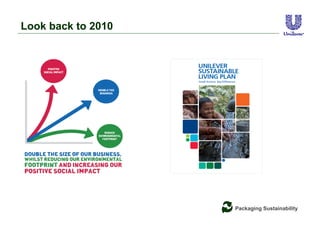
Look back to 2010
Improving Health
&Well-being
Enhancing
Livelihoods
Reducing Environmental
Impacts
HEALTH &
HYGIENE
NUTRITION GREENHOUSE
GASES
WATER WASTE
SUSTAINABLE
SOURCING
BETTER
LIVELIHOODS
Reduce diarrhoeal
disease
Improve heart health
Improve oral
health
Improve
self-esteem
Provide safe drinking
water
Reduce salt
Reduce saturated fat
Remove trans
fat
Reduce sugar
Reduce calories
Reduce GHG from
skin cleansing &
hair washing
Reduce GHG from
washing clothes
Reduce GHG from
manufacturing
Reduce GHG from
transport
Reduce GHG from
refrigeration
Reduce water use in
agriculture
Reduce water use in
laundry process
Reduce water use in
skin cleansing &
hair washing
Reduce water use in
manufacturing
Recycle
packaging
Tackle sachet waste
Eliminate PVC
Reduce waste from
manufacturing
Reuse packaging
Reduce packaging
Sustainable
palm oil
Sustainable paper &
board
Sustainable
tea
Sustainable
fruit & vegetables
Sustainable
soy
Sustainable
cocoa
Help smallholder
farmers
Support micro-
entrepreneurs
Sustainable
sugar, sunflower oil,
rapeseed oil & dairy
Provide healthy
eating information
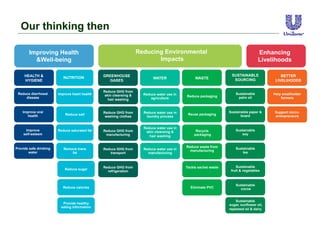
Our thinking then
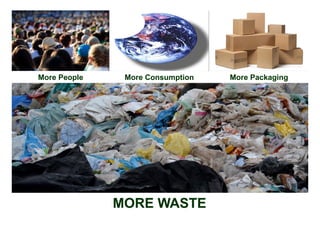
MORE WASTE
More People More Consumption More Packaging
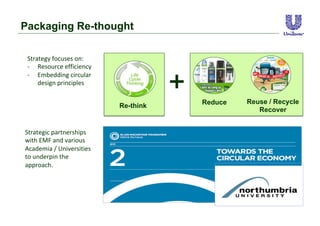
Strategy	focuses	on:	
-  Resource	efficiency	
-  Embedding	circular	
design	principles	
Strategic	partnerships	
with	EMF	and	various	
Academia	/	Universities	
to	underpin	the	
approach.	
Reduce
Re-think
+
Reuse / Recycle
Recover
Packaging Re-thought
Packaging Sustainability
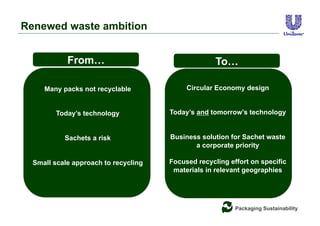
From… To…
Circular Economy design
Today’s and tomorrow’s technology
Business solution for Sachet waste
a corporate priority
Focused recycling effort on specific
materials in relevant geographies
Renewed waste ambition
Many packs not recyclable
Today’s technology
Sachets a risk
Small scale approach to recycling
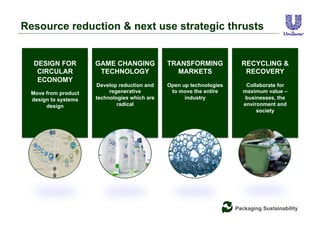
GAME CHANGING
TECHNOLOGY
Develop reduction and
regenerative
technologies which are
radical
TRANSFORMING
MARKETS
Open up technologies
to move the entire
industry
Packaging Sustainability
DESIGN FOR
CIRCULAR
ECONOMY
Move from product
design to systems
design
RECYCLING &
RECOVERY
Collaborate for
maximum value –
businesses, the
environment and
society
Resource reduction & next use strategic thrusts
Packaging Sustainability
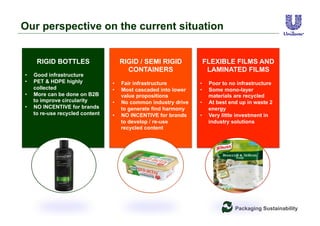
FLEXIBLE FILMS AND
LAMINATED FILMS
•  Poor to no infrastructure
•  Some mono-layer
materials are recycled
•  At best end up in waste 2
energy
•  Very little investment in
industry solutions
RIGID / SEMI RIGID
CONTAINERS
•  Fair infrastructure
•  Most cascaded into lower
value propositions
•  No common industry drive
to generate find harmony
•  NO INCENTIVE for brands
to develop / re-use
recycled content
RIGID BOTTLES
•  Good infrastructure
•  PET & HDPE highly
collected
•  More can be done on B2B
to improve circularity
•  NO INCENTIVE for brands
to re-use recycled content
Our perspective on the current situation
Packaging Sustainability
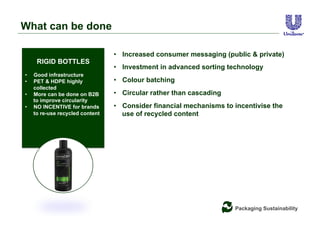
RIGID BOTTLES
•  Good infrastructure
•  PET & HDPE highly
collected
•  More can be done on B2B
to improve circularity
•  NO INCENTIVE for brands
to re-use recycled content
What can be done
•  Increased consumer messaging (public & private)
•  Investment in advanced sorting technology
•  Colour batching
•  Circular rather than cascading
•  Consider financial mechanisms to incentivise the
use of recycled content
Packaging Sustainability
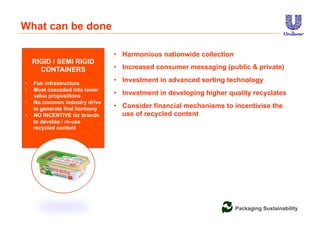
RIGID / SEMI RIGID
CONTAINERS
•  Fair infrastructure
•  Most cascaded into lower
value propositions
•  No common industry drive
to generate find harmony
•  NO INCENTIVE for brands
to develop / re-use
recycled content
What can be done
•  Harmonious nationwide collection
•  Investment in advanced sorting technology
•  Investment in developing higher quality recyclates
•  Consider financial mechanisms to incentivise the
use of recycled content
•  Increased consumer messaging (public & private)
Packaging Sustainability
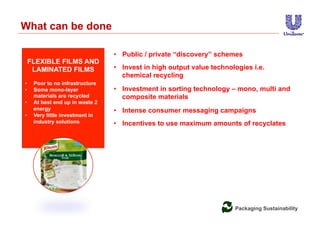
FLEXIBLE FILMS AND
LAMINATED FILMS
•  Poor to no infrastructure
•  Some mono-layer
materials are recycled
•  At best end up in waste 2
energy
•  Very little investment in
industry solutions
What can be done
•  Invest in high output value technologies i.e.
chemical recycling
•  Investment in sorting technology – mono, multi and
composite materials
•  Intense consumer messaging campaigns
•  Incentives to use maximum amounts of recyclates
•  Public / private “discovery” schemes
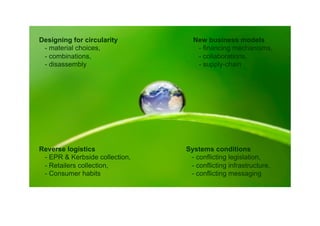
Systems conditions
- conflicting legislation,
- conflicting infrastructure,
- conflicting messaging
New business models
- financing mechanisms,
- collaborations,
- supply-chain
Reverse logistics
- EPR & Kerbside collection,
- Retailers collection,
- Consumer habits
Designing for circularity
- material choices,
- combinations,
- disassembly
The
Circular Economy
in the
Asia Pacific Region
www.keepasiabeautiful.org

Circular Economy for Plastics 2015

  • 1.
    CIRCULAR ECONOMY FOR PLASTICS INDUSTRYPERSPECTIVE MARCH 2015 LOUIS LINDENBERG THE DUTCH CENTRE
  • 2.
  • 3.
    Improving Health &Well-being Enhancing Livelihoods Reducing Environmental Impacts HEALTH& HYGIENE NUTRITION GREENHOUSE GASES WATER WASTE SUSTAINABLE SOURCING BETTER LIVELIHOODS Reduce diarrhoeal disease Improve heart health Improve oral health Improve self-esteem Provide safe drinking water Reduce salt Reduce saturated fat Remove trans fat Reduce sugar Reduce calories Reduce GHG from skin cleansing & hair washing Reduce GHG from washing clothes Reduce GHG from manufacturing Reduce GHG from transport Reduce GHG from refrigeration Reduce water use in agriculture Reduce water use in laundry process Reduce water use in skin cleansing & hair washing Reduce water use in manufacturing Recycle packaging Tackle sachet waste Eliminate PVC Reduce waste from manufacturing Reuse packaging Reduce packaging Sustainable palm oil Sustainable paper & board Sustainable tea Sustainable fruit & vegetables Sustainable soy Sustainable cocoa Help smallholder farmers Support micro- entrepreneurs Sustainable sugar, sunflower oil, rapeseed oil & dairy Provide healthy eating information Our thinking then
  • 4.
    MORE WASTE More PeopleMore Consumption More Packaging
  • 5.
  • 6.
    Packaging Sustainability From… To… CircularEconomy design Today’s and tomorrow’s technology Business solution for Sachet waste a corporate priority Focused recycling effort on specific materials in relevant geographies Renewed waste ambition Many packs not recyclable Today’s technology Sachets a risk Small scale approach to recycling
  • 7.
    GAME CHANGING TECHNOLOGY Develop reductionand regenerative technologies which are radical TRANSFORMING MARKETS Open up technologies to move the entire industry Packaging Sustainability DESIGN FOR CIRCULAR ECONOMY Move from product design to systems design RECYCLING & RECOVERY Collaborate for maximum value – businesses, the environment and society Resource reduction & next use strategic thrusts
  • 8.
    Packaging Sustainability FLEXIBLE FILMSAND LAMINATED FILMS •  Poor to no infrastructure •  Some mono-layer materials are recycled •  At best end up in waste 2 energy •  Very little investment in industry solutions RIGID / SEMI RIGID CONTAINERS •  Fair infrastructure •  Most cascaded into lower value propositions •  No common industry drive to generate find harmony •  NO INCENTIVE for brands to develop / re-use recycled content RIGID BOTTLES •  Good infrastructure •  PET & HDPE highly collected •  More can be done on B2B to improve circularity •  NO INCENTIVE for brands to re-use recycled content Our perspective on the current situation
  • 9.
    Packaging Sustainability RIGID BOTTLES • Good infrastructure •  PET & HDPE highly collected •  More can be done on B2B to improve circularity •  NO INCENTIVE for brands to re-use recycled content What can be done •  Increased consumer messaging (public & private) •  Investment in advanced sorting technology •  Colour batching •  Circular rather than cascading •  Consider financial mechanisms to incentivise the use of recycled content
  • 10.
    Packaging Sustainability RIGID /SEMI RIGID CONTAINERS •  Fair infrastructure •  Most cascaded into lower value propositions •  No common industry drive to generate find harmony •  NO INCENTIVE for brands to develop / re-use recycled content What can be done •  Harmonious nationwide collection •  Investment in advanced sorting technology •  Investment in developing higher quality recyclates •  Consider financial mechanisms to incentivise the use of recycled content •  Increased consumer messaging (public & private)
  • 11.
    Packaging Sustainability FLEXIBLE FILMSAND LAMINATED FILMS •  Poor to no infrastructure •  Some mono-layer materials are recycled •  At best end up in waste 2 energy •  Very little investment in industry solutions What can be done •  Invest in high output value technologies i.e. chemical recycling •  Investment in sorting technology – mono, multi and composite materials •  Intense consumer messaging campaigns •  Incentives to use maximum amounts of recyclates •  Public / private “discovery” schemes
  • 12.
    Systems conditions - conflictinglegislation, - conflicting infrastructure, - conflicting messaging New business models - financing mechanisms, - collaborations, - supply-chain Reverse logistics - EPR & Kerbside collection, - Retailers collection, - Consumer habits Designing for circularity - material choices, - combinations, - disassembly
  • 13.
    The Circular Economy in the AsiaPacific Region www.keepasiabeautiful.org