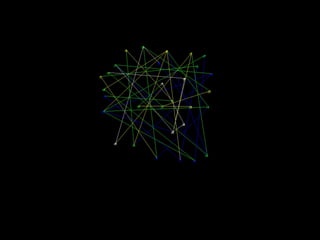
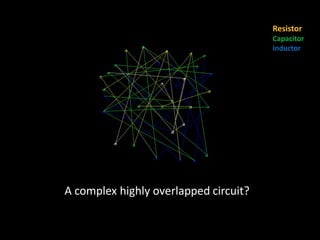
A complex highly overlapped circuit?
Resistor
Capacitor
Inductor
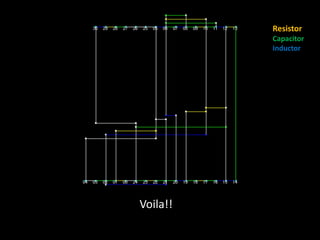
Voila!!
Resistor
Capacitor
Inductor
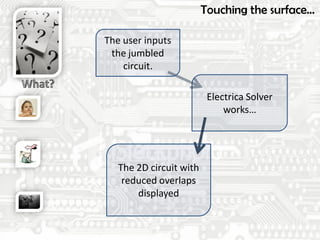
Electrica Solver
works…
The user inputs
the jumbled
circuit.
The 2D circuit with
reduced overlaps
displayed
Touching the surface…
Broader view…
Simplified Orthogonal Circuits for ICs..
Complicated physical circuits  Simplified 2D
circuits
Mesh Charting & Decompression..
Puzzle Solving..
GPS Devices..
Labyrinth routing
Language:
C++
Compiler:
Visual C++
Interface :
OpenGL platform
Extra standard Libraries used:
<glut.h> <glu.h>
<glut32.lib>
Available Code Snippets Downloaded :
NONE
Data Structure:
struct GLcoordinates
{
int x,y,numConn;
struct
{
int index;
int connAttr;
} conn[10];
}oldpts[50];
Simple and flexible data structure for easy handling,
expansion and manipulation for input points.
Can hold any number of connections and nodes within a
given limit.
A
L
G
O
R
I
T
H
M
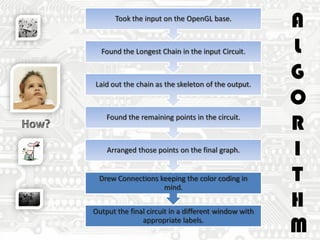
Output the final circuit in a different window with
appropriate labels.
Drew Connections keeping the color coding in
mind.
Arranged those points on the final graph.
Found the remaining points in the circuit.
Laid out the chain as the skeleton of the output.
Found the Longest Chain in the input Circuit.
Took the input on the OpenGL base.
A
L
G
O
R
I
T
H
M
A
L
G
O
R
I
T
H
M
LongestChain()
Finding the longest chain in a set of N points with no
limitations on the connections should take
N!
(N-3)!
steps…
This means the steps for a 50 point limit circuit is
117600!!
Electrica doesn’t calculate the longest chain after the
input is complete, in fact, it intelligently and intuitively
keeps storing the parameters for longest chain as the
user interacts and enters the nodes and makes
connections.
Electrica does it in 3 steps!!
A
L
G
O
R
I
T
H
M
DrawConnections()
To avoid overlapping, we use counters in the Y-
direction which completes the circuit with all
orthogonal connections.
Color Codes:-
Resistor
Capacitor
Inductor
DrawText()
OpenGL does not directly support text output, so we
had to include the built In libraries of bitmap fonts and
modify them to serve our purpose of node labeling.
A
L
G
O
R
I
T
H
M
Limitations
• Maximum nodes is limited ( Can be increased as per
requirement by the developer)
• Number of build chains is limited ( The algorithm for
‘n’ number of chains has been developed as well.
Recursion would be used and the program can be
modified. Time needed..)
•DrawConnections() is not at its best potential due to
limitations in time, but better algorithms have been
devised and are ready to be implemented for a more
accurate output.
This project is presently an infant to the world of
graphs and OpenGL..
It can be taken forward to build applications that
would find use in multiple areas..
USP
I. COST
II. INTERFACE
III. ORIGINALITY
IV. PLATFORM INDEPENDENCE (Runs on LINUX OS)
V. RANGE OF APPLICATION
VI. EXPANDABILITY
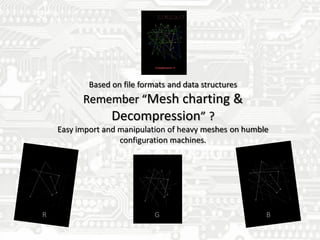
Based on file formats and data structures
Remember “Mesh charting &
Decompression” ?
Easy import and manipulation of heavy meshes on humble
configuration machines.
R G B
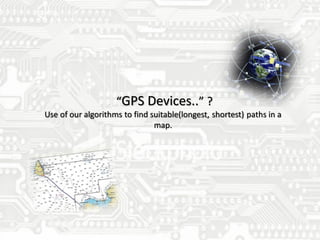
“GPS Devices..” ?
Use of our algorithms to find suitable(longest, shortest) paths in a
map.
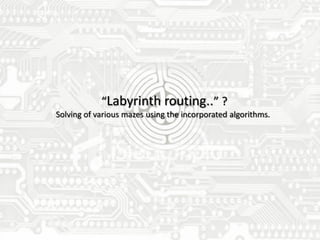
“Labyrinth routing..” ?
Solving of various mazes using the incorporated algorithms.
Interest in solving Graph based
problems..
Optimization of graph analyzing
algorithms is at a nascent stage ,
quickly developing.
Very co$tly similar softwares..
NI MultiSim : ~ $3,000
NI LabView : ~ $3,500
LaB Experiments:
Encounter with complex jumbled
circuits gave a kick..
Prices as on www.ni.com(21/03/08)

Circuit Simplifier

  • 3.
    A complex highlyoverlapped circuit? Resistor Capacitor Inductor
  • 4.
  • 6.
    Electrica Solver works… The userinputs the jumbled circuit. The 2D circuit with reduced overlaps displayed Touching the surface…
  • 7.
    Broader view… Simplified OrthogonalCircuits for ICs.. Complicated physical circuits  Simplified 2D circuits Mesh Charting & Decompression.. Puzzle Solving.. GPS Devices.. Labyrinth routing
  • 9.
    Language: C++ Compiler: Visual C++ Interface : OpenGLplatform Extra standard Libraries used: <glut.h> <glu.h> <glut32.lib> Available Code Snippets Downloaded : NONE
  • 10.
    Data Structure: struct GLcoordinates { intx,y,numConn; struct { int index; int connAttr; } conn[10]; }oldpts[50]; Simple and flexible data structure for easy handling, expansion and manipulation for input points. Can hold any number of connections and nodes within a given limit. A L G O R I T H M
  • 11.
    Output the finalcircuit in a different window with appropriate labels. Drew Connections keeping the color coding in mind. Arranged those points on the final graph. Found the remaining points in the circuit. Laid out the chain as the skeleton of the output. Found the Longest Chain in the input Circuit. Took the input on the OpenGL base. A L G O R I T H M
  • 12.
    A L G O R I T H M LongestChain() Finding the longestchain in a set of N points with no limitations on the connections should take N! (N-3)! steps… This means the steps for a 50 point limit circuit is 117600!! Electrica doesn’t calculate the longest chain after the input is complete, in fact, it intelligently and intuitively keeps storing the parameters for longest chain as the user interacts and enters the nodes and makes connections. Electrica does it in 3 steps!!
  • 13.
    A L G O R I T H M DrawConnections() To avoid overlapping,we use counters in the Y- direction which completes the circuit with all orthogonal connections. Color Codes:- Resistor Capacitor Inductor DrawText() OpenGL does not directly support text output, so we had to include the built In libraries of bitmap fonts and modify them to serve our purpose of node labeling.
  • 14.
    A L G O R I T H M Limitations • Maximum nodesis limited ( Can be increased as per requirement by the developer) • Number of build chains is limited ( The algorithm for ‘n’ number of chains has been developed as well. Recursion would be used and the program can be modified. Time needed..) •DrawConnections() is not at its best potential due to limitations in time, but better algorithms have been devised and are ready to be implemented for a more accurate output.
  • 16.
    This project ispresently an infant to the world of graphs and OpenGL.. It can be taken forward to build applications that would find use in multiple areas..
  • 17.
    USP I. COST II. INTERFACE III.ORIGINALITY IV. PLATFORM INDEPENDENCE (Runs on LINUX OS) V. RANGE OF APPLICATION VI. EXPANDABILITY
  • 18.
    Based on fileformats and data structures Remember “Mesh charting & Decompression” ? Easy import and manipulation of heavy meshes on humble configuration machines. R G B
  • 19.
    “GPS Devices..” ? Useof our algorithms to find suitable(longest, shortest) paths in a map.
  • 20.
    “Labyrinth routing..” ? Solvingof various mazes using the incorporated algorithms.
  • 22.
    Interest in solvingGraph based problems.. Optimization of graph analyzing algorithms is at a nascent stage , quickly developing.
  • 23.
    Very co$tly similarsoftwares.. NI MultiSim : ~ $3,000 NI LabView : ~ $3,500 LaB Experiments: Encounter with complex jumbled circuits gave a kick.. Prices as on www.ni.com(21/03/08)