Into the CloudBarton GeorgeDell Cloud EvangelistApril 14, 2010
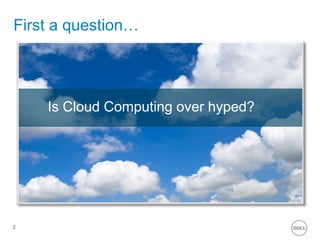
First a question…2Is Cloud Computing over hyped?
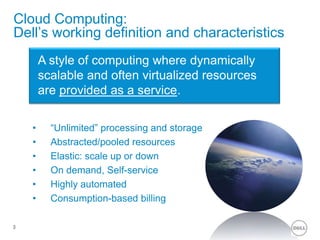
3Cloud Computing: Dell’s working definition and characteristicsA style of computing where dynamically scalable and often virtualized resources are provided as a service. “Unlimited” processing and storage
Abstracted/pooled resources
Elastic: scale up or down
On demand, Self-service
Highly automated
Consumption-based billingHowever you define it, we believe…4It’s about evolving IT to enable greater responsiveness to business needs while at the same time driving greater efficiencies.
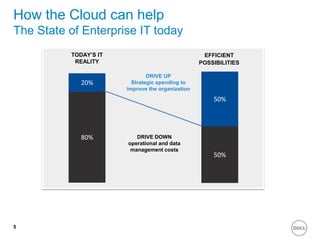
How the Cloud can helpThe State of Enterprise IT todayEFFICIENTPOSSIBILITIESTODAY’S IT REALITYDRIVE UPStrategic spending to improve the organizationDRIVE DOWN operational and data management costs5
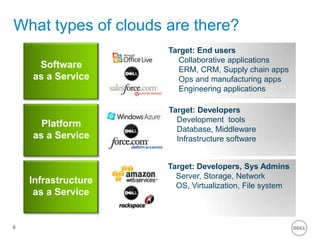
What types of clouds are there?6Target: End users Collaborative applications
 ERM, CRM, Supply chain apps
 Ops and manufacturing apps
 Engineering applicationsSoftwareas a ServiceTarget: Developers Development  tools

Into the Cloud - An introduction to cloud computing

Editor's Notes

  • #6 Business as usual just won’t cut it anymore. Companies are spending up to 80 percent of their operating budget just keeping the lights on. That leaves few investment dollars—and time—for innovating ways to improve the business. At Dell, we believe it’s possible to reduce IT operating expenses down to 50%, through efficient solutions for IT operations and data management.
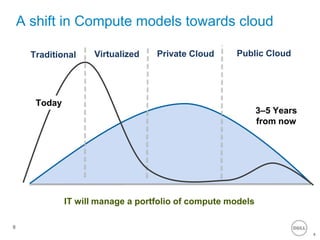
  • #9 One of the greatest ways to get greater efficiencies (and greater agility for that matter) is with the cloud. What I'm showing here in this slide is four swim lanes. You've got traditional, virtualized, private cloud and public cloud, and each one of these is a compute model, and what we believe is that IT organizations will actually be using a mix of these. If you look at where the mix falls today, it would be under this curve right here. The majority of people in IT are working with models that are both traditional and/or virtualized, and a little bit of flirting over here with the public cloud, not a lot in private cloud. Three to Five years from now, what we see is we this flattening out and there will be a much greater concentration here in the private cloud, with a lot of computing in both virtualized and public on either side. With that being said, though, there will still be traditional IT. It's not as if this is going to go away. For as long as we have compute, you're going to still have people who are working here (in the traditional space), and there's going to be applications that won't make any sense to either virtualize or move to the cloud.
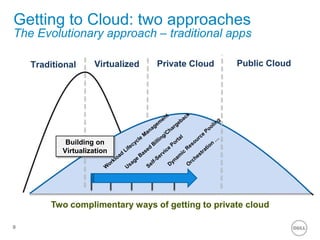
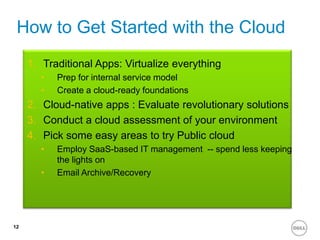
  • #10 There are two ways of getting to the cloud, evolutionary and revolutionary. The first, evolutionary is adapting what you have. You start with virtualization, and then you layer on various capabilities, things like workload lifecycle management, dynamic resource pooling, orchestration, et cetera. With the addition of these capabilities you're getting greater and greater efficiencies and closer and closer to a complete private cloud installation. You don't have to get all the way out to a full private cloud to get benefit, and each step along the way you're getting increased benefits.
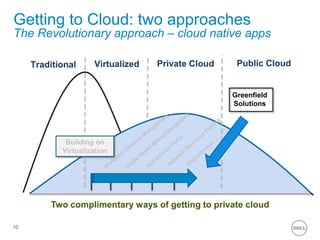
  • #11 Now, the other approach, which is what I'm going to be talking about today, is the revolutionary approach for Greenfield solutions. Basically these are turnkey, integrated private cloud solutions that you will drop in lock, stock right here. So, there are two complementary ways of getting to the cloud, and we actually believe that people are going to be using both of these within their organizations, just depending on what the specific circumstances are for each case. I’d like to now go into more detail about the Revolutionary Solutions.