CIM SMASH/Server Management API
              Programming Guide
                                                                ESX 5.0


          This document supports the version of each product listed and
          supports all subsequent versions until the document is replaced
          by a new edition. To check for more recent editions of this
          document, see http://www.vmware.com/support/pubs.


                                                         EN-000509-00
CIM SMASH/Server Management API Programming Guide


You can find the most up-to-date technical documentation on the VMware Web site at:
http://www.vmware.com/support/
The VMware Web site also provides the latest product updates.
If you have comments about this documentation, submit your feedback to:
docfeedback@vmware.com


Copyright © 2007–2011 VMware, Inc. All rights reserved. This product is protected by U.S. and international copyright and
intellectual property laws. VMware products are covered by one or more patents listed at
http://www.vmware.com/go/patents.
VMware is a registered trademark or trademark of VMware, Inc. in the United States and/or other jurisdictions. All other marks
and names mentioned herein may be trademarks of their respective companies.


VMware, Inc.
3401 Hillview Ave.
Palo Alto, CA 94304
www.vmware.com


2                                                                                                                  VMware, Inc.
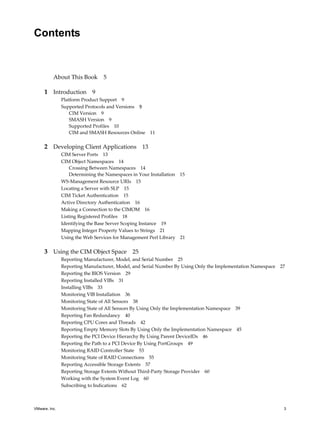
Contents


          About This Book        5

     1 Introduction 9
               Platform Product Support 9
               Supported Protocols and Versions 9
                   CIM Version 9
                   SMASH Version 9
                   Supported Profiles 10
                   CIM and SMASH Resources Online    11


     2 Developing Client Applications 13
               CIM Server Ports 13
               CIM Object Namespaces 14
                   Crossing Between Namespaces 14
                   Determining the Namespaces in Your Installation 15
               WS-Management Resource URIs 15
               Locating a Server with SLP 15
               CIM Ticket Authentication 15
               Active Directory Authentication 16
               Making a Connection to the CIMOM 16
               Listing Registered Profiles 18
               Identifying the Base Server Scoping Instance 19
               Mapping Integer Property Values to Strings 21
               Using the Web Services for Management Perl Library 21

     3 Using the CIM Object Space 25
               Reporting Manufacturer, Model, and Serial Number 25
               Reporting Manufacturer, Model, and Serial Number By Using Only the Implementation Namespace 27
               Reporting the BIOS Version 29
               Reporting Installed VIBs 31
               Installing VIBs 33
               Monitoring VIB Installation 36
               Monitoring State of All Sensors 38
               Monitoring State of All Sensors By Using Only the Implementation Namespace 39
               Reporting Fan Redundancy 40
               Reporting CPU Cores and Threads 42
               Reporting Empty Memory Slots By Using Only the Implementation Namespace 45
               Reporting the PCI Device Hierarchy By Using Parent DeviceIDs 46
               Reporting the Path to a PCI Device By Using PortGroups 49
               Monitoring RAID Controller State 53
               Monitoring State of RAID Connections 55
               Reporting Accessible Storage Extents 57
               Reporting Storage Extents Without Third-Party Storage Provider 60
               Working with the System Event Log 60
               Subscribing to Indications 62


VMware, Inc.                                                                                                3
CIM SMASH/Server Management API Programming Guide


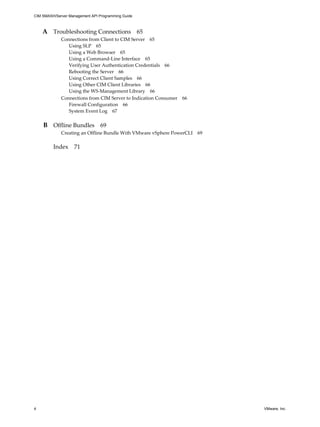
    A Troubleshooting Connections 65
             Connections from Client to CIM Server 65
                Using SLP 65
                Using a Web Browser 65
                Using a Command-Line Interface 65
                Verifying User Authentication Credentials 66
                Rebooting the Server 66
                Using Correct Client Samples 66
                Using Other CIM Client Libraries 66
                Using the WS-Management Library 66
             Connections from CIM Server to Indication Consumer 66
                Firewall Configuration 66
                System Event Log 67


    B Offline Bundles 69
             Creating an Offline Bundle With VMware vSphere PowerCLI 69

         Index 71


4                                                                         VMware, Inc.
About This Book


          The CIM SMASH/Server Management API Programming Guide provides information about developing
          applications using the CIM SMASH/Server Management API version 5.

          VMware® provides many different APIs and SDKs for various applications and goals. This book provides
          information about developing management clients that use industry-standard data models. The System
          Management Architecture for Server Hardware (SMASH) is an industry standard for managing server
          hardware. This book describes the SMASH profiles implemented by VMware and contains suggestions for
          using the Common Information Model (CIM) classes to accomplish common use cases.

          To view the current version of this book as well as all VMware API and SDK documentation, go to
          http://www.vmware.com/support/pubs/sdk_pubs.html.


Revision History
          This book is revised with each release of the product or when necessary. A revised version can contain minor
          or major changes. Table 1 summarizes the significant changes in each version of this book.

          Table 1. Revision History
          Revision      Description

          20110824      Added PCI Device use cases.
                        Corrected Software Update use cases to match current design.
                        Updated product version numbers.
                        Corrected CIM profile version numbers.
                        Removed Host Hardware RAID Controller profile support from default
                        configuration.
                        Revised Perl WS-Management section to bypass deprecated StubOps
                        module.
                        Removed section about Rebooting the Managed Server (deprecated
                        feature).
                        Revised sections about manufacturer, model, and serial number.

          20100430      Added Active Directory Authentication.
                        Added WS-Management code sample.
                        Added Software Update use cases.
                        Corrected Software Inventory use case.
                        Updated version numbers for vSphere 4.1 release.
                        Added Software Inventory use case.
                        Corrected error in RAID controller illustration.
                        Added information on crossing namespace boundaries.
                        Corrected error in WS-Man Resource URI for VMware classes.

          20090521      Updated product names for vSphere 4.0 release.
                        Added use cases for SEL, and physical memory slots.
                        Added namespace, ports, and XML schema information.


VMware, Inc.                                                                                                         5
CIM SMASH/Server Management API Programming Guide


         Table 1. Revision History (Continued)
         Revision       Description

         20080703       VMware ESX™ Server 3.5 Update 2 and ESX Server 3i version 3.5 Update
                        2 release.
                        Replaced instance diagrams with expanded versions.
                        Added use case for CPU core & threading model.
                        Added use case for fan redundancy.
                        Added use cases for Host Hardware RAID Controller profile.
                        Added appendix about troubleshooting connections.
                        Replaced Profile Reference appendix with a URL.
                        Listed indications supported.
                        Added ESX Server 3.5.

         20080409       ESX Server 3i version 3.5 Update 1 release.
                        Changed title (formerly CIM SMASH API Programming Guide)
                        Updated URLs.
                        Removed List of Tables.
                        Added Physical Asset profile; listed properties for all profiles.
                        Updated ElementName of Base Server registered profile.
                        Added SMI-S RAID Controller profile.
                        Divided chapter 2 into 2 parts, and expanded introductory material.
                        Corrected typographical errors.
                        Added some illustrations.

         20071210       ESX Server 3i version 3.5 release.


Intended Audience
         This book is intended for software developers who create applications that need to manage VMware vSphere®
         server hardware with interfaces based on CIM standards.


VMware Technical Publications Glossary
         VMware Technical Publications provides a glossary of terms that might be unfamiliar to you. For definitions
         of terms as they are used in VMware technical documentation, go to http://www.vmware.com/support/pubs.


Document Feedback
         VMware welcomes your suggestions for improving our documentation. Send your feedback to
         docfeedback@vmware.com.


Technical Support and Education Resources
         The following sections describe the technical support resources available to you. To access the current versions
         of other VMware books, go to http://www.vmware.com/support/pubs.


    Online Support
         To use online support to submit technical support requests, view your product and contract information, and
         register your products, go to http://communities.vmware.com/community/developer.


    Support Offerings
         To find out how VMware support offerings can help meet your business needs, go to
         http://www.vmware.com/support/services.


6                                                                                                             VMware, Inc.
About This Book


     VMware Professional Services
          VMware Education Services courses offer extensive hands-on labs, case study examples, and course materials
          designed to be used as on-the-job reference tools. Courses are available onsite, in the classroom, and live
          online. For onsite pilot programs and implementation best practices, VMware Consulting Services provides
          offerings to help you assess, plan, build, and manage your virtual environment. To access information about
          education classes, certification programs, and consulting services, go to http://www.vmware.com/services.


VMware, Inc.                                                                                                         7
CIM SMASH/Server Management API Programming Guide


8                                                   VMware, Inc.
1


Introduction                                                                                              1
          VMware ESX 5.0 includes a CIM Object Manager (CIMOM) that implements a set of server discovery and
          monitoring features that are compatible with the SMASH standard. With the VMware
          CIM SMASH/Server Management API, clients that use industry-standard protocols can do the following:

              Enumerate system resources

              Monitor system health data

              Upgrade installed software

          The VMware implementation of the SMASH standard uses the open-source implementation of the
          Open Management with CIM (OMC) project. OMC provides tools and software infrastructure for hardware
          vendors and others who require a reliable implementation of the Distributed Management Task Force (DMTF)
          management profiles.

          This chapter includes the following topics:

              “Platform Product Support” on page 9

              “Supported Protocols and Versions” on page 9


Platform Product Support
          The VMware CIM SMASH/Server Management API is supported by ESX 5.0. Hardware compatibility for ESX
          is documented in the hardware compatibility guides, available on the VMware Web site. See
          http://www.vmware.com/support/pubs.


Supported Protocols and Versions
          The VMware CIM SMASH/Server Management API supports the following protocols:

              CIM-XML over HTTP or HTTPS

              WS-Management over HTTP or HTTPS

              SLP


     CIM Version
          The CIM standard is an object model maintained by the DMTF, a consortium of leading hardware and
          software vendors. ESX 5 is compatible with version 2.26.0 Final of the CIM schema.


     SMASH Version
          The SMASH standard is maintained by the Server Management Working Group (SMWG) of the DMTF.
          ESX 5.0 is compatible with version 1.0.0 of the SMASH standard.


VMware, Inc.                                                                                                     9
CIM SMASH/Server Management API Programming Guide


     Supported Profiles
         The VMware CIM SMASH/Server Management API supports a subset of the profiles defined by the SMWG.
         These profiles have overlapping structures and can be used in combinations to manage a server.

         This VMware CIM implementation also includes a profile from the SMI specification developed by the Storage
         Networking Industry Association (SNIA). The implementation uses SMI-S version 1.3.

         In some situations, the version of a profile supported by the CIMOM is important. The following table shows
         the version of each profile that is implemented by the VMware CIM SMASH/Server Management API for this
         release of ESX.

         Some profiles are only partially implemented by VMware. The implementation does not include all
         mandatory elements specified in the profile. These profiles are listed with “N/A” in the Version column. For
         information about which elements are implemented, see the VMware CIM SMASH/Server Management API
         and Profile Reference at
         http://pubs.vmware.com/vsphere-50/topic/com.vmware.cimsdk.smashref.doc_50/index.html.

         Table 1-1. Profile Versions
         Profile                                                Version
         Base Server                                            1.0.0

         Battery                                                1.0.0

         CLP Admin Domain                                       N/A

         CPU                                                    1.0.0
         Ethernet Port                                          N/A

         Fan                                                    1.0.1

         Host Discovered Resources                              N/A

         Host LAN Port                                          N/A

         Indications                                            N/A

         IP Interface                                           N/A
         Job Control                                            1.3.0

         PCI Device                                             N/A

         Physical Asset                                         1.0.2
         Power State Management                                 1.0.1

         Power Supply                                           1.0.1

         Profile Registration                                   1.0.0
         Record Log                                             1.0.0

         Sensors                                                1.0.0

         Software Inventory                                     1.0.0

         Software Update                                        1.0.0

         System Memory                                          1.0.0


         The Job Control subprofile is specified by the SNIA, as part of the SMI-S. All other profiles are specified by the
         DMTF.


10                                                                                                              VMware, Inc.
Chapter 1 Introduction


     CIM and SMASH Resources Online
          The following resources related to the CIM, SMASH, and SMI standards are available:

              http://www.dmtf.org (DMTF home page)

              http://www.dmtf.org/standards/cim (CIM standards)

              http://www.dmtf.org/standards/published_documents (DMTF publications)

              http://www.snia.org (SNIA home page)

              http://www.snia.org/tech_activities/standards/curr_standards/smi (SMI-S)


VMware, Inc.                                                                                                       11
CIM SMASH/Server Management API Programming Guide


12                                                  VMware, Inc.
2


Developing Client Applications                                                                                 2
          A basic CIM client that allows you to connect to a CIM server can be outlined as several steps that build on
          prior steps. Each step is explained and illustrated with pseudocode. You can expand this outline to create
          clients that allow you to manage the server.

          The CIM client outline presented in this chapter shows a recommended general approach to accessing the CIM
          objects from the Interop namespace. This approach assumes no advance knowledge of the specifics of the CIM
          implementation. If your client is aware of items such as the Service URL and the namespaces used in the
          VMware implementation, see “Using the CIM Object Space” on page 25 for more information about accessing
          specific objects in the Implementation namespace.

          This chapter includes the following topics:

              “CIM Server Ports” on page 13

              “CIM Object Namespaces” on page 14

              “WS-Management Resource URIs” on page 15

              “Locating a Server with SLP” on page 15

              “CIM Ticket Authentication” on page 15

              “Active Directory Authentication” on page 16

              “Making a Connection to the CIMOM” on page 16

              “Listing Registered Profiles” on page 18
              “Identifying the Base Server Scoping Instance” on page 19

              “Mapping Integer Property Values to Strings” on page 21

              “Using the Web Services for Management Perl Library” on page 21


CIM Server Ports
          CIM servers are available for both CIM-XML and WS-Management protocols, and for both secured and
          non-secured HTTP connections. Select one of the ports that corresponds to the type of connection you want to
          make. Table 2-1 shows the default port numbers used by the CIM servers.

          Table 2-1. Port Numbers for CIM Client Connections
          Connection Type      Port Number      Active in the Default Configuration?

          CIM-XML/HTTP         5988             No
          CIM-XML/HTTPS        5989             Yes

          WS-Man/HTTP          80               No

          WS-Man/HTTPS         443              Yes


VMware, Inc.                                                                                                             13
CIM SMASH/Server Management API Programming Guide


CIM Object Namespaces
         To access a CIM object directly, you must know the namespace in which the object is stored. A managed server
         can have several CIM namespaces. This guide uses the Interop namespace and the Implementation
         namespace.

         Most CIM objects are stored in the Implementation namespace. If you know the URL and the Implementation
         namespace in advance, you can enumerate objects directly by connecting to that namespace.

         The Interop namespace contains a few CIM objects, particularly instances of CIM_RegisteredProfile. One
         of these instances exists for each CIM profile that is fully implemented on the managed server.
         CIM_RegisteredProfile acts as a repository of information that can be used to identify and access objects
         in the Implementation namespace. For each registered CIM profile, the CIM server has an association that you
         can follow to move from the Interop namespace to the Implementation namespace.

         Some profiles in the VMware implementation are only partially implemented. The implementation does not
         include all the mandatory properties and methods for those profiles. The Interop namespace does not contain
         instances of CIM_RegisteredProfile for profiles that are only partially implemented. To access
         unregistered profiles, you must know the Implementation namespace.


     Crossing Between Namespaces
         The ElementConformsToProfile association crosses the boundary between the Interop namespace and the
         Implementation namespace. The association is instantiated in both namespaces, so you can enumerate it in
         either namespace.

         The endpoint references in any instance of the ElementConformsToProfile association include the namespace
         for the endpoint. If you access the referenced endpoint, such as with a GetInstance() method, the request
         is directed to the provider in the correct namespace.

         For example, if you enumerate the class OMC_ElementConformsToRecordLogProfile in the Interop
         namespace, you get an object that associates an instance of OMC_RegisteredRecordLogProfile in the
         Interop namespace with an instance of OMC_IpmiRecordLog in the Implementation namespace. The
         endpoint references look similar to these:
         ConformantStandard =
           root/interop:OMC_RegisteredRecordLogProfile.InstanceID=”IPMI:vmware-host SEL Log”

         ManagedElement =
           root/cimv2:OMC_IpmiRecordLog.InstanceID=”IPMI:vmware-host SEL Log (Node 0)”

         If you enumerate the class OMC_ElementConformsToRecordLogProfile in the Implementation namespace,
         you get an object in the Implementation namespace that is otherwise identical to the object in the Interop
         namespace.

         Regardless of which namespace provides the ElementConformsToProfile instance, the endpoint references
         work the same. If you do a GetInstance() for the ConformantStandard endpoint, the CIM server returns
         an instance of OMC_RegisteredRecordLogProfile in the Interop namespace. If you do a GetInstance()
         for the ManagedElement endpoint, the CIM server returns an instance of OMC_IpmiRecordLog in the
         Implementation namespace.

         To simplify the diagrams in this document, the ElementConformsToProfile association is pictured as a single
         object on the boundary between namespaces, rather than as two objects, one in each namespace. See “Base
         Server Scoping Instance Associated with Profile Registration” on page 19 for an example diagram.


14                                                                                                         VMware, Inc.
Chapter 2 Developing Client Applications


     Determining the Namespaces in Your Installation
          You can hard-code namespaces in the client, or specify them at run time, or you can obtain the namespaces
          from a Service Location Protocol (SLP) Service Agent. Table 2-2 lists the namespaces used by ESX.

          Table 2-2. ESX Namespaces
                                  Interop Namespace            Implementation Namespace

          ESX                     root/interop                 root/cimv2


          You can obtain both the Interop namespace and the Implementation namespace for your managed server from
          SLP. You can identify the Interop namespace more conveniently than the Implementation namespace in the
          SLP output.

          The approach preferred in this document is to use SLP to obtain the Interop namespace and the URL to
          enumerate CIM_RegisteredProfile, and then move to the Scoping Instance of the Base Server profile in the
          Implementation namespace. The Scoping Instance represents the managed server and is associated with many
          other objects in the Implementation namespace. The Scoping Instance provides a reliable point from which to
          navigate to CIM objects that represent any part of the managed server.


WS-Management Resource URIs
          For WS-Management connections, the client must also specify a resource URI when accessing CIM objects. The
          URI represents an XML namespace associated with the schema definition.

          The choice of URI depends on the class name of the CIM object. The prefix of the class name determines which
          URI the client must use. Table 2-3 shows which URI to use for each supported class name prefix.

          Table 2-3. Resource URIs for CIM classes
           Class Name Prefix     Resource URI

          VMware_                http://schemas.vmware.com/wbem/wscim/1/cim-schema/2/
          OMC_                   http://schema.omc-project.org/wbem/wscim/1/cim-schema/2/

          CIM_                   http://schemas.dmtf.org/wbem/wscim/1/cim-schema/2/


Locating a Server with SLP
          If you do not know the URL to access the WBEM service of the CIMOM on the ESX machine, or if you do not
          know the namespace, use SLP to discover the service and the namespace before your client makes a connection
          to the CIMOM.

          SLP-compliant services attached to the same subnet respond to a client SLP query with a Service URL and a
          list of service attributes. The Service URL returned by the WBEM service begins with the service type
          service:wbem:https:// and follows with the domain name and port number to connect to the CIMOM.

          Among the attributes returned to the client is InteropSchemaNamespace. The value of this attribute is the
          name of the Interop namespace.

          For more information about SLP, see the following links:

               http://tools.ietf.org/html/rfc2608

               http://tools.ietf.org/html/rfc3059


CIM Ticket Authentication
          A CIM client must authenticate before it can access data or perform operations on an ESX host. The client can
          authenticate in one of the following ways.

               Directly with the CIMOM on the managed host by supplying a valid user name and password for an
                account that is defined on the managed host.


VMware, Inc.                                                                                                                     15
CIM SMASH/Server Management API Programming Guide


             With a sessionId that the CIMOM accepts in place of the user name and password. The sessionId (called
              a “ticket”) can be obtained by invoking the AcquireCimServicesTicket() method on VMware
              vCenter™ Server.

         As a best practice, use CIM ticket authentication for servers managed by vCenter. If the managed host is
         operating in lockdown mode, the CIMOM does not accept new authentication requests from CIM clients.
         However, the CIMOM does continue to accept a valid ticket obtained from vCenter Server.

         The ticket must be obtained by using the credentials of any user that has administrative privileges on vCenter
         Server. For more information about CIM ticket authentication, see the VMware technical note CIM
         Authentication for Lockdown Mode.


Active Directory Authentication
         ESX hosts implement the Pluggable Authentication Module (PAM) framework, which can be configured to
         support authentication of Active Directory users. This feature is transparent to the CIM client. The client uses
         Active Directory authentication by supplying a user name and password that were previously entered into the
         Active Directory database.

         System administrators can use the vSphere Client or the Web Services SDK to add an ESX host to the Active
         Directory domain and to grant access rights to specific users. Hosts configured to use Active Directory
         authentication can also be configured to accept local users that have been granted access rights.


Making a Connection to the CIMOM
         Before you can enumerate classes, invoke methods, or examine properties of the managed server, you must
         create a connection object in your client. The connection object manages the connection with the CIM server,
         accepts CIM methods by proxy, and passes them to the CIM server. The following pseudocode illustrates how
         to create a connection by using command-line parameters passed to the client.


16                                                                                                            VMware, Inc.
Chapter 2 Developing Client Applications


          To make a connection to the CIMOM

          1    Collect the connection parameters from the environment.
               use os

               function parse_environment()
                  ///Check if all parameters are set in the shell environment.///
                  VI_SERVER = VI_USERNAME = VI_PASSWORD = VI_NAMESPACE=Null
                  ///Any missing environment variable is cause to revert to command-line arguments.///
                  try
                      return { 'VI_SERVER':os.environ['VI_SERVER'], 
                               'VI_USERNAME':os.environ['VI_USERNAME'], 
                               'VI_PASSWORD':os.environ['VI_PASSWORD'], 
                               'VI_NAMESPACE':os.environ['VI_NAMESPACE'] }
                  catch
                      return Null

               use sys

               function get_params()
                  ///Check if parameters are passed on the command line.///
                  param_host = param_user = param_password = param_namespace = Null
                  if len( sys.argv ) == 5
                     print 'Connect using command-line parameters.'
                     param_host, param_user, param_password, param_namespace = sys.argv [ 1:5 ]
                     return { 'host':param_host, 
                              'user':param_user, 
                              'password':param_password, 
                              'namespace':param_namespace }
                  env = parse_environment()
                  if env
                     print 'Connect using environment variables.'
                     return { 'host':env['VI_SERVER'], 
                              'user':env['VI_USERNAME'], 
                              'password':env['VI_PASSWORD'], 
                              'namespace':env['VI_NAMESPACE'] }
                  else
                     print 'Usage: ' + sys.argv[0] + ' <host> <user> <password> [<namespace>]'
                     print ' or set environment variables: VI_SERVER, VI_USERNAME, VI_NAMESPACE'
                     return Null

               params = get_params()
               if params is Null
                  exit(-1)

          2    Create the connection object in the client.
               use wbemlib
               connection = Null

               function connect_to_host( params )
                  ///Connect to the server.///
                  connection = wbemlib.WBEMConnection( 'https://' + params['host'], 
                            ( params['user'], params['password'] ), 
                            params['namespace'] )
                  return connection

               if connect_to_host( params )
                  print 'Connected to: ' + params['host'] + ' as user: ' + params['user']
               else
                  print 'Failed to connect to: ' + params['host'] + ' as user: ' + params['user']

               With some client libraries, creating a connection object in the client does not send a request to the CIMOM.
               A request is not sent until a method is called. To verify that such a client can connect to and authenticate
               with the server, see another use case, such as “Listing Registered Profiles” on page 18.


VMware, Inc.                                                                                                                  17
CIM SMASH/Server Management API Programming Guide


Listing Registered Profiles
         VMware recommends that CIM clients list the registered profiles before you use them for other purposes. If a
         profile is not present in the registration list (CIM_RegisteredProfile), the profile is not implemented or is
         incompletely implemented.

         SMASH profiles are registered in the Interop namespace, even when they are implemented in the
         Implementation namespace. A client exploring the CIM objects on the managed server can use the associations
         to move from CIM_RegisteredProfile to the objects in the Implementation namespace.

         The CIM_RegisteredProfile class is instantiated with subclasses that represent the profiles that are
         registered in the Interop namespace. Each instance represents a profile that is fully implemented in the
         Implementation namespace. Figure 2-1 shows a few instances of CIM_RegisteredProfile subclasses.

         Figure 2-1. Registered Profile Subclasses in Interop Namespace

                         root/interop               CIM_RegisteredProfile


          OMC_RegisteredBaseServerProfile


                              OMC_RegisteredSensorProfile


                                                 OMC_RegisteredCPUProfile


                                                                    .
                                                                        .
                                                                            .

                                                            VMware_PowerManagementServiceRegisteredProfile


         The following pseudocode shows one way to identify the profiles registered on the managed server. The
         pseudocode in this topic depends on the pseudocode in “Making a Connection to the CIMOM” on page 16.

         To list registered profiles

         1    Connect to the server URL.

              Specify the Interop namespace, supplied as a parameter, for the connection.
              use wbemlib
              use sys
              use connection renamed cnx
              connection = Null

              params = cnx.get_params()
              if params is Null
                 sys.exit(-1)
              interop_params = params
              interop_params['namespace'] = 'root/interop'
              connection = cnx.connect_to_host( interop_params )
              if connection is Null
                 print 'Failed to connect to: ' + params['host'] + ' as user: ' + params['user']


18                                                                                                           VMware, Inc.
Chapter 2 Developing Client Applications


          2    Enumerate instances of CIM_RegisteredProfile.
               function get_registered_profile_names( connection )
                  ///Get instances of RegisteredProfile.///
                  instance_names = connection.EnumerateInstanceNames( 'CIM_RegisteredProfile' )
                  if instance_names is Null
                     print 'Failed to enumerate RegisteredProfile.'
                     return Null
                  else
                     return instance_names

               instance_names = get_registered_profile_names( connection )
               if instance_names is Null
                  sys.exit(-1)

          3    For each instance of CIM_RegisteredProfile, print the name and version of the profile.
               function print_profile( instance )
                  print 'n' + ' [' + instance.classname + '] ='
                  for prop in ( 'RegisteredName', 'RegisteredVersion' )
                     print ' %30s = %s' % ( prop, instance[prop] )

               for instance_name in instance_names
                  instance = connection.GetInstance( instance_name )
                  print_profile( instance )


Identifying the Base Server Scoping Instance
          The Scoping Instance of CIM_ComputerSystem for the Base Server profile is an object that represents the
          managed server. Various hardware and software components of the managed server are represented by CIM
          objects associated with this Scoping Instance.

          A client can locate CIM objects by using one of the following ways:

              Enumerate instances in the Implementation namespace, and then filter the results by their property
               values. This approach requires specific knowledge of the Implementation namespace and the subclassing
               used by the SMASH implementation on the managed server.
              Locate the Base Server Scoping Instance that represents the managed server, and then traverse selected
               association objects to find the desired components. This approach requires less knowledge of the
               implementation details.

          Figure 2-2 shows the association between the profile registration instance in the Interop namespace and the
          Base Server Scoping Instance in the Implementation namespace.

          Figure 2-2. Base Server Scoping Instance Associated with Profile Registration

                          CIM_RegisteredProfile::
                       OMC_RegisteredBaseServerProfile

                                                            CIM_ElementConformsToProfile::
          root/interop                                   OMC_ElementConformsToBaseServerProfile

                                                         ConformantStandard
                                                         ManagedElement
          root/cimv2


                         CIM_ComputerSystem::
                       OMC_UnitaryComputerSystem


          The following pseudocode shows how to traverse the association to arrive at the Base Server Scoping Instance.
          This pseudocode depends on the pseudocode in “Making a Connection to the CIMOM” on page 16.


VMware, Inc.                                                                                                                       19
CIM SMASH/Server Management API Programming Guide


         To identify the Base Server Scoping Instance

         1    Connect to the server URL.

              Specify the Interop namespace, supplied as a parameter, for the connection.
              use wbemlib
              use sys
              use connection renamed cnx
              connection = Null

              params = cnx.get_params()
              if params is Null
                 sys.exit(-1)
              interop_params = params
              interop_params['namespace'] = 'root/interop'
              connection = cnx.connect_to_host( interop_params )
              if connection is Null
                 print 'Failed to connect to: ' + params['host'] + ' as user: ' + params['user']
                 sys.exit(-1)

         2    Enumerate instances of CIM_RegisteredProfile.
              use registered_profiles renamed prof

              profile_instance_names = prof.get_registered_profile_names( connection )
              if profile_instance_names is Null
                 print ‘No registered profiles found.’
                 sys.exit(-1)

         3    Select the instance that corresponds to the Base Server profile.
              function isolate_base_server_registration( connection, instance_names )
                 ///Isolate the Base Server registration.///
                 for instance_name in instance_names
                    instance = connection.GetInstance( instance_name )
                    if instance[ 'RegisteredName' ] == 'Base Server'
                       return instance_name
                 return Null

              profile_instance_name = isolate_base_server_registration( connection, 
                                                                        profile_instance_names )
              if profile_instance_name is Null
                 print 'Base Server profile is not registered in namespace ' + namespace
                 sys.exit(-1)

         4    Traverse the CIM_ElementConformsToProfile association to reach the Scoping Instance.
              function associate_to_scoping_instance( connection, profile_name )
                 ///Follow ElementConformsToProfile from RegisteredProfile to ComputerSystem.///
                 instance_names = connection.AssociatorNames( profile_name, 
                                              AssocClass = 'CIM_ElementConformsToProfile', 
                                              ResultRole = 'ManagedElement' )
                 if len( instance_names ) > 1
                    print 'Error: %d Scoping Instances found.' % len( instance_names )
                    sys.exit(-1)
                 return instance_names.pop()

              function print_instance( instance )
                 print 'n' + ' [' + instance.classname + '] ='
                 for prop in instance.keys()
                    print ' %30s = %s' % ( prop, instance[prop] )

              scoping_instance_name = associate_to_scoping_instance( connection, profile_instance_name )
              if scoping_instance_name is Null
                 print 'Failed to find Scoping Instance.'
                 sys.exit(-1)
              else
                 print_instance( connection.GetInstance( scoping_instance_name )


20                                                                                                   VMware, Inc.
Chapter 2 Developing Client Applications


Mapping Integer Property Values to Strings
          Many of the properties defined in CIM contain integer values that represent status or configuration
          information. The qualifiers for those properties define a mapping to human-readable string values.

          This example shows a general-purpose routine for converting an integer value to the corresponding string
          value. The example assumes that the client library you are using has support for introspecting class property
          information available in the qualifiers.

          The following function expects three parameters:

              A connection object that you have previously created, as described in “Making a Connection to the
               CIMOM” on page 16

              An instance of the class that you have retrieved from the CIMOM

              A string value containing the name of a property of that instance, to be mapped to its string descriptor
          use wbemlib
          use connection

          function map_instance_property_to_string( connection, instance, prop )
             class_info = connection.GetClass( instance.classname, includeQualifiers=True )
             qualifiers = class_info.properties[ prop ].qualifiers
             if qualifiers.key( ‘ValueMap’ ) and qualifiers.key( ‘Values’ )
                strings = qualifiers[ ‘Values’ ]
                nums = qualifiers[ ‘ValueMap’ ]
                prop_val = instance[ prop ]
                for ( i=0; len( nums ) - 1; i++ )
                   if str( nums[ i ] ) == str( prop_val )
                      return strings[ i ]
             return Null


Using the Web Services for Management Perl Library
          VMware ESX supports the WS-Management protocol in addition to the CIM-XML protocol for passing CIM
          information between client and server. VMware provides WS-Management client libraries as part of the
          vSphere SDK for Perl.

          In the VMware Web Services for Management Perl Library there are two API layers recommended for Perl
          clients:

              WSMan::WSBasic implements serialization and deserialization of objects transported with the SOAP
               protocol.

              WSMan::GenericOps implements a wrapper interface for WSMan::WSBasic. WSMan::GenericOps
               provides CIM objects in the form of Perl hashes.
          NOTE The StubOps API layer, which provides a wrapper for WSMan::GenericOps, is deprecated in ESX 5.0.
          You can use the GenericOps API layer to get the same results.

          Using the WSMan::GenericOps layer of the SDK is similar to using a CIM-XML client library. The client creates
          a connection object, enumerates instances, and traverses associations in the same general way as described in
          “Making a Connection to the CIMOM” on page 16, “Listing Registered Profiles” on page 18, and “Identifying
          the Base Server Scoping Instance” on page 19. For more information about the vSphere SDK for Perl, see the
          vSphere SDK for Perl Programming Guide.
          The following code example shows how you can make a connection to the CIM server, enumerate registered
          profiles, and follow the ElementConformsToProfile association to the Base Server Scoping Instance of
          ComputerSystem.


VMware, Inc.                                                                                                                 21
CIM SMASH/Server Management API Programming Guide


         #!/usr/bin/perl
         use strict;
         use warnings;
         use VMware::VIRuntime;
         use WSMan::GenericOps;
         use VMware::VILib;
         $Util::script_version = "1.0";
         =pod
            USAGE:: perl central_server.pl --server myserver.example.com --username abc
                     --password xxxx [--namespace xxx/xxx] [--timeout numsecs]
         =cut
         my %opts = (
             namespace => {
                type      => '=s',
                help      => 'Namespace for queries. Default is root/interop for profile registration.',
                required => 0,
                default => 'root/interop',
             },
             timeout => {
                type => '=s',
                help => 'Default http timeout for all the queries. Default is 120',
                required => 0,
                default => '120'
             },
         );
         Opts::add_options( %opts );
         Opts::parse();
         Opts::validate();

         Opts::set_option( 'protocol', 'http' );
         Opts::set_option( 'servicepath', '/wsman' );
         Opts::set_option( 'portnumber', '80');

         sub create_connection_object
         {
            my %args = (
               path => Opts::get_option( 'servicepath' ),
               username => Opts::get_option( 'username' ),
               password => Opts::get_option( 'password' ),
               port => Opts::get_option ( 'portnumber' ),
               address => Opts::get_option ( 'server' ),
               namespace => Opts::get_option( 'namespace' ),
               timeout => Opts::get_option( 'timeout' )
            );
            my $client = WSMan::GenericOps->new( %args );
            if ( not defined $client ) {
               print "Failed to create connection object.n";
               return undef;
            }
            # Add resource URIs for derived classes:
            $client->register_class_ns( OMC => 'http://schema.omc-project.org/wbem/wscim/1/cim-schema/2',
                                         VMware => 'http://schemas.vmware.com/wbem/wscim/1/cim-schema/2',
                                      );
            return $client;
         }


22                                                                                                 VMware, Inc.
Chapter 2 Developing Client Applications


          sub get_registered_profiles
          {
             my ($client) = @_;
             my @instances = ();
             eval {
                @instances = $client->EnumerateInstances(
                                          class_name => 'CIM_RegisteredProfile' );
             };
             if ( $@ ) {
                print "Failed EnumerateInstances() on CIM_RegisteredProfile.n";
                die $@;
             }
             return @instances;
          }

          sub isolate_base_server_registration
          {
             my ($client, @instances) = @_;
             foreach my $instance (@instances) {
                my $class_name = ( keys %$instance )[ 0 ];
                my $profile = $instance->{ $class_name };
                if ( $profile->{'RegisteredName'}
                  && $profile->{'RegisteredName'} eq 'Base Server' ) {
                   return $instance;
                }
             }
             return undef;
          }

          sub associate_to_scoping_instance
          {
             my ($client, $instance) = @_;
             my $class_name = ( keys %$instance )[ 0 ];
             my $profile = $instance->{ $class_name };
             my @instances = ();
             eval {
                @instances = $client->EnumerateAssociatedInstances(
                                            class_name => $class_name,
                                            selectors => $profile,
                                            associationclassname => 'CIM_ElementConformsToProfile',
                                            resultrole => 'ManagedElement' );
             };
             if ( $@ ) {
                print "Failed EnumerateAssociatedInstances() for Base Server profile registration.n";
                die $@;
             }
             if ( scalar( @instances ) > 1 ) {
                print "Error: " . scalar( @instances ) . " Scoping Instances found.n";
                return undef;
             }
             pop @instances;
          }

          # Create client connection object for ESX host:
          my $client = create_connection_object();
          if ( not defined $client ) {
             die "Aborting.n";
          }
          my @profile_instances = get_registered_profiles( $client );
          if ( scalar( @profile_instances ) == 0 ) {
             die( 'No registered profile instances found on '
                   . Opts::get_option( 'server' ) . ':'
                   . Opts::get_option( 'namespace' ) . "n"
                );
          }


VMware, Inc.                                                                                                       23
CIM SMASH/Server Management API Programming Guide


         my $profile_instance = isolate_base_server_registration( $client, @profile_instances );
         if ( not defined $profile_instance ) {
            die( "Base Server profile is not registered in namespace.n" );
         }
         my $scoping_instance = associate_to_scoping_instance( $client, $profile_instance );
         if ( not defined $scoping_instance ) {
            die( "No managed element found for base server.n" );
         }
         print "Base Server profile Scoping Instance properties:n";
         my $class_name = ( keys %$scoping_instance )[ 0 ];
         my $base_server = $scoping_instance->{ $class_name };
         for my $property (keys %$base_server ) {
            my $value = 'undefined';
            if ( defined $base_server->{$property} ) {
               $value = $base_server->{$property}
            }
            print ' ', $property, ': ', $value, "n";
         }


24                                                                                                 VMware, Inc.
3


Using the CIM Object Space                                                                                      3
          You can learn how to use the CIM object space to get information and manage a server that runs VMware ESX
          by studying these examples. Each example describes a goal to accomplish, steps to accomplish the goal, and a
          few lines of pseudocode to demonstrate the steps used in the client. These examples are chosen primarily to
          explain features of the VMware implementation of the profiles, and secondarily to demonstrate common
          operations.

          This chapter includes the following topics:

              “Reporting Manufacturer, Model, and Serial Number” on page 25

              “Reporting Manufacturer, Model, and Serial Number By Using Only the Implementation Namespace” on
               page 27

              “Reporting the BIOS Version” on page 29

              “Reporting Installed VIBs” on page 31

              “Installing VIBs” on page 33

              “Monitoring VIB Installation” on page 36

              “Monitoring State of All Sensors” on page 38

              “Monitoring State of All Sensors By Using Only the Implementation Namespace” on page 39

              “Reporting Fan Redundancy” on page 40
              “Reporting CPU Cores and Threads” on page 42

              “Reporting Empty Memory Slots By Using Only the Implementation Namespace” on page 45

              “Reporting the PCI Device Hierarchy By Using Parent DeviceIDs” on page 46

              “Reporting the Path to a PCI Device By Using PortGroups” on page 49

              “Monitoring RAID Controller State” on page 53

              “Monitoring State of RAID Connections” on page 55

              “Reporting Accessible Storage Extents” on page 57

              “Reporting Storage Extents Without Third-Party Storage Provider” on page 60

              “Working with the System Event Log” on page 60

              “Subscribing to Indications” on page 62

          Many of the examples build on the basic steps described in “Developing Client Applications” on page 13.


Reporting Manufacturer, Model, and Serial Number
          Taking an inventory of systems in your datacenter can be a first step to monitoring the status of the servers.
          You can store the inventory data for future use when you monitor configuration changes.

VMware, Inc.                                                                                                           25
CIM SMASH/Server Management API Programming Guide


         This example shows how to get physical identifying information from the Interop namespace by traversing
         associations to the CIM_Chassis for the Scoping Instance. Figure 3-1 shows the relationships of the CIM
         objects involved.

         If you know the Implementation namespace in advance, you can bypass the Interop namespace. For
         information about getting physical identifying information by using only the Implementation namespace, see
         “Reporting Manufacturer, Model, and Serial Number By Using Only the Implementation Namespace” on
         page 27.

         Figure 3-1. Locating Chassis Information from the Base Server Scoping Instance

                          CIM_RegisteredProfile::
                       OMC_RegisteredBaseServerProfile

                                                            CIM_ElementConformsToProfile::
         root/interop                                    OMC_ElementConformsToBaseServerProfile

                                                         ConformantStandard
         root/cimv2                                      ManagedElement


                         CIM_ComputerSystem::
                       OMC_UnitaryComputerSystem
                                                           CIM_ComputerSystemPackage::
                                                           OMC_ComputerSystemPackage

                                                            Dependent
                                                            Antecedent


                                CIM_Chassis::
                                OMC_Chassis

                           Manufacturer
                           Model
                           SerialNumber
                           ElementName
                           Tag


         This pseudocode depends on the pseudocode in “Making a Connection to the CIMOM” on page 16 and
         “Identifying the Base Server Scoping Instance” on page 19.

         To report manufacturer, model, and serial number

         1    Connect to the server URL.

              Specify the Interop namespace, supplied as a parameter, for the connection.
              use wbemlib
              use sys
              use connection renamed cnx
              connection = Null

              params = cnx.get_params()
              if params is Null
                 sys.exit(-1)
              interop_params = params
              interop_params['namespace'] = 'root/interop'
              connection = cnx.connect_to_host( interop_params )
              if connection is Null
                 print 'Failed to connect to: ' + params['host'] + ' as user: ' + params['user']
                 sys.exit(-1)


26                                                                                                       VMware, Inc.
Chapter 3 Using the CIM Object Space


          2    Locate the Base Server Scoping Instance of CIM_ComputerSystem.
               use scoping_instance renamed si

               scoping_instance_name = si.get_scoping_instance_name( connection )
               if scoping_instance_name is Null
                  print 'Failed to find Scoping Instance.'
                  sys.exit(-1)

          3    Traverse the CIM_ComputerSystemPackage association to reach the CIM_Chassis instance that
               corresponds to the managed server.
               instance_names = connection.AssociatorNames( scoping_instance_name, 
                                            AssocClass = 'CIM_ComputerSystemPackage', 
                                            ResultClass = 'CIM_Chassis' )
               if len( instance_names ) > 1
                  print 'Error: %d Chassis instances found for Scoping Instance.' 
                        % len ( instance_names )
                  sys.exit(-1)

          4    Print the Manufacturer, Model, and SerialNumber properties.

               This example prints additional properties to help identify physical components.
               instance_name = instance_names.pop()
               instance = connection.GetInstance( instance_name )
               print ’n’ + ’CIM_Chassis [’ + instance.classname + ’] =’
               for property_name in [ ’ElementName’, ’Tag’, 
                     ’Manufacturer’, ’Model’, ’SerialNumber’ ]
                  if instance.key( property_name )
                     value = instance[ property_name ]
                  else
                     value = ’(not available)’
                  print ’ %30s : %s’ % ( property_name, value )


               A sample of the output looks like the following:
               CIM_Chassis [OMC_Chassis] =
                                     ElementName     :   Chassis
                                             Tag     :   23.0
                                    Manufacturer     :   Cirrostratus Systems
                                           Model     :   20KF6KM
                                    SerialNumber     :   67940851


Reporting Manufacturer, Model, and Serial Number By Using Only the
Implementation Namespace
          Taking an inventory of systems in your datacenter can be a first step to monitoring the status of the servers.
          You can store the inventory data for future use in monitoring configuration changes.

          This example shows how to get the physical identifying information from the Implementation namespace by
          enumerating CIM_Chassis for the managed server. This approach is convenient when the namespace is
          known in advance. For information about getting physical identifying information by using the Interop
          namespace, see “Reporting Manufacturer, Model, and Serial Number” on page 25.

          You might see more than one instance of CIM_Chassis if the managed server is a blade system. Figure 3-2
          shows an example of a server with two instances of CIM_Chassis, one for a blade and the other for the blade
          enclosure.


VMware, Inc.                                                                                                               27
CIM SMASH/Server Management API Programming Guide


         Figure 3-2. Locating Chassis Information in a Blade Server
         root/cimv2
                          CIM_Chassis::                         CIM_Chassis::
                          OMC_Chassis                           OMC_Chassis

                          Manufacturer                           Manufacturer
                          Model                                  Model
                          SerialNumber                           SerialNumber
                          ElementName                            ElementName
                          Tag                                    Tag
                          PackageType = Chassis/Frame            PackageType = Blade


             CIM_ComputerSystemPackage::                                    CIM_ComputerSystemPackage::
             OMC_ComputerSystemPackage                                      OMC_ComputerSystemPackage

                              Antecedent                                    Antecedent
                              Dependent                                     Dependent


                         CIM_ComputerSystem::                    CIM_ComputerSystem::
                       OMC_ModularComputerSystem               OMC_UnitaryComputerSystem


                                                 CIM_ComponentCS::
                                                 OMC_ComponentCS

                                           GroupComponent
                                                            PartComponent


         This pseudocode depends on the pseudocode in “Making a Connection to the CIMOM” on page 16,
         “Identifying the Base Server Scoping Instance” on page 19, and “Mapping Integer Property Values to Strings”
         on page 21.

         To report Manufacturer, Model, and Serial Number by using only the Implementation namespace

         1     Connect to the server URL.

               Specify the Implementation namespace, supplied as a parameter, for the connection.

               The actual namespace you will use depends on your installation.
               use wbemlib
               use sys
               use connection renamed cnx
               connection = Null

               params = cnx.get_params()
               if params is Null
                  sys.exit(-1)
               connection = cnx.connect_to_host( params )
               if connection is Null
                  print 'Failed to connect to: ' + params['host'] + ' as user: ' + params['user']
                  sys.exit(-1)

         2     Use the EnumerateInstances method to get all the CIM_Chassis instances on the server.
               chassis_instance_names = connection.EnumerateInstanceNames( 'CIM_Chassis' )
               if len( chassis_instance_names ) is 0
                  print 'No %s instances were found.' % ('CIM_Chassis')
                  sys.exit(0)


28                                                                                                        VMware, Inc.
Chapter 3 Using the CIM Object Space


          3    Print the Manufacturer, Model, and SerialNumber properties of the Chassis instances.

               This example prints additional properties to help identify physical components.
               use value_mapper renamed mapper

               for instance_name in chassis_instance_names
                  print_chassis( connection, instance_name )

               function print_chassis( connection, instance_name )
                  instance = connection.GetInstance( instance_name )
                  print 'n' + 'CIM_Chassis [' + instance.classname + '] ='
                  for property_name in [ 'ElementName', 'Tag', 'Manufacturer', 
                    'Model', 'SerialNumber' ]
                     if instance.key( property_name )
                        value = instance[ property_name ]
                     else
                        value = '(not available)'
                     print ' %30s : %s' % ( property_name, value )
                  for property_name in [ ’PackageType’, 'ChassisPackageType' ]
                     if instance.key( property_name )
                        value = mapper.map_instance_property_to_string( connection,
                                                                        instance,
                                                                        property_name )
                        if value is Null
                           value = ’’
                     else
                        value = '(not available)'
                     print ' %30s : %s' % ( property_name, value )


               A sample of the output looks like the following:
               CIM_Chassis [OMC_Chassis] =
                                     ElementName     :   Chassis
                                             Tag     :   23.0
                                    Manufacturer     :   Cirrostratus Systems
                                           Model     :   20KF6KM-02
                                    SerialNumber     :   67940851
                                     PackageType     :   Blade
                              ChassisPackageType     :   None

               CIM_Chassis [OMC_Chassis] =
                                     ElementName     :   Chassis
                                             Tag     :   23.1
                                    Manufacturer     :   Cirrostratus Systems
                                           Model     :   20KF6KM-W
                                    SerialNumber     :   439-41902
                                     PackageType     :   Chassis/Frame
                              ChassisPackageType     :   Blade Enclosure


Reporting the BIOS Version
          System administrators can query the BIOS version of the managed server as part of routine maintenance.

          This example shows how to get the BIOS version string by traversing the CIM_InstalledSoftwareIdentity
          association from the server Scoping Instance. The VMware implementation of the Software Inventory profile
          uses CIM_InstalledSoftwareIdentity to associate firmware and hypervisor instances of
          CIM_SoftwareIdentity to the server Scoping Instance. VMware does not implement the
          CIM_ElementSoftwareIdentity association for firmware and hypervisor instances, so you must use
          CIM_InstalledSoftwareIdentity to locate the system BIOS instance of CIM_SoftwareIdentity.

          Figure 3-3 shows the relationships of the CIM objects involved.


VMware, Inc.                                                                                                            29
CIM SMASH/Server Management API Programming Guide


         Figure 3-3. Locating the BIOS Version from the Base Server Scoping Instance

                          CIM_RegisteredProfile::
                       OMC_RegisteredBaseServerProfile

                                                            CIM_ElementConformsToProfile::
         root/interop                                    OMC_ElementConformsToBaseServerProfile

                                                         ConformantStandard
         root/cimv2                                      ManagedElement


                         CIM_ComputerSystem::
                       OMC_UnitaryComputerSystem
                                                           CIM_InstalledSoftwareIdentity::
                                                           OMC_InstalledSoftwareIdentity

                                                            System
                                                            InstalledSoftware


                          CIM_SoftwareIdentity::
                        OMC_SMASHFirmwareIdentity

                           Manufacturer
                           VersionString


         The VMware implementation of CIM_SoftwareIdentity makes the version available in the
         VersionString property rather than in the MajorVersion and MinorVersion properties.

         This pseudocode depends on the pseudocode in “Making a Connection to the CIMOM” on page 16 and
         “Identifying the Base Server Scoping Instance” on page 19.

         To report the BIOS version

         1    Connect to the server URL.

              Specify the Interop namespace, supplied as a parameter, for the connection.
              use wbemlib
              use sys
              use connection renamed cnx
              connection = Null

              params = cnx.get_params()
              if params is Null
                 sys.exit(-1)
              interop_params = params
              interop_params['namespace'] = 'root/interop'
              connection = cnx.connect_to_host( interop_params )
              if connection is Null
                 print 'Failed to connect to: ' + params['host'] + ' as user: ' + params['user']
                 sys.exit(-1)

         2    Locate the Base Server Scoping Instance that represents the managed server.
              use scoping_instance renamed si

              scoping_instance_name = si.get_scoping_instance_name( connection )
              if scoping_instance_name is Null
                 print 'Failed to find server Scoping Instance.'
                 sys.exit(-1)


30                                                                                                 VMware, Inc.
Chapter 3 Using the CIM Object Space


          3    Traverse the CIM_InstalledSoftwareIdentity association to reach the CIM_SoftwareIdentity
               instances that correspond to the software on the managed server.
               instance_names = connection.Associators( scoping_instance_name, 
                                           AssocClass = 'CIM_InstalledSoftwareIdentity', 
                                           ResultRole = 'InstalledSoftware' )

          4    Select the CIM_SoftwareIdentity instance that represents the BIOS of the managed server, and print
               the Manufacturer and VersionString properties.
               function print_info( connection, instance_name )
                  instance = connection.GetInstance( instance_name )
                  print 'n' + ’CIM_SoftwareIdentity’ + ' [' + instance.classname + '] ->'
                  for prop in [ 'Manufacturer', 'VersionString' ]
                     print ' %30s = %s' % ( prop, instance[prop] )

               for instance_name in instance_names
                  instance = connection.GetInstance( instance_name )
                  if instance['Name'] == 'System BIOS'
                     print_info( connection, instance_name )


Reporting Installed VIBs
          System administrators can use a CIM client application to query the name and version information for the
          vSphere Installation Bundles (VIBs) that are installed on the managed server. This information is valuable for
          diagnosing software problems.

          This example shows how to get the name and software version string by traversing the
          CIM_ElementSoftwareIdentity association from the server Scoping Instance. The VMware
          implementation of the Software Inventory profile uses CIM_InstalledSoftwareIdentity to associate only
          firmware and hypervisor instances of CIM_SoftwareIdentity to the server Scoping Instance. For VIBs,
          VMware implements the CIM_ElementSoftwareIdentity association. The ElementSoftwareStatus
          property of the CIM_ElementSoftwareIdentity association contains the value 6 (Installed).
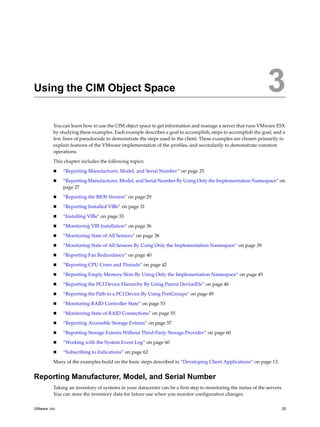
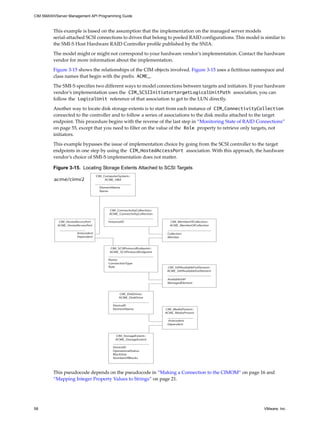
          Figure 3-4 shows the relationships of the CIM objects involved. VIBs are modeled with instances of
          VMware_ComponentSoftwareIdentity.

          The CIM_InstalledSoftwareIdentity association that leads to the instance of
          VMware_HypervisorSoftwareIdentity is included in the illustration for comparison only.


VMware, Inc.                                                                                                              31
CIM SMASH/Server Management API Programming Guide


         Figure 3-4. Locating the Installed Software Versions from the Base Server Scoping Instance

                                                   CIM_RegisteredProfile::
                                                OMC_RegisteredBaseServerProfile

             root/interop
                                                                                CIM_ElementConformsToProfile::
                                                                             OMC_ElementConformsToBaseServerProfile

             root/cimv2                                                      ConformantStandard
                                                                             ManagedElement


                                                       CIM_System::
                                                 OMC_UnitaryComputerSystem

               CIM_ElementSoftwareIdentity::                                           CIM_SoftwareIdentity::
              VMware_ElementSoftwareIdentity                                       VMware_InstalledSoftwareIdentity

                                Dependent                                           System
                                Antecedent                                          InstalledSoftware
                  ElementSoftwareStatus==6


                                                    CIM_SoftwareIdentity::
                                               VMware_ComponentSoftwareIdentity

                                                    ElementName
                                                    VersionString


                                                    CIM_SoftwareIdentity::
                                               VMware_HypervisorSoftwareIdentity

                                                    ElementName
                                                    VersionString


         The VMware implementation of CIM_SoftwareIdentity for VIBs makes the version available in the
         VersionString property rather than in the MajorVersion and MinorVersion properties.

         This pseudocode depends on the pseudocode in “Making a Connection to the CIMOM” on page 16 and
         “Identifying the Base Server Scoping Instance” on page 19.

         To report the VIB versions

         1    Connect to the server URL.

              Specify the Interop namespace, supplied as a parameter, for the connection.
              use wbemlib
              use sys
              use connection renamed cnx
              use registered_profiles renamed prof
              connection = Null

              params = cnx.get_params()
              if params is Null
                 sys.exit(-1)
              interop_params = params
              interop_params['namespace'] = 'root/interop'
              connection = cnx.connect_to_host( interop_params )
              if connection is Null
                 print 'Failed to connect to: ' + params['host'] + ' as user: ' + params['user']
                 sys.exit(-1)


32                                                                                                                    VMware, Inc.
Chapter 3 Using the CIM Object Space


          2    Locate the Base Server Scoping Instance that represents the managed server.
               use scoping_instance renamed si

               scoping_instance_name = si.get_scoping_instance_name( connection )
               if scoping_instance_name is Null
                  print 'Failed to find server Scoping Instance.'
                  sys.exit(-1)

          3    Use the CIM_ElementSoftwareIdentity association to identify the CIM_SoftwareIdentity
               instances that correspond to the software on the managed server.
               element_softwares = connection.References( scoping_instance_name, 
                                                         ResultClass = 'VMware_ElementSoftwareIdentity' )
               if len( element_softwares ) < 1
                  print 'No software was found for the server Scoping Instance.'
                  sys.exit(-1)

          4    Select only those instances for which the ElementSoftwareStatus property of the
               CIM_ElementSoftwareIdentity association has a value of 6 (Installed).

               Print the ElementName and VersionString properties of the CIM_SoftwareIdentity instances.
               function print_info( instance )
                  print ' Software = %s' % ( instance[ 'ElementName' ] )
                  print '     (Version %s)' % ( instance[ 'VersionString' ] )

               print 'Installed software:'
               count = 0
               for software in element_softwares
                  if software[ 'ElementSoftwareStatus' ] == [6L]
                     print_instance( connection.GetInstance( software[ 'Antecedent' ] ) )
                     count = count + 1
               if not count
                  print '   None'


Installing VIBs
          The VMware implementation of the DMTF Software Update profile allows system administrators to update
          ESX software by using CIM client applications. The CIM software installation service applies an offline bundle
          file to update the software on the managed server. To identify the current software version, see “Reporting
          Installed VIBs” on page 31.

          This example shows how to locate the CIM_SoftwareInstallationService by traversing the
          CIM_HostedService association from the server Scoping Instance. The InstallFromURI() method starts
          the update process on the managed server and returns a CIM_ConcreteJob instance that you can use to
          monitor completion of the installation.

          The VMware implementation of the Software Update profile does not include a
          CIM_ServiceAffectsElement association between the instance of CIM_SoftwareInstallationService
          and the instance of CIM_SoftwareIdentity that represents a VIB. As a result, you cannot use the
          InstallFromSoftwareIdentity() method that is described in the Software Update profile specification.

          To use the InstallFromURI() method, you must know the location of the offline bundle in a local file
          system. You supply the path to the offline bundle in the form of a URI when you invoke the method. For
          example, you might pass "file:///vmfs/Storage1/bundle.zip" as the value of the URI parameter.

          NOTE You cannot use an online depot in the URI that you pass to the InstallFromURI() method. For
          instructions to create an offline bundle from a set of VIBs in an online depot, see “Offline Bundles” on page 69.

          Figure 3-5 shows the relationships of the CIM objects involved in the installation of VIBs by using CIM. The
          CIM_SoftwareInstallationService instance in Figure 3-5 represents the CIM provider that starts the
          software installation.


VMware, Inc.                                                                                                                33
CIM SMASH/Server Management API Programming Guide


         Figure 3-5. Starting an Update of ESX Software

                                                     CIM_RegisteredProfile::
                                                  OMC_RegisteredBaseServerProfile

             root/interop
                                                                                     CIM_ElementConformsToProfile::
                                                                                  OMC_ElementConformsToBaseServerProfile

             root/cimv2                                                           ConformantStandard
                                                                                  ManagedElement


                                                         CIM_System::
                                                   OMC_UnitaryComputerSystem


                  CIM_HostedService::                                                   CIM_ServiceAffectsElement::
             VMware_HostedInstallationService                                      VMware_InstallationServiceAffectsElement

                               Antecedent                                               AffectedElement
                               Dependent                                                AffectingElement


                                                 CIM_SoftwareInstallationService::
                                                VMware_SoftwareInstallationService

                                                      InstallFromURI()


                       CIM_ElementCapabilities::
             VMware_ElementSoftwareInstallationCapabilities

                                      ManagedElement
                                      Capabilities


                                             CIM_SoftwareInstallationServiceCapabilities::
                                            VMware_SoftwareInstallationServiceCapabilities

                                      SupportedAsynchronousActions=[5] (InstallFromURI)
                                      SupportedURISchemes=[3] (file)


         The CIM_SoftwareInstallationServiceCapabilities instance advertises the InstallFromURI action
         and the supported URI schemes that it supports. Figure 3-5 includes the instance for completeness. The
         pseudocode example does not use it.

         This pseudocode depends on the pseudocode in “Making a Connection to the CIMOM” on page 16 and
         “Identifying the Base Server Scoping Instance” on page 19.

         To install VIBs

         1    Connect to the server URL.

              Specify the Interop namespace, supplied as a parameter, for the connection.
              use wbemlib
              use sys
              use connection renamed cnx
              connection = Null

              params = cnx.get_params()
              if params is Null
                 sys.exit(-1)
              interop_params = params
              interop_params['namespace'] = 'root/interop'
              connection = cnx.connect_to_host( interop_params )
              if connection is Null
                 print 'Failed to connect to: ' + params['host'] + ' as user: ' + params['user']
                 sys.exit(-1)


34                                                                                                                            VMware, Inc.
Chapter 3 Using the CIM Object Space


          2    Locate the Base Server Scoping Instance that represents the managed server.
               use scoping_instance renamed si

               scoping_instance_name = si.get_scoping_instance_name( connection )
               if scoping_instance_name is Null
                  print 'Failed to find server Scoping Instance.'
                  sys.exit(-1)

          3    Use the CIM_HostedService association to identify the CIM_SoftwareInstallationService
               instance that represents the Software Update provider on the managed server.

               The VMware implementation includes only one instance of CIM_SoftwareInstallationService.
               installation_services = connection.AssociatorNames( scoping_instance_name, 
                                                       AssocClass = ’CIM_HostedService’, 
                                                       ResultClass = 'CIM_SoftwareInstallationService' )
               if len( installation_services ) != 1
                  print 'Failed to find the software installation service for the scoping computer system.'
                  sys.exit(-1)
               installation_service = installation_services.pop()

          4    On the CIM_SoftwareInstallationService instance, invoke the InstallFromURI() method with
               the following parameters.

                  A URI that identifies the offline bundle file containing the VIBs that you choose to install.

                  A reference to the CIM_ComputerSystem instance that represents the managed server.

                  An empty list for the InstallOptions parameter. The CIM provider ignores any install options that
                   you specify.

               The method returns a single output parameter, which is a reference to an instance of CIM_ConcreteJob.
               You can use the instance to monitor completion of the software installation.
               function launch_installation( service, 
                                              bundle_file, 
                                              server, 
                                              cli_options )
                  metadata_uri = ’file://%s’ % bundle_file
                  method_params = { ’URI’    : metadata_uri, 
                                    ’Target’ : server, 
                                  ’InstallOptions’ : cli_options }
                  ( error_return, output ) = connection.InvokeMethod( 'InstallFromURI', 
                                                                      service, 
                                                                      **method_params )
                  if error_return == 4096
                     print ’Software installation in progress...’
                     job_ref = output[ ’Job’ ]
                     return job_ref
                  else
                     print ’Invalid method parameters; error = %s’ % error_return
                     sys.exit( -1 )
               vib = params[’extra_params’][0]
               cli_options = []
               job_ref = launch_installation( installation_service, 
                                           vib, 
                                           scoping_instance_name, 
                                           cli_options )

               If there is an error in the method parameters, such as a mismatch in the option lists, the
               InstallFromURI() method returns immediately.

               If the method returns the value 4096, the provider has accepted the method parameters and will start the
               update process. You can monitor the installation by using the instance of CIM_ConcreteJob that is
               returned by the method. See “Monitoring VIB Installation” on page 36.


VMware, Inc.                                                                                                               35
CIM SMASH/Server Management API Programming Guide


Monitoring VIB Installation
         The VMware implementation of the DMTF Software Update profile allows system administrators to use CIM
         client applications to update ESX software. See “Installing VIBs” on page 33. The update can take several
         minutes to complete. For a CIM client, this is an asynchronous operation because the CIM server returns before
         the update is complete.

         You can monitor the status of the update operation in one of two ways:

             You can poll for status of the operation by using the CIM_ConcreteJob class.

             You can subscribe to any of the supported indications that report changes in the status of the update
              operation. The supported indications are shown in Table 3-1.

         Table 3-1. Indications Supported by the VMware Implementation of the Software Update Profile
         Condition                   CQL Expression

         Any job creation            SELECT * from CIM_InstCreation WHERE SourceInstance ISA CIM_ConcreteJob

         Any job change              SELECT * from CIM_InstModification WHERE SourceInstance ISA CIM_ConcreteJob

         Any job deletion            SELECT * from CIM_InstDeletion WHERE SourceInstance ISA CIM_ConcreteJob


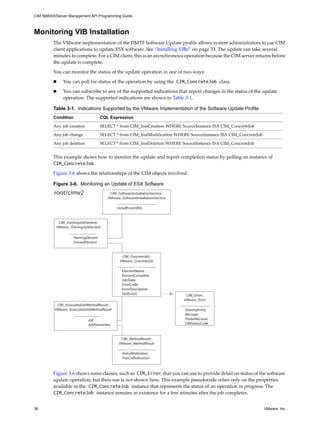
         This example shows how to monitor the update and report completion status by polling an instance of
         CIM_ConcreteJob.

         Figure 3-6 shows the relationships of the CIM objects involved.

         Figure 3-6. Monitoring an Update of ESX Software
          root/cimv2                     CIM_SoftwareInstallationService::
                                        VMware_SoftwareInstallationService

                                             InstallFromURI()


            CIM_OwningJobElement::
           VMware_OwningJobElement

                     OwningElement
                     OwnedElement


                                                CIM_ConcreteJob::
                                               VMware_ConcreteJob

                                                ElementName
                                                PercentComplete
                                                JobState
                                                ErrorCode
                                                ErrorDescription
                                                GetError()                    CIM_Error::
                                                                             VMware_Error
           CIM_AssociatedJobMethodResult::
          VMware_AssociatedJobMethodResult                                   OwningEntity
                                                                             Message
                            Job                                              ProbableCause
                            JobParameters                                    CIMStatusCode


                                               CIM_MethodResult::
                                              VMware_MethodResult

                                                PreCallIndication
                                                PostCallIndication


         Figure 3-6 shows some classes, such as CIM_Error, that you can use to provide detail on status of the software
         update operation, but their use is not shown here. This example pseudocode relies only on the properties
         available in the CIM_ConcreteJob instance that represents the status of an operation in progress. The
         CIM_ConcreteJob instance remains in existence for a few minutes after the job completes.


36                                                                                                                 VMware, Inc.
Chapter 3 Using the CIM Object Space


          This pseudocode depends on the pseudocode in “Making a Connection to the CIMOM” on page 16 and
          “Identifying the Base Server Scoping Instance” on page 19.

          To monitor VIB installation

          1    After invoking the InstallFromURI() method, save the object reference returned in the Job output
               parameter.

               The output parameter is a reference to an instance of CIM_ConcreteJob that you can use to monitor
               progress of the software update operation.
               ( error_return, output ) = connection.InvokeMethod( 'InstallFromURI', 
                                                                   service, 
                                                                   **method_params )
               ...
               job_ref = output[ ’Job’ ]
               ...

          2    Retrieve the referenced instance of CIM_ConcreteJob and test the value of the PercentComplete
               property.

               Repeat this step until the PercentComplete property has the value 100.
               function check_job_done( job_ref )
                  job = connection.GetInstance( job_ref )
                  print ’ percent complete %3d’ % job[ ’PercentComplete’ ]
                  print ’ job status: %s’ % job[ ’JobStatus’ ]
                  if job[ ’PercentComplete’ ] == 100
                     return 1
                  else
                     return 0

               use time
               ticks = 0
               while not check_job_done( job_ref )
                  print ’Job time elapsed: %d seconds’ % ticks
                  print
                  time.sleep( 10 )
                  ticks = ticks + 10
               print ’      error code: %s’ % job[ ’ErrorCode’ ]
               print ’     description: %s’ % job[ ’ErrorDescription’ ]
               print ’Time elapsed: %d seconds’ % ticks

               While the software update operation is in progress, the property has an arbitrary value less than 100.
               After the operation completes, the PercentComplete property takes the value 100 and the CIM server
               no longer updates the CIM_ConcreteJob instance.

               A sample of the output looks like the following:
               Software installation in progress...
                  percent complete 10
                  job status: Scanning URI for installable packages
               Time elapsed: 0 seconds

                  percent complete 10
                  job status: Scanning URI for installable packages
               Time elapsed: 10 seconds

                  percent complete 10
                  job status: Scanning URI for installable packages
               Time elapsed: 20 seconds

                  percent complete 30
                  job status: Scan of URI Complete and installable packages found. Starting Update.
               Time elapsed: 30 seconds

                  percent complete 30
                  job status: Scan of URI Complete and installable packages found. Starting Update.
               Time elapsed: 40 seconds


VMware, Inc.                                                                                                            37
CIM SMASH/Server Management API Programming Guide


              ...

                 percent complete 100
                 job status: The update completed successfully, but the system needs to be rebooted for the
                             changes to be effective.
                        error code: None
                       description: None
              Time elapsed: 1000 seconds


Monitoring State of All Sensors
         This information is useful to system administrators who need to monitor system health. This example shows
         how to locate system sensors, report their current states, and flag any sensors that have abnormal states.

         The example uses only CIM_NumericSensor instances for simplicity. You can also query discrete sensors by
         substituting CIM_Sensor for CIM_NumericSensor. Determining which values constitute normal sensor state
         is hardware-dependent.

         This example shows how to get the sensor states by starting from the Interop namespace and traversing
         associations from the managed server Scoping Instance. Figure 3-7 shows the relationships of the CIM objects
         involved. For information about getting sensor states by using only the Implementation namespace, see
         “Monitoring State of All Sensors By Using Only the Implementation Namespace” on page 39.

         Figure 3-7. Locating Sensor State from the Base Server Scoping Instance

                          CIM_RegisteredProfile::
                       OMC_RegisteredBaseServerProfile

                                                            CIM_ElementConformsToProfile::
         root/interop                                    OMC_ElementConformsToBaseServerProfile

                                                         ConformantStandard
                                                         ManagedElement
         root/cimv2


                         CIM_ComputerSystem::
                       OMC_UnitaryComputerSystem
                                                                CIM_SystemDevice::
                                                                OMC_SystemDevice

                                                            GroupComponent
                                                            PartComponent


                            CIM_NumericSensor::
                            OMC_NumericSensor

                           ElementName
                           CurrentState
                           PossibleStates


         This pseudocode depends on the pseudocode in “Making a Connection to the CIMOM” on page 16 and
         “Identifying the Base Server Scoping Instance” on page 19.


38                                                                                                         VMware, Inc.
Chapter 3 Using the CIM Object Space


          To report state for all sensors

          1    Connect to the server URL.

               Specify the Interop namespace, supplied as a parameter, for the connection.
               use wbemlib
               use sys
               use connection renamed cnx
               connection = Null

               params = cnx.get_params()
               if params is Null
                  sys.exit(-1)
               interop_params = params
               interop_params['namespace'] = 'root/interop'
               connection = cnx.connect_to_host( interop_params )
               if connection is Null
                  print 'Failed to connect to: ' + params['host'] + ' as user: ' + params['user']
                  sys.exit(-1)

          2    Locate the Base Server profile Scoping Instance of CIM_ComputerSystem.
               use scoping_instance renamed si

               scoping_instance_name = si.get_scoping_instance_name( connection )
               if scoping_instance_name is Null
                  print 'Failed to find server Scoping Instance.'
                  sys.exit(-1)

          3    Traverse the CIM_SystemDevice association to reach the CIM_NumericSensor instances on the
               managed server.
               instances = connection.Associators( scoping_instance_name, 
                                      AssocClass = 'CIM_SystemDevice', 
                                      ResultClass = 'CIM_NumericSensor' )
               if len( instances ) is 0
                  print 'Error: No sensors associated with server Scoping Instance.'
                  sys.exit(-1)

          4    For each sensor instance, print the ElementName and CurrentState properties.

               You can flag any abnormal values you find. Abnormal values depend on the sensor type and its
               PossibleStates property.
               function print_info( instance, base_class )
                  print 'n' + base_class + ' [' + instance.classname + '] ='
                  if instance['CurrentState'] != 'Normal'
                     print '********* SENSOR STATE WARNING *********n'
                  for prop in [ 'ElementName', 'CurrentState' ]
                     print ' %30s = %s' % ( prop, instance[prop] )

               for instance in instances
                  print_info( instance, 'CIM_NumericSensor' )

               A sample of the output looks like the following:
               CIM_NumericSensor [OMC_NumericSensor] =
                                   ElementName = FAN 1 RPM for System Board 1
                                  CurrentState = Normal
               CIM_NumericSensor [OMC_NumericSensor] =
                                   ElementName = Ambient Temp for System Board 1
                                  CurrentState = Normal


Monitoring State of All Sensors By Using Only the Implementation
Namespace
          This information is useful to system administrators who need to monitor system health. This example shows
          how to locate system sensors, report their current states, and flag any sensors with abnormal states.


VMware, Inc.                                                                                                            39
CIM SMASH/Server Management API Programming Guide


         The example uses only CIM_NumericSensor instances for simplicity. You can also query discrete sensors by
         substituting CIM_Sensor for CIM_NumericSensor. Determining which values constitute normal sensor state
         is hardware-dependent.

         This example shows how to get the sensor states from the Implementation namespace, assuming you already
         know its name. For information about getting sensor state by using the standard Interop namespace,
         see“Monitoring State of All Sensors” on page 38.

         This pseudocode depends on the pseudocode in “Making a Connection to the CIMOM” on page 16.

         To report state of all sensors by using only the Implementation namespace

         1    Connect to the server URL.

              Specify the Implementation namespace, supplied as a parameter, for the connection.

              The actual namespace you will use depends on your installation.
              use wbemlib
              use sys
              use connection renamed cnx
              connection = Null

              params = cnx.get_params()
              if params is Null
                 sys.exit(-1)
              connection = cnx.connect_to_host( params )
              if connection is Null
                 print 'Failed to connect to: ' + params['host'] + ' as user: ' + params['user']
                 sys.exit(-1)

         2    Enumerate instances of CIM_NumericSensor.
              instances = connection.EnumerateInstances( ’CIM_NumericSensor’ )
              if len( instances ) is 0
                 print 'Error: No sensors found on managed server.'
                 sys.exit(-1)

         3    Iterate over the sensor instances, printing the properties ElementName and CurrentState.
              function print_info( instance )
                 print 'n' + 'CIM_NumericSensor [' + instance.classname + '] ='
                 if instance['CurrentState'] != 'Normal'
                    print '********* SENSOR STATE WARNING *********n'
                 for prop in [ 'ElementName', 'CurrentState' ]
                    print ' %30s = %s' % ( prop, instance[prop] )

              for instance in instances
                 print_info( instance )

              A sample of the output looks like the following:
              CIM_NumericSensor [OMC_NumericSensor] =
                                  ElementName = FAN 1 RPM for System Board 1
                                 CurrentState = Normal
              CIM_NumericSensor [OMC_NumericSensor] =
                                  ElementName = Ambient Temp for System Board 1
                                 CurrentState = Normal


Reporting Fan Redundancy
         Fan redundancy information is useful to system administrators who need to monitor system health.
         This example shows how to locate system fans and query the CIMOM for redundant fan relationships.

         This example shows how to enumerate the fans by starting from the Interop namespace and traversing
         associations from the managed server Scoping Instance. Figure 3-8 shows the relationships of the CIM objects
         involved. If the managed server provides redundant cooling, the redundancy is modeled in the CIMOM by an
         instance of CIM_RedundancySet that is associated with two (or more) redundant fans.


40                                                                                                         VMware, Inc.
Chapter 3 Using the CIM Object Space


          Figure 3-8. Locating Redundant Fans
                                                CIM_RegisteredProfile::
                                             OMC_RegisteredBaseServerProfile


                root/interop                                                             CIM_ElementConformsToProfile::
                                                                                      OMC_ElementConformsToBaseServerProfile

                                                                                      ConformantStandard
                root/cimv2                                                            ManagedElement


                                                CIM_ComputerSystem::
                                              OMC_UnitaryComputerSystem
                 CIM_SystemDevice::                                                  CIM_SystemDevice::
                 OMC_SystemDevice                                                    OMC_SystemDevice

                   GroupComponent                                                         GroupComponent
                   PartComponent                                                          PartComponent


                                           CIM_Fan::                   CIM_Fan::
                                           OMC_Fan                     OMC_Fan

                                         ElementName                  ElementName
                                         DeviceID                     DeviceID


                  CIM_MemberOfCollection::                                     CIM_MemberOfCollection::
               OMC_MemberOfFanRedundancySet                                 OMC_MemberOfFanRedundancySet

                                      Member                                 Member
                                      Collection                             Collection


                                                    CIM_RedundancySet::
                                                   OMC_FanRedundancySet

                                                   Name
                                                   RedundancyStatus


          This pseudocode depends on the pseudocode in “Making a Connection to the CIMOM” on page 16 and
          “Identifying the Base Server Scoping Instance” on page 19.

          To report fan redundancy

          1       Connect to the server URL.

                  Specify the Interop namespace, supplied as a parameter, for the connection.
                  use wbemlib
                  use sys
                  use connection renamed cnx
                  connection = Null

                  params = cnx.get_params()
                  if params is Null
                     sys.exit(-1)
                  interop_params = params
                  interop_params['namespace'] = 'root/interop'
                  connection = cnx.connect_to_host( interop_params )
                  if connection is Null
                     print 'Failed to connect to: ' + params['host'] + ' as user: ' + params['user']
                     sys.exit(-1)


VMware, Inc.                                                                                                                                                    41
CIM SMASH/Server Management API Programming Guide


         2    Locate the Base Server Scoping Instance of CIM_ComputerSystem.
              use scoping_instance renamed si

              scoping_instance_name = si.get_scoping_instance_name( connection )
              if scoping_instance_name is Null
                 print 'Failed to find server Scoping Instance.'
                 sys.exit(-1)

         3    Traverse the CIM_SystemDevice association to reach the CIM_Fan instances on the managed server.
              fan_instances = connection.Associators( scoping_instance_name, 
                                                      AssocClass = 'CIM_SystemDevice', 
                                                      ResultClass = ’CIM_Fan’ )
              if len( fan_instances ) is 0
                 print 'Error: No fans associated with server Scoping Instance.'
                 sys.exit(-1)

         4    For each fan instance, print the ElementName and DeviceID properties.
              function print_info( instance )
                 print 'n' + ’CIM_Fan [' + instance.classname + '] ='
                 for prop in [ 'ElementName', 'DeviceID' ]
                    print ' %30s = %s' % ( prop, instance[prop] )

              for fan_instance in fan_instances
                 print_info( fan_instance )

         5    For each fan instance, traverse the CIM_MemberOfCollection association to reach any instances of
              CIM_RedundancySet.
              set_instances = connection.Associators( scoping_instance_name, 
                                                      AssocClass = 'CIM_MemberOfCollection', 
                                                      ResultClass = ’CIM_RedundancySet’ )

         6    For each fan instance, print the redundancy status. If the fan is not a member of a redundancy set, the
              redundancy status is not applicable.
              if len( set_instances ) is 0
                 print '    Redundancy status: N/A'
              else
                 for instance in set_instances
                    name = instance[’Name’]
                    status = instance[’RedundancyStatus’]
                    print ’    redundancy set (%s) status = %s’ %
                              ( instance[’Name’], (status==2 ? ’Fully Redundant’ : ’unknown or degraded’)

              A sample of the output looks like the following:
              CIM_Fan [OMC_Fan] =
                                  ElementName = FAN 1 RPM
                                  DeviceID = 48.0.32.99
                 redundancy set (117.0.32.0) status = Fully Redundant
              CIM_Fan [OMC_Fan] =
                                  ElementName = FAN 2 RPM
                                  DeviceID = 49.0.32.99
                 redundancy set (117.0.32.0) status = Fully Redundant


Reporting CPU Cores and Threads
         This information is useful to system administrators who need to monitor system health. This example shows
         how to enumerate the processor cores and hardware threads in a managed server.

         The VMware implementation does not include instances of CIM_ProcessorCapabilities, but cores and
         hardware threads are modeled with individual instances of CIM_ProcessorCore and
         CIM_HardwareThread.


42                                                                                                           VMware, Inc.
Chapter 3 Using the CIM Object Space


          This example shows how to locate information about the CPU cores and threads by starting from the Interop
          namespace and traversing associations from the managed server Scoping Instance. A managed server has one
          or more processors, each of which has one or more cores with one or more threads. Figure 3-9 shows the
          relationships of the CIM objects involved. For simplicity, the diagram shows only a single processor with one
          core and one hardware thread.

          Figure 3-9. Locating CPU Cores and Hardware Threads
                        CIM_RegisteredProfile::
                     OMC_RegisteredBaseServerProfile

                                                          CIM_ElementConformsToProfile::
          root/interop                                 OMC_ElementConformsToBaseServerProfile

                                                       ConformantStandard
                                                       ManagedElement
          root/cimv2

                        CIM_ComputerSystem::
                      OMC_UnitaryComputerSystem               CIM_SystemDevice::
                                                              OMC_SystemDevice

                                                          GroupComponent
                                                          PartComponent


                             CIM_Processor::
                             OMC_Processor

                         ElementName
                         Family
                         CurrentClockSpeed                   CIM_ConcreteComponent::
                                                        OMC_ProcessorCoreConcreteComponent

                                                          GroupComponent
                                                          PartComponent


                           CIM_ProcessorCore::
                           OMC_ProcessorCore

                         ElementName
                         CoreEnabledState                     CIM_ConcreteComponent::
                                                        OMC_HardwareThreadConcreteComponent

                                                          GroupComponent
                                                          PartComponent


                         CIMHardwareThread::
                         OMC_HardwareThread

                         ElementName


          This pseudocode depends on the pseudocode in “Making a Connection to the CIMOM” on page 16 and
          “Identifying the Base Server Scoping Instance” on page 19.


VMware, Inc.                                                                                                                     43
CIM SMASH/Server Management API Programming Guide


         To report CPU cores and threads

         1    Connect to the server URL.

              Specify the Interop namespace, supplied as a parameter, for the connection.
              use wbemlib
              use sys
              use connection renamed cnx
              connection = Null

              params = cnx.get_params()
              if params is Null
                 sys.exit(-1)
              interop_params = params
              interop_params['namespace'] = 'root/interop'
              connection = cnx.connect_to_host( interop_params )
              if connection is Null
                 print 'Failed to connect to: ' + params['host'] + ' as user: ' + params['user']
                 sys.exit(-1)

         2    Locate the Base Server Scoping Instance of CIM_ComputerSystem.
              use scoping_instance renamed si

              scoping_instance_name = si.get_scoping_instance_name( connection )
              if scoping_instance_name is Null
                 print 'Failed to find server Scoping Instance.'
                 sys.exit(-1)

         3    Traverse the CIM_SystemDevice association to reach the CIM_Processor instances on the managed
              server.
              proc_instance_names = connection.AssociatorNames( scoping_instance_name, 
                                                                AssocClass = 'CIM_SystemDevice', 
                                                                ResultClass = ’CIM_Processor’ )
              if len( proc_instance_names ) is 0
                 print 'Error: No processors associated with server Scoping Instance.'
                 sys.exit(-1)

         4    For each CIM_Processor instance, print the ElementName, Family, and CurrentClockSpeed
              properties.
              for proc_instance_name in proc_instance_names
                 instance = connection.GetInstance( proc_instance_name )
                 print ‘ %s (Family: %s) (%sMHz)’ %
                       ( instance[‘ElementName’], instance[‘Family’], instance[‘CurrentClockSpeed’] )

         5    For each CIM_Processor instance, traverse the CIM_ConcreteComponent association to reach the
              CIM_ProcessorCore instances on the managed server.
              core_instance_names = connection.AssociatorNames( proc_instance_name, 
                                                                AssocClass = 'CIM_ConcreteComponent', 
                                                                ResultClass = ’CIM_ProcessorCore’ )
              if len( core_instance_names ) is 0
                 print 'No processor cores associated with this CPU.’
                 sys.exit(-1)

         6    For each CIM_ProcessorCore instance, print the ElementName and CoreEnabledState properties.
              for core_instance_name in core_instance_names
                 instance = connection.GetInstance( core_instance_name )
                 print ’      %s (%s)’ % 
                       ( instance[‘ElementName’], 
                         (instance[‘CoreEnabledState’]==’Enabled’)?’Enabled’:’Disabled’ )


44                                                                                                   VMware, Inc.
Chapter 3 Using the CIM Object Space


          7    For each CIM_ProcessorCore instance, traverse the CIM_ConcreteComponent association to reach the
               CIM_HardwareThread instances on the managed server.
               thread_instance_names = connection.AssociatorNames( core_instance_name, 
                                                               AssocClass = 'CIM_ConcreteComponent', 
                                                               ResultClass = ’CIM_HardwareThread’ )
               if len( thread_instance_names ) is 0
                  print 'No hardware threads associated with this CPU core.’
                  sys.exit(-1)

          8    For each CIM_HardwareThread instance, print the ElementName property.
               for thread_instance_name in thread_instance_names
                  instance = connection.GetInstance( thread_instance_name )
                  print ‘           %s’ % instance[‘ElementName’]

               A sample of the output looks like the following:
               CPU1 (Family: 179) (2667MHz)
                    CPU1 Core 1 (Enabled)
                         CPU1 Core 1 Thread     1
                    CPU1 Core 2 (Enabled)
                         CPU1 Core 2 Thread     1
               CPU2 (Family: 179) (2667MHz)
                    CPU2 Core 1 (Enabled)
                         CPU1 Core 1 Thread     1
                    CPU2 Core 2 (Enabled)
                         CPU1 Core 2 Thread     1


Reporting Empty Memory Slots By Using Only the Implementation
Namespace
          This example describes how to determine the empty slots available for new memory cards. This information
          is useful to system administrators who want to upgrade the capacity of a managed server.

          This example shows how to locate information about the installed memory and available slots by using only
          the objects in the Implementation namespace. Figure 3-10 shows the CIM objects involved.

          You can locate used memory slots by enumerating physical memory instances. To locate unused slots, you also
          enumerate the OMC_MemorySlot instances and compare the results. The set of unused slots comprises all
          those OMC_MemorySlot instances whose ElementName property does not match any of the instances of
          OMC_PhysicalMemory.

          NOTE This example assumes that the managed server is a single-node system.

          Figure 3-10. Locating Physical Memory Slots
                                    CIM_PhysicalMemory::
          root/cimv2                OMC_PhysicalMemory

                                 ElementName
                                 Capacity


                                        CIM_Slot::
                                      OMC_MemorySlot

                                 Number
                                 ElementName


VMware, Inc.                                                                                                           45
CIM SMASH/Server Management API Programming Guide


         This pseudocode depends on the pseudocode in “Making a Connection to the CIMOM” on page 16.

         To report empty memory slots

         1    Connect to the server URL.

              Specify the Implementation namespace, supplied as a parameter, for the connection.

              The actual namespace you will use depends on your implementation.
              use wbemlib
              use sys
              use connection renamed cnx
              connection = Null

              params = cnx.get_params()
              if params is Null
                 sys.exit(-1)
              connection = cnx.connect_to_host( params )
              if connection is Null
                 print 'Failed to connect to: ' + params['host'] + ' as user: ' + params['user']
                 sys.exit(-1)

         2    Enumerate the OMC_PhysicalMemory instances.
              chip_instances = connection.EnumerateInstances( ’OMC_PhysicalMemory’ )
              if len( chip_instances ) is 0
                 print 'Error: No physical memory instances were found.'
                 sys.exit(-1)

         3    Enumerate the OMC_MemorySlot instances.
              slot_instances = connection.EnumerateInstances( ’OMC_MemorySlot’ )
              if len( slot_instances ) is 0
                 print 'Error: No memory slot instances were found.'
                 sys.exit(-1)

         4    For each OMC_MemorySlot instance, compare the ElementName property with the set of
              OMC_PhysicalMemory instances, and discard the instances that have matching ElementName
              properties.

              For other instances, print the ElementName property.
              function slot_filled( slot, chips )
                 for chip in chips
                    if slot['ElementName'] == chip['ElementName']
                       return True
                 return False

              empty_slots = []
              for slot_instance in slot_instances
                 if not slot_filled( slot_instance, chip_instances )
                    empty_slots.append( slot_instance )
              print ' %s empty memory slots found.' % len( empty_slots )
              for slot_instance in empty_slots
                 print slot_instance['ElementName']

              A sample of the output looks like the following:
                4 empty memory slots found.
              DIMM 3C
              DIMM 4D
              DIMM 7C
              DIMM 8D


Reporting the PCI Device Hierarchy By Using Parent DeviceIDs
         This example describes a simple way to enumerate the PCI devices present in the managed server. This
         information is useful to system administrators who want to troubleshoot device problems or upgrade the
         hardware in a managed server.


46                                                                                                      VMware, Inc.
Chapter 3 Using the CIM Object Space


          The PCI Device profile specification allows flexibility in how the profile is implemented. Designers can apply
          one of three approaches to modeling PCI device connections, or they can combine these approaches for a more
          complete implementation. Device connections can be modeled with a combination of the following
          approaches.

                DeviceConnection associations

                PCIPortGroup instances that express relationships between PCI ports
                Primary and secondary bus numbers that relate PCI devices to bridges and switches

          The VMware implementation supports the first two modeling approaches. For an example that uses the
          second approach to relating PCI devices, see “Reporting the Path to a PCI Device By Using PortGroups” on
          page 49.

          For convenience, the VMware implementation also provides a fourth way to model device connections:
          ParentDeviceID.

          The ParentDeviceID property relates a PCI device directly to the bridge or switch through which the device
          accesses the CPU. The value of the property is the value of the DeviceID property of that bridge or switch,
          which can be called its parent device. A CIM client that is aware of the ParentDeviceID property can map
          the hierarchy of PCI devices by using only that property to determine the relationships between devices.

          This example shows how you can map the PCI device hierarchy by using the ParentDeviceID property. For
          illustration, this example enumerates PCI device instances by their VMware-specific class names, rather than
          by a parent class. Alternatively, you could enumerate the CIM_PCIDevice class, because all three of the
          VMware classes derive, directly or indirectly, from that class, as shown in Figure 3-11.

          Figure 3-11. Inheritance Relationships of PCI Device Classes

                                      CIM_PCIDevice


                CIM_PCIBridge                               CIM_PCIeSwitch


               VMware_PCIBridge      VMware_PCIDevice     VMware_PCIeSwitch


          This pseudocode depends on the pseudocode in “Making a Connection to the CIMOM” on page 16.


VMware, Inc.                                                                                                              47
CIM SMASH/Server Management API Programming Guide


         To report the PCI device hierarchy

         1    Connect to the server URL.

              Specify the Implementation namespace, supplied as a parameter, for the connection.

              The actual namespace you will use depends on your implementation.
              use wbemlib
              use sys
              use connection renamed cnx
              connection = Null

              params = cnx.get_params()
              if params is Null
                 sys.exit(-1)
              connection = cnx.connect_to_host( params )
              if connection is Null
                 print 'Failed to connect to: ' + params['host'] + ' as user: ' + params['user']
                 sys.exit(-1)

         2    Enumerate the VMware_PCIDevice, VMware_PCIBridge, and VMware_PCIeSwitch instances.

              Save each instance in an associative array, keyed by its parent’s DeviceID, or "none" if it has no parent.
              This example saves the children of each parent device as a nested associative array of instances indexed
              by the device’s own ID.
              dev_entries = {}
              enum_devs( ’VMware_PCIDevice’ )
              enum_devs( ’VMware_PCIBridge’ )
              enum_devs( ’VMware_PCIeSwitch’ )

              function enum_devs( class_name )
                 dev_instances = connection.EnumerateInstances( class_name )
                 for dev in dev_instances
                    parent = dev[ ’ParentDeviceID’ ]
                    if not parent
                       parent = ’none’
                    id = dev[ ’DeviceID’ ]
                    if not dev_entries.key( parent )
                       dev_entries[ parent ] = {}
                    dev_entries[ parent ][ id ] = dev

         3    Starting with the value "none" for devices that have no parent, access the children of each parent.

              For each child, print the DeviceID, the BusNumber, DeviceNumber, and FunctionNumber, and the
              ElementName properties. Recursively do the same for the children of each child device.
              parent = ’none’
              print_children( ’’, parent )

              function print_children( indent, id )
                 if dev_entries.key( id )
                    dev_list = dev_entries[ id ]
                    for key in dev_list.keys()
                       dev = dev_list[ key ]
                       print indent, print_dev( dev )
                       print_children( indent + ’   ’, dev[ ’DeviceID’ ] )

              function print_dev( dev )
                 dev_summary = ’ID=%s B/D/F=%s/%s/%s (%s)’ % 
                    (dev[ ’DeviceID ], dev[ ’BusNumber’ ], dev[ ’DeviceNumber’ ], 
                     dev[ ’FunctionNumber’ ], dev[ ’ElementName’ ])
                 return dev_summary


48                                                                                                            VMware, Inc.
Chapter 3 Using the CIM Object Space


               This pseudocode displays an indented representation of the hierarchy of PCI devices. A sample of the
               output looks like the following:
                ID=PCI 0:0:1:0 B/D/F=0/1/0 (Plutonic Devices PD-631 PCI-X Bridge)
                   ID=PCI 0:2:1:0 B/D/F=2/1/0 (Trans-Oort Networks E-1500 Terabit Ethernet Adapter)
                   ID=PCI 0:2:1:1 B/D/F=2/1/1 (Trans-Oort Networks E-1500 Terabit Ethernet Adapter)
                ID=PCI 0:0:2:0 B/D/F=0/2/0 (Plutonic Devices PD-631 PCI-X Bridge)
                   ID=PCI 0:3:1:0 B/D/F=3/1/0 (Haumea HINA-15K Block Storage Adapter)
                   ID=PCI 0:3:1:1 B/D/F=3/1/1 (Haumea HINA-15K Block Storage Adapter)
                   ID=PCI 0:3:2:0 B/D/F=3/2/0 (Haumea HINA-15K Block Storage Adapter)
                   ID=PCI 0:3:2:1 B/D/F=3/2/1 (Haumea HINA-15K Block Storage Adapter)
                   ID=PCI 0:3:3:0 B/D/F=3/3/0 (Plutonic Devices PD-631 PCI-X Bridge)
                      ID=PCI 0:4:1:0 B/D/F=4/1/0 (Mercuricity Generic USB OHCI Hub)
                      ID=PCI 0:4:1:1 B/D/F=4/1/1 (Mercuricity Generic USB OHCI Hub)
                      ID=PCI 0:4:1:2 B/D/F=4/1/2 (Mercuricity Generic USB OHCI Hub)
                ID=PCI 0:0:3:0 B/D/F=0/3/0 (Albedo-Kuiper Grafix Super X-Treme Duo)
                ID=PCI 0:0:3:1 B/D/F=0/3/1 (Albedo-Kuiper Grafix Super X-Treme Duo)
                ID=PCI 0:0:4:0 B/D/F=0/4/0 (vAndromeda FCoW Adapter)


Reporting the Path to a PCI Device By Using PortGroups
          This example describes a way to discover the path to a PCI device in the managed server by using the
          portgroup connections. This information is useful to system administrators who want to troubleshoot device
          problems or upgrade the hardware in a managed server.

          The PCI Device profile specification allows flexibility in how the profile is implemented. Designers can apply
          one of three approaches to modeling PCI device connections, or they can combine these approaches for a more
          complete implementation. Device connections can be modeled with a combination of the following
          approaches.

              DeviceConnection associations

              PCIPortGroup instances that express relationships between PCI ports

              Primary and secondary bus numbers that relate PCI devices to bridges and switches

          The VMware implementation supports the first two modeling approaches.

          For convenience, the VMware implementation also provides a fourth way to model device connections:
          ParentDeviceID. For an example that uses the ParentDeviceID property, see “Reporting the PCI Device
          Hierarchy By Using Parent DeviceIDs” on page 46. The ParentDeviceID property is specific to VMware
          classes, so it cannot be used in vendor-independent object traversal algorithms.

          This example shows how you can trace the path to a PCI device by using the PCIPortGroup associations.
          This way of relating PCI devices depends only on the properties defined in the CIM schema, so it is
          vendor-independent. Figure 3-12 shows the relationships of the CIM objects involved.

          Given a PCI device identified by bus, device, and function numbers (<bus>:<device>:<function>), this
          example identifies and displays all ports, bridges, and switches between the chosen device and the CPU. The
          PCI Device profile specifies how to model associations between devices and their ports, and between ports and
          the logical port groups that represent all ports on the same PCI bus.

          In Figure 3-12, the SystemDevice association to the managed server is included for reference, but is not used
          in this example.


VMware, Inc.                                                                                                              49
CIM SMASH/Server Management API Programming Guide


         Figure 3-12. Tracing the Path to a PCI Device By Using PortGroups
                                                        CIM_ComputerSystem::
             root/cimv2                               OMC_UnitaryComputerSystem              CIM_SystemDevice::
                                                                                           VMware_PCISystemDevice

                                                                                            GroupComponent
                                                                                            PartComponent


                             CIM_PCIDevice::                   CIM_PCIDevice::
                            VMware_PCIDevice                  VMware_PCIBridge

                          DeviceID                          DeviceID
                          BusNumber                         BusNumber
                          DeviceNumber                      DeviceNumber
                          FunctionNumber                    FunctionNumber
                          PhysicalSlot                      PhysicalSlot
                          PCIDeviceID                       PCIDeviceID
                          ElementName                       ElementName
                                                            SecondaryBusNumber


                 CIM_ControlledBy::                                        CIM_ControlledBy::
               VMware_PCIControlledBy                                    VMware_PCIControlledBy

                          Antecedent                                     Antecedent
                          Dependent                                      Dependent


                                 CIM_PCIPort::               CIM_PCIPort::
                                VMware_PCIPort              VMware_PCIPort

                                  PortType                    PortType


               CIM_MemberOfCollection::                              CIM_MemberOfCollection::
             VMware_PCIMemberOfCollection                          VMware_PCIMemberOfCollection

                               Member                               Member
                               Collection                           Collection


                                              CIM_PCIPortGroup::
                                             VMware_PCIPortGroup

                                              BusNumber
                                              ElementName


         This pseudocode depends on the pseudocode in “Making a Connection to the CIMOM” on page 16.

         To trace the path to a PCI device

         1     Connect to the server URL.

               Specify the Implementation namespace, supplied as a parameter, for the connection.

               The actual namespace you will use depends on your implementation.
               use wbemlib
               use sys
               use connection renamed cnx
               connection = Null

               params = cnx.get_params()
               if params is Null
                  sys.exit(-1)
               connection = cnx.connect_to_host( params )
               if connection is Null
                  print 'Failed to connect to: ' + params['host'] + ' as user: ' + params['user']
                  sys.exit(-1)


50                                                                                                                  VMware, Inc.
Chapter 3 Using the CIM Object Space


          2    Enumerate the names of all CIM_PCIDevice instances and save each instance name in an array.
               dev_instance_names = connection.EnumerateInstances( ’CIM_PCIDevice’ )
               if len( dev_instance_names ) is 0
                  print ’Error: No CIM_PCIDevice instances were found.’
                  sys.exit(-1)

          3    Search the array of PCI devices for one that matches the bus number, device number, and function number
               selected by the command-line parameters.
               param_bus, param_device, param_function = params[’extra_params’][0].split( ’:’ )
               chosen_name = Null
               for dev_name in dev_instance_names
                  dev = connection.GetInstance( dev_name )
                  if (dev[’BusNumber’], dev[’DeviceNumber’], dev[’FunctionNumber’]) == 
                     (param_bus, param_device, param_function)
                     chosen_name = dev_name
                     break
               if chosen_name is Null
                  print ’Error: Chosen device (%s:%s:%s) not found on the managed system.’ % 
                        (param_bus, param_device, param_function)
                  exit(-1)

          4    Print the DeviceID, the BusNumber, DeviceNumber, and FunctionNumber, the PhysicalSlot,
               and the ElementName properties of the chosen device.
               print ’Chosen device:’
               print_dev( dev )

               function print_dev( dev )
                  print ’ID=%s B/D/F=%s/%s/%s Slot=%s Type=%s (%s)’ % 
                        (dev[’DeviceID’], dev[’BusNumber’], dev[’DeviceNumber’], dev[’FunctionNumber’], 
                        dev[’PhysicalSlot’], dev[ ’ElementName’ ])

          5    Traverse the CIM_ControlledBy association to get instance names of the class CIM_PCIPort, selecting
               the instance that has the same BusNumber as the chosen instance of CIM_PCIDevice.

               Print the PortType property of the CIM_PCIPort instance. This example maps the PortType property
               to the corresponding string value in its Values qualifier.
               port_name = connected_port_on_bus( dev_name, dev[ ’BusNumber’ ]
               if port_name is Null
                  print ’No upstream port found.’
                  break
               port = connection.GetInstance( port_name )
               print_port( port )

               function connected_port_on_bus( dev_name, bus_number )
                  port_instance_names = connection.AssociatorNames( dev_name, 
                                                                    AssocClass = ’CIM_ControlledBy’, 
                                                                    ResultClass = ’CIM_PCIPort’ )
                  for port_instance_name in port_instance_names
                     port = connection.GetInstance( port_instance_name, 
                                                    PropertyList = [’BusNumber’, ’PortType’] )
                     if port[ ’BusNumber’ ] == bus_number
                        return port_instance_name
                  return Null

               use value_mapper renamed mapper
               function print_port( port )
                  port_type = mapper.map_property_value_to_string( port, ’PortType’ )
                  print ’ (%s port on bus %s)’ % (port_type, port[ ’BusNumber’ ])


VMware, Inc.                                                                                                            51
CIM SMASH/Server Management API Programming Guide


         6    Traverse the CIM_MemberOfCollection association to the class CIM_PCIPortGroup.

              A port can only belong to one portgroup, so the result is a list with one member. Print the ElementName
              property of the portgroup. If this portgroup has BusNumber 0, stop looping because bus 0 connects to
              the CPU.
              portgroup = portgroup_of_port( port_name )
              print_portgroup( portgroup )
              if (portgroup[ ’BusNumber’ ] == 0
                 break

              function portgroup_of_port( port_name )
                 portgroup_instance_names = connection.AssociatorNames( 
                                                       port_name, 
                                                       AssocClass = ’CIM_MemberOfCollection’, 
                                                       ResultClass = ’CIM_PCIPortGroup’ )
                 portgroup_instance_name = portgroup_instance_names[ 0 ]
                 return connection.GetInstance( portgroup_instance_name, 
                                                PropertyList = [’BusNumber’, ’ElementName’]

              function print_portgroup( portgroup )
                 print ’ ’, portgroup[ ’ElementName’ ]

         7    Enumerate instances of the CIM_PCIBridge and find one that has the same SecondaryBusNumber as
              the BusNumber of the instance of CIM_PCIPortGroup.

              If no instance of CIM_PCIBridge is found, search for an instance of CIM_PCIeSwitch that has a
              SecondaryBusNumbers property containing the same BusNumber as the instance of
              CIM_PCIPortGroup.
              dev_name = upstream_bridge_or_switch( portgroup[ ’BusNumber’ ], ’CIM_PCIBridge’ )
              if dev_name is Null
                 dev_name = upstream_bridge_or_switch( portgroup[ ’BusNumber’ ], ’CIM_PCIeSwitch’ )
                 if dev_name is Null
                    print ’No upstream PCI device found.’
                    break

              function upstream_bridge_or_switch( bus_number, class_name )
                 names = connection.EnumerateInstanceNames( class_name )
                 for name in names
                    instance = connection.GetInstance( name )
                    if class_name == ’CIM_PCIBridge’ and instance[ ’SecondaryBusNumber’ ] == bus_number 
                    or class_name == ’CIM_PCIeSwitch’ and bus_number in instance[ ’SecondaryBusNumbers’ ]
                       return name
                 return Null

         8    Working backwards from the bridge or switch, traverse the CIM_ControlledBy association to the class
              CIM_PCIPort, selecting the instance that has the same BusNumber as the portgroup.
              port_name = connected_port_on_bus( dev_name, portgroup[ ’BusNumber’ ] )
              if port_name is Null
                 print ’Error: Missing port on downstream side of upstream device.’
                 sys.exit(-1)

         9    Print the PortType property of the CIM_PCIPort.
              port = connection.GetInstance( port_name )
              print_port( port )

         10   Print the DeviceID, the BusNumber, DeviceNumber, and FunctionNumber, the PhysicalSlot,
              and the ElementName properties of the upstream bridge or switch.
              dev = connection.GetInstance( dev_name )
              print_dev( dev )

         11   Repeat from step 4.


52                                                                                                         VMware, Inc.
Chapter 3 Using the CIM Object Space


                A sample of the output looks like the following:
                Chosen device:
                 ID=PCI 0:4:1:0 B/D/F=4/1/0 Slot=0 (Mercuricity Generic USB OHCI Hub)
                  (PCI-X port on bus 4)
                    PCI port group for bus number 4
                  (PCI-X port on bus 4)
                 ID=PCI 0:3:3:0 B/D/F=3/3/0 Slot=2 (Plutonic Devices PD-631 PCI-X Bridge)
                  (PCI-X port on bus 3)
                    PCI port group for bus number 3
                  (PCI-X port on bus 3)
                 ID=PCI 0:0:1:0 B/D/F=0/1/0 Slot=0 (Plutonic Devices PD-631 PCI-X Bridge)
                  (PCI port on bus 0)


Monitoring RAID Controller State
          RAID controller state is useful to system administrators who need to monitor system health. This example
          shows how you can report the health state of RAID controllers on the managed server.

          This example assumes you have installed a VIB that contains an implementation of the Host Hardware RAID
          profile, defined by the SNIA. VMware does not implement this profile, but prominent hardware vendors
          provide implementations for their storage controllers.

          You can enumerate the controllers by starting from the Interop namespace and traversing associations from
          the Scoping Instance of the profile. Figure 3-13 shows the relationships of the CIM objects involved.
          Figure 3-13 uses a fictitious namespace and class names that begin with the prefix ACME_.

          NOTE This example is consistent with versions of SMI-S prior to version 1.4. It is not consistent with version
          1.5 or later. Early releases of SMI-S 1.4 are also consistent.

          The CIM_PortController instance is logically identical to an instance of CIM_ComputerSystem subclassed
          as ACME_HBA. The ACME_HBA instance is the logical entity that is associated with the controller port objects.

          Figure 3-13. Locating RAID Controllers

                                       CIM_RegisteredProfile::
                                     ACME_HHRCRegisteredProfile


               root/interop                                               CIM_ElementConformsToProfile::
                                                                        ACME_ElementConformsToHHRCProfile

                                                                     ConformantStandard
               acme/cimv2                                            ManagedElement


                                              CIM_PortController::
                                              ACME_PortController

                                                ElementName
                                                HealthState          CIM_LogicalIdentity::
                                                                     ACME_LogicalIdentity

                                                                      SameElement
                                                                      SystemElement


                                          CIM_ComputerSystem::
                                               ACME_HBA

                                          ElementName
                                          Name
                                          EnabledState
                                          HealthState
                                          OperationalStatus


          This pseudocode depends on the pseudocode in “Making a Connection to the CIMOM” on page 16 and
          “Mapping Integer Property Values to Strings” on page 21.


VMware, Inc.                                                                                                                      53
CIM SMASH/Server Management API Programming Guide


         To locate RAID controllers

         1    Connect to the server URL.

              Specify the Interop namespace, supplied as a parameter, for the connection.
              use wbemlib
              use sys
              use connection renamed cnx
              connection = Null

              params = cnx.get_params()
              if params is Null
                 sys.exit(-1)
              interop_params = params
              interop_params['namespace'] = 'root/interop'
              connection = cnx.connect_to_host( interop_params )
              if connection is Null
                 print 'Failed to connect to: ' + params['host'] + ' as user: ' + params['user']
                 sys.exit(-1)

         2    Locate the CIM_RegisteredProfile instance for the Host Hardware RAID Controller profile.
              use registered_profiles renamed prof

              profile_instance_name = prof.get_registered_profile_names( connection )
              hhrc_instance_name = Null
              for instance_name in profile_instance_names
                 instance = connection.GetInstance( instance_name )
                 if instance[ ’RegisteredName’ ] == ’Host Hardware RAID Controller’
                    hhrc_instance_name = instance_name
                    break
              if hhrc_instance_name is Null
                 print 'Host Hardware RAID Controller profile not registered.'
                 sys.exit(-1)

         3    Traverse the CIM_ElementConformsToProfile association to reach the CIM_PortController
              instances for the Host Hardware RAID Controller profile on the managed server.
              pc_instance_names = connection.AssociatorNames( hhrc_instance_name, 
                                                          AssocClass = 'CIM_ElementConformsToProfile', 
                                                          ResultClass = ’CIM_PortController’ )
              if len( pc_instance_names ) is 0
                 print 'Error: No RAID port controllers found.'
                 sys.exit(-1)

         4    For each port controller instance, traverse the CIM_LogicalIdentity association to reach the matching
              instance of CIM_ComputerSystem representing the RAID controller.

              The CIM_LogicalIdentity mapping is 1:1, so the resulting array has only one element.
              for pc_instance_name in pc_instance_names
                 controller_instance_names = connection.AssociatorNames( pc_instance_name, 
                                                            AssocClass = 'CIM_LogicalIdentity', 
                                                            ResultClass = ’CIM_ComputerSystem’ )
                 cs_instance_name = controller_instance_names[ 0 ]


54                                                                                                       VMware, Inc.
Chapter 3 Using the CIM Object Space


          5    For the resulting controller instance, print the ElementName, Name, EnabledState, HealthState, and
               OperationalStatus properties.

               This pseudocode provides default values for the properties. VMware cannot guarantee that your
               hardware vendor has implemented all the properties used in this example.
               use value_mapper renamed map

                  instance = connection.GetInstance( cs_instance_name )
                  if instance.key( ’ElementName’ )
                     element_name = instance[ ’ElementName’ ]
                  else
                     element_name = ’ElementName not available’
                  if instance.key( ’Name’ )
                     name = instance[ ’Name’ ]
                  else
                     name = ’Name not available’
                  if instance.key( ’EnabledState’ )
                     enabled_state = map.map_instance_property_to_string( connection, 
                                                                          instance, 
                                                                          ’EnabledState’ )
                  if not enabled_state
                     enabled_state = ’not available’
                  if instance.key( ’HealthState’ )
                     health_state = map.map_instance_property_to_string( connection, 
                                                                         instance, 
                                                                         ’HealthState’ )
                  if not health_state
                     health_state = ’not available’
                  if instance.key( ’OperationalStatus’ )
                     operational_status = map.map_instance_property_to_string( connection, 
                                                                               instance, 
                                                                               ’OperationalStatus’ )
                  if not operational_status
                     operational_status = ’not available’
                  print "%s (%s)’ % ( element_name, name )
                  print ’ EnabledState: ’ + enabled_state
                  print ’ HealthState: ’ + health_state
                  print ’ OperationalStatus: ’ + operational_status

               A sample of the output looks like the following:
               Controller 0 SAS/SATA (1F7D708944192F00)
                 EnabledState: Enabled
                 HealthState: Minor failure
                 OperationalStatus: Degraded


Monitoring State of RAID Connections
          This example shows how to report the connections of RAID controller initiators to targets on the managed
          server. RAID connection information is useful to system administrators who need to monitor system health.

          This example assumes you have installed a VIB that contains an implementation of the Host Hardware RAID
          profile, defined by the SNIA. VMware does not implement this profile, but prominent hardware vendors
          provide implementations for their storage controllers.

          This example assumes an implementation that models serial-attached SCSI connections to drives that belong
          to pooled RAID configurations. This model is similar to the SMI-S Host Hardware RAID Controller profile
          published by the SNIA. The model might or might not correspond to your hardware vendor’s implementation.

          Figure 3-14 shows the relationships of the CIM objects involved. Figure 3-14 uses a fictitious namespace and
          class names that begin with the prefix ACME_.

          This example enumerates the connections of a controller by starting from the instance of
          CIM_ComputerSystem subclassed as ACME_HBA that represents the RAID controller. You must do this
          procedure for each disk controller that you monitor on the managed server. See “Monitoring RAID Controller
          State” on page 53 for information about locating the RAID controllers attached to a managed system.


VMware, Inc.                                                                                                             55
CIM SMASH/Server Management API Programming Guide


         From the ACME_HBA instance, you traverse the CIM_SystemDevice association to the CIM_LogicalPort
         instances, then traverse the CIM_DeviceSAPImplementation association to the
         CIM_SCSIProtocolEndpoint instances.

         The SMI-S specifies two different ways to model connections between targets and initiators. This example
         shows the simpler but less detailed choice.

         Your hardware vendor’s implementation might not follow this approach. Contact the hardware vendor for
         more information about the implementation.

         This example traverses the CIM_MemberOfCollection association from the CIM_SCSIProtocolEndpoint
         to the CIM_ConnectivityCollection instance that represents a connection to a SCSI target. If your vendor’s
         hardware implementation models the connection with the CIM_SCSIInitiatortargetLogicalUnitPath
         association, you can find connection status in that association instead of in the
         CIM_ConnectivityCollection instance.

         Figure 3-14. Locating Connections Between HBA Initiators and Targets
                                        CIM_ComputerSystem::
         acme/cimv2                          ACME_HBA

                                       ElementName
                                       Name                      CIM_SystemDevice::
                                                                 ACME_SystemDevice

                                                                  GroupComponent
                                                                  PartComponent


                                          CIM_LogicalPort::
                                         ACME_SASSATAPort

                                       DeviceID
                                       ElementName               CIM_DeviceSAPImplementation::
                                                                 ACME_DeviceSAPImplementation

                                                                  Antecedent
                                                                  Dependent


                                   CIM_SCSIProtocolEndpoint::
                                   ACME_SCSIProtocolEndpoint

                                  Name
                                  ConnectionType
                                  Role                              CIM_MemberOfCollection::
                                                                    ACME_MemberOfCollection

                                                                  Member
                                                                  Collection


                                  CIM_ConnectivityCollection::
                                  ACME_ConnectivityCollection

                                  InstanceID
                                  ConnectivityStatus


         This pseudocode depends on the pseudocode in “Making a Connection to the CIMOM” on page 16 and
         “Mapping Integer Property Values to Strings” on page 21.


56                                                                                                        VMware, Inc.
Chapter 3 Using the CIM Object Space


          To report state of RAID connections

          1    From a given instance of CIM_ComputerSystem that represents a SCSI controller, traverse the
               CIM_SystemDevice association to reach the CIM_LogicalPort instances on the managed server.
               port_instance_names = connection.AssociatorNames( controller_instance_name, 
                                                    AssocClass = 'CIM_SystemDevice', 
                                                    ResultClass = ’CIM_LogicalPort’ )
               if len( port_instance_names ) is 0
                  print 'Error: No ports associated with controller.'
                  sys.exit(-1)

          2    For each logical port instance, traverse the CIM_DeviceSAPImplementation association to reach the
               matching instance of CIM_SCSIProtocolEndpoint.
               for port_instance_name in port_instance_names
                  init_instance_names = connection.AssociatorNames( port_instance_name, 
                                                       AssocClass = 'CIM_DeviceSAPImplementation', 
                                                       ResultClass = ’CIM_SCSIProtocolEndpoint’ )

          3    From the instance of CIM_SCSIProtocolEndpoint, traverse the CIM_MemberOfCollection association
               to reach the instance of CIM_ConnectivityCollection that represents the connection between initiator
               and target.
                  for init_instance_name in init_instance_names
                     conn_instance_names = connection.AssociatorNames( init_instance_name, 
                                                        AssocClass = 'CIM_MemberOfCollection', 
                                                        ResultClass = ’CIM_ConnectivityCollection’ )

          4    For the resulting instance of CIM_ConnectivityCollection, print the InstanceID and
               ConnectivityStatus properties.
                     for instance_name in conn_instance_names
                        print_scsi_connection_instance( connection, instance_name )

               use value_mapper renamed map

               function print_scsi_connection_instance( connection, instance_name
                  health_state = connectivity_status = ’’
                  instance = connection.GetInstance( instance_name )
                  if instance.key( ’InstanceID’ )
                     instance_id = instance[ ’InstanceID’ ]
                  else
                     instance_id = ’InstanceID not available’
                  if instance.key( ’ConnectivityStatus’ )
                     connectivity_status = map.map_instance_property_to_string( connection, 
                                                                                instance, 
                                                                                ’ConnectivityStatus’ )
                  if not connectivity_status
                     connectivity_status = ’not available’
                  print ’   Port connection ’ + instance_id
                  print ’     ConnectivityStatus: ’ + connectivity status


Reporting Accessible Storage Extents
          This example shows how to report the disk storage extents that are accessible to a given SCSI controller. The
          information can be useful for configuring the managed servers in a datacenter.

          This example assumes you have already located an instance of CIM_ComputerSystem subclassed as
          ACME_Controller that represents the RAID controller. See “Monitoring RAID Controller State” on page 53
          for information about locating the RAID controllers attached to a managed system.

          This example is based on the assumption that you have already installed a VIB that contains an
          implementation of the Host Hardware RAID profile, defined by the SNIA. VMware does not implement this
          profile, but prominent hardware vendors provide implementations for their storage controllers.


VMware, Inc.                                                                                                             57
CIM SMASH/Server Management API Programming Guide


         This example is based on the assumption that the implementation on the managed server models
         serial-attached SCSI connections to drives that belong to pooled RAID configurations. This model is similar to
         the SMI-S Host Hardware RAID Controller profile published by the SNIA.

         The model might or might not correspond to your hardware vendor’s implementation. Contact the hardware
         vendor for more information about the implementation.

         Figure 3-15 shows the relationships of the CIM objects involved. Figure 3-15 uses a fictitious namespace and
         class names that begin with the prefix ACME_.

         The SMI-S specifies two different ways to model connections between targets and initiators. If your hardware
         vendor’s implementation uses the CIM_SCSIInitiatortargetLogicalUnitPath association, you can
         follow the LogicalUnit reference of that association to get to the LUN directly.

         Another way to locate disk storage extents is to start from each instance of CIM_ConnectivityCollection
         connected to the controller and to follow a series of associations to the disk media attached to the target
         endpoint. This procedure begins with the reverse of the last step in “Monitoring State of RAID Connections”
         on page 55, except that you need to filter on the value of the Role property to retrieve only targets, not
         initiators.

         This example bypasses the issue of implementation choice by going from the SCSI controller to the target
         endpoints in one step by using the CIM_HostedAccessPort association. With this approach, the hardware
         vendor’s choice of SMI-S implementation does not matter.

         Figure 3-15. Locating Storage Extents Attached to SCSI Targets
                                   CIM_ComputerSystem::
         acme/cimv2                     ACME_HBA

                                     ElementName
                                     Name


                                          CIM_ConnectivityCollection::
                                          ACME_ConnectivityCollection

            CIM_HostedAccessPort          InstanceID                       CIM_MemberOfCollection::
           ACME_HostedAccessPort                                           ACME_MemberOfCollection

                      Antecedent                                          Collection
                      Dependent                                           Member


                                           CIM_SCSIProtocolEndpoint::
                                           ACME_SCSIProtocolEndpoint

                                          Name
                                          ConnectionType
                                          Role                            CIM_SAPAvailableForElement::
                                                                          ACME_SAPAvailableForElement

                                                                          AvailableSAP
                                                                          ManagedElement


                                                CIM_DiskDrive::
                                                ACME_DiskDrive

                                             DeviceID
                                             ElementName                 CIM_MediaPresent::
                                                                         ACME_MediaPresent

                                                                          Antecedent
                                                                          Dependent


                                              CIM_StorageExtent::
                                              ACME_StorageExtent

                                             DeviceID
                                             OperationalStatus
                                             BlockSize
                                             NumberOfBlocks


         This pseudocode depends on the pseudocode in “Making a Connection to the CIMOM” on page 16 and
         “Mapping Integer Property Values to Strings” on page 21.


58                                                                                                           VMware, Inc.
Chapter 3 Using the CIM Object Space


          To report available storage extents

          1    From a given instance of CIM_ComputerSystem subclassed as ACME_HBA, traverse the
               CIM_HostedAccessPoint association to reach the CIM_SCSIProtocolEndpoint instances on the
               managed server.

               Use the value of the Role property to distinguish the target endpoints from the initiator endpoints.
               Values of 3 or 4 indicate that the endpoint functions as a target.
               targ_instance_names = connection.AssociatorNames( controller_instance_name, 
                                                    AssocClass = 'CIM_HostedAccessPoint', 
                                                    ResultClass = ’CIM_SCSIProtocolEndpoint’ )
               if len( targ_instance_names ) is 0
                  print 'Error: No targets associated with SCSI controller instance.'
                  sys.exit(-1)
               for instance_name in targ_instance_names
                  instance = connection.GetInstance( instance_name )
                  if ( not ( instance[’Role’] in [3, 4] ) )
                     targ_instance_names.delete( instance_name )

          2    For each target instance, traverse the CIM_SAPAvailableForElement association to reach the disk drive
               for the target.
               for targ_instance_name in targ_instance_names
                  disk_instance_names = connection.AssociatorNames( targ_instance_name, 
                                                       AssocClass = 'CIM_SAPAvailableForElement', 
                                                       ResultClass = ’CIM_DiskDrive’ )

          3    From CIM_DiskDrive, traverse the CIM_MediaPresent association to reach the storage extents that
               belong to that drive.
                  for disk_instance_name in disk_instance_names
                     ext_instance_names = connection.AssociatorNames( disk_instance_name, 
                                                        AssocClass = 'CIM_MediaPresent', 
                                                        ResultClass = ’CIM_StorageExtent’ )

          4    For each instance of CIM_StorageExtent, print the DeviceID and OperationalStatus properties.
               Also print the computed extent size (BlockSize * NumberOfBlocks), if those properties are available.
                     for ext_instance_name in ext_instance_names
                        print_extent( connection, ext_instance_name )

               use value_mapper renamed mapper
               function print_extent( connection, instance_name )
                  instance = connection.GetInstance( instance_name )
                  device_id = instance[ ’DeviceID’ ]
                  operational_status = ’’
                  status_codes = instance[ ’OperationalStatus’ ]
                  for status_code in status_codes
                     value = mapper.map_instance_property_to_string( connection, 
                                                                      instance, 
                                                                      ’OperationalStatus’ )
                     operational_status = operational_status + ’ ’ + value
                  if instance.key( ’BlockSize’ )
                     block_size = instance[ ’BlockSize’ ]
                  else
                     block_size = 0
                  if instance.key( ’NumberOfBlocks’ )
                     num_blocks = instance[ ’NumberOfBlocks’ ]
                  else
                     num_blocks = 0
                  print ’Disk extent: ’ + device_id
                  print ’    Operational status: ’ + operational_status
                  size = num_blocks * block_size
                  if size
                     print ’    Size: " + size


VMware, Inc.                                                                                                             59
CIM SMASH/Server Management API Programming Guide


Reporting Storage Extents Without Third-Party Storage Provider
         This example shows how to report the disk storage extents that are available to a managed server, in the
         absence of a dedicated storage provider supplied by a storage vendor. Information about the storage extents
         is limited when a dedicated storage provider is not installed. The limited information can still be useful for
         configuring the managed servers in a datacenter.

         You can locate disk storage extents by enumerating instances of VMware_HypervisorStorageExtent in the
         Implementation namespace. The pseudocode in this topic depends on the pseudocode in “Making a
         Connection to the CIMOM” on page 16.

         To report storage extents

         1    Connect to the server URL.

              Specify the Implementation namespace, supplied as a parameter, for the connection.

              The actual namespace you will use depends on your installation.
              use wbemlib
              use sys
              use connection renamed cnx
              connection = Null

              params = cnx.get_params()
              if params is Null
                 sys.exit( -1 )
              connection = cnx.connect_to_host( params )
              if connection is Null
                 print 'Failed to connect to: ' + params['host'] + ' as user: ' + params['user']
                 sys.exit( -1 )

         2    Enumerate instance names of VMware_HypervisorStorageExtent.

              Select the instances where the OtherIdentifyingInfo property begins with ’/vmfs/devices/disks’.
              For each such instance, print the ElementName, OtherIdentifyingInfo, and OperationalStatus
              properties.
              use value_mapper renamed mapper
              instances = connection.EnumerateInstances( ’VMware_HypervisorStorageExtent’ )
              for instance in instances
                 if instance[ ’OtherIdentifyingInfo’ ][ 0 ] begins ’/vmfs/devices/disks’
                    status = mapper.map_instance_property_to_string( connection, 
                                                                     instance, 
                                                                     ’OperationalStatus’ )
                    print ’ Storage Extent = ’ + instance[ ’ElementName’ ]
                    print ’   Other Info: ’ + instance[ ’OtherIdentifyingInfo’ ]
                    print ’   OperationalStatus: ’ + status

              A sample of the output looks like the following:
              Storage Extent = Local Disk (naa.7001e4e041d08f00119991caf9fd2aaf)
                Other Info: /vmfs/devices/disks/naa.7001e4e041d08f00119991caf9fd2aaf
                OperationalStatus: OK


Working with the System Event Log
         This example shows how to list the records in the system event log (SEL) of a managed server. This example
         also shows how to clear the records from the SEL. Clearing the log entries can save on disk space and reduce
         clutter from old records in the SEL.

         You can locate the instance of CIM_RecordLog that represents the SEL by enumerating all instances of
         CIM_RecordLog and filtering out other logs by name. The log records are associated to the CIM_RecordLog
         instance. Figure 3-16 shows the relationships of the CIM objects involved.

         NOTE This discussion assumes that the managed server is a single-node system.


60                                                                                                           VMware, Inc.
Chapter 3 Using the CIM Object Space


          Figure 3-16. Listing Records of the System Event Log
                                         CIM_RecordLog::
          root/cimv2                    OMC_IpmiRecordLog

                                      ElementName = “IPMI SEL”
                                      ClearLog()                  CIM_LogManagesRecord::
                                                                 OMC_IpmiLogManagesRecord

                                                                   Log
                                                                   Record


                                         CIM_LogRecord::
                                        OMC_IpmiLogRecord

                                      RecordID
                                      RecordData
                                      MessageTimestamp


          This example shows how to get the log entries from the Implementation namespace, assuming you already
          know its name. The pseudocode in this topic depends on the pseudocode in “Making a Connection to the
          CIMOM” on page 16.

          To list and clear the System Event Log

          1    Connect to the server URL.

               Specify the Implementation namespace, supplied as a parameter, for the connection.

               The actual namespace you will use depends on your installation.
               use wbemlib
               use sys
               use connection renamed cnx
               connection = Null

               params = cnx.get_params()
               if params is Null
                  sys.exit( -1 )
               connection = cnx.connect_to_host( params )
               if connection is Null
                  print 'Failed to connect to: ' + params['host'] + ' as user: ' + params['user']
                  sys.exit( -1 )

          2    Enumerate instance names of CIM_RecordLog.
               instance_names = connection.EnumerateInstanceNames( ’CIM_RecordLog’ )
               if len( instance_names ) is 0
                  print 'Error: No logs found on managed server.'
                  sys.exit( -1 )

          3    Iterate over the log instances, rejecting all log instances that are not named "IPMI SEL".
               for instance_name in instance_names
                  instance = connection.GetInstance( instance_name )
                  if instance[’ElementName’] is ’IPMI SEL’
                     print_log_entries( instance_name )
                     clear_log_entries( instance_name )

          4    From the log instance that represents the SEL, traverse the CIM_LogManagesRecord association to reach
               the entries that belong to the log.
               function print_log_entries( instance_name )
                  instances = connection.Associators( instance_name,
                                                      AssocClass = ’CIM_LogManagesRecord’ )
                  for instance in instances
                     for prop in [ ’MessageTimestamp’, ’RecordData’ ]
                        print ’ %28s %s’ % ( prop, instance[prop] )


VMware, Inc.                                                                                                                 61
CIM SMASH/Server Management API Programming Guide


         5    On the log instance that represents the SEL, invoke the ClearLog() method with no parameters.
              function clear_log_entries( instance_name )
                 method_params = { }
                 ( error_return, output ) = connection.InvokeMethod( 'ClearLog', 
                                                                     instance_name, 
                                                                     **method_params )
                 if error_return is 0
                    print ’Log entries cleared.’
                 else
                    print ’Failed to clear log entries; error = %s’ % error_return

              A sample of the output looks like the following:
              Log contains 5 entries:
                MessageTimestamp 20090408014645.000000+000
                  RecordData *81.0.32*1 0*2*5 2 220 73*32 0*4*16*81*false*111*2*255*255*1*
                MessageTimestamp 20090408014807.000000+000
                  RecordData *3.0.32*2 0*2*87 2 220 73*32 0*4*1*3*false*1*87*149*129*1*
                MessageTimestamp 20090408015617.000000+000
                  RecordData *3.0.32*3 0*2*65 4 220 73*32 0*4*1*3*false*1*89*149*129*1*
                MessageTimestamp 20090408020052.000000+000
                  RecordData *3.0.32*4 0*2*84 5 220 73*32 0*4*1*3*false*1*89*149*129*1*
                MessageTimestamp 20090408020807.000000+000
                  RecordData *3.0.32*5 0*2*7 7 220 73*32 0*4*1*3*false*1*89*150*129*1*
              Log entries cleared.


Subscribing to Indications
         ESX 5.0 supports the following types of indications.

         Table 3-2. Indications Supported by ESX
         Indication                                 Description
         OMC_IpmiAlertIndication                    Sent whenever entries are added to the IPMI System Event Log, and
                                                    whenever a sensor’s HealthState property becomes less healthy than
                                                    previously seen.

         OMC_BatteryIpmiAlertIndication             Specializes OMC_IpmiAlertIndication.

         OMC_BIOSIpmiAlertIndication                Specializes OMC_IpmiAlertIndication.

         OMC_ChassisIpmiAlertIndication             Specializes OMC_IpmiAlertIndication.
         OMC_CoolingUnitIpmiAlertIndication         Specializes OMC_IpmiAlertIndication.

         OMC_DiskIpmiAlertIndication                Specializes OMC_IpmiAlertIndication.

         OMC_MemoryIpmiAlertIndication              Specializes OMC_IpmiAlertIndication.
         OMC_PowerIpmiAlertIndication               Specializes OMC_IpmiAlertIndication.

         OMC_ProcessorIpmiAlertIndication           Specializes OMC_IpmiAlertIndication.

         VMware_ConcreteJobCreation                 Notifies a listener when a new VMware_ConcreteJob has been created to
                                                    monitor an asynchronous operation initiated by an extrinsic method.

         VMware_ConcreteJobModification             Reports when the status of a VMware_ConcreteJob has changed. A
                                                    change to a job indicates progress or completion, or that an error occurred
                                                    during the asynchronous operation.

         VMware_ConcreteJobDeletion                 Notifies a listener when a VMware_ConcreteJob has been deleted by the
                                                    provider for that job.

         VMware_KernelIPChangedIndication           This indication is sent whenever the ESX kernel IP address for the host has
                                                    changed.


62                                                                                                                    VMware, Inc.
Chapter 3 Using the CIM Object Space


          To receive CIM indications, you must have a running process that accepts indication messages and logs them
          or otherwise acts on them, depending on your application. You can use a commercial CIM indication
          consumer to do this. If you choose to implement your own indication consumer, see the following documents:

              DMTF's CIM Event Model White Paper at http://www.dmtf.org/standards/documents/CIM/DSP0107.pdf

              DMTF's Indications Profile specification at
               http://www.dmtf.org/standards/published_documents/DSP1054.pdf

              CIM indication specifications from your server supplier that are specific to the server model

          The indication consumer must operate with a known URL. This URL is used when instantiating the
          IndicationHandler object.

          Similarly, you must know which indication class to monitor. This information is used when instantiating the
          IndicationFilter object.

          This example shows how to instantiate the objects needed to register for indications.

          This pseudocode depends on the pseudocode in “Making a Connection to the CIMOM” on page 16.

          To subscribe to indications

          1    Connect to the server URL.

               Specify the Interop namespace for the connection.
               use wbemlib
               use sys
               use connection renamed cnx
               connection = Null

               params = cnx.get_params()
               if params is Null
                  exit(-1)
               interop_params = params
               interop_params['namespace'] = 'root/interop'
               connection = cnx.connect_to_host( interop_params )
               if connection is Null
                  print 'Failed to connect to: ' + params['host'] + ' as user: ' + params['user']

          2    Build the URL for the indication consumer.
               destination = 'http://' + params['consumer_host'] 
                             + ':' + params['consumerPort'] + '/indications'

          3    Create the IndicationHandler instance to represent the consumer.
               handlerBindings = { 
                  'SystemCreationClassName' : 'OMC_UnitaryComputerSystem', 
                  'SystemName' : clientHost, 
                  'Name': 'Org:Local', 
                  'CreationClassName' : 'CIM_IndicationHandlerCIMXML' 
                  }

               handlerName = wbemlib.CIMInstanceName( 
                  'CIM_IndicationHandlerCIMXML', 
                  keybindings=handlerBindings, 
                  namespace='root/interop' )

               handlerInst = wbemlib.CIMInstance( 
                  'CIM_IndicationHandlerCIMXML', 
                  properties = handlerBindings, 
                  path = handlerName )
               handlerInst['Destination'] = destination

               chandlerName = connection.CreateInstance( handlerInst )

               Use a globally unique organization identifier in place of Org, and use an organizationally unique
               identifier in place of Local.


VMware, Inc.                                                                                                              63
CIM SMASH/Server Management API Programming Guide


         4    Create the IndicationFilter instance to specify the indication class (such as CIM_AlertIndication).

              The SourceNamespace property of the filter must match the Implementation namespace of the
              indication provider. In this pseudocode, the namespace is root/cimv2 but a third-party indication
              provider might use a different namespace.
              filterBindings = { 
                 'SystemCreationClassName' : 'OMC_UnitaryComputerSystem', 
                 'SystemName' : clientHost, 
                 'Name': 'Org:Local', 
                 'CreationClassName' : 'CIM_IndicationFilter' 
                 }

              filterName = wbemlib.CIMInstanceName( 
                 'CIM_IndicationFilter', 
                 keybindings=filterBindings, 
                 namespace='root/interop' )

              filterInst = wbemlib.CIMInstance( 
                 'CIM_IndicationFilter', 
                 properties = filterBindings, 
                 path = filterName )
                 filterInst['SourceNamespace'] = 'root/cimv2'
                 filterInst['Query'] = 'SELECT * FROM ' + params['className']
                 filterInst['QueryLanguage'] = 'WQL'

                  cfilterName = connection.CreateInstance( filterInst )

         5    Create the IndicationSubscription association to link the filter with the handler.
              subBindings = { 'Filter': cfilterName, 
                              'Handler' : chandlerName }

                  subName = wbemlib.CIMInstanceName( 
                     'CIM_IndicationSubscription', 
                     keybindings = subBindings, 
                     namespace = 'root/interop' )

                  subInst = wbemlib.CIMInstance( 'CIM_IndicationSubscription', 
                                                  path = subName )
                  subInst['Filter'] = cfilterName
                  subInst['Handler'] = chandlerName

                  rsubName = connection.CreateInstance( subInst )


64                                                                                                         VMware, Inc.
A


Troubleshooting Connections                                                                                     A
          If you have trouble with connections between a CIM client and a CIM server, or between a CIM server and a
          process that consumes indications, you can try to diagnose and correct the trouble using this information.

          This material is organized into two sections. One section applies to connections initiated by the client. The
          other section applies to connections initiated by the server when delivering indications.

              See “Connections from Client to CIM Server” on page 65 if your CIM client is unable to connect to the
               CIM server.

              See “Connections from CIM Server to Indication Consumer” on page 66 if your CIM client is able to
               connect to the CIM server and subscribe to indications, but the indications are not delivered.


Connections from Client to CIM Server
          If your client fails to complete a connection to a CIM server, use these suggestions to help verify the connection
          parameters and the health of the CIM server.


     Using SLP
          Check the connection parameters using an SLP client (available on the Web). Run the SLP client on the same
          subnetwork as the managed server. Verify that the managed server advertises the expected CIM service and
          the correct URL.


     Using a Web Browser
          To verify that you can reach the CIM service at the advertised location, connect to the managed server with a
          Web browser. Use a URL of the form https://<cim-server.mydomain.com>:5989/ (substituting the name of the
          actual server), and verify that the server is responding on the expected port. Port 5989 is the default port for
          CIM-XML connections, but your installation might be different.


     Using a Command-Line Interface
          Using a command-line interface allows you to bypass any issues related to the correct invocation of the
          interface functions in a programmatic client.

          For convenient interactive access to a CIM server, install wbemcli, available from
          http://sourceforge.net/project/showfiles.php?group_id=128809. Using wbemcli, you can invoke CIM
          operations from a shell.

          To access a CIM server using the WS-Management protocol, install the wsmancli package, available from
          http://sourceforge.net/projects/openwsman/. Using the wsman command-line interface, you can invoke CIM
          operations from a shell.


VMware, Inc.                                                                                                              65
CIM SMASH/Server Management API Programming Guide


     Verifying User Authentication Credentials
         If you are certain that the connection parameters are correct, verify the authentication parameters. To complete
         a connection, you must authenticate as a user that is known to the managed server.

         Connect to the managed server through the console and check that your root password is correct. Then use
         that password to authenticate as the root user from your client.

         NOTE If the managed server is in lockdown mode, you must authenticate using a CIM ticket obtained from
         vCenter Server. See CIM Authentication for Lockdown Mode for more information about using a CIM ticket to
         authenticate.


     Rebooting the Server
         If all your connection parameters are correct and you are certain of your authentication credentials but you
         still cannot complete a connection, reboot the managed server or restart the management agents on the server.


     Using Correct Client Samples
         If you are using sample clients supplied by VMware, check the documentation to be sure that the samples are
         intended to work with the CIM server to which you are trying to connect. The samples might hard-code
         parameters, such as the port and namespace, that affect the connection.

         For example, the C++ code in the CIM Storage Management API Programming Guide connects to the CIM server
         included with ESX Server 3.0, but does not connect to the CIM server included with ESX 4 or later.


     Using Other CIM Client Libraries
         VMware does not test all available CIM client libraries with ESX. If your CIM client cannot connect to the CIM
         server, try writing a test client for a different library. For example, http://.sourceforge.net has a number of CIM
         client libraries available.


     Using the WS-Management Library
         If you are unable to find a satisfactory client library to make a WBEM connection, use WS-Management. ESX
         5.0 includes a WS-Man server to support CIM operations.

         VMware recommends using the Web Services for Management Perl Library for WS-Man clients. This library
         is included with the VMware vSphere SDK for Perl version 1.6 or higher. See
         http://www.vmware.com/support/pubs/sdk_pubs.html for more information about the vSphere SDK for Perl.


Connections from CIM Server to Indication Consumer
         If your client can connect to a CIM server and subscribe to indications, but cannot receive indications, use these
         suggestions to try to resolve the problem.


     Firewall Configuration
         ESX ships with a software firewall that is configured by default to block outgoing connection requests. When
         an indication is triggered, the producer cannot open a connection to the consumer unless the target port is
         opened in the firewall.

         When you create an indication subscription, the CIMOM opens the corresponding port in the firewall for you.
         To check the firewall configuration, use these commands:

             esxcli network firewall get

              tells you whether the firewall is enabled.

             esxcli network firewall ruleset list

              tells you which specific services are enabled.


66                                                                                                               VMware, Inc.
Appendix A Troubleshooting Connections


          To disable or enable the firewall, use these commands:

              esxcli network firewall set -e false

               disables the firewall.

              esxcli network firewall set -e true

               enables the firewall.

          It is also possible to create rulesets to open or close firewall ports manually. For information about manual
          firewall configuration for ESX, see the vSphere Security Guide.

          For information about the esxcli command set, see the manual Getting Started with vSphere Command-Line
          Interfaces.


     System Event Log
          Alert indications for a managed server rely primarily on the contents of the System Event Log (SEL). If the SEL
          is disabled, or if it is full and cannot accept new log entries, you will not receive most alert indications for new
          events.
          If the SEL is full, system status is shown correctly in response to CIM queries, regardless of indication delivery.
          To receive indications when the SEL is not accepting new entries, you have the following options.

              Consult your hardware vendor’s system documentation for instructions to clear the SEL.

              See “Working with the System Event Log” on page 60 for instructions to clear the SEL from a CIM client.

              You can clear the SEL from a vSphere Client connected to vCenter Server. On the Hardware tab, choose
               System Event Log from the View menu and click Reset event log.


VMware, Inc.                                                                                                                  67
CIM SMASH/Server Management API Programming Guide


68                                                  VMware, Inc.
B


Offline Bundles                                                                                                B
          Offline bundles contain a combination of VIBs and metadata used to update ESX host software. Offline
          bundles are similar to depots, with the difference that offline bundles are available from a local file system
          rather than from a web server.

          You can create an offline bundle from a depot using VMware vSphere PowerCLI.


Creating an Offline Bundle With VMware vSphere PowerCLI
          Before you can create an offline bundle, you must install the PowerCLI software. vSphere PowerCLI 5.0
          requires:

              .NET 2.0 Service Pack 1

              Windows PowerShell 1.0 or Windows PowerShell 2.0 RTM

          You can download vSphere PowerCLI 5.0 from the VMware vSphere 5.0 web site.

          To create an offline bundle using vSphere PowerCLI

          1    Run vSphere PowerCLI.

               Choose Start > Programs > VMware > VMware vSphere PowerCLI > VMware vSphere PowerCLI.

          2    Select a software depot from which to create an offline bundle.

               Add-ESXSoftwareDepot http://depot-server/build-123456/ESX

          NOTE If you previously added a different software depot during this session, first remove it from the array
             of default software depots. Repeat the following commands until the $DefaultSoftwareDepots array
             is empty. Then select a software depot using the Add-ESXSoftwareDepot command.

               Remove-ESXSoftwareDepot $DefaultSoftwareDepots[0]
               $DefaultSoftwareDepots

          3    Display a list of the array image profiles in the depot.

               $profiles=Get-ESXImageProfile
               $profiles

          4    Find the array index of the Standard image profile and export it to an offline bundle.

               Export-ESXImageProfile -ImageProfile $profiles[index] ‘
                                      -ExportToBundle -FilePath “C:ESX_bundle.zip”

          For information about using the offline bundle to upgrade ESX host software, see “Installing VIBs” on page 33.

          For more information about using vSphere PowerCLI with image profiles, see vSphere Installation and Setup.


VMware, Inc.                                                                                                               69
CIM SMASH/Server Management API Programming Guide


70                                                  VMware, Inc.
Index


          A                                                        network 65
          Active Directory 16                                      PCI devices 49, 52
          associations                                             troubleshooting 65
               CIM_ComputerSystemPackage 27                    console access, managed server 66
               CIM_ConcreteComponent 44, 45                    controllers, RAID 53, 55
               CIM_ControlledBy 51, 52                         cores
               CIM_DeviceSAPImplementation 56, 57                  See processor cores
               CIM_ElementConformsToProfile 20, 54             CPU cores
               CIM_ElementSoftwareIdentity 29, 31, 33              See processor cores
               CIM_HostedAccessPoint 59
               CIM_HostedService 33, 35
                                                               D
               CIM_IndicationFilter 64                         device IDs
               CIM_IndicationSubscription 64                       PCI devices 46
               CIM_InstalledSoftwareIdentity 29, 31            diagnosing connections 65
               CIM_LogicalIdentity 54                          DMTF 9, 11
               CIM_LogManagesRecord 61
                                                               E
               CIM_MediaPresent 59
                                                               extents
               CIM_MemberOfCollection 42, 52, 56, 57
                                                                   storage 57, 58, 59, 60
               CIM_SAPAvailableForElement 59
               CIM_SCSIInitiatortargetLogicalUnitPath 56, 58   F
               CIM_ServiceAffectsElement 33
                                                               fans
               CIM_SystemDevice 39, 42, 44, 56, 57
                                                                    instances 42
               PCIPortGroup 49
                                                                    redundancy 40
          authentication 16
                                                               firewall
               CIM ticket 16
                                                                    ports 13, 66
               credentials 15, 66
                                                                    software 66
               PAM 16
               password 15                                     H
                                                               hardware threads 42, 43
          B
          Base Server profile 15, 20                           I
          BIOS version 29, 31                                  image profiles 69
                                                               Implementation namespace 14, 18, 19, 28
          C
                                                               indication consumer 63, 66
          CIM object space 25
                                                               indication producer 66
          CIM server 65
                                                               indications 62, 63
          CIM ticket 16
                                                                    OMC_BatteryIpmiAlertIndication 62
          CIM version 9
                                                                    OMC_BIOSIpmiAlertIndication 62
          CIMOM 10, 15
                                                                    OMC_ChassisIpmiAlertIndication 62
          CIM-XML 9
                                                                    OMC_CoolingUnitIpmiAlertIndication 62
          client applications, developing 13
                                                                    OMC_DiskIpmiAlertIndication 62
          client libraries, CIM 21, 66
                                                                    OMC_IpmiAlertIndication 62
          connection object, client 17, 21
                                                                    OMC_MemoryIpmiAlertIndication 62
          connections
                                                                    OMC_PowerIpmiAlertIndication 62
               CIM client to CIM server 65
                                                                    VMware_ConcreteJobCreation 62
               CIM server to indication consumer 66
                                                                    VMware_ConcreteJobDeletion 62


VMware, Inc.                                                                                                71
CIM SMASH/Server Management API Programming Guide


               VMware_ConcreteJobModification 62               memory 45
               VMware_KernelIPChangedIndication 62             metadata, software installation 69
         initiators 55, 57, 59                                 methods, extrinsic
         instances                                                 ClearLog 62
               ACME_Controller (fictitious) 57                     InstallFromSoftwareIdentity 33
               ACME_HBA (fictitious) 53, 55, 56, 59                InstallFromURI 33, 35
               CIM_AlertIndication 64                          model number 25, 27
               CIM_Chassis 27
               CIM_ComputerSystem 39, 42, 44, 53, 54, 55,      N
                        57, 59                                 namespace, XML 15
               CIM_ConcreteJob 33                              namespaces, CIM 13
               CIM_ConnectivityCollection 56, 57, 58              Implementation 14, 18, 19, 28
               CIM_DiskDrive 59                                   Interop 14, 15, 18
               CIM_Fan 42
               CIM_HardwareThread 42, 45                       O
               CIM_LogicalPort 56, 57                          offline bundles 33, 69
               CIM_NumericSensor 38, 39, 40                    OMC 9
               CIM_PCIBridge 52                                online resources, CIM and SMASH 11
               CIM_PCIDevice 47, 51
               CIM_PCIeSwitch 52
                                                               P
               CIM_PCIPort 51, 52                              PAM
               CIM_PCIPortGroup 52                                  see Pluggable Authentication Module
               CIM_PhysicalPackage 27, 28                      PCI
               CIM_PortController 53, 54                            bridge 52
               CIM_Processor 44                                     bus 49, 52
               CIM_ProcessorCapabilities 42                         devices 46, 49, 50, 51
               CIM_ProcessorCore 42, 44, 45                         port 52
               CIM_RecordLog 61                                     ports 49, 51
               CIM_RedundancySet 40, 42                             switch 52
               CIM_RegisteredProfile 14, 15, 19                     topology 46
               CIM_SCSIProtocolEndpoint 56, 57, 59             platform product support 9
               CIM_Sensor 38, 40                               Pluggable Authentication Module 16
               CIM_SoftwareIdentity 29, 30, 31, 32, 33         portgroups, PCI 49, 52
               CIM_SoftwareInstallationService 33, 35          ports
               CIM_SoftwareInstallationServiceCapabilities 3        CIM server 13, 15, 65
                        4                                           device controller 53, 54
               CIM_StorageExtent 59                                 firewall 66
               OMC_MemorySlot 45, 46                                indication 66
               OMC_PhysicalMemory 45, 46                            PCI 49, 51, 52
               VMware_ComponentSoftwareIdentity 31             processor cores 42
               VMware_ConcreteJob 62                           profiles
               VMware_HypervisorSoftwareIdentity 31                 Base Server 10, 15, 20
               VMware_HypervisorStorageExtent 60                    CPU 10
         Interop namespace 14, 15, 18                               Ethernet Port 10
         inventory, datacenter 25                                   Fan 10
                                                                    IP Interface 10
         L                                                          PCI Device 10, 47, 49
         lockdown mode 16                                           Power State Management 10
                                                                    Power Supply 10
         M                                                          Profile Registration 10
         managed server 14, 19, 25, 27                              Record Log 10
         management agents 66                                       registered 14, 18
         manufacturer 25, 27                                        Sensors 10


72                                                                                                    VMware, Inc.
Index


               SMASH 10, 14                                      resource URIs 15
               Software Inventory 10, 31
               Software Update 33                                S
               System Memory 10                                  sample clients 66
               versions 10                                       schema definitions 15
          properties                                             Scoping Instance, Base Server 15, 19, 20, 38
               BlockSize 59                                      SEL
               BusNumber 48, 51, 52                                   See System Event Log
               ConectivityStatus 57                              sensors 38, 39
               CoreEnabledState 44                               serial number 25, 27
               CurrentClockSpeed 44                              server, managed 14, 19, 25, 27
               CurrentState 39, 40                               Service URL 15
               DeviceID 42, 47, 48, 51, 52, 59                   sessionId
               DeviceNumber 48, 51, 52                                see CIM ticket
               ElementName 33, 39, 40, 42, 44, 45, 46, 48, 51,   shell operations 65
                        52, 55, 60                               SLP 9, 15, 65
               ElementSoftwareStatus 31, 33                      SMASH profiles 10
               EnabledState 55                                   SMASH version 9
               Family 44                                         SMI-S 11, 55, 58
               FunctionNumber 48, 51, 52                         SMWG 9, 10
               HealthState 55, 62                                SNIA 11, 55, 58
               InstanceID 57                                     SOAP protocol 21
               LogicalUnit 58                                    software depot 33, 69
               MajorVersion 30, 32                               software installation
               Manufacturer 27, 29, 31                                metadata 69
               MinorVersion 30, 32                                    offline bundles 69
               Model 27, 29                                           vSphere Installation Bundles 34, 69
               Name 55                                           software version 31
               NumberOfBlocks 59                                 software, installed 33, 36
               OperationalStatus 55, 59, 60                      state
               OtherIdentifyingInfo 60                                RAID connections 55
               ParentDeviceID 47, 49                                  RAID controller 53
               PhysicalSlot 51, 52                                    sensors 38, 39
               PortType 51, 52                                   storage extents 57, 58, 59, 60
               PossibleStates 39                                 subnetwork 65
               RegisteredName 19                                 subscribing to indications 62
               RegisteredVersion 19                              System Event Log 62
               Role 59
               SecondaryBusNumber 52                             T
               SecondaryBusNumbers 52                            targets 55, 57, 58, 59
               SerialNumber 27, 29                               technical support resources 6
               VersionString 30, 31, 32, 33                      threads
               VMware_PCIBridge 48                                    See hardware threads
               VMware_PCIDevice 48                               troubleshooting connections 65
               VMware_PCIeSwitch 48
          protocol and version support 9
                                                                 U
                                                                 upgrading ESX 69
          R                                                      URIs
          RAID controllers 53, 55                                    offline bundle 33, 35
          rebooting 66                                               resource 15
          redundancy, fans 40                                    URL
          registered profiles 14, 18                                 CIM server 14, 15, 65
               listing 18                                            indication consumer 63


VMware, Inc.                                                                                                      73
CIM SMASH/Server Management API Programming Guide


              Service 15

         V
         vCenter Server 16
         version
              BIOS 29
              CIM 9
              profiles 10
         VIBs
              see vSphere Installation Bundles
         VMware vSphere PowerCLI 69
         vSphere Client 16
         vSphere Installation Bundles 31, 33, 36
         vSphere SDK for Perl 21, 66
         vSphere SDK for Perl Programming Guide 21

         W
         WBEM 15
         wbemcli utility 65
         Web Services for Management Perl Library 66
         Web Services SDK 16
         Windows PowerShell 69
         WS-Management 9, 21

         X
         XML namespace 15


74                                                     VMware, Inc.

Cim smash 500_prog

  • 1.
    CIM SMASH/Server ManagementAPI Programming Guide ESX 5.0 This document supports the version of each product listed and supports all subsequent versions until the document is replaced by a new edition. To check for more recent editions of this document, see http://www.vmware.com/support/pubs. EN-000509-00
  • 2.
    CIM SMASH/Server ManagementAPI Programming Guide You can find the most up-to-date technical documentation on the VMware Web site at: http://www.vmware.com/support/ The VMware Web site also provides the latest product updates. If you have comments about this documentation, submit your feedback to: docfeedback@vmware.com Copyright © 2007–2011 VMware, Inc. All rights reserved. This product is protected by U.S. and international copyright and intellectual property laws. VMware products are covered by one or more patents listed at http://www.vmware.com/go/patents. VMware is a registered trademark or trademark of VMware, Inc. in the United States and/or other jurisdictions. All other marks and names mentioned herein may be trademarks of their respective companies. VMware, Inc. 3401 Hillview Ave. Palo Alto, CA 94304 www.vmware.com 2 VMware, Inc.
  • 3.
    Contents About This Book 5 1 Introduction 9 Platform Product Support 9 Supported Protocols and Versions 9 CIM Version 9 SMASH Version 9 Supported Profiles 10 CIM and SMASH Resources Online 11 2 Developing Client Applications 13 CIM Server Ports 13 CIM Object Namespaces 14 Crossing Between Namespaces 14 Determining the Namespaces in Your Installation 15 WS-Management Resource URIs 15 Locating a Server with SLP 15 CIM Ticket Authentication 15 Active Directory Authentication 16 Making a Connection to the CIMOM 16 Listing Registered Profiles 18 Identifying the Base Server Scoping Instance 19 Mapping Integer Property Values to Strings 21 Using the Web Services for Management Perl Library 21 3 Using the CIM Object Space 25 Reporting Manufacturer, Model, and Serial Number 25 Reporting Manufacturer, Model, and Serial Number By Using Only the Implementation Namespace 27 Reporting the BIOS Version 29 Reporting Installed VIBs 31 Installing VIBs 33 Monitoring VIB Installation 36 Monitoring State of All Sensors 38 Monitoring State of All Sensors By Using Only the Implementation Namespace 39 Reporting Fan Redundancy 40 Reporting CPU Cores and Threads 42 Reporting Empty Memory Slots By Using Only the Implementation Namespace 45 Reporting the PCI Device Hierarchy By Using Parent DeviceIDs 46 Reporting the Path to a PCI Device By Using PortGroups 49 Monitoring RAID Controller State 53 Monitoring State of RAID Connections 55 Reporting Accessible Storage Extents 57 Reporting Storage Extents Without Third-Party Storage Provider 60 Working with the System Event Log 60 Subscribing to Indications 62 VMware, Inc. 3
  • 4.
    CIM SMASH/Server ManagementAPI Programming Guide A Troubleshooting Connections 65 Connections from Client to CIM Server 65 Using SLP 65 Using a Web Browser 65 Using a Command-Line Interface 65 Verifying User Authentication Credentials 66 Rebooting the Server 66 Using Correct Client Samples 66 Using Other CIM Client Libraries 66 Using the WS-Management Library 66 Connections from CIM Server to Indication Consumer 66 Firewall Configuration 66 System Event Log 67 B Offline Bundles 69 Creating an Offline Bundle With VMware vSphere PowerCLI 69 Index 71 4 VMware, Inc.
  • 5.
    About This Book The CIM SMASH/Server Management API Programming Guide provides information about developing applications using the CIM SMASH/Server Management API version 5. VMware® provides many different APIs and SDKs for various applications and goals. This book provides information about developing management clients that use industry-standard data models. The System Management Architecture for Server Hardware (SMASH) is an industry standard for managing server hardware. This book describes the SMASH profiles implemented by VMware and contains suggestions for using the Common Information Model (CIM) classes to accomplish common use cases. To view the current version of this book as well as all VMware API and SDK documentation, go to http://www.vmware.com/support/pubs/sdk_pubs.html. Revision History This book is revised with each release of the product or when necessary. A revised version can contain minor or major changes. Table 1 summarizes the significant changes in each version of this book. Table 1. Revision History Revision Description 20110824 Added PCI Device use cases. Corrected Software Update use cases to match current design. Updated product version numbers. Corrected CIM profile version numbers. Removed Host Hardware RAID Controller profile support from default configuration. Revised Perl WS-Management section to bypass deprecated StubOps module. Removed section about Rebooting the Managed Server (deprecated feature). Revised sections about manufacturer, model, and serial number. 20100430 Added Active Directory Authentication. Added WS-Management code sample. Added Software Update use cases. Corrected Software Inventory use case. Updated version numbers for vSphere 4.1 release. Added Software Inventory use case. Corrected error in RAID controller illustration. Added information on crossing namespace boundaries. Corrected error in WS-Man Resource URI for VMware classes. 20090521 Updated product names for vSphere 4.0 release. Added use cases for SEL, and physical memory slots. Added namespace, ports, and XML schema information. VMware, Inc. 5
  • 6.
    CIM SMASH/Server ManagementAPI Programming Guide Table 1. Revision History (Continued) Revision Description 20080703 VMware ESX™ Server 3.5 Update 2 and ESX Server 3i version 3.5 Update 2 release. Replaced instance diagrams with expanded versions. Added use case for CPU core & threading model. Added use case for fan redundancy. Added use cases for Host Hardware RAID Controller profile. Added appendix about troubleshooting connections. Replaced Profile Reference appendix with a URL. Listed indications supported. Added ESX Server 3.5. 20080409 ESX Server 3i version 3.5 Update 1 release. Changed title (formerly CIM SMASH API Programming Guide) Updated URLs. Removed List of Tables. Added Physical Asset profile; listed properties for all profiles. Updated ElementName of Base Server registered profile. Added SMI-S RAID Controller profile. Divided chapter 2 into 2 parts, and expanded introductory material. Corrected typographical errors. Added some illustrations. 20071210 ESX Server 3i version 3.5 release. Intended Audience This book is intended for software developers who create applications that need to manage VMware vSphere® server hardware with interfaces based on CIM standards. VMware Technical Publications Glossary VMware Technical Publications provides a glossary of terms that might be unfamiliar to you. For definitions of terms as they are used in VMware technical documentation, go to http://www.vmware.com/support/pubs. Document Feedback VMware welcomes your suggestions for improving our documentation. Send your feedback to docfeedback@vmware.com. Technical Support and Education Resources The following sections describe the technical support resources available to you. To access the current versions of other VMware books, go to http://www.vmware.com/support/pubs. Online Support To use online support to submit technical support requests, view your product and contract information, and register your products, go to http://communities.vmware.com/community/developer. Support Offerings To find out how VMware support offerings can help meet your business needs, go to http://www.vmware.com/support/services. 6 VMware, Inc.
  • 7.
    About This Book VMware Professional Services VMware Education Services courses offer extensive hands-on labs, case study examples, and course materials designed to be used as on-the-job reference tools. Courses are available onsite, in the classroom, and live online. For onsite pilot programs and implementation best practices, VMware Consulting Services provides offerings to help you assess, plan, build, and manage your virtual environment. To access information about education classes, certification programs, and consulting services, go to http://www.vmware.com/services. VMware, Inc. 7
  • 8.
    CIM SMASH/Server ManagementAPI Programming Guide 8 VMware, Inc.
  • 9.
    1 Introduction 1 VMware ESX 5.0 includes a CIM Object Manager (CIMOM) that implements a set of server discovery and monitoring features that are compatible with the SMASH standard. With the VMware CIM SMASH/Server Management API, clients that use industry-standard protocols can do the following:  Enumerate system resources  Monitor system health data  Upgrade installed software The VMware implementation of the SMASH standard uses the open-source implementation of the Open Management with CIM (OMC) project. OMC provides tools and software infrastructure for hardware vendors and others who require a reliable implementation of the Distributed Management Task Force (DMTF) management profiles. This chapter includes the following topics:  “Platform Product Support” on page 9  “Supported Protocols and Versions” on page 9 Platform Product Support The VMware CIM SMASH/Server Management API is supported by ESX 5.0. Hardware compatibility for ESX is documented in the hardware compatibility guides, available on the VMware Web site. See http://www.vmware.com/support/pubs. Supported Protocols and Versions The VMware CIM SMASH/Server Management API supports the following protocols:  CIM-XML over HTTP or HTTPS  WS-Management over HTTP or HTTPS  SLP CIM Version The CIM standard is an object model maintained by the DMTF, a consortium of leading hardware and software vendors. ESX 5 is compatible with version 2.26.0 Final of the CIM schema. SMASH Version The SMASH standard is maintained by the Server Management Working Group (SMWG) of the DMTF. ESX 5.0 is compatible with version 1.0.0 of the SMASH standard. VMware, Inc. 9
  • 10.
    CIM SMASH/Server ManagementAPI Programming Guide Supported Profiles The VMware CIM SMASH/Server Management API supports a subset of the profiles defined by the SMWG. These profiles have overlapping structures and can be used in combinations to manage a server. This VMware CIM implementation also includes a profile from the SMI specification developed by the Storage Networking Industry Association (SNIA). The implementation uses SMI-S version 1.3. In some situations, the version of a profile supported by the CIMOM is important. The following table shows the version of each profile that is implemented by the VMware CIM SMASH/Server Management API for this release of ESX. Some profiles are only partially implemented by VMware. The implementation does not include all mandatory elements specified in the profile. These profiles are listed with “N/A” in the Version column. For information about which elements are implemented, see the VMware CIM SMASH/Server Management API and Profile Reference at http://pubs.vmware.com/vsphere-50/topic/com.vmware.cimsdk.smashref.doc_50/index.html. Table 1-1. Profile Versions Profile Version Base Server 1.0.0 Battery 1.0.0 CLP Admin Domain N/A CPU 1.0.0 Ethernet Port N/A Fan 1.0.1 Host Discovered Resources N/A Host LAN Port N/A Indications N/A IP Interface N/A Job Control 1.3.0 PCI Device N/A Physical Asset 1.0.2 Power State Management 1.0.1 Power Supply 1.0.1 Profile Registration 1.0.0 Record Log 1.0.0 Sensors 1.0.0 Software Inventory 1.0.0 Software Update 1.0.0 System Memory 1.0.0 The Job Control subprofile is specified by the SNIA, as part of the SMI-S. All other profiles are specified by the DMTF. 10 VMware, Inc.
  • 11.
    Chapter 1 Introduction CIM and SMASH Resources Online The following resources related to the CIM, SMASH, and SMI standards are available:  http://www.dmtf.org (DMTF home page)  http://www.dmtf.org/standards/cim (CIM standards)  http://www.dmtf.org/standards/published_documents (DMTF publications)  http://www.snia.org (SNIA home page)  http://www.snia.org/tech_activities/standards/curr_standards/smi (SMI-S) VMware, Inc. 11
  • 12.
    CIM SMASH/Server ManagementAPI Programming Guide 12 VMware, Inc.
  • 13.
    2 Developing Client Applications 2 A basic CIM client that allows you to connect to a CIM server can be outlined as several steps that build on prior steps. Each step is explained and illustrated with pseudocode. You can expand this outline to create clients that allow you to manage the server. The CIM client outline presented in this chapter shows a recommended general approach to accessing the CIM objects from the Interop namespace. This approach assumes no advance knowledge of the specifics of the CIM implementation. If your client is aware of items such as the Service URL and the namespaces used in the VMware implementation, see “Using the CIM Object Space” on page 25 for more information about accessing specific objects in the Implementation namespace. This chapter includes the following topics:  “CIM Server Ports” on page 13  “CIM Object Namespaces” on page 14  “WS-Management Resource URIs” on page 15  “Locating a Server with SLP” on page 15  “CIM Ticket Authentication” on page 15  “Active Directory Authentication” on page 16  “Making a Connection to the CIMOM” on page 16  “Listing Registered Profiles” on page 18  “Identifying the Base Server Scoping Instance” on page 19  “Mapping Integer Property Values to Strings” on page 21  “Using the Web Services for Management Perl Library” on page 21 CIM Server Ports CIM servers are available for both CIM-XML and WS-Management protocols, and for both secured and non-secured HTTP connections. Select one of the ports that corresponds to the type of connection you want to make. Table 2-1 shows the default port numbers used by the CIM servers. Table 2-1. Port Numbers for CIM Client Connections Connection Type Port Number Active in the Default Configuration? CIM-XML/HTTP 5988 No CIM-XML/HTTPS 5989 Yes WS-Man/HTTP 80 No WS-Man/HTTPS 443 Yes VMware, Inc. 13
  • 14.
    CIM SMASH/Server ManagementAPI Programming Guide CIM Object Namespaces To access a CIM object directly, you must know the namespace in which the object is stored. A managed server can have several CIM namespaces. This guide uses the Interop namespace and the Implementation namespace. Most CIM objects are stored in the Implementation namespace. If you know the URL and the Implementation namespace in advance, you can enumerate objects directly by connecting to that namespace. The Interop namespace contains a few CIM objects, particularly instances of CIM_RegisteredProfile. One of these instances exists for each CIM profile that is fully implemented on the managed server. CIM_RegisteredProfile acts as a repository of information that can be used to identify and access objects in the Implementation namespace. For each registered CIM profile, the CIM server has an association that you can follow to move from the Interop namespace to the Implementation namespace. Some profiles in the VMware implementation are only partially implemented. The implementation does not include all the mandatory properties and methods for those profiles. The Interop namespace does not contain instances of CIM_RegisteredProfile for profiles that are only partially implemented. To access unregistered profiles, you must know the Implementation namespace. Crossing Between Namespaces The ElementConformsToProfile association crosses the boundary between the Interop namespace and the Implementation namespace. The association is instantiated in both namespaces, so you can enumerate it in either namespace. The endpoint references in any instance of the ElementConformsToProfile association include the namespace for the endpoint. If you access the referenced endpoint, such as with a GetInstance() method, the request is directed to the provider in the correct namespace. For example, if you enumerate the class OMC_ElementConformsToRecordLogProfile in the Interop namespace, you get an object that associates an instance of OMC_RegisteredRecordLogProfile in the Interop namespace with an instance of OMC_IpmiRecordLog in the Implementation namespace. The endpoint references look similar to these: ConformantStandard = root/interop:OMC_RegisteredRecordLogProfile.InstanceID=”IPMI:vmware-host SEL Log” ManagedElement = root/cimv2:OMC_IpmiRecordLog.InstanceID=”IPMI:vmware-host SEL Log (Node 0)” If you enumerate the class OMC_ElementConformsToRecordLogProfile in the Implementation namespace, you get an object in the Implementation namespace that is otherwise identical to the object in the Interop namespace. Regardless of which namespace provides the ElementConformsToProfile instance, the endpoint references work the same. If you do a GetInstance() for the ConformantStandard endpoint, the CIM server returns an instance of OMC_RegisteredRecordLogProfile in the Interop namespace. If you do a GetInstance() for the ManagedElement endpoint, the CIM server returns an instance of OMC_IpmiRecordLog in the Implementation namespace. To simplify the diagrams in this document, the ElementConformsToProfile association is pictured as a single object on the boundary between namespaces, rather than as two objects, one in each namespace. See “Base Server Scoping Instance Associated with Profile Registration” on page 19 for an example diagram. 14 VMware, Inc.
  • 15.
    Chapter 2 DevelopingClient Applications Determining the Namespaces in Your Installation You can hard-code namespaces in the client, or specify them at run time, or you can obtain the namespaces from a Service Location Protocol (SLP) Service Agent. Table 2-2 lists the namespaces used by ESX. Table 2-2. ESX Namespaces Interop Namespace Implementation Namespace ESX root/interop root/cimv2 You can obtain both the Interop namespace and the Implementation namespace for your managed server from SLP. You can identify the Interop namespace more conveniently than the Implementation namespace in the SLP output. The approach preferred in this document is to use SLP to obtain the Interop namespace and the URL to enumerate CIM_RegisteredProfile, and then move to the Scoping Instance of the Base Server profile in the Implementation namespace. The Scoping Instance represents the managed server and is associated with many other objects in the Implementation namespace. The Scoping Instance provides a reliable point from which to navigate to CIM objects that represent any part of the managed server. WS-Management Resource URIs For WS-Management connections, the client must also specify a resource URI when accessing CIM objects. The URI represents an XML namespace associated with the schema definition. The choice of URI depends on the class name of the CIM object. The prefix of the class name determines which URI the client must use. Table 2-3 shows which URI to use for each supported class name prefix. Table 2-3. Resource URIs for CIM classes Class Name Prefix Resource URI VMware_ http://schemas.vmware.com/wbem/wscim/1/cim-schema/2/ OMC_ http://schema.omc-project.org/wbem/wscim/1/cim-schema/2/ CIM_ http://schemas.dmtf.org/wbem/wscim/1/cim-schema/2/ Locating a Server with SLP If you do not know the URL to access the WBEM service of the CIMOM on the ESX machine, or if you do not know the namespace, use SLP to discover the service and the namespace before your client makes a connection to the CIMOM. SLP-compliant services attached to the same subnet respond to a client SLP query with a Service URL and a list of service attributes. The Service URL returned by the WBEM service begins with the service type service:wbem:https:// and follows with the domain name and port number to connect to the CIMOM. Among the attributes returned to the client is InteropSchemaNamespace. The value of this attribute is the name of the Interop namespace. For more information about SLP, see the following links:  http://tools.ietf.org/html/rfc2608  http://tools.ietf.org/html/rfc3059 CIM Ticket Authentication A CIM client must authenticate before it can access data or perform operations on an ESX host. The client can authenticate in one of the following ways.  Directly with the CIMOM on the managed host by supplying a valid user name and password for an account that is defined on the managed host. VMware, Inc. 15
  • 16.
    CIM SMASH/Server ManagementAPI Programming Guide  With a sessionId that the CIMOM accepts in place of the user name and password. The sessionId (called a “ticket”) can be obtained by invoking the AcquireCimServicesTicket() method on VMware vCenter™ Server. As a best practice, use CIM ticket authentication for servers managed by vCenter. If the managed host is operating in lockdown mode, the CIMOM does not accept new authentication requests from CIM clients. However, the CIMOM does continue to accept a valid ticket obtained from vCenter Server. The ticket must be obtained by using the credentials of any user that has administrative privileges on vCenter Server. For more information about CIM ticket authentication, see the VMware technical note CIM Authentication for Lockdown Mode. Active Directory Authentication ESX hosts implement the Pluggable Authentication Module (PAM) framework, which can be configured to support authentication of Active Directory users. This feature is transparent to the CIM client. The client uses Active Directory authentication by supplying a user name and password that were previously entered into the Active Directory database. System administrators can use the vSphere Client or the Web Services SDK to add an ESX host to the Active Directory domain and to grant access rights to specific users. Hosts configured to use Active Directory authentication can also be configured to accept local users that have been granted access rights. Making a Connection to the CIMOM Before you can enumerate classes, invoke methods, or examine properties of the managed server, you must create a connection object in your client. The connection object manages the connection with the CIM server, accepts CIM methods by proxy, and passes them to the CIM server. The following pseudocode illustrates how to create a connection by using command-line parameters passed to the client. 16 VMware, Inc.
  • 17.
    Chapter 2 DevelopingClient Applications To make a connection to the CIMOM 1 Collect the connection parameters from the environment. use os function parse_environment() ///Check if all parameters are set in the shell environment./// VI_SERVER = VI_USERNAME = VI_PASSWORD = VI_NAMESPACE=Null ///Any missing environment variable is cause to revert to command-line arguments./// try return { 'VI_SERVER':os.environ['VI_SERVER'], 'VI_USERNAME':os.environ['VI_USERNAME'], 'VI_PASSWORD':os.environ['VI_PASSWORD'], 'VI_NAMESPACE':os.environ['VI_NAMESPACE'] } catch return Null use sys function get_params() ///Check if parameters are passed on the command line./// param_host = param_user = param_password = param_namespace = Null if len( sys.argv ) == 5 print 'Connect using command-line parameters.' param_host, param_user, param_password, param_namespace = sys.argv [ 1:5 ] return { 'host':param_host, 'user':param_user, 'password':param_password, 'namespace':param_namespace } env = parse_environment() if env print 'Connect using environment variables.' return { 'host':env['VI_SERVER'], 'user':env['VI_USERNAME'], 'password':env['VI_PASSWORD'], 'namespace':env['VI_NAMESPACE'] } else print 'Usage: ' + sys.argv[0] + ' <host> <user> <password> [<namespace>]' print ' or set environment variables: VI_SERVER, VI_USERNAME, VI_NAMESPACE' return Null params = get_params() if params is Null exit(-1) 2 Create the connection object in the client. use wbemlib connection = Null function connect_to_host( params ) ///Connect to the server./// connection = wbemlib.WBEMConnection( 'https://' + params['host'], ( params['user'], params['password'] ), params['namespace'] ) return connection if connect_to_host( params ) print 'Connected to: ' + params['host'] + ' as user: ' + params['user'] else print 'Failed to connect to: ' + params['host'] + ' as user: ' + params['user'] With some client libraries, creating a connection object in the client does not send a request to the CIMOM. A request is not sent until a method is called. To verify that such a client can connect to and authenticate with the server, see another use case, such as “Listing Registered Profiles” on page 18. VMware, Inc. 17
  • 18.
    CIM SMASH/Server ManagementAPI Programming Guide Listing Registered Profiles VMware recommends that CIM clients list the registered profiles before you use them for other purposes. If a profile is not present in the registration list (CIM_RegisteredProfile), the profile is not implemented or is incompletely implemented. SMASH profiles are registered in the Interop namespace, even when they are implemented in the Implementation namespace. A client exploring the CIM objects on the managed server can use the associations to move from CIM_RegisteredProfile to the objects in the Implementation namespace. The CIM_RegisteredProfile class is instantiated with subclasses that represent the profiles that are registered in the Interop namespace. Each instance represents a profile that is fully implemented in the Implementation namespace. Figure 2-1 shows a few instances of CIM_RegisteredProfile subclasses. Figure 2-1. Registered Profile Subclasses in Interop Namespace root/interop CIM_RegisteredProfile OMC_RegisteredBaseServerProfile OMC_RegisteredSensorProfile OMC_RegisteredCPUProfile . . . VMware_PowerManagementServiceRegisteredProfile The following pseudocode shows one way to identify the profiles registered on the managed server. The pseudocode in this topic depends on the pseudocode in “Making a Connection to the CIMOM” on page 16. To list registered profiles 1 Connect to the server URL. Specify the Interop namespace, supplied as a parameter, for the connection. use wbemlib use sys use connection renamed cnx connection = Null params = cnx.get_params() if params is Null sys.exit(-1) interop_params = params interop_params['namespace'] = 'root/interop' connection = cnx.connect_to_host( interop_params ) if connection is Null print 'Failed to connect to: ' + params['host'] + ' as user: ' + params['user'] 18 VMware, Inc.
  • 19.
    Chapter 2 DevelopingClient Applications 2 Enumerate instances of CIM_RegisteredProfile. function get_registered_profile_names( connection ) ///Get instances of RegisteredProfile./// instance_names = connection.EnumerateInstanceNames( 'CIM_RegisteredProfile' ) if instance_names is Null print 'Failed to enumerate RegisteredProfile.' return Null else return instance_names instance_names = get_registered_profile_names( connection ) if instance_names is Null sys.exit(-1) 3 For each instance of CIM_RegisteredProfile, print the name and version of the profile. function print_profile( instance ) print 'n' + ' [' + instance.classname + '] =' for prop in ( 'RegisteredName', 'RegisteredVersion' ) print ' %30s = %s' % ( prop, instance[prop] ) for instance_name in instance_names instance = connection.GetInstance( instance_name ) print_profile( instance ) Identifying the Base Server Scoping Instance The Scoping Instance of CIM_ComputerSystem for the Base Server profile is an object that represents the managed server. Various hardware and software components of the managed server are represented by CIM objects associated with this Scoping Instance. A client can locate CIM objects by using one of the following ways:  Enumerate instances in the Implementation namespace, and then filter the results by their property values. This approach requires specific knowledge of the Implementation namespace and the subclassing used by the SMASH implementation on the managed server.  Locate the Base Server Scoping Instance that represents the managed server, and then traverse selected association objects to find the desired components. This approach requires less knowledge of the implementation details. Figure 2-2 shows the association between the profile registration instance in the Interop namespace and the Base Server Scoping Instance in the Implementation namespace. Figure 2-2. Base Server Scoping Instance Associated with Profile Registration CIM_RegisteredProfile:: OMC_RegisteredBaseServerProfile CIM_ElementConformsToProfile:: root/interop OMC_ElementConformsToBaseServerProfile ConformantStandard ManagedElement root/cimv2 CIM_ComputerSystem:: OMC_UnitaryComputerSystem The following pseudocode shows how to traverse the association to arrive at the Base Server Scoping Instance. This pseudocode depends on the pseudocode in “Making a Connection to the CIMOM” on page 16. VMware, Inc. 19
  • 20.
    CIM SMASH/Server ManagementAPI Programming Guide To identify the Base Server Scoping Instance 1 Connect to the server URL. Specify the Interop namespace, supplied as a parameter, for the connection. use wbemlib use sys use connection renamed cnx connection = Null params = cnx.get_params() if params is Null sys.exit(-1) interop_params = params interop_params['namespace'] = 'root/interop' connection = cnx.connect_to_host( interop_params ) if connection is Null print 'Failed to connect to: ' + params['host'] + ' as user: ' + params['user'] sys.exit(-1) 2 Enumerate instances of CIM_RegisteredProfile. use registered_profiles renamed prof profile_instance_names = prof.get_registered_profile_names( connection ) if profile_instance_names is Null print ‘No registered profiles found.’ sys.exit(-1) 3 Select the instance that corresponds to the Base Server profile. function isolate_base_server_registration( connection, instance_names ) ///Isolate the Base Server registration./// for instance_name in instance_names instance = connection.GetInstance( instance_name ) if instance[ 'RegisteredName' ] == 'Base Server' return instance_name return Null profile_instance_name = isolate_base_server_registration( connection, profile_instance_names ) if profile_instance_name is Null print 'Base Server profile is not registered in namespace ' + namespace sys.exit(-1) 4 Traverse the CIM_ElementConformsToProfile association to reach the Scoping Instance. function associate_to_scoping_instance( connection, profile_name ) ///Follow ElementConformsToProfile from RegisteredProfile to ComputerSystem./// instance_names = connection.AssociatorNames( profile_name, AssocClass = 'CIM_ElementConformsToProfile', ResultRole = 'ManagedElement' ) if len( instance_names ) > 1 print 'Error: %d Scoping Instances found.' % len( instance_names ) sys.exit(-1) return instance_names.pop() function print_instance( instance ) print 'n' + ' [' + instance.classname + '] =' for prop in instance.keys() print ' %30s = %s' % ( prop, instance[prop] ) scoping_instance_name = associate_to_scoping_instance( connection, profile_instance_name ) if scoping_instance_name is Null print 'Failed to find Scoping Instance.' sys.exit(-1) else print_instance( connection.GetInstance( scoping_instance_name ) 20 VMware, Inc.
  • 21.
    Chapter 2 DevelopingClient Applications Mapping Integer Property Values to Strings Many of the properties defined in CIM contain integer values that represent status or configuration information. The qualifiers for those properties define a mapping to human-readable string values. This example shows a general-purpose routine for converting an integer value to the corresponding string value. The example assumes that the client library you are using has support for introspecting class property information available in the qualifiers. The following function expects three parameters:  A connection object that you have previously created, as described in “Making a Connection to the CIMOM” on page 16  An instance of the class that you have retrieved from the CIMOM  A string value containing the name of a property of that instance, to be mapped to its string descriptor use wbemlib use connection function map_instance_property_to_string( connection, instance, prop ) class_info = connection.GetClass( instance.classname, includeQualifiers=True ) qualifiers = class_info.properties[ prop ].qualifiers if qualifiers.key( ‘ValueMap’ ) and qualifiers.key( ‘Values’ ) strings = qualifiers[ ‘Values’ ] nums = qualifiers[ ‘ValueMap’ ] prop_val = instance[ prop ] for ( i=0; len( nums ) - 1; i++ ) if str( nums[ i ] ) == str( prop_val ) return strings[ i ] return Null Using the Web Services for Management Perl Library VMware ESX supports the WS-Management protocol in addition to the CIM-XML protocol for passing CIM information between client and server. VMware provides WS-Management client libraries as part of the vSphere SDK for Perl. In the VMware Web Services for Management Perl Library there are two API layers recommended for Perl clients:  WSMan::WSBasic implements serialization and deserialization of objects transported with the SOAP protocol.  WSMan::GenericOps implements a wrapper interface for WSMan::WSBasic. WSMan::GenericOps provides CIM objects in the form of Perl hashes. NOTE The StubOps API layer, which provides a wrapper for WSMan::GenericOps, is deprecated in ESX 5.0. You can use the GenericOps API layer to get the same results. Using the WSMan::GenericOps layer of the SDK is similar to using a CIM-XML client library. The client creates a connection object, enumerates instances, and traverses associations in the same general way as described in “Making a Connection to the CIMOM” on page 16, “Listing Registered Profiles” on page 18, and “Identifying the Base Server Scoping Instance” on page 19. For more information about the vSphere SDK for Perl, see the vSphere SDK for Perl Programming Guide. The following code example shows how you can make a connection to the CIM server, enumerate registered profiles, and follow the ElementConformsToProfile association to the Base Server Scoping Instance of ComputerSystem. VMware, Inc. 21
  • 22.
    CIM SMASH/Server ManagementAPI Programming Guide #!/usr/bin/perl use strict; use warnings; use VMware::VIRuntime; use WSMan::GenericOps; use VMware::VILib; $Util::script_version = "1.0"; =pod USAGE:: perl central_server.pl --server myserver.example.com --username abc --password xxxx [--namespace xxx/xxx] [--timeout numsecs] =cut my %opts = ( namespace => { type => '=s', help => 'Namespace for queries. Default is root/interop for profile registration.', required => 0, default => 'root/interop', }, timeout => { type => '=s', help => 'Default http timeout for all the queries. Default is 120', required => 0, default => '120' }, ); Opts::add_options( %opts ); Opts::parse(); Opts::validate(); Opts::set_option( 'protocol', 'http' ); Opts::set_option( 'servicepath', '/wsman' ); Opts::set_option( 'portnumber', '80'); sub create_connection_object { my %args = ( path => Opts::get_option( 'servicepath' ), username => Opts::get_option( 'username' ), password => Opts::get_option( 'password' ), port => Opts::get_option ( 'portnumber' ), address => Opts::get_option ( 'server' ), namespace => Opts::get_option( 'namespace' ), timeout => Opts::get_option( 'timeout' ) ); my $client = WSMan::GenericOps->new( %args ); if ( not defined $client ) { print "Failed to create connection object.n"; return undef; } # Add resource URIs for derived classes: $client->register_class_ns( OMC => 'http://schema.omc-project.org/wbem/wscim/1/cim-schema/2', VMware => 'http://schemas.vmware.com/wbem/wscim/1/cim-schema/2', ); return $client; } 22 VMware, Inc.
  • 23.
    Chapter 2 DevelopingClient Applications sub get_registered_profiles { my ($client) = @_; my @instances = (); eval { @instances = $client->EnumerateInstances( class_name => 'CIM_RegisteredProfile' ); }; if ( $@ ) { print "Failed EnumerateInstances() on CIM_RegisteredProfile.n"; die $@; } return @instances; } sub isolate_base_server_registration { my ($client, @instances) = @_; foreach my $instance (@instances) { my $class_name = ( keys %$instance )[ 0 ]; my $profile = $instance->{ $class_name }; if ( $profile->{'RegisteredName'} && $profile->{'RegisteredName'} eq 'Base Server' ) { return $instance; } } return undef; } sub associate_to_scoping_instance { my ($client, $instance) = @_; my $class_name = ( keys %$instance )[ 0 ]; my $profile = $instance->{ $class_name }; my @instances = (); eval { @instances = $client->EnumerateAssociatedInstances( class_name => $class_name, selectors => $profile, associationclassname => 'CIM_ElementConformsToProfile', resultrole => 'ManagedElement' ); }; if ( $@ ) { print "Failed EnumerateAssociatedInstances() for Base Server profile registration.n"; die $@; } if ( scalar( @instances ) > 1 ) { print "Error: " . scalar( @instances ) . " Scoping Instances found.n"; return undef; } pop @instances; } # Create client connection object for ESX host: my $client = create_connection_object(); if ( not defined $client ) { die "Aborting.n"; } my @profile_instances = get_registered_profiles( $client ); if ( scalar( @profile_instances ) == 0 ) { die( 'No registered profile instances found on ' . Opts::get_option( 'server' ) . ':' . Opts::get_option( 'namespace' ) . "n" ); } VMware, Inc. 23
  • 24.
    CIM SMASH/Server ManagementAPI Programming Guide my $profile_instance = isolate_base_server_registration( $client, @profile_instances ); if ( not defined $profile_instance ) { die( "Base Server profile is not registered in namespace.n" ); } my $scoping_instance = associate_to_scoping_instance( $client, $profile_instance ); if ( not defined $scoping_instance ) { die( "No managed element found for base server.n" ); } print "Base Server profile Scoping Instance properties:n"; my $class_name = ( keys %$scoping_instance )[ 0 ]; my $base_server = $scoping_instance->{ $class_name }; for my $property (keys %$base_server ) { my $value = 'undefined'; if ( defined $base_server->{$property} ) { $value = $base_server->{$property} } print ' ', $property, ': ', $value, "n"; } 24 VMware, Inc.
  • 25.
    3 Using the CIMObject Space 3 You can learn how to use the CIM object space to get information and manage a server that runs VMware ESX by studying these examples. Each example describes a goal to accomplish, steps to accomplish the goal, and a few lines of pseudocode to demonstrate the steps used in the client. These examples are chosen primarily to explain features of the VMware implementation of the profiles, and secondarily to demonstrate common operations. This chapter includes the following topics:  “Reporting Manufacturer, Model, and Serial Number” on page 25  “Reporting Manufacturer, Model, and Serial Number By Using Only the Implementation Namespace” on page 27  “Reporting the BIOS Version” on page 29  “Reporting Installed VIBs” on page 31  “Installing VIBs” on page 33  “Monitoring VIB Installation” on page 36  “Monitoring State of All Sensors” on page 38  “Monitoring State of All Sensors By Using Only the Implementation Namespace” on page 39  “Reporting Fan Redundancy” on page 40  “Reporting CPU Cores and Threads” on page 42  “Reporting Empty Memory Slots By Using Only the Implementation Namespace” on page 45  “Reporting the PCI Device Hierarchy By Using Parent DeviceIDs” on page 46  “Reporting the Path to a PCI Device By Using PortGroups” on page 49  “Monitoring RAID Controller State” on page 53  “Monitoring State of RAID Connections” on page 55  “Reporting Accessible Storage Extents” on page 57  “Reporting Storage Extents Without Third-Party Storage Provider” on page 60  “Working with the System Event Log” on page 60  “Subscribing to Indications” on page 62 Many of the examples build on the basic steps described in “Developing Client Applications” on page 13. Reporting Manufacturer, Model, and Serial Number Taking an inventory of systems in your datacenter can be a first step to monitoring the status of the servers. You can store the inventory data for future use when you monitor configuration changes. VMware, Inc. 25
  • 26.
    CIM SMASH/Server ManagementAPI Programming Guide This example shows how to get physical identifying information from the Interop namespace by traversing associations to the CIM_Chassis for the Scoping Instance. Figure 3-1 shows the relationships of the CIM objects involved. If you know the Implementation namespace in advance, you can bypass the Interop namespace. For information about getting physical identifying information by using only the Implementation namespace, see “Reporting Manufacturer, Model, and Serial Number By Using Only the Implementation Namespace” on page 27. Figure 3-1. Locating Chassis Information from the Base Server Scoping Instance CIM_RegisteredProfile:: OMC_RegisteredBaseServerProfile CIM_ElementConformsToProfile:: root/interop OMC_ElementConformsToBaseServerProfile ConformantStandard root/cimv2 ManagedElement CIM_ComputerSystem:: OMC_UnitaryComputerSystem CIM_ComputerSystemPackage:: OMC_ComputerSystemPackage Dependent Antecedent CIM_Chassis:: OMC_Chassis Manufacturer Model SerialNumber ElementName Tag This pseudocode depends on the pseudocode in “Making a Connection to the CIMOM” on page 16 and “Identifying the Base Server Scoping Instance” on page 19. To report manufacturer, model, and serial number 1 Connect to the server URL. Specify the Interop namespace, supplied as a parameter, for the connection. use wbemlib use sys use connection renamed cnx connection = Null params = cnx.get_params() if params is Null sys.exit(-1) interop_params = params interop_params['namespace'] = 'root/interop' connection = cnx.connect_to_host( interop_params ) if connection is Null print 'Failed to connect to: ' + params['host'] + ' as user: ' + params['user'] sys.exit(-1) 26 VMware, Inc.
  • 27.
    Chapter 3 Usingthe CIM Object Space 2 Locate the Base Server Scoping Instance of CIM_ComputerSystem. use scoping_instance renamed si scoping_instance_name = si.get_scoping_instance_name( connection ) if scoping_instance_name is Null print 'Failed to find Scoping Instance.' sys.exit(-1) 3 Traverse the CIM_ComputerSystemPackage association to reach the CIM_Chassis instance that corresponds to the managed server. instance_names = connection.AssociatorNames( scoping_instance_name, AssocClass = 'CIM_ComputerSystemPackage', ResultClass = 'CIM_Chassis' ) if len( instance_names ) > 1 print 'Error: %d Chassis instances found for Scoping Instance.' % len ( instance_names ) sys.exit(-1) 4 Print the Manufacturer, Model, and SerialNumber properties. This example prints additional properties to help identify physical components. instance_name = instance_names.pop() instance = connection.GetInstance( instance_name ) print ’n’ + ’CIM_Chassis [’ + instance.classname + ’] =’ for property_name in [ ’ElementName’, ’Tag’, ’Manufacturer’, ’Model’, ’SerialNumber’ ] if instance.key( property_name ) value = instance[ property_name ] else value = ’(not available)’ print ’ %30s : %s’ % ( property_name, value ) A sample of the output looks like the following: CIM_Chassis [OMC_Chassis] = ElementName : Chassis Tag : 23.0 Manufacturer : Cirrostratus Systems Model : 20KF6KM SerialNumber : 67940851 Reporting Manufacturer, Model, and Serial Number By Using Only the Implementation Namespace Taking an inventory of systems in your datacenter can be a first step to monitoring the status of the servers. You can store the inventory data for future use in monitoring configuration changes. This example shows how to get the physical identifying information from the Implementation namespace by enumerating CIM_Chassis for the managed server. This approach is convenient when the namespace is known in advance. For information about getting physical identifying information by using the Interop namespace, see “Reporting Manufacturer, Model, and Serial Number” on page 25. You might see more than one instance of CIM_Chassis if the managed server is a blade system. Figure 3-2 shows an example of a server with two instances of CIM_Chassis, one for a blade and the other for the blade enclosure. VMware, Inc. 27
  • 28.
    CIM SMASH/Server ManagementAPI Programming Guide Figure 3-2. Locating Chassis Information in a Blade Server root/cimv2 CIM_Chassis:: CIM_Chassis:: OMC_Chassis OMC_Chassis Manufacturer Manufacturer Model Model SerialNumber SerialNumber ElementName ElementName Tag Tag PackageType = Chassis/Frame PackageType = Blade CIM_ComputerSystemPackage:: CIM_ComputerSystemPackage:: OMC_ComputerSystemPackage OMC_ComputerSystemPackage Antecedent Antecedent Dependent Dependent CIM_ComputerSystem:: CIM_ComputerSystem:: OMC_ModularComputerSystem OMC_UnitaryComputerSystem CIM_ComponentCS:: OMC_ComponentCS GroupComponent PartComponent This pseudocode depends on the pseudocode in “Making a Connection to the CIMOM” on page 16, “Identifying the Base Server Scoping Instance” on page 19, and “Mapping Integer Property Values to Strings” on page 21. To report Manufacturer, Model, and Serial Number by using only the Implementation namespace 1 Connect to the server URL. Specify the Implementation namespace, supplied as a parameter, for the connection. The actual namespace you will use depends on your installation. use wbemlib use sys use connection renamed cnx connection = Null params = cnx.get_params() if params is Null sys.exit(-1) connection = cnx.connect_to_host( params ) if connection is Null print 'Failed to connect to: ' + params['host'] + ' as user: ' + params['user'] sys.exit(-1) 2 Use the EnumerateInstances method to get all the CIM_Chassis instances on the server. chassis_instance_names = connection.EnumerateInstanceNames( 'CIM_Chassis' ) if len( chassis_instance_names ) is 0 print 'No %s instances were found.' % ('CIM_Chassis') sys.exit(0) 28 VMware, Inc.
  • 29.
    Chapter 3 Usingthe CIM Object Space 3 Print the Manufacturer, Model, and SerialNumber properties of the Chassis instances. This example prints additional properties to help identify physical components. use value_mapper renamed mapper for instance_name in chassis_instance_names print_chassis( connection, instance_name ) function print_chassis( connection, instance_name ) instance = connection.GetInstance( instance_name ) print 'n' + 'CIM_Chassis [' + instance.classname + '] =' for property_name in [ 'ElementName', 'Tag', 'Manufacturer', 'Model', 'SerialNumber' ] if instance.key( property_name ) value = instance[ property_name ] else value = '(not available)' print ' %30s : %s' % ( property_name, value ) for property_name in [ ’PackageType’, 'ChassisPackageType' ] if instance.key( property_name ) value = mapper.map_instance_property_to_string( connection, instance, property_name ) if value is Null value = ’’ else value = '(not available)' print ' %30s : %s' % ( property_name, value ) A sample of the output looks like the following: CIM_Chassis [OMC_Chassis] = ElementName : Chassis Tag : 23.0 Manufacturer : Cirrostratus Systems Model : 20KF6KM-02 SerialNumber : 67940851 PackageType : Blade ChassisPackageType : None CIM_Chassis [OMC_Chassis] = ElementName : Chassis Tag : 23.1 Manufacturer : Cirrostratus Systems Model : 20KF6KM-W SerialNumber : 439-41902 PackageType : Chassis/Frame ChassisPackageType : Blade Enclosure Reporting the BIOS Version System administrators can query the BIOS version of the managed server as part of routine maintenance. This example shows how to get the BIOS version string by traversing the CIM_InstalledSoftwareIdentity association from the server Scoping Instance. The VMware implementation of the Software Inventory profile uses CIM_InstalledSoftwareIdentity to associate firmware and hypervisor instances of CIM_SoftwareIdentity to the server Scoping Instance. VMware does not implement the CIM_ElementSoftwareIdentity association for firmware and hypervisor instances, so you must use CIM_InstalledSoftwareIdentity to locate the system BIOS instance of CIM_SoftwareIdentity. Figure 3-3 shows the relationships of the CIM objects involved. VMware, Inc. 29
  • 30.
    CIM SMASH/Server ManagementAPI Programming Guide Figure 3-3. Locating the BIOS Version from the Base Server Scoping Instance CIM_RegisteredProfile:: OMC_RegisteredBaseServerProfile CIM_ElementConformsToProfile:: root/interop OMC_ElementConformsToBaseServerProfile ConformantStandard root/cimv2 ManagedElement CIM_ComputerSystem:: OMC_UnitaryComputerSystem CIM_InstalledSoftwareIdentity:: OMC_InstalledSoftwareIdentity System InstalledSoftware CIM_SoftwareIdentity:: OMC_SMASHFirmwareIdentity Manufacturer VersionString The VMware implementation of CIM_SoftwareIdentity makes the version available in the VersionString property rather than in the MajorVersion and MinorVersion properties. This pseudocode depends on the pseudocode in “Making a Connection to the CIMOM” on page 16 and “Identifying the Base Server Scoping Instance” on page 19. To report the BIOS version 1 Connect to the server URL. Specify the Interop namespace, supplied as a parameter, for the connection. use wbemlib use sys use connection renamed cnx connection = Null params = cnx.get_params() if params is Null sys.exit(-1) interop_params = params interop_params['namespace'] = 'root/interop' connection = cnx.connect_to_host( interop_params ) if connection is Null print 'Failed to connect to: ' + params['host'] + ' as user: ' + params['user'] sys.exit(-1) 2 Locate the Base Server Scoping Instance that represents the managed server. use scoping_instance renamed si scoping_instance_name = si.get_scoping_instance_name( connection ) if scoping_instance_name is Null print 'Failed to find server Scoping Instance.' sys.exit(-1) 30 VMware, Inc.
  • 31.
    Chapter 3 Usingthe CIM Object Space 3 Traverse the CIM_InstalledSoftwareIdentity association to reach the CIM_SoftwareIdentity instances that correspond to the software on the managed server. instance_names = connection.Associators( scoping_instance_name, AssocClass = 'CIM_InstalledSoftwareIdentity', ResultRole = 'InstalledSoftware' ) 4 Select the CIM_SoftwareIdentity instance that represents the BIOS of the managed server, and print the Manufacturer and VersionString properties. function print_info( connection, instance_name ) instance = connection.GetInstance( instance_name ) print 'n' + ’CIM_SoftwareIdentity’ + ' [' + instance.classname + '] ->' for prop in [ 'Manufacturer', 'VersionString' ] print ' %30s = %s' % ( prop, instance[prop] ) for instance_name in instance_names instance = connection.GetInstance( instance_name ) if instance['Name'] == 'System BIOS' print_info( connection, instance_name ) Reporting Installed VIBs System administrators can use a CIM client application to query the name and version information for the vSphere Installation Bundles (VIBs) that are installed on the managed server. This information is valuable for diagnosing software problems. This example shows how to get the name and software version string by traversing the CIM_ElementSoftwareIdentity association from the server Scoping Instance. The VMware implementation of the Software Inventory profile uses CIM_InstalledSoftwareIdentity to associate only firmware and hypervisor instances of CIM_SoftwareIdentity to the server Scoping Instance. For VIBs, VMware implements the CIM_ElementSoftwareIdentity association. The ElementSoftwareStatus property of the CIM_ElementSoftwareIdentity association contains the value 6 (Installed). Figure 3-4 shows the relationships of the CIM objects involved. VIBs are modeled with instances of VMware_ComponentSoftwareIdentity. The CIM_InstalledSoftwareIdentity association that leads to the instance of VMware_HypervisorSoftwareIdentity is included in the illustration for comparison only. VMware, Inc. 31
  • 32.
    CIM SMASH/Server ManagementAPI Programming Guide Figure 3-4. Locating the Installed Software Versions from the Base Server Scoping Instance CIM_RegisteredProfile:: OMC_RegisteredBaseServerProfile root/interop CIM_ElementConformsToProfile:: OMC_ElementConformsToBaseServerProfile root/cimv2 ConformantStandard ManagedElement CIM_System:: OMC_UnitaryComputerSystem CIM_ElementSoftwareIdentity:: CIM_SoftwareIdentity:: VMware_ElementSoftwareIdentity VMware_InstalledSoftwareIdentity Dependent System Antecedent InstalledSoftware ElementSoftwareStatus==6 CIM_SoftwareIdentity:: VMware_ComponentSoftwareIdentity ElementName VersionString CIM_SoftwareIdentity:: VMware_HypervisorSoftwareIdentity ElementName VersionString The VMware implementation of CIM_SoftwareIdentity for VIBs makes the version available in the VersionString property rather than in the MajorVersion and MinorVersion properties. This pseudocode depends on the pseudocode in “Making a Connection to the CIMOM” on page 16 and “Identifying the Base Server Scoping Instance” on page 19. To report the VIB versions 1 Connect to the server URL. Specify the Interop namespace, supplied as a parameter, for the connection. use wbemlib use sys use connection renamed cnx use registered_profiles renamed prof connection = Null params = cnx.get_params() if params is Null sys.exit(-1) interop_params = params interop_params['namespace'] = 'root/interop' connection = cnx.connect_to_host( interop_params ) if connection is Null print 'Failed to connect to: ' + params['host'] + ' as user: ' + params['user'] sys.exit(-1) 32 VMware, Inc.
  • 33.
    Chapter 3 Usingthe CIM Object Space 2 Locate the Base Server Scoping Instance that represents the managed server. use scoping_instance renamed si scoping_instance_name = si.get_scoping_instance_name( connection ) if scoping_instance_name is Null print 'Failed to find server Scoping Instance.' sys.exit(-1) 3 Use the CIM_ElementSoftwareIdentity association to identify the CIM_SoftwareIdentity instances that correspond to the software on the managed server. element_softwares = connection.References( scoping_instance_name, ResultClass = 'VMware_ElementSoftwareIdentity' ) if len( element_softwares ) < 1 print 'No software was found for the server Scoping Instance.' sys.exit(-1) 4 Select only those instances for which the ElementSoftwareStatus property of the CIM_ElementSoftwareIdentity association has a value of 6 (Installed). Print the ElementName and VersionString properties of the CIM_SoftwareIdentity instances. function print_info( instance ) print ' Software = %s' % ( instance[ 'ElementName' ] ) print ' (Version %s)' % ( instance[ 'VersionString' ] ) print 'Installed software:' count = 0 for software in element_softwares if software[ 'ElementSoftwareStatus' ] == [6L] print_instance( connection.GetInstance( software[ 'Antecedent' ] ) ) count = count + 1 if not count print ' None' Installing VIBs The VMware implementation of the DMTF Software Update profile allows system administrators to update ESX software by using CIM client applications. The CIM software installation service applies an offline bundle file to update the software on the managed server. To identify the current software version, see “Reporting Installed VIBs” on page 31. This example shows how to locate the CIM_SoftwareInstallationService by traversing the CIM_HostedService association from the server Scoping Instance. The InstallFromURI() method starts the update process on the managed server and returns a CIM_ConcreteJob instance that you can use to monitor completion of the installation. The VMware implementation of the Software Update profile does not include a CIM_ServiceAffectsElement association between the instance of CIM_SoftwareInstallationService and the instance of CIM_SoftwareIdentity that represents a VIB. As a result, you cannot use the InstallFromSoftwareIdentity() method that is described in the Software Update profile specification. To use the InstallFromURI() method, you must know the location of the offline bundle in a local file system. You supply the path to the offline bundle in the form of a URI when you invoke the method. For example, you might pass "file:///vmfs/Storage1/bundle.zip" as the value of the URI parameter. NOTE You cannot use an online depot in the URI that you pass to the InstallFromURI() method. For instructions to create an offline bundle from a set of VIBs in an online depot, see “Offline Bundles” on page 69. Figure 3-5 shows the relationships of the CIM objects involved in the installation of VIBs by using CIM. The CIM_SoftwareInstallationService instance in Figure 3-5 represents the CIM provider that starts the software installation. VMware, Inc. 33
  • 34.
    CIM SMASH/Server ManagementAPI Programming Guide Figure 3-5. Starting an Update of ESX Software CIM_RegisteredProfile:: OMC_RegisteredBaseServerProfile root/interop CIM_ElementConformsToProfile:: OMC_ElementConformsToBaseServerProfile root/cimv2 ConformantStandard ManagedElement CIM_System:: OMC_UnitaryComputerSystem CIM_HostedService:: CIM_ServiceAffectsElement:: VMware_HostedInstallationService VMware_InstallationServiceAffectsElement Antecedent AffectedElement Dependent AffectingElement CIM_SoftwareInstallationService:: VMware_SoftwareInstallationService InstallFromURI() CIM_ElementCapabilities:: VMware_ElementSoftwareInstallationCapabilities ManagedElement Capabilities CIM_SoftwareInstallationServiceCapabilities:: VMware_SoftwareInstallationServiceCapabilities SupportedAsynchronousActions=[5] (InstallFromURI) SupportedURISchemes=[3] (file) The CIM_SoftwareInstallationServiceCapabilities instance advertises the InstallFromURI action and the supported URI schemes that it supports. Figure 3-5 includes the instance for completeness. The pseudocode example does not use it. This pseudocode depends on the pseudocode in “Making a Connection to the CIMOM” on page 16 and “Identifying the Base Server Scoping Instance” on page 19. To install VIBs 1 Connect to the server URL. Specify the Interop namespace, supplied as a parameter, for the connection. use wbemlib use sys use connection renamed cnx connection = Null params = cnx.get_params() if params is Null sys.exit(-1) interop_params = params interop_params['namespace'] = 'root/interop' connection = cnx.connect_to_host( interop_params ) if connection is Null print 'Failed to connect to: ' + params['host'] + ' as user: ' + params['user'] sys.exit(-1) 34 VMware, Inc.
  • 35.
    Chapter 3 Usingthe CIM Object Space 2 Locate the Base Server Scoping Instance that represents the managed server. use scoping_instance renamed si scoping_instance_name = si.get_scoping_instance_name( connection ) if scoping_instance_name is Null print 'Failed to find server Scoping Instance.' sys.exit(-1) 3 Use the CIM_HostedService association to identify the CIM_SoftwareInstallationService instance that represents the Software Update provider on the managed server. The VMware implementation includes only one instance of CIM_SoftwareInstallationService. installation_services = connection.AssociatorNames( scoping_instance_name, AssocClass = ’CIM_HostedService’, ResultClass = 'CIM_SoftwareInstallationService' ) if len( installation_services ) != 1 print 'Failed to find the software installation service for the scoping computer system.' sys.exit(-1) installation_service = installation_services.pop() 4 On the CIM_SoftwareInstallationService instance, invoke the InstallFromURI() method with the following parameters.  A URI that identifies the offline bundle file containing the VIBs that you choose to install.  A reference to the CIM_ComputerSystem instance that represents the managed server.  An empty list for the InstallOptions parameter. The CIM provider ignores any install options that you specify. The method returns a single output parameter, which is a reference to an instance of CIM_ConcreteJob. You can use the instance to monitor completion of the software installation. function launch_installation( service, bundle_file, server, cli_options ) metadata_uri = ’file://%s’ % bundle_file method_params = { ’URI’ : metadata_uri, ’Target’ : server, ’InstallOptions’ : cli_options } ( error_return, output ) = connection.InvokeMethod( 'InstallFromURI', service, **method_params ) if error_return == 4096 print ’Software installation in progress...’ job_ref = output[ ’Job’ ] return job_ref else print ’Invalid method parameters; error = %s’ % error_return sys.exit( -1 ) vib = params[’extra_params’][0] cli_options = [] job_ref = launch_installation( installation_service, vib, scoping_instance_name, cli_options ) If there is an error in the method parameters, such as a mismatch in the option lists, the InstallFromURI() method returns immediately. If the method returns the value 4096, the provider has accepted the method parameters and will start the update process. You can monitor the installation by using the instance of CIM_ConcreteJob that is returned by the method. See “Monitoring VIB Installation” on page 36. VMware, Inc. 35
  • 36.
    CIM SMASH/Server ManagementAPI Programming Guide Monitoring VIB Installation The VMware implementation of the DMTF Software Update profile allows system administrators to use CIM client applications to update ESX software. See “Installing VIBs” on page 33. The update can take several minutes to complete. For a CIM client, this is an asynchronous operation because the CIM server returns before the update is complete. You can monitor the status of the update operation in one of two ways:  You can poll for status of the operation by using the CIM_ConcreteJob class.  You can subscribe to any of the supported indications that report changes in the status of the update operation. The supported indications are shown in Table 3-1. Table 3-1. Indications Supported by the VMware Implementation of the Software Update Profile Condition CQL Expression Any job creation SELECT * from CIM_InstCreation WHERE SourceInstance ISA CIM_ConcreteJob Any job change SELECT * from CIM_InstModification WHERE SourceInstance ISA CIM_ConcreteJob Any job deletion SELECT * from CIM_InstDeletion WHERE SourceInstance ISA CIM_ConcreteJob This example shows how to monitor the update and report completion status by polling an instance of CIM_ConcreteJob. Figure 3-6 shows the relationships of the CIM objects involved. Figure 3-6. Monitoring an Update of ESX Software root/cimv2 CIM_SoftwareInstallationService:: VMware_SoftwareInstallationService InstallFromURI() CIM_OwningJobElement:: VMware_OwningJobElement OwningElement OwnedElement CIM_ConcreteJob:: VMware_ConcreteJob ElementName PercentComplete JobState ErrorCode ErrorDescription GetError() CIM_Error:: VMware_Error CIM_AssociatedJobMethodResult:: VMware_AssociatedJobMethodResult OwningEntity Message Job ProbableCause JobParameters CIMStatusCode CIM_MethodResult:: VMware_MethodResult PreCallIndication PostCallIndication Figure 3-6 shows some classes, such as CIM_Error, that you can use to provide detail on status of the software update operation, but their use is not shown here. This example pseudocode relies only on the properties available in the CIM_ConcreteJob instance that represents the status of an operation in progress. The CIM_ConcreteJob instance remains in existence for a few minutes after the job completes. 36 VMware, Inc.
  • 37.
    Chapter 3 Usingthe CIM Object Space This pseudocode depends on the pseudocode in “Making a Connection to the CIMOM” on page 16 and “Identifying the Base Server Scoping Instance” on page 19. To monitor VIB installation 1 After invoking the InstallFromURI() method, save the object reference returned in the Job output parameter. The output parameter is a reference to an instance of CIM_ConcreteJob that you can use to monitor progress of the software update operation. ( error_return, output ) = connection.InvokeMethod( 'InstallFromURI', service, **method_params ) ... job_ref = output[ ’Job’ ] ... 2 Retrieve the referenced instance of CIM_ConcreteJob and test the value of the PercentComplete property. Repeat this step until the PercentComplete property has the value 100. function check_job_done( job_ref ) job = connection.GetInstance( job_ref ) print ’ percent complete %3d’ % job[ ’PercentComplete’ ] print ’ job status: %s’ % job[ ’JobStatus’ ] if job[ ’PercentComplete’ ] == 100 return 1 else return 0 use time ticks = 0 while not check_job_done( job_ref ) print ’Job time elapsed: %d seconds’ % ticks print time.sleep( 10 ) ticks = ticks + 10 print ’ error code: %s’ % job[ ’ErrorCode’ ] print ’ description: %s’ % job[ ’ErrorDescription’ ] print ’Time elapsed: %d seconds’ % ticks While the software update operation is in progress, the property has an arbitrary value less than 100. After the operation completes, the PercentComplete property takes the value 100 and the CIM server no longer updates the CIM_ConcreteJob instance. A sample of the output looks like the following: Software installation in progress... percent complete 10 job status: Scanning URI for installable packages Time elapsed: 0 seconds percent complete 10 job status: Scanning URI for installable packages Time elapsed: 10 seconds percent complete 10 job status: Scanning URI for installable packages Time elapsed: 20 seconds percent complete 30 job status: Scan of URI Complete and installable packages found. Starting Update. Time elapsed: 30 seconds percent complete 30 job status: Scan of URI Complete and installable packages found. Starting Update. Time elapsed: 40 seconds VMware, Inc. 37
  • 38.
    CIM SMASH/Server ManagementAPI Programming Guide ... percent complete 100 job status: The update completed successfully, but the system needs to be rebooted for the changes to be effective. error code: None description: None Time elapsed: 1000 seconds Monitoring State of All Sensors This information is useful to system administrators who need to monitor system health. This example shows how to locate system sensors, report their current states, and flag any sensors that have abnormal states. The example uses only CIM_NumericSensor instances for simplicity. You can also query discrete sensors by substituting CIM_Sensor for CIM_NumericSensor. Determining which values constitute normal sensor state is hardware-dependent. This example shows how to get the sensor states by starting from the Interop namespace and traversing associations from the managed server Scoping Instance. Figure 3-7 shows the relationships of the CIM objects involved. For information about getting sensor states by using only the Implementation namespace, see “Monitoring State of All Sensors By Using Only the Implementation Namespace” on page 39. Figure 3-7. Locating Sensor State from the Base Server Scoping Instance CIM_RegisteredProfile:: OMC_RegisteredBaseServerProfile CIM_ElementConformsToProfile:: root/interop OMC_ElementConformsToBaseServerProfile ConformantStandard ManagedElement root/cimv2 CIM_ComputerSystem:: OMC_UnitaryComputerSystem CIM_SystemDevice:: OMC_SystemDevice GroupComponent PartComponent CIM_NumericSensor:: OMC_NumericSensor ElementName CurrentState PossibleStates This pseudocode depends on the pseudocode in “Making a Connection to the CIMOM” on page 16 and “Identifying the Base Server Scoping Instance” on page 19. 38 VMware, Inc.
  • 39.
    Chapter 3 Usingthe CIM Object Space To report state for all sensors 1 Connect to the server URL. Specify the Interop namespace, supplied as a parameter, for the connection. use wbemlib use sys use connection renamed cnx connection = Null params = cnx.get_params() if params is Null sys.exit(-1) interop_params = params interop_params['namespace'] = 'root/interop' connection = cnx.connect_to_host( interop_params ) if connection is Null print 'Failed to connect to: ' + params['host'] + ' as user: ' + params['user'] sys.exit(-1) 2 Locate the Base Server profile Scoping Instance of CIM_ComputerSystem. use scoping_instance renamed si scoping_instance_name = si.get_scoping_instance_name( connection ) if scoping_instance_name is Null print 'Failed to find server Scoping Instance.' sys.exit(-1) 3 Traverse the CIM_SystemDevice association to reach the CIM_NumericSensor instances on the managed server. instances = connection.Associators( scoping_instance_name, AssocClass = 'CIM_SystemDevice', ResultClass = 'CIM_NumericSensor' ) if len( instances ) is 0 print 'Error: No sensors associated with server Scoping Instance.' sys.exit(-1) 4 For each sensor instance, print the ElementName and CurrentState properties. You can flag any abnormal values you find. Abnormal values depend on the sensor type and its PossibleStates property. function print_info( instance, base_class ) print 'n' + base_class + ' [' + instance.classname + '] =' if instance['CurrentState'] != 'Normal' print '********* SENSOR STATE WARNING *********n' for prop in [ 'ElementName', 'CurrentState' ] print ' %30s = %s' % ( prop, instance[prop] ) for instance in instances print_info( instance, 'CIM_NumericSensor' ) A sample of the output looks like the following: CIM_NumericSensor [OMC_NumericSensor] = ElementName = FAN 1 RPM for System Board 1 CurrentState = Normal CIM_NumericSensor [OMC_NumericSensor] = ElementName = Ambient Temp for System Board 1 CurrentState = Normal Monitoring State of All Sensors By Using Only the Implementation Namespace This information is useful to system administrators who need to monitor system health. This example shows how to locate system sensors, report their current states, and flag any sensors with abnormal states. VMware, Inc. 39
  • 40.
    CIM SMASH/Server ManagementAPI Programming Guide The example uses only CIM_NumericSensor instances for simplicity. You can also query discrete sensors by substituting CIM_Sensor for CIM_NumericSensor. Determining which values constitute normal sensor state is hardware-dependent. This example shows how to get the sensor states from the Implementation namespace, assuming you already know its name. For information about getting sensor state by using the standard Interop namespace, see“Monitoring State of All Sensors” on page 38. This pseudocode depends on the pseudocode in “Making a Connection to the CIMOM” on page 16. To report state of all sensors by using only the Implementation namespace 1 Connect to the server URL. Specify the Implementation namespace, supplied as a parameter, for the connection. The actual namespace you will use depends on your installation. use wbemlib use sys use connection renamed cnx connection = Null params = cnx.get_params() if params is Null sys.exit(-1) connection = cnx.connect_to_host( params ) if connection is Null print 'Failed to connect to: ' + params['host'] + ' as user: ' + params['user'] sys.exit(-1) 2 Enumerate instances of CIM_NumericSensor. instances = connection.EnumerateInstances( ’CIM_NumericSensor’ ) if len( instances ) is 0 print 'Error: No sensors found on managed server.' sys.exit(-1) 3 Iterate over the sensor instances, printing the properties ElementName and CurrentState. function print_info( instance ) print 'n' + 'CIM_NumericSensor [' + instance.classname + '] =' if instance['CurrentState'] != 'Normal' print '********* SENSOR STATE WARNING *********n' for prop in [ 'ElementName', 'CurrentState' ] print ' %30s = %s' % ( prop, instance[prop] ) for instance in instances print_info( instance ) A sample of the output looks like the following: CIM_NumericSensor [OMC_NumericSensor] = ElementName = FAN 1 RPM for System Board 1 CurrentState = Normal CIM_NumericSensor [OMC_NumericSensor] = ElementName = Ambient Temp for System Board 1 CurrentState = Normal Reporting Fan Redundancy Fan redundancy information is useful to system administrators who need to monitor system health. This example shows how to locate system fans and query the CIMOM for redundant fan relationships. This example shows how to enumerate the fans by starting from the Interop namespace and traversing associations from the managed server Scoping Instance. Figure 3-8 shows the relationships of the CIM objects involved. If the managed server provides redundant cooling, the redundancy is modeled in the CIMOM by an instance of CIM_RedundancySet that is associated with two (or more) redundant fans. 40 VMware, Inc.
  • 41.
    Chapter 3 Usingthe CIM Object Space Figure 3-8. Locating Redundant Fans CIM_RegisteredProfile:: OMC_RegisteredBaseServerProfile root/interop CIM_ElementConformsToProfile:: OMC_ElementConformsToBaseServerProfile ConformantStandard root/cimv2 ManagedElement CIM_ComputerSystem:: OMC_UnitaryComputerSystem CIM_SystemDevice:: CIM_SystemDevice:: OMC_SystemDevice OMC_SystemDevice GroupComponent GroupComponent PartComponent PartComponent CIM_Fan:: CIM_Fan:: OMC_Fan OMC_Fan ElementName ElementName DeviceID DeviceID CIM_MemberOfCollection:: CIM_MemberOfCollection:: OMC_MemberOfFanRedundancySet OMC_MemberOfFanRedundancySet Member Member Collection Collection CIM_RedundancySet:: OMC_FanRedundancySet Name RedundancyStatus This pseudocode depends on the pseudocode in “Making a Connection to the CIMOM” on page 16 and “Identifying the Base Server Scoping Instance” on page 19. To report fan redundancy 1 Connect to the server URL. Specify the Interop namespace, supplied as a parameter, for the connection. use wbemlib use sys use connection renamed cnx connection = Null params = cnx.get_params() if params is Null sys.exit(-1) interop_params = params interop_params['namespace'] = 'root/interop' connection = cnx.connect_to_host( interop_params ) if connection is Null print 'Failed to connect to: ' + params['host'] + ' as user: ' + params['user'] sys.exit(-1) VMware, Inc. 41
  • 42.
    CIM SMASH/Server ManagementAPI Programming Guide 2 Locate the Base Server Scoping Instance of CIM_ComputerSystem. use scoping_instance renamed si scoping_instance_name = si.get_scoping_instance_name( connection ) if scoping_instance_name is Null print 'Failed to find server Scoping Instance.' sys.exit(-1) 3 Traverse the CIM_SystemDevice association to reach the CIM_Fan instances on the managed server. fan_instances = connection.Associators( scoping_instance_name, AssocClass = 'CIM_SystemDevice', ResultClass = ’CIM_Fan’ ) if len( fan_instances ) is 0 print 'Error: No fans associated with server Scoping Instance.' sys.exit(-1) 4 For each fan instance, print the ElementName and DeviceID properties. function print_info( instance ) print 'n' + ’CIM_Fan [' + instance.classname + '] =' for prop in [ 'ElementName', 'DeviceID' ] print ' %30s = %s' % ( prop, instance[prop] ) for fan_instance in fan_instances print_info( fan_instance ) 5 For each fan instance, traverse the CIM_MemberOfCollection association to reach any instances of CIM_RedundancySet. set_instances = connection.Associators( scoping_instance_name, AssocClass = 'CIM_MemberOfCollection', ResultClass = ’CIM_RedundancySet’ ) 6 For each fan instance, print the redundancy status. If the fan is not a member of a redundancy set, the redundancy status is not applicable. if len( set_instances ) is 0 print ' Redundancy status: N/A' else for instance in set_instances name = instance[’Name’] status = instance[’RedundancyStatus’] print ’ redundancy set (%s) status = %s’ % ( instance[’Name’], (status==2 ? ’Fully Redundant’ : ’unknown or degraded’) A sample of the output looks like the following: CIM_Fan [OMC_Fan] = ElementName = FAN 1 RPM DeviceID = 48.0.32.99 redundancy set (117.0.32.0) status = Fully Redundant CIM_Fan [OMC_Fan] = ElementName = FAN 2 RPM DeviceID = 49.0.32.99 redundancy set (117.0.32.0) status = Fully Redundant Reporting CPU Cores and Threads This information is useful to system administrators who need to monitor system health. This example shows how to enumerate the processor cores and hardware threads in a managed server. The VMware implementation does not include instances of CIM_ProcessorCapabilities, but cores and hardware threads are modeled with individual instances of CIM_ProcessorCore and CIM_HardwareThread. 42 VMware, Inc.
  • 43.
    Chapter 3 Usingthe CIM Object Space This example shows how to locate information about the CPU cores and threads by starting from the Interop namespace and traversing associations from the managed server Scoping Instance. A managed server has one or more processors, each of which has one or more cores with one or more threads. Figure 3-9 shows the relationships of the CIM objects involved. For simplicity, the diagram shows only a single processor with one core and one hardware thread. Figure 3-9. Locating CPU Cores and Hardware Threads CIM_RegisteredProfile:: OMC_RegisteredBaseServerProfile CIM_ElementConformsToProfile:: root/interop OMC_ElementConformsToBaseServerProfile ConformantStandard ManagedElement root/cimv2 CIM_ComputerSystem:: OMC_UnitaryComputerSystem CIM_SystemDevice:: OMC_SystemDevice GroupComponent PartComponent CIM_Processor:: OMC_Processor ElementName Family CurrentClockSpeed CIM_ConcreteComponent:: OMC_ProcessorCoreConcreteComponent GroupComponent PartComponent CIM_ProcessorCore:: OMC_ProcessorCore ElementName CoreEnabledState CIM_ConcreteComponent:: OMC_HardwareThreadConcreteComponent GroupComponent PartComponent CIMHardwareThread:: OMC_HardwareThread ElementName This pseudocode depends on the pseudocode in “Making a Connection to the CIMOM” on page 16 and “Identifying the Base Server Scoping Instance” on page 19. VMware, Inc. 43
  • 44.
    CIM SMASH/Server ManagementAPI Programming Guide To report CPU cores and threads 1 Connect to the server URL. Specify the Interop namespace, supplied as a parameter, for the connection. use wbemlib use sys use connection renamed cnx connection = Null params = cnx.get_params() if params is Null sys.exit(-1) interop_params = params interop_params['namespace'] = 'root/interop' connection = cnx.connect_to_host( interop_params ) if connection is Null print 'Failed to connect to: ' + params['host'] + ' as user: ' + params['user'] sys.exit(-1) 2 Locate the Base Server Scoping Instance of CIM_ComputerSystem. use scoping_instance renamed si scoping_instance_name = si.get_scoping_instance_name( connection ) if scoping_instance_name is Null print 'Failed to find server Scoping Instance.' sys.exit(-1) 3 Traverse the CIM_SystemDevice association to reach the CIM_Processor instances on the managed server. proc_instance_names = connection.AssociatorNames( scoping_instance_name, AssocClass = 'CIM_SystemDevice', ResultClass = ’CIM_Processor’ ) if len( proc_instance_names ) is 0 print 'Error: No processors associated with server Scoping Instance.' sys.exit(-1) 4 For each CIM_Processor instance, print the ElementName, Family, and CurrentClockSpeed properties. for proc_instance_name in proc_instance_names instance = connection.GetInstance( proc_instance_name ) print ‘ %s (Family: %s) (%sMHz)’ % ( instance[‘ElementName’], instance[‘Family’], instance[‘CurrentClockSpeed’] ) 5 For each CIM_Processor instance, traverse the CIM_ConcreteComponent association to reach the CIM_ProcessorCore instances on the managed server. core_instance_names = connection.AssociatorNames( proc_instance_name, AssocClass = 'CIM_ConcreteComponent', ResultClass = ’CIM_ProcessorCore’ ) if len( core_instance_names ) is 0 print 'No processor cores associated with this CPU.’ sys.exit(-1) 6 For each CIM_ProcessorCore instance, print the ElementName and CoreEnabledState properties. for core_instance_name in core_instance_names instance = connection.GetInstance( core_instance_name ) print ’ %s (%s)’ % ( instance[‘ElementName’], (instance[‘CoreEnabledState’]==’Enabled’)?’Enabled’:’Disabled’ ) 44 VMware, Inc.
  • 45.
    Chapter 3 Usingthe CIM Object Space 7 For each CIM_ProcessorCore instance, traverse the CIM_ConcreteComponent association to reach the CIM_HardwareThread instances on the managed server. thread_instance_names = connection.AssociatorNames( core_instance_name, AssocClass = 'CIM_ConcreteComponent', ResultClass = ’CIM_HardwareThread’ ) if len( thread_instance_names ) is 0 print 'No hardware threads associated with this CPU core.’ sys.exit(-1) 8 For each CIM_HardwareThread instance, print the ElementName property. for thread_instance_name in thread_instance_names instance = connection.GetInstance( thread_instance_name ) print ‘ %s’ % instance[‘ElementName’] A sample of the output looks like the following: CPU1 (Family: 179) (2667MHz) CPU1 Core 1 (Enabled) CPU1 Core 1 Thread 1 CPU1 Core 2 (Enabled) CPU1 Core 2 Thread 1 CPU2 (Family: 179) (2667MHz) CPU2 Core 1 (Enabled) CPU1 Core 1 Thread 1 CPU2 Core 2 (Enabled) CPU1 Core 2 Thread 1 Reporting Empty Memory Slots By Using Only the Implementation Namespace This example describes how to determine the empty slots available for new memory cards. This information is useful to system administrators who want to upgrade the capacity of a managed server. This example shows how to locate information about the installed memory and available slots by using only the objects in the Implementation namespace. Figure 3-10 shows the CIM objects involved. You can locate used memory slots by enumerating physical memory instances. To locate unused slots, you also enumerate the OMC_MemorySlot instances and compare the results. The set of unused slots comprises all those OMC_MemorySlot instances whose ElementName property does not match any of the instances of OMC_PhysicalMemory. NOTE This example assumes that the managed server is a single-node system. Figure 3-10. Locating Physical Memory Slots CIM_PhysicalMemory:: root/cimv2 OMC_PhysicalMemory ElementName Capacity CIM_Slot:: OMC_MemorySlot Number ElementName VMware, Inc. 45
  • 46.
    CIM SMASH/Server ManagementAPI Programming Guide This pseudocode depends on the pseudocode in “Making a Connection to the CIMOM” on page 16. To report empty memory slots 1 Connect to the server URL. Specify the Implementation namespace, supplied as a parameter, for the connection. The actual namespace you will use depends on your implementation. use wbemlib use sys use connection renamed cnx connection = Null params = cnx.get_params() if params is Null sys.exit(-1) connection = cnx.connect_to_host( params ) if connection is Null print 'Failed to connect to: ' + params['host'] + ' as user: ' + params['user'] sys.exit(-1) 2 Enumerate the OMC_PhysicalMemory instances. chip_instances = connection.EnumerateInstances( ’OMC_PhysicalMemory’ ) if len( chip_instances ) is 0 print 'Error: No physical memory instances were found.' sys.exit(-1) 3 Enumerate the OMC_MemorySlot instances. slot_instances = connection.EnumerateInstances( ’OMC_MemorySlot’ ) if len( slot_instances ) is 0 print 'Error: No memory slot instances were found.' sys.exit(-1) 4 For each OMC_MemorySlot instance, compare the ElementName property with the set of OMC_PhysicalMemory instances, and discard the instances that have matching ElementName properties. For other instances, print the ElementName property. function slot_filled( slot, chips ) for chip in chips if slot['ElementName'] == chip['ElementName'] return True return False empty_slots = [] for slot_instance in slot_instances if not slot_filled( slot_instance, chip_instances ) empty_slots.append( slot_instance ) print ' %s empty memory slots found.' % len( empty_slots ) for slot_instance in empty_slots print slot_instance['ElementName'] A sample of the output looks like the following: 4 empty memory slots found. DIMM 3C DIMM 4D DIMM 7C DIMM 8D Reporting the PCI Device Hierarchy By Using Parent DeviceIDs This example describes a simple way to enumerate the PCI devices present in the managed server. This information is useful to system administrators who want to troubleshoot device problems or upgrade the hardware in a managed server. 46 VMware, Inc.
  • 47.
    Chapter 3 Usingthe CIM Object Space The PCI Device profile specification allows flexibility in how the profile is implemented. Designers can apply one of three approaches to modeling PCI device connections, or they can combine these approaches for a more complete implementation. Device connections can be modeled with a combination of the following approaches.  DeviceConnection associations  PCIPortGroup instances that express relationships between PCI ports  Primary and secondary bus numbers that relate PCI devices to bridges and switches The VMware implementation supports the first two modeling approaches. For an example that uses the second approach to relating PCI devices, see “Reporting the Path to a PCI Device By Using PortGroups” on page 49. For convenience, the VMware implementation also provides a fourth way to model device connections: ParentDeviceID. The ParentDeviceID property relates a PCI device directly to the bridge or switch through which the device accesses the CPU. The value of the property is the value of the DeviceID property of that bridge or switch, which can be called its parent device. A CIM client that is aware of the ParentDeviceID property can map the hierarchy of PCI devices by using only that property to determine the relationships between devices. This example shows how you can map the PCI device hierarchy by using the ParentDeviceID property. For illustration, this example enumerates PCI device instances by their VMware-specific class names, rather than by a parent class. Alternatively, you could enumerate the CIM_PCIDevice class, because all three of the VMware classes derive, directly or indirectly, from that class, as shown in Figure 3-11. Figure 3-11. Inheritance Relationships of PCI Device Classes CIM_PCIDevice CIM_PCIBridge CIM_PCIeSwitch VMware_PCIBridge VMware_PCIDevice VMware_PCIeSwitch This pseudocode depends on the pseudocode in “Making a Connection to the CIMOM” on page 16. VMware, Inc. 47
  • 48.
    CIM SMASH/Server ManagementAPI Programming Guide To report the PCI device hierarchy 1 Connect to the server URL. Specify the Implementation namespace, supplied as a parameter, for the connection. The actual namespace you will use depends on your implementation. use wbemlib use sys use connection renamed cnx connection = Null params = cnx.get_params() if params is Null sys.exit(-1) connection = cnx.connect_to_host( params ) if connection is Null print 'Failed to connect to: ' + params['host'] + ' as user: ' + params['user'] sys.exit(-1) 2 Enumerate the VMware_PCIDevice, VMware_PCIBridge, and VMware_PCIeSwitch instances. Save each instance in an associative array, keyed by its parent’s DeviceID, or "none" if it has no parent. This example saves the children of each parent device as a nested associative array of instances indexed by the device’s own ID. dev_entries = {} enum_devs( ’VMware_PCIDevice’ ) enum_devs( ’VMware_PCIBridge’ ) enum_devs( ’VMware_PCIeSwitch’ ) function enum_devs( class_name ) dev_instances = connection.EnumerateInstances( class_name ) for dev in dev_instances parent = dev[ ’ParentDeviceID’ ] if not parent parent = ’none’ id = dev[ ’DeviceID’ ] if not dev_entries.key( parent ) dev_entries[ parent ] = {} dev_entries[ parent ][ id ] = dev 3 Starting with the value "none" for devices that have no parent, access the children of each parent. For each child, print the DeviceID, the BusNumber, DeviceNumber, and FunctionNumber, and the ElementName properties. Recursively do the same for the children of each child device. parent = ’none’ print_children( ’’, parent ) function print_children( indent, id ) if dev_entries.key( id ) dev_list = dev_entries[ id ] for key in dev_list.keys() dev = dev_list[ key ] print indent, print_dev( dev ) print_children( indent + ’ ’, dev[ ’DeviceID’ ] ) function print_dev( dev ) dev_summary = ’ID=%s B/D/F=%s/%s/%s (%s)’ % (dev[ ’DeviceID ], dev[ ’BusNumber’ ], dev[ ’DeviceNumber’ ], dev[ ’FunctionNumber’ ], dev[ ’ElementName’ ]) return dev_summary 48 VMware, Inc.
  • 49.
    Chapter 3 Usingthe CIM Object Space This pseudocode displays an indented representation of the hierarchy of PCI devices. A sample of the output looks like the following: ID=PCI 0:0:1:0 B/D/F=0/1/0 (Plutonic Devices PD-631 PCI-X Bridge) ID=PCI 0:2:1:0 B/D/F=2/1/0 (Trans-Oort Networks E-1500 Terabit Ethernet Adapter) ID=PCI 0:2:1:1 B/D/F=2/1/1 (Trans-Oort Networks E-1500 Terabit Ethernet Adapter) ID=PCI 0:0:2:0 B/D/F=0/2/0 (Plutonic Devices PD-631 PCI-X Bridge) ID=PCI 0:3:1:0 B/D/F=3/1/0 (Haumea HINA-15K Block Storage Adapter) ID=PCI 0:3:1:1 B/D/F=3/1/1 (Haumea HINA-15K Block Storage Adapter) ID=PCI 0:3:2:0 B/D/F=3/2/0 (Haumea HINA-15K Block Storage Adapter) ID=PCI 0:3:2:1 B/D/F=3/2/1 (Haumea HINA-15K Block Storage Adapter) ID=PCI 0:3:3:0 B/D/F=3/3/0 (Plutonic Devices PD-631 PCI-X Bridge) ID=PCI 0:4:1:0 B/D/F=4/1/0 (Mercuricity Generic USB OHCI Hub) ID=PCI 0:4:1:1 B/D/F=4/1/1 (Mercuricity Generic USB OHCI Hub) ID=PCI 0:4:1:2 B/D/F=4/1/2 (Mercuricity Generic USB OHCI Hub) ID=PCI 0:0:3:0 B/D/F=0/3/0 (Albedo-Kuiper Grafix Super X-Treme Duo) ID=PCI 0:0:3:1 B/D/F=0/3/1 (Albedo-Kuiper Grafix Super X-Treme Duo) ID=PCI 0:0:4:0 B/D/F=0/4/0 (vAndromeda FCoW Adapter) Reporting the Path to a PCI Device By Using PortGroups This example describes a way to discover the path to a PCI device in the managed server by using the portgroup connections. This information is useful to system administrators who want to troubleshoot device problems or upgrade the hardware in a managed server. The PCI Device profile specification allows flexibility in how the profile is implemented. Designers can apply one of three approaches to modeling PCI device connections, or they can combine these approaches for a more complete implementation. Device connections can be modeled with a combination of the following approaches.  DeviceConnection associations  PCIPortGroup instances that express relationships between PCI ports  Primary and secondary bus numbers that relate PCI devices to bridges and switches The VMware implementation supports the first two modeling approaches. For convenience, the VMware implementation also provides a fourth way to model device connections: ParentDeviceID. For an example that uses the ParentDeviceID property, see “Reporting the PCI Device Hierarchy By Using Parent DeviceIDs” on page 46. The ParentDeviceID property is specific to VMware classes, so it cannot be used in vendor-independent object traversal algorithms. This example shows how you can trace the path to a PCI device by using the PCIPortGroup associations. This way of relating PCI devices depends only on the properties defined in the CIM schema, so it is vendor-independent. Figure 3-12 shows the relationships of the CIM objects involved. Given a PCI device identified by bus, device, and function numbers (<bus>:<device>:<function>), this example identifies and displays all ports, bridges, and switches between the chosen device and the CPU. The PCI Device profile specifies how to model associations between devices and their ports, and between ports and the logical port groups that represent all ports on the same PCI bus. In Figure 3-12, the SystemDevice association to the managed server is included for reference, but is not used in this example. VMware, Inc. 49
  • 50.
    CIM SMASH/Server ManagementAPI Programming Guide Figure 3-12. Tracing the Path to a PCI Device By Using PortGroups CIM_ComputerSystem:: root/cimv2 OMC_UnitaryComputerSystem CIM_SystemDevice:: VMware_PCISystemDevice GroupComponent PartComponent CIM_PCIDevice:: CIM_PCIDevice:: VMware_PCIDevice VMware_PCIBridge DeviceID DeviceID BusNumber BusNumber DeviceNumber DeviceNumber FunctionNumber FunctionNumber PhysicalSlot PhysicalSlot PCIDeviceID PCIDeviceID ElementName ElementName SecondaryBusNumber CIM_ControlledBy:: CIM_ControlledBy:: VMware_PCIControlledBy VMware_PCIControlledBy Antecedent Antecedent Dependent Dependent CIM_PCIPort:: CIM_PCIPort:: VMware_PCIPort VMware_PCIPort PortType PortType CIM_MemberOfCollection:: CIM_MemberOfCollection:: VMware_PCIMemberOfCollection VMware_PCIMemberOfCollection Member Member Collection Collection CIM_PCIPortGroup:: VMware_PCIPortGroup BusNumber ElementName This pseudocode depends on the pseudocode in “Making a Connection to the CIMOM” on page 16. To trace the path to a PCI device 1 Connect to the server URL. Specify the Implementation namespace, supplied as a parameter, for the connection. The actual namespace you will use depends on your implementation. use wbemlib use sys use connection renamed cnx connection = Null params = cnx.get_params() if params is Null sys.exit(-1) connection = cnx.connect_to_host( params ) if connection is Null print 'Failed to connect to: ' + params['host'] + ' as user: ' + params['user'] sys.exit(-1) 50 VMware, Inc.
  • 51.
    Chapter 3 Usingthe CIM Object Space 2 Enumerate the names of all CIM_PCIDevice instances and save each instance name in an array. dev_instance_names = connection.EnumerateInstances( ’CIM_PCIDevice’ ) if len( dev_instance_names ) is 0 print ’Error: No CIM_PCIDevice instances were found.’ sys.exit(-1) 3 Search the array of PCI devices for one that matches the bus number, device number, and function number selected by the command-line parameters. param_bus, param_device, param_function = params[’extra_params’][0].split( ’:’ ) chosen_name = Null for dev_name in dev_instance_names dev = connection.GetInstance( dev_name ) if (dev[’BusNumber’], dev[’DeviceNumber’], dev[’FunctionNumber’]) == (param_bus, param_device, param_function) chosen_name = dev_name break if chosen_name is Null print ’Error: Chosen device (%s:%s:%s) not found on the managed system.’ % (param_bus, param_device, param_function) exit(-1) 4 Print the DeviceID, the BusNumber, DeviceNumber, and FunctionNumber, the PhysicalSlot, and the ElementName properties of the chosen device. print ’Chosen device:’ print_dev( dev ) function print_dev( dev ) print ’ID=%s B/D/F=%s/%s/%s Slot=%s Type=%s (%s)’ % (dev[’DeviceID’], dev[’BusNumber’], dev[’DeviceNumber’], dev[’FunctionNumber’], dev[’PhysicalSlot’], dev[ ’ElementName’ ]) 5 Traverse the CIM_ControlledBy association to get instance names of the class CIM_PCIPort, selecting the instance that has the same BusNumber as the chosen instance of CIM_PCIDevice. Print the PortType property of the CIM_PCIPort instance. This example maps the PortType property to the corresponding string value in its Values qualifier. port_name = connected_port_on_bus( dev_name, dev[ ’BusNumber’ ] if port_name is Null print ’No upstream port found.’ break port = connection.GetInstance( port_name ) print_port( port ) function connected_port_on_bus( dev_name, bus_number ) port_instance_names = connection.AssociatorNames( dev_name, AssocClass = ’CIM_ControlledBy’, ResultClass = ’CIM_PCIPort’ ) for port_instance_name in port_instance_names port = connection.GetInstance( port_instance_name, PropertyList = [’BusNumber’, ’PortType’] ) if port[ ’BusNumber’ ] == bus_number return port_instance_name return Null use value_mapper renamed mapper function print_port( port ) port_type = mapper.map_property_value_to_string( port, ’PortType’ ) print ’ (%s port on bus %s)’ % (port_type, port[ ’BusNumber’ ]) VMware, Inc. 51
  • 52.
    CIM SMASH/Server ManagementAPI Programming Guide 6 Traverse the CIM_MemberOfCollection association to the class CIM_PCIPortGroup. A port can only belong to one portgroup, so the result is a list with one member. Print the ElementName property of the portgroup. If this portgroup has BusNumber 0, stop looping because bus 0 connects to the CPU. portgroup = portgroup_of_port( port_name ) print_portgroup( portgroup ) if (portgroup[ ’BusNumber’ ] == 0 break function portgroup_of_port( port_name ) portgroup_instance_names = connection.AssociatorNames( port_name, AssocClass = ’CIM_MemberOfCollection’, ResultClass = ’CIM_PCIPortGroup’ ) portgroup_instance_name = portgroup_instance_names[ 0 ] return connection.GetInstance( portgroup_instance_name, PropertyList = [’BusNumber’, ’ElementName’] function print_portgroup( portgroup ) print ’ ’, portgroup[ ’ElementName’ ] 7 Enumerate instances of the CIM_PCIBridge and find one that has the same SecondaryBusNumber as the BusNumber of the instance of CIM_PCIPortGroup. If no instance of CIM_PCIBridge is found, search for an instance of CIM_PCIeSwitch that has a SecondaryBusNumbers property containing the same BusNumber as the instance of CIM_PCIPortGroup. dev_name = upstream_bridge_or_switch( portgroup[ ’BusNumber’ ], ’CIM_PCIBridge’ ) if dev_name is Null dev_name = upstream_bridge_or_switch( portgroup[ ’BusNumber’ ], ’CIM_PCIeSwitch’ ) if dev_name is Null print ’No upstream PCI device found.’ break function upstream_bridge_or_switch( bus_number, class_name ) names = connection.EnumerateInstanceNames( class_name ) for name in names instance = connection.GetInstance( name ) if class_name == ’CIM_PCIBridge’ and instance[ ’SecondaryBusNumber’ ] == bus_number or class_name == ’CIM_PCIeSwitch’ and bus_number in instance[ ’SecondaryBusNumbers’ ] return name return Null 8 Working backwards from the bridge or switch, traverse the CIM_ControlledBy association to the class CIM_PCIPort, selecting the instance that has the same BusNumber as the portgroup. port_name = connected_port_on_bus( dev_name, portgroup[ ’BusNumber’ ] ) if port_name is Null print ’Error: Missing port on downstream side of upstream device.’ sys.exit(-1) 9 Print the PortType property of the CIM_PCIPort. port = connection.GetInstance( port_name ) print_port( port ) 10 Print the DeviceID, the BusNumber, DeviceNumber, and FunctionNumber, the PhysicalSlot, and the ElementName properties of the upstream bridge or switch. dev = connection.GetInstance( dev_name ) print_dev( dev ) 11 Repeat from step 4. 52 VMware, Inc.
  • 53.
    Chapter 3 Usingthe CIM Object Space A sample of the output looks like the following: Chosen device: ID=PCI 0:4:1:0 B/D/F=4/1/0 Slot=0 (Mercuricity Generic USB OHCI Hub) (PCI-X port on bus 4) PCI port group for bus number 4 (PCI-X port on bus 4) ID=PCI 0:3:3:0 B/D/F=3/3/0 Slot=2 (Plutonic Devices PD-631 PCI-X Bridge) (PCI-X port on bus 3) PCI port group for bus number 3 (PCI-X port on bus 3) ID=PCI 0:0:1:0 B/D/F=0/1/0 Slot=0 (Plutonic Devices PD-631 PCI-X Bridge) (PCI port on bus 0) Monitoring RAID Controller State RAID controller state is useful to system administrators who need to monitor system health. This example shows how you can report the health state of RAID controllers on the managed server. This example assumes you have installed a VIB that contains an implementation of the Host Hardware RAID profile, defined by the SNIA. VMware does not implement this profile, but prominent hardware vendors provide implementations for their storage controllers. You can enumerate the controllers by starting from the Interop namespace and traversing associations from the Scoping Instance of the profile. Figure 3-13 shows the relationships of the CIM objects involved. Figure 3-13 uses a fictitious namespace and class names that begin with the prefix ACME_. NOTE This example is consistent with versions of SMI-S prior to version 1.4. It is not consistent with version 1.5 or later. Early releases of SMI-S 1.4 are also consistent. The CIM_PortController instance is logically identical to an instance of CIM_ComputerSystem subclassed as ACME_HBA. The ACME_HBA instance is the logical entity that is associated with the controller port objects. Figure 3-13. Locating RAID Controllers CIM_RegisteredProfile:: ACME_HHRCRegisteredProfile root/interop CIM_ElementConformsToProfile:: ACME_ElementConformsToHHRCProfile ConformantStandard acme/cimv2 ManagedElement CIM_PortController:: ACME_PortController ElementName HealthState CIM_LogicalIdentity:: ACME_LogicalIdentity SameElement SystemElement CIM_ComputerSystem:: ACME_HBA ElementName Name EnabledState HealthState OperationalStatus This pseudocode depends on the pseudocode in “Making a Connection to the CIMOM” on page 16 and “Mapping Integer Property Values to Strings” on page 21. VMware, Inc. 53
  • 54.
    CIM SMASH/Server ManagementAPI Programming Guide To locate RAID controllers 1 Connect to the server URL. Specify the Interop namespace, supplied as a parameter, for the connection. use wbemlib use sys use connection renamed cnx connection = Null params = cnx.get_params() if params is Null sys.exit(-1) interop_params = params interop_params['namespace'] = 'root/interop' connection = cnx.connect_to_host( interop_params ) if connection is Null print 'Failed to connect to: ' + params['host'] + ' as user: ' + params['user'] sys.exit(-1) 2 Locate the CIM_RegisteredProfile instance for the Host Hardware RAID Controller profile. use registered_profiles renamed prof profile_instance_name = prof.get_registered_profile_names( connection ) hhrc_instance_name = Null for instance_name in profile_instance_names instance = connection.GetInstance( instance_name ) if instance[ ’RegisteredName’ ] == ’Host Hardware RAID Controller’ hhrc_instance_name = instance_name break if hhrc_instance_name is Null print 'Host Hardware RAID Controller profile not registered.' sys.exit(-1) 3 Traverse the CIM_ElementConformsToProfile association to reach the CIM_PortController instances for the Host Hardware RAID Controller profile on the managed server. pc_instance_names = connection.AssociatorNames( hhrc_instance_name, AssocClass = 'CIM_ElementConformsToProfile', ResultClass = ’CIM_PortController’ ) if len( pc_instance_names ) is 0 print 'Error: No RAID port controllers found.' sys.exit(-1) 4 For each port controller instance, traverse the CIM_LogicalIdentity association to reach the matching instance of CIM_ComputerSystem representing the RAID controller. The CIM_LogicalIdentity mapping is 1:1, so the resulting array has only one element. for pc_instance_name in pc_instance_names controller_instance_names = connection.AssociatorNames( pc_instance_name, AssocClass = 'CIM_LogicalIdentity', ResultClass = ’CIM_ComputerSystem’ ) cs_instance_name = controller_instance_names[ 0 ] 54 VMware, Inc.
  • 55.
    Chapter 3 Usingthe CIM Object Space 5 For the resulting controller instance, print the ElementName, Name, EnabledState, HealthState, and OperationalStatus properties. This pseudocode provides default values for the properties. VMware cannot guarantee that your hardware vendor has implemented all the properties used in this example. use value_mapper renamed map instance = connection.GetInstance( cs_instance_name ) if instance.key( ’ElementName’ ) element_name = instance[ ’ElementName’ ] else element_name = ’ElementName not available’ if instance.key( ’Name’ ) name = instance[ ’Name’ ] else name = ’Name not available’ if instance.key( ’EnabledState’ ) enabled_state = map.map_instance_property_to_string( connection, instance, ’EnabledState’ ) if not enabled_state enabled_state = ’not available’ if instance.key( ’HealthState’ ) health_state = map.map_instance_property_to_string( connection, instance, ’HealthState’ ) if not health_state health_state = ’not available’ if instance.key( ’OperationalStatus’ ) operational_status = map.map_instance_property_to_string( connection, instance, ’OperationalStatus’ ) if not operational_status operational_status = ’not available’ print "%s (%s)’ % ( element_name, name ) print ’ EnabledState: ’ + enabled_state print ’ HealthState: ’ + health_state print ’ OperationalStatus: ’ + operational_status A sample of the output looks like the following: Controller 0 SAS/SATA (1F7D708944192F00) EnabledState: Enabled HealthState: Minor failure OperationalStatus: Degraded Monitoring State of RAID Connections This example shows how to report the connections of RAID controller initiators to targets on the managed server. RAID connection information is useful to system administrators who need to monitor system health. This example assumes you have installed a VIB that contains an implementation of the Host Hardware RAID profile, defined by the SNIA. VMware does not implement this profile, but prominent hardware vendors provide implementations for their storage controllers. This example assumes an implementation that models serial-attached SCSI connections to drives that belong to pooled RAID configurations. This model is similar to the SMI-S Host Hardware RAID Controller profile published by the SNIA. The model might or might not correspond to your hardware vendor’s implementation. Figure 3-14 shows the relationships of the CIM objects involved. Figure 3-14 uses a fictitious namespace and class names that begin with the prefix ACME_. This example enumerates the connections of a controller by starting from the instance of CIM_ComputerSystem subclassed as ACME_HBA that represents the RAID controller. You must do this procedure for each disk controller that you monitor on the managed server. See “Monitoring RAID Controller State” on page 53 for information about locating the RAID controllers attached to a managed system. VMware, Inc. 55
  • 56.
    CIM SMASH/Server ManagementAPI Programming Guide From the ACME_HBA instance, you traverse the CIM_SystemDevice association to the CIM_LogicalPort instances, then traverse the CIM_DeviceSAPImplementation association to the CIM_SCSIProtocolEndpoint instances. The SMI-S specifies two different ways to model connections between targets and initiators. This example shows the simpler but less detailed choice. Your hardware vendor’s implementation might not follow this approach. Contact the hardware vendor for more information about the implementation. This example traverses the CIM_MemberOfCollection association from the CIM_SCSIProtocolEndpoint to the CIM_ConnectivityCollection instance that represents a connection to a SCSI target. If your vendor’s hardware implementation models the connection with the CIM_SCSIInitiatortargetLogicalUnitPath association, you can find connection status in that association instead of in the CIM_ConnectivityCollection instance. Figure 3-14. Locating Connections Between HBA Initiators and Targets CIM_ComputerSystem:: acme/cimv2 ACME_HBA ElementName Name CIM_SystemDevice:: ACME_SystemDevice GroupComponent PartComponent CIM_LogicalPort:: ACME_SASSATAPort DeviceID ElementName CIM_DeviceSAPImplementation:: ACME_DeviceSAPImplementation Antecedent Dependent CIM_SCSIProtocolEndpoint:: ACME_SCSIProtocolEndpoint Name ConnectionType Role CIM_MemberOfCollection:: ACME_MemberOfCollection Member Collection CIM_ConnectivityCollection:: ACME_ConnectivityCollection InstanceID ConnectivityStatus This pseudocode depends on the pseudocode in “Making a Connection to the CIMOM” on page 16 and “Mapping Integer Property Values to Strings” on page 21. 56 VMware, Inc.
  • 57.
    Chapter 3 Usingthe CIM Object Space To report state of RAID connections 1 From a given instance of CIM_ComputerSystem that represents a SCSI controller, traverse the CIM_SystemDevice association to reach the CIM_LogicalPort instances on the managed server. port_instance_names = connection.AssociatorNames( controller_instance_name, AssocClass = 'CIM_SystemDevice', ResultClass = ’CIM_LogicalPort’ ) if len( port_instance_names ) is 0 print 'Error: No ports associated with controller.' sys.exit(-1) 2 For each logical port instance, traverse the CIM_DeviceSAPImplementation association to reach the matching instance of CIM_SCSIProtocolEndpoint. for port_instance_name in port_instance_names init_instance_names = connection.AssociatorNames( port_instance_name, AssocClass = 'CIM_DeviceSAPImplementation', ResultClass = ’CIM_SCSIProtocolEndpoint’ ) 3 From the instance of CIM_SCSIProtocolEndpoint, traverse the CIM_MemberOfCollection association to reach the instance of CIM_ConnectivityCollection that represents the connection between initiator and target. for init_instance_name in init_instance_names conn_instance_names = connection.AssociatorNames( init_instance_name, AssocClass = 'CIM_MemberOfCollection', ResultClass = ’CIM_ConnectivityCollection’ ) 4 For the resulting instance of CIM_ConnectivityCollection, print the InstanceID and ConnectivityStatus properties. for instance_name in conn_instance_names print_scsi_connection_instance( connection, instance_name ) use value_mapper renamed map function print_scsi_connection_instance( connection, instance_name health_state = connectivity_status = ’’ instance = connection.GetInstance( instance_name ) if instance.key( ’InstanceID’ ) instance_id = instance[ ’InstanceID’ ] else instance_id = ’InstanceID not available’ if instance.key( ’ConnectivityStatus’ ) connectivity_status = map.map_instance_property_to_string( connection, instance, ’ConnectivityStatus’ ) if not connectivity_status connectivity_status = ’not available’ print ’ Port connection ’ + instance_id print ’ ConnectivityStatus: ’ + connectivity status Reporting Accessible Storage Extents This example shows how to report the disk storage extents that are accessible to a given SCSI controller. The information can be useful for configuring the managed servers in a datacenter. This example assumes you have already located an instance of CIM_ComputerSystem subclassed as ACME_Controller that represents the RAID controller. See “Monitoring RAID Controller State” on page 53 for information about locating the RAID controllers attached to a managed system. This example is based on the assumption that you have already installed a VIB that contains an implementation of the Host Hardware RAID profile, defined by the SNIA. VMware does not implement this profile, but prominent hardware vendors provide implementations for their storage controllers. VMware, Inc. 57
  • 58.
    CIM SMASH/Server ManagementAPI Programming Guide This example is based on the assumption that the implementation on the managed server models serial-attached SCSI connections to drives that belong to pooled RAID configurations. This model is similar to the SMI-S Host Hardware RAID Controller profile published by the SNIA. The model might or might not correspond to your hardware vendor’s implementation. Contact the hardware vendor for more information about the implementation. Figure 3-15 shows the relationships of the CIM objects involved. Figure 3-15 uses a fictitious namespace and class names that begin with the prefix ACME_. The SMI-S specifies two different ways to model connections between targets and initiators. If your hardware vendor’s implementation uses the CIM_SCSIInitiatortargetLogicalUnitPath association, you can follow the LogicalUnit reference of that association to get to the LUN directly. Another way to locate disk storage extents is to start from each instance of CIM_ConnectivityCollection connected to the controller and to follow a series of associations to the disk media attached to the target endpoint. This procedure begins with the reverse of the last step in “Monitoring State of RAID Connections” on page 55, except that you need to filter on the value of the Role property to retrieve only targets, not initiators. This example bypasses the issue of implementation choice by going from the SCSI controller to the target endpoints in one step by using the CIM_HostedAccessPort association. With this approach, the hardware vendor’s choice of SMI-S implementation does not matter. Figure 3-15. Locating Storage Extents Attached to SCSI Targets CIM_ComputerSystem:: acme/cimv2 ACME_HBA ElementName Name CIM_ConnectivityCollection:: ACME_ConnectivityCollection CIM_HostedAccessPort InstanceID CIM_MemberOfCollection:: ACME_HostedAccessPort ACME_MemberOfCollection Antecedent Collection Dependent Member CIM_SCSIProtocolEndpoint:: ACME_SCSIProtocolEndpoint Name ConnectionType Role CIM_SAPAvailableForElement:: ACME_SAPAvailableForElement AvailableSAP ManagedElement CIM_DiskDrive:: ACME_DiskDrive DeviceID ElementName CIM_MediaPresent:: ACME_MediaPresent Antecedent Dependent CIM_StorageExtent:: ACME_StorageExtent DeviceID OperationalStatus BlockSize NumberOfBlocks This pseudocode depends on the pseudocode in “Making a Connection to the CIMOM” on page 16 and “Mapping Integer Property Values to Strings” on page 21. 58 VMware, Inc.
  • 59.
    Chapter 3 Usingthe CIM Object Space To report available storage extents 1 From a given instance of CIM_ComputerSystem subclassed as ACME_HBA, traverse the CIM_HostedAccessPoint association to reach the CIM_SCSIProtocolEndpoint instances on the managed server. Use the value of the Role property to distinguish the target endpoints from the initiator endpoints. Values of 3 or 4 indicate that the endpoint functions as a target. targ_instance_names = connection.AssociatorNames( controller_instance_name, AssocClass = 'CIM_HostedAccessPoint', ResultClass = ’CIM_SCSIProtocolEndpoint’ ) if len( targ_instance_names ) is 0 print 'Error: No targets associated with SCSI controller instance.' sys.exit(-1) for instance_name in targ_instance_names instance = connection.GetInstance( instance_name ) if ( not ( instance[’Role’] in [3, 4] ) ) targ_instance_names.delete( instance_name ) 2 For each target instance, traverse the CIM_SAPAvailableForElement association to reach the disk drive for the target. for targ_instance_name in targ_instance_names disk_instance_names = connection.AssociatorNames( targ_instance_name, AssocClass = 'CIM_SAPAvailableForElement', ResultClass = ’CIM_DiskDrive’ ) 3 From CIM_DiskDrive, traverse the CIM_MediaPresent association to reach the storage extents that belong to that drive. for disk_instance_name in disk_instance_names ext_instance_names = connection.AssociatorNames( disk_instance_name, AssocClass = 'CIM_MediaPresent', ResultClass = ’CIM_StorageExtent’ ) 4 For each instance of CIM_StorageExtent, print the DeviceID and OperationalStatus properties. Also print the computed extent size (BlockSize * NumberOfBlocks), if those properties are available. for ext_instance_name in ext_instance_names print_extent( connection, ext_instance_name ) use value_mapper renamed mapper function print_extent( connection, instance_name ) instance = connection.GetInstance( instance_name ) device_id = instance[ ’DeviceID’ ] operational_status = ’’ status_codes = instance[ ’OperationalStatus’ ] for status_code in status_codes value = mapper.map_instance_property_to_string( connection, instance, ’OperationalStatus’ ) operational_status = operational_status + ’ ’ + value if instance.key( ’BlockSize’ ) block_size = instance[ ’BlockSize’ ] else block_size = 0 if instance.key( ’NumberOfBlocks’ ) num_blocks = instance[ ’NumberOfBlocks’ ] else num_blocks = 0 print ’Disk extent: ’ + device_id print ’ Operational status: ’ + operational_status size = num_blocks * block_size if size print ’ Size: " + size VMware, Inc. 59
  • 60.
    CIM SMASH/Server ManagementAPI Programming Guide Reporting Storage Extents Without Third-Party Storage Provider This example shows how to report the disk storage extents that are available to a managed server, in the absence of a dedicated storage provider supplied by a storage vendor. Information about the storage extents is limited when a dedicated storage provider is not installed. The limited information can still be useful for configuring the managed servers in a datacenter. You can locate disk storage extents by enumerating instances of VMware_HypervisorStorageExtent in the Implementation namespace. The pseudocode in this topic depends on the pseudocode in “Making a Connection to the CIMOM” on page 16. To report storage extents 1 Connect to the server URL. Specify the Implementation namespace, supplied as a parameter, for the connection. The actual namespace you will use depends on your installation. use wbemlib use sys use connection renamed cnx connection = Null params = cnx.get_params() if params is Null sys.exit( -1 ) connection = cnx.connect_to_host( params ) if connection is Null print 'Failed to connect to: ' + params['host'] + ' as user: ' + params['user'] sys.exit( -1 ) 2 Enumerate instance names of VMware_HypervisorStorageExtent. Select the instances where the OtherIdentifyingInfo property begins with ’/vmfs/devices/disks’. For each such instance, print the ElementName, OtherIdentifyingInfo, and OperationalStatus properties. use value_mapper renamed mapper instances = connection.EnumerateInstances( ’VMware_HypervisorStorageExtent’ ) for instance in instances if instance[ ’OtherIdentifyingInfo’ ][ 0 ] begins ’/vmfs/devices/disks’ status = mapper.map_instance_property_to_string( connection, instance, ’OperationalStatus’ ) print ’ Storage Extent = ’ + instance[ ’ElementName’ ] print ’ Other Info: ’ + instance[ ’OtherIdentifyingInfo’ ] print ’ OperationalStatus: ’ + status A sample of the output looks like the following: Storage Extent = Local Disk (naa.7001e4e041d08f00119991caf9fd2aaf) Other Info: /vmfs/devices/disks/naa.7001e4e041d08f00119991caf9fd2aaf OperationalStatus: OK Working with the System Event Log This example shows how to list the records in the system event log (SEL) of a managed server. This example also shows how to clear the records from the SEL. Clearing the log entries can save on disk space and reduce clutter from old records in the SEL. You can locate the instance of CIM_RecordLog that represents the SEL by enumerating all instances of CIM_RecordLog and filtering out other logs by name. The log records are associated to the CIM_RecordLog instance. Figure 3-16 shows the relationships of the CIM objects involved. NOTE This discussion assumes that the managed server is a single-node system. 60 VMware, Inc.
  • 61.
    Chapter 3 Usingthe CIM Object Space Figure 3-16. Listing Records of the System Event Log CIM_RecordLog:: root/cimv2 OMC_IpmiRecordLog ElementName = “IPMI SEL” ClearLog() CIM_LogManagesRecord:: OMC_IpmiLogManagesRecord Log Record CIM_LogRecord:: OMC_IpmiLogRecord RecordID RecordData MessageTimestamp This example shows how to get the log entries from the Implementation namespace, assuming you already know its name. The pseudocode in this topic depends on the pseudocode in “Making a Connection to the CIMOM” on page 16. To list and clear the System Event Log 1 Connect to the server URL. Specify the Implementation namespace, supplied as a parameter, for the connection. The actual namespace you will use depends on your installation. use wbemlib use sys use connection renamed cnx connection = Null params = cnx.get_params() if params is Null sys.exit( -1 ) connection = cnx.connect_to_host( params ) if connection is Null print 'Failed to connect to: ' + params['host'] + ' as user: ' + params['user'] sys.exit( -1 ) 2 Enumerate instance names of CIM_RecordLog. instance_names = connection.EnumerateInstanceNames( ’CIM_RecordLog’ ) if len( instance_names ) is 0 print 'Error: No logs found on managed server.' sys.exit( -1 ) 3 Iterate over the log instances, rejecting all log instances that are not named "IPMI SEL". for instance_name in instance_names instance = connection.GetInstance( instance_name ) if instance[’ElementName’] is ’IPMI SEL’ print_log_entries( instance_name ) clear_log_entries( instance_name ) 4 From the log instance that represents the SEL, traverse the CIM_LogManagesRecord association to reach the entries that belong to the log. function print_log_entries( instance_name ) instances = connection.Associators( instance_name, AssocClass = ’CIM_LogManagesRecord’ ) for instance in instances for prop in [ ’MessageTimestamp’, ’RecordData’ ] print ’ %28s %s’ % ( prop, instance[prop] ) VMware, Inc. 61
  • 62.
    CIM SMASH/Server ManagementAPI Programming Guide 5 On the log instance that represents the SEL, invoke the ClearLog() method with no parameters. function clear_log_entries( instance_name ) method_params = { } ( error_return, output ) = connection.InvokeMethod( 'ClearLog', instance_name, **method_params ) if error_return is 0 print ’Log entries cleared.’ else print ’Failed to clear log entries; error = %s’ % error_return A sample of the output looks like the following: Log contains 5 entries: MessageTimestamp 20090408014645.000000+000 RecordData *81.0.32*1 0*2*5 2 220 73*32 0*4*16*81*false*111*2*255*255*1* MessageTimestamp 20090408014807.000000+000 RecordData *3.0.32*2 0*2*87 2 220 73*32 0*4*1*3*false*1*87*149*129*1* MessageTimestamp 20090408015617.000000+000 RecordData *3.0.32*3 0*2*65 4 220 73*32 0*4*1*3*false*1*89*149*129*1* MessageTimestamp 20090408020052.000000+000 RecordData *3.0.32*4 0*2*84 5 220 73*32 0*4*1*3*false*1*89*149*129*1* MessageTimestamp 20090408020807.000000+000 RecordData *3.0.32*5 0*2*7 7 220 73*32 0*4*1*3*false*1*89*150*129*1* Log entries cleared. Subscribing to Indications ESX 5.0 supports the following types of indications. Table 3-2. Indications Supported by ESX Indication Description OMC_IpmiAlertIndication Sent whenever entries are added to the IPMI System Event Log, and whenever a sensor’s HealthState property becomes less healthy than previously seen. OMC_BatteryIpmiAlertIndication Specializes OMC_IpmiAlertIndication. OMC_BIOSIpmiAlertIndication Specializes OMC_IpmiAlertIndication. OMC_ChassisIpmiAlertIndication Specializes OMC_IpmiAlertIndication. OMC_CoolingUnitIpmiAlertIndication Specializes OMC_IpmiAlertIndication. OMC_DiskIpmiAlertIndication Specializes OMC_IpmiAlertIndication. OMC_MemoryIpmiAlertIndication Specializes OMC_IpmiAlertIndication. OMC_PowerIpmiAlertIndication Specializes OMC_IpmiAlertIndication. OMC_ProcessorIpmiAlertIndication Specializes OMC_IpmiAlertIndication. VMware_ConcreteJobCreation Notifies a listener when a new VMware_ConcreteJob has been created to monitor an asynchronous operation initiated by an extrinsic method. VMware_ConcreteJobModification Reports when the status of a VMware_ConcreteJob has changed. A change to a job indicates progress or completion, or that an error occurred during the asynchronous operation. VMware_ConcreteJobDeletion Notifies a listener when a VMware_ConcreteJob has been deleted by the provider for that job. VMware_KernelIPChangedIndication This indication is sent whenever the ESX kernel IP address for the host has changed. 62 VMware, Inc.
  • 63.
    Chapter 3 Usingthe CIM Object Space To receive CIM indications, you must have a running process that accepts indication messages and logs them or otherwise acts on them, depending on your application. You can use a commercial CIM indication consumer to do this. If you choose to implement your own indication consumer, see the following documents:  DMTF's CIM Event Model White Paper at http://www.dmtf.org/standards/documents/CIM/DSP0107.pdf  DMTF's Indications Profile specification at http://www.dmtf.org/standards/published_documents/DSP1054.pdf  CIM indication specifications from your server supplier that are specific to the server model The indication consumer must operate with a known URL. This URL is used when instantiating the IndicationHandler object. Similarly, you must know which indication class to monitor. This information is used when instantiating the IndicationFilter object. This example shows how to instantiate the objects needed to register for indications. This pseudocode depends on the pseudocode in “Making a Connection to the CIMOM” on page 16. To subscribe to indications 1 Connect to the server URL. Specify the Interop namespace for the connection. use wbemlib use sys use connection renamed cnx connection = Null params = cnx.get_params() if params is Null exit(-1) interop_params = params interop_params['namespace'] = 'root/interop' connection = cnx.connect_to_host( interop_params ) if connection is Null print 'Failed to connect to: ' + params['host'] + ' as user: ' + params['user'] 2 Build the URL for the indication consumer. destination = 'http://' + params['consumer_host'] + ':' + params['consumerPort'] + '/indications' 3 Create the IndicationHandler instance to represent the consumer. handlerBindings = { 'SystemCreationClassName' : 'OMC_UnitaryComputerSystem', 'SystemName' : clientHost, 'Name': 'Org:Local', 'CreationClassName' : 'CIM_IndicationHandlerCIMXML' } handlerName = wbemlib.CIMInstanceName( 'CIM_IndicationHandlerCIMXML', keybindings=handlerBindings, namespace='root/interop' ) handlerInst = wbemlib.CIMInstance( 'CIM_IndicationHandlerCIMXML', properties = handlerBindings, path = handlerName ) handlerInst['Destination'] = destination chandlerName = connection.CreateInstance( handlerInst ) Use a globally unique organization identifier in place of Org, and use an organizationally unique identifier in place of Local. VMware, Inc. 63
  • 64.
    CIM SMASH/Server ManagementAPI Programming Guide 4 Create the IndicationFilter instance to specify the indication class (such as CIM_AlertIndication). The SourceNamespace property of the filter must match the Implementation namespace of the indication provider. In this pseudocode, the namespace is root/cimv2 but a third-party indication provider might use a different namespace. filterBindings = { 'SystemCreationClassName' : 'OMC_UnitaryComputerSystem', 'SystemName' : clientHost, 'Name': 'Org:Local', 'CreationClassName' : 'CIM_IndicationFilter' } filterName = wbemlib.CIMInstanceName( 'CIM_IndicationFilter', keybindings=filterBindings, namespace='root/interop' ) filterInst = wbemlib.CIMInstance( 'CIM_IndicationFilter', properties = filterBindings, path = filterName ) filterInst['SourceNamespace'] = 'root/cimv2' filterInst['Query'] = 'SELECT * FROM ' + params['className'] filterInst['QueryLanguage'] = 'WQL' cfilterName = connection.CreateInstance( filterInst ) 5 Create the IndicationSubscription association to link the filter with the handler. subBindings = { 'Filter': cfilterName, 'Handler' : chandlerName } subName = wbemlib.CIMInstanceName( 'CIM_IndicationSubscription', keybindings = subBindings, namespace = 'root/interop' ) subInst = wbemlib.CIMInstance( 'CIM_IndicationSubscription', path = subName ) subInst['Filter'] = cfilterName subInst['Handler'] = chandlerName rsubName = connection.CreateInstance( subInst ) 64 VMware, Inc.
  • 65.
    A Troubleshooting Connections A If you have trouble with connections between a CIM client and a CIM server, or between a CIM server and a process that consumes indications, you can try to diagnose and correct the trouble using this information. This material is organized into two sections. One section applies to connections initiated by the client. The other section applies to connections initiated by the server when delivering indications.  See “Connections from Client to CIM Server” on page 65 if your CIM client is unable to connect to the CIM server.  See “Connections from CIM Server to Indication Consumer” on page 66 if your CIM client is able to connect to the CIM server and subscribe to indications, but the indications are not delivered. Connections from Client to CIM Server If your client fails to complete a connection to a CIM server, use these suggestions to help verify the connection parameters and the health of the CIM server. Using SLP Check the connection parameters using an SLP client (available on the Web). Run the SLP client on the same subnetwork as the managed server. Verify that the managed server advertises the expected CIM service and the correct URL. Using a Web Browser To verify that you can reach the CIM service at the advertised location, connect to the managed server with a Web browser. Use a URL of the form https://<cim-server.mydomain.com>:5989/ (substituting the name of the actual server), and verify that the server is responding on the expected port. Port 5989 is the default port for CIM-XML connections, but your installation might be different. Using a Command-Line Interface Using a command-line interface allows you to bypass any issues related to the correct invocation of the interface functions in a programmatic client. For convenient interactive access to a CIM server, install wbemcli, available from http://sourceforge.net/project/showfiles.php?group_id=128809. Using wbemcli, you can invoke CIM operations from a shell. To access a CIM server using the WS-Management protocol, install the wsmancli package, available from http://sourceforge.net/projects/openwsman/. Using the wsman command-line interface, you can invoke CIM operations from a shell. VMware, Inc. 65
  • 66.
    CIM SMASH/Server ManagementAPI Programming Guide Verifying User Authentication Credentials If you are certain that the connection parameters are correct, verify the authentication parameters. To complete a connection, you must authenticate as a user that is known to the managed server. Connect to the managed server through the console and check that your root password is correct. Then use that password to authenticate as the root user from your client. NOTE If the managed server is in lockdown mode, you must authenticate using a CIM ticket obtained from vCenter Server. See CIM Authentication for Lockdown Mode for more information about using a CIM ticket to authenticate. Rebooting the Server If all your connection parameters are correct and you are certain of your authentication credentials but you still cannot complete a connection, reboot the managed server or restart the management agents on the server. Using Correct Client Samples If you are using sample clients supplied by VMware, check the documentation to be sure that the samples are intended to work with the CIM server to which you are trying to connect. The samples might hard-code parameters, such as the port and namespace, that affect the connection. For example, the C++ code in the CIM Storage Management API Programming Guide connects to the CIM server included with ESX Server 3.0, but does not connect to the CIM server included with ESX 4 or later. Using Other CIM Client Libraries VMware does not test all available CIM client libraries with ESX. If your CIM client cannot connect to the CIM server, try writing a test client for a different library. For example, http://.sourceforge.net has a number of CIM client libraries available. Using the WS-Management Library If you are unable to find a satisfactory client library to make a WBEM connection, use WS-Management. ESX 5.0 includes a WS-Man server to support CIM operations. VMware recommends using the Web Services for Management Perl Library for WS-Man clients. This library is included with the VMware vSphere SDK for Perl version 1.6 or higher. See http://www.vmware.com/support/pubs/sdk_pubs.html for more information about the vSphere SDK for Perl. Connections from CIM Server to Indication Consumer If your client can connect to a CIM server and subscribe to indications, but cannot receive indications, use these suggestions to try to resolve the problem. Firewall Configuration ESX ships with a software firewall that is configured by default to block outgoing connection requests. When an indication is triggered, the producer cannot open a connection to the consumer unless the target port is opened in the firewall. When you create an indication subscription, the CIMOM opens the corresponding port in the firewall for you. To check the firewall configuration, use these commands:  esxcli network firewall get tells you whether the firewall is enabled.  esxcli network firewall ruleset list tells you which specific services are enabled. 66 VMware, Inc.
  • 67.
    Appendix A TroubleshootingConnections To disable or enable the firewall, use these commands:  esxcli network firewall set -e false disables the firewall.  esxcli network firewall set -e true enables the firewall. It is also possible to create rulesets to open or close firewall ports manually. For information about manual firewall configuration for ESX, see the vSphere Security Guide. For information about the esxcli command set, see the manual Getting Started with vSphere Command-Line Interfaces. System Event Log Alert indications for a managed server rely primarily on the contents of the System Event Log (SEL). If the SEL is disabled, or if it is full and cannot accept new log entries, you will not receive most alert indications for new events. If the SEL is full, system status is shown correctly in response to CIM queries, regardless of indication delivery. To receive indications when the SEL is not accepting new entries, you have the following options.  Consult your hardware vendor’s system documentation for instructions to clear the SEL.  See “Working with the System Event Log” on page 60 for instructions to clear the SEL from a CIM client.  You can clear the SEL from a vSphere Client connected to vCenter Server. On the Hardware tab, choose System Event Log from the View menu and click Reset event log. VMware, Inc. 67
  • 68.
    CIM SMASH/Server ManagementAPI Programming Guide 68 VMware, Inc.
  • 69.
    B Offline Bundles B Offline bundles contain a combination of VIBs and metadata used to update ESX host software. Offline bundles are similar to depots, with the difference that offline bundles are available from a local file system rather than from a web server. You can create an offline bundle from a depot using VMware vSphere PowerCLI. Creating an Offline Bundle With VMware vSphere PowerCLI Before you can create an offline bundle, you must install the PowerCLI software. vSphere PowerCLI 5.0 requires:  .NET 2.0 Service Pack 1  Windows PowerShell 1.0 or Windows PowerShell 2.0 RTM You can download vSphere PowerCLI 5.0 from the VMware vSphere 5.0 web site. To create an offline bundle using vSphere PowerCLI 1 Run vSphere PowerCLI. Choose Start > Programs > VMware > VMware vSphere PowerCLI > VMware vSphere PowerCLI. 2 Select a software depot from which to create an offline bundle. Add-ESXSoftwareDepot http://depot-server/build-123456/ESX NOTE If you previously added a different software depot during this session, first remove it from the array of default software depots. Repeat the following commands until the $DefaultSoftwareDepots array is empty. Then select a software depot using the Add-ESXSoftwareDepot command. Remove-ESXSoftwareDepot $DefaultSoftwareDepots[0] $DefaultSoftwareDepots 3 Display a list of the array image profiles in the depot. $profiles=Get-ESXImageProfile $profiles 4 Find the array index of the Standard image profile and export it to an offline bundle. Export-ESXImageProfile -ImageProfile $profiles[index] ‘ -ExportToBundle -FilePath “C:ESX_bundle.zip” For information about using the offline bundle to upgrade ESX host software, see “Installing VIBs” on page 33. For more information about using vSphere PowerCLI with image profiles, see vSphere Installation and Setup. VMware, Inc. 69
  • 70.
    CIM SMASH/Server ManagementAPI Programming Guide 70 VMware, Inc.
  • 71.
    Index A network 65 Active Directory 16 PCI devices 49, 52 associations troubleshooting 65 CIM_ComputerSystemPackage 27 console access, managed server 66 CIM_ConcreteComponent 44, 45 controllers, RAID 53, 55 CIM_ControlledBy 51, 52 cores CIM_DeviceSAPImplementation 56, 57 See processor cores CIM_ElementConformsToProfile 20, 54 CPU cores CIM_ElementSoftwareIdentity 29, 31, 33 See processor cores CIM_HostedAccessPoint 59 CIM_HostedService 33, 35 D CIM_IndicationFilter 64 device IDs CIM_IndicationSubscription 64 PCI devices 46 CIM_InstalledSoftwareIdentity 29, 31 diagnosing connections 65 CIM_LogicalIdentity 54 DMTF 9, 11 CIM_LogManagesRecord 61 E CIM_MediaPresent 59 extents CIM_MemberOfCollection 42, 52, 56, 57 storage 57, 58, 59, 60 CIM_SAPAvailableForElement 59 CIM_SCSIInitiatortargetLogicalUnitPath 56, 58 F CIM_ServiceAffectsElement 33 fans CIM_SystemDevice 39, 42, 44, 56, 57 instances 42 PCIPortGroup 49 redundancy 40 authentication 16 firewall CIM ticket 16 ports 13, 66 credentials 15, 66 software 66 PAM 16 password 15 H hardware threads 42, 43 B Base Server profile 15, 20 I BIOS version 29, 31 image profiles 69 Implementation namespace 14, 18, 19, 28 C indication consumer 63, 66 CIM object space 25 indication producer 66 CIM server 65 indications 62, 63 CIM ticket 16 OMC_BatteryIpmiAlertIndication 62 CIM version 9 OMC_BIOSIpmiAlertIndication 62 CIMOM 10, 15 OMC_ChassisIpmiAlertIndication 62 CIM-XML 9 OMC_CoolingUnitIpmiAlertIndication 62 client applications, developing 13 OMC_DiskIpmiAlertIndication 62 client libraries, CIM 21, 66 OMC_IpmiAlertIndication 62 connection object, client 17, 21 OMC_MemoryIpmiAlertIndication 62 connections OMC_PowerIpmiAlertIndication 62 CIM client to CIM server 65 VMware_ConcreteJobCreation 62 CIM server to indication consumer 66 VMware_ConcreteJobDeletion 62 VMware, Inc. 71
  • 72.
    CIM SMASH/Server ManagementAPI Programming Guide VMware_ConcreteJobModification 62 memory 45 VMware_KernelIPChangedIndication 62 metadata, software installation 69 initiators 55, 57, 59 methods, extrinsic instances ClearLog 62 ACME_Controller (fictitious) 57 InstallFromSoftwareIdentity 33 ACME_HBA (fictitious) 53, 55, 56, 59 InstallFromURI 33, 35 CIM_AlertIndication 64 model number 25, 27 CIM_Chassis 27 CIM_ComputerSystem 39, 42, 44, 53, 54, 55, N 57, 59 namespace, XML 15 CIM_ConcreteJob 33 namespaces, CIM 13 CIM_ConnectivityCollection 56, 57, 58 Implementation 14, 18, 19, 28 CIM_DiskDrive 59 Interop 14, 15, 18 CIM_Fan 42 CIM_HardwareThread 42, 45 O CIM_LogicalPort 56, 57 offline bundles 33, 69 CIM_NumericSensor 38, 39, 40 OMC 9 CIM_PCIBridge 52 online resources, CIM and SMASH 11 CIM_PCIDevice 47, 51 CIM_PCIeSwitch 52 P CIM_PCIPort 51, 52 PAM CIM_PCIPortGroup 52 see Pluggable Authentication Module CIM_PhysicalPackage 27, 28 PCI CIM_PortController 53, 54 bridge 52 CIM_Processor 44 bus 49, 52 CIM_ProcessorCapabilities 42 devices 46, 49, 50, 51 CIM_ProcessorCore 42, 44, 45 port 52 CIM_RecordLog 61 ports 49, 51 CIM_RedundancySet 40, 42 switch 52 CIM_RegisteredProfile 14, 15, 19 topology 46 CIM_SCSIProtocolEndpoint 56, 57, 59 platform product support 9 CIM_Sensor 38, 40 Pluggable Authentication Module 16 CIM_SoftwareIdentity 29, 30, 31, 32, 33 portgroups, PCI 49, 52 CIM_SoftwareInstallationService 33, 35 ports CIM_SoftwareInstallationServiceCapabilities 3 CIM server 13, 15, 65 4 device controller 53, 54 CIM_StorageExtent 59 firewall 66 OMC_MemorySlot 45, 46 indication 66 OMC_PhysicalMemory 45, 46 PCI 49, 51, 52 VMware_ComponentSoftwareIdentity 31 processor cores 42 VMware_ConcreteJob 62 profiles VMware_HypervisorSoftwareIdentity 31 Base Server 10, 15, 20 VMware_HypervisorStorageExtent 60 CPU 10 Interop namespace 14, 15, 18 Ethernet Port 10 inventory, datacenter 25 Fan 10 IP Interface 10 L PCI Device 10, 47, 49 lockdown mode 16 Power State Management 10 Power Supply 10 M Profile Registration 10 managed server 14, 19, 25, 27 Record Log 10 management agents 66 registered 14, 18 manufacturer 25, 27 Sensors 10 72 VMware, Inc.
  • 73.
    Index SMASH 10, 14 resource URIs 15 Software Inventory 10, 31 Software Update 33 S System Memory 10 sample clients 66 versions 10 schema definitions 15 properties Scoping Instance, Base Server 15, 19, 20, 38 BlockSize 59 SEL BusNumber 48, 51, 52 See System Event Log ConectivityStatus 57 sensors 38, 39 CoreEnabledState 44 serial number 25, 27 CurrentClockSpeed 44 server, managed 14, 19, 25, 27 CurrentState 39, 40 Service URL 15 DeviceID 42, 47, 48, 51, 52, 59 sessionId DeviceNumber 48, 51, 52 see CIM ticket ElementName 33, 39, 40, 42, 44, 45, 46, 48, 51, shell operations 65 52, 55, 60 SLP 9, 15, 65 ElementSoftwareStatus 31, 33 SMASH profiles 10 EnabledState 55 SMASH version 9 Family 44 SMI-S 11, 55, 58 FunctionNumber 48, 51, 52 SMWG 9, 10 HealthState 55, 62 SNIA 11, 55, 58 InstanceID 57 SOAP protocol 21 LogicalUnit 58 software depot 33, 69 MajorVersion 30, 32 software installation Manufacturer 27, 29, 31 metadata 69 MinorVersion 30, 32 offline bundles 69 Model 27, 29 vSphere Installation Bundles 34, 69 Name 55 software version 31 NumberOfBlocks 59 software, installed 33, 36 OperationalStatus 55, 59, 60 state OtherIdentifyingInfo 60 RAID connections 55 ParentDeviceID 47, 49 RAID controller 53 PhysicalSlot 51, 52 sensors 38, 39 PortType 51, 52 storage extents 57, 58, 59, 60 PossibleStates 39 subnetwork 65 RegisteredName 19 subscribing to indications 62 RegisteredVersion 19 System Event Log 62 Role 59 SecondaryBusNumber 52 T SecondaryBusNumbers 52 targets 55, 57, 58, 59 SerialNumber 27, 29 technical support resources 6 VersionString 30, 31, 32, 33 threads VMware_PCIBridge 48 See hardware threads VMware_PCIDevice 48 troubleshooting connections 65 VMware_PCIeSwitch 48 protocol and version support 9 U upgrading ESX 69 R URIs RAID controllers 53, 55 offline bundle 33, 35 rebooting 66 resource 15 redundancy, fans 40 URL registered profiles 14, 18 CIM server 14, 15, 65 listing 18 indication consumer 63 VMware, Inc. 73
  • 74.
    CIM SMASH/Server ManagementAPI Programming Guide Service 15 V vCenter Server 16 version BIOS 29 CIM 9 profiles 10 VIBs see vSphere Installation Bundles VMware vSphere PowerCLI 69 vSphere Client 16 vSphere Installation Bundles 31, 33, 36 vSphere SDK for Perl 21, 66 vSphere SDK for Perl Programming Guide 21 W WBEM 15 wbemcli utility 65 Web Services for Management Perl Library 66 Web Services SDK 16 Windows PowerShell 69 WS-Management 9, 21 X XML namespace 15 74 VMware, Inc.