Putting Things In Perspective
The Most Important Realization About 4IR, Factories Of the
Future, and CIM 4.0
Phil Andrews
March 2019
1
Some Negative Aspects of 4IR
• The explosion of technologies (too many, too fast) cannot be
comprehended and implemented or adopted by most companies and
individuals ➔ Core industries disruption issue
• The pace is too frantic. Modern life is giving us brain fatigue. See:
https://www.salon.com/2021/12/12/the-dangers-of-overtaxing-your-
prefrontal-cortex/ ➔ Health issue
• The gap between the Haves and Have-Nots is getting bigger ➔
Inequality issue
• Vulnerability of systems and devices ➔ Cybersecurity issue
• Misuse of data/information ➔ Ethical issue
Phillip Andrews 2
Phillip Andrews 3
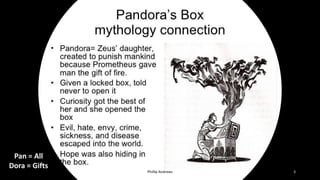
Pan = All
Dora = Gifts
Phillip Andrews 4
Phillip Andrews 5
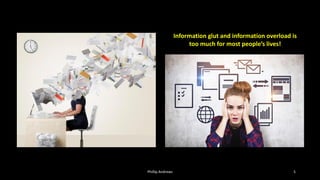
Information glut and information overload is
too much for most people’s lives!
Phillip Andrews 6
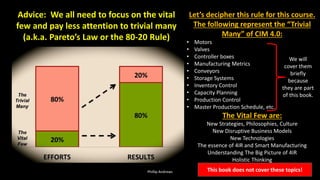
Advice: We all need to focus on the vital
few and pay less attention to trivial many
(a.k.a. Pareto’s Law or the 80-20 Rule)
Let’s decipher this rule for this course.
The following represent the “Trivial
Many” of CIM 4.0:
• Motors
• Valves
• Controller boxes
• Manufacturing Metrics
• Conveyors
• Storage Systems
• Inventory Control
• Capacity Planning
• Production Control
• Master Production Schedule, etc.
The Vital Few are:
New Strategies, Philosophies, Culture
New Disruptive Business Models
New Technologies
The essence of 4IR and Smart Manufacturing
Understanding The Big Picture of 4IR
Holistic Thinking
We will
cover them
briefly
because
they are part
of this book.
This book does not cover these topics!
Phillip Andrews 7
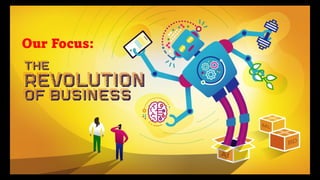
Our Focus:
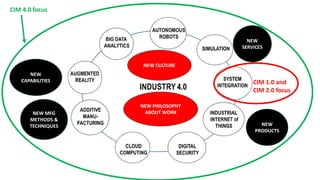
CIM 1.0 and
CIM 2.0 focus
CIM 4.0 focus
Phillip Andrews 8
NEW
SERVICES
NEW CULTURE
NEW MFG
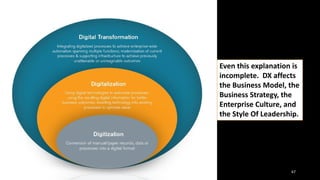
METHODS &
TECHNIQUES
NEW
CAPABILITIES
NEW PHILOSOPHY
ABOUT WORK
NEW
PRODUCTS
CIM 4.0 New Philosophy
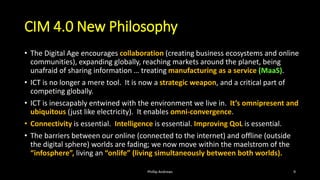
• The Digital Age encourages collaboration (creating business ecosystems and online
communities), expanding globally, reaching markets around the planet, being
unafraid of sharing information … treating manufacturing as a service (MaaS).
• ICT is no longer a mere tool. It is now a strategic weapon, and a critical part of
competing globally.
• ICT is inescapably entwined with the environment we live in. It’s omnipresent and
ubiquitous (just like electricity). It enables omni-convergence.
• Connectivity is essential. Intelligence is essential. Improving QoL is essential.
• The barriers between our online (connected to the internet) and offline (outside
the digital sphere) worlds are fading; we now move within the maelstrom of the
“infosphere”, living an “onlife” (living simultaneously between both worlds).
Phillip Andrews 9
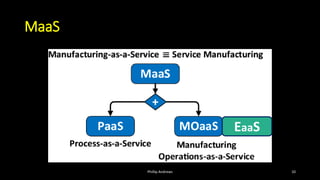
MaaS
Phillip Andrews 10
EaaS
Phillip Andrews 11
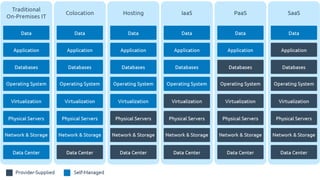
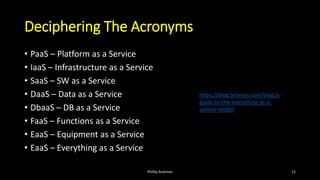
Deciphering The Acronyms
• PaaS – Platform as a Service
• IaaS – Infrastructure as a Service
• SaaS – SW as a Service
• DaaS – Data as a Service
• DbaaS – DB as a Service
• FaaS – Functions as a Service
• EaaS – Equipment as a Service
• EaaS – Everything as a Service
Phillip Andrews 12
https://blog.britesys.com/blog/a-
guide-to-the-everything-as-a-
service-model
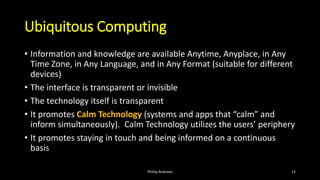
Ubiquitous Computing
• Information and knowledge are available Anytime, Anyplace, in Any
Time Zone, in Any Language, and in Any Format (suitable for different
devices)
• The interface is transparent or invisible
• The technology itself is transparent
• It promotes Calm Technology (systems and apps that “calm” and
inform simultaneously). Calm Technology utilizes the users’ periphery
• It promotes staying in touch and being informed on a continuous
basis
Phillip Andrews 13
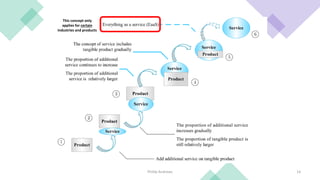
Phillip Andrews 14
This concept only
applies for certain
industries and products
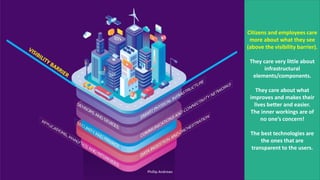
Phillip Andrews 15
Citizens and employees care
more about what they see
(above the visibility barrier).
They care very little about
infrastructural
elements/components.
They care about what
improves and makes their
lives better and easier.
The inner workings are of
no one’s concern!
The best technologies are
the ones that are
transparent to the users.
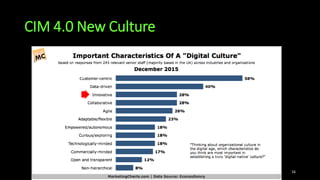
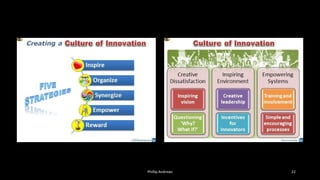
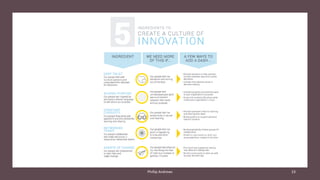
CIM 4.0 New Culture
Phillip Andrews 16
Phillip Andrews 17
Phillip Andrews 18
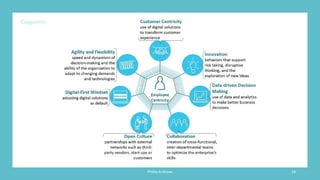
Capgemini
Phillip Andrews 19
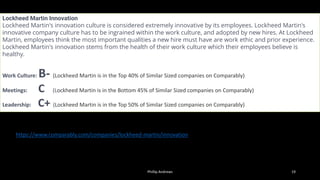
Lockheed Martin Innovation
Lockheed Martin's innovation culture is considered extremely innovative by its employees. Lockheed Martin's
innovative company culture has to be ingrained within the work culture, and adopted by new hires. At Lockheed
Martin, employees think the most important qualities a new hire must have are work ethic and prior experience.
Lockheed Martin's innovation stems from the health of their work culture which their employees believe is
healthy.
Work Culture: B- (Lockheed Martin is in the Top 40% of Similar Sized companies on Comparably)
Meetings: C (Lockheed Martin is in the Bottom 45% of Similar Sized companies on Comparably)
Leadership: C+ (Lockheed Martin is in the Top 50% of Similar Sized companies on Comparably)
https://www.comparably.com/companies/lockheed-martin/innovation
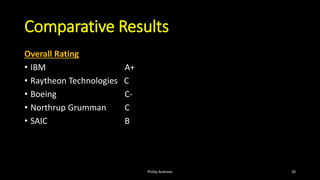
Comparative Results
Overall Rating
• IBM A+
• Raytheon Technologies C
• Boeing C-
• Northrup Grumman C
• SAIC B
Phillip Andrews 20
Phillip Andrews 21
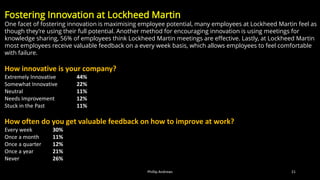
Fostering Innovation at Lockheed Martin
One facet of fostering innovation is maximising employee potential, many employees at Lockheed Martin feel as
though they’re using their full potential. Another method for encouraging innovation is using meetings for
knowledge sharing, 56% of employees think Lockheed Martin meetings are effective. Lastly, at Lockheed Martin
most employees receive valuable feedback on a every week basis, which allows employees to feel comfortable
with failure.
How innovative is your company?
Extremely Innovative 44%
Somewhat Innovative 22%
Neutral 11%
Needs Improvement 12%
Stuck in the Past 11%
How often do you get valuable feedback on how to improve at work?
Every week 30%
Once a month 11%
Once a quarter 12%
Once a year 21%
Never 26%
Phillip Andrews 22
Phillip Andrews 23
Phillip Andrews 24
Some Important
1st Realization
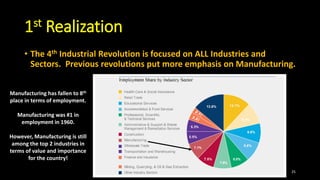
• The 4th Industrial Revolution is focused on ALL Industries and
Sectors. Previous revolutions put more emphasis on Manufacturing.
Phillip Andrews 25
Manufacturing has fallen to 8th
place in terms of employment.
Manufacturing was #1 in
employment in 1960.
However, Manufacturing is still
among the top 2 industries in
terms of value and importance
for the country!
2nd Realization
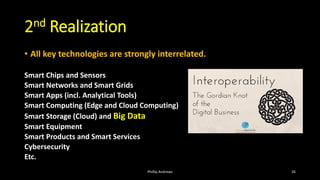
• All key technologies are strongly interrelated.
Smart Chips and Sensors
Smart Networks and Smart Grids
Smart Apps (incl. Analytical Tools)
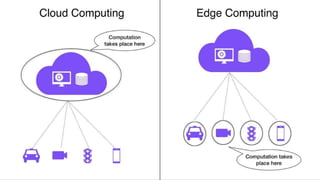
Smart Computing (Edge and Cloud Computing)
Smart Storage (Cloud) and Big Data
Smart Equipment
Smart Products and Smart Services
Cybersecurity
Etc.
Phillip Andrews 26
Big Data Is One Of The Most Strategic Aspects
In An Enterprise
Phillip Andrews 27
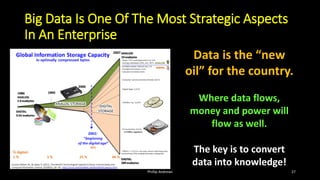
Data is the “new
oil” for the country.
Where data flows,
money and power will
flow as well.
The key is to convert
data into knowledge!
The New Mentality
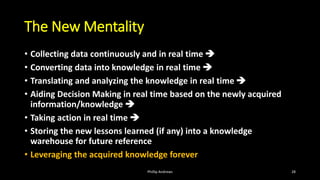
• Collecting data continuously and in real time ➔
• Converting data into knowledge in real time ➔
• Translating and analyzing the knowledge in real time ➔
• Aiding Decision Making in real time based on the newly acquired
information/knowledge ➔
• Taking action in real time ➔
• Storing the new lessons learned (if any) into a knowledge
warehouse for future reference
• Leveraging the acquired knowledge forever
Phillip Andrews 28
Phillip Andrews 29
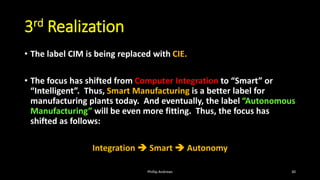
3rd Realization
• The label CIM is being replaced with CIE.
• The focus has shifted from Computer Integration to “Smart” or
“Intelligent”. Thus, Smart Manufacturing is a better label for
manufacturing plants today. And eventually, the label “Autonomous
Manufacturing” will be even more fitting. Thus, the focus has
shifted as follows:
Integration ➔ Smart ➔ Autonomy
Phillip Andrews 30
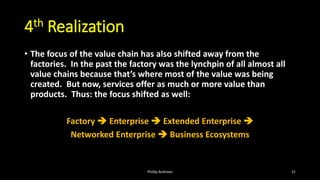
4th Realization
• The focus of the value chain has also shifted away from the
factories. In the past the factory was the lynchpin of all almost all
value chains because that’s where most of the value was being
created. But now, services offer as much or more value than
products. Thus: the focus shifted as well:
Factory ➔ Enterprise ➔ Extended Enterprise ➔
Networked Enterprise ➔ Business Ecosystems
Phillip Andrews 31
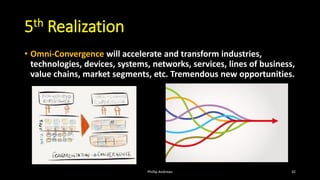
5th Realization
• Omni-Convergence will accelerate and transform industries,
technologies, devices, systems, networks, services, lines of business,
value chains, market segments, etc. Tremendous new opportunities.
Phillip Andrews 32
Phillip Andrews 33
6th Realization
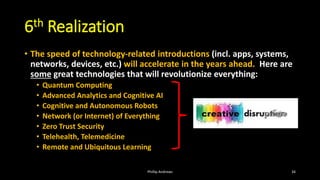
• The speed of technology-related introductions (incl. apps, systems,
networks, devices, etc.) will accelerate in the years ahead. Here are
some great technologies that will revolutionize everything:
• Quantum Computing
• Advanced Analytics and Cognitive AI
• Cognitive and Autonomous Robots
• Network (or Internet) of Everything
• Zero Trust Security
• Telehealth, Telemedicine
• Remote and Ubiquitous Learning
Phillip Andrews 34
7th Realization
• Digital Transformation (DTX) is more difficult and challenging than
most people realize and anticipate for these reasons:
• Lack of in-house skills (incl. leadership skills)
• Lack of correct mindset
• Lack of shared vision, shared understanding, shared commitment
• DTX is a multiyear journey (many projects), not a single project
• DTX must bedriven top-down (with executive sponsorship)
• Lack of proper funding
• DTX requires extensive and relentless business and personal transformation
• Insufficient training, mentoring and coaching
• Too much “ugly package” left over from old systems, networks, devices, etc.
Phillip Andrews 35
Sample Technologies That Will
Continue to Drive and Enable
The 4IR
Phillip Andrews 36
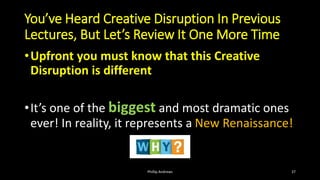
You’ve Heard Creative Disruption In Previous
Lectures, But Let’s Review It One More Time
•Upfront you must know that this Creative
Disruption is different
•It’s one of the biggest and most dramatic ones
ever! In reality, it represents a New Renaissance!
Phillip Andrews 37
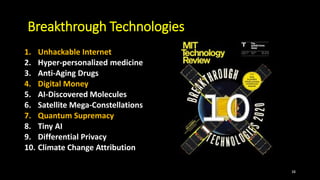
Breakthrough Technologies
1. Unhackable Internet
2. Hyper-personalized medicine
3. Anti-Aging Drugs
4. Digital Money
5. AI-Discovered Molecules
6. Satellite Mega-Constellations
7. Quantum Supremacy
8. Tiny AI
9. Differential Privacy
10. Climate Change Attribution
38
39
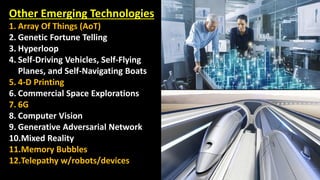
Other Emerging Technologies
1. Array Of Things (AoT)
2. Genetic Fortune Telling
3. Hyperloop
4. Self-Driving Vehicles, Self-Flying
Planes, and Self-Navigating Boats
5. 4-D Printing
6. Commercial Space Explorations
7. 6G
8. Computer Vision
9. Generative Adversarial Network
10.Mixed Reality
11.Memory Bubbles
12.Telepathy w/robots/devices
40
41
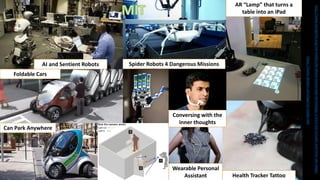
AI and Sentient Robots
Foldable Cars
Can Park Anywhere
https://www.dezeen.com/tag/mit-media-lab/
AR “Lamp” that turns a
table into an iPad
Health Tracker Tattoo
Conversing with the
inner thoughts
Wearable Personal
Assistant
Spider Robots 4 Dangerous Missions
http://www.zerogenie.org/mit-media-lab-where-tomorrows-technology-is-born-60-minutes-overtime-cbs-news/
Phillip Andrews 42
Phillip Andrews 43
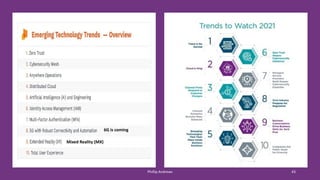
6G is coming
Mixed Reality (MX)
The Big Question For Everyone Now Is:
Phillip Andrews 44
45
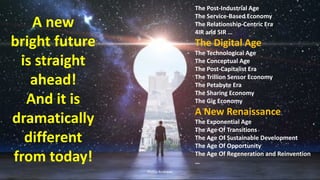
A new
bright future
is straight
ahead!
And it is
dramatically
different
from today!
The Post-Industrial Age
The Service-Based Economy
The Relationship-Centric Era
4IR and 5IR …
The Digital Age
The Technological Age
The Conceptual Age
The Post-Capitalist Era
The Trillion Sensor Economy
The Petabyte Era
The Sharing Economy
The Gig Economy
A New Renaissance
The Exponential Age
The Age Of Transitions
The Age Of Sustainable Development
The Age Of Opportunity
The Age Of Regeneration and Reinvention
…
Phillip Andrews
Why Are The Experts Calling
This a New Renaissance?
What is so special?
Phillip Andrews 46
… Because It Changes Everything!
• New approaches to Mobility (Smart Mobility)
• New sources of energy and ways to save energy (Smart Energy)
• New ways to collect and reuse waste (Smart Waste Management)
• New ways to educate and learn (Smart Education)
• New methods for taking care of health (Smart Healthcare)
• New ways to do business (Smart Business / Smart Manufacturing)
• New ways to perform agriculture (Smart Farming)
• New ways to live, work, and enjoy life (Smart Living)
• New types of Cities (Smart Cities) (Cities Of The Future)
• New thought processes, new mental models, new values … (Digital Culture)
47
Phillip Andrews
CIM 4.0 Represents Creative Disruption For
Several Industries, Companies, and Professions
• Movie Theaters
• Small Retailers
• Bookstores, Libraries
• Newspapers
• Job Recruiting Companies
• Real Estate Companies
• Hotels and Motels
• Book Publishing Companies
• Manufacturing Companies
• Logistics Companies
• Traditional Schools
• Taxi Drivers
• Truck Drivers
• Pilots
• Financial Advisors, Brokers
• Tax Preparers
• Clerks, Cashiers, Bank Tellers
• Translators
• Editors, Proofreaders
• Fast Food Workers
• Postal Workers
• Farmers and Ranchers
Phillip Andrews 48
They all are
threatened.
And there are
many more!
They all are
threatened.
And there are
many more!
What Does Digital Disruption Look Like?
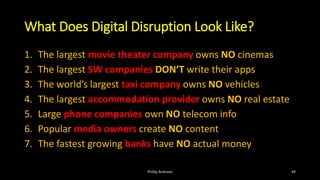
1. The largest movie theater company owns NO cinemas
2. The largest SW companies DON’T write their apps
3. The world’s largest taxi company owns NO vehicles
4. The largest accommodation provider owns NO real estate
5. Large phone companies own NO telecom info
6. Popular media owners create NO content
7. The fastest growing banks have NO actual money
Phillip Andrews 49
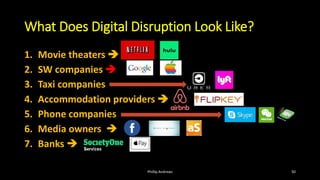
What Does Digital Disruption Look Like?
1. Movie theaters ➔
2. SW companies ➔
3. Taxi companies
4. Accommodation providers ➔
5. Phone companies
6. Media owners ➔
7. Banks ➔
Phillip Andrews 50
Phillip Andrews 51
And There
Are
Hundreds
More
New Biz
Models!
… and there are hundreds
more to come with the
4IR!
… and there are hundreds
more to come with the
4IR!
Phillip Andrews
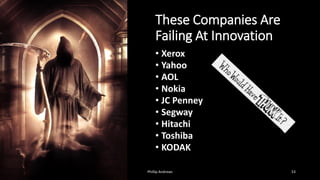
These Companies Are
Failing At Innovation
• Xerox
• Yahoo
• AOL
• Nokia
• JC Penney
• Segway
• Hitachi
• Toshiba
• KODAK
53
Phillip Andrews
Sample Of Major Business Fumbles
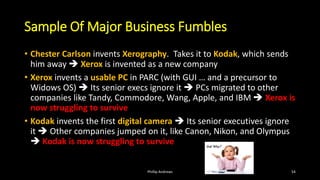
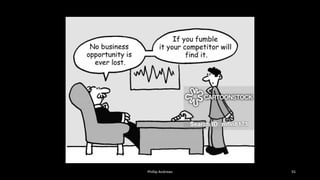
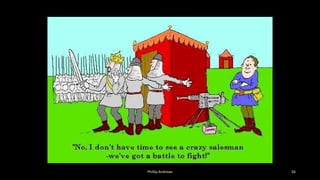
• Chester Carlson invents Xerography. Takes it to Kodak, which sends
him away ➔ Xerox is invented as a new company
• Xerox invents a usable PC in PARC (with GUI … and a precursor to
Widows OS) ➔ Its senior execs ignore it ➔ PCs migrated to other
companies like Tandy, Commodore, Wang, Apple, and IBM ➔ Xerox is
now struggling to survive
• Kodak invents the first digital camera ➔ Its senior executives ignore
it ➔ Other companies jumped on it, like Canon, Nikon, and Olympus
➔ Kodak is now struggling to survive
Phillip Andrews 54
Phillip Andrews 55
Phillip Andrews 56
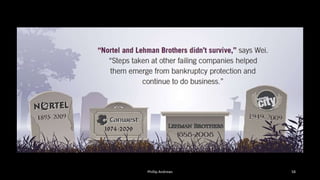
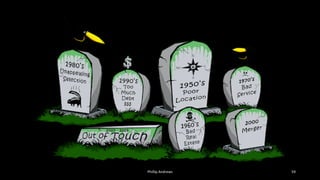
Reminder
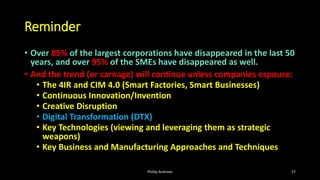
• Over 85% of the largest corporations have disappeared in the last 50
years, and over 95% of the SMEs have disappeared as well.
• And the trend (or carnage) will continue unless companies espouse:
• The 4IR and CIM 4.0 (Smart Factories, Smart Businesses)
• Continuous Innovation/Invention
• Creative Disruption
• Digital Transformation (DTX)
• Key Technologies (viewing and leveraging them as strategic
weapons)
• Key Business and Manufacturing Approaches and Techniques
Phillip Andrews 57
Phillip Andrews 58
Phillip Andrews 59
Please help! Creative
Disruption is chasing
my company!
Phillip Andrews 60
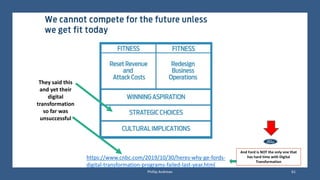
https://www.cnbc.com/2019/10/30/heres-why-ge-fords-
digital-transformation-programs-failed-last-year.html
They said this
and yet their
digital
transformation
so far was
unsuccessful
Phillip Andrews 61
And Ford is NOT the only one that
has hard time with Digital
Transformation
Phillip Andrews 62
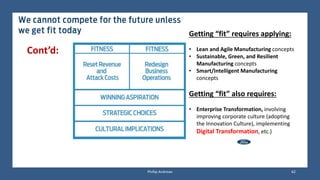
Getting “fit” requires applying:
• Lean and Agile Manufacturing concepts
• Sustainable, Green, and Resilient
Manufacturing concepts
• Smart/Intelligent Manufacturing
concepts
Getting “fit” also requires:
• Enterprise Transformation, involving
improving corporate culture (adopting
the Innovation Culture), implementing
Digital Transformation, etc.)
Cont’d:
Phillip Andrews 63
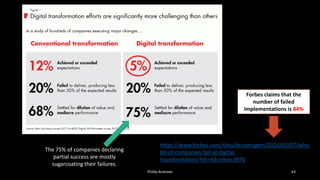
https://www.forbes.com/sites/brucerogers/2016/01/07/why-
84-of-companies-fail-at-digital-
transformation/?sh=43ce9cec397b
Forbes claims that the
number of failed
implementations is 84%
The 75% of companies declaring
partial success are mostly
sugarcoating their failures.
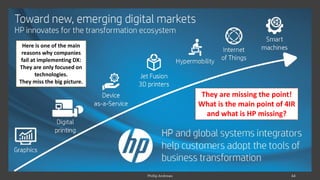
They are missing the point!
What is the main point of 4IR
and what is HP missing?
Here is one of the main
reasons why companies
fail at implementing DX:
They are only focused on
technologies.
They miss the big picture.
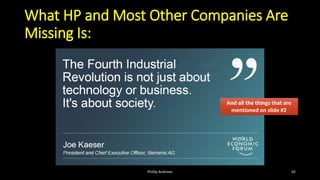
What HP and Most Other Companies Are
Missing Is:
Phillip Andrews 65
And all the things that are
mentioned on slide #2
And all the things that are
mentioned on slide #2
Phillip Andrews 66
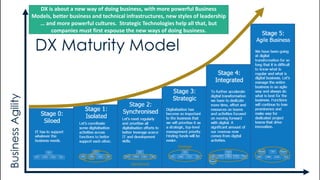
DX is about a new way of doing business, with more powerful Business
Models, better business and technical infrastructures, new styles of leadership
… and more powerful cultures. Strategic Technologies help all that, but
companies must first espouse the new ways of doing business.
Phillip Andrews 67
Even this explanation is
incomplete. DX affects
the Business Model, the
Business Strategy, the
Enterprise Culture, and
the Style Of Leadership.
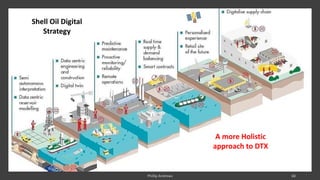
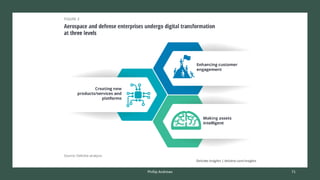
Shell Oil Digital
Strategy
A more Holistic
approach to DTX
Phillip Andrews 69
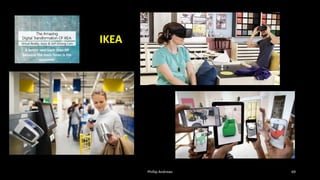
IKEA
A better approach than HP
because the main focus is the
customer
Phillip Andrews
70
Phillip Andrews 71
Phillip Andrews 72
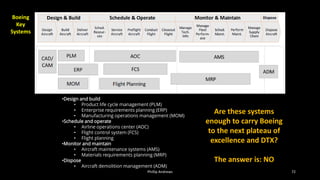
•Design and build
• Product life cycle management (PLM)
• Enterprise requirements planning (ERP)
• Manufacturing operations management (MOM)
•Schedule and operate
• Airline operations center (AOC)
• Flight control system (FCS)
• Flight planning
•Monitor and maintain
• Aircraft maintenance systems (AMS)
• Materials requirements planning (MRP)
•Dispose
• Aircraft demolition management (ADM)
Boeing
Key
Systems
Are these systems
enough to carry Boeing
to the next plateau of
excellence and DTX?
The answer is: NO
Phillip Andrews 73
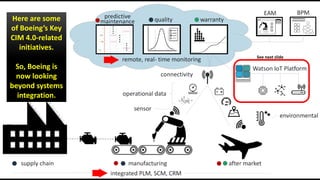
Here are some
of Boeing’s Key
CIM 4.0-related
initiatives.
So, Boeing is
now looking
beyond systems
integration.
Here are some
of Boeing’s Key
CIM 4.0-related
initiatives.
So, Boeing is
now looking
beyond systems
integration.
See next slide
Phillip Andrews 74
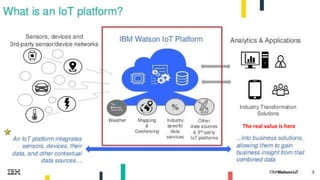
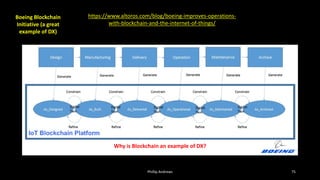
The real value is here
Phillip Andrews 75
https://www.altoros.com/blog/boeing-improves-operations-
with-blockchain-and-the-internet-of-things/
Boeing Blockchain
Initiative (a great
example of DX)
Why is Blockchain an example of DX?
Phillip Andrews 76
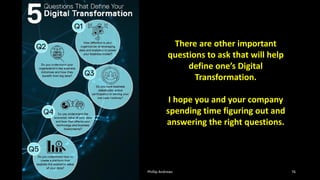
There are other important
questions to ask that will help
define one’s Digital
Transformation.
I hope you and your company
spending time figuring out and
answering the right questions.
Phillip Andrews 77
https://blog.tmcnet.com/blog/rich-tehrani/e-commerce/digital-
transformation-helps-lockheed-martin-go-hypersonic.html
https://www.youtube.com/watch?v=wyvDCUtf_5o
You are leading
the DTX
movement and
the Fourth
Industrial
Revolution!
Keep it up.
Your future and
the country’s
future depend
on it!

Cim 4.0 putting things in perspective

  • 1.
    Putting Things InPerspective The Most Important Realization About 4IR, Factories Of the Future, and CIM 4.0 Phil Andrews March 2019 1
  • 2.
    Some Negative Aspectsof 4IR • The explosion of technologies (too many, too fast) cannot be comprehended and implemented or adopted by most companies and individuals ➔ Core industries disruption issue • The pace is too frantic. Modern life is giving us brain fatigue. See: https://www.salon.com/2021/12/12/the-dangers-of-overtaxing-your- prefrontal-cortex/ ➔ Health issue • The gap between the Haves and Have-Nots is getting bigger ➔ Inequality issue • Vulnerability of systems and devices ➔ Cybersecurity issue • Misuse of data/information ➔ Ethical issue Phillip Andrews 2
  • 3.
    Phillip Andrews 3 Pan= All Dora = Gifts
  • 4.
  • 5.
    Phillip Andrews 5 Informationglut and information overload is too much for most people’s lives!
  • 6.
    Phillip Andrews 6 Advice:We all need to focus on the vital few and pay less attention to trivial many (a.k.a. Pareto’s Law or the 80-20 Rule) Let’s decipher this rule for this course. The following represent the “Trivial Many” of CIM 4.0: • Motors • Valves • Controller boxes • Manufacturing Metrics • Conveyors • Storage Systems • Inventory Control • Capacity Planning • Production Control • Master Production Schedule, etc. The Vital Few are: New Strategies, Philosophies, Culture New Disruptive Business Models New Technologies The essence of 4IR and Smart Manufacturing Understanding The Big Picture of 4IR Holistic Thinking We will cover them briefly because they are part of this book. This book does not cover these topics!
  • 7.
  • 8.
    CIM 1.0 and CIM2.0 focus CIM 4.0 focus Phillip Andrews 8 NEW SERVICES NEW CULTURE NEW MFG METHODS & TECHNIQUES NEW CAPABILITIES NEW PHILOSOPHY ABOUT WORK NEW PRODUCTS
  • 9.
    CIM 4.0 NewPhilosophy • The Digital Age encourages collaboration (creating business ecosystems and online communities), expanding globally, reaching markets around the planet, being unafraid of sharing information … treating manufacturing as a service (MaaS). • ICT is no longer a mere tool. It is now a strategic weapon, and a critical part of competing globally. • ICT is inescapably entwined with the environment we live in. It’s omnipresent and ubiquitous (just like electricity). It enables omni-convergence. • Connectivity is essential. Intelligence is essential. Improving QoL is essential. • The barriers between our online (connected to the internet) and offline (outside the digital sphere) worlds are fading; we now move within the maelstrom of the “infosphere”, living an “onlife” (living simultaneously between both worlds). Phillip Andrews 9
  • 10.
  • 11.
  • 12.
    Deciphering The Acronyms •PaaS – Platform as a Service • IaaS – Infrastructure as a Service • SaaS – SW as a Service • DaaS – Data as a Service • DbaaS – DB as a Service • FaaS – Functions as a Service • EaaS – Equipment as a Service • EaaS – Everything as a Service Phillip Andrews 12 https://blog.britesys.com/blog/a- guide-to-the-everything-as-a- service-model
  • 13.
    Ubiquitous Computing • Informationand knowledge are available Anytime, Anyplace, in Any Time Zone, in Any Language, and in Any Format (suitable for different devices) • The interface is transparent or invisible • The technology itself is transparent • It promotes Calm Technology (systems and apps that “calm” and inform simultaneously). Calm Technology utilizes the users’ periphery • It promotes staying in touch and being informed on a continuous basis Phillip Andrews 13
  • 14.
    Phillip Andrews 14 Thisconcept only applies for certain industries and products
  • 15.
    Phillip Andrews 15 Citizensand employees care more about what they see (above the visibility barrier). They care very little about infrastructural elements/components. They care about what improves and makes their lives better and easier. The inner workings are of no one’s concern! The best technologies are the ones that are transparent to the users.
  • 16.
    CIM 4.0 NewCulture Phillip Andrews 16
  • 17.
  • 18.
  • 19.
    Phillip Andrews 19 LockheedMartin Innovation Lockheed Martin's innovation culture is considered extremely innovative by its employees. Lockheed Martin's innovative company culture has to be ingrained within the work culture, and adopted by new hires. At Lockheed Martin, employees think the most important qualities a new hire must have are work ethic and prior experience. Lockheed Martin's innovation stems from the health of their work culture which their employees believe is healthy. Work Culture: B- (Lockheed Martin is in the Top 40% of Similar Sized companies on Comparably) Meetings: C (Lockheed Martin is in the Bottom 45% of Similar Sized companies on Comparably) Leadership: C+ (Lockheed Martin is in the Top 50% of Similar Sized companies on Comparably) https://www.comparably.com/companies/lockheed-martin/innovation
  • 20.
    Comparative Results Overall Rating •IBM A+ • Raytheon Technologies C • Boeing C- • Northrup Grumman C • SAIC B Phillip Andrews 20
  • 21.
    Phillip Andrews 21 FosteringInnovation at Lockheed Martin One facet of fostering innovation is maximising employee potential, many employees at Lockheed Martin feel as though they’re using their full potential. Another method for encouraging innovation is using meetings for knowledge sharing, 56% of employees think Lockheed Martin meetings are effective. Lastly, at Lockheed Martin most employees receive valuable feedback on a every week basis, which allows employees to feel comfortable with failure. How innovative is your company? Extremely Innovative 44% Somewhat Innovative 22% Neutral 11% Needs Improvement 12% Stuck in the Past 11% How often do you get valuable feedback on how to improve at work? Every week 30% Once a month 11% Once a quarter 12% Once a year 21% Never 26%
  • 22.
  • 23.
  • 24.
  • 25.
    1st Realization • The4th Industrial Revolution is focused on ALL Industries and Sectors. Previous revolutions put more emphasis on Manufacturing. Phillip Andrews 25 Manufacturing has fallen to 8th place in terms of employment. Manufacturing was #1 in employment in 1960. However, Manufacturing is still among the top 2 industries in terms of value and importance for the country!
  • 26.
    2nd Realization • Allkey technologies are strongly interrelated. Smart Chips and Sensors Smart Networks and Smart Grids Smart Apps (incl. Analytical Tools) Smart Computing (Edge and Cloud Computing) Smart Storage (Cloud) and Big Data Smart Equipment Smart Products and Smart Services Cybersecurity Etc. Phillip Andrews 26
  • 27.
    Big Data IsOne Of The Most Strategic Aspects In An Enterprise Phillip Andrews 27 Data is the “new oil” for the country. Where data flows, money and power will flow as well. The key is to convert data into knowledge!
  • 28.
    The New Mentality •Collecting data continuously and in real time ➔ • Converting data into knowledge in real time ➔ • Translating and analyzing the knowledge in real time ➔ • Aiding Decision Making in real time based on the newly acquired information/knowledge ➔ • Taking action in real time ➔ • Storing the new lessons learned (if any) into a knowledge warehouse for future reference • Leveraging the acquired knowledge forever Phillip Andrews 28
  • 29.
  • 30.
    3rd Realization • Thelabel CIM is being replaced with CIE. • The focus has shifted from Computer Integration to “Smart” or “Intelligent”. Thus, Smart Manufacturing is a better label for manufacturing plants today. And eventually, the label “Autonomous Manufacturing” will be even more fitting. Thus, the focus has shifted as follows: Integration ➔ Smart ➔ Autonomy Phillip Andrews 30
  • 31.
    4th Realization • Thefocus of the value chain has also shifted away from the factories. In the past the factory was the lynchpin of all almost all value chains because that’s where most of the value was being created. But now, services offer as much or more value than products. Thus: the focus shifted as well: Factory ➔ Enterprise ➔ Extended Enterprise ➔ Networked Enterprise ➔ Business Ecosystems Phillip Andrews 31
  • 32.
    5th Realization • Omni-Convergencewill accelerate and transform industries, technologies, devices, systems, networks, services, lines of business, value chains, market segments, etc. Tremendous new opportunities. Phillip Andrews 32
  • 33.
  • 34.
    6th Realization • Thespeed of technology-related introductions (incl. apps, systems, networks, devices, etc.) will accelerate in the years ahead. Here are some great technologies that will revolutionize everything: • Quantum Computing • Advanced Analytics and Cognitive AI • Cognitive and Autonomous Robots • Network (or Internet) of Everything • Zero Trust Security • Telehealth, Telemedicine • Remote and Ubiquitous Learning Phillip Andrews 34
  • 35.
    7th Realization • DigitalTransformation (DTX) is more difficult and challenging than most people realize and anticipate for these reasons: • Lack of in-house skills (incl. leadership skills) • Lack of correct mindset • Lack of shared vision, shared understanding, shared commitment • DTX is a multiyear journey (many projects), not a single project • DTX must bedriven top-down (with executive sponsorship) • Lack of proper funding • DTX requires extensive and relentless business and personal transformation • Insufficient training, mentoring and coaching • Too much “ugly package” left over from old systems, networks, devices, etc. Phillip Andrews 35
  • 36.
    Sample Technologies ThatWill Continue to Drive and Enable The 4IR Phillip Andrews 36
  • 37.
    You’ve Heard CreativeDisruption In Previous Lectures, But Let’s Review It One More Time •Upfront you must know that this Creative Disruption is different •It’s one of the biggest and most dramatic ones ever! In reality, it represents a New Renaissance! Phillip Andrews 37
  • 38.
    Breakthrough Technologies 1. UnhackableInternet 2. Hyper-personalized medicine 3. Anti-Aging Drugs 4. Digital Money 5. AI-Discovered Molecules 6. Satellite Mega-Constellations 7. Quantum Supremacy 8. Tiny AI 9. Differential Privacy 10. Climate Change Attribution 38
  • 39.
    39 Other Emerging Technologies 1.Array Of Things (AoT) 2. Genetic Fortune Telling 3. Hyperloop 4. Self-Driving Vehicles, Self-Flying Planes, and Self-Navigating Boats 5. 4-D Printing 6. Commercial Space Explorations 7. 6G 8. Computer Vision 9. Generative Adversarial Network 10.Mixed Reality 11.Memory Bubbles 12.Telepathy w/robots/devices
  • 40.
  • 41.
    41 AI and SentientRobots Foldable Cars Can Park Anywhere https://www.dezeen.com/tag/mit-media-lab/ AR “Lamp” that turns a table into an iPad Health Tracker Tattoo Conversing with the inner thoughts Wearable Personal Assistant Spider Robots 4 Dangerous Missions http://www.zerogenie.org/mit-media-lab-where-tomorrows-technology-is-born-60-minutes-overtime-cbs-news/
  • 42.
  • 43.
    Phillip Andrews 43 6Gis coming Mixed Reality (MX)
  • 44.
    The Big QuestionFor Everyone Now Is: Phillip Andrews 44
  • 45.
    45 A new bright future isstraight ahead! And it is dramatically different from today! The Post-Industrial Age The Service-Based Economy The Relationship-Centric Era 4IR and 5IR … The Digital Age The Technological Age The Conceptual Age The Post-Capitalist Era The Trillion Sensor Economy The Petabyte Era The Sharing Economy The Gig Economy A New Renaissance The Exponential Age The Age Of Transitions The Age Of Sustainable Development The Age Of Opportunity The Age Of Regeneration and Reinvention … Phillip Andrews
  • 46.
    Why Are TheExperts Calling This a New Renaissance? What is so special? Phillip Andrews 46
  • 47.
    … Because ItChanges Everything! • New approaches to Mobility (Smart Mobility) • New sources of energy and ways to save energy (Smart Energy) • New ways to collect and reuse waste (Smart Waste Management) • New ways to educate and learn (Smart Education) • New methods for taking care of health (Smart Healthcare) • New ways to do business (Smart Business / Smart Manufacturing) • New ways to perform agriculture (Smart Farming) • New ways to live, work, and enjoy life (Smart Living) • New types of Cities (Smart Cities) (Cities Of The Future) • New thought processes, new mental models, new values … (Digital Culture) 47 Phillip Andrews
  • 48.
    CIM 4.0 RepresentsCreative Disruption For Several Industries, Companies, and Professions • Movie Theaters • Small Retailers • Bookstores, Libraries • Newspapers • Job Recruiting Companies • Real Estate Companies • Hotels and Motels • Book Publishing Companies • Manufacturing Companies • Logistics Companies • Traditional Schools • Taxi Drivers • Truck Drivers • Pilots • Financial Advisors, Brokers • Tax Preparers • Clerks, Cashiers, Bank Tellers • Translators • Editors, Proofreaders • Fast Food Workers • Postal Workers • Farmers and Ranchers Phillip Andrews 48 They all are threatened. And there are many more! They all are threatened. And there are many more!
  • 49.
    What Does DigitalDisruption Look Like? 1. The largest movie theater company owns NO cinemas 2. The largest SW companies DON’T write their apps 3. The world’s largest taxi company owns NO vehicles 4. The largest accommodation provider owns NO real estate 5. Large phone companies own NO telecom info 6. Popular media owners create NO content 7. The fastest growing banks have NO actual money Phillip Andrews 49
  • 50.
    What Does DigitalDisruption Look Like? 1. Movie theaters ➔ 2. SW companies ➔ 3. Taxi companies 4. Accommodation providers ➔ 5. Phone companies 6. Media owners ➔ 7. Banks ➔ Phillip Andrews 50
  • 51.
  • 52.
    And There Are Hundreds More New Biz Models! …and there are hundreds more to come with the 4IR! … and there are hundreds more to come with the 4IR! Phillip Andrews
  • 53.
    These Companies Are FailingAt Innovation • Xerox • Yahoo • AOL • Nokia • JC Penney • Segway • Hitachi • Toshiba • KODAK 53 Phillip Andrews
  • 54.
    Sample Of MajorBusiness Fumbles • Chester Carlson invents Xerography. Takes it to Kodak, which sends him away ➔ Xerox is invented as a new company • Xerox invents a usable PC in PARC (with GUI … and a precursor to Widows OS) ➔ Its senior execs ignore it ➔ PCs migrated to other companies like Tandy, Commodore, Wang, Apple, and IBM ➔ Xerox is now struggling to survive • Kodak invents the first digital camera ➔ Its senior executives ignore it ➔ Other companies jumped on it, like Canon, Nikon, and Olympus ➔ Kodak is now struggling to survive Phillip Andrews 54
  • 55.
  • 56.
  • 57.
    Reminder • Over 85%of the largest corporations have disappeared in the last 50 years, and over 95% of the SMEs have disappeared as well. • And the trend (or carnage) will continue unless companies espouse: • The 4IR and CIM 4.0 (Smart Factories, Smart Businesses) • Continuous Innovation/Invention • Creative Disruption • Digital Transformation (DTX) • Key Technologies (viewing and leveraging them as strategic weapons) • Key Business and Manufacturing Approaches and Techniques Phillip Andrews 57
  • 58.
  • 59.
  • 60.
    Please help! Creative Disruptionis chasing my company! Phillip Andrews 60
  • 61.
    https://www.cnbc.com/2019/10/30/heres-why-ge-fords- digital-transformation-programs-failed-last-year.html They said this andyet their digital transformation so far was unsuccessful Phillip Andrews 61 And Ford is NOT the only one that has hard time with Digital Transformation
  • 62.
    Phillip Andrews 62 Getting“fit” requires applying: • Lean and Agile Manufacturing concepts • Sustainable, Green, and Resilient Manufacturing concepts • Smart/Intelligent Manufacturing concepts Getting “fit” also requires: • Enterprise Transformation, involving improving corporate culture (adopting the Innovation Culture), implementing Digital Transformation, etc.) Cont’d:
  • 63.
    Phillip Andrews 63 https://www.forbes.com/sites/brucerogers/2016/01/07/why- 84-of-companies-fail-at-digital- transformation/?sh=43ce9cec397b Forbesclaims that the number of failed implementations is 84% The 75% of companies declaring partial success are mostly sugarcoating their failures.
  • 64.
    They are missingthe point! What is the main point of 4IR and what is HP missing? Here is one of the main reasons why companies fail at implementing DX: They are only focused on technologies. They miss the big picture.
  • 65.
    What HP andMost Other Companies Are Missing Is: Phillip Andrews 65 And all the things that are mentioned on slide #2 And all the things that are mentioned on slide #2
  • 66.
    Phillip Andrews 66 DXis about a new way of doing business, with more powerful Business Models, better business and technical infrastructures, new styles of leadership … and more powerful cultures. Strategic Technologies help all that, but companies must first espouse the new ways of doing business.
  • 67.
    Phillip Andrews 67 Eventhis explanation is incomplete. DX affects the Business Model, the Business Strategy, the Enterprise Culture, and the Style Of Leadership.
  • 68.
    Shell Oil Digital Strategy Amore Holistic approach to DTX
  • 69.
    Phillip Andrews 69 IKEA Abetter approach than HP because the main focus is the customer
  • 70.
  • 71.
  • 72.
    Phillip Andrews 72 •Designand build • Product life cycle management (PLM) • Enterprise requirements planning (ERP) • Manufacturing operations management (MOM) •Schedule and operate • Airline operations center (AOC) • Flight control system (FCS) • Flight planning •Monitor and maintain • Aircraft maintenance systems (AMS) • Materials requirements planning (MRP) •Dispose • Aircraft demolition management (ADM) Boeing Key Systems Are these systems enough to carry Boeing to the next plateau of excellence and DTX? The answer is: NO
  • 73.
    Phillip Andrews 73 Hereare some of Boeing’s Key CIM 4.0-related initiatives. So, Boeing is now looking beyond systems integration. Here are some of Boeing’s Key CIM 4.0-related initiatives. So, Boeing is now looking beyond systems integration. See next slide
  • 74.
    Phillip Andrews 74 Thereal value is here
  • 75.
  • 76.
    Phillip Andrews 76 Thereare other important questions to ask that will help define one’s Digital Transformation. I hope you and your company spending time figuring out and answering the right questions.
  • 77.
    Phillip Andrews 77 https://blog.tmcnet.com/blog/rich-tehrani/e-commerce/digital- transformation-helps-lockheed-martin-go-hypersonic.html https://www.youtube.com/watch?v=wyvDCUtf_5o Youare leading the DTX movement and the Fourth Industrial Revolution! Keep it up. Your future and the country’s future depend on it!