
Locating a New
   Business
Introducing location
• Small businesses are started in various locations -
  where depends on several factors
• Technology (particularly communications) has made
  the choice much easier, particularly for service
  businesses
• Most start-ups begin life at home, but then need to
  find extra/different space as the business grows
• The location cost and proximity to customers are key
  factors in choosing the best location
• An entrepreneur will often have to compromise –
  there is rarely a “perfect business location”
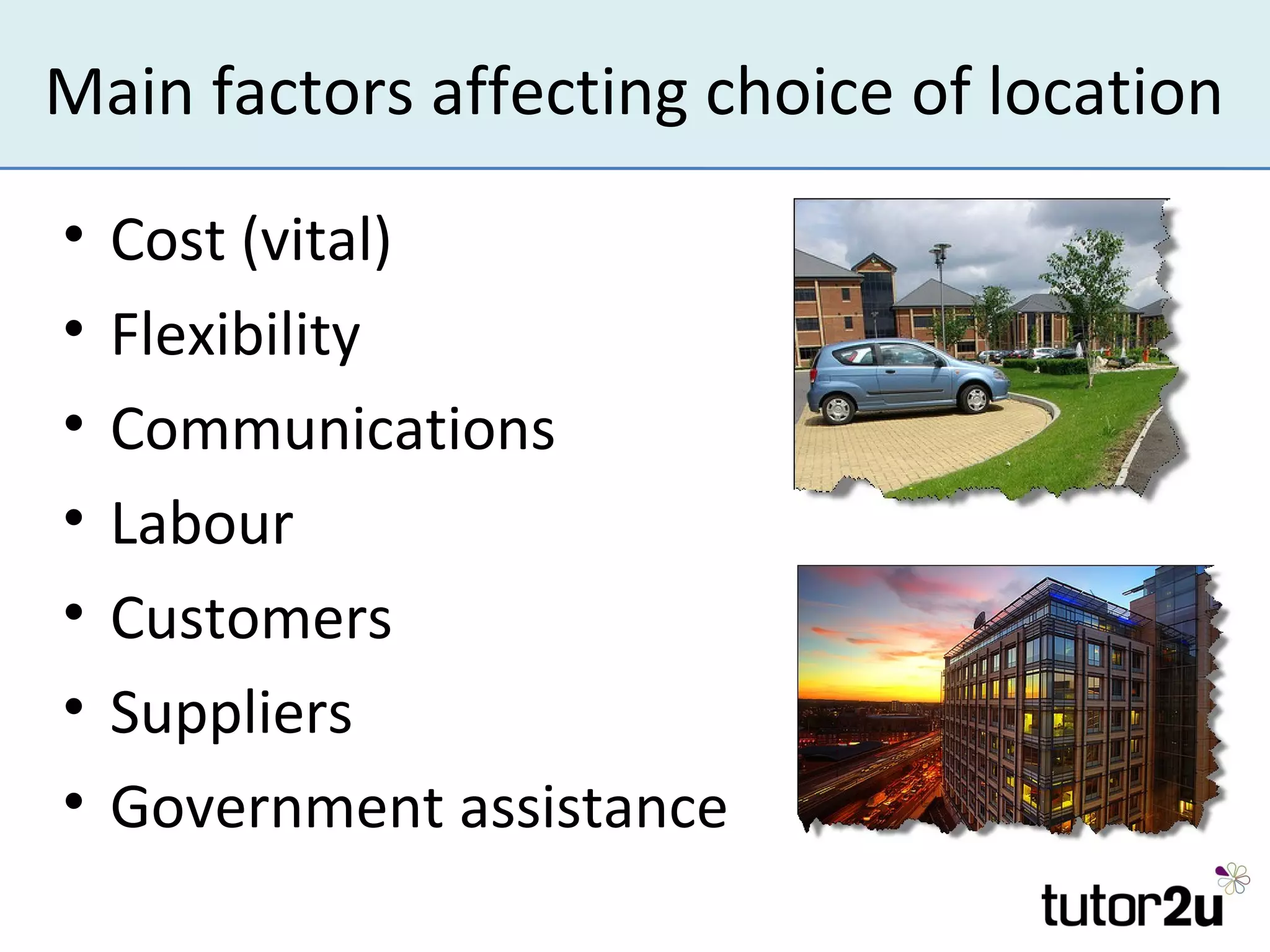
Main factors affecting choice of location
•   Cost (vital)
•   Flexibility
•   Communications
•   Labour
•   Customers
•   Suppliers
•   Government assistance
Main location costs

•   Rent (to the landlord)
•   Maintenance charges
•   Insurance (can be substantial)
•   Rates (local government tax)
•   Energy costs (electricity, gas)
•   Housekeeping (e.g. cleaning, security)
Why location flexibility matters
• A start-up or small business needs to:
  – Minimise its costs
  – Set up operations that can be scaled-back or
    scaled-up when needed
  – Avoid being locked into a location which might
    not prove suitable in the future
• Examples of flexibility
  – Short-term leases
  – Hot-desking
Communication
• This includes transport facilities (road, rail,
  air) as well as information technology
  infrastructure
• Transport links are particularly important if
  the business delivers products, sells direct
  using a sales force or is dependent on
  imports and exports
• Information technology now makes the
  choice wider – most start-ups can quickly
  establish reliable broadband Internet
  connections
Labour
• When a start-up needs to
  hire employees, then access
  to a reliable pool of staff with
  relevant skills is important
• Businesses that are labour-
  intensive often look to locate
  in areas of traditionally low
  wages
• Manufacturing businesses
  tend to locate where they
  can access trained employees
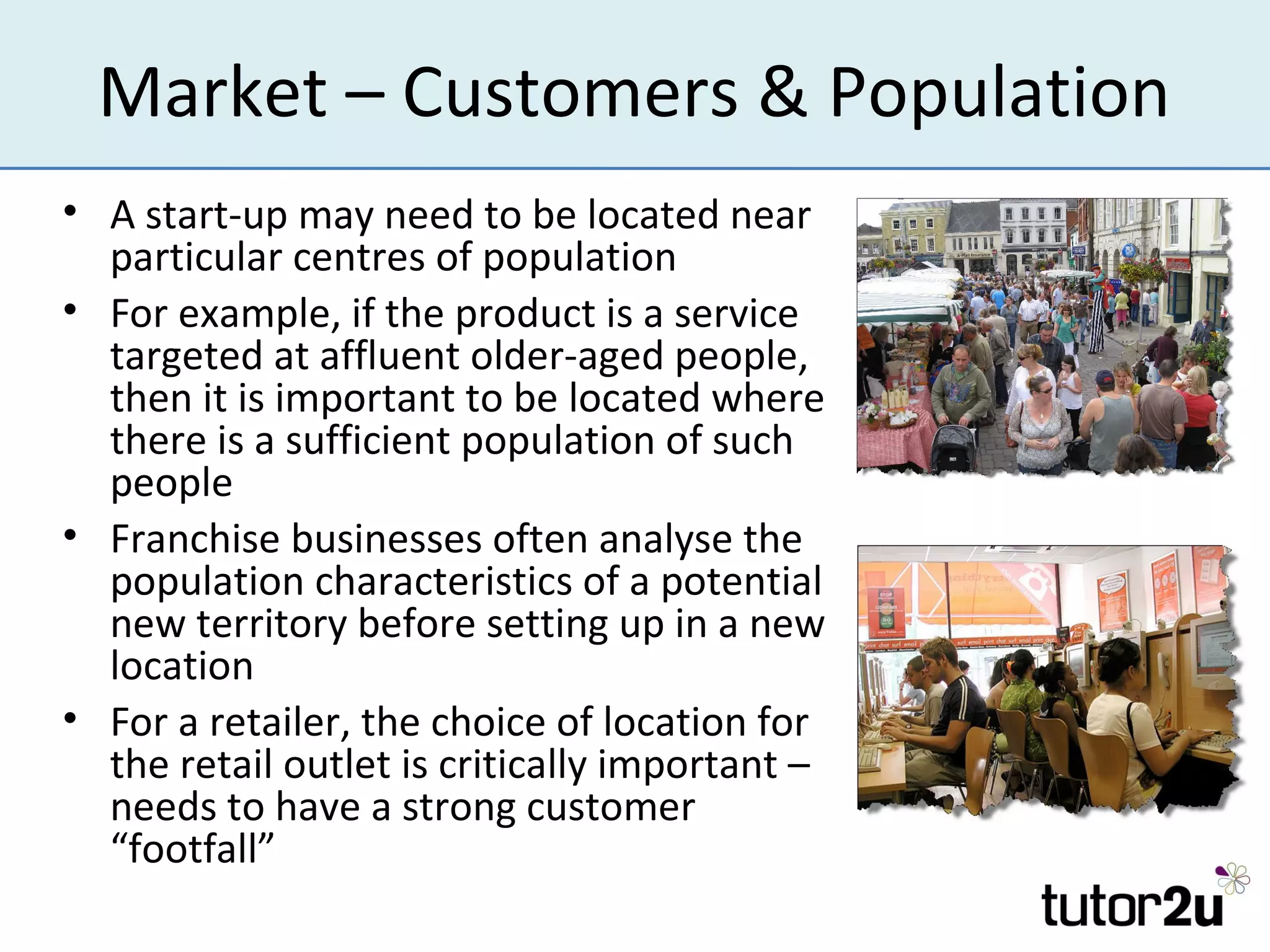
Market – Customers & Population
• A start-up may need to be located near
  particular centres of population
• For example, if the product is a service
  targeted at affluent older-aged people,
  then it is important to be located where
  there is a sufficient population of such
  people
• Franchise businesses often analyse the
  population characteristics of a potential
  new territory before setting up in a new
  location
• For a retailer, the choice of location for
  the retail outlet is critically important –
  needs to have a strong customer
  “footfall”
Suppliers
• The business may be
  dependent on supplies of a
  particular raw material, so
  costs will be lower if the
  business is located near
  the source of supply
• This factor tends to be
  more important for
  manufacturing businesses
  rather than service
  businesses
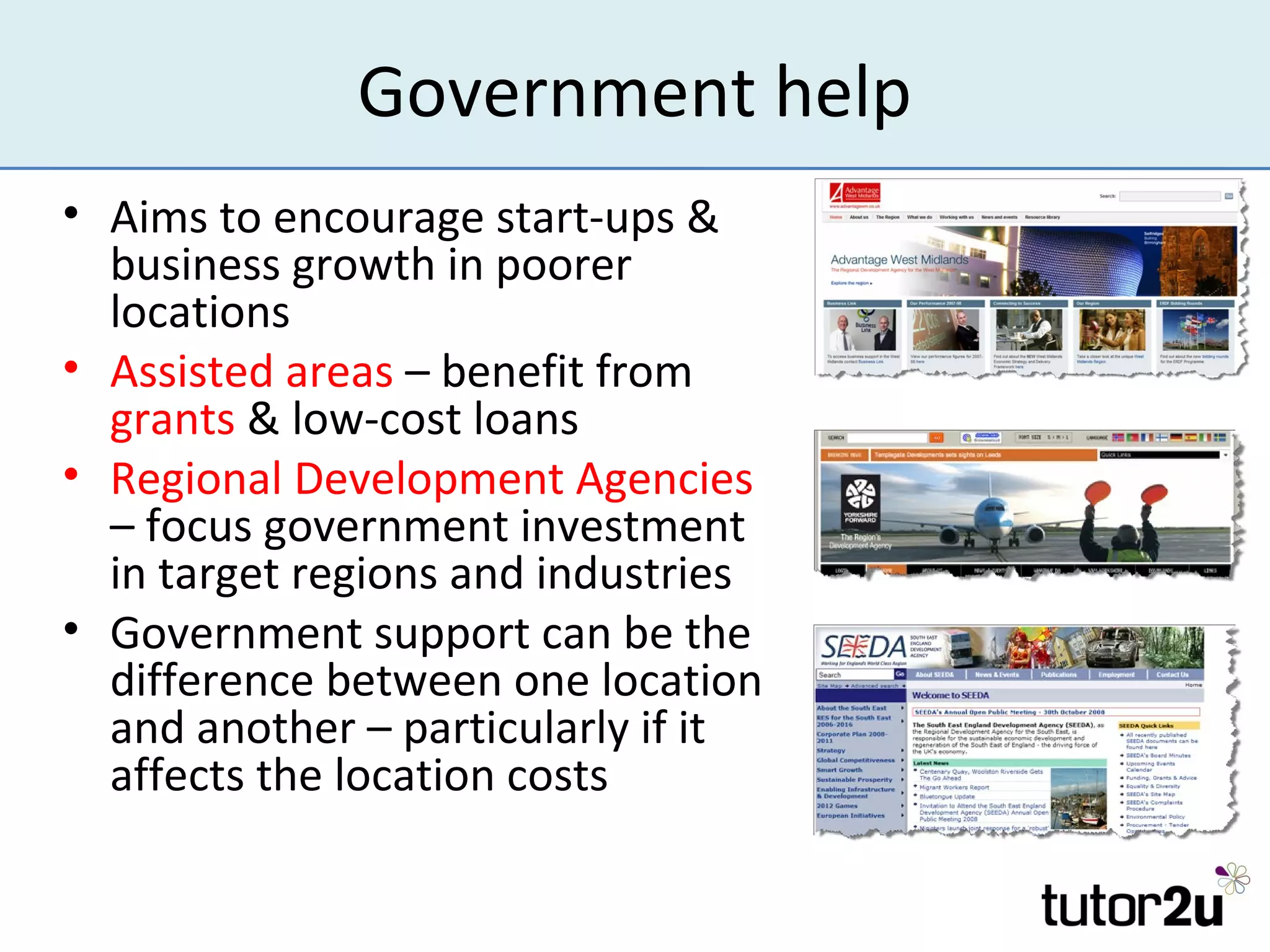
Government help
• Aims to encourage start-ups &
  business growth in poorer
  locations
• Assisted areas – benefit from
  grants & low-cost loans
• Regional Development Agencies
  – focus government investment
  in target regions and industries
• Government support can be the
  difference between one location
  and another – particularly if it
  affects the location costs
Home-based start-ups
• 60% of new businesses
  are started from home
• 2.1 million home-based
  businesses in the UK
• Popular sectors
  – Business & professional
    services
  – Online trading
  – Food products
Running a business from home
Advantages                                 Disadvantages
Very low cost - the big advantage          Requires greater self-discipline

Less travelling, although customers and    Work is often interrupted – e.g. by
suppliers might still need to be visited   callers to the home or by family
Work can be combined with domestic         Work never goes away – it is difficult to
tasks and responsibilities (e.g. child     separate work from home life
care)
Reduced risk and a lower break-even        Potentially lonely – lack of simulation
point                                      from colleagues

Environmental benefits – lower carbon      Working from home can give a poor
footprint                                  impression to potential customers
You can wear what you like!                Some hidden costs – e.g. extra
                                           household insurance, potentially higher
                                           capital gains tax when the house is sold
Follow tutor2u on Twitter


tutor2u      tutor2u_econ
Become a fan of tutor2u on
      Facebook!


   tutor2u on Facebook
Keep up-to-date with business
stories, resources, quizzes and
 worksheets for your business
    course. Click the logo!

Choosing the Location of a New Business

  • 1.
  • 2.
    Introducing location • Smallbusinesses are started in various locations - where depends on several factors • Technology (particularly communications) has made the choice much easier, particularly for service businesses • Most start-ups begin life at home, but then need to find extra/different space as the business grows • The location cost and proximity to customers are key factors in choosing the best location • An entrepreneur will often have to compromise – there is rarely a “perfect business location”
  • 3.
    Main factors affectingchoice of location • Cost (vital) • Flexibility • Communications • Labour • Customers • Suppliers • Government assistance
  • 4.
    Main location costs • Rent (to the landlord) • Maintenance charges • Insurance (can be substantial) • Rates (local government tax) • Energy costs (electricity, gas) • Housekeeping (e.g. cleaning, security)
  • 5.
    Why location flexibilitymatters • A start-up or small business needs to: – Minimise its costs – Set up operations that can be scaled-back or scaled-up when needed – Avoid being locked into a location which might not prove suitable in the future • Examples of flexibility – Short-term leases – Hot-desking
  • 6.
    Communication • This includestransport facilities (road, rail, air) as well as information technology infrastructure • Transport links are particularly important if the business delivers products, sells direct using a sales force or is dependent on imports and exports • Information technology now makes the choice wider – most start-ups can quickly establish reliable broadband Internet connections
  • 7.
    Labour • When astart-up needs to hire employees, then access to a reliable pool of staff with relevant skills is important • Businesses that are labour- intensive often look to locate in areas of traditionally low wages • Manufacturing businesses tend to locate where they can access trained employees
  • 8.
    Market – Customers& Population • A start-up may need to be located near particular centres of population • For example, if the product is a service targeted at affluent older-aged people, then it is important to be located where there is a sufficient population of such people • Franchise businesses often analyse the population characteristics of a potential new territory before setting up in a new location • For a retailer, the choice of location for the retail outlet is critically important – needs to have a strong customer “footfall”
  • 9.
    Suppliers • The businessmay be dependent on supplies of a particular raw material, so costs will be lower if the business is located near the source of supply • This factor tends to be more important for manufacturing businesses rather than service businesses
  • 10.
    Government help • Aimsto encourage start-ups & business growth in poorer locations • Assisted areas – benefit from grants & low-cost loans • Regional Development Agencies – focus government investment in target regions and industries • Government support can be the difference between one location and another – particularly if it affects the location costs
  • 11.
    Home-based start-ups • 60%of new businesses are started from home • 2.1 million home-based businesses in the UK • Popular sectors – Business & professional services – Online trading – Food products
  • 12.
    Running a businessfrom home Advantages Disadvantages Very low cost - the big advantage Requires greater self-discipline Less travelling, although customers and Work is often interrupted – e.g. by suppliers might still need to be visited callers to the home or by family Work can be combined with domestic Work never goes away – it is difficult to tasks and responsibilities (e.g. child separate work from home life care) Reduced risk and a lower break-even Potentially lonely – lack of simulation point from colleagues Environmental benefits – lower carbon Working from home can give a poor footprint impression to potential customers You can wear what you like! Some hidden costs – e.g. extra household insurance, potentially higher capital gains tax when the house is sold
  • 13.
    Follow tutor2u onTwitter tutor2u tutor2u_econ
  • 14.
    Become a fanof tutor2u on Facebook! tutor2u on Facebook
  • 15.
    Keep up-to-date withbusiness stories, resources, quizzes and worksheets for your business course. Click the logo!