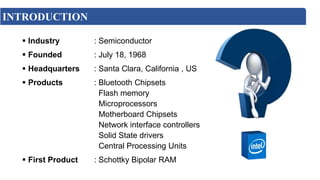
 Industry : Semiconductor
 Founded : July 18, 1968
 Headquarters : Santa Clara, California , US
 Products : Bluetooth Chipsets
Flash memory
Microprocessors
Motherboard Chipsets
Network interface controllers
Solid State drivers
Central Processing Units
 First Product : Schottky Bipolar RAM
INTRODUCTION
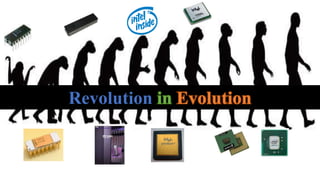
Revolution in Evolution
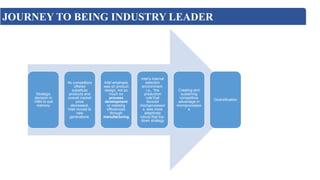
JOURNEY TO BEING INDUSTRY LEADER
Strategic
decision in
1984 to exit
memory
As competitors
offered
substitute
products and
overall market
price
decreased,
Intel moved to
new
generations.
Intel emphasis
was on product
design, not so
much on
process
development
or realizing
efficiencies
through
manufacturing
Intel’s internal
selection
environment,
i.e., “the
production
rule”that
favored
microprocessor
s, was more
adaptively
robust that top-
down strategy
Creating and
sustaining
competitive
advantage in
microprocessor
s
Diversification
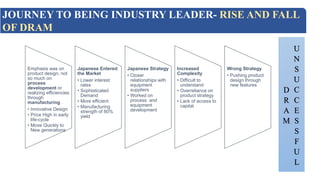
JOURNEY TO BEING INDUSTRY LEADER- RISE AND FALL
OF DRAM
Emphasis was on
product design, not
so much on
process
development or
realizing efficiencies
through
manufacturing .
• Innovative Design
• Price High in early
life-cycle
• Move Quickly to
New generations
Japanese Entered
the Market
• Lower interest
rates
• Sophisticated
Demand
• More efficient
• Manufacturing
strength of 80%
yield
Japanese Strategy
• Closer
relationships with
equipment
suppliers
• Worked on
process and
equipment
development
Increased
Complexity
• Difficult to
understand
• Overreliance on
product strategy
• Lack of access to
capital
Wrong Strategy
• Pushing product
design through
new features
D
R
A
M
U
N
S
U
C
C
E
S
S
F
U
L
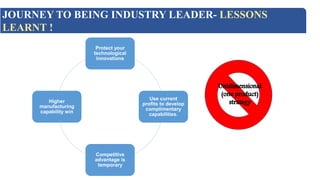
JOURNEY TO BEING INDUSTRY LEADER- LESSONS
LEARNT !
Protect your
technological
innovations
Use current
profits to develop
complimentary
capabilities.
Competitive
advantage is
temporary
Higher
manufacturing
capability win
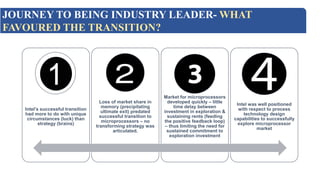
JOURNEY TO BEING INDUSTRY LEADER- WHAT
FAVOURED THE TRANSITION?
Intel’s successful transition
had more to do with unique
circumstances (luck) than
strategy (brains)
Loss of market share in
memory (precipitating
ultimate exit) predated
successful transition to
microprocessors – no
transforming strategy was
articulated.
Market for microprocessors
developed quickly – little
time delay between
investment in exploration &
sustaining rents (feeding
the positive feedback loop)
– thus limiting the need for
sustained commitment to
exploration investment
Intel was well positioned
with respect to process
technology design
capabilities to successfully
explore microprocessor
market
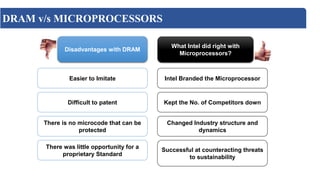
Disadvantages with DRAM
What Intel did right with
Microprocessors?
Easier to Imitate
Difficult to patent
There is no microcode that can be
protected
There was little opportunity for a
proprietary Standard
Intel Branded the Microprocessor
Kept the No. of Competitors down
Changed Industry structure and
dynamics
Successful at counteracting threats
to sustainability
DRAM v/s MICROPROCESSORS
Market Share
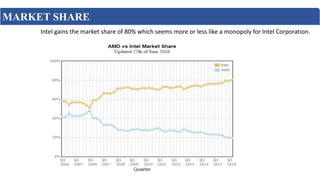
Intel gains the market share of 80% which seems more or less like a monopoly for Intel Corporation.
MARKET SHARE
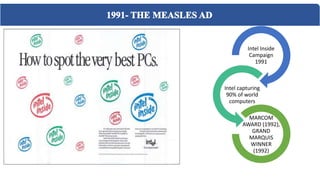
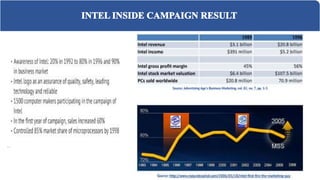
Intel Inside
Campaign
1991
Intel capturing
90% of world
computers
MARCOM
AWARD (1992),
GRAND
MARQUIS
WINNER
(1992)
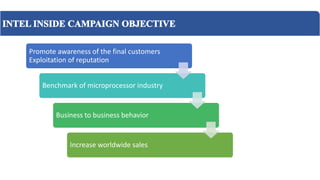
Promote awareness of the final customers
Exploitation of reputation
Benchmark of microprocessor industry
Business to business behavior
Increase worldwide sales
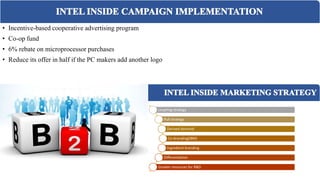
• Incentive-based cooperative advertising program
• Co-op fund
• 6% rebate on microprocessor purchases
• Reduce its offer in half if the PC makers add another logo
Leapfrog strategy
Pull strategy
Derived demand
Co-branding(IBM)
Ingredient branding
Differentiation
Greater resources for R&D
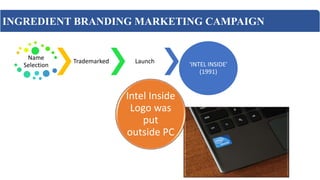
Intel Inside
Logo was
put
outside PC
Name
Selection
Trademarked Launch ‘INTEL INSIDE’
(1991)
INGREDIENT BRANDING MARKETING CAMPAIGN
. . . . .
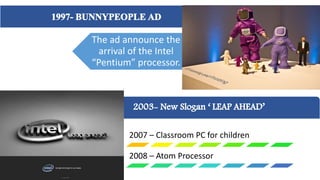
The ad announce the
arrival of the Intel
“Pentium” processor.
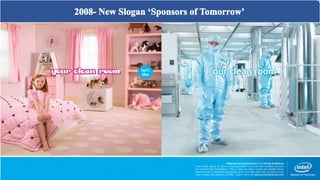
2007 – Classroom PC for children
2008 – Atom Processor
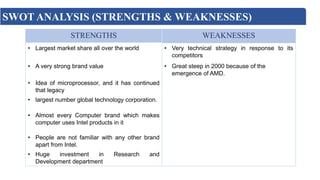
SWOT ANALYSIS (STRENGTHS & WEAKNESSES)
STRENGTHS WEAKNESSES
• Largest market share all over the world • Very technical strategy in response to its
competitors
• A very strong brand value • Great steep in 2000 because of the
emergence of AMD.
• Idea of microprocessor, and it has continued
that legacy
• largest number global technology corporation.
• Almost every Computer brand which makes
computer uses Intel products in it
• People are not familiar with any other brand
apart from Intel.
• Huge investment in Research and
Development department
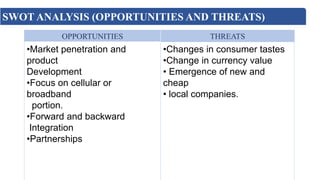
SWOT ANALYSIS (OPPORTUNITIES AND THREATS)
OPPORTUNITIES THREATS
•Market penetration and
product
Development
•Focus on cellular or
broadband
portion.
•Forward and backward
Integration
•Partnerships
•Changes in consumer tastes
•Change in currency value
• Emergence of new and
cheap
• local companies.
DISCLAIMER

Intel case study

  • 2.
     Industry :Semiconductor  Founded : July 18, 1968  Headquarters : Santa Clara, California , US  Products : Bluetooth Chipsets Flash memory Microprocessors Motherboard Chipsets Network interface controllers Solid State drivers Central Processing Units  First Product : Schottky Bipolar RAM INTRODUCTION
  • 3.
  • 4.
    JOURNEY TO BEINGINDUSTRY LEADER Strategic decision in 1984 to exit memory As competitors offered substitute products and overall market price decreased, Intel moved to new generations. Intel emphasis was on product design, not so much on process development or realizing efficiencies through manufacturing Intel’s internal selection environment, i.e., “the production rule”that favored microprocessor s, was more adaptively robust that top- down strategy Creating and sustaining competitive advantage in microprocessor s Diversification
  • 5.
    JOURNEY TO BEINGINDUSTRY LEADER- RISE AND FALL OF DRAM Emphasis was on product design, not so much on process development or realizing efficiencies through manufacturing . • Innovative Design • Price High in early life-cycle • Move Quickly to New generations Japanese Entered the Market • Lower interest rates • Sophisticated Demand • More efficient • Manufacturing strength of 80% yield Japanese Strategy • Closer relationships with equipment suppliers • Worked on process and equipment development Increased Complexity • Difficult to understand • Overreliance on product strategy • Lack of access to capital Wrong Strategy • Pushing product design through new features D R A M U N S U C C E S S F U L
  • 6.
    JOURNEY TO BEINGINDUSTRY LEADER- LESSONS LEARNT ! Protect your technological innovations Use current profits to develop complimentary capabilities. Competitive advantage is temporary Higher manufacturing capability win
  • 7.
    JOURNEY TO BEINGINDUSTRY LEADER- WHAT FAVOURED THE TRANSITION? Intel’s successful transition had more to do with unique circumstances (luck) than strategy (brains) Loss of market share in memory (precipitating ultimate exit) predated successful transition to microprocessors – no transforming strategy was articulated. Market for microprocessors developed quickly – little time delay between investment in exploration & sustaining rents (feeding the positive feedback loop) – thus limiting the need for sustained commitment to exploration investment Intel was well positioned with respect to process technology design capabilities to successfully explore microprocessor market
  • 8.
    Disadvantages with DRAM WhatIntel did right with Microprocessors? Easier to Imitate Difficult to patent There is no microcode that can be protected There was little opportunity for a proprietary Standard Intel Branded the Microprocessor Kept the No. of Competitors down Changed Industry structure and dynamics Successful at counteracting threats to sustainability DRAM v/s MICROPROCESSORS
  • 9.
    Market Share Intel gainsthe market share of 80% which seems more or less like a monopoly for Intel Corporation. MARKET SHARE
  • 11.
    Intel Inside Campaign 1991 Intel capturing 90%of world computers MARCOM AWARD (1992), GRAND MARQUIS WINNER (1992)
  • 12.
    Promote awareness ofthe final customers Exploitation of reputation Benchmark of microprocessor industry Business to business behavior Increase worldwide sales
  • 13.
    • Incentive-based cooperativeadvertising program • Co-op fund • 6% rebate on microprocessor purchases • Reduce its offer in half if the PC makers add another logo Leapfrog strategy Pull strategy Derived demand Co-branding(IBM) Ingredient branding Differentiation Greater resources for R&D
  • 14.
    Intel Inside Logo was put outsidePC Name Selection Trademarked Launch ‘INTEL INSIDE’ (1991) INGREDIENT BRANDING MARKETING CAMPAIGN
  • 16.
    . . .. .
  • 17.
    The ad announcethe arrival of the Intel “Pentium” processor. 2007 – Classroom PC for children 2008 – Atom Processor
  • 19.
    SWOT ANALYSIS (STRENGTHS& WEAKNESSES) STRENGTHS WEAKNESSES • Largest market share all over the world • Very technical strategy in response to its competitors • A very strong brand value • Great steep in 2000 because of the emergence of AMD. • Idea of microprocessor, and it has continued that legacy • largest number global technology corporation. • Almost every Computer brand which makes computer uses Intel products in it • People are not familiar with any other brand apart from Intel. • Huge investment in Research and Development department
  • 20.
    SWOT ANALYSIS (OPPORTUNITIESAND THREATS) OPPORTUNITIES THREATS •Market penetration and product Development •Focus on cellular or broadband portion. •Forward and backward Integration •Partnerships •Changes in consumer tastes •Change in currency value • Emergence of new and cheap • local companies.
  • 21.