Pathway-Centric Tools and Technology™

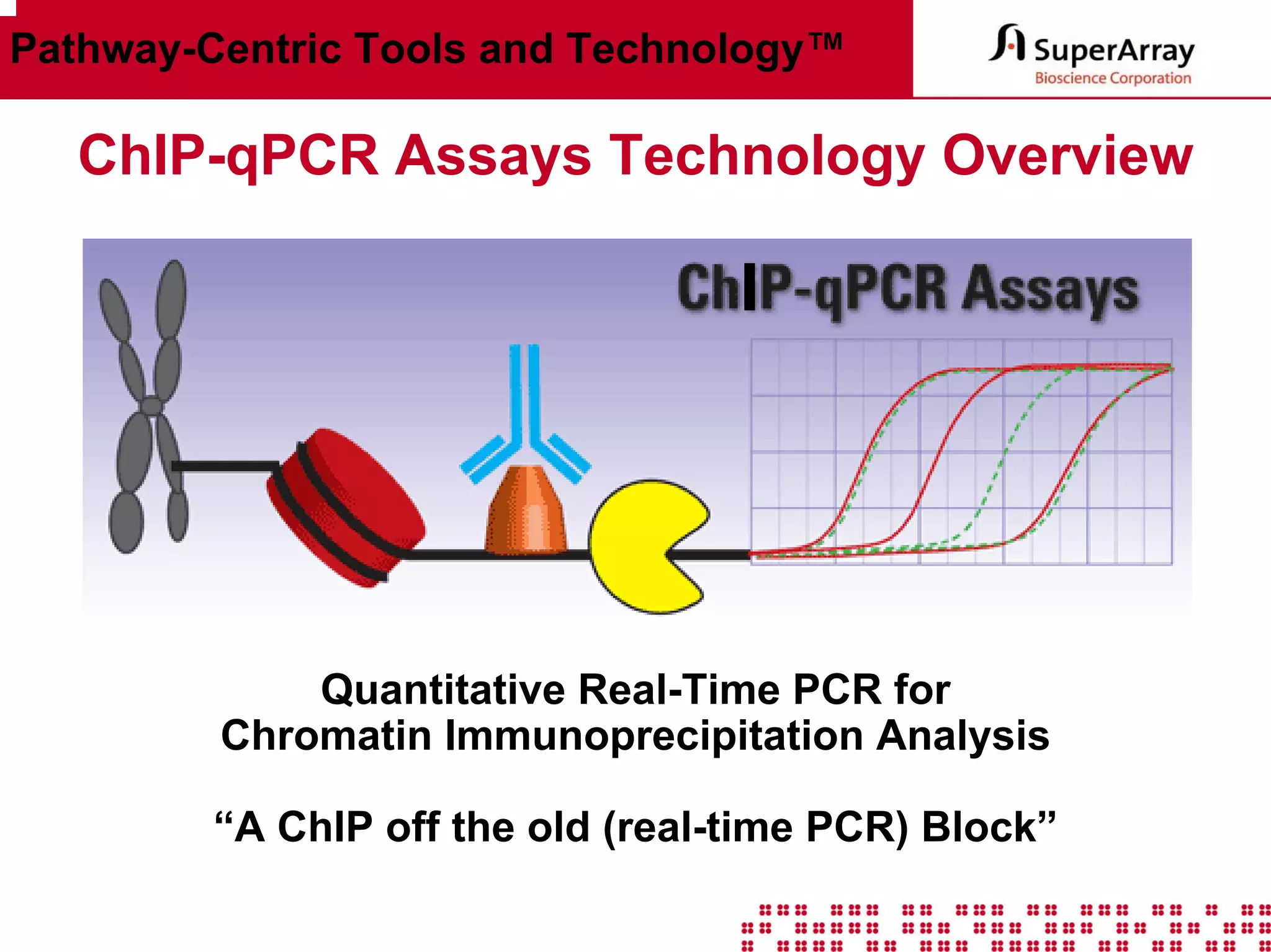
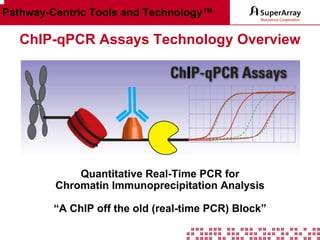
ChIP-qPCR Assays Technology Overview

Quantitative Real-Time PCR for
Chromatin Immunoprecipitation Analysis
“A ChIP off the old (real-time PCR) Block”
Pathway-Centric Tools and Technology™

Topics to be Covered
Challenges Facing ChIP Researchers
Solutions that the ChIP-qPCR Assays Provide
How the ChIP-qPCR Assays Work
Tiled Primer Assays for Every Human, Mouse, Rat Promoter
Quantitative Real-Time PCR Performance
Protocol Overview & Data Analysis

How YOU Can Use the ChIP-qPCR Assays
Application Example:
p53 ChIP with CDKN1A and GADD45A qPCR
Pathway-Centric Tools and Technology™
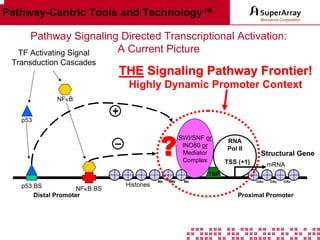
Pathway Signaling Directed Transcriptional Activation:
A Current Picture
TF Activating Signal
Transduction Cascades

THE Signaling Pathway Frontier!
Highly Dynamic Promoter Context

NFκB
p53

+

?

–

SWI/SNF or
INO80 or
Mediator
Complex

RNA
Pol II

Structural Gene

TSS (+1)

mRNA

TBP

p53 BS
NFκB BS
Distal Promoter

Histones

Me

Me

Me

OAc

OAc

OAc

Proximal Promoter
Pathway-Centric Tools and Technology™

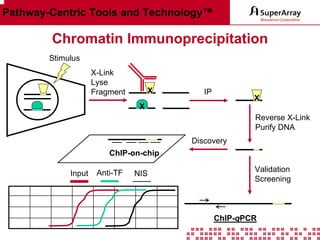
Chromatin Immunoprecipitation
Stimulus
X-Link
Lyse
Fragment

X

IP

X

X

Reverse X-Link
Purify DNA
Discovery
ChIP-on-chip
Input

Anti-TF

NIS

Validation
Screening

ChIP-qPCR
Pathway-Centric Tools and Technology™

Challenges Facing ChIP Researchers
Difficulty Designing PCR Primers for gDNA:
GC-rich, high sequence content variation & repetitive sequences
Localizing amplicon near TF binding site can be a hindrance
Multiple rounds of assay design & validation

Time-Consuming End-Point PCR:
Requires post-run gel electrophoresis & image analysis
NOT quantitative, narrow dynamic range, low sensitivity

Detecting Other Target Promoter Sites:
Interesting data on one gene’s promoter
Test another genes’ promoters with SAME precious ChIP material

ChIP-on-chip Requires PCR Validation:
Many enriched sites to validate
Each involving above optimization difficulties
Pathway-Centric Tools and Technology™

What the ChIP-qPCR Assays Provide
Time and Money Savings:
No more repeated fruitless rounds gDNA assay design & optimization
Ready-to-use, optimized assays; Standardized PCR conditions

Quick and Easy Use:
No more post-run gel-based analysis
Quantitative & higher-throughput SYBR® Green real-time PCR
Measure enrichment at more promoter regions in same run & ChIP prep

Guaranteed Performance:
High amplification efficiency and specificity guaranteed
More accurately quantify ChIP DNA fractions, including mock IP

Comprehensive Coverage:
Tiled assays for every human, mouse or rat gene promoter
Customized genome-wide options also available
Pathway-Centric Tools and Technology™

What are ChIP-qPCR Assays?
Pre-designed and validated real-time PCR primer assays
measuring genomic DNA promoter region sequence
enrichment within chromatin immunoprecipitation samples
Accommodate every human, mouse and rat gene promoter with
a ChIP-target independent approach
Thirty (30) 1-kb tiles from -20 kb to +10 kb relative to each TSS
When coupled with an average 1-kb fragmentation size,
provides best possible sensitivity and resolution balance
Quality Control: One product with high amplification efficiency
Well-suited for functional screening assays
Fold-differences in fractional enrichment
ChIP-on-chip validation
Pathway-Centric Tools and Technology™

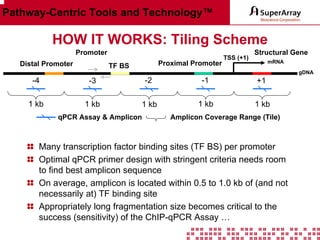
HOW IT WORKS: Tiling Scheme
Promoter
Distal Promoter

Proximal Promoter

TF BS

TSS (+1)

Structural Gene
mRNA
gDNA

-4

-3

-2

-1

+1

1 kb

1 kb

1 kb

1 kb

1 kb

qPCR Assay & Amplicon

Amplicon Coverage Range (Tile)

Many transcription factor binding sites (TF BS) per promoter
Optimal qPCR primer design with stringent criteria needs room
to find best amplicon sequence
On average, amplicon is located within 0.5 to 1.0 kb of (and not
necessarily at) TF binding site
Appropriately long fragmentation size becomes critical to the
success (sensitivity) of the ChIP-qPCR Assay …
Pathway-Centric Tools and Technology™
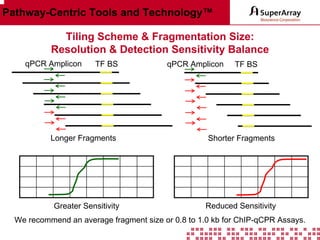
Tiling Scheme & Fragmentation Size:
Resolution & Detection Sensitivity Balance
qPCR Amplicon

TF BS

Longer Fragments

Greater Sensitivity

qPCR Amplicon

TF BS

Shorter Fragments

Reduced Sensitivity

We recommend an average fragment size or 0.8 to 1.0 kb for ChIP-qCPR Assays.
Pathway-Centric Tools and Technology™

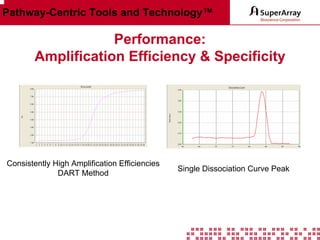
Performance:
Amplification Efficiency & Specificity

Consistently High Amplification Efficiencies
DART Method

Single Dissociation Curve Peak
Pathway-Centric Tools and Technology™

HOW IT WORKS: Protocol Overview
Grow & Treat Cells with Biological Replicates
Cross-Link with Formaldehyde; Lyse Cells & Prepare Chromatin
Fragment DNA by Sonication to 800-1,000-bp Average Size
Divide Sample into Four Fractions:
Input gDNA (~1/100th of total)
Immunoprecipitations:
Target TF = Experimental Inquiry
RNA Polymerase II = Positive Control for ChIP process
Non-Immune Serum = Negative Control for non-specific DNA IP
Reverse Cross-Linking & Purify DNA
Pathway-Centric Tools and Technology™

HOW IT WORKS: Protocol Overview
Three Types of qPCR Assays:
Promoter Target of Interest
Experimental Inquiry
ChIP-qPCR Primer Assays, Cataloged and Custom

Positive Control for ChIP Process
Assay proximal to constitutively active promoter of an
abundantly expressed housekeeping gene
ChIP-qPCR Positive Control Proximal HKG Promoter Assays

Negative Control for Non-Specific DNA co-IP
Specific gDNA sequence within ORF-free intergenic region
“Promoter Desert”
ChIP-qPCR Negative Control IGX Assays
Pathway-Centric Tools and Technology™

HOW IT WORKS: Protocol Overview
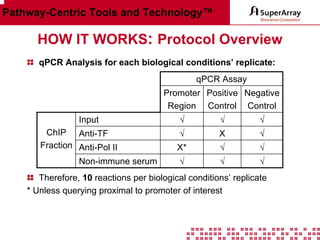
qPCR Analysis for each biological conditions’ replicate:
qPCR Assay
Promoter Positive Negative
Region Control Control
Input
ChIP Anti-TF
Fraction Anti-Pol II
Non-immune serum

√

√

√

√

X

√

X*

√

√

√

√

√

Therefore, 10 reactions per biological conditions’ replicate
* Unless querying proximal to promoter of interest
Pathway-Centric Tools and Technology™

HOW IT WORKS: Data Analysis
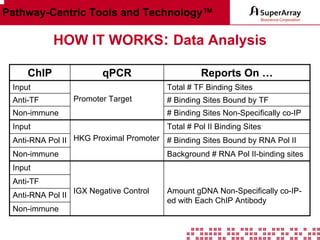
ChIP

qPCR

Input
Anti-TF

Reports On …
Total # TF Binding Sites

Promoter Target

# Binding Sites Bound by TF

Non-immune

# Binding Sites Non-Specifically co-IP

Input

Total # Pol II Binding Sites

Anti-RNA Pol II HKG Proximal Promoter # Binding Sites Bound by RNA Pol II
Non-immune

Background # RNA Pol II-binding sites

Input
Anti-TF
Anti-RNA Pol II
Non-immune

IGX Negative Control

Amount gDNA Non-Specifically co-IPed with Each ChIP Antibody
Pathway-Centric Tools and Technology™

HOW IT WORKS: Data Analysis
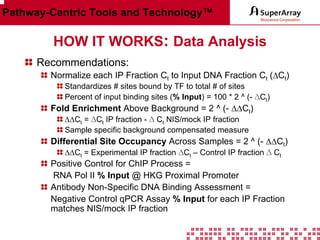
Recommendations:
Normalize each IP Fraction Ct to Input DNA Fraction Ct (∆Ct)
Standardizes # sites bound by TF to total # of sites
Percent of input binding sites (% Input) = 100 * 2 ^ (- ∆Ct)

Fold Enrichment Above Background = 2 ^ (- ∆∆Ct)
∆∆Ct = ∆Ct IP fraction - ∆ Ct NIS/mock IP fraction
Sample specific background compensated measure

Differential Site Occupancy Across Samples = 2 ^ (- ∆∆Ct)
∆∆Ct = Experimental IP fraction ∆Ct – Control IP fraction ∆ Ct

Positive Control for ChIP Process =
RNA Pol II % Input @ HKG Proximal Promoter
Antibody Non-Specific DNA Binding Assessment =
Negative Control qPCR Assay % Input for each IP Fraction
matches NIS/mock IP fraction
Pathway-Centric Tools and Technology™

Application Example
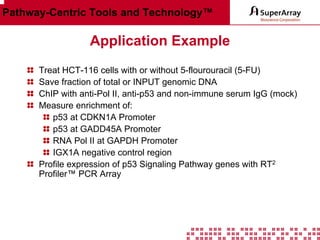
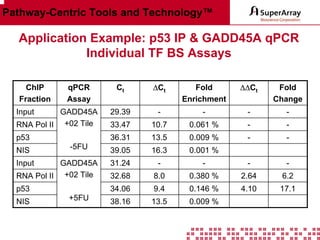
Treat HCT-116 cells with or without 5-flourouracil (5-FU)
Save fraction of total or INPUT genomic DNA
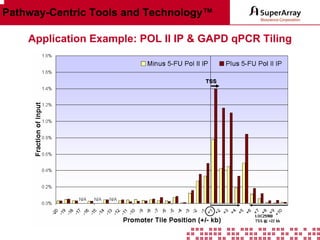
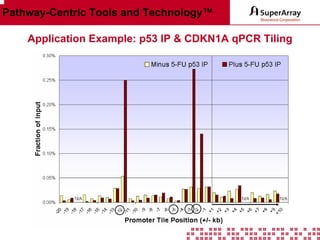
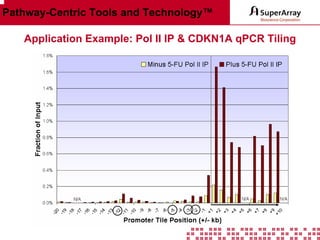
ChIP with anti-Pol II, anti-p53 and non-immune serum IgG (mock)
Measure enrichment of:
p53 at CDKN1A Promoter
p53 at GADD45A Promoter
RNA Pol II at GAPDH Promoter
IGX1A negative control region
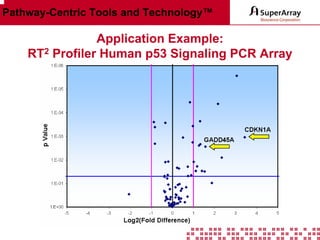
Profile expression of p53 Signaling Pathway genes with RT2
Profiler™ PCR Array
Pathway-Centric Tools and Technology™
Application Example: POL II IP & GAPD qPCR Tiling
Pathway-Centric Tools and Technology™
Application Example: p53 IP & CDKN1A qPCR Tiling
Pathway-Centric Tools and Technology™
Application Example: Pol II IP & CDKN1A qPCR Tiling
Pathway-Centric Tools and Technology™

Application Example:
RT2 Profiler Human p53 Signaling PCR Array
Pathway-Centric Tools and Technology™

Application Example: p53 IP & GADD45A qPCR
Individual TF BS Assays
ChIP
Fraction

qPCR
Assay

Ct

∆Ct

Fold
Enrichment

∆∆Ct

Fold
Change

GADD45A
RNA Pol II +02 Tile

29.39

-

-

-

-

33.47

10.7

0.061 %

-

-

p53

36.31

13.5

0.009 %

-

-

39.05

16.3

0.001 %

Input

NIS

-5FU

GADD45A
RNA Pol II +02 Tile

31.24

-

-

-

-

32.68

8.0

0.380 %

2.64

6.2

p53

34.06

9.4

0.146 %

4.10

17.1

38.16

13.5

0.009 %

Input

NIS

+5FU
Pathway-Centric Tools and Technology™

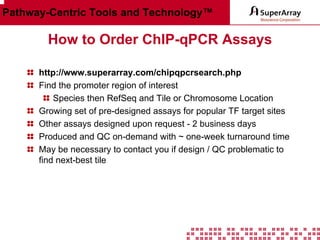
How to Order ChIP-qPCR Assays
http://www.superarray.com/chipqpcrsearch.php
Find the promoter region of interest
Species then RefSeq and Tile or Chromosome Location
Growing set of pre-designed assays for popular TF target sites
Other assays designed upon request - 2 business days
Produced and QC on-demand with ~ one-week turnaround time
May be necessary to contact you if design / QC problematic to
find next-best tile
Pathway-Centric Tools and Technology™

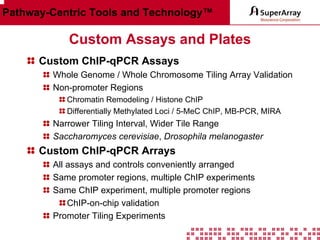
Custom Assays and Plates
Custom ChIP-qPCR Assays
Whole Genome / Whole Chromosome Tiling Array Validation
Non-promoter Regions
Chromatin Remodeling / Histone ChIP
Differentially Methylated Loci / 5-MeC ChIP, MB-PCR, MIRA

Narrower Tiling Interval, Wider Tile Range
Saccharomyces cerevisiae, Drosophila melanogaster

Custom ChIP-qPCR Arrays
All assays and controls conveniently arranged
Same promoter regions, multiple ChIP experiments
Same ChIP experiment, multiple promoter regions
ChIP-on-chip validation
Promoter Tiling Experiments
Pathway-Centric Tools and Technology™

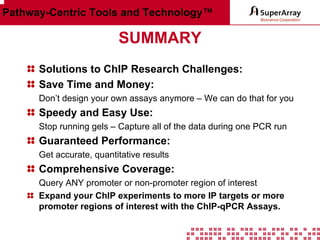
SUMMARY
Solutions to ChIP Research Challenges:
Save Time and Money:
Don’t design your own assays anymore – We can do that for you

Speedy and Easy Use:
Stop running gels – Capture all of the data during one PCR run

Guaranteed Performance:
Get accurate, quantitative results

Comprehensive Coverage:
Query ANY promoter or non-promoter region of interest
Expand your ChIP experiments to more IP targets or more
promoter regions of interest with the ChIP-qPCR Assays.
Pathway-Centric Tools and Technology™

ChIP-qPCR Assays Technology Overview

Quantitative Real-Time PCR for
Chromatin Immunoprecipitation Analysis
“A ChIP off the old (real-time PCR) Block”

Chipqpcrpresentation

  • 1.
    Pathway-Centric Tools andTechnology™ ChIP-qPCR Assays Technology Overview Quantitative Real-Time PCR for Chromatin Immunoprecipitation Analysis “A ChIP off the old (real-time PCR) Block”
  • 2.
    Pathway-Centric Tools andTechnology™ Topics to be Covered Challenges Facing ChIP Researchers Solutions that the ChIP-qPCR Assays Provide How the ChIP-qPCR Assays Work Tiled Primer Assays for Every Human, Mouse, Rat Promoter Quantitative Real-Time PCR Performance Protocol Overview & Data Analysis How YOU Can Use the ChIP-qPCR Assays Application Example: p53 ChIP with CDKN1A and GADD45A qPCR
  • 3.
    Pathway-Centric Tools andTechnology™ Pathway Signaling Directed Transcriptional Activation: A Current Picture TF Activating Signal Transduction Cascades THE Signaling Pathway Frontier! Highly Dynamic Promoter Context NFκB p53 + ? – SWI/SNF or INO80 or Mediator Complex RNA Pol II Structural Gene TSS (+1) mRNA TBP p53 BS NFκB BS Distal Promoter Histones Me Me Me OAc OAc OAc Proximal Promoter
  • 4.
    Pathway-Centric Tools andTechnology™ Chromatin Immunoprecipitation Stimulus X-Link Lyse Fragment X IP X X Reverse X-Link Purify DNA Discovery ChIP-on-chip Input Anti-TF NIS Validation Screening ChIP-qPCR
  • 5.
    Pathway-Centric Tools andTechnology™ Challenges Facing ChIP Researchers Difficulty Designing PCR Primers for gDNA: GC-rich, high sequence content variation & repetitive sequences Localizing amplicon near TF binding site can be a hindrance Multiple rounds of assay design & validation Time-Consuming End-Point PCR: Requires post-run gel electrophoresis & image analysis NOT quantitative, narrow dynamic range, low sensitivity Detecting Other Target Promoter Sites: Interesting data on one gene’s promoter Test another genes’ promoters with SAME precious ChIP material ChIP-on-chip Requires PCR Validation: Many enriched sites to validate Each involving above optimization difficulties
  • 6.
    Pathway-Centric Tools andTechnology™ What the ChIP-qPCR Assays Provide Time and Money Savings: No more repeated fruitless rounds gDNA assay design & optimization Ready-to-use, optimized assays; Standardized PCR conditions Quick and Easy Use: No more post-run gel-based analysis Quantitative & higher-throughput SYBR® Green real-time PCR Measure enrichment at more promoter regions in same run & ChIP prep Guaranteed Performance: High amplification efficiency and specificity guaranteed More accurately quantify ChIP DNA fractions, including mock IP Comprehensive Coverage: Tiled assays for every human, mouse or rat gene promoter Customized genome-wide options also available
  • 7.
    Pathway-Centric Tools andTechnology™ What are ChIP-qPCR Assays? Pre-designed and validated real-time PCR primer assays measuring genomic DNA promoter region sequence enrichment within chromatin immunoprecipitation samples Accommodate every human, mouse and rat gene promoter with a ChIP-target independent approach Thirty (30) 1-kb tiles from -20 kb to +10 kb relative to each TSS When coupled with an average 1-kb fragmentation size, provides best possible sensitivity and resolution balance Quality Control: One product with high amplification efficiency Well-suited for functional screening assays Fold-differences in fractional enrichment ChIP-on-chip validation
  • 8.
    Pathway-Centric Tools andTechnology™ HOW IT WORKS: Tiling Scheme Promoter Distal Promoter Proximal Promoter TF BS TSS (+1) Structural Gene mRNA gDNA -4 -3 -2 -1 +1 1 kb 1 kb 1 kb 1 kb 1 kb qPCR Assay & Amplicon Amplicon Coverage Range (Tile) Many transcription factor binding sites (TF BS) per promoter Optimal qPCR primer design with stringent criteria needs room to find best amplicon sequence On average, amplicon is located within 0.5 to 1.0 kb of (and not necessarily at) TF binding site Appropriately long fragmentation size becomes critical to the success (sensitivity) of the ChIP-qPCR Assay …
  • 9.
    Pathway-Centric Tools andTechnology™ Tiling Scheme & Fragmentation Size: Resolution & Detection Sensitivity Balance qPCR Amplicon TF BS Longer Fragments Greater Sensitivity qPCR Amplicon TF BS Shorter Fragments Reduced Sensitivity We recommend an average fragment size or 0.8 to 1.0 kb for ChIP-qCPR Assays.
  • 10.
    Pathway-Centric Tools andTechnology™ Performance: Amplification Efficiency & Specificity Consistently High Amplification Efficiencies DART Method Single Dissociation Curve Peak
  • 11.
    Pathway-Centric Tools andTechnology™ HOW IT WORKS: Protocol Overview Grow & Treat Cells with Biological Replicates Cross-Link with Formaldehyde; Lyse Cells & Prepare Chromatin Fragment DNA by Sonication to 800-1,000-bp Average Size Divide Sample into Four Fractions: Input gDNA (~1/100th of total) Immunoprecipitations: Target TF = Experimental Inquiry RNA Polymerase II = Positive Control for ChIP process Non-Immune Serum = Negative Control for non-specific DNA IP Reverse Cross-Linking & Purify DNA
  • 12.
    Pathway-Centric Tools andTechnology™ HOW IT WORKS: Protocol Overview Three Types of qPCR Assays: Promoter Target of Interest Experimental Inquiry ChIP-qPCR Primer Assays, Cataloged and Custom Positive Control for ChIP Process Assay proximal to constitutively active promoter of an abundantly expressed housekeeping gene ChIP-qPCR Positive Control Proximal HKG Promoter Assays Negative Control for Non-Specific DNA co-IP Specific gDNA sequence within ORF-free intergenic region “Promoter Desert” ChIP-qPCR Negative Control IGX Assays
  • 13.
    Pathway-Centric Tools andTechnology™ HOW IT WORKS: Protocol Overview qPCR Analysis for each biological conditions’ replicate: qPCR Assay Promoter Positive Negative Region Control Control Input ChIP Anti-TF Fraction Anti-Pol II Non-immune serum √ √ √ √ X √ X* √ √ √ √ √ Therefore, 10 reactions per biological conditions’ replicate * Unless querying proximal to promoter of interest
  • 14.
    Pathway-Centric Tools andTechnology™ HOW IT WORKS: Data Analysis ChIP qPCR Input Anti-TF Reports On … Total # TF Binding Sites Promoter Target # Binding Sites Bound by TF Non-immune # Binding Sites Non-Specifically co-IP Input Total # Pol II Binding Sites Anti-RNA Pol II HKG Proximal Promoter # Binding Sites Bound by RNA Pol II Non-immune Background # RNA Pol II-binding sites Input Anti-TF Anti-RNA Pol II Non-immune IGX Negative Control Amount gDNA Non-Specifically co-IPed with Each ChIP Antibody
  • 15.
    Pathway-Centric Tools andTechnology™ HOW IT WORKS: Data Analysis Recommendations: Normalize each IP Fraction Ct to Input DNA Fraction Ct (∆Ct) Standardizes # sites bound by TF to total # of sites Percent of input binding sites (% Input) = 100 * 2 ^ (- ∆Ct) Fold Enrichment Above Background = 2 ^ (- ∆∆Ct) ∆∆Ct = ∆Ct IP fraction - ∆ Ct NIS/mock IP fraction Sample specific background compensated measure Differential Site Occupancy Across Samples = 2 ^ (- ∆∆Ct) ∆∆Ct = Experimental IP fraction ∆Ct – Control IP fraction ∆ Ct Positive Control for ChIP Process = RNA Pol II % Input @ HKG Proximal Promoter Antibody Non-Specific DNA Binding Assessment = Negative Control qPCR Assay % Input for each IP Fraction matches NIS/mock IP fraction
  • 16.
    Pathway-Centric Tools andTechnology™ Application Example Treat HCT-116 cells with or without 5-flourouracil (5-FU) Save fraction of total or INPUT genomic DNA ChIP with anti-Pol II, anti-p53 and non-immune serum IgG (mock) Measure enrichment of: p53 at CDKN1A Promoter p53 at GADD45A Promoter RNA Pol II at GAPDH Promoter IGX1A negative control region Profile expression of p53 Signaling Pathway genes with RT2 Profiler™ PCR Array
  • 17.
    Pathway-Centric Tools andTechnology™ Application Example: POL II IP & GAPD qPCR Tiling
  • 18.
    Pathway-Centric Tools andTechnology™ Application Example: p53 IP & CDKN1A qPCR Tiling
  • 19.
    Pathway-Centric Tools andTechnology™ Application Example: Pol II IP & CDKN1A qPCR Tiling
  • 20.
    Pathway-Centric Tools andTechnology™ Application Example: RT2 Profiler Human p53 Signaling PCR Array
  • 21.
    Pathway-Centric Tools andTechnology™ Application Example: p53 IP & GADD45A qPCR Individual TF BS Assays ChIP Fraction qPCR Assay Ct ∆Ct Fold Enrichment ∆∆Ct Fold Change GADD45A RNA Pol II +02 Tile 29.39 - - - - 33.47 10.7 0.061 % - - p53 36.31 13.5 0.009 % - - 39.05 16.3 0.001 % Input NIS -5FU GADD45A RNA Pol II +02 Tile 31.24 - - - - 32.68 8.0 0.380 % 2.64 6.2 p53 34.06 9.4 0.146 % 4.10 17.1 38.16 13.5 0.009 % Input NIS +5FU
  • 22.
    Pathway-Centric Tools andTechnology™ How to Order ChIP-qPCR Assays http://www.superarray.com/chipqpcrsearch.php Find the promoter region of interest Species then RefSeq and Tile or Chromosome Location Growing set of pre-designed assays for popular TF target sites Other assays designed upon request - 2 business days Produced and QC on-demand with ~ one-week turnaround time May be necessary to contact you if design / QC problematic to find next-best tile
  • 23.
    Pathway-Centric Tools andTechnology™ Custom Assays and Plates Custom ChIP-qPCR Assays Whole Genome / Whole Chromosome Tiling Array Validation Non-promoter Regions Chromatin Remodeling / Histone ChIP Differentially Methylated Loci / 5-MeC ChIP, MB-PCR, MIRA Narrower Tiling Interval, Wider Tile Range Saccharomyces cerevisiae, Drosophila melanogaster Custom ChIP-qPCR Arrays All assays and controls conveniently arranged Same promoter regions, multiple ChIP experiments Same ChIP experiment, multiple promoter regions ChIP-on-chip validation Promoter Tiling Experiments
  • 24.
    Pathway-Centric Tools andTechnology™ SUMMARY Solutions to ChIP Research Challenges: Save Time and Money: Don’t design your own assays anymore – We can do that for you Speedy and Easy Use: Stop running gels – Capture all of the data during one PCR run Guaranteed Performance: Get accurate, quantitative results Comprehensive Coverage: Query ANY promoter or non-promoter region of interest Expand your ChIP experiments to more IP targets or more promoter regions of interest with the ChIP-qPCR Assays.
  • 25.
    Pathway-Centric Tools andTechnology™ ChIP-qPCR Assays Technology Overview Quantitative Real-Time PCR for Chromatin Immunoprecipitation Analysis “A ChIP off the old (real-time PCR) Block”