FDI & China

To Benefit from the Booming Economy of China
Speaker: Mr. Shen Linchang

                                 Lawyer of Shanghai Promise Law Firm
                                 Co-founder of Investee SNS Web
            .
                                       *   Foreign Direct Investment
.                                      *   Intellectual Property
.                                      *   Corporate General Counsel
                                       *   Commercial Litigation/Arbitration


                                 http://www.investee.biz/
                                 Email: lawyer@investee.biz
                                 Mobile: 0086-15000355201
                                 MSN: yzslc@hotmail.com
DISCLAIMER:

• It should be noted that the material in this presentation is
  designed to provide general information only and should not
  be construed as legal advice on any particular matter, whether
  it be legal, procedural or other. The author expressly disclaim
  all liability to any person in respect of the consequences of
  anything done or omitted to be done wholly or partly in
  reliance on the whole or any part of the contents of this
  presentation.
• All rights reserved.
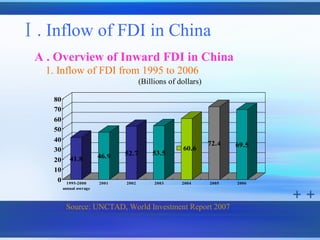
Ⅰ. Inflow of FDI in China
 A . Overview of Inward FDI in China
   1. Inflow of FDI from 1995 to 2006
                                        (Billions of dollars)

    80
    70
    60
    50
    40
                                                                72.4   69.5
    30                                                60.6
                          46.9   52.7       53.5
    20      41.8
    10
     0     1995-2000      2001   2002        2003     2004      2005   2006
         annual average


          Source: UNCTAD, World Investment Report 2007
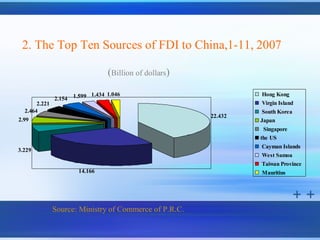
2. The Top Ten Sources of FDI to China,1-11, 2007

                                   (Billion of dollars)

               2.154   1.599 1.434 1.046                           Hong Kong
       2.221                                                       Virgin Island
  2.464                                                             South Korea
                                                          22.432
2.99                                                               Japan
                                                                    Singapore
                                                                   the US
                                                                   Cayman Islands
3.229
                                                                   West Samoa
                                                                   Taiwan Province
                        14.166                                     Mauritius


               Source: Ministry of Commerce of P.R.C.
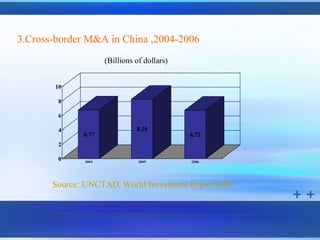
3.Cross-border M&A in China ,2004-2006
                     (Billions of dollars)


       10

        8

        6

        4                      8.25
              6.77                           6.72
        2

        0     2004              2005         2006


       Source: UNCTAD, World Investment Report 2007
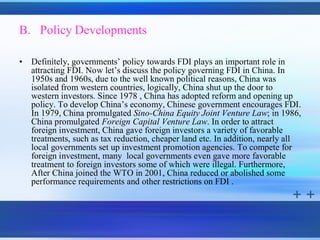
B. Policy Developments

•   Definitely, governments’ policy towards FDI plays an important role in
    attracting FDI. Now let’s discuss the policy governing FDI in China. In
    1950s and 1960s, due to the well known political reasons, China was
    isolated from western countries, logically, China shut up the door to
    western investors. Since 1978 , China has adopted reform and opening up
    policy. To develop China’s economy, Chinese government encourages FDI.
    In 1979, China promulgated Sino-China Equity Joint Venture Law; in 1986,
    China promulgated Foreign Capital Venture Law. In order to attract
    foreign investment, China gave foreign investors a variety of favorable
    treatments, such as tax reduction, cheaper land etc. In addition, nearly all
    local governments set up investment promotion agencies. To compete for
    foreign investment, many local governments even gave more favorable
    treatment to foreign investors some of which were illegal. Furthermore,
    After China joined the WTO in 2001, China reduced or abolished some
    performance requirements and other restrictions on FDI .
1. Emphasis on Quality rather than Quantity


• Recently, Chinese government is increasingly
  emphasizing the quality rather than the quantity of
  inward FDI. China encourages FDI with advanced
  technology or managerial expertise. At the same time,
  China increasingly restricts the FDI with high energy-
  consumption and environment-pollution.
• Why does China alter the policy governing the FDI?
• In the past three decades , China has witnessed rapid
  economic growth, however, such growth was on the
  cost of natural resources and environment pollution,
  Chinese government realizes such an economic
  growth model can not last long.
• Additionally, after 30 years of economic development,
  especially due to the consecutive trade surplus, China
  has accumulated astronomical foreign reserves.
  Unlike 30 years ago, the lack of capital is no longer a
  problem for the development of Chinese economy.
2. Unification of Two Income Tax Systems


• In 2007, China promulgated new corporate income
  tax law and unified two income tax systems for
  foreign affiliates and domestic enterprises. The new
  corporate income tax law took effect in January 1st,
  2008.
3.To Control Cross-border M&A in China
•   Just as mentioned above, cross-border M&A in China spurred great
    controversy. Although M&A accounted for a small share of the whole
    inward FDI to China, the M&A targets were usually the reputable and top
    Chinese companies in the relevant industries, foreign investors can shape
    monopoly position in Chinese markets by cross-border M&A. Furthermore,
    some Chinese traditional famous brands disappeared after M&A.Many
    people worry about the national economic security and strongly suggest
    effectively control cross-border M&A of Chinese companies. Consequently,
    in 2006,six ministries of central government jointly enacted a special
    regulation to control cross-border M&A in China. According to the
    regulation, all cross-border M&A of Chinese enterprises are subject to the
    examination of the Ministry of Commerce.
C. Prospect: Optimistic

• Nonetheless, in my view, the prospect of inward FDI
  to China will still be optimistic. There are several
  factors to support my judgment.
1. Globalization

• First of all, globalization is an irresistible trend in
  21st century, no one can change the trend of it. No
  country can isolate itself from the world. Every
  nation can only adapt to the tendency. Globalization
  will involve all economies and integrate them into a
  single global economy. Transnational companies in
  developed countries will continue to invest abroad.
  What is more, developing countries will become
  more and more important sources of FDI .
2.China: A Huge Market with Great Potential

• Secondly, China has a huge market with great
  potential. China has a population which is more than
  1.3 billion, and the middle class has grew quickly
  after 30 years of development of Chinese economy.
  China will remain a magnet for FDI , especially for
  market-seeking FDI.
3.Affluent Human Resources


• Furthermore, China has ample human resources.
  Every year , more than 6 million students graduate
  from universities and colleges. In rural area, there
  exist a huge pool of potential labor. Such human
  resources reserve can meet all demands of FDI.
4. The Investment Environment will Continue to Be Improved

• In addition, the investment environment will continue to be
  improved. In foreseeable future, Chinese government will hold
  the policy of utilization of FDI.Although China will control
  cross-border M&A, (Actually, it is international customs in
  FDI regime, even USA, the only economy superpower, still
  restricts some cross-border M&A by the reason of national
  security), China regards cross-border M&A as a higher form
  of FDI and welcome the M&A without harm to Chinese
  economy. To attract FDI, it is reasonably expected Chinese
  government will continue to improve governance and legal
  environment .
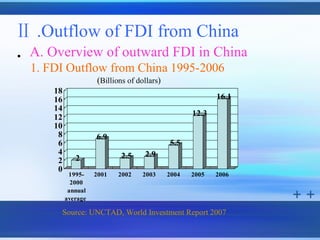
Ⅱ .Outflow of FDI from China
•   A. Overview of outward FDI in China
    1. FDI Outflow from China 1995-2006
                       (Billions of dollars)
        18
        16                                                   16.1
        14
        12                                            12.3
        10
         8             6.9
         6                                     5.5
         4                    2.5     2.9
         2      2
         0
              1995-    2001   2002    2003     2004   2005   2006
               2000
              annual
             average

         Source: UNCTAD, World Investment Report 2007
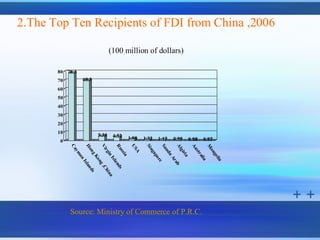
2.The Top Ten Recipients of FDI from China ,2006

                               (100 million of dollars)

       80 78.3
       70        69.3
       60
       50
       40
       30
       20
       10
                        5.38    4.52   1.98   1.32   1.17   0.99   0.88   0.87
        0
            Ca

            Ho


            Vi

            Ru


                                        US


                                               Si

                                               Sa


                                               Al


                                               Au


                                               M
                                                  ng
              rg


                                                  gir


                                                  on
                                                  ud
               ym


               ng


                                                   str
               ssi


                                          A


                                                     ap
                 in


                                                     go
                                                      u


                                                      ia
                  a


                                                       ali
                   an


                   Ko


                                                        or
                    Is l


                                                        Ar


                                                         lia
                                                          a
                       Is l


                                                            e
                       ng


                        an


                                                             ab
                           an


                            ds
                            ,C
                              ds


                               hi
                                  na


            Source: Ministry of Commerce of P.R.C.
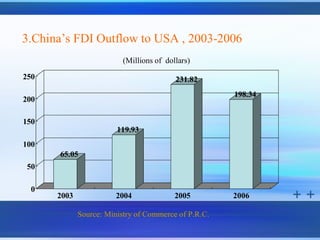
3.China’s FDI Outflow to USA , 2003-2006
                          (Millions of dollars)

250                                       231.82
                                                      198.34
200

150
                        119.93
100
      65.05
 50

  0
      2003              2004              2005        2006

             Source: Ministry of Commerce of P.R.C.
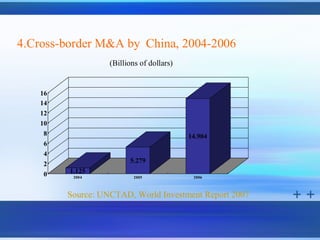
4.Cross-border M&A by China, 2004-2006
                   (Billions of dollars)


    16
    14
    12
    10
     8                                     14.904
     6
     4
     2                   5.279

     0   1.125
          2004            2005              2006


         Source: UNCTAD, World Investment Report 2007
• In fact, most cross-border M&A were carried out by state-
  owned enterprises, they mainly invested abroad in primary
  sectors, such as oil , gas, metal mineral and so on , to meet the
  thirsty demand of domestic rapid growing economy.
  However, Some M&A has caused great sensation abroad.
• Currently, the outward FDI carried out by state-owned
  enterprises accounted for the bulk of the whole outward FDI
  of China, however, some private-owned companies have
  begun to expand abroad in past several years, and more and
  more private-owned enterprises will consider to invest
  abroad.Recently,lots of private-owned enterprises , especially
  in Zhejiang Province,Jiangsu Province ,have consulted us
  about overseas expansion.
B.China’s Policy towards Outward FDI
• 1. “Going Global” Strategy

• In 2000, China outlined the “ going global” strategy. Under the
  strategy, Chinese government encourages Chinese enterprises
  to expand abroad to make good use of both domestic and
  overseas markets and resources. Correspondingly, Chinese
  government dismantled some outward FDI barriers and
  loosened some restriction on outward FDI. The Chinese
  Government has abolished quotas on the purchase of foreign
  exchange for overseas investment since 1 July 2006. It is
  becoming easier and easier for Chinese domestic enterprises to
  obtain approval from authorities to invest abroad.
• In my view, such a strategy is necessary and reasonable. To
  cope with the globalization, China’s government should
  encourage domestic enterprises to expand overseas and
  actively participate in the global competition. After three
  decades of opening up ,especially after the entry into WTO,
  China’s market is quite open to foreign enterprises. Indeed ,
  China’s market has became the integral part of the whole
  world market. Secondly, after 30 years of rapid economic
  growth, the natural resources have become the bottleneck of
  further economic development, so it essential to expand
  abroad to safeguard raw material provision.
• In addition, Chinese enterprises have accumulated some
  international market knowledge's and experiences, they are
  capable of overseas expansion now.
2. To Induce State-owned Enterprises to Expand abroad in
Primary Sectors to Secure Domestic Natural Resources Provision

• Some Chinese state-owned enterprises have become
  the important players in the cross-border M&A
  markets, In China, the largest and most active buyers
  are in the oil and gas industry. China National
  Petroleum Corporation acquired PetroKazakhstan for
  $4.1 billion in 2005, and Sinopec bought the Russian-
  United Kingdom joint venture Udmurtneft for $3.5
  billion in 2006.
3. Encourage Private-owned Enterprises to Invest abroad
• Private-owned enterprises now are easy to access foreign
  exchange and can easily get the approval from the authorities
  to invest abroad. Some local governments improve their public
  service for these outward FDI enterprises and even provide
  some stimulus measures for them. Additionally, Chinese
  government also seeks to improve the overseas investment
  environment for Chinese enterprises by diplomatic ways . In
  the past decade or so , China has signed a good number of
  International Investment Agreements ( IIA ) with other
  countries.
C. Prospect :Continue to Increase Quickly

• I am confident that China’s outwards FDI will
  continue to rise quickly. There are many factors
  supporting this judgment.
1. To Expand abroad in the Extractive Industries to
Meet the Huge Demand of Natural Resources in China

• Firstly, to safeguard the further economic development, state-
  owned enterprises will continue to expand abroad in the
  extractive industries to meet the huge demand of natural
  resources in China, such as oil, gas, metal mineral etc. Chinese
  state-owned enterprises will continue to merger or acquire
  overseas enterprises in these sector. Such deal is usually high
  risky and need astronomic capital injection. However, such
  cross-border M&A is sensitive, Chinese government and state-
  owned enterprises should carefully handle them.
2. Market-seeking

• Market-seeking will drive Chinese enterprises to
  expand abroad. The competition in Chinese market is
  now quite heated, to survive and develop, Chinese
  enterprises ,both state-owned enterprises and private
  enterprises, will consider to explore overseas market,
  and the outward FDI is one of the effective way to
  seek overseas market.
3. Bypassing Trade Barriers

• Bypassing trade barriers is another important factor driving
  Chinese enterprises to invest abroad. Due to the consecutive
  trade deficit and trade imbalance with China, some countries,
  Especially some developing countries, impose severe
  restriction against Chinese exports. For example, Mexico has
  laid astonishingly high anti-dumping tariff on some Chinese
  goods , such as shoes and garments. Under such high tariff, it
  is virtually impossible to enter the market for Chinese goods.
  Trade barriers will drive Chinese enterprises to shift their
  production in other countries by the way of outward FDI.
4. The Rising Production Cost

• The rising production cost will force Chinese
  enterprises to expand abroad. In China, the
  production cost is rising quickly. Actually, some
  enterprises in coastal area consulting us about
  overseas investment now are facing such difficult
  position, many an enterprise in labor-intensive
  industries are considering to shift their production in
  less developed countries, such as Viet
  Nam,Laos ,Cambodia etc.
5. Market Network Seeking , Technology and
Managerial Expertise Seeking etc.

• Of course , there exist some other factors stimulating
  Chinese enterprises invest abroad. Such as market
  network seeking , technology and managerial
  expertise seeking , such outward FDI will usually be
  located in developed countries. Actually, there have
  already existed such outward FDI in USA, including
  Lenovo acquiring IBM’s computer sector, and Hair
  establishing plants in USA.
Ⅲ China’s Legal System
• Part three , I will briefly introduce Chinese legal
  system .Although China has opened up for accurate
  30 years, I guess most of my American friend are not
  familiar with the legal system of China . Additionally,
  legal environment plays an important role to attract
  FDI .I will introduce two major differences between
  Chinese and American legal system.
A. Written Law Tradition

• Firstly, unlike America China is traditionally a written law
  country. USA inherited the case law tradition from England ,
  and precedents are the most important source of law . Judge
  in America should follow precedents when trying cases. In
  contrast, the most important source of law in China is written
  law,including NPC Statutory Law , Administrative regulations
  enacted by the State Council. Theoretically, The precedents
  are not binging for Chinese judges. However, Chinese judges
  will respect the precedents, especially those delivered by
  higher courts. The reason is simple: the decision of a case will
  be supervised by the higher court, if the judge did not take into
  account the relevant precedents, he will face the risk his
  judgement will be altered or remanded.
• In general, Chinese legal system belongs to the continental
  law system, quite close to the ones of France and Germany,.
  In the first half of 20th century, China consistently studied
  the law from Western countries ,especially from Germany.
  After the establishment of the People’s Republic of China, the
  former Soviet Union exerted huge influences on Chinese legal
  system. Since 1978, American law influenced China a lot .
  For example, the IPR law, the promulgation and
  implementation of Patent Law, Trade Mark Law ,Copy Right
  Law etc can be attributed to the influence of USA
  government to a certain extent.
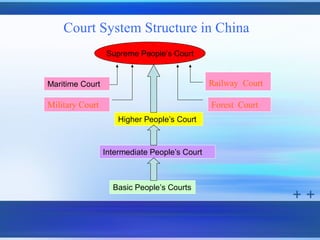
B. One System of Court

• Second , USA is a federalist countries, there exist two
  parallel systems of court: the federal court system and
  state court system. By contrast ,China has only one
  system of courts. The court system has four levels.
  The highest one is the Supreme Court, followed by
  higher court, intermediate court and basic court.
  According to the Civil Procedural Law, generally,
  cases involving foreign interest should be tried in the
  intermediate court for first instance.
Court System Structure in China
                 Supreme People’s Court


Maritime Court                                 Railway Court

Military Court                                 Forest Court
                     Higher People’s Court


                 Intermediate People’s Court


                   Basic People’s Courts
C. Commercial Law is Close to Western Countries’
•   Although there exist great difference in constitutional law ,criminal
    law ,administrative law and so on between China and USA , the
    commercial law of China is quite close to the western countries'. Since the
    adoption of reform and opening up policy, China has promulgated
    successively a series of commercial laws to construct and regulate the
    market economy. China has primarily formed a whole system of
    commercial law, including contract law , company law, security law and so
    on .Such law are mainly transplanted from Western countries, naturally,
    Chinese commercial law is quite similar to the western countries’. I am
    confident that it will be quite beneficial to USA investors to do business in
    China, USA investors needn’t worry too much about the difference
    between America and China in the field of commercial law.
Introduction to “Investee” SNS Web

                           http://www.investee.biz/


Investee :Integrating Investment Essential Elements.
Investee SNS Web aims to provide an efficient platform for global businessmen to
communicate and cooperate. Particularly, Investee is dedicated to bridging and
matching investors and investees worldwide.
Besides profile registration, contacts management, group moderation and microblog
release etc, the Investee Web also provides “Projects”, “Investors”, “Events” and
“Jobs” to facilitate users to distribute and share the information in connection with
investment projects, investment intentions, events and job opportunities.
Thank you!

Wish you all a happy and prosperous new year!

Foreign Direct Investment & China

  • 1.
    FDI & China ToBenefit from the Booming Economy of China
  • 2.
    Speaker: Mr. ShenLinchang Lawyer of Shanghai Promise Law Firm Co-founder of Investee SNS Web . * Foreign Direct Investment . * Intellectual Property . * Corporate General Counsel * Commercial Litigation/Arbitration http://www.investee.biz/ Email: lawyer@investee.biz Mobile: 0086-15000355201 MSN: yzslc@hotmail.com
  • 3.
    DISCLAIMER: • It shouldbe noted that the material in this presentation is designed to provide general information only and should not be construed as legal advice on any particular matter, whether it be legal, procedural or other. The author expressly disclaim all liability to any person in respect of the consequences of anything done or omitted to be done wholly or partly in reliance on the whole or any part of the contents of this presentation. • All rights reserved.
  • 4.
    Ⅰ. Inflow ofFDI in China A . Overview of Inward FDI in China 1. Inflow of FDI from 1995 to 2006 (Billions of dollars) 80 70 60 50 40 72.4 69.5 30 60.6 46.9 52.7 53.5 20 41.8 10 0 1995-2000 2001 2002 2003 2004 2005 2006 annual average Source: UNCTAD, World Investment Report 2007
  • 5.
    2. The TopTen Sources of FDI to China,1-11, 2007 (Billion of dollars) 2.154 1.599 1.434 1.046 Hong Kong 2.221 Virgin Island 2.464 South Korea 22.432 2.99 Japan Singapore the US Cayman Islands 3.229 West Samoa Taiwan Province 14.166 Mauritius Source: Ministry of Commerce of P.R.C.
  • 6.
    3.Cross-border M&A inChina ,2004-2006 (Billions of dollars) 10 8 6 4 8.25 6.77 6.72 2 0 2004 2005 2006 Source: UNCTAD, World Investment Report 2007
  • 7.
    B. Policy Developments • Definitely, governments’ policy towards FDI plays an important role in attracting FDI. Now let’s discuss the policy governing FDI in China. In 1950s and 1960s, due to the well known political reasons, China was isolated from western countries, logically, China shut up the door to western investors. Since 1978 , China has adopted reform and opening up policy. To develop China’s economy, Chinese government encourages FDI. In 1979, China promulgated Sino-China Equity Joint Venture Law; in 1986, China promulgated Foreign Capital Venture Law. In order to attract foreign investment, China gave foreign investors a variety of favorable treatments, such as tax reduction, cheaper land etc. In addition, nearly all local governments set up investment promotion agencies. To compete for foreign investment, many local governments even gave more favorable treatment to foreign investors some of which were illegal. Furthermore, After China joined the WTO in 2001, China reduced or abolished some performance requirements and other restrictions on FDI .
  • 8.
    1. Emphasis onQuality rather than Quantity • Recently, Chinese government is increasingly emphasizing the quality rather than the quantity of inward FDI. China encourages FDI with advanced technology or managerial expertise. At the same time, China increasingly restricts the FDI with high energy- consumption and environment-pollution.
  • 9.
    • Why doesChina alter the policy governing the FDI? • In the past three decades , China has witnessed rapid economic growth, however, such growth was on the cost of natural resources and environment pollution, Chinese government realizes such an economic growth model can not last long. • Additionally, after 30 years of economic development, especially due to the consecutive trade surplus, China has accumulated astronomical foreign reserves. Unlike 30 years ago, the lack of capital is no longer a problem for the development of Chinese economy.
  • 10.
    2. Unification ofTwo Income Tax Systems • In 2007, China promulgated new corporate income tax law and unified two income tax systems for foreign affiliates and domestic enterprises. The new corporate income tax law took effect in January 1st, 2008.
  • 11.
    3.To Control Cross-borderM&A in China • Just as mentioned above, cross-border M&A in China spurred great controversy. Although M&A accounted for a small share of the whole inward FDI to China, the M&A targets were usually the reputable and top Chinese companies in the relevant industries, foreign investors can shape monopoly position in Chinese markets by cross-border M&A. Furthermore, some Chinese traditional famous brands disappeared after M&A.Many people worry about the national economic security and strongly suggest effectively control cross-border M&A of Chinese companies. Consequently, in 2006,six ministries of central government jointly enacted a special regulation to control cross-border M&A in China. According to the regulation, all cross-border M&A of Chinese enterprises are subject to the examination of the Ministry of Commerce.
  • 12.
    C. Prospect: Optimistic •Nonetheless, in my view, the prospect of inward FDI to China will still be optimistic. There are several factors to support my judgment.
  • 13.
    1. Globalization • Firstof all, globalization is an irresistible trend in 21st century, no one can change the trend of it. No country can isolate itself from the world. Every nation can only adapt to the tendency. Globalization will involve all economies and integrate them into a single global economy. Transnational companies in developed countries will continue to invest abroad. What is more, developing countries will become more and more important sources of FDI .
  • 14.
    2.China: A HugeMarket with Great Potential • Secondly, China has a huge market with great potential. China has a population which is more than 1.3 billion, and the middle class has grew quickly after 30 years of development of Chinese economy. China will remain a magnet for FDI , especially for market-seeking FDI.
  • 15.
    3.Affluent Human Resources •Furthermore, China has ample human resources. Every year , more than 6 million students graduate from universities and colleges. In rural area, there exist a huge pool of potential labor. Such human resources reserve can meet all demands of FDI.
  • 16.
    4. The InvestmentEnvironment will Continue to Be Improved • In addition, the investment environment will continue to be improved. In foreseeable future, Chinese government will hold the policy of utilization of FDI.Although China will control cross-border M&A, (Actually, it is international customs in FDI regime, even USA, the only economy superpower, still restricts some cross-border M&A by the reason of national security), China regards cross-border M&A as a higher form of FDI and welcome the M&A without harm to Chinese economy. To attract FDI, it is reasonably expected Chinese government will continue to improve governance and legal environment .
  • 17.
    Ⅱ .Outflow ofFDI from China • A. Overview of outward FDI in China 1. FDI Outflow from China 1995-2006 (Billions of dollars) 18 16 16.1 14 12 12.3 10 8 6.9 6 5.5 4 2.5 2.9 2 2 0 1995- 2001 2002 2003 2004 2005 2006 2000 annual average Source: UNCTAD, World Investment Report 2007
  • 18.
    2.The Top TenRecipients of FDI from China ,2006 (100 million of dollars) 80 78.3 70 69.3 60 50 40 30 20 10 5.38 4.52 1.98 1.32 1.17 0.99 0.88 0.87 0 Ca Ho Vi Ru US Si Sa Al Au M ng rg gir on ud ym ng str ssi A ap in go u ia a ali an Ko or Is l Ar lia a Is l e ng an ab an ds ,C ds hi na Source: Ministry of Commerce of P.R.C.
  • 19.
    3.China’s FDI Outflowto USA , 2003-2006 (Millions of dollars) 250 231.82 198.34 200 150 119.93 100 65.05 50 0 2003 2004 2005 2006 Source: Ministry of Commerce of P.R.C.
  • 20.
    4.Cross-border M&A byChina, 2004-2006 (Billions of dollars) 16 14 12 10 8 14.904 6 4 2 5.279 0 1.125 2004 2005 2006 Source: UNCTAD, World Investment Report 2007
  • 21.
    • In fact,most cross-border M&A were carried out by state- owned enterprises, they mainly invested abroad in primary sectors, such as oil , gas, metal mineral and so on , to meet the thirsty demand of domestic rapid growing economy. However, Some M&A has caused great sensation abroad. • Currently, the outward FDI carried out by state-owned enterprises accounted for the bulk of the whole outward FDI of China, however, some private-owned companies have begun to expand abroad in past several years, and more and more private-owned enterprises will consider to invest abroad.Recently,lots of private-owned enterprises , especially in Zhejiang Province,Jiangsu Province ,have consulted us about overseas expansion.
  • 22.
    B.China’s Policy towardsOutward FDI • 1. “Going Global” Strategy • In 2000, China outlined the “ going global” strategy. Under the strategy, Chinese government encourages Chinese enterprises to expand abroad to make good use of both domestic and overseas markets and resources. Correspondingly, Chinese government dismantled some outward FDI barriers and loosened some restriction on outward FDI. The Chinese Government has abolished quotas on the purchase of foreign exchange for overseas investment since 1 July 2006. It is becoming easier and easier for Chinese domestic enterprises to obtain approval from authorities to invest abroad.
  • 23.
    • In myview, such a strategy is necessary and reasonable. To cope with the globalization, China’s government should encourage domestic enterprises to expand overseas and actively participate in the global competition. After three decades of opening up ,especially after the entry into WTO, China’s market is quite open to foreign enterprises. Indeed , China’s market has became the integral part of the whole world market. Secondly, after 30 years of rapid economic growth, the natural resources have become the bottleneck of further economic development, so it essential to expand abroad to safeguard raw material provision. • In addition, Chinese enterprises have accumulated some international market knowledge's and experiences, they are capable of overseas expansion now.
  • 24.
    2. To InduceState-owned Enterprises to Expand abroad in Primary Sectors to Secure Domestic Natural Resources Provision • Some Chinese state-owned enterprises have become the important players in the cross-border M&A markets, In China, the largest and most active buyers are in the oil and gas industry. China National Petroleum Corporation acquired PetroKazakhstan for $4.1 billion in 2005, and Sinopec bought the Russian- United Kingdom joint venture Udmurtneft for $3.5 billion in 2006.
  • 25.
    3. Encourage Private-ownedEnterprises to Invest abroad • Private-owned enterprises now are easy to access foreign exchange and can easily get the approval from the authorities to invest abroad. Some local governments improve their public service for these outward FDI enterprises and even provide some stimulus measures for them. Additionally, Chinese government also seeks to improve the overseas investment environment for Chinese enterprises by diplomatic ways . In the past decade or so , China has signed a good number of International Investment Agreements ( IIA ) with other countries.
  • 26.
    C. Prospect :Continueto Increase Quickly • I am confident that China’s outwards FDI will continue to rise quickly. There are many factors supporting this judgment.
  • 27.
    1. To Expandabroad in the Extractive Industries to Meet the Huge Demand of Natural Resources in China • Firstly, to safeguard the further economic development, state- owned enterprises will continue to expand abroad in the extractive industries to meet the huge demand of natural resources in China, such as oil, gas, metal mineral etc. Chinese state-owned enterprises will continue to merger or acquire overseas enterprises in these sector. Such deal is usually high risky and need astronomic capital injection. However, such cross-border M&A is sensitive, Chinese government and state- owned enterprises should carefully handle them.
  • 28.
    2. Market-seeking • Market-seekingwill drive Chinese enterprises to expand abroad. The competition in Chinese market is now quite heated, to survive and develop, Chinese enterprises ,both state-owned enterprises and private enterprises, will consider to explore overseas market, and the outward FDI is one of the effective way to seek overseas market.
  • 29.
    3. Bypassing TradeBarriers • Bypassing trade barriers is another important factor driving Chinese enterprises to invest abroad. Due to the consecutive trade deficit and trade imbalance with China, some countries, Especially some developing countries, impose severe restriction against Chinese exports. For example, Mexico has laid astonishingly high anti-dumping tariff on some Chinese goods , such as shoes and garments. Under such high tariff, it is virtually impossible to enter the market for Chinese goods. Trade barriers will drive Chinese enterprises to shift their production in other countries by the way of outward FDI.
  • 30.
    4. The RisingProduction Cost • The rising production cost will force Chinese enterprises to expand abroad. In China, the production cost is rising quickly. Actually, some enterprises in coastal area consulting us about overseas investment now are facing such difficult position, many an enterprise in labor-intensive industries are considering to shift their production in less developed countries, such as Viet Nam,Laos ,Cambodia etc.
  • 31.
    5. Market NetworkSeeking , Technology and Managerial Expertise Seeking etc. • Of course , there exist some other factors stimulating Chinese enterprises invest abroad. Such as market network seeking , technology and managerial expertise seeking , such outward FDI will usually be located in developed countries. Actually, there have already existed such outward FDI in USA, including Lenovo acquiring IBM’s computer sector, and Hair establishing plants in USA.
  • 32.
    Ⅲ China’s LegalSystem • Part three , I will briefly introduce Chinese legal system .Although China has opened up for accurate 30 years, I guess most of my American friend are not familiar with the legal system of China . Additionally, legal environment plays an important role to attract FDI .I will introduce two major differences between Chinese and American legal system.
  • 33.
    A. Written LawTradition • Firstly, unlike America China is traditionally a written law country. USA inherited the case law tradition from England , and precedents are the most important source of law . Judge in America should follow precedents when trying cases. In contrast, the most important source of law in China is written law,including NPC Statutory Law , Administrative regulations enacted by the State Council. Theoretically, The precedents are not binging for Chinese judges. However, Chinese judges will respect the precedents, especially those delivered by higher courts. The reason is simple: the decision of a case will be supervised by the higher court, if the judge did not take into account the relevant precedents, he will face the risk his judgement will be altered or remanded.
  • 34.
    • In general,Chinese legal system belongs to the continental law system, quite close to the ones of France and Germany,. In the first half of 20th century, China consistently studied the law from Western countries ,especially from Germany. After the establishment of the People’s Republic of China, the former Soviet Union exerted huge influences on Chinese legal system. Since 1978, American law influenced China a lot . For example, the IPR law, the promulgation and implementation of Patent Law, Trade Mark Law ,Copy Right Law etc can be attributed to the influence of USA government to a certain extent.
  • 35.
    B. One Systemof Court • Second , USA is a federalist countries, there exist two parallel systems of court: the federal court system and state court system. By contrast ,China has only one system of courts. The court system has four levels. The highest one is the Supreme Court, followed by higher court, intermediate court and basic court. According to the Civil Procedural Law, generally, cases involving foreign interest should be tried in the intermediate court for first instance.
  • 36.
    Court System Structurein China Supreme People’s Court Maritime Court Railway Court Military Court Forest Court Higher People’s Court Intermediate People’s Court Basic People’s Courts
  • 37.
    C. Commercial Lawis Close to Western Countries’ • Although there exist great difference in constitutional law ,criminal law ,administrative law and so on between China and USA , the commercial law of China is quite close to the western countries'. Since the adoption of reform and opening up policy, China has promulgated successively a series of commercial laws to construct and regulate the market economy. China has primarily formed a whole system of commercial law, including contract law , company law, security law and so on .Such law are mainly transplanted from Western countries, naturally, Chinese commercial law is quite similar to the western countries’. I am confident that it will be quite beneficial to USA investors to do business in China, USA investors needn’t worry too much about the difference between America and China in the field of commercial law.
  • 38.
    Introduction to “Investee”SNS Web http://www.investee.biz/ Investee :Integrating Investment Essential Elements. Investee SNS Web aims to provide an efficient platform for global businessmen to communicate and cooperate. Particularly, Investee is dedicated to bridging and matching investors and investees worldwide. Besides profile registration, contacts management, group moderation and microblog release etc, the Investee Web also provides “Projects”, “Investors”, “Events” and “Jobs” to facilitate users to distribute and share the information in connection with investment projects, investment intentions, events and job opportunities.
  • 39.
    Thank you! Wish youall a happy and prosperous new year!