CHINESE GARDEN
SUBMITTED TO:-AR.MEKHALA SAHA PRESENTED BY:-MOHIT KAPOOR
CHINESE GARDEN
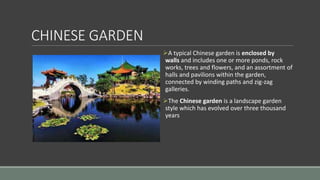
A typical Chinese garden is enclosed by
walls and includes one or more ponds, rock
works, trees and flowers, and an assortment of
halls and pavilions within the garden,
connected by winding paths and zig-zag
galleries.
The Chinese garden is a landscape garden
style which has evolved over three thousand
years
HISTORY
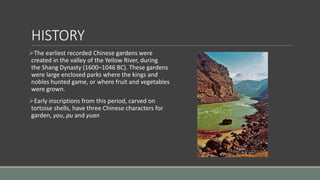
The earliest recorded Chinese gardens were
created in the valley of the Yellow River, during
the Shang Dynasty (1600–1046 BC). These gardens
were large enclosed parks where the kings and
nobles hunted game, or where fruit and vegetables
were grown.
Early inscriptions from this period, carved on
tortoise shells, have three Chinese characters for
garden, you, pu and yuan
FAMOUS HISTORICAL POETRY FOR
GARDEN
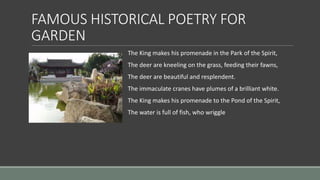
The King makes his promenade in the Park of the Spirit,
The deer are kneeling on the grass, feeding their fawns,
The deer are beautiful and resplendent.
The immaculate cranes have plumes of a brilliant white.
The King makes his promenade to the Pond of the Spirit,
The water is full of fish, who wriggle
Architecture
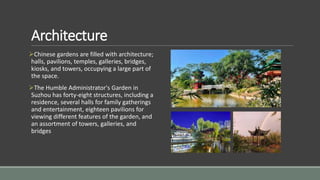
Chinese gardens are filled with architecture;
halls, pavilions, temples, galleries, bridges,
kiosks, and towers, occupying a large part of
the space.
The Humble Administrator's Garden in
Suzhou has forty-eight structures, including a
residence, several halls for family gatherings
and entertainment, eighteen pavilions for
viewing different features of the garden, and
an assortment of towers, galleries, and
bridges
Architecture
The garden structures are not designed to
dominate the landscape, but to be in harmony
with it.
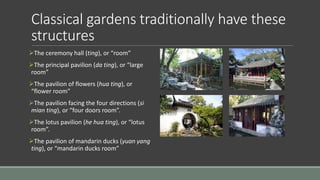
Classical gardens traditionally have these
structures
The ceremony hall (ting), or “room”
The principal pavilion (da ting), or “large
room”
The pavilion of flowers (hua ting), or
“flower room”
The pavilion facing the four directions (si
mian ting), or “four doors room”.
The lotus pavilion (he hua ting), or “lotus
room”.
The pavilion of mandarin ducks (yuan yang
ting), or “mandarin ducks room”
Classical gardens traditionally have these
structures
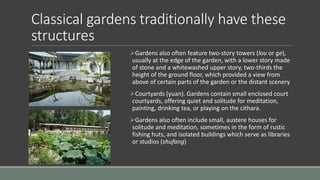
Gardens also often feature two-story towers (lou or ge),
usually at the edge of the garden, with a lower story made
of stone and a whitewashed upper story, two-thirds the
height of the ground floor, which provided a view from
above of certain parts of the garden or the distant scenery
Courtyards (yuan). Gardens contain small enclosed court
courtyards, offering quiet and solitude for meditation,
painting, drinking tea, or playing on the cithara.
Gardens also often include small, austere houses for
solitude and meditation, sometimes in the form of rustic
fishing huts, and isolated buildings which serve as libraries
or studios (shufang)
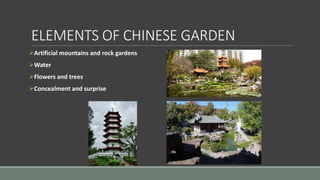
ELEMENTS OF CHINESE GARDEN
Artificial mountains and rock gardens
Water
Flowers and trees
Concealment and surprise
Artificial mountains and rock gardens
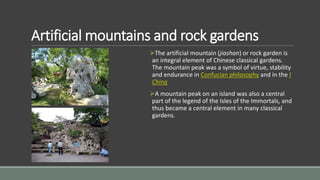
The artificial mountain (jiashan) or rock garden is
an integral element of Chinese classical gardens.
The mountain peak was a symbol of virtue, stability
and endurance in Confucian philosophy and in the I
Ching
A mountain peak on an island was also a central
part of the legend of the Isles of the Immortals, and
thus became a central element in many classical
gardens.
Water
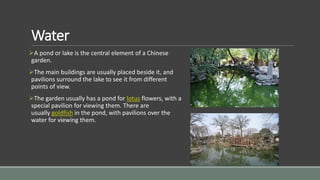
A pond or lake is the central element of a Chinese
garden.
The main buildings are usually placed beside it, and
pavilions surround the lake to see it from different
points of view.
The garden usually has a pond for lotus flowers, with a
special pavilion for viewing them. There are
usually goldfish in the pond, with pavilions over the
water for viewing them.
Flowers and trees
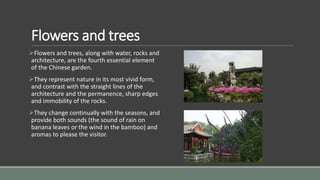
Flowers and trees, along with water, rocks and
architecture, are the fourth essential element
of the Chinese garden.
They represent nature in its most vivid form,
and contrast with the straight lines of the
architecture and the permanence, sharp edges
and immobility of the rocks.
They change continually with the seasons, and
provide both sounds (the sound of rain on
banana leaves or the wind in the bamboo) and
aromas to please the visitor.
Concealment and surprise
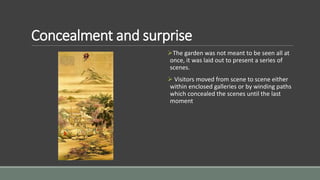
The garden was not meant to be seen all at
once, it was laid out to present a series of
scenes.
 Visitors moved from scene to scene either
within enclosed galleries or by winding paths
which concealed the scenes until the last
moment
Philosophy
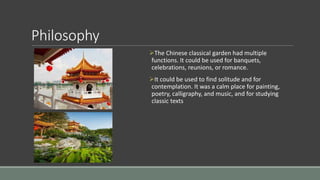
The Chinese classical garden had multiple
functions. It could be used for banquets,
celebrations, reunions, or romance.
It could be used to find solitude and for
contemplation. It was a calm place for painting,
poetry, calligraphy, and music, and for studying
classic texts
Influence
Chinese influence on the Japanese garden
Chinese influence on the Europe
WHAT MAKES CHINESE GARDEN
SPECIAL?
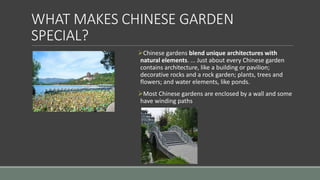
Chinese gardens blend unique architectures with
natural elements. ... Just about every Chinese garden
contains architecture, like a building or pavilion;
decorative rocks and a rock garden; plants, trees and
flowers; and water elements, like ponds.
Most Chinese gardens are enclosed by a wall and some
have winding paths
THANK YOU!

CHINESE GARDEN.pptx

  • 1.
    CHINESE GARDEN SUBMITTED TO:-AR.MEKHALASAHA PRESENTED BY:-MOHIT KAPOOR
  • 2.
    CHINESE GARDEN A typicalChinese garden is enclosed by walls and includes one or more ponds, rock works, trees and flowers, and an assortment of halls and pavilions within the garden, connected by winding paths and zig-zag galleries. The Chinese garden is a landscape garden style which has evolved over three thousand years
  • 3.
    HISTORY The earliest recordedChinese gardens were created in the valley of the Yellow River, during the Shang Dynasty (1600–1046 BC). These gardens were large enclosed parks where the kings and nobles hunted game, or where fruit and vegetables were grown. Early inscriptions from this period, carved on tortoise shells, have three Chinese characters for garden, you, pu and yuan
  • 4.
    FAMOUS HISTORICAL POETRYFOR GARDEN The King makes his promenade in the Park of the Spirit, The deer are kneeling on the grass, feeding their fawns, The deer are beautiful and resplendent. The immaculate cranes have plumes of a brilliant white. The King makes his promenade to the Pond of the Spirit, The water is full of fish, who wriggle
  • 5.
    Architecture Chinese gardens arefilled with architecture; halls, pavilions, temples, galleries, bridges, kiosks, and towers, occupying a large part of the space. The Humble Administrator's Garden in Suzhou has forty-eight structures, including a residence, several halls for family gatherings and entertainment, eighteen pavilions for viewing different features of the garden, and an assortment of towers, galleries, and bridges
  • 6.
    Architecture The garden structuresare not designed to dominate the landscape, but to be in harmony with it.
  • 7.
    Classical gardens traditionallyhave these structures The ceremony hall (ting), or “room” The principal pavilion (da ting), or “large room” The pavilion of flowers (hua ting), or “flower room” The pavilion facing the four directions (si mian ting), or “four doors room”. The lotus pavilion (he hua ting), or “lotus room”. The pavilion of mandarin ducks (yuan yang ting), or “mandarin ducks room”
  • 8.
    Classical gardens traditionallyhave these structures Gardens also often feature two-story towers (lou or ge), usually at the edge of the garden, with a lower story made of stone and a whitewashed upper story, two-thirds the height of the ground floor, which provided a view from above of certain parts of the garden or the distant scenery Courtyards (yuan). Gardens contain small enclosed court courtyards, offering quiet and solitude for meditation, painting, drinking tea, or playing on the cithara. Gardens also often include small, austere houses for solitude and meditation, sometimes in the form of rustic fishing huts, and isolated buildings which serve as libraries or studios (shufang)
  • 9.
    ELEMENTS OF CHINESEGARDEN Artificial mountains and rock gardens Water Flowers and trees Concealment and surprise
  • 10.
    Artificial mountains androck gardens The artificial mountain (jiashan) or rock garden is an integral element of Chinese classical gardens. The mountain peak was a symbol of virtue, stability and endurance in Confucian philosophy and in the I Ching A mountain peak on an island was also a central part of the legend of the Isles of the Immortals, and thus became a central element in many classical gardens.
  • 11.
    Water A pond orlake is the central element of a Chinese garden. The main buildings are usually placed beside it, and pavilions surround the lake to see it from different points of view. The garden usually has a pond for lotus flowers, with a special pavilion for viewing them. There are usually goldfish in the pond, with pavilions over the water for viewing them.
  • 12.
    Flowers and trees Flowersand trees, along with water, rocks and architecture, are the fourth essential element of the Chinese garden. They represent nature in its most vivid form, and contrast with the straight lines of the architecture and the permanence, sharp edges and immobility of the rocks. They change continually with the seasons, and provide both sounds (the sound of rain on banana leaves or the wind in the bamboo) and aromas to please the visitor.
  • 13.
    Concealment and surprise Thegarden was not meant to be seen all at once, it was laid out to present a series of scenes.  Visitors moved from scene to scene either within enclosed galleries or by winding paths which concealed the scenes until the last moment
  • 14.
    Philosophy The Chinese classicalgarden had multiple functions. It could be used for banquets, celebrations, reunions, or romance. It could be used to find solitude and for contemplation. It was a calm place for painting, poetry, calligraphy, and music, and for studying classic texts
  • 15.
    Influence Chinese influence onthe Japanese garden Chinese influence on the Europe
  • 16.
    WHAT MAKES CHINESEGARDEN SPECIAL? Chinese gardens blend unique architectures with natural elements. ... Just about every Chinese garden contains architecture, like a building or pavilion; decorative rocks and a rock garden; plants, trees and flowers; and water elements, like ponds. Most Chinese gardens are enclosed by a wall and some have winding paths
  • 17.