Page 1giz I China’s Urban Transport Challenge | 03 June 2016 | Alexander Jung
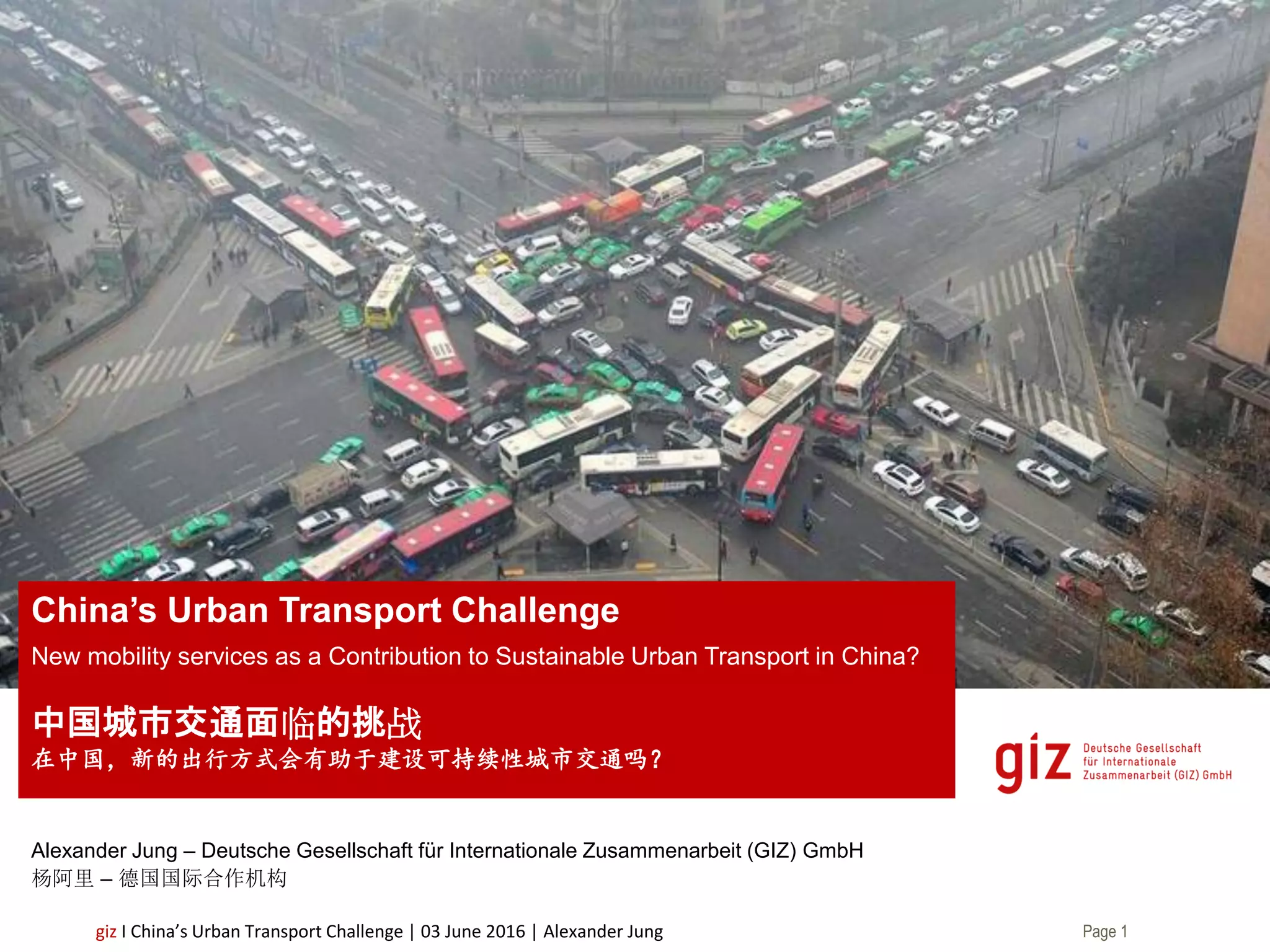
China’s Urban Transport Challenge
New mobility services as a Contribution to Sustainable Urban Transport in China?
中国城市交通面临的挑战
在中国,新的出行方式会有助于建设可持续性城市交通吗?
Alexander Jung – Deutsche Gesellschaft für Internationale Zusammenarbeit (GIZ) GmbH
杨阿里 – 德国国际合作机构
Page 2giz I China’s Urban Transport Challenge | 03 June 2016 | Alexander Jung
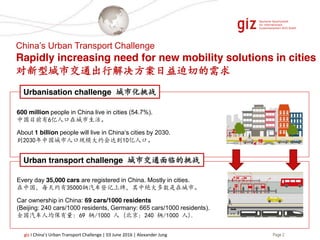
Every day 35,000 cars are registered in China. Mostly in cities.
在中国,每天约有35000辆汽车登记上牌,其中绝大多数是在城市。
Car ownership in China: 69 cars/1000 residents
(Beijing: 240 cars/1000 residents, Germany: 665 cars/1000 residents).
全国汽车人均保有量: 69 辆/1000 人 (北京: 240 辆/1000 人).
China’s Urban Transport Challenge
Rapidly increasing need for new mobility solutions in cities
对新型城市交通出行解决方案日益迫切的需求
600 million people in China live in cities (54.7%).
中国目前有6亿人口在城市生活。
About 1 billion people will live in China‘s cities by 2030.
到2030年中国城市人口规模大约会达到10亿人口。
Urbanisation challenge 城市化挑战
Urban transport challenge 城市交通面临的挑战
Page 3giz I China’s Urban Transport Challenge | 03 June 2016 | Alexander Jung
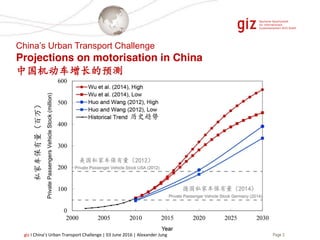
私家车保有量(百万)
历史趋势
美国私家车保有量(2012)
德国私家车保有量(2014)
China’s Urban Transport Challenge
Projections on motorisation in China
中国机动车增长的预测
Page 4giz I China’s Urban Transport Challenge | 03 June 2016 | Alexander Jung
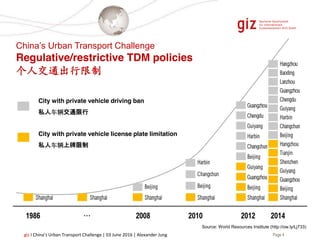
Source: World Resources Institute (http://ow.ly/Lj733)
China’s Urban Transport Challenge
Regulative/restrictive TDM policies
个人交通出行限制
City with private vehicle license plate limitation
私人车辆上牌限制
City with private vehicle driving ban
私人车辆交通限行
Page 5giz I China’s Urban Transport Challenge | 03 June 2016 | Alexander Jung
Monetarypolicies
财政政策
Non-monetarypolicies
非财政政策
China’s Urban Transport Challenge
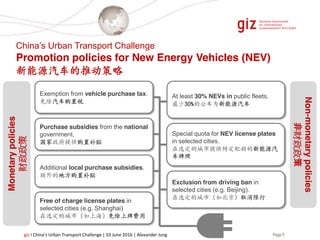
Promotion policies for New Energy Vehicles (NEV)
新能源汽车的推动策略
Exemption from vehicle purchase tax.
免除汽车购置税
Additional local purchase subsidies.
额外的地方购置补贴
Exclusion from driving ban in
selected cities (e.g. Beijing).
在选定的城市(如北京)取消限行
Free of charge license plates in
selected cities (e.g. Shanghai)
在选定的城市(如上海)免除上牌费用
Purchase subsidies from the national
government.
国家政府提供购置补贴
Special quota for NEV license plates
in selected cities.
在选定的城市提供特定配额的新能源汽
车牌照
At least 30% NEVs in public fleets.
最少30%的公车为新能源汽车
Page 6giz I China’s Urban Transport Challenge | 03 June 2016 | Alexander Jung
快速城市化
China’s Urban Transport Challenge
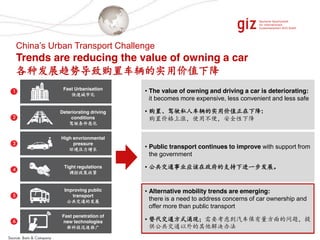
Trends are reducing the value of owning a car
各种发展趋势导致购置车辆的实用价值下降
Fast Urbanisation
快速城市化
Fast penetration of
new technologies
新科技迅速推广
Deteriorating driving
conditions
驾驶条件恶化
High envrionmental
pressure
环境压力增长
Tight regulations
调控政策收紧
Improving public
transport
公共交通的发展
• The value of owning and driving a car is deteriorating:
it becomes more expensive, less convenient and less safe
• 购置、驾驶私人车辆的实用价值正在下降:
购置价格上涨,使用不便,安全性下降
• Public transport continues to improve with support from
the government
• 公共交通事业应该在政府的支持下进一步发展。
• Alternative mobility trends are emerging:
there is a need to address concerns of car ownership and
offer more than public transport
• 替代交通方式涌现;需要考虑到汽车保有量方面的问题,提
供公共交通以外的其他解决办法
Page 7giz I China’s Urban Transport Challenge | 03 June 2016 | Alexander Jung
北京
烟台
上海
杭州
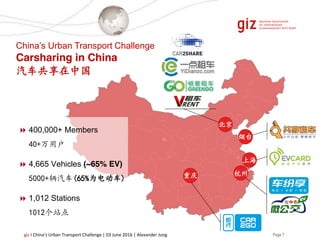
400,000+ Members
40+万用户
4,665 Vehicles (~65% EV)
5000+辆汽车(65%为电动车)
1,012 Stations
1012个站点
China’s Urban Transport Challenge
Carsharing in China
汽车共享在中国
重庆
Page 8giz I China’s Urban Transport Challenge | 03 June 2016 | Alexander Jung
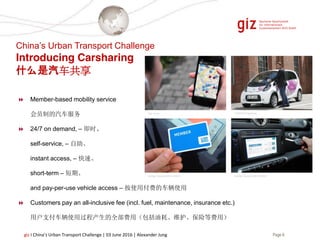
Member-based mobility service
会员制的汽车服务
24/7 on demand, – 即时、
self-service, – 自助、
instant access, – 快速、
short-term – 短期、
and pay-per-use vehicle access – 按使用付费的车辆使用
Customers pay an all-inclusive fee (incl. fuel, maintenance, insurance etc.)
用户支付车辆使用过程产生的全部费用(包括油耗、维护、保险等费用)
car2go Deutschland GmbH
Car Jump CITROËN Multicity
car2go Deutschland GmbH
China’s Urban Transport Challenge
Introducing Carsharing
什么是汽车共享
Page 9giz I China’s Urban Transport Challenge | 03 June 2016 | Alexander Jung
China’s Urban Transport Challenge
Carsharing in China
汽车共享在中国
Page 10giz I China’s Urban Transport Challenge | 03 June 2016 | Alexander Jung
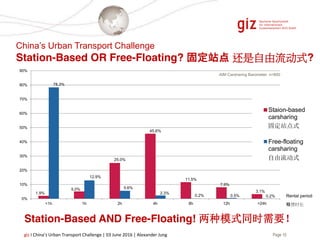
1.9%
5.0%
25.0%
45.6%
11.5%
7.9%
3.1%
78.3%
12.9%
5.6%
2.3%
0.2% 0.5% 0.2%
0%
10%
20%
30%
40%
50%
60%
70%
80%
90%
<1h 1h 2h 4h 8h 12h >24h
Staion-based
carsharing
Free-floating
carsharing
Station-Based AND Free-Floating! 两种模式同时需要!
AIM Carsharing Barometer, n=800
固定站点式
自由流动式
Rental period
租赁时长
China’s Urban Transport Challenge
Station-Based OR Free-Floating? 固定站点 还是自由流动式?
Page 11giz I China’s Urban Transport Challenge | 03 June 2016 | Alexander Jung
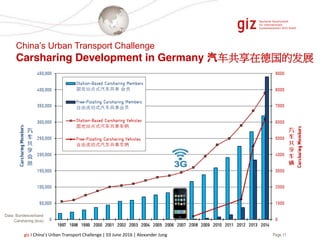
Data: Bundesverband
Carsharing (bcs)
China’s Urban Transport Challenge
Carsharing Development in Germany 汽车共享在德国的发展
Page 12giz I China’s Urban Transport Challenge | 03 June 2016 | Alexander Jung
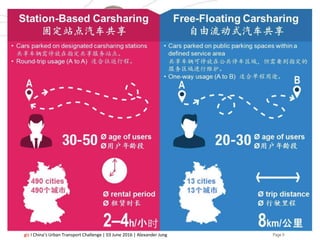
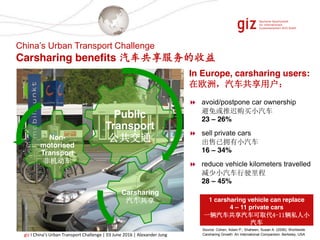
1 carsharing vehicle can replace
4 – 11 private cars
一辆汽车共享汽车可取代4-11辆私人小
汽车
In Europe, carsharing users:
在欧洲,汽车共享用户:
avoid/postpone car ownership
避免或推迟购买小汽车
23 – 26%
sell private cars
出售已拥有小汽车
16 – 34%
reduce vehicle kilometers travelled
减少小汽车行驶里程
28 – 45%
Source: Cohen, Adam P.; Shaheen, Susan A. (2006): Worldwide
Carsharing Growth: An International Comparison. Berkeley, USA
Non-
motorised
Transport
非机动车
Carsharing
汽车共享
Public
Transport
公共交通
China’s Urban Transport Challenge
Carsharing benefits 汽车共享服务的收益
Page 13giz I China’s Urban Transport Challenge | 03 June 2016 | Alexander Jung
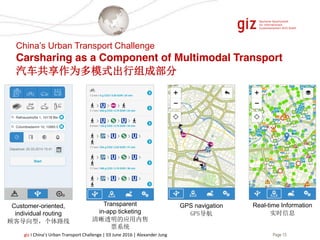
Customer-oriented,
individual routing
顾客导向型,个体路线
GPS navigation
GPS导航
Transparent
in-app ticketing
清晰透明的应用内售
票系统
Real-time Information
实时信息
China’s Urban Transport Challenge
Carsharing as a Component of Multimodal Transport
汽车共享作为多模式出行组成部分
Page 14giz I China’s Urban Transport Challenge | 03 June 2016 | Alexander Jung
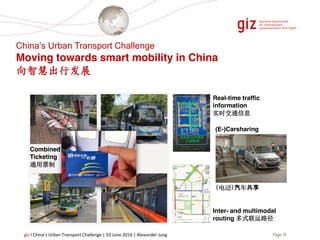
Real-time traffic
information
实时交通信息
Inter- and multimodal
routing 多式联运路径
(E-)Carsharing
Combined
Ticketing
通用票制
(电动)汽车共享
China’s Urban Transport Challenge
Moving towards smart mobility in China
向智慧出行发展
Page 15giz I China’s Urban Transport Challenge | 03 June 2016 | Alexander Jung
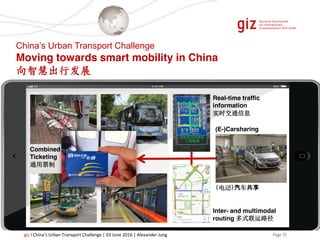
Real-time traffic
information
实时交通信息
Inter- and multimodal
routing 多式联运路径
(E-)Carsharing
Combined
Ticketing
通用票制
(电动)汽车共享
China’s Urban Transport Challenge
Moving towards smart mobility in China
向智慧出行发展
Page 16giz I China’s Urban Transport Challenge | 03 June 2016 | Alexander Jung
China’s Urban Transport Challenge
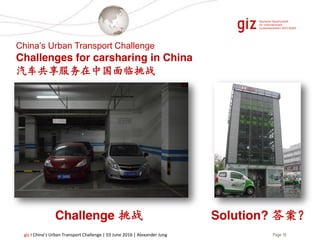
Challenges for carsharing in China
汽车共享服务在中国面临挑战
Challenge 挑战 Solution? 答案?
Page 17giz I China’s Urban Transport Challenge | 03 June 2016 | Alexander Jung
1
New mobility concepts made dramatic progress over the last five years.
新的出行概念在最近五年获得引人注目的进步。
2
Urban environmental and transport challenges/policies will drive rapid business innovation which
may overtake the processes in the western hemisphere.
城市的环境、交通所面临的挑战及相关政策会驱动商业上的高速创新,可能会超越西方的发展进度。
3
Electrification will play a key role in the future development of carsharing in China.
电气化将会在中国的汽车共享发展中扮演关键的角色。
4
Parking is one of the major challenges, especially for infrastructure dependent mobility services.
泊车是一项主要的挑战,尤其针对依赖于基础设施的出行服务。
5
Dynamic market development can overrun governmental authorities and increase the
business risk for operators.
动态的市场发展可能会超过政府相关部门的限度,并使运营商的业务风险增加。
6
How can an urban mobility scenario look like in future?
一个合适的城市出行解决方案会是怎样的?
China’s Urban Transport Challenge
Quintessence 要点和精华
Page 18giz I China’s Urban Transport Challenge | 03 June 2016 | Alexander Jung
Food for thought…
的设想 …
Contact Details
Deutsche Gesellschaft für
Internationale Zusammenarbeit
(GIZ) GmbH
Alexander Jung
Project Manager
alexander.jung@giz.de
www.sustainabletransport.org
联系方式
德国国际合作机构
杨阿里
项目经理
alexander.jung@giz.de
www.sustainabletransport.org

China's Urban Transport Challenge

  • 1.
    Page 1giz IChina’s Urban Transport Challenge | 03 June 2016 | Alexander Jung China’s Urban Transport Challenge New mobility services as a Contribution to Sustainable Urban Transport in China? 中国城市交通面临的挑战 在中国,新的出行方式会有助于建设可持续性城市交通吗? Alexander Jung – Deutsche Gesellschaft für Internationale Zusammenarbeit (GIZ) GmbH 杨阿里 – 德国国际合作机构
  • 2.
    Page 2giz IChina’s Urban Transport Challenge | 03 June 2016 | Alexander Jung Every day 35,000 cars are registered in China. Mostly in cities. 在中国,每天约有35000辆汽车登记上牌,其中绝大多数是在城市。 Car ownership in China: 69 cars/1000 residents (Beijing: 240 cars/1000 residents, Germany: 665 cars/1000 residents). 全国汽车人均保有量: 69 辆/1000 人 (北京: 240 辆/1000 人). China’s Urban Transport Challenge Rapidly increasing need for new mobility solutions in cities 对新型城市交通出行解决方案日益迫切的需求 600 million people in China live in cities (54.7%). 中国目前有6亿人口在城市生活。 About 1 billion people will live in China‘s cities by 2030. 到2030年中国城市人口规模大约会达到10亿人口。 Urbanisation challenge 城市化挑战 Urban transport challenge 城市交通面临的挑战
  • 3.
    Page 3giz IChina’s Urban Transport Challenge | 03 June 2016 | Alexander Jung 私家车保有量(百万) 历史趋势 美国私家车保有量(2012) 德国私家车保有量(2014) China’s Urban Transport Challenge Projections on motorisation in China 中国机动车增长的预测
  • 4.
    Page 4giz IChina’s Urban Transport Challenge | 03 June 2016 | Alexander Jung Source: World Resources Institute (http://ow.ly/Lj733) China’s Urban Transport Challenge Regulative/restrictive TDM policies 个人交通出行限制 City with private vehicle license plate limitation 私人车辆上牌限制 City with private vehicle driving ban 私人车辆交通限行
  • 5.
    Page 5giz IChina’s Urban Transport Challenge | 03 June 2016 | Alexander Jung Monetarypolicies 财政政策 Non-monetarypolicies 非财政政策 China’s Urban Transport Challenge Promotion policies for New Energy Vehicles (NEV) 新能源汽车的推动策略 Exemption from vehicle purchase tax. 免除汽车购置税 Additional local purchase subsidies. 额外的地方购置补贴 Exclusion from driving ban in selected cities (e.g. Beijing). 在选定的城市(如北京)取消限行 Free of charge license plates in selected cities (e.g. Shanghai) 在选定的城市(如上海)免除上牌费用 Purchase subsidies from the national government. 国家政府提供购置补贴 Special quota for NEV license plates in selected cities. 在选定的城市提供特定配额的新能源汽 车牌照 At least 30% NEVs in public fleets. 最少30%的公车为新能源汽车
  • 6.
    Page 6giz IChina’s Urban Transport Challenge | 03 June 2016 | Alexander Jung 快速城市化 China’s Urban Transport Challenge Trends are reducing the value of owning a car 各种发展趋势导致购置车辆的实用价值下降 Fast Urbanisation 快速城市化 Fast penetration of new technologies 新科技迅速推广 Deteriorating driving conditions 驾驶条件恶化 High envrionmental pressure 环境压力增长 Tight regulations 调控政策收紧 Improving public transport 公共交通的发展 • The value of owning and driving a car is deteriorating: it becomes more expensive, less convenient and less safe • 购置、驾驶私人车辆的实用价值正在下降: 购置价格上涨,使用不便,安全性下降 • Public transport continues to improve with support from the government • 公共交通事业应该在政府的支持下进一步发展。 • Alternative mobility trends are emerging: there is a need to address concerns of car ownership and offer more than public transport • 替代交通方式涌现;需要考虑到汽车保有量方面的问题,提 供公共交通以外的其他解决办法
  • 7.
    Page 7giz IChina’s Urban Transport Challenge | 03 June 2016 | Alexander Jung 北京 烟台 上海 杭州 400,000+ Members 40+万用户 4,665 Vehicles (~65% EV) 5000+辆汽车(65%为电动车) 1,012 Stations 1012个站点 China’s Urban Transport Challenge Carsharing in China 汽车共享在中国 重庆
  • 8.
    Page 8giz IChina’s Urban Transport Challenge | 03 June 2016 | Alexander Jung Member-based mobility service 会员制的汽车服务 24/7 on demand, – 即时、 self-service, – 自助、 instant access, – 快速、 short-term – 短期、 and pay-per-use vehicle access – 按使用付费的车辆使用 Customers pay an all-inclusive fee (incl. fuel, maintenance, insurance etc.) 用户支付车辆使用过程产生的全部费用(包括油耗、维护、保险等费用) car2go Deutschland GmbH Car Jump CITROËN Multicity car2go Deutschland GmbH China’s Urban Transport Challenge Introducing Carsharing 什么是汽车共享
  • 9.
    Page 9giz IChina’s Urban Transport Challenge | 03 June 2016 | Alexander Jung China’s Urban Transport Challenge Carsharing in China 汽车共享在中国
  • 10.
    Page 10giz IChina’s Urban Transport Challenge | 03 June 2016 | Alexander Jung 1.9% 5.0% 25.0% 45.6% 11.5% 7.9% 3.1% 78.3% 12.9% 5.6% 2.3% 0.2% 0.5% 0.2% 0% 10% 20% 30% 40% 50% 60% 70% 80% 90% <1h 1h 2h 4h 8h 12h >24h Staion-based carsharing Free-floating carsharing Station-Based AND Free-Floating! 两种模式同时需要! AIM Carsharing Barometer, n=800 固定站点式 自由流动式 Rental period 租赁时长 China’s Urban Transport Challenge Station-Based OR Free-Floating? 固定站点 还是自由流动式?
  • 11.
    Page 11giz IChina’s Urban Transport Challenge | 03 June 2016 | Alexander Jung Data: Bundesverband Carsharing (bcs) China’s Urban Transport Challenge Carsharing Development in Germany 汽车共享在德国的发展
  • 12.
    Page 12giz IChina’s Urban Transport Challenge | 03 June 2016 | Alexander Jung 1 carsharing vehicle can replace 4 – 11 private cars 一辆汽车共享汽车可取代4-11辆私人小 汽车 In Europe, carsharing users: 在欧洲,汽车共享用户: avoid/postpone car ownership 避免或推迟购买小汽车 23 – 26% sell private cars 出售已拥有小汽车 16 – 34% reduce vehicle kilometers travelled 减少小汽车行驶里程 28 – 45% Source: Cohen, Adam P.; Shaheen, Susan A. (2006): Worldwide Carsharing Growth: An International Comparison. Berkeley, USA Non- motorised Transport 非机动车 Carsharing 汽车共享 Public Transport 公共交通 China’s Urban Transport Challenge Carsharing benefits 汽车共享服务的收益
  • 13.
    Page 13giz IChina’s Urban Transport Challenge | 03 June 2016 | Alexander Jung Customer-oriented, individual routing 顾客导向型,个体路线 GPS navigation GPS导航 Transparent in-app ticketing 清晰透明的应用内售 票系统 Real-time Information 实时信息 China’s Urban Transport Challenge Carsharing as a Component of Multimodal Transport 汽车共享作为多模式出行组成部分
  • 14.
    Page 14giz IChina’s Urban Transport Challenge | 03 June 2016 | Alexander Jung Real-time traffic information 实时交通信息 Inter- and multimodal routing 多式联运路径 (E-)Carsharing Combined Ticketing 通用票制 (电动)汽车共享 China’s Urban Transport Challenge Moving towards smart mobility in China 向智慧出行发展
  • 15.
    Page 15giz IChina’s Urban Transport Challenge | 03 June 2016 | Alexander Jung Real-time traffic information 实时交通信息 Inter- and multimodal routing 多式联运路径 (E-)Carsharing Combined Ticketing 通用票制 (电动)汽车共享 China’s Urban Transport Challenge Moving towards smart mobility in China 向智慧出行发展
  • 16.
    Page 16giz IChina’s Urban Transport Challenge | 03 June 2016 | Alexander Jung China’s Urban Transport Challenge Challenges for carsharing in China 汽车共享服务在中国面临挑战 Challenge 挑战 Solution? 答案?
  • 17.
    Page 17giz IChina’s Urban Transport Challenge | 03 June 2016 | Alexander Jung 1 New mobility concepts made dramatic progress over the last five years. 新的出行概念在最近五年获得引人注目的进步。 2 Urban environmental and transport challenges/policies will drive rapid business innovation which may overtake the processes in the western hemisphere. 城市的环境、交通所面临的挑战及相关政策会驱动商业上的高速创新,可能会超越西方的发展进度。 3 Electrification will play a key role in the future development of carsharing in China. 电气化将会在中国的汽车共享发展中扮演关键的角色。 4 Parking is one of the major challenges, especially for infrastructure dependent mobility services. 泊车是一项主要的挑战,尤其针对依赖于基础设施的出行服务。 5 Dynamic market development can overrun governmental authorities and increase the business risk for operators. 动态的市场发展可能会超过政府相关部门的限度,并使运营商的业务风险增加。 6 How can an urban mobility scenario look like in future? 一个合适的城市出行解决方案会是怎样的? China’s Urban Transport Challenge Quintessence 要点和精华
  • 18.
    Page 18giz IChina’s Urban Transport Challenge | 03 June 2016 | Alexander Jung Food for thought… 的设想 … Contact Details Deutsche Gesellschaft für Internationale Zusammenarbeit (GIZ) GmbH Alexander Jung Project Manager alexander.jung@giz.de www.sustainabletransport.org 联系方式 德国国际合作机构 杨阿里 项目经理 alexander.jung@giz.de www.sustainabletransport.org