NEW MOBILITY
BACKGROUND PAPER
FULL REPORT
Technical Paper 4 to support the Discussion Paper for the
Next Regional Transportation Plan
July 2016
New Mobility
July 2016
Foreword
This report presents findings and research on the future of
cities and new mobility, conducted by WSP Group on behalf of
Metrolinx, the regional transportation authority for the Greater
Toronto and Hamilton Area in Ontario, Canada. This work is
intended to inform policy discussion around the role of new
mobility as part of the Regional Transportation Plan update.
Given the uncertainty and dynamic nature of new mobility, a
foresight and scenario generation approach was used to derive
strategic directions and policy considerations for government
and a wide range of new mobility stakeholders. Research was
conducted on a broad range of global and regional trends, and
future scenarios were developed in a structured framework to
help identify potential opportunities, risks and implications that
may arise from developments in new mobility. The findings of
this research were validated through a panel of Thought Leaders
who came from a wide cross-section of perspectives that span
sectors and geography. These Thought Leaders are listed in
the Acknowledgements section of the report. The project team
is grateful for the richness and thoughtfulness of the advice
received.
New mobility is a rapidly evolving topic. This report frames
current thinking on the issues, opportunities and forces at play
in the emergence of new mobility. Continued research and
analysis will be needed as this field evolves and matures over
the coming years.
Table of Contents
1.	Introduction........................................................1
The Changing Nature of Mobility..................................................................1
Overview of this Report..................................................................................3
2.	 Key Trends...........................................................5
Transformative Technologies........................................................................6
New Government Roles...............................................................................12
User Needs and Desires...............................................................................14
Urban Form and Built Environment ..........................................................17
3.	 The Futures of New Mobility...........................21
4.	 Strategic Directions..........................................25
The Challenge................................................................................................26
Theme 1: Government Re-imagined..........................................................26
Theme 2: New Mobility is the New Transit................................................32
Theme 3: The User is King...........................................................................38
Theme 4: Driving the Cities We Want.........................................................42
Theme 5: All About the Data........................................................................46
Theme 6: Plan for the “Known Unknowns” ...............................................50
5.	 Planning for Change.........................................55
Protecting the Public Interest......................................................................55
Working Together in New Ways..................................................................58
Acknowledgements................................................60
Figure and Image Credits.......................................62
vi
INTRODUCTION
1
2
3
4
5
1
1
INTRODUCTION
1
2
3
4
5
1.	Introduction
The Changing Nature of Mobility
In the Greater Toronto and Hamilton Area (GTHA), a growing
public desire for alternatives to travel by private car has led
to new policy and financial support for transit, cycling and
walking. After decades of underinvestment, public transit in the
GTHA is receiving significant financial support from all orders
of government. The overall scope, quality and integration of
transit has improved significantly, and transit is now competitive
in many areas where it has lagged for years. At the same time,
a rapidly growing network of cycling and walking facilities is
helping more people to use active modes for daily travel.
However, policy and infrastructure work slowly. It can take
decades to feel the full effects of some policies, and years of
planning, engineering, design and construction are needed
before a rapid transit line can carry passengers. Change
continues to unfold as those things happen, so while we plan
for the short term we must also look farther ahead and consider
trends that are only starting to emerge. A key role of Metrolinx
is to watch for emerging trends, and to consider their potential
impact on transportation in the GTHA.
Just as gas-powered cars reshaped cities in the 1900s, today’s
rapidly changing technologies seem likely to disrupt mobility in
the GTHA. The great unknown is in which advances will have the
greatest effect, and where they might lead us. The answer will
depend on other social, economic and built environment trends
that will both influence, and be influenced by, new technologies.
2
INTRODUCTION
1
2
3
4
5
It is not just the technologies themselves that matter, but how
they are applied, and how people interact with them. Already,
new models of mobility are blurring the lines between public
and private transportation, and changing the very definitions of
different travel modes—but their ultimate impact will depend
on the actions of government, the private sector and individual
users. We cannot predict the future of mobility in the GTHA, but
we can use our understanding of current trends to illuminate
what might happen as they shift and evolve with time, perhaps
as they weaken or strengthen, and even as they converge to
take us in new and unexpected directions
Figure 1.1 - Map of the Region
*GO Transit Service will be added to Brantford in Fall 2016.
*
3
INTRODUCTION
1
2
3
4
5
Overview of this Report
This report contributes to a growing
discussion about how “new mobility”
could impact the GTHA, and about ways
to ensure that it benefits the region as a
whole. It has been structured to mirror the
analysis process used in developing this
report, illustrated in the diagram to the
left. Chapter 2—Key Trends explores major
trends related to technology, government,
individual users and the built environment,
and their impacts so far. Chapter 3—The
Futures of New Mobility identifies two
radically different future scenarios and
how they might emerge given the changing
dynamics of the system. Chapter 4—
Strategic Directions uses six key themes to
suggest a number of ways the region can
prepare for impending change. The report
concludes with Chapter 5—Planning for
Change, a discussion of how key actors in
the GTHA can work together to create the
mobility future they want to see.
(Keyissu
es, challenges, and con
siderations)
Strategic
Directions
Risks &
Opportunities
Key Themes
Futures of
New Mobility
Scenarios
Urban form
and Built
Environment
User Needs
and Desires
New
Government
Roles
Transformative
Technology
Key Trends in Four Areas of Impact
Scan of Global and Regional
New Mobility Trends
Figure 1.2 - Analysis Process
4
KEYTRENDS
1
2
3
4
5
2
5
KEYTRENDS
1
2
3
4
5
2.	 Key Trends
The term “new mobility” includes many forms
of transportation arising both from changing
needs and demands, and from new and
emerging capabilities. While new mobility
offers exciting opportunities to enhance
the movement of people and goods in the
GTHA, its effects seem likely to reach beyond
transportation and impact our overall quality
of life. This reality will challenge all levels of
government to define an appropriate policy
and planning response for the GTHA—
something that must be based on a broad
understanding of relevant trends.
This chapter identifies the global and regional
trends most important to new mobility in four
key areas: transformative technologies, new
government roles, user needs and desires,
and urban form and built environment. These
are areas of significant—and in some cases
imminent—change that will influence mobility
and quality of life in the GTHA. Most of the
trends discussed are interconnected, and have
broad relevance across all four areas.
Urban Form
and Built
Environment
New
Government Roles
Users Needs
and Desires
Transformative
Technologies
Figure 2.1 - Areas of Impact
6
KEYTRENDS
1
2
3
4
5
Internet of Things (IoT)
Examples of consumer
products that make use of IoT
technologies include smart
thermostats and wearable
fitness devices. IoT applications
in transportation include
parking management systems
that track vacant and occupied
spaces in a facility, and many
more are expected to emerge.
Connected vehicles have yet to
hit the market, but are expected
to make roads safer using
vehicle-to-vehicle and vehicle-to-
infrastructure communication.
The technology has similar
objectives as autonomous
vehicles, but is being developed
separately in parallel. Cisco
estimates that in 2012, there
were about 8.7 billion connected
objects globally. By 2013, this
number exceeded 10.0 billion,
and by 2020, it is estimated that
the number of connected objects
will reach up to 1.8 trillion.1
Big Data
Big data represents the
information about our lives
that is being collected in
an unprecedented variety,
richness and volume, and
being processed with once-
unimaginable speed. Datasets
are generated from many
sources including business
transactions, sensors and social
media. In the transportation
sector, there is strong interest in
analyzing this data to gain new
insights into human behaviour
and system performance.
Important questions have arisen
about personal data privacy,
security and ownership. Many
sectors will also have to contend
with the issue of a skills gap.
Canada’s Big Data Consortium
estimates that Canada has a
skills gap of between 10,500
and 19,500 professionals with
deep data and analytical skills,
and a further gap of 150,000
professionals with solid data and
analytical literacy. 2
Transformative Technologies
Technology-driven increases in automation, connectivity and
information sharing have reached the realm of transportation
infrastructure and services, making many aspects of life easier
and more convenient. However, while they might enable us
to use resources more efficiently, they could also have the
opposite effect and encourage us to accelerate our consumption
to unprecedented levels.
An increasingly connected and data driven world
The Internet of Things (IoT) and big data are two key
technological trends that are enabling an increasingly connected
and data-driven world. IoT technologies create “smart” systems
of interacting sensors and devices that can operate with little
human intervention, gathering rich data about the condition of a
system and its use. The resulting large sets of data (big data) can
be processed using advanced analytics for a variety of purposes
in both public and private sectors; these include service
planning, travel demand forecasting, long range planning,
emergency response, customized goods and services, improved
information provision, and targeted marketing.
Thanks to IoT technologies, transit users can actively track
the location of their next bus through onboard GPS tracking.
Beacons, which enable location-based communication, can
provide geographically relevant content to users about nearby
services and businesses. Electronic displays and smartphone
applications give car drivers information on parking space
availability that is gathered through parking bay sensors.
Maintenance crews can be notified and deployed faster when
infrastructure issues arise. Assets can be used more efficiently
when certain roads and transit lines are under high demand
1 Cisco (July, 2013)	
2 Canada’s Big Data Consortium (October 2015)
7
KEYTRENDS
1
2
3
4
5
Contactless Payment
This technology has evolved
from special purpose smart
cards (e.g. the PRESTO farecard)
to options enabled by bank
and credit card companies.
Technologies including radio-
frequency identification (RFID)
and near field communication
(NFC) enable quick transactions
and are suitable for transit
environments. Contactless
payment examples include Visa
payWaveTM
and Mastercard Tap
& GoTM
. In the United Kingdom,
Transport for London allows fare
payment for bus, underground,
tram, light rail, cable car, river
bus and overground train rides
using contactless bank cards and
credit cards.
An emerging generation of
contactless payment relies on
smartphones and other personal
devices to act as personalized
smart tokens, which adds an
extra level of security. Personal
devices allow individuals to
authenticate their identity
using a passcode or biometric
authentication. Examples
include Apple Pay and Android
Pay, which use fingerprint
identification technology built
into many smartphones.
and travellers are redirected to less-congested routes,
times and destinations. Connected vehicles, which are
more aware of their surroundings, will contribute to a safer
transportation system.
A more integrated and informed mobility system
IoT and big data are creating opportunities for a more
integrated and informed transportation system. Mobile
traveller information systems for smartphones and other
mobile devices are increasingly used to share live information
about the condition of the transportation system and to
aid in trip planning and navigation. These applications give
users better access to the transportation system as they
are no longer limited by their own knowledge, and can
encourage the use of certain modes by offering information
and recommendations.
In some jurisdictions, mobile applications are being extended
to incorporate new functions such as integrated fare payments
for transportation service providers. Progress is also being
made toward combining live and customized information
with integrated fare payment through the use of personalized
smart tokens and contactless digital payment. A logical next
step would give users convenient, comprehensive access to
information and payment options for different modes through
a single portal. This would signal a shift from treating the
transportation system as a set of discrete modes, towards
treating it as a set of integrated mobility services. Some
jurisdictions are coming close to this concept through the
advancement of Mobility as a Service frameworks.
8
KEYTRENDS
1
2
3
4
5
Mobility as a Service (MaaS)
MaaS is a distribution model for
mobility services. It integrates
services offered by multiple
independent providers (e.g.
transit, taxi, bike share,
car share) into one mobile
application, allowing travellers
to plan and pay for their
mobility needs through a single
portal. The goal of MaaS is to
be more attractive than auto
ownership. European research
and industry activity around this
model has been significant. A
pilot project called UbiGo3
was
tested in Gothenburg Sweden,
and more recently a solution
called Whim was released in
Helsinki, Finland.4
The growth of
MaaS could have a potentially
strong impact in reducing auto
ownership and use.
Personal transport without personal ownership
New technologies have enabled the practice of resource-
sharing between people and/or businesses in many sectors,
such as short-term rental of rooms and homes as casual travel
accommodation. In transportation, the sharing economy has
manifested itself in ridesharing, carsharing, bikesharing, and
other on-demand mobility services such as ridesourcing through
transport network companies (TNCs) such as Uber and Lyft.
Although carsharing and bikesharing have had only limited
impact on the broader transportation system, emerging
models are enabling steady growth. Between 2014 and 2015,
the number of carsharing memberships in Canada grew by
50%, while fleets grew by 26%.5
Many services are also shifting
towards more convenient free-floating models, which allow
vehicles, both cars and bikes, to be picked up and dropped off
closer to where people actually need to be instead of being
confined to station infrastructure, or needing to return the
vehicle back to its origin. Growth within the sharing economy is
also introducing peer-to-peer models of car and bike sharing,
which will make the fleet of available vehicles even larger.
Government transportation agencies have historically been the
biggest proponent of ridesharing, or carpooling, as a measure
of transportation demand management (TDM). Conventional
systems matched drivers to passengers ahead of time, usually
by home and work location, to form fixed groupings of
carpoolers. Though these programs have had some success
in increasing per vehicle occupancy and reducing the number
of trips and emissions produced at the workplace level, the
lack of flexibility has made it challenging for application in a
3 UbiGO (2016)
4 MaaS Global (2016)
5 Transportation Sustainability Research Centre (2015)
Mobile Traveller Information
Systems
The earliest such systems were
commissioned by government
entities and transit operators,
and generally offered users
transit schedules, journey
planning, and predictive travel
times. Newer systems, including
some private companies, have
introduced dynamic route
optimization capabilities,
real-time transit and traveller
information and multimodal
trip planning. Since these
applications are usually free,
many companies are supported
by investor funding with the
eventual intent of monetizing
the data collected through the
system. Examples of these
applications in the GTHA
include Google Maps, Transit
App, Moovit, CityMapper, and
Metrolinx’ own Triplinx.
9
KEYTRENDS
1
2
3
4
5
Transportation network
companies (TNCs)
TNCs use online applications
to provide prearranged
transportation services for
paying passengers, connecting
them with drivers who use their
personal vehicles. International
examples include Lyft, Uber,
Didi Kuaidi and Haxi. The
type of service provided by
TNCs is usually referred to as
ridesourcing, though other
terms, such as ride-hailing, and
e-hailing are also used. The
City of Toronto has termed
TNCs as Private Transportation
Companies (PTCs).
broader context. Some TNCs have begun to enter the market
of ridesharing as an extension of the on-demand ridesourcing
services they provide. Using similar mobile platforms as those
used in ridesourcing, both drivers and riders are being given the
option of opening up their ride to other users looking to travel
along a similar route in exchange for costs being shared. Though
most ridesharing services provided by TNCs still require pre-
matching, such systems are making the process of ridesharing
more flexible and convenient. Ridesharing remains distinct from
on-demand mobility.
Many of these services are becoming more flexible than
conventional fixed-route transit services, and do not require
users to own a car. Growing acceptance of these shared mobility
models could reduce dependence on private automobiles, and
could increase average vehicle occupancy.
Everything on-demand
On-demand services such as those provided by TNCs have
expanded beyond ridesourcing to include a whole host of new
services. This trend is empowering users with the ability to
access anything they want, whenever they want it, right at their
fingertips through their mobile devices. This trend is providing
users with more options, and also changing user expectations.
In the movement of people, new permutations of mobility
services include not only advanced ridesharing capabilities
(such as UberPool and Lyft Line), but also services that look
increasingly reminiscent of public transit. Microtransit services
are an increasingly common sight for many cities, some of which
are aimed at complementing existing transit by acting as the
first-mile and last-mile leg of trips (as in the case of Bridj and
10
KEYTRENDS
1
2
3
4
5
RideCo), while others serve as independent services on their
own (such as UberHop and Chariot). Passenger comfort and
convenience are often used as the major selling points of these
services. These services often help to fill gaps that have been
challenging for conventional transit to fill, yet there is also risk
that these services could cannibalize ridership from the public
transit network, making it less sustainable to operate public
systems in the long run.
Changes brought about by on-demand services to the goods
and services industry are even more drastic. Starting with
on-demand restaurant food delivery (from services such as
UberEats and Foodora) and fulfilment of personal errands
(such as TaskRabbit), services are now moving in a direction
of providing anything and everything that can be delivered
on-demand. While users may benefit from an unprecedented
level of convenience, widespread adoption may result in major
implications for the transportation system. Whereas users
today may trip-chain to save time when conducting their own
shopping and errands, on-demand last-mile goods and services
delivery might mean that the same user would be served by a
number of different uncoordinated trips. This has the potential
of greatly increasing the amount of trips taken, overall VKTs and
transport related emissions.
6 Isaac, L (2016)
7 Singapore-MIT Alliance for Research and Technology (SMART)(2016)
8 Dutch Automated Vehicle Initiative (DAVI) (2016)
9 Post Bus (June 2016)
Autonomous Vehicles (AVs)
AVs (also referred to as driverless
or self-driving cars) sense their
environment using GPS, LIDAR
and radar. They can navigate
roads without human input
and make intelligent decisions
about interacting with other road
users. AVs have the potential
to improve safety, decrease the
environmental impacts of vehicle
use, increase mobility for seniors
and youth, and reduce vehicle
operating costs.
Although many researchers
believe that driverless vehicles
will not be ubiquitous in
society until 2025 to 2040, the
technology has been deployed in
test-beds around the world.6
In
Queenstown, Singapore, SMART
(Singapore-MIT Alliance for
Research and Technology) has
initiated testing of autonomous
vehicles on a designated 6km
route within a business park.7
In the Netherlands, WEpods, a
fully autonomous and electric
vehicle, is being tested as a
shuttle service between the train
station in the town of Ede and
the Wageningen University.8
In Sion, Switzerland, the iconic
PostBus service has partnered
with a startup called BestMile for
a two year pilot of autonomous
buses called "SmartShuttles"
that will service the city centre.9
In addition to these examples,
many other pilot projects aimed
at testing this technology are
being developed and initiated in
cities around the world.
11
KEYTRENDS
1
2
3
4
5
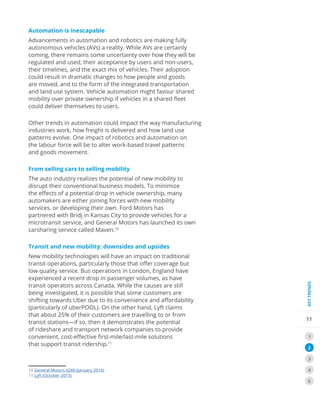
Automation is inescapable
Advancements in automation and robotics are making fully
autonomous vehicles (AVs) a reality. While AVs are certainly
coming, there remains some uncertainty over how they will be
regulated and used, their acceptance by users and non-users,
their timelines, and the exact mix of vehicles. Their adoption
could result in dramatic changes to how people and goods
are moved, and to the form of the integrated transportation
and land use system. Vehicle automation might favour shared
mobility over private ownership if vehicles in a shared fleet
could deliver themselves to users.
Other trends in automation could impact the way manufacturing
industries work, how freight is delivered and how land use
patterns evolve. One impact of robotics and automation on
the labour force will be to alter work-based travel patterns
and goods movement.
From selling cars to selling mobility
The auto industry realizes the potential of new mobility to
disrupt their conventional business models. To minimize
the effects of a potential drop in vehicle ownership, many
automakers are either joining forces with new mobility
services, or developing their own. Ford Motors has
partnered with Bridj in Kansas City to provide vehicles for a
microtransit service, and General Motors has launched its own
carsharing service called Maven.10
Transit and new mobility: downsides and upsides
New mobility technologies will have an impact on traditional
transit operations, particularly those that offer coverage but
low quality service. Bus operations in London, England have
experienced a recent drop in passenger volumes, as have
transit operators across Canada. While the causes are still
being investigated, it is possible that some customers are
shifting towards Uber due to its convenience and affordability
(particularly of uberPOOL). On the other hand, Lyft claims
that about 25% of their customers are travelling to or from
transit stations—if so, then it demonstrates the potential
of rideshare and transport network companies to provide
convenient, cost-effective first-mile/last-mile solutions
that support transit ridership.11
10 General Motors (GM) (January 2016)
11 Lyft (October 2015)
12
KEYTRENDS
1
2
3
4
5
New Government Roles
Successful companies seek out opportunities to disrupt and
revolutionize existing business models. Now, disruptive forces
in the transportation industry are pushing to reshape a sector
that has been dominated by public infrastructure, services
and regulation. Government involvement in some areas of
transportation may be challenged, but services for some
transportation consumers could improve. Governments will
continue to prioritize and protect the public good, but will also
have to accommodate changing consumer expectations and
industry dynamics.
Adapting to new mobility service models
New mobility is difficult to define, and will be even more
challenging to regulate because many emerging service models
are fluid and evolve very quickly. They occupy a middle ground
between traditional public and private transport services,
avoiding neat categories that satisfy today’s transport policies
and regulations. Some service models have created conflicts in
the transportation industry, as new players have either taken
advantage of regulatory gaps or side-stepped existing rules
altogether. The taxi industry, which is facing disruption from
Uber, Lyft and other TNCs, was one of the first sectors to feel the
impact of new mobility. Transit is also starting to see its effects,
and will likely face greater competition over time. Government’s
role in operating transit services may diminish, but its role in
ensuring safety, equitable access and the public good will be
ever more critical.
Data—the new currency
In an increasingly connected world, data will become more
valuable than ever. Smart systems are fueled by data, and new
mobility services could thrive or fail on the richness of their
Rethinking the Public Interest
Conflicts can arise when the
needs of new business models
compete with the needs of
other uses that have enjoyed
long-standing protection under
government regulations. As
an example, Car2Go recently
changed its policies to allow
users to park on Toronto streets
even though they had been
generally limited to city-owned
lots. The company thinks door-
to-door access is fundamental to
making carsharing work for the
masses, and asked the City of
Toronto for a residential parking
pilot program in November
2015. However, Councillors
felt the request would take
too many parking spaces from
residents who rely on street
parking permits, and rejected
the request. Faced with this
challenging decision with difficult
tradeoffs, officials chose to
preserve the status quo, which
prioritizes car-owning residents
over carsharing residents.
Car2Go now absorbs the cost of
all parking infractions within its
costs. As new business models
such as carsharing become
more pervasive, it will be even
more important that regulations
set out an environment that
provides mobility options for all
residents irrespective of how
they prefer to access a vehicle.
13
KEYTRENDS
1
2
3
4
5
underlying datasets. In the technology sector, many emerging
services (e.g. mobile traveller information systems) have
deliberately opted to forgo short-term revenues and subsist
on investor funds, in exchange for a larger market share and
more user information that can be monetized in the long term.
In managing transportation and land use systems, government
has traditionally been the major collector and consumer of
data. However, in a climate of immense competition over data
ownership, government may not be able to keep pace. Loss of
control over data collection will be a challenge, as government
decisions should be informed by the best data available. The
protection of user privacy is another key issue.
New approaches to managing transportation assets
Despite the possibility of a diminishing role for government
in operating transportation services and collecting data,
government will have continued oversight over the built
environment. It will maintain its key role as the owner and
caretaker of urban transportation infrastructure, and may need
to change the ways that it manages those assets. One example
would be if a rise in autonomous vehicles allows more efficient
practices in road design and parking supply. Another example
is the need for governments to reflect potential efficiencies
arising from new mobility services in the business cases
developed for new infrastructure projects. A third example is
the need to monitor new mobility’s impact on the consumption
of transport infrastructure; the over-consumption of roads
depletes both their condition and their quality of service,
leading to greater maintenance costs and unwanted congestion
and environmental impacts. Through its control over the
infrastructure on which conventional and new mobility services
operate, government can manage usage of the transportation
system in a way that ensures overall sustainability.
14
KEYTRENDS
1
2
3
4
5
User Needs and Desires
Users and consumers play a major role in shaping the future
of our cities. Emerging technologies and services can enable
new ways of doing things, but user uptake is what determines
their true value and impact. Technological change presents
new opportunities for the private sector, and at the same time
introduces new challenges for the public sector—notably in
protecting equitable access by all citizens to public services.
In the transportation sector, a key question for government is
how to distribute mobility resources in a way that meets the
mobility expectations of users, while ensuring that all population
segments can access those resources to meet their daily needs.
Higher and changing expectations
Consumers are diverse, and trends in other sectors reveal a
growing consumer expectation to have this diversity catered
to by services tailored to the needs of different population
segments. The internet and mobile applications allow for
even greater personalization of services, as an unprecedented
wealth of information about goods and services is available
online. Coupled with this is the rise of the sharing economy
and an increased acceptance of foregoing exclusive ownership
of some possessions. In transportation, there has been a
rise in carsharing services that could lead to a decline in
personal vehicle ownership.
A generation of mobile seniors, aging in place
Studies indicate that as baby boomers approach retirement,
most expect to “age in place” and continue their historically
high degree of mobility that relies largely on cars.12
Freedom
of movement has played an integral role in the life of that
12 Canadian Mortgage and Housing Corporation
15
KEYTRENDS
1
2
3
4
5
generation, and will continue to influence their future lifestyle
choices. Many baby boomers live in suburbs that are difficult
to serve by public transit, raising the challenge of how to satisfy
their mobility needs when driving is no longer an option due to
health or income constraints. New mobility technologies and
services could help satisfy their needs, but will be tested by the
behaviours and preferences of this influential demographic.
However, unlike previous generations of seniors, baby boomers
are the first to age into retirement as connected internet users.13
With approximately 80% of Canadian baby boomers currently
online, it's possible that many new and emerging technologies
and mobility services will be able to serve this cohort with
little impediment.14
A connected culture
The “millennial” generation is at the forefront of a culture that
expects constant online connectivity, real-time information
and on-demand service. Consumers assume they can access
information on transportation services via the internet as
conveniently as they book restaurants and hotels, listen to
music, share photos and communicate with friends and family.
Mobile traveller information apps and on-demand mobility
services cater to these expectations.
The connected culture has also raised expectations for
customizable products and fast delivery. Consumers have
tremendous power over where, when and whether to buy
goods and services. With the growth in e-commerce, many
13 IPSOS (2012)
14 Statistics Canada (2014)
16
KEYTRENDS
1
2
3
4
5
brick-and-mortar stores are evolving from points of sale into
showcases for brand identities and products. These trends will
impact freight movements and retail-related travel patterns,
with real implications for land use.
On the flip side of the connected culture is a lack of connectivity
experienced by some segments of the population due to the
costs of being online, language barriers, or a lack of technical
know-how. To ensure equitable access to mobility services in a
highly connected paradigm, government will need to support
population segments that have a reduced online presence.
Inequity of access and fragmented service
Rising inequity is a global trend to which the GTHA is not
immune. A changing regional economy and rising housing costs
are leading a majority of lower-income population clusters to
locate outside Toronto’s core, away from higher-order transit
and other centralized resources. Ensuring access and mobility
for these parts of the population will be a challenge, particularly
as transit’s farebox revenues face rising competition from new
mobility services. High levels of personalized services could also
lead to unsustainable transit ridership and a decline in service,
resulting in a fragmented market. As private players in the
market will eagerly respond to the needs of consumers who can
pay, government will need to protect the interests of those who
cannot.
17
KEYTRENDS
1
2
3
4
5
Urban Form and Built Environment
Land use and transportation go hand-in-hand. New mobility
trends are bound to have an impact on the built environment,
and the reverse is also true. Mobility services and conditions
have the power to alter the economics of location decisions
and trip-making within industry as well as households. New
development opportunities could also open up as mobility
demands shift away from infrastructure centred around
the private automobile.
Re-urbanization or re-suburbanization
Urban form could shift in very different directions, depending
on how mobility markets develop and how governments
regulate land use and transportation. Current trends reveal
an interest from today’s younger generation in a more urban
lifestyle. On the other hand, the promise of a more productive
suburban commute in self-driving vehicles could tempt many
who struggle with the higher cost of living in urban centres.
Longer car-based commutes could offer benefits for some, but
would have negative impacts on society and the environment;
the risk of increased urban sprawl is therefore a concern, and
will need to be addressed in transportation and land use plans,
policies and regulations.
Where robots go to work
The rise in robotics and automation, particularly in industry, will
affect where businesses locate and what traffic they generate. In
many areas, the loss of industrial employment due to robotics
and automation has created lower employee densities, and
at the same time reduced labour requirements have allowed
industries to locate farther away from the cities and suburbs
where potential employees live. More remote, lower-density
18
KEYTRENDS
1
2
3
4
5
industrial workplaces are less likely to support efficient fixed-
route transit services—but they could benefit from new mobility
services that are more responsive to demand.
Parking unlocked
Shared mobility service models could decrease parking
requirements in urban areas, particularly on streets and at
major destinations. Users could be dropped off and picked up
without the vehicles they use (particularly autonomous vehicles)
sitting idle in the interim. This dynamic could unlock a significant
amount of land now occupied by parking facilities. Parking lots
and structures could be redeveloped, while on-street parking
lanes could be reclaimed as spaces for walking, cycling, transit
or motor vehicle movement. Governments will have to be
proactive in protecting these reclaimed urban environments;
in the meantime, the future value and repurposing potential of
planned parking facilities should be considered through a new
mobility lens.
Smart parking applications could provide an interim solution
to the growth of existing parking demand. Applications like
Rover15
and WhereiPark16
can help to unlock underused parking
assets by connecting drivers requiring parking with other
users who have parking spaces to offer. Fulfilment of demand
using existing parking may delay the need for construction
of expensive new parking facilities that will quickly become
obsolete. However, opening up a new market of parking spaces
in the interim may also lead to increased demand for driving
as parking constraints have been seen as a limiting factor for
drivers in the past.
15 Rover (n.d.)
16 WhereiPark (n.d.)
19
KEYTRENDS
1
2
3
4
5
An electric future
One new mobility paradigm includes an electrified (or
“decarbonized”) future transportation system that would require
very different infrastructure than today’s petroleum-based
cities. Because electric vehicles are typically charged at home,
work and other destinations, the wide-scale adoption of electric
vehicles would allow lands now occupied by service centres to
be repurposed.
Emissions from transportation made up about 35% of all
emissions in Ontario in 2013, the largest single source of
greenhouse gas (GHG) emissions. More than 70% of the
transportation-related emissions can be attributed to cars
and trucks. A shift towards an electrified transportation
system is expected to contribute significantly to the decrease
in GHG emissions.
Expanding the use of electric
vehicles
Ontario’s Climate Change Action
Plan identifies transportation
as a major action area, and
highlights a number of actions
for the government to take
in the transportation sector,
many of which are related to
creating an electric future.
Actions include maintaining
incentives for electric vehicles,
providing free overnight vehicle
charging, ensuring that charging
infrastructure is widely available,
and making electric vehicle-ready
homes and workplaces a new
requirement.
The Ontario Ministry of
Transportation (MTO) has been
an avid proponent of increased
adoption of EVs in Ontario.
In addition to education and
awareness programs, the
ministry has implemented
an Electric Vehicle Incentive
Program (EVIP) to counter the
current price premium of EVs
as compared to conventional
gas-powered vehicles, and has
also established an Electric
Vehicle Chargers Ontario (EVCO)
grant program to encourage
the expansion of charging
infrastructure across the
province.
20
THEFUTURESOFNEWMOBILITY
1
2
3
4
5
3
21
THEFUTURESOFNEWMOBILITY
1
2
3
4
5
What will the world look like by 2041? Where will people
live, work and go to school? How will people and goods be
transported? Will vehicles be able to roam autonomously?
Would individuals still need to own their own vehicles?
While many futures are possible, the one that arrives will
depend on the progression of key trends, and on the responses
of government, the private sector and transportation system
users. This chapter presents two scenarios developed to
illustrate diverging outcomes of the new mobility paradigm.
The first scenario envisions a future where governments take
a strong stance in directing the evolution of new mobility. The
second scenario envisions a future where governments allow
new mobility trends to develop organically and with little direct
regulation. Both scenarios take into account many different
global and regional trends that were investigated for this report.
The goal of this chapter is not to choose a direction, but rather
to explore two sets of outcomes that define the extremes of
possible opportunities, risks and implications related to new
mobility. In the following diagram the middle portion shows
how various elements of new mobility are likely to interact in the
future given their current trajectories while the panels on either
side describe the network conditions that might arise out of two
divergent response scenarios: a “highly managed” development
scenario and an “organic” development scenario.
3.	 The Futures of New Mobility
22
THEFUTURESOFNEWMOBILITY
1
2
3
4
5
Connected
Vehicles
Autonomous
Vehicles
Convergenceof
Connected and Autonomous Veh
icles(CAVs)
Internet of
Things (IOT)
A
Connected W
orld
Big Data
New
WaystoUn
derstand the
World
Automation
Incr
eased Autom
a
tion
Shared/on-demand mobility services
would be limited to only those services that
complement public transit in a
first-mile/last-mile function, increase per
vehicle occupancy, or satisfy demand in
areas that are difficult to serve with transit.
However, the banning of all other
shared/on-demand services would be
difficult to enforce, and some may continue
to operate outside of regulations. Service
providers that partner with government
would have to enter formal contractual
relationships with government to operate,
making it a challenge for many service
providers, especially smaller ones. Long
procurement processes for retaining services
would make solutions outdated by the time
they are implemented, limiting innovation.
Changing
Industries
and
Manufacturing
LabourMarket
Disruption and R
isingIneuqality
Smart
Parking
Smart
Stations
NewCapab
ilities
Public transit would continue to provide
broad network coverage, with higher-order
or frequent service parts of the network
acting as the backbone. Certain elements of
shared/on-demand services would be
incorporated into the public transit service
offering, such as through microtransit in
areas that have lower demand.
Mobility management would be a central
part of government’s role within transpor-
tation. Service pricing, road user charges,
and taxes would play a fundamental part in
motivating desirable people and goods
movement behaviour. Government may
consider taking a one-window approach for
personal mobility, by integrating all pricing
on one platform, but may face challenges in
operating and maintaining such a system.
The built environment would continue to
be shaped by policies that encourage higher
densities. Mobility management mechanisms
would contribute to discouraging widespread
acceptance of longer commutes as a result
of CAVs. With the expectation of increased
first-mile last-mile and autonomous services,
stations would be re-developed to address
the diminished need for parking at stations.
Evolving
Economy
Changing
Environment
Drivers of Change
Freight and
Delivery
On-Demand
M
obility in Goo
dsMovement
HIGHLY MANAGED DEVELOPMENT
Divergent
to
Imminent
23
THEFUTURESOFNEWMOBILITY
1
2
3
4
5
Ridesourcing
(TNCs)
Ridesharing
Carsharing
Convergence of S
hared/On-DemandMobility
Services
Contactless
Payment
Smart
Tokens
Account-Based Digita
lPayment
Mobility
as a
Service
Integra
ted Mobility
System
Shared/on-demand mobility services
would be allowed to operate freely with
little oversight. With automation, no driver
will be needed, so even individuals would
be able to put their privately owned CAVs
up for sharing, which could introduce
concerns around safety, security and
liability. Driven by profit, pricing may
motivate single-occupant vehicles, and
longer travel distances, resulting in more
driving overall.
Public transit would only remain in corri-
dors where transit is much more competi-
tive in travel time and convenience, or
where intense demand results in autono-
mous vehicle congestion. Other parts of the
network, particularly those with low levels of
service, would have ridership cannibalized
by emerging modes that are more demand
responsive.
The built environment would return to a
trajectory of sprawl as CAVs would enable
commuters to travel longer distances
without the stress from driving and lost
productivity. Transit station parking would
largely become obsolete as most riders will
be dropped off by CAVs, but without a plan
for how to deal with these structures, many
will sit vacant. Similarly, without plans to
accommodate the increase in drop-offs at
stations, station access will be a challenge,
and perhaps a deterrent to transit use.
Mobility management would be difficult
to coordinate with low government over-
sight. Pricing of services would be based
purely on competition, with little regard for
network, or societal impact. Modes and
services that generate the most profit
would be motivated, while low-impact
modes such as transit, walking and cycling
would be less emphasized.
User Needs
and Desires
Demographic
Shifts
Auto
Makers
Financial
Institutions
Information
Companies
New Players and Changing Private Ro
leinMobility
ORGANIC DEVELOPMENT
Responses
an
Future
24
STRATEGICDIRECTIONS
1
2
3
4
5
4
25
STRATEGICDIRECTIONS
1
2
3
4
5
4.	 Strategic Directions
From the analysis of key trends and future scenarios, it is
evident that the arrival of new mobility will bring about major
changes to the transportation system and the region as a
whole. Although many aspects of this coming paradigm remain
uncertain, this change will happen quickly and all levels of
government in the GTHA must be prepared to respond.
This chapter highlights opportunities and risks associated with
the arrival of the new mobility paradigm and identifies strategic
directions that government should consider. The intent of these
strategic directions is not to prescribe an appropriate response,
but rather to garner greater consideration for the implications of
new mobility at all levels.
The opportunities, risks and strategic directions have been
organized under six major themes that correspond to core areas
of action. These themes have been listed below alongside the
key diagram which is used throughout this section.
1
2
34
5
6
Theme 6:
Plan for the "Known Unknowns"6
Theme 5:
All About the Data5
Theme 4:
Driving the Cities We Want4
Theme 3:
The User is King3
Theme 2:
New Mobility is the New Transit2
Theme 1:
Government Re-Imagined1
26
STRATEGICDIRECTIONS
1
2
3
4
5
In this era of technology and innovation, the private sector
has become increasingly involved in what were, until recently,
government services. For several decades, transit in the GTHA
has been managed by municipal and provincial governments,
and used as an instrument of social policy. Government now
needs to re-examine its role and purpose in providing mobility,
an effort that could fundamentally alter the current model
of government as transit operator. It could lead government
toward a role more focused on mobility policy and management,
with more limited, strategic choices about the markets it will
serve directly.
Today, transit systems operate in sparsely populated, low-
demand areas of the GTHA to ensure a basic level of access
and mobility for all citizens. These services often require a
substantial operating subsidy that is funded by property taxes
and transit fare revenues on higher-ridership routes. However,
advanced technologies and data analytics have allowed
the private sector to deploy potentially more attractive and
financially sustainable transportation services in these markets.
Recognizing this, what is government’s role in delivering access
and mobility? Answering this question may require us to
redraw the line between public and private, re-imagining the
government space.
Private delivery of public services is not new, and in fact many of
the earliest transit services in Ontario were privately operated.
However, government must be aware of the risks, opportunities
and implications of a private-sector resurgence in mobility,
and be proactive in clearly defining its role and position. An
added challenge is the pace at which new technologies and
service models are emerging and evolving. Governments will
be challenged to keep pace with the private sector unless they
adopt a more nimble and responsive approach.
One of government’s core goals is to optimize value for society
as a whole. In the case of transportation, the public sector has
done this by providing services when the private sector was
not engaged or did not have appropriate business models.
However, now that the private sector can provide competitive
services (or better) to at least some markets, some public-sector
services may have difficulty competing. The public sector needs
to reassess its service offerings and consider how new service
models can be complementary and contribute to a broader
vision for the GTHA.
Theme 1:
Government
Re-imagined
TheChallenge
27
STRATEGICDIRECTIONS
1
2
3
4
5
•• Rapid innovation. The private sector,
with its more limited mandate and
stakeholders, can often innovate
more rapidly than the public sector.
Involvement of the private sector
in conventional public services
could inject innovation and create
opportunities for more creative and
effective service delivery.
•• Improved service. Emerging service
models focus on greater convenience
and optimized routing, which can
make them more desirable for users.
But rather than competing with
transit, new mobility could provide a
complementary solution to the first-
mile/last-mile challenge and provide
quality connecting services.
•• Reduced draw on government
resources. If the private sector
provides some mobility services,
public operating costs could decline.
Scarce resources could then be
reallocated to other services that offer
greater returns.
•• Sub-optimal societal outcomes.
The private sector does not have a
mandate to achieve optimal societal
outcomes, and sometimes the goals of
business may conflict with the public
good. For example, an excessive
dependence on privately supplied
on-demand services could have
undesirable impacts such as increased
congestion, emissions and energy use.
•• Loss of control. Government may
lose control and oversight over
critical parts of the transportation
system, as the private sector adopts a
greater role in data collection, system
monitoring and service delivery.
•• Lack of internal capability.
Governments may not have the
internal skills and resources to
manage a transportation system that
is increasingly driven by technologies
and data.
•• Revenue shock. Private mobility
services could lead to lower transit
revenue, particularly where they
target high-ridership routes and leave
government running inefficient routes
that could also lose ridership.
Opportunities Risks
28
STRATEGICDIRECTIONS
1
2
3
4
5
[1.1] Picking a lane
The private sector can find ways of providing better mobility
outcomes to individual users, but government must be mindful
how this could impact its ability to achieve its vision and goals
for the GTHA. The public sector must lead—doing nothing is not
an option, because the private sector will look to government
for a policy and regulatory framework and a statement of
government’s role. Inaction will encourage the private sector to
exploit grey areas of policy or regulation. There may be no exact
parallels of a paradigm of innovation challenging government
so fundamentally, but it may help to consider cases where
business has adopted responsibilities in other sectors such as
telecommunications, health care and social services.
Government must be clear in its role and vision for the future,
extending beyond mobility to address many aspects of life in the
GTHA including land use, health, environment and the economy.
The current review of the Growth Plan for the Greater Golden
Horseshoe and the review of the Regional Transportation Plan
offer perfect opportunities for the provincial government to set
a clear direction for the coming decades.
[1.2] Regulating a fast-moving target
Regulatory approaches for emerging modes and services
vary greatly from jurisdiction to jurisdiction, as governments
grapple with how to balance risks and opportunities. While
ridesharing has long been welcomed by many transportation
agencies as a way to increase vehicle occupancy, transport
network companies such as Uber and Lyft seem to challenge
governments due to their fluid ability to provide both
StrategicDirections
29
STRATEGICDIRECTIONS
1
2
3
4
5
ridesourcing and ridesharing services through a single platform.
Many jurisdictions are still contending with issues around driver
insurance, safety and security, accessibility for people with
disabilities, and competition with other modes such as taxis,
transit, walking and cycling.
Senior levels of government can play a role in regulation.
Countries such as Brazil, Spain and Italy have prohibited
transport network companies outright. In Canada, where
municipalities have been generally unwilling to advance
regulation and fill gaps in roles and responsibilities, provinces
could provide guiding frameworks. For example, British
Columbia has temporarily banned transportation network
companies while it develops guidance and potential regulation.
[1.3] Planning versus licensing
New mobility discussions in Canadian municipalities have
revolved around government’s licensing role. This is needed, but
government’s important planning function has often received
scant attention. Regulations must advance in sync with planning
and mobility management functions. For example, Toronto
recently opened the door for transportation network companies
such as Uber to operate in the city, but requires the companies
to share basic data such as the origins and destinations of trips.
This represents progress, but the data will be used for licensing
purposes; it will not provide the information needed to manage
an efficient urban mobility system. Beyond licensing and
operations, new mobility discussions need to take place within
the context of a long-term transportation vision as its impacts
will be lasting and pervasive.
17 City of Toronto (2016)
Progress in Toronto
The City of Toronto recently
developed a new Vehicle-for-
Hire by-law that includes a new
licensing category for private
transportation companies (PTCs).
The by-law sets requirements for
basic data sharing, and regulates
taxicabs, limousines and PTCs
in a way that enhances public
safety and consumer protection
while providing opportunities for
competition and innovation.17
30
STRATEGICDIRECTIONS
1
2
3
4
5
[1.4] Moving from operator to enabler
The public sector will need to rethink its role in transit provision
as the private sector’s market share grows. While GTHA
governments may be able to step back from certain aspects of
transit service, they must continue to shape and direct them
to ensure positive outcomes for the entire region. One way to
do this is to set regulatory parameters within which all service
providers must operate, ensuring that the framework protects
the public interest without stifling innovation. The framework
should also be aligned across provincial, regional and local
governments, because inconsistencies across boundaries or
between areas could complicate GTHA-wide services or create
inefficiencies. All levels of government should be open to
emerging opportunities, and should not rely on past practices to
guide future approaches.
[1.5] Creating new skillsets, processes and partnerships
To succeed in an increasingly technology- and data-driven
landscape, governments will need a workforce development
plan to transition from obsolete skillsets to new capabilities.
Partnerships with the private sector will be critical in areas
where governments lack the experience or resources to
deliver services directly; this will require more flexible
and responsive procurement processes that encourage
private-sector innovation.
31
STRATEGICDIRECTIONS
1
2
3
4
5
[1.6] Experimenting with confidence
Rapid change means there will often be insufficient information
or experience to confidently evaluate options before
implementation. Experimentation, and a willingness to either
succeed or fail, will be essential. Time-limited pilot projects are a
good way to evaluate the impacts of new services or regulations
before adopting more lasting changes. Pilot projects should
consider how a permanent solution would be established if they
succeed, and how lessons learned will be captured if they fail.
[1.7] Innovating through pricing
While the private sector may increasingly deliver mobility
services, the infrastructure those services use will still be owned
and maintained by government. Pricing of infrastructure is a key
tool in government’s toolbox, and enables mobility management
opportunities that could prevent unacceptable congestion and
environmental impacts. Pricing incentives and disincentives
can encourage positive behaviors such as carpooling, active
transportation, teleworking and time shifting. Furthermore,
private-sector involvement will likely move mobility pricing from
a fixed-price regime to more value-based pricing. Government
will need to make its pricing practices more flexible and
responsive to market conditions.
18 Milton Transit (2016)
19 Government of UK (2015)
Pilot-testing innovative access
to GO stations
GO Transit conducted a pilot
test with RideCo to provide
convenient, on-demand first-
mile/last-mile access to the
Milton GO station using on-
demand “personalized mass
transit.” Unlike Uber and Lyft,
RideCo sourced rides through
established transportation
services such as shuttles, taxis
and limousine services to help
commuters reach GO train
and bus services. The pilot has
concluded, and while successful,
there is no clear direction
on how it might become
permanent.18
RideCo currently
operates as a TNC in Kitchener-
Waterloo where the company is
based. From the lessons learned
out of this pilot, Metrolinx is
looking further into how on-
demand services can be used in
coordination with existing transit
services.
Road testing
The United Kingdom’s Centre
for Connected and Autonomous
Vehicles has allocated £100
million towards an intelligent
mobility fund. Part of the
funding will go towards trials
of connected and autonomous
vehicles so the government
can learn the implications of
the technology, and to identify
regulations needed to ensure
the technology’s deployment in a
manner that benefits the UK. 19
32
STRATEGICDIRECTIONS
1
2
3
4
5
Theme 2:
New Mobility
is the New
Transit
Emerging technologies, the sharing economy and innovative
business models are likely to have disruptive impacts on public
transit, but also present opportunities to improve transit
elements such as traveller information systems and demand-
responsive services. Transit can continue to flourish if it
embraces change and adopts new business practices. However,
because benefits for individuals can come at the expense of
broader societal benefits, transit systems will need to consider
how new mobility service models can be successfully integrated.
The sharing economy and on-demand services have already
begun to change the GTHA’s mobility landscape. Transportation
network companies (TNCs) integrate both of these elements,
and their rapid success has disrupted the taxi industry. TNCs
have been able to undercut the cost of traditional taxis while
providing more effective matching of drivers and passengers,
user-friendly mobile apps, advanced algorithms, improved
traveller information and streamlined payment mechanisms.
Some TNCs are operating semi-fixed route services during peak
periods, and enabling users to open up their rides to others.
These services are increasingly encroaching on the realm of
public transit, but with a more dynamic and convenient offer.
While public transit may risk losing ridership to emerging
services in certain markets, this shift in service provision
provides an opportunity for transit agencies to focus transit
in areas where it is most effective. Autonomous vehicles are
expected to further accelerate the impact of TNCs on transit,
as new operating models expand the range of geographies and
customer volumes that can be served profitably.
TNCs may be capable of replacing conventional transit in some
markets, particularly low-density areas where inadequate
demand makes fixed routes costly and ineffective. However,
in denser areas where public transit thrives, broad use of
on-demand services could be detrimental. When regulating
TNCs and other new mobility service models, government
must carefully consider their possible range of impacts
on quality of life.
TheChallenge
33
STRATEGICDIRECTIONS
1
2
3
4
5
•• Safety for all users. The most
immediate benefit of autonomous
vehicles and related driver-assistance
technologies is improved safety for
motorists and other street users. This
change could make on-road cycling
more comfortable for a broader
demographic to use it regularly.
•• Improved traveller information.
Dynamic traveller information systems
can keep users updated about
transportation conditions.
•• Optimized travel patterns. Advanced
data analytics and route assignment
or service deployment algorithms have
the potential to help optimize travel
patterns. Instead of all users striving
for individually optimal solutions,
coordination could permit a more
system-optimal outcome.
•• First-mile/last-mile access. New
mobility models can fill market gaps
that transit has found difficult to serve.
First-mile/last-mile trips have been a
particular challenge for conventional
transit services in lower-density areas.
The flexibility of on-demand feeder
services makes them an excellent
complement to conventional transit.
•• Lack of influence over algorithms.
Algorithms will drive new mobility
service models. Without input into
how algorithms are written, it will be
difficult for government to maximize
the chances of socially optimal
outcomes.
•• Lack of influence over data. A wealth
of data will be collected by private
entities involved in new mobility.
Not owning this data means that
government will need to work hard to
access it and influence how it is used.
•• More driving. More direct and
convenient car-based mobility options
(e.g. TNCs and automated vehicles)
that draw travel demand away from
transit, walking and cycling could
increase overall vehicle-kilometres
travelled.
•• Workforce impacts. Government
workforces may not possess the
skills to integrate and leverage new
mobility data analytics, algorithms and
operating models. TNCs have already
impacted jobs in the taxi industry
by relying on casual and affordable
labour, and autonomous vehicles
would dramatically change the role of
vehicle operators.
Opportunities Risks
34
STRATEGICDIRECTIONS
1
2
3
4
5
[2.1] Keeping a network perspective
Door-to-door transport is undeniably attractive from a user
standpoint, but must also be viewed through the lens of how
it will impact the GTHA’s transportation network and quality
of life. A proliferation of new mobility services will require all
levels of government to adopt a strong role in managing the
overall network while harnessing technology and innovation,
and to find ways of integrating new models of service into the
transportation system. Walking, cycling and public transit will
remain crucial to alleviating congestion and keeping the region a
desirable place for people to live and work.
[2.2] Supporting the transit backbone
New mobility service models could disrupt and even replace
elements of the public transit system, but could also
complement and be integrated with existing transit services
to make the transportation system better. It is crucial that
existing higher-order transit services continue their role as the
backbone of the transportation system, and that new mobility
services focus on acting as first-mile/last-mile feeders. Fixed-
route rapid transit will likely remain the most efficient and
sustainable transport option for densely populated areas, but
highly subsidized transit services in lower-density areas will be
less able to compete with new mobility services once they are
adopted more broadly. In those areas, government will have to
decide how dynamic on-demand services can be incorporated,
either by working with new mobility businesses or developing
their own.
20 Lyft (2016)
21 Ford Motor Company (2016)
Bridging the gap with first-
mile/last-mile services
There are numerous examples of
on-demand services being pilot
tested by government agencies
in partnership with private
companies.
In the United States, Lyft has
partnerships with a number
of transportation authorities.
California’s Metropolitan
Transportation Commission
delivers carpooling services
through Lyft’s Carpool mode
which (unlike its better-known
ridesourcing services) helps
commuters find carpool partners
with similar routes, and allows
individuals to use online cost-
sharing for their trip.20
In Kansas City, Ford Motors and
Bridj have partnered to provide
an on-demand microtransit
service that complements other
forms of transportation. The
service has designated pick-up
drop-off locations near Kansas
City Transit stops and bike-share
stations, making it easy for riders
to seamlessly continue their
trip.21
StrategicDirections
35
STRATEGICDIRECTIONS
1
2
3
4
5
[2.3] Making a business case for transit
From a pure cost-recovery perspective, some transit
investments may not seem viable. However, transit’s social
benefits must be accounted for in business case appraisals,
which should consider carbon costs, health benefits, community
resilience, road safety and congestion relief.
[2.4] Adapting the workforce
The emergence of TNCs has already had labour impacts on the
taxi industry and automation has resulted in many waves of job-
loss across North American labour markets.22
With the onset of
on-demand transit services and autonomous vehicles there will
undoubtedly be some impact to the public transit industry, with
vehicle operators likely to be the most affected. In the GTHA,
guided rail systems will likely be the first to feel the impact of
automation with the implementation of Automatic Train Control
in the Toronto Transit Commission (TTC) subway system. To
minimize the resulting disruption, transit systems should seek
opportunities for their workforces to acquire new capabilities
that will support the evolution of transit. Customer service,
maintenance, emergency response, and other areas that are
more challenging to address with preemptive solutions will likely
remain within the jurisdiction of the human labour force.
22 Ticoll, D (2015)
36
STRATEGICDIRECTIONS
1
2
3
4
5
[2.5] Avoiding zero-occupant vehicles
Average vehicle occupancy has remained low for decades,
as single-occupant vehicles have become the norm. The
emergence of autonomous vehicles could further exacerbate
this by introducing zero-occupant (i.e. driverless and riderless)
vehicles, which in theory could roam the streets continuously.
Widespread private ownership of autonomous vehicles could
be a major contributor to this threat, particularly in areas like
downtown Toronto where drivers might (if the law permits)
allow their vehicles to roam the streets rather than pay high
parking prices. In contrast, the use of autonomous vehicles in a
shared and integrated mobility model would have predictably
more beneficial outcomes for the GTHA, and should be
supported over a private ownership model through regulatory
mechanisms. Demand management mechanisms that have
been used to curb single-occupant vehicle use under the current
paradigm will have to be re-evaluated to ensure their continued
effectiveness as autonomous vehicles enter the market.
37
STRATEGICDIRECTIONS
1
2
3
4
5
Mobility as a Service (MaaS) in
action
A pilot MaaS system called UbiGo
was tested over six months
in Gothenburg, Sweden. The
service provided 70 paying
households with access to public
transit, carshare, car rental,
taxi and bikeshare all through
a single platform, for a package
price. At the end of testing, no
household had dropped out of
the pilot, and many wanted to
continue using the service.23
[2.6] Providing one-window access
Integration between existing public transit and new mobility
services will be crucial to making a shared transportation
system function effectively. To reinforce the seamlessness of
the network, government should take on a leadership role in
developing a strategy for coordinated pricing and operation
among various service providers, administered through a
single portal. One approach could be to develop a Mobility as
a Service (MaaS) platform that integrates a range of mobility
options and gives users a single point of coordinated access.
Developing and operating a MaaS platform would be a
different role for government, but would allow it to retain
influence over the pricing and management of regional
mobility. As with any shift towards unfamiliar territory,
development of IT solutions such as a MaaS platform internally
comes with certain risks that government will have to contend
with. As more becomes known of MaaS platforms and the
changing labour profile within the public sector, government
will be able to better assess how to best balance between
influence over the system and risks associated with managing
the unknown.
23 UbiGo (2016)
38
STRATEGICDIRECTIONS
1
2
3
4
5
Theme 3:
The User
is King
Transit systems are adapting to a new world of rising consumer
expectations, accelerating product personalization, ubiquitous
mobile devices, and internet-enabled real-time information.
They are increasingly focused on the user experience, and rely
on marketing and engagement strategies to attract and retain
customers. Alternative transit services (whether publicly or
privately delivered) are filling gaps where conventional services
are not meeting customer needs and desires.
Users’ diverse mobility preferences are also shifting due to
technological, economic and demographic trends. Today’s
young adults own fewer cars than previous generations have
and are generally more concerned with their connectivity
to the internet.24
In response, on-demand ridesourcing and
carsharing have emerged as convenient and affordable
alternatives that keep users connected physically with the help
of digital connectivity.
Even as these changes take place, access to and affordability of
mobility services remain key priorities for users. Individuals that
are unable to drive, such as older adults, youth and people with
disabilities, remain disadvantaged from a mobility perspective;
this is particularly true in suburban and rural areas with lower
levels of transit service. The need for all residents to have
mobility options, regardless of their location, income, age or
ability, will continue—however, increased market segmentation
and service personalization bring with them the risk that certain
market segments could see less service, rather than more. Some
disadvantaged groups, such as seniors, could be impacted more
than others.
24 Environics Analytics (2015)
TheChallenge
39
STRATEGICDIRECTIONS
1
2
3
4
5
•• Openness to shared mobility.
Current trends in various sectors point
to a general openness towards the
adoption of shared mobility.
•• Personalization of service offerings.
New technologies and mobility service
models are well suited to provide
desirable types and qualities of
services, and to compete with privately
owned cars.
•• Improved network coverage and
geographic equity. Dynamic services
could reach a broader user base,
including those who live in areas of the
region that have been more difficult to
serve effectively with public transit.
•• Access to user data. Users have
been open to sharing some personal
data, which is critical to the success of
dynamic on-demand services.
•• Personal versus societal benefits.
The personal benefits of on-demand
mobility services could challenge
the societal benefits of a more
coordinated and balanced mobility
system.
•• Marginalization of “offline”
individuals. With most new mobility
service interactions occurring through
the internet using mobile devices,
there is a risk that parts of the
population that are poorly connected
may have reduced access to transport
services.
•• Inequitable access to services. More
convenient on-demand services may
come at a higher cost to users. While
this may be an attractive trade-off for
many users, some will likely be priced
out of vital transport services unless a
subsidy is provided.
•• Lack of consideration for universal
access. Preserving accessibility for
seniors and people with disabilities
may not be a priority for private
operators.
Opportunities Risks
40
STRATEGICDIRECTIONS
1
2
3
4
5
[3.1] Focusing on users
How travellers respond to change, and whether government
improves its understanding of user behaviours and sentiments,
will help shape the emergence of new mobility models. Data-
enabled mobility services could lead to more refined market
segmentation and the emergence of more tailored solutions
with the potential to improve service across various groups and
demographics. While many indicators point towards consumer
acceptance of shared and on-demand mobility services, this
could change with environmental or socio-economic shifts.
Public support for a regional transportation vision will also be
important to ensure that sustainable mobility remains a top
priority even in changing political climates; it is critical for users
to be informed about the implications of their mobility choices.
It will be particularly challenging to build user awareness of
these broader implications, even as the attractiveness of new
services grows.
[3.2] Ensuring equitable access
Even though government’s role in providing mobility may
evolve, it should continue to play a role in mobility pricing and
targeted service provision to support an equitable distribution of
benefits for travellers regardless of their demographic, location
or trip timing. Emerging new mobility service models should
provide the tools to make equitable access a reality, but that
objective is not a natural priority of profit-driven companies. The
adoption of autonomous vehicles will make equitable access
across geography and time easier to accomplish, but individuals
without reliable internet connectivity or online skills will be
excluded. The ability to access mobility services without the
internet should remain.
StrategicDirections
41
STRATEGICDIRECTIONS
1
2
3
4
5
[3.3] Designing for universal access
New technologies have the potential to remove mobility barriers
for the elderly and people with disabilities, and should be
designed into delivery solutions. From driverless vehicles to
accessible smart stations, an array of solutions could improve
universal access.
[3.4] Striving for personal mobility
The convenience of cars is difficult to match, but personalized
mobility could help break our long-held attachment to the
personal automobile. Diverse consumer needs require diverse,
nimble and adaptable services, and emerging technologies
make it possible for transportation to be a much more personal
experience. The use of personal identifiers (e.g. smartphones
or smart tokens) over an integrated platform (e.g. MaaS) will
give travellers access to a mix of mobility options that are
tailored to their needs. From a social standpoint, account-
based personal mobility also provides a mechanism for
government to provide targeted subsidies to individuals who
are in need, without compromising the cost-recovery potential
of the greater network.
42
STRATEGICDIRECTIONS
1
2
3
4
5
Theme 4:
Driving
the Cities
We Want
How people travel is strongly influenced by aspects of the built
environment such as land use patterns and transportation
infrastructure. While the GTHA’s post-war growth was
characterized by low-density, automobile-oriented development,
in recent years planners have emphasized active and sustainable
modes of transportation such as walking, cycling and public
transit. Approaches to physical planning such as transit-oriented
development (TOD) and complete streets have been successful
in facilitating more walking, cycling and transit use, as well as
allowing public transit to be provided more efficiently.
Changes in transportation technology and user preferences
that will accompany new mobility are expected to create
opportunities for changing our urban, suburban and rural built
environments. Emerging travel options such as carsharing,
ridesharing, on-demand services and autonomous vehicles may
require new or adapted infrastructure. Convenient on-demand
services could lead fewer people to drive alone and park their
car at their destination, reducing parking demands at rapid
transit stations and travel destinations, and permitting a new
view of the urban realm. At the same time, more buildings may
need convenient pick-up and drop-off areas. Automated vehicles
may enable more efficient use of road space and greater road
safety, allowing improved walking and cycling facilities and more
shared use spaces. Freight movement could also be impacted,
leading to changes in the nature, design and location of goods
movement infrastructure.
Widespread use of autonomous vehicles could hinder urban
intensification, which is a provincially directed policy goal of
governments across the GTHA. Access to driverless cars could
increase the acceptability of long car commutes, and thus
encourage more development outside major centres; it could
also undermine efforts to increase land use densities around
rapid transit stations.
TheChallenge
43
STRATEGICDIRECTIONS
1
2
3
4
5
•• Improved geographical access. On-
demand transportation services could
improve transit service in low-density
areas of the GTHA.
•• Reclaimed space for redevelopment.
Autonomous vehicles and on-demand
services may reduce parking demand,
allowing redevelopment of parking
areas into more people-oriented
environments.
•• Less cluttered streets. Automated
vehicles could reduce the need for
car infrastructure, opening up new
opportunities for multimodal facilities
and shared use spaces.
•• Increased sprawl from acceptance
of longer commutes. Autonomous
vehicles may increase commuters’
willingness to travel long distances,
leading to greater emissions and
infrastructure costs.
•• Mismatch of land use policies
and emerging infrastructure
needs. Existing land use policies, if
unchanged, may constrain innovation
and adaptation to new transportation
technology.
•• Competing demands over reclaimed
space. Conflicts could arise among
different user groups in competing for
limited funding and physical space.
•• Obsolescence of current plans.
Today’s planned infrastructure
investments will be made over the
next decade, at the same time that
emerging new mobility models might
indicate different or conflicting needs.
•• Impacts to human health. The
convenience of automated and on-
demand mobility may detract from
healthy and active modes of transport
such as walking and cycling.
Opportunities Risks
44
STRATEGICDIRECTIONS
1
2
3
4
5
[4.1] Planning proactively with a clear vision
To address the opportunities and risks presented above, GTHA
governments need to proactively anticipate how the movement
of people and goods might change in the future. A vision for
planning should leverage technological change, rather than
being subjected to it. For example, policies should address the
possibility that developable land could be freed up by reduced
parking demands.
[4.2] Reclaiming space for active and sustainable modes
If reduced demands for on-street parking make some road
space available for other uses, municipal governments should
make it a priority to reclaim this space for active and sustainable
modes, or urban space, instead of releasing it as additional road
space for cars.
[4.3] Integrating land use and transportation policy
While optimizing transportation efficiency and maintaining
mobility choice should remain future priorities, it will also be
necessary to preserve public safety, build people-oriented
places, and protect the natural environment. Transportation and
land use will need to be considered as an integrated system.
For example, an appropriate combination of incentives and
disincentives may be needed to minimize sprawl and congestion
resulting from the adoption of automated vehicles.
25 Passenger Transport Executive Group (2011)
26 International Making Cities Livable (n.d.)
Implementing a vision
Street layout, residential density,
and the location of services
were carefully planned for the
new community of Hammarby
Sjöstad in Stockholm, Sweden.
Now nearing completion, the
development will be home to
24,000 people and 4,000 jobs,
and has already met the target
for 80% of trips to be made by
non-car modes.25
Return to a human scale
Freiburg, Germany has
maintained a clear vision
that includes human-scale
development, community
participation and priority for
public transportation since the
city was rebuilt following World
War II. As a result, the city is now
recognized as one of the most
livable and sustainable in the
world. 26
StrategicDirections
45
STRATEGICDIRECTIONS
1
2
3
4
5
Planned obsolescence for
parking
With the expansion of the GO
rail service, there has been a
dramatic increase in parking
demand at GO Stations. As
stations become increasingly
space-constrained, more and
more structured parking has
been built. In recent years, 2,800
parking spaces have been built
per year at an approximate cost
of almost $5,600 per surface
parking space and $33,800 per
structured parking space.27
As new mobility changes how
people get to stations,, this
investment will need to be
carefully reviewed to ensure
value for money and that built
structures will be designed for
dissassembly or adaptive reuse
in the future.
[4.4] “Futureproofing” infrastructure
Future government projects and plans should be assessed
through the lens of new mobility to minimize the risk that
major investments (e.g. freeways or rapid transit lines) could
be rendered obsolete. This “futureproofing” of infrastructure
may raise the bar for projects to be considered worthy of
implementation, may require stronger links to land use planning
to ensure ridership supports the investment, and may require
more flexible transit station designs that can be adapted to
the shifting circulation and parking needs of emerging access
modes. It will also be important for design standards and zoning
(e.g. for parking and freight loading facilities) to be regularly
reviewed to reflect changing conditions.
27 (Metrolinx, 2015)
46
STRATEGICDIRECTIONS
1
2
3
4
5
Theme 5:
All About
the Data
New mobility systems will give transportation practitioners
and service providers a higher volume of detailed data for
planning, analysis and overall decision making. Big data fuels
these processes, and while its use will also demand new skills,
the insights it provides is well worth the effort. By allowing
more refined analysis and market segmentation it will permit
more tailored solutions that better meet the needs of various
customer groups.
Smartphones represent a significant tool for responding to
mobility issues. They allow users to share services, crowd-source
information on collisions and service interruptions, and plan
and modify trips based on real-time information. Today’s critical
mass of smartphone users has allowed transit systems and
private companies to offer on-demand services as an alternative
to fixed-route, fixed-schedule transit routes.
The quantity and nature of mobility data being generated,
stored and processed produced have brought increased
attention to the field of data management. Concerns have
been raised around personal privacy and safety related to data
security. In many areas, the ownership and treatment of data
are poorly defined, as is the role of government in managing key
processes and databases.
TheChallenge
47
STRATEGICDIRECTIONS
1
2
3
4
5
•• Better decision making. Big data
will provide broader, more detailed
data to inform planning decisions and
support more tailored solutions that
benefit users regardless of income,
geography and lifestyle.
•• Dynamic services. Live information
feeds to travellers and service
providers will allow transportation
systems to be more flexible and
adaptive.
•• Usage-based strategies. Data
generation and monitoring will enable
new policy tools for transportation
demand management such as
mileage-based car insurance
premiums or incentive programs for
active transportation.
•• Loss of access to data. Privatization
of some mobility services could result
in governments losing control of and
access to data.
•• Increasingly complex data
management. The volume and
multiple streams of data could make it
difficult to manage effectively.
•• Disconnects with historical data.
As technologies advance, continuity
may be lost between older and newer
datasets.
•• Privacy and security vulnerabilities.
New vulnerabilities may emerge
related to data security and public
safety, particularly where there is a
mix of publicly- and privately-held
data.
Opportunities Risks
48
STRATEGICDIRECTIONS
1
2
3
4
5
[5.1] Adopting a data stewardship role
The source, format and ownership of mobility-related data will
likely continue to change as new services and technologies
emerge. By acting as stewards of mobility-related data,
GTHA governments can work to maintain its integrity,
security and openness.
[5.2] Seeking data partnerships
Although government has traditionally played a major role in
the collection of transportation data, the private sector has now
surpassed it. With the mobile devices of platform users acting
as probes and sensors, companies have been able to collect a
rich assortment of data about transportation system users. This
data is invaluable to government in informing decisions and
future plans, and all levels of government should seek access to
it through partnership agreements.
28 Government of Ontario (2016)
Open data
Government bodies around the
world have created open data
portals to enable public access
to government data. In the
United Kingdom, Transport for
London (TfL) has an open data
policy and shares traffic, incident
and public transport data. It
encourages software developers
to use the data to provide
travel information in innovative
ways that benefit road and
public transport users. TfL also
stewards the data by establishing
terms and conditions of use that
developers must adhere to.
Ontario has taken a first step
towards enabling open data
with the Open Data Directive.28
However, more work needs to be
done. With so many ministries
and municipalities in the
province, coordination between
all data generators and users will
be required. The province must
take a leadership role.
StrategicDirections
49
STRATEGICDIRECTIONS
1
2
3
4
5
A wealth of data
Mobile traveller information
applications such as Waze,
Transit App, Moovit and
Citymapper collect data actively
through user interactions,
and passively as users go
about their travel. Waze, in
particular, gathers up-to-date
traffic information through
data points generated by users’
smartphones to provide up-
to-date traffic and navigation
information to the broader
network. The Waze Connected
Citizens Program provides a
mechanism for government
agencies to partner with Waze to
exchange data.29
[5.3] Transforming government information and analytics
With the ability to openly access or exchange data, public- and
private-sector mobility service providers can offer tailored
solutions to different user groups. Government should make use
of mobility-related data to inform its plans and decisions, and
should ensure that affordable and accessible options remain
available to disadvantaged groups. With great uncertainty
around how transportation will take shape in the future,
government can also leverage the available data to make better
use of scenario planning techniques and improve understanding
of longer-term planning and operational impacts.
29 Waze (n.d.)
50
STRATEGICDIRECTIONS
1
2
3
4
5
Theme 6:
Plan for
the “Known
Unknowns”
Global economic and political uncertainties, climate change,
technological advances and generational shifts all guarantee
that change will be constant. Governments are likely to
be increasingly challenged by these disruptive trends, and
transportation systems need to be flexible and responsive if
they are to prove resilient.
Societal changes will place new demands on the transportation
system. As our population ages, the mobility needs of many
people will shift. Rising income disparity is another factor
broadening the range of services and lifestyles that different
groups need, want or can afford.
In recent years, stronger consensus around environmental
degradation and climate change has increased the priority
of emission reductions and other “green” strategies. Support
for environmental sustainability is particularly strong where
synergies exist with public health and quality of life, such as in
the potential of active transportation to reduce emissions and
fight chronic illness. As a low-tech solution, active transportation
is also perceived as more resilient than motorized modes that
rely on external energy sources and advanced communications.
TheChallenge
51
STRATEGICDIRECTIONS
1
2
3
4
5
•• Flexibility and responsiveness.
Through vigilant monitoring,
government can identify ways to take
advantage of new or shifting trends as
they emerge.
•• Sharing and learning. Changes in
mobility are being felt across Canada,
and especially in large communities.
There is an opportunity for Metrolinx
to share concerns, strategies and
experiences with other major
planning and transit authorities across
Canada including Montréal's Agence
métropolitaine de transport (AMT) and
Vancouver's TransLink.
•• Inability to keep pace in a
changing world. The inertia of
existing processes could challenge
government’s ability to keep pace in a
rapidly changing environment.
•• Obsolescence of current
infrastructure. Changes in the
mobility and environmental
landscapes may render current
infrastructure obsolete.
•• Network vulnerabilities to
disruption. Disruptions are possible
from both natural and human sources
such as severe weather, network
outages and cyberattacks.
Opportunities Risks
52
STRATEGICDIRECTIONS
1
2
3
4
5
[6.1] Steering into the wind
In the face of uncertain conditions, a strong sense of direction
for mobility-related objectives can help support the GTHA’s
economic, social and environmental aspirations. There is a
need for government to retain control of vital policy tools
such as financial incentives and disincentives, and to apply
them in meeting objectives. New technologies and service
models should be evaluated critically in terms of their support
for the regional mobility vision and be linked to strategic
objectives. As new directions are taken, government should
ensure that regulations and public sector skillsets are updated.
Similarly, policies should not be so specific that they only
capture the current landscape, and should be broad enough to
accommodate new developments. Assumptions and standards
should be reviewed periodically and adjusted according to the
latest conditions and outlooks.
[6.2] Addressing climate change
Urban form and mobility must be put in the context of climate
change, which is the most significant strategic risk facing
Ontario and its inhabitants. Mitigation is one priority, and
involves taking steps to achieve provincial emission reduction
targets. Adaptation is a second priority, and involves preparing
for a warmer climate that will bring more frequent and severe
weather events, and place extra burden on many aspects of our
infrastructure. Many related decisions will have to revolve not
around what people want their mobility system to be, but what
they need it to be.
StrategicDirections
53
STRATEGICDIRECTIONS
1
2
3
4
5
[6.3] Raising the bar for new infrastructure and services
Planning for the unexpected does not require prescience, but
it does need a cautious attitude and flexibility in anticipating
change. Major infrastructure investments should be considered
carefully in light of emerging trends. Where possible,
infrastructure should be designed keeping adaptation to future
technologies and service models in mind.
[6.4] Creating redundancy
A more diverse offering of modes could help keep the GTHA
moving when disruptions occur. The broad efforts of various
governments to reduce reliance on private cars and fossil fuels
will help, but it is also important to consider the resiliency
of the other modes that will attract new users. Policies that
support complete streets and active transportation should be
strengthened, because human-powered modes are as adaptable
as they are beneficial. As ridership grows, redundancy should be
built into the transit network to protect its access to energy and
communications.
[6.5] Planning to keep the region moving
New mobility, by design, is dependent on technology and
constant internet connectivity. This represents a vulnerability
to cyber attacks and electricity blackouts, among other threats.
These risks need to be mitigated. Governments must work with
service providers to ensure that backup systems and improved
cyber-security will guarantee robustness.
30 BBC News (2016)
Moving beyond disruption
Heavy reliance on digital services
and internet connectivity
has made the possibility of
network outages a concern in
many sectors. As mobility is
increasingly internet-enabled,
contingency plans must ensure
that the GTHA can keep moving
in face of such disruptions.
For example, many services
dependent on the cloud
computing division of Amazon
experienced a recent outage due
to severe weather in Australia.
The affected services ranged
from food delivery to ticket
selling to carsharing service.30
54
MOVINGFORWARD
1
2
3
4
5
5
55
MOVINGFORWARD
1
2
3
4
5
5.	 Planning for Change
This report frames current thinking on the issues, opportunities
and forces at play in the emergence of new mobility. By looking
forward at how different trends and scenarios could evolve, it
identifies broad strategic directions that are of interest to a wide
range of new mobility stakeholders.
To support the update of the GTHA’s Regional Transportation
Plan, this concluding chapter highlights several high priority
areas where future work could bridge gaps in current research
or otherwise inform government transportation policy.
Protecting the Public Interest
The changing mobility landscape will have implications for public
policy and supporting research including the following key areas.
Regional policy and regulation
An ownership model of new mobility-continuing and expanding
the current model based on private vehicle ownership–would
have major implications for the GTHA’s transportation system
and policy framework. In this model, vehicle owners and service
providers would play a key role in shaping travel patterns and
their impacts, especially changes in the amount of motor vehicle
travel and government’s ability to shape outcomes for the
56
MOVINGFORWARD
1
2
3
4
5
benefit of society. Research is needed to understand how the
effectiveness of different policy levers would change depending
on the model and mix of ownership.
For example, mobility pricing is a key policy tool but
government’s influence could diminish with a greater range
of private-sector mobility offerings that compete with transit
and are market priced. Data ownership, access, sharing and
security are key areas of research that must span the public
and private realms. Research is also needed on where and how
government can best invest its limited resources to influence
industry practices—for example, in the area of travel planning
the role of government could range from creating its own tools
to creating frameworks and standards that guide the work of
others. Research could also explore policy models for Mobility as
a Service (MaaS), addressing issues such as organizational roles
and priority strategies to ensure effectiveness.
Rapid transit network planning
New mobility trends highlight the need for new tools and
approaches for rapid transit network planning. Dynamic and
uncertain circumstances call for scenario planning tools that
can quickly assess policy and infrastructure options, both for
strategic purposes and to monitor the plan’s progress and
shifting context. At a project level, evaluation tools and business
cases will need to consider how new rapid transit lines, transit
stations and parking structures can respond to a changing
environment, and what role is played by factors such as the
level of of public acceptance of on-demand mobility services and
autonomous vehicles, and how it impacts the degree and timing
of possible uptake. Financial models will need to be sensitive
to a range of revenue and service approaches, including
disruptive ones. Similarly, traditional transportation models will
need upgrading to more accurately assess the impacts of new
mobility choices and services on individual behaviours and the
broader transportation system.
Operations and business models
Underpinning the Regional Transportation Plan will be the
need for a better understanding of new mobility practices
and business models. While international experience is highly
varied, work can be done to bring together good examples of
new mobility offerings and lessons learned, such as the Milton
GO Connect service, Kutsuplus in Helsinki or Bridj in Kansas
City, Boston and Washington, D.C. Government will also need
to monitor trends in the automotive, financial and information
technology sectors to ensure the ongoing relevance of plans.
57
MOVINGFORWARD
1
2
3
4
5
Mobility pricing
The integration of transit fares across the region, to create a
unified and logical fare structure for transit trips regardless
of the operating agency, has become an increasingly urgent
priority. The discussion has become more complex with the
arrival of new mobility. Government policies around transit fares
must continue to balance social, economic and environmental
objectives, while also considering new market forces. Research
is needed to build a better understanding of mobility pricing
across modes and operators (e.g. bikeshare, parking), advanced
transportation modelling, and private-sector business models
for public mobility. Work is also required to decouple social and
transportation policy objectives so that both can be pursued in
an integrated and effective manner. For example, technology
now allows for a consistent approach to fares, while concessions
to different user groups can be applied to qualifying individuals.
These subsidies can then be explicitly accounted for in the
appropriate operating budget.
Next-generation transportation demand management
TDM tools such as road or cordon charges have the potential to
be a key lever of mobility policy in limiting the growth in vehicle-
kilometres travelled that could result from new technology
and service models. Work is needed to explore new ways of
managing demand and their potential effectiveness.
Parking management
Parking is an area that faces significant potential disruption
from new mobility, both in terms of pricing and in the nature
and extent of required infrastructure at GO stations and across
the region. Within the broader topic of mobility pricing, parking
pricing could be a key policy lever in managing demand. Areas
of research could include how on-demand mobility services
and autonomous vehicles could impact parking demands
and operations; of particular interest might be the impacts
of a mixed vehicle fleet on the timing, layout and possible
repurposing of transit stations, parking structures and access
streets.
Urban freight
The automation of urban freight and the possible convergence
of goods movement with personal mobility could raise a host of
policy issues. Monitoring developments in the freight industry
will be increasingly important to regional modelling and policy
frameworks.
58
MOVINGFORWARD
1
2
3
4
5
Active transportation and safer, more complete streets
New mobility has the potential to reshape how public rights-
of-way are used, and could lead to the reallocation of road
space. Policy consideration should be given to how to best
use road space, and how to repurpose roads over time in a
way that balances public and private mobility with wider civic
needs. Understanding the changing context of safety will also be
important to street design and operations.
Working Together in New Ways
A key finding of this report is the emergence of a wide range
of new players in the mobility field, and the changing balance
of public- and private-sector roles. There is an urgent need for
cultural change in how government views its role in mobility
and how it engages with external stakeholders. There is a need
for greater collaboration among different levels of government,
between government and the private sector, and even within
the private sector.
Government collaboration
New mobility is disruptive, and the response of government so
far has been fragmented and unfocused leading to a range of
strategies. Canada’s federal and provincial governments have
been more active in the realm of autonomous vehicles, while the
impacts of transportation network companies have largely been
met by wildly different approaches of municipal governments.
There is an opportunity to share initiatives and collaborate
in research and policy development; in particular, Montréal’s
Agence métropolitaine de transport (AMT) and Vancouver’s
TransLink have mandates and experiences that support their
continued engagement with Metrolinx. Other municipalities,
regions and provinces can also engage on the topic, with scope
for a greater provincial role and more coordinated action across
municipalities. This could include identifying areas of research
and policy development, and clarifying the appropriate roles of
different jurisdictions in areas such as road safety, data analytics
and security, and new transit business models. Of particular
concern are inconsistent approaches across boundaries
or between jurisdictions that could create inefficiencies or
complicate GTHA-wide services.
59
MOVINGFORWARD
1
2
3
4
5
Partnering with the private sector
Government’s role in mobility is changing rapidly and a new
approach to engaging with the private sector will be needed in
areas ranging from procurement processes to the coordination
and delivery of different services. Research is needed on
different partnership models, their successes and failures, and
lessons learned. Government will need to better understand
industry dynamics in the mobility space and to monitor the
evolution of business models and strategies, particularly in the
automotive, financial, information and logistics sectors.
A culture shift
In the context of the Regional Transportation Plan, re-imagining
the role of government when it comes to innovative approaches
such as Mobility as a Service (MaaS) means regulating service
providers in a way that protects the public interest without
stifling innovation. For transit operators, it means moving from
their traditional role as train and bus operators into a new role
as mobility managers and enablers. It will be important for
government to be strategic in where it engages, and to maintain
a clear policy direction on what factors it wishes to influence or
control. Critically, this will in turn require corporate support and
accountability within different areas of each organization.
A fundamental shift in government culture is needed, and the
public sector will need to rethink its role in transit as private
sector services grow along with their market share. While many
governments have acknowledged the arrival of new mobility,
few recognize the extent to which it will change the industry,
and fewer still have worked to understand the pragmatic
implications for today. Immediately after World War II, few
planners foresaw the massive transformation of mobility and
cities that took place over the next two decades; today, planners
are in a similar situation and inertia must not restrain their
ability to leap (sometimes uncomfortably) into a new future for
mobility in the GTHA.
Acknowledgements
Thought Leader Panelists
Anthony Perl, Simon Fraser University, Canada
Barrie Kirk, Canadian Automated Vehicles Centre of Excellence, Canada
Bob Oliver, Pollution Probe, Canada
Caroline Cerfontaine, Union internationale des transports publics (UITP), Belgium
Catherine Kargas, Marcon, Canada
Cherise Burda, Ryerson City Building Institute, Canada
David McKeown, Medical Officer of Health, City of Toronto, Canada
Gunnar Söderholm, City of Stockholm, Sweden
Jake Sion, TransitApp, Canada
John Stanley, University of Sydney, Australia
Jörg Beckmann, Mobility Academy & World Collaborative Mobility Congress (wocomoco), Switzerland
Kalina Soltys, Transport for London, UK
Kevin McLaughlin, mMobility, Canada
Laurent Chevrot, Réseau de transport de Longueuil, Canada
Lea Hoyer, Stadtwerke Osnabrück, Germany
Marlene Connor, Mobility Management Committee, American Public Transportation Association (APTA), USA
Matti Siemiatycki, University of Toronto, Canada
Michael Glotz Richter, City of Bremen, Germany
Michael Lichtenegger, Neue Urbane Mobilität, Wiener Stadtwerke, Austria
Robert Stüssi, Urban Logistics, Portugal
Sandra Phillips, Movmi, Canada/Switzerland
Sharon Doyle, York Region Transit, Canada
Sunil Johal, Mowat Centre, Canada
Susan Zielinski, Sustainable Mobility & Accessibility Research & Transformation (SMART), University of Michigan, USA
Tim Savoie, South Coast British Columbia Transportation Authority (TransLink), Canada
Wendy Reuter, Canadian Urban Transit Association (CUTA), Canada
Thought Leader Facilitation
Michael Roschlau, Toronto, Canada
Metrolinx Advisors
Antoine Belaieff, Director, Regional Planning, Metrolinx, Toronto Canada
Kyle Kellam, Transportation Analyst, Systems Planning, Metrolinx, Toronto, Canada
Lisa Salsberg, Senior Manager, Systems Planning, Metrolinx, Toronto, Canada
Josh Tzventarny, Senior Advisor, Sustainability, Metrolinx, Toronto, Canada
Naren Garg, Advisor, Hub and Station Planning, Metrolinx, Toronto, Canada
Lisa Orchard, Senior Advisor, Systems Planning, Metrolinx, Toronto, Canada
Eric Peterson, Senior Advisor, Systems Planning, Metrolinx, Toronto, Canada
Jennifer Niece, Senior Advisor, Strategic Planning, Metrolinx, Toronto, Canada
External Advisors
Michael Urban, Mowat Centre, University of Toronto, Toronto, Canada
Consulting Team
Daniel Haufschild, Project Lead, WSP, Toronto, Canada
Kitty Chiu, Research/Author, WSP, Toronto, Canada
Lauren Isaac, Advisor, WSP, San Francisco, USA
Gianluca Barletta, Advisor, WSP, London, UK
Andrew Potter, Advisor, WSP, London, UK
Harold Sich, Advisor, WSP, Toronto, Canada
Rachel Zack, Research, WSP, San Francisco, USA
Cian O’Neill, Research, WSP, Toronto, Canada
Sonya Terek, Research, WSP Toronto, Canada
Steve Cassidy, Advisor, Viaqqo, Edinburgh, UK
Beth Garner, Advisor and Research, Viaqqo, Edinburgh, UK
Alan Woodland, Advisor, Red Team, Vancouver, Canada
Geoff Noxon, Editor/Advisor, Noxon Associates, Ottawa, Canada
Layout and Graphics
Ratnak Vann, WSP, Toronto, Canada
Figure and Image Credits
Chapter 1
P 1	 "Red"	 																			 				© Umair Khan/FlickR
p 2	 "Map of the Region"	 						 Metrolinx
p 3	 "Analysis Process"							WSP Group
Chapter 2
p 5	 "Subway train and passengers"					© connel_design/Adobe Stock
p 5	 "4 Areas of Impact"							WSP Group
p 6	 "In hall station a man using his smartwatch" 	 			© idprod/Adobe Stock
p 7	 "Man pays his ticket with his mobile on platform. Close up hands"	 © idprod/Adobe Stock
p 8	 "Carpool to GO Transit"						 Metrolinx
p 9 	 "Friends on move looking for carpooling"				 © Leonardo Patrizi/iStock Photo
p 10	 "Young Woman Receiving A Package From Courier Delivery Man"	 © Tyler Olsen/Adobe Stock
p 12	 "Using cellphone with de-focused city tram"	 			© astrosystem/Adobe Stock
p 13	 "Road construction"	 						© lulu/Adobe Stock
p 14	 "Elderly couple in the car with a map"					© auremar/Adobe Stock
p 15	 "A group of students having fun with smartphones after class"	 © nenetus/Adobe Stock
p 16	 "Young Asian man looks out from a bus stop"				© Roijoy/Adobe Stock
p 17	 "Robot arm in a factory"	 					© Oliver Sved/Adobe Stock
p 18	 "Marked parking lot without cars"					© Jörg Hackemann/Adobe Stock
p 19	 "Power supply for electric car charging" 				© kasto/Adobe Stock
Chapter 3
p 21	 "Blonde business woman traveling by bus"				© kasto/Adobe Stock
p 22	 "Divergent responses to an imminent future"				WSP Group
Chapter 4
p 28	 "alternative ecological clean transport"					© bluraz/Adobe Stock
p 29	 "Plan aménagement du territoire - cadastre"				 © Olivier Tuffé/Adobe Stock
p 30	 "Train driver"								© wellphoto/Adobe Stock
p 31	 "Closeup of designers creating mobile app prototype"			 © barang/Adobe Stock
p 34	 "Public transport"							 © mrcats/Adobe Stock
p 35	 "Woman boarding bus And using pass"	 			 © Monkey Business/Adobe Stock
p 36	 "Traffic during the rush hour"	 					© Kadmy/Adobe Stock
p 37	 "Woman using her phone on a train" [edited]				 © kieferpix/Adobe Stock
p 40	 "Anonymous crowd walking on a street in New York" 			 © blvdone/Adobe Stock
p 41	 "Detail of a man using a wheelchair" 					 © Minerva Studio/Adobe Stock
p 44	 "Bicycle sign or icon and movement of cyclist in the park"		 © phanuwatnandee/Adobe Stock
p 45	 "Bhumibol Bridge"							© nirutft/Adobe Stock
p 48	 "Network engineer admin at data center"				 © kadmy/Adobe Stock
p 49	 "State in which the conference using the electronic tablet"		 © Monet/Adobe Stock
p 52	 "inondation auto assurances"						© Lulu Berlu/Adobe Stock
Chapter 5
p 55	 "Highway traffic at sunset"						 © Tomasz Zajda/Adobe Stock
04_New_Mobility_Report_EN

04_New_Mobility_Report_EN

  • 1.
    NEW MOBILITY BACKGROUND PAPER FULLREPORT Technical Paper 4 to support the Discussion Paper for the Next Regional Transportation Plan July 2016
  • 3.
  • 4.
    Foreword This report presentsfindings and research on the future of cities and new mobility, conducted by WSP Group on behalf of Metrolinx, the regional transportation authority for the Greater Toronto and Hamilton Area in Ontario, Canada. This work is intended to inform policy discussion around the role of new mobility as part of the Regional Transportation Plan update. Given the uncertainty and dynamic nature of new mobility, a foresight and scenario generation approach was used to derive strategic directions and policy considerations for government and a wide range of new mobility stakeholders. Research was conducted on a broad range of global and regional trends, and future scenarios were developed in a structured framework to help identify potential opportunities, risks and implications that may arise from developments in new mobility. The findings of this research were validated through a panel of Thought Leaders who came from a wide cross-section of perspectives that span sectors and geography. These Thought Leaders are listed in the Acknowledgements section of the report. The project team is grateful for the richness and thoughtfulness of the advice received. New mobility is a rapidly evolving topic. This report frames current thinking on the issues, opportunities and forces at play in the emergence of new mobility. Continued research and analysis will be needed as this field evolves and matures over the coming years.
  • 5.
    Table of Contents 1. Introduction........................................................1 TheChanging Nature of Mobility..................................................................1 Overview of this Report..................................................................................3 2. Key Trends...........................................................5 Transformative Technologies........................................................................6 New Government Roles...............................................................................12 User Needs and Desires...............................................................................14 Urban Form and Built Environment ..........................................................17 3. The Futures of New Mobility...........................21 4. Strategic Directions..........................................25 The Challenge................................................................................................26 Theme 1: Government Re-imagined..........................................................26 Theme 2: New Mobility is the New Transit................................................32 Theme 3: The User is King...........................................................................38 Theme 4: Driving the Cities We Want.........................................................42 Theme 5: All About the Data........................................................................46 Theme 6: Plan for the “Known Unknowns” ...............................................50 5. Planning for Change.........................................55 Protecting the Public Interest......................................................................55 Working Together in New Ways..................................................................58 Acknowledgements................................................60 Figure and Image Credits.......................................62
  • 6.
  • 7.
    1 INTRODUCTION 1 2 3 4 5 1. Introduction The Changing Natureof Mobility In the Greater Toronto and Hamilton Area (GTHA), a growing public desire for alternatives to travel by private car has led to new policy and financial support for transit, cycling and walking. After decades of underinvestment, public transit in the GTHA is receiving significant financial support from all orders of government. The overall scope, quality and integration of transit has improved significantly, and transit is now competitive in many areas where it has lagged for years. At the same time, a rapidly growing network of cycling and walking facilities is helping more people to use active modes for daily travel. However, policy and infrastructure work slowly. It can take decades to feel the full effects of some policies, and years of planning, engineering, design and construction are needed before a rapid transit line can carry passengers. Change continues to unfold as those things happen, so while we plan for the short term we must also look farther ahead and consider trends that are only starting to emerge. A key role of Metrolinx is to watch for emerging trends, and to consider their potential impact on transportation in the GTHA. Just as gas-powered cars reshaped cities in the 1900s, today’s rapidly changing technologies seem likely to disrupt mobility in the GTHA. The great unknown is in which advances will have the greatest effect, and where they might lead us. The answer will depend on other social, economic and built environment trends that will both influence, and be influenced by, new technologies.
  • 8.
    2 INTRODUCTION 1 2 3 4 5 It is notjust the technologies themselves that matter, but how they are applied, and how people interact with them. Already, new models of mobility are blurring the lines between public and private transportation, and changing the very definitions of different travel modes—but their ultimate impact will depend on the actions of government, the private sector and individual users. We cannot predict the future of mobility in the GTHA, but we can use our understanding of current trends to illuminate what might happen as they shift and evolve with time, perhaps as they weaken or strengthen, and even as they converge to take us in new and unexpected directions Figure 1.1 - Map of the Region *GO Transit Service will be added to Brantford in Fall 2016. *
  • 9.
    3 INTRODUCTION 1 2 3 4 5 Overview of thisReport This report contributes to a growing discussion about how “new mobility” could impact the GTHA, and about ways to ensure that it benefits the region as a whole. It has been structured to mirror the analysis process used in developing this report, illustrated in the diagram to the left. Chapter 2—Key Trends explores major trends related to technology, government, individual users and the built environment, and their impacts so far. Chapter 3—The Futures of New Mobility identifies two radically different future scenarios and how they might emerge given the changing dynamics of the system. Chapter 4— Strategic Directions uses six key themes to suggest a number of ways the region can prepare for impending change. The report concludes with Chapter 5—Planning for Change, a discussion of how key actors in the GTHA can work together to create the mobility future they want to see. (Keyissu es, challenges, and con siderations) Strategic Directions Risks & Opportunities Key Themes Futures of New Mobility Scenarios Urban form and Built Environment User Needs and Desires New Government Roles Transformative Technology Key Trends in Four Areas of Impact Scan of Global and Regional New Mobility Trends Figure 1.2 - Analysis Process
  • 10.
  • 11.
    5 KEYTRENDS 1 2 3 4 5 2. Key Trends Theterm “new mobility” includes many forms of transportation arising both from changing needs and demands, and from new and emerging capabilities. While new mobility offers exciting opportunities to enhance the movement of people and goods in the GTHA, its effects seem likely to reach beyond transportation and impact our overall quality of life. This reality will challenge all levels of government to define an appropriate policy and planning response for the GTHA— something that must be based on a broad understanding of relevant trends. This chapter identifies the global and regional trends most important to new mobility in four key areas: transformative technologies, new government roles, user needs and desires, and urban form and built environment. These are areas of significant—and in some cases imminent—change that will influence mobility and quality of life in the GTHA. Most of the trends discussed are interconnected, and have broad relevance across all four areas. Urban Form and Built Environment New Government Roles Users Needs and Desires Transformative Technologies Figure 2.1 - Areas of Impact
  • 12.
    6 KEYTRENDS 1 2 3 4 5 Internet of Things(IoT) Examples of consumer products that make use of IoT technologies include smart thermostats and wearable fitness devices. IoT applications in transportation include parking management systems that track vacant and occupied spaces in a facility, and many more are expected to emerge. Connected vehicles have yet to hit the market, but are expected to make roads safer using vehicle-to-vehicle and vehicle-to- infrastructure communication. The technology has similar objectives as autonomous vehicles, but is being developed separately in parallel. Cisco estimates that in 2012, there were about 8.7 billion connected objects globally. By 2013, this number exceeded 10.0 billion, and by 2020, it is estimated that the number of connected objects will reach up to 1.8 trillion.1 Big Data Big data represents the information about our lives that is being collected in an unprecedented variety, richness and volume, and being processed with once- unimaginable speed. Datasets are generated from many sources including business transactions, sensors and social media. In the transportation sector, there is strong interest in analyzing this data to gain new insights into human behaviour and system performance. Important questions have arisen about personal data privacy, security and ownership. Many sectors will also have to contend with the issue of a skills gap. Canada’s Big Data Consortium estimates that Canada has a skills gap of between 10,500 and 19,500 professionals with deep data and analytical skills, and a further gap of 150,000 professionals with solid data and analytical literacy. 2 Transformative Technologies Technology-driven increases in automation, connectivity and information sharing have reached the realm of transportation infrastructure and services, making many aspects of life easier and more convenient. However, while they might enable us to use resources more efficiently, they could also have the opposite effect and encourage us to accelerate our consumption to unprecedented levels. An increasingly connected and data driven world The Internet of Things (IoT) and big data are two key technological trends that are enabling an increasingly connected and data-driven world. IoT technologies create “smart” systems of interacting sensors and devices that can operate with little human intervention, gathering rich data about the condition of a system and its use. The resulting large sets of data (big data) can be processed using advanced analytics for a variety of purposes in both public and private sectors; these include service planning, travel demand forecasting, long range planning, emergency response, customized goods and services, improved information provision, and targeted marketing. Thanks to IoT technologies, transit users can actively track the location of their next bus through onboard GPS tracking. Beacons, which enable location-based communication, can provide geographically relevant content to users about nearby services and businesses. Electronic displays and smartphone applications give car drivers information on parking space availability that is gathered through parking bay sensors. Maintenance crews can be notified and deployed faster when infrastructure issues arise. Assets can be used more efficiently when certain roads and transit lines are under high demand 1 Cisco (July, 2013) 2 Canada’s Big Data Consortium (October 2015)
  • 13.
    7 KEYTRENDS 1 2 3 4 5 Contactless Payment This technologyhas evolved from special purpose smart cards (e.g. the PRESTO farecard) to options enabled by bank and credit card companies. Technologies including radio- frequency identification (RFID) and near field communication (NFC) enable quick transactions and are suitable for transit environments. Contactless payment examples include Visa payWaveTM and Mastercard Tap & GoTM . In the United Kingdom, Transport for London allows fare payment for bus, underground, tram, light rail, cable car, river bus and overground train rides using contactless bank cards and credit cards. An emerging generation of contactless payment relies on smartphones and other personal devices to act as personalized smart tokens, which adds an extra level of security. Personal devices allow individuals to authenticate their identity using a passcode or biometric authentication. Examples include Apple Pay and Android Pay, which use fingerprint identification technology built into many smartphones. and travellers are redirected to less-congested routes, times and destinations. Connected vehicles, which are more aware of their surroundings, will contribute to a safer transportation system. A more integrated and informed mobility system IoT and big data are creating opportunities for a more integrated and informed transportation system. Mobile traveller information systems for smartphones and other mobile devices are increasingly used to share live information about the condition of the transportation system and to aid in trip planning and navigation. These applications give users better access to the transportation system as they are no longer limited by their own knowledge, and can encourage the use of certain modes by offering information and recommendations. In some jurisdictions, mobile applications are being extended to incorporate new functions such as integrated fare payments for transportation service providers. Progress is also being made toward combining live and customized information with integrated fare payment through the use of personalized smart tokens and contactless digital payment. A logical next step would give users convenient, comprehensive access to information and payment options for different modes through a single portal. This would signal a shift from treating the transportation system as a set of discrete modes, towards treating it as a set of integrated mobility services. Some jurisdictions are coming close to this concept through the advancement of Mobility as a Service frameworks.
  • 14.
    8 KEYTRENDS 1 2 3 4 5 Mobility as aService (MaaS) MaaS is a distribution model for mobility services. It integrates services offered by multiple independent providers (e.g. transit, taxi, bike share, car share) into one mobile application, allowing travellers to plan and pay for their mobility needs through a single portal. The goal of MaaS is to be more attractive than auto ownership. European research and industry activity around this model has been significant. A pilot project called UbiGo3 was tested in Gothenburg Sweden, and more recently a solution called Whim was released in Helsinki, Finland.4 The growth of MaaS could have a potentially strong impact in reducing auto ownership and use. Personal transport without personal ownership New technologies have enabled the practice of resource- sharing between people and/or businesses in many sectors, such as short-term rental of rooms and homes as casual travel accommodation. In transportation, the sharing economy has manifested itself in ridesharing, carsharing, bikesharing, and other on-demand mobility services such as ridesourcing through transport network companies (TNCs) such as Uber and Lyft. Although carsharing and bikesharing have had only limited impact on the broader transportation system, emerging models are enabling steady growth. Between 2014 and 2015, the number of carsharing memberships in Canada grew by 50%, while fleets grew by 26%.5 Many services are also shifting towards more convenient free-floating models, which allow vehicles, both cars and bikes, to be picked up and dropped off closer to where people actually need to be instead of being confined to station infrastructure, or needing to return the vehicle back to its origin. Growth within the sharing economy is also introducing peer-to-peer models of car and bike sharing, which will make the fleet of available vehicles even larger. Government transportation agencies have historically been the biggest proponent of ridesharing, or carpooling, as a measure of transportation demand management (TDM). Conventional systems matched drivers to passengers ahead of time, usually by home and work location, to form fixed groupings of carpoolers. Though these programs have had some success in increasing per vehicle occupancy and reducing the number of trips and emissions produced at the workplace level, the lack of flexibility has made it challenging for application in a 3 UbiGO (2016) 4 MaaS Global (2016) 5 Transportation Sustainability Research Centre (2015) Mobile Traveller Information Systems The earliest such systems were commissioned by government entities and transit operators, and generally offered users transit schedules, journey planning, and predictive travel times. Newer systems, including some private companies, have introduced dynamic route optimization capabilities, real-time transit and traveller information and multimodal trip planning. Since these applications are usually free, many companies are supported by investor funding with the eventual intent of monetizing the data collected through the system. Examples of these applications in the GTHA include Google Maps, Transit App, Moovit, CityMapper, and Metrolinx’ own Triplinx.
  • 15.
    9 KEYTRENDS 1 2 3 4 5 Transportation network companies (TNCs) TNCsuse online applications to provide prearranged transportation services for paying passengers, connecting them with drivers who use their personal vehicles. International examples include Lyft, Uber, Didi Kuaidi and Haxi. The type of service provided by TNCs is usually referred to as ridesourcing, though other terms, such as ride-hailing, and e-hailing are also used. The City of Toronto has termed TNCs as Private Transportation Companies (PTCs). broader context. Some TNCs have begun to enter the market of ridesharing as an extension of the on-demand ridesourcing services they provide. Using similar mobile platforms as those used in ridesourcing, both drivers and riders are being given the option of opening up their ride to other users looking to travel along a similar route in exchange for costs being shared. Though most ridesharing services provided by TNCs still require pre- matching, such systems are making the process of ridesharing more flexible and convenient. Ridesharing remains distinct from on-demand mobility. Many of these services are becoming more flexible than conventional fixed-route transit services, and do not require users to own a car. Growing acceptance of these shared mobility models could reduce dependence on private automobiles, and could increase average vehicle occupancy. Everything on-demand On-demand services such as those provided by TNCs have expanded beyond ridesourcing to include a whole host of new services. This trend is empowering users with the ability to access anything they want, whenever they want it, right at their fingertips through their mobile devices. This trend is providing users with more options, and also changing user expectations. In the movement of people, new permutations of mobility services include not only advanced ridesharing capabilities (such as UberPool and Lyft Line), but also services that look increasingly reminiscent of public transit. Microtransit services are an increasingly common sight for many cities, some of which are aimed at complementing existing transit by acting as the first-mile and last-mile leg of trips (as in the case of Bridj and
  • 16.
    10 KEYTRENDS 1 2 3 4 5 RideCo), while othersserve as independent services on their own (such as UberHop and Chariot). Passenger comfort and convenience are often used as the major selling points of these services. These services often help to fill gaps that have been challenging for conventional transit to fill, yet there is also risk that these services could cannibalize ridership from the public transit network, making it less sustainable to operate public systems in the long run. Changes brought about by on-demand services to the goods and services industry are even more drastic. Starting with on-demand restaurant food delivery (from services such as UberEats and Foodora) and fulfilment of personal errands (such as TaskRabbit), services are now moving in a direction of providing anything and everything that can be delivered on-demand. While users may benefit from an unprecedented level of convenience, widespread adoption may result in major implications for the transportation system. Whereas users today may trip-chain to save time when conducting their own shopping and errands, on-demand last-mile goods and services delivery might mean that the same user would be served by a number of different uncoordinated trips. This has the potential of greatly increasing the amount of trips taken, overall VKTs and transport related emissions. 6 Isaac, L (2016) 7 Singapore-MIT Alliance for Research and Technology (SMART)(2016) 8 Dutch Automated Vehicle Initiative (DAVI) (2016) 9 Post Bus (June 2016) Autonomous Vehicles (AVs) AVs (also referred to as driverless or self-driving cars) sense their environment using GPS, LIDAR and radar. They can navigate roads without human input and make intelligent decisions about interacting with other road users. AVs have the potential to improve safety, decrease the environmental impacts of vehicle use, increase mobility for seniors and youth, and reduce vehicle operating costs. Although many researchers believe that driverless vehicles will not be ubiquitous in society until 2025 to 2040, the technology has been deployed in test-beds around the world.6 In Queenstown, Singapore, SMART (Singapore-MIT Alliance for Research and Technology) has initiated testing of autonomous vehicles on a designated 6km route within a business park.7 In the Netherlands, WEpods, a fully autonomous and electric vehicle, is being tested as a shuttle service between the train station in the town of Ede and the Wageningen University.8 In Sion, Switzerland, the iconic PostBus service has partnered with a startup called BestMile for a two year pilot of autonomous buses called "SmartShuttles" that will service the city centre.9 In addition to these examples, many other pilot projects aimed at testing this technology are being developed and initiated in cities around the world.
  • 17.
    11 KEYTRENDS 1 2 3 4 5 Automation is inescapable Advancementsin automation and robotics are making fully autonomous vehicles (AVs) a reality. While AVs are certainly coming, there remains some uncertainty over how they will be regulated and used, their acceptance by users and non-users, their timelines, and the exact mix of vehicles. Their adoption could result in dramatic changes to how people and goods are moved, and to the form of the integrated transportation and land use system. Vehicle automation might favour shared mobility over private ownership if vehicles in a shared fleet could deliver themselves to users. Other trends in automation could impact the way manufacturing industries work, how freight is delivered and how land use patterns evolve. One impact of robotics and automation on the labour force will be to alter work-based travel patterns and goods movement. From selling cars to selling mobility The auto industry realizes the potential of new mobility to disrupt their conventional business models. To minimize the effects of a potential drop in vehicle ownership, many automakers are either joining forces with new mobility services, or developing their own. Ford Motors has partnered with Bridj in Kansas City to provide vehicles for a microtransit service, and General Motors has launched its own carsharing service called Maven.10 Transit and new mobility: downsides and upsides New mobility technologies will have an impact on traditional transit operations, particularly those that offer coverage but low quality service. Bus operations in London, England have experienced a recent drop in passenger volumes, as have transit operators across Canada. While the causes are still being investigated, it is possible that some customers are shifting towards Uber due to its convenience and affordability (particularly of uberPOOL). On the other hand, Lyft claims that about 25% of their customers are travelling to or from transit stations—if so, then it demonstrates the potential of rideshare and transport network companies to provide convenient, cost-effective first-mile/last-mile solutions that support transit ridership.11 10 General Motors (GM) (January 2016) 11 Lyft (October 2015)
  • 18.
    12 KEYTRENDS 1 2 3 4 5 New Government Roles Successfulcompanies seek out opportunities to disrupt and revolutionize existing business models. Now, disruptive forces in the transportation industry are pushing to reshape a sector that has been dominated by public infrastructure, services and regulation. Government involvement in some areas of transportation may be challenged, but services for some transportation consumers could improve. Governments will continue to prioritize and protect the public good, but will also have to accommodate changing consumer expectations and industry dynamics. Adapting to new mobility service models New mobility is difficult to define, and will be even more challenging to regulate because many emerging service models are fluid and evolve very quickly. They occupy a middle ground between traditional public and private transport services, avoiding neat categories that satisfy today’s transport policies and regulations. Some service models have created conflicts in the transportation industry, as new players have either taken advantage of regulatory gaps or side-stepped existing rules altogether. The taxi industry, which is facing disruption from Uber, Lyft and other TNCs, was one of the first sectors to feel the impact of new mobility. Transit is also starting to see its effects, and will likely face greater competition over time. Government’s role in operating transit services may diminish, but its role in ensuring safety, equitable access and the public good will be ever more critical. Data—the new currency In an increasingly connected world, data will become more valuable than ever. Smart systems are fueled by data, and new mobility services could thrive or fail on the richness of their Rethinking the Public Interest Conflicts can arise when the needs of new business models compete with the needs of other uses that have enjoyed long-standing protection under government regulations. As an example, Car2Go recently changed its policies to allow users to park on Toronto streets even though they had been generally limited to city-owned lots. The company thinks door- to-door access is fundamental to making carsharing work for the masses, and asked the City of Toronto for a residential parking pilot program in November 2015. However, Councillors felt the request would take too many parking spaces from residents who rely on street parking permits, and rejected the request. Faced with this challenging decision with difficult tradeoffs, officials chose to preserve the status quo, which prioritizes car-owning residents over carsharing residents. Car2Go now absorbs the cost of all parking infractions within its costs. As new business models such as carsharing become more pervasive, it will be even more important that regulations set out an environment that provides mobility options for all residents irrespective of how they prefer to access a vehicle.
  • 19.
    13 KEYTRENDS 1 2 3 4 5 underlying datasets. Inthe technology sector, many emerging services (e.g. mobile traveller information systems) have deliberately opted to forgo short-term revenues and subsist on investor funds, in exchange for a larger market share and more user information that can be monetized in the long term. In managing transportation and land use systems, government has traditionally been the major collector and consumer of data. However, in a climate of immense competition over data ownership, government may not be able to keep pace. Loss of control over data collection will be a challenge, as government decisions should be informed by the best data available. The protection of user privacy is another key issue. New approaches to managing transportation assets Despite the possibility of a diminishing role for government in operating transportation services and collecting data, government will have continued oversight over the built environment. It will maintain its key role as the owner and caretaker of urban transportation infrastructure, and may need to change the ways that it manages those assets. One example would be if a rise in autonomous vehicles allows more efficient practices in road design and parking supply. Another example is the need for governments to reflect potential efficiencies arising from new mobility services in the business cases developed for new infrastructure projects. A third example is the need to monitor new mobility’s impact on the consumption of transport infrastructure; the over-consumption of roads depletes both their condition and their quality of service, leading to greater maintenance costs and unwanted congestion and environmental impacts. Through its control over the infrastructure on which conventional and new mobility services operate, government can manage usage of the transportation system in a way that ensures overall sustainability.
  • 20.
    14 KEYTRENDS 1 2 3 4 5 User Needs andDesires Users and consumers play a major role in shaping the future of our cities. Emerging technologies and services can enable new ways of doing things, but user uptake is what determines their true value and impact. Technological change presents new opportunities for the private sector, and at the same time introduces new challenges for the public sector—notably in protecting equitable access by all citizens to public services. In the transportation sector, a key question for government is how to distribute mobility resources in a way that meets the mobility expectations of users, while ensuring that all population segments can access those resources to meet their daily needs. Higher and changing expectations Consumers are diverse, and trends in other sectors reveal a growing consumer expectation to have this diversity catered to by services tailored to the needs of different population segments. The internet and mobile applications allow for even greater personalization of services, as an unprecedented wealth of information about goods and services is available online. Coupled with this is the rise of the sharing economy and an increased acceptance of foregoing exclusive ownership of some possessions. In transportation, there has been a rise in carsharing services that could lead to a decline in personal vehicle ownership. A generation of mobile seniors, aging in place Studies indicate that as baby boomers approach retirement, most expect to “age in place” and continue their historically high degree of mobility that relies largely on cars.12 Freedom of movement has played an integral role in the life of that 12 Canadian Mortgage and Housing Corporation
  • 21.
    15 KEYTRENDS 1 2 3 4 5 generation, and willcontinue to influence their future lifestyle choices. Many baby boomers live in suburbs that are difficult to serve by public transit, raising the challenge of how to satisfy their mobility needs when driving is no longer an option due to health or income constraints. New mobility technologies and services could help satisfy their needs, but will be tested by the behaviours and preferences of this influential demographic. However, unlike previous generations of seniors, baby boomers are the first to age into retirement as connected internet users.13 With approximately 80% of Canadian baby boomers currently online, it's possible that many new and emerging technologies and mobility services will be able to serve this cohort with little impediment.14 A connected culture The “millennial” generation is at the forefront of a culture that expects constant online connectivity, real-time information and on-demand service. Consumers assume they can access information on transportation services via the internet as conveniently as they book restaurants and hotels, listen to music, share photos and communicate with friends and family. Mobile traveller information apps and on-demand mobility services cater to these expectations. The connected culture has also raised expectations for customizable products and fast delivery. Consumers have tremendous power over where, when and whether to buy goods and services. With the growth in e-commerce, many 13 IPSOS (2012) 14 Statistics Canada (2014)
  • 22.
    16 KEYTRENDS 1 2 3 4 5 brick-and-mortar stores areevolving from points of sale into showcases for brand identities and products. These trends will impact freight movements and retail-related travel patterns, with real implications for land use. On the flip side of the connected culture is a lack of connectivity experienced by some segments of the population due to the costs of being online, language barriers, or a lack of technical know-how. To ensure equitable access to mobility services in a highly connected paradigm, government will need to support population segments that have a reduced online presence. Inequity of access and fragmented service Rising inequity is a global trend to which the GTHA is not immune. A changing regional economy and rising housing costs are leading a majority of lower-income population clusters to locate outside Toronto’s core, away from higher-order transit and other centralized resources. Ensuring access and mobility for these parts of the population will be a challenge, particularly as transit’s farebox revenues face rising competition from new mobility services. High levels of personalized services could also lead to unsustainable transit ridership and a decline in service, resulting in a fragmented market. As private players in the market will eagerly respond to the needs of consumers who can pay, government will need to protect the interests of those who cannot.
  • 23.
    17 KEYTRENDS 1 2 3 4 5 Urban Form andBuilt Environment Land use and transportation go hand-in-hand. New mobility trends are bound to have an impact on the built environment, and the reverse is also true. Mobility services and conditions have the power to alter the economics of location decisions and trip-making within industry as well as households. New development opportunities could also open up as mobility demands shift away from infrastructure centred around the private automobile. Re-urbanization or re-suburbanization Urban form could shift in very different directions, depending on how mobility markets develop and how governments regulate land use and transportation. Current trends reveal an interest from today’s younger generation in a more urban lifestyle. On the other hand, the promise of a more productive suburban commute in self-driving vehicles could tempt many who struggle with the higher cost of living in urban centres. Longer car-based commutes could offer benefits for some, but would have negative impacts on society and the environment; the risk of increased urban sprawl is therefore a concern, and will need to be addressed in transportation and land use plans, policies and regulations. Where robots go to work The rise in robotics and automation, particularly in industry, will affect where businesses locate and what traffic they generate. In many areas, the loss of industrial employment due to robotics and automation has created lower employee densities, and at the same time reduced labour requirements have allowed industries to locate farther away from the cities and suburbs where potential employees live. More remote, lower-density
  • 24.
    18 KEYTRENDS 1 2 3 4 5 industrial workplaces areless likely to support efficient fixed- route transit services—but they could benefit from new mobility services that are more responsive to demand. Parking unlocked Shared mobility service models could decrease parking requirements in urban areas, particularly on streets and at major destinations. Users could be dropped off and picked up without the vehicles they use (particularly autonomous vehicles) sitting idle in the interim. This dynamic could unlock a significant amount of land now occupied by parking facilities. Parking lots and structures could be redeveloped, while on-street parking lanes could be reclaimed as spaces for walking, cycling, transit or motor vehicle movement. Governments will have to be proactive in protecting these reclaimed urban environments; in the meantime, the future value and repurposing potential of planned parking facilities should be considered through a new mobility lens. Smart parking applications could provide an interim solution to the growth of existing parking demand. Applications like Rover15 and WhereiPark16 can help to unlock underused parking assets by connecting drivers requiring parking with other users who have parking spaces to offer. Fulfilment of demand using existing parking may delay the need for construction of expensive new parking facilities that will quickly become obsolete. However, opening up a new market of parking spaces in the interim may also lead to increased demand for driving as parking constraints have been seen as a limiting factor for drivers in the past. 15 Rover (n.d.) 16 WhereiPark (n.d.)
  • 25.
    19 KEYTRENDS 1 2 3 4 5 An electric future Onenew mobility paradigm includes an electrified (or “decarbonized”) future transportation system that would require very different infrastructure than today’s petroleum-based cities. Because electric vehicles are typically charged at home, work and other destinations, the wide-scale adoption of electric vehicles would allow lands now occupied by service centres to be repurposed. Emissions from transportation made up about 35% of all emissions in Ontario in 2013, the largest single source of greenhouse gas (GHG) emissions. More than 70% of the transportation-related emissions can be attributed to cars and trucks. A shift towards an electrified transportation system is expected to contribute significantly to the decrease in GHG emissions. Expanding the use of electric vehicles Ontario’s Climate Change Action Plan identifies transportation as a major action area, and highlights a number of actions for the government to take in the transportation sector, many of which are related to creating an electric future. Actions include maintaining incentives for electric vehicles, providing free overnight vehicle charging, ensuring that charging infrastructure is widely available, and making electric vehicle-ready homes and workplaces a new requirement. The Ontario Ministry of Transportation (MTO) has been an avid proponent of increased adoption of EVs in Ontario. In addition to education and awareness programs, the ministry has implemented an Electric Vehicle Incentive Program (EVIP) to counter the current price premium of EVs as compared to conventional gas-powered vehicles, and has also established an Electric Vehicle Chargers Ontario (EVCO) grant program to encourage the expansion of charging infrastructure across the province.
  • 26.
  • 27.
    21 THEFUTURESOFNEWMOBILITY 1 2 3 4 5 What will theworld look like by 2041? Where will people live, work and go to school? How will people and goods be transported? Will vehicles be able to roam autonomously? Would individuals still need to own their own vehicles? While many futures are possible, the one that arrives will depend on the progression of key trends, and on the responses of government, the private sector and transportation system users. This chapter presents two scenarios developed to illustrate diverging outcomes of the new mobility paradigm. The first scenario envisions a future where governments take a strong stance in directing the evolution of new mobility. The second scenario envisions a future where governments allow new mobility trends to develop organically and with little direct regulation. Both scenarios take into account many different global and regional trends that were investigated for this report. The goal of this chapter is not to choose a direction, but rather to explore two sets of outcomes that define the extremes of possible opportunities, risks and implications related to new mobility. In the following diagram the middle portion shows how various elements of new mobility are likely to interact in the future given their current trajectories while the panels on either side describe the network conditions that might arise out of two divergent response scenarios: a “highly managed” development scenario and an “organic” development scenario. 3. The Futures of New Mobility
  • 28.
    22 THEFUTURESOFNEWMOBILITY 1 2 3 4 5 Connected Vehicles Autonomous Vehicles Convergenceof Connected and AutonomousVeh icles(CAVs) Internet of Things (IOT) A Connected W orld Big Data New WaystoUn derstand the World Automation Incr eased Autom a tion Shared/on-demand mobility services would be limited to only those services that complement public transit in a first-mile/last-mile function, increase per vehicle occupancy, or satisfy demand in areas that are difficult to serve with transit. However, the banning of all other shared/on-demand services would be difficult to enforce, and some may continue to operate outside of regulations. Service providers that partner with government would have to enter formal contractual relationships with government to operate, making it a challenge for many service providers, especially smaller ones. Long procurement processes for retaining services would make solutions outdated by the time they are implemented, limiting innovation. Changing Industries and Manufacturing LabourMarket Disruption and R isingIneuqality Smart Parking Smart Stations NewCapab ilities Public transit would continue to provide broad network coverage, with higher-order or frequent service parts of the network acting as the backbone. Certain elements of shared/on-demand services would be incorporated into the public transit service offering, such as through microtransit in areas that have lower demand. Mobility management would be a central part of government’s role within transpor- tation. Service pricing, road user charges, and taxes would play a fundamental part in motivating desirable people and goods movement behaviour. Government may consider taking a one-window approach for personal mobility, by integrating all pricing on one platform, but may face challenges in operating and maintaining such a system. The built environment would continue to be shaped by policies that encourage higher densities. Mobility management mechanisms would contribute to discouraging widespread acceptance of longer commutes as a result of CAVs. With the expectation of increased first-mile last-mile and autonomous services, stations would be re-developed to address the diminished need for parking at stations. Evolving Economy Changing Environment Drivers of Change Freight and Delivery On-Demand M obility in Goo dsMovement HIGHLY MANAGED DEVELOPMENT Divergent to Imminent
  • 29.
    23 THEFUTURESOFNEWMOBILITY 1 2 3 4 5 Ridesourcing (TNCs) Ridesharing Carsharing Convergence of S hared/On-DemandMobility Services Contactless Payment Smart Tokens Account-BasedDigita lPayment Mobility as a Service Integra ted Mobility System Shared/on-demand mobility services would be allowed to operate freely with little oversight. With automation, no driver will be needed, so even individuals would be able to put their privately owned CAVs up for sharing, which could introduce concerns around safety, security and liability. Driven by profit, pricing may motivate single-occupant vehicles, and longer travel distances, resulting in more driving overall. Public transit would only remain in corri- dors where transit is much more competi- tive in travel time and convenience, or where intense demand results in autono- mous vehicle congestion. Other parts of the network, particularly those with low levels of service, would have ridership cannibalized by emerging modes that are more demand responsive. The built environment would return to a trajectory of sprawl as CAVs would enable commuters to travel longer distances without the stress from driving and lost productivity. Transit station parking would largely become obsolete as most riders will be dropped off by CAVs, but without a plan for how to deal with these structures, many will sit vacant. Similarly, without plans to accommodate the increase in drop-offs at stations, station access will be a challenge, and perhaps a deterrent to transit use. Mobility management would be difficult to coordinate with low government over- sight. Pricing of services would be based purely on competition, with little regard for network, or societal impact. Modes and services that generate the most profit would be motivated, while low-impact modes such as transit, walking and cycling would be less emphasized. User Needs and Desires Demographic Shifts Auto Makers Financial Institutions Information Companies New Players and Changing Private Ro leinMobility ORGANIC DEVELOPMENT Responses an Future
  • 30.
  • 31.
    25 STRATEGICDIRECTIONS 1 2 3 4 5 4. Strategic Directions Fromthe analysis of key trends and future scenarios, it is evident that the arrival of new mobility will bring about major changes to the transportation system and the region as a whole. Although many aspects of this coming paradigm remain uncertain, this change will happen quickly and all levels of government in the GTHA must be prepared to respond. This chapter highlights opportunities and risks associated with the arrival of the new mobility paradigm and identifies strategic directions that government should consider. The intent of these strategic directions is not to prescribe an appropriate response, but rather to garner greater consideration for the implications of new mobility at all levels. The opportunities, risks and strategic directions have been organized under six major themes that correspond to core areas of action. These themes have been listed below alongside the key diagram which is used throughout this section. 1 2 34 5 6 Theme 6: Plan for the "Known Unknowns"6 Theme 5: All About the Data5 Theme 4: Driving the Cities We Want4 Theme 3: The User is King3 Theme 2: New Mobility is the New Transit2 Theme 1: Government Re-Imagined1
  • 32.
    26 STRATEGICDIRECTIONS 1 2 3 4 5 In this eraof technology and innovation, the private sector has become increasingly involved in what were, until recently, government services. For several decades, transit in the GTHA has been managed by municipal and provincial governments, and used as an instrument of social policy. Government now needs to re-examine its role and purpose in providing mobility, an effort that could fundamentally alter the current model of government as transit operator. It could lead government toward a role more focused on mobility policy and management, with more limited, strategic choices about the markets it will serve directly. Today, transit systems operate in sparsely populated, low- demand areas of the GTHA to ensure a basic level of access and mobility for all citizens. These services often require a substantial operating subsidy that is funded by property taxes and transit fare revenues on higher-ridership routes. However, advanced technologies and data analytics have allowed the private sector to deploy potentially more attractive and financially sustainable transportation services in these markets. Recognizing this, what is government’s role in delivering access and mobility? Answering this question may require us to redraw the line between public and private, re-imagining the government space. Private delivery of public services is not new, and in fact many of the earliest transit services in Ontario were privately operated. However, government must be aware of the risks, opportunities and implications of a private-sector resurgence in mobility, and be proactive in clearly defining its role and position. An added challenge is the pace at which new technologies and service models are emerging and evolving. Governments will be challenged to keep pace with the private sector unless they adopt a more nimble and responsive approach. One of government’s core goals is to optimize value for society as a whole. In the case of transportation, the public sector has done this by providing services when the private sector was not engaged or did not have appropriate business models. However, now that the private sector can provide competitive services (or better) to at least some markets, some public-sector services may have difficulty competing. The public sector needs to reassess its service offerings and consider how new service models can be complementary and contribute to a broader vision for the GTHA. Theme 1: Government Re-imagined TheChallenge
  • 33.
    27 STRATEGICDIRECTIONS 1 2 3 4 5 •• Rapid innovation.The private sector, with its more limited mandate and stakeholders, can often innovate more rapidly than the public sector. Involvement of the private sector in conventional public services could inject innovation and create opportunities for more creative and effective service delivery. •• Improved service. Emerging service models focus on greater convenience and optimized routing, which can make them more desirable for users. But rather than competing with transit, new mobility could provide a complementary solution to the first- mile/last-mile challenge and provide quality connecting services. •• Reduced draw on government resources. If the private sector provides some mobility services, public operating costs could decline. Scarce resources could then be reallocated to other services that offer greater returns. •• Sub-optimal societal outcomes. The private sector does not have a mandate to achieve optimal societal outcomes, and sometimes the goals of business may conflict with the public good. For example, an excessive dependence on privately supplied on-demand services could have undesirable impacts such as increased congestion, emissions and energy use. •• Loss of control. Government may lose control and oversight over critical parts of the transportation system, as the private sector adopts a greater role in data collection, system monitoring and service delivery. •• Lack of internal capability. Governments may not have the internal skills and resources to manage a transportation system that is increasingly driven by technologies and data. •• Revenue shock. Private mobility services could lead to lower transit revenue, particularly where they target high-ridership routes and leave government running inefficient routes that could also lose ridership. Opportunities Risks
  • 34.
    28 STRATEGICDIRECTIONS 1 2 3 4 5 [1.1] Picking alane The private sector can find ways of providing better mobility outcomes to individual users, but government must be mindful how this could impact its ability to achieve its vision and goals for the GTHA. The public sector must lead—doing nothing is not an option, because the private sector will look to government for a policy and regulatory framework and a statement of government’s role. Inaction will encourage the private sector to exploit grey areas of policy or regulation. There may be no exact parallels of a paradigm of innovation challenging government so fundamentally, but it may help to consider cases where business has adopted responsibilities in other sectors such as telecommunications, health care and social services. Government must be clear in its role and vision for the future, extending beyond mobility to address many aspects of life in the GTHA including land use, health, environment and the economy. The current review of the Growth Plan for the Greater Golden Horseshoe and the review of the Regional Transportation Plan offer perfect opportunities for the provincial government to set a clear direction for the coming decades. [1.2] Regulating a fast-moving target Regulatory approaches for emerging modes and services vary greatly from jurisdiction to jurisdiction, as governments grapple with how to balance risks and opportunities. While ridesharing has long been welcomed by many transportation agencies as a way to increase vehicle occupancy, transport network companies such as Uber and Lyft seem to challenge governments due to their fluid ability to provide both StrategicDirections
  • 35.
    29 STRATEGICDIRECTIONS 1 2 3 4 5 ridesourcing and ridesharingservices through a single platform. Many jurisdictions are still contending with issues around driver insurance, safety and security, accessibility for people with disabilities, and competition with other modes such as taxis, transit, walking and cycling. Senior levels of government can play a role in regulation. Countries such as Brazil, Spain and Italy have prohibited transport network companies outright. In Canada, where municipalities have been generally unwilling to advance regulation and fill gaps in roles and responsibilities, provinces could provide guiding frameworks. For example, British Columbia has temporarily banned transportation network companies while it develops guidance and potential regulation. [1.3] Planning versus licensing New mobility discussions in Canadian municipalities have revolved around government’s licensing role. This is needed, but government’s important planning function has often received scant attention. Regulations must advance in sync with planning and mobility management functions. For example, Toronto recently opened the door for transportation network companies such as Uber to operate in the city, but requires the companies to share basic data such as the origins and destinations of trips. This represents progress, but the data will be used for licensing purposes; it will not provide the information needed to manage an efficient urban mobility system. Beyond licensing and operations, new mobility discussions need to take place within the context of a long-term transportation vision as its impacts will be lasting and pervasive. 17 City of Toronto (2016) Progress in Toronto The City of Toronto recently developed a new Vehicle-for- Hire by-law that includes a new licensing category for private transportation companies (PTCs). The by-law sets requirements for basic data sharing, and regulates taxicabs, limousines and PTCs in a way that enhances public safety and consumer protection while providing opportunities for competition and innovation.17
  • 36.
    30 STRATEGICDIRECTIONS 1 2 3 4 5 [1.4] Moving fromoperator to enabler The public sector will need to rethink its role in transit provision as the private sector’s market share grows. While GTHA governments may be able to step back from certain aspects of transit service, they must continue to shape and direct them to ensure positive outcomes for the entire region. One way to do this is to set regulatory parameters within which all service providers must operate, ensuring that the framework protects the public interest without stifling innovation. The framework should also be aligned across provincial, regional and local governments, because inconsistencies across boundaries or between areas could complicate GTHA-wide services or create inefficiencies. All levels of government should be open to emerging opportunities, and should not rely on past practices to guide future approaches. [1.5] Creating new skillsets, processes and partnerships To succeed in an increasingly technology- and data-driven landscape, governments will need a workforce development plan to transition from obsolete skillsets to new capabilities. Partnerships with the private sector will be critical in areas where governments lack the experience or resources to deliver services directly; this will require more flexible and responsive procurement processes that encourage private-sector innovation.
  • 37.
    31 STRATEGICDIRECTIONS 1 2 3 4 5 [1.6] Experimenting withconfidence Rapid change means there will often be insufficient information or experience to confidently evaluate options before implementation. Experimentation, and a willingness to either succeed or fail, will be essential. Time-limited pilot projects are a good way to evaluate the impacts of new services or regulations before adopting more lasting changes. Pilot projects should consider how a permanent solution would be established if they succeed, and how lessons learned will be captured if they fail. [1.7] Innovating through pricing While the private sector may increasingly deliver mobility services, the infrastructure those services use will still be owned and maintained by government. Pricing of infrastructure is a key tool in government’s toolbox, and enables mobility management opportunities that could prevent unacceptable congestion and environmental impacts. Pricing incentives and disincentives can encourage positive behaviors such as carpooling, active transportation, teleworking and time shifting. Furthermore, private-sector involvement will likely move mobility pricing from a fixed-price regime to more value-based pricing. Government will need to make its pricing practices more flexible and responsive to market conditions. 18 Milton Transit (2016) 19 Government of UK (2015) Pilot-testing innovative access to GO stations GO Transit conducted a pilot test with RideCo to provide convenient, on-demand first- mile/last-mile access to the Milton GO station using on- demand “personalized mass transit.” Unlike Uber and Lyft, RideCo sourced rides through established transportation services such as shuttles, taxis and limousine services to help commuters reach GO train and bus services. The pilot has concluded, and while successful, there is no clear direction on how it might become permanent.18 RideCo currently operates as a TNC in Kitchener- Waterloo where the company is based. From the lessons learned out of this pilot, Metrolinx is looking further into how on- demand services can be used in coordination with existing transit services. Road testing The United Kingdom’s Centre for Connected and Autonomous Vehicles has allocated £100 million towards an intelligent mobility fund. Part of the funding will go towards trials of connected and autonomous vehicles so the government can learn the implications of the technology, and to identify regulations needed to ensure the technology’s deployment in a manner that benefits the UK. 19
  • 38.
    32 STRATEGICDIRECTIONS 1 2 3 4 5 Theme 2: New Mobility isthe New Transit Emerging technologies, the sharing economy and innovative business models are likely to have disruptive impacts on public transit, but also present opportunities to improve transit elements such as traveller information systems and demand- responsive services. Transit can continue to flourish if it embraces change and adopts new business practices. However, because benefits for individuals can come at the expense of broader societal benefits, transit systems will need to consider how new mobility service models can be successfully integrated. The sharing economy and on-demand services have already begun to change the GTHA’s mobility landscape. Transportation network companies (TNCs) integrate both of these elements, and their rapid success has disrupted the taxi industry. TNCs have been able to undercut the cost of traditional taxis while providing more effective matching of drivers and passengers, user-friendly mobile apps, advanced algorithms, improved traveller information and streamlined payment mechanisms. Some TNCs are operating semi-fixed route services during peak periods, and enabling users to open up their rides to others. These services are increasingly encroaching on the realm of public transit, but with a more dynamic and convenient offer. While public transit may risk losing ridership to emerging services in certain markets, this shift in service provision provides an opportunity for transit agencies to focus transit in areas where it is most effective. Autonomous vehicles are expected to further accelerate the impact of TNCs on transit, as new operating models expand the range of geographies and customer volumes that can be served profitably. TNCs may be capable of replacing conventional transit in some markets, particularly low-density areas where inadequate demand makes fixed routes costly and ineffective. However, in denser areas where public transit thrives, broad use of on-demand services could be detrimental. When regulating TNCs and other new mobility service models, government must carefully consider their possible range of impacts on quality of life. TheChallenge
  • 39.
    33 STRATEGICDIRECTIONS 1 2 3 4 5 •• Safety forall users. The most immediate benefit of autonomous vehicles and related driver-assistance technologies is improved safety for motorists and other street users. This change could make on-road cycling more comfortable for a broader demographic to use it regularly. •• Improved traveller information. Dynamic traveller information systems can keep users updated about transportation conditions. •• Optimized travel patterns. Advanced data analytics and route assignment or service deployment algorithms have the potential to help optimize travel patterns. Instead of all users striving for individually optimal solutions, coordination could permit a more system-optimal outcome. •• First-mile/last-mile access. New mobility models can fill market gaps that transit has found difficult to serve. First-mile/last-mile trips have been a particular challenge for conventional transit services in lower-density areas. The flexibility of on-demand feeder services makes them an excellent complement to conventional transit. •• Lack of influence over algorithms. Algorithms will drive new mobility service models. Without input into how algorithms are written, it will be difficult for government to maximize the chances of socially optimal outcomes. •• Lack of influence over data. A wealth of data will be collected by private entities involved in new mobility. Not owning this data means that government will need to work hard to access it and influence how it is used. •• More driving. More direct and convenient car-based mobility options (e.g. TNCs and automated vehicles) that draw travel demand away from transit, walking and cycling could increase overall vehicle-kilometres travelled. •• Workforce impacts. Government workforces may not possess the skills to integrate and leverage new mobility data analytics, algorithms and operating models. TNCs have already impacted jobs in the taxi industry by relying on casual and affordable labour, and autonomous vehicles would dramatically change the role of vehicle operators. Opportunities Risks
  • 40.
    34 STRATEGICDIRECTIONS 1 2 3 4 5 [2.1] Keeping anetwork perspective Door-to-door transport is undeniably attractive from a user standpoint, but must also be viewed through the lens of how it will impact the GTHA’s transportation network and quality of life. A proliferation of new mobility services will require all levels of government to adopt a strong role in managing the overall network while harnessing technology and innovation, and to find ways of integrating new models of service into the transportation system. Walking, cycling and public transit will remain crucial to alleviating congestion and keeping the region a desirable place for people to live and work. [2.2] Supporting the transit backbone New mobility service models could disrupt and even replace elements of the public transit system, but could also complement and be integrated with existing transit services to make the transportation system better. It is crucial that existing higher-order transit services continue their role as the backbone of the transportation system, and that new mobility services focus on acting as first-mile/last-mile feeders. Fixed- route rapid transit will likely remain the most efficient and sustainable transport option for densely populated areas, but highly subsidized transit services in lower-density areas will be less able to compete with new mobility services once they are adopted more broadly. In those areas, government will have to decide how dynamic on-demand services can be incorporated, either by working with new mobility businesses or developing their own. 20 Lyft (2016) 21 Ford Motor Company (2016) Bridging the gap with first- mile/last-mile services There are numerous examples of on-demand services being pilot tested by government agencies in partnership with private companies. In the United States, Lyft has partnerships with a number of transportation authorities. California’s Metropolitan Transportation Commission delivers carpooling services through Lyft’s Carpool mode which (unlike its better-known ridesourcing services) helps commuters find carpool partners with similar routes, and allows individuals to use online cost- sharing for their trip.20 In Kansas City, Ford Motors and Bridj have partnered to provide an on-demand microtransit service that complements other forms of transportation. The service has designated pick-up drop-off locations near Kansas City Transit stops and bike-share stations, making it easy for riders to seamlessly continue their trip.21 StrategicDirections
  • 41.
    35 STRATEGICDIRECTIONS 1 2 3 4 5 [2.3] Making abusiness case for transit From a pure cost-recovery perspective, some transit investments may not seem viable. However, transit’s social benefits must be accounted for in business case appraisals, which should consider carbon costs, health benefits, community resilience, road safety and congestion relief. [2.4] Adapting the workforce The emergence of TNCs has already had labour impacts on the taxi industry and automation has resulted in many waves of job- loss across North American labour markets.22 With the onset of on-demand transit services and autonomous vehicles there will undoubtedly be some impact to the public transit industry, with vehicle operators likely to be the most affected. In the GTHA, guided rail systems will likely be the first to feel the impact of automation with the implementation of Automatic Train Control in the Toronto Transit Commission (TTC) subway system. To minimize the resulting disruption, transit systems should seek opportunities for their workforces to acquire new capabilities that will support the evolution of transit. Customer service, maintenance, emergency response, and other areas that are more challenging to address with preemptive solutions will likely remain within the jurisdiction of the human labour force. 22 Ticoll, D (2015)
  • 42.
    36 STRATEGICDIRECTIONS 1 2 3 4 5 [2.5] Avoiding zero-occupantvehicles Average vehicle occupancy has remained low for decades, as single-occupant vehicles have become the norm. The emergence of autonomous vehicles could further exacerbate this by introducing zero-occupant (i.e. driverless and riderless) vehicles, which in theory could roam the streets continuously. Widespread private ownership of autonomous vehicles could be a major contributor to this threat, particularly in areas like downtown Toronto where drivers might (if the law permits) allow their vehicles to roam the streets rather than pay high parking prices. In contrast, the use of autonomous vehicles in a shared and integrated mobility model would have predictably more beneficial outcomes for the GTHA, and should be supported over a private ownership model through regulatory mechanisms. Demand management mechanisms that have been used to curb single-occupant vehicle use under the current paradigm will have to be re-evaluated to ensure their continued effectiveness as autonomous vehicles enter the market.
  • 43.
    37 STRATEGICDIRECTIONS 1 2 3 4 5 Mobility as aService (MaaS) in action A pilot MaaS system called UbiGo was tested over six months in Gothenburg, Sweden. The service provided 70 paying households with access to public transit, carshare, car rental, taxi and bikeshare all through a single platform, for a package price. At the end of testing, no household had dropped out of the pilot, and many wanted to continue using the service.23 [2.6] Providing one-window access Integration between existing public transit and new mobility services will be crucial to making a shared transportation system function effectively. To reinforce the seamlessness of the network, government should take on a leadership role in developing a strategy for coordinated pricing and operation among various service providers, administered through a single portal. One approach could be to develop a Mobility as a Service (MaaS) platform that integrates a range of mobility options and gives users a single point of coordinated access. Developing and operating a MaaS platform would be a different role for government, but would allow it to retain influence over the pricing and management of regional mobility. As with any shift towards unfamiliar territory, development of IT solutions such as a MaaS platform internally comes with certain risks that government will have to contend with. As more becomes known of MaaS platforms and the changing labour profile within the public sector, government will be able to better assess how to best balance between influence over the system and risks associated with managing the unknown. 23 UbiGo (2016)
  • 44.
    38 STRATEGICDIRECTIONS 1 2 3 4 5 Theme 3: The User isKing Transit systems are adapting to a new world of rising consumer expectations, accelerating product personalization, ubiquitous mobile devices, and internet-enabled real-time information. They are increasingly focused on the user experience, and rely on marketing and engagement strategies to attract and retain customers. Alternative transit services (whether publicly or privately delivered) are filling gaps where conventional services are not meeting customer needs and desires. Users’ diverse mobility preferences are also shifting due to technological, economic and demographic trends. Today’s young adults own fewer cars than previous generations have and are generally more concerned with their connectivity to the internet.24 In response, on-demand ridesourcing and carsharing have emerged as convenient and affordable alternatives that keep users connected physically with the help of digital connectivity. Even as these changes take place, access to and affordability of mobility services remain key priorities for users. Individuals that are unable to drive, such as older adults, youth and people with disabilities, remain disadvantaged from a mobility perspective; this is particularly true in suburban and rural areas with lower levels of transit service. The need for all residents to have mobility options, regardless of their location, income, age or ability, will continue—however, increased market segmentation and service personalization bring with them the risk that certain market segments could see less service, rather than more. Some disadvantaged groups, such as seniors, could be impacted more than others. 24 Environics Analytics (2015) TheChallenge
  • 45.
    39 STRATEGICDIRECTIONS 1 2 3 4 5 •• Openness toshared mobility. Current trends in various sectors point to a general openness towards the adoption of shared mobility. •• Personalization of service offerings. New technologies and mobility service models are well suited to provide desirable types and qualities of services, and to compete with privately owned cars. •• Improved network coverage and geographic equity. Dynamic services could reach a broader user base, including those who live in areas of the region that have been more difficult to serve effectively with public transit. •• Access to user data. Users have been open to sharing some personal data, which is critical to the success of dynamic on-demand services. •• Personal versus societal benefits. The personal benefits of on-demand mobility services could challenge the societal benefits of a more coordinated and balanced mobility system. •• Marginalization of “offline” individuals. With most new mobility service interactions occurring through the internet using mobile devices, there is a risk that parts of the population that are poorly connected may have reduced access to transport services. •• Inequitable access to services. More convenient on-demand services may come at a higher cost to users. While this may be an attractive trade-off for many users, some will likely be priced out of vital transport services unless a subsidy is provided. •• Lack of consideration for universal access. Preserving accessibility for seniors and people with disabilities may not be a priority for private operators. Opportunities Risks
  • 46.
    40 STRATEGICDIRECTIONS 1 2 3 4 5 [3.1] Focusing onusers How travellers respond to change, and whether government improves its understanding of user behaviours and sentiments, will help shape the emergence of new mobility models. Data- enabled mobility services could lead to more refined market segmentation and the emergence of more tailored solutions with the potential to improve service across various groups and demographics. While many indicators point towards consumer acceptance of shared and on-demand mobility services, this could change with environmental or socio-economic shifts. Public support for a regional transportation vision will also be important to ensure that sustainable mobility remains a top priority even in changing political climates; it is critical for users to be informed about the implications of their mobility choices. It will be particularly challenging to build user awareness of these broader implications, even as the attractiveness of new services grows. [3.2] Ensuring equitable access Even though government’s role in providing mobility may evolve, it should continue to play a role in mobility pricing and targeted service provision to support an equitable distribution of benefits for travellers regardless of their demographic, location or trip timing. Emerging new mobility service models should provide the tools to make equitable access a reality, but that objective is not a natural priority of profit-driven companies. The adoption of autonomous vehicles will make equitable access across geography and time easier to accomplish, but individuals without reliable internet connectivity or online skills will be excluded. The ability to access mobility services without the internet should remain. StrategicDirections
  • 47.
    41 STRATEGICDIRECTIONS 1 2 3 4 5 [3.3] Designing foruniversal access New technologies have the potential to remove mobility barriers for the elderly and people with disabilities, and should be designed into delivery solutions. From driverless vehicles to accessible smart stations, an array of solutions could improve universal access. [3.4] Striving for personal mobility The convenience of cars is difficult to match, but personalized mobility could help break our long-held attachment to the personal automobile. Diverse consumer needs require diverse, nimble and adaptable services, and emerging technologies make it possible for transportation to be a much more personal experience. The use of personal identifiers (e.g. smartphones or smart tokens) over an integrated platform (e.g. MaaS) will give travellers access to a mix of mobility options that are tailored to their needs. From a social standpoint, account- based personal mobility also provides a mechanism for government to provide targeted subsidies to individuals who are in need, without compromising the cost-recovery potential of the greater network.
  • 48.
    42 STRATEGICDIRECTIONS 1 2 3 4 5 Theme 4: Driving the Cities WeWant How people travel is strongly influenced by aspects of the built environment such as land use patterns and transportation infrastructure. While the GTHA’s post-war growth was characterized by low-density, automobile-oriented development, in recent years planners have emphasized active and sustainable modes of transportation such as walking, cycling and public transit. Approaches to physical planning such as transit-oriented development (TOD) and complete streets have been successful in facilitating more walking, cycling and transit use, as well as allowing public transit to be provided more efficiently. Changes in transportation technology and user preferences that will accompany new mobility are expected to create opportunities for changing our urban, suburban and rural built environments. Emerging travel options such as carsharing, ridesharing, on-demand services and autonomous vehicles may require new or adapted infrastructure. Convenient on-demand services could lead fewer people to drive alone and park their car at their destination, reducing parking demands at rapid transit stations and travel destinations, and permitting a new view of the urban realm. At the same time, more buildings may need convenient pick-up and drop-off areas. Automated vehicles may enable more efficient use of road space and greater road safety, allowing improved walking and cycling facilities and more shared use spaces. Freight movement could also be impacted, leading to changes in the nature, design and location of goods movement infrastructure. Widespread use of autonomous vehicles could hinder urban intensification, which is a provincially directed policy goal of governments across the GTHA. Access to driverless cars could increase the acceptability of long car commutes, and thus encourage more development outside major centres; it could also undermine efforts to increase land use densities around rapid transit stations. TheChallenge
  • 49.
    43 STRATEGICDIRECTIONS 1 2 3 4 5 •• Improved geographicalaccess. On- demand transportation services could improve transit service in low-density areas of the GTHA. •• Reclaimed space for redevelopment. Autonomous vehicles and on-demand services may reduce parking demand, allowing redevelopment of parking areas into more people-oriented environments. •• Less cluttered streets. Automated vehicles could reduce the need for car infrastructure, opening up new opportunities for multimodal facilities and shared use spaces. •• Increased sprawl from acceptance of longer commutes. Autonomous vehicles may increase commuters’ willingness to travel long distances, leading to greater emissions and infrastructure costs. •• Mismatch of land use policies and emerging infrastructure needs. Existing land use policies, if unchanged, may constrain innovation and adaptation to new transportation technology. •• Competing demands over reclaimed space. Conflicts could arise among different user groups in competing for limited funding and physical space. •• Obsolescence of current plans. Today’s planned infrastructure investments will be made over the next decade, at the same time that emerging new mobility models might indicate different or conflicting needs. •• Impacts to human health. The convenience of automated and on- demand mobility may detract from healthy and active modes of transport such as walking and cycling. Opportunities Risks
  • 50.
    44 STRATEGICDIRECTIONS 1 2 3 4 5 [4.1] Planning proactivelywith a clear vision To address the opportunities and risks presented above, GTHA governments need to proactively anticipate how the movement of people and goods might change in the future. A vision for planning should leverage technological change, rather than being subjected to it. For example, policies should address the possibility that developable land could be freed up by reduced parking demands. [4.2] Reclaiming space for active and sustainable modes If reduced demands for on-street parking make some road space available for other uses, municipal governments should make it a priority to reclaim this space for active and sustainable modes, or urban space, instead of releasing it as additional road space for cars. [4.3] Integrating land use and transportation policy While optimizing transportation efficiency and maintaining mobility choice should remain future priorities, it will also be necessary to preserve public safety, build people-oriented places, and protect the natural environment. Transportation and land use will need to be considered as an integrated system. For example, an appropriate combination of incentives and disincentives may be needed to minimize sprawl and congestion resulting from the adoption of automated vehicles. 25 Passenger Transport Executive Group (2011) 26 International Making Cities Livable (n.d.) Implementing a vision Street layout, residential density, and the location of services were carefully planned for the new community of Hammarby Sjöstad in Stockholm, Sweden. Now nearing completion, the development will be home to 24,000 people and 4,000 jobs, and has already met the target for 80% of trips to be made by non-car modes.25 Return to a human scale Freiburg, Germany has maintained a clear vision that includes human-scale development, community participation and priority for public transportation since the city was rebuilt following World War II. As a result, the city is now recognized as one of the most livable and sustainable in the world. 26 StrategicDirections
  • 51.
    45 STRATEGICDIRECTIONS 1 2 3 4 5 Planned obsolescence for parking Withthe expansion of the GO rail service, there has been a dramatic increase in parking demand at GO Stations. As stations become increasingly space-constrained, more and more structured parking has been built. In recent years, 2,800 parking spaces have been built per year at an approximate cost of almost $5,600 per surface parking space and $33,800 per structured parking space.27 As new mobility changes how people get to stations,, this investment will need to be carefully reviewed to ensure value for money and that built structures will be designed for dissassembly or adaptive reuse in the future. [4.4] “Futureproofing” infrastructure Future government projects and plans should be assessed through the lens of new mobility to minimize the risk that major investments (e.g. freeways or rapid transit lines) could be rendered obsolete. This “futureproofing” of infrastructure may raise the bar for projects to be considered worthy of implementation, may require stronger links to land use planning to ensure ridership supports the investment, and may require more flexible transit station designs that can be adapted to the shifting circulation and parking needs of emerging access modes. It will also be important for design standards and zoning (e.g. for parking and freight loading facilities) to be regularly reviewed to reflect changing conditions. 27 (Metrolinx, 2015)
  • 52.
    46 STRATEGICDIRECTIONS 1 2 3 4 5 Theme 5: All About theData New mobility systems will give transportation practitioners and service providers a higher volume of detailed data for planning, analysis and overall decision making. Big data fuels these processes, and while its use will also demand new skills, the insights it provides is well worth the effort. By allowing more refined analysis and market segmentation it will permit more tailored solutions that better meet the needs of various customer groups. Smartphones represent a significant tool for responding to mobility issues. They allow users to share services, crowd-source information on collisions and service interruptions, and plan and modify trips based on real-time information. Today’s critical mass of smartphone users has allowed transit systems and private companies to offer on-demand services as an alternative to fixed-route, fixed-schedule transit routes. The quantity and nature of mobility data being generated, stored and processed produced have brought increased attention to the field of data management. Concerns have been raised around personal privacy and safety related to data security. In many areas, the ownership and treatment of data are poorly defined, as is the role of government in managing key processes and databases. TheChallenge
  • 53.
    47 STRATEGICDIRECTIONS 1 2 3 4 5 •• Better decisionmaking. Big data will provide broader, more detailed data to inform planning decisions and support more tailored solutions that benefit users regardless of income, geography and lifestyle. •• Dynamic services. Live information feeds to travellers and service providers will allow transportation systems to be more flexible and adaptive. •• Usage-based strategies. Data generation and monitoring will enable new policy tools for transportation demand management such as mileage-based car insurance premiums or incentive programs for active transportation. •• Loss of access to data. Privatization of some mobility services could result in governments losing control of and access to data. •• Increasingly complex data management. The volume and multiple streams of data could make it difficult to manage effectively. •• Disconnects with historical data. As technologies advance, continuity may be lost between older and newer datasets. •• Privacy and security vulnerabilities. New vulnerabilities may emerge related to data security and public safety, particularly where there is a mix of publicly- and privately-held data. Opportunities Risks
  • 54.
    48 STRATEGICDIRECTIONS 1 2 3 4 5 [5.1] Adopting adata stewardship role The source, format and ownership of mobility-related data will likely continue to change as new services and technologies emerge. By acting as stewards of mobility-related data, GTHA governments can work to maintain its integrity, security and openness. [5.2] Seeking data partnerships Although government has traditionally played a major role in the collection of transportation data, the private sector has now surpassed it. With the mobile devices of platform users acting as probes and sensors, companies have been able to collect a rich assortment of data about transportation system users. This data is invaluable to government in informing decisions and future plans, and all levels of government should seek access to it through partnership agreements. 28 Government of Ontario (2016) Open data Government bodies around the world have created open data portals to enable public access to government data. In the United Kingdom, Transport for London (TfL) has an open data policy and shares traffic, incident and public transport data. It encourages software developers to use the data to provide travel information in innovative ways that benefit road and public transport users. TfL also stewards the data by establishing terms and conditions of use that developers must adhere to. Ontario has taken a first step towards enabling open data with the Open Data Directive.28 However, more work needs to be done. With so many ministries and municipalities in the province, coordination between all data generators and users will be required. The province must take a leadership role. StrategicDirections
  • 55.
    49 STRATEGICDIRECTIONS 1 2 3 4 5 A wealth ofdata Mobile traveller information applications such as Waze, Transit App, Moovit and Citymapper collect data actively through user interactions, and passively as users go about their travel. Waze, in particular, gathers up-to-date traffic information through data points generated by users’ smartphones to provide up- to-date traffic and navigation information to the broader network. The Waze Connected Citizens Program provides a mechanism for government agencies to partner with Waze to exchange data.29 [5.3] Transforming government information and analytics With the ability to openly access or exchange data, public- and private-sector mobility service providers can offer tailored solutions to different user groups. Government should make use of mobility-related data to inform its plans and decisions, and should ensure that affordable and accessible options remain available to disadvantaged groups. With great uncertainty around how transportation will take shape in the future, government can also leverage the available data to make better use of scenario planning techniques and improve understanding of longer-term planning and operational impacts. 29 Waze (n.d.)
  • 56.
    50 STRATEGICDIRECTIONS 1 2 3 4 5 Theme 6: Plan for the“Known Unknowns” Global economic and political uncertainties, climate change, technological advances and generational shifts all guarantee that change will be constant. Governments are likely to be increasingly challenged by these disruptive trends, and transportation systems need to be flexible and responsive if they are to prove resilient. Societal changes will place new demands on the transportation system. As our population ages, the mobility needs of many people will shift. Rising income disparity is another factor broadening the range of services and lifestyles that different groups need, want or can afford. In recent years, stronger consensus around environmental degradation and climate change has increased the priority of emission reductions and other “green” strategies. Support for environmental sustainability is particularly strong where synergies exist with public health and quality of life, such as in the potential of active transportation to reduce emissions and fight chronic illness. As a low-tech solution, active transportation is also perceived as more resilient than motorized modes that rely on external energy sources and advanced communications. TheChallenge
  • 57.
    51 STRATEGICDIRECTIONS 1 2 3 4 5 •• Flexibility andresponsiveness. Through vigilant monitoring, government can identify ways to take advantage of new or shifting trends as they emerge. •• Sharing and learning. Changes in mobility are being felt across Canada, and especially in large communities. There is an opportunity for Metrolinx to share concerns, strategies and experiences with other major planning and transit authorities across Canada including Montréal's Agence métropolitaine de transport (AMT) and Vancouver's TransLink. •• Inability to keep pace in a changing world. The inertia of existing processes could challenge government’s ability to keep pace in a rapidly changing environment. •• Obsolescence of current infrastructure. Changes in the mobility and environmental landscapes may render current infrastructure obsolete. •• Network vulnerabilities to disruption. Disruptions are possible from both natural and human sources such as severe weather, network outages and cyberattacks. Opportunities Risks
  • 58.
    52 STRATEGICDIRECTIONS 1 2 3 4 5 [6.1] Steering intothe wind In the face of uncertain conditions, a strong sense of direction for mobility-related objectives can help support the GTHA’s economic, social and environmental aspirations. There is a need for government to retain control of vital policy tools such as financial incentives and disincentives, and to apply them in meeting objectives. New technologies and service models should be evaluated critically in terms of their support for the regional mobility vision and be linked to strategic objectives. As new directions are taken, government should ensure that regulations and public sector skillsets are updated. Similarly, policies should not be so specific that they only capture the current landscape, and should be broad enough to accommodate new developments. Assumptions and standards should be reviewed periodically and adjusted according to the latest conditions and outlooks. [6.2] Addressing climate change Urban form and mobility must be put in the context of climate change, which is the most significant strategic risk facing Ontario and its inhabitants. Mitigation is one priority, and involves taking steps to achieve provincial emission reduction targets. Adaptation is a second priority, and involves preparing for a warmer climate that will bring more frequent and severe weather events, and place extra burden on many aspects of our infrastructure. Many related decisions will have to revolve not around what people want their mobility system to be, but what they need it to be. StrategicDirections
  • 59.
    53 STRATEGICDIRECTIONS 1 2 3 4 5 [6.3] Raising thebar for new infrastructure and services Planning for the unexpected does not require prescience, but it does need a cautious attitude and flexibility in anticipating change. Major infrastructure investments should be considered carefully in light of emerging trends. Where possible, infrastructure should be designed keeping adaptation to future technologies and service models in mind. [6.4] Creating redundancy A more diverse offering of modes could help keep the GTHA moving when disruptions occur. The broad efforts of various governments to reduce reliance on private cars and fossil fuels will help, but it is also important to consider the resiliency of the other modes that will attract new users. Policies that support complete streets and active transportation should be strengthened, because human-powered modes are as adaptable as they are beneficial. As ridership grows, redundancy should be built into the transit network to protect its access to energy and communications. [6.5] Planning to keep the region moving New mobility, by design, is dependent on technology and constant internet connectivity. This represents a vulnerability to cyber attacks and electricity blackouts, among other threats. These risks need to be mitigated. Governments must work with service providers to ensure that backup systems and improved cyber-security will guarantee robustness. 30 BBC News (2016) Moving beyond disruption Heavy reliance on digital services and internet connectivity has made the possibility of network outages a concern in many sectors. As mobility is increasingly internet-enabled, contingency plans must ensure that the GTHA can keep moving in face of such disruptions. For example, many services dependent on the cloud computing division of Amazon experienced a recent outage due to severe weather in Australia. The affected services ranged from food delivery to ticket selling to carsharing service.30
  • 60.
  • 61.
    55 MOVINGFORWARD 1 2 3 4 5 5. Planning forChange This report frames current thinking on the issues, opportunities and forces at play in the emergence of new mobility. By looking forward at how different trends and scenarios could evolve, it identifies broad strategic directions that are of interest to a wide range of new mobility stakeholders. To support the update of the GTHA’s Regional Transportation Plan, this concluding chapter highlights several high priority areas where future work could bridge gaps in current research or otherwise inform government transportation policy. Protecting the Public Interest The changing mobility landscape will have implications for public policy and supporting research including the following key areas. Regional policy and regulation An ownership model of new mobility-continuing and expanding the current model based on private vehicle ownership–would have major implications for the GTHA’s transportation system and policy framework. In this model, vehicle owners and service providers would play a key role in shaping travel patterns and their impacts, especially changes in the amount of motor vehicle travel and government’s ability to shape outcomes for the
  • 62.
    56 MOVINGFORWARD 1 2 3 4 5 benefit of society.Research is needed to understand how the effectiveness of different policy levers would change depending on the model and mix of ownership. For example, mobility pricing is a key policy tool but government’s influence could diminish with a greater range of private-sector mobility offerings that compete with transit and are market priced. Data ownership, access, sharing and security are key areas of research that must span the public and private realms. Research is also needed on where and how government can best invest its limited resources to influence industry practices—for example, in the area of travel planning the role of government could range from creating its own tools to creating frameworks and standards that guide the work of others. Research could also explore policy models for Mobility as a Service (MaaS), addressing issues such as organizational roles and priority strategies to ensure effectiveness. Rapid transit network planning New mobility trends highlight the need for new tools and approaches for rapid transit network planning. Dynamic and uncertain circumstances call for scenario planning tools that can quickly assess policy and infrastructure options, both for strategic purposes and to monitor the plan’s progress and shifting context. At a project level, evaluation tools and business cases will need to consider how new rapid transit lines, transit stations and parking structures can respond to a changing environment, and what role is played by factors such as the level of of public acceptance of on-demand mobility services and autonomous vehicles, and how it impacts the degree and timing of possible uptake. Financial models will need to be sensitive to a range of revenue and service approaches, including disruptive ones. Similarly, traditional transportation models will need upgrading to more accurately assess the impacts of new mobility choices and services on individual behaviours and the broader transportation system. Operations and business models Underpinning the Regional Transportation Plan will be the need for a better understanding of new mobility practices and business models. While international experience is highly varied, work can be done to bring together good examples of new mobility offerings and lessons learned, such as the Milton GO Connect service, Kutsuplus in Helsinki or Bridj in Kansas City, Boston and Washington, D.C. Government will also need to monitor trends in the automotive, financial and information technology sectors to ensure the ongoing relevance of plans.
  • 63.
    57 MOVINGFORWARD 1 2 3 4 5 Mobility pricing The integrationof transit fares across the region, to create a unified and logical fare structure for transit trips regardless of the operating agency, has become an increasingly urgent priority. The discussion has become more complex with the arrival of new mobility. Government policies around transit fares must continue to balance social, economic and environmental objectives, while also considering new market forces. Research is needed to build a better understanding of mobility pricing across modes and operators (e.g. bikeshare, parking), advanced transportation modelling, and private-sector business models for public mobility. Work is also required to decouple social and transportation policy objectives so that both can be pursued in an integrated and effective manner. For example, technology now allows for a consistent approach to fares, while concessions to different user groups can be applied to qualifying individuals. These subsidies can then be explicitly accounted for in the appropriate operating budget. Next-generation transportation demand management TDM tools such as road or cordon charges have the potential to be a key lever of mobility policy in limiting the growth in vehicle- kilometres travelled that could result from new technology and service models. Work is needed to explore new ways of managing demand and their potential effectiveness. Parking management Parking is an area that faces significant potential disruption from new mobility, both in terms of pricing and in the nature and extent of required infrastructure at GO stations and across the region. Within the broader topic of mobility pricing, parking pricing could be a key policy lever in managing demand. Areas of research could include how on-demand mobility services and autonomous vehicles could impact parking demands and operations; of particular interest might be the impacts of a mixed vehicle fleet on the timing, layout and possible repurposing of transit stations, parking structures and access streets. Urban freight The automation of urban freight and the possible convergence of goods movement with personal mobility could raise a host of policy issues. Monitoring developments in the freight industry will be increasingly important to regional modelling and policy frameworks.
  • 64.
    58 MOVINGFORWARD 1 2 3 4 5 Active transportation andsafer, more complete streets New mobility has the potential to reshape how public rights- of-way are used, and could lead to the reallocation of road space. Policy consideration should be given to how to best use road space, and how to repurpose roads over time in a way that balances public and private mobility with wider civic needs. Understanding the changing context of safety will also be important to street design and operations. Working Together in New Ways A key finding of this report is the emergence of a wide range of new players in the mobility field, and the changing balance of public- and private-sector roles. There is an urgent need for cultural change in how government views its role in mobility and how it engages with external stakeholders. There is a need for greater collaboration among different levels of government, between government and the private sector, and even within the private sector. Government collaboration New mobility is disruptive, and the response of government so far has been fragmented and unfocused leading to a range of strategies. Canada’s federal and provincial governments have been more active in the realm of autonomous vehicles, while the impacts of transportation network companies have largely been met by wildly different approaches of municipal governments. There is an opportunity to share initiatives and collaborate in research and policy development; in particular, Montréal’s Agence métropolitaine de transport (AMT) and Vancouver’s TransLink have mandates and experiences that support their continued engagement with Metrolinx. Other municipalities, regions and provinces can also engage on the topic, with scope for a greater provincial role and more coordinated action across municipalities. This could include identifying areas of research and policy development, and clarifying the appropriate roles of different jurisdictions in areas such as road safety, data analytics and security, and new transit business models. Of particular concern are inconsistent approaches across boundaries or between jurisdictions that could create inefficiencies or complicate GTHA-wide services.
  • 65.
    59 MOVINGFORWARD 1 2 3 4 5 Partnering with theprivate sector Government’s role in mobility is changing rapidly and a new approach to engaging with the private sector will be needed in areas ranging from procurement processes to the coordination and delivery of different services. Research is needed on different partnership models, their successes and failures, and lessons learned. Government will need to better understand industry dynamics in the mobility space and to monitor the evolution of business models and strategies, particularly in the automotive, financial, information and logistics sectors. A culture shift In the context of the Regional Transportation Plan, re-imagining the role of government when it comes to innovative approaches such as Mobility as a Service (MaaS) means regulating service providers in a way that protects the public interest without stifling innovation. For transit operators, it means moving from their traditional role as train and bus operators into a new role as mobility managers and enablers. It will be important for government to be strategic in where it engages, and to maintain a clear policy direction on what factors it wishes to influence or control. Critically, this will in turn require corporate support and accountability within different areas of each organization. A fundamental shift in government culture is needed, and the public sector will need to rethink its role in transit as private sector services grow along with their market share. While many governments have acknowledged the arrival of new mobility, few recognize the extent to which it will change the industry, and fewer still have worked to understand the pragmatic implications for today. Immediately after World War II, few planners foresaw the massive transformation of mobility and cities that took place over the next two decades; today, planners are in a similar situation and inertia must not restrain their ability to leap (sometimes uncomfortably) into a new future for mobility in the GTHA.
  • 66.
    Acknowledgements Thought Leader Panelists AnthonyPerl, Simon Fraser University, Canada Barrie Kirk, Canadian Automated Vehicles Centre of Excellence, Canada Bob Oliver, Pollution Probe, Canada Caroline Cerfontaine, Union internationale des transports publics (UITP), Belgium Catherine Kargas, Marcon, Canada Cherise Burda, Ryerson City Building Institute, Canada David McKeown, Medical Officer of Health, City of Toronto, Canada Gunnar Söderholm, City of Stockholm, Sweden Jake Sion, TransitApp, Canada John Stanley, University of Sydney, Australia Jörg Beckmann, Mobility Academy & World Collaborative Mobility Congress (wocomoco), Switzerland Kalina Soltys, Transport for London, UK Kevin McLaughlin, mMobility, Canada Laurent Chevrot, Réseau de transport de Longueuil, Canada Lea Hoyer, Stadtwerke Osnabrück, Germany Marlene Connor, Mobility Management Committee, American Public Transportation Association (APTA), USA Matti Siemiatycki, University of Toronto, Canada Michael Glotz Richter, City of Bremen, Germany Michael Lichtenegger, Neue Urbane Mobilität, Wiener Stadtwerke, Austria Robert Stüssi, Urban Logistics, Portugal Sandra Phillips, Movmi, Canada/Switzerland Sharon Doyle, York Region Transit, Canada Sunil Johal, Mowat Centre, Canada Susan Zielinski, Sustainable Mobility & Accessibility Research & Transformation (SMART), University of Michigan, USA Tim Savoie, South Coast British Columbia Transportation Authority (TransLink), Canada Wendy Reuter, Canadian Urban Transit Association (CUTA), Canada Thought Leader Facilitation Michael Roschlau, Toronto, Canada
  • 67.
    Metrolinx Advisors Antoine Belaieff,Director, Regional Planning, Metrolinx, Toronto Canada Kyle Kellam, Transportation Analyst, Systems Planning, Metrolinx, Toronto, Canada Lisa Salsberg, Senior Manager, Systems Planning, Metrolinx, Toronto, Canada Josh Tzventarny, Senior Advisor, Sustainability, Metrolinx, Toronto, Canada Naren Garg, Advisor, Hub and Station Planning, Metrolinx, Toronto, Canada Lisa Orchard, Senior Advisor, Systems Planning, Metrolinx, Toronto, Canada Eric Peterson, Senior Advisor, Systems Planning, Metrolinx, Toronto, Canada Jennifer Niece, Senior Advisor, Strategic Planning, Metrolinx, Toronto, Canada External Advisors Michael Urban, Mowat Centre, University of Toronto, Toronto, Canada Consulting Team Daniel Haufschild, Project Lead, WSP, Toronto, Canada Kitty Chiu, Research/Author, WSP, Toronto, Canada Lauren Isaac, Advisor, WSP, San Francisco, USA Gianluca Barletta, Advisor, WSP, London, UK Andrew Potter, Advisor, WSP, London, UK Harold Sich, Advisor, WSP, Toronto, Canada Rachel Zack, Research, WSP, San Francisco, USA Cian O’Neill, Research, WSP, Toronto, Canada Sonya Terek, Research, WSP Toronto, Canada Steve Cassidy, Advisor, Viaqqo, Edinburgh, UK Beth Garner, Advisor and Research, Viaqqo, Edinburgh, UK Alan Woodland, Advisor, Red Team, Vancouver, Canada Geoff Noxon, Editor/Advisor, Noxon Associates, Ottawa, Canada Layout and Graphics Ratnak Vann, WSP, Toronto, Canada
  • 68.
    Figure and ImageCredits Chapter 1 P 1 "Red" © Umair Khan/FlickR p 2 "Map of the Region" Metrolinx p 3 "Analysis Process" WSP Group Chapter 2 p 5 "Subway train and passengers" © connel_design/Adobe Stock p 5 "4 Areas of Impact" WSP Group p 6 "In hall station a man using his smartwatch" © idprod/Adobe Stock p 7 "Man pays his ticket with his mobile on platform. Close up hands" © idprod/Adobe Stock p 8 "Carpool to GO Transit" Metrolinx p 9 "Friends on move looking for carpooling" © Leonardo Patrizi/iStock Photo p 10 "Young Woman Receiving A Package From Courier Delivery Man" © Tyler Olsen/Adobe Stock p 12 "Using cellphone with de-focused city tram" © astrosystem/Adobe Stock p 13 "Road construction" © lulu/Adobe Stock p 14 "Elderly couple in the car with a map" © auremar/Adobe Stock p 15 "A group of students having fun with smartphones after class" © nenetus/Adobe Stock p 16 "Young Asian man looks out from a bus stop" © Roijoy/Adobe Stock p 17 "Robot arm in a factory" © Oliver Sved/Adobe Stock p 18 "Marked parking lot without cars" © Jörg Hackemann/Adobe Stock p 19 "Power supply for electric car charging" © kasto/Adobe Stock Chapter 3 p 21 "Blonde business woman traveling by bus" © kasto/Adobe Stock p 22 "Divergent responses to an imminent future" WSP Group
  • 69.
    Chapter 4 p 28 "alternative ecological clean transport" © bluraz/Adobe Stock p 29 "Plan aménagement du territoire - cadastre" © Olivier Tuffé/Adobe Stock p 30 "Train driver" © wellphoto/Adobe Stock p 31 "Closeup of designers creating mobile app prototype" © barang/Adobe Stock p 34 "Public transport" © mrcats/Adobe Stock p 35 "Woman boarding bus And using pass" © Monkey Business/Adobe Stock p 36 "Traffic during the rush hour" © Kadmy/Adobe Stock p 37 "Woman using her phone on a train" [edited] © kieferpix/Adobe Stock p 40 "Anonymous crowd walking on a street in New York" © blvdone/Adobe Stock p 41 "Detail of a man using a wheelchair" © Minerva Studio/Adobe Stock p 44 "Bicycle sign or icon and movement of cyclist in the park" © phanuwatnandee/Adobe Stock p 45 "Bhumibol Bridge" © nirutft/Adobe Stock p 48 "Network engineer admin at data center" © kadmy/Adobe Stock p 49 "State in which the conference using the electronic tablet" © Monet/Adobe Stock p 52 "inondation auto assurances" © Lulu Berlu/Adobe Stock Chapter 5 p 55 "Highway traffic at sunset" © Tomasz Zajda/Adobe Stock