DEMOCRACY IN
POLAND

ABHISHEK SINGH
IX- B
DEVELOPMENT OF DEMOCRACY

More than half of the independent countries in the
world today are democratic.
The expansion of democracy has not been smooth and
straight.
It has seen several ups and downs in different
countries.
It still remains an unstable and uncertain achievement.
SALVADOR ALLENDE


He was the president of Chile, a country in South America.









He was a leader elected by the people.
Allende was the founder leader of the Socialist Party of Chile
and led the Popular Unity coalition to victory in the presidential
election in 1970.
After being elected the president, Allende had taken several
policy decisions to help the poor and the workers.
These included reform of the educational system, free milk for
children and redistribution of lands to the landless farmers.
He was opposed to foreign companies taking away natural
resources like copper from the country.
The landlords, the rich and the church opposed his policies.
Some other political parties in Chile also opposed his
government.
MAP OF CHILE

abhishek
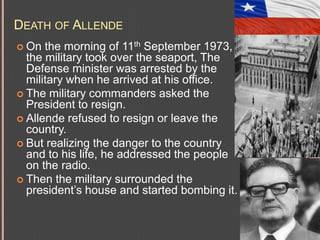
DEATH OF ALLENDE
the morning of 11th September 1973,
the military took over the seaport, The
Defense minister was arrested by the
military when he arrived at his office.
 The military commanders asked the
President to resign.
 Allende refused to resign or leave the
country.
 But realizing the danger to the country
and to his life, he addressed the people
on the radio.
 Then the military surrounded the
president’s house and started bombing it.
 On
 President

Allende died in the
military attack .
 This was the sacrifice he was
talking about in his last speech.
 A government and people elected
was overthrown by the military
through conspiracy and violence.
 What took place in this story is a
military coup.
 General Augusto Pinochet army
general, led the coup.
 The government of U.S.A was
unhappy with the rule of Allende
and have known to support the
coup destroying Allende.
abhishek

A GOVERNMENT
AND PEOPLE

ELECTED WAS
OVERTHROWN BY
THE MILITARY
THOROUGH
CONSPIRACY AND
VIOLENCE.
PINOCHET'S RULE
 Pinochet

became the President of the
country and ruled for the next 17 years.
 From a government that was elected
by the people, the power shifted to the
military officers.
 They could do as they wished and no
one could question them.
 Thus a military dictatorship was
established in Chile.
 Pinochet’s government was tortured
and killed several of those who
supported Allende and those who
wanted democracy to be restored.
These included General Alberto Bachelet of
Chilean Air Force and many other officers who
refused to join the coup.
 General Bachelet’s wife and daughter were put
in prison and tortured.
 More than 3,000 people were killed by the
military.
 Many more were reported ‘missing’. No one
knows what happen with them.

RESTORATION OF DEMOCRACY
Pinochet’s

military dictator ship came to an
end after he decided to hold a referendum
1988.
He felt confident that in this referendum,
the people would say ‘yes’ to his
continuing in power. But the people of
Chile has not forgotten their democratic
traditions.
Their vote was decisive ‘no’ to Pinochet.
This led to Pinochet losing first his political
and then his military powers.
Pinochet’s funeral.
 The

hope Allende expressed in
his last address was realized:
felony, cowardice and treason
were finally punished.
 Political freedom was restored.
 Since then Chile had held 4
presidential elections in which
different political parties have
participated.
 The elected governments that
came to power ordered inquires
into Pinochet’s rule.
 These inquires showed that his
government was not only very
brutal, but also very corrupt.
STORY OF MICHELLE BACHELET
Michelle Bachelet daughter of general Bachelet
who was imprisoned and tortured along with her
mother was elected president of Chile in January
2006.
 A medical doctor and a moderate socialist ,
Michelle became the first women to be a defence
minister in Latin America.
 In the presidential elections none Chile’s richest
men.

THANK YOU!
*ABHISHEK SINGH
IX-B

Chile democracy

  • 1.
  • 2.
    DEVELOPMENT OF DEMOCRACY Morethan half of the independent countries in the world today are democratic. The expansion of democracy has not been smooth and straight. It has seen several ups and downs in different countries. It still remains an unstable and uncertain achievement.
  • 3.
    SALVADOR ALLENDE  He wasthe president of Chile, a country in South America.        He was a leader elected by the people. Allende was the founder leader of the Socialist Party of Chile and led the Popular Unity coalition to victory in the presidential election in 1970. After being elected the president, Allende had taken several policy decisions to help the poor and the workers. These included reform of the educational system, free milk for children and redistribution of lands to the landless farmers. He was opposed to foreign companies taking away natural resources like copper from the country. The landlords, the rich and the church opposed his policies. Some other political parties in Chile also opposed his government.
  • 4.
  • 5.
    DEATH OF ALLENDE themorning of 11th September 1973, the military took over the seaport, The Defense minister was arrested by the military when he arrived at his office.  The military commanders asked the President to resign.  Allende refused to resign or leave the country.  But realizing the danger to the country and to his life, he addressed the people on the radio.  Then the military surrounded the president’s house and started bombing it.  On
  • 6.
     President Allende diedin the military attack .  This was the sacrifice he was talking about in his last speech.  A government and people elected was overthrown by the military through conspiracy and violence.  What took place in this story is a military coup.  General Augusto Pinochet army general, led the coup.  The government of U.S.A was unhappy with the rule of Allende and have known to support the coup destroying Allende.
  • 7.
    abhishek A GOVERNMENT AND PEOPLE ELECTEDWAS OVERTHROWN BY THE MILITARY THOROUGH CONSPIRACY AND VIOLENCE.
  • 8.
    PINOCHET'S RULE  Pinochet becamethe President of the country and ruled for the next 17 years.  From a government that was elected by the people, the power shifted to the military officers.  They could do as they wished and no one could question them.  Thus a military dictatorship was established in Chile.  Pinochet’s government was tortured and killed several of those who supported Allende and those who wanted democracy to be restored.
  • 9.
    These included GeneralAlberto Bachelet of Chilean Air Force and many other officers who refused to join the coup.  General Bachelet’s wife and daughter were put in prison and tortured.  More than 3,000 people were killed by the military.  Many more were reported ‘missing’. No one knows what happen with them. 
  • 10.
    RESTORATION OF DEMOCRACY Pinochet’s militarydictator ship came to an end after he decided to hold a referendum 1988. He felt confident that in this referendum, the people would say ‘yes’ to his continuing in power. But the people of Chile has not forgotten their democratic traditions. Their vote was decisive ‘no’ to Pinochet. This led to Pinochet losing first his political and then his military powers.
  • 11.
  • 12.
     The hope Allendeexpressed in his last address was realized: felony, cowardice and treason were finally punished.  Political freedom was restored.  Since then Chile had held 4 presidential elections in which different political parties have participated.  The elected governments that came to power ordered inquires into Pinochet’s rule.  These inquires showed that his government was not only very brutal, but also very corrupt.
  • 13.
    STORY OF MICHELLEBACHELET Michelle Bachelet daughter of general Bachelet who was imprisoned and tortured along with her mother was elected president of Chile in January 2006.  A medical doctor and a moderate socialist , Michelle became the first women to be a defence minister in Latin America.  In the presidential elections none Chile’s richest men. 
  • 15.