Techniques of  Child and Adolescent Counseling dr. tracy mallett
Clinical Disorders Axis I
Main categories of clinical disorders Mood (depressive, bipolar) Anxiety (panic, PTSD, phobias, general) Adjustment (with or without mood or anxiety) Sexual (dysfunctions, paraphilias) Impulse control (intermittent explosive, pyromania) Substance-related Cognitive (delirium, dementia, amnestic) Dissociative (amnesia, fugue, identity) Somatoform (pain, hypochondriasis, body dysmorphic)
Disorders Usually First Diagnosed in Infancy, Childhood, or Adolescence
Mental Retardation Mild Mental Retardation IQ 50-55 to 70 Moderate Mental Retardation IQ 35-40 to 50-55 Severe Mental Retardation IQ 20-25 to 35-40 Profound Mental Retardation IQ Below 20-25
Learning Disorders Reading Mathematics Disorder of Written Expression
Motor Skills Disorders Developmental Coordination Disorder
Communication Disorders Expressive Language Disorder Mixed Receptive-Expressive Language Disorder Phonological Disorder (formerly Developmental Articulation Disorder) Stuttering
Pervasive Developmental Disorders Autistic Disorder Rett’s Disorder Childhood Disintegrative Disorder Asperger’s Disorder
Attention-Deficit and Disruptive Behavior Disorders ADHD Conduct Disorder Oppositional Defiant Disorder
Feeding and eating disorders of infancy or early childhood Pica Rumination Disorder Feeding disorder of infancy or early childhood
Tic Disorders Tourette’s Disorder Chronic Motor or Vocal Tic Disorder Transient Tic Disorder (less than one year duration)
Elimination Disorders Enuresis Encopresis
Others Separation Anxiety Disorder Selective Mutism Reactive Attachment Disorder Stereotypic Movement Disorder
Personality Disorders Axis II
Eccentric disorders Paranoid personality disorder Schizoid personality disorder Schizotypal personality disorder
Paranoid   Consistent suspiciousness, distrust in others Others’ motives are interpreted as attempts to harm Preoccupied with unjustified doubts about the truthfulness of others Reads demeaning/threatening meanings into the innocent actions of others Persistent grudge-bearing Frequent unjustified suspicions about the faithfulness of a domestic partner
Schizoid Pervasive pattern of detachment from social relationships Restricted expressed emotion Does not desire or enjoy close relationships Usually chooses solitary activities Little interest in sexual interaction Limited ability to take pleasure in activities Appears indifferent to others’ praise or criticism Demonstrates emotional coldness
Schizotypal Pnality Disordersoer Social and interpersonal deficits, marked by discomfort with and reduced capacity for close relationships Cognitive or perceptual distortions (such as extreme superstitiousness, belief in clairvoyance, telepathy, magical thinking) Eccentric or peculiar behavior
Dramatic disorders Antisocial personality disorder Borderline personality disorder Histrionic personality disorder Narcissistic personality disorder
Anxious disorders Avoidant personality disorder Dependent personality disorder Obsessive-compulsive personality disorder
Assessment of suicide risk (Juhnke & Granello, 2005)
Risk Factors Demographics Depression/Hopelessness DSM disorders Substance use Recent previous suicide attempts Suicidal ideation Challenges to clear thinking Family dysfunction Access to lethal means Recent and chronic stressors
Demographics Gender: Women attempt more; men succeed more Gender and ethnicity: Most likely groups:  Caucasian males Caucasian females African American males
Depression/Hopelessness Strong association between depressed mood and eventual suicide Assessment tool to determine level of hope: “ When do you believe things will get better for you?” The client’s response suggests whether hope for improvement exists.
Hopelessness, continued Ask, “What number between 0 and 10 best reflects how you see your current concerns over time?” A response of 0 to 4 indicates a high degree of hopelessness; this client is at greater risk of suicide.
DSM Disorders There is a high correlation between completed suicide and co-existing Axis I or Axis II disorders Predominant are affective disorders and substance abuse disorders People with personality disorders with coexisting impulse control disorders are also at high risk.
Substance use Clients who abuse substances or binge on substances are at increased risk Note that such clients are not necessarily diagnosable as substance dependent Many clients present as more impulsive, reckless and daring when under the influence Suicide risk should ALWAYS be assessed when you realize a client abuses substances.
Recent suicide attempts One of the best predictors for suicide risk, particularly when the attempt was highly lethal. When people attempt suicide and live, they may become less fearful of their own death. They may also learn to be more successful in their attempt (they may learn from their “mistakes”)
Suicidal ideation Suicidal thoughts may escalate, and become central to their daily lives  Ultimately, everything they do revolves around suicide.
Challenges to clear thinking If a client is impeded in adaptive problem solving or clear thinking, they are at increased risk Examples: Experiencing strong emotions such as anger or betrayal; symptoms of a DSM disorder; being out of touch with reality
Family dysfunction Physical, emotional or sexual abuse Previous suicidal modeling Poor problem solving
Access to lethal means Can the client get access to a potentially lethal method? Examples: firearms, hanging, self-asphyxiation (car exhast), overdose
Recent and chronic stressors Poor relational supports Chronic disease Poverty Poor cultural adjustment Marital discord Job loss Life transition
Assessing for suicidality Ideation : thoughts of taking one’s own life, or preoccupation with leaving a situation Intent : Making a decision to take one’s life Plan : having a specific idea of method of suicide Means : having the materials and opportunity to carry out the plan
Juvenile delinquency
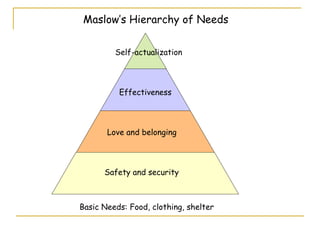
Effectiveness Safety and security Love and belonging Self-actualization Basic Needs: Food, clothing, shelter Maslow’s Hierarchy of Needs
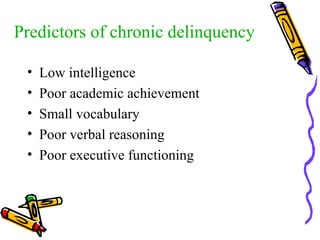
Low intelligence Poor academic achievement Small vocabulary Poor verbal reasoning Poor executive functioning Predictors of chronic delinquency
Traditional measurement instruments have a focus on pathology  Increasing attention is being paid to evaluating children’s programs from a strengths perspective  Newer, strengths-based instruments have been more commonly used Evaluation of delinquency
Specific areas of evaluation Family Evaluation of the family is important in determining the cause of delinquent behavior. Aggressive children tend to come from families with high levels of hostility and aggression.  An assessment needs to address the types of emotional supports available.
Families of aggressive children frequently have the following characteristics: High levels of hostility and aggression A history of maltreatment Physical fighting Cycles of coercive behavior High parental rejection Physical punishment Parental ineffectiveness Family disorganization Absence of father Conflict between parents
Chronic adult offenders commonly begin their careers as chronic juvenile offenders. This suggests that intervention strategies which are initiated early have the best chance of changing juveniles’ behavior, before the criminal behavior is ingrained into the child’s skill repertoire.  Possibilities for intervention include family- and school-based programs
In the early part of the 20th century the emphasis of treatment for children was on the individual and focused on assisting the child to successfully adapt to the presenting environment.  The climate of treatment for children has since shifted to include the family and community in intervention efforts
Family Support Model Families are viewed from a health-promotion framework rather than a pathology-based model Uses collaboration between family and professionals for goal determination and intervention strategy Builds upon inherent strengths
Goals of the Family Support Model Strengthening the family unit Enhancing growth of individual family members Empowering the family to gain more adaptive skills Enabling the family to require fewer professional interventions in the long run
Use of family support model Involves assessing the child as an integral part of a larger family system  Considers it counterproductive to attempt to provide services to the child alone The family’s unique set of resources is utilized Resources may include the strength of the marital relationship; individual coping skills of the parents; extended family and/or community support; and the problem-solving abilities of the family as a whole
Personal issues
Managing personal issues The bottom line:  If you do not have a good understanding of your “personal baggage,” and develop adaptive coping skills for addressing it, you will have a difficult time in clinical practice. It is NOT appropriate to enter this field as a way to understand and/or deal with personal issues. These should be resolved – or healthfully addressed -  prior to beginning practice.
Resources thought helpful by dr. mallett
Talking to Children about Sex Age 6 to 9: Harris, R. (2004). It’s so amazing!. Cambridge, Mass: Candlewick Press Age 10 and up: Harris, R. (2004). It’s perfectly normal. Cambridge, Mass: Candlewick Press.
“ Body Safety” Koke, S. (1995). My body is mine, my feelings are mine. Plainview, NY: Childsplay LLC.  (or, teaching children to be safe from sexual abuse)
Sexual Abuse Resources Kahn, Timothy J. (1999). Pathways: a guided workbook for youth beginning treatment. Brandon, VT: The Safer Society Press.  Steen, Charlene. (1998). The Conduct Management Workbook. Brandon, VT: The Safer Society Press.
Oppositional Child Resources Barkley, R. (1997). Defiant children: A clinician’s manual for assessment and parent training. New York: Guliford Press. Berg, B. (1992). The Conduct Management Workbook. Dayton, OH: Cognitive Therapeutics.
Foster/Adoptive Families Delaney, Richard. (1997). The healing power of the family. (1997). Oklahoma City, OK: Wood ‘n Barnes Publishing. An array of materials from Boys Town Press: www.girlsandboystown.org/btpress
References Marsh. E.J. & Barkley, R.A. (1998). Treatment of Childhood Disorders. New York: Gulliford Press.
Play Therapy

Child/Adolescent assessment and treatment

  • 1.
    Techniques of Child and Adolescent Counseling dr. tracy mallett
  • 2.
  • 3.
    Main categories ofclinical disorders Mood (depressive, bipolar) Anxiety (panic, PTSD, phobias, general) Adjustment (with or without mood or anxiety) Sexual (dysfunctions, paraphilias) Impulse control (intermittent explosive, pyromania) Substance-related Cognitive (delirium, dementia, amnestic) Dissociative (amnesia, fugue, identity) Somatoform (pain, hypochondriasis, body dysmorphic)
  • 4.
    Disorders Usually FirstDiagnosed in Infancy, Childhood, or Adolescence
  • 5.
    Mental Retardation MildMental Retardation IQ 50-55 to 70 Moderate Mental Retardation IQ 35-40 to 50-55 Severe Mental Retardation IQ 20-25 to 35-40 Profound Mental Retardation IQ Below 20-25
  • 6.
    Learning Disorders ReadingMathematics Disorder of Written Expression
  • 7.
    Motor Skills DisordersDevelopmental Coordination Disorder
  • 8.
    Communication Disorders ExpressiveLanguage Disorder Mixed Receptive-Expressive Language Disorder Phonological Disorder (formerly Developmental Articulation Disorder) Stuttering
  • 9.
    Pervasive Developmental DisordersAutistic Disorder Rett’s Disorder Childhood Disintegrative Disorder Asperger’s Disorder
  • 10.
    Attention-Deficit and DisruptiveBehavior Disorders ADHD Conduct Disorder Oppositional Defiant Disorder
  • 11.
    Feeding and eatingdisorders of infancy or early childhood Pica Rumination Disorder Feeding disorder of infancy or early childhood
  • 12.
    Tic Disorders Tourette’sDisorder Chronic Motor or Vocal Tic Disorder Transient Tic Disorder (less than one year duration)
  • 13.
  • 14.
    Others Separation AnxietyDisorder Selective Mutism Reactive Attachment Disorder Stereotypic Movement Disorder
  • 15.
  • 16.
    Eccentric disorders Paranoidpersonality disorder Schizoid personality disorder Schizotypal personality disorder
  • 17.
    Paranoid Consistent suspiciousness, distrust in others Others’ motives are interpreted as attempts to harm Preoccupied with unjustified doubts about the truthfulness of others Reads demeaning/threatening meanings into the innocent actions of others Persistent grudge-bearing Frequent unjustified suspicions about the faithfulness of a domestic partner
  • 18.
    Schizoid Pervasive patternof detachment from social relationships Restricted expressed emotion Does not desire or enjoy close relationships Usually chooses solitary activities Little interest in sexual interaction Limited ability to take pleasure in activities Appears indifferent to others’ praise or criticism Demonstrates emotional coldness
  • 19.
    Schizotypal Pnality DisordersoerSocial and interpersonal deficits, marked by discomfort with and reduced capacity for close relationships Cognitive or perceptual distortions (such as extreme superstitiousness, belief in clairvoyance, telepathy, magical thinking) Eccentric or peculiar behavior
  • 20.
    Dramatic disorders Antisocialpersonality disorder Borderline personality disorder Histrionic personality disorder Narcissistic personality disorder
  • 21.
    Anxious disorders Avoidantpersonality disorder Dependent personality disorder Obsessive-compulsive personality disorder
  • 22.
    Assessment of suiciderisk (Juhnke & Granello, 2005)
  • 23.
    Risk Factors DemographicsDepression/Hopelessness DSM disorders Substance use Recent previous suicide attempts Suicidal ideation Challenges to clear thinking Family dysfunction Access to lethal means Recent and chronic stressors
  • 24.
    Demographics Gender: Womenattempt more; men succeed more Gender and ethnicity: Most likely groups: Caucasian males Caucasian females African American males
  • 25.
    Depression/Hopelessness Strong associationbetween depressed mood and eventual suicide Assessment tool to determine level of hope: “ When do you believe things will get better for you?” The client’s response suggests whether hope for improvement exists.
  • 26.
    Hopelessness, continued Ask,“What number between 0 and 10 best reflects how you see your current concerns over time?” A response of 0 to 4 indicates a high degree of hopelessness; this client is at greater risk of suicide.
  • 27.
    DSM Disorders Thereis a high correlation between completed suicide and co-existing Axis I or Axis II disorders Predominant are affective disorders and substance abuse disorders People with personality disorders with coexisting impulse control disorders are also at high risk.
  • 28.
    Substance use Clientswho abuse substances or binge on substances are at increased risk Note that such clients are not necessarily diagnosable as substance dependent Many clients present as more impulsive, reckless and daring when under the influence Suicide risk should ALWAYS be assessed when you realize a client abuses substances.
  • 29.
    Recent suicide attemptsOne of the best predictors for suicide risk, particularly when the attempt was highly lethal. When people attempt suicide and live, they may become less fearful of their own death. They may also learn to be more successful in their attempt (they may learn from their “mistakes”)
  • 30.
    Suicidal ideation Suicidalthoughts may escalate, and become central to their daily lives Ultimately, everything they do revolves around suicide.
  • 31.
    Challenges to clearthinking If a client is impeded in adaptive problem solving or clear thinking, they are at increased risk Examples: Experiencing strong emotions such as anger or betrayal; symptoms of a DSM disorder; being out of touch with reality
  • 32.
    Family dysfunction Physical,emotional or sexual abuse Previous suicidal modeling Poor problem solving
  • 33.
    Access to lethalmeans Can the client get access to a potentially lethal method? Examples: firearms, hanging, self-asphyxiation (car exhast), overdose
  • 34.
    Recent and chronicstressors Poor relational supports Chronic disease Poverty Poor cultural adjustment Marital discord Job loss Life transition
  • 35.
    Assessing for suicidalityIdeation : thoughts of taking one’s own life, or preoccupation with leaving a situation Intent : Making a decision to take one’s life Plan : having a specific idea of method of suicide Means : having the materials and opportunity to carry out the plan
  • 36.
  • 37.
    Effectiveness Safety andsecurity Love and belonging Self-actualization Basic Needs: Food, clothing, shelter Maslow’s Hierarchy of Needs
  • 38.
    Low intelligence Pooracademic achievement Small vocabulary Poor verbal reasoning Poor executive functioning Predictors of chronic delinquency
  • 39.
    Traditional measurement instrumentshave a focus on pathology Increasing attention is being paid to evaluating children’s programs from a strengths perspective Newer, strengths-based instruments have been more commonly used Evaluation of delinquency
  • 40.
    Specific areas ofevaluation Family Evaluation of the family is important in determining the cause of delinquent behavior. Aggressive children tend to come from families with high levels of hostility and aggression. An assessment needs to address the types of emotional supports available.
  • 41.
    Families of aggressivechildren frequently have the following characteristics: High levels of hostility and aggression A history of maltreatment Physical fighting Cycles of coercive behavior High parental rejection Physical punishment Parental ineffectiveness Family disorganization Absence of father Conflict between parents
  • 42.
    Chronic adult offenderscommonly begin their careers as chronic juvenile offenders. This suggests that intervention strategies which are initiated early have the best chance of changing juveniles’ behavior, before the criminal behavior is ingrained into the child’s skill repertoire. Possibilities for intervention include family- and school-based programs
  • 43.
    In the earlypart of the 20th century the emphasis of treatment for children was on the individual and focused on assisting the child to successfully adapt to the presenting environment. The climate of treatment for children has since shifted to include the family and community in intervention efforts
  • 44.
    Family Support ModelFamilies are viewed from a health-promotion framework rather than a pathology-based model Uses collaboration between family and professionals for goal determination and intervention strategy Builds upon inherent strengths
  • 45.
    Goals of theFamily Support Model Strengthening the family unit Enhancing growth of individual family members Empowering the family to gain more adaptive skills Enabling the family to require fewer professional interventions in the long run
  • 46.
    Use of familysupport model Involves assessing the child as an integral part of a larger family system Considers it counterproductive to attempt to provide services to the child alone The family’s unique set of resources is utilized Resources may include the strength of the marital relationship; individual coping skills of the parents; extended family and/or community support; and the problem-solving abilities of the family as a whole
  • 47.
  • 48.
    Managing personal issuesThe bottom line: If you do not have a good understanding of your “personal baggage,” and develop adaptive coping skills for addressing it, you will have a difficult time in clinical practice. It is NOT appropriate to enter this field as a way to understand and/or deal with personal issues. These should be resolved – or healthfully addressed - prior to beginning practice.
  • 49.
  • 50.
    Talking to Childrenabout Sex Age 6 to 9: Harris, R. (2004). It’s so amazing!. Cambridge, Mass: Candlewick Press Age 10 and up: Harris, R. (2004). It’s perfectly normal. Cambridge, Mass: Candlewick Press.
  • 51.
    “ Body Safety”Koke, S. (1995). My body is mine, my feelings are mine. Plainview, NY: Childsplay LLC. (or, teaching children to be safe from sexual abuse)
  • 52.
    Sexual Abuse ResourcesKahn, Timothy J. (1999). Pathways: a guided workbook for youth beginning treatment. Brandon, VT: The Safer Society Press. Steen, Charlene. (1998). The Conduct Management Workbook. Brandon, VT: The Safer Society Press.
  • 53.
    Oppositional Child ResourcesBarkley, R. (1997). Defiant children: A clinician’s manual for assessment and parent training. New York: Guliford Press. Berg, B. (1992). The Conduct Management Workbook. Dayton, OH: Cognitive Therapeutics.
  • 54.
    Foster/Adoptive Families Delaney,Richard. (1997). The healing power of the family. (1997). Oklahoma City, OK: Wood ‘n Barnes Publishing. An array of materials from Boys Town Press: www.girlsandboystown.org/btpress
  • 55.
    References Marsh. E.J.& Barkley, R.A. (1998). Treatment of Childhood Disorders. New York: Gulliford Press.
  • 56.