Crisis Intervention Handbook:
Assessment, Treatment
and Research,
Third Edition
Albert R. Roberts, Ph.D.,
Editor
OXFORD UNIVERSITY PRESS
CRISIS INTERVENTION HANDBOOK
Third Edition
This page intentionally left blank
CRISIS INTERVENTION HANDBOOK
Assessment, Treatment, and Research
THIRD EDITION
Edited by
Albert R. Roberts, Ph.D.
1
2005
3
Oxford University Press, Inc., publishes works that further
Oxford University’s objective of excellence
in research, scholarship, and education.
Oxford New York
Auckland Cape Town Dar es Salaam Hong Kong Karachi
Kuala Lumpur Madrid Melbourne Mexico City Nairobi
New Delhi Shanghai Taipei Toronto
With offices in
Argentina Austria Brazil Chile Czech Republic France Greece
Guatemala Hungary Italy Japan Poland Portugal Singapore
South Korea Switzerland Thailand Turkey Ukraine Vietnam
Copyright  2000, 2005 Oxford University Press
Published by Oxford University Press, Inc.,
198 Madison Avenue, New York, New York 10016
www.oup.com
Oxford is a registered trademark of Oxford University Press
All rights reserved. No part of this publication may be reproduced,
stored in a retrieval system, or transmitted, in any form or by any means,
electronic, mechanical, photocopying, recording, or otherwise,
without the prior permission of Oxford University Press.
Library of Congress Cataloging-in-Publication Data
Crisis intervention handbook : assessment, treatment,
and research / edited by Albert R. Roberts. — 3rd ed.
p. cm.
Includes bibliographical references and index.
ISBN-13 978-0-19-517991-0
ISBN 0-19-517991-9
1. Crisis intervention (Mental health services)—Handbooks, manuals, etc.
2. Community mental health services—Handbooks, manuals, etc.
I. Roberts, Albert R.
RC480.6.C744 2005
362.2′2—dc22 2005010137
Chapters 4, 6, 7, 11, 13, and 14 are reproduced from the journal Brief Treatment and Crisis
Intervention by permission of Oxford University Press.
9 8 7 6 5 4 3 2 1
Printed in the United States of America
on acid-free paper
Acknowledgments
I want to express my sincere gratitude to the authors who contributed their
expertise and original chapters to this book. I am also appreciative of the
anonymous reviewers’ important insights and technical suggestions.
Grateful acknowledgment goes to my exceptional editor, Joan Bossert (Edi-
torial Director, Academic Books at Oxford University Press) for her deep com-
mitment to this third edition and her editorial wisdom and care for detail.
This book also owes a debt to the late Lilian Schein, longtime director of the
Behavioral Science and Nursing Book Clubs. Ms. Schein helped me plan the
first edition and taught me to appreciate interdisciplinary clinical practice.
My wife Beverly deserves special thanks and appreciation for thoroughly
editing and proofreading several chapters and co-authoring chapter 19.
Most important, Beverly’s patience with me for the lost weekends and for
the overflowing numbers of books, files, and papers in several rooms of our
house went way beyond the call of duty of a marital partner. I am delighted
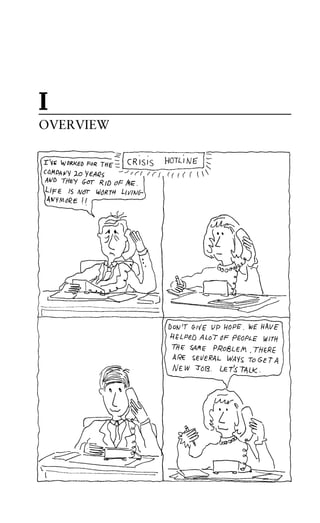
and appreciative of the excellent illustrations drawn by my sister-in-law,
Carole S. Roberts.
I dedicate this book to my late parents, Evelyn and Harry Roberts, who
gave me unconditional love, emotional strength, and encouragement. They
instilled within me a deep conviction to pursue knowledge, overcome adver-
sity, and thrive to set realistic short-term and long-term goals; to aid and
support vulnerable groups; and to persevere in all my occupational and fam-
ily endeavors. I am forever devoted and appreciative of everything they did
for me and my brother during our childhood and adolescence.
vi Acknowledgments
Both of them demonstrated superior inner strength after being diagnosed
with cancer. At a time when women had only a 10% chance of a two- to
five-year survival from breast cancer and mastectomy, my mother lived six-
teen years. During his two years with the intense pain of prostrate cancer,
my father rarely complained and bravely persevered. Their quiet fighting
spirit, courage, and resilience serve to make them role models for all persons
in medical and psychological crisis.
I also dedicate this book to Dr. Viktor Frankl, psychiatrist, author of Man’s
Search for Meaning, and founder of logotherapy. When I was a young adult,
his book helped me cope, survive, and master depression in the aftermath of
my parents’ deaths. His work continues to sustain and motivate many others.
NATIONAL INTERNET RESOURCES AND
24-HOUR CRISIS INTERVENTION HOTLINES
The National Suicide Prevention Lifeline is a 24-hour, toll-free suicide pre-
vention hotline. Persons in crisis can call 1-800-273-8255 and be connected
to one of the 115 crisis centers in the NSPI Network located in the city
and state nearest to the caller’s location. The national hotline network is
administered through the Mental Health Association of New York City and
is funded by Substance Abuse and Mental Health Services Administration’s
Center for Mental Health Services of the U.S. Department of Health and
Human Services.
The National Disaster Technical Assistance Center of the Substance
Abuse and Mental Health Services Administration (SAMHSA) in Bethesda,
Maryland, provides resources and expertise to assist states, territories, and
local communities that are preparing for or responding to the mental health
needs of natural and man-made community disasters. Website: http://www.
mentalhealth.samhsa.gov/dtac or phone: 1-800-308-3515.
The International Crisis Intervention Network was developed in 2001
and its overriding goal is to provide the latest information on evidence-based
crisis intervention protocols, disaster mental health protocols, trauma treatment
models, suicide prevention center directories, and domestic violence interven-
tion resources as well as the latest books and peer-reviewed journal article ab-
stracts on crisis intervention. Website: http://www.crisisinterventionnetwork.
com
The National Domestic Violence Toll-Free Hotline provides crisis tele-
phone counseling and referral to a network of emergency shelters and sup-
port groups for survivors of intimate partner violence. In addition to the
hotline, the website contains information on teen and dating violence, do-
mestic violence in the workplace, information for victims and survivors of
domestic violence, and information for abusers. Website: http://www.ndvh.
org or phone: 1-800-799-SAFE (7233).
Foreword
Unlike the usual stresses and conflicts that are a part of everyday life at
home and at work, acute crisis episodes frequently overwhelm our tradi-
tional coping skills and result in dysfunctional behavior, “going to pieces,”
intense fears, and a highly anxious state, also known as a state of dis-
equilibrium. This handbook focuses on acute crisis episodes and psychiatric
emergencies and the step-by-step crisis intervention strategies used by crisis
counselors. Each chapter focuses on a different major crisis-precipitating
event, such as turbulent divorces, adolescent suicides, airplane crashes and
fatalities of family members, date rape on the college campus, shootings in
the public schools, battering of women and their children, polydrug abuse,
HIV-positive women, patients in intensive care units, and survivors of com-
munity disasters and mass terrorist attacks. This book includes many illumi-
nating case studies that illustrate how best to intervene in the aftermath of
a crisis episode or traumatic event.
The acute and situational crises experienced by millions of individuals and
families has been escalating in intensity and frequency. Crisis intervention
programs and strategies can limit the debilitating impact of acute crisis epi-
sodes as they maximize opportunities for crisis stabilization and resolution.
It is a remarkable thing when crisis clinicians, counselors, and researchers
from different disciplines collaborate on a major mental health and public
health problem. Some practitioners have been concerned about psychiatric
disorders, others about life-threatening illnesses, and some others about de-
velopmental crises. But, all mental health practitioners and graduate students
viii Foreword
have an overriding concern about the impact of community-wide disasters,
especially mass terrorist attacks and how to rapidly assess and provide crisis
intervention services. What sets this pathfinding and seminal book apart
from others on crisis intervention is both the systematic application of Rob-
erts’s 7-Stage Crisis Intervention Protocol, the introduction of the Assess-
ment, Crisis Intervention, and Trauma (ACT) Treatment Model, and the
copious use of compelling and thought-provoking case illustrations on 60
different types of the most prevalent acute crisis episodes in society today.
Disaster mental health teams have proliferated in these important few years
since the September 11 terrorist bombings of the World Trade Center and
the Pentagon. Many of the 15 brand new chapters seize on the opportunity
to empower, support, and build on the inner strengths of millions of individ-
uals by describing the process and therapeutic techniques of evidence-based
crisis intervention. This is the most practical time-limited treatment book I
have read in the past 10 years. It is timely, focused, straightforward, compre-
hensive, empowering, highly readable, and extremely valuable.
Dr. Roberts has always been an innovator and clinical research professor
in the forefront of futuristic treatment planning. In 1999, Professor Roberts
completed his six-level continuum on the duration and severity of domestic
violence based on 501 cases. Now at the end of 2004, Professor Roberts has
updated and expanded the second edition of his authoritative handbook. The
Crisis Intervention Handbook is a masterful sourcebook of practical signifi-
cance, bridging crisis theory and assessment to evidence-based practice. This
book provides well-written, detailed, up-to-date, thorough, and practical best
practices. I predict that this authoritative volume will become the classic defini-
tive work on crisis intervention for the important years ahead.
As editor of this volume, Dr. Roberts has selected as the chapter authors
an outstanding cast of 50 internationally recognized experts in the rapid
assessment and treatment of crisis episodes. Each chapter provides the reader
with a comprehensive and practical application of Roberts’s seven-stage cri-
sis intervention model to the key components of acute and situational crises.
This third edition of 32 specially designed chapters includes 14 brand new
chapters and 18 thoroughly revised chapters. This is the first handbook on
crisis intervention to incorporate into each chapter a section on resilience,
protective factors, and the strengths perspective. Also, 15 of the chapters
each apply two or more case studies to the seven stages in Roberts’ Crisis
Intervention Model.
This all-inclusive resource provides everything mental health clinicians,
crisis counselors, healthcare specialists, crisis intervenors, and trained volun-
teers need to know about crisis intervention. This book is a stunning achieve-
ment and landmark work.
Ann Wolbert Burgess, RN, CS, D.N.Sc., FAAN., DACFE
Professor of Psychiatric-Mental Health Nursing
School of Nursing, Boston College
Contents
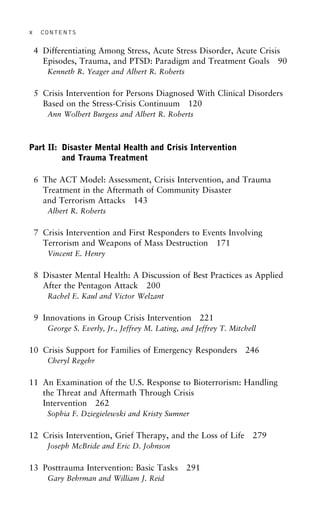
Foreword vii
Ann Wolbert Burgess
Contributors xiii
Introduction xix
Part I: Overview
1 Bridging the Past and Present to the Future of Crisis Intervention
and Crisis Management 3
Albert R. Roberts
2 Lethality Assessment and Crisis Intervention with Persons
Presenting with Suicidal Ideation 35
Albert R. Roberts and Kenneth R. Yeager
3 How to Work With Clients’ Strengths in Crisis Intervention:
A Solution-Focused Approach 64
Gilbert J. Greene, Mo-Yee Lee, Rhonda Trask, and Judy Rheinscheld
x CONTENTS
4 Differentiating Among Stress, Acute Stress Disorder, Acute Crisis
Episodes, Trauma, and PTSD: Paradigm and Treatment Goals 90
Kenneth R. Yeager and Albert R. Roberts
5 Crisis Intervention for Persons Diagnosed With Clinical Disorders
Based on the Stress-Crisis Continuum 120
Ann Wolbert Burgess and Albert R. Roberts
Part II: Disaster Mental Health and Crisis Intervention
and Trauma Treatment
6 The ACT Model: Assessment, Crisis Intervention, and Trauma
Treatment in the Aftermath of Community Disaster
and Terrorism Attacks 143
Albert R. Roberts
7 Crisis Intervention and First Responders to Events Involving
Terrorism and Weapons of Mass Destruction 171
Vincent E. Henry
8 Disaster Mental Health: A Discussion of Best Practices as Applied
After the Pentagon Attack 200
Rachel E. Kaul and Victor Welzant
9 Innovations in Group Crisis Intervention 221
George S. Everly, Jr., Jeffrey M. Lating, and Jeffrey T. Mitchell
10 Crisis Support for Families of Emergency Responders 246
Cheryl Regehr
11 An Examination of the U.S. Response to Bioterrorism: Handling
the Threat and Aftermath Through Crisis
Intervention 262
Sophia F. Dziegielewski and Kristy Sumner
12 Crisis Intervention, Grief Therapy, and the Loss of Life 279
Joseph McBride and Eric D. Johnson
13 Posttrauma Intervention: Basic Tasks 291
Gary Behrman and William J. Reid
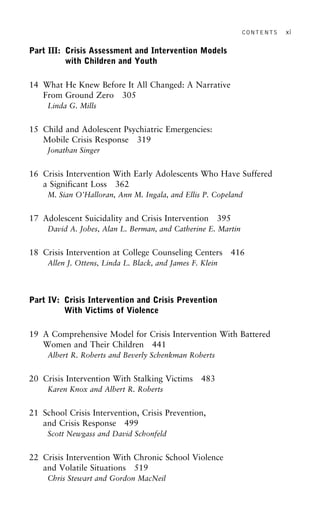
CONTENTS xi
Part III: Crisis Assessment and Intervention Models
with Children and Youth
14 What He Knew Before It All Changed: A Narrative
From Ground Zero 305
Linda G. Mills
15 Child and Adolescent Psychiatric Emergencies:
Mobile Crisis Response 319
Jonathan Singer
16 Crisis Intervention With Early Adolescents Who Have Suffered
a Significant Loss 362
M. Sian O’Halloran, Ann M. Ingala, and Ellis P. Copeland
17 Adolescent Suicidality and Crisis Intervention 395
David A. Jobes, Alan L. Berman, and Catherine E. Martin
18 Crisis Intervention at College Counseling Centers 416
Allen J. Ottens, Linda L. Black, and James F. Klein
Part IV: Crisis Intervention and Crisis Prevention
With Victims of Violence
19 A Comprehensive Model for Crisis Intervention With Battered
Women and Their Children 441
Albert R. Roberts and Beverly Schenkman Roberts
20 Crisis Intervention With Stalking Victims 483
Karen Knox and Albert R. Roberts
21 School Crisis Intervention, Crisis Prevention,
and Crisis Response 499
Scott Newgass and David Schonfeld
22 Crisis Intervention With Chronic School Violence
and Volatile Situations 519
Chris Stewart and Gordon MacNeil
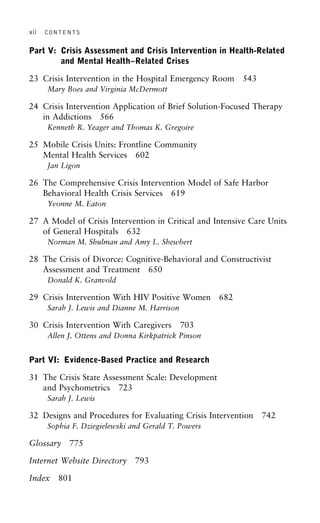
xii CONTENTS
Part V: Crisis Assessment and Crisis Intervention in Health-Related
and Mental Health–Related Crises
23 Crisis Intervention in the Hospital Emergency Room 543
Mary Boes and Virginia McDermott
24 Crisis Intervention Application of Brief Solution-Focused Therapy
in Addictions 566
Kenneth R. Yeager and Thomas K. Gregoire
25 Mobile Crisis Units: Frontline Community
Mental Health Services 602
Jan Ligon
26 The Comprehensive Crisis Intervention Model of Safe Harbor
Behavioral Health Crisis Services 619
Yvonne M. Eaton
27 A Model of Crisis Intervention in Critical and Intensive Care Units
of General Hospitals 632
Norman M. Shulman and Amy L. Shewbert
28 The Crisis of Divorce: Cognitive-Behavioral and Constructivist
Assessment and Treatment 650
Donald K. Granvold
29 Crisis Intervention With HIV Positive Women 682
Sarah J. Lewis and Dianne M. Harrison
30 Crisis Intervention With Caregivers 703
Allen J. Ottens and Donna Kirkpatrick Pinson
Part VI: Evidence-Based Practice and Research
31 The Crisis State Assessment Scale: Development
and Psychometrics 723
Sarah J. Lewis
32 Designs and Procedures for Evaluating Crisis Intervention 742
Sophia F. Dziegielewski and Gerald T. Powers
Glossary 775
Internet Website Directory 793
Index 801
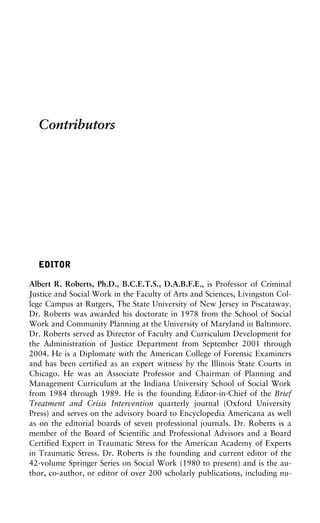
Contributors
EDITOR
Albert R. Roberts, Ph.D., B.C.E.T.S., D.A.B.F.E., is Professor of Criminal
Justice and Social Work in the Faculty of Arts and Sciences, Livingston Col-
lege Campus at Rutgers, The State University of New Jersey in Piscataway.
Dr. Roberts was awarded his doctorate in 1978 from the School of Social
Work and Community Planning at the University of Maryland in Baltimore.
Dr. Roberts served as Director of Faculty and Curriculum Development for
the Administration of Justice Department from September 2001 through
2004. He is a Diplomate with the American College of Forensic Examiners
and has been certified as an expert witness by the Illinois State Courts in
Chicago. He was an Associate Professor and Chairman of Planning and
Management Curriculum at the Indiana University School of Social Work
from 1984 through 1989. He is the founding Editor-in-Chief of the Brief
Treatment and Crisis Intervention quarterly journal (Oxford University
Press) and serves on the advisory board to Encyclopedia Americana as well
as on the editorial boards of seven professional journals. Dr. Roberts is a
member of the Board of Scientific and Professional Advisors and a Board
Certified Expert in Traumatic Stress for the American Academy of Experts
in Traumatic Stress. Dr. Roberts is the founding and current editor of the
42-volume Springer Series on Social Work (1980 to present) and is the au-
thor, co-author, or editor of over 200 scholarly publications, including nu-
xiv CONTRIBUTORS
merous peer-reviewed journal articles and book chapters, and 26 books. Dr.
Roberts’s most recent book, Ending Intimate Abuse: Practical Guidance and
Survival Strategies (Oxford University Press), was published in March 2005
and was co-authored by his wife, Beverly Schenkman Roberts.
Dr. Roberts has 30 years of full-time teaching experience at the under-
graduate and graduate levels in both criminal justice and social work. He has
conducted eight different national organizational surveys over the past 30
years and has been project director or principal investigator on research proj-
ects in Maryland, New York, Indiana, and New Jersey. In 2002, Dr. Roberts
completed the first national organizational survey of 39 statewide domestic
violence coalitions under the auspices of the National Network to End Domes-
tic Violence (NNEDV) in Washington, D.C. His recent books include Evi-
dence-Based Practice Manual: Research and Outcome Measures in Health
and Human Services (co-edited by Kenneth R. Yeager, Oxford University
Press, 2004); and Social Workers’ Desk Reference (co-edited by Gilbert J.
Greene, Oxford, 2002). Social Workers’ Desk Reference has won three na-
tional awards from the Association of American Publishers, the American
Library Association User’s Reference Division, and Choice. Dr. Roberts has
been listed in Who’s Who in America since 1992.
Contributors
Gary Behrman, Ph.D. Northern Illinois University
DeKalb, IllinoisResearch Associate
School of Social Work
State University of New York Mary Boes, D.S.W., M.P.H.
Albany, New York Associate Professor
Department of Social Work
University of Northern Iowa
Alan L. Berman, Ph.D.
Cedar Falls, Iowa
Executive Director
American Association of Suicidology
Ann Wolbert Burgess, R.N.,Bethesda, Maryland
D.N.Sc., F.A.A.N.Professor Emeritus of Psychology
Professor of Psychiatric-MentalAmerican University
Health NursingWashington, D.C.
School of Nursing
Boston College
Boston, MassachussettsLinda L. Black, Ph.D.
Associate Professor Forensic Mental Health Editor
for the journalDepartment of Educational
Psychology, Counseling, and Brief Treatment and Crisis
InterventionSpecial Education
CONTRIBUTORS xv
Ellis Copeland, Ph.D. Thomas K Gregoire, Ph.D.
Associate ProfessorProfessor of School Psychology
Division of Professional Psychology College of Social Work
Ohio State UniversityUniversity of Northern Colorado
Greeley, Colorado Columbus, Ohio
Dianne F. Harrison, Ph.D.
Sophia R. Dziegielewski, Ph.D.
Associate Vice-President of
Professor and Director Academic Affairs
School of Social Work Professor and Dean Emerita of
University of Cincinnati
Social Work
Cincinnati, Ohio
Florida State University
Tallahassee, Florida
Yvonne M. Eaton, M.S.W.
Vincent Henry, Ph.D.Clinical Supervisor
Associate Professor and DirectorSafe Harbor Behavioral Healthcare
Homeland Security Training Insti-Clinical Director
tuteErie County Critical Incident Stress
Southampton College of LongManagement Team
Island UniversityErie, Pennsylvania
Southampton, New York
George S. Every, Jr. Ph.D., FAPM., Ann M. Inela, M.A.
CTS Division of Professional Psychology
Co-founder, International Critical University of Northern Colorado
Incident Stress Foundation, Inc. Greeley, Colorado
Ellicott City, Maryland
Adjunct Professor of Psychology David A. Jobes, Ph.D.
Johns Hopkins University and Professor
Loyola University Department of Psychology
Baltimore, Maryland Catholic University of America
Washington, D.C.
Former President, American
Donald K. Granvold, Ph.D.
Association of SuicidologyProfessor and Associate Dean
School of Social Work
Eric D. Johnson, Ph.D.
University of Texas at Arlington
Assistant Professor and Director
Arlington, Texas
Family Therapy Graduate Programs
Drexel University
Philadelphia, PennsylvaniaGilbert J. Greene, Ph.D.
Professor
College of Social Work Rachel Kaul, M.S.W.
DirectorOhio State University
Columbus, Ohio Disaster and Emergency Services
xvi CONTRIBUTORS
Maryland Department of Health College of Health and Human
Sciencesand Mental Hygiene
Baltimore, Maryland Georgia State University
Atlanta, GeorgiaFormer Coordinator
Pentagon Employee Assistance
Gordon MacNeil, Ph.D.Program
Associate ProfessorWashington, D.C.
School of Social Work
The University of AlabamaJames F. Klein, Ph.D. Candidate
Tuscaloosa, AlabamaCounseling Psychology
University of Northern Illinois
Catherine E. Martin, Ph.D.
DeKalb, Illinois
Department of Psychology
Catholic University of America
Karen Knox, Ph.D. Washington, D.C.
Associate Professor and Director
Field Placements Joseph McBride, M.S.W.
School of Social Work Critical Incident Stress Debriefing
Southwest Texas State University Trainer
San Marcos, Texas New Jersey Chapter of NASW
Clinical Social Worker
Jeffrey M. Lating, Ph.D. Lawrenceville, New Jersey
Professor and Director
Virginia McDermott, R.N.Doctoral Program in Psychology
Medical-Surgical NurseLoyola University of Baltimore
Cardiac Care UnitBaltimore, Maryland
Allen Memorial Hospital
Waterloo, IowaMo-Yee Lee, Ph.D.
Professor of Social Work
Linda G. Mills, Ph.D., J.D.
Ohio State University
Professor of Social Work and Affili-
Columbus,Ohio
ated Professor of Law
Visiting Research Professor
Vice-Provost for Student Services
University of Hong Kong
New York University
Hong Kong, China
New York, New York
Sarah J. Lewis, Ph.D. Jeffrey T. Mitchell, Ph.D.
Associate Professor Co-founder, International Critical
School of Social Work Incident Stress Foundation
Barry University Ellicott City, Maryland
Miami, Florida Associate Professor
Emergency Services Department
University of Maryland at BaltimoreJan Ligon, Ph.D.
Associate Professor County
Baltimore County, MarylandDepartment of Social Work
CONTRIBUTORS xvii
Scott Newgass, M.S.W. Judy Rheinsheld, M.S.W.
Scioto Paint Valley Mental HealthClinical Instructor in Social Work
Yale Child Study Institute Center
Fayette County ClinicCoordinator
Regional School Crisis Prevention Washington Court House, Ohio
and Response Program
Albert R. Roberts, Ph.D., D.A.B.F.E.
New Haven, Connecticut
Professor of Criminal Justice and So-
cial WorkM. Sean O’Halloran, Ph.D.
Faculty of Arts and ScienceProfessor of Counseling Psychology
Rutgers University, Livingstonand Clinic Director
College CampusPsychological Services Clinic
Piscataway, New JerseyDivision of Professional Psychology
Editor-in-Chief of theUniversity of Northern Colorado
Brief Treatment and Crisis Interven-Greeley, Colorado
tion journal
Allen J Ottens, Ph.D.
Beverly Schenkman Roberts, M.Ed.Associate Professor
Health Advocate and DirectorDepartment of Educational
Mainstreaming Medical CarePsychology, Counseling and
ProgramSpecial Education
The Arc of New JerseyNorthern Illinois University
North Brunswick, New JerseyDekalb, Illinois
Donna Kirkpatrick Pinson, Ph.D.
Cheryl Regehr, Ph.D.
Candidate
Professor of Social Work and
Counseling Psychology
Director, Centre for Applied
University of Northern Illinois
Social Research
DeKalb, Illinois
University of Toronto
Former Clinical Director Gerald T. Powers, Ph.D.
Critical Incident Stress Team at Professor Emeritus
Pearson International Airport School of Social Work
Toronto, Canada Indiana University
Research Commentaries Editor of Indianapolis, Indiana
the
David Schonfeld, M.D.Brief Treatment and Crisis Interven-
Professor of Pediatrics and Child Studytion journal
Department of Pediatrics and
Institute for Child StudyWilliam J. Reid, D.S.W. (Deceased)
Professor Emeritus of Social Work Yale University School of Medicine
Yale-New Haven HospitalState University of New York at
Albany and Director
Regional School Crisis PreventionThe University of Chicago
School of Social Service and Response Program
New Haven, ConnecticutAdministration
xviii CONTRIBUTORS
Amy L. Shewbert, B.A. Kristy Sumner, M.S.W.
Ph.D. CandidateResearch Assistant
Psychological Management Services College of Public Affairs and Health
SciencesLubbock, Texas
University of Central Florida
Norman M. Shulman, Ed.D. Orlando, Florida
Clinical Assistant Professor
Department of Neuropsychiatry and Rhonda Trask, M.S.W.
Clinical Social WorkerBehavioral Science
Texas Tech University School of Newark, Ohio
Medicine
Victor Welzant, Psy.D.Licensed Psychologist
Director of TrainingPsychological Management Services
International Critical Incident StressLubbock, Texas
Foundation
Ellicott City, MarylandJonathan Singer, M.S.W.
Doctoral Candidate and Instructor
Kenneth R. Yeager, Ph.D.School of Social Work
Director of Quality Assurance andUniversity of Pittsburgh
Assistant Professor of Psychiatry,Pittsburgh, Pennsylvania
Department of Psychiatry
School of MedicineChris Stewart, Ph.D.
Assistant Professor Ohio State University Medical
CenterSchool of Social Work
University of Pittsburgh Columbus, Ohio
Pittsburgh, Pennsylvania
Introduction
The first edition of this book (published in 1990) and the second (published
in 2000) were major successes, and the editor has kept the same framework
with the five original sections. However, this new edition is basically a new
book, with 15 brand-new chapters and an additional section on disaster
mental health and crisis intervention. The remaining original chapters were
thoroughly updated and revised by the original authors.
Since the publication of the first edition, crisis intervention practices and
programs have changed considerably. Professional and public interest in cri-
sis intervention, crisis response teams, crisis management, and crisis stabili-
zation has grown tremendously in the past decade, partially due, no doubt,
to the prevalence of acute crisis events impacting on the lives of the general
public. The focus of this book is on crisis intervention services for persons
who are victims of natural disasters; school-based and home-based violence;
violent crimes, such as homicide, aggravated assault, sexual assault, domes-
tic violence, and date rape among college students; and personal or family
crises, such as the death of a loved one, incest, life-threatening medical con-
ditions, divorce, suicide and suicide attempts, and drug abuse.
Suicide prevention programs and other 24-hour crisis hotlines provide val-
uable assistance to callers who are contemplating suicide and related self-
destructive acts. These telephone hotlines are operational nationwide, usu-
ally staffed by trained graduate students and volunteers. The programs that
are accredited by the American Association of Suicidology require all crisis
xix
xx INTRODUCTION
hotline workers to complete a minimum of 40 hours of training and 20
hours of supervised hotline experience.
Hundreds of thousands of persons in distress turn to health care, family
counseling, and domestic violence and mental health facilities throughout
the United States for help in resolving crisis situations. Many crises are trig-
gered by a life-threatening event, such as acute cardiac arrest, attempted
murder, criminal homicide, motor vehicle crashes, child custody battles,
drug overdoses, psychiatric emergencies, sexual assaults, woman battering,
suicide, and/or community disasters. Crisis events and situations can often
be critical turning points in a person’s life. They can serve as a challenge and
opportunity for rapid problem resolution and growth, or as a debilitating
event leading to sudden disequilibrium, failed coping, and dysfunctional be-
havior patterns. In addition, given the limitations imposed on crisis interve-
nors and clinicians by the requirements of managed care groups, the use of
brief treatment has become more widespread.
INDIVIDUAL VERSUS GROUP
CRISIS INTERVENTION
There is debate in the field of crisis intervention among competing profes-
sional groups. The primary debate stems from each professional group’s
somewhat different crisis intervention model, and the groups’ different train-
ing and educational requirements for certification. The nature of the debate
is complicated by the fact that in the professional literature read by the in-
volved professional groups and organizations, crisis intervention has been
defined in different ways, including different concepts and parameters of
intervention. This handbook applies a unifying model of crisis intervention
while building on the strengths of each model.
At the core of the debate among professionals in the crisis intervention
field is the definition and scope of the assistance provided by professionals
immediately after the crisis event has occurred, and the definition and scope
of the assistance provided by professionals in the short-term period (several
weeks) following the crisis event. Also key to the debate is the level of train-
ing and expertise of the professionals who provide the immediate assistance.
This issue is further compounded by the fact that there are two overarching
categories of crisis events: private events that impact individuals or families
(e.g., a suicide attempt, an HIV diagnosis, divorce, woman battering, or the
untimely death of a close family member), and public events that impact
groups of individuals (e.g., a shooting at a school or in the workplace, a
devastating tornado, or an airplane crash). A complicating factor in the lat-
ter category is the involvement and intrusion of the news media at a time
when the affected individuals may want to be left alone to deal with the
crisis situation. This handbook will address and clarify these issues.
INTRODUCTION xxi
Some authorities have mistakenly defined crisis intervention as grief coun-
seling, hostage negotiations, or observing and collecting evidence at the
crime scene of a domestic violence incident. Other authorities define crisis
intervention to include disaster relief work and emergency medical services
performed by paramedics, firefighters, emergency medical technicians
(EMTs), airport security officers, flight attendants, and airline baggage han-
dlers, as well as trained volunteers. Other authorities contend that crisis in-
tervention is synonymous with the work of crisis response teams consisting
of trained mental health professionals, victim advocates, law enforcement
specialists, and clergy (2-day training and follow-up debriefings by the train-
ers from the National Organization for Victim Assistance [NOVA]). Finally,
the third and largest group of authorities (including the editor of this book)
have operationally defined crisis intervention as immediate, short-term, and
applied through rapid assessment protocols; bolstering coping methods, psy-
chosocial adaptation, solution-focused, timely crisis resolution. In general,
the expectation is that the crisis intervenor (also referred to as the crisis
clinician, crisis counselor, psychologist, or social worker) has completed a
graduate degree in clinical, community, or school psychology; guidance and
counseling; pastoral counseling; psychiatric–mental health nursing; or social
work. As part of the master’s or doctoral program, the mental health profes-
sional has acquired basic counseling, crisis intervention, and clinical practice
training and skills, as well as field practicum experience.
In chapter 1, and subsequent chapters, the authors focus on the extensive
step-by-step, eclectic model of crisis intervention (interchangeable with the
term crisis counseling). There is much confusion among the general public
regarding the definition of crisis intervention among mental health profes-
sionals in the aftermath of traumatic events, such as mass shootings in the
schools, airplane disasters, and murders in the workplace. Frontline crisis
workers and emergency services personnel are well trained and effective in
rescuing survivors and defusing potentially disastrous situations. The aver-
age citizen is not aware of the vital work of crisis clinicians after the work
of first responders/frontline crisis workers is completed. Because of a strong
code of ethics and confidentiality safeguards, it would be a violation for
social workers and psychologists to issue press releases or engage in inter-
views with journalists. Chapter 9, by Everly, Lating, and Mitchell, focuses
on Critical Incident Stress Debriefing for emergency services personnel, fire-
fighters, and police officers after individuals in the disaster receive medical
attention and are stabilized. Jeff Mitchell and George Everly are the founders
of the International Critical Incident Stress Foundation, and critical incident
stress and trauma debriefing teams.
The controversy in this field developed as a result of rigid adherence to
one model or approach rather than using an eclectic perspective that recog-
nizes and accepts the most effective components of each model. This is the
first comprehensive handbook that prepares the crisis intervenor for rapid
xxii INTRODUCTION
assessment and timely crisis intervention in the twenty-first century. Emo-
tional and psychological first aid (also known as critical incident debriefing,
frontline first response, and crisis stabilization) can be effectively adminis-
tered by trained volunteers, including emergency service workers. However,
crisis intervention or crisis counseling is much more extensive than critical
incident debriefing and crisis stabilization, usually requiring considerably
more time (usually 4 to 6 weeks) and graduate-level courses in a mental
health discipline. Since crisis intervention is a multidisciplinary field, the edi-
tor is more concerned with the graduate courses and training seminars com-
pleted, and the skills of the crisis intervenor, than with the particular aca-
demic discipline with which the crisis clinician is identified.
There are two primary phases to crisis intervention. The initial phase occurs
either immediately after the acute crisis episode or disaster has occurred or
within 48 hours of the event. This phase is generally referred to as defusing
the crisis and securing safety, crisis stabilization, emotional first aid, or crisis
management. This phase is usually standard operating procedure for state-
wide crisis response teams (who have been trained by the American Psycho-
logical Association disaster task force, the International Critical Incident
Stress Foundation, and/or the American Red Cross), law enforcement agen-
cies, hospitals and medical centers, and correctional agencies.
The specific nature of the intervention varies depending on the type of
crisis event that has occurred. An example is the need for crisis intervention
brought on by violence in the workplace, in which a disgruntled employee
returns to his former place of business and shoots his former supervisors
and/or coworkers. In this scenario, the initial intervention revolves around
providing emergency medical services for the shooting victims, as well as
crisis stabilization for the victims and coworkers, particularly those who
were at the scene and witnessed the shooting. The first activity of the crisis
team is to meet with the key people who are in charge at the site where the
crisis event occurred to establish the plan of action. Next, the crisis team
assembles the victims and observers to the crisis event (who have been medi-
cally stabilized) to provide a debriefing and to clarify the facts surrounding
the event (e.g., has the shooter been taken into custody? has a telephone
hotline been set up for family members who want to know what is happen-
ing?); identify postcrisis problems; provide an overview of what to expect
emotionally in the aftermath of the crisis event; and describe where victims
and observers can go for individual counseling and support. The team also
facilitates individual and group discussions to help the parties involved to
ventilate and process the event. Finally, the crisis team communicates with
the supervisors to help them understand how to identify and facilitate their
employees’ recovery by referral to a licensed mental health professional.
Although the crisis team approach described here is the recommended
response to an institutional or natural disaster, it is not always available and
INTRODUCTION xxiii
depends on the readiness and proactive stance of the community in which
one lives and works. Every community should have access to trained crisis
intervenors, either locally or through a consulting contract with a crisis team
from a nearby city. The most commonly used models for group crisis inter-
vention—emotional first aid, crisis and disaster management—were devel-
oped by Jeff Mitchell, George Everly, David Schonfeld, and Scott Newgass.
These two models will be applied in chapters 8, 9, 21, and 26.
The most popular model for individual crisis intervention is generally
known as crisis intervention or crisis counseling, which takes place during
the days and weeks immediately after the crisis event. This phase or type
of crisis intervention is commonly utilized by clinical social workers and
psychologists in group private practices, crisis intervention units of commu-
nity mental health centers, child and family counseling centers, and hospital
settings. Various practice models have been developed to assist clinicians in
working with persons in crisis including the three-step model (assessment,
boiling down the problem, coping alternatives). This book will consistently
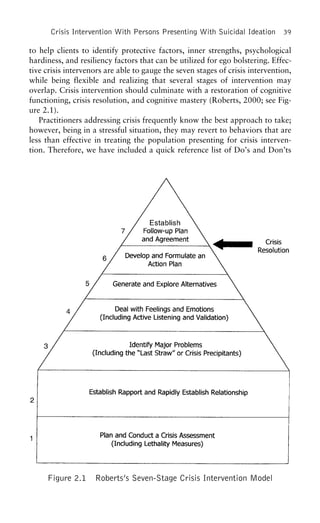
utilize the Roberts seven-stage crisis intervention model, which is applied as
an intervention framework for providing crisis counseling. This thorough
and sequential model can facilitate early identification of crisis precipitants,
active listening, problem solving, effective coping skills, inner strengths and
protective factors, and effective crisis resolution.The Roberts seven-stage
model consists of the following:
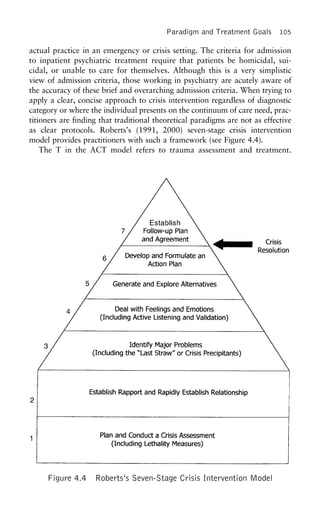
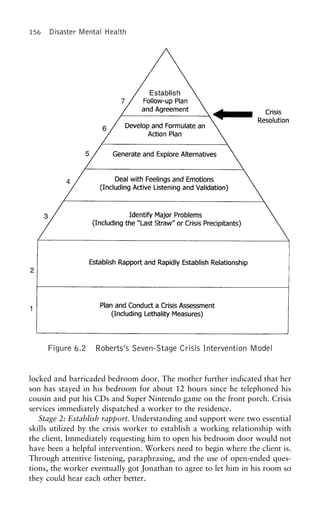
1. Assess lethality and mental health status.
2. Establish rapport and engage the client.
3. Identify major problems.
4. Deal with feelings.
5. Explore alternative coping methods and partial solutions.
6. Develop an action plan.
7. Develop a termination and follow-up protocol.
This handbook was written for frontline crisis workers, graduate stu-
dents, and clinicians who work with individuals, families, and communities
in crisis. Crisis theory and practice principles cut across several professions,
including counseling, social work, psychology, psychiatric nursing, psychia-
try, law enforcement, and victim assistance. Therefore, an interdisciplinary
approach has been used in compiling and editing this book. This volume is
a collaborative work, with original chapters written by prominent clinical
social workers, health social workers, clinical nurse specialists, clinical psy-
chologists, counseling psychologists, community psychologists, and victim
advocates. Each practice chapter (chapters 5 through 30) begins with one to
three case studies or vignettes, followed by sections that present an introduc-
tion; the scope of the problem; and the research literature related to resil-
ience and protective factors for specific high-risk groups (e.g., depressed ado-
lescents, incest survivors, stressed-out college students, battered women,
xxiv INTRODUCTION
chemically dependent individuals). The main part of each chapter includes a
framework for the practice of crisis intervention with a specific target group.
Several detailed cases and case commentaries are included in each chapter
to demonstrate the steps in the operation of the seven-stage crisis interven-
tion model. Also highlighted in each chapter are clinical issues, controversies,
roles, and skills. Many of the chapters conclude with summaries and predic-
tions for the future use of crisis intervention with a particular target group,
such as callers to a 24-hour mobile crisis unit, college students in crisis,
women with AIDS, adolescent suicide attemptors, victims of violent crimes,
victims of community disasters, and substance abusers.
Although the primary focus of this book is crisis intervention in the
United States, some of the chapters do include a discussion of suicide and
family crises and community disasters in other countries. Chapter 2 (by Rob-
erts) reviews studies on the effectiveness of suicide prevention centers in Can-
ada, England, and Japan, as well as the United States. Suicide prevention by
e-mail has been shown to be effective through the network of Samaritans
mutual aid in Australia, England, and Hong Kong. Chapters 1 and 2 also
includes information on crisis intervention studies conducted with groups of
clients in Switzerland, Canada, and the United States who had psychiatric
emergencies.
In Chapter 9, Everly, Mitchell, and Lating, the founders of Critical Inci-
dent Stress Management (CISM), apply their group crisis intervention model
to community disasters—for example, the bombing of the U.S. Embassy in
Nairobi; a nationwide crisis intervention system for postwar Kuwait; and
crisis intervention services for families of victims of the TWA 800 air disaster
that occurred over Long Island, New York.
In Chapters 21 and 22 there is a discussion of school shootings, poten-
tially violent situations, and crisis prevention, as well as group crisis inter-
vention models in the aftermath of school fatalities in the United States.
Chapter 9 focuses on a statewide school crisis prevention team and crisis
response program that has helped thousands of children and adolescents
during the past decade. These chapters contain valuable information for
mental health professionals worldwide, by providing detailed information
on how to plan and implement individual crisis intervention, schoolwide
notification systems, classroom interventions, training and support for
schoolteachers and guidance counselors, and crisis intervention in resource
rooms. No nation is immune from the shootings at schools and at work that
have received extensive attention in the media. An example of a horrendous
act of violence, in what could have been viewed as an unlikely location for
mass murder, occurred in Sterling, Scotland on March 13, 1996. A disgrun-
tled former school custodian, angry because he had been fired, returned to
the elementary school where he had worked, killing a teacher and 16 chil-
dren and injuring many other children before turning the gun on himself.
The police and emergency services staff brought the injured victims to the
INTRODUCTION xxv
three infirmaries (hospitals) in the area. In the aftermath of this horrific
school disaster, no crisis intervention teams were available to provide assis-
tance to the grieving family members and the recovering victims.
Recognizing the necessity of having mental health professionals mobilized
to respond quickly if a disaster occurred in their local community, the Amer-
ican Red Cross in the 1990s developed cooperative agreements with the
American Counseling Association, the American Psychological Association,
and the National Association of Social Workers in order to facilitate the
development of mental health and crisis response teams to provide immedi-
ate intervention. As a result, within 24 hours of a major disaster in the
United States (such as a plane crash of tornado) community crisis response
teams are on the scene, providing crisis intervention services.
Historically, in each decade there have been a number of fatal terrorists
attacks that result in acute crisis episodes and psychological trauma to survi-
vors and secondary victims in different parts of the world. The following is
a sample of some of the worst events in the past four decades:
• On September 5, 1972, Palestinian terrorists attacked Olympic Village
in Munich, Germany, 11 Israeli Olympic athletes, one policemen, and
five of the terrorists were killed, and the remaining 3 terrorists were
captured;
• On November 23, 1985, Palestinian terrorists hijacked an Egypt Airliner
in the Middle East and forced the pilot to fly them to Malta—when
Egyptian Commandoes tried to rescue all of the passengers, 59 people
were killed;
• On December 21, 1988, Pan Am 103 was bombed over Lockerbie, Scot-
land, and as a result 259 people were killed by Libyan terrorists;
• April 19, 1995, the Federal Building in Oklahoma City was bombed
with a 4,000 pound fertilizer bomb and 168 people were killed, includ-
ing 19 children, and more than 500 people were injured;
• On August 7, 1998, U.S. Embassies in Nairobi, Kenya, and Tanzania
were bombed by terrorists—291 people were killed in Nairobi, includ-
ing 12 U.S. citizens, and more than 5,000 people were seriously injured,
while 11 people were killed and 77 injured at the U.S. Embassy at Tan-
zania;
• On September 11, 2001, 19 Islamic terrorist suicide bombers highjacked
four large passenger airliners killing almost 3,000 people by crashing
the planes into New York City’s World Trade Center Twin Towers, the
Pentagon in Virginia and a field in Shanksville, Pennsylvania;
• On March 11, 2004, the terrorist bombing of train in Madrid, Spain,
kills 190 passengers and injures 1800 others;
• and on September 4, 2004, a school is taken over in Beslan, Russia, and
more than 340 children and adults are killed.
We cannot predict the psychological impact of future mass terrorist at-
tacks. However, the best method of preparing ourselves as mental health
professionals is to develop the skills necessary for rapid acute lethality and
xxvi INTRODUCTION
clinical assessment, as well as training in evidence-based crisis intervention
protocols, multicomponent critical incident stress management, trauma
treatment methods, and other disaster mental health interventions (for de-
tailed information and the latest protocols see chapters 5 through 14 of this
book).
This volume is intended to be a key resource for professionals who are
called upon to intervene with individuals and groups in crisis. There is a
very strong interest in the application of crisis theory and crisis intervention
techniques among professionals practicing in school, family, health, mental
health, victim assistance, and group private practice settings. This book has
been designed primarily for frontline crisis workers (e.g., clinical psycholo-
gists and social workers at outpatient mental health centers, psychiatric–
mental health nurses, social work case managers, and clinicians skilled in
crisis management after a community disaster), clinicians in managed care
settings, and graduate students who need to know the latest steps and meth-
ods for intervening effectively with persons in acute crisis. This book will
also be useful as the primary text in courses such as crisis intervention, crisis
counseling, crisis intervention and brief treatment, social work practice II,
and mental health practice, and as the supplementary text in health social
work, introduction to human services, psychiatric nursing, and community
psychology.
I
OVERVIEW
This page intentionally left blank
1
Bridging the Past and Present
to the Future of Crisis Intervention
and Crisis Management
ALBERT R. ROBERTS
This book is an interdisciplinary handbook, specially written by a team of
50 esteemed crisis and trauma experts, to prepare crisis workers, crisis coun-
selors, crisis therapists, emergency services workers, clergy, and graduate
students for rapid lethality assessments, timely crisis intervention, and
trauma treatment in the 21st century. It is the third edition of the Crisis
Intervention Handbook: Assessment, Treatment, and Research.
The landscape of crisis intervention practices and services was forever al-
tered on September 11, 2001, with the mass terrorist disasters at the World
Trade Center Twin Towers in New York City, the Pentagon in Arlington,
Virginia, and United Airlines Flight 93, which crashed in Shanksville, Penn-
sylvania. As a result of this catastrophic terrorist attack, 2,973 lives were
lost—the largest loss of life of U.S. citizens, firefighters (343 fatalities, FDNY),
and police (23 fatalities, NYPD) on one day in our history. The impact of
this attack spread far beyond New York and Washington, D.C. All over the
country crisis intervention procedures were reviewed and updated.
This edition contains 14 new chapters and a new section on disaster men-
tal health and frontline crisis intervention strategies. The other 18 chapters
in sections 1 and 3 through 6 have been revised and updated for this edition.
We live in an era in which sudden and unpredictable crisis and traumatic
events have become the familiar subjects of everyday news. Millions of peo-
ple are struck by potentially crisis-inducing events that they are not able to
resolve on their own. They need immediate help from mental health profes-
3
4 Overview
sionals, crisis intervention workers, or their significant others. The up-to-
date chapters in this book include thought-provoking case illustrations of
acute crisis episodes, with a step-by-step crisis intervention protocol applied
to each of the 50 case histories discussed.
The prevalence of social, psychological, criminal justice, and public health
problems has increased dramatically in recent years. Most notable are these
potentially crisis-inducing or trauma-provoking events:
Violent crimes (e.g., hostage situations, assaults, terrorist bombings, bio-
terrorism threats, domestic violence, muggings, sniper or drive-by shoot-
ings, sexual assaults, murder and attempted murders, violence in schools
and the workplace, mass murders).
Traumatic stressors or crisis-prone situations (e.g., becoming divorced or
separated from one’s spouse, losing one’s job, being hospitalized for a
sudden heart attack, being diagnosed with cancer, being diagnosed with
a sexually transmitted disease, having emergency surgery, watching a
close family member die, sustaining serious injuries in a car accident,
experiencing a near fatal encounter).
The onset or reoccurrence of mental illness (e.g., schizophrenia, schizoaf-
fective disorder, bipolar disorder, personality disorders, obsessive com-
pulsive disorder, phobias, panic disorder, posttraumatic stress disorder,
major depression).
Natural disasters (e.g., hurricanes, floods, tornadoes, earthquakes, vol-
canic eruptions).
Accidents (e.g., airplane crashes, train crashes, multiple motor vehicle and
truck crashes, bus crashes, ferry boat crashes).
Transitional or developmental stressors or events (e.g., moving to a new
city, changing schools in the middle of the year, divorce, unwanted
pregnancy, having a baby with a disability, becoming physically disa-
bled and placed in a nursing home).
The increase in terrorist threats as reported by the Federal Bureau of In-
vestigation and the Office of Homeland Security has made many Americans
anxious and panicky, hypervigilant, and intensely fearful that the next mass
terrorist attack will result in the death of one of their loved ones. In addition
to generalized fears about future terrorist attacks, there are numerous other
scenarios that are potential triggers for a crisis:
The homicide rate in the United States is the highest of all countries except
Colombia and South Africa, and for the year 2000, it was the second
leading cause of death for individuals age 15 to 24.
Approximately one out of every five children and youths in the United
States exhibit signs and symptoms of a psychiatric disorder each year.
Crisis Intervention and Crisis Management 5
Domestic violence is prevalent throughout the United States, with an esti-
mated 8.7 million cases annually.
The National Institute of Mental Health reports that more than 30,500
people die annually from suicide, 80 people die each day of the year.
The U.S. Department of Health and Human Services reports that more
than 3,200 new cases of cancer are diagnosed each day of the year.
The U.S. Public Health Service reports that 140 patients with AIDS die
each day of the year.
Motor vehicle accidents alone kill 118 people each day of the year.
All of these life-threatening or fatal events can produce acute crisis epi-
sodes and posttraumatic stress disorder (PTSD). Therefore, it is critically
important for all mental health and public health professionals to provide
early responses in the form of lethality assessments, crisis intervention, and
trauma treatment (see Chapter 6 in this volume for an overview of the seven
new chapters in Section 2 on disaster mental health strategies and for a
discussion of first responders’ and frontline crisis workers’ application of the
ACT model: Assessment, Crisis Intervention, and Trauma Treatment).
The high physical and psychological costs of traumatic events, such as
the ones listed above, are all too familiar to mental health and health care
professionals. Chapter 7 presents a detailed discussion of the different weap-
ons of mass destruction, how first responders should prepare for and re-
spond to terrorist threats, and the vital work of the New York City Disaster
Coalition of over 300 licensed clinicians who have provided free and confi-
dential treatment to survivors and their families post-September 11. Chapter
8 examines the disaster mental health and crisis intervention strategies used
with survivors at the Pentagon for the past three years.
Crisis intervention can lead to early resolution of acute stress disorders
or crisis episodes, while providing a turning point so that the individual is
strengthened by the experience. Crisis and traumatic events can provide a
danger or warning signal, or an opportunity to sharply reduce emotional
pain and vulnerability. The ultimate goal of crisis intervention is to bolster
available coping methods or help individuals reestablish coping and prob-
lem-solving abilities while helping them to take concrete steps toward man-
aging their feelings and developing an action plan. Crisis intervention can
reinforce strengths and protective factors for those who feel overwhelmed
by a traumatic event. In addition, it aims to reduce lethality and potentially
harmful situations and provides referrals to community agencies.
When two people experience the same traumatic event, one may cope in
a positive way and experience a manageable amount of stress, while the
other person may experience a crisis state because of inadequate coping skills
and a lack of crisis counseling. Two key factors in determining whether or
6 Overview
not a person who experiences multiple stressors escalates into a crisis state
are the individual’s perception of the situation or event and the individual’s
ability to utilize traditional coping skills. Roberts and Dziegielewski (1995)
have noted that crisis precipitants have different levels of intensity and dura-
tion, and likewise, there are wide variations in different individuals’ ability
to cope. Some people are able to cope effectively and mobilize their inner
strengths, despite their perceptions that the stressor or crisis precipitant is
intense. However, many other individuals need to learn new resources and
coping skills through skillful crisis intervention (Roberts, 1990, 2000). Pro-
fessionals often confuse the meaning and operational definition of stressful
life events, acute stress disorder, acute crisis episodes, and PTSD. Chapter 4
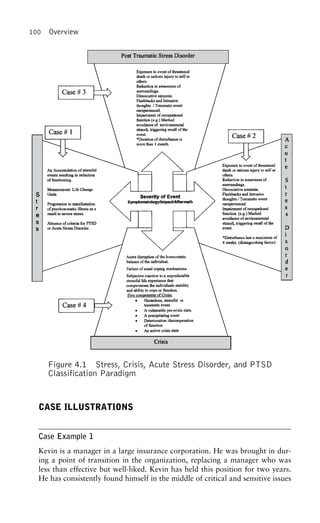
differentiates and clearly defines the differences between the four terms, and
also presents a new paradigm with four different case studies: a person under
stress, a person experiencing acute stress disorder, a person encountering an
acute crisis episode, and a person suffering from PTSD. In Chapter 5, the
six levels of the stress-crisis-trauma continuum are described, with case illus-
trations and treatment recommendations.
Counselors, social workers, psychiatric nurses, psychiatrists, psychologists,
and emergency services personnel are working collaboratively to provide a
new vision and clinical insights into crisis intervention and crisis response
teams. Crisis intervention has become the most widely used time-limited
treatment modality in the world. As a result of the crisis intervention and
critical incident stress management movement, millions of persons in crisis
situations have been helped in a cost-efficient and timely manner. Chapter
9, written by the founders of critical incident stress management (CISM), has
a thorough and up-to-date discussion of the components and effectiveness of
group crisis intervention and debriefing by first responders.
While it is vital to ensure that emergency responders have services avail-
able to help mitigate the consequences of disaster, emergency workers do
not suffer alone. Families of responders cope with long absences and fears
for their loved one’s safety during the disaster event. They feel the aftershock
as the emergency responder returns home having faced trauma and devasta-
tion. Chapter 10 reviews the impact of emergency service work on families
and suggests means for contributing to their health and well-being.
This work can be used by students and professionals in all the health and
human service professions to further their understanding of crisis and its
reduction and as a base for crisis intervention practice to increase their skills.
CASE SCENARIOS
Some crisis situations are personal, such as the death of a loved one or being
the victim of a rape, a robbery, or a severe battering incident; others are
Crisis Intervention and Crisis Management 7
triggered by a sudden, community-wide traumatic event, such as an airplane
crash, flood, hurricane, terrorist attack, or tornado. Both individual and
community-wide traumatic events can cause widespread crisis for dozens,
hundreds, or even many thousands of people.
Secondary Victims in the Aftermath of the World Trade Center
Terrorist Attack on September 11, 2001
Shelley is a 20-year-old college junior whose uncle was one of the 343 brave
NYFD firefighters who died trying to rescue people trapped in the carnage of
the Twin Towers at the World Trade Center on the morning of September
11. Shelley was very close to her uncle and grew up two blocks away from
him and his family on Staten Island. Shelley’s mother was the sister of her
deceased uncle. Uncle Frank had three kids, two at colleges in North Carolina
and Massachusetts, and a third, Samantha, who was only 10 years old at the
time. Samantha’s father used to take her to work with him in the morning,
where she would have breakfast with the other firefighters, and then her dad
would drop her off at school, which was near the firehouse in Staten Island.
Shelley was very supportive of her own mother, her widowed aunt, and her
10-year-old cousin and did her best to help with their immediate concrete
and crisis needs.
Since returning to NYU in lower Manhattan, Shelley has had difficulty
concentrating, has nightmares and gets only a few hours sleep each night, and
is anxious about her grades and graduation. Shelley speaks to her mother or
aunt almost every day after her classes. She also attended her Uncle Frank’s
funeral and wake, as well as two memorial services. In addition, Shelley and
other members of her immediate family watched the television coverage re-
peatedly after the terrorist attacks. Shelley seems to be overwhelmed emotion-
ally by her grief-stricken aunt and young cousin as well as the intrusive
thoughts and nightmares she has of the television images of the collapse of
the Twin Towers and the aftermath of the rescue efforts. Some days she cuts
all classes and completely withdraws and isolates herself in her dorm room.
Shelley goes to the university counseling center on referral from her aca-
demic advisor. However, she is very quiet and withdrawn due to her de-
pressed mood and crisis reactions.
Sudden Death of a Spouse and Child
Joe begins to barbecue the hamburgers for tonight’s dinner. His wife and
their two daughters are expected home in about 20 minutes. His older daugh-
ter had a track meet, and his wife and younger daughter went to watch her.
The phone rings, and Joe is informed by a police officer that his wife and
older daughter have been killed by a drunken driver who sped through a red
light and smashed into their car two blocks from their house. His life will
never be the same.
8 Overview
Deaths and Injuries Related to Plane Crash
At 9:00 A.M. one morning, the pilot of a malfunctioning air force attack jet
tried unsuccessfully to make an emergency landing at Indianapolis Interna-
tional Airport. The out-of-control jet clipped the top of a nearby bank build-
ing, then rammed into the lobby of a Ramada Inn and exploded, killing 10
people and injuring several others. This tragic accident resulted in hundreds
of persons in crisis: those injured in the explosion, the family members of the
dead and injured, the guests and surviving employees at the hotel who wit-
nessed the horror, and the employees and customers at the bank building that
was struck by the plane, even though no one at the bank was physically hurt.
Woman Battering
Judy B., a 27-year-old surgical nurse, was a survivor of wife battering. She
and Ray had been married for 6 years, and they had two children. As Ray’s
drinking increased, so did his beatings. The final straw was a violent attack
in which Ray punched Judy many times in her face. The day following this
last assault, after looking at her swollen face in the mirror, Judy went to a
gun store and purchased a handgun. As she drove home looking at the gun
by her side, she finally decided to seek help. She called the battered women’s
shelter hot line and said, “I’m afraid that I’m going to kill my husband.”
Forcible Rape
Mary R. was a 22-year-old college senior when she was raped. At 11 P.M.
one evening Mary had just left the health sciences library at the university
and was walking the three long blocks to the parking lot where her car was
parked. She recalls her reactions a week later: “I was sort of in shock and
numb. It was a terrifying, painful, and degrading experience. It was some-
thing you don’t expect to happen. But it could have been much worse. He
held a knife to my throat while raping me. I thought he was going to kill me
afterward. I’m glad to be alive.”
Robbery
John A., a 24-year-old blind male, was a victim of robbery. John was return-
ing to his apartment in the Bronx following an afternoon appointment with
his physician when he was robbed. John recalled what took place: “A guy
came up to me and pressed the cold barrel of his gun on my neck. He said if
I don’t give him what I got he would shoot me and the dog. I gave him the
$21 I had. Nobody helped me. Everybody’s afraid to intervene. They’re afraid
because they know the guy will get off or be put on probation and may come
after them.
About a week after the robbery, I woke up sweating and had a serious
asthma attack. I was hospitalized for a week. Now I try not to visit friends
or my cousin in Manhattan. I go out a lot less. I stay home and listen to the
radio or TV most of the time.”
Crisis Intervention and Crisis Management 9
Broken Romance, Depression, and Alcoholism
Liz, a 21-year-old college senior, is very depressed. She and her fiance´ have
just broken up, and she feels unable to cope. She cries most of the day, feels
agitated, and isn’t sleeping or eating normally. Since the beginning of the
relationship a year ago, Liz has become socially isolated. Her family strongly
dislikes her fiance´, and her fiance´ discouraged her from spending time with
her friends. Liz now doubts that she will find a job upon graduation in 3
months and is considering moving home. She comes from a large family, with
parents who are very much involved with the other children. Thoughts of
moving back home and losing her independence, as well as the broken ro-
mance and the lack of a support system, have immobilized Liz, who has cut
all her classes for the past week. She has not talked with friends or family
about the breakup, and she is “holed up” in her room in the dormitory,
drinking herself into a stupor and refusing to eat or leave the building even
for a walk.
Shelley, Joe, Judy, Mary, John, and Liz are experiencing crisis reactions
in the aftermath of highly stressful hazardous events. The initial crisis reac-
tion in the aftermath of the sudden death of a loved one or being the victim
of a violent crime is usually a series of physiological and emotional reactions.
Some common reactions and symptoms after traumatic and crisis events in-
clude overwhelming feelings of anxiety, despair, and hopelessness, guilt, in-
tense fears, grief over sudden losses, confusion, difficulty concentrating,
powerlessness, irritability, intrusive imagery, flashbacks, extreme suspicious-
ness of others, shame, disorientation, loss of appetite, binge drinking, sleep
disturbances, helplessness, terror, exhaustion, losses or lapses of religious
beliefs, and/or shattered assumptions about personal safety. Persons experi-
encing traumatic events or an accumulation of stressful life events usually
attempt to understand and reduce their symptoms, to regain control of their
environment, and to reach out to their support system (e.g., a significant
other). Sometimes the person’s internal and external coping methods are
successful, and an acute crisis episode is averted; at other times vulnerable
individuals and groups fail in their attempts to cope, and crisis episodes
escalate.
Chapters 1 through 5 of this book link crisis theory to practice. The empha-
sis in the first five chapters is placed on the application of individual and
group crisis intervention paradigms and models to facilitating crisis resolu-
tion. Chapter 1 links the past to the present state-of-the-art knowledge of
conceptualizing crisis theory, crisis reactions, and crisis intervention prac-
tices. Chapter 2 focuses on how-to conduct lethality/danger assessments and
apply each of the seven stages of the crisis intervention model to 3 individu-
als with different degrees of suicide ideation presenting to a crisis center or
psychiatric screening unit. Chapter 3 integrates Roberts’s seven-stage crisis
10 Overview
intervention model with solution-based therapy and a strengths perspective.
Chapter 4 delineates and examines a stress, crisis, PTSD Classification Para-
digm which provides guidelines for practitioners to effectively assess the se-
verity of initial event, diagnostic symptoms, and treatment planning options.
Chapter 5 develops a continuum of stress and crisis episodes ranging from
low-level somatic distress to cumulative and catastrophic acute crisis epi-
sodes.
Chapters 6, 12, 15, through 30 apply Roberts’s seven-stage model of cri-
sis assessment and intervention to particular high-risk groups and situations
such as the following:
• persons experiencing the loss of a loved one at the World Trade Center
and the Pentagon on September 11th
• early adolescents who have experienced a significant loss
• adolescents and adults with suicidal ideation and plans
• child and adolescent psychiatric emergencies
• crises on the college campus
• battered women in crisis
• crisis related to separation, divorce, and child custody
• HIV-positive women in crisis
• persons in medical crisis presenting at the emergency room
• persons presenting with life-threatening injuries at a hospital emergency
room
• persons experiencing psychiatric crises and coming to the local mental
health center or emergency room
• a series of crises experienced by substance abusers
• people experiencing mental health–related crises and being helped by a
frontline 24-hour mobile crisis team
• persons in crisis as a result of the burden of caring for a terminally ill or
disabled parent
This is the first comprehensive handbook to consistently apply a comprehen-
sive seven-stage crisis intervention model to a wide range of clients in acute
crisis.
SCOPE OF THE PROBLEM AND
PREVALENCE ESTIMATES
We live in an era in which traumatic events and acute crisis episodes have
become far too prevalent. Each year, millions of people are confronted with
traumatic crisis-producing events that they cannot resolve on their own, and
they often turn for help to 24-hour telephone crisis hotlines; crisis units of
community mental health centers; and outpatient, hospital-based programs.
During the past two decades, thousands of crisis intervention programs
have been established throughout the United States and Canada. There are
Crisis Intervention and Crisis Management 11
over 1,400 grassroots crisis centers and crisis units affiliated with the Ameri-
can Association of Suicidology or a local community mental health center.
Altogether there are also over 11,000 victim assistance programs, rape crisis
programs, child sexual and physical abuse intervention programs, police-
based crisis intervention programs, and battered women’s shelters and hot-
lines. In addition, crisis services are provided at thousands of local hospital
emergency rooms, hospital-based trauma centers and emergency psychiatric
services, suicide prevention centers, and pastoral counseling services.
Crisis centers and hotlines provide information, crisis assessments, inter-
vention, and referrals for callers with such problems as depression, suicide
ideation, psychiatric emergencies, chemical dependency, AIDS, sexual dys-
function, woman battering, and crime victimization. Because of their 24-
hour availability, they can provide immediate, though temporary, assistance.
Some crisis victims do not have a caring friend or relative to whom they
can turn; they often benefit from an empathetic, active listener. Even when
significant others are available to aid the person in crisis, hotlines provide a
valuable service by linking the caller to appropriate community resources.
The large number of documented calls to crisis hotlines—an estimated
4.3 million calls annually—indicates the importance of these programs
(Roberts & Camasso, 1994). The first national organizational survey of cri-
sis units and centers yielded a response from 107 programs (Roberts, 1995).
The researcher’s summary findings indicated that a total of 578,793 crisis
callers were handled by the crisis centers and programs in the 1-year period
directly prior to receipt of the mailed questionnaire, or an annual average of
5,409 callers per crisis intervention program. In 1990, 796 crisis intervention
units and programs (affiliated with a community mental health center) were
in operation throughout the United States, and the annual average number
of callers received by each program was 5,409. As a result of multiplying
the average number of callers by the number of programs, Roberts (1995)
estimated the annual number of callers to be sightly over 4.3 million. If we
broaden our estimate to all national and local 24-hour crisis lines, including
those for crime victims, survivors of terrorist attacks, battered women, sex-
ual assault victims, troubled employees, adolescent runaways, and child
abuse victims, as well as the crisis intervention units at mental health centers,
the total estimate would be approximately 35 to 45 million crisis callers per
year.
CRISIS REACTIONS AND
CRISIS INTERVENTION
A crisis can be defined as a period of psychological disequilibrium, experi-
enced as a result of a hazardous event or situation that constitutes a signifi-
cant problem that cannot be remedied by using familiar coping strategies. A
12 Overview
crisis occurs when a person faces an obstacle to important life goals that
generally seems insurmountable through the use of customary habits and
coping patterns. The goal of crisis intervention is to resolve the most pressing
problem within a 1- to 12-week period using focused and directed interven-
tions aimed at helping the client develop new adaptive coping methods.
Crisis reaction refers to the acute stage, which usually occurs soon after
the hazardous event (e.g., sexual assault, battering, suicide attempt). During
this phase, the person’s acute reaction may take various forms, including
helplessness, confusion, anxiety, shock, disbelief, and anger. Low self-esteem
and serious depression are often produced by the crisis state. The person in
crisis may appear to be incoherent, disorganized, agitated, and volatile or
calm, subdued, withdrawn, and apathetic. It is during this period that the
individual is often most willing to seek help, and crisis intervention is usually
more effective at this time (Golan, 1978).
Crisis intervention can provide a challenge, an opportunity, and a turning
point within the individual’s life. According to Roberts and Dziegielewski
(1995), crisis clinicians have been encouraged to examine psychological and
situational crises in terms of “both danger and opportunity” (p. 16). The
aftermath of a crisis episode can result in either a highly positive or a highly
negative change. Immediate and structured crisis intervention guided by
Roberts’s seven-stage model facilitates crisis resolution, cognitive mastery,
and personal growth, rather than psychological harm.
A divorce, a robbery, a broken engagement, being the victim of a domestic
assault, and being the close relative of a person killed in an automobile acci-
dent or a plane crash are all highly stressful occurrences that can result in an
active crisis state. The persons involved may exhibit denial, intense anxiety,
and confusion; they may express anger and fear, or grief and loss, but they
can all survive. Crisis intervention can reduce immediate danger and fear, as
well as provide support, hope, and alternative ways of coping and growing.
Persons in acute crisis have had similar reactions to traumatic events,
from initial feelings of disruption and disorganization to the eventual read-
justment of the self. During the impact phase, survivors of victimization and
other crisis-producing events often feel numb, disoriented, shattered, fearful,
vulnerable, helpless, and lonely. The survivors may seek help, consolation,
and advice from friends or professionals within several hours or days after
the traumatic or stressful life event.
Helping a person in crisis—whether it be in the aftermath of a violent
crime, a suicide attempt, a drug overdose, a life-threatening illness, a natural
disaster, a divorce, a broken romance, or an automobile crash—requires
exceptional sensitivity, active listening skills, and empathy on the part of
the crisis intervenor. If a hotline worker, crisis counselor, social worker, or
psychologist is able to establish rapport with the person in crisis soon after
the acute crisis episode, many hours of later treatment may be averted.
Crisis Intervention and Crisis Management 13
DEFINING A CRISIS AND
CRISIS CONCEPTS
Crisis may be viewed in various ways, but most definitions emphasize that
it can be a turning point in a person’s life. According to Bard and Ellison
(1974), crisis is “a subjective reaction to a stressful life experience, one so
affecting the stability of the individual that the ability to cope or function
may be seriously compromised” (p. 68).
It has been established that a crisis can develop when an event, or a series
of events, takes place in a person’s life and the result is a hazardous situation.
However, it is important to note that the crisis is not the situation itself (e.g.,
being victimized); rather, it is the person’s perception of and response to the
situation (Parad, 1971, p. 197).
The most important precipitant of a crisis is a stressful or hazardous
event. But two other conditions are also necessary to have a crisis state: (a)
the individual’s perception that the stressful event will lead to considerable
upset and/or disruption; and (b) the individual’s inability to resolve the dis-
ruption by previously used coping methods (see the Glossary p. 513).
Crisis intervention refers to a therapist entering into the life situation of
an individual or family to alleviate the impact of a crisis to help mobilize
the resources of those directly affected (Parad, 1965).
In conceptualizing crisis theory, Parad and Caplan (1960) examine the
fact that “crises have a peak or sudden turning point”; as the individual
reaches this peak, tension increases and stimulates the mobilization of pre-
viously hidden strengths and capacities. They urge timely intervention to
help individuals cope successfully with a crisis situation. Caplan (1961)states
that “a relatively minor force, acting for a relatively short time, can switch
the balance to one side or another, to the side of mental health or the side
of mental ill health” (p. 293).
There is a general consensus among clinical social workers, counselors,
psychologists, and emergency services workers that the following character-
ize a person in crisis:
1. Perceiving a precipitating event as being meaningful and threatening
2. Appearing unable to modify or lessen the impact of stressful events
with traditional coping methods
3. Experiencing increased fear, tension, and/or confusion
4. Exhibiting a high level of subjective discomfort
5. Proceeding rapidly to an active state of crisis—a state of disequilibrium
The term crisis as it has been described here is applicable to most of the
clients of the social workers, psychologists, emergency service workers, di-
saster mental health workers, and professional counselors who prepared
14 Overview
chapters for this handbook. The definition of a crisis stated previously is
particularly applicable to persons in acute crisis because these individuals
usually seek help only after they have experienced a hazardous event and
are in a vulnerable state, have failed to cope and lessen the crisis through
customary coping methods, and want outside help.
Foundation Assumptions and
the Crisis Theory Framework
The conceptual framework for crisis intervention practice presented in this
handbook incorporates the basic principles of crisis theory. The crisis inter-
vention specialization is built on a basic knowledge of crisis theory and prac-
tice. Crisis theory includes a cluster of principles upon which crisis clinicians
and researchers usually agree. In this book the prominent authorities on
crisis intervention demonstrate the application of the crisis intervention pro-
cess and practices to special groups at high risk of crisis. But first it will be
helpful to summarize the foundation principles of crisis theory and to place
them in a step-by-step crisis management framework.
Basic Tenets of Crisis Theory
As mentioned earlier, a crisis state is a temporary upset, accompanied by
some confusion and disorganization, and characterized by a person’s inabil-
ity to cope with a specific situation through the use of traditional problem-
solving methods. According to Naomi Golan (1978), the heart of crisis the-
ory and practice rests in a series of basic statements:
Crisis situations can occur episodically during “the normal life span of
individuals, families, groups, communities and nation.” They are often ini-
tiated by a hazardous event. This may be a catastrophic event or a series
of successive stressful blows which rapidly build up a cumulative effect.
(p. 8)
The impact of the hazardous event disturbs the individual’s homeostatic
balance and puts him in a vulnerable state. (p. 8)
If the problem continues and cannot be resolved, avoided, or redefined,
tension rises to a peak, and a precipitating factor can bring about a turning
point, during which self-righting devices no longer operate and the individ-
ual enters a state of a disequilibrium . . . (an) active crisis. (p. 8)
Duration of the Crisis
Persons cannot remain indefinitely in a state of psychological turmoil and
survive. Caplan (1964) noted, and other clinical supervisors have concurred,
that in a typical crisis state equilibrium will be restored in 4 to 6 weeks.
Crisis Intervention and Crisis Management 15
However, the designation of 4 to 6 weeks has been confusing. Several au-
thors note that crisis resolution can take from several weeks to several
months. To clarify the confusion concerning this period, it is useful to ex-
plain the difference between restoring equilibrium and crisis resolution.
Disequilibrium, which is characterized by confusing emotions, somatic
complaints, and erratic behavior, is reduced considerably within the first 6
weeks of crisis intervention. The severe emotional discomfort experienced
by the person in crisis propels him or her toward action that will result in
reducing the subjective discomfort. Thus, equilibrium is restored, and the
disorganization is time limited.
Viney (1976) aptly describes crisis resolution as restoration of equilib-
rium, as well as cognitive mastery of the situation and the development of
new coping methods. Fairchild (1986) refers to crisis resolution as an adap-
tive consequence of a crisis in which the person grows from the crisis experi-
ence through the discovery of new coping skills and resources to employ in
the future. In this handbook, crisis intervention is viewed as the process of
working through the crisis event so that the person is assisted in exploring
the traumatic experience and his or her reaction to it. Emphasis is also
placed on helping the individual do the following:
Make behavioral changes and interpersonal adjustments.
Mobilize internal and external resources and supports.
Reduce unpleasant or disturbing affects related to the crisis.
Integrate the event and its aftermath into the individual’s other life experi-
ences and markers.
The goal of effective crisis resolution is to remove vulnerabilities from the
individual’s past and bolster him or her with an increased repertoire of new
coping skills to serve as a buffer against similar stressful situations in the
future.
HISTORICAL DEVELOPMENT
As far back as 400 B.C., physicians have stressed the significance of crisis as
a hazardous life event. Hippocrates himself defined a crisis as a sudden state
that gravely endangers life. But the development of a cohesive theory of crisis
and approaches to crisis management had to await the twentieth century.
The movement to help people in crisis began in 1906 with the establishment
of the first suicide prevention center, the National Save-a-Life League in
New York City. However, contemporary crisis intervention theory and prac-
tice were not formally elaborated until the 1940s, primarily by Erich Linde-
mann and Gerald Caplan.
Lindemann and his associates at Massachusetts General Hospital intro-
duced the concepts of crisis intervention and time-limited treatment in 1943
16 Overview
in the aftermath of Boston’s worst nightclub fire, at the Coconut Grove, in
which 493 people perished. Lindemann (1944) and colleagues based the cri-
sis theory they developed on their observations of the acute and delayed
reactions of survivors and grief-stricken relatives of victims. Their clinical
work focused on the psychological symptoms of the survivors and on pre-
venting unresolved grief among relatives of the persons who had died. They
found that many individuals experiencing acute grief often had five related
reactions:
1. Somatic distress
2. Preoccupation with the image of the deceased
3. Guilt
4. Hostile reactions
5. Loss of patterns of conduct
Furthermore, Lindemann and colleagues concluded that the duration of a
grief reaction appears to be dependent on the success with which the be-
reaved person does his or her mourning and “grief work.” In general, this
grief work involves achieving emancipation from the deceased, readjusting
to the changes in the environment from which the loved one is missing, and
developing new relationships. We learned from Lindemann that people need
to be encouraged to permit themselves to have a period of mourning and
eventual acceptance of the loss and adjustment to life without the parent,
child, spouse, or sibling. If the normal process of grieving is delayed, negative
outcomes of crises will develop. Lindemann’s work was soon adapted to
interventions with World War II veterans suffering from “combat neurosis”
and bereaved family members.
Gerald Caplan, who was affiliated with Massachusetts General Hospital
and the Harvard School of Public Health, expanded Lindemann’s pioneering
work in the 1940s and 1950s. Caplan studied various developmental crisis
reactions, as in premature births, infancy, childhood, and adolescence, and
accidental crises such as illness and death. He was the first psychiatrist to
relate the concept of homeostasis to crisis intervention and to describe the
stages of a crisis. According to Caplan (1961), a crisis is an upset of a steady
state in which the individual encounters an obstacle (usually an obstacle to
significant life goals) that cannot be overcome through traditional problem-
solving activities. For each individual, a reasonably constant balance or
steady state exists between affective and cognitive experience. When this
homeostatic balance or stability in psychological functioning is threatened
by physiological, psychological, or social forces, the individual engages in
problem-solving methods designed to restore the balance. However, in a cri-
sis situation, the person in distress faces a problem that seems to have no
solution. Thus homeostatic balance is disrupted, or an upset of a steady state
ensues.
Crisis Intervention and Crisis Management 17
Caplan (1964) explains this concept further by stating that the problem
is one in which the individual faces “stimuli which signal danger to a funda-
mental need satisfaction . . . and the circumstances are such that habitual
problem-solving methods are unsuccessful within the time span of past ex-
pectations of success” (p. 39).
Caplan also described four stages of a crisis reaction. The first stage is
the initial rise of tension that comes from the emotionally hazardous crisis-
precipitating event. The second stage is characterized by an increased level
of tension and disruption to daily living because the individual is unable to
resolve the crisis quickly. As the person attempts and fails to resolve the
crisis through emergency problem-solving mechanisms, tension increases to
such an intense level that the individual may go into a depression. The per-
son going through the final stage of Caplan’s model may experience either
a mental collapse or a breakdown, or may partly resolve the crisis by using
new coping methods. J. S. Tyhurst (1957) studied transition states—migra-
tion, retirement, civilian disaster, and so on—in the lives of persons experi-
encing sudden changes. Based on his field studies on individual patterns of
responses to community disaster, Tyhurst identified three overlapping
phases, each with its own manifestations of stress and attempts at reduc-
ing it:
1. A period of impact
2. A period of recoil
3. A posttraumatic period of recovery
Tyhurst recommended stage-specific intervention. He concluded that per-
sons in transitional crisis states should not be removed from their life situa-
tion, and that intervention should focus on bolstering the network of rela-
tionships.
In addition to building on the pioneering work of Lindemann and Caplan,
Lydia Rapoport was one of the first practitioners to write about the linkage
of modalities such as ego psychology, learning theory, and traditional social
casework (Rapoport, 1967). In Rapoport’s first article on crisis theory
(1962), she defined a crisis as “an upset of a steady state” (p. 212) that
places the individual in a hazardous condition. She pointed out that a crisis
situation results in a problem that can be perceived as a threat, a loss, or a
challenge. She then stated that there are usually three interrelated factors
that create a state of crisis:
1. A hazardous event
2. A threat to life goals
3. An inability to respond with adequate coping mechanisms
In their early works, Lindemann and Caplan briefly mentioned that a
hazardous event produces a crisis, but it was Rapoport (1967) who most
thoroughly described the nature of this crisis-precipitating event. She clearly
18 Overview
conceptualized the content of crisis intervention practice, particularly the
initial or study phase (assessment). She began by pointing out that in order
to help persons in crisis, the client must have rapid access to the crisis
worker. She stated: “A little help, rationally directed and purposefully fo-
cused at a strategic time, is more effective than more extensive help given at
a period of less emotional accessibility” (Rapoport, 1967, p. 38).
This point was echoed by Naomi Golan (1978), who concluded that dur-
ing the state of active crisis, when usual coping methods have proved inade-
quate and the individual and his or her family are suffering from pain and
discomfort, a person is frequently more amenable to suggestions and change.
Clearly, intensive, brief, appropriately focused treatment when the client is
motivated can produce more effective change than long-term treatment
when motivation and emotional accessibility are lacking.
Rapoport (1967) asserted that during the initial interview, the first task
of the practitioner is to develop a preliminary diagnosis of the presenting
problem. It is most critical during this first interview that the crisis therapist
convey a sense of hope and optimism to the client concerning successful
crisis resolution. Rapoport suggested that this sense of hope and enthusiasm
can be properly conveyed to the client when the interview focuses on mutual
exploration and problem solving, along with clearly delineated goals and
tasks. The underlying message is that client and therapist will be working
together to resolve the crisis.
Seeking Help
In the late 1960s the suicide prevention movement took hold, and suicide
prevention centers were established across the United States. From the out-
set, the initial request for help was generally made via a telephone hotline,
a practice that continues to the present day. Aided by funding from the
National Institute of Mental Health’s Center for Studies of Suicide Preven-
tion, these centers grew from 28 in 1966 to almost 200 by 1972. They built
on Caplan’s crisis theory and the work of Edwin Schneidman and Norman
Farberow at the Los Angeles Suicide Prevention Center (Roberts, 1975,
1979).
An enormous boost to the development of crisis intervention programs
and units came about as a result of the community mental health movement.
The availability of 24-hour crisis intervention and emergency services was
considered a major component of any comprehensive community mental
health center (CMHC). As a prerequisite to receiving federal funding under
the Community Mental Health Centers Act of 1963, CMHCs were required
to include an emergency services component in their system plan. During the
1970s the number of CMHCs that contained crisis intervention units grew
rapidly, more than doubling from 376 centers in 1969 to 796 as of 1980
(Foley & Sharfstein, 1983).
Crisis Intervention and Crisis Management 19
What motivates people in crisis to seek help? Ripple, Alexander, and Po-
lemis (1964) suggest that a balance of discomfort and hope is necessary to
motivate a distressed person to seek help. Hope as defined by Stotland
(1969) is the perceived possibility of attaining a goal.
The crisis clinician knows that coping patterns differ for each of us. The
crisis clinician also knows that for an individual to suffer and survive a crisis
(such as losing a loved one, living through an earthquake or a tornado,
attempting suicide, or being sexually assaulted), he or she must have a con-
scious purpose to live and grow. Each individual in crisis must define his or
her own purpose. Persons in crisis need to ventilate, to be accepted, and to
receive support, assistance, and encouragement to discover the paths to crisis
resolution.
It is useful for the client to understand the specific personal meaning of
the event and how it conflicts with his or her expectations, life goals, and
belief system. Thoughts, feelings, and beliefs usually flow out freely when a
client in crisis talks. The crisis clinician should listen carefully and note any
cognitive errors or distortions (overgeneralizing, catastrophizing) or irra-
tional beliefs. The clinician should avoid prematurely stating rational beliefs
or reality-based cognitions for the client. Instead, the he or she should help
the client to recognize discrepancies, distortions, and irrational beliefs. This
is best accomplished through carefully worded questions such as “How do
you view yourself now that you realize that everyone with less than 5 years’
seniority got laid off?” or “Have you ever asked your doctor whether he
thinks you will die from cancer at a young age or what your actual risk of
getting cancer is?”
CRISIS INTERVENTION MODELS
AND STRATEGIES
Several systematic practice models and techniques have been developed for
crisis intervention work. The crisis intervention model applied in this book
builds on and synthesizes those developed by Caplan (1964), Golan (1978),
Parad (1965), Roberts (1991, 1998), and Roberts and Dziegielewski (1995).
All of these practice models and techniques focus on resolving immediate
problems and emotional conflicts through a minimum number of contacts.
Crisis-oriented treatment is time limited and goal directed, in contrast to
long-term psychotherapy, which can take several years to complete.
Crisis intervenors should “adopt a role which is active and directive with-
out taking problem ownership” away from the individual in crisis prema-
turely (Fairchild, 1986, p. 6). The skilled crisis intervenor should display
acceptance and hopefulness in order to communicate to persons in crisis that
their intense emotional turmoil and threatening situations are not hopeless,
and that, in fact, they (like others in similar situations before them) will
20 Overview
survive the crisis successfully and become better prepared for potentially haz-
ardous life events in the future.
In order to become an effective crisis intervenor, it is important to gauge
the stages and completeness of the intervention. The following seven-stage
paradigm should be viewed as a guide, not as a rigid process, since with
some clients stages may overlap.
Roberts’s (1991) seven-stage model of crisis intervention (Figure 1.1) has
been utilized for helping persons in acute psychological crisis, acute situa-
tional crises, and acute stress disorders. The seven stages are as follows:
Figure 1.1 Roberts’s Seven-Stage Crisis Intervention Model
Crisis Intervention and Crisis Management 21
1. Plan and conduct a thorough assessment (including lethality, danger-
ousness to self or others, and immediate psychosocial needs).
2. Make psychological contact, establish rapport, and rapidly establish the
relationship (conveying genuine respect for the client, acceptance, reas-
surance, and a nonjudgmental attitude).
3. Examine the dimensions of the problem in order to define it (including
the last straw or precipitating event).
4. Encourage an exploration of feelings and emotions.
5. Generate, explore, and assess past coping attempts.
6. Restore cognitive functioning through implementation of action plan.
7. Follow up and leave the door open for booster sessions 3 and/or 6
months later.
1. Plan and conduct a thorough psychosocial and lethality assessment. In
many cases, stages 1 and 2 occur at the same time. However, first and fore-
most, basic information needs to be obtained in order to determine whether
the caller is in imminent danger. Crisis clinicians are trained to perform an
ongoing, rapid risk assessment with all clients in crisis. Crisis counselors,
psychologists, and social workers encounter a full range of self-destructive
individuals in crisis, including those who have taken potentially lethal drug
overdoses, depressed and lonely callers who have attempted suicide, and im-
pulsive acting-out adolescents threatening to injure someone. In cases of im-
minent danger, emergency medical or police intervention is often necessary.
All suicide prevention and other 24-hour crisis hotlines have access to para-
medics and emergency medical technicians, poison control centers, the po-
lice, and the emergency rescue squad. It is critically important for the crisis
intervenor to be in close contact with the crisis caller before, during, and
after medical stabilization and discharge.
In many other crisis situations, there is some potential for danger and
harm. As a result of potential danger to crisis callers with a history of reck-
less driving, binge drinking, chemical dependency, bi-polar disorder, explo-
sive anger, passive aggressive behavior, schizophrenia, and/or preoccupation
with suicidal thoughts or fantasies, it is imperative that crisis intervenors use
stages 1 through 7 of Roberts’s model as a guide to crisis intervention.
Assessments of imminent danger and potential lethality should examine
the following factors:
• Determine whether the crisis caller needs medical attention (e.g., drug
overdose, suicide attempt, or domestic violence).
• Is the crisis caller thinking about killing herself or himself? (Are these
general thoughts, or does the caller have a specific suicide plan or pact,
with the location, time, and method specified?)
• Determine whether the caller is a victim of domestic violence, sexual
assault, and/or other violent crime. If the caller is a victim, ask whether
the batterer is nearby or likely to return soon.
22 Overview
• Determine whether any children are in danger.
• Does the victim need emergency transportation to the hospital or a
shelter?
• Is the crisis caller under the influence of alcohol or drugs?
• Is the caller about to injure herself or himself (e.g., self-injurious behav-
iors or self-mutilations)?
• Inquire whether there are any violent individuals living in the residence
(e.g., assaultive boarders or perpetrators of elder abuse or sibling abuse).
If time permits, the risk assessment should include the following (recog-
nize that a client who is in imminent danger needs to go immediately to a
safe place):
• In domestic violence situations, determine the nature of the caller’s pre-
vious efforts to protect herself or her children, in order to determine her
ability to protect herself.
• In order to fully assess the perpetrator’s threat in cases of domestic vio-
lence, inquire into the batterer’s criminal history, physical abuse history,
substance abuse history, destruction of property, impulsive acts, history
of mental disorders, previous psychiatric diagnosis, previous suicide
threats or gestures, stalking behavior, and erratic employment or long
periods of unemployment.
• If the caller is a victim of a violent crime, is there a history of prior visits
to the hospital emergency room for physical abuse, drug overdose, or
suicide attempts?
• Are there any guns or rifles in the home?
• Has anyone recently used a weapon against the caller?
• Has the caller received any terroristic threats, including death threats?
• Determine whether the caller is suffering from major depression, intense
anxiety, phobic reactions, agitation, paranoid delusions, acute stress dis-
order, adjustment disorder, personality disorder, post tramatic stress dis-
order (PTSD), and/or sleep disturbances.
2. Make psychological contact and rapidly establish the relationship.
This second stage involves the initial contact between the crisis intervenor
and the potential client. The main task for the clinician at this point is to
establish rapport by conveying genuine respect for and acceptance of the
client. The client also often needs reassurance that he or she can be helped
and that this is the appropriate place to receive such help. For example,
sufferers of obsessive-compulsive disorders (OCDs) and phobias, such as ag-
oraphobia, often believe that they will never get better. This is often the case
when they have been misdiagnosed with a psychosis or personality disorder
by a crisis clinician who has never seen patients with OCD or agoraphobia.
If the crisis clinician has helped many other clients suffering from agorapho-
bia, he or she should describe the situation of a previous client who at one
Crisis Intervention and Crisis Management 23
point could not even leave his room for a 4-month period and now is mar-
ried and successfully working 5 days a week outside of his home.
3. Examine the dimensions of the problem in order to define it. It is
useful to try to identify the following: (a) the “last straw,” or the precipitat-
ing event that led the client to seek help; (b) previous coping methods; and
(c) dangerousness or lethality. Crisis counselors should explore these dimen-
sions through specific open-ended questions. The focus must be on now and
how rather than then and why. For example, key questions would be: “What
situation or event led you to seek help at this time?” and “When did this
event take place?”
4. Encourage an exploration of feelings and emotions. This step is closely
related to examining and defining the dimensions of the problem, particu-
larly the precipitating event. It is presented here as a separate step because
some therapists overlook it in their attempt to make rapid assessment and
find the precipitating event. It is extremely therapeutic for a client to venti-
late and express feelings and emotions in an accepting, supportive, private,
and nonjudgmental setting.
The primary technique for identifying a client’s feelings and emotions is
through active listening. This involves the crisis intervenor listening in an
empathic and supportive way to both the client’s reflection of what hap-
pened and how the client feels about the crisis event.
5. Explore and assess past coping attempts. Most youths and adults have
developed several coping mechanisms—some adaptive, some less adaptive,
and some inadequate—as responses to the crisis event. Basically, an emo-
tionally hazardous event becomes an emotional crisis when the “usual ho-
meostatic, direct problem-solving mechanisms do not work” (Caplan, 1964,
p. 39). Thus, attempts to cope fail. One of the major foci of crisis interven-
tion involves identifying and modifying the client’s coping behaviors at both
the preconscious and the conscious level. It is important for the crisis interve-
nor to attempt to bring to the conscious level the client’s coping responses
that now operate just below the surface, at the preconscious level, and then
to educate the client in modifying maladaptive coping behaviors. Specifi-
cally, it is useful to ask the client how certain situations are handled, such
as feelings of intense anger, loss of a loved one (a child or spouse), disap-
pointment, or failure.
Solution-based therapy should be integrated into crisis intervention at this
stage. This method emphasizes working with client strengths. The client is
viewed as being very resourceful and having untapped resources or latent
inner coping skills from which to draw upon. This approach utilizes specifi-
cally explicated clinical techniques (e.g., the miracle question, the partial
miracle question, the scaling technique) appropriate for crisis intervention
practice. Solution-focused therapy and the strengths perspective view the cli-
ent as resilient. The resilient person generally has sufficiently high self-esteem,
a social support network, and the necessary problem-solving skills to bounce
24 Overview
back, cope with, and thrive in the aftermath of stressful life events or trau-
matic events.
Integrating strengths and solution-focused approaches involves jogging
clients’ memories so they recall the last time everything seemed to be going
well, and they were in a good mood rather than depressed and/or success-
fully dealt with a previous crisis in their lives. These are some examples of
components in a solution focused approach:
• How would you have coped with the divorce or death of your parents
when you were in a good mood?
• Write a letter to your parents, letting them know that you are setting a
specific goal for yourself in order to make them proud of the values and
ambition they instilled within you.
• If your deceased parents are in heaven looking down on you, what could
you do to make them proud?
See chapters 3, 14, 17, and 25 for thorough applications of crisis interven-
tion and brief solution-focused therapy with traumatized children and youth
as well as suicidal, abused, unemployed, and drug-addicted clients.
It is important to help the client to generate and explore alternatives and
previously untried coping methods or partial solutions. If possible, this in-
volves collaboration between the client and the crisis intervenor to generate
alternatives. It is also important at this stage to explore the consequences
and client’s feelings about each alternative. Most clients have some notion
of what should be done to cope with the crisis situation, but they may well
need assistance from the crisis clinician in order to define and conceptualize
more adaptive coping responses. In cases where the client has little or no
introspection or personal insights, the clinician needs to take the initiative
and suggest more adaptive coping methods. Defining and conceptualizing
more adaptive coping behaviors can be a highly productive component in
helping the client resolve the crisis situation.
6. Restore cognitive functioning through implementation of an action
plan. The basic premise underlying a cognitive approach to crisis resolution
is that the ways in which external events and a person’s cognitions of the
events turn into personal crisis are based on cognitive factors. The crisis
clinician who uses a cognitive approach helps the client focus on why a
specific event leads to a crisis state (e.g., it violates a person’s expectancies)
and, simultaneously, what the client can do to effectively master the experi-
ence and be able to cope with similar events should they occur in the future.
Cognitive mastery involves three phases. First, the client needs to obtain a
realistic understanding of what happened and what led to the crisis. In order
to move beyond the crisis and get on with life, the client must understand
what happened, why it happened, who was involved, and the final outcome
(e.g., being locked out of one’s house, a suicide attempt, death of an adoles-
cent, a divorce, a child being battered).
Crisis Intervention and Crisis Management 25
Second, it is useful for the client to understand the event’s specific mean-
ing: how it conflicts with his or her expectations, life goals, and belief sys-
tem. Thoughts and belief statements usually flow freely when a client in
crisis talks. The crisis intervenor should listen carefully and note any cogni-
tive errors or distortions (overgeneralizing, catastrophizing) or irrational be-
liefs. The clinician should avoid prematurely stating the rational beliefs or
reality-based cognitions for the client. Instead, the clinician should help the
client discover distortions and irrational beliefs. This can be facilitated
through carefully worded questions such as “Do you still want to move out
of state now that you know that the person who raped you and brutally
killed his previous two victims will be executed today in the electric chair?”
or “Have you ever asked your doctor whether he thinks you will die from a
heart attack at a young age?”
The third and final part of cognitive mastery involves restructuring, re-
building, or replacing irrational beliefs and erroneous cognitions with ratio-
nal beliefs and new cognitions. This may involve providing new information
through cognitive restructuring, homework assignments, or referral to others
who have lived through and mastered a similar crisis (e.g., a support group
for widows, for rape victims, or for students who have been confronted with
school violence).
7. Follow up. At the final session the client should be told that if at any
time he or she needs to come back for another session, the door will be open
and the clinician will be available. Sometimes clients cancel their second,
third, or fourth appointment prior to resolving the crisis. For example, a
client who was raped at knifepoint is up half the night prior to her appoint-
ment with her clinician. She mistakenly thinks her nightmares and insomnia
are caused by the clinician. In actuality, she has not come to grips with her
vulnerabilities and fears that the rapist will return. The clinician, knowing
that victims of violent crimes often go into crisis at the anniversary of the
crime—exactly 1 month or 1 year after the victimization—informs the client
that she would like to see her again, and that as soon as she calls she will
be given an emergency appointment the same day.
CRISIS INTERVENTION UNITS AND
24-HOUR HOTLINES
Where can persons in crisis turn for help? How do they find the phone
number of the crisis intervention program in their area? Police officers, hos-
pital emergency room staff, crisis workers, and psychiatric screeners are
available 24 hours a day, 7 days a week. In fact, on weekends and at night
they are often the only help available. The police or an information operator
can give a person in crisis the name of a local hotline, a community crisis
center, the crisis intervention unit at the local community mental health cen-
26 Overview
ter, a rape crisis center, a battered women’s shelter, or a family crisis inter-
vention program that provides home-based crisis services. In addition, many
large cities have information and referral networks funded by the United
Way, the Community Service Society, or the American Red Cross. These
information and referral (I and R) services give crisis callers the phone num-
bers of community agencies in their localities. Unfortunately, because of lim-
ited resources, some of these information and crisis lines are available only
from 8:30 A.M. to 5:00 P.M.
The information and referral services throughout the United States, which
number in excess of 30,000, operate under different organizational auspices,
including traditional social service agencies, community mental health cen-
ters, public libraries, police departments, shopping malls, women’s centers,
travelers’ aid centers, youth crisis centers, and area agencies on aging (Levin-
son, 2004). The goal of information and referral networks is to facilitate
access to services and to overcome the many barriers that obstruct entry to
needed resources (Levinson, 2003, p. 7). According to the United Way of
America, “I and R is a service which informs, guides, directs and links people
in need to the appropriate human service which alleviates or eliminates the
need” (1980, p. 3).
Some information and referral networks are generic and provide informa-
tion to the public on all community services, including crisis centers. Others
are more specialized and focus on meeting the needs of callers such as those
who are depressed and have suicide ideation, children and youths in crisis,
women in crisis, survivors of violent crimes, runaways and homeless youths,
or the elderly.
The primary objective of a crisis intervention program is to intervene at
the earliest possible stage. Thus, given the immediacy and rapid response
rate of telephone crisis counseling and referrals, 24-hour crisis lines generally
meet their objective (Waters and Finn, 1995). With the development of crisis
centers nationwide, there has been a considerable increase in the use of the
telephone as a method of rapid crisis assessment and management. The 24-
hour telephone crisis service maximizes the immediacy and availability of
crisis intervention. It also provides anonymity to the caller while allowing
the intervenor to assess the risk of suicide and imminent danger. The tele-
phone crisis intervenor is trained to establish rapport with the caller, conduct
a brief assessment, provide a sympathetic ear, help develop a crisis manage-
ment plan, and/or refer the caller to an appropriate treatment program or
service. In most cases effective crisis resolution can be facilitated by suicide
prevention hotlines as long as they provide referral and follow-up services.
Waters and Finn (1995) have identified and discussed the goals of 13
types of crisis hotlines for special and high-risk groups:
• Career-oriented and job information hotlines
• Employee assistance hotlines
• Information and referral hotline for dementia caregivers
Crisis Intervention and Crisis Management 27
• Kidline
• Media call-ins
• Police emergency calls (911)
• Substance abuse crisis lines
• Suicide prevention hotlines
• Teen lines
• Telephone reassurance programs for the elderly
• Telephone crisis treatment for agoraphobia
• University-based counseling hotlines
• 24-hour availability for telephone therapy with one of the 300 licensed
family therapists, psychologists, or social workers on call
Suicide Prevention and Crisis Centers
Suicide prevention services began in London England, in 1906 when the
Salvation Army opened an antisuicide bureau aimed at helping persons who
had attempted suicide. At about the same time, the Reverend Harry M. War-
ren (a minister and pastoral counselor) opened the National Save-a-Life
League in New York City. Over the years the league’s 24-hour hotline has
been answered by full-time staff, by trained volunteers, and, in a few in-
stances, by consulting psychiatrists who have served on the agency’s board
of directors.
In the 1960s and early 1970s, federal funding was made available as a
result of the Community Mental Health Centers Act of 1963 and by the
National Institute of Mental Health (NIMH). Between 1968 and 1972, al-
most 200 suicide prevention centers were established (Roberts, 1979, p.
398). In the United States and Canada that number now has increased more
than sevenfold. See chapters 2, 5, 6, 15, and 16 for detailed examinations
of crisis intervention and follow-up treatment of depressed children, youth,
and adults, and of persons with suicide ideation and prior suicide attempts.
At about the same time that 24-hour suicide prevention centers were devel-
oping and expanding, crisis units of community mental health centers were
also being established throughout the United States. The overriding goal of
both types of crisis intervention programs was rapid assessment and early in-
tervention for potentially suicidal callers. There was an emphasis in the late
1960s and throughout the 1970s on 24-hour telephone crisis intervention,
outreach to clients in the community, and, on a more limited scale, 24-hour
mobile crisis units, which were part of the community mental health centers.
See chapters 23, 26, and 27 for a detailed examination of three 24-hour mo-
bile crisis intervention units currently saving numerous lives in the communi-
ties of Erie, Pennsylvania, Atlanta, Georgia, and Piscataway, New Jersey.
National Domestic Violence Hotline
A 24-hour, toll-free, national domestic violence hotline became operational
in February 1996. Operated by the Texas Council on Family Violence in
Austin, this crisis phone line provides immediate crisis assessment and inter-
28 Overview
vention, as well as referrals to emergency services and shelters throughout
the United States. The national hotline received an initial $1-million-dollar
grant from the U.S. Department of Health and Human Services, and its an-
nual budget is $1.2 million per year.
In January 1997 the Center for Social Work Research at the School of
Social Work of the University of Texas at Austin completed the first evaluation
study of the National Domestic Violence Hotline (NDVH; McRoy, Danis, and
Lewis, 1997). The high frequency of incoming calls to the NDVH—61,677
calls during its first 6 months of operation—is an important initial indicator
of success. The volume of calls far exceeded expectations.
The hotline has an electronic phone-tracking system that monitors the
number of incoming calls, the average length of calls, the busiest call times,
and the number of calls received from all the different area codes. The
NDVH also has an internal database consisting of the information logs the
hotline workers complete on each caller.
The national hotline averaged 300 calls per day, with the highest volume
days handling more than 2,000 calls. Calls are distributed throughout the
United States, with all 50 states represented. The highest and the lowest use
states, based on phone bills, are as shown in Table 1-1.
Another important measure of effectiveness is the extent to which hotline
workers linked domestic violence callers in crisis to community resources
such as an emergency shelter. During the first 6 months of operation, 89%
of the 24,441 referrals were made to shelters for battered women. In addi-
tion, 80% of the shelters receiving referrals from the national hotline have
Table 1.1 Volume of Calls From the 15
States With the Highest and Lowest Utilization
States Number
Highest Use
1. California 8,645
2. Texas 7,151
3. New York 4,433
4. Florida 2,873
5. Pennsylvania 2,353
6. Ohio 2,268
7. New Jersey 2,223
Lowest Use
1. Virgin Islands 21
2. Puerto Rico 91
3. North Dakota 104
4. Vermont 107
5. South Dakota 120
6. Alaska 132
7. Wyoming 150
8. Rhode Island 150
Crisis Intervention and Crisis Management 29
indicated that they operate their own local 24-hour hotline (Lewis, Danis,
and McRoy, 1997).
There seem to be two primary reasons for the high visibility and large
number of calls. First and foremost, the national hotline is highly visible due
to public service announcements made in conjunction with television movies
on domestic violence and other major media campaigns. Second, the hotline
provides immediate information for women who plan to move or are in
transit to another state to escape from the batterer, and thus most likely are
unfamiliar with shelters and transitional housing in a different area.
It is important to point out that the phone bill by design protects callers’
anonymity. No information provided by phone records can be connected to
identifiable information on actual callers.
In-depth interviews were conducted with all hotline workers to determine
what they considered the most important crisis intervention technique they
provided to callers. The three most important crisis services or techniques
were actively listening, making referrals, and being empathetic with callers
(Lewis, Danis, and McRoy, 1997, p. c13).
Child Abuse Hotlines and Referral Networks
Childhelp USA operates a national tollfree (1-800-4-A-Child) child abuse
hotline dedicated to the prevention of physical and emotional abuse of chil-
dren. It is staffed 24 hours a day with professional crisis counselors and
serves the United States, Canada, U.S. Virgin Islands, and Puerto Rico. Be-
tween its inception in 1982 and the end of 1999, it had received more than
2 million calls. It utilizes a database of 55,000 resources.
A number of states, cities, and counties have developed hotlines for re-
porting suspected cases of child abuse and neglect. Early case finding and
rapid investigation and intervention can lead to resolving crisis situations
and preventing further child maltreatment. Many communities have also de-
veloped parental stress hotline services, which provide immediate interven-
tion for potentially abusive parents who are at risk of injuring their child.
These crisis intervention hotlines offer supportive reassurance, advice, and
nonjudgmental listening from trained volunteers. The hotlines are usually
available on a toll-free basis, 24 hours a day, 7 days a week.
Respite centers or crisis nurseries are available in most large cities to pro-
vide parents in crisis with temporary relief from child care. For example,
New York City’s Foundling Hospital has a crisis nursery where parents can
take their children and leave them overnight when they fear they may lose
control and inflict injury.
Rape Crisis Programs
Programs for rape crisis have been developed by medical centers, community
mental health centers, women’s counseling centers, crisis clinics, and police
30 Overview
departments. Social workers at rape crisis organizations provide crisis inter-
vention, advocacy, support, education, and referral to community resources.
Crisis intervention generally involves an initial visit or accompaniment from
a social worker, crisis counselor, or nurse while the victim is being examined
in the hospital emergency room. Although follow-up is often handled
through telephone counseling, in-person counseling sessions may take place
when the victim is in distress. In several parts of the country, rape crisis
programs have begun support groups for sexual assault victims. See chapter
11 for a comprehensive review of assessment and crisis intervention strate-
gies for rape and incest survivors.
Battered Women’s Shelters and Hotlines
A number of state legislatures have enacted legislation that provides special
grants, contracts, and city/county general revenue funding for hotlines and
shelters for victims of domestic violence. There are crisis intervention ser-
vices for battered women and their children in every state and major metro-
politan area in the country. The primary focus of these services is to ensure
the women’s safety, but many shelters have evolved into much more than
just a place for safe lodging. Crisis intervention for battered women gener-
ally entails a 24-hour telephone hotline, safe and secure emergency shelter
(the average length of stay being 3 to 4 weeks), an underground network of
volunteer homes and shelters, and welfare and court advocacy by student
interns and other volunteers (Roberts, 1998). Shelters also provide peer
counseling, support groups, information on women’s legal rights, and refer-
ral to social service agencies.
In some communities, emergency services for battered women have been
expanded to include parenting education workshops, assistance in finding
housing, employment counseling and job placement for the women, and
group counseling for batterers. In the all-too-often neglected area of assess-
ment and treatment for the children of battered women, a small but growing
number of shelters provides either group counseling or referral to mental
health centers, as needed. For a more complete discussion of crisis interven-
tion practices with battered women and their children, see chapter 19.
Case Example
The Victim Services Agency in New York has a 24-hour crime victim and
domestic violence hotline, staffed by 68 counselors and 20 volunteers, that
responded to approximately 71,000 callers in 1998. The following is a case
illustration of a battered woman who required many calls, hours of commit-
ment from the crisis worker, and case coordination to resolve her life-threat-
ening situational crisis.
Crisis Intervention and Crisis Management 31
Jasmine
An emergency call was received at 8:00 one morning from Jasmine, the 15-
year-old daughter of Serita, who begged the crisis worker to help her mom,
frantically explaining, “My mom’s live-in boyfriend is going to kill her.” The
crisis worker reported that the daughter described previous incidents of vio-
lence perpetrated by the boyfriend. Jasmine described a serious argument that
had erupted at 6:00 that morning, with loud yelling from the boyfriend, who
threatened to kill Serita with the gun he had recently obtained, while pointing
it directly at her.
The crisis worker tried to build rapport with the terrified girl, asking
where her mother was and whether she could be reached by phone. Jasmine
replied that her mother had escaped temporarily to a neighbor’s apartment
as soon as the boyfriend stormed out of the apartment following a visit from
the police, which had occurred a few minutes before Jasmine made her
phone call to the Victim Services Agency.
Jasmine gave the worker the neighbor’s phone number, and the worker
called Serita there. The neighbor had called the police at 6:45 A.M. because
of the yelling and fighting in the nearby apartment. The boyfriend had pre-
viously told Serita that if anyone ever called the police, he would kill her.
After the police were called by the neighbor, Serita knew that her boyfriend’s
violent temper would become even worse. She was terrified to go to a local
battered women’s shelter, fearing that he would track her down and kill her.
Serita had a sister living in Georgia, who was willing to take her and
Jasmine in on a temporary basis. The advantage of staying with her sister
was that Serita had never talked to her boyfriend about where her sister
lived, telling him just that it was “down South,” and had never mentioned
her sister’s last name, which was different from Serita’s. She believed he
would never be able to find her if she traveled so far away from New York.
The worker needed to quickly coordinate plans with Travelers’ Aid to
provide a bus ticket for Serita and her daughter to travel to Georgia that
evening. Serita obtained an Order of Protection, and the police took the
batterer’s keys to the apartment. For a period of time during the afternoon,
the batterer watched the apartment from across the street.
A taxi cab (which had a special arrangement with Victim Services) was
called to take Serita and Jasmine to Travelers’ Aid to pick up the bus ticket
for her trip to Georgia. The driver needed to wait until the boyfriend left
the area before arriving at the apartment. The crisis worker felt that secrecy
was necessary to avoid the inevitable confrontation that would have ensued
if the boyfriend had seen Serita leaving the apartment with all her luggage.
Serita’s escape from the batterer was handled flawlessly; she reached
32 Overview
Georgia, with the batterer unaware of her plans or her intended destination.
Serita and Jasmine stayed with Serita’s sister until her Section 8 housing
paperwork was transferred from New York to Georgia.
Chapter 3, by Gilbert Greene, Mo-Yee-Lee, Rhonda Trask, and Judy
Rheinscheld demonstrates through case illustrations how to tap into and
bolster clients’ strengths in crisis intervention. The chapter demonstrates
how to integrate Roberts’s seven-stage crisis intervention model with solu-
tion-focused treatment in a stepwise manner. The crisis clinician utilizing this
integrated strengths approach serves as a catalyst and facilitator for clients
discovering their own resources and coping skills. Greene et al. systemati-
cally bolster their clients by emphasizing the person’s resilience, inner
strengths, and ability to bounce back and continue to grow emotionally.
This highly practical overview chapter aptly applies the strengths-based ap-
proach to a diverse range of clients in crisis situations.
I firmly believe that crisis intervention which focuses on the client’s inner
strengths and resilience, and that seeks partial and full solutions will become
the short-term treatment of choice during the first quarter of the twenty-first
century.
SUMMARY
It is clear, in reviewing current progress in applying time-limited crisis inter-
vention approaches to persons in acute crisis, that we have come a long way
in the past decade. Crisis intervention is provided by several hundred volun-
tary crisis centers and crisis lines; by most of the 790 community mental
health centers and their satellite programs; and by the majority of the 11,000
victim assistance, child abuse, sexual assault, and battered women’s pro-
grams available throughout the country. In addition, crisis services are pro-
vided at thousands of local hospital emergency rooms, hospital-based emer-
gency psychiatric services, suicide prevention centers, crisis nurseries, local
United Way–funded information lines, and pastoral counseling services. The
crisis services that have proliferated in recent years are often directed toward
particular groups, such as rape victims, battered women, adolescent suicide
attemptors, victims of school violence as well as students who were in the
building but were not directly harmed, separated and divorced individuals,
abusive parents, and victims of disasters. The increased development of crisis
services and units reflects a growing awareness among public health and
mental health administrators of the critical need for community crisis ser-
vices.
This handbook provides an up-to-date, comprehensive examination of the
crisis model and its application to persons suffering from an acute crisis.
Most social workers, clinical psychologists, marital and family therapists,
and counselors agree that crisis theory and the crisis intervention approach
Crisis Intervention and Crisis Management 33
provide an extremely useful focus for handling all types of acute crisis. Al-
most every distressed person who calls or visits a community mental health
center, victim assistance program, rape crisis unit or program, battered
women’s shelter, substance abuse treatment program, or suicide prevention
program can be viewed as being in some form of crisis. By providing rapid
assessments and timely responses, clinicians can formulate effective and eco-
nomically feasible plans for time-limited crisis intervention.
REFERENCES
Aguilera, D. C., & Messick, J. M. Levinson, R. (April 30, 2004). Per-
sonal communication.(1982). Crisis intervention: Theory
and methodology. St. Louis, MO: Levinson, R. W. (2003). Information
and referral networks. 2nd editionC. V. Mosby.
Bard, M., & Ellison, K. (1974, May). New York: Springer.
Lewis, C. M., Danis, F., and McRoy,Crisis intervention and investiga-
tion of forcible rape. The Police R. (1997). Evaluation of the Na-
tional Domestic Violence Hotline.Chief, 41, 68–73.
Bellak, L., & Siegel, H. (1983). Hand- Austin: University of Texas at Aus-
tin, Center for Social Work Re-book of intensive brief and emer-
gency psychotherapy. Larchmont, search.
Lindemann, E. (1944). Symptomatol-NY: CRS.
Burns, D. D. (1980). Feeling good. ogy and management of acute
grief. American Journal of Psychia-New York: New American Library.
Caplan, G. (1961). An approach to try, 101, 141–148.
Meichenbaum, D., & Jaremko, M. E.community mental health. New
York: Grune and Stratton. (1983). Stress reduction and pre-
vention. New York: Plenum.Caplan, G. (1964). Principles of pre-
ventive psychiatry. New York: Ba- Parad, H. J. (1965). Crisis interven-
tion: Selected readings. New York:sic Books.
Fairchild, T. N. (1986). Crisis inter- Family Service Association of
America.vention strategies for school-based
helpers. Springfield, IL: Charles C. Parad, H. J. (1971). Crisis Interven-
tion. In R. Morris (Ed.), Encyclope-Thomas.
Foley, H. A., & Sharfstein, S. S. dia of social work (Vo1. 1, pp.
196–202). New York: National As-(1983). Madness and Government:
Who Cares for the Mentally Ill? sociation of Social Workers.
Parad, H. J., & Caplan, G. (1960). AWashington, D.C.: American Psy-
chiatric Press. framework for studying families in
crisis. Social Work, 5(3), 3–15.Golan, N. (1978). Treatment in crisis
situations. New York: Free Press. Rapoport, L. (1962). The state of cri-
sis: Some theoretical considera-Halpern, H. A. (1973). Crisis theory:
A definitional study. Community tions. Social Service Review, 36,
211–217.Mental Health Journal, 9, 342–349.
Kadushin, A., & Martin, J. A. (1988). Rapoport, L. (1967). Crisis-Oriented
Short-Term Casework, Social Ser-Child welfare services (4th ed.).
New York: Macmillan. vice Review 41, 31–43.
34 Overview
Ripple, L., Alexander, E., & Polemis, (1994). Staff turnover at crisis in-
tervention units and programs: AB. (1964). Motivation, capacity,
and opportunity. Chicago: Univer- national survey. Crisis Intervention
and Time-Limited Treatment, 1(1),sity of Chicago Press.
Roberts, A. R. (1975). Self-Destruc- 1–9.
Roberts, A. R., & S. F. Dziegielewski.tive Behavior. Springfield, IL:
Charles C. Thomas. (1995). Foundation skills and appli-
cations of crisis intervention andRoberts, A. R. (1979). Organization
of suicide prevention agencies. In cognitive therapy. In A. R. Roberts
(Ed.), Crisis intervention and time-L. D. Hankoff & B. Einsidler
(Eds.), Suicide: Theory and clinical limited cognitive treatment (pp. 3–
27). Thousand Oaks, CA: Sage.aspects (pp. 391–399). Littleton,
MA: PSG Publishing. Slaby, A. E. (1985). Crisis-oriented
therapy. In Frank R. Lipton & Ste-Roberts, A. R. (1984). Battered
women and their families. New phen M. Goldfinger (Eds.), Emer-
gency psychiatry at the crossroadsYork: Springer.
Roberts, A. R. (1991). Conceptualiz- (pp. 21–34). San Francisco: Jossey-
Bass.ing crisis theory and the crisis inter-
vention model. In A. R. Roberts Stotland, E. (1969). The psychology of
hope. San Francisco: Jossey-Bass.(Ed.), Contemporary perspectives
on crisis intervention and preven- Tyhurst, J. S. (1957). The role of tran-
sition states—including disas-tion (pp. 3–17). Englewood Cliffs,
NJ: Prentice-Hall. ters—in mental illness. In Sympo-
sium on preventive and socialRoberts, A. R. (1995). Crisis interven-
tion units and centers in the united psychiatry (pp. 1–23). Washing-
ton, DC: Walter Reed Army Insti-states: A national survey. In A. R.
Roberts (Ed.), Crisis intervention tute of Research.
United Way of America. (1980). Infor-and time-limited cognitive treat-
ment (pp. 54–70). Thousand Oaks, mation and referral: Programmed
resource and training course. Alex-CA: Sage.
Roberts, A. R. (1998). Battered andria, VA: Author.
Viney, L. L. (1976). The concept ofwomen and their families: Interven-
tion strategies and treatment pro- crisis: A tool for clinical psycholo-
gists. Bulletin of the British Psycho-grams (2nd ed.). New York:
Springer. logical Society, 29, 387–395.
Waters, J., & Finn, E. (1995). Han-Roberts, A. R. (2000). An overview
of crisis theory and crisis interven- dling client crises effectively on the
telephone. In A. R. Roberts (Ed.),tion. In A. Roberts (ed.) Crisis in-
tervention handbook, 2nd edition Crisis intervention and time-limited
cognitive treatment (pp. 251–189).(pp. 3–30). New York: Oxford.
Roberts, A. R., & M. Camasso Thousand Oaks, CA: Sage.
2
Lethality Assessment and Crisis
Intervention With Persons Presenting
With Suicidal Ideation
ALBERT R. ROBERTS
KENNETH R. YEAGER
Every 17 minutes someone in this country commits suicide. This equates to
83 suicides each and every day throughout the United States. Crisis counse-
lors and psychiatric screeners must make assessments, often under daunting
conditions, that may determine life and death for thousands of people mak-
ing calls to hotlines and appearing at emergency rooms across the country.
Below we recount three actual cases. How would you assess their situations,
and how should the crisis intervention worker respond?
Case 1 Synopsis: Maryann
Maryann has barricaded herself in her bedroom for the past 24 hours. She
has called her cousin to offer him her favorite CDs. She has ripped the phone
out of the wall and thrown it into the hallway. Her mother can hear her
sobbing. Knowing she has just broken up with her boyfriend and had taken
an overdose of sleeping pills eight months ago in a similar situation, Mary-
ann’s mother is worried. Making matters worse, Maryann lost her father
within the past year. Maryann’s mother calls the crisis intervention hotline.
Case 2 Synopsis: Jeanette, call me “Jet”
Jeanette, who preferred to be called Jet, is a 27-year-old female who has suf-
fered a traumatic event in conjunction with her cocaine dependence. Jeanette
presented to the treatment facility following an episode of physical and sexual
35
36 Overview
abuse while under the influence of cocaine. While she was in treatment, Jet’s
withdrawal symptoms combined with her resistance to participate in pro-
gramming led to her being considered noncompliant and resistant to treat-
ment. Perceptions of Jet’s treatment needs varied widely among staff. Unfor-
tunately, her agitation led to an altercation with staff, resulting in an episode
of restraint. In the process of restraining Jet, she was retraumatized by the
staff, forced onto a bed in the restraint room by two male staff in a manner
similar to the physical and sexual abuse experienced prior to her admission
to the inpatient psychiatric facility.
Case 3 Synopsis: Harvey
Harvey, a successful dentist, age 50, has been suffering with bipolar disorder
for 16 years. He entered a substance abuse treatment facility for alcohol de-
pendence and was successfully undergoing treatment when he began exhibit-
ing signs of major depressive disorder. Harvey confessed to his business part-
ner that he planned to shoot himself. Staff reported that Harvey had a plan
to hang himself. Consequently, he was transferred to an inpatient psychiatric
facility for stabilization. Harvey was remorseful and worked diligently on his
treatment plan. He agreed not to harm himself and made plans for the future.
He was returned to the substance abuse treatment facility, then to a halfway
house, where, after two weeks, he was given a temporary leave to return home.
Were these three people in immediate danger of committing suicide? How
will the crisis counselors or psychiatric screeners decide the severity of the
crisis and the most beneficial treatment? In this chapter we consider these
important clinical issues and methods of suicide risk assessment. We review
evidence-based findings concerning signs of acute suicidal behavior and pre-
sent Roberts’s seven-stage crisis intervention model, the most effective model
for intervening quickly on behalf of persons with suicidal ideation. Readers
will follow the process of each of the seven stages in the crisis intervention
framework as it was applied to each of these three individuals. Finally, you
will find, perhaps to your surprise, what eventually happened to Maryann,
Jet, and Harvey.
SCOPE OF THE PROBLEM
Suicide and suicide attempts are a major social and public health problem
in the United States. The scope of the problem is evidenced by national data
indicating that over 30,500 individuals kill themselves annually; approxi-
mately 765,000 individuals attempt suicide each year; and 1 out of every 59
people in the United States is a suicide survivor, a close family member, or
friend (Alan L. Berman, Executive Director, American Association of Suicid-
ology, personal communication, 2003; Jobes, Berman,& Martin, 2000;
Westefeld et al., 2000).
Crisis Intervention With Persons Presenting With Suicidal Ideation 37
On a busy night in the emergency room waiting area, a young psychiatric
resident receives a page from the answering service. A patient recently dis-
charged from the inpatient unit asks a question: “I’m feeling funny. Could
this be the medication?” The resident reads the page and accurately priori-
tizes to address the actively psychotic patient in the emergency waiting room.
Twenty minutes later, another page from the same patient, pleading: I’m
feeling funny . . . I need to speak with someone right now.” The resident
continues to work up the four patients in acute distress in the emergency
room. Another 20 minutes pass. The resident receives yet another page from
the same patient: “I’m going to kill myself if I don’t hear from someone in
the next 10 minutes.” With the acute issues addressed, the resident returns
the patient’s call. She asks the patient: “Are you currently suicidal?” The
patient responds: “No, I knew that saying I was going to kill myself would
get your attention . . . I was tired of waiting for you to call back.” Tired and
frustrated, the psychiatric resident reprimands the patient: “The threat of
suicide is not an appropriate way to have a question answered.” To which
the patient responds in frustration:
You have no idea what I go through on a day-to-day basis and how often
I consider taking my life, you don’t know what I go through . . . The effec-
tiveness of the medication you are prescribing is disappointing at best and
the side effects are terrible. Three times this year you have hospitalized me
when I’m trying my best by taking the medication you have prescribed. I
just needed someone to talk to and you act as if I mean absolutely nothing.
The patient is admitted to the emergency department seven hours later,
having taken all of her prescribed antipsychotic medication.
Patients are facing remarkable barriers to treatment. Given the nature of
their illness, persons with mental illness are challenged to access services.
Community mental health centers as well as private psychiatric clinics are
experiencing remarkable waiting lists for services. Desperate and in an effort
to have their voices heard, people at times take drastic steps to make a plea
for services. The goal of mental health professionals is to assure that each
individual voice is heard. No plea for service should go unanswered. How-
ever, dollars for services are shrinking. Mental health professionals are
stretched beyond reasonable limits, and direct line staff are frequently react-
ing to the constraints of the treatment delivery system. This chapter presents
a clear framework for providing effective crisis intervention within the cur-
rent constraints of today’s mental health practice environments.
CRISIS INTERVENTION
Crisis intervention is a difficult task and is especially difficult to do well. As
the acuity of mental health consumers increases and the service delivery sys-
38 Overview
tem buckles under the increasing pressure of those seeking services, specific
and efficacious interventions and guidelines are clearly needed to keep the
process flowing. Growing evidence indicates that the risk factors for suicide
include a precipitating event such as multiple stressors or a traumatic event,
major depression, increased substance abuse, deterioration in social or occu-
pational functions, hopelessness, and verbal expressions of suicidal ideation
(Weishaar, 2004). For some individuals, dealing with ambivalence (simulta-
neous thoughts of self-harm and thoughts of immediate gratification and
satisfaction) is a day-to-day event. For others, the thought of suicide mistak-
enly appears to be an immediate fix to an emotionally painful or acutely
embarrassing situation that seems insurmountable.
For the chemically dependent individual suicide may be the easy way out
of a cycle of use and withdrawal. Every person brought to local hospital
emergency rooms or psychiatric screening centers is different. The scenarios
are as endless and diverse as the population served. Therefore, it may be
helpful to begin with a working definition of crisis:
Crisis: An acute disruption of psychological homeostasis in which one’s
usual coping mechanisms fail and there exists evidence of distress and
functional impairment. The subjective reaction to a stressful life experience
that compromises the individual’s stability and ability to cope or function.
The main cause of a crisis is an intensely stressful, traumatic, or hazardous
event, but two other conditions are also necessary: (1) the individual’s per-
ception of the event as the cause of considerable upset and/or disruption;
and (2) the individual’s inability to resolve the disruption by previously
used coping mechanisms. Crisis also refers to “an upset in the steady state.”
It often has five components: a hazardous or traumatic event, a vulnerable
state, a precipitating factor, an active crisis state, and the resolution of the
crisis. (Roberts, 2002, p. 516)
This definition is particularly applicable to persons in acute crisis because
these individuals usually seek help only after they have experienced a hazard-
ous or traumatic event and are in a vulnerable state, have failed to cope and
lessen the crisis through customary coping methods, lack family or commu-
nity social supports, and want outside help. Acute psychological or situa-
tional crisis episodes may be viewed in various ways, but the definition we
are using emphasizes that a crisis can be a turning point in a person’s life.
Crisis intervention generally occurs when a counselor or behavioral clini-
cian enters into the life situation of an individual or family to alleviate the
impact of a crisis episode by facilitating and mobilizing the resources of
those directly affected. Rapid assessment and timely intervention on the part
of crisis counselors, social workers, psychologists, or psychiatrists is of para-
mount importance.
Crisis intervenors should be active and directive while displaying a non-
judgmental, accepting, hopeful, and positive attitude. Crisis intervenors need
Crisis Intervention With Persons Presenting With Suicidal Ideation 39
to help clients to identify protective factors, inner strengths, psychological
hardiness, and resiliency factors that can be utilized for ego bolstering. Effec-
tive crisis intervenors are able to gauge the seven stages of crisis intervention,
while being flexible and realizing that several stages of intervention may
overlap. Crisis intervention should culminate with a restoration of cognitive
functioning, crisis resolution, and cognitive mastery (Roberts, 2000; see Fig-
ure 2.1).
Practitioners addressing crisis frequently know the best approach to take;
however, being in a stressful situation, they may revert to behaviors that are
less than effective in treating the population presenting for crisis interven-
tion. Therefore, we have included a quick reference list of Do’s and Don’ts
Figure 2.1 Roberts’s Seven-Stage Crisis Intervention Model
40 Overview
for crisis workers. Though they seem obvious, it is important to keep them
close as a reminder of effective tools or approaches to crisis intervention.
Do’s
• Treat every caller with respect: Speak and listen to the caller as you
would like to be spoken and listened to.
• Help the caller to feel he or she did the right thing by calling. “I’m glad
that you called.”
• Assess in your own mind whether the call is an emergency:
◦ Is the caller safe?
◦ Is someone or something in immediate danger?
◦ If so, act appropriately.
• Except in an emergency, at the beginning of the call concentrate on the
caller’s feelings and not on the situation.
• Make the caller feel heard. Be empathetic. “It sounds like you’re feeling
disappointed with your boyfriend.”
• Allow the caller to vent his or her feelings.
• Be aware of your own feelings and how they may interfere with your
handling of the call. For example, if you are having strong feelings about
a divorce in your own life, you need to remind yourself to exclude these
feelings when talking with a caller who is having problems with a di-
vorce.
• Recognize that although you might feel you are not doing enough, just
listening and “being there” may be extremely helpful and all that is nec-
essary.
• If not obvious, ask what made the caller ask for help at this time.
• Help the caller to generate choices and make decisions.
• Help the caller establish a relationship with the agency rather than with
you as an individual. You may not always be available when the caller
is in need of help, but the agency can be.
• When ending a call, find out what the caller’s plans are, what comes
next, what tomorrow looks like. Offer to make a follow-up call.
Don’ts
• Do not minimize the caller’s feelings. Do not say, “How can you feel
that way? It’s not as bad as you are imagining.”
• Do not be judgmental, place blame, or take sides. There are usually
more than enough people in the caller’s life who fill these roles.
• Remain neutral, allowing the caller to solve his or her own problems.
• Do not preach, moralize, or diagnose.
• Do not offer solutions or tell the caller what you think he or she should
do. Do not hide suggestions or statements in the form of questions, such
as “Do you think it would be better to stay there and feel awful or go
and talk it over with him?”
• Do not give compliments beyond reflecting the strengths illustrated in
the caller’s story.
Crisis Intervention With Persons Presenting With Suicidal Ideation 41
• Do not ask the caller why he or she felt or behaved a certain way. The
caller may not know why, respond defensively, or both.
• Do not share your thoughts or theories with the caller. Share only your
concern about the caller’s well-being.
• Do not reveal to the caller whether another person has used the service.
• Do not have unrealistic expectations about what can be accomplished
during a single call. If the caller’s problems have developed over time,
realizations and change will probably also take time.
SUICIDE ASSESSMENT MEASURES,
TOOLS, AND GUIDELINES
The critical first step in applying Roberts’s seven-stage crisis intervention
model (R-SSCIM) is conducting a lethality and biopsychosocial risk assess-
ment. This involves a relatively quick assessment of the number and duration
of risk factors, including imminent danger and availability of lethal weap-
ons, verbalization of suicide or homicide risk, need for immediate medical
attention, positive and negative coping strategies, lack of family or social
supports, active psychiatric diagnosis, and current drug or alcohol use (Ea-
ton & Roberts, 2002; Roberts, 2000; see also Eaton, this volume).
If possible, a medical assessment should include a brief summary of the
presenting problem, any ongoing medical conditions, and current medica-
tions (names, dosages, and time of last dose). According to Roberts and
Yeager (2004), if, during a suicide risk assessment, the person exhibits any
of the following factors, then it would seem prudent for an ambulance to be
called; if the patient is already at the emergency room, he or she should be
further evaluated by a psychiatric screener, psychiatric mental health nurse,
or psychiatric resident and hospitalized in a psychiatric inpatient unit for 48
to 120 hours of observation and evaluation (see Table 2.1):
• Patient expresses suicidal ideation.
• Patient has a suicide plan.
• Patient has access to lethal means and exhibits poor judgment.
• Patient is agitated and exhibits imminent danger to self or others.
• Psychotic patient exhibits command hallucinations related to harming
self or others.
• Patient is intoxicated or high on illegal drugs and acting in an impulsive
manner.
• Family member reports on patient’s suicidal thoughts.
TRIAGE ASSESSMENT
First responders, also known as crisis response team members or frontline
crisis intervention workers, are called on to conduct an immediate debriefing
42 Overview
Table 2.1
Crisis Intervention With Persons Presenting With Suicidal Ideation 43
under less than stable circumstances. Sometimes they may have to delay the
crisis assessment until the patient has been stabilized and supported; in other
disaster responses, an assessment can be completed simultaneously with the
debriefing. According to many first responders, ideally A (assessment) pre-
cedes C (crisis intervention), but in the midst of a disaster or acute crisis,
this linear order is not always possible (see Chapter 6 in this book for a
detailed discussion of the ACT integrative model).
In the immediate aftermath of a community disaster, the first type of
assessment by disaster mental health specialists should be psychiatric triage.
A triage or screening tool can be useful in gathering and recording informa-
tion about the initial contact between a person experiencing crisis or trauma
reactions and the mental health specialist. The triage form should include
essential demographic information (name, address, phone number, e-mail
address, etc.), perception of the magnitude of the traumatic event, coping
methods, any presenting problem(s), safety issues, previous traumatic experi-
ences, social support network, drug and alcohol use, preexisting psychiatric
conditions, suicide risk, and homicide risk (Eaton & Roberts, 2002). Several
hundred articles have examined emergency medical triage, but very few pub-
lications have discussed emergency psychiatric triage (Liese, 1995, pp. 48–
49; Roberts, 2002;). Triage has been defined as the medical “process of
assigning patients to appropriate treatments depending on their medical con-
ditions and available medical resources” (Liese, 1995, p. 48). Medical triage
was first used in the military to respond quickly to the medical needs of
soldiers wounded in war. Triage involves assigning physically ill or injured
patients to different levels of care, ranging from “emergent” (i.e., immediate
treatment required) to “nonemergent” (i.e., no medical treatment required).
Psychiatric or psychological triage assessment refers to the immediate de-
cision-making process in which the mental health worker determines lethal-
ity and referral to one of the following alternatives:
• Emergency inpatient psychiatric hospitalization.
• Outpatient treatment facility or private therapist.
• Support group or social service agency.
• No referral needed.
The ACT intervention model refers to triage assessment, crisis interven-
tion, and trauma treatment and referral to appropriate community resources.
Concerning triage assessment, emergency psychiatric response should take
place when the rapid assessment indicates that the individual is a danger to
self or others and is exhibiting intense and acute psychiatric symptoms.
These survivors generally require short-term hospitalization and psychophar-
macotherapy to protect themselves from self-harm (e.g., suicide attempts and
self-injurious behavior) or harm to other persons (e.g., murder and attempted
murder). The small number of individuals needing emergency psychiatric
44 Overview
treatment are generally diagnosed with moderate- to high-potential lethality
(e.g., suicidal ideation and/or homicidal thoughts) and acute mental disor-
der. In the small percentage of cases where emergency psychiatric treatment
is indicated, these persons are usually suffering from an accumulation of
several previous traumatic events (Burgess & Roberts, 2000).
Concerning the other categories of psychiatric triage, many individuals
may be in a precrisis stage due to ineffective coping skills, a weak support
system, or ambivalence about seeking mental health assistance. These same
individuals may have no psychiatric symptoms and no suicide risk. How-
ever, because of the catastrophic nature of the September 11 disaster, per-
sons who had suddenly lost a loved one and had no previous experience
coping with sudden death were particularly vulnerable to acute crisis or trau-
matic stress.
Another type of triage assessment used almost exclusively by crisis inter-
vention and suicide prevention programs is the Intervention Priority Scale,
developed by the 24-hour mobile crisis intervention services of Community
Integration, Inc. of Erie, Pennsylvania. This scale should be utilized by other
programs throughout North America. The Intervention Priority Scale allows
a number from I to IV based on clinical criteria to be assigned at the time
the triage information is collected. Each number on the scale corresponds to
an outside time limit considered to be safe for crisis response. Examples of
a priority I situation include requests for immediate assistance by police and
emergency services personnel, suicide attempts in progress, suicidal or homi-
cidal individuals with the means currently available, and individuals experi-
encing command hallucinations of a violent nature. Examples of a priority
II crisis include individuals who are able to contract for safety or who have
reliable supports present, individuals experiencing hallucinations or delu-
sions, and individuals who are unable to meet basic human needs. Examples
of a priority III crisis include individuals with fleeting suicidal ideation or
major depression and no feasible suicide plan, and individuals suffering from
mood disturbances. Examples of a priority IV crisis include individuals who
have no thought to harm self or others, who present no psychiatric symp-
toms, and who are not experiencing any other situational crises (Eaton &
Ertl, 2000; Eaton & Roberts, 2002).
In Gregory Brown’s (2002) final grant report to the National Institute of
Mental Health, he reviews and evaluates the psychometric properties of a
number of the most commonly used suicide assessment measures. We recom-
mend that every crisis counselor, psychiatric screener, medical social worker,
psychiatric mental health nurse, and psychiatrist be trained in the use of
these suicide assessment measures:
• Beck Hopelessness Scale
• Beck Depression Inventory
• Beck Scale for Suicide Ideation
Crisis Intervention With Persons Presenting With Suicidal Ideation 45
• Firestone Assessment of Self-Destructive Thoughts
• Modified Scale for Suicide Ideation
• Linehan Reasons for Living Scale
• Self-Monitoring Suicide Ideation Scale
• Scale for Suicide Ideation at Worst Point
• Lifetime Parasuicidal Count
• SADS Person Scale
• Suicide Potential Lethality Scale
The National Mental Health Association has developed the following use-
ful warning signs of someone considering suicide:
• Verbal suicide threats such as “You’d be better off without me around.”
• Expressions of hopelessness and helplessness.
• Personality changes.
• Depression.
• Daring or risk-taking behavior.
• Previous suicide attempts.
• Giving away prized possessions.
• Lack of interest in future plans.
• Gun ownership among the poor.
Two of the most useful evidence-based measures of suicide risk are the
Beck Hopelessness Scale (BHS) and the Scale for Suicide Ideation–Worst
(SSI-W). The latter 19-item scale is an interviewer-administered rating scale
that seems to accurately measure the magnitude of a patient’s specific beliefs,
behaviors, attitudes, and plans to commit suicide during the specific time
period when he or she is at the highest risk of suicide. More specifically,
interviewers asked patients to recall the approximate time frame and day
when they had the most intense and strongest desire to kill themselves. Pa-
tients were then asked to keep this worst experience in mind while they
answered and were rated on 19 items related to their wish to die, duration
and frequency of suicide ideation, number of deterrents, actual amount of
preparation for a contemplated attempt, and the desire to make an active or
passive suicide attempt (Beck, Brown, & Steer, 1997).
Retrospective longitudinal research of suicide ideation at its most severe
point or worst point in time seems to be a valid predictor of eventual suicide
among psychiatric outpatients within an average of four years from the ini-
tial assessment interview. This important study by Beck and associates
(1999) was based on a large sample of 3,701 outpatients who sought psychi-
atric treatment at the University of Pennsylvania between 1979 and 1994.
After follow-up on all patients four years after completion of treatment, it
was found that only 30 of the former patients, or fewer than 1%, had com-
mitted suicide. All 3,701 patients were assessed on three scales: Current Sui-
cide Ideation (SSI-C), SSI-W, and BHS. With regard to the findings related
46 Overview
to the SSI-W: “Patients who scored in the higher risk category of SSI-W had
a 14 times higher odds of committing suicide than patients who scored in
the lower risk category” (p. 7). With regard to the BHS, patients who scored
in the highest category for hopelessness had a 6 times higher odds of com-
mitting suicide than patients who scored in the lower-risk category.
One implication of the longitudinal study is that patients who present at
outpatient clinics and community mental health centers may not be experi-
encing as much suicide ideation or hopelessness as they did in past days,
weeks, or months. Therefore, it is critically important to determine suicide
ideation at the worst point in time: when the person in crisis called a 24-
hour crisis hotline, when the person asked a significant other to drive him
or her to the hospital, or when the person arrived at the emergency room. It
is also imperative to monitor risk of suicide at regular intervals throughout
treatment.
Two Cautionary Notes Regarding
Suicide Lethality Assessment
Unfortunately, two of the most frequently cited risk factors of high suicide
intent—a history of one or more prior suicide attempts and a current suicide
plan—are often misunderstood. It has been obvious to most clinicians and
suicidologists that either having a history of a prior suicide attempt or hav-
ing a specific suicide plan should result in a prediction of high suicide risk.
However, it is critically important for crisis counselors and psychiatric
screeners to be made aware that the research demonstrates that the absence
of a prior suicide attempt should not be taken as an indication that the crisis
caller will not commit suicide or make a very serious lethal attempt (Clark,
1998; Fawcett et al., 1990; Kleespies & Dettmer, 2000; Maris, 1992). Re-
views of the suicide risk assessment literature indicate that 60% to 70% of
suicide completers complete suicide on their first attempt and “had no
known history of prior attempts” (Kleespies & Dettmer, 2000).
The second cautionary note relates to the fact that some patients may
well be ambivalent about suicide, untrusting of the clinician or psychiatric
screener, ashamed, or guarded and unwilling to share suicidal thoughts with
a stranger such as a crisis clinician or psychiatric screener. In other cases,
the suicidal individual may have a concrete and specific plan with location
and lethal method of suicide but be unwilling to share his or her thoughts
with anyone. Psychiatric screeners, intake workers, crisis counselors, psychi-
atric residents, and emergency room nurses and social workers should be
vigilant and cautious in suicide risk assessments, and should never assume
that a crisis caller or patient is not at suicide risk because he or she reports no
suicidal thoughts, wishes, or plans. Fawcett and associates (1990) in their re-
search found that a small group of depressed patients who committed suicide
within one year of clinical suicide assessment were more likely to be those
Crisis Intervention With Persons Presenting With Suicidal Ideation 47
patients who said they had no suicidal thoughts or ideas. In sharp contrast,
the large group of depressed patients who were still alive five years after initial
assessment shared their suicidal thoughts and ideas with the clinician.
With regard to suicide risk estimates and lethality assessments, Rudd and
Joiner (1998) have pointed out that individuals in the severe or imminent
suicide risk category have predisposing factors, such as a long history of
substance abuse, a family history of a parent or sibling who committed sui-
cide, or a history of child physical or sexual abuse; multiple acute risk fac-
tors, such as a recent job loss due to substance abuse, depressed mood, or
specific suicide plan with a lethal method available; and a lack of protective
factors, such as a significant other or close family members and medication
compliance.
In the current care environment, practitioners are required to determine
imminent, moderate, and low suicide risk. In doing so, the individual prac-
titioner is required to assign the patient to the most appropriate level of care.
The implementation of Roberts’s SSCIM provides appropriate interventions
for resolution of moderate and low suicidal ideation immediately on the
individual’s seeking assistance. If the appropriate clinical pathway is fol-
lowed during the initial assessment, application of the seven-stage model can
provide insight in a nonthreatening manner to assist the patient in develop-
ment of cognitive stabilization.
DISCUSSION OF SUICIDE IDEATION FLOW
CHART AND INTERVENTION PROTOCOL
The operation of a crisis intervention program and time-limited treatment
program for persons with suicide ideation is shown by the flow chart in
Figure 2.2. This provides a general description of the different clinical path-
ways and the functions of mobile crisis intervention programs, emergency
psychiatric units, inpatient treatment units, partial hospital programs, day
treatment facilities, and other referral sources in the community.
Crisis intervention and suicide prevention programs usually maintain a
24-hour telephone crisis service. This service provides a lifeline as well as an
entry point to behavioral health care for persons with major depression or
suicidal thoughts and ideation. When the crisis worker answers the cry for
help, his or her primary duty is to initiate crisis intervention, beginning with
rapid lethality and triage assessment and establishing rapport. In essence,
crisis intervention and suicide prevention include certain primary steps in an
attempt to prevent suicide:
1. Conduct a rapid lethality and biopsychosocial assessment.
2. Attempt to establish rapport, and at the same time communicate a will-
ingness to help the caller in crisis.
48 Overview
Figure 2.2 Person expresses suicidal ideation
3. Help the caller in crisis to develop a plan of action that links him or
her to community health care and mental health agencies. The most
frequent outcome of depressed or suicidal callers is that they are trans-
ported to psychiatric screening and intake, a behavioral health care fa-
cility, hospital, or addiction treatment program.
The crisis intervention worker assumes full responsibility for the case
when he or she answers the phone. The caller cannot be rushed and handled
Crisis Intervention With Persons Presenting With Suicidal Ideation 49
simply by a referral to another agency. Crisis workers should follow the case
until complete transfer of responsibility has been accomplished by some
other agency assuming responsibility. The crisis worker should complete the
state-mandated mental health and psychiatric screening report, which makes
an initial determination as to whether or not the person is a danger to self
or others. This report should be given to the ambulance driver and faxed to
the intake worker on duty at the receiving psychiatric unit or hospital. In
other cases where the risk of suicide is low and a close family member or
significant other can take responsibility for the person in crisis, the client
and the family member need telephone numbers to call in the case of an
emergency. The ultimate goal of all crisis and suicide prevention services is
to relieve intense emotional pain and acute crisis episodes while helping the
caller to find positive ways to cope with life.
Imperative for all crisis clinicians is the ability to establish rapport with
the person in crisis by listening in a patient, hopeful, self-assured, interested,
and knowledgeable manner. The skilled crisis worker communicates that the
person has done the right thing by calling and, furthermore, that the crisis
worker is able to help. An empathetic ear is provided to the crisis caller to
relieve his or her intense stress by active listening. The crisis worker should
relate to the caller in a confidential, spontaneous, and noninstitutionalized
manner (Roberts, 2000; Yeager & Gregiore, 2000).
After listening to the story of the person in crisis and asking several key
questions, the crisis worker makes a determination as to whether or not the
caller has a high, moderate, or low suicide risk.
If the caller has a lethal method (e.g., a firearm) readily available and a
specific plan for suicide, or has previously attempted suicide, he or she is
considered to have a high suicide risk. Callers frequently evaluated as low
suicide risk still need help, but they are primarily depressed and sometimes
expressing ambivalent thoughts about what it’s like to be in heaven versus
hell. They have not yet planned the specific details of suicide or shared a
concrete plan with the crisis counselor. As discussed earlier, if the caller has
predisposing factors (e.g., a possible copycat suicide, such as a teenager whose
high school classmate committed suicide in the past year, or who has a parent
or sibling who committed suicide), he or she may be at moderate to high risk
of suicide. Other callers may be persons seeking information for themselves or
a family member, social callers with personal problems such as loneliness or
sexual dysfunction, or callers needing emergency medical attention.
With regard to inpatient versus outpatient psychiatric treatment, the most
important determinant should be imminent danger and lethal means to sui-
cide. It is also extremely important for crisis clinicians and intake psychiatric
screeners to make a multiaxial differential diagnosis, which determines acute
or chronic psychosocial stressors, dysfunctional relationships, decreased self-
esteem or hopelessness, severe or unremitting anxiety, living alone without
50 Overview
social support, intimate partner violence, personality disorders (particularly
borderline personality disorders), major depressive disorders, bipolar disor-
ders, and comorbidity (American Psychiatric Association, 2003). Making ac-
curate assessments and predicting short-term risk of suicide (one to three
days) has been found to be much more reliable than predicting long-term
risk (Simon, 1992). For example, a 65-year-old widower has some symp-
toms of major depressive disorder and sometimes smokes marijuana; he may
be a long-term risk of suicide. Therefore, he should be asked every month
or two if he has been thinking of suicide. Risk will increase when this man
learns that he has liver cancer as a result of 30 years of alcohol abuse. He
should then be assessed with a full clinical interview for an escalation of
depressive thoughts and drug addiction as well as any suicidal thoughts or
plans. Another serious clue to increased suicidal risk is when a person has
no social support network, poor judgment and poor impulse control, and
adamantly refuses to sign a contract for safety.
CASE STUDIES AND APPLICATION
OF R-SSCIM
Maryann
Maryann’s mother reports that her 17-year-old daughter is barricaded in her
bedroom and last night ripped the phone out of the wall and threw it into
the hallway. Maryann has not eaten for 24 hours. Her boyfriend broke up
with her, and her mother has heard her crying for many hours. Maryann
refuses to speak with her mother. The mother is very worried because eight
months earlier, Maryann had ingested a lot of sleeping pills and been rushed
to the ER when she was distraught about the breakup with her previous
boyfriend. A few hours ago, Maryann called her favorite first cousin and
told him that she was giving him all of her favorite CDs. Maryann’s father
passed away 12 months ago from cirrhosis of the liver. She was very close
to her father. The mother calls the psychiatric screening and crisis interven-
tion hotline at one of New Jersey’s large medical centers and indicates that
she thinks her daughter is depressed and possibly suicidal.
Suicide Risk Assessment
After reading Maryann’s case synopsis and reviewing the suicide risk assess-
ment flow chart (Figure 2.2), would your preliminary rapid assessment rate
Maryann as at low, moderate, or high suicide risk?
It is important to keep in mind that while many persons at high risk of
suicide have expressed or exhibited a specific suicide plan and availability of
a lethal method (e.g., firearms or hanging), there are exceptions. There is a
relatively small group of individuals who do not talk to anyone before mak-
Crisis Intervention With Persons Presenting With Suicidal Ideation 51
ing a lethal suicide attempt, but do give clear clues of imminent suicide risk.
For example, a college student fails a course for the first time and can’t sleep,
although he has never had a problem sleeping and has been an honor student
for the past three years. Or a young adult who never expressed paranoid delu-
sions has now expressed irrational fears that a violent gang with 100 members
is after him and will try to kill him tonight. These delusions are an outgrowth
of a drug-induced psychosis. Psychiatric screeners, crisis workers, counselors,
social workers, family members, and close friends should be made aware of
the fact that a critical clue to suicidal ideation and suicide attempts is a drastic
change in behavior patterns, daily routine, or actions (e.g., barricading oneself
in a room for 24 hours and refusing to come out to eat or go to the bathroom,
giving away prized possessions, having paranoid delusions or command hallu-
cinations for the first time, talking about how wonderful it would be to go to
Heaven to be with one’s recently deceased and loving father).
The psychiatric screener crisis worker who answered the phone deter-
mines that this call seems to be at moderate to high risk of lethality and that
she needs to immediately go to Maryann’s home. The preliminary lethality
assessment is based on the following seven high-risk factors:
1. This is the first time that Maryann has ever barricaded herself in her
room.
2. She seems to be depressed, evidenced by not eating for 24 hours and
crying for many hours.
3. She had a previous suicide attempt only eight months ago.
4. She recently gave away prized possessions.
5. Her father, to whom she was close, died only 12 months ago.
6. She refuses to communicate with anyone.
7. She broke the phone (property damage).
You are the crisis worker, and you are dispatched to the home. The fol-
lowing application focuses on what you should say and do when you arrive.
We describe this crisis situation with specific details, statements, and ques-
tions on ways to apply each of the seven stages in the R-SSCIM. First, it is
important to be aware that Stages 1 and 2 often take place simultaneously.
However, in the case of life-threatening and high-risk suicide ideation, child
abuse, sexual assault, or domestic violence, the emphasis is on rapid crisis,
lethality, and triage assessment.
Stage 1: Assess Lethality
The crisis worker needs to obtain background information quickly
from the mother (rapid collateral assessment).
Ask the mother if the daughter has been taking Acutane for acne.
Then ask the mother if Maryann was ever prescribed any antide-
pressant medication.
If yes, does she know if Maryann has been taking her medication,
and what it is, and who prescribed it?
52 Overview
Was it prescribed by a family doctor or a psychiatrist?
Does Maryann currently have access to her medications or any other
drugs?
Ask the mother if anything has changed in the past 20–30 minutes
(since her phone call) in her daughter’s situation.
Next, give the mother something to do so she is not in the way
(e.g., ask her to call the ex-boyfriend or best girlfriend to obtain
background data, especially whether Maryann has recently taken
any illegal drugs).
Assess Maryann’s danger to herself and others (suicidal or homicidal
thoughts), as well as substance abuse history and preexisting men-
tal disorders.
Ask questions about symptoms, traumatic events, stressful life events,
future plans, suicidal ideation, previous suicide attempts, mental ill-
ness.
Ask about upcoming special events or birthday celebrations that the
youth in crisis may be looking forward to, or recollections of
happy events or celebrations in the past that may be repeated in
the future (special events can instill hope for the future).
Determine if youth needs immediate medical attention if there are
drugs, sleeping pills, or weapons in her room.
Rapid Triage Assessment:
1. The individual is a danger to herself or others and is exhibiting in-
tense and acute psychiatric symptoms. These survivors generally re-
quire short-term emergency hospitalization and psychopharmacother-
apy to protect themselves from self-harm or harm to other persons
(Priority I: Emergency medical treatment, ambulance or rescue
transport, and psychiatric screening center).
2. The individual is in a precrisis stage due to ineffective coping skills,
a weak support system, or ambivalence about seeking the help of a
therapist. These individuals may have mild or no psychiatric symp-
toms or suicide risk. They may need one to three sessions of crisis
counseling and referral to a support group.
3. The third type of client may have called a suicide prevention pro-
gram or a 24-hour mobile crisis intervention unit for information
because he or she is sad, anxious, lonely, or depressed.
It is important to make a determination of whether the person in crisis
needs the mobile crisis intervention team to respond quickly to the home or
other place in the community. The caller may have just attempted suicide or
is planning to attempt suicide shortly, or may be experiencing command
hallucinations of a violent nature (Priority I). The caller may be experiencing
delusions and may be unable to leave the house (Priority II), or may be
suffering from mood disturbance or depression and fleeting suicidal ideation,
with no specific suicidal plan (Priority III, probably in need of an appoint-
ment with a caring counselor or therapist).
Crisis Intervention With Persons Presenting With Suicidal Ideation 53
Stage 2: Establish Rapport
It is very important to introduce yourself and speak in a calm and
neutral manner.
Crisis workers should do their best to make a psychological connec-
tion to the 17-year-old in a precrisis or acute crisis situation.
Part of establishing rapport and putting the person at ease involves be-
ing nonjudgmental, listening actively, and demonstrating empathy.
Establish a bridge, bond, or connection by asking Maryann what
CDs or posters she likes.
“Do you have any posters on your wall right now?”
“Do you have a favorite TV show?”
“Do you have a favorite recording artist?”
An alternative approach is brief self-disclosure. For example: “When
I was 17 years old my boyfriend broke up with me. I think I un-
derstand the emotional pain and sadness you are going through. I
thought I loved my boyfriend very much. In fact, he was my first
love. He broke up with me for another girl and I was very sad,
just like you. But, about two months after the breakup, I met
someone else and we had a very enjoyable long-term relation-
ship.”
Ask Maryann what her favorite deserts or candy are.
It is important to understand that many adolescents are impulsive and impa-
tient, may have escape fantasies, and be very sensitive and temperamental.
So don’t lecture, preach, or moralize. Make concise statements, be caring,
display keen interest, and do not make disparaging or insulting statements
of any kind.
Stages 3 and 4 sometimes take place simultaneously.
Stage 3: Identify the major problem, including crisis precipitants or trig-
gering incidents
Ask questions to determine the final straw or precipitating event that
led Maryann into her current situation.
Focus on the problem or problems and prioritize and focus on the
worst problem first.
Listen carefully for symptoms and clues of suicidal thoughts and
intent.
Make a direct inquiry about suicidal plans and about nonverbal ges-
tures or other communications (e.g., diaries, poems, journals,
school essays, paintings or drawings).
Because most adolescent suicides are impulsive and unplanned, it is
important to determine whether the youth has easy access to a
lethal weapon or drugs (including sleeping pills, methamphet-
amines, or barbituates).
Stage 4: Deal with feelings and emotions and provide support
Deal with the client’s immediate feelings or fears.
54 Overview
Allow Maryann to tell her story and why she seems to be feeling so
bad.
Provide preliminary empathy to the impact of Maryann’s breakup
with her boyfriend.
Use active listening skills (e.g., paraphrasing, reflection of feelings,
summarizing, reassurance, compliments, advice giving, reframing,
and probes).
Normalize the client’s experiences.
Validate and identify her emotions.
Examine past coping methods.
Encourage ventilation of mental and physical feelings.
Stage 5: Explore possible alternatives
First, reestablish balance and homeostasis, also known as equilibrium:
Ask Mary Ann what has helped in the past. For example, what did
she do to cope with the loss and grief of losing a loved family
member after her father passed away?
Integrate solution-based therapy (e.g., full or partial Miracle question).
Ask her about bright spots from her past (e.g., hobbies, birthday
celebrations, sports successes, academic successes, vacations).
Mutually explore and suggest new coping options and alternatives.
It is important for the crisis worker to jog the client’s memories so
she can verbalize the last time everything seemed to be going well
and she was in a good mood. Help the client find untapped re-
sources.
Stage 6: Help client develop and formulate an action plan.
Provide client with a specific phone number of a therapist.
Stage 7: Follow-up phone call, in-person appointment for booster session, or
home visit
Let Maryann know that she can call you, and give her your beeper
number. Let her know that the beeper is for an emergency.
Depending on the crisis worker’s assessment when leaving the home,
it would be useful to schedule a follow-up with the therapist to
whom Maryann is being referred, so that there is a team ap-
proach.
Follow-up also may include a booster session with the crisis worker
scheduled for one week or 30 days later.
Jeanette
Jeanette introduced herself in the session by saying “My name is Jeanette,
but everyone calls me Jet.” She is a 27-year-old female who presented to the
hospital emergency department seeking treatment for a severe laceration
above her right eye. In the process of triaging Jet, an astute medical student
questioned if the cut was the result of physical abuse. Jet became tearful and
reported that she had been beaten and sexually assaulted by two men while
“semiconscious” at a house where there was “a party going on.” Jet re-
ported, “I was really high and almost passed out, when these two guys came
Crisis Intervention With Persons Presenting With Suicidal Ideation 55
in the room. I was too messed up to fight, it just happened. One of them
was rough, he kept hitting me . . . but I couldn’t stop him, I was just too
high to protect myself.” As the assessment progressed, Jet reported current
suicidal ideation as well as a past history of suicide attempts and substance
abuse, including smoking cocaine and taking crystal methamphetamine for
the past three years. Jet reports smoking $300 to $800 worth of cocaine, as
available. Jet also drinks daily, reporting a tolerance of nearly two bottles
of wine per day. During the admission, Jet reported that she feels there is no
hope and that she would like to “end it all.” She reported to staff that she
knew acetaminophen in a large enough dose would “do the trick.” She re-
ported a plan of picking up two large bottles on the way home, taking the
drug with “downers,” and just not waking up. This report led to voluntary
admission to the inpatient psychiatric unit for psychiatric stabilization and
detoxification.
Following admission to the inpatient unit, Jet slept for nearly 24 hours.
On the third day of treatment (at approximately 9:00 A.M.), Jet began to
experience mood swings. At this time, she yelled at the nursing staff when
she did not receive Motrin for the headache she was experiencing. As the
day progressed, Jet experienced a variety of moods ranging from relief to
paralyzing anxiety. By noon she had experienced a confrontation with each
nurse on duty. Jet reported severe cravings and feelings of uncertainty of her
well-being and in general her ability to maintain abstinence. By 2:00 Jet was
reported by staff to be participating in treatment groups and integrating well
into the community. However, with the change of shift came a change of
staff and new personality conflicts.
Jet was immediately confronted by the evening charge nurse for being late
to treatment activities; there was a second confrontation regarding atten-
dance of the evening AA meeting. Finally, at 10:00 P.M., Jet and the nurse
were at the nursing station screaming at one another. Jet had requested a cup
of coffee, and the charge nurse refused, stating, “Speed freaks don’t need a
stimulant.” At this, Jet lunged at the charge nurse. She was immediately re-
strained by two male staff and given Haldol and Ativan. The effect of this
medication was similar to her feelings while being physically abused. Jet re-
ports believing the two male staff were going to rape her. She began to fight,
and the harder she fought, the worse her experience became. By 10:30 Jet
was in five-point restraints, screaming and sobbing while reliving the trauma
that led to her admission to the psychiatric and detoxification unit.
R-SSCIM Application
Stage 1: Plan and Conduct a Crisis
and Lethality Assessment
Stage 1 of the seven-stage crisis intervention model began with the night
nurse speaking calmly with Jet and working to bring her to a rational state
56 Overview
where she could begin to assess the nature of the reaction Jet was displaying
while restrained. The nurse accurately assessed that the restraints were a
large portion of the issue. Despite conflict between staff regarding Jet’s ac-
tions, the night nurse began reducing Jet’s distress by removing one restraint
at a time, assuring Jet that others would be removed as she demonstrated
her ability to cooperate.
Stage 2: Establish Rapport and Rapidly
Establish Relationship
As Jet demonstrated her willingness to cooperate, the night nurse began the
process of rapidly establishing rapport with Jet, as outlined in the seven-
stage model. Establishing rapport began with a smile and soft conversation.
A cold compress was placed on Jet’s forehead, while another was used to
wipe her face and arms. These simple acts of kindness would set the stage
for further investigation, treatment, and stabilization.
While establishing a relationship appears simple, it is frequently difficult
to do well given the time constraints experienced in crisis stabilization. For
example, in this case, the team was aware that Jet was experiencing with-
drawal and mood swings characteristic of cocaine dependence. For this rea-
son, the night nurse began the process of assessing the physical distress re-
lated to withdrawal and began to approach Jet in a manner to address the
physical and emotional aspect of her illness.
Stage 3: Identify Major Problems
(Including the Last Straw or Precipitants)
It is interesting how each staff responded to Jet as she progressed through
the first day of treatment. Jet was labeled by staff as “depressed,” “a danger
to self and others,” “noncompliant,” and “drug seeking.” As the team re-
viewed the case they began to assume preferred philosophical and theoretical
perspectives regarding this case and Jet’s response to treatment. None con-
sidered the potential of retraumatization until the night nurse began to iden-
tify key components of the case.
While talking with Jet, the nurse utilized probing questions and active
listening to facilitate Jet’s expression of the “last straw” leading to her re-
straint. The probing questions were specifically designed to examine the di-
mensions of the problem in order to further define the problem. Jet reported:
I began to remember the assault. When I was being assaulted, I was high,
so the impact wasn’t that bad . . . but when those two big male staff held
me down it all came rushing back in. I was there again. I kept trying to
tell myself this wasn’t real. But it was very real. I wasn’t able to convince
myself that they weren’t going to hurt me . . . That’s probably because they
were hurting me. Not the same way, but it was the same in my mind at
Crisis Intervention With Persons Presenting With Suicidal Ideation 57
the time. I just remember not being able to move while they had their way
with me.
Stage 4: Deal With Feelings and Emotions
Dealing with the feelings and emotions that Jet experienced as a result of the
retraumatization became a critical portion of the crisis intervention process.
Having explored the dimensions of the problems as outlined by Jet, the crisis
team once again utilized the strength of the positive rapport with the night
nurse to address the feelings and emotions associated with this case. The
crisis intervenor was able to offer assuring comments designed to reframe
Jet’s cognitive distortions while at the same time validating accurate percep-
tions. The intervenor first explored concepts of fact as opposed to Jet’s per-
ceptions by asking clarifying questions:
Intervenor: Jet, you said the abuse was all your fault. What exactly do
you feel you were doing wrong?
Jet: I put myself in the position of being abused and shouldn’t
have . . . I shouldn’t have used so much, I shouldn’t have
been at that party.
Intervenor: No one deserves to experience what you have experienced,
not at the party and not here in the hospital. What can we
do today to begin to deal with this?
Jet: Can you really help me to get sober? If you can, I’d like
that . . . I don’t ever want to be there again.
Intervenor: I agree, that’s a great start, and we can help with that, but
you realize that at some point we will have to address the
other issues?
Jet: (tearful) Yes.
Stage 5: Generate and Explore Alternatives
In this stage, Jet worked with the team to develop a plan for her ongoing
problem-solving process. She and the social worker, having sorted through
facts and perceptions, made a list of actions for Jet to engage in to facilitate
psychiatric stabilization and to establish a program of recovery. Jet agreed
that she would begin an antidepressant (SSRI) and that she would work with
her social worker to address issues related to her abuse. Finally, Jet began
to actively participate as a member of the Women’s Cocaine Anonymous
Group.
Stage 6: Develop and Formulate an Action Plan
Jet realized that she would need to establish a self-directed program of recov-
ery. As time progressed, she was demonstrating clear thinking. She was able
58 Overview
to formulate plans designed to distance herself from situations that led to
her vulnerability, thus reducing fears that were previously driving her ac-
tions. Jet requested to speak with the second shift charge nurse, the medical
director, and staff involved in the restraint episode to discuss her experiences
on the night she was restrained. She provided a powerful description of how
staff had in fact engaged in actions that retraumatized her. In essence, Jet
demonstrated restoration of cognitive functioning through the development
of a self-directed plan of action.
Stage 7: Establish Follow-up Plan and Agreement
Given the moderate expression of suicidal ideation and the development of
a plan of action designed to examine and explore the events leading to Jet’s
crisis admission and restraint episode, the staff now revisited Jet’s case to
determine the next most appropriate actions. With her plan in hand, Jet
reported feeling stable enough to return to her home environment. Staff re-
administered the depression scale and hopelessness scale given at the begin-
ning of crisis intervention. The depression scale had improved remarkably,
as had the hopelessness scale. More important, Jet was able to verbalize
seeing a way out by being an active participant in her recovery plan. The
plan consisted of three to six weeks of partial hospitalization to provide her
with the necessary support and opportunity to implement her plan of action
and to monitor her functioning as she progressed through the potentially
stressful events contained in the plan of action.
Jet progressed well through her plan of action. She attended and actively
participated in the partial hospitalization program. She attended a minimum
of three 12-step support groups per week. During this time, she participated
in group and individual sessions designed to increase her overall function-
ality.
One year later, Jet continues in her program of recovery. She is now the
chairperson of the women’s group that she attended on the first night of her
admission. She is completing the first year of nursing school and plans to
take a master’s degree as a psychiatric nurse practitioner.
Harvey
Harvey is an extremely successful dentist practicing in a midwestern city
suburb. He is married with three children, ages 12, 15, and 18. Although
extremely successful, Harvey has struggled with bipolar disorder since age
33; he is currently 50. Harvey was referred to a substance abuse treatment
facility for alcohol dependence. This referral came following three successive
complaints to the state medical board stating that he smelled of alcohol.
Harvey admitted his abuse of alcohol and that in fact on the days of each
Crisis Intervention With Persons Presenting With Suicidal Ideation 59
complaint he had drinks during lunch prior to returning to his practice in
the afternoon.
Harvey had successfully completed detoxification and was in the second
week of his treatment when he demonstrated symptoms of major depressive
disorder, severe. He expressed extreme feelings of despair and depressed
mood nearly every day, loss of interest in almost all activities of the day,
psychomotor agitation, fatigue, hypersomnia, and excessive guilt about be-
ing “sick.” By the end of the second week, he expressed suicidal ideation,
including a plan to kill himself with a gun, which he had access to while
on a therapeutic leave from the facility. This information was shared in a
conversation with his business partner, who immediately called the treating
facility to alert them to this issue.
The staff intervened, completing the first stage of Roberts’s seven-stage
model. In completing the lethality assessment, staff revealed a second, more
pressing concern. This was that Harvey’s actual plan was to hang himself in
the bathroom of the halfway house that evening. As a result, Harvey was
transferred to an inpatient psychiatric facility for a brief period of stabiliza-
tion.
During this time, Harvey expressed remorse for his actions, stating, “I
would never kill myself.” He reported to staff that he had far too much to
live for and simply would not waste his life. Harvey worked diligently on
his treatment plan, participated in group and individual sessions, and com-
pleted goal work related to specific areas of needs, including family therapy
and addiction treatment.
With regard to suicidal ideation, Harvey spoke openly in session with his
family that he would not harm himself. He agreed to have his gun collection
removed from the house and spoke openly of future plans. After four days,
Harvey returned to the addiction treatment facility. He was admitted to the
halfway house program. Following two weeks in the halfway house, Harvey
was granted a leave of absence.
Harvey’s flight arrived in his hometown at 6:00 P.M. At 8:00, Harvey’s
wife contacted the treatment facility expressing concern that he had not re-
turned home. At 10:00 that evening Harvey’s body was discovered at his
office, the apparent victim of death by asphyxiation. He was found in a
chair with nitrous oxide on full without sufficient oxygen to support life.
Although questions were raised related to the possibility of accidental death,
the autopsy indicated the presence of sufficient lethal amounts of barbitu-
rates in the system to facilitate overdose if asphyxiation had not occurred.
R-SSCIM Application
In the case of Harvey, review of the clinical practice indicated that staff had
completed all necessary steps to provide a treatment plan to protect the pa-
60 Overview
tient from self-harm. The psychiatric facility had followed the American Psy-
chiatric Association’s approved practice guideline for the management of
depressive disorder. Family conferences had been completed. Harvey and
family members agreed to have all of his guns removed from the house, and
an additional safety sweep removed potentially mood-altering substances
from the home environment.
It was believed that Harvey did not have a key to his office, that the key
had been surrendered to his wife on his admission to the addiction treatment
center. Further, it was not clear to peers or family how or where Harvey
had gained access to mood-altering substances. Discussions with Harvey’s
roommates provided no insight into potential risk for self-harm. Further-
more, everyone believed that Harvey was doing exceptionally well in his
treatment.
Investigations were launched by the treating facility in an attempt to de-
termine if there had been any discrepancies in Harvey’s treatment that could
have contributed to this event. Review of the case indicated that on numer-
ous occasions there was clearly completed assessment of suicidal ideation.
On each occasion, the patient denied suicidal ideation. In the record, numer-
ous notes indicated discussion of his remorse for suicidal ideation and of his
efforts to resolve issues that might lead to future suicidal ideation. Harvey
was compliant with the treatment milieu, including group and individual
sessions and medication, and was involved in family therapy.
The patient’s discharge conference from the psychiatric facility summa-
rized all progress made, including efforts to remove risk factors from the
home. This documentation was compared with the halfway house documen-
tation and demonstrated remarkable similarities in progress notes, which
also described the patient’s progress in management of his depressive symp-
toms and resolution of suicidal ideation. While relieved that the case had
apparently not been mismanaged, concerns remained given the reality of the
loss of this patient.
In assessment of the case, some raised the question of whether it was
possible that the patient could have made a decision to commit suicide but
have chosen not to share this information with anyone. Was it possible for
the patient to hide this from staff? Literature review found that Beck et al.
(1993) had indicated that dealing with suicide by identifying intent only as
a global concept is an oversimplification. Suicidal ideation and suicidal acts
are complex patterns of behavior requiring increasingly thorough analyses
for better understanding. Furthermore, it is indicated that the decision to
communicate suicidal ideation, plan, and intent is an extremely personal
decision. Although many will discuss suicidal ideation prior to the attempt,
some choose to communicate after the event with a note, and still others
choose not to communicate at all.
In revisiting the subject, Beck et al. (1973, 1993) conclude the following
with regard to communication of suicidal ideation:
Crisis Intervention With Persons Presenting With Suicidal Ideation 61
There is no clear evidence that verbal communication, final acts, and previ-
ous suicide attempts are justifiably labeled together as ways of commu-
nicating suicidal intent.
Prior verbalization of suicidal ideation or intent bears little relationship
to the extent of the wish to die experienced at the time of the suicide
attempt.
Talking or not talking about suicidal plans may be a manifestation of per-
sonal style rather than an index of despair or hidden motives.
It was believed, but of course not confirmed by those investigating the
case, that the patient had indeed developed and carried out the plan without
communication of his intent. In reality, this left staff of both facilities feeling
helpless in their ability to predict potential for self-harm in this case.
CONCLUSION
Due to the increasing demand that mental health professionals be able to
work within time-limited and resource-limited environments with increas-
ingly complex populations, straightforward, realistic approaches to crisis in-
tervention are critically needed.
Our goal in this chapter has been to provide a realistic framework for
crisis intervention, examining potential clinical pathways for patients pre-
senting across the continuum of care need. Mental health practitioners
working in crisis intervention and stabilization environments should consis-
tently consider assessment strategies, the utility of instruments to assess and
reassess patient status, amount of time available, patient burden, cost, and
potential outcome of chosen interventions. Application of best practices
based on evidence-based reviews and use of systematic approaches such as
the R-SSCIM will assist practitioners by providing a stable framework for
addressing crisis in a continuously changing care environment. It is the chal-
lenge of all mental health practitioners to develop their skills in rapid assess-
ment and risk and rescue strategies, building on the strengths of the patient
as outlined by the seven-stage model.
REFERENCES
American Psychiatric Association, Beck, Aaron T., & Lester, D. (1976).
Components of suicidal intent inSteering Committee on Practice
Guidelines. (2003). Practice guide- completed and attempted suicides.
Journal of Psychology: Interdisci-line for the assessment and treat-
ment of patients with suicidal be- plinary & Applied, 92(1), 35–38.
Beck, A. T., Brown, G., & Steer, R.havior. Washington, DC: American
Psychiatric Association. (1997). Psychometric characteris-
62 Overview
tics of the scale for suicide ideation Eaton, Y., & Roberts, A. R. (2002).
Frontline crisis intervention: Step-with psychiatric outpatients. Be-
havior Research and Therapy, 11, by-step practice guidelines with
case applications. In A. R. Roberts1039–1046.
Beck, A. T., Brown, G., Steer, R., & G. J. Greene (Eds)., Social work-
ers’ desk reference (pp. 89–96).Dahlsgaard, K., & Grisham, J.
(1999). Suicide ideation at its New York: Oxford University
Press.worst point: A predictor of even-
tual suicide in psychiatric outpa- Fawcett, J., Scheftner, W., Fogg, L.,
Clark, D. C., Young, M. A., Hed-tients. Suicide and Life-Threaten-
ing Behavior, 29(1), 1–9. eker, D., & Gibbons, R. (1990).
Time-related predictors of suicideBeck, A. T., Steer, R. A., Beck, J. S.,
& Newman, C. F. (1993). Hope- in major affective disorder. Ameri-
can Journal of Pyschiatry, 147,lessness, depression, suicidal ide-
ation, and clinical diagnosis of 1189–1194.
Jobes, D. A., Berman, A. L., & Mar-depression. Suicide and Life-
Threatening Behavior, 23, 139– tin, C. (2000). Adolescent suicidal-
ity and crisis intervention. In A. R.145.
Brown, G. (2002). A review of suicide Roberts (Ed.). Crisis intervention
handbook: Assessment, treatment,assessment measures for interven-
tion research with adults and older and research (2nd ed. pp. 131–
151). New York: Oxford Univer-adults. Unpublished manuscript.
Department of Psychiatry. Univer- sity Press.
Kleespies, P. M., & Dettmer, E. L.sity of Pennsylvania.
Burgess, A. W., & Roberts, A. R. (2000). An evidence-based ap-
proach to evaluating and managing(2000). Crisis intervention for per-
sons diagnosed with clinical disor- suicidal emergencies. Journal of
Clinical Psychology, 56(9), 1109–ders based on the stress-crisis con-
tinuum. In A. R. Roberts (Ed.), 1130.
Kovacs, M., Beck, A. T., & Weiss-Crisis intervention handbook: As-
sessment, treatment, and research man, A. (1976). The communi-
cation of suicidal intent: A re-(2nd ed., pp. 56–76). New York:
Oxford University Press. examination. Archives of General
Psychiatry, 33(2), 198–201.Clark, D. (1998). The evaluation and
management of the suicidal pa- Leise, B. S. (1995). Integrating crisis
intervention, cognitive therapy andtient. In P. M. Kleespies (Ed.).
Emergencies in mental health prac- triage. In A. R. Roberts (Ed.). Cri-
sis intervention and time-limitedtice (pp. 379–397). New York:
Guilford Press. cognitive treatment (pp. 28–51).
Thousand Oaks, CA: Sage Publica-Eaton, Y., & Ertl, B. (2000). The com-
prehensive crisis intervention tions.
Maris, R. W., Berman, A. L., Malts-model of Community Integration,
Inc. crisis services. In A. R. Rob- berger, J. T., & Yufit, R. I. (Eds.).
(1992). Assessment and predictionerts (Ed.), Crisis intervention hand-
book: Assessment, treatment and of suicide. New York: Guilford
Press.research (2nd ed.) (pp. 373–387).
New York: Oxford University Roberts, A. R. (Ed.). (2000). Crisis in-
tervention handbook: Assessment,Press.
Crisis Intervention With Persons Presenting With Suicidal Ideation 63
treatment, and research (pp. 513– reduction in crisis intervention. In
A. R. Roberts & K. Yeager (Eds.),529). New York: Oxford Univer-
sity Press. Evidence-based practice manual:
Research and outcome measures inRoberts, A. R. (2002). Assessment, cri-
sis intervention and trauma treat- health and human services (pp.
749–757). New York: Oxford Uni-ment: The integrative ACT inter-
vention model. Brief treatment and versity Press.
Westefeld, J. S., Range, I. M., Rogers,crisis intervention, 2(1),1–21.
Roberts, A. R., Yeager, K. R., & J. R., Maples, M. R., Bromley, J. I.,
& Alcorn, J. (2000). Suicide: AnStreiner, D. L. (2004). Evidence-
based practice with comorbid sub- overview. The Counseling Psychol-
ogist, 28, 445–510.stance abuse, mental illness and
suicidality: Can the evidence be Yeager, K. R., & Gregoire, T. K.
(2000). Crisis intervention applica-found? Brief Treatment and Crisis
Intervention, 4(2), 123–136. tion of brief solution-focused ther-
apy in addictions. In A. R. RobertsRudd, M., &Joiner, T. (1998). The
assessment, management, and treat- (Ed.), Crisis intervention hand-
book: Assessment, treatment andment of suicidality: Toward clini-
cally informed and balanced stan- research (2nd ed., pp. 275–306).
New York: Oxford Universitydards of care. Clinical Psychology:
Science and Practice, 5, 135–150. Press.
Yeager, K. R., & Roberts, A. R.Simon, R. I. (1992). Psychiatry and
law for clinicians. Washington, (2004). Mental illness, substance
dependence and suicidality: Second-D.C.: American Psychiatric Press.
U.S. Department of Health and Hu- ary data analysis. In A. R. Roberts
& K. R. Yeager (Eds.), Evidence-man Services. (2001). National
strategy for suicide prevention: based practice manual: Research
and outcome measures in healthGoals and objectives for action.
Rockville, MD: Author. and human services (pp. 70–75).
New York: Oxford UniversityWeishaar, M. E. (2004). A cognitive-
behavioral approach to suicide risk Press.
3
How to Work With Clients’ Strengths
in Crisis Intervention: A Solution-
Focused Approach
GILBERT J. GREENE
MO-YEE LEE
RHONDA TRASK
JUDY RHEINSCHELD
Through a review of literature, theory, and case examples, this chapter will
address the following:
• How to use solution-focused therapy in working with the strengths of
clients in crisis
• How to structure a solution-focused/strengths-based approach to crisis
intervention in a stepwise manner
• How to consistently engage clients in “change talk” and not stay stuck
in “problem talk”
• How to co-construct with clients outcome goals that include a future
without the presenting problem
• How to develop homework tasks that are consistent with enhancing cli-
ent strengths
According to Roberts (1991), a crisis is “a period of psychological dis-
equilibrium, experienced as a result of a hazardous event or situation that
constitutes a significant problem that cannot be remedied by using familiar
coping strategies” (p. 4). Crisis intervention tends to view the precipitating
event as overwhelming the client’s usual coping skills (strengths); conse-
quently, these coping skills are inadequate to meet the challenge of the pre-
cipitating event. The Chinese translation of the word crisis consists of two
separate characters that literally mean “danger” and “opportunity.” Crisis
64
Working With Clients’ Strengths 65
intervention views the provision of services to clients in crisis as an “oppor-
tunity” for clients to learn new coping skills. In fact, the literature has consis-
tently stressed that clients need to develop new resources and coping skills
in order for crisis intervention to be successful (Eaton & Roberts, 2002;
Roberts and Dziegielewski, 1995; Roberts, 1996; Kanel, 1999). The empha-
sis throughout the crisis intervention literature has overwhelmingly been on
how to help clients develop new coping skills.
People in crisis also have the “opportunity” to further identify, mobilize,
and enhance the strengths (coping skills) they already have. Some scholars
have stated that crisis intervenors should also identify and work with clients’
personal strengths (Parad & Parad, 1990; Puryear, 1979; Roberts, 1991);
however, the crisis intervention literature lacks a clear explication of how to
specifically operationalize doing this. One possible source for information on
how to operationalize working with clients’ strengths in crisis intervention is
the strengths perspective (Rapp, 1998; Saleeby, 1992, 1997).
The strengths perspective views clients as having the resources and coping
skills for successfully handling crisis situations but they are not using them,
are underusing them, or are not aware that they are using them (Saleebey,
2002). The job of the clinician using this approach is to help clients tap into
the resources within themselves (Saleebey, 2002). A clinician, therefore, does
not change people but serves as a catalyst for clients discovering and using
their own resources to accomplish their goals (Saleeby, 2002). General
guidelines for the clinical use of the strengths perspective have been discussed
in the literature (Cowger & Snively, 2002; Rapp, 1998, 2002); however, a
more specific operationalization of its use in conducting and facilitating the
therapeutic conversations that make up clinical practice generally and crisis
intervention specifically is lacking.
One approach to clinical practice that emphasizes working with client
strengths is solution-focused therapy, which has been developing since the
1970s and emphasizes working only with client strengths (DeJong, 2002; de
Shazer, 1985; de Shazer et al., 1986), This approach provides specifically
defined clinician behaviors that are very appropriate for operationalizing a
strengths perspective in the practice of crisis intervention. Like the strengths
perspective, solution-focused therapy views clients as being very resourceful
and assumes they have all they need to solve their problems (Walter &
Peller, 1992). The use of solution-focused therapy for operationalizing the
strengths perspective has been discussed in the literature (DeJong & Miller,
1995). There has been some discussion in the literature of using solution-
focused therapy in crisis intervention (Berg & Miller, 1992b; Berg, 1994;
Brown, Shiang, & Bongar, 2003; DeJong & Berg, 2002; Lipchik, 2002;
Wiger & Harowski, 2003).
Both the strengths perspective (Rapp, 1998; Saleeby, 2002) and solution-
focused therapy (Selekman, 1997) view clients as resilient. Resilience has
been defined as a person’s ability not only to cope with, survive, and bounce
66 Overview
back from difficult and traumatic experiences and situations but also to con-
tinue to grow and develop psychologically and emotionally (Walsh, 1998).
However, in the crisis intervention literature, the emphasis has consistently
been on helping people return only to their precrisis level of functioning
(Fraser, 1998); such a perspective is not completely consistent with client
resilience. Fraser (1998) proposes that clinicians should consistently view a
crisis as a catalyst for clients experiencing growth and development beyond
a precrisis level of functioning. The literature does not contain a discussion
of operationalizing working with clients’ strengths and powers of resilience
in the provision of crisis intervention services. The purpose of this chapter
is to present such an operationalization so that clients in crisis have the
opportunity not only to develop new coping skills but also to identify, mobi-
lize, and enhance those strengths and coping skills they already have but
may have forgotten or may be underutilizing.
CRISIS INTERVENTION AND
SOLUTION-FOCUSED THERAPY
Crisis Intervention
A crisis can result from situational stressors, transitional changes, or disas-
ters (Parad & Parad, 1990). The degree to which an event is experienced as
a crisis depends on how the person perceives it; a crisis for one person may
not be a crisis for another (Roberts & Dziegielewski, 1995). A crisis occurs
when a precipitating event disrupts an individual’s or a family’s usual ways
of functioning, resulting in their experiencing a sense of disequilibrium (Rob-
erts, 1991; Parad & Parad, 1990). When in this state, people experience a
variety of strong feelings, such as vulnerability, anxiety, powerlessness, and
hopelessness (Parad & Parad, 1990). At this point a person may resort to
increasing the use of his or her usual coping strategies or trying some new
strategies in a trial-and-error manner to attempt to deal with the crisis situa-
tion (Ewing, 1990). If these additional efforts are unsuccessful, the person
experiences increasing tension and is at risk for major disorganization of his
or her functioning (Caplan, 1964).
After 4 to 6 weeks, clients will, with or without treatment, experience
either a return to their previous equilibrium or a new equilibrium that may
leave them coping better or worse than prior to the crisis (Parad & Parad,
1990). The primary purpose of crisis intervention is to accelerate the return
to equilibrium and at least prevent individuals from stabilizing at a new,
regressed level of equilibrium. There are various models of crisis interven-
tion. One of the most complete models is the seven-stage approach devel-
oped by Roberts (1991): (1) assess lethality and safety needs; (2) establish
rapport and communication; (3) identify the major problems; (4) deal with
Working With Clients’ Strengths 67
feelings and provide support; (5) explore possible alternatives; (6) assist in
formulating an action plan; and (7) follow up.
A central idea in crisis intervention is that because of their disequilibrium
and emotional distress, clients will take steps that they otherwise might have
resisted prior to the crisis and in the process develop new coping skills (Ew-
ing, 1990; Parad & Parad, 1990; Roberts, 1991). Client change in crisis
intervention is accomplished by various in-session and between-session activ-
ities. One clinician activity in the session involves challenging the client’s
negative self-talk or irrational beliefs by the use of “carefully worded ques-
tions” (Roberts, 1991, p. 8). The purpose of such questions is to get the
client to replace the negative, irrational self-talk with positive, rational self-
talk. The clinician also works with the client to identify alternative courses
of action for successfully dealing with the crisis. After various alternatives
have been identified, the clinician and the client develop an action plan for
implementing them. An action plan involves carrying out specific tasks, “pri-
marily by the client, but also by the worker and significant others, designed
to solve specific problems in the current life situation, to modify previous
inadequate or inappropriate ways of functioning, and to learn new coping
patterns” (Golan, 1986, p. 323). Tasks are specific actions that must be
performed in order for the client to achieve his or her treatment goal (rees-
tablish equilibrium; Fortune, 1985; Golan, 1986; Levy & Shelton, 1990).
Most tasks are performed by the client between sessions in the form of
“homework assignments,” but some are done within the treatment situation.
Successfully performing therapeutic tasks should result in the client feeling,
thinking, or behaving in new and different ways. In crisis intervention, clini-
cians should “encourage clients to think of alternative ideas, coping meth-
ods, and solutions” (Roberts, 1991, p. 12). However, when they are under
the stress of helping clients deal with the crisis, clinicians are often tempted
to jump in quickly to offer solutions and advice.
A clinician who offers advice to and generates solutions for a client may
quicken crisis resolution but does not foster client empowerment. Clients
often do not respond as quickly as clinicians would like. However, clients
are more likely to generate their own solutions, and thus feel empowered, if
clinicians show patience. Perhaps clinicians would be less likely to “rescue”
(Friesen & Casella, 1982) clients and more likely to reinforce client
strengths, even in a crisis, if they had a specific model to guide them in such
situations. One therapeutic model that lends itself to working with client
strengths in crisis situations is solution-focused therapy.
Solution-Focused Therapy
Solution-focused therapy views change as inevitable and continuous (Kral &
Kowalski, 1989). This approach presumes that there are fluctuations in the
client’s presenting problem such that it does not remain constant in severity;
68 Overview
at times the problem is either not present or at least is less frequent or intense
than at other times (Berg & Miller, 1992b). The task of a clinician using a
solution-focused approach is to work collaboratively with the client to iden-
tify what she or he is already doing that contributes to the diminishing of
the problem. Solution-focused therapy, therefore, emphasizes identifying and
amplifying clients’ strengths and resources used in solving or reducing the
frequency and/or intensity of the presenting problem. This therapeutic ap-
proach assumes that clients ultimately possess the resources and capabilities
to resolve their problems (de Shazer, 1985). Solution-focused therapy, there-
fore, is a nonpathologizing approach to working with clients.
In solution-focused therapy the emphasis is on finding solutions rather
than solving problems. The solution-focused therapist is a catalyst for the
client, enlarging and increasing the frequency of solution patterns rather
than decreasing problem patterns; the focus is on “what is happening when
things are going well” instead of “what is happening when the problem is
present.” Solution-focused therapy’s emphasis on strengths and solutions
helps build the expectation that change is going to happen (de Shazer et al.,
1986). According to de Shazer et al. (1986), the more the therapeutic dis-
course concerns alternate futures and solutions, the more clients expect
change to occur. The clinician’s focus is on asking clients questions that
achieve solutions through encouraging “change talk” (Weiner-Davis, 1993)
or “solution talk” as opposed to “problem talk” (Walter & Peller, 1992).
Change talk involves clients identifying either positive changes that have oc-
curred in the problem or exceptions to the problem, or their no longer view-
ing the situation as problematic (Weiner-Davis, 1993). Gingerich, de Shazer,
and Weiner-Davis (1988) found that when clinicians intentionally engage in
change talk, clients are more than four times as likely to discuss change in
their next speaking turn. This is in keeping with an assumption of solution-
focused therapy that a small change is all that is necessary to elicit a larger
change (O’Hanlon & Weiner-Davis, 1989; Walter & Peller, 1992), thus re-
sulting in a positive self-fulfilling prophecy instead of a negative one.
Solution-focused therapy assumes that clients really do want to change
rather than seeing them as resistant. Clients not changing is viewed as their
way of letting the clinician know how to help them. Asking the client to do
more of what he or she is already capable of doing can strengthen the thera-
peutic relationship because the clinician is not asking the client to do some-
thing unfamiliar (Molnar & de Shazer, 1987); the client is likely to get the
message that he or she is okay and is not deficient or in need of “fixing.”
According to Berg and Jaya (1993), when clinicians focus on working with
clients and respecting their way of solving problems, the clients will offer
clinicians many opportunities to learn from them. Adaptation to the way
clients see their situation not only is respectful but also promotes coopera-
tion in therapy. It is the clinician’s responsibility to be sensitive to the client’s
worldview and try to fit with it as closely as possible.
Working With Clients’ Strengths 69
Solution-focused therapy is appropriate for use with clients in crisis be-
cause it is known to produce quick and dramatic changes. Solution-focused
therapy is also especially useful with clients in crisis because the therapist
usually begins in the present and focuses on joining and understanding the
client’s view of the problem. After the problem is defined as concretely and
specifically as possible, the clinician moves the focus to discussion of solu-
tions. A basic tenet of solution-focused therapy is that one does not need to
know the cause or function of a problem in order to resolve it (O’Hanlon
& Weiner-Davis, 1989). This is consistent with crisis intervention, in which
a clinician does not have to know everything about the client’s problem and
the goal in order to successfully provide crisis intervention as soon as possi-
ble (Gilliland & James, 1993).
A SOLUTION-FOCUSED APPROACH
TO CRISIS INTERVENTION
The structure of a solution-focused approach to crisis intervention, which has
some overlap with Roberts’s model of crisis intervention, described earlier, is
the following: (1) join with the client; (2) elicit the client’s definition of the
problem; (3) elicit the client’s desired outcome goal; (4) identify solutions; (5)
develop and implement an action plan; (6) conduct termination and follow-
up. The solution-focused crisis worker assesses lethality and safety needs from
the very first contact with the client. Assessing lethality and safety needs, how-
ever, is not listed as a separate step here because it is done in the course of
joining, defining problems, and identifying goals and solutions. The solution-
focused crisis worker relies heavily on the use of questions during the interview
to identify and amplify client strengths, successes, and solutions. In this regard,
the primary intervention is the use of questions.
Step 1: Joining
According to Berg (1994), joining involves “what the worker needs to do in
the engagement phase in order to establish a positive working relationship”
(p. 51). Joining is comparable to Roberts’s stages 2 and 4. For joining to
occur, the crisis clinician must use a number of skills, including empathy
(identifying and reflecting the client’s feelings), support, acceptance, track-
ing, matching and mirroring nonverbal communication, and using the cli-
ent’s language. Joining is done throughout the crisis intervention work but
is especially important in the beginning. To facilitate joining, Berg recom-
mends that the clinician should avoid confronting clients and provoking de-
fensiveness, avoid getting into debates and arguments with clients, and when
appropriate take a “one-down position” and see the client as the “expert”
on her or his situation (p. 53).
In this phase the crisis worker also should immediately begin assessing
70 Overview
the extent to which the client is a threat to him- or herself or to others or is
being threatened by others. Such an assessment is certainly an initial focus
and should continue throughout the crisis work. Ensuring client safety is
analogous to stage 1 (assessing lethality) of Roberts’s model of crisis inter-
vention (1996). In the solution-focused crisis intervention model discussed
here, assessing lethality, which includes ensuring client safety, is viewed not
as a separate step but as a theme continuing throughout the crisis work; the
crisis worker performs these activities as the crisis work unfolds.
Step 2: Defining Problems
Although the approach described in this chapter emphasizes “solutions,” the
first interview usually begins with the client describing the problem(s) that
precipitated seeking crisis services. At this point the client may want to talk
about the problematic situation and the accompanying painful feelings. The
crisis worker can begin the interview by asking, “What kinds of concerns
are you having now for you to want to see someone like myself?” Instead
of using the word problem, the crisis worker may want to use concern or
issue as a way to normalize the crisis event the client is experiencing. In this
way, the crisis worker moves away from pathologizing the crisis and conveys
the message that such an event can be a part of life, although mostly unex-
pected, that calls for extra effort to find a solution. A question many thera-
pists use when beginning a first interview, which should not be used, is:
“What brings you here today?” This question can reinforce a sense of exter-
nal locus of control, which most clients already are experiencing (Frank,
1982). Since all clinical work should be empowering to clients (reinforcing
an internal locus of control), clinicians should choose their words carefully.
When the client mentions a number of problems, the crisis worker should
ask the client to prioritize them. This prioritizing could be done by the
worker saying the following: “You have mentioned several problems you
are having now. I find it very helpful to work on one problem at a time,
whenever possible. Which of the problems you just mentioned do you want
to focus on first in our work together?” It is important for problems to be
defined as specifically (concretely and behaviorally) as possible in terms of
who, what, when, where, how, and how often. Once the worker thinks the
client has defined the problem as specifically as possible for now, the worker
should ask the client to define his or her goal(s). Some clients, however, have
a greater desire to ventilate and may still want to keep focused on problem
talk. When this occurs, it is best to not push clients to define goals and
solution talk until they are ready.
Step 3: Setting Goals
In solution-focused therapy, setting goals receives more emphasis than defin-
ing problems (de Shazer, 1985). A goal describes a desired future state for
Working With Clients’ Strengths 71
the client in terms of how she or he will be feeling, thinking, and behaving
differently. Like problems, goals should be set by the client and defined as
specifically as possible (de Shazer, 1988). Clients are much more likely to
cooperate (not resist) in the clinical situation when the focus of the work
is on their goals rather than those set by the clinician (Berg & Gallagher,
1991).
Often when clients are asked what their goal is, they might say something
like: “I want to stop being depressed” or “I want to get rid of my depres-
sion.” Goals, however, should be stated in the positive rather than the nega-
tive, such as, “What do you want to be feeling instead?” or “How do you
want to be feeling differently?” (Walter & Peller, 1992). Goal setting in-
volves clients representing to themselves a future reality that does not con-
tain the presenting problem. The more they describe in detail how they want
to be feeling, thinking, and behaving differently in the future, the more real
these become (Walter & Peller, 1992).
The Miracle Question
and the Dream Question
Sometimes clients have trouble setting a goal with sufficient specificity. A
clinician can use the miracle question or the dream question to facilitate such
specificity. An example of the miracle question is the following:
Suppose that after our meeting today you go home and go to bed. While
you are sleeping a miracle happens and your problem is suddenly solved,
like magic. The problem is gone. Because you were sleeping, you don’t
know that a miracle happened, but when you wake up tomorrow morning,
you will be different. How will you know a miracle has happened? What
will be the first small sign that tells you that a miracle has happened and
the problem is resolved? (Berg & Miller, 1992a, p. 359)
The dream question, which is an adaptation of the miracle question, is illus-
trated in the following:
Suppose that tonight while you are sleeping you have a dream. In this
dream you discover the answers and resources you need to solve the prob-
lem that you are concerned about right now. When you wake up tomor-
row, you may or may not remember your dream, but you do notice you
are different. As you go about starting your day, how will you know that
you discovered or developed the skills and resources necessary to solve
your problem? What will be the first small bit of evidence that you did
this? (Greene, Lee, Mentzer, Pinnell, & Niles, 1998; Lee, Greene, Mentzer,
Pinnell, & Niles, 2001)
The miracle question was adapted for use in the following cases.
72 Overview
Domestic Violence
An anonymous woman called, and her voice was barely audible. She sounded
exhausted, lethargic, hopeless, and depressed. She began the call by saying
she lives with a man who is very abusive. He beat her up yesterday, claiming
he must discipline her. He makes her write out her mistakes on paper 100
times, and then she must write him a formal apology promising not to do it
again. When he goes to work, he locks all doors, windows, and cupboards
and the refrigerator. He allows her to eat only one meal a day and withholds
that if she is being punished.
Worker: Suppose that while you are sleeping tonight a miracle happens
and your problem is suddenly solved. Like magic the problem is
gone. Because you were sleeping, you don’t know that a miracle
happened, but when you wake up tomorrow, you will be differ-
ent. How will you know a miracle happened? What will be the
first small sign that tells you that a miracle has happened and the
problem is resolved?
Client: He would be out of the house, and I would be here safe.
Worker: What would your being safe look like?
Client: I would be free to go about the house as I please and do what I
want to do. I might even leave the house and walk to the store.
Worker: What would you do at the store once you were there?
Client: I might call my sister and talk to her, which I haven’t done in
months.
Worker: What would you talk to her about?
Client: I’d probably tell her what a no-good SOB Bill is, and then she
would help me figure out how to get out of the house for good.
Worker: What would need to happen for even a small part of this miracle
to happen?
Client: Well, I’d have to have a plan. A plan that would let me sneak
out of the house when Bill is at work.
Worker: Have you ever done this before? (questions on past successes)
Client: Yes, a long time ago.
Worker: How did you do that at that time?
Relationship Questions
Based on a systems perspective, individuals never exist alone. Besides asking
clients to establish concrete, precise indicators of change for themselves
through the use of miracle questions, it is also helpful to ask what their
significant others think or might think about their problematic situation and
progress (Berg, 1994). Establishing multiple indicators of change helps cli-
ents develop a clearer vision of a desired future appropriate to their real-life
Working With Clients’ Strengths 73
context. Examples are: “What would your mother (or husband, friend, sis-
ter, etc.) notice that’s different about you if they didn’t know that a miracle
had occurred?”
Harrassment
An anonymous woman called feeling hopeless, helpless, and angry. She is a
lesbian who is being harassed and discriminated against by coworkers be-
cause of her lesbianism. She feels trapped because she enjoys her work and
does not want to leave, but she is also sick of the harassment. Recently, some-
one has begun following her and driving by her house all night. She believes
it is a coworker but has no proof. The client reports feeling extremely fearful
and has no idea what to do.
Worker: Suppose that while you are sleeping tonight a miracle happens
and your problem is suddenly solved, like magic. The problem is
gone. Because you were sleeping, you don’t know that a miracle
happened, but when you wake up tomorrow, you will be differ-
ent. How will you know a miracle happened? What will be the
first small sign that tells you that a miracle has happened and the
problem is resolved?
Client: I would be able to wake up, not in fear, and I would be able to
go to work, enjoy my work and my coworkers, and I would be
treated like any other normal decent human being, without being
treated like some freak with the plague.
Worker: That’s a big miracle! What will be the first small sign that tells
you a miracle has happened? (Focus on small, concrete behavior
instead of the big, grandiose solutions)
Client: Well, first, I’ll wake up with no fear.
Worker: What would your partner notice about you if you wake up with
no fear?
Client: Well, she’ll probably feel that I am more relaxed . . . umm, proba-
bly less tense.
Worker: What will she notice you doing when you are more relaxed
when you wake up in the morning?
Client: Umm, I’ll be in a good mood, maybe joke around a little bit, and
get both of us a good breakfast (a smile on her face). Isn’t that
nice?
Worker: What would it take for you to start acting as if you wake up
with no fear?
Client: I would need to know I was safe.
Worker: What would you need to do in order to feel safe?
Client: I would probably need to get the police involved. And maybe I
could tighten up my security, you know, buy a deadbolt lock
and a saber-toothed tiger (ha-ha!).
74 Overview
Worker: See, you have some great ideas to help yourself! (Compliment)
What will you do first? (Assisting client to develop a concrete
plan to make her feel safe)
Step 4: Identifying Solutions
After the client describes in detail a future without the problem(s), the crisis
worker uses exception questions, coping questions, and questions about past
successes to assist the client to identify solutions that are conducive to realiz-
ing the envisioned future. At the same time, the crisis worker uses scaling
questions to help the client quantify and evaluate his or her situation and
progress.
Scaling Questions
Scaling questions allow for quantifying the client’s problem and goal, which
can be helpful not only in evaluating the client’s situation and progress but
also is an intervention itself (Greene, 1989). Scaling questions ask the client
to rank the problem and goal on a scale of 1 to 10, with 1 as the worst the
problem could possibly be and 10 as the most desirable outcome. The clini-
cian usually begins each meeting by asking the client where he or she is on
the 1 to 10 scale of the problem/goal continuum. When clients rank them-
selves higher on the scale in subsequent meetings, even slightly, the clinician
asks what she or he has been doing to make this happen (Berg, 1994). This
is a way to help the client notice what has been helpful, which may otherwise
go unnoticed. The following case illustrates the use of scaling questions.
Grief and Loss
A woman called saying she needed to talk. Her father died yesterday. The
client is upset but goes on to say that her main problem is the fact that her
divorce will be final any day. She was married for 3 years and has two chil-
dren under the age of 3. Her husband left her with the children and has
moved in with another woman. The client says she does not know how she
will make it.
Worker: I’m amazed that you’ve kept yourself going for the past 6
months.
Client: Yeah, me too. I guess things have been worse.
Worker: They’ve been worse than even now?
Client: Yeah, when he first left I was at an all-time low.
Worker: If I were to ask you to rate the way you’re handling this situa-
tion on a scale of 1 to 10, with 1 being 6 months ago and 10 be-
Working With Clients’ Strengths 75
ing where you want to get to, where would you say you’re at to-
day?
Client: I’d say I’m at a 3 or 4.
Worker: Wow, that’s pretty impressive given what you’ve been through.
How have you gotten yourself from a 1 to a 4?
Client: Well, I decided I’ve got to keep myself going for the kids. I’ve
been taking classes to get my GED, even though I’m not very
good at math.
Worker: Your kids give you energy to move on and to start planning for
your future.
Client: Yes, I think so.
Worker: What would need to happen in order for you to move from a 4
to a 5? (Using the scaling question to help the client identify solu-
tions)
Client: Well, I haven’t thought about that. . . . Maybe if I get support
from my own family . . . like if they baby-sit my babies when I
am preparing for the exam.
Worker: Who in your family can possibly baby-sit your children? (Be spe-
cific)
Client: Maybe my sisters.
Worker: How will they know that you need their help?
Client: Well, maybe I need to talk to them. . . . We have pretty good rela-
tionships with each other.
Exception Questions
When clients first see a crisis clinician, they usually start talking about their
crisis situation and their corresponding feelings (the presenting problem). In
keeping with solution-focused therapy’s assumption that there are fluctua-
tions in how the client experiences the problem, the clinician asks questions
to learn when the problem does not exist or at least is less frequent or in-
tense. In regard to this Kral and Kowalski (1989) state: “The therapist’s job
is not to initiate change, but to punctuate the differences between the com-
plaint pattern and the pattern of the exceptions (change) thereby making
explicit the ‘naturally’ occurring variations which are in the direction of the
desired solution” (p. 73). The assumption is that during these times the client
is usually doing something to make things better, and the clinician asks fur-
ther questions to discover what the client is doing. After “doing more of
what works” comes “do more of the same,” making the exception the rule
(Kral & Kowalski, 1989). The next case provides an illustration of identify-
ing exceptions.
76 Overview
Maintaining Sobriety
Jane is extremely disappointed by and ashamed of her recent fall from sobri-
ety. She has been sober for 19 months but yesterday got into a big argument
with her ex-husband and spent the evening in a bar getting drunk.
Worker: You were able to stay sober for 19 months?
Client: Yeah, but what good is it? I wasn’t sober last night!
Worker: It sounds like you felt drinking would be a way for you to deal
with the stress of your ex-husband?
Client: Yeah, that’s usually when I always got my drunkest, when he
and I would get into one of those fights.
Worker: How many times during the last 19 months did you argue with
your ex-husband and not drink?
Client: Well, there have been a few times.
Worker: How did you manage to not drink during those times?
Client: Well, one thing that kept me from drinking is going to my AA
meetings. I really count on those people for support.
Worker: How did you know to go to an AA meeting when you had these
arguments with your ex and you did not drink?
Client: I just told myself if I don’t go to a meeting and talk to someone
I’m going to drink. And I got myself away from him.
Worker: That’s very smart thinking on your part. Is this something you’re
willing to do again in the future?
Client: Well, I think I can, especially with the help of the program.
Past Successes
Sometimes clients initially have difficulty identifying exceptions to their pres-
enting problem in their current lives or their recent past. When this situation
occurs, the clinician can ask about times in the past when the client success-
fully handled the same or similar situations and how she or he was able to
do so (Berg & Gallagher, 1991). In regard to the presenting problem, the
clinician can even ask the client about exceptions that occurred years earlier.
If the client cannot come up with any exceptions, the clinician can ask about
an exception to similar problems in the past. The idea is to find out what
solutions have worked in the past and to apply them to the current crisis
situation. The following case illustrates the use of identifying past successes.
A Suicidal Client
The anonymous client was a 58-year-old woman who reported feeling de-
pressed and suicidal. She began having these feelings at Christmas, when an
Working With Clients’ Strengths 77
argument developed between her sister and mother. The client stated that she
had spent several years and much effort trying to mend these relationships,
and she now fears it has all been for nothing. The argument also brought up
the many issues of her childhood, and now she finds it necessary to deal with
these issues again. The client says she is so depressed that she is contemplating
suicide.
Worker: Have you ever felt suicidal in the past?
Client: Yes, about 25 years ago.
Worker: Did you make a suicide attempt then?
Client: No, somehow I got out of it.
Worker: How did you do that?
Client: A doctor put me on antidepressants for a while. I also keep busy
walking and exercising. Talking to friends also was very helpful.
Worker: How did you keep from thinking about those family problems?
Client: I just kept occupied.
Worker: Are you doing any of those things now that you did then?
Client: No, but I guess I could.
Worker: What is one small thing you could start with?
Coping Questions
Oftentimes clients in crisis will state that nothing is going right, that they
can find nothing positive in their lives, and that they are unable to identify
any exceptions, either present or past. Such clients can feel hopeless about
themselves and their future (Berg & Miller, 1992b). The crisis worker needs
to recognize such negativity as a sign of great desperation and a signal for
empathetic help. In such a situation, the client could perceive the clinician’s
focus on the positive as being artificial and imposing. The coping question
can be quite effective with these clients in crisis who see little possibility for
positive changes (Berg & Miller, 1992b). Coping questions can be an impe-
tus for clients feeling a sense of empowerment because they start to become
aware of resources they did not know they had or had forgotten (Berg,
1994). The following example illustrates the use of coping questions.
The Desperate Single Mom
Loraine was a 26-year-old unemployed single mother with a 7-year-old, “im-
possible” boy, Teddy. According to Loraine, she had never been able to han-
dle Teddy, who never listened and destroyed almost everything. Recently,
Teddy set fire at the apartment and inappropriately touched a 5-year-old girl.
Loraine claimed that she had a very bad relationship with Teddy, had not
talked to him for a long time, and was on the verge of giving up. Loraine was
78 Overview
very depressed and became agitated when the worker tried to get her to think
about positive changes in the mother-child relationship, which seemed to be
impossible to Loraine. The worker used the coping questions instead.
Worker: If I ask you to rank your relationship with Teddy on a scale of 1
to 10, with 1 as the worst scenario both of you can get to and
10 as the best possible relationship that both of you can have,
how would you rank your relationship with Teddy now?
Client: I have to say it would be in the minus range.
Worker: Sounds like the situation is really bad. I just wonder what have
you been doing to keep it from getting worse? You know, the sit-
uation can be much worse; how do you keep it from getting any
worse?
Client: I do pay attention to him sometimes. I don’t ignore him totally,
even though sometimes I feel so depressed and overwhelmed it’s
all I can do to pay attention to what’s going on with me.
Worker: So how are you able to do that—to take care of Teddy some of
the time even though you are feeling so bad you don’t feel like
it?
Client: I just do it. I am his mother, and I do have responsibility for
him. I really don’t know how I do it. I let things go for a while,
but eventually I just tell myself I’ve got to take care of Teddy,
since no one else can. I know I should be doing a better job of
being a mother, but right now I feel like I can barely take care of
myself.
Worker: That’s really something that you are able at times to get yourself
to do what you have to do for Teddy even though you don’t feel
like it. Using the same 1 to 10 scale, with 1 meaning you don’t
want to take care of him at all and 10 meaning that you would
do whatever you have to in order to take care of Teddy and
keep him from getting into trouble, how would you rank your-
self?
Client: I would say around 7.
Worker: That’s pretty high. When was the last time you were able to take
care of Teddy and keep him from getting into trouble? (Excep-
tion questions)
Compliments
Many clients seeing a clinician for the first time expect to be judged and
criticized, and they may be prepared to defend themselves (Wall, Kleckner,
Amendt, & duRee Bryant, 1989). Complimenting clients is a way to enhance
their cooperation rather than elicit defensiveness and resistance. Compli-
ments do not have to be directly related to the presenting problem but can
Working With Clients’ Strengths 79
be related to whatever the client is doing that is good for him or her, that
he or she is good at or aspires to (Berg & Gallagher, 1991, p. 101). Such
compliments, therefore, are feedback to clients about strengths, successes, or
exceptions. Clients are usually surprised, relieved, and pleased when they
receive praise from the clinician. A consequence of therapeutic compliments
is that clients are usually more willing to search for, identify, and amplify
solution patterns. The following provides an example of using compliments.
Relationship Issues
Betty was hysterical when she called and asked for advice. She is a single
mother of four children. Betty must work full-time to support her children
and often feels guilty about the time she spends away from them. Betty’s
guilty feelings intensified today when she came home from work to find her
7-year-old daughter and 9-year-old son involved in “sexual play.” She is feel-
ing very inadequate as a parent.
Worker: Wow, this must feel terribly overwhelming for you. I want to
commend you on your strength and courage in calling here to-
day.
Client: Well, I don’t know how strong I am. Look what a mess my kids
are in. And it’s all my fault. If I didn’t have to work so much,
this probably wouldn’t be happening.
Worker: What have you said to your children about your working?
Client: They know I work to feed ’em, clothe ’em, and keep this shack
over their heads.
Worker: That is a lot of responsibility: working, raising four children as a
single parent, keeping food on the table, clothing on the children,
and a home together. It takes a lot of energy, skill, and motivation
to do that. I really admire you for being able to do all that.
Complimenting clients is helpful at any time during the interview but espe-
cially toward the end of a session as a preface to giving clients homework
assignments or tasks. However, clients in crisis often are overwhelmed by
their problematic situations and tend to be pessimistic. The crisis worker has
to be careful not to overcompliment, which the client may perceive as super-
ficial and insincere. Compliments should be based on what clients have actu-
ally done or mentioned in the interview.
Step 5: Develop and Implement
an Action Plan
Tasks or homework assignments are also used in solution-focused therapy
but in different ways than in other crisis intervention models. As mentioned
80 Overview
earlier, solution-focused therapy assumes clients are already doing to some
extent or are capable of doing whatever is needed for problem resolution
and goal attainment. Therefore, tasks in solution-focused therapy involve
the client identifying solutions and/or doing more of them (Walter & Peller,
1992). Tasks are based on thoughts, feelings, and behaviors that the client
has used in the past or is using in the present (Molnar & de Shazer, 1987).
The following are some commonly used solution-focused tasks.
Formula First Session Task
Between now and next the time we meet, we[I] would like you to observe,
so that you can describe to us[me] next time, what happens in your [pick
one: family, life, marriage, relationship] that you want to continue to have
happen. (de Shazer, 1985, p. 137)
Clients in crisis situations often feel that nothing is going right for them
and that they are losing control of their lives. This task helps refocus clients’
attention to something they are doing well rather than problems or failures.
This change of focus can lead to clients realizing that there still is something
working in their lives, and thus they can have some sense of control of their
life situation (Berg, 1994).
The name of this task comes from its successful use at the end of the first
session with a wide variety of clients regardless of presenting problem (de
Shazer et al., 1986). The formula first session task is especially useful with
clients who present vaguely defined problems and are not responsive to the
clinician’s attempt to define them more concretely and specifically. In one
follow-up survey on the use of the formula first session task, 89% of clients
reported at the next session that they noticed things they wanted to continue,
and 92% of these clients said that at least one was something “new or differ-
ent” (de Shazer et al., 1986, p. 217).
Keep Track of Current Successes
Identify the ways you are able to keep doing (behaviors which are
exceptions to the problem behavior). (Molnar & de Shazer, 1987, p. 356)
or
Pay attention to and keep track of what you do to overcome the tempta-
tion or urge to . . . (perform the symptom or some behavior associated
with the problem). (Berg & Gallagher, 1991, p. 101; Molnar & de Shazer,
1987, p. 356)
The purpose of this task is to help clients focus on what skills and abilities
they have and use them to improve their situation. The more specific and
detailed the clients are in making these descriptions, the more likely they are
Working With Clients’ Strengths 81
in anchoring such behaviors into their behavioral repertoire. Furthermore,
the more they notice the connections between their behavior and positive
outcomes, the more likely they are to have a sense of control over their
problematic situation.
Prediction Task
Oftentimes the client experiences the problem as outside her or his control.
The client is able to identify exceptions but believes that she or he has no
control over these occurrences. In the prediction task the client is asked to
predict or rate something, e.g., “First thing each morning rate the possibility
of (an exception behavior) happening before noon” (Molnar & de
Shazer, 1987, p. 356). The purpose of this task is to help clients realize that
the exception behaviors may be much more within their control than they
think. By asking a client to keep a careful record of what he or she predicted
and how the day actually turned out will produce important insights into
the client’s ability to make what appears to be a random or spontaneous
exception into a deliberate one (Berg, 1994). The crisis worker can then
encourage the client to do more of such deliberate exception and ultimately
making the exception into the rule.
Pretend the Miracle Has Happened
This task asks the client to pick a day when he or she is to pretend that a
miracle has happened and the problem or crisis that brought him or her for
help is solved. The worker should encourage the client to do everything that
he or she would do if the miracle had happened and to keep track of what
he or she notices that is different about himself or herself and how other
people react to him or her (Berg, 1994). The purpose of this strategy is for
clients to have a reason to have good feelings and successes in a way they
otherwise would not. Clients do not need to wait for a miracle to happen
before they can experience good feelings, thoughts, and behaviors that are
associated with a problem-free situation. This task allows clients to learn
that they can turn a desired “fantasy” into a reality.
Solution-focused tasks have been shown to be effective in a wide variety
of problem situations. The important issue for the worker, however, is to
find a good fit between the client’s circumstances and strengths and the task
assignment. The worker has to judge whether the task appears to make sense
to the client and the client’s readiness to engage in the specific task assign-
ments.
Step 6: Termination and Follow-Up
A person in a crisis situation usually experiences significant disequilibrium.
Crisis intervention attempts to prevent a person from stabilizing at a re-
82 Overview
gressed level of functioning and preferably helps a person reestablish equilib-
rium with increased coping abilities. An important criterion for termination
is for the client to return to the previous level of functioning, if not a higher
one, rather than having all of his or her problems solved. In this regard, a
solution-focused approach shares a philosophy with crisis intervention with
respect to termination. A solution-focused approach perceives that life is full
of problems to be solved, and it is simply not realistic for clients to solve all
their problems before terminating the case. Instead, specific goal achieve-
ment is identified as the criterion for termination. Therefore, at termination,
the worker assists clients to review their specific goals, assess their readiness
for termination, and anticipate possible future setbacks. Scaling questions
are frequently used in the process. The following examples illustrate the pro-
cess.
The Doubtful Single Father
John was a 37-year-old single father with a 9-year-old son, Justin, who has
been diagnosed as having attention deficit hyperactivity disorder. The father
has learning difficulties of his own and did not finish high school. John is
separated from Susan, Justin’s mother, who has some serious “mental prob-
lems” and “poor parenting skills.” Justin chose to live with his father. In
addition to the separation and the stresses of single parenting, John’s mother
died recently and he became very depressed. Two months ago he got drunk,
and the apartment caught on fire, apparently because of a lighted cigarette.
Luckily, no one got hurt. The Children Services Department got involved be-
cause of suspected child neglect. John had six sessions of crisis intervention
and made tremendous improvement. Although John was still lacking confi-
dence in his parenting, both John and the worker thought termination was in
order at this time.
Worker: John, suppose when we first started meeting, your ability to take
care of Justin was at 1 and where you wanted your parenting
ability to be was at 10. Where would you say you are at today
between 1 and 10? (Evaluating progress)
Client: I would say I am at maybe 6 or 7.
Worker: That’s a lot of progress. Looking back, what have you done to
help yourself to be an adequate parent?
Client: Well, I keep telling myself that I don’t want to mess up the life
of my son. Later on when I thought about it, I didn’t dare to
think about what would happen if I’d set the apartment on fire.
Worker: So, you remind yourself a lot that you don’t want that to happen
again. What else have you been doing that’s helpful?
Client: Hey, the list that we came up with helps me a lot (client referred
to a checklist that the worker developed with him about things
that he should do regarding adequate parenting). I put it on the
fridge so I can see it every day.
Working With Clients’ Strengths 83
Worker: I’m glad to hear that. What else have you been doing with Justin
that’s helpful? (Try to get a behavioral description of the interac-
tion between father and son)
Client: With Justin. . . . Oh, I guess I do more things with him. He really
likes it.
Worker: You know, you have made terrific progress since we started. I
just wonder on a scale of 1 to 10, with 10 meaning you have ev-
ery confidence that you will keep up with your progress and 1
meaning you have no confidence at all to maintain the changes,
where would you put yourself between 1 and 10 today? (Evaluat-
ing confidence to maintain the changes)
Client: I don’t know, maybe 5. Sometimes I have doubts about whether
the situation would go back again.
Worker: So, you’re a little bit uncertain. What would it take for you to
move from a 5 to a 6?
Client: Maybe I just have to keep doing what I’ve been doing. Well, it’s
good to have someone reminding me, I guess.
Worker: Who may be a good person to remind you?
Client: Let me think. My sister is really concerned about Justin and me.
She would probably like to help if I ask her.
Worker: How easy would it be for you to talk to her about this?
Client: Very easy; there should be no problem.
Worker: I want to ask you a slightly different but very important ques-
tion. What would be the earliest sign to you that you are starting
to go backward? What would your sister notice about you that
would tell her that you are beginning to slip?
The primary task at termination is for clients to evaluate and consolidate
their progress. It is important for clients to know what is working for them
so they can connect their own action to the successful outcomes. In this way,
life is no longer a series of crises that are out of their control. They can
actively participate in creating solutions and enhance their skills and compe-
tencies as a result of the experience. The emphasis is no longer on deficits;
instead, clients’ strengths are recognized and celebrated. The use of the com-
pliment is especially important for clients who have successfully coped with
a crisis. A general guideline is for clients to own and take full credit for their
successes.
Besides evaluating and celebrating positive progress, it is important to assist
clients to go beyond current successes and develop indicators that will tell
them when they may need help in the future. A solution-focused approach
views problems as both normal and inherent in human living. Therefore, help-
ing clients to ameliorate all their problems is less realistic than helping clients
to recognize times when they will need help again and/or giving them the skills
for dealing with new problematic situations when they occur.
84 Overview
Sometime after termination of crisis intervention, the crisis worker, when-
ever possible, should contact the client to see how well she or he is doing
(Roberts, 1991, 1996). The length of time between termination and follow-
up will vary, but follow-up usually should occur within 1 month (Roberts,
1991, 1996). At termination the worker should inform the client that he or
she will want to make a follow-up contact and seek permission to do so.
Such a contact can help support and consolidate the client’s continued suc-
cesses, solutions, and strengths. In addition, during a follow-up contact the
worker can make a referral for longer term clinical work if the client requests
it. Most therapeutic approaches do not make follow-up an explicit compo-
nent, and solution-focused therapy is no exception. The authors of this chap-
ter, however, agree with Roberts in this regard.
SUMMARY AND CONCLUSION
Although crisis intervention and solution-focused therapy come from dis-
tinct therapeutic traditions, they do have commonalities. For instance, crisis
intervention perceives most crises as self-limiting in that the state of disequi-
librium usually lasts 4 to 6 weeks (Parad & Parad, 1990). Consequently,
crisis work tends to be immediate, short-term, and intense. A solution-
focused approach also emphasizes a rapid and brief response to clients’ help-
seeking effort.
Although a solution-focused approach assumes clients already have re-
sources and strengths and that the purpose of intervention is to help clients
successfully deal with their presenting problem(s) by utilizing what they
bring with them to the treatment situation, it does not deny that at times a
more direct approach may be necessary. A solution-focused approach en-
courages clients to look for exceptions to the problem and do more of the
exception-maintaining patterns. A crisis event, however, may be so novel
that new coping and problem-solving skills are needed. In a solution-focused
approach, if no exceptions can be found, clients are encouraged to do some-
thing different. In fact, one of the basic tenets of solution-focused therapy is
“If it works, do more of it. If it doesn’t work, don’t do it again, do some-
thing else” (de Shazer et al., 1986, p. 212). In addition, even a solution-
oriented crisis worker may need to actively provide concrete services, practi-
cal support, information, and other interventions that will help alleviate cli-
ents’ immediate disequilibrium in their life situation—actions that are not
emphasized in a typical solution-focused approach. The authors of this chap-
ter, however, encourage crisis workers, whenever possible, to not use a direct
approach too quickly before trying a solution-focused approach. A more
direct approach may quickly resolve the presenting crisis but may not leave
the client with a greater sense of strength, competence, and empowerment.
Experience, skilled judgment, flexibility, and individualized treatment
may best describe the wisdom required in using a solution-focused approach
Working With Clients’ Strengths 85
to crisis intervention. For many years now, the crisis intervention literature
has recognized the “opportunity” inherent in a crisis situation: A person can
experience notable personal growth if the situation is handled successfully
(Caplan, 1964). This chapter adopts a strengths perspective operationalized
by the use of solution-focused therapy integrated with crisis intervention. It
is assumed that clients, in spite of their crisis situation, come with a diverse
repertoire of strengths and skills that they are not currently noticing. In solu-
tion-focused crisis intervention, clients are assisted in discovering and ampli-
fying their strengths and resources—an intervention approach that envisions
clients’ new learning and strengths through the passage of life. This approach
provides clinicians with a systematic way to work with clients’ strengths and
resilience to help them handle crises and experience personal growth and
development.
There are numerous reports in the literature of successfully using solution-
focused therapy with clients in crisis and difficult situations such as those
who are suicidal (Sharry, Darmody, & Madden, 2002; Softas-Nall & Fran-
cis, 1998), have a serious mental disability (Hagen & Mitchell, 2001; Rhodes
& Jakes, 2002; Rowan & O’Hanlon, 1999; Schott & Conyers, 2003), are
physically disabled (Johnson & Webster, 2002), have experienced trauma
(O’Hanlon & Bertolino, 1998), child abuse or neglect (Berg & Kelly, 2002),
domestic violence (Lee, Sebold, & Uken, 2002, 2003), and self-harm (Selek-
man, 2002). The authors believe that a solution-focused approach to crisis
intervention is the treatment of choice in the majority of crisis situations.
Currently, there are no well-designed studies documenting the effectiveness
of a solution-focused/strengths-based approach to crisis intervention. How-
ever, one of the authors in a previous job at a crisis hotline documented that
shortly after introducing solution-focused techniques to the staff, the time
spent on the telephone with chronic callers decreased from 1,000 minutes to
200 minutes in a 1-month period. Only future research can shed light on
what this dramatic decrease means and whether it can be attributed to the
use of a solution-focused approach.
ACKNOWLEDGMENTS Portions of this chapter are adapted from G. J. Greene,
M. Y. Lee, R. Trask, & J. Rheinscheld (1996), Client strengths and crisis inter-
vention: A solution-focused approach. Crisis Intervention and Time-Limited
Treatment, 3, 43–63.
REFERENCES
Berg, I. K. (1994). Family based ser- Berg, I. K., & Gallagher, D. (1991). So-
vices: A solution-focused approach. lution focused brief treatment with
New York: Norton. adolescent substance abusers.
86 Overview
In T. C. Todd & M. D. Selekman How to interview for client
strengths. Social Work, 40, 729–(Eds.), Family therapy approaches
with adolescent substance abusers 736.
de Shazer, S. (1985). Keys to solution in(pp. 93–111). Boston: Allyn and
Bacon. brief therapy. New York: Norton.
de Shazer, S. (1988). Clues: Investigat-Berg, I. K., & Jaya, A. (1993). Different
and same: Family therapy with ing solutions in brief therapy. New
York: Norton.Asian-American families. Journal of
Marital and Family Therapy, 19, de Shazer, S., Berg, I. K., Lipchik, E.
Nunnally, E., Molnar, A., Gingerich,31–38.
Berg, I. K., & Kelly, S. (2000). Building W., & Weiner-Davis, M. (1986). Brief
therapy: Focused solution develop-solutions in child protective services.
New York: W. W. Norton & Co. ment. Family Process, 25, 207–221.
Eaton, Y. M., & Roberts, A. R. (2002).Berg, I. K., & Miller, S. D. (1992a,
June). Working with Asian American Frontline Crisis Intervention: Step-
by-step practice guidelines with caseclients: One person at a time. Fami-
lies in Society, 356–363. examples. In A. R. Roberts & G. J.
Greene (Eds.), Social workers’ deskBerg, I. K., & Miller, S. D. (1992b).
Working with the problem drinker: reference (pp. 89–96). New York:
Oxford University Press.A solution-focused approach. New
York: Norton. Ewing, C. P. (1990). Crisis intervention
as brief psychotherapy. In R. A.Brown, L. M., Shiang, J., & Bongar, B.
(2003). Crisis intervention. In G. Wells & V. J. Giannetti (Eds.), Hand-
book of the brief psychotherapiesStricker & T. A. Widiger (Eds.),
Handbook of psychology: Clinical (pp. 277–294). New York: Plenum.
Fisch, R., Weakland, J. H., & Segal, L.psychology, vol. 8. (pp. 431–453).
New York: John Wiley & Sons. (1982). The tactics of change: Doing
therapy briefly. San Francisco: Jos-Caplan, G. (1964). Principles of preven-
tive psychiatry. New York: Basic sey-Bass.
Fortune, A. E. (1985). The task-cen-Books.
Cowger, C. D., & Snively, C. A. tered model. In A. E. Fortune (Ed.),
Task-centered practice with families(2002). Assessing client strengths. In
A. R. Roberts & G. J. Greene (Eds.), and groups (pp. 1–30). New York:
Springer.Social workers’ desk reference (pp.
221–225). New York: Oxford Uni- Frank, J. D. (1982). Therapeutic compo-
nents shared by all psychotherapies.versity Press.
Dattilio, F. M., & Freeman, A. (1994). In J. H. Harvey & M. M. Parks
(Eds.), Psychotherapy research andCognitive-behavioral strategies in cri-
sis intervention. New York: Guil- behavior change (pp. 5–38). Wash-
ington, DC: American Psychologicalford.
DeJong, P. (2002). Solution-focused Association.
Fraser, J. S. (1998). A catalyst model:therapy. In A. R. Roberts & G. J.
Greene (Eds.), Social workers’ desk Guidelines for doing crisis interven-
tion and brief therapy from a processreference (pp. 112–116). New York:
Oxford University Press. view. Crisis Intervention and Time-
Limited Treatment, 4, 159–177.DeJong, P., & Berg, I. K. (2002). Inter-
viewing for solutions (2nd ed.). Pa- Friesen, V. I., & Casella, N. T. (1982).
The rescuing therapist: A duplicationcific Grove, CA: Brooks/Cole.
DeJong, P., & Miller, S. D. (1995). of the pathogenic family system.
Working With Clients’ Strengths 87
American Journal of Family Ther- tegic and Systemic Therapies, 8,
73–76.apy, 10, 57–61.
Gilliland, B. E., & James, R. K. (1993). Lee, M. Y., Greene, G. J., Mentzer,
R. A., Pinnell, S., & Niles, N.Crisis intervention strategies (2nd
ed.). Pacific Grove, CA: Brooks/ (2001). Solution-focused brief ther-
apy and the treatment of depression:Cole.
Gingerich, W., de Shazer, S., & Weiner- A pilot study. Journal of Brief Ther-
apy, 1(1), 33–49.Davis, M. (1988). Constructing
change: A research view of interview- Lee, M. Y., Sebold, J., & Uken, A.
(2002). Brief solution-focused grouping. In E. Lipchik (Ed.), Interviewing
(pp. 21–32). Rockville, MD: Aspen. treatment with domestic violence of-
fenders: Listening to the narratives ofGolan, N. (1986). Crisis theory. In F. J.
Turner (Ed.), Social work treatment: participants and their partners. Jour-
nal of Brief Therapy, 2(1), 3–26.Interlocking theoretical approaches
(pp. 296–340). New York: Free Lee, M. Y., Sebold, J., & Uken, A.
(2003). Solution-focused treatmentPress.
Greene, G. J. (1989). Using the written of domestic violence offenders: Ac-
countability for change. New York:contract for evaluating and enhancing
practice effectiveness. Journal of Inde- Oxford University Press.
Levy, R. L., & Shelton, J. L. (1990).pendent Social Work, 4, 135–155.
Greene, G. J., Lee, M. Y., Mentzer, R. Tasks in brief therapy. In R. A.
Wells & V. J. Gianetti (Eds.), Hand-A., Pinnell, S. R., & Niles, D.
(1998). Miracles, dreams, and em- book of the brief therapies (pp. 145–
163). New York: Plenum.powerment: A brief therapy practice
note. Families in Society, 79, 395– Lipchik, E. (2002). Beyond technique in
solution-focused therapy. NY: The399.
Hagen, B. F., & Mitchell, D. L. (2001). Guilford Press.
Molnar, A., & de Shazer, S. (1987). So-Might within the madness: Solution-
focused therapy and thought-disor- lution focused therapy: Toward the
identification of therapeutic tasks.dered clients. Archives of Psychiatric
Nursing, 15(2), 86–93. Journal of Marital and Family Ther-
apy, 5, 349–358.Hoff, L. E. (1995). People in crisis: Un-
derstanding and helping (4th ed.). O’Hanlon, B., & Bertolino, B. (1998).
Even from a broken web: Brief, re-San Francisco: Jossey-Bass.
Johnson, C., & Webster, D. (2002). Re- spectful solution-oriented therapy for
sexual abuse and trauma. New York:crafting a life: Solutions for chronic
pain and illness. New York: Brun- John Wiley & Sons.
O’Hanlon, W. H., & Weiner-Davis, M.ner-Routledge.
Kanel, K. (1999). A guide to crisis inter- (1989). In search of solutions: A new
direction in psychotherapy. Newvention. Pacific Grove, CA: Brooks/
Cole. York: Norton.
Parad, H. J., & Parad, L. G. (1990). Cri-Kiser, D. J., Piercy, F. P., & Lipchik, E.
(1993). The integration of emotion sis intervention: An introductory
overview. In H. J. Parad & L. G.in solution-focused therapy. Journal
of Marital and Family Therapy, 19, Parad (Eds.), Crisis intervention
book 2: The practitioner’s source-233–242.
Kral, R., & Kowalski, K. (1989). After book for brief therapy (pp. 3–68).
Milwaukee, WI: Family Servicethe miracle: The second stage in solu-
tion focused therapy. Journal of Stra- America.
88 Overview
Puryear, D. A. (1979). Helping people treatment: Theory, technique, and ap-
plications (pp. 16–33). Chicago: Nel-in crisis. San Francisco: Jossey-Bass.
Rapoport, L. (1970). Crisis intervention son-Hall.
Roberts, A. R., & Dziegielewski, S. F.as a mode of brief treatment. In R.
W. Roberts & Robert H. Nee (Eds.), (1995). Foundation skills and appli-
cations of crisis intervention and cog-Theories of social casework (pp.
265–312). Chicago: University of nitive therapy. In A. R. Roberts
(Ed.), Crisis intervention and time-Chicago Press.
Rapp, C. A. (1992). The strengths per- limited cognitive treatment (pp. 3–
27). Thousand Oaks, CA: Sage.spective of case management with
persons suffering from severe mental Rowan, T., & O’Hanlon, B. (1999). So-
lution-oriented therapy for chronicillness. In D. Saleebey (Ed.), The
strengths perspective in social work and severe mental illness. New York:
John Wiley & Sons.practice (pp. 45–58). New York:
Longman. Saleeby, D. (Ed.). (1992). The strengths
perspective in social work practice.Rapp, C. A. (1998). The strengths
model: Case management with peo- New York: Longman.
Saleeby, D. (Ed.). (2002). The strengthsple suffering from severe and persis-
tent mental illness. New York: Ox- perspective in social work practice
(3rd ed.). New York: Longman.ford University Press.
Rapp, C. A. (2002). A strengths ap- Schott, S. A., & Conyers, L. M. (2003).
A solution-focused approach to psy-proach to case management with cli-
ents with severe mental disabilities. chiatric rehabilitation. Psychiatric Re-
habilitation Journal, 27(1), 43–50.In A. R. Roberts & G. J. Greene
(Eds.), Social workers’ desk reference Selekman, M. D. (1997). Solution-
focused therapy with children: Har-(pp. 486–491). New York: Oxford
University Press. nessing family strengths for systemic
change. New York: Guilford.Rhodes, J., & Jakes, S. (2002). Using so-
lution-focused therapy during a psy- Selekman, M. D. (2002). Living on the
Razor’s Edge: Solution-oriented briefchotic crisis: A case study. Clinical
Psychology and Psychotherapy, 9, family therapy with self-harming ado-
lescents. New York: W. W. Norton139–148.
Roberts, A. R. (1990). Overview of cri- & Co.
Sharry, J., Darmody, M., & Madden, B.sis theory and crisis intervention. In
A. R. Roberts (Ed.), Crisis interven- (2002). A solution-focused approach
to working with clients who are sui-tion handbook: Assessment, treat-
ment and research (pp. 3–16). Bel- cidal. British Journal of Guidance &
Counseling, 30(4), 383–399.mont, CA: Wadsworth.
Roberts, A. R. (1991). Conceptualizing Softas-Nall, B. C., & Francis, P. C.
(1998). A solution-focused approachcrisis theory and the crisis interven-
tion model. In A. R. Roberts (Ed.), to a family with a suicidal member.
The Family Journal, 6(3), 227–Contemporary perspectives on crisis
intervention and prevention (pp. 3– 230.
Wall, M. D., Kleckner, T., Amendt, J.17). Englewood Cliffs, NJ: Prentice-
Hall. H., & duRee Bryant, R. (1989).
Therapeutic compliments: Setting theRoberts, A. R. (1996). Epidemiology
and definitions of acute crisis in stage for successful therapy. Journal
of Marital and Family Therapy, 15,American society. In A. R. Roberts
(Ed.), Crisis management and brief 159–167.
Working With Clients’ Strengths 89
Walsh, F. (1998). Strengthening family Price (Eds.), Therapeutic conversa-
tions (pp. 149–160). New York:resilience. New York: Guilford.
Walter, J. L., & Peller, J. E. (1992). Be- Norton.
Wiger, D. E., & Harowski, K. J.coming solution-focused in brief ther-
apy. New York: Brunner/Mazel. (2003). Essentials of crisis counseling
and intervention. New York: JohnWeiner-Davis, M. (1993). Pro-con-
structed realities. In S. Gilligan & R. Wiley & Sons.
4
Differentiating Among Stress,
Acute Stress Disorder, Acute Crisis
Episodes, Trauma, and PTSD:
Paradigm and Treatment Goals
KENNETH R. YEAGER
ALBERT R. ROBERTS
Why focus on the distinguishing components among stressors, acute stress
disorders, acute crisis episodes, and Posttraumatic Stress Disorder (PTSD)?
Can clear operational definitions and specific case illustrations clarify the
parameters and differences among these four clinical concepts? What types
of treatment goals are effective in treating the persons encountering the four
events and disorders? What are the components of a diagnostic stress-crisis-
trauma-PTSD paradigm? This chapter answers these vital questions. In addi-
tion, we thoroughly examine the clinical issues and controversies, diagnostic
indicators, and treatment goals necessary for advancing mental health assess-
ment, crisis intervention, and trauma treatment. We aim to enhance theory
building, assessment, and practice skills in behavioral health and public health
and medical settings.
There are few human conditions that are so diversely described as stress,
crisis, and trauma. Many report that stress helps them to work productively
and meet multiple deadlines; others report on the stressful burden of manag-
ing a professional career, parenting children, and caring for aging parents,
launching the individual into a downward spiral that culminates in physical
and emotional consequences of tremendous proportion. Then there is the
term “crisis,” which some people use when they are having a bad day, as in
“one crisis after another.” In sharp contrast to stress and crisis perceptions,
trauma reactions are frequently precipitated by a random, sudden, and arbi-
trary traumatic event, such as a natural disaster, terrorism and mass murder,
90
Paradigm and Treatment Goals 91
violent sexual assault, or sniper or drive-by killings (Roberts, 2002). One
reason for the overuse of the words stress, crisis, and trauma is a lack of
understanding of the true definitions and parameters of each term. Fre-
quently in the academic literature, the definitions are overlapping.
Individuals do not respond to stress in the same manner. Responses are
unique and often determined by each individual’s personality and character,
temperament, other stressors that day, protective factors and coping skills,
adaptability to change and unexpected events, support system, and the inten-
sity and duration of the stressor. Therefore, what is simple stress for one
individual may result in the onset of a crisis episode or traumatic reaction
for another (Corcoran & Roberts, 2000). At times, this confusion leads to
denial or underestimation of stress and related conditions and a buildup of
multiple stressors without effectively adapting and coping.
This chapter delineates and presents for discussion a trimodal approach
to addressing stress, crisis, trauma, and PTSD. We define and compare each
term, outlining similarities contributing to confusion among mental health
professionals. Case examples will demonstrate methodology to accurately
delineate and discuss the degree and severity of the issue facing each individ-
ual, applying the solution-focused approach, crisis intervention, and a strengths
perspective.
DEFINING TERMS AND
HISTORICAL OVERVIEW
Stress: Any stimulus, internal state, situation, or event with an observable
individual reaction, usually in the form of positively adapting or negatively
adapting to a new or different situation in one’s environment. The concept
generally refers to the nature of an experience, resulting from the person
interacting in the context of their his or her environment, through either
physiological overarousal or underarousal, with an outcome of psychologi-
cal or physiological distress (bad stress outcome) or eustress (good stress
outcome). Stressors range from minor to major and can be positive or
negative events. Generally, stressors are life events such as daily annoy-
ances, pressures at home or on the job, marital discord and conflicts, emer-
gencies, motor vehicle accidents, illness, and injury. Positive stressful life
events and transitions include birth of a child, a graduation ceremony, a
family vacation, and a job promotion.
Mason (1975) developed one of the most inclusive operational definitions
of stress, stressors, and stressful experiences. Mason delineated a conceptual
framework and application of three different definitions of stress to unravel
some of the confusion with general usage of the concept. Stress may be
caused by (1) an internal state of the organism, also known as strain based
on both the physiological and psychological reactions; (2) an external event
92 Overview
or stressor, such as combat trauma and natural disasters; major life events,
such as marriage, divorce, and being laid off; noxious environmental stress-
ors, such as air pollution and overcrowding; or role strain, such as a bad
marriage; or (3) an experience that arises from a transaction between a per-
son and his or her environment, particularly where there is a mismatch or
poor fit between the individual’s resources and the perceived challenge,
threat, or need (Mason, 1975).
Hans Selye (1956) concluded from his influential physiological research,
“Stress is part of life. It is a natural by-product of all our activities. . . .
The secret of life is the successful adjustment to ever-changing stress” (pp.
299–300). According to Selye’s general adaptation syndrome, there are gen-
erally three stages in the human body’s reaction to extreme stress. First is the
alarm reaction, in which the body stirs its defense mechanisms—the glands,
hormones, and nervous system—into action. Second is the adaptation stage,
when the body fights back (e.g., the arteries can harden when the heart is
under pressure). Third is the exhaustion stage, when the body’s defenses
seem to be unable to cope, and the individual becomes seriously ill and may
die (Selye, 1956). Selye concludes that the best way to survive and thrive is
to adapt and respond in positive ways to the stress of life.
Stressors frequently are characterized as ranging from minor to major and
as negative or positive stimuli or events. They are inclusive of daily problems.
Sometimes they appear as pressure; at other times, stressors are described as
disturbing annoyances. Events such as intense marital strife/discord, physical
illness of family members and friends, hospitalization of family members,
caring for children and loved ones, accidents, emergencies, being responsible
for a special needs child or terminally ill aging parent, job pressure to per-
form, financial difficulties, and even moving across town or severe weather
can present as stressors. The challenges that are framed by stress, both posi-
tive and negative, provide defining structures for meaning in our day-to-day
lives. The complete absence of stress can lead to boredom and lack of mean-
ing in one’s life. Too much stress, or a pile-up of multiple stressors without
effective coping, frequently can have a detrimental impact on an individual’s
physical and mental health.
Some careers, such as rescue work, emergency service work, surgical and
emergency medicine, and law enforcement, are known to be highly stressful
and physically demanding. In these high-stress jobs, people may thrive, be
continually reenergized, and experience occupational growth, or they may
encounter vicarious traumatization. Dr. Hans Selye, a Nobel Laureate and
founder of the International Institute of Stress in Montreal, in an interview
with Modern Maturity magazine (Wixen, 1978) stated that he thrives on
and enjoys considerable satisfaction from an extremely demanding schedule.
Directly prior to the interview, Dr. Selye had spoken at a major medical
conference in Europe, slept four hours, then traveled 2,500 miles to Houston
and his next interview and conference speaking engagement. The next day
Paradigm and Treatment Goals 93
he flew to Montreal and two days later began a nine-day speaking tour
throughout Scandinavia. Dr. Selye never tries to avoid stress; instead, he
indicated that stress gives him pleasure and a great degree of satisfaction
(Wixen, 1978). In contrast, Regehr’s (2001) recent article focuses on vicari-
ous traumatization of the hidden victims of disaster and emergency rescue
work and the positive and negative effects of group crisis intervention and
critical incident stress debriefings with worker stress reactions and the symp-
toms of PTSD. Regehr systematically reviews the strengths and limitations
of crisis debriefing groups.
When intensely stressful life events and well-documented physiological
events are placed in motion, these physiological responses to stressors are
best described as a chain of biochemical reactions that have the potential to
impact all major organ systems. Stress begins in the brain. Reaction to per-
ceived stressful or emergency events triggers what Walter Cannon (1927)
described as the fight or flight response. In response to neurochemical mes-
sages, a complex chain reaction is triggered, impacting specifically serotonin,
norepinephrine, and dopamine. Adrenal glands release adrenaline and other
hormones. The immediate physiological response is an increased heart rate
and blood pressure, dilated pupils, and a heightened sense of alertness. These
responses are linked to the survival mechanism of the human and have been
present since the beginning of humankind (Chrousos & Gold, 1992; Haddy
& Clover, 2001; McEwen, 1995).
Many have attempted to answer the question of the impact of stress. Sim-
ply put, how much stress is too much? There appears to be no definitive
answer, as the same amount and type of stress may lead to negative conse-
quences for one individual and have little to no impact on another. Thomas
Holmes and Richard Rahe (1967) constructed a social readjustment rating
scale after asking hundreds of people from a variety of backgrounds their
response to changing life events and to rank the relative degree of adjustment
necessary to address these life-change units (LCUs). For example, a child leav-
ing for college = 28 LCUs; job promotion = 31 LCUs; marital separation =
56 LCUs; and death of a spouse = 100 LCUs. An accumulation of 200 or
more LCUs in a single year increases the incidence of psychosomatic disorders.
Dohrenwend and Dohrenwend (1974) trace the relationship between
stressful life events and physical illnesses as well as psychiatric disorders.
Their review of the research indicates that a pile-up of certain types of stress-
ful life events is correlated with depression, heart disease, and attempted
suicide. There is some research evidence that specific types of stressful life
events, such as marriage, marked trouble with your boss, being incarcerated,
and death of a spouse, can play a significant role in the causation of several
psychosomatic and psychiatric disorders (Dohrenwend & Dohrenwend,
1974). However, it should be noted that Dohrenwend and Dohrenwend doc-
ument the methodological flaws and sampling biases in many of the early
studies and aptly recommend greater use of prospective designs and con-
94 Overview
trolled studies and development of reliable and measurable attributes of
stressful life events and environmentally anchored measures.
Specific psychic stress: May be defined as a specific personality response
or an unconscious conflict that causes a homeostatic disequilibria contrib-
uting to the development of psychosomatic disorder. (Kaplan & Sadock,
1998, p. 826)
The changes that the body experiences in response to stress have long
been thought to present a remarkable health threat. Franz Alexander (1950)
hypothesized that unconscious conflicts are associated with certain psycho-
somatic disorders. For example, Friedman and Rosenman (1959) identified
the high-strung, so-called Type A personality as a stress response that predis-
poses a person to coronary disease. Clinical studies continue to confirm the
connection between stress and vulnerability to illness, for instance, in de-
creased resistance to infection. There is remarkable evidence that persons
under intense stress for long periods of time are more susceptible to the
common cold. Recent research demonstrated some of the impact of stress
on the immune system’s ability to fight illness. One such study demonstrated
that women who scored highest on psychological stress scales had a shortage
of cytokines, a set of proteins produced by the immune system to aid in the
healing process. Despite recent advances, medical researchers are unable to
explain the highly individualized response to stress. Many conclude that en-
vironmental factors combined with genetic makeup and innate coping skills
are the best determinants of an individual’s personal reaction to stress (Pow-
ell & Matthews, 2002).
Crisis: An acute disruption of psychological homeostasis in which one’s
usual coping mechanisms fail and there exists evidence of distress and
functional impairment. The subjective reaction to a stressful life experience
that compromises the individual’s stability and ability to cope or function.
The main cause of a crisis is an intensely stressful, traumatic, or hazardous
event, but two other conditions are also necessary: (1) the individual’s per-
ception of the event as the cause of considerable upset and/or disruption;
and (2) the individual’s inability to resolve the disruption by previously
used coping mechanisms. Crisis also refers to “an upset in the steady state.”
It often has five components: a hazardous or traumatic event, a vulnerable
state, a precipitating factor, an active crisis state, and the resolution of the
crisis. (Roberts, 2002, p. 1)
This definition of crisis is particularly applicable to persons in acute crisis
because these individuals usually seek help only after they have experienced
a hazardous or traumatic event and are in a vulnerable state, have failed to
lessen the crisis through customary coping methods, lack family or commu-
nity social supports, and want outside help. Acute psychological or situa-
Paradigm and Treatment Goals 95
tional crisis episodes may be viewed in various ways, but the definition we
are using emphasizes that a crisis can be a turning point in a person’s life.
Crisis intervention occurs when a counselor, behavioral clinician, or thera-
pist enters into the life situation of an individual or family to alleviate the
impact of a crisis episode by facilitating and mobilizing the resources of
those directly affected. Rapid assessment and timely intervention on the part
of crisis counselors, social workers, psychologists, or child psychiatrists is of
paramount importance. Crisis intervenors should be active and directive
while displaying a nonjudgmental, accepting, hopeful, and positive attitude.
Crisis intervenors need to help crisis clients to identify protective factors,
inner strengths, psychological hardiness, or resiliency factors that can be uti-
lized for ego bolstering. Effective crisis intervenors are able to gauge the
seven stages of crisis intervention, while being flexible and realizing that
several stages of intervention may overlap. Crisis intervention should culmi-
nate in a restoration of cognitive functioning, crisis resolution, and cognitive
mastery (Roberts, 2000a).
Acute Stress Disorder: The development of characteristic anxiety, dissocia-
tive and other symptoms that occurs within one month after exposure to
an extreme traumatic stressor. As a response to the traumatic event, the
individual develops dissociative symptoms. Individuals with Acute Stress
Disorder may have a decrease in emotional responsiveness, often finding it
difficult or impossible to experience pleasure in previously enjoyable activ-
ities, and frequently feel guilty about pursuing usual life tasks. (American
Psychiatric Association [APA], 2000)
Beyond a physiological response to stress, a sudden remarkable stressor
(e.g., physical violence or threatened physical violence) can provoke more
that a flight-or-fight response, triggering a psychiatric illness referred to as
Acute Stress Disorder. A combined grouping of dissociative and anxiety
symptoms with the avoidance of reminders of the traumatic event character-
ize this anxiety disorder. Dissociative symptoms are frequently present and
include emotional detachment, temporary loss of memory, derealization, and
depersonalization. Potential anxiety-based symptoms associated with Acute
Stress Disorder may include but are not limited to irritability, confused and
disordered thoughts, sleep disturbance, and being easily startled. The emer-
gence of symptoms occurs within one month of a traumatic event. Associ-
ated features in the diagnostic criteria are symptoms that significantly inter-
fere with normal social or vocational functioning. Symptoms associated with
Acute Stress Disorder last between two days and four weeks. This disorder
is a relatively new diagnostic category. It was introduced in 1994 in an effort
to differentiate time-limited reaction to trauma and to provide clear delinea-
tion between brief stress reactions from extended reactions to trauma from
PTSD (APA, 2000).
96 Overview
Trauma: Psychological trauma refers to human reactions to traumatic
stress, violent crimes, infectious disease outbreaks, and other dangerous
and life-threatening events. For psychological trauma to occur, the individ-
ual’s adaptive pathways become shut off as a result of overexposure to
stress hormones. Persistent hyperarousal mechanisms related to the trau-
matic event continually reoccur and are amplified by traumatic recollec-
tions stored in the brain. The victims of trauma find themselves rapidly
alternating their mental states between relatively calm and peaceful states
to states of intense anxiety, agitation, anger, hypervigilance, and extreme
arousal. (Roberts, 2002a, pp. 2–3)
Psychological trauma, or the human trauma response, can take place soon
after observing or being the victim of a traumatic stressor or event. This is
usually the case in Acute Stress Disorder. However, many times, individuals
have a delayed reaction to a traumatic event, and this delay of several weeks
to several months usually surfaces in the form of symptoms of psychological
trauma such as avoidance of familiar surroundings, intense fears, sudden
breaking of appointments, social isolation, trance-like states, sleep distur-
bances and repeated nightmares, depressive episodes, and hyperarousal.
According to Terr (1994), there are two types of trauma among children.
Type I refers to victims who have experienced and suffered from a single
traumatic event, such as the 26 Chowchilla, California, children who were
kidnapped in 1976 and buried alive in their school bus for almost 27 hours.
Type II trauma refers to experiencing multiple traumatic events, such as on-
going and recurring incest, child abuse, or family violence. The exception is
an extremely horrific single traumatic occurrence that is marked by multiple
homicides and includes dehumanizing sights (e.g., dismembered bodies), pierc-
ing sounds, and strong odors (fire and smoke).
The American Academy of Experts in Traumatic Stress (ATSM) is a mul-
tidisciplinary network of professionals dedicated to formulating and extend-
ing the use of traumatic stress reduction protocols with emergency respond-
ers (e.g., police, fire, EMS, nurses, disaster response personnel, psychologists,
social workers, funeral directors, and clergy). Dr. Mark D. Lerner, a clinical
psychologist and president of ATSM, and Dr. Raymond D. Shelton, Director
of Emergency Medical Training at the Nassau County (New York) Police
Training Academy and director of professional development for ATSM, pro-
vide the following guidance for addressing psychological trauma quickly
during traumatic events:
All crisis intervention and trauma treatment specialists are in agreement
that before intervening, a full assessment of the situation and the individ-
ual must take place. By reaching people early, during traumatic exposure,
we may ultimately prevent acute traumatic stress reactions from becoming
chronic stress disorders. The first three steps of Acute Traumatic Stress
Management (ATSM) are: (1) assess for danger/safety for self and others;
Paradigm and Treatment Goals 97
(2) consider the type and extent of property damage and/or physical injury
and the way the injury was sustained (e.g., a terroristic explosion); and (3)
evaluate the level of responsiveness—is the individual alert, in pain, aware
of what has occurred, or in emotional shock or under the influence of
drugs? (Lerner & Shelton, 2001, pp. 31–32)
Personal impact in the aftermath of potentially stressful and crisis-produc-
ing events can be measured by:
• Spatial dimensions: The closer the person is to the center of the tragedy,
the greater the stress. Similarly, the closer the person’s relationship is to
the homicide victim, the greater the likelihood of entering into a crisis
state.
• Subjective crime clock: The greater the duration (estimated length of
time exposed and estimated length of exposure to sensory experiences,
e.g., an odor of gasoline combined with the smell of a fire) that an indi-
vidual is affected by the community disaster, violent crime, or other
tragedy, the greater the stress.
• Reoccurrence (perceived): The greater the perceived likelihood that the
tragedy will happen again, the greater the likelihood of intense fears,
which contribute to an active crisis state on the part of the survivor
(Young, 1995).
Posttraumatic Stress Disorder: A set of typical symptoms that develop after
a person sees, is involved in, or hears of “an extreme traumatic stressor.”
PTSD is an acute, chronic, delayed, debilitating, and complex mental dis-
order. It includes altered awareness, detachment, dissociative states, ego
fragmentation, personality changes, paranoid ideation, trigger events, and
vivid intrusive traumatic recollections. PTSD is often comorbid with major
depression, dysthymia, alcohol or substance abuse, and generalized anxiety
disorder. The person reacts to this experience with fear and helplessness,
sleep disturbances, hyperarousal and hypervigilance, persistently reliving
the event through graphic and magnified horrific flashbacks and intrusive
thoughts, and unsuccessful attempts to avoid being reminded of it. The
symptoms must last for more than a month and must significantly affect
important areas of life. (APA, 2000)
Some stressors are so severe that almost anyone is susceptible to the over-
whelming effects of the experience. PTSD can arise from war experiences,
torture, natural disasters, terrorism, rape, assault, or serious accidents. A
recent example reflective of this is the random sniper shootings in Rockville,
Maryland, and Virginia. In today’s society, television is spreading individual
reaction to traumatic stressors. Examples of this can be seen daily when
persons cast their eyes to the sky in fear as a jet flies over or stoop low
beside their car while pumping gasoline. The complete impact of vicarious
stressors as delivered through multimedia bombardment is not examined in
this chapter; however, this subject warrants further examination.
98 Overview
The history of PTSD begins with Jacob DaCosta’s 1871 paper “On Irrita-
ble Heart,” describing the symptoms of stress witnessed in Civil War sol-
diers. The disorder was referred to as “traumatic neurosis,” resulting from
the strong influence of psychoanalysis. This was replaced by the term “shell
shock” during World War I, as psychiatrists hypothesized this was the im-
pact of brain trauma resulting from the percussion blows of exploding
bombshells. It was not until 1941, when the survivors of the Coconut Grove
nightclub fire began to demonstrate symptoms of nervousness, nightmares,
and graphic recollections of the tragedy, that the definition was expanded
to include operational fatigue, delayed grief, and combat neurosis. It was
not until the return of Vietnam War veterans that the notion of posttrau-
matic disorder emerged in its current context. Throughout the history of this
disorder one inescapable fact has been present: The appearance of the disor-
der was roughly correlated with the severity of the disorder, with the most
severe stressors resulting in the emergence of characteristic symptomatology
in 75% of the victims.
The critical feature of PTSD is the development of characteristic symp-
toms following exposure to an extreme traumatic stressor involving direct
personal experience of an event of direct or threatened death or severe in-
jury, threat to one’s physical integrity or that of another person, or being
witness to an unexpected violent death, serious harm, or threat of injury to
self or another. Criteria in the Diagnostic and Statistical Manual of Mental
Disorders (DSM-IV-TR; APA, 2000) specify that the presence of symptoms
of hyperarousal, avoidance, and reexperiencing of the trauma must have
been present for more than one month. Patients who have experienced symp-
toms for less than one month should be diagnosed as having Acute Stress
Disorder. The DSM-IV-TR provides clinicians the opportunity to specify
acute (symptoms less than three months) or chronic (symptoms lasting
longer than three months). There is also provision for delayed onset if the
appearance of symptoms occurs six months or more after the stressful event.
The need for a consolidated approach to individual and group psycholog-
ical crisis intervention appears to be significant. Breslau et al. (1991) indi-
cated that 89.6% of adults may experience a traumatic event over the course
of their lifetime. Previous thought has linked the risk of exposure to trauma
to specific occupational groups, including the military, firefighting, and law
enforcement. However, recent events have expanded this scope to include
educators, emergency medical personnel, and even innocent bystanders, as
demonstrated following the terrorist attack in New York City. Previously,
Everly and Mitchell (1999) indicated that conditional risk of developing a
stress disorder for the general population was in excess of 9%, with high-
risk population potential ranging from 10% to 30%. It is too soon to mea-
sure the direct impact of recent events on the general population; however,
it is certain that many more persons are experiencing significant exposure to
risk for stress, acute stress, crisis, and posttraumatic stress.
Paradigm and Treatment Goals 99
The need for prompt intervention cannot be underestimated. Over a de-
cade ago, Swanson and Carbon (1989) began writing on the need for prompt
intervention in cases of stress, crisis, and trauma for the APA’s task force on
the treatment of psychiatric disorders. Concurrently, Roberts’ seven-stage
model of crisis intervention emerged, urging a systematic and eclectic ap-
proach to crisis intervention. There is an emergent need and strong argument
for providing immediate aid and forming a treatment alliance with psycho-
logical trauma victims. The question is not whether to provide emergency
psychological services, but how to frame the interactions and diagnoses in a
manner that provides accurate and consistent individualized care approaches.
A CLINICAL FRAMEWORK
It is not difficult to understand the confusion experienced by practitioners
surrounding the terms stress, trauma, and crisis. These terms are used to
describe not only the event or situation, but also the individualized response
to the event and, at times, the diagnosis associated with the individual’s
response to the event. It is important to differentiate the severity of event
from patients’ perception and their unique abilities to cope with the event.
In doing so, the clinician will have a clearer picture of the appropriate diag-
nostic framework criteria and categories to be applied.
To utilize the diagram below in Figure 4.1, the practitioner must first
examine the severity of the event and its potential impact on the individual’s
response when accounting for individual personality and character, tempera-
ment, other stressors that day, protective factors and coping skills, adapt-
ability to change and unexpected events, support system, and the intensity
and duration of the stressor. Once the nature of the initial event is clearly
understood, the practitioner can construct an accurate depiction of the indi-
vidual’s condition. Note: Accurate differentiation among stress, crisis, Acute
Stress Disorder, and PTSD should be accomplished through a multimeasure-
ment, multidisciplinary approach: completion of an informational interview,
examination of the social environment, application of scale measurement,
and consultation with medical practitioners. This process leads to a greater
understanding of the factors impacting the individual. Determinations made
through this process are approximations, seeking to construct a framework
to serve as a foundation for treatment planning and care delivery. This pro-
cess is not a diagnostic criterion, nor is it intended to replace DSM-IV-TR
classification.
What follows are a series of case examples that differentiate among stress,
crisis, Acute Stress Disorder, and PTSD. Special emphasis is placed on the
event, the individual’s response to the event, the application of appropriate
diagnostic criteria when warranted, resiliency factors, and treatment plan-
ning.
100 Overview
Figure 4.1 Stress, Crisis, Acute Stress Disorder, and PTSD
Classification Paradigm
CASE ILLUSTRATIONS
Case Example 1
Kevin is a manager in a large insurance corporation. He was brought in dur-
ing a point of transition in the organization, replacing a manager who was
less than effective but well-liked. Kevin has held this position for two years.
He has consistently found himself in the middle of critical and sensitive issues
Paradigm and Treatment Goals 101
between department staff and administration. At this point in his life, Kevin
is responsible for the care of his elderly frail mother, who was diagnosed with
terminal cancer three months previously. He is a single parent with three
children, of whom the eldest has recently left for college. Kevin is experienc-
ing financial difficulties and may be facing foreclosure on his house. He pre-
sents for counseling to address job stress, as he is fearful the company is
looking at demotion or termination from his position. On the positive side,
Kevin reports that he has become involved in a significant new relationship,
but he fears that this will end when “the wheels come off in his employment.”
Case Example 2
Jill is a nurse manager with 27 years of experience in critical care working in
the transplant unit of a large metropolitan medical center. Two days prior to
seeking assistance, her last living and favorite uncle was admitted to the medi-
cal center following a mild heart attack. Jill reports that on the first day of
her uncle’s hospitalization, she assured him and his wife that they were in
“the right place.” Knowing the medical staff, Jill arranged for her uncle to be
seen by the very best cardiologist and a group of nurses whom she personally
knew and felt would do excellent work. Jill left the unit that day feeling very
good about her work. When she returned to work the next day, she checked
in on her uncle. A unit assistant told Jill that he had been moved to a critical
care pod and that his condition had worsened over the last shift. Jill ap-
proached the critical care pod as her uncle experienced a major cardiac event.
She remained present throughout the code, assisting the residents, cardiolo-
gist, and anesthesiologist. Unfortunately, her uncle did not survive the event.
Still, Jill remained focused. She accompanied the cardiologist as he informed
family of the unanticipated outcome. Jill contacted pastoral care to provide a
private area for her aunt and cousins to grieve their loss. She was present
until all arrangements had been made and her family had left the medical
center. Realizing she could not work, Jill took the nearest stairwell to her unit
to explain her absence. She was unable to proceed and was found by staff
sitting on the stairs tearful and overwhelmed by the experience. Since that
time she has relived the experience of the code, reporting vivid recollections
of the death of her favorite uncle and the faces of her family members.
Case Example 3
Thomas is a firefighter with Engine House 1 in a large metropolitan area who
presents following the loss of three peers in a warehouse fire in the garment
district. Tom recounts that the fire was intense: “This is the most intense
fire I had ever seen. The smoke was extremely thick and very toxic. As time
progressed, the heat was overwhelming.” Tom notes that he and three peers
were on the third floor of the warehouse when he heard a large explosion. “I
knew it was bad. When you hear anything above the roar of the fire it’s got
to be very big and very dangerous.” At the time of the explosion Tom had
moved away from the team to secure equipment for advancement and to
direct the reinforcement team. He reports, “After the explosion I turned
102 Overview
around to see where my buddies were, but I didn’t see ’em. . . . At first I
thought it was the smoke, so I moved closer. . . . Then I saw what really hap-
pened. . . . The floor had given way, it just fell out from under them. Two of
my buddies were on the next floor down, I could hear them screaming, they
was in the middle of the fire, there wasn’t anything I could do for them. I just
sat there and watched them thrash, kick, scream, and die. I didn’t see Vince
at first, then I saw him. He was hanging on a pipe about four feet below me.
I reached down for him. I had a chance . . . but when he reached up for my
hand, all I grabbed was his glove . . . I still see his face as he fell. After I got
out I realized his glove was still in my hand. . . . What I realized is . . . Oh my
God . . . the flesh of his hand was still in the glove. I hadn’t missed, there just
wasn’t nothin’ there to grab. Now I know what that look on his face was
about. . . . I can’t seem to shake it. . . . I haven’t had a decent night’s sleep for
about six months. . . . I was doing all I could to help. . . . It haunts me. Some-
times it’s not even a dream. I’m just thinking and there it is, boom . . . right
in my face, like I’m living it all over again. I’m just not sure how much more
of this I can take. I don’t know how I got out . . . worse yet, I don’t know
why.”
Case Example 4
William is a 54-year-old information technology director for a large manufac-
turing firm. While working in the plant one afternoon, William was struck
by a large piece of equipment that was being moved via overhead crane; this
resulted in a closed-head trauma. Once he was physically stabilized, the true
effects of William’s injuries became apparent. William experienced moderate
cognitive impairment, affecting his ability to concentrate and to consistently
complete logical problem solving. The head trauma had also impacted Wil-
liam’s ability to ambulate. It became apparent that his rehabilitation was go-
ing to be not only difficult and lengthy, but he would be challenged to learn
to walk again. To further complicate matters, William was plagued by chronic
pain in the form of migraine headaches, which would present without warn-
ing, often lasting for days. William is the sole support for his family and
found that he had no short-term disability and that his long-term disability
was only 60% of his income. He was faced with not only remarkable health
issues, but also remarkable financial stressors. William’s wife and family were
extremely supportive and actively participated in each phase of his rehabilita-
tion. William was connected with a social worker to begin the process of
establishing social, emotional, and vocational rehabilitation.
Clearly conceptualizing each of the cases provides the opportunity for
examination of the defining factors of stress, crisis, Acute Stress Disorder,
and PTSD. Figure 4.2 provides a roadmap for practitioners to process the
nature of an individual’s presenting problems and precipitating event and
serves as a springboard for intervention based on the ACT intervention
model (Roberts, 2002).
Paradigm and Treatment Goals 103
Figure 4.2 Five-Way Diagram of Trigger or Precipitating Event
and Outcome
With the onset of crisis, stress, and trauma, the single common event is
an episode that challenges or threatens the individual and his or her percep-
tion of the world. Based on the severity of the event and the individual’s
perception of the acute stressor, situational stressor, or accumulation of
stressors, each person will progress in his or her response to the trigger/
precipitating event.
THE ACT INTERVENTION MODEL
A: The A in the ACT intervention model refers to assessment of the pre-
senting problem. This is inclusive of (1) triage assessment, emergency
psychiatric response based on crisis assessment and appraisal of imme-
diate medical needs; and (2) trauma assessment, including the biopsy-
chosocial and cultural assessment protocols.
C: The C in the ACT intervention model refers to connecting to support
groups, the delivery of social services, critical incident stress debriefing,
and crisis intervention.
T: The T in the ACT intervention model refers to traumatic reactions,
sequelae, and posttraumatic stress disorders (see figure 4.3).
Immediate assessment of risk to self or others (e.g., suicide attempts, self-
injurious behavior, and assessment of the individual’s ability to care for self)
104 Overview
Figure 4.3 ACT Model
or harm to others (e.g., potential for aggression toward others, attempted
murder, murder) is the first step or A of the ACT model. Individuals present-
ing with homicidal or suicidal ideation or the demonstrated inability to care
for self will require a brief hospitalization to become stabilized. The primary
objective of assessment is to provide data to better understand the nature of
the event and the individual’s perception of and response to the event, extent
of support system, effectiveness of coping mechanisms, and perceptions re-
garding willingness to seek assistance. Intake forms and rapid assessment
instruments should be utilized to gather sufficiently accurate information to
assist with the decision-making process. It is important to note that although
the assessment is of the individual, the practitioner should always consider
the person’s immediate environment, including seeking information about
supportive interpersonal relationships (Roberts & Lewis, 2001, 2002). Accu-
rate assessment will lead to accurate diagnosis of the individual’s condition
and in turn will facilitate treatment interventions that are understandable,
measurable, and accomplishable for the client.
The C in the ACT model addresses crisis intervention and connection
to services. Although practitioners have training in a variety of theoretical
approaches, this training is not easily applied to the nature of cases seen in
Paradigm and Treatment Goals 105
actual practice in an emergency or crisis setting. The criteria for admission
to inpatient psychiatric treatment require that patients be homicidal, sui-
cidal, or unable to care for themselves. Although this is a very simplistic
view of admission criteria, those working in psychiatry are acutely aware of
the accuracy of these brief and overarching admission criteria. When trying to
apply a clear, concise approach to crisis intervention regardless of diagnostic
category or where the individual presents on the continuum of care need, prac-
titioners are finding that traditional theoretical paradigms are not as effective
as clear protocols. Roberts’s (1991, 2000) seven-stage crisis intervention
model provides practitioners with such a framework (see Figure 4.4).
The T in the ACT model refers to trauma assessment and treatment.
Figure 4.4 Roberts’s Seven-Stage Crisis Intervention Model
106 Overview
Traumatic events are overwhelming and highly emotionally charged experi-
ences that remarkably impact the individual’s ability to maintain psychologi-
cal/psychiatric stability. Long-term exposure to a series of traumatic events
(e.g., domestic violence) may lead to deterioration of psychological well-
being. Furthermore, it is important to note that of those who experience
traumatic events, only 3% to 5% develop PTSD.
Lerner and Shelton (2001) have developed a model of intervention that
they believe is effective in intervening with traumatic stress and psychologi-
cal trauma survivors to prevent escalation into PTSD:
1. Assess for danger/safety for self and others.
2. Consider the physical and perceptual mechanism of injury.
3. Evaluate the level of responsiveness.
4. Address medical needs.
5. Observe and identify each individual’s signs of traumatic stress.
6. Introduce yourself, state your title and role, and begin to develop a
connection.
7. Ground the individual by allowing him or her to tell his or her story.
8. Provide support through active and empathic listening.
9. Normalize, validate, and educate.
10. Bring the person to the present, describe future events, and provide
referrals.
CRITICAL INCIDENT STRESS DEBRIEFING
Critical incident stress debriefing has been found to be useful in the after-
math of floods, hurricanes, tornadoes, and large fires. Crisis response and
crisis intervention work is demanding and highly stressful. Frontline crisis
intervention workers may be exposed to gruesome and life-threatening
events. Eaton and Ertl (2000) indicate that incidents such as completed sui-
cides, dead bodies, and threats to or assaults on crisis workers warrant the
use of critical incident stress management (CISM) techniques. Keeping work-
ers safe and ensuring that they can find satisfaction in their work as well as
in their personal lives requires that they receive support in managing their
own stress. CISM can play an important part in providing that support to
workers in crisis intervention programs. It includes a wide variety of tech-
niques and interventions for individuals exposed to life-threatening or trau-
matic events (Mitchell & Everly, 1993). There are more than 300 crisis
response teams utilizing a standardized model of CISM services internation-
ally, as listed by the International Critical Incident Stress Foundation (Everly,
Lating, & Mitchell, 2000). The utilization of CISM techniques allows work-
ers the opportunity to discuss the traumatic event, promotes group cohesion,
and educates workers on stress reactions and coping techniques (Eaton &
Roberts, 2002).
Paradigm and Treatment Goals 107
For a detailed discussion of the stress-crisis-trauma flow chart, with resil-
ience and hardiness protective factors built in, see Judith A. Waters’s article.
She also documents the perspectives of the most prominent clinical and re-
search psychologists related to stress theory and trauma perspectives in the
aftermath of September 11. Approximately 30 years ago, William Reid and
Laura Epstein of the University of Chicago developed the first empirically
tested time-limited social work treatment model: task-centered practice. As
a result, we were delighted that Gary Behrmann and William Reid (2002),
wrote a special article for this issue which integrates task-centered practice
with crisis intervention based on their work in New York. For those individ-
uals planning a training workshop on crisis intervention, we suggest you
review Maureen Underwood and John Kalafat’s crisis intervention curricu-
lum and evaluation in this issue. The latter article, written by a clinical social
worker and a clinical psychologist, is representative of the multidisciplinary
team approach that the journal’s mission encourages.
APPLICATION OF ACT MODEL
AND SEVEN-STAGE CRISIS
INTERVENTION MODEL
Case Example 1
Kevin presents with an accumulation of stress factors (Figure 4.5). On the
LCU rating of common stressors, he has a cumulative stress score of 270.
His psychosomatic symptoms are beginning to emerge as headaches and re-
markable weight loss, accompanied by fleeting feelings of anxiety and hope-
lessness. Following assessment of Kevin’s situation, crisis intervention con-
sisted of addressing the issues that he prioritized in the first session. These
were addressed as follows:
Problem: Job stress.
Goal: Increased understanding of personal reaction to stress.
Methods:
1. List stressful situations experienced in order of severity (Stage 3 of
Roberts’s seven-stage model).
2. Consider alternatives to stress that have worked (Stage 5 of Roberts’s
seven-stage model).
3. List alternative actions for given stressful situations (Stage 6 of Rob-
erts’s seven-stage model).
4. Keep a log of activities and how these have impacted your stress level.
Initially, Kevin was reluctant to complete this task. In fact, his first list
consisted of looking at the employment ads on a daily basis and finding a
new position. It was noted that this would be helpful, but would not resolve
108 Overview
Figure 4.5
all of the problems Kevin was faced with. In subsequent sessions, Kevin did
complete a list of stressors that encompassed each identified in the initial
assessment. He acknowledged that he needed to take better care of himself.
His list of activities included cutting back on caffeinated beverages and alco-
holic beverages, improving his diet by staying away from fatty and fried
foods, taking a walk each day on his lunch break, and making time after
work to do something fun with his family and friends rather than focusing
on the stressful daily events and how to “fix” them.
Kevin experienced an accumulation of stressors that were transitioning
him into a state of specific psychic stress that was impacting his personal
health. Following accurate assessment, Kevin was able to work through the
seven-stage crisis intervention model to address the stressors in his life. In
Kevin’s log was a statement that demonstrated his understanding of the im-
pact of stress on his life: “I now understand that it is not my job or those
around me that is causing my problems, it’s all about what I do with what
is given to me. If I focus on every little issue I will never be able to see my
way out of the hole I am continually digging!”
Paradigm and Treatment Goals 109
The T in the ACT model was combined with the seventh step of Roberts’s
model, follow-up. Kevin indicated that the pending loss of his mother would
be a remarkably difficult time for him. He was able to process his concerns
about this with his group. He shared that of all of his problems this was the
final remaining issue. In the closing session, Kevin shared a plan specifying
who he will utilize for support and the actions he will take following the
loss of his mother. He was reassured that should there be a need to come
for additional sessions, there would be openings for him. Kevin agreed to do
so if necessary.
Case Autopsy
Kevin attended a total of six one-hour sessions. These sessions were based
on a solution-focused approach combined with Roberts’s seven-stage crisis
intervention model. In each session clear goals were outlined. Homework
sessions focused on specific actions to be taken based on collaborative inter-
action between Kevin and his therapist. Kevin did not change jobs. Rather,
he chose to maintain his focus on completing the day-to-day tasks and re-
moving himself from the office politics. He ran his division strictly by the
book and documented every action according to company policy. The thera-
pist capitalized on the strengths of Kevin’s family and their willingness to
make changes to address pending issues. Kevin developed a plan to sell the
home he was living in, as his family no longer required such a large house.
After speaking with his children, Kevin purchased a smaller house with a
pool and a recreation room in the basement. He reports that this has been
an excellent compromise for him and his children. Kevin was able to remove
the majority of his financial stressors following the sale of his home. He was
careful to remove himself from office politics, and while he was walking at
lunch one day his boss was terminated. Kevin reports working to build a
more positive rapport with his staff. In addition, Kevin displayed a number
of resilience factors: supportive significant others or family, willingness to
assess need for change, ability to enact changes, financial equity in his home
to utilize for reduction of financial stressors, and consistent and steady full-
time employment with good health benefits.
Case Example 2
The unanticipated death of Jill’s favorite uncle precipitated a situational cri-
sis (Figure 4.6). Jill was quite skilled in dealing with stressful situations;
however, this situation was more than the typical stressor faced in her work
environment. Assessment of this case included application of the Beck Anxi-
ety Scale. Jill’s score reflected significant anxiety associated with this expe-
rience. Assessment of competencies of nursing practice indicated minimal
impact; however, emotionally, Jill was not prepared to return to her work.
110 Overview
Figure 4.6
There are many strong arguments for providing acute psychological counsel
and forming a therapeutic rapport as early as possible following a traumatic
event (Roberts, 2000b). Slaikeu (1984) argued that rapid intervention is es-
sential to successful resolution of crisis. McGee (1974) cites “Hansel’s Law,”
indicating that the successful outcome for individuals addressing traumatic
events increases directly as a function of the outcome’s proximity in both
time and place to the crisis event.
In Jill’s case, the C and T of the ACT model took the form of brief,
solution-focused intervention combined with Roberts’s seven-stage crisis in-
tervention model. This intervention was instituted within 48 hours of the
trauma event. The intrevention occurred in the department of psychiatry
associated with the hospital facility, thus providing proximity to the event.
Jill’s therapist provided support and assured her that the sessions would not
be shared with her immediate supervisor and that they would work together
as a team to develop her ongoing plan of care. Jill felt treatment in the
Paradigm and Treatment Goals 111
institution of her employment was appropriate. These actions served to rap-
idly establish the therapeutic relationship between Jill and her therapist (Stage
2 of Roberts’s seven-stage model).
The function of the debriefing was to “psychologically de-escalate” Jill,
permitting the opportunity for her to explore and express feelings of guilt
and her perception that she had not provided all of the assistance possible
for her uncle (Stage 4 of Roberts’s seven-stage model). As the debriefing
continued, a pattern emerged of Jill’s believing that she had a greater level of
responsibility for her uncle’s death than was warranted. Jill was experiencing
remarkable difficulties sleeping and maintaining concentration, which ulti-
mately resulted in significant distress in social and occupational functioning.
Also, Jill was isolated from her primary support system, her family, as she
felt that her failure to do all she could for her uncle made it impossible for
her to seek assistance from them. Interventions associated with Jill’s case
utilized an integrated multicomponent approach, as debriefing as a stand-
alone therapy has not been found to be as successful as a multicomponent
approach. Jill worked with her therapist to develop and formulate her treat-
ment plan (Stage 6 Roberts’s seven-stage model). Interventions included:
1. Individual therapy sessions twice per week. Jill was encouraged to dis-
cuss the event and her subsequent reactions to the event.
2. Psychoeducational interventions to increase her awareness of a variety
of coping mechanisms (e.g., relaxation techniques).
3. Pharmacotherapy, including the use of tricyclic medication (Elavil) and
mild doses of sedatives as needed for sleep.
4. A family conference to provide education and to permit cathartic venti-
lation in a manner that empowered family members to provide con-
structive support in the face of a demanding crisis situation.
5. Because Jill reported having strong spiritual beliefs, pastoral interven-
tion was utilized.
Jill responded almost immediately to the support of her family, indicating
that she felt for the first time since the event that she was not alone. Within
a week, Jill felt it was no longer necessary to utilize the sedative medication
prescribed; however, she remained compliant to the prescribed tricyclic med-
ication. By the end of the second week of therapy, Jill asked to return to her
unit and visit her friends. Soon after this visit, she related her belief in her
ability to return to the workforce. Three weeks to the day after the traumatic
event, Jill returned to work. It is important to note that Jill’s experience met
the diagnostic criteria for Acute Stress Disorder (Figure 4.6), specifically the
time component. Her disturbance occurred within four weeks of the event
and persisted for approximately three weeks, which is within the maximum
four-week duration (APA, 2000).
112 Overview
Case Autopsy
Although Jill was no stranger to stressful experiences in the hospital setting,
she was not prepared for the emotional trauma associated with the loss of
her uncle in her work environment. Jill related during therapy that the resi-
dent reported to her later that he felt it strange that she was on critical care
unit; however, with the current nursing shortage, he assumed that Jill was
covering an additional shift. In fact, none of the crisis team responding to
the code had been aware that this was a relative. It was not until the cardiol-
ogist arrived that team members were aware of the true nature of the event.
Jill reports that the cardiologist asked her in the hall while going to speak
with the family if she was “all right.” To this day, she is uncertain of her
response.
Jill attended six follow-up sessions over a 4-month period and has not
experienced significant symptoms associated with the traumatic event. By
the final session, she had discontinued the tricyclic medication. The resilience
factors she exhibited were pre-incident training and preparation, strong fam-
ily support, support in her work environment, rapid response of debriefing
and initiation of crisis intervention, spiritual beliefs, and cognitive abilities
to apply multicomponent approach.
Case Example 3
Assessment of Tom indicated that he had been experiencing numerous diag-
nostic criteria for Acute Posttraumatic Stress Disorder (Figure 4.7). Symp-
toms identified during the initial assessment included intense feelings of help-
lessness and horror associated with the event. Tom also reported recurrent
distressing recollections of the event, specifically, images of his friend’s face
and the realization of why his friend was unable to hold on during his rescue
efforts. Tom described intense feelings suggesting the presence of flashbacks
relating to the episode and that he had been experiencing recurrent distress-
ful dreams of the event that were uncharacteristically realistic. He also re-
ported feeling estranged from his peer group. There was a remarkable ten-
dency toward isolation and reduction of participation in significant activities.
Most important, Tom began to avoid thoughts, feelings, and conversations
associated with the traumatic event. Finally, Tom was experiencing sleep
disturbance, including insomnia and early morning wakening, and difficulty
concentrating and had demonstrated in the course of the assessment inter-
view an exaggerated startle response.
As time progressed, Tom’s condition began to deteriorate, until he reached
the point of suicidal ideation. He stated, “I can’t deal with the torture of
reliving this event every day. I don’t understand why I had to survive. I
should be dead.” In this case, the C in the ACT model required admission
to an inpatient psychiatric facility to facilitate psychiatric stabilization in a
Paradigm and Treatment Goals 113
Figure 4.7
safe environment. Pharmacotherapy for Tom consisted of a selective seroto-
nin reuptake inhibitor (SSRI) and Triazodone to assist with sleep.
Tom struggled to become involved in group therapy. He experienced re-
markable difficulty relating to his peers on the unit. This was further compli-
cated by the events of September 11, 2001, which occurred on the tenth day
of Tom’s treatment. On two separate occasions, Tom experienced violent
physical outbreaks after watching televised accounts of this tragedy. On a
third occasion, Tom was triggered by the unit fire alarm. This event was so
severe that the crisis team was involved, and Tom was placed in seclusion to
minimize stimuli. Zyprexa and Ativan were administered to minimize Tom’s
agitation.
Tom worked with the multidisciplinary treatment team to develop an in-
tegrated treatment plan. This was a slow process, initially focusing on inte-
gration into the community.
Problem: Lack of participation in programming.
Goal: Increased involvement in programming.
Methods:
1. Tom will meet with Mary Ann Jones, LISW, each morning and pick
three groups to participate in each day.
114 Overview
2. Tom will talk with Mary Ann Jones at the end of the day and relate
how these groups helped.
3. Tom will eat dinner in the community room with at least two peers.
4. Tom will limit his time watching the television to 1 hour per day.
5. Tom will sleep at least 8 hours per evening, utilizing medication as
needed for sleep.
The focus of the initial goal was to establish relationships with his peers
and the staff (Stage 2 of Roberts’s seven-stage crisis intervention model). As
time progressed, Tom found art therapy and music therapy to be helpful in
relaxing him and improving his interactions on the unit. He became more
active in group therapy and was challenged to identify his major problems
(Stage 3 of Roberts’s seven-stage model). Tom shared that trusting again
would be difficult. He began by sharing the recurrent thoughts and dreams,
first in the form of questions, then in more detail. Within three weeks he
was beginning to deal with the feelings and emotions associated with the
traumatic event.
Tom transitioned into the partial hospitalization program. One day while
in group, he regressed as a result of an ambulance entering the Emergency
Department with lights and sirens on. However, he was able to utilize the
group to explore alternatives to his natural response to isolate and relive his
trauma. He contracted to stay with two peers throughout the remainder of
the day and to participate in art therapy, as he felt this would be relaxing.
Tom was able to build on his strengths and to utilize a solution-focused
approach to develop a plan that functioned for that day.
Case Autopsy
Tom’s treatment has been lengthy. He continues to follow up in the outpa-
tient clinic twice monthly for therapy and medication management. He has
not been able to return to his work or the now empty site of the warehouse
fire. Tom’s treatment plan continues to be solution-focused, primarily deal-
ing with environmental triggers. He has applied for vocational rehabilitation
and is interested in education in computers. Tom occasionally attends a com-
munity-based support group for persons with PTSD; however, he acknowl-
edges his ambivalence regarding the effectiveness of this group. Tom contin-
ues on medication and reports better results with Risperdal than previously
experienced with the SSRI. His resilience factors include a strong will to
survive, willingness to learn, and discovery of the ability to express emotion
through art, crafts, and music.
Case Example 4
In the case of William, a series of neurocognitive testing indicated severe
closed-head trauma. William was facing life-changing and life-long adjust-
Paradigm and Treatment Goals 115
ments secondary to his crisis event (Figure 4.8). Remarkably, he was open
and willing to do whatever was necessary. Once medically stable, William
was transferred to a long-term residential physical rehabilitation facility. As-
sessment indicated the need for physical strengthening and rehabilitation to
establish optimal functioning capacity.
William and his family met with the team, consisting of a physician, neu-
rologist, physical therapist, and social worker. William connected best with
the social worker. Building on this strength, the treatment team selected the
social worker to review and develop treatment planning with William. Ini-
tially, the treatment plan addressed physical strengthening and integration
into a physical rehabilitation program. However, as time progressed, all team
members became involved in assessment and reassessment of functioning.
For example, two weeks into rehabilitation, William decided the process was
too painful, that he could not go on. Rather than engaging in arguments
with him, the team took the approach of establishing a treatment plan based
on William’s transitioning into an extended care facility rather than return-
ing to his home as he intended. The physician, physical therapist, and social
worker met with William to discuss the nature of his extended care place-
ment and the need to refocus attention on transition planning rather than
on rehabilitation (Stage 5 Roberts’s seven-stage model).
Figure 4.8
116 Overview
This shift in planning evoked a remarkably emotional response. The team
made time for William and listened to his complaints of their lack of caring,
validated this feeling, and proceeded to rewrite his treatment plan to move
in a more aggressive manner toward strength training and rehabilitation
(Stage 6 Roberts’s seven-stage model). In solution-focused therapy, setting
goals receives more emphasis than defining problems (de Shazer, 1985). In
William’s case, goal setting was based on a desired future state: how he
perceived he would be acting, thinking, and feeling differently once the goal
was accomplished. Without exception, William demonstrated willingness to
work with the team and his family to successfully complete his rehabilitation
(Yeager & Gregiore, 2000).
Resolving financial stressors was a remarkable issue in this case. Initially,
William’s wife assumed the responsibility for this process. However, the so-
cial worker arranged for a case conference with William’s employer, Wil-
liam, his wife, and his attorney. Setting the process into motion led to a
quick and fair settlement rather than a prolonged court hearing. Prior to this
conference, William was asked with his family to establish concrete, precise
indicators of changes for themselves. This process led to the ability to clearly
articulate what their needs were and what concessions the family would be
willing to make to facilitate the change process.
Case Autopsy
William was able to return to his home. Today he is able to walk with the
assistance of support devices. He and his family are living a modest life.
William is receiving disability from his company based on agreements made
in the rehabilitation facility. In this case, crisis intervention and solution-
focused therapy integrated commonalities focusing on time-limited, intense
interventions. Resistance was avoided through the presentation of alternative
realities. William made his choice to continue in rehabilitation, as this sup-
ported his perception of where he would like to be once discharged from
the facility. He demonstrated the following resilience factors: utilization of
multidisciplinary team approach, clear focus of ongoing living plans, sup-
portive family, integrated treatment planning, utilization of problem-solving
approach to address financial issues, and family cooperation.
CONCLUSION
In each of the case examples, the critical components for completion of diag-
nosis and development of treatment planning were addressed. Diagrams out-
lining characteristic symptoms associated with each disorder were also pro-
vided for an integrated overview of the critical factors associated with
accurate classification. More important, this chapter provided a paradigm
Paradigm and Treatment Goals 117
to clarify critical components and operational definitions and demonstrated
a method to examine parameters and differences both within and among
stress, crisis, Acute Stress Disorder, and PTSD.
REFERENCES
Eaton, Y., & Ertl, B. (2000). TheAlexander, F. (1950). Psychosomatic
Comprehensive Crisis Interventionmedicine. New York: Norton.
Model of Community Integration,American Psychiatric Association.
Inc. Crisis Services. In A. R. Rob-(2002). Diagnostic and statistical
erts (Ed.), Crisis intervention hand-manual of mental disorders (4th
book: Assessment, treatment, anded., text revision). Washington,
research (2nd ed., pp. 373–387).DC: Author.
New York: Oxford UniversityBreslau, N., Davis, G. C., Andreski,
Press.P., & Peterson, E. (1991). Trau-
Eaton, Y., & Roberts, A. R. (2002).matic events and posttraumatic dis-
Frontline Crisis Intervention: Step-order in urban population young
by-Step Practice Guidelines withadults. Archives of General Psychi-
Case Applications. In A. R. Rob-atry, 48, 216–222.
erts and G. J. Greene (Eds). SocialCannon, W. B. (1927). A labora-
Workers’ Desk Reference (pp. 89–tory course in physiology. Cam-
96). New York: Oxford Universitybridge, MA: Harvard University
Press.Press.
Everly, G. S., & Mitchell, J. T.Chrousos, G. P., & Gold, P. W.
(1999). Critical incident stress man-(1992). The concepts of stress and
agement: A new era and standardstress system disorders: Overview
of care in crisis intervention (2ndof physical and behavioral homeo-
ed.). Ellicott City, MD: Chevron.stasis. Journal of the American
Everly, G., Lating, J., Mitchell, J.Medical Association, 267, 1244–
(2000). Innovation in group crisis1252.
intervention: Critical incident stressCorcoran J., & Roberts, A. R. (2000).
debriefing and critical incidentResearch on crisis intervention and
stress management. In A. Robertsrecommendations for further re-
(Eds.) Crisis intervention hand-search. In A. R. Roberts (Ed.), Cri-
book: Assessment, treatment, andsis intervention handbook: Assess-
research (2nd ed., pp. 77–97). Newment, treatment and research (2nd
York: Oxford University Press.ed., pp. 453–486). New York: Ox-
Friedman, M., & Rosenman, R.ford University Press.
(1972). “Alteration of Type A be-Dohrenwend, B. S., & Dohrenwend,
havior and its effect on cardiacB. P. (Eds.). (1974). Stressful life
recurrences in post myocardial in-events: Their nature and effects.
farct patients. Advances in Mind-New York: Wiley.
Body Medicine, 17(1), 12.de Shazer, S. (1985). Keys to solution
Haddy, R. I., & Clover, R. D. (2001).in brief therapy. New York:
The biological processes in psycho-Norton.
118 Overview
logical stress. Journal of Collabora- tion of traumatic stress among
emergency services and disastertive Family Healthcare, 19(3),
workers. Ellicott City, MD:291–299.
Chevron.Holmes, T. H., & Rahe, R. H.
Powell, L. H., & Matthews, K. A.(1967). Social adjustment rating
(2002). New directions in under-scale. Journal of Psychosomatic Re-
standing the link between stresssearch, 11, 213–218.
and health in women. Interna-Kaplan, H. I., & Sadock, B. J. (1998).
tional Journal of Behavioral Medi-Synopsis of psychiatry: Behavioral
cine, 9(3), 173.sciences, clinical psychiatry (8th
Regehr, C. (2001). Crisis debriefinged.). New York: Lippincott Wil-
groups for emergency responders:liams & Wilkins.
Reviewing the evidence. BriefLerner, M. D., & Shelton, R. D.
Treatment and Crisis Intervention,(2001). Acute traumatic stress man-
1(2), 87–100.agement: Addressing emergent psy-
Roberts, A. R. (1990). An overviewchological needs during traumatic
of crisis theory and crisis interven-events. Commack, NY: American
tion. In A. R. Roberts (Ed.), CrisisAcademy of Experts in Traumatic
intervention handbook (pp. 3–16).Stress.
Belmont, CA: Wadsworth.Lewis, S., & Roberts, A. R. (2002).
Roberts, A. (1991). ContemporaryCrisis assessment tools: The good,
perspectives on crisis intervention
the bad and the available. Brief
and prevention. Englewood Cliffs,
Treatment and Crisis Intervention,
NJ: Prentice-Hall.
1, 17–28.
Roberts, A. R. (Ed.). (1995). Crisis in-
Lewis, S., & Roberts, A. R. (2002).
tervention and time-limited cogni-
Crisis assessment tools. In A. R.
tive treatment. Thousand Oaks,
Roberts & G. J. Greene (Eds.), So-
CA: Sage.
cial workers’ desk reference (pp.
Roberts, A. R. (Ed.). (2000a). Crisis
208–212). New York: Oxford Uni-
intervention handbook: Assess-
versity Press. ment, treatment, and research (2nd
Mason, J. W. (1975). A historical ed.). New York: Oxford University
view of the stress field. Journal of Press.
Human Stress, 1, 6–27. Roberts, A. R. (2000b). An overview
McEwen, B. S. (1995). Stressful expe- of crisis theory and crisis interven-
rience, brain and emotions: Devel- tion. In A. R. Roberts (Ed.), Crisis
opmental, genetic and hormonal in- intervention handbook: Assess-
fluences. In M. S. Gazzanga (Ed.), ment, treatment, and research (2nd
The cognitive neurosciences (pp. ed., pp. 3–30). New York: Oxford
1117–1138). Cambridge, MA: University Press.
MIT Press. Roberts, A. R. (2002). Assessment, cri-
McGee R. K. (1974). Crisis interven- sis intervention and trauma treat-
tion in the community. Baltimore: ment: The integrative ACT inter-
University Park Press. vention model. Brief Treatment
Mitchell, J., & Everly, G. (1993). Crit- and Crisis Intervention, 2, 10.
ical Incident Stress Debriefing: An Selye, H. (1956). The stress of life.
New York: McGraw-Hill.operations manual for the preven-
Paradigm and Treatment Goals 119
Slaikeu, K. A. (1984). Crisis interven- ber). Lesson in living. Modern Ma-
turity, 8–10.tion: A handbook for practice and
research. Needham Heights, MA: Yeager, K. R., & Gregiore, T. K.
(2000). Crisis intervention applica-Allyn & Bacon.
Swanson, W. C., & Carbon, J. B. tion for brief solution-focused ther-
apy in addictions. In A. R. Roberts(1989). Crisis intervention: Theory
and technique. In Taskforce report (Ed.), Crisis intervention handbook:
Assessment, treatment and researchof the American Psychiatric Associ-
ation: Treatments of psychiatric (2nd ed., pp. 275–306). New York:
Oxford University Press.disorders. Washington, DC: Ameri-
can Psychiatric Association Press. Young M.A. (1995). Crisis response
teams in the aftermath of disasters.Terr, L. (1994). Unchained memories:
True stories of traumatic memo- In A. R. Roberts (Ed.), Crisis inter-
vention and time limited cognitiveries, lost and found. New York: Ba-
sic Books. treatment (pp. 151–187). Thou-
sand Oaks, CA: Sage.Wixen, H. (1978, October–Novem-
5
Crisis Intervention for Persons
Diagnosed With Clinical Disorders
Based on the Stress-Crisis Continuum
ANN WOLBERT BURGESS
ALBERT R. ROBERTS
All mental health professionals, including crisis clinicians, will benefit from
applying our seven-level stress-crisis continuum. By determining the level
and category that the person in crisis presents with, clinicians will be in an
optimal position to determine whether crisis intervention, cognitive-behav-
ioral therapy, medication, inpatient hospitalization, or other treatment mo-
dalities are appropriate. This chapter delineates and discusses a stress-crisis
continuum consisting of seven levels to be used in conjunction with persons
diagnosed with clinical disorders. Burgess and Roberts’s first two levels are
identified as somatic distress–crisis and transitional stress–crisis. In both, the
stress symptomatology is usually reduced with brief crisis intervention and
primary mental health care treatment. Levels 3, 4, and 5 seem to have oc-
curred with increasing frequency during the 1990s. Individuals suffering
from level 3 (traumatic stress–crisis) benefit from individual and group cri-
sis-oriented therapy; level 4 (family crises) benefits from case management,
and crisis treatment with forensic intervention; level 5 (mentally ill persons
in crisis) benefits from crisis intervention, case monitoring, and day treat-
ment; level 6 (psychiatric emergencies) benefits from crisis stabilization, hos-
pitalization, and/or legal intervention; and level 7 (catastrophic traumatic
stress crises) involves multiple successive traumatic events in combination
with level 4, 5, or 6 stressor and requires crisis stabilization, grief counseling,
social support, and symptom resolution. A rapid escalation of level 7 clients
took place in the months and years right after the September 11, 2001, mass
120
The Stress-Crisis Continuum 121
terrorist attacks. The application of Burgess and Roberts’s stress-crisis con-
tinuum can optimize treatment planning, symptom reduction, and cost-
effective outcomes in the context of a managed care health system.
Managed care is emerging as the dominant model of care as we begin the
twenty-first century, and mental health practice is envisioned as a system
based on principles of management and competition. Feldman (1992) asserts
that managed mental health care systems have a great potential to save insur-
ance carriers money by reducing inpatient stays and purchasing therapists’
treatment more cost-effectively. Lazarus (1995) points out that an important
component in preparing for practice in an era of managed competition is a
continuum-of-care model that matches treatment modality with severity of
symptoms.
If it is true that history repeats itself, writes Arthur Lazarus (1994), then
it is no accident that some managed mental health care programs of the
1990s resemble community mental health practice in the 1960s and 1970s.
Prevention, outreach, team care, and case management are crucial to the
operation of managed care programs, just as they were to community mental
health. Treatment protocols indicate a resurgence of group and family ther-
apy with individual counseling, strongly resembling that provided in com-
munity mental health centers: brief, symptom focused, and crisis oriented
(Lazarus, 1994).
As we enter the twenty-first century, legislators, policy makers, and health
care administrators have an intensified interest in issues related to the quality
of patient care, patterns of utilization of services, costs, and benefits. Every
day, millions of individuals and families experience acute crisis episodes.
These individuals are not able to resolve their crises on their own; as a result,
many seek help from a mental health professional in their community.
We believe that to compete in the managed mental health care arena, crisis
intervention will be a critical component. To practice crisis intervention re-
quires a theoretical conceptualization of the stress-crisis continuum, the as-
sessment and classification of levels of stress-crisis, and an empirical basis to
the interventions.
Patricia Kelley confronts the challenge of the managed care world and
narrative constructivist psychotherapy (1998). She notes that as managed
care pushes for time-limited treatment, DSM-IV diagnosis, concrete problem
definition, specific goals, and preapproved treatment plans based on evi-
dence-based outcome models, the constructivist therapies seem at odds with
the approach. Such therapies are based on a world that is nonlinear, denies
the possibility of objectivity, and holds multiple views of reality with no
fixed truths. Kelley argues for optimism and outlines ways to improve the
fit between narrative therapy and managed care.
This chapter presents a classification paradigm for assessing emotional
stress and acute crisis episodes in terms of seven levels that fall along a
stress-crisis continuum. This classification is an adaptation and expansion of
122 Overview
Baldwin’s (1978) crisis classification. The seven levels are somatic distress,
transitional stress, traumatic stress–crisis, family crises, serious mental ill-
ness, psychiatric emergencies, and catastrophic/cumulative crises (see Bald-
win’s Table 2.1). With advancement from level 1 to level 7, the internal
conflicts of the client become more serious and chronic.
For example, the closing case in this chapter illustrates cumulative levels
of ongoing stress and crises that interact with a somatic distress and trau-
matic event: the diagnosis of HIV. The woman was an adopted child (transi-
tional stress), and her sexual identity (transitional stress) was also an issue
for her over the years. Much of her substance abuse and suicidal intent (psy-
chiatric emergency) numbed her confusion over developmental issues, in-
cluding her employment disruption (transition stress) and physical assaults
with female partners (transitional stress–crisis). The male patient assault
(traumatic stress–crisis) precipitated her involvement in the legal system
(transitional stress). Her HIV-positive status (somatic and traumatic event)
remains her most immediate precursor to a series of acute crisis episodes.
Each of the seven types of crisis is presented with defining characteristics
and suggested treatment modalities consistent with the managed mental
health care objective of cost-effective and time-efficient clinical care. Cost-
effectiveness measures of managed mental health and substance abuse ser-
vices should be based on clearly delineated and measurable parameters. For
example, what specific behavioral measures will indicate functional improve-
ment of client groups receiving “x” number of crisis intervention sessions?
Equally important from the insurance company’s perspective is whether a
client’s improvement is predictable and within the guaranteed claim allow-
ance or, ideally below, current claim costs.
THEORETICAL FRAMEWORK
The clearest framework for the description of a psychological/biological
stress continuum is the model reported by the Institute of Medicine study of
stress and human health (Elliot & Eisdorfer, 1982). There are three primary
elements in the model, the activators/stressors, the reactions, and the conse-
quences, which can be referred to as the “x-y-z sequence” (Elliot & Eis-
dorfer, 1982). Activators/stressors, which are the focus of this typology, may
be internal or external events or conditions—such as depressive symptoms,
a serious illness, death of a family member, violent crime victimization, child
abuse, recurring psychosis, or a suicide attempt—that are sufficiently intense
to evoke some change in the individual. Reactions include both biological
and psychosocial responses to the activator/stressor. Consequences are the
prolonged and cumulative effects of the reactions, such as physical and/or
mental distress. The model attends to individual differences and variations
throughout the sequence through its conceptualization of mediators, which
The Stress-Crisis Continuum 123
are the filters and modifiers in the sequence (Elliot & Eisdorfer, 1982).
Added to the model are interventions designed to reduce stress and symp-
tomatology between reactions and consequences. This model suggests a dy-
namic, interactive process across the stress continuum between an individual
and the environment (Lowery, 1987, p. 42).
Burgess and Roberts’s (1995) stress-crisis continuum is an eclectic classifi-
cation developed in 1995 and expanded from earlier models (Baldwin, 1978;
Elliot & Eisdorfer, 1982).
LEVEL 1: SOMATIC DISTRESS
Case Example
Mrs. Gardner, a 30-year-old widow, was admitted to a psychiatric unit with
numerous physical complaints, including urinary incontinence, nausea, gener-
alized pain, and dizziness. The patient was about to be married for the second
time and experienced severe symptoms while writing wedding invitations.
Her fiance´’s brother had been killed suddenly in an automobile accident while
working at his job on the railroad several weeks before the patient’s admis-
sion. This death was similar to that of the patient’s first husband, who was
killed in an automobile accident 1 year after their marriage. As a child, the
patient had enuresis frequently until age 7. Although the diagnosis of multiple
sclerosis was ruled out at this admission, this diagnosis might still show up
in later years.
Initially, Mrs. Gardner showed no distress over her symptoms. She was
able to give up the catheter when other patients exerted negative reinforce-
ment for this behavior. After this milieu intervention, Mrs. Gardner was able
to control her own urine. She concurrently began to talk to the psychiatric
nurse about her fear of losing her fiance´ as she had lost her first husband,
which was causing her to fear another marriage. The nurse helped the patient
connect this dynamic understanding to the multiple somatic symptoms she
experienced prior to admission, especially the urinary incontinence. Mrs.
Gardner was discharged with no recurrence of the symptoms. She and her
second husband continued attending couples counseling on an outpatient ba-
sis after their marriage.
Such crises are defined by somatic distress resulting from (a) a biomedical
disease and/or (b) minor psychiatric symptoms. The mental health issue may
or may not be clearly identified. Examples of this type of crisis precipitant
include biomedical diagnoses such as cancer, stroke, diabetes, and lupus, as
well as minor psychiatric states such as somatization, depression, and phobia
or anxiety. The patient’s response to this level of stress-crisis is generally
anxiety and/or depressive symptoms. The etiology of the crisis is biomedical,
124 Overview
that is, there is generally an immune system suppression, a physical health
disequilibrium, or, in minor psychiatric symptomatology, an unresolved dy-
namic issue.
Primary care providers generally see this type of somatic stress–crisis.
Physical health symptoms bring the patient to a physician or nurse-practi-
tioner. A physical examination with laboratory testing can generally identify
patients with a clear medical diagnosis. Those patients without a biomedical
diagnosis may move into the first group at a later time with additional physi-
cal symptoms.
Patients without a confirmed medical diagnosis may report physical com-
plaints ranging from a specific set of pain symptoms related to the head,
back, abdomen, joints, or chest, or pain during menstruation or intercourse;
gastrointestinal symptoms such as bloating, nausea, vomiting; sexual symp-
toms; and pseudoneurological symptoms such as body weakness, loss of
sensation, fatigue, and impaired concentration (American Psychiatric Associ-
ation, 1994). In the case example, Mrs. Gardner had serious physical symp-
toms that were connected, in part, to an unresolved grief issue.
Both patients with and without a medical diagnosis can respond with
minor psychiatric symptoms of anxiety and depression. Mechanic (1994)
argues for a close connection between physical and mental health care in an
integrated system in order to address the common comorbidities between
physical and mental disorders. That is, a medical diagnosis of cancer or
diabetes can easily increase a person’s stress level leading to the development
of depressive symptoms.
Research
Approximately half of all mental health care is provided by the general medi-
cal sector (Regier, Narrow, Rae et al., 1993). Studies indicate that utilization
of primary care ambulatory services increases with patients who present with
physical symptoms with underlying psychosocial issues. These studies sug-
gest that 40 to 60% of all visits involve symptoms for which no biomedical
disease can be detected (Barsky, 1981; Van der Gaag & Van de Ven, 1978).
Bodily symptoms or negative mood may result from stress and/or psychoso-
cial problems.
The prevalence of depressive symptomatology in primary care patients
ranges from 3.4 to 5.4% (Hoeper, Nyez, Cleary et al. 1979; Barrott, Barrott,
Oxman et al., 1988) compared with 4% for major depressive disorder
(Blacker, Clare, & Thomas, 1979). Perez-Stable and colleagues (1990) found
depression prevalent not only in medical patients but especially in the disad-
vantaged public sector.
Untreated minor psychiatric symptoms can be costly for a primary care
facility. When patients with negative laboratory results complain of vague
somatic symptoms, they may be referred to as somatizers. Miranda and col-
The Stress-Crisis Continuum 125
leagues (1991) examined the prediction from Mechanic’s (1994) attribution
theory of somatization that somatizers who are under stress will overuse
ambulatory medical services. As hypothesized, life stress interacted with so-
matization in predicting number of medical visits; somatizers who were un-
der stress made more visits to the clinics than did nonsomatizers or somat-
izers who were not under stress. Although stress affected somatizers most,
stress was predictive of increased medical utilization for all patients. These
results suggest that psychological services intended to reduce overutilization
of outpatient medical services might be best focused on stress reduction and
be most beneficial to somatizers and persons with negative mood states.
The etiology of stress and medical illness is being studied in the stress/
immune response research (Lowery, 1987). One program of research that
addresses the stress-illness linkages by examining central arousal, immune
changes, and clinical outcomes, albeit with different populations, is the work
of Levy and colleagues. In a series of studies Levy et al. (1987, 1990) found
that breast cancer patients who were rated as less well adjusted to their
illness, that is, expressing more distress, had lower levels of natural killer
(NK) cell activity than did patients who were less distressed. Moreover,
lower NK activity was associated with cancer spread to the axillary lymph
nodes. In a sample of healthy individuals (Levy et al., 1991), younger sub-
jects (18 to 29 years of age) who reported more perceived stress were more
likely to have lower NK activity and lower levels of plasma beta endorphins,
and reported more infectious morbidity.
Intervention
Patients with a defined medical illness will be treated with medical and nurs-
ing protocols appropriate to the illness. For patients without a clear medical
diagnosis, the intervention strategy is symptom reduction, which requires
the use of brief self-report assessment tools to first detect psychiatric symp-
tomatology that is distressing but does not meet criteria for the Diagnostic
and Statistical Manual (American Psychiatric Association, 1994, DSM-IV).
The early treatment of psychiatric symptomatology has been shown to re-
duce symptoms and interrupt the progression to major psychiatric disorder
(Miranda & Munoz, 1994).
An intervention of choice in level 1 somatic distress–crisis is education.
Teaching patients about their illness, symptoms, and subsequent health care
has long been a priority in health care practice. The method of teaching may
be self-tutorial, as in watching videotapes or reading written materials, or
individually taught by a nurse or health care provider or through a group
method of learning. One teaching method, described by Miranda and Mu-
noz (1994), reports on an 8-week cognitive-behavioral course that was in-
tended to teach patients to control negative moods. The course was similar
to cognitive-behavioral therapy.
126 Overview
LEVEL 2: TRANSITIONAL STRESS CRISIS
Case Example
Mary, age 8, is the only child of parents who have been married 12 years.
The mother indicated that it took 4 years to get pregnant with Mary. The
pregnancy was complicated by a 69-pound weight gain, chronic indigestion,
and a blood sugar level of 160 (the mother was told she had gestational dia-
betes). Mary was born at term; forceps were used because she was in the
occiput-posterior head presentation (described by the mother as “sunny-side
up”); the delivery was complicated by shoulder dystocia. Mary was large for
gestational age, with a birth weight of 10 pounds 13 ounces. At less than 24
hours of age, Mary had a generalized tonic-clonic seizure that lasted about
10 minutes. She continued to have intermittent seizures and was treated with
Valium and phenobarbital. She became seizure free, and blood workups were
negative. Skull films were negative except for bilateral hematomas from the
forceps. Mary was continued on phenobarbital until 8 months of age. She
was off anticonvulsants from 8 months until 15 months of age. Mary also
had a heart murmur.
At age 8, neuropsychological testing revealed “a pattern of deficits consis-
tent with right hemisphere atrophy and subsequent attention deficit disorder
(ADD) with mild hyperactivity.” Mary’s primary ADD symptoms included
visual distraction, slower processing speed, perceptual-motor disorganization,
and impulsive response pattern. Both parent and teacher checklists reflect a
high level of attentional problems, distractibility, impulsive behavior, and
moderate behavior problems in both the home and the school settings. Mary’s
self-esteem is high; however, her ADD symptoms create considerable learning
problems, and she is at continued risk for underachievement in the classroom.
Her functioning was legally determined to be a result of neonatal head
trauma.
Such crises reflect stressful events that are generally anticipated and reflect
life transitions over which the child or adult may or may not have substantial
control. Defining characteristics of transitional stresses are that there is disrup-
tion of the anticipated developmental event or role. The stressor is generally
identified; the event is developmental in nature in that many people experience
it. The transition is anticipated, and time is available to prepare for the
changes that occur.
Transition stresses include normative events around parenthood such as
infertility or premature birth; childhood such as birth injury, hyperactivity,
or illness; adolescence such as teen pregnancy or school problems; adulthood
such as work disruption or chronic illness; and legal issues such as litigation.
The individual’s response is the development of personality trait rigidity and
loss of personal flexibility. The etiology of the crisis is the failure to master
developmental tasks.
The Stress-Crisis Continuum 127
The case example describes a medical problem in a normative life event
of childbirth. The transition stress results from interruption and delay in
the normal neurobiological development of infancy into childhood. Mary’s
hyperactivity and academic problems are linked to a birth injury, something
she and her mother had no control over. Additionally, this injury has the
capacity to compromise mastery of the developmental tasks of childhood,
adolescence, and adulthood.
Erikson (1963) attributed a central or nuclear conflict to each of the eight
developmental life issues. His theory further states that a relatively successful
resolution of the basic conflicts associated with each level of development
provides an important foundation for successful progression to the next
stage. Whatever the resolution of these conflicts—mastery or failure—the
result significantly influences personality development. Thus, in transitional
stress, there is the potential to fail to master a developmental task.
J. S. Tyhurst (1957) studied transition states—migration and retire-
ment—in the lives of persons experiencing sudden change during civilian
disaster. Based on his field studies on individual patterns of responses to
community disaster, Tyhurst identified three overlapping phases, each with
its own manifestations of stress and attempts at reducing it: a period of
impact, a period of recoil, and a posttraumatic period of recovery.
Intervention
There are several useful interventions for transitional stress. The primary
task of the crisis counselor during time-limited individual sessions is to edu-
cate the patient to an understanding of the changes that have taken or will
take place and to explore any psychodynamic implications of these changes.
Support is provided as needed, and anticipatory guidance is used to help the
individual plan an adaptive coping response to problems that have resulted
from the transition. Crisis intervention techniques are used if the event oc-
curs without anticipatory information.
A second intervention is the use of group approaches. Following the brief
individual therapy, the client is referred to self-help groups specific to the
transition issue (e.g., parents without partners, parents of children with
chronic illness). Self-help groups assist those experiencing a similar life tran-
sition (e.g., preretirement groups, childbirth preparation groups, group ap-
proaches to college orientation).
LEVEL 3: TRAUMATIC STRESS CRISIS
Case Example
Carol had been on maternity leave for 2 months and needed to return to
work. She was a single parent who also had a 4-year-old boy and a 7-year-
128 Overview
old girl, and she depended on the income she made as an assistant manager
at a local restaurant, where she had worked for the past 5 years. Carol placed
an ad for a baby-sitter in the newspaper. A woman called about the ad, set
up an appointment, and the next day came to the house for an interview.
Carol could not be there, so she had her mother come to the house to talk
with the woman. The woman introduced herself to Carol’s mother, who was
holding the month-old baby. She seemed like a pleasant, competent woman
and was well dressed. She said she didn’t need the money but wanted to spend
her time doing something she enjoyed. She said she had two teenage children
of her own but missed taking care of an infant. Carol’s mother wanted to see
how she held a baby, so she handed the baby to the woman. At that moment
the telephone rang, and Carol’s mother went to the other room to answer it.
As soon as she was out of sight, the woman left the house and drove off with
the baby. When Carol’s mother returned to the room, no one was there. She
ran to the door just as the woman was driving away.
Carol’s mother immediately called the police, who arrived within 5 minutes.
Carol arrived shortly after and was told of her baby’s kidnapping. She was
devastated and at first blamed her mother. After this incident, Carol’s mother
began having nightmares and couldn’t sleep. Carol, who could barely function,
had to send the other children to their father’s house to live temporarily.
The news media were immediately involved, and 4 days later the baby was
recovered through a tip to a hotline. The abductor’s husband’s work associ-
ates had visited the baby and were suspicious when they noted it did not look
like a newborn. They had heard the media announcement about the kidnap-
ping and called the hot line. The abductor was a master’s-prepared psycho-
therapist who had faked a pregnancy as a way to halt divorce proceedings.
She pled guilty and spent 1 year in a psychiatric hospital plus 4 years on
probation.
Such crises are precipitated by strong, externally imposed stresses. They
involve experiencing, witnessing, or learning about a sudden, unexpected,
and uncontrollable life-threatening event that overwhelms the individual.
Other examples of traumatic crises include crime-related victimization of
personal assault, rape, and sexual assault, arson, or hostage taking; victim-
ization by natural disaster; being the victim of a serious vehicular accident
or plane crash; sudden death of a partner or family member; accidents with
physical dismemberment; and receiving a life-threatening medical diagnosis
such as cancer. One of the most recent traumatic stress–crises events was
the right-wing terrorist truck bombing of the federal office building in Okla-
homa City in which 82 men, women, and children died. The trauma, stress,
and crisis reactions of the hundreds of survivors and family members of the
deceased will be remembered for years. The community was totally united,
and hundreds of caring citizens came to the aid and support of the survivors.
In addition, the FBI quickly mobilized and apprehended the two terrorists
responsible for the bombing.
The Stress-Crisis Continuum 129
The individual’s response in the midst of a disaster or traumatic event is
intense fear, helplessness, and behavior disorganization. Usual coping behav-
iors are rendered ineffective due to the sudden, unanticipated nature of the
stress. There may be a refractory period during which the person experiences
emotional paralysis and coping behaviors cannot be mobilized.
In the case example, the infant’s grandmother directly experienced the
abduction by offering the infant to the abductor to hold and then leaving
the room to answer a telephone call. The infant’s mother experienced the
trauma by learning about the abduction when she returned home. The
women were unable to process the information about the trauma, and thus
the dysfunctional symptoms developed. Until the infant was returned, the
mother and grandmother were unable to cope with daily activities.
Research
Lindemann and his associates at Massachusetts General Hospital introduced
the concepts of crisis intervention and time-limited treatment in 1943 in the
aftermath of Boston’s worst nightclub fire, at the Coconut Grove, in which
493 people perished. Lindemann (1944) and colleagues based their crisis
theory on their observations of the acute and delayed reactions of survivors
and grief-stricken relatives of victims. Their clinical work focused on the
psychological symptoms of the survivors and on preventing unresolved grief
among relatives of the persons who had died. They found that many individ-
uals experiencing acute grief often had five related reactions: somatic dis-
tress, preoccupation with the image of the deceased, guilt, hostile reactions,
and loss of patterns of conduct.
Furthermore, Lindemann and colleagues concluded that the duration of a
grief reaction appears to be dependent on the success with which the be-
reaved person does his or her mourning and “grief work.” In general, this
grief work refers to achieving emancipation from the deceased, readjusting
to the changes in the environment from which the loved one is missing,
and developing new relationships. People need to be encouraged to permit
themselves to have a period of mourning and eventual acceptance of the loss
and adjustment to life without the deceased. If the normal process of grieving
is delayed, negative outcomes will develop.
In the 1970s, the trauma of rape was introduced into the literature
through the term “rape trauma syndrome” (Burgess & Holmstrom, 1974).
Rape trauma consists of an acute phase of disorganization followed by a
longterm phase of reorganization. A wide range of somatic, cognitive, psy-
chological, and social symptoms are noted in both phases.
The trauma suffered by the victim affects her family, her social network,
and the community. Recovery from rape is complex and influenced by many
factors, including prior life stress, style of attack, relationship of victim and
offender, number of assailants, pre-existing psychiatric disorders, the amount
130 Overview
of violence or the sexual acts demanded, and postrape factors of institutional
response to the victim, social network response, and subsequent victimiza-
tion. Clinicians should consider all these factors in assessing and identifying
victims who are at high risk for slow recovery from rape and who will re-
main vulnerable to many life stresses for a long time.
The pioneering work of Charles R. Figley and members of the Consor-
tium on Veteran Studies (Figley, 1978) provides insight into the level 3 crisis
of war combat. Figley suggests that combat includes four major elements
that make it highly traumatic: a high degree of dangerousness, a sense of
helplessness in preventing death, a sense of destruction and disruption, in
both lives and property, and a sense of loss. Moreover, the long-term emo-
tional adjustment to combat follows four stages: recovery, avoidance, recon-
sideration, and adjustment.
Intervention
Crisis reaction refers to the acute stage, which usually occurs soon after the
hazardous event and includes the neurobiology of trauma. During this
phase, the person’s acute reaction may take various forms, including help-
lessness, confusion, anxiety, shock, disbelief, and anger. Low self-esteem and
serious depression are often produced by the crisis state. The person in crisis
may appear to be incoherent, disorganized, agitated, and volatile or calm,
subdued, withdrawn, and apathetic. It is during this period that the individ-
ual is often most willing to seek help, and crisis intervention is usually most
effective at this time (Golan, 1978).
Tyhurst recommended a stage-specific intervention. He concluded that per-
sons in a traumatic crisis state should not be removed from their life situation,
and intervention should focus on bolstering the network of relationships.
Cognitive-behavioral therapy to assist in the information processing of
trauma (Burgess & Hartman, 1997) is a treatment recommended for rape-
related posttraumatic stress disorder and depression. Also termed cognitive
processing therapy (Resick & Mechanic, 1995), this treatment is time-lim-
ited and effective. Other modalities to consider include pharmacotherapy
with antianxiety medication to help with the longterm physiological symp-
toms of posttraumatic stress disorder. In addition and/or following individ-
ual trauma work, patients are referred for stress reduction/relaxation treat-
ment, crisis or self-help groups, and psychoeducation groups.
Strategic solution-focused therapy (Quick, 1998) combines the principles
and techniques of strategic therapy and solution-focused therapy. In this ap-
proach, the therapist clarifies problems, elaborates solutions, identifies and
evaluates attempted solutions, and designs interventions that include valida-
tion, compliment, and suggestion components. The pragmatic principle of
doing what works and changing what is not working is the goal for both
the client and the therapist. See chapter 3 for detailed information.
The Stress-Crisis Continuum 131
A promising therapeutic technique designed by Francine Shapiro, eye
movement desensitization and reprocessing (EMDR), incorporates key as-
pects of many of the major therapeutic modalities. The basic underlying
principles derive from an information-processing model that aims to directly
access and process dysfunctional perceptions that were stored in memory at
the time of the traumatic event. The state-dependent perceptions are consid-
ered primary to the development of posttraumatic stress symptoms. Addi-
tional, rigid thoughts are assumed to be caused by earlier life experiences
that are dysfunctionally stored. The primary goal of EMDR is to release
clients from the nonadaptive bonds of the past, thereby providing them with
the ability to make positive and flexible choices in the present. Current re-
search on EMDR substantiates its ability to rapidly and effectively process
the targeted event and attendant traumatic information. The eight phases of
treatment are considered necessary to resolve the trauma (Shapiro, 1998).
LEVEL 4: FAMILY CRISIS
Case Example
Meredith, age 23, first met Willis, age 29, when he came to the apartment
she shared with a roommate hairdresser, to have a haircut. According to Wil-
lis, they felt an instant chemistry, and they began dating. From the beginning
they isolated themselves from others, and when Meredith and her roommate
parted, Willis asked Meredith to move in with him. Meredith ignored a nag-
ging internal warning that this was not a good decision. For example, on their
first date, Willis showed Meredith, a mental health counselor, his psychiatric
record. She later said his diagnosis should have been a red flag to her: border-
line personality disorder with antisocial, dependent, and passive-aggressive
features. He also had a history of a drinking problem.
Willis believed he had found his future marriage partner; Meredith did
not. After several months, she met another man she wanted to date and told
Willis, whose reaction was worse than she imagined. He became depressed
and began cutting himself and leaving blood on tissues around the apartment
and writing “I love you” in blood on the wall. He begged her not to leave.
As Meredith began dating her new boyfriend, Willis obtained his address
and telephone number. He began to write threatening letters. The boyfriend
ended the relationship by leaving town. Willis continued to mail Meredith
notes and greeting cards, pleading with her and then berating her. Detectives
told Willis they could not arrest him, since his letters had been written before
the new state stalking law took effect. They suggested he enter a psychiatric
hospital.
Meredith left town, but within months Willis located her. She found a
balloon and get-well card taped to her car and noticed two holes in the front
windows of her apartment. When police arrested Willis, they found a stun
132 Overview
gun, rope, latex gloves, duct tape, and a pocketknife in his car. He pled no
contest to his 16-month obsession with his ex-girlfriend.
Some emotional crises result from attempts to deal with primary interper-
sonal situations that develop within the family or social network (e.g., rela-
tional dysfunction). These relate back to developmental tasks and level 2
transitional crisis. If unresolved, the family crises reflect a struggle with a
deeper, but usually circumscribed, developmental issue that has not been
resolved adaptively in the past and that represents an attempt to attain emo-
tional maturity. These crises usually involve developmental issues such as
dependency, value conflicts, sexual identity, emotional intimacy, power is-
sues, or attaining self-discipline. Often a repeated pattern of specific relation-
ship difficulties occurs over time in those presenting with this type of crisis
(Baldwin, 1978). The crisis may be directed internally or externally, as in
chronic abuse.
Examples of family crises include child abuse, the use of children in por-
nography, parental abductions, adolescent runaways, battering and rape,
homelessness, and domestic homicide. The individual’s response to this level
of crisis is chronic fear, an inability to protect the self and others, and a type
of learned helplessness. The etiology of the crisis relates to the neurobiol-
ogy of chronic trauma. There is often undisclosed relationship abuse and
divided family loyalty.
In the case example, the potential dangerousness of the male partner,
Willis, is clearly noted. His psychiatric diagnosis of personality disorder sug-
gests an unresolved developmental power issue as noted by his stalking.
Research
It is important to note that every type of emotional crisis involves an interac-
tion of an external stressor and a vulnerability of the individual. However,
it is in level 4 crisis that there is a shift from a primarily external locus of
stress that produces the crisis to an internal locus determined by the psycho-
dynamics of the individual and/or preexisting psychopathology that becomes
manifest in problem situations. Child abuse and battering within a domestic
violence context are prime examples of family crises. Both are interpersonal
situations that exist around long-term relationships. See chapter 20 for a
review of the research on child abuse and crisis intervention.
Intervention
In family violence, the goals of intervention in level 4 crises are to help
individuals restabilize their lives, strengthen their interpersonal relationships,
and deter psychiatric symptomatology. First the crisis state, if there is one,
must be resolved. All abuse must cease, and children and adults must be
The Stress-Crisis Continuum 133
safe. The survivors must adapt to immediate losses and changes created by
the disclosure of abuse and the protective response by others. The dysfunc-
tion in the family system must be addressed.
Roberts’s (1995, 1996) seven-step crisis intervention model is imple-
mented. This model offers an integrated problem-solving approach to crisis
resolution. The steps include assessing lethality and safety needs; establishing
rapport and communication; identifying the major problems; dealing with
feelings and providing support; exploring possible alternatives; assisting in
formulating an action plan; and conducting follow-up.
Recovery services are to aid survivors in resolving the long-term issues.
Stress reduction interventions are of two types: (a) those designed to help
the individual prevent or manage stress, and (b) those aimed at eliminating
or reducing the potency of the stressor. Techniques to consider include phys-
ical activity to discharge repressed energy; nutrition therapy to enhance
physiological recovery; spiritual support for persons who value religious be-
liefs to promote a sense of integrity with the natural world; relaxation to
counter hypervigilance; pleasure activities to promote a sense of fun and
humor; and expressive activities such as reading, art, and music.
A variety of psychoeducational and therapeutic interventions have been
developed to change perpetrator behavior, many of which have produced an
actual decrease in violent or exploitive behavior. Generally, interventions
include components designed to increase the knowledge and skills of the
perpetrator with regard to anger control, mediation, communication, and
family roles. See chapter 8 on domestic violence interventions.
Group models are often helpful. For example, narrative theory provides
a useful framework for brief group treatment of persons in crisis because it
proposes that understanding of experience is gained through social dis-
course. Groups offer persons in crisis a new context for attributing meaning
to critical events (Laube, 1998).
LEVEL 5: SERIOUS MENTAL ILLNESS
Case Example
Mrs. Dee, age 32, was referred to the mental health clinic by her case man-
ager. When she arrived, clinging to her were her four children: Doddy (age
2), Bryant (age 3), Katie (age 5), and Sally (age 6). The children were unkempt
and waiflike. Mrs. Dee, chain-smoking cigarettes, stated that she wanted
some Valium for her nerves. Mrs. Dee lives in the project with her husband,
Jim. She and her family (namely, three sisters, a younger brother, father, and
mother) have been known to the multiservice health center for more than 15
years. Mrs. Dee, upon questioning, revealed that she felt things were just
getting to be too much this morning, and she decided to call her case man-
ager. Although she did not describe herself as depressed, questioning revealed
134 Overview
that she was hearing voices telling her not to eat because the food was poi-
soned. She had lost 20 pounds in the last month, and her sleeping was erratic
because she felt the neighbors were able to see through her walls. She, as well
as the children, looked emaciated. Although the children clung to their
mother, she seemed to ignore them.
Three months earlier, Mrs. Dee had had a hysterectomy. She was upset
with the home care she received after the surgery. She had been promised
homemaker services, but when the homemakers came to the apartment, they
quit the next day, which she attributed to the fact that they were Black and
she was White Irish. A month later she got into a row with her father, who
was an alcoholic. Her husband, who was out of work, was at home most of
the day or out playing baseball. During this time, her three sisters were in
and out of her apartment, as was her brother. All her siblings were on drugs
or were drinking. Two sisters had children and presently the state was step-
ping in to remove the children from their mothers because of neglect and
multiple injuries that could not be accounted for.
Shortly after her return home from the hospital after the hysterectomy,
Mrs. Dee slashed her wrists. She was taken to an emergency ward, where
her wrists were stitched. She refused to talk to a psychiatrist. Homemaker
help was sent to her house, but she refused to let the homemaker enter her
house. She did develop a relationship with a nurse, and she recounted a life
full of struggle. Her first child was born when she was 16. She married 2
years later and had another child, followed by a divorce, then marriage to
her present husband and two more children. She had difficulty with her
husband, who often beat her. During this time a social worker came to the
house, and eventually all these children were placed in a home and later
were given up for adoption. Thus, Mrs. Dee forbade any investigation into
the records at this time for fear her present four children would be taken
away. She claimed that she had been abused by the authorities and that her
children were removed from her against her will. The current stressor of the
hysterectomy and its unresolved meaning reactivated underlying psychotic
symptoms and heightened the multiproblem nature of this family.
Such crises reflect serious mental illness in which preexisting problems
have been instrumental in precipitating the crisis. Or the situation may in-
volve a state in which the severity of the illness significantly impairs or com-
plicates adaptive resolution. There is often an unidentified dynamic issue.
Other examples of serious mental illness include diagnoses of psychosis,
dementia, bipolar depression, and schizophrenia. The patient response will
be disorganized thinking and behavior. The etiology is neurobiological.
The case example indicates that Mrs. Dee was experiencing perceptual diffi-
culties and paranoid thinking. An unresolved issue for her was related to the
hysterectomy and the psychological meaning of the end to her childbearing.
The Stress-Crisis Continuum 135
Intervention
The clinician needs to be able to diagnose the mental illness and adapt the
intervention approach to include appreciation of the personality or charac-
terological aspects of the patient. Persons with long-term and recurring se-
vere mental illness require a mix of traditional medical and long-term treat-
ments that are helpful in sustaining their function and role. Roberts’s (1991,
1995, 1996) crisis intervention model may be used to reduce symptoms in
an acute crisis.
The crisis therapist responds primarily in terms of the present problem of
the patient, with an emphasis on problem-solving skills and environmental
manipulation. The therapist gives support but is careful not to produce or
reinforce dependency or regression by allowing the therapeutic process to
become diffuse. The therapist acknowledges the deeper problems of the cli-
ent and assesses them to the degree possible within the crisis intervention
context, but does not attempt to resolve problems representing deep emo-
tional conflict. Through the process of crisis intervention, the patient is
helped to stabilize functioning to the fullest extent possible and is prepared
for referral for other services once the process has been completed.
Case monitoring and management are indicated, as well as an assessment
for inpatient hospitalization or sheltered care. Medication will be needed for
psychotic thinking. Continuity of care is critical with this level of crisis and
is generally accomplished through the case manager. Other services should
include referral for vocational training and group work.
LEVEL 6: PSYCHIATRIC EMERGENCIES
Case Example
Mr. Mars, age 65, was admitted to a psychiatric unit following a suicide
attempt. According to his history, he had two older sisters and several older
half siblings. His mother, who had glaucoma, died in her 90s of a cause un-
known to the patient; his father died at age 66 of prostate cancer. Mr. Mars
described himself as the “bully” in his family and felt distanced from siblings
and parents.
Mr. Mars enlisted in the Marine Corps after high school and served in
World War II combat. After the war, he returned home and worked 20 years
as a truck driver, then for 8 years as a prison guard. He and his wife had no
children. Prior to his diagnosis of diabetes, he drank beer regularly and en-
joyed the company of his tavern friends. He had many interests prior to his
work retirement, belonging to community groups, the Marine Corps League,
and the VFW, and he was chairman of his church picnic.
Mr. Mars was first hospitalized at age 48 with complaints of inability to
sleep, no interest in work, suicide ideation, thoughts of wanting to hurt his
136 Overview
wife, a peculiar preoccupation with numbers, lack of appetite, and weight
loss. His recent diagnosis was diabetes mellitus, which was seen as a precipi-
tant to the depression. He was diagnosed with psychotic depressive reaction
and treated with Elavil, Trilafon, and group therapy and discharged after 6
weeks. Mr. Mars continued outpatient counseling and pharmacotherapy for
a year. Counseling notes indicate he discussed his contemplated suicide at the
time of hospitalization, displayed no insight into his condition, regretted not
having children, always worked hard, had little communication with his wife,
talked on a very superficial level, and had passive aggressive behavior (e.g.,
waiting weeks to get even for a perceived wrong).
Mr. Mars’s history of medical problems included diabetes, high blood
pressure, and glaucoma. He had a transurethral resection of the prostate for
a benign condition. His second psychiatric hospitalization occurred following
the laceration of his left wrist and arm, which required surgical correction.
On admission, he stated, “I wanted to end it all . . . too many things in too
little time.” That evening he had eaten dinner around 6 P.M. and had a gra-
ham cracker snack at 10 P.M. While his wife was at choir practice, he cut his
arm several times with a razor blade and “held it over the bathtub hoping to
pass out and die.” When nothing happened, he cut his arm several more
times. He said that after retiring he “couldn’t enjoy it like I wanted; I’m stuck
in the house and bored.” His stated goals for hospitalization were to
“straighten out, get better and get the hell out of here.”
Mrs. Mars stated her husband did not give her any indication he was de-
pressed or was thinking of harming himself. She had gone to choir practice,
and when she returned found her husband over the bathtub with several deep
lacerations; she called the ambulance. Mrs. Mars described her husband as
selfish and self-serving, showing no consideration for others. She said they
argued frequently and that he did not talk about his feelings. They had been
married 40 years. Mrs. Mars reported that when they argued, her husband
would hold a grudge and not talk to her for days.
Psychiatric emergencies involve crisis situations in which general function-
ing has been severely impaired. The individual is rendered incompetent, un-
able to assume personal responsibility, and unable to exert control over feel-
ings and actions that he or she experiences. There is threat or actual harm
to self and/or others.
Examples of psychiatric emergencies include drug overdose, suicide attempts,
stalking, personal assault, rape, and homicide. The individual presents with a
loss of personal control. The patient’s level of consciousness and orientation,
rationality, rage, and anxiety all affect the level of cooperation he or she may
give to the immediate assessment of the need for emergency intervention.
The etiology of these crises focuses the self-abusive component to suicide
attempts and drug overdoses. Aggression toward others suggests a need for
dominance, control, and sexualized aggression.
The case example illustrates serious suicidal intent on the part of Mr.
The Stress-Crisis Continuum 137
Mars. Of interest is the denial by Mrs. Mars of any warning signs. By history
it was learned that Mr. Mars was trying to dispense some of his money to a
favorite niece when Mrs. Mars interceded. While in the hospital, he tried to
run away from a group activity and into a river. Three weeks after admis-
sion, he successfully hung himself in a bathroom at 12:30 A.M., between 30-
minute unit checks.
Intervention
The clinician needs to be confident in his or her skills at managing a client’s
out-of-control behavior and/or must have adequate assistance available (see
chapter 26). When an emergency presents itself, with appropriate coopera-
tion, questions need to be raised and answered regarding the location of the
patient, exactly what the patient has done, and the availability of significant
others. In the case of a suicide attempt, the clinician’s immediate task, to
assess the lethality of the act, is greatly aided by published lethality scales.
Where medical-biological danger has been determined to exist or where suf-
ficient data for that determination are not available, emergency medical at-
tention is required. Dangerous and volatile situations should be handled by
police and local rescue squads, who can provide rapid transportation to a
hospital emergency room. Rapid medical evaluation is an essential first step
in resolving a current and future suicidal crisis (Jobes & Berman, 1996).
Psychiatric emergencies are the most difficult type of crisis to manage
because there may be incomplete information about the situation, the patient
may be disruptive or minimally helpful, and there is an immediacy in under-
standing the situation in depth in order to initiate effective treatment. Patient
assessment is greatly facilitated when informants with some knowledge of
the precipitating events accompany the patient; in many instances they can
be helpful in planning appropriate psychological and medical services (see
chapters 15 and 23–27).
The basic intervention strategy for level 6 psychiatric crisis involves the
following components: (a) rapidly assessing the patient’s psychological and
medical condition; (b) clarifying the situation that produced or led to the
patient’s condition; (c) mobilizing all mental health and/or medical resources
necessary to effectively treat the patient; and (d) arranging for follow-up or
coordination of services to ensure continuity of treatment as appropriate. It
is in this type of psychiatric emergency that the skills of the crisis therapist
are tested to the limit because he or she must be able to work effectively and
quickly in highly charged situations and to intervene where there may be
life-threatening implications of the patient’s condition (Burgess & Baldwin,
1981; Burgess & Roberts, 1995).
Police or emergency medical technicians are often called to transport the
patient to a hospital or jail. Medication, restraint, and/or legal intervention
are all indicated for psychiatric emergencies.
138 Overview
LEVEL 7: CATASTROPHIC CRISIS
Case Example
A young bisexual woman in her mid-30s was admitted to a psychiatric hospi-
tal following a serious suicide attempt. A number of stressful events had oc-
curred over a 3-month period. She began drinking heavily when her partner
moved out of her apartment; she had a car accident during a snowstorm; later
her car was stolen, and she began “drinking around the clock.” She could not
control herself and took a leave of absence from her computer analyst job.
She was hospitalized briefly at the local psychiatric hospital. Three weeks
after that hospitalization, one evening she was drinking with a man she met
at a bar. He drove her home, and they continued drinking in her apartment.
The man wanted sex, but she refused, and he forced the situation. After he
left the apartment she called a friend to take her to a local hospital, where a
rape examination revealed vaginal lacerations. On returning home, the woman
continued drinking and, while intoxicated, slashed her wrist with a broken
glass. She again called her friend, who took her back to the hospital, where she
received 10 sutures; later she was transferred to the psychiatric hospital.
The next day the woman requested discharge against medical advice. She
returned to her apartment and went on an extended drinking bout for another
6 weeks, during which she was also very suicidal. About the time she brought
a legal suit against one of the male patients and the psychiatric hospital for
simple assault, blood tests revealed that she was HIV-positive.
Level 7 has two or more level 3 traumatic crises in combination with level
4, 5, or 6 stressors. Classifying an individual into one of the preceding levels
of crisis is dependent upon the nature, duration, and intensity of the stressful
life event(s) and one’s perception of being unable to cope and lessen the
crisis. Sometimes a crisis is temporary and quickly resolved; at other times
it can be life-threatening and extremely difficult to accept and resolve (e.g.,
having AIDS or a multiple personality disorder, or losing all family members
due to a disaster).
In summary, the lack of an up-to-date classification model for determin-
ing levels of emotional crises has resulted in a significant gap to advancing
the development of crisis theory. The revised and expanded Baldwin (1978)
crisis typology is presented to increase communication between therapists
and other crisis care providers in clinical assessment, treatment planning,
and continuity of health care within a managed care context.
REFERENCES
American Psychiatric Association. for the classification of emotional
(1994). Diagnostic and statistical- crises: Implications for crisis inter-
manual of mental disorders (4th vention. American Journal of Or-
ed.). Washington, DC: Author. thopsychiatry, 48, 538–551.
Baldwin, B. A. (1978). A paradigm Barrott, J. E., Barrott, J. A., Oxman,
The Stress-Crisis Continuum 139
new abridged somatization con-T. et al. (1988). The prevalence of
struct. Journal of Nervous andpsychiatric disorders in primary
Mental Disease, 177, 140–146.care practice. Archives of General
Feldman, S. (1972). Managed mentalPsychiatry, 44, 1100–1108.
health services. Springfield, IL:Barsky, A. J. (1981). Hidden reasons
Charles C. Thomas.some patients visit doctors. Annals
Figley, C. (1978). Stress disordersof Internal Medicine, 94, 492.
among Vietnam veterans: Theory,Burgess, A. W., & Baldwin, B. A.
research and treatment implica-(1981). Crisis intervention theory
tions. New York: Brunner/Mazel.and practice. Englewood Cliffs,
Golan, N. (1978). Treatment in crisisNJ: Prentice-Hall.
situations. New York: Free Press.Burgess, A. W., & Hartman, C. R.
Hoeper, E. W., Nyez, G. R., Cleary,(1997). Victims of sexual assault.
P. D., et al. (1979). Estimated prev-In A. W. Burgess (Ed.), Psychiatric
alence of research diagnostic crite-nursing: Promoting mental health
ria mental disorders in primary(pp. 425–437). Stamford, CT: Ap-
medical care. International Journalpleton & Lange.
of Mental Health, 8, 6–13.Burgess, A. W., & Holmstrom, L. L.
Hollon, S. D., DeRubeis, R. J., Evans,(1974). Rape trauma syndrome.
M. D., et al. (1992). Cognitive ther-American Journal of Psychiatry,
apy and pharmacotherapy for de-131, 981–986.
pression singly and in combina-Burgess, A. W., & Roberts, A. R.
tion. Archives of General(1995). The stress-crisis contin-
Psychiatry, 49, 774–781.uum. Crisis Intervention and Time-
Jobes, D. A., & Berman A. L. (1996).Limited Treatment, 2(1), 31–47.
Crisis assessment and time-limitedCaplan, G. (1961). An approach to
intervention with high risk suicidalcommunity mental health. New
youth. In A. R. Roberts (Ed.), Cri-York. Grune & Stratton.
sis management and brief treat-Caplan, G. (1964). Principles of pre-
ment: Theory, practice and researchventive psychiatry. New York: Ba-
(pp. 53–69). Chicago: Nelson-Hall.sic Books.
Kelley, P. (1998). Narrative therapyElkin, J., Shea, T., Watkins, J., et al.
in a managed care world. Crisis In-(1989). National Institutes of Men-
tervention and Time-Limited Inter-tal Health treatment of depression
vention, 4, 113–123.collaborative research program:
Laube, J. J. (1998). Crisis-orientedGeneral effectiveness of treatment.
narrative group therapy. Crisis In-Archives of General Psychiatry,
tervention and Time-Limited Treat-46, 971–982.
ment, 4, 215–226.Elliott, G. R., & Eisdorfer, C. (1982).
Lazarus, A. (1994). Managed care:Stress and human health. New
Lessons from community mentalYork: Springer.
health. Hospital and CommunityEnthoven, A. C. (1993). The history and
Psychiatry, 45(4), 30–31.principles of managed competition.
Lazarus, A. (1995). Preparing forHealth Affairs, 12 (suppl.), 24–28.
practice in an era of managed com-Escobar, J. I., Rubio-Stipec, M., Can-
ino, G., & Karno, M. (1989). So- petition. Psychiatric Services,
46(2), 184–185.matic symptoms index (SSI): A
140 Overview
Levy, S. M., Herberman, R. B., White- Regier D. A., Narrow W. E., Rae,
D. S., et al. (1993). The de factoside, T., et al. (1990). Perceived so-
cial support and tumor estrogen/ US mental and addictive disorders
service system: Epidemiologicprogesterone receptor status as pre-
dictors of natural killer cell activity Catchment Area prospective 1-year
prevalence rates of disorders andin breast cancer cell patients. Psy-
chosomatic Medicine, 52, 73–85. services. Archives of General Psy-
chiatry, 50, 85–94.Levy, S. M., Herberman, R. B., &
Winkelstein, A. (1987). Natural Resick, P., & Mechanic, M. (1995).
Cogitive processing therapy withkiller cell activity in primary breast
cancer patients: Social and behav- rape victims. In A. R. Roberts (Ed.),
Crisis intervention and time-limitedioral predictors. Paper presented at
the Annual Meeting of the Ameri- cognitive treatment (pp. 182–198).
Thousand Oaks, CA: Sage.can Society of Clinical Oncology.
Lindemann, E. (1944). Symptomotol- Roberts, A. R., (Ed.). (1991). Contem-
porary perspectives on crisis inter-ogy and management of acute
grief. American Journal of Psychia- vention and prevention. Englewood
Cliffs, NJ: Prentice-Hall.try, 101, 141–148.
Lowery, B. (1987). Stress research: Roberts, A. R., (Ed.). (1995). Crisis in-
tervention and time-limited cogni-Some theoretical and methodologi-
cal issues. Image, 19(1), 42–46. tive treatment. Thousand Oaks,
CA: Sage.Mechanic, D. (1994). Integrating men-
tal health into a general health care Roberts, A. R. (1996). The epidemiol-
ogy of acute crisis in American soci-system. Hospital and Community
Psychiatry, 45, 893–897. ety. In A. R. Roberts (Ed.), Crisis
management and brief treatmentMiranda, J., & Munoz, R. (1994). In-
tervention for minor depression in (pp. 13–28). Chicago: Nelson-Hall.
Shapiro, F. (1998). Eye movement de-primary care patients. Psychoso-
matic Medicine, 56, 136–142. sensitization and reprocessing
(EMDR): Accelerated informationMiranda, J., Perez-Stable, E., Munoz,
R. F., Hargreaves W., & Henke C. processing and affect-driven con-
structions. Crisis Intervention andJ. (1991). Somatization, psychiatric
disorder, and stress in utilization of Time-Limited Interventions, 4,
145–157.ambulatory medical services.
Health Psychology, 10(1), 46–51. Tyhurst J. S. (1957). The role of tran-
sition states—including disas-Perez-Stable, E., Miranda, J., Munoz
R. F., et al. (1990). Depression in ters—in mental illness. In Sympo-
sium on social and preventivemedical outpatients: Underrecogni-
tion and misdiagnosis. Archives of psychiatry. Washington, DC:
Walter Reed Army Institute ofInternal Medicine, 150, 1083–1088.
Quick, E. K. (1998). Strategic solu- Research.
Van der Gaag, J., & Van de Ven, W.tion focused therapy: Doing what
works in crisis intervention. Crisis (1978). The demand for primary
health care. Medical Care, 16,Intervention and Time-Limited In-
tervention, 4, 197–214. 299.
II
DISASTER MENTAL HEALTH
AND CRISIS INTERVENTION
AND TRAUMA TREATMENT
This page intentionally left blank
6
The ACT Model: Assessment, Crisis
Intervention, and Trauma Treatment
in the Aftermath of Community
Disaster and Terrorism Attacks
ALBERT R. ROBERTS
Mental health professionals woke up on September 12, 2001, to find them-
selves, for the most part, ill-equipped to deal with the many thousands of
persons encountering psychological trauma and acute crisis episodes as a
result of the horrendous murder of 2,973 people on that fateful day of Sep-
tember 11. Although those in the health professions were anxious to help
the thousands of survivors who were experiencing shock, fear, somatic
stress, trauma, anxiety, and grief in varying degrees, few if any comprehen-
sive models for assessment, crisis intervention, or trauma treatment were in
current practice. Moreover, we have now come to understand that the ongo-
ing intense stress and fear of a nation living under the threat of likely addi-
tional terrorist attacks makes the need for crisis-oriented intervention plans
imperative for all communities across the nation.
This chapter presents a conceptual three-stage framework and interven-
tion model that should be useful in helping mental health professionals pro-
vide acute crisis and trauma treatment services. The assessment, crisis in-
tervention, and trauma treatment model (ACT) may be thought of as a
sequential set of assessments and intervention strategies. This model inte-
grates various assessment and triage protocols with three primary crisis-
oriented intervention strategies: the seven-stage crisis intervention model,
critical incident stress management (CISM), and the 10-step acute traumatic
stress management protocol. In addition, this chapter introduces and briefly
highlights the other six practical and empirically based papers that appear
143
144 Disaster Mental Health
in this section of the book, whose focus is on how mental health disaster
management skills and crisis-oriented intervention strategies were imple-
mented in the aftermath of the September 11, 2001, terroristic mass disaster
at the World Trade Center and the Pentagon.
OVERVIEW
This section of the third edition of the Crisis Intervention Handbook was
prepared to provide administrators, clinicians, crisis counselors, trainers, re-
searchers, and mental health consultants with the latest theories and best
crisis intervention strategies and trauma treatment practices currently avail-
able. To assist all clinicians whose clients may be in a precrisis or crisis state,
10 experts in crisis intervention or trauma treatment were invited to write
or cowrite chapters for this section of the Handbook.
As has been widely reported, the horrific events of September 11, 2001,
resulted in the loss of approximately 2,973 lives in the World Trade Center;
this includes 343 Fire Department of New York fatalities, 37 Port Authority
police, 23 members of the New York Police Department, 125 persons in the
Pentagon, and over 300 on four hijacked airliners (National Commission on
Terrorist Attacks upon the United States, 2004, p. 311). The suddenness and
extreme severity of the terrorist attack, combined with the fear of additional
terrorist actions that may lie ahead, serves as a wake-up call for all mental
health professionals as we expand and coordinate interagency crisis response
teams, crisis intervention programs, and trauma treatment resources. This
chapter presents an overarching theoretical framework and intervention
model that may be useful in helping mental health professionals provide
crisis and trauma services.
This overview chapter is built on the premise that it is useful for counse-
lors, psychologists, nurses, and social workers to have a conceptual frame-
work, also known as a planning and intervention model, to improve the
delivery of services for persons in a precrisis or traumatic state. The second
premise is that mental health professionals need an organizing framework
to determine sequentially which assessment and intervention strategies to use
first, second, and third. Thus, I developed a three-part conceptual frame-
work as a foundation model to initiate, implement, evaluate, and modify a
well-coordinated crisis intervention and trauma treatment program in the
aftermath of the September 11 catastrophes.
Terrorist acts of mass destruction are sudden, unexpected, dangerous, and
life-threatening, affecting large groups of people and overwhelming to hu-
man adaptation and our basic coping skills. Unfortunately, as long as there
are terrorists, senseless murders of innocent persons and destruction of prop-
erty are likely to continue. Therefore, it is imperative that all emergency
services personnel and crisis workers be trained to respond immediately and
The ACT Model 145
appropriately. In the aftermath of catastrophic terrorist tragedies, people
experience different symptoms, including surprise, shock, denial, numbness,
fear, anger, adrenal surges, caring for others, attachment and bonding, isola-
tion, loneliness, arousal, attentiveness, vigilance, irritability, sadness, and ex-
haustion. Many individuals, particularly those not living within 50 miles of
the disaster sites and not losing a loved one, will generally adapt relatively
quickly and return to their regular work schedules and routines of daily
living. However, in the deep recesses of their minds is the knowledge that
they may be the next victims. But for many of the survivors and those indi-
viduals living close to the disaster site and without personal resources and
social supports, acute stress, crisis, and trauma reactions could be prevalent.
In view of the most horrific and barbaric mass murders in U.S. history it has
become critically important for all informed citizens to know the difference
between acute stress, normal grief, acute crisis episodes, trauma reactions,
and Posttraumatic Stress Disorder (PTSD). This overview chapter and the
chapters by George Everly, Jeff Lating, and Jeff Mitchell; Vincent Henry;
Joshua Miller; Sophia Dziegielewski and Kristy Sumner; William Reid and
Gary Behrmann; and Rachel Kaul and Victor Welzantt examine the different
definitions of acute stress, crisis, and psychological trauma as well as disaster
mental health, critical incident stress management, and crisis intervention
strategies.
Vincent Henry (currently a professor of criminal justice) was a first re-
sponder to the World Trade Center attacks and the rescue and recovery
activities. In the weeks directly following the September 11 attacks and near
the end of his 21-year career as an NYPD police officer and detective, he
served as the commanding officer of a sniper unit on top of St. Vincent’s
Hospital in lower Manhattan protecting injured survivors and watching for
terrorists. His chapter provides an overview of specific types of weapons of
mass destruction and the type of response protocols utilized by police, fire,
emergency medical services, and disaster mental health coalitions. He exam-
ines some of the psychological crises and traumas experienced by first re-
sponders to terrorist attacks and describes a successful clinical service con-
sisting of more than 300 specially trained clinical volunteers, the New York
Disaster Counseling Coalition. This counseling and psychotherapy group
provides confidential and free treatment services to all first responders and
their family members who request services. The volunteer clinicians have
offices throughout the New York Metropolitan area, northern New Jersey,
southern Connecticut, and parts of Pennsylvania.
Professors Mitchell and Everly are internationally known as the founders
of the group crisis intervention model CISM, which includes the group crisis
intervention protocol critical incident stress debriefing (CISD). It was cer-
tainly timely for them to update their chapter for this edition and take into
account the adverse impact of mass disaster terrorism as the leading cause
of posttraumatic distress. George Everly, Jeffrey Mitchell, and Jeffrey Lating
146 Disaster Mental Health
aptly focus on how to implement CISD as a screening, triage, group discus-
sion, and psychoeducational method. The goal of this intervention is to re-
duce acute distress and acute crisis episodes. The authors then focus on the
10 core elements of CISM as a multicomponent crisis intervention system
and its recent applications to mass disasters, military venues, and terrorist-
related situations. They also discuss a recent meta-analysis that demon-
strated the effectiveness of crisis intervention with medical and surgical
patients.
The poignant chapter by Linda Mills depicts the experiences and reactions
of her 5-year-old son, through her eyes, when they were uprooted from their
apartment and his school, which were in close proximity to the World Trade
Center site. Professor Mills’s chapter is compelling and heart-wrenching be-
cause she writes about the horror that she and her family experienced and
its impact on her young child.
Rachel Kaul, a former emergency room social worker and American Red
Cross disaster mental health responder, describes the disaster mental health
strategies applied to the various populations affected by the Pentagon attack.
Following her work as a disaster mental health responder, she worked as the
coordinator of Trauma and Emergency Services at the Pentagon employee
assistant program, assisting workers and family members with trauma re-
duction and recovery for over two years. Now, as the Maryland coordinator
of emergency services, and in collaboration with Dr. Victor Welzant of the
International Critical Incident Stress Foundation and Sheppard Pratt Health
Services, she underscores the critical need for implementing crisis manage-
ment and disaster mental health strategies as well as self-care techniques
among all disaster mental health responders and for employing best practice
approaches in the process.
Sophia Dziegielewski and Kristy Sumner’s timely chapter focuses on the
nature and extent of bioterrorism threats in the United States and an applica-
tion of the seven-stage crisis intervention model to reduce fear, stress, crisis,
and trauma among the survivors of bioterrorist attacks. Joshua Miller pro-
vides a thorough description of the emergency mental health system re-
sponses that he witnessed at the World Trade Center and the responses of
the survivors of the tragedy. Professor Miller was inspired by the resiliency
of the survivors, their capacity to use this tragedy to reevaluate their lives,
cherish their relationships, and strengthen their social bonds with family,
friends, and colleagues. This section ends with a chapter by Joseph McBride
and Eric Johnson that clarifies the differences between grief counseling and
crisis intervention and then examines the ways crisis intervention strategies
have been effectively applied with survivors of mass terrorist murders.
According to Lenore Terr (1994), a professor of psychiatry, there are two
types of trauma among children. Type I refers to child victims who have
experienced a single traumatic event, such as the 26 children from Chow-
The ACT Model 147
chilla, California, who were kidnapped in 1976 and buried alive in their
school bus for almost 27 hours. Type II trauma refers to child victims who
have experienced multiple traumatic events such as ongoing incest or child
abuse. Research has demonstrated that most children experiencing a single
isolated traumatic event had detailed memories of the event but no dissocia-
tion, personality disorders, or memory loss. In sharp contrast, child survivors
experiencing multiple or repetitious incest and/or child sexual abuse trauma
(Type II trauma) exhibited dissociative disorders (also known as multiple
personality disorders) or Borderline Personality Disorder (BPD), recurring
trance-like states, depression, suicidal ideation and/or suicide attempts, sleep
disturbances, and, to a lesser degree, self-mutilation and PTSD (Terr, 1994;
Valentine, 2000). The age of the incest victim frequently mediates the coping
strategies of adult survivors who face crisis and trauma. Research has indi-
cated that when the childhood incest was prolonged and severe, an adult
diagnosis of BPD, Dissociative Disorder, Panic Disorder, alcohol abuse or
dependency, and/or PTSD occurs with greater frequency (Valentine, 2000).
The exception to the low incidence of long-lasting mental disorders among
victims of a Type I trauma is an extremely horrific single traumatic occur-
rence which is marked by multiple homicides and includes dehumanizing
sights (e.g. dismembered bodies), piercing sounds, and strong odors (fire and
smoke). The long-lasting psychological impact of the September 11 mass
disasters will not be known for at least another decade, at which time pro-
spective and retrospective longitudinal research studies will be completed.
The American Academy of Experts in Traumatic Stress (ATSM) is a mul-
tidisciplinary network of professionals dedicated to formulating and extend-
ing the use of traumatic stress reduction protocols with emergency respond-
ers (e.g., police, fire, EMS, nurses, disaster response personnel, psychologists,
social workers, funeral directors, and clergy). Dr. Mark D. Lerner, a clinical
psychologist and president of ATSM, and Dr. Raymond D. Shelton, director
of Emergency Medical Training at the Nassau County (New Jersey) Police
Training Academy and director of professional development for ATSM, pro-
vide the following guidance for addressing psychological trauma quickly
during traumatic events:
All crisis intervention and trauma treatment specialists are in agreement
that before intervening, a full assessment of the situation and the individ-
ual must take place. By reaching people early, during traumatic exposure,
we may ultimately prevent acute traumatic stress reactions from becoming
chronic stress disorders. The first three steps of Acute Traumatic Stress
Management (ATSM) are: (1) assess for danger/safety for self and others;
(2) consider the type and extent of property damage and/or physical injury
and the way the injury was sustained (e.g., a terroristic explosion); and (3)
evaluate the level of responsiveness—is the individual alert, in pain, aware
148 Disaster Mental Health
of what has occurred, or in emotional shock or under the influence of
drugs? (Lerner & Shelton, 2001, pp. 31–32)
Personal impact in the aftermath of potentially stressful and crisis-produc-
ing events can be measured by:
• Spatial dimensions: The closer the person is to the center of the tragedy,
the greater the stress. Similarly, the closer the person’s relationship is to
the homicide victim, the greater the likelihood of entering into a crisis
state.
• Subjective crime clock: The greater the duration (estimated length of
time exposed and estimated length of exposure to sensory experiences,
e.g., an odor of gasoline combined with the smell of a fire) that an indi-
vidual is affected by the community disaster, violent crime, or other
tragedy, the greater the stress.
• Reoccurrence (perceived): The greater the perceived likelihood that the
tragedy will happen again, the greater the likelihood of intense fears,
which contribute to an active crisis state on the part of the survivor
(Young, 1995).
NEED FOR EDUCATIONAL CURRICULUM,
UNIVERSITY-BASED CERTIFICATE
PROGRAMS, AND TRAINING IN CRISIS
INTERVENTION AND TRAUMA
TREATMENT IN THE AFTERMATH
OF DISASTERS
An unprecedented outpouring of offers to provide counseling to help survi-
vors cope with grief from the loss of loved ones resulted from the events of
September 11. Mental health professionals reached out to assist thousands
of people who survived the tragedy by escaping from the Pentagon, the
World Trade Center, and nearby office buildings amid falling debris and
thick black smoke. Many in the media and the general public have assumed
that all clinicians have the proper training and experience to provide crisis
counseling to persons traumatized by these events.
Despite the recognition of the urgent need for more comprehensive crisis
intervention course and workshop offerings, as of July 2004, the level of
training among the vast majority of social workers, psychologists, and coun-
selors in crisis intervention work has been somewhat limited. For example,
despite the heightened awareness in communities throughout the United
States of the looming threat of another mass terrorist attack and the interest
of university administrators and faculty on university and department curric-
ulum committees, it has taken the author almost three years to get approval
for a new 21-credit certificate program in crisis management and criminal
The ACT Model 149
justice practices. It was finally offered in September 2004 at Rutgers Univer-
sity’s off-campus center in Monmouth County, New Jersey, thanks to the
commitment of Vice President Raymond Caprio. This only came about as a
result of my reconnecting with Caprio, who is interested in innovations and
responding to community needs. There is a dearth of certificate programs
and training opportunities at graduate schools in the human service profes-
sions. The overwhelming majority of graduate programs in social work, clin-
ical psychology, and counseling do not require even one course in crisis inter-
vention. The most deficient curricula are in the 147 Masters of Social Work
(MSW) accredited programs throughout the United States. Only a handful
of these large educational programs offer a one-semester course in crisis in-
tervention. Even the small number of programs that offer required course
content related to crisis intervention and trauma treatment usually limit the
content to just one to three (two- or three-hour sessions) classes as partial
fulfillment of a three-credit course on social work practice. I predict that this
lack of education and skill building will change in the important years
ahead. For example, Elaine Congress, professor and associate dean at the
Graduate School of Social Services of Fordham University in Manhattan, has
indicated to me that the curriculum committee at her school is developing a
new crisis intervention course and one-day workshops. Some training for
practitioners on crisis intervention (usually two to five days) is provided by
such organizations as the National Organization for Victim Assistance, the
American Red Cross, and the Crisis Prevention Institute.
As helping professionals in the aftermath of the mass destruction caused
by the terrorist attacks of September 11, 2001, we all wanted to rush to
action. However, I am calling for all mental health professionals to pause
and assess. If we don’t assess, we are likely to engage in well-intentioned but
misguided and potentially harmful action. For example, a therapist with no
training in crisis intervention or trauma treatment may encourage a survivor
to make impulsive changes such as breaking his or her lease on an apartment
in lower Manhattan and moving to New Jersey, where the lengthy commute
to work will be very stressful and expensive.
As mental health professionals, what are the things we should assess, and
which methods should we use to conduct assessments in the aftermath of a
mass disaster? The answer to this question provides the focus of the next
section.
THE ACT INTERVENTION MODEL
OF CRISIS AND TRAUMA ASSESSMENT
AND TREATMENT
Somatic stress, crisis, and psychological trauma frequently take place in the
wake of unnatural, man-made disasters such as the terrorist mass murders
150 Disaster Mental Health
of September 11, 2001. Most individuals have little or no preparation for
traumatic events. The catastrophic nature of the World Trade Center and
Pentagon disasters has impacted and threatened the safety of many U.S. citi-
zens. The important first step in determining the psychosocial needs of all
survivors and their families and the grieving family members of the murder
victims is assessment. Thus, the focus of this section is to examine the A,
assessment, component of the newly developed ACT intervention model for
acute crisis and trauma treatment (Figure 6.1). First, I briefly identify psychi-
atric triage assessment and the different types of assessment protocols. Sec-
ond, I identify and discuss the components of a crisis assessment. Third, I
enumerate and review the dimensions of the biopsychosocial and cultural
assessment. Finally, I briefly list the different types of rapid assessment in-
struments and scales used in mental health, crisis, and trauma assessments.
Triage Assessment
First responders, or crisis response team members, also known as frontline
crisis intervention workers, are called on to conduct an immediate debriefing
under less than stable circumstances and sometimes have to delay the crisis
Figure 6.1 ACT Model
The ACT Model 151
assessment to right after immediate stabilization and support. With other di-
saster responses, an assessment can be completed simultaneously with the de-
briefing. According to many of the crisis intervention specialists whom I have
trained, ideally A (assessment) precedes C (crisis intervention), but in the
rough and tumble of the disaster or acute crisis, it is not always that linear.
In the immediate aftermath of a community disaster, the first type of
assessment by disaster mental health specialists should be psychiatric triage.
A triage/screening tool can be useful in gathering and recording information
about the initial contact between a person experiencing crisis or trauma reac-
tions and the mental health specialist. The triage form should include essen-
tial demographic information (name, address, phone number, e-mail address,
etc.), perception of the magnitude of the traumatic event, coping methods,
any presenting problems, safety issues, previous traumatic experiences, social
support network, drug and alcohol use, preexisting psychiatric conditions,
suicide risk, and homicide risk (Eaton & Roberts, 2002). Several hundred
articles have examined emergency medical triage, but very few publications
have discussed emergency psychiatric triage (Liese, 1995, pp. 48–49). Triage
has been defined as the medical “process of assigning patients to appropriate
treatments depending on their medical conditions and available medical re-
sources” (p. 48). Medical triage was first used in the military to respond
quickly to the medical needs of our wounded soldiers. Triage involves as-
signing physically ill or injured patients to different levels of care, ranging
from “emergent” (i.e., immediate treatment required) to “nonemergent”
(i.e., no medical treatment required).
Psychiatric or psychological triage assessment refers to the immediate de-
cision-making process in which the mental health worker determines lethal-
ity and referral to one of the following alternatives:
Emergency inpatient hospitalization.
Outpatient treatment facility or private therapist.
Support group or social service agency.
No referral needed.
The A in my ACT intervention model refers to triage, crisis, and trauma
assessments and referral to appropriate community resources. With regard
to triage assessment, emergency psychiatric response should take place when
the rapid assessment indicates that the individual is a danger to self or others
and is exhibiting intense and acute psychiatric symptoms. These survivors
generally require short-term hospitalization and psychopharmacotherapy to
protect themselves from self-harm (e.g., suicide attempts and self-injurious
behavior) or harm to other persons (e.g., murder and attempted murder).
The small number of individuals needing emergency psychiatric treatment
generally are diagnosed with moderate- to high-potential lethality (e.g., sui-
cidal ideation and/or homicidal thoughts) and acute mental disorders. In the
152 Disaster Mental Health
small percentage of cases where emergency psychiatric treatment is indi-
cated, these persons usually are suffering from an accumulation of several
previous traumatic events (Burgess & Roberts, 2000).
With regard to the other categories of psychiatric triage, many individuals
may be in a precrisis stage due to ineffective coping skills, a weak support
system, or ambivalence about seeking mental health assistance. These same
individuals may have no psychiatric symptoms and no suicide risk. How-
ever, because of the catastrophic nature of the September 11 disaster, per-
sons who have suddenly lost a loved one and have no previous experience
coping with sudden death may be particularly vulnerable to acute crisis or
traumatic stress. Therefore, it is imperative that all mental health profession-
als become knowledgeable about timely crisis and trauma assessments.
Another type of triage assessment used almost exclusively by crisis inter-
vention and suicide prevention programs will now be addressed. Specifically,
the 24-hour mobile crisis intervention services of Community Integration,
Inc. of Erie, Pennsylvania, developed an Intervention Priority Scale that
should be utilized by other programs throughout North America. This Inter-
vention Priority Scale allows a number from I to IV to be assigned at the time
the triage information is collected, based on clinical criteria. Each number on
the scale corresponds to an outside time limit considered to be safe for crisis
response. Examples of a Priority I assessment include requests for immediate
assistance by police and emergency services personnel, suicide attempts in
progress, suicidal or homicidal individuals with the means currently avail-
able, and individuals experiencing command hallucinations of a violent na-
ture. Examples of a Priority II situation include individuals who are able to
contract for safety or who have reliable supports present, individuals experi-
encing hallucinations or delusions, or individuals who are unable to meet
basic human needs. Examples of a Priority III situation include individuals
with fleeting suicidal ideation or major depression and no feasible suicide
plan, or individuals suffering from mood disturbances. Priority IV assess-
ments are those cases where there is no thought to harm self or others, no
psychiatric symptoms are present, and no other situational crises exist (Ea-
ton & Ertl, 2000; Eaton & Roberts, 2002).
Crisis Assessment
The primary role of the crisis counselor and other clinical staff in conducting
an assessment is to gather information that can help to resolve the crisis.
Intake forms and rapid assessment instruments help the crisis clinician or
mental health counselor to make better-informed decisions on the type and
duration of treatment recommended. Although crisis assessment is oriented
to the individual, it must always include an assessment of the person’s imme-
diate environment and interpersonal relationships. As Gitterman (2002) elo-
quently points out in The Life Model:
The ACT Model 153
The purpose of social work is improving the level of fit between people
and their environments, especially between people’s needs and their envi-
ronmental resources. . . . [The professional function of social work is] to
help people mobilize and draw on personal and environmental resources
for effective coping to alleviate life stressors and the associated stress.
(p. 106)
Crisis assessment will facilitate treatment planning and decision making.
The ultimate goal of crisis assessment is, first, to provide a systematic
method of organizing client information related to personal characteristics,
parameters of the crisis episode, and the intensity and duration of the crisis,
and, second, utilizing these data to develop effective treatment plans. In the
words of Lewis and Roberts (2001):
Most intake workers have failed to distinguish between stressful life events,
traumatic events, coping skills and other mediators of a crisis, and an ac-
tive crisis state. Most crisis episodes are preceded by one or more stressful,
hazardous, and/or traumatic events. However, not all stressed or trauma-
tized individuals move into a crisis state. Every day thousands of individu-
als completely avert a crisis, while many other thousands of individuals
quickly escalate into a crisis state. (p. 20)
Thus, it is extremely important to assess and measure whether a person is
in a crisis state so that individual treatment goals and an appropriate crisis
intervention protocol can be implemented. (For a detailed discussion of
crisis-specific measurement tools and crisis-oriented rapid assessment instru-
ments, see Lewis & Roberts, 2001.)
According to Eaton and Roberts (2002), there are eight fundamental
questions that the crisis worker should ask the client when conducting a
suicide risk assessment, for example, “Are you having thoughts of self
harm?”; “Have you done anything to intentionally hurt yourself?”; and “Do
you feel there is hope that things can improve?” Eaton and Roberts also
delineate nine questions for measuring homicide/violence risk, such as “Have
you made any preparations to hurt others?” (p. 92).
Biopsychosocial and Cultural Assessments
There are different methods of assessment designed to measure clients’ situa-
tion, stress level, presenting problems, and acute crisis episode: monitoring
and observing, client logs, semistructured interviews, individualized rating
scales, goal attainment scales, behavioral observations, self-reports, cognitive
measures, and diagnostic systems and codes (LeCroy & Okamoto, 2002;
Pike, 2002).
Vandiver and Corcoran (2002) aptly identify and discuss the biopsycho-
social-cultural model of assessment as the first step in the clinical interview
154 Disaster Mental Health
aimed at providing the necessary information to “establish treatment goals
and an effective treatment plan” (p. 297). It is important for individual as-
sessments to gather information on the following:
1. Current health status (e.g., hypertension) and past health status (e.g.,
diabetes) or injuries (e.g., brain injury); current medication use and
health and lifestyle behaviors (e.g., fitness exercises, nutrition, sleep
patterns, substance abuse).
2. The psychological status of the client, including mental status, appear-
ance and behavior, speech and language, thought process and content,
mood and affect, cognitive functioning, concentration, memory, and
insight and general intelligence. An additional critical area of assess-
ment is the determination of suicidal or homicidal risk and possible
need for an immediate referral.
3. The sociocultural experiences and cultural background of the client,
including ethnicity, language, assimilation, acculturation, spiritual be-
liefs, environmental connections (e.g., community ties, neighborhood,
economic conditions, availability of food and shelter), social networks
and relationships (e.g., family, friends, coworkers). (Vandiver & Corco-
ran, 2001, p. 298)
The assessment process should provide a step-by-step method for exploring,
identifying, describing, measuring, classifying, diagnosing, and coding health
or mental health problems, environmental conditions, resilience and protective
factors, positive lifestyle behaviors, and level of functioning. Austrian (2002)
delineates the 10 basic components of a biopsychosocial assessment:
1. Demographic data.
2. Current and previous agency contacts.
3. Medical, psychiatric, and substance abuse history.
4. Brief history of client and significant others.
5. Summary of client’s current situation.
6. Presenting request.
7. Presenting problem as defined by client and counselor.
8. Contract agreed on by client and counselor.
9. Intervention plan.
10. Intervention goals.
Some of the most popular assessment tools include:
The Diagnostic and Statistical Manual-IV-TR (DSM-IV-TR; American
Psychiatric Association, 2000; Munson, 2002; Williams, 2002).
Rapid assessment instruments such as the Brief Symptom Inventory, the
Beck Depression Inventory, the Derogatis Symptom Checklist SCL-90,
the Reasons for Living Scale, and the Impact of Events scale (see J.
Corcoran & Boyer-Quick, 2002; K. Corcoran & Fischer, 2000).
Person-in-Environment system (Karls, 2002).
Goal attainment scales (Pike, 2002).
The ACT Model 155
CRISIS INTERVENTION STRATEGIES
It is imperative for all communities throughout the United States and Can-
ada to have a multidisciplinary and comprehensive crisis response and crisis
intervention plan ready for systematic implementation and mobilizations in
the aftermath of a major disaster. Crisis intervention models and techniques
provide guidelines for practitioners to resolve clients’ presenting problems,
stress and psychological trauma, and emotional conflicts with a minimum
number of contacts. Crisis-oriented treatment is time-limited and goal-
directed, in contrast to long-term psychotherapy, which can take one to
three years to complete (Roberts, 2000).
Roberts’s Seven-Stage Crisis
Intervention Model
Although counselors, psychologists, and social workers have been trained in
a variety of theoretical models, very little graduate coursework has prepared
them with a crisis intervention protocol and guidelines to follow in dealing
with crises. Roberts’s (1991, 2000) seven-stage crisis intervention model be-
gins to provide practitioners with this useful framework.
Case Example
The 24-hour crisis intervention unit of a New Jersey mental health center
received a call from the mother of a 22-year-old college senior whose father
(who worked on the 95th floor of the World Trade Center) was killed on
September 11. The college student had barricaded himself in his bedroom.
His mother indicated that she had overheard a phone conversation between
her depressed son, Jonathan, and his cousin. Jonathan told his 19-year-old
female cousin that he needed her to come over immediately because he was
giving her his Super Nintendo set and all of his games. The mother was con-
cerned about possible suicidal behavior because her son had never given away
any of his prized possessions before. In addition, during the past two weeks
he was eating very little, sleeping 12 to 15 hours each day, refusing to return
to college, and mentioning that Heaven would be a nice place to live. His
mom also overhead him asking his cousin if she thought there were basketball
hoops in Heaven so that he and his father could play basketball again.
Roberts’s (1996) seven-stage crisis intervention model (Figure 6.2) was
initiated.
Stage 1: Assess lethality. The mother phoning crisis services had some
information about the current mental status of the client. She indicated that
she could hear her son speak very softly in a muffled voice through the
156 Disaster Mental Health
Figure 6.2 Roberts’s Seven-Stage Crisis Intervention Model
locked and barricaded bedroom door. The mother further indicated that her
son has stayed in his bedroom for about 12 hours since he telephoned his
cousin and put his CDs and Super Nintendo game on the front porch. Crisis
services immediately dispatched a worker to the residence.
Stage 2: Establish rapport. Understanding and support were two essential
skills utilized by the crisis worker to establish a working relationship with
the client. Immediately requesting him to open his bedroom door would not
have been a helpful intervention. Workers need to begin where the client is.
Through attentive listening, paraphrasing, and the use of open-ended ques-
tions, the worker eventually got Jonathan to agree to let him in his room so
they could hear each other better.
The ACT Model 157
Stage 3: Identify problems. Luckily, Jonathan had not yet done anything
to harm himself, but he was contemplating suicide. He had a vague plan of
overdosing, but no available method. He expressed his major problem as the
sudden death of his dad.
Stage 4: Deal with feelings. The crisis worker allowed Jonathan to tell his
story about why he was feeling so bad. The worker was able to validate
and identify Jonathan’s emotions. They then began to explore together more
effective ways of coping with his upsetting feelings.
Stage 5: Explore alternatives. Various options were discussed, including
inpatient and outpatient mental health services. The client allowed his
mother to join the worker and himself during this stage. The mother pro-
vided a lot of support and encouragement to the client as well. At this stage,
Jonathan indicated that he was feeling better and would not “do anything
stupid.”
Stage 6: Develop an action plan. Jonathan, his mother, and the crisis
worker decided on the following action plan:
1. A contract for safety was signed by the client (this is a written agree-
ment that the client agrees to call crisis services for help before he will
act on any thought to harm himself or others).
2. A release of information was obtained by the worker to contact an
outpatient provider.
3. An outpatient provider was contacted and the client received an ap-
pointment for the next afternoon.
4. The mother hid all medications on the recommendation of crisis ser-
vices.
5. Both Jonathan and his mother were given a crisis card to call if any
additional concerns or issues arose.
Stage 7: Follow-up. A follow-up phone call was made to the residence the
next evening. Jonathan’s mother indicated that he was in good spirits that
day and had attended his first appointment with the therapist. Jonathan told
the crisis worker that he was doing great, he thought his therapist was “re-
ally cool,” and he had plans to “go bowling with friends on Saturday.”
Effective crisis intervenors should be active, directive, focused, and hope-
ful. It is critically important that the crisis worker gauge the stages and com-
pleteness of the intervention. Roberts’s seven- stage crisis intervention para-
digm “should be viewed as a guide, not as a rigid process, since with some
clients stages may overlap. Roberts’ . . . model of crisis intervention has been
utilized for helping persons in acute psychological crisis, acute situational
crises, and acute stress disorders” (Roberts, 2000, p. 15). The seven stages
of crisis intervention combined with a strengths perspective will now be dis-
cussed.
158 Disaster Mental Health
Roberts’s Model From
a Strengths Perspective
Stage 1
Plan and conduct a thorough biopsychosocial and crisis assessment. This
involves a quick assessment of risk and dangerousness, including suicide and
homicide/violence risk assessment, need for medical attention, positive and
negative coping strategies, and current drug or alcohol use (Eaton & Ertl,
2000; Roberts, 2000). If possible, a medical assessment should include a
brief summary of the presenting problem, any medical conditions, current
medications (names, dosages, and most recent dose), and allergies. This med-
ical information is essential to relay to emergency medical responders at-
tempting to treat problems such as overdoses.
A drug or alcohol assessment should include information about drugs
used, amount used, when last use, and any withdrawal symptoms the client
is experiencing. Any knowledge of Angel Dust, methamphetamine, or PCP
ingestion should always precipitate a team crisis response with the police,
due to the likelihood of violent and bizarre behavior.
The initial crisis assessment should examine resilience and protective fac-
tors, internal and external coping methods and resources, and the degree of
extended family and informal support network. Many individuals in a pre-
crisis or crisis situation socially isolate themselves and are unaware of and
lack insight into which persons would be most supportive in their efforts at
crisis resolution and recovery. The crisis clinician can facilitate and bolster
clients’ resilience by encouraging them to telephone or write a letter to per-
sons who may well support their efforts at recovery. Seeking advice on how
best to cope with a crisis related to self-destructive patterns such as polydrug
abuse, binge drinking, self-injurious behavior, or depression can lead to
overwhelming support, suggestions, advice, and encouragement from one’s
support network (Yeager & Gregoire, 2000).
Stage 2
Rapidly establish rapport and the therapeutic relationship (this often occurs
simultaneously with Stage 1). Conveying respect and acceptance are key
steps in this stage. Crisis workers must meet the clients where they are; for
example, if the client begins a conversation talking about his dog or para-
keet, this is where we should begin (Roberts, 2000). We must display a
neutral and nonjudgmental attitude as well, ensuring that our personal opin-
ions and values are not apparent or stated. Poise, maintaining a calm de-
meanor, and appearing to be in control are essential skills in crisis work
(Belkin, 1984).
The ACT Model 159
Stage 3
Identify the issues pertinent to the client and any precipitants to the client’s
crisis contact. Use open-ended questions in asking clients to explain and
describe their problem and to tell their story in their own words (Roberts,
2000). This provides the crisis worker with valuable insights into the nature
of the presenting problem. It is important for clients to feel that the worker
is truly interested in them and understands them; this also helps build rap-
port and trust. Also helpful during both Stages 2 and 3 is using the questions
of solution-focused therapy (SFT) in identifying clients’ strengths and re-
sources, which includes discerning their effective past coping skills (Greene,
Lee, Trask, & Rheinscheld, 2000; also see Yeager & Gregoire, 2000). Some
of the SFT questions that would be helpful are:
• Exception question (identifying times when the problematic situation is
not present or is just a little bit better and what is different about those
times compared to the present crisis situation).
• Coping question.
• Questions for identifying past success.
Identifying client strengths and resources should also help in developing
rapport and trust, as clients tend to develop comfort more quickly with
someone who is not focusing only on their short-comings (deficits, dysfunc-
tion, and failures; Greene et al., 2000).
Stage 4
Deal with feelings and emotions by effectively using active listening skills.
Show the client that you are listening to what they are saying by responding
with encouraging phrases, such as “Uh huh” and “Oh.” This type of verbal
feedback is especially important when providing telephone intervention. Ad-
ditional skills include reflection, paraphrasing, and emotion labeling (Bolton,
1984). Reflection involves restating the words, feelings, and ideas of the
client; paraphrasing involves restating the meaning of the client’s words in
the worker’s own language; and emotion labeling involves the worker sum-
marizing the emotions that seem to underlie the client’s message, for exam-
ple, “You sound very angry” (Eaton & Roberts, 2002).
Stage 5
Generate and explore alternatives by identifying the strengths of the client
as well as previous successful coping mechanisms. Ideally, the ability of the
worker and the client to work collaboratively during this stage should yield
160 Disaster Mental Health
the widest array of potential resources and alternatives. According to Rob-
erts (2000), the person in crisis is viewed as resourceful, resilient
and having untapped resources or latent inner coping skills from which
to draw upon. . . . Integrating strengths and solution-focused approaches
involves jogging clients’ memories so they recall the last time everything
seemed to be going well, and they were in a good mood rather than de-
pressed and/or successfully dealt with a previous crisis in their lives. (p. 19)
Aguilera and Messick (1982) state that the ability to be creative and flexible,
adapting ideas to individual situations, is a key skill in effective workers.
Stage 6
Implement the action plan. The crisis worker should assist the client in the
least restrictive manner, enabling the client to feel empowered. Important
steps in this stage include identifying persons and referral sources to be con-
tacted and providing coping mechanisms (Roberts & Roberts, 2000). Crisis
workers at Community Integration, Inc. Crisis Services utilize carbon forms
to record the plan developed by worker and client. This is a useful mecha-
nism to provide clients with phone numbers and specifics of the plan to
follow, and also provides the necessary documentation for other crisis work-
ers to know what to encourage and reinforce on subsequent contacts with
the client (Eaton & Ertl, 2000).
Stage 7
Establish a follow-up plan and agreement. Crisis workers should follow up
with the client after the initial intervention to ensure that the crisis has been
resolved and to determine the postcrisis status of the client and the situation.
This can be accomplished via telephone or face-to-face contact. In a team
setting, when someone other than the original crisis worker will be conduct-
ing follow-ups, the utilization of a dry erase board can be a good organiza-
tional tool. At a glance, all workers can view the list of cases needing follow-
up, when follow-up was requested, and items to address during follow-up
contact. Of course, documentation in the client’s chart would be more de-
tailed and specific (Eaton & Roberts, 2002).
Critical Incident Stress Debriefing
Critical incident stress debriefing has been found to be useful in the after-
math of floods, hurricanes, tornadoes, and large fires. Crisis response and
crisis intervention work is demanding and highly stressful. Frontline crisis
intervention workers may be exposed to gruesome and life-threatening
events. Eaton and Ertl (2000) indicate that incidents such as completed sui-
The ACT Model 161
cides, dead bodies, and threats or assaults on crisis workers warrant the
use of CISM techniques. Keeping workers safe and ensuring they can find
satisfaction in their work as well as in their personal lives requires that they
receive support in managing their own stress. CISM can play an important
part in providing that support to workers in crisis intervention programs. It
includes a wide variety of techniques and interventions for individuals ex-
posed to life-threatening or traumatic events (Mitchell & Everly, 1993).
There are more than 300 crisis response teams utilizing a standardized model
of CISM services internationally, as listed by the International Critical Inci-
dent Stress Foundation (Everly, Lating, & Mitchell, 2000). The utilization
of CISM techniques allows workers the opportunity to discuss the traumatic
event, promotes group cohesion, and educates workers on stress reactions
and coping techniques (Eaton & Roberts, 2002).
Approximately 30 years ago, William Reid and Laura Epstein of the Uni-
versity of Chicago developed the first empirically tested time-limited social
work treatment model: task-centered practice. As a result, I was delighted
that Gary Behrmann and the late William Reid wrote a chapter for this book
that integrates task-centered practice with crisis intervention based on their
work in New York.
CRISIS VERSUS TRAUMA REACTIONS
For the most part, individuals function in their daily lives in a state of emo-
tional balance. Occasionally, intensely stressful life events will stretch a per-
son’s sense of well-being and equilibrium. However, even stressful life events
are frequently predictable within a person’s ordinary routines, and he or she
is able to mobilize effective coping methods to handle the stress. In sharp
contrast, traumatic events lift people out of their usual realm of equilibrium
and make it difficult to reestablish a sense of balance or equilibrium. Trauma
reactions are often precipitated by a sudden, random, and arbitrary trau-
matic event. The most common types of trauma-inducing stressors are vio-
lent crimes, terrorism, and natural disasters (Young, 1995).
Trauma Assessment and Treatment
Traumatic events refer to overwhelming, unpredictable, and emotionally
shocking experiences. The potentially traumatizing event may be a large-
scale disaster, such as an earthquake, Hurricane Bonnie’s devastastation in
southern Florida, and the bombing of the Oklahoma City Federal Office
Building. These were all disasters that occurred at one point in time. Trau-
mas may also build up from a series of traumatic events that may repeat
themselves many times over months and years, such as domestic violence,
incest, hurricanes, floods, tornadoes, and war. The impact of the traumatic
event(s) may be physical and psychological. Nevertheless, it is important to
162 Disaster Mental Health
note that the majority of individuals who are exposed to a traumatic event
experience psychological trauma symptoms, but never develop PTSD.
Working with survivors and secondary victims of mass murders poses
special issues and problems for mental health professionals. Specialized
knowledge, skills, and training should be required. For example, clients suf-
fering from PTSD may need emergency appointments with little notice, or
they may need to see their trauma therapist the morning after a night of
intense nightmares and flashbacks. As a result of upsetting memories and
insomnia after the nightmares, clients may have angry outbursts in the clini-
cian’s office. In addition, mental health practitioners working in outpatient
and inpatient settings need to recognize that for some survivors of disaster-
induced trauma, stress and grief reactions will last for 10 to 60 days and
then totally subside. For others, there may be delayed acute crisis reactions
at the one-month and one-year anniversaries of the disastrous event. Still
others will develop full-blown PTSD, evidenced by their chronic intrusive
thoughts, avoidance behavior, flashbacks, nightmares, and hypervigilance,
which may persist for years. The traumatic memories keep intruding during
the day and in the middle of the night until they become unbearable.
Research has indicated that the effects of community disasters on levels
of psychological distress, transient stress reactions, Acute Stress Disorder,
generalized anxiety disorder, death anxiety, and PTSD vary from one study
to the next (Blair, 2000; Chantarujikapong et al., 2001; Cheung-Chung,
Chung, & Easthope, 2000; Ford, 1999; Fukada, Morimoto, Mure, & Maru-
yama, 2000; Regehr, 2001). PTSD and high levels of psychological distress
seem to be dependent on pre- and postwar factors, age, gender, personal
resources and living arrangements, and quality of life after the traumatic
event. Lev-wiesel’s (2000) retrospective study of 170 Holocaust survivors 55
years posttrauma found that the most significant mediating factor in pre-
venting PTSD was the child survivor’s living arrangements at the end of the
war. The study findings indicate that the most traumatic stress and PTSD
was experienced by the child survivors placed in foster homes, and the low-
est traumatic stress was found in the survivors who were sheltered by the
partisans and/or hid in the woods (Lev-weisel, 2000). With regard to the
influence of age and gender on the severity of depressive symptoms among
1,015 adults one year after the Armenian earthquake, the following was
found: “Persons between the ages of 31–55 reported significantly higher
depressive ratings than individuals who were 17–30,” and women had much
higher scores on the Beck Depression Inventory than the men in the study
(Toukmanian, Jadaa, & Lawless, 2000). Research demonstrates that resil-
ience, personal resources, and social supports are important variables in me-
diating and mitigating against the development of PTSD (Fukuda et al.,
2000; Gold, Engdahl, Eberly, Blake, Page, et al., 2000; Lev-wiesel, 2000).
In addition, while depressive symptomatology seems to be comorbid with
PTSD, in studies of prisoners of war, higher educational levels and social
The ACT Model 163
support was associated with lower depressive symptoms and trauma (Gold
et al., 2000; Solomon, Mikulciner, & Avitzur, 1989).
Several studies have examined whether there is an association between
trauma exposure during traumatic events and death anxiety after witnessing
or experiencing life-threatening or near-death encounters associated with a
plane crash. For example, Cheung-Chung et al. (2000) found that in the
aftermath of the Coventry (England) airline crash, in which the plane crashed
near 150 private homes (no residents were killed, although multiple fires
spread throughout the neighborhood as a result of the crash), 40% of the
witnesses had instrusive thoughts, 30% found that other things kept making
them think about the disaster, 36% had trouble falling or staying asleep,
and 33% had pictures of the disaster popping into their minds. In sharp
contrast, 70% reported that they either rarely or never had any dreams
about the crash. With regard to death anxiety or fear of death, close to one
in three persons (29%) expressed fears or anxiety about death. This study
indicates the different responses of residents witnessing an aircraft disaster.
Unfortunately, these types of studies rarely conduct a psychiatric or biopsy-
chosocial history to determine the relationship of preexisting psychiatric dis-
orders or physical illnesses on the development of partial or full-blown
PTSD.
Posttraumatic stress reactions are a pattern of conscious and subconscious
expressions of behavior and emotional responses related to handling recol-
lections of the environmental stressors of the traumatic or catastrophic event
and the immediate aftermath. First and foremost, public safety must be main-
tained. In other words, police, firefighters, and emergency services personnel
should make sure that all survivors are transported to a safe place and that
there is no further danger at the disaster site. Only after all survivors are in
a safe place should group CISD, group grief counseling, and mental health
referrals begin. In the weeks and months postdisaster, mental health profes-
sionals and crisis intervenors need to be ready to conduct crisis and trauma
assessments. Only mental health professionals experienced in crisis and
trauma work should conduct the assessments and interventions. Rushed as-
sessments by inexperienced professionals or volunteers and use of standard-
ized mental health intake rating forms have resulted in the false labeling of
clients with posttraumatic stress reactions as having personality disorders
(Briere & Runtz, 1989; Koss et al., 1994; Walker, 1991).
Kroll (1993) clearly delineates the differences between normative responses
and adapting to traumatic events compared to the development of long-
lasting PTSD symptoms. Kroll aptly suggests an addition to the DSM-IV V-
code: simply adding “uncomplicated posttraumatic stress responses.” This
would help to differentiate between normal human responses to traumatic
events and PTSD. It is critically important that every response to human
tragedy and communitywide disaster not be labeled or classified as a mental
disorder. Because of the catastrophic nature of the September 11 mass mur-
164 Disaster Mental Health
ders, the American Psychiatric Association diagnostic classification of PTSD
may eventually need to be changed, particularly extending the time line of
30 days in the definition.
In the months following a community disaster, trauma therapists should
be available and on-call for follow-up work. Once the traumatized person is
referred to an experienced trauma therapist, the following should take place:
1. A comprehensive biopsychosocial, crisis, and trauma assessment should
be completed.
2. Specific treatment goals and a treatment plan should be developed.
3. An agreed number of sessions, formal or informal contract, should be
determined.
4. Both directive and nondirective counseling techniques should be utilized,
as well as eye movement desensitization and reprocessing (EMDR), trau-
matic incident recording, deep breathing, systematic muscle relaxation,
encouraging hobbies, or other trauma intervention techniques.
5. An open-door policy should be maintained so that clients can return
periodically for booster sessions or follow-up treatment when needed.
Acute Stress Management
The American Academy of Experts in Traumatic Stress is an interdisciplinary
network of professionals providing emergency responses and timely inter-
vention for survivors of traumatic events. Drs. Mark D. Lerner and Ray-
mond D. Shelton (2001) have written a monograph that includes their
detailed traumatic stress response protocol. As a member of the Board of
Scientific and Professional Advisors of the American Academy of Experts in
Traumatic Stress, I support the Academy’s systematic and practical interven-
tions and recently developed training workshops. The following summary of
Lerner and Shelton’s 10 stages of acute stress management provides useful
guideposts for all first responders (i.e., emergency service personnel, crisis
response team members, and disaster mental health workers) in the direct
aftermath of a community disaster:
1. Assess for danger/safety for self and others.
2. Consider the physical and perceptual mechanism of injury.
3. Evaluate the level of responsiveness.
4. Address medical needs.
5. Observe and identify each individual’s signs of traumatic stress.
6. Introduce yourself, state your title and role, and begin to develop a
connection.
7. Ground the individual by allowing him or her to tell his or her story.
8. Provide support through active and empathic listening.
9. Normalize, validate, and educate.
10. Bring the person to the present, describe future events, and provide
referrals.
The ACT Model 165
Eye Movement Desensitization
and Reprocessing
Another trauma treatment model that has had some degree of success, al-
though it is viewed as controversial by many practitioners, is EMDR. The
EMDR time-limited eight-stage treatment method is utilized after a thera-
peutic bond has been established with the patient. There is a growing
amount of evidence that EMDR is effective with patients who have had
one specific traumatic experience when the treatment is implemented by an
experienced therapist with extensive formal training in EMDR. The EMDR
protocol includes eight phases with specific steps in each phase (Shapiro,
1995). EMDR integrates cognitive-behavioral strategies, such as desensitiza-
tion, imaginal exposure, and cognitive restructuring, and systematic bilateral
stimulation and relaxation techniques. There have been a number of studies,
including a meta-analysis, documenting the efficacy of EMDR in treating
PTSD. It has shown significant positive effects when compared with other
treatment modalities or pharmacotherapy for PTSD and other trauma-
induced problems (Rubin, 2002; Van Etten & Taylor, 1998). Rubin has
reviewed controlled randomized studies that found positive effects, particu-
larly with regard to reducing trauma symptoms in children who were suffer-
ing from a single trauma and/or loss of a loved one. (See Karen Knox’s 2002
article for a relevant case application of EMDR with a young adult family
member who lost a loved one in the World Trade Center terrorist disaster.)
It should be noted that the research has shown that EMDR has not been
effective in reducing psychiatric sequelae of agoraphobia, social phobia, and
generalized anxiety disorder (Rubin, 2002).
Crisis Worker Self-Care
One cannot discuss working with populations affected by crisis and trauma
without discussing the crisis counselor or social worker as well. An over-
looked element of crisis work is the responsibility of the mental health pro-
fessional to engage in appropriate self-care. Rachel Kaul’s (this volume) first-
person account of her two years of work providing crisis counseling and
psychological first aid to victims and first responders after the attack on the
Pentagon emphasizes this important feature of effective response to disasters.
Inattention to elements of self-care can result in fatigue and in traumatic
stress reactions on the part of the crisis clinician that can compromise his or
her ability to provide mental health care for others.
CONCLUSION
The attack of September 11, 2001, resulted in huge personal, psychological,
and financial traumas. Such community disasters can overload our tradi-
166 Disaster Mental Health
tional coping methods. This is particularly evident among the thousands of
citizens who worked in or lived near the World Trade Center or Pentagon
prior to September 11. Mental health professionals and emergency respond-
ers are always ready and eager to aid persons in crisis. However, prior to
September 11, no one had anticipated that the United States would be vic-
timized in an assault of the magnitude that occurred; therefore, the health
care and mental health organizations were not prepared with an interagency
coordinated disaster mental health response. With the increased threat of
terrorist activity in the future, in the United States and throughout the world,
mental health educators and practitioners must develop the following: train-
ing and certification programs for crisis intervenors and trauma specialists;
systematic and empirically tested procedures and protocols for crisis re-
sponse, crisis intervention, and trauma treatment in the event of a future
mass disaster or terrorist attack; and coordinated interagency disaster mental
health teams on-call and ready for rapid deployment to community disasters
in their respective regions.
Behavioral clinicians, mental health counselors, and social workers are
increasingly being expected to respond quickly and efficiently to individuals
and groups who are in need of crisis intervention and time-limited, trauma-
focused treatment. This overview presented the ACT conceptual model to
help communities respond to survivors of disasters and prepare for the fu-
ture. Concerns about the growing threat of violence in corporations, manu-
facturing facilities, hospitals, and educational institutions are resulting in
organizational pressure being placed on practitioners to be skilled in effec-
tively assessing risks and unmet needs and providing rapid intervention.
Roberts’s (1991, 2000) seven-stage crisis intervention model provides clini-
cians with a useful framework to follow. Lerner and Shelton’s (2001) 10-step
trauma assessment and intervention model also provides a useful framework
to facilitate the recovery of survivors of traumatic events. These conceptual
models will assist practitioners in facilitating effective crisis resolution and
trauma reduction.
A number of studies and a meta-analysis have demonstrated that certain
population groups benefit from crisis intervention programs. Females in the
15–24 and the 55–64 age groups benefited the most from suicide prevention
and crisis intervention programs (J. Corcoran & Roberts, 2000). The re-
search on the effectiveness of crisis intervention programs with people pre-
senting with psychiatric emergencies also shows positive outcomes; however,
those clients with preexisting severe personality disorders usually benefited
from crisis intervention only when it was augmented with short-term inpa-
tient treatment followed by twice-a-week outpatient treatment and medica-
tion management (J. Corcoran & Roberts, 2000). The research on the effec-
tiveness of crisis intervention after the September 11 terrorist attack has yet
to be completed. Therefore, it is recommend that future studies should be
strengthened by including standardized crisis assessments at pretest, posttest,
The ACT Model 167
and follow-ups, along with determining preexisting psychiatric conditions.
In addition, whenever possible, matched naturally occurring comparison
groups or quasi-control groups (no crisis intervention) should be created.
Most important, longitudinal follow-up studies, whether through face-to-
face or telephone contact, should be administered at uniform periods (e.g.,
1 month, 3 months, 6 months, 12 months, 24 months, 36 months, 5 years,
and 10 years post–initial crisis intervention). Independent evaluators or re-
searchers or university-based researchers should be hired or contracted with
by crisis intervention units of local community mental health centers, victim
assistance programs, and outpatient hospital clinics.
In the next five to 10 years we will begin to learn the results of longitudi-
nal research on the psychological impact of the September 11 terrorist disas-
ters on children, adolescents, and adults. Therefore, it is important for dis-
aster mental health researchers and criminologists to start planning and
implementing studies now. Because of the vulnerability of U.S. citizens to
terrorist attacks, federal, state, and local training and educational curricula
development activities should be given priority now, so that mental health
professionals are better prepared to meet the mental health needs of our
citizens in the event of future terrorist disasters.
REFERENCES
Aguilera, D., & Messick, J. (1982). (2000). Crisis intervention for per-
sons diagnosed with clinical disor-Crisis intervention: Theory and
methodology (4th ed.). St. Louis: ders based on the stress-crisis con-
tinuum. In A. R. Roberts (Ed.),Mosby.
Austrian, S. (2002). Biopsychosocial Crisis intervention handbook: As-
sessment, treatment, and researchassessment. In A. R. Roberts &
G. J. Greene (Eds.), Social workers’ (2nd ed., pp. 56–76). New York:
Oxford University Press.desk reference (pp. 204–208). New
York: Oxford University Press. Chantarujikapong, S. I., Scherrer, J. F.,
Xian, H., Eisen, S. A., Lyons, M. J.,Barker, R. (1999). The social work
dictionary (4th ed.). Washington, Goldberg, J., et al. (2001). A twin
study of generalized anxiety disor-DC: NASW Press.
Belkin, G. (1984). Introduction to der symptoms, panic disorder
symptoms and post-traumaticcounseling (2nd ed.). Dubuque, IA:
William C. Brown. stress disorder in men. Psychiatry
Research, 103, 133–145.Blair, R. (2000). Risk factors associ-
ated with PTSD and major depres- Cheung-Chung, M. C., Chung, C., &
Easthope, Y. (2000). Traumaticsion among Cambodian refugees in
Utah. Health & Social Work, 25, stress and death anxiety among
community residents exposed to an23–30.
Bolton, R. (1984). People skills. Engle- aircraft crash. Death Studies, 24,
689–704.wood Cliffs, NJ: Prentice-Hall.
Burgess, A. W., & Roberts, A. R. Corcoran, J., & Roberts, A. R.
168 Disaster Mental Health
(2000). Research on crisis interven- Ford, J. D. (1999). Disorders of ex-
tion and recommendations for fu- treme stress following war-zone
ture research. In A. R. Roberts military trauma: Associated fea-
(Ed.), Crisis intervention hand- tures of post-traumatic stress disor-
book: Assessment, treatment, and der (PTSD) or comorbid but dis-
research (2nd ed., pp. 453–486). tinct syndromes? Retrieved from
New York: Oxford University http://www.trauma-pages.com/
Press. ford99.htm.
Corcoran, K., & Boyer-Quick, J. Fukuda, S., Morimoto, K., Mure, K.,
(2002). How clinicians can ef- & Maruyama, S. (2000). Effect of
fectively use assessment tools to the Hanshin-Awaji earthquake on
evidence medical necessity and posttraumatic stress, lifestyle
throughout the treatment process. changes, and cortisol levels of vic-
In A. R. Roberts & G. J. Greene tims. Archives of Environmental
(Eds.), Social workers’ desk refer- Health, 55, 121–125.
ence (pp. 198–204). New York: Gitterman, A. (2002). The life model.
Oxford University Press. In A. R. Roberts & G. J. Greene
Corcoran, K., & Fischer, J. (2000). (Eds.), Social workers’ desk refer-
Measures for clinical practice: A ence (pp. 105–107). New York:
sourcebook (Vols. 1 and 2, 3rd Oxford University Press.
ed.). New York: Free Press. Gold, P. B., Engdahl, B. E., Eberly,
Eaton, Y., & Ertl, B. (2000). The com- R. E., Blake, R. J., Page, W. F., &
prehensive crisis intervention Frueh, B. C. (2000). Trauma expo-
model of Community Integration, sure, resilience, social support, and
Inc. Crisis Services. In A. R. Rob-
PTSD construct validity among for-
erts (Ed.), Crisis intervention hand-
mer prisoners of war. Social Psychi-
book: Assessment, treatment, and
atry & Psychiatric Epidemiology,
research (2nd ed., pp. 373–387).
35, 36–42.
New York: Oxford University
Greene, G. J., Lee, M. L., Trask, R.,
Press.
& Rheinscheld, J. (2000). How to
Eaton, Y., & Roberts, A. R. (2002).
work with clients’ strengths in cri-
Frontline crisis intervention: Step-
sis intervention: A solution-focused
by-step practice guidelines with
approach. In A. R. Roberts (Ed.),case applications. In A. R. Roberts
Crisis intervention handbook: As-& G. J. Greene (Eds.), Social work-
sessment, treatment, and researchers’ desk reference (pp. 89–96).
(2nd ed., pp. 31–55). New York:New York: Oxford University
Oxford University Press.Press.
Greenstone, J., & Leviton, S. (1993).Everly, G., Lating, J., & Mitchell, J.
Elements of crisis intervention: Cri-(2000). Innovation in group crisis
ses and how to respond to them.intervention: Critical incident stress
Pacific Grove, CA: Brooks/Cole.debriefing and critical incident
Hersh, J. (1985). Interviewing collegestress management. In A. R. Rob-
students in crisis. Journal of Coun-erts (Ed.), Crisis intervention hand-
seling and Development, 63, 286–book: Assessment, treatment, and
289.research (2nd ed., pp. 77–97).
Karls, J. M. (2002). Person-in-environ-New York: Oxford University
Press. ment system: Its essence and appli-
The ACT Model 169
cations. In A. R. Roberts & G. J. (2004). The 9/11 Commission re-
port (authorized ed.). New York:Greene (Eds.), Social workers’ desk
reference (pp. 194–198). New Norton.
Parad, H. (1965). Crisis intervention:York: Oxford University Press.
LeCroy, C., & Okamoto, S. (2002). Selected readings. New York: Fam-
ily Service Association of America.Guidelines for selecting and using
assessment tools with children. In Pike, C. K. (2002). Developing client-
focused measures. In A. R. RobertsA. R. Roberts & G. J. Greene
(Eds.), Social workers’ desk refer- & G. J. Greene (Eds.), Social work-
ers’ desk reference (pp. 189–193).ence (pp. 213–216). New York:
Oxford University Press. New York: Oxford University
Press.Leise, B. S. (1995). Integrating crisis
intervention, cognitive therapy and Roberts, A. R. (1991). Conceptualiz-
ing crisis theory and the crisis inter-triage. In A. R. Roberts (Ed.), Cri-
sis intervention and time-limited vention model. In A. R. Roberts
(Ed.), Contemporary perspectivescognitive treatment (pp. 28–51).
Thousand Oaks, CA: Sage. on crisis intervention and preven-
tion (pp. 3–17). Englewood Cliffs,Lev-wiesel, R. (2000). Posttraumatic
stress disorder symptoms, psycho- NJ: Prentice-Hall.
Roberts, A. R. (1996). Epidemiologylogical distress, personal resources,
and quality of life. Family Process, and definitions of acute crisis epi-
sodes. In A. R. Roberts (Ed.), Cri-39, 445–460.
Lewis, S., & Roberts, A. R. (2001). sis management and brief treat-
ment. Chicago: Nelson-Hall.Crisis assessment tools. In A. R.
Roberts & G. J. Greene (Eds.), So- Roberts, A. R. (2000). An overview
of crisis theory and crisis interven-cial workers’ desk reference (pp.
208–212). New York: Oxford Uni- tion. In A. R. Roberts (Ed.), Crisis
intervention handbook: Assess-versity Press.
Mitchell, J., & Everly, G. (1993). Crit- ment, treatment, and research (2nd
ed., pp. 3–30). New York: Oxfordical incident stress debriefing: An
operations manual for the preven- University Press.
Roberts, A. R., & Roberts, B. S.tion of traumatic stress among
emergency services and disaster (2000). A comprehensive model
for crisis intervention with batteredworkers. Ellicott City, MD:
Chevron. women and their children. In A. R.
Roberts (Ed.), Crisis interventionMoursund, J. (1993). The process of
counseling and therapy (3rd ed.). handbook: Assessment, treatment,
and research (2nd ed., pp. 177–Englewood Cliffs, NJ: Prentice-
Hall. 207). New York: Oxford Univer-
sity Press.Munson, C. (2002). Guidelines for
the Diagnostic and Statistical Man- Rubin, A. (2002). Eye movement de-
sensitization and reprocessing. Inual (DSM-IV-TR) multiaxial sys-
tem diagnosis. In A. R. Roberts & A. R. Roberts & G. J. Greene
(Eds.), Social workers’ desk refer-G. J. Greene (Eds.), Social workers’
desk reference (pp. 181–189). New ence (pp. 412–417). New York:
Oxford University Press.York: Oxford University Press.
National Commission on Terrorist At- Shapiro, F. (1995). Eye movement de-
sensitization and reprocessing: Ba-tacks upon the United States.
170 Disaster Mental Health
sic principles, protocols, and proce- Comparative efficacy of treatments
for post-traumatic stress disorder:dures. New York: Guilford Press.
Solomon, Z., Mikulciner, M., & A meta-analysis. Clinical Psychol-
ogy and Psychotherapy, 5, 126–Avitzur, E. (1989). Coping, locus
of control, social support, and com- 145.
Waters, J. A., & Finn, E. (1995). Han-bat-related posttraumatic stress dis-
order: A prospective study. Journal dling client crises effectively on the
telephone. In A. R. Roberts (Ed.),of Personality and Social Psycholol-
ogy, 55, 279–285. Crisis intervention and time-limited
cognitive treatment (pp. 251–289).Terr, L. (1994). Unchained memories:
True stories of traumatic memo- Thousand Oaks, CA: Sage.
Williams, J. B. W. (2002). Using theries, lost and found. New York: Ba-
sic Books. Diagnostic and Statistical Manual
for Mental Disorders, 4th ed., textToukmanian, S. G., Jadaa, D., & Law-
less, D. (2000). A cross-cultural revision (DSM-IV-TR). In A. R.
Roberts & G. J. Greene (Eds.), So-study of depression in the after-
math of a natural disaster. Anxi- cial workers’ desk reference (pp.
171–180). New York: Oxford Uni-ety, Stress, and Coping, 13, 289–
307. versity Press.
Yeager, K. R., & Gregoire, T. K.Valentine, P. (2000). An application
of crisis intervention to situational (2000). Crisis intervention applica-
tion of brief solution-focused ther-crises frequently experienced by
adult survivors of incest. In A. R. apy in addictions. In A. R. Roberts
(Ed.), Crisis intervention hand-Roberts (Ed.), Crisis intervention
handbook: Assessment, treatment, book: Assessment, treatment, and
research (2nd ed., pp. 275–306).and research (2nd ed., pp. 250–
271). New York: Oxford Univer- New York: Oxford University
Press.sity Press.
Vandiver, V. L., & Corcoran, K. Young, M. A. (1995). Crisis response
teams in the aftermath of disasters.(2002). Guidelines for establishing
treatment goals and treatment In A. R. Roberts (Ed.), Crisis inter-
vention and time-limited cognitiveplans with Axis I disorders: Sample
treatment plan for generalized anxi- treatment (pp. 151–187). Thou-
sand Oaks, CA: Sage.ety disorder. In A. R. Roberts &
G. J. Greene (Eds.), Social workers’ Zealberg, J., Santos, A., & Fisher, R.
(1993). Benefits of mobile crisisdesk reference (pp. 297–304). New
York: Oxford University Press. programs. Hospital and Commu-
nity Psychiatry, 44, 16–17.Van Etten, M., & Taylor, S. (1998).
7
Crisis Intervention and
First Responders to Events
Involving Terrorism and
Weapons of Mass Destruction
VINCENT E. HENRY
July Fourth was a beautiful day in Veterans Memorial Park, and Central
City Police Officers Pedro (Pete) Bernal and Dennis O’Loughlin were happy
to be assigned to the Park Car that day. The thousand-acre park was full of
people strolling, cycling, and rollerblading, a band was playing at the ga-
zebo, and families spread their picnic blankets on the lawns and barbecued
at the small beach at the edge of MacArthur Lake. “It doesn’t get much
better than this,” Officer Bernal said to his partner as they cruised slowly
past the playground filled with laughing children, “and it sure beats answer-
ing jobs all day in Sector Charlie. It’s too bad every day can’t be as nice and
relaxed as today. A day like today makes you glad to be alive. Good country,
America.”
“It sure is. What should we do for lunch?” O’Loughlin replied, savoring
the aromas of various ethnic foods emanating from all the pushcarts in the
park. “It’s almost one o’clock and I’m starving.” After some discussion, they
settled on a Cuban sandwich for Dennis and two hot dogs with mustard,
relish, onions, and sauerkraut for Pedro. The call came just as they were
getting back in their cruiser.
“Park Car One on the air?”
“Park Car One. Go ahead, Central.”
“Park One, we have multiple aided calls in the vicinity of the gazebo on
the Great Lawn. Callers state several people are having seizures. An ambu-
lance is on the way. Please check and advise.”
171
172 Disaster Mental Health
Dennis and Pete looked at each other. Both were experienced and well-
trained cops, and the implications of the call were readily apparent to them.
Just this week the precinct’s intelligence liaison officer, Lieutenant Kennedy,
had briefed the outgoing roll call to be especially on guard for potential
terrorist events during the holiday weekend. Based on information received
at the weekly regional Terrorstat meeting, Kennedy related that credible but
unspecified threats—“intelligence chatter”—had been received by the FBI
and passed on to local agencies. Although the information was not specific,
and although the nation and the city remained at Threat Condition Yellow,
officers should be especially attentive when responding to unusual events.
“Ten-four, Central. Please try the callback numbers and determine the
number of victims and if there are any other symptoms. Have the ambulance
stand by at the south entrance to the park and have Park Two stand by near
the Boathouse until we check and advise.”
Dennis and Pete regretfully put aside their food, started up their cruiser,
and headed slowly toward the Great Lawn. They had been partners for al-
most 10 years and were experienced enough to know that they should not
rush in to a situation like this, but instead respond carefully and gather as
much information as possible on their way to the scene. A great many things
had changed in police work during their 10 years as partners, not the least
of which was the strategic and tactical approach they now took to calls that
might involve a possible terrorist act. The terrorist attacks on the World
Trade Center and the Pentagon five years ago required cops across the na-
tion to adopt a new and very different orientation to the way they worked,
and the possibility that even the most mundane and seemingly ordinary call
for service might have some terrorist connection was always in the back of
their minds. So far, Central City had escaped the realities of terrorism, but
Bernal and O’Loughlin and their entire department were well prepared and
well trained to handle terrorist incidents.
Perhaps because Bernal and O’Loughlin were so well trained and so well
prepared, they were also terribly frightened by the prospect of a terrorist
attack, especially one involving weapons of mass destruction. Everyone, it
seems, was affected by the September 11 terrorist attacks, and in that respect
these police officers were no different: like many others, they were riveted
by media accounts of the event, and for days and weeks afterward they
followed the frightening and terrible events closely in the news. As police
officers, though, Bernal and O’Loughlin had a particularly strong interest in
the September 11 attacks. Because they were experienced cops, they could
very easily relate to the challenges and struggles faced by the police, fire, and
other rescue personnel who responded to the World Trade Center or the
Pentagon, and felt great empathy for them. As experienced cops, they could
well understand the extent of the human tragedy resulting from the terrorist
attacks: the anguish of thousands of families torn apart, the sorrow of thou-
sands of friends of those who lost their lives, the pain and suffering of all of
those who were injured, the economic impact on those who lost their jobs
Crisis Intervention and First Responders 173
and whose families lost a source of income. Bernal and O’Loughlin under-
stood all this, and because they understood it so well—and because they
were such good cops—they prepared themselves thoroughly for the possibil-
ity of such an event in their city. Their department provided excellent train-
ing, but like many other cops, they sought out additional knowledge and
additional skills that might become important if a terrorist attack occurred.
Bernal and O’Loughlin knew a great deal about terrorism and weapons
of mass destruction, and what they knew frightened them. They were fright-
ened now, but they could not afford to let their fear become immobilizing:
they had a job to do, responsibilities to fulfill. The public needed protection,
and it was their role as police officers to provide that protection. Beyond the
cognitive knowledge and skills they’d developed, the two cops had prepared
themselves physically, emotionally, and psychologically for this day. Later,
they’d both talk about how frightened they were, but their overall prepara-
tion had steeled them emotionally and psychologically and they were able
to put their fear aside to fulfill both the public’s expectations of them and
their own expectations of themselves. Both would later say that although
they were afraid, they were also quite focused on the task required of them
and their fear had a somewhat distant or abstract quality to it. There was a
job to do, and they refused to permit the substantial fear they felt to prevent
them from doing what needed to be done.
Despite the warmth of the day, they rolled up the cruiser’s windows and
turned off the air conditioner; if the situation turned out the way they hoped
it wouldn’t, at least they would be partially protected from airborne contam-
inants drawn in through the ventilation system. Pete rummaged in the gear
bags on the cruiser’s back seat, pulling out two pairs of binoculars, a small
radiation detector, and a copy of the department’s field guide to hazardous
materials and weapons of mass destruction.
On the way to the scene, they carefully watched the holiday crowds for
anything unusual or out of the ordinary. No one they passed appeared to be
ill, and no one seemed to be in a particular hurry to leave the area. Dennis
stopped the cruiser at the edge of the woods surrounding the Great Lawn,
about a quarter mile from the gazebo.
Pete scanned the area with the binoculars, first looking at the commotion
near the gazebo and then scanning the trees at the edge of the lawn. Dennis
also scanned the scene with his binoculars. The band had stopped playing
and highly excited people were milling around, trampling the picnic blankets
and turning over barbecue grills. Some civilians lay prone or rolled on the
ground as others tired to administer aid, while others gathered their children
and tried to flee the chaotic scene. Some fell to the ground as they ran, and
others fell to their knees to vomit. Dennis and Pete could hear frenzied
shouting, and several civilians, spotting the cruiser, ran toward the cops.
“No birds. I don’t see any birds in the trees. And there’s a mist or cloud
hanging over the area. It could be barbecue smoke, but I don’t know. There’s
a dog having some kind of seizure, too. What have you got?” Dennis said
174 Disaster Mental Health
to his partner. “Rats. Look at the rats crossing the road. The rats are run-
ning away. The wind is blowing toward the west, spreading the cloud. Move
the car up the hill to the east roadway, but don’t get any closer to the ga-
zebo. I think I see dead pigeons at the verge of the woods. I get nothing on
the radiation detector for now, but we may be too far away.”
The first civilian, a highly distraught man with a flushed face, streaming
tears, and vomit on his shirt, reached the cruiser and shouted frantically at
the cops to help. Pete and Dennis both knew that time, distance, and shield-
ing were the keys to their self-preservation, just as they both knew that they
would become a liability if they became contaminated or affected by what-
ever substance was making these people sick. Time, distance, and shielding
were the keys to their survival as well as the survival of the victims. Pete
used the loudspeaker to order the man to back off from the police car: the
civilian could potentially be a vector to spread whatever chemical or biologi-
cal agent was afflicting the crowd, and the two cops would be of no help to
anyone if they became affected by it. They’d later say that one of the hardest
things about the situation was avoiding the urge to rush in to immediately
render aid; it is, after all, the natural tendency of cops and rescue workers
to run toward trouble in order to help. But the very fact that they lived to
say it was evidence that they acted wisely and according to the way they’d
been trained.
Still, they’d later be troubled by an amorphous sense of guilt, an irrational
form of guilt, because in reality they’d performed superbly in every respect.
The nagging thoughts remained, though: perhaps they could have done
more. Perhaps more lives could have been saved if only they had done some-
thing differently. If only . . . The guilt was just one lasting outcome of their
experience, however. The horrible images and associations connected with
their experiences on that day and on the days and weeks that followed
would stay with them, always near the forefront of consciousness and seem-
ingly ready to reemerge at the slightest provocation. One of the most difficult
things was that no one, other than those who were also at the park that day,
really seemed to understand how different the world had become. No one
seemed to understand what they’d seen and felt and smelled and touched,
how it changed their world. They, along with the others who responded,
were lauded as heroes, a label that was at first intoxicating but which they
quickly came to resent. It made them angry that no one else seemed to under-
stand them, or that nothing would ever be the same.
Pete communicated with the man using the loudspeaker, learning more
about what had gone on near the gazebo as the first victims fell ill and taking
notes about the symptoms. He learned there was a faint odor, like the smell
of newly cut grass, at the time the first people fell ill.
Dennis picked up the radio and spoke calmly. “Park Car One to Central.
Be advised we have a likely mass chemical or biological event on the Great
Lawn. Numerous civilians down. There is a crowd of several hundred peo-
Crisis Intervention and First Responders 175
ple, and we’ll be moving them away from the scene to the east side of the
park near the boathouse. Notify the Emergency Response Unit. Notify Mid-
town Hospital, Saint Mary’s, and all the other hospitals to expect casualties.
Notify the patrol supervisor that we’ll set up a temporary emergency head-
quarters in the Parks Department office north of the Lawn pending his ar-
rival. Notify the chief and the Fire Department. Have all available PD units
respond to seal the park exits and perimeter, and have a unit respond to the
Broadway bus station to prevent further contamination from people leaving
the park. Have the ambulances respond to the boathouse area to set up an
aid station. Central, caution the responding units not to approach the gazebo
or the Great Lawn itself until we have further information about the contam-
inant and its effects. Also, caution the responding units to be aware of sec-
ondary devices or events. Here are the symptoms, Central . . . ”
The threat of terrorist events involving weapons of mass destruction is real,
and the futuristic scenario described above is not at all far-fetched.
The September 11, 2001, terrorist attacks on the World Trade Center and
the Pentagon changed the United States forever, ushering in a host of new
and unprecedented realities for the American people, for the intelligence and
national security communities, for medical personnel, for private security
entities, and perhaps especially for the police, fire, and emergency medical
personnel. In particular, police, fire, and emergency medical service person-
nel, the agencies and individuals most likely to be the first responders to
possible terrorist attacks, now face compelling demands to adopt new strate-
gies and tactics, to undertake new training, and to view their roles and their
work in an entirely different way. As first responders, police, fire, and emer-
gency medical service personnel are our first line of defense in case of terror-
ist attack, but the enormity and complexity of the challenges they face make
it abundantly clear that they alone cannot bear the responsibility for ensur-
ing our safety. Although first responders play an absolutely critical role in
homeland security and domestic preparedness, and although a great deal of
attention and resources have already been focused on them to counter the
terrorist threat, much more needs to be done. Perhaps most important, the
realistic potential that American people, towns, and cities may again come
under attack from terrorists demands that significant systemic changes occur
throughout the range of public agencies and private entities charged with the
responsibility for ensuring public safety. We must develop and implement a
broader, more coordinated, more cohesive, and more focused approach to
terrorism and to weapons of mass destruction (WMD), and that approach
must involve new relationships between and among all of these public agen-
cies and private entities.
The actions necessary to bring about all these changes are extensive, and
they lie well beyond the scope of this chapter to fully describe or explore.
This chapter focuses more narrowly on the issue of WMDs in the hands of
176 Disaster Mental Health
terrorist groups, on the danger they pose to the American people and our
nation as a whole, and on the steps necessary to create a more viable system
to counter the threat. The importance of adequate preparation for future
terrorist acts involving WMDs is illuminated by the virtual consensus among
knowledgeable experts that these future acts are a practical inevitability. It
is not a matter of whether such incidents will occur, but when they will
occur (Lynch, 2002; Shenon & Stout, 2002).
In the first section of this chapter I define WMDs in general and provide
an overview of specific types of WMDs as a way of understanding the nature
of the threat they pose. I then examine, in a general way, the type of response
protocols police, fire, emergency medical service, and other agencies have
employed in relation to a mass terrorist attack, highlighting some of the
problems and issues that are likely to emerge. I then explore some of the
psychological consequences likely to become manifest among first respond-
ers to terrorist and WMD events, finally describing an innovative and suc-
cessful approach to providing first responders with the type and quality of
clinical services they may need.
Largely because the author had a professional involvement as a first re-
sponder to the World Trade Center attacks and the rescue and recovery
activities that ensued, this chapter draws many examples and insights from
the September 11 terrorist attacks in New York City. The events surround-
ing the World Trade Center attacks serve as a useful model from which a
variety of guiding principles and insights can be distilled, including insights
into the range and quality of psychological consequences likely to affect first
responders to terrorist events.
WEAPONS OF MASS DESTRUCTION:
AN OVERVIEW
Weapons of mass destruction are devices, biological organisms, or chemical
substances that, when successfully detonated or dispersed, are readily capa-
ble of causing massive casualties. WMDs have been defined in various ways.
The Department of Defense (Henneberry, 2001), for example, defines
WMDs as “weapons that are capable of a high order of destruction and/or
of being used in such a manner as to destroy large numbers of people.” The
definition goes on to note that these can include nuclear, chemical, biologi-
cal, and radiological weapons. For legal purposes, Title 18 of the U.S. Code
(18 USC 113B) includes various types of firearms and other weapons in its
definition of WMDs, but it goes on to include “any weapon designed or
intended to cause death or serious bodily injury through the release, dissemi-
nation, or impact of toxic or poisonous chemicals, or their precursors; any
weapon involving a disease organism; or any weapon that is designed to
release radiation or radioactivity at a level dangerous to human life.”
Crisis Intervention and First Responders 177
The Federal Emergency Management Agency (FEMA, 2001) defines WMDs
as “any weapon that is designed or intended to cause death or serious bodily
injury through the release, dissemination, or impact of toxic or poisonous
chemicals; disease organisms; radiation or radioactivity; or explosion or fire.”
The FEMA definition goes on to point out that WMDs are distinguished
from other types of terrorist tools because they may not be immediately
obvious, because it may be difficult to determine when and where they have
been released, and because of the danger they pose to first responders and
medical personnel. Although a great deal of research has taken place on
battlefield exposure to WMDs, scientists have a more limited understanding
of how they might affect civilian populations.
Examples of WMDs include nuclear devices (ranging from nuclear bombs
to smaller and more easily constructed “dirty bombs” that spread deadly
radiation in a relatively small area), biological devices (such as anthrax, small-
pox, and other deadly toxins), and chemical agents (such as nerve agents
and gaseous poisons). These three categories of weapons are often referred
to collectively as NBC (nuclear, biological, and chemical) weapons. It should
also be recognized that the hijacked airliners used in the September 11 ter-
rorist attacks on the Pentagon and the World Trade Center clearly conform
to the FEMA definition of a WMD: they were high-powered explosive de-
vices loaded with highly flammable fuel that caused a tremendous number
of casualties, they were not immediately obvious as weapons, and they posed
an exceptionally high degree of danger to first responders and medical per-
sonnel as well as to the general public.
Biological and Chemical Agents
in Warfare and Terrorism
Chemical and biological agents have been used in warfare between nations
for many years, and they have been extremely effective weapons in terms of
causing casualties and death as well as in spreading fear and panic among
an enemy’s soldiers. More recently, they have become the weapons of choice
for terrorists and extremist groups for essentially the same reasons, as well
as the fact that they are rather easily manufactured and deployed. The first
modern wartime use of chemical weapons of war occurred during World
War I, when German forces used chlorine gas against Allied forces in April
1915 during the Second Battle of Ypres. British forces retaliated in Septem-
ber of that year, firing artillery shells containing chlorine gas against the
German forces at Loos. Poison gas was a fairly successful but nevertheless
imperfect battlefield weapon: French and Algerian troops fled in a panic
when they confronted chlorine gas at Ypres, but shifting winds during the
British action at Loos also caused numerous casualties among the British
forces employing them (Duffy, 2002). The fact that the spread and effect of
poison gases and some biological agents can be so easily affected by wind
178 Disaster Mental Health
and other environmental factors makes them particularly unpredictable and
especially dangerous to first responders, to rescue personnel, and to civilians
in densely populated urban areas.
The development of the use of poison gases continued throughout World
War I. Phosgene gas was used by both sides in the conflict, and it was seen
as an improved weapon because it caused less choking and coughing than
chlorine gas and was therefore more likely to be inhaled. Phosgene also had
a delayed effect in which soldiers might suddenly die up to 48 hours after
their exposure. Mustard gas, an almost odorless chemical, was developed by
Germany and first used against Russian troops at Riga in 1917. The strategic
advantages of mustard gas (also known as Yperite) included inflicting pain-
ful blisters, the fact that it was more difficult to protect against than chlorine
or phosgene, and the fact that it could remain potent in the soil for weeks,
making it dangerous to recapture contaminated trenches or territory (Duffy,
2002). The use of chlorine, phosgene, and mustard gas continued through-
out World War I, inflicting a terrible casualty rate. According to one esti-
mate, there were almost 1,240,000 casualties from poison gas during World
War I, including more than 90,000 deaths. Russia alone suffered nearly
420,000 gas casualties (Duffy, 2002).
The decades following World War I saw continued development of poi-
son gases as well as some use on the battlefield. During the 1920s, British
forces used chemical weapons against Kurdish rebels in Iraq, and the 1930s
saw the use of mustard gas by Italy during its conquest of Ethiopia and the
use of chemical weapons by Japan in its invasion of China. The first nerve
agent, Tabun, was developed in Germany in 1938.
In the United States, the first known attempt by a terrorist or extremist
group to use biological agents against the civilian population occurred in
1972, when members of a right-wing group known as the Order of the Ris-
ing Sun were found to possess more than 30 kilograms of typhoid bacteria.
The group intended to spread typhoid through the water supply systems of
several major midwestern cities (Sachs, 2002, p. 3).
Another bioterrorism event occurred in the United States in 1984, when
members of a religious cult known as Rajneeshee infected an estimated 751
people in Oregon with Salmonella bacteria (Torok et al., 1995). Cult mem-
bers grew the bacteria from cultures they purchased from a medical supply
company and disseminated the bacteria by spraying it on restaurant salad
bars. Their goal was to influence the results of an upcoming local election
by making a large number of voters too sick to vote on election day (Mc-
Dade & Franz, 1988; Sachs, 2002, pp. 4–5). Investigators considered the
possibility of bioterrorism when the outbreak occurred, but the possibility
was deemed unlikely and the source of the contamination only became ap-
parent when the FBI investigated the cult for other criminal violations. This
incident highlighted the difficulties of distinguishing a bioterrorist attack
Crisis Intervention and First Responders 179
from a naturally occurring infectious disease outbreak (McDade & Franz,
1988).
The series of anthrax attacks that took place across the United States in
2001 were a type of terrorist attack, spreading tremendous alarm and fear
throughout the population. In these incidents, anthrax spores were distrib-
uted, perhaps at random, through the U.S. Postal Service to individuals, cor-
porations, and political figures, and at least 10 cases of anthrax infection
were documented by health officials (Jernigan et al., 2001; Traeger et al.,
2001).
Former Iraqi dictator Saddam Hussein used both chemical weapons
(nerve agents) and biological weapons (anthrax) on Iranian forces during
the 1980–1988 war between Iran and Iraq, and he also used cyanide against
Iraqi Kurds in 1987 and 1988. In 1995, members of the Aum Shinrikyo (or
Supreme Truth) cult dispersed deadly Sarin gas on the Tokyo subway sys-
tem, killing a dozen people and injuring more than 5,500 others.
Aum Shinrikyo’s 1995 Tokyo subway attack, which represents the first
known use of poison gas or other WMD by terrorists, had a tremendous
impact on Japan and on Japanese society because it spread such fear and
alarm among members of the public. The Japanese people, like the rest of
the world community, were not well prepared for the possibility that a fairly
small religious cult would carry out such an attack, nor were they prepared
for the possibility that a fairly small religious cult could carry out this type
of attack. The fact that such a small group marshaled the resources necessary
to kill and injure large numbers of people and spread panic across an entire
nation had repercussions throughout the world, demonstrating how easily
terrorists or extremist groups can manufacture and disseminate deadly WMDs.
Aum Shinrikyo was a doomsday cult centered around leader Shoko Asa-
hara’s apocalyptic philosophy and his twisted notion that only the true be-
lievers belonging to the cult would be saved once the world ended. Asahara’s
goal in undertaking the attack was to hasten the end of the world. The
cult, which accumulated immense wealth from its members, recruited young
scientists as cult members and put them to work producing biological and
chemical weapons. It also began to stockpile hundreds of tons of deadly
chemicals and acquired a helicopter to help distribute the gas over densely
populated Japanese cities (Kristoff, 1995; Lifton, 1999).
Sarin, an exceptionally toxic nerve agent that is several hundred times
more toxic than cyanide, was first developed by Nazi scientists in the 1930s.
Also known as GB, Sarin is a fairly complex chemical compound that can
take either liquid or gaseous form, and although its manufacture requires a
fairly high level of skill, training, and knowledge of chemistry, it is made
from common chemicals that are readily available to the public. Once cult
members manufactured a quantity of Sarin, it was a rather simple thing to
disseminate it: liquid Sarin was sealed in paint cans and other containers
180 Disaster Mental Health
that cult members carried into subway stations in shopping bags. They sim-
ply put down the bags, casually punctured the containers with the tips of
their umbrellas, and walked away while the liquid evaporated into a gas and
spread through the area. Experts concur that the 1995 subway attack was
simply a test, a dry run in anticipation of and preparation for a much larger
and much more deadly attack. Experts also concur that many more lives
would have been lost and many more would have been injured if Aum Shin-
rikyo had been able to manufacture a purer form of Sarin or distribute it
more effectively (Kristoff, 1995; Lifton, 1999).
Perhaps one of the most frightening aspects of Aum Shinrikyo’s attack on
the subway system was the relative ease with which the group obtained the
necessary precursor chemicals to manufacture large quantities of deadly
Sarin. There are many other biological and chemical agents that are rela-
tively easy to obtain, manufacture, and disseminate, making them very at-
tractive to terrorist organizations. Depending on the particular chemical or
biological agent involved, a relatively small and easily transportable amount
of the substance can spread throughout an area and contaminate or infect
people coming in contact with it. Especially when toxic biological substances
with a prolonged incubation period are involved, signs of illness may not be
immediately apparent. Individuals infected with the toxic substance may act
as a vector, spreading the substance to others with whom they have contact.
As it might be days or weeks before the first infected individuals become ill,
they can spread the infection to literally hundreds or thousands of other
people, many of whom will in turn become vectors spreading the disease.
A chemical event is likely to immediately produce dozens of victims, and
first responders who lack adequate personal protection equipment may also
become victims. All exposed victims must be decontaminated before leaving
the scene, because hospital emergency rooms will not accept the victims of
a biological or chemical incident until they have been properly decontami-
nated.
Chemical agents can enter the body in various ways. Some agents are
disseminated as aerosols or gases and enter the body through the respiratory
tract, while others are disseminated in a liquid form and enter the body
through contact with the skin. Because the eyes and mucous membranes are
particularly sensitive to many toxic agents, irritated eyes and nasal passages
often indicate exposure. While other chemical agents can be ingested via
contaminated food or liquid, inhalation and skin contact are the primary
hazard for victims and emergency responders.
There are three basic categories of chemical agents: nerve agents, blister
or vesicant agents, and choking agents.
Nerve Agents
Nerve agents, which include the substances Tabun (GA), Soman (GD), Sarin
(GB), and methylphosphonothioic acid (VX), are an especially toxic class of
Crisis Intervention and First Responders 181
chemical weapon that act on the body by interrupting the central nervous
system to prevent the transmission of nerve impulses, resulting in twitches
and spasms. Other symptoms of exposure to nerve agents typically include
dilation of pupils (pinpoint pupils), runny nose and lacrimation (tearing of
eyes), salivation (drooling), difficulty breathing, muscle twitches and spasms,
involuntary defecation or urination, nausea and vomiting.
Depending on their purity, nerve agents generally take the form of color-
less liquids, although some may have a slight yellowish tinge if impurities
are present. Tabun and Sarin may have a slightly fruity odor, Soman may
have a slight odor of camphor, and VX smells like sulfur. Nerve agents
evaporate fairly quickly and can be absorbed into the body either through
inhalation or absorption through the skin. Nerve agents vary a bit in terms
of their toxicity and the amount of exposure necessary to bring on symptoms
or cause death, but all are exceptionally deadly at exceptionally low dosages.
Exposure to a fatal dose of a nerve agent, if untreated, will typically cause
death in a matter of minutes. The typical treatment for nerve agents is an
injection of atropine.
Blister or Vesicant Agents
Blister or vesicant agents act by producing burns or blisters on the skin or
any other body part they come in contact with, and they can be fatal. They
act quickly on the eyes, lungs, skin, and mucous membranes, inflicting severe
damage on the lungs and respiratory tract when inhaled and resulting in
vomiting and diarrhea when ingested.
Blister agents include mustard gas (also known as Yperite or sulfur mus-
tard), nitrogen mustard (HN), Lewisite (L), and phosgene oxime (CX). Mus-
tard gas and Lewisite are particularly dangerous because they produce severe
injuries for which there is no known antidote or therapy; a single drop of
liquid mustard on the skin can cause serious damage and itching in only a
few minutes, and exposure to even a slight amount of mustard in its gaseous
state can cause painful blistering, tearing, and lesions of the eyes. Depending
on weather conditions as well as the extent and duration of exposure, the
effects of mustard gas can be delayed for up to a day. Several hours after
the exposure, respiratory effects become apparent in the form of severe burn-
ing pain in the throat, trachea, and lungs. Although most mustard gas vic-
tims survive, severe pulmonary edema or swelling of the lungs may result in
death. The only effective form of protection against mustard gas is the use
of a full-body protective suit (Level I protection) and the use of a gas mask
or respirator.
Lewisite, which is typically colorless and odorless in its liquid state but as
a gas may emit the faint scent of geraniums, causes symptoms that are gener-
ally similar to mustard gas but also includes a decrease in both blood pres-
sure and body temperature. Inhalation of Lewisite in high concentrations
182 Disaster Mental Health
can lead to death in a few minutes, and the antidote (Dimercaprol) for skin
blistering must be applied before the actual blistering begins to take place.
Phosgene oxime (CX) can exist as a white powder or, when mixed with
water or other solvents, in a liquid state. Contact with phosgene oxime is
extremely painful, and it quickly irritates the skin, the respiratory system,
and the eyes, leading to lesions of the eye, blindness, and respiratory edema.
Contact with the skin immediately produces an area of white surrounded by
reddened skin and swelling. Because phosgene oxime is heavier than air, it
can remain in low-lying areas for quite some time, and so it poses a particu-
lar danger for rescue workers. Phosgene oxime has a sharp and penetrating
odor.
Choking Agents
These agents enter the body via the respiratory tract and often cause severe
pulmonary edema. Because these agents are most effectively deployed as
gases, they are typically stored and transported in bottles or cylinders prior
to being disseminated into the air. As their name implies, choking agents
quickly attack and cause severe damage to the lungs and respiratory system,
and they can cause pulmonary edema and death. Choking agents include
phosgene (CG), diphosgene (DP), and chlorine (CL) in liquid or gaseous
form. It should be noted that phosgene (CG) and phosgene oxime (CX) are
chemically different substances that have different properties and different
symptoms. Symptoms include severe coughing, choking, nausea, lacrima-
tion, difficulty breathing, and vomiting. The initial symptoms may subside
for a period of up to a day, but the symptoms typically return when pulmo-
nary edema takes place and individuals exposed to choking agents may go
into shock as their blood pressure and heart rate drop precipitously.
Biological Agents
Biological agents share some common characteristics with chemical agents,
but important differences distinguish this class of WMDs from chemical
agents. Whereas chemical agents typically produce symptoms relatively
quickly, biological agents may not produce symptoms for periods of up to
several weeks. There may be no early warning signs to a bioterrorist event,
and first responders may not easily or immediately recognize that they have
been exposed. In contrast to the three classes of chemical agents, biological
agents do not typically produce immediate symptoms on the skin or in respi-
ratory system. Many biological agents are living organisms—bacteria or vi-
ruses; they cannot be detected by any of our senses, and the scientific devices
used to detect and identify them are complex and difficult to use. Detection
generally occurs only after an incubation period has elapsed and the infected
person becomes ill.
Crisis Intervention and First Responders 183
Biological agents, which include anthrax, tularemia, cholera, plague, bot-
ulism, and smallpox, can be disseminated through a population in several
ways. Although some biotoxins (such as anthrax) may be spread through
contact with the skin (either through direct contact or through cuts and
lacerations), in terms of WMDs and the terrorist goals of causing widespread
casualties, the most effective means of dissemination are to aerosolize the
biological agent into a fine mist or powder that is inhaled or to contaminate
food or water that members of the public will ingest.
There are three classes of biological agents: bacteria, viruses, and toxins.
Bacteria and viruses are living organisms that require a host organism in
order to survive and reproduce. After entering the body (usually through
inhalation or ingestion), the organism establishes itself within the host, be-
gins to replicate, and produces poisonous toxins that cause severe and often
fatal illnesses.
The difficulties involved in detecting and diagnosing biological WMD at-
tacks can be especially pronounced when the biological agents result in a
slowly developing community health crisis or an epidemic of some sort. Be-
cause a prolonged incubation period often precedes the appearance of symp-
toms, bioterrorist attacks may be difficult to trace back to their source and
may not be easily recognized as part of a terrorist act. The difficulties in-
volved in detecting and diagnosing cases of anthrax infection across the na-
tion in the fall of 2001 are an example. While a more focused direct attack,
such as the rapid release of a large quantity of fast-acting biological toxin in
an office building or mass transportation center, would probably be recog-
nized and dealt with more quickly, both forms of attack can have a potent
psychological impact on the public as well as on first responders. Beyond
the deaths and illnesses that may occur, such attacks suit the needs and
objectives of terrorists because they can generate substantial fear and public
alarm.
Terrorism and the Use of Nuclear Material
Although the likelihood is small that a terrorist organization could obtain
or manufacture a high-grade nuclear device capable of destroying a large
area, much less transport it to the United States and detonate it, there is a
much greater potential for terrorists to construct an improvised nuclear de-
vice (IND) or dirty bomb. Such an improvised weapon would nevertheless
have a devastating physical and psychological impact by spreading radioac-
tive contamination throughout a densely populated urban area.
A dirty bomb is essentially a conventional explosive device surrounded
by radioactive materials that, on detonation, spreads radioactive material
within a relatively small fallout zone. Depending on the size of the device
and the type and amount of radioactive material involved, the immediate
area surrounding the detonation might be uninhabitable for a long time, and
184 Disaster Mental Health
those directly exposed to the radioactive fallout are likely to suffer radiation
sickness. The possibility also exists that exposed victims might eventually
develop cancer, leukemia, or other diseases related to radiation exposure.
The possibility that INDs or dirty bombs might be detonated in urban
areas is particularly alarming, because the materials required for such devices
can be obtained fairly easily, because large amounts of radioactive material
are not required for an effective device, and because radiation cannot be
detected by human senses. A seemingly “ordinary” small explosion in or
near a large crowd of people could spread nuclear contaminants through
the crowd, with no immediately apparent symptoms. The low-grade nuclear
materials required to construct such a device are used, transported, and
stored in various locations, including hospitals and medical facilities, re-
search laboratories, and industrial manufacturing facilities across the nation.
Although these materials are more carefully guarded today than they were
in the past, it is probably not beyond the capacity of a determined terrorist
organization to obtain them.
FIRST RESPONDER SAFETY:
TIME, DISTANCE, AND SHIELDING
Generally speaking, the police and emergency workers who might be called
on to respond initially to a nuclear, biological, or chemical event are not
adequately trained to deal effectively with those events. This is not to say
that most police and emergency workers lack any training in this area, but
rather that they lack the highly specific training and special expertise re-
quired to recognize and deal with many of the complex and unique threats
posed by such events. At present, many also lack the special tools, gear, and
protective equipment these events may require. Patrol officers, firefighters,
and emergency medical service personnel who initially respond to an event
involving WMDs should not be expected to undertake the specific duties
and responsibilities that are better performed by well-equipped and more
highly trained specialists. Their primary role should be to recognize the
threat, to minimize additional exposure to chemical or biological agents, to
ensure the safety of victims, to safeguard the scene, and to report their find-
ings to those more competent to deal with these issues. Another primary
responsibility is to minimize their own contact with the chemical or biologi-
cal agent and to provide as much information as possible to ensure the safety
and the effectiveness of other responding units. First responders who rush in
to a WMD event not only risk death or serious injury from secondary de-
vices that may have been placed at or near the scene precisely to disable or
kill rescuers, but they may also become a significant liability to other victims
as well as to other responders if they become contaminated themselves. The
first responder who rushes in and becomes a victim may exacerbate the over-
all problem, consuming precious time and resources.
Crisis Intervention and First Responders 185
As Gordon M. Sachs (2002, pp. vii–viii) points out, responders must
make some tough choices and difficult decisions:
The first instinct for emergency responders at any incident is always to
rush in and save as many people as possible; however, in a terrorist-related
incident there are many factors to consider. Can the victims be saved? Will
responders become targets? Was an agent of some type released? If it was,
will responders have the means to detect it? Will their gear provide ade-
quate protection? These are but a few of the questions that we must be-
come accustomed to asking when responding to terrorist-related incidents.
There is no reason to allow civilians to suffer needlessly; neither can there
be any reason to send responders haphazardly into unknown and danger-
ous environments.
There are four types or levels of protective gear used by emergency work-
ers during WMD events. Level A protection is a chemical-resistant suit that
entirely encapsulates the emergency worker, and it includes a self-contained
breathing apparatus (SCBA) or an independent air supply so that workers
are not exposed to fumes, biological agents, or other toxic substances that
may be present in the environment. This level of protection provides maxi-
mum respiratory and skin protection and is typically used when the situation
involves a high potential for liquid splashes or vapor hazards or when the
chemical agent is unidentified. Generally speaking, this level of protection is
used by highly trained specialists who enter the “hot zone,” or the area
closest to the WMD’s point of dispersal.
Level B protection is a chemical-resistant suit and gloves that does not
entirely encapsulate the rescue worker, but it does include SCBA or an inde-
pendent air supply. This type of gear provides a high level of respiratory
protection but less protection against liquids and gases that may affect the
skin or be absorbed through the skin. This type of gear provides the mini-
mum amount of protection one should use in the hot zone, and is not recom-
mended for prolonged exposure or use in the hot zone.
Level C protection is provided by hooded chemical-resistant clothing and
gloves and is equipped with an air-purifying respirator or gas mask. It is
generally utilized when there is minimal or no hazard posed by the potential
for liquid splashes or direct contact.
Level D protection is the type most police, fire, and emergency medical
workers typically have available to them: their uniforms and clothing. This
type of protective gear provides minimal protection from chemical, biologi-
cal, or nuclear hazards and should not be worn in or near the hot zone.
Perhaps the most important tools available to ensure the safety of first
responders, though, have nothing to do with equipment or gear. They are
the concepts of time, distance, and shielding, which, when properly applied,
can be the key to the first responder’s self-preservation. In terms of time,
emergency responders should keep the time they spend in the vicinity of the
186 Disaster Mental Health
incident to an absolute minimum. Minimizing the time spent in proximity
to a nuclear, biological, or chemical substance generally reduces one’s chance
of illness or injury because it minimizes one’s exposure to the toxic sub-
stance. If emergency workers absolutely need to approach the scene to rescue
someone or to inspect it more closely, they should not remain there a mo-
ment longer than necessary. They should also be aware that if they do ap-
proach the scene they may inadvertently become a vector to spread the sub-
stance, and they should take appropriate steps to decontaminate as quickly
as possible. First responders who come in proximity to the scene should
promptly notify their supervisors and medical personnel to ensure a proper
decontamination, and until decontamination occurs they should avoid con-
tact with others.
Similarly, emergency workers should maintain a safe and appropriate dis-
tance from the hazard, and they should try to move uphill from the source
if possible. In terms of distance, emergency responders must also bear in
mind that many substances can be spread by wind currents, and they should
consider the direction and velocity of the wind in determining a safe loca-
tion. There are various charts and tables available to first responders to help
them determine the proper interval of safety between them and a particular
type, source, and quantity of toxic substance. Police, fire, and emergency
workers should prepare themselves for the possibility of a WMD attack by
obtaining these tables and consulting them before approaching the scene.
For example, the North American Emergency Response Guide, developed
jointly by the U.S. Department of Transportation, Transport Canada, and
the Secretariat of Communications and Transportation of Mexico for use by
first responders to transportation incidents involving hazardous materials,
permits users to quickly identify the type of substance involved in the inci-
dent and to protect both themselves and the public during the initial re-
sponse phase.
First responders should also bear in mind that these charts and tables
provide general guidelines, and that qualified experts who subsequently ar-
rive at the scene are likely to evaluate the situation and adjust the distances
of the hot, warm, and cold zones. In establishing the initial zones, first re-
sponders should remain flexible and, if necessary, they should err on the side
of safety to extend the distance. In terms of distance, first responders should
also bear in mind that secondary devices or booby traps designed to injure
and disable rescuers may be in the area, and they should proceed cautiously.
The secondary devices might be as powerful or perhaps more powerful than
the primary device.
Shielding refers to any object that can be used to protect the first re-
sponder from a specific hazard, and can include buildings, vehicles, and any
personal protective equipment available. The type of shielding responders
should use is determined by a number of factors, including weather, the
physical environment, the geography, and the topography of the area; build-
Crisis Intervention and First Responders 187
ings in urban areas may, for example, provide shielding (as well as a better
vantage point) that is not available in a rural area, where a hill or elevation
may fulfill the same functions. Simply rolling up the windows of a police
car, turning off the air conditioner, and putting on gloves can provide some
degree of safety and protection to police officers approaching the scene of a
potentially toxic event. If an officer’s department does not furnish personal
protective gear (as it should), it may be advisable to purchase an inexpensive
and lightweight Tyvek jumpsuit for one’s gear bag.
The most critical concerns for first responders must be their own safety
and protection, and they must avoid the compelling urge to rush into a situa-
tion to render help. It can be a very difficult thing for a dedicated police
officer, firefighter, or emergency medical worker not to rush in and not to
render aid to someone in need, but training and common sense must prevail.
As noted above, the rescuer who becomes a victim exacerbates and compli-
cates the situation other responders must confront.
THE PRIVATE SECTOR’S ROLE
The problems associated with preventing, deterring, responding to, and in-
vestigating terrorist attacks involving WMDs are enormously difficult and
complex, and they require solutions that are equally complex. We must rec-
ognize that the threat posed by a terrorist WMD attack involves much more
than simply developing effective first-response capabilities and that an actual
attack will have resounding impact and repercussions throughout the local
(and possibly the national) economy, the health care system, the corporate
and business communities, public utilities, and government operations at
every level. We must also recognize that depending on the type, the quality,
and the extent of a WMD attack, literally hundreds of public agencies and
private sector entities may be called on to participate in initial response, in
rescue and recovery, and in ongoing rebuilding efforts. We need look no
further than the World Trade Center attacks in New York to realize that
literally hundreds of organizations become involved in the overall recovery
effort. While police, fire, and emergency medical personnel handled most of
the first-responder duties in the first minutes and hours following the attack,
they were very quickly joined at the scene by personnel from a host of other
organizations. These organizations included the American Red Cross and
other relief organizations, the telephone, gas, and electric utilities operating
in New York City, federal law enforcement agencies (the FBI, BATF, Secret
Service, and U.S. Customs, to name a few), law enforcement from other
states and jurisdictions (the New York State Police, the New Jersey State
Police, and practically every local municipality in the region immediately
dispatched officers to the scene), FEMA, every branch of the U.S. military,
the National Guard, and a raft of others. Personnel from all these organiza-
188 Disaster Mental Health
tions quickly converged on the scene, and although they were willing and to
a large extent able to help out, the lack of central direction and focus created
enormous confusion and duplication of efforts. Without for a moment re-
ducing the commitment and bravery displayed by these individuals, the area
that became known as Ground Zero quickly degenerated to a state of near
chaos as everyone tried to pitch in and help.
Immediately after the attack, hospital emergency rooms within a 100-mile
radius of New York City were mobilized and put on alert. Medical person-
nel were called in to hospitals and medical facilities, and medical personnel
in private practices showed up to volunteer at hospitals. Private ambulance
services were mobilized for the transport of casualties, and buses from the
city’s Transit Authority were commandeered to bring police and other rescu-
ers to the scene. Corporate facilities, office buildings, and college campuses
went into a high-security mode, often deploying their security personnel to
evacuate and lock down their facilities. The city’s transportation infrastruc-
ture—public transportation, subways and buses, bridges and tunnels, roads
and highways—quickly became overwhelmed by the effort to evacuate tens
of thousands of people from Lower Manhattan.
Communications systems were overwhelmed. Most cell phone service
throughout Lower Manhattan ended when the Towers fell and cellular re-
peaters were destroyed, and a main switching station for the city’s hard-wire
telephone system flooded and interrupted most service in the area. As noted
above, there was little or no interoperability between the police and fire
radio communication systems to begin with, and the loss of radio repeaters
made radio communications even more difficult.
In the days following the attack, help poured in from across the nation in
the form of personnel, equipment, food, and medical supplies, and a com-
plex logistical system of depots and distribution points had to be established
and implemented. The work went on 24 hours a day for months, and work-
ers required food, medical attention, and places to rest and recuperate be-
tween shifts. Heavy construction equipment was rushed to New York to aid
in the removal of debris, and thousands of construction workers were de-
ployed to make the area safe. The rescue and recovery phase of operations
continued for several weeks in the futile hope that additional survivors
would be located, and fires burned at the World Trade Center site for 99
days. The fires and smoke, along with the airborne hazardous materials they
contained, prompted public health officials to monitor air quality through-
out the Lower Manhattan area. As bodies and body parts were recovered,
they were removed to a medical examiner’s facility for DNA testing in hope
of identifying the dead and bringing closure to surviving family and friends.
Canine rescue teams were brought in to aid in the search for victims, and
the animals required extensive and specialized veterinary care. Psychologists,
psychiatrists, and mental health workers arrived to provide crisis interven-
tion and therapy for those traumatized by the event, and a special center for
Crisis Intervention and First Responders 189
family and friends of victims was established to help them deal with their
loss and with the legal, financial, and personal consequences.
Even before the rescue and recovery phase ended, the process of removing
millions of tons of debris via truck and barge to a site on Staten Island
commenced. The debris would be sifted by hand by NYPD detectives and
other law enforcement officers to locate body parts as well as any personal
effects or crime scene evidence that might be recovered, and all recovered
items had to be logged, vouchered, and forwarded to the morgue or to tem-
porary storage facilities. Complicating the entire operation was the fact that
the World Trade Center site became the world’s largest and most difficult
crime scene, and all the precautions ordinarily undertaken to discover and
preserve evidence were put in place. Providing security for the site was a
monumental effort.
The list of actions and activities that took place in the aftermath of this
horrific and devastating attack goes on and on, and without belaboring the
point further, it should suffice to say that this was the largest and most
complicated enterprise ever undertaken as the result of a terrorist WMD
attack. Tens of thousands of individuals, hundreds of public agencies, and
dozens of private sector entities played a role in the initial response, in the
rescue and recovery, or in the removal operations phases.
THE TRAUMATIC IMPACT
ON FIRST RESPONDERS
The psychological repercussions of the September 11 terrorist attacks were
far-ranging and consequential, as individuals across the nation and around
the world felt the traumatic impact of the events and their aftermath. Indeed,
the consequences and repercussions of the terrorist attacks continue to reso-
nate in public discourse, in the political sphere, and in our individual and
collective social and psychological worlds. Without minimizing the trau-
matic impact the attacks had on any individual or group, it should be
pointed out that as individuals and as a group, first responders to the World
Trade Center, many of whom witnessed the devastation firsthand, encoun-
tered profound sensory images of death and destruction, and were in close
proximity to the alien landscape of Ground Zero for protracted period, were
certainly among the most traumatized. These first responders are, in Robert
Jay Lifton’s (1980) definition, survivors: they have come in close physical
and psychological contact with death but remained alive, and their post-
exposure lives and experiences can be understood in terms of Lifton’s (1967,
1974, 1980, 1983) “psychology of survival” perspective. The psychology of
survival is a natural, adaptive, and universal human psychological response
to an entirely unnatural experience involving profound death trauma, and
as an adaptive and protective response it permits the individual to physically
190 Disaster Mental Health
and psychologically survive the traumatic experience (Lifton 1967, 1974,
1980, 1983).
First responders to the World Trade Center attacks clearly manifest the
five themes and features of Lifton’s psychology of survival, a psychological
perspective that was developed from extensive studies of other death-
immersed groups. Among the groups Lifton studied were survivors of the
Hiroshima atomic bombing (1967, 1970) and of natural disasters (Lifton &
Olsen, 1976) and Vietnam veterans (1973). The perspective was also devel-
oped and refined in studies of Nazi doctors and the medicalization of killing
(1986), the psychology of genocide (1986, 1990), the threat of nuclear ex-
tinction (1982, 1987, 1990), and the process of “thought reform” in the
development of cults (1963). Given the breadth and scope of Lifton’s re-
search on traumatized individuals and groups and the fact that it has been
successfully applied in the area of police psychology (Henry, 1995, 2001,
2004a, 2004b), his model seems particularly appropriate to understand the
experience of first responders to terrorist events. The post–September 11
lives of first responders are characterized by lasting features of psychic
numbing, death guilt, suspicion of various forms of nurturance they perceive
as counterfeit, a lasting death imprint or indelible psychic image of death
trauma, and a powerful quest to make coherent meaning of their absurd and
painful experience (Henry, 2001, 2004a, 2004b).
Many first responders, particularly the police officers, firefighters, and
emergency medical service personnel who were physically present during the
actual attack as well as those involved in the rescue and recovery efforts
following the Towers’ collapse, were deeply traumatized by their experience.
In the days and weeks following the attacks, those who worked at Ground
Zero experienced a complete immersion in profound sensory images of death
and destruction, and many experienced a deep and penetrating grief for lost
friends, peers, and coworkers. Although each individual experienced and
interpreted the event differently, many or most first responders encountered
the traumatic sights and smells of death on a massive and unprecedented
scale. Many experienced the trauma of body handling as they dug through
the rubble in search of survivors and, ultimately, victims. They experienced,
probably to a far greater extent than the average person physically distant
from the site, an overarching sense of fear that a subsequent attack would
imperil their safety. They were exposed to choking clouds of smoke rising
from the rubble, and many understood or supposed that the noxious fumes
they breathed contained all sorts of carcinogenic and poisonous chemical
compounds likely to affect their future health. Many rescuers worked seem-
ingly endless hours in and around the pile of rubble, and along with the
stress and the lack of sufficient sleep and food their physical exertion led
quickly to an overall exhaustion. Many were physically and emotionally iso-
lated from their families as they worked almost continuously for weeks on
end. Their isolation and absence in a time of great public fear often engen-
Crisis Intervention and First Responders 191
dered resentment and anger among family members who perceived their ab-
sence as evidence that the first responder’s priorities placed professional du-
ties above family responsibilities. This introduced tremendous (and often
enduring) strains to their most intimate relationships—the very relationships
that are critical in providing the kind of ongoing sustenance and support
traumatized individuals require. The specific (and quite complex) dimensions
and features of the trauma experienced by first responders have been described
at length elsewhere, as have many of the social and psychological outcomes
and repercussions of that traumatic exposure (Henry, 2004a, 2004b).
It seems unnecessary to belabor the point further in the context of this
chapter. It should be pointed out, however, that in addition to manifesting
the features of survivor psychology, many first responders to the World
Trade Center attacks as well as to the attacks on the Pentagon and the crash
site in Pennsylvania can be expected to eventually manifest the symptoms of
posttraumatic stress disorder (PTSD) or other traumatic syndromes. To a
greater or lesser extent, all the first responders to these events carry the
psychological baggage of having been immersed in this profound imagery of
death and destruction. Although many continue to experience psychological
difficulties, there remain few adequate sources of treatment available to
them. Where resources are available, many first responders are resistant to
accessing and utilizing them.
Generally speaking, members of the police and firefighter occupational
cultures have traditionally been reluctant to seek assistance or treatment for
the psychological difficulties they may encounter as a result of their work.
While this widely recognized dynamic is often simplistically attributed to the
“macho” features of their tight-knit and insular cultures, cultures that are
often characterized as suspicious of outsiders and that place great value on
ideals of personal courage and stoic self-sufficiency, it must be recognized
that the reality of organizational life in police and fire agencies can also
operate synergistically with these cultural features to actively discourage
members from acknowledging difficulties and seeking help for them. This
seems especially true of police agencies, whose formal and informal policies
may in fact operate to effectively penalize officers who seek help. At the very
least, policies can easily create the perception that negative career conse-
quences will accrue to officers who come forward to admit they are having
psychological difficulties.
It must be recognized that although many police, fire, and emergency
medical service agencies provide employee assistance programs or other
counseling services to their members, the advent of these services is a rela-
tively recent phenomenon and they are not central to the agencies’ larger
organizational goals. Perhaps especially in the context of police agencies, a
larger overriding organizational goal is that of liability abatement, and this
goal impacts the provision of psychological services in important ways.
Stated succinctly, officers who step forward to acknowledge their psycho-
192 Disaster Mental Health
logical difficulties pose a distinct problem for police agencies in terms of
liability: by acknowledging difficulties, they implicitly increase the agency’s
potential liability if those officers subsequently become involved in, for ex-
ample, an incident involving physical or deadly physical force. The legal
issue of the officer’s fitness for duty will inevitably arise in these and other
cases, and the agency will have to prove that it performed due diligence in
evaluating the officer before he or she was returned to full enforcement du-
ties. Agencies that encourage members to come forward with their problems
concomitantly increase their potential liability for the on- or off-duty actions
those members take or fail to take.
Perhaps especially in police agencies (where liability may be greater),
members acknowledging difficulties may find themselves removed from ac-
tive duty, stripped of their weapons and enforcement powers, and relegated
to desk duty for a prolonged period pending treatment, fitness evaluation,
and administrative resolution of their case. Such reassignment becomes pub-
lic knowledge throughout the member’s workgroup and inevitably involves
both a stigma and a significant loss of privacy. Because such reassignment
involves an undoing of the officer’s professional identity and a loss of the
symbols of office, it may actually exacerbate his or her troubles. Further
compounding the problem is the fact that many police officers, firefighters,
and emergency medical service personnel have little trust in the abilities of
agency therapists or in their assurances of confidentiality. These therapists
are, after all, in the agency’s employ, and the inherent potential for a conflict
of interest may be magnified in the perspective of an already mistrustful
officer. As members of tight-knit and insular occupational cultures whose
features are not well understood by “outsiders,” they often have little faith
in the capacity of civilian therapists to understand the unique realities of
their occupational and social worlds, the depth and dimension of the trauma
and human suffering they frequently witness, the physical and emotional
hazards they regularly face, or the particular worldview that sets them apart
from the larger culture. Many police officers, firefighters, and emergency
medical service personnel are understandably suspicious of the bureaucracies
and distrustful of their agencies’ employee assistance policies, and many sim-
ply do not seek help for fear they will be stigmatized, penalized, or misunder-
stood (see, generally, Henry, 2001, 2004a, 2004b).
An upshot of this complex dynamic is that although many police officers,
firefighters, and emergency medical service personnel who participated in
rescue and recovery efforts at Ground Zero were traumatized by their expe-
rience, they resist any impulse to acknowledge and seek help for their trou-
bles. The empirical question of precisely how many first responders demon-
strate clinical symptoms of traumatic disorders remains uncertain and may
not be known for some time, but some early research indicates the number
is substantial (Centers for Disease Control and Prevention, 2002; Galea et
al., 2002; Goode, 2001; Schuster, 2001). Given their overall reluctance to
Crisis Intervention and First Responders 193
seek help and the fact that stress-related symptoms often emerge long after
the traumatic exposure, the dimension of traumatic syndromes among rescue
workers may not be known for years, if ever. But although a clear causal
link to the effects of trauma related to September 11 cannot be entirely es-
tablished, anecdotal evidence documents a dramatic increase in the number
and severity of drug- and alcohol-related incidents (both on and off duty)
among FDNY firefighters (see, e.g., Celona, 2004; Hu, 2004).
THE NEW YORK DISASTER
COUNSELING COALITION
Fortunately for first responders in New York City, there exists an organiza-
tion that provides an array of necessary psychological services to police,
firefighters, emergency medical service personnel, and their families, an orga-
nization whose structure, goals, and orientation offer a viable and attractive
alternative to agency-based resources and helps to overcome a great deal of
the traditional reluctance to seek assistance. The New York Disaster Coun-
seling Coalition (NYDCC) was founded on September 12, 2001, by a group
of concerned clinicians and psychotherapists who recognized the traumatic
impact the World Trade Center attacks would have on first responders and
their families. They also recognized and, in terms of formulating NYDCC’s
structure, policies, and operational protocols, accounted for many of the
organizational and cultural impediments that deter first responders from of-
ficially seeking help.
The NYDCC, chartered as a nonprofit organization, has since grown into
a network of almost 300 fully licensed, fully insured, fully credentialed clini-
cians with terminal degrees in their respective fields. These clinicians, repre-
senting a broad array of specializations and treatment approaches, including
psychologists, psychiatrists, and clinical social workers, have committed to
voluntarily provide a minimum of one hour of treatment services each week
to a first responder or his or her family member who is affected by the
September 11 attacks. Importantly, the commitment these mental health
professionals make to their first responder and family member clients is
open-ended and reflects the motto of NYDCC: they agree to provide their
services “for as long as it takes.” Depending on the individual circumstances
of each referral, treatment for a first responder client or family member may
consist of a few sessions, or it may continue for years. At no time, however,
will the first responder or family member client be charged a fee of any kind.
Consistent with the canons of ethical practice and availing law, principles of
client-clinician confidentiality apply, and clinicians will not notify the client’s
agency that he or she is receiving treatment.
The NYDCC model is unique in the nation, and its highly innovative and
effective approach clearly addresses the specific needs of the first responder
194 Disaster Mental Health
community. NYDCC’s operational protocols are designed to assure confi-
dentiality and privacy. Following a brief telephone intake interview (con-
ducted by a trained psychotherapist) aimed at evaluating the scope and di-
mensions of the particular issues the client is facing, he or she is provided
with the names and contact information for three volunteer clinicians with
appropriate credentials or areas of specialization in the client’s local area of
residence. Almost 300 volunteer clinicians are members of the NYDCC re-
ferral network, and their offices are widely distributed throughout the New
York metropolitan area and a region that includes northern New Jersey,
southern Connecticut, and parts of Pennsylvania. Consistent with NYDCC’s
pledge of complete confidentiality, no personally identifying data are re-
corded during the intake interview. The information retained at NYDCC is
collected solely for statistical purposes and consists of the caller’s agency,
age, gender, and county of residence. While the individual clinicians typically
maintain their own confidential clinical treatment notes, they do not submit
health insurance reimbursement claims and there is no paper trail that might
be traced back to the client.
As a nonprofit entity, the NYDCC is entirely supported by contributions
and funding from philanthropic foundations. All the volunteer therapists in
the NYDCC referral network are thoroughly vetted and must submit proof
of licensure and malpractice insurance as well as a curriculum vitae and two
professional reference letters from colleagues who have known them for a
minimum of two years. NYDCC staff regularly update records proving licen-
sure and valid malpractice insurance, and the volunteers have the opportu-
nity to attend an array of ongoing training sessions to help them understand
and treat the unique constellation of difficulties first responders confront.
These sessions have addressed such topics as understanding the occupational
cultures of police and firefighters, domestic violence in law enforcement fam-
ilies, the socialization and training of police, and a number of other issues
affecting members of the first responder community and their families. Given
the number of participating mental health professionals volunteering one
hour each week and the number of clients referred, NYDCC estimates it
provides the equivalent of more than $1.4 million in treatment services each
year to first responders and their families. The cost-effectiveness of the
NYDCC model is clearly evident in the fact that this figure represents ap-
proximately six times NYDCC’s total operating costs, including rent, utili-
ties, the salaries of two employees, and all outreach expenses.
One of the supreme ironies affecting the provision of services to all of
those affected by the September 11 attacks is that federal, state, and private
funding sources originally devoted to psychological treatment have largely
been depleted, and sufficient additional funds have not been allocated. One
part of this irony arises from the fact that the psychological features resulting
from traumatic exposure often do not begin to manifest themselves until years
after the traumatic event, and this appears to be particularly true among
Crisis Intervention and First Responders 195
first responders. Whether due to delayed manifestation of symptoms, to re-
sistance to seek treatment on the part of first responders, or to some combi-
nation of both, NYDCC referral statistics reveal steadily increasing rates and
numbers of referrals for clinical services among first responders and their
families with the passage of time. As this chapter is being written, nearly
three years have elapsed since the September 11 attacks, and NYDCC’s re-
ferral numbers and rates continue to increase each month. Although there is
clearly a continued and expanding need for its services, the not-for-profit
NYDCC finds it increasingly difficult to access funding to provide those
necessary and very cost-effective services. Another ironic element is that NYDCC
(and any other not-for-profit or volunteer entities that do not charge a fee
for services) is ineligible under current federal rules to receive funding under
Project Liberty and FEMA mental health counseling grant programs. If
NYDCC clinicians charged their full fees for treatment services and submit-
ted health insurance claims, that is, if they created the very paper trail that
makes first responders reluctant to access those services, the organization
would be eligible for federal support. Current regulations do not permit vol-
unteer organizations to receive these funds.
Beyond providing free, high-quality, and confidential mental health ser-
vices to first responders and their families, NYDCC has also undertaken a
range of initiatives aimed at supporting police, firefighters, and emergency
medical service personnel (and their families) and remediating the stress re-
sulting from the physical and emotional dangers they deal with on a daily
basis. These initiatives include a series of seminars designed to educate retir-
ing first responders about their pension benefits, employment opportunities,
and life after retirement, seminars whose success gave rise to a Retirement
Services Division within NYDCC. The Retirement Services Division consists
of retired first responders who are available to confer with prospective retir-
ees about these and other issues and to fulfill an important peer support
function. Grant funding also permitted NYDCC to conduct several week-
end-long seminars to help nearly 200 first responders and their spouses or
significant others to develop more resilient relationships.
Another NYDCC initiative is the “DCC in a Box” Replication Project,
an effort under way to formally memorialize the experience of NYDCC and
record the lessons learned in developing from a concept first conceived in
the immediate aftermath of September 11 to a fully functioning entity that
provides free and confidential clinical treatment services to hundreds of first
responders and their families. The goal of the Replication Project is to make
these nuts-and-bolts lessons available to other cities so that similar disaster
counseling coalitions can be created prior to a disaster, ready to quickly
mobilize the necessary personnel and resources in the event of an attack.
Clearly, the NYDCC represents a unique and viable model to provide first
responders and their families with the broad range of clinical and other ser-
vices they require as the result of their traumatic exposures. The model is
196 Disaster Mental Health
based on an altruistic appreciation for the needs and concerns of first re-
sponders, and it is an exceptionally cost-effective model that accounts for
and overcomes many of the factors that inhibit police officers, firefighters,
and emergency medical services personnel from going to their agencies for
help.
CONCLUSION
The new realities of terrorism and WMDs demand a new set of policies,
practices, and relationships among and between a host of entities and institu-
tions charged with the responsibility to ensure public safety. As illustrated
by the experiences and lessons of the September 11 attacks on the World
Trade Center and the Pentagon, police, fire, and emergency medical services
face unprecedented challenges in the future, and similar challenges confront
virtually every institution in the United States.
This chapter outlined some of the issues, problems, and threats posed by
the specter of terrorism and terrorists’ use of WMDs, and it identified the
compelling need for highly coordinated response and recovery planning that
integrates resources, skills, personnel, and capabilities of a range of public
sector agencies and private sector organizations. No plan can pretend to be
perfect, there are simply too many unforeseen issues and exigencies that arise
in specific events, and the planning must therefore be crafted for flexibility
and adaptability. This involves nothing less than a new mind-set that ac-
cepts, accounts for, and takes up the challenges posed by the realities of our
world.
Recent history reveals the extent and dimension of the threat posed by
WMDs, their availability to terrorists and extremist groups, and the massive
casualties they can inflict on public safety personnel and members of the
public. These threats are not likely to subside, and in fact may increase.
There is a pressing need for more and better training for the first responders
to such events so that they can recognize events involving WMDs and so
that they can operate safely to minimize deaths, injuries, and damage. Simi-
larly, there is a pressing need for more and better equipment to help first
responders achieve their goals. But here again we see the need for a new
mind-set among emergency workers, a mind-set of safety and preparedness
that infiltrates all their duties and activities. Beyond the essential role played
by first responders, the issues of better training, better equipment, and better
coordination apply as well to the broad array of secondary responders and
institutions who will be called on once the immediate crisis has passed.
Terrorism and the use of WMDs pose a particularly significant threat to
first responders: the police officers, firefighters, and emergency medical ser-
vice personnel who are our first line of defense against such attacks and are
typically among the first individuals and groups to enter the sites where
Crisis Intervention and First Responders 197
attacks have taken place. By the nature of their work, first responders to
terrorist and WMD events are exposed to a range of traumatic experiences,
and many inevitably suffer the lasting physical, social, and psychological
consequences of that exposure.
For a variety of complex and interrelated reasons, first responders who
experience psychological difficulties are typically reluctant to seek help from
their agencies’ employee assistance programs. First responders are often dis-
trustful of their agencies’ motivations in offering help, they are often suspi-
cious of an inherent conflict of interest they perceive among therapists em-
ployed by their agency, and they often lack faith that their problems will be
treated with sensitivity and confidentiality. Many believe that by coming
forward to acknowledge a difficulty and to seek help for it they place their
reputation and their career in jeopardy. As a result, first responders as a
group are generally reluctant to seek the kind of help they often need.
The New York Disaster Counseling Coalition provides an innovative
model for treatment that overcomes many or all of the factors contributing
to first responders’ resistance. Created in recognition of the fact that many
first responders to the World Trade Center attacks would suffer lasting psy-
chological consequences and cognizant of the factors that encourage resis-
tance, the NYDCC’s referral and treatment protocols illuminate the kind of
organization first responders need. The NYDCC model, which can easily be
adapted and implemented in other venues in preparation for terrorist attacks
or other forms of trauma-producing disasters, is a highly cost-effective
means of providing high-quality psychological services to first responders
and their families. The realities of our world are such that organizations like
the NYDCC and the crisis intervention and relief services they provide must
become part of an integrated and intelligent national response to the threat
of terrorism and WMDs.
REFERENCES
Celona, L. (2004, August 16). 28th Psychological and emotional effects
of the September 11 attacks on thefirefighter booze bust. New York
Post, p. 7. World Trade Center: Connecticut,
New Jersey and New York, 2001.Centers for Disease Control and Pre-
vention. (2002a, September 11). In- Morbidity and Mortality Weekly
Report, 51(35), 784–786.juries and illnesses among New
York City Fire Department rescue Centers for Disease Control and Pre-
vention. (2002c, September 11).workers after responding to the
World Trade Center attacks. Mor- Impact of September 11 attacks on
workers in the vicinity of thebidity and Mortality Weekly Re-
port, 51 (Special Issue). World Trade Center: New York
City. Morbidity and MortalityCenters for Disease Control and Pre-
vention. (2002b, September 11). Weekly Report, 51(35), 781–783.
198 Disaster Mental Health
Centers for Disease Control and Pre- Henry, V. E. (2004a). Death work:
Police, trauma, and the psychologyvention. (2002d, January 11).
Rapid assessment of injuries of survival. New York: Oxford
University Press.among survivors of the terrorist at-
tack on the World Trade Center: Henry, V. E. (2004b). Police, the
World Trade Center attacks andNew York City, September 2001.
Morbidity and Mortality Weekly the psychology of survival: Implica-
tions for clinical practice. [SpecialReport, 51(1), 1–5.
Duffy, M. (2002, May 5). Weapons issue: Dialogues on Terror: Pa-
tients and Their Psychoanalysts,of war: Poison gas. Available on-
line: http://www.firstworldwar. Part 2]. Psychoanalysis and Psycho-
therapy.com/weaponry/gas.htm.
Federal Emergency Management Hu, W. (2004, February 29). Fire-
fighter in crash took cocaine, cityAgency. (2002, July). Managing
the emergency consequences of ter- says. New York Times, p. B1.
Jernigan, J. A., Stephens, D. S., Ash-rorist incidents: Interim planning
guide for state and local govern- ford, D. A., Omenaca, C., Topiel,
M. S., Galbraith, M., members ofments. Washington, DC: Author.
Available online: http://www.fema. the Anthrax Bioterrorism Investiga-
tion Team, et al. (2001, Novem-gov/txt/onp/managingemerconseq.
txt. ber–December). Bioterrorism-
related inhalational anthrax: TheGalea, S., et al. (2002). Psychological
sequelae of the September 11 ter- first 10 cases reported in the
United States. Emerging Infectiousrorist attacks in New York City.
New England Journal of Medicine, Diseases, 7(6). Available online:
http://www.cdc.gov/ncidod/eid/346(13), 982–987.
Goode, E. (2001, September 25). v017n06/jernigan.html.
Kristof, N. D. (1995, March 25). Po-Therapists hear survivors’ refrain:
“If only.” New York Times, p. F1. lice find more chemicals tied to
sect. New York Times.Henneberry, O. (2001, December 5).
Bioterrorism information re- Lifton, R. J. (1967). Death in life: Sur-
vivors of Hiroshima. New York:sources. Paper presented at the
New Jersey Hospital Association’s Basic Books.
Lifton, R. J. (1970). History and hu-Conference, “Thinking the Un-
thinkable: Biochemical Terrorism man survival. New York: Random
House.and Disasters: Information Re-
sources for Medical Librarians,” Lifton, R. J. (1973). Home from the
war. Vietnam veterans: Neither vic-Princeton, NJ. Available online:
http://www.njha.com/ep/pdf/bio- tims nor executioners. New York:
Basic Books.cdchandout.
Henry, V. E. (2001). The police offi- Lifton, R. J. (1974). The sense of im-
mortality: On death and the conti-cer as survivor: The psychological
impact of exposure to death in con- nuity of life. In R. J. Lifton & E.
Olson (Eds.), Explorations in psy-temporary urban policing. Unpub-
lished doctoral dissertation, Gradu- chohistory: The Wellfleet papers
(pp. 271–287). New York: Simonate School and University Center
of the City University of New and Schuster.
Lifton, R. J. (1976). The life of theYork.
Crisis Intervention and First Responders 199
self: Toward a new psychology. Sachs, G. M. (2003). Terrorism emer-
gency response: A handbook for re-New York: Simon and Schuster.
Lifton, R. J. (1980). The concept of sponders. Upper Saddle River, NJ:
Prentice-Hall.the survivor. In J. E. Dimsdale
(Ed.), Survivors, victims, and perpe- Schuster, M. A., Stein, B. D., Jaycox,
L. H., Collins, R. L., Marshall,trators: Essays on the Nazi Holo-
caust (pp. 113–126). New York: G. N., Elliott, M. N., et al. (2001,
November 15). A national surveyHemisphere.
Lifton, R. J. (1983). The broken con- of stress reactions after the Septem-
ber 11, 2001, terrorist attacks.nection: On death and the continu-
ity of life. New York: Basic Books. New England Journal of Medicine,
345(20), 1507–1512.(Original work published 1979)
Lifton, R. J. (1986). The Nazi doc- Shenon, P.,& Stout, D. (2002, May
21). Rumsfeld says terrorists willtors: Medical killing and the psy-
chology of genocide. New York: use weapons of mass destruction.
New York Times, p. A1.Basic Books.
Lifton, R. J. (1999). Destroying the Torok, T. J., Tauxe, R. V., Wise,
R. P., Livengood, J. R., Sokolow,world to save it: Aum Shinrikyo,
apocalyptic violence, and the new R., Mauvais, S., et al. (1997, Au-
gust 6). A large community out-global terrorism. New York:
Henry Holt. break of salmonellosis caused by
intentional contamination of res-Lifton, R. J.,& Strozier, C. B. (2001,
September 16). The fragile city: taurant salad bars. Journal of the
American Medical Association,“We were exposed and raw.” New
York Times, pp. 14–17. 278(5), 389–395.
Traeger, M. S., Wiersma, S. T., Ro-Lynch, C. (2002, January 24). U.N.
monitors warn of Afghan missiles; senstein, N. E., Malecki, J. M.,
Shepard, C. W. Raghunathan,Panel says Taliban, Al Qaeda rem-
nants may pose conventional, P. L., Florida Investigation Team,
et al. (2002, October). First case ofchemical threat. Washington Post.
McDade, J. E., & Franz, D. (1988, bioterrorism-related inhalational
anthrax in the United States, PalmJuly–September). Bioterrorism as a
public health threat. Emerging In- Beach, Florida, 2001. Emerging In-
fectious Diseases, 8(10). Availablefectious Diseases, 4(3). Available
online: http://www.cdc.gov/ncidod/ online: http://www.cdc.gov/ncidod/
EID/v018n010/02–0354.htm.eid/v014n03/mcdade.htm.
8
Disaster Mental Health: A Discussion
of Best Practices as Applied
After the Pentagon Attack
RACHEL E. KAUL
VICTOR WELZANT
On the morning of September 11, 2001, American Airlines Flight 77 took
off from Dulles Airport bound for L.A. with two pilots, four flight atten-
dants, and 58 passengers on board. Included among the passengers were five
terrorists, who hijacked the aircraft and, at 9:38 A.M., deliberately crashed
into the west side of the Pentagon, between corridors 4 and 5. Hundreds of
military and civilian personnel struggled to reach safety through flames,
choking black smoke, and debris. Many encountered closed fire doors that
were difficult to open, bomb-proof glass windows that could not be broken,
and narrow stairways blocked with people impeding escape. In other sec-
tions of the building, workers were ordered to evacuate. Upon exiting the
building, rumors of a second plane heading for the Pentagon quickly circu-
lated, adding to the confusion and fear of those gathered. Many civilian and
military personnel made heroic attempts to assist injured colleagues or those
remaining trapped inside the burning building. In spite of these efforts, by
noon it appeared unlikely that anyone else would be rescued alive. Early
death counts were speculated to be as high as 800, but, in total, 184 inno-
cent lives were taken, including those on board the airplane, and at least 350
were injured that day. The five terrorists also perished.
By late afternoon, teams of military, local, and federal response and law
enforcement agencies had set up operations surrounding the damaged seg-
ment of the Pentagon. A perimeter was secured and attempts to fight the still
raging fire and begin further rescue and recovery operations were organized.
200
Disaster Mental Health: A Discussion 201
Disaster mental health volunteers from a variety of sources, including the
American Red Cross, Department of Defense, and community mental health
organizations, were enlisted to monitor the operation site and be on hand to
assist personnel experiencing psychological distress. Mental health workers
would be on site for the duration of the recovery operation, providing cover-
age 24 hours a day.
In the days following the attack, mental health professionals working in-
side the Pentagon with work groups and individuals were in high demand.
Disaster mental health volunteers were requested to assist those working
inside the building to augment services being provided. In addition, mental
health professionals familiar with disaster were placed in the health care
clinic to assist the military and employee assistance program staff meet the
psychological needs of this diverse population.
A family assistance center was established swiftly after the attack. Families
of those who had perished gathered at a nearby hotel, where briefings were
held twice daily to apprise them of the status of the recovery and identifica-
tion efforts. Agencies providing financial and tangible resources were also
on site, such as the American Red Cross, the Social Security Administration,
and the Uniformed Services Organization, in addition to providers of mental
health and emotional support. Disaster mental health volunteers worked
with family members and also with those staffing the center, strongly af-
fected by their interactions with the grieving families day after day. At this
location, and as time passed, the needs of those staffing and utilizing the
family assistance center became more complex, and informal psychological
first aid was not always sufficient to address concerns. Enhanced crisis inter-
vention techniques were often required to assist people in understanding and
accessing supportive resources and tangible needs.
Disaster mental health has become a significant focus for many engaged in
the field of crisis intervention, particularly since September 11, 2001. Al-
though mental health providers have long been responding to natural and
man-made disasters, the complexity of the responses at the Pentagon, and
in New York and Pennsylvania, created a desire to examine best practice
approaches to disaster mental health. Recent consensus in the field indicates
that multiple intervention strategies applied to different populations and in
a phasic way creates a foundation that is essential to best practice.
Due to the often overwhelming and ongoing nature of disasters and the
recovery efforts they necessitate, building competency in a variety of inter-
vention techniques and prioritizing assessment and education is essential for
effective response. Experts agree that most people will recover from the ef-
fects of a disaster with little or no formal psychological intervention (Norris,
Friedman, Watson, Byrne, Diaz, et al., 2002). Providing well-planned and
targeted psychological first aid may help many access coping skills and re-
sources more quickly and may also allow disaster mental health providers to
202 Disaster Mental Health
identify populations or individuals at greater risk for developing distressing
psychosocial issues. In doing so, these individuals may be linked with the
resources they need to ensure better outcomes. Different populations benefit
from a variety of approaches applied at different stages of disaster response
and recovery. In this chapter, these concepts are explored from a general
perspective and then highlighted further in the context of the Pentagon disas-
ter mental health response. The primary populations discussed are emer-
gency responders and volunteers at the disaster site, civilians and workers
inside the building following the attack, and staff and family members at the
Family Assistance Center in the weeks following the attack.
DISASTER MENTAL HEALTH:
A REVIEW OF THE EARLY
INTERVENTION LITERATURE
Following significant crisis, there is a wide range of nonpathological stress
responses that may be evidenced by those exposed (Caplan, 1964; Litz,
2004; Myers, 1994; North et al., 2002). In many situations, these expected
reactions have led to both a professional concern and an outpouring of sup-
port for those impacted by crisis events. A strong and compelling desire to
help those suffering the effects of disasters, criminal victimization, terrorism,
and other adverse events is common among human service professionals.
Many disaster relief programs, crime victim services, crisis hotlines, and di-
saster mental health initiatives were born from this strong desire to assist in
the recovery of those affected by crises. Additionally, the public mental
health reforms of the 1960s and 1970s led to a renewed interest in the provi-
sion of crisis intervention and brief crisis therapy for those in acute distress
(Roberts, 2000).
Despite decades of development and increasing sophistication, the field of
crisis intervention has recently been challenged to provide more rigorous,
empirically based validation of crisis intervention strategies (Foa, Keane, &
Friedman, 2000; National Institute of Mental Health [NIMH], 2002). A
recent review of early interventions for mass violence incidents concluded
that there are “few randomized controlled trials of psychological interven-
tions following mass violence” and that the scientific community has an
“ethical duty to conduct scientifically valid research to improve assessment,
early intervention, and treatment of persons exposed to mass violence” (NIMH,
2002, p. 11). Concern has been raised that some early intervention models
have even been shown to have minimal or even adverse effects in certain
populations (Bisson & Deahl, 1994; McNally, Bryant, & Ehlers, 2003). This
confluence of professional concerns is counterbalanced by the clinical experi-
ence of practitioners and the consistently positive reports of those receiving
early intervention following traumatic events (Chemtob, Tomas, Law, & Crem-
Disaster Mental Health: A Discussion 203
niter, 1997; Dyregrov, 1998; Robinson & Mitchell, 1993). Many interven-
tionists and researchers would agree that a strong desire to help, if not
grounded in empirical and practical foundations, might lead to interventions
that prove ineffective or potentially harmful despite good intentions. Train-
ing, informed by practical experience and grounded in scientific research,
may be the optimal blend to prevent adverse effects of early intervention
(Deahl, Srinivansan, Jones, Neblett, & Jolly, 2001).
The “lessons learned” of effective intervention have been transmitted
through a variety of methods, including case studies, program descriptions,
professional supervision, consultation, and empirical study (Everly & Mitch-
ell, 1999; Lindeman, 1944; Roberts, 2000). The events of September 11,
2001, led to a renewed interest in effective early intervention following crisis
events and have spearheaded efforts to reach consensus on best practices. In
examining efforts undertaken by experienced disaster mental health prac-
titioners after the Pentagon attack, these best practice guidelines are pre-
sented in detail below.
PRINCIPLES OF EARLY INTERVENTION
AND PSYCHOLOGICAL FIRST AID
Early intervention has been defined as occurring within the first four weeks
following a traumatic event. A key principle of early intervention is to expect
normal recovery for the majority of those exposed (NIMH, 2002). Although
there are predictable and transient stress reactions in many individuals follow-
ing trauma (North et al., 1999; Shalev & Ursano, in press), there is also a
natural pattern of recovery that is evidenced by most, even in the absence of
formal intervention (Horowitz, 2001). This in no way invalidates the need for
support, practical assistance, and assessment of individuals, groups, and organi-
zations. Rather, it recognizes the inherent resilience of individuals and commu-
nities and supports natural recovery mechanisms in specific populations.
Effective early intervention is based on careful assessment of individuals,
groups, and systems. This assessment recognizes that intervention is best
applied when there are indications that coping is being overly challenged, as
demonstrated by evidence of distress or an inability to function effectively
to meet one’s immediate needs and challenges (Caplan, 1964; Everly, 2001).
Assessment also prevents unwarranted application of intervention strategies
based on assumptions of providers.
Another guiding principle for those responding to the psychological needs
created by disaster is that crisis intervention, like disaster, is phasic (Myers
& Zunin, 1990). Disasters may have relatively predictable phases of response
with differing psychological needs as events unfold over time. Careful assess-
ment allows interventions to be matched to the needs of each response phase
for individuals and groups at any given time. Phasic intervention requires
204 Disaster Mental Health
flexibility in the application of any crisis intervention strategy or model.
Crisis intervention programs are best organized as multicomponent systems,
with the ability to provide psychological triage, assessment, individual crisis
intervention, small and large group intervention, referral, follow-up, and or-
ganizational consultation (Everly and Langleib, 2003).
APPLICATION OF EARLY INTERVENTION
Early intervention first strives to meet basic needs of survivors and workers
such as survival, safety, security, food, fluids, and shelter. Other needs may
include communication with family, friends, and community, the need for
orientation to disaster services, and additional sources of social support. As
basic needs are met, ongoing assessment helps to determine what resources
and level of intervention are necessary. Much of the early intervention in the
initial phases of a disaster is done individually and informally (Myers, 1994).
As the disaster unfolds over time, more in-depth intervention models may
become necessary as survivors are faced with the additional stressors of di-
saster recovery. Survivors and responders are challenged by overwhelming
and complex tasks, such as interacting with relief agencies, addressing insur-
ance issues, rebuilding homes, and mourning losses. Later interventions may
focus on groups of individuals and may begin to reconnect natural support
networks and identify those in need of further assistance (Norwood, Ursano,
& Fullerton, 2000).
Providing outreach and information is an integral task of early interven-
tion (Ursano, Fullerton, & Norwood, 1995). The focus may be on normaliz-
ing stress reactions or on providing information about referral resources for
additional mental health assistance or about disaster relief resources, such as
shelter locations, assistance centers, and procedures for applying for tangible
resources. Outreach provides an opportunity to further assess individuals
and communities and to link individuals with available resources. Training
is another application of early intervention that can enhance an organiza-
tion’s or community’s ability to cope with adversity. Training programs un-
dertaken in the workplace or among intact community groups can focus on
stress and trauma management, worker self-care, building resilience, or help-
ing parents meet children’s needs during a disaster. From this point of view,
training is an intervention in itself and offers the opportunity to screen and
refer, as well as to educate and support.
PHASES OF DISASTER
AND DISASTER RESPONSE
The phases of disaster and operations are important to consider when plan-
ning intervention strategy. Disaster response and recovery typically occur in
Disaster Mental Health: A Discussion 205
several phases. Many disasters are preceded by a Warning or Threat Phase.
The disaster event itself is known as the Impact Phase. This is followed
swiftly by the Heroic or Rescue Phase, during which efforts to resolve the
immediate and most destructive effects of the event are the main priority.
The Honeymoon Phase occurs in the weeks following, and it is during this
period that formal systems are created to provide assistance and support. As
federal, state, and volunteer resources begin to scale back services or prepare
to discontinue their role in the disaster recovery altogether, workers and
survivors often enter a Disillusionment Phase, with the reality of the losses
sustained and the challenges ahead taking on greater focus. Communities
and workers then transition into the Reconstruction or Recovery Phase, dur-
ing which those impacted by the disaster begin the long and often painful
process of attempting to restore their lives to predisaster circumstances. Each
phase correlates with different needs both by survivors of the event and
those working to address and resolve the conditions brought about by the
event (DeWolfe, 2000).
EMERGENCY RESPONDERS
First responders require varying levels of intervention depending on the
phase of disaster during which the mental health worker interacts with them.
During the Heroic Phase, responders and the community affected rise to the
occasion, pulling together to meet the demands brought on by a crisis event.
The psychological needs during this time are primarily met by reestablishing
a sense of safety and security. During the Honeymoon Phase, when rescue
or recovery operations have been established and coordinated, a common
sense of purpose usually mitigates the accompanying distress of a disaster,
particularly for responders. As the work continues, however, and the impact
and losses of the disaster become more apparent, many workers enter a
Disillusionment Phase, where tempers grow short and a sense of hopeless-
ness may compromise the ability to remain optimistic or hopeful about the
recovery mission. It is at this phase that disaster mental health workers may
be most useful to first responders.
Helping responders on scene access their own social supports and provid-
ing them with useful solutions to reactions that may be interfering with their
efforts can assist them in maintaining safety and effectiveness. This can be
accomplished by a disaster mental health worker asking questions that focus
specifically on the nature of the reactions responders are experiencing and
on the coping strategies they are already utilizing or have utilized in the past.
Intense emotional processing of the disaster event or of recovery operations
is not encouraged, unless the responder initiates this kind of dialogue. On
some occasions, typically during more protracted or particularly distressing
operations, more formal intervention and referral may be indicated. The
206 Disaster Mental Health
safety and well-being of others on scene can be better ensured if personnel
with appropriate training in psychological rapid assessment and referral are
on hand to take appropriate action steps with an acutely distressed individ-
ual (Watson, Friedman, Gibson, Ritchie, Ruzek, et al., in press).
Large group interventions, particularly during the Heroic and Honey-
moon Phases, that provide information about traumatic stress and its effects
and suggestions to cope with any troubling or adverse reactions are often
utilized in many first responder populations as a way of preventing or miti-
gating psychological distress. These large group interventions are typically
provided at the end of a shift and are brief in nature and predominantly
informational and educational. Emotional and psychological processing is
generally not encouraged, as workers may be expected to return to a scene
after a few hours’ rest, or they may not be psychologically ready to process
the event and their experiences. These types of interventions are best pro-
vided by mental health workers familiar with first responder culture or by
trained peers who are supported by clinical guidance from mental health
professionals familiar with disaster and trauma.
The final stage of disaster response is the Reconstruction or Recovery
Phase. For first responders, it is during this phase that they return to normal
duties and attempt to make meaning of the event and resulting operation.
Small group interventions that allow homogeneous work groups to discuss
their experiences and responses may be indicated at this time. Many first
responder groups have systems or utilize program models such as critical
incident stress management (Mitchell & Everly, 2001) to allow for a range
of supportive intervention. Small process groups within these programs
allow responders to normalize any lingering or adverse reactions they may
be experiencing, explore strategies for mitigating them, and identify reac-
tions requiring a more intensive level of intervention. In certain circum-
stances, work groups involved in disaster site operations will require more
formal small group intervention, such as a critical incident stress debriefing
or one-on-one assistance. A thorough assessment and screening of individu-
als should be a priority prior to initiating more intensive group processing,
as there may be a risk of secondary traumatization among those exposed to
different traumatic stimuli. Most theorists recommend that these kinds of
group interventions be voluntary to further ensure the overall psychological
safety of the group (Bisson, McFarlane, & Rose, 2000).
THE DISASTER SITE: DAY 1–DAY 10
In the first few days following the Pentagon attack, disaster mental health
workers were dispatched to the site and to respite areas established through-
out the operations area to monitor personnel on scene and to provide appro-
priate support. Public safety, law enforcement, military, federal, and volun-
Disaster Mental Health: A Discussion 207
teer agency personnel together faced the grueling task of searching for and
recovering the remains of all who had been killed in the terrorist attack.
Operations were under way 24 hours a day, seven days a week. First re-
sponder teams from neighboring regions and states arrived to assist, and a
camp was established to meet the needs of those working on site.
Disaster mental health workers were an integral part of the response ef-
forts. The primary focus of these workers was to meet the basic needs of
those involved in the many aspects of the recovery and firefighting opera-
tion. While on site, disaster mental health personnel focused initially on
meeting physical and tangible needs. Passing out water, Gatorade, food, dry
clothing, sunscreen, and other supplies helped mental health workers build
rapport and establish trust among first responders, who are often wary of
psychological intervention. In addition, responders were better able to main-
tain their ability to meet the extreme physical demands placed on them.
Psychological first aid, in the form of brief and informal conversations,
allowed mental health personnel to assess basic levels of functioning among
the site workers and ensure their safety and well-being. In addition, it allowed
these practitioners to consider effective ongoing intervention strategy in this
setting. It was important that inexperienced disaster mental health personnel
exercise caution about asking probing questions that might lead to overt
emotional catharsis. Responders tasked with the challenge of stabilizing the
building, which burned for more than a week, and for recovering remains,
were, by necessity, psychologically defended and wary of emotional conver-
sations. They were primarily concerned with remaining operational and able
to function effectively. Few were in need of structured, formal crisis interven-
tion. However, a brief opportunity to ventilate with a mental health worker
about what they were experiencing was often remarked on later as helpful
and important to those engaged in the difficult recovery and stabilization
mission. Disaster mental health workers also provided psychoeducation or
suggested concrete strategies for addressing sleep disturbance or the occa-
sional overwhelming emotional concerns of the first responders staffing the
scene.
Hundreds of community volunteers were also on scene, serving food and
organizing supplies to support the recovery effort. Mental health workers
monitored this population as well for signs and symptoms of distress that
could impact anyone’s ability to function. On-site workers experienced mild
to significant cognitive disorganization and emotional distress, and many
commented on a sense of hopelessness or fear about the future. The adverse
conditions of the site itself made the work physically challenging as well.
The smells emanating from the burning building, extreme changes in temper-
ature, long work hours, constantly changing personnel, and mud, dust, and
debris caused physical and psychological strain. Mental health personnel,
exposed to these same stressors, reassured those on site by educating them
about the expected nature of these kinds of reactions. Handouts were readily
208 Disaster Mental Health
available providing guidance about managing traumatic stress and facilitat-
ing self-care. People were encouraged daily to talk about their responses to
one another and to rely on each other for support. Mental health workers
also provided information about resources for further emotional or tangible
support to everyone with whom they interacted.
As the recovery operation began to wind down and the focus shifted to
repairing the building, disaster mental health workers were requested to as-
sist with support services being provided to the military and civilian workers
inside the Pentagon. First responders on site began accessing and mobilizing
their usual mechanisms of support, including their employee assistance pro-
grams and their crisis response or critical incident stress management teams.
The population inside the building had particular needs. They had returned
to work on September 12, the day after the attack, and had walked back
into a building to work while slain colleagues still burned inside of it. For
the most part, work groups pulled together to provide one another with
the support and courage they would need to continue the functions of the
Department of Defense. Even so, in the days and weeks that followed, many
individuals accessed psychological services and many work groups requested
support. Services were available through the on-site employee assistance pro-
gram (the Pentagon Employee Referral Service), the DiLorenzo Healthcare
Clinic located inside the building, and military mental health and extended
chaplain services established at the Pentagon after the attack. In addition to
the resources available, disaster mental health workers arrived to augment
and support existing services.
THE COMMUNITY
For the community directly impacted by a disaster, the Impact and Heroic
Phases can be particularly traumatic. People are often forced, by necessity,
into new or unfamiliar roles and may be exposed to gruesome or upsetting
sights, sounds, and smells. The intense desire to survive and to assist others
usually results in a sense of determination that will initially protect survivors
from the shock, helplessness, and fear that may follow. Generally, disaster
mental health workers interacting with community members at this stage
focus on tangible needs and on connecting people with the resources or so-
cial supports they need to feel safe and secure.
As the Honeymoon Phase develops, disaster mental health workers rely
on interventions that assist impacted individuals to access the resources re-
quired for recovery. Mental health workers often meet with local and faith-
based community members and leaders to ascertain the level of distress in
evidence among those impacted so that appropriate intervention may be
planned and provided. Most supportive work is done one-on-one in disaster
recovery centers or other venues providing a range of services. However,
Disaster Mental Health: A Discussion 209
when a large and somewhat cohesive community is affected by a disaster,
large and small group interventions may be indicated.
It is generally recommended that large groups of a heterogeneous nature
be informational with a brief question-and-answer period, but otherwise in-
clude minimal discussion (Everly, 2003). This prevents the risk of secondary
traumatization among people who may have experienced different levels of
exposure. Most are primarily in need of concrete information about the di-
saster and any resulting rescue and recovery operations. Any informational
briefing should include, in addition, education about traumatic stress and
coping strategies. Handouts that further describe common reactions to crisis
and disaster as well as handouts targeted to parents or caregivers of people
with special needs are also helpful. Printed material should also be available
in a variety of languages to meet the needs of diverse community groups.
Small group interventions may also be utilized for those primarily and
secondarily impacted by a disaster. Groups of eight to 20 participants that
allow for emotional ventilation and strengthen group cohesiveness may be
conducted by experienced disaster mental health practitioners days or weeks
after the event. A key feature of these groups is that members share a similar
level of exposure to events related to the disaster. Intact work groups or
community groups with comparable types of exposure to the disaster often
find comfort in hearing each other’s reactions and gain new insight into their
own emotions. Furthermore, during these groups, mental health workers are
well-placed to assess the individuals involved and target those who may be
in need of further assistance or higher levels of care.
There are numerous group models utilized during and following crisis and
disaster. Formal training in the approaches developed by the International
Critical Incident Stress Foundation, the National Organization for Victims
Assistance, the American Red Cross, and others, paired with a current un-
derstanding of best practice guidelines and recommendations, is important
for anyone engaging in disaster mental health. In general, during a small
process group, the first question asked addresses the facts of the event. By
beginning with a question such as “Can you briefly describe what hap-
pened?” or “How did you hear about the event?” facilitators encourage
people to remain fairly cognitive as they describe events that preceded the
resulting distress or emotional reactions. Next, the group facilitator may ask
“What kinds of reactions have you been experiencing since the event?” to
elicit the signs and symptoms that will help group members realize the uni-
versality of many of their responses. This also allows mental health prac-
titioners to evaluate the need for referral and further services among the
individuals present. An important question to include as the group process
develops is “What have you been doing to cope with these reactions?” This
allows group members to shift to a strengths perspective as they begin to
recount and to hear about strategies and mechanisms for self-care from one
another. Group facilitators will generally begin to conclude the processing
210 Disaster Mental Health
by providing additional education and teaching about stress, stress manage-
ment, and resources. Handouts with phone numbers and referral sources are
provided as well. It is advisable to have at least two people facilitate any
small group, and one of these should be a mental health professional experi-
enced in disaster and disaster response. Upon completion of the group pro-
cess, participants who wish to are encouraged to talk one-on-one with facili-
tators so they may discuss any individual or personal concerns that were not
adequately addressed by the group intervention. Any small group process
should be followed a day or two later by a phone call or visit from a facilita-
tor to key participants. In this way, providers can best ensure that they have
done everything possible to meet the needs of all who attended.
One-on-one services following disaster are often provided by establishing
outreach programs. Mental health practitioners go to the communities or
worksites of the populations affected, bringing educational materials and
engaging in informal conversation with whomever they happen to meet. In
this way, the needs of the larger community are swiftly identified. Large
group presentations targeting specific topics of concern may be planned or
support groups established for populations with special needs arranged. Ed-
ucational and training programs initiated by behavioral health and employee
assistance programs following a disaster frequently target traumatic stress
and educate participants on signs and symptoms that may be better addressed
with professional assessment and treatment (Kaul, 2003). This type of inter-
vention may be particularly beneficial during the Disillusionment and Re-
construction Phases, when many of the sources of support immediately fol-
lowing the disaster have begun to be dismantled.
THE PENTAGON WORKERS:
DAY 11–DAY 20
Disaster mental health volunteers responded to requests from work groups
and providers inside the Pentagon in greater numbers as the needs of those
working the crash site decreased. The Pentagon population consists of ap-
proximately 50% military and 50% civilian workers. Work groups in the
building experienced a wide range of exposure and response to the terrifying
events of September 11. Some lost colleagues, friends, and even family mem-
bers in the attack. Others felt their own lives in peril as they escaped from
flames and falling debris. Many participated in heroic and difficult rescue
attempts. Some individuals initially had little notion of what had occurred,
and it was not until they were ordered to evacuate to the parking areas and
saw the thick cloud of black smoke blocking out the sky that they realized
a tragic event had occurred. Because of the rumors of a second airplane
headed toward the building, many people became fearful for their lives only
Disaster Mental Health: A Discussion 211
after leaving the building. Workers fled their offices, leaving purses, house
keys, car keys, cell phones, and money inside. Once outside, many found
they had no idea of what to do next or how to get home. Some were unable
to contact loved ones for many hours to assure them they were safe. Feelings
of shock and dismay gave way to anxiety about returning to work in the
Pentagon, as a second attack was anticipated. The complex and intentional
nature of the event, in addition to the fact that most workers returned to
the scene of the attack the very next day, created a difficult task for mental
health and disaster mental health providers.
Most individuals were seen by support mechanisms in place within the
Pentagon. Disaster mental health volunteers were requested in the weeks
following the attack to provide group interventions that would reach the
greatest number of people rapidly and effectively. Large group briefings were
held by Pentagon leadership to inform the community about the recovery
operations and about additional and enhanced security measures being de-
veloped and implemented to ensure everyone’s safety. Disaster mental health
workers conducted small group interventions with work groups throughout
the building that sought to address the emotional and psychological concerns
in evidence.
Careful assessment prior to intervention application was considered a pri-
ority. Each work group, although intact, was made up of diverse individuals
and a broad range of exposure to the event was common. Because of this,
small process groups focused on the reactions people were experiencing at
the time of the intervention, and little discussion about the events of Septem-
ber 11 were elicited. Groups were encouraged to understand their distress
as expected and to view their ability to come to work or to access resources
as indicative of great strength and courage. Lists of resources were developed
and presented, and an important element in most of these groups was that
mental health professionals created a positive perception of seeking psycho-
logical support and assistance if so indicated. During follow-up conversa-
tions conducted by providers, many of those interviewed stated that they
found the chance to hear how their colleagues and friends were coping com-
forting and they appreciated the reassurance gained by having mental health
professionals well versed in disaster response and recovery guiding the dis-
cussion. In addition, individuals who had never before accessed mental
health resources stated that they were more inclined to do so after attending
a well-facilitated group intervention.
Military and civilian outreach and education programs were designed and
implemented in the weeks and months after September 11, 2001. Some of
these programs continue today, and individuals who still struggle with recov-
ering are identified and assisted. Although these programs do not fall under
the purview of early intervention, they resulted from the guidance and direc-
tion provided by professionals committed to effective disaster mental health
212 Disaster Mental Health
response and who understood that the need for ongoing support and assess-
ment for the Pentagon community would continue long past the conclusion
of formal disaster response efforts.
FAMILY MEMBERS
As the internal providers were establishing comprehensive, ongoing pro-
gramming, services were also being provided to the families and loved ones
of those who were killed in the attack. For the most part, tangible and emo-
tional resources were available to survivors of the deceased at the Depart-
ment of Defense’s Family Assistance Center, established in the early after-
math of the attack. Counselors and disaster mental health providers were
on hand to assist family members and friends to cope with the grief and
uncertainty the ongoing recovery and identification efforts created.
The surviving loved ones of those who perish in a disaster are acutely
impacted. For most, their lives are forever changed and the needs they pre-
sent to caregivers are extreme. Grief and shock are often compounded by
conditions that require significant delays in body recovery and identification.
The normal processes by which people begin to grieve and gain support may
be unavailable for days, weeks, or even months. For family geographically
removed from the deceased, travel, unfamiliar surroundings, and separation
from community support add to the isolation and despair. This is often tem-
pered by the fact that following disasters resulting in multiple fatalities, ser-
vice centers are established to bring grieving families together and allow
them to support one another during the recovery operation.
Many services may be made available to surviving loved ones in one pri-
mary location. Agencies providing tangible resources, such as reimbursement
for travel, lodging, or food, as well as victims’ assistance or relief organiza-
tions are there to help. Family members receive guidance about the compli-
cated documentation related to insurance and benefits and learn of resources
that may assist them as they begin the process of learning to cope with their
losses. Disaster mental health workers often find this population extremely
challenging to assist. Informal intervention may not be sufficient to truly
facilitate access to resources and support. In addition, disaster mental health
workers are relied on, in these service centers, to monitor the stress and
coping of the other workers staffing them. In this type of setting, the primary
focus of the provider will be working with people one-on-one or with a
family group. It is useful to utilize a model of crisis intervention to organize
one’s approach to addressing the complex needs found in each of these cru-
cial populations.
Several models for individual crisis intervention exist that many prac-
titioners and disaster mental health providers rely on. The SAFER-R model,
Disaster Mental Health: A Discussion 213
developed by Everly (Everly & Mitchell, 1999), guides a clinician through a
series of objectives to facilitate an individual’s restoration to adaptive func-
tioning or referral to a higher level of care. This is accomplished by:
S: Stabilizing the individual and acute adverse stress reactions.
A: Acknowledging the crisis event as well as the fact that the reactions
experienced are due to the event and not due to personal weakness.
F: Facilitating understanding of the event and reactions to it.
E: Encouraging adaptive coping techniques.
R: Restoring functioning or referring.
Assessment for danger and lethality is conducted through every part of the
process and appropriate action taken whenever a threat to self or others is
identified.
Roberts’s seven-stage crisis intervention model (Roberts, 2000) is also use-
ful when working with a population experiencing complex and acute emo-
tional reactions to an event. The seven stages articulated in the model are:
1. Assessment of lethality and safety.
2. Establishment of rapport and communication.
3. Identification of major problems.
4. Dealing with feelings and provision of support.
5. Exploration of possible alternatives.
6. Formulation of an action plan.
7. Provision of follow-up.
The application of these stages may not always follow this order, but the
objectives are important regardless of the order in which they are achieved.
Due to the intense and complicated issues faced by grieving families after a
disaster, a strong grasp of tangible resources and psychological tools is essen-
tial for a disaster mental health worker. Utilizing a model will assist workers
in formulating effective action plans that will aid survivors in restoring their
ability to cope or access other resources they might require (Roberts, 2000).
Group interventions may also be utilized in family service centers. When
a recovery operation is under way, family members desire frequent reports
about the status of the operation and any new information that has been
learned. Informational briefings may occur two or three times a day follow-
ing a disaster. Mental health providers should be included to present infor-
mation about the expected reactions and responses many of those gathered
may be experiencing. In addition, surviving loved ones can be informed or
reminded about the importance of social support or about the psychological
resources available to them.
214 Disaster Mental Health
Formal small group intervention may be organized by advocacy or sup-
port groups. In general, families will gravitate toward each other naturally
and will find others with whom they can share their loss and grief. When
contemplating a small process group for family members, practitioners expe-
rienced in grief and loss counseling should be relied on.
For volunteers and staff in family support centers, stress levels generally
increase after the initial Heroic Phase transitions to the Honeymoon Phase.
These workers may enter the Disillusionment Phase earlier than workers at
other venues, due to the extreme emotion they are exposed to at every shift
every day. Disaster mental health practitioners provide other workers with
opportunities to ventilate their emotions and to reinforce their value in the
overall disaster response. The needs of those left behind by the deceased can
seem insurmountable to workers interacting directly with them and many
will meet people with whom they closely identify. Mental health providers
can remind workers to take steps to meet their own self-care requirements
and provide them with a compassionate and understanding ear.
All disaster response personnel should be provided with information on
reactions they may experience after disaster response efforts are concluded.
Many disaster responders, including those in the mental health field, find
returning to their everyday lives extremely challenging and lonely. After wit-
nessing so much loss and sadness, many feel reluctant to admit that they
need assistance to cope effectively themselves. Workers are encouraged to
maintain contact and connections with others who responded to the disaster
and to reach out for support and reassurance.
As recovery and identification operations wind down, it is common prac-
tice to hold a memorial service for all those who perished during the disaster,
before families who live elsewhere leave town. This final event often cor-
relates closely with the closure of the family assistance center as well, and
disaster mental health workers are available to provide for any emotional
needs that arise. Families and workers are often doubly impacted during this
time as they prepare to take leave of one another in addition to continue to
grieve their losses. Disaster mental health workers should reiterate any plans
formulated by those whom they have assisted and ensure that survivors
and workers understand the resources available to them and how to access
them.
The intentionality of the Pentagon attack as well as the shocking, unex-
pected nature of it resulted in a broad range of needs for those who survived
the deceased. Many local and out-of-town families utilized the Family Assis-
tance Center on a daily basis. They received updates twice daily on the re-
covery operations, applied for benefits and assistance, and received psycho-
logical and emotional guidance and support. Staff at this facility worked
tirelessly to resolve complicated and heart-wrenching issues every day. Disas-
ter mental health workers became more and more important as the days and
weeks went by to stabilize and assist everyone there.
Disaster Mental Health: A Discussion 215
THE FAMILY AND WORKERS
AT THE FAMILY ASSISTANCE
CENTER: DAY 21–DAY 31
The Family Assistance Center for the families of those killed at the Pentagon
was established at a local hotel and several floors were given over to its
operations. Media and anyone not directly connected with response activi-
ties were denied access to the second floor, where the majority of services
were collected. American Red Cross case workers were housed on additional
floors and families signed in daily to consult with a caseworker about exist-
ing or emerging needs. Federal and volunteer agencies and other assistance
groups provided literature, teddy bears for children, guidance about benefits,
and counseling.
In the first week of the center’s operation, disaster mental health volun-
teers initially provided supportive, reflective counseling and assisted family
members in understanding resources. By the third week of the response,
however, many survivors felt their shock give way to frustration and anger
at their lack of control resulting from the situation. Identification of remains
was a long process, from their perspective, and many worried they would
be denied even the possibility of returning home with remains of their loved
ones. Many different resources were available to surviving loved ones from
a variety of sources. Navigating multiple and unfamiliar application systems
was time-consuming and further taxed the patience and emotional reserves
of families.
The workers responsible for guiding family members through the intricate
systems in place also grew fatigued and stressed. Many responders and staff
had been away from their homes and families for weeks and were also living
in hotels or barracks, away from their normal mechanisms of self-care. Di-
saster mental health workers began spending more time with those staffing
the center as the Disillusionment Phase began for many in the third week.
Most mental health providers found that longer and more structured in-
tervention was needed to meet the demands apparent in those utilizing and
working in the Family Assistance Center. Mental health responders moni-
tored individuals more frequently to determine that agreed upon action plans
or recommended resources were proving effective. Practitioners with spe-
cialized knowledge of children, grief, or military culture were called in to
address concerns and questions related to these issues. Families were encour-
aged to bring photographs, letters, and other objects of meaning and to
create a temporary memorial at the Family Assistance Center as a way of
expressing and sharing their loss.
Staff at the Family Assistance Center were encouraged to spend time with
one another at the end of each shift to process the events of the day and to
reflect on the strategies they found most helpful in coping. It was not uncom-
mon for disaster mental health staff to make recommendations regarding
216 Disaster Mental Health
shift length and days off for staff who had been working this site for weeks.
A general recommendation, adhered to by many relief and response agencies,
is that each shift not exceed 12 hours and no one staff person work more
than six days in a row. As is also common, however, these guidelines were
often difficult to enforce. Workers committed to providing all they could for
the families they met at times worked beyond points of personal exhaustion.
Many workers lost their voice or developed minor illnesses during the re-
sponse, and yet no one wanted to quit. Disaster mental health personnel
worked with staff to develop ways to allow them to meet the needs of the
families and continue to remain physically and psychologically healthy.
An important aspect of working in the Family Assistance Center was col-
laboration among a large number of federal, local, volunteer, and private
agencies. Information and resources were shared and services provided to all
who were seeking them, regardless of status or affiliation. Mental health
workers swiftly learned what different agencies and organizations could pro-
vide to allow for appropriate referral.
The memorial service for the victims of the Pentagon attack was held on
October 11, 2001. Families were escorted by military and civilian counselors
and disaster mental health volunteers to the building where the terrible event
had occurred. In a service attended by the president and other dignitaries,
those who had been lost were remembered. Following this event, most fami-
lies elected to return home, some with and some without positively identified
remains of lost loved ones.Tearful goodbyes were exchanged between fami-
lies, workers, and the Pentagon community. The next day, the bulk of the
Family Assistance Center was dismantled. A limited number of services re-
mained available at an alternate location for people with further needs.
Community and military outreach programs took on the role of providing
for the ongoing mental health needs of surviving family and friends. The
Family Assistance Center staff accessed resources for emotional support in
their own communities and workplaces. The community created within the
Family Assistance Center and the support it provided, however, remained a
prominent memory in the minds of all those who experienced it.
SELF-CARE FOR PROVIDERS
Compassion fatigue and secondary traumatization have been described by
Charles Figley (1995) as important considerations for professionals who
work closely with traumatized and grieving people. Disaster mental health
providers, particularly those working for an extended period of time with
populations affected by this kind of event, will find the work is as personally
taxing as it is meaningful. The intensity of emotion surrounding disaster and
the complex needs of large numbers of people can take a toll on the personal
resources of a mental health provider. In some instances, the mental health
Disaster Mental Health: A Discussion 217
worker is directly impacted by the tragedy by having been at the scene itself,
as were many of the Pentagon mental health providers, or by having suffered
a personal loss due to the event. Some mental health professionals may feel
unprepared or lack training and experience to effectively address the intense
needs of the people they are hoping to assist.
Providing for the needs of the caregivers must be a priority from the earli-
est possible phase of a crisis. One-on-one support for mental health provid-
ers may be offered through supervision by peers during the disaster response.
This allows the mental health worker an opportunity to process some of the
things he or she has seen and heard. Small group interventions can be con-
ducted specifically for caregivers to encourage them to be mindful of their
need for self-care throughout their work with others. Some mental health
workers may need to be encouraged to take a break or an unplanned day
off to bolster their own energy and emotional reserves. Others may require
psychological services to better understand their experiences and personal
reactions. Caregivers must be aware that disaster response work, though
meaningful and exciting, is extremely stressful, and they will need to develop
ways to ensure their own physical and psychological health (Figley, 1995).
The flexibility and breadth of experience required to assist individuals
affected by disaster may also seem daunting to mental health practitioners
new to disaster response. Confidence and ability can be built by taking for-
mal training and by participating in drills and exercises in communities and
workplaces. An important quality for any disaster mental health worker to
possess is a tolerance for ambiguity and a problem-solving approach to ob-
stacles and challenges. Experience and supervision are also essential compo-
nents for disaster mental health workers to have in place when mobilized to
respond to an emergency. Most disaster mental health workers say they find
the value of the work far outweighs the stress and challenge associated with
it. Proper training and support can minimize the adverse effects of working
in the disaster response realm.
CONSIDERATIONS FOR
FURTHER RESEARCH
As noted above, much of our knowledge base regarding early intervention
following trauma originated in the collective experience of practitioners in
the field. More recently, a focus on empirical evaluation of early intervention
has been viewed as necessary to prevent adverse effects, for survivors and
responders, and ensure the best care possible for everyone touched by a
disaster event. Research in disaster mental health is difficult for many logisti-
cal reasons. However, creative research designs may allow fundamental
questions to be answered concerning effectiveness. One question raised in
discussions of the effectiveness of early interventions is which outcome mea-
218 Disaster Mental Health
sures most closely assess the value of early intervention. Traditional research
in this area has focused on measures of psychiatric symptoms and the abil-
ity of early intervention to prevent psychopathology (McNally, Bryant, &
Ehlers, 2003). This may be problematic, as the goals of early intervention
emphasize additional and equally valid outcomes such as reduction of dis-
tress, enhanced coping, reconnection with one’s social support system, edu-
cation, and increased willingness to access further care when indicated. One
future direction of research should be to identify more relevant variables and
address measurement of these outcomes. Additionally, research to focus on
the identification of early indicators of long-term difficulties could be helpful
in allowing more effective secondary prevention efforts. Early intervention
with diverse populations has suffered from a paucity of research, as have
studies to address the effectiveness of predisaster training on enhancing out-
comes following adverse events. Much of the recent focus on resilience fol-
lowing trauma may yield fruitful findings that will inform more effective
practice (Bonanno, 2004). In the meantime, disaster mental health ap-
proaches firmly based in crisis intervention theory and guided by best prac-
tice recommendations and cautions may provide individuals and communi-
ties impacted by disasters with invaluable benefit and support in times of
extreme need.
REFERENCES
Bisson, J. I., & Deahl, M. P. (1994). Evaluating psychological debrief-
Psychological debriefing and pre- ing: Are we measuring the right
vention of post-traumatic stress: outcomes? Journal of Traumatic
More research is needed. British Stress, 14, 527–529.
Journal of Psychiatry, 165, 717– DeWolfe, D. (2000). Training manual
720. for mental health and human ser-
Bonanno, G. A. (2004). Loss, trauma vice workers in major disasters
and human resilience: Have we un- (2nd ed.). (DHHS Publication No.
derestimated the human capacity ADM 90–538).
to thrive after extremely adverse Dyregrov, A. (1998). Psychological de-
events? American Psychologist, briefing: An effective method. Trau-
59(1), 20–28. matologye, 4(2), Article 1.
Caplan, G. (1964). Principles of pre- Everly, G. S., Jr. (2000). Crisis manage-
ventive psychiatry. New York: Ba- ment briefings (CMB): Large group
sic Books. crisis intervention in response to ter-
Chemtob, C., Tomas, S., Law, W., & rorism, disasters, and violence. Inter-
Cremniter, D. (1997). Post disaster national Journal of Emergency Men-
psychosocial intervention. Ameri- tal Health, 2(1), 53–57.
can Journal of Psychiatry, 134, Everly, G. S., Jr. (2001) Thoughts on
415–417. early intervention. International
Deahl, M. P., Srinivasan, M., Jones, Journal of Emergency Mental
N., Neblett, C, & Jolly, A. (2001). Health, 3(4), 207–210.
Disaster Mental Health: A Discussion 219
Everly, G. S., Jr., & Langlieb, A. Myers, D. (1994). Disaster response
and recovery: A handbook for men-(2003). The evolving nature of di-
saster mental health services. Inter- tal health professionals. Rockville,
MD: Center for Mental Health Ser-national Journal of Emergency
Mental Health, 5(3), 113–120. vices.
Myers, D., & Zunin, L. (1990). Un-Everly, G. S., Jr., & Mitchell, J. T.
(1999). Critical incident stress man- published training materials. Cali-
fornia Department of Mentalagement: A new era and standard
of care in crisis intervention. Elli- Health.
National Institute of Mental Health.cott City, MD: Chevron.
Figley, C. R. (Ed.). (1995). Compas- (2002). Mental health and mass vi-
olence: Evidence-based early psy-sion fatigue: Coping with second-
ary traumatic stress disorder in chological intervention for victims/
survivors of mass violence. A work-those who treat the traumatized.
New York: Brunner/Mazel. shop to reach consensus on best
practices. NIH Publication No.Foa, E. B., Keane, T. M., & Fried-
man, M. J. (Eds.). (2000). Effective 02–5138, Washington, DC: U.S.
Government Printing Office.treatments for PTSD: Practice
guidelines from the International Norris, F. H., Friedman, M. J., Wat-
son, P. J., Byrne, C. M., Diaz, E.,Society for Traumatic Stress stud-
ies. New York: Guilford Press. & Kaniasty, K. Z. (2002). 60,000
disaster victims speak: Part I, anHorowitz, M. (2001). Stress response
syndromes (4th ed). New York: empirical review of the empirical
literature, 1981–2001. Psychiatry,Aronson.
Kaul, R. E. (2003). Workplace inter- 65(3), 207–239.
North, C. S., Nixon, S. J., Shariat, S.,ventions. In M. Lattanzi-Licht &
K. J. Doka (Eds.), Living with Mallonee, S., McMillen, J. C.,
Spitznagel, E. L., et al. (1999). Psy-grief, coping with public tragedy.
Washington, DC: Hospice Founda- chiatric disorders among survivors
of the Oklahoma City bombing.tion of America.
Lindemann E. (1944). Symptomatol- Journal of the Americal Medical
Association, 282(8), 755–762.ogy and management of acute
grief. American Journal of Psychia- North, C. S., et al. (2002). Coping,
functioning, and adjustment of res-try, 101, 141–148.
Litz, B. (2004). Early intervention for cue workers after the Oklahoma
City bombing. International Soci-trauma and traumatic loss. New
York: Guilford Press. ety for Traumatic Stress Studies,
15, 171–175.McNally, R. J., Bryant, R, A., &
Ehlers, A. (2003). Does early psy- Norwood, A., Ursano, R., & Fuller-
ton, C. (2000). Disaster psychiatry:chological intervention promote re-
covery from posttraumatic stress? Principles and practices. Psychiat-
ric Quarterly, 71(3), 207–227.Psychological Science in the Public
Interest, 4(2), 45–79. Roberts, A. (Ed.). (2000). Crisis inter-
vention handbook: Assessment,Mitchell, J. T., & Everly, G. S., Jr.
(2001). Critical incident stress de- treatment, and research (2nd ed.).
New York: Oxford Universitybriefing. Ellicott City, MD:
Chevron. Press.
220 Disaster Mental Health
Robinson, R. C., & Mitchell, J. T. Ursano, R. J., Fullerton, C. S., & Nor-
wood, A. E. (1995). Psychiatric di-(1993). Evaluation of psychologi-
cal debriefings. Journal of Trau- mensions of disaster: Patient care,
community consultation, and pre-matic Stress, 6(3), 367–382.
Shalev, A. Y., & Ursano, R. J. (in ventive medicine. Harvard Review
of Psychiatry 3(4), 196–209.press). Mapping the multidimen-
sional picture of acute responses to Watson, P., Friedman, M., Gibson,
L., Ritchie, Ruzek, & Norris. (intraumatic stress. In U. Schneider
(Ed.), Early intervention for psy- press). Early intervention for
trauma related problems. Annualchological trauma. Oxford: Oxford
University Press. Review of Psychiatry.
9
Innovations in Group Crisis Intervention
GEORGE S. EVERLY, JR.
JEFFREY M. LATING
JEFFREY T. MITCHELL
As this chapter is being written we find the world enmeshed in a war on
terrorism. Because terrorism represents a form of psychological warfare,
there has been considerable interest in the contribution that the mental
health professions may make to this new era in world history. Preceding the
interest engendered by terrorism, however, the mental health professions
were responding to the perceived psychological needs of mass disaster vic-
tims. New data sets have emerged suggesting that posttraumatic distress is a
significant mental health concern in military personnel returning from Iraq
(Hoge et al., 2004; Friedman, 2004). Furthermore, longitudinal data on the
terrorism of September 11, 2001, suggests that the adverse impact of mass
disaster terrorism may persist so as to represent a significant public health
challenge (Stein et al., 2004). The convergence of these two perspectives has
led many to seek to innovate and refine emergent psychological intervention.
In this chapter, we shall look at an innovation in the psychological phenome-
nology of posttraumatic stress, and we shall further examine the potential
contributions of group process to the field of crisis intervention.
HISTORICAL BACKGROUND
Crises are affecting an ever-increasing number of businesses, schools, and
communities, and mass disasters are becoming virtually epidemic. For exam-
ple, the lifetime prevalence for trauma exposure has been estimated to be
221
222 Disaster Mental Health
about 60% for males and about 51% for females in the United States (Kes-
sler, Sonnega, Bromet, Hughes, & Nelson, 1995); the prevalence for trauma
exposure for children and adolescents has been estimated to be about 40%
(see Ford, Ruzek, and Niles, 1996); and the lifetime prevalence of criminal
victimization as assessed among female HMO patients has been estimated
to be 57% (Koss, Woodruff, & Koss, 1991).
As a result of these disturbing trends, formalized crisis intervention pro-
grams have been recommended and instituted in larger numbers than ever
before (see chapter 1). For example, in 1989 the International Critical Inci-
dent Stress Foundation (ICISF) formalized an international network of crisis
response teams that utilize a standardized group crisis intervention model
and share access to centralized international coordination. This network
now consists of over 300 crisis response teams with approximately 10,000
trained crisis team members worldwide. The ICISF network, which repre-
sents the largest crisis intervention system of its kind in the world, gained
United Nations affiliation in 1997.
In 1992, the American Red Cross initiated its disaster mental health net-
work, which as of 1999 had approximately 2,000 active disaster mental
health personnel throughout the United States. In 1996, the Occupational
Safety and Health Administration (OSHA, 1996) recommended that health
care and social service organizations implement a comprehensive program
of medical and psychological support services for employees who experience
or witness violence at the workplace. Similarly, OSHA (1998) later recom-
mended that such postincident response programs, including postincident
debriefing and counseling, also be made available to the employees of late-
night retail establishments. In addition, OSHA has specifically noted that an
emerging trend in crisis response is the utilization of comprehensive, multi-
component Critical Incident Stress Management (CISM) programs in order
to “provide a range or continuum of care tailored to the individual victim
or the organization’s needs” (OSHA, 1998, p. 8). Crisis intervention pro-
grams are not confined to civilian populations; they have been implemented
by the United States military as well. The U.S. Air Force has mandated that
crisis response teams be trained and available at every U.S. Air Force base
to respond to any psychological crises that might arise. Similarly, the U.S.
Coast Guard Policies and Procedures (COMDTINST 1754.3) has mandated
that multicomponent crisis intervention programs be established in each geo-
graphic region for which the U.S. Coast Guard has responsibility.
In the wake of September 11, 2001, there has been great interest focused
upon early psychological intervention, often referred to as crisis intervention
(Caplan, 1964), psychological first aid, emergency mental health, or emo-
tional first aid (Neil, Oney, DiFonso, Thacker, & Reichart, 1974). Concep-
tually, a parallel may be drawn between physical health and mental health,
such that “as physical first aid is to surgery, crisis intervention is to psycho-
therapy.” As the goals of physical first aid are
Innovations in Group Crisis Intervention 223
1. stabilization of physiological functioning,
2. mitigation of physiological dysfunction/distress,
3. return of acute adaptive physiological functioning, and/or
4. facilitation of access to the next level of care;
the goals of crisis intervention are
1. stabilization of psychological functioning through meeting basic physi-
cal needs, then addressing the most basic of psychological needs,
2. mitigation of psychological dysfunction/distress,
3. return of acute adaptive psychological functioning, and/or
4. facilitation of access to the next level of care.
The current practice of crisis intervention is founded upon a corpus of well-
controlled empirical support. Langesley, Machotka, & Flomenhaft (1971)
used random assignment (RCT) of 300 patients to inpatient treatment vs.
family crisis intervention. Results indicated crisis intervention was superior
to inpatient treatment for preventing subsequent psychiatric hospitalizations.
Decker & Stubblebine (1972) followed 540 psychiatric patients for 2.5 years
subsequent to an initial psychiatric hospitalization. Traditional follow-up
treatment was compared to crisis intervention services. Results supported
the superiority of the crisis intervention services in preventing subsequent
hospitalizations. Bunn & Clarke (1979), in a randomized controlled design
with 30 individuals who had accompanied relatives to the hospital after a
serious injury, found 20 minutes of supportive crisis counseling superior to
no intervention in reducing anxiety. Finally, Bordow & Porritt (1979) em-
ployed a three-group RCT of individual crisis intervention with hospitalized
motor vehicle accident victims. Results were indicative of a dose response
relationship between intervention level and the reduction of reported dis-
tress. A recent meta-analytic review of crisis intervention with medical and
surgical patients revealed support for the ability of such intervention to miti-
gate acute psychological distress (Stapleton, 2004). Closer scrutiny revealed
that specialized training, multiple sessions, and multiple intervention compo-
nents all served to positively influence clinical outcome.
A TWO-FACTOR MODEL OF ACUTE CRISIS
Before introducing the aforementioned methods of group crisis intervention,
let us begin with a brief introduction to the nature of the acute crisis re-
sponse. The conceptual exploration and potential theoretical integration of
the acute crisis response is not a new endeavor. More than 100 years ago,
the psychologist Pierre Janet formulated a systematic therapeutic approach
to posttraumatic psychopathology that recognized the various stages and
evolutions of posttraumatic stress reactions. Janet contended that the cogni-
224 Disaster Mental Health
tive appraisal of the traumatic event combined with emotional reactivity de-
termined the degree, nature, and severity of psychological impact. In a later
integrated conceptual delineation, Kardiner (1941) described posttraumatic
stress as a physioneurosis, a term that encompasses the intricate connections
of biological and psychological substrates. Almost 40 years after Kardiner’s
psychophysiological formulation of posttraumatic stress, the American Psy-
chiatric Association (APA, 1980) operationalized posttraumatic stress disor-
der (PTSD) under the rubric of an anxiety disorder, combining more basic
physiological constituents with higher order cognitive and affective pro-
cesses. The APA criteria (APA, 1980, 1987, 1994) conceptualized PTSD
within three symptom clusters that occur following exposure to a traumatic
event. These symptom clusters are (a) intrusive psychological reexperiencing
of the traumatic event; (b) psychological numbing to, or reduced involve-
ment with, the external environment; and (c) autonomic nervous system
(ANS) hyperreactivity and/or hyperfunction (although recent data suggest
that the physiological arousal is not limited to the ANS).
Everly (1995) has posited that these symptom clusters may be blended
into a two-factor “neurocognitive” phenomenological core. The two factors
are:
1. A neurological hypersensitivity, which results in a pathognomonic pro-
clivity for neurologic arousal (Everly, 1990; van der Kolk, 1988) exist-
ing within the limbic circuitry and primarily affecting amygdaloid and
hippocampal cells (Everly, 1995).
2. A psychological hypersensitivity in the form of intrusive cognitive recol-
lection of some uniquely meaningful aspect of the trauma. This psycho-
logical hypersensitivity may be viewed as some form of violation or
contradiction of the individual’s worldview (or Weltanschauung) re-
garding safety, security, or sense of self. Moreover, the individual is
unable to assimilate the traumatic event into his or her idiosyncratic
worldview (Bowlby, 1969; Everly, 1995; Janoff-Bulman, 1992; Lifton,
1988; Wilson, 1989).
Factor 1: Neurological Hypersensitivity
We will now briefly review each of these factors. As mentioned previously,
Kardiner’s (1941) term physioneurosis captured the inextricable combina-
tion of biological and psychological phenomena. More specifically, he pur-
ported five consistent clinical features of posttrauma syndromes:
1. Exaggerated startle reflex and irritability
2. Atypical dream experiences
3. A propensity for explosive and aggressive reactions
4. Psychic fixation upon the trauma
5. Constriction of personality functioning
Innovations in Group Crisis Intervention 225
Reviewing Kardiner’s criteria, as well as DSM criteria, it is apparent that
the core physiological mechanisms of a trauma reaction involve arousal of
the central nervous system (CNS), the autonomic nervous system (ANS), and
sundry neuroendocrine effector mechanisms (Everly, 1995). Moreover, van
der Kolk (1988) views PTSD as a pathological inability to modulate arousal,
which is also consistent with Kardiner’s original perspective. Therefore,
PTSD may represent CNS neurological hypersensitivity (in the form of “er-
gotropic tuning” or preferential sympathetic nervous system responsiveness)
and hyperfunction (in the form of hypertonus, reactive hyperphasic ampli-
tude, or both). Robert Post (1985, 1986; Post & Ballenger, 1981) has pro-
posed the term behavioral sensitization to reflect the condition in which ex-
treme stress, including psychosocial stressors, may render the neurological
tissues of the limbic system hypersensitive to subsequent excitation. Post
(1992) has since postulated that psychosocial stressors may be capable of
creating a form of neurological sensitization that may be encoded at the level
of gene expression. Thus, an individual suffering from posttraumatic stress
may experience neurological hypersensitivity in the following forms:
1. Altered neuronal structural and intraneuronal function such as an aug-
mentation of excitatory postsynaptic receptors and/or a decrease in in-
hibitory receptors (see Gray, 1982; Joy, 1985; Nutt, 1989; Perry,
Southwick, & Giller, 1990; Post & Ballenger, 1981).
2. An augmentation of available excitatory neurotransmitters, such as
norepinephrine (Davidson & Baum, 1986; Murburs, McFall, & Veith,
1990; Krystal et al., 1989); dopamine (Kalivas & Duffy, 1989); and
glutamate (McGeer & McGeer, 1988; Palkovits, Lang, Patthy, &
Elekes, 1986).
3. A decrease in inhibitory neurochemicals, such as gamma-aminobutyric
acid (GABA; Biggio, 1983; Drugan et al., 1989; Gray, 1982; Krnjevic,
1983; van Gelder, 1986).
Excessive stimulation of CNS mechanisms may, in extreme cases, result in
a well-documented phenomenon known as excitatory toxicity. In essence,
excitatory toxicity entails massive release of excitatory neurotransmitters
(primarily glutamate, but likely norepinephrine, aspartate, dopamine, and
others as well), which in high enough concentrations may become “excito-
toxins” capable of damaging or possibly destroying the neural substrates
they serve. Neural excitatory toxicity within hippocampal, septal, and cor-
pus callosum cells may account for some of the memory and concentration
dysfunctions (Everly & Horton, 1989), aggressive behavior, and diminished
family or social interaction or bonding, as well as posttrauma alexithymia
(Henry, 1993). In fact, recent data have suggested reduced hippocampal vol-
ume in individuals with combat-related PTSD and in individuals with PTSD
related to childhood physical and sexual abuse (Bremner et al., 1995;
Bremner et al., 1997). As noted previously, overarousal in PTSD is not lim-
226 Disaster Mental Health
ited to the CNS; neuroendocrine hyperactivity (elevated circulating catechol-
amine levels) is considered a core feature of PTSD (Davidson & Baum, 1986;
Mason et al., 1986). The data are, however, less conclusive regarding endo-
crine involvement of the hypothalamic-anterior pituitary-adrenal cortical
(HPAC) axis (Davidson & Baum, 1986; Mason et al., 1986; Pitman & Orr,
1990; Rahe et al., 1990; Schaeffer & Baum, 1984).
Factor 2: Psychological Hypersensitivity
As mentioned earlier, the essence of a traumatic reaction from a psychologi-
cal perspective is likely predicated on the violation of the individual’s world-
view as it pertains to safety or security, as well as the person’s inability to
assimilate the traumatic event into his or her perception of the self and/or
the world. Janoff-Bulman (1988) described certain core assumptions about
how people view the world and themselves with regard to invulnerability.
More specifically, these assumptions are (a) that the world is benevolent
(i.e., people are inherently good, and good things happen); (b) that events in
the world are meaningful (i.e., events make sense); and (c) that the self is
positive and worthy (i.e., good things happen to good people). Naturally, a
traumatic event seriously threatens these core assumptions, and from the
cognitive as well as existential perspectives, treatment consists of reestablish-
ing an organized, integrated set of assumptions.
Other noted scholars have also addressed the psychological hypersensitiv-
ity associated with PTSD. For example, developmentalist John Bowlby
(1969) noted that individuals need to create working models of the environ-
ment (called the environmental model) and of one’s self (i.e., one’s resources,
proficiencies, etc., called the organismic model). Attainment of life’s goals,
including safety and security, requires continual and functional interaction
between the models.
Robert Lifton (1988) has written extensively about survivors of trauma
and their struggles to master and assimilate traumatic events into some
meaningful context. One of his 10 formulated principles relevant to the
study of psychological trauma specifically addresses the importance of mean-
ing. According to Lifton (1988), “without addressing this idea of meaning
. . . we cannot understand post-traumatic stress disorder” (p. 10).
Abraham Maslow’s (1954) proposed hierarchy of human needs (physio-
logical needs, safety, affiliation, self-esteem, and self-actualization) posits
that the foundation of motivation is the need to satisfy basic physiological
needs (e.g., food, water). He defined safety as freedom from fear, having
security, protection, and the need for structure and order. The remainder of
the hierarchy involves the need to belong and be loved, the need for self-
esteem, and finally becoming self-actualized. Maslow maintained that one
cannot progress to a higher level in the hierarchy until one has satisfied the
need at the preceding level, which leads to some individuals “getting stuck”
Innovations in Group Crisis Intervention 227
and spending a lifetime pursing a rudimentary need. As we know, trauma is
the antithesis of order, protection, and security. No matter which higher
order Maslovian need level one has reached prior to being traumatized, the
trauma serves to return the individual back to a quest for safety. Therefore,
concepts such as personal growth are suppressed until the safety need can
once again be satisfied.
Existentialist Viktor Frankl (1959) argued that the failure to discover
meaning and a sense of responsibility in one’s life is the core of psychopath-
ology. As Frankl explained in his exposition of logotherapy, he who loses
the “why” to live may lose the “how” as well. Indeed, trauma may have a
devastating impact because it produces a violation or contradiction to both
the meaning and the sense of responsibility that one may have previously
found in life. Frankl did, however, adhere to Nietzsche’s famous motto,
“That which does not kill me, makes me stronger.” This statement helps
to provide an optimistic cognitive foundation to help in reintegrating one’s
worldview or Weltanschauung.
CRITICAL INCIDENT STRESS DEBRIEFING
The “modern era” of crisis intervention has existed since the mid-1940s,
built upon the work of Lindemann (1944) and the subsequent work of
Caplan (1964), according to Roberts (in chapter 1 of this volume). Since that
time, crisis intervention has become “a proven approach to helping people in
the pain of an emotional crisis” (Swanson & Carbon, 1989, p. 2520).
For the most part, the history of crisis intervention has been built upon
individual applications, that is, one-on-one applications. However, as crisis
interventions were applied to large-scale crises and mass disasters, the need
for more efficient tactics became clear. The tactic of group crisis interven-
tion, which had its roots in the military and later the emergency services,
emerged as an innovation to the field. One model of group crisis intervention
was developed by Jeffrey T. Mitchell (1983), who built upon the historical
tenets of crisis intervention combined with the insights gained through group
therapeutic applications (Yalom, 1970). Mitchell formulated a specific
model of group crisis intervention referred to as Critical Incident Stress De-
briefing (CISD; Mitchell & Everly, 1996). A review of relevant literature
reveals the CISD model of group crisis intervention to be an effective tactic
(Arendt & Elklit, 2001; Everly & Boyle, 1999; Everly & Mitchell, 1999;
Everly, Boyle, & Lating, 1999; Ritchie, 2002).
CISD is designed to mitigate the psychological impact of a traumatic event
and accelerate recovery from acute symptoms of distress that may arise
in the immediate wake of a crisis or a traumatic event. A very important
component of CISD is identifying individuals who may require professional
mental health follow-up after the event. The formal CISD process is a seven-
228 Disaster Mental Health
phase group meeting or discussion in which individuals who have been af-
fected by a traumatic event are given the chance to talk about their thoughts
and emotions in a controlled and rational manner. The debriefing process
has been carefully structured to flow in a nonthreatening manner from the
cognitively oriented process of human experience through a more emotion-
ally oriented experience, and then back to an educative, cognitive process.
As a true innovation, the use of the CISD has clearly expanded beyond
its original intention. The CISD intervention is intended to serve as a screen-
ing/triage, group discussion, and psychoeducational mechanism.
It is further hoped that it will reduce acute distress. There is no evidence
that it can prevent PTSD. Further, it should be utilized only with homoge-
neous groups that have been exposed to the same degree of trauma. Thus,
the CISD will be a limited intervention used most commonly with the mili-
tary and emergency response personnel. Some civilian use may be appro-
priate, if a homogeneous group. It is important to note that despite having
both psychological and educative elements, the debriefing process should not
be considered psychotherapy. We will now briefly review the formal stages
of the CISD process, which usually takes 1 to 3 hours to complete. The
CISD intervention may be done 1 to 10 days after emergency service applica-
tions and 1 to 4 weeks after mass disasters depending upon suitability and
receptivity. CISD is a “ritual of closure.” Its timing should reflect its nature.
Introduction Phase
The introduction to the CISD is absolutely critical for success; it sets the tone
for the subsequent phases. If the introduction is mishandled, it is likely that
the remainder of the debriefing will be awkward and difficult. The following
are several objectives that should be achieved during the introduction:
• Explain the purpose of the meeting.
• Explain and give an overview of the process.
• Motivate the participants.
• Assure confidentiality.
• Explain the guidelines (e.g., no tape recorders or notes, talk only for
yourself).
• Point out the team members.
• Answer questions or concerns.
The concept that drives the introduction is the attempt to anticipate logis-
tical and psychological barriers to the group discussion and to establish
guidelines to minimize or eliminate them.
Fact Phase
Typically, the most natural thing for a distressed individual to discuss is a
description of the facts of an incident. Facts are, in essence, a collection of
Innovations in Group Crisis Intervention 229
impersonal items. A discussion of facts is not likely to engender the type of
distress that a more personal discussion of feelings would. To assist partici-
pants in talking about an incident in the fact phase, the leader of the debrief-
ing may say something like this:
The CISD team wasn’t present during the incident. We only know some
bits and pieces of what happened. It would be helpful to our understanding
if you would tell us who you are, what your role was during the incident,
and, briefly, what happened from your perspective. It doesn’t matter if
what you experienced is different from what everyone else experienced.
You all had an important part to play in the situation, and it would help
everyone to have a big picture constructed by putting all your pieces of the
incident together. If you choose not to speak, that is OK; just shake your
head, and we will pass over you. For the sake of organization, we will
start on my left [or right] and proceed around the room. Again, what we
need to know from you is (a) who you are, (b) what was your job or
involvement during the incident, and (c) what happened from your per-
spective?
The group participants will then begin to tell their stories. The exact order
of telling the story is irrelevant; the last to arrive at the scene might be the
first to speak. As others present their pieces, ideally the story comes together.
The concept that drives the fact phase is the notion, as Sir Francis Bacon
stated, that “information is power.”
Thought Phase
The thought phase begins when the CISD team leader asks each of the par-
ticipants to express their first thoughts or most prominent thought concern-
ing the traumatic event. This phase serves as a transition between the imper-
sonal outside facts and that which is becoming more internal, close, and
personal. It is quite difficult to respond to questions about thoughts without
some discarding of emotion entering the discussion. CISD teams should ex-
pect this leakage of emotion as a natural by-product of the debriefing pro-
cess. Emotional comments during the thought phase should be considered a
sign that the process is working and on schedule.
Reaction Phase
The reaction phase is typically the most emotionally powerful of all phases.
However, if the introduction, fact, and thought phases have been performed
well, then the reaction phase will flow easily and naturally. The CISD team
will typically experience a quieting of their interactions with the group dur-
ing this phase. In fact, most of the talking during this stage is done by the
participants. The discussion at this point is freewheeling. Whoever wants to
speak may do so; there is no longer a specified order to the discussion (i.e.,
230 Disaster Mental Health
systematically going around the room) as during the fact and thought
phases. The questions that trigger most of the discussion in the reaction
phase are:
• What was the worst thing about this situation for you personally?
• If you could erase one part of the situation, what part would you choose
to erase?”
• What aspect of the situation causes you the most pain?
The concept that drives this phase is that of cathartic ventilation with a
potential for emotional abreaction.
Symptom Phase
This phase serves as another transition. The objective is to begin to move
the group back from the emotionally laden content of the reaction phase
toward more cognitively oriented material. Stopping the debriefing at this
juncture would leave people in a charged emotional state, which could possi-
bly be distressing. A debriefing is always continued to the end to complete
the process and to restore people to the cognitive level.
The symptom phase is initiated when the team asks the participants to
describe any cognitive, physical, emotional, or behavioral experiences they
may have encountered at the scene of the incident, as well as symptoms
that followed subsequently. The concept that drives this phase is consensual
normalization and attacking the myth of unique weakness or vulnerability.
Teaching Phase
The teaching phase evolves naturally after the symptoms phase. It begins by
acknowledging several of the symptoms just described in the symptom phase
and reaffirming to the group that those symptoms are normal, typical, or
predictable after the type of incident they experienced. Other team members
forewarn the group about possible symptoms they might develop in the fu-
ture. The team may then spend time providing stress management strategies
such as instructions on diet, exercise, rest, talking to one’s family, and a
range of other topics. The teaching phase is very cognitive in its approach.
It is designed to bring the participants further away from the emotional
content they had worked through in the reaction phase.
Reentry Phase
This is the last, and possibly the most important, phase of the formal debrief-
ing. It is used to clarify issues, answer questions, make summary statements,
and accelerate homeostasis, sometimes thought of as psychological closure.
The participants in the debriefing will need to do the following:
Innovations in Group Crisis Intervention 231
1. Introduce any new material they wish to discuss.
2. Review old material already discussed.
3. Ask any questions.
4. Discuss anything they wish that would help them bring closure to the
debriefing.
The debriefing team will need to do the following:
1. Answer any questions posed.
2. Inform and reassure as needed.
3. Provide appropriate handouts.
4. Provide referral sources as appropriate for psychological assessment,
therapy, and so on.
5. Make summary comments.
The summary comments made by the CISD team are usually words of
respect, encouragement, appreciation, support, and direction. Every CISD
team member should make a summary statement in the last few minutes of
the debriefing, but the essence of this phase is the identification of homoge-
nizing themes that may be used to facilitate closure and provide a psycholog-
ical uplift.
CRITICAL INCIDENT STRESS MANAGEMENT:
A STRATEGIC INTERVENTION SYSTEM
One of the earliest of the integrated multi-component psychological crisis
intervention systems that has gained wide-spread utilization is Critical Inci-
dent Stress Management (CISM). The American Red Cross, the National
Organization for Victims Assistance (NOVA), and the Salvation Army also
utilize their own integrated multi-component crisis intervention systems.
Early on, the British Psychological Society (1990) suggested that crisis inter-
vention would likely be ineffective unless provided as a multi-component
system. Historically, there has been some confusion as to the actual nature
and evolution of the CISM approach to crisis intervention vis-a`-vis the fre-
quently utilized small group crisis intervention known as Critical Incident
Stress Debriefing (CISD), as well as numerous other crisis interventions ge-
nerically referred to as “debriefing.” A brief review of the evolution of CISM
may prove useful in understanding the evolution of the field of emergency/
disaster mental health, additionally it may serve to correct possible miscon-
ceptions and inappropriate expectations for the entire field.
CISM represents, both strategically and tactically, an integrated multi-
faceted approach to crisis intervention. Consistent with Theodore Millon’s
(Millon, Grossman, Meagher, Millon, & Everly, 1999) concepts of potenti-
ating pairings (using interacting combinations of interventions so as to
232 Disaster Mental Health
achieve an enhancing clinical effect), catalytic sequences (sequentially com-
bining tactical interventions in their most clinically useful ways), and the
polythetic nature of the CISM approach (selecting the tactical interventions
as determined by the specific needs of each crisis situation), specific crisis
interventions within the CISM formulation are to be combined and se-
quenced in such a manner so as to yield the most efficient and effective crisis
intervention possible. The various combinations and permutations that are
actually utilized within the CISM model will be determined by the specific
needs of each critical incident or traumatic event, as they uniquely arise
(Everly & Mitchell, 1999). The current integrated, multi-component nature
of CISM was not commonly practiced, nor was it fully developed in its for-
mative years. Excessive reliance was placed upon one specific small group
crisis intervention component of the overall CISM formulation. An over-
utilization of the Criticial Incident Stress Debriefing (CISD) intervention
seemed clearly in evidence. Such an over-utilization of CISD was not to be
unexpected, however.
Let us now review the core components of the CISM model (Mitchell &
Everly, 2001; Everly & Mitchell, 1999). This list of components has been
significantly modified from a tactical perspective and has been strategically
expanded since originally introduced. The expansion of CISM has been a
direct result of its utilization beyond its original role serving emergency ser-
vices personnel subsequent to well circumscribed critical incidents and its
more recent applications to mass disasters, military venues, and terrorist-
related situations. It may be argued that such tactical modification and stra-
tegic expansion represents the avoidance of stagnation and is an imperative
dynamic for a healthy system. The ten extant core CISM elements are listed
below.
1. Strategic planning and assessment
2. Precrisis preparation. This includes stress management education,
mental preparedness training, stress resistance, and crisis mitigation
training for both individuals and organizations.
3. Disaster or large-scale incidents, as well as school and community sup-
port programs, including demobilizations, informational briefings, and
“town meetings.”
4. Defusing. This is a three-phase, structured small-group discussion pro-
vided within hours of a crisis for purposes of assessment, triaging, and
acute symptom mitigation.
5. Critical Incident Stress Debriefing (CISD) refers to (Mitchell & Everly,
2001), a seven-phase, structured group discussion, usually provided 1
to 10 days after an acute crisis and 3 to 4 weeks after the disaster in
mass disasters. It is designed to mitigate acute symptoms, assess the
need for follow-up, and, if possible, provide a sense of postcrisis psy-
chological closure.
6. One-on-one crisis intervention/counseling or psychological support
throughout the full range of the crisis spectrum (this is the most widely
Innovations in Group Crisis Intervention 233
used of the CISM interventions). Typically, this form of intervention
consists of one to three contacts with an individual who is in crisis.
Each contact may last anywhere from 15 minutes to 2 hours, depend-
ing on the nature and severity of the crisis.
7. Family crisis intervention, as well as organizational consultation.
8. Organizational and community consultation
9. Pastoral Crisis Intervention—the integration of psychological crisis in-
tervention with pastoral support.
10. Follow-up and referral mechanisms for assessment and treatment, if
necessary.
Specific guidelines for these interventions, summarized in Table 9.1, can
be found in Everly and Mitchell (1999) and Mitchell and Everly (2001).
Just as one would never attempt to play a round of golf with only one
golf club, one would not attempt the complex task of intervention within a
crisis or disaster with only one crisis intervention technology. Because crisis
intervention, generically, and CISM, specifically, represent a subspecialty
within behavioral health, one should not attempt application without ade-
quate and specific training (see Koss & Shiang, 1994). CISM is not psycho-
therapy, nor a substitute for psychotherapy. CISM is a form of psychological
“first aid.”
APPLICATION OF MODELS TO
CASE STUDIES
To understand how the comprehensive and integrative CISM model works
from a temporal perspective, the following case examples will provide inter-
vention recommendations that may be offered during the precrisis phase, the
acute crisis phase, and the postcrisis phase.
Case 1
The line of thunderstorms happened suddenly and seemed remarkably iso-
lated. The 65 children and 38 staff at the relatively secluded Willow Park
Day Care Center never saw it coming. The thunderstorms spawned several
tornadoes of mainly low magnitude in the surrounding vicinity. The tornado
near the day care center was the most powerful, with winds of close to 200
miles per hour. When it touched ground, it demolished the roof of the build-
ing while most of the children were napping. The collapsed roof immediately
killed 14 of the children, and three of the staff, and left 7 other children
trapped in the rubble for 8 to 12 hours while two shifts of emergency work-
ers, as well as excavation experts from the next town, worked feverishly to
rescue them. Despite the best efforts of the rescue workers, two of the trapped
children suffered massive injuries and died.
Table 9.1 Critical Incident Stress Management (CISM): A Strategic Approach to Multi-component Intervention Systems
(Adapted from: Everly and Mitchell, 1999; revised 2004)
Intervention Timing Activation Goal Format
1. Strategic planning Pre-Crisis/Pre-Disaster Crisis or Disaster Anticipation Assessment. To develop a phase sensi- Individuals/Groups/
tive integrated multi-component inter- Organizations
vention/response system
2. Pre-crisis/pre-disaster prepa- Pre-crisis/Pre-disaster Crisis or disaster anticipation To foster resiliency Individual Group Organi-
ration phase Set expectations zations
Improve coping
Stress management
3. Demobilizations, respite Shift disengagement To inform and consult, allow psycho- Large groups/Organiza-
centers & staff consultation logical decompression and physical tions
(rescuer & recovery) Event driven restoration
4. Crisis Management Briefing Anytime post-crisis Stress management
(CMB) (civilians, schools,
business)
5. Defusing Post-crisis (within 12 Usually symptom driven Symptom mitigation Small groups
hours) Possible closure
Triage
234
6. Critical Incident Stress Post-crisis (1–10 days; Usually symptom driven, can Facilitate psychological closure Small groups
Debriefing (CISD) 3–4 weeks mass disas- be event driven Symptom mitigation
ters) Triage
7. Individual crisis interven- Anytime Symptom driven Symptom mitigation. Individuals
tion 1:1 Anywhere Return to function, if possible.
Referral, if needed.
8. Family CISM Either symptom driven or Foster support & communications Families/Organizations
event driven Symptom mitigation9. Community and organiza- Anytime
Closure, if possibletional consultation
Referral, if needed
10. Pastoral crisis intervention Anytime Usually symptom driven To mitigate a “crisis of faith” and Individuals/Families/
use spiritual tools to assist in re- Groups
covery.
11. Follow-up/Referral Anytime Usually symptom driven Assess mental status. Access higher Individual/Family
level of care; if needed.
From: Everly, G. & Mitchell, J. (1999). Critical Incident Stress Management (CISM): A New Era and Standard of Care in Crisis Intervention. Ellicott City, MD: Chevron Publishing.
Revised January 2004
235
236 Disaster Mental Health
For this tragic event, CISM services would likely be offered to both the
emergency service (EMS) workers and to the civilians. Upon being informed
of the incident, a CISM team would be dispatched to the scene.
EMS Workers
It is hoped that the EMS workers would have received an introduction to
the appropriate expectations about acute stress disorder and its management
as part of their precrisis professional preparation. However, even with ample
psychological preparedness, few EMS workers are actually prepared for the
horrific psychological devastation that occurs when a group of children per-
ishes. When the CISM team arrives at the scene, its initial duties would
include not intruding on the rescue efforts but providing support to the oper-
ation as requested. The CISM team members may provide acute one-on-one
support for those with clear evidence of functional impairment during the
rescue efforts. Several models of one-on-one interventions may be employed
(Everly & Mitchell, 1999; Roberts, 1991, 1996). Given the nature and sever-
ity of this trauma, for the workers completing their initial shift (and with
the prospect of returning to the scene the next day), a demobilization area
should be established where the workers can decompress and receive infor-
mation for 10 to 20 minutes. A 30-minute defusing intervention may then
be done to help mitigate the effects of acute trauma if deemed necessary.
Approximately 1 week after the acute rescue assignment (when the out-of
town rescuers are back home), debriefings would be conducted with those
involved in the operation to assist them in normalizing their reactions, to
put the incident in perspective, and to challenge irrational beliefs. A separate
debriefing would be conducted with those from out of town who have since
returned home. Also, the CISM team would want to make consultations
with families available for those in need. It is also very important that fol-
low-up services such as employee assistance programs (EAPs) or community
mental health referrals are made available for those workers for whom the
crisis intervention services described here are insufficient.
Civilians
For the civilians involved in the disaster, such as the day care staff or rela-
tives of the victims, one-on-one interventions, family support, and follow-up
referrals to mental health professionals are likely to be the most relevant
CISM components. “Town meetings” and crisis management briefings (Ev-
erly & Mitchell, 1999) can be held for civilians and the community at large.
Within a few days of the event, social support services may be offered. A
week to 10 days after the completion of the event, the CISD may be utilized
for the civilians most severely impacted. Chaplaining and pastoral crisis in-
tervention services would be available.
Innovations in Group Crisis Intervention 237
Case 2
It was 9:58 A.M. on a morning in May, seemingly no different than most days
in this small midwestern town. However, appearances can be deceiving. Two
blocks away from the town’s second-largest insurance building, 35-year-old
David G., a recently unemployed auto and truck mechanic, sat passively in his
car, contemplating what the next several hours would bring. He had fleeting,
emotional thoughts about his mother, who passed away suddenly less than 2
months ago. He had described her to others as his only “true friend.” He also
continued to seethe about the rejection he encountered 2 days ago, when his
girlfriend of 3 years, 28-year-old Angela, told him that she no longer wanted
to see him. David, who did not have a history of violence, warned her follow-
ing the breakup that he would not allow her to embarrass him and ruin his
life. She refused to take his calls since the breakup, but David had decided
that he would be heard. When his watch signaled 10:00 A.M., David slowly,
yet purposefully, approached the building.
What happened next could only be described as a nightmarish blur. When
David was questioned by the receptionist in the empty lobby regarding the
purpose of his visit, he calmly removed the 9-millimeter pistol he had con-
cealed under his jacket and shot her twice in the chest, killing her instantly.
Seemingly void of emotion, he proceeded onto the elevator and then to Ange-
la’s crowded work area, where he located her talking to several of her col-
leagues while they were on a break. Unfortunately, she did not notice him
until he was less than 10 feet away. Without uttering a word, David shot
Angela three times, also killing her instantly. He then placed the weapon un-
der his chin and with a single pull of the trigger ended this grisly, shocking,
and tragic ordeal.
A highly efficient and well-organized EAP or in-house crisis team that
may be part of a human resources department would likely provide initial
support services. This, for example, may include two counselors trained in
CISM who may be dispatched and who arrive at the scene within 2 to 4
hours after the shooting.
EMS Workers
This type of event, albeit devastating in its own right, typically does not
result in inordinate functional impairment on the part of seasoned EMS per-
sonnel, who have received extensive psychological preparedness precrisis
training. The CISD intervention and possible follow-up referrals should,
however, be available for EMS workers who may experience functional diffi-
culty with this event. Given the 2- to 4-hour time lag before the arrival of
the counselors, any support service that the EMS workers need would come
from resources connected with their respective organizations.
238 Disaster Mental Health
Civilians
In this type of crisis, interventions for the employees will be critical. The
CISM counselors will likely begin by making themselves available for one-
on-one interventions with those who were most directly involved in the inci-
dent and for those most clearly decompensated. Given the magnitude of this
type of event within a company, a defusing may be done, and a CISD should
be scheduled within a week’s time. Moreover, in this type of incident in a
relatively large company, it is important to have a group informational brief-
ing that allows for dissemination of accurate information about the events
and alleviation of concerns about security and safety for affected employees.
Included within this briefing should be guidelines on how individuals may
access “local” professionals who may be used for follow-up should individu-
als and/or families have further concerns about the incident. Indeed, follow-
up services will be vitally important in this type of event.
As is clear from these examples, CISM covers the crisis spectrum, from
preincident training to postincident follow-up. Every crisis is unique. There-
fore, although it may not be feasible, or at times even efficacious, to provide
the interventions exactly as described here, these suggestions allow the
reader to have a better applied sense of CISM. Take, for example, the second
case study. Should this insurance company be considered negligent for not
having provided precrisis training for its employees? Clearly, in a high-risk
industry, such as banking, the issue of negligence might be raised; however,
should this be the case for businesses such as insurance companies? We
would like to think not; however, incidents like the World Trade Center
bombing, the Oklahoma City bombing, and the recent rash of school shoot-
ings may lead us to reconsider our response to this question.
CONCLUSIONS AND A CAUTIONARY NOTE
1. It is imperative that crisis intervention, especially disaster mental health
interventions, follow the basic principles and hierarchy of needs, that is,
meeting basic needs first. More specifically, needs for food, water, shelter,
alleviation of pain, reunification with family members, and the provision of
a sense of safety and security should all precede the utilization of psychologi-
cally oriented crisis interventions.
2. As compulsory participation in disaster mental health intervention is
likely to be perceived negatively, participation in any psychologically ori-
ented disaster intervention activities should be voluntary accompanied by
some form of relevant informed consent when intervention goes beyond sim-
ple information or educational briefings.
3. Group disaster intervention poses a risk for iatrogenic harm if it intro-
duces traumatogenetic material to group members who would not otherwise
Innovations in Group Crisis Intervention 239
be exposed to such material. To reduce this risk, it is suggested that small
disaster intervention groups be made up of naturally occurring cohorts and/
or homogeneous groups with regard to trauma exposure and toxicity. The
formation of small heterogeneous crisis intervention debriefings should not
be endorsed.
4. It has been proposed that health education about signs and symptoms
of distress may actually psychogenically create such symptoms in highly sug-
gestible persons. It is hard to accept this notion of potential mass hysteria
so as to “keep information from people for their own good.” Nevertheless,
it may be argued that the manner in which the information is presented may
have a significant effect upon subsequent hysterical symptomatology. Such
information should be presented as basic health education–related infor-
mation designed to empower the recipients of such information to assume
more, not less, control in responding to adversity, when such seems appro-
priate.
5. The notion of the value of cathartic ventilation has been challenged to
the degree that concern has been expressed that cathartic ventilation may
become a pathogenic abreactive process. To reduce this risk, it might be
suggested that assessment and triage are essential elements of effective disas-
ter mental health intervention wherein psychologically vulnerable or brittle
persons (highly aroused, morbidly depressed, highly guilt-ridden individuals,
the intensely bereaved, dissociating individuals, those experiencing psychotic
symptomatology, those physically injured or in pain) not be included in
group intervention, rather, they should be approached individually and more
appropriate interventions should be utilized. Furthermore, whether individu-
ally or in groups, deep probing techniques, psychotherapeutic interpretation,
and paradoxical intention should clearly be avoided.
6. Concern has been expressed that disaster intervention techniques should
never consist of univariate standalone interventions. Rather, crisis interven-
tion should consist of a phase sensitive, multi-variate intervention system.
Critical Incident Stress Management (CISM) represents one such system.
Consistent with the notion of integrative psychotherapy, crisis intervention
should be integrative, that is, crisis intervention should be conceived of as a
configurational system of strategies and tactics in which each intervention
technique is selected not only for its efficacy in resolving singular clinical and
preclinical features but also for its contribution to the overall constellation of
intervention procedures in their task of responding to the unique demands
of any given circumstance (adapted from Millon, 2003). Potential crisis in-
terventions may include:
a. Assessment and triage
b. Strategic planning
c. Psychoeducation and anticipatory guidance
d. Liaison, advocacy, and reunification, or building, of familial and social
support networks
240 Disaster Mental Health
e. Individual clinical intervention
f. Small group intervention
g. Large group intervention, e.g., “town meetings” and respite sectors for
emergency response personnel
h. Follow-up and referral
7. So that disaster mental health intervention is not conceived of as a
substitute for more formal psychotherapeutic and/or psychiatric interven-
tions, crisis intervention is conceived of as but one point on a continuum of
care which certainly includes psychotherapy. The natural corollary of this
conceptualization is that successful crisis intervention, similar to successful
physical first aid, may actually consist of simply facilitating access to the
next and more appropriate level of care.
8. Unfortunately there is a misconception that evidence exists to suggest
that CISD/CISM has proven harmful to its recipients (e.g., see Snelgrove,
1998). The investigations that are frequently cited to suggest such an adverse
effect simply did not use the CISD or CISM system as prescribed (Dyregrov,
1998), a fact that often is unreported or overlooked (Friedman, Foa, & Char-
ney, 2003; Wessely & Deahl, 2003; Rose et al., 2002).
A careful review of literature in the area of crisis intervention reveals a
body of literature fraught with inconsistent terminology (Everly & Mitchell,
1999); inconsistent standards for training and practice (Dyregrov, 1998;
Koss and Shiang, 1994; Mitchell & Everly, 2001); poorly defined and poorly
controlled outcome investigations (Everly, Flannery, & Mitchell, 2000; Dyr-
egrov, 1998; Everly & Mitchell, 1999; Mitchell & Everly, 2001); and even
the possibility of “political” or guild issues (Dyregrov, 1998)—all of which
apparently serve to hinder a more rapid refinement of the field. Nevertheless,
the specific effectiveness of CISD and/or CISM programs has been empiri-
cally validated through thoughtful qualitative analyses, controlled investiga-
tions, and even meta-analyses (Everly, Boyle, & Lating, 1999; Everly &
Boyle, 1999; Flannery, 1998; Mitchell & Everly, 2001; Everly & Mitchell,
1999; Mitchell & Everly, in press; Everly, Flannery, & Mitchell, 2000; Dyre-
grov, 1997). Unfortunately, this fact is often overlooked (e.g., see Rose &
Bisson, 1998; Snelgrove, 1998). Flannery and his colleagues have applied the
CISM model to violence in the workplace with strikingly beneficial results
(Flannery, 1998). His Assaulted Staff Action Program (ASAP) stands as the
gold standard for violence-oriented crisis intervention programs and has
been validated through well-controlled empirical investigations (Flannery,
2001).
In sum, no one CISM intervention is designed to stand alone, not even
the widely used CISD. Efforts to implement and evaluate CISM must be
programmatic, not unidimensional (Mitchell & Everly, in press). While the
CISM approach to crisis intervention is continuing to evolve, as should any
worthwhile endeavor, current investigations have clearly demonstrated its
Innovations in Group Crisis Intervention 241
value as a tool to reduce human suffering. Future research should focus
upon how the CISM process can be made even more effective to those in
crisis.
REFERENCES
American Psychiatric Association. (1997). Magnetic resonance im-
aging–based measurement of hip-(1980). Diagnostic and statistical
manual of mental disorders (3rd pocampal volume in posttraumatic
stress disorder related to childhooded.). Washington, DC: Author.
American Psychiatric Association. physical and sexual abuse: A pre-
liminary report. Biological Psychia-(1987). Diagnostic and statistical
manual of mental disorders (3rd try, 41, 23–32.
British Psychological Working Party.ed., rev.). Washington, DC: Author.
American Psychiatric Association. (1990). Psychological aspects of di-
saster. Leicester: British Psychologi-(1994). Diagnostic and statistical
manual of mental disorders (4th cal Society.
Caplan, G. (1964). Principles of pre-ed.). Washington, DC: Author.
Biggio, G. (1983). The action of ventive psychiatry. New York:
Basic Books.stress, beta carbornes, diazepam,
Ro15-1788 on GABA receptors in Davidson, L., & Baum, A. (1986).
Chronic stress and post-traumaticthe rat brain. In G. Biggio & E.
Costa (Eds.), Benzodiazepine recog- stress disorders. Journal of Consult-
ing and Clinical Psychology, 54,nition and site ligands (pp. 105–
119). New York: Raven. 303–308.
Drugan, R. C., Murrow, A. L., Weiz-Bisson, J., & Deahl, M. (1994). Psy-
chological debriefing and prevent- man, R. et al. (1989). Stress-in-
duced behavioral depression associ-ing post traumatic stress. British
Journal of Psychiatry, 165, 717– ated with a decrease in GABA
receptor–mediated chloride ion in-720.
Bowlby, J. (1969). Attachment and flux and brain benzodiazepine re-
ceptor occupancy. Brain Research,loss: Vol. 1. Attachment. New
York: Basic Books. 487, 45–51.
Dyregrov, A. (1997). The process ofBremner, J. D., Randall, P., Scott, T.
N., Bronen, R. A., Seibyl, J. P., psychological debriefing. Journal
of Traumatic Stress, 10, 589–604.Southwick, S. M., Delaney, R. C.,
McCarty, G., Charney, D. S., & In- Dyregrov, A. (1998). Psychological de-
briefing: An effective method?nis, R. B. (1995). MRI-based mea-
surements of hippocampal volume Traumatologye, 4(2), Article 1.
Everly, G. S. (1990). Post-traumaticin combat-related posttraumatic
stress disorder. American Journal stress disorder as a “disorder of
arousal.” Psychology and Health:of Psychiatry, 152, 973–981.
Bremner, J. D., Randall, P., Vermet- An International Journal, 4, 135–
145.ten, E., Staib, L., Bronen, R. A.,
Mazure´, C., Capelli, S., McCarthy, Everly, G. S., & Boyle, S. (1999). Ef-
fectiveness of Critical IncidentG., Innis, R. B., & Charney, D. S.
242 Disaster Mental Health
Stress Debriefing (CISD): A meta- (CISM). International Journal of
Emergency Mental Health, 3,analysis. International Journal of
Emergency Mental Health, 1(3), 5–10.
Flannery, R. B., Jr., Hanson, M., &165–168.
Everly, G. S., Boyle, S., & Lating, J. Penk, W. (1994). Risk factors for
psychiatric inpatient assaults on(1999). The effectiveness of psycho-
logical debriefings in vicarious staff. The Journal of Mental
Health Administration, 21, 24–31.trauma: A meta-analysis. Stress
Medicine, 15, 229–233. Flannery, R. B., Jr., Hanson, M.,
Penk, W., Flannery, G., & Gal-Everly, G. S., Jr., Flannery, R. B., Jr.,
& Eyler, V. (2002). Critical inci- lagher, C. (1995). The Assaulted
Staff Action Program: An approachdent stress management: A statisti-
cal review of the literature. Psychi- to coping with the aftermath of vio-
lence in the workplace. In L. Mur-atric Quarterly, 73, 171–182.
Everly, G. S., Jr., Flannery, R. B., Jr., phy, J. Hurrell, S. Sauter, and G.
Keita (Eds.). Job stress interven-& Mitchell, J. (2000). Critical inci-
dent stress management: A review tions (pp. 199–212). Washington,
D.C.: APA Press.of the literature. Aggression and Vi-
olent Behavior, 5, 23–40. Frankl, V. (1959). Man’s search for
meaning. Boston: Beacon.Everly, G. S., Flannery, R., & Mitch-
ell, J. (in press). CISM: A review of Friedman, M. J. (2004). Acknowledg-
ing the psychiatric costs of war.literature. Aggression and Violent
Behavior: A Review Journal. New England Journal of Medicine,
351, 75–77.Everly, G. S., & Horton, A. M.
(1989). Neuropsychology of PTSD. Friedman, M., Foa, E., & Charney,
D. (2003). Toward evidence-basedPerceptual and Motor Skills, 68,
807–810. early intervention for acutely trau-
matized adults and children. Bio-Everly, G. S., & Mitchell, J. T.
(1997). Critical Incident Stress logical Psychiatry, 53, 765–768.
Gray, J. (1982). The neuropsychologyManagement (CISM): A new era
and standard of care in crisis inter- of anxiety. New York: Oxford Uni-
versity Press.vention. Ellicott City, MD:
Chevron. Henry, J. P. (1993, February). Alexi-
thymia and PTSD. Paper presentedFord, J. D., Ruzek, J., & Niles, B.
(1996). Identifying and treating to the Fifth Montreux Congress on
stress, Montreux, Switzerland.VA medical care patients with un-
detected sequelae of psychological Hoge, C. W., Castro, C., Messer, S.,
McGurk, D., Cotting, D., & Koff-trauma and post-traumatic stress
disorder. NCP Clinical Quarterly, man, R. (2004). Combat duty in
Iraq and Afghanistan, mental6, 77–82.
Flannery, R. B. (1998). The Assaulted health problems, and barriers to
care. New England Journal of Med-Staff Action Program: Coping with
the psychological aftermath of vio- icine, 351, 13–22.
Institute of Medicine. (2003). Prepar-lence. Ellicott City, MD: Chevron.
Flannery, R. B., Jr. (2001). Assaulted ing for the psychological conse-
quences of terrorism. Washington,Staff Action Program (ASAP): Ten
years of empirical support for Criti- DC: National Academies Press.
Janoff-Bulman, R. (1988). Victims ofcal Incident Stress Management
Innovations in Group Crisis Intervention 243
violence. In S. Fisher & J. Reason Langsley, D., Machotka, P., & Flo-
menhaft, K. (1971). Avoiding men-(Eds.), Handbook of life stress, cog-
nition and health (pp. 101–113). tal health admission: A follow-up.
American Journal of Psychiatry,New York: Wiley.
Janoff-Bulman, R. (1992). Shattered 127, 1391–1394.
Lifton, R. J. (1988). Understandingassumptions. New York: Jason
Aronson. the traumatized self. In J. P. Wil-
son, Z. Harel, & B. Kahana (Eds.),Joy, R. (1985). The effects of neuro-
toxicants on kindling and kindled Human adaptation to extreme
stress (pp. 7–31). New York:seizures. Fundamental and Applied
Toxicology, 5, 41–65. Plenum.
Lindemann, E. (1944). Symptomatol-Kalivas, P. W., & Duffy, P. (1989).
Similar effects of cocaine and stress ogy and management of acute
grief. American Journal of Psychia-on mesocorticolimbic dopamine
neurotransmission in the rat. try, 101, 141–148.
Maslow, A. H. (1954). MotivationBiological Psychiatry, 25, 913–
928. and personality. New York:
Harper.Kardiner, A. (1941). The traumatic
neuroses of war. New York: Mason, J. W., et al. (1986). Urinary
free cortisol in PTSD. Journal ofHoeber.
Kessler, R. C., Sonnega, A., Bromet, Nervous and Mental Disorders,
174, 145–149.E., Hughes, M., & Nelson, C.
(1995). Posttraumatic stress disor- McGeer, E., & McGeer, P. (1988). Ex-
citotoxins and animal models ofder in the National Comorbidity
Survey. Archives of General Psychi- disease. In C. Galli, L. Manzo, &
P. Spencer (Eds.), Recent advancesatry, 52, 1048–1060.
Koss, M., & Shiang, J. (1994). Re- in nervous system toxicology (pp.
107–131). New York: Plenum.search on brief psychotherapy. In
A. Bergin & S. Garfield (Eds.), McNally, R., Bryant, R., & Ehlers, A.
(2003). Does early psychological in-Handbook of psychotherapy and
behavior change (pp. 664–700). tervention promote recovery from
posttraumatic stress? PsychologicalNew York: Wiley.
Koss, M. P., Woodruff, W., & Koss, Science in the Public Interest, 4,
45–79.P. G. (1991). Criminal victimiza-
tion among primary care medical Millon, T., Grossman, S., Meagher,
S., Millon, C., & Everly, G.patients. Behavioral Sciences and
the Law, 9, 45–46. (1999). Personality-guided therapy.
New York: Wiley.Krnjevic, K. (1983). GABA-mediated
inhibitory mechanisms in relation Mitchell, J. T. (1983). When disaster
strikes . . . The critical incidentto epileptic discharges. In H. Jasper
& N. van Gelder (Eds.), Basic stress debriefing process. Journal
of Emergency Medical Services,mechanisms of neuronal hyperex-
citability (pp. 249–263). New 8(1), 36–39.
Mitchell, J. T., & Everly, G. S.York: Liss.
Krystal, J. H., Kosten, T. R., South- (2001). Critical Incident Stress De-
briefing: An operations manual. El-wick, S., et al. (1989). Neurobiolog-
ical aspects of PTSD. Behavior licott City, MD: Chevron.
Mitchell, J. T., & Everly, G. S.Therapy, 20, 177–198.
244 Disaster Mental Health
(1999). Critical Incident Stress ment of post-traumatic stress disor-
der (pp. 87–114). Washington,Management: A new era in crisis
intervention. Traumatic Stress DC: American Psychiatric Press.
Pitman, R. K., & Orr, S. P. (1990).Points, Fall, vol. 1, no. 1, 6–7,
10–11. Twenty-four hour urinary cortisol
and catecholamine excretion inMitchell, J. T., & Everly, G. S. (in
press). CISM and CISD: Evolution, combat-related post-traumatic
stress disorder. Biological Psychia-effects and outcomes. In B. Ra-
phael & J. Wilson (Eds.), Psycho- try, 27, 245–247.
Post, R. (1985). Stress, sensitization,logical debriefing. Cambridge:
Cambridge University Press. kindling, and conditioning. Behav-
ioral and Brain Sciences, 8, 372–Murburs, M., McFall, M., & Veith,
R. (1990). Catecholamines, stress 373.
Post, R. (1986). Does limbic systemand PTSD. In E. Giller (Ed.), Bio-
logical assessment and treatment of dysfunction play a role in affective
illness? In B. Doane & K. Living-post-traumatic stress disorder (pp.
29–64). Washington, DC: Ameri- ston (Eds.), The limbic system.
New York: Raven.can Psychiatric Press.
National Institute of Mental Health. Post, R. (1992). Transduction of psy-
chological stress into the neurobiol-(2002). Mental health and mass vi-
olence. Washington, DC: Author. ogy of recurrent affective disor-
ders. American Journal ofNutt, D. (1989). Altered central a-2
adrenoreceptor sensitivity in panic Psychiatry, 149, 999–1010.
Post, R., & Ballenger, J. (1981). Kin-disorder. Archives of General Psy-
chiatry, 46, 165–169. dling models for progressive devel-
opment of psychopathology. In H.OSHA. (1996). Guidelines for pre-
venting workplace violence for Van Pragg (Ed.), Handbook of bio-
logical psychiatry (pp. 609–651).healthcare and social service work-
ers. OSHA 3148-1996. Washing- New York: Marcel Dekker.
Rahe, R. H., Karson, S., Howard, N.ton, DC: U.S. Department of
Labor. S., Rubin, R. T., et al. (1990). Psy-
chological and physiological assess-OSHA. (1998). Recommendations for
workplace violence prevention pro- ments on American hostages freed
from captivity in Iran. Psychoso-grams in late-night retail establish-
ments. OSHA 3153-1998. Wash- matic Medicine, 52, 1–16.
Roberts, A. R. (1991). Conceptualiz-ington, DC: U.S. Department of
Labor. ing crisis theory and the crisis inter-
vention model. In A. R. RobertsPalkovits, M., Lang, T., Patthy, A., &
Elekes, L. (1986). Distribution and (Ed.), Contemporary perspectives
on crisis intervention and preven-stress-induced increase of gluta-
mate and aspartate levels in dis- tion (pp. 3–17). Englewood Cliffs,
NJ: Prentice-Hall.crete brain nuclei of rats. Brain Re-
search, 373, 252–257. Roberts, A. R. (1996). Epidemiology
and definitions of acute crisis inPerry, B. D., Southwick, S. M., &
Giller, E. L. (1990). Adrenergic re- American society. In A. R. Roberts
(Ed.), Crisis management and briefceptor regulation in post-traumatic
stress disorder. In E. Giller (Ed.), treatment (pp. 16–33). Belmont,
CA: Wadsworth.Biological assessment and treat-
Innovations in Group Crisis Intervention 245
Rose, S., & Bisson J. (1998). Brief van der Kolk, B. (1988). The trauma
spectrum. Journal of Traumaticearly psychological interventions
following a trauma: A systematic Stress, 1, 273–290.
van Gelder, N. M. (1986). The hyper-review of the literature. Journal of
Traumatic Stress, 11, 698–710. excited brain: Glutamic acid re-
lease and failure of inhibition. InSchaeffer, M. A., & Baum, A. (1984).
Adrenal cortical response to stress R. Schwarz & Y. Ben-Ari (Eds.),
Excitatory amino acids and epi-at Three Mile Island. Psychoso-
matic Medicine, 46, 227–237. lepsy (pp. 331–347). New York:
Plenum.Snelgrove, T. (1998). Debriefing un-
der fire. Trauma Lines, 3(2), 3–11. Wessely, S., Rose, S., & Bisson, J.
(1998). A systematic review ofStein, B., Elliott, M., Jaycoxx, L., Col-
lins, R., Berry, S., Klein, D., & brief psychological interventions
(debriefing) for the treatment of im-Schuster, M. (2004). A longitudi-
nal study of the psychological con- mediate trauma related symptoms
and the prevention of post trau-sequences of the September 11,
2001 terrorist attacks: Reactions, matic stress disorder (Cochrane Re-
view). Cochrane Library, Issue 3,impairment, and help-seeking. Psy-
chiatry, 67, 105–117. Oxford, UK: Update Software.
Wilson, J. P. (1989). Trauma, trans-Swanson, W. C., & Carbon, J. B.
(1989). Crisis intervention theory formation, and healing. New York:
Brunner/Mazel.and technique. In The Task Force
Report of the American Psychiatric Yalom, I. (1970). Theory and practice
of group psychotherapy. NewAssociation Treatments of Psychi-
atric Disorders (pp. 2520–2531). York: Basic Books.
Washington, DC: APA Press.
10
Crisis Support for Families
of Emergency Responders
CHERYL REGEHR
One cold winter night police, fire, and ambulance arrived in a snow-covered
neighborhood following the frantic call from a mother that her baby was
burned. The house had the appearance of despair and the cold February
wind ripped through broken windows. As emergency crews entered the home,
they realized that the home had no heat source and that a pungent smell
filled the building. In the kitchen, they discovered the charred remains of a
baby who had been placed on an open oven door to warm and, when left
unattended, had been flung into the oven as the door hinge slammed shut.
The wife of a responder described the impact of this type of event on their
family in the days that followed: “It’s almost like a bomb going off. It hit
him and just like an aftershock, hit all of us.”
On September 2, 1998, Swissair 111 on a regular flight between New
York and Geneva crashed into the ocean off the east coast of Nova Scotia,
Canada, with its 229 passengers and crew. Word of the disaster spread quickly
through the small towns surrounding the scene and people entered the water
in small vessels searching for survivors, though none was to be found. In the
subsequent days, weeks, and then months, the scenic tourist spot of Peggy’s
Cove became headquarters for an international investigation. Military and
civilian personnel launched massive efforts to recover the remains of the
dead from open waters and the nearby beaches that continued for almost
one year. The long, exhausting hours of work and weeks away from home
246
Crisis Support for Families of Emergency Responders 247
for military and emergency service personnel resulted in naming the event
“Operation Perseverance.”
The public’s awareness that emergency responders are exposed to violence
and danger well beyond most of our own experiences was never clearer than
in the aftermath of 9/11. In this single, horrifying event, 343 firefighters and
75 police officers lost their lives in the line of duty. Thousands of other
emergency responders worked tirelessly to assist the 2,261 people who were
injured and seemingly endlessly to recover the bodies of the 2,801 people
who were killed. Miles away at the Pentagon in Washington and Shanksville,
Pennsylvania, where AA flight 93 crashed, a similar story unfolded as 228
people were killed and 76 were injured (September 11 News.com, 2004).
Yet, risks to emergency responders exist not only during catastrophic but
relatively rare events, rather, risks occur on a relatively frequent basis. for
instance, 56% of volunteer firefighters in New South Wales reported that
their safety had been seriously threatened at some time, 26% in the prior
year (Marmar, Weiss, Metzler, Delucchi, Best, et al., 1999). Seventy percent
of paramedics in an urban sample had been assaulted on the job, and 56%
reported experiencing events on the job which they believed could have re-
sulted in their own death (Regehr, Goldberg, & Hughes, 2002). In addition
to personal danger, emergency responders are regularly exposed to the suf-
fering and death of others. One study of paramedics reported that over 80%
of those in a large urban area had experienced each of the following events:
the death of a patient while in their care, the death of a child, events involv-
ing multiple causalties, and events involving violence perpetrated by one in-
dividual against another (Regehr, Goldberg, & Hughes, 2002). In a sample
of 165 firefighters in Australia, 78% indicated that they had been exposed
to at least one critical incident at work, including the death of a colleague,
injury on duty, mass casualties, or the death of a child (Regehr, Hill, &
Glancy, 2000). Over 40% of 103 firefighters studied in Canada report being
exposed to each of the following events: violence against others, multiple
casualties, and the death of a child; approximately 30% of firefighters report
experiencing the death of a person in their care (Regehr & Bober, 2004).
Although in many ways, the training and personality styles of emergency
responders prepare them to deal with high-drama situations, nevertheless,
this exposure has an impact on their emotional and psychological well-
being. McFarlane (1988) observed that 32% of firefighters in Australia re-
ported significant levels of symptoms on the General Health Questionnaire
(GHQ) four months after a huge brushfire, and 30% continued to have
significant levels of symptoms at 29 months. Other firefighter cross-sectional
design studies report rates of distress in the high or severe range on the
Impact of Event Scale (IES) of 26% (Bryant & Harvey, 1996) and 24.6%
(Regehr & Bober, 2004), suggesting that at any given time, approximately
25% of firefighters currently on the job are experiencing significant trauma
248 Disaster Mental Health
symptoms. Similarly, sectional design studies have demonstrated that at any
given time, approximately 25% to 33% of paramedics have trauma symp-
toms in the high or severe range, which is considered consistent with a di-
agnosis of posttraumatic stress disorder (PTSD; Alexander & Klein, 2001;
Regehr, Goldberg, & Hughes, 2002).
In addition to traumatic exposure, emergency service work poses other
stressors. Studies of emergency responders point to the difficulties presented
by the everyday hassles of shift work, unpredictably long hours, organiza-
tional politics, and lack of opportunities for promotion. Several large-scale
studies of police officers in England, Australia, Canada, and the United
States have concluded that more than events such as dealing with victims of
serious accidents, being attacked by aggressive offenders, or dealing with
protesters, the police organization with its rules, procedures, communication
paths, bureaucratic hierarchy, and management style was the greatest source
of job stress (Brown & Campbell, 1990; Burke, 1993; Buunk & Peeters,
1994; Coman & Evans, 1991; Hart, Wearing, & Headley, 1995). Similarly,
ambulance workers involved in body recovery duties following mass disas-
ters in England identified that poor relationships with management, not be-
ing valued for their skills, and shift work were the major stressors they en-
countered (Thompson, 1993).
The support of family is paramount to reducing the impact of highly
stressful work on emergency responders. In research conducted on emer-
gency service personnel, social support of others including family and friends
was significantly negatively correlated with scores on both trauma symptom
scales and depression scales (King, King, Fairbank, Keane, & Adams, 1997;
Leffler & Dembert, 1998; Regehr, Hemsworth, & Hill, 2001; Weiss,
Marmar, Metzler, & Ronfeldt, 1995). Further, those who had higher levels
of family support were less likely to take mental health stress leaves from
work following a traumatic event (Regehr, Goldberg, Glancy, & Knott,
2002).
Yet, family members are not immune from the stresses encountered by
their loved ones who place themselves in the line of fire. They, too, are
affected by the impact of shift work and unpredictably long hours. They
suffer from organizational politics and lack of opportunities for promotion,
which would bring more financial resources to the family, along with more
regular living and work schedules. They feel the secondary effects of trau-
matic events through exposure to traumatic material described by their fam-
ily member and reported in the media. They also experience the trauma on
an emotional level, through witnessing and coping with the trauma reactions
of the emergency responder. This trauma exposure frequently results in fears
and trauma symptoms in family.
The family is not a bottomless resource. Unless the needs of family mem-
bers are attended to, their ability to support will wither away. While studies
on divorce rates among emergency responders differ regarding whether they
Crisis Support for Families of Emergency Responders 249
are higher than those in the general public, anecdotal evidence suggests that
many senior responders are on their second and third marriages. Responders
encountered in both research and clinical experience talk at length about the
stresses that the job places on spouses and other family members (Regehr &
Bober, 2004).
This chapter identifies the particular stressors encountered by families of
emergency responders and suggests both means of prevention and specific
approaches to dealing with crisis situations that follow traumatic exposures
of emergency responders.
MARRIED TO THE JOB
The lives of emergency responders, and consequently their families, are fraught
with uncertainty and tension. The job competes with the family for time and
attention. Shift work in and of itself forces families to accommodate to
missed social events and missed children’s sports games and concerts. The
regular six o’clock dinner of the TV family does not exist in these house-
holds. Emergency responders are called on to work special details or extra
shifts. Emergency incidents requiring considerable time and paperwork never
occur at the beginning of a shift. Further, emergency responders, particularly
those in policing, describe how family vacation plans can be disrupted by a
big case or impending trial (Regehr & Bober, 2004). As a result, the spouse
of an emergency responder may have to make sacrifices in his or her own
career to accommodate the needs of the responder’s career and the compet-
ing demands of family (Kannady, 1993). Children of emergency responders
may feel isolated and abandoned by the absent parent, and there is some
evidence that they look exclusively to the other parent (usually the mother)
for support (Maslach & Jackson, 1979). As one officer in our study ex-
plained, “My wife says she raised the kids, and she did. I wasn’t out every
night, but it certainly was a few nights a week. I’d mostly be home on week-
ends, but there’s always an excuse: I’m going to do this, do that” (Regehr,
Dimitropoulos, Bright, George & Henderson, in press).
Other factors also interfere with family life. During a long and complex
case in policing, a sense of competition can arise between the spouse and the
actors in the case. For officers in sexual assault squads or special victims
units, victims may have access to the officer at all hours of the day and night,
and when they call to discuss how they are managing, calls can appear to
the spouse to be very personal and intimate. For officers working under-
cover, other challenges arise. One officer talked about the difficulty in read-
justing to regular family life after a major undercover drug case: “At 10 or
11 at night, I would go out and walk for three hours. It used to drive my
wife crazy. ‘Where are you going? What are you doing?’ I just couldn’t sleep.
It took me months to get back to routine and to sleeping well.”
250 Disaster Mental Health
In addition, the organizational environment can create barriers between
the responder and his or her family. To protect themselves from the dangers
of the job, emergency service workers develop strong ties with colleagues.
This cohesiveness and solidarity results in a rigid boundary between the
members of the emergency organization and others, including not only the
public, but also members of other organizations. Emergency workers main-
tain this professional boundary not only when on the job; frequently, social
activities and social relationships become limited to others in the same pro-
fession. This boundary may limit the spouse’s sense of connection and acces-
sibility to the loved one and leave him or her feeling like another outsider
(Borum & Philpot, 1993).
An additional problem for families is the public scrutiny that they encoun-
ter at times. Especially for families living in smaller communities, everyone
knows who the emergency responders are. There may be higher expectations
for the behavior of the “cop’s kid” and higher visibility for misbehavior.
Families can be subject to comments of neighbors when a rescue went badly
or a scandal erupts in an organization and all members of the service become
tainted. Responders have reported that families have been subject to accusa-
tions of racism or incompetence as a result of media reports. One officer
who was involved in a trial heavily covered in the media described the im-
pact on his family: “Some days I’d come home and my daughter would be
crying, and she’d say nothing is wrong. Then you’d find out, ‘The kids at
school are teasing me, that you are a drug dealer.’ And I sat down with her
and explained what was happening.”
The everyday job of an emergency responder is frequently fraught with
minor hassles and conflicts. Emergency service organizations tend to be
highly structured and organized and allow for little flexibility. This can breed
anger and resentment among responders. Much citizen contact involves un-
lawful or abusive behavior or people complaining. While this may be most
obvious in the work of police officers, our study of paramedics revealed that
70% had been victims of violence on the job (Regehr, Goldberg, & Hughes,
2002). This can result in emotional exhaustion, a chronic state of physical
and emotional depletion resulting from excessive work demands and contin-
uous hassles. Anger, impatience, cynicism, and other negative feelings are
frequently expressed at home.
Researchers have demonstrated how job-related stresses experienced in a
variety of working environments can be transmitted to other family members
once the individual returns home. In general, findings suggest that job stress
dampens the quality of marital interactions and causes the other spouse to
feel more negatively toward the relationship (Larson & Almeida, 1999;
Thompson & Bolger, 1999). One study of police officers, for instance, found
that emotional exhaustion and negative affective states of police officers are
associated with their spouses’ reports of family conflict (Burke, 1993). An-
other study utilizing physiological measures discovered that on days officers
Crisis Support for Families of Emergency Responders 251
reported higher levels of stress, both the officers and their wives showed
greater levels of autonomic arousal during conversations (Roberts & Leven-
son, 2001). A particularly interesting finding in this study involved car-
diovascular and somatic measures. Although greater vascular activity is gen-
erally associated with greater somatic or physical activity, Roberts and
Levenson found that officers and wives showed greater cardiovascular ac-
tivity but lower levels of body movement on high-stress days. They hypothe-
sized that lower levels of activity may reflect a freeze-type response associ-
ated with intense fear or readiness. In police work, this type of vigilance and
defensiveness is required to facilitate the quick response required during an
incident. The authors propose that on high-stress days, officers maintain this
stance at home and wives similarly take on a defensive stance.
TRAUMA CONTAGION
Trauma contagion, or secondary trauma, is often experienced by emergency
responders who witness the pain and suffering of others. However, the trau-
matic experience does not stop there, but continues to ripple outward to
encompass other family members. Several research studies have looked at
the impact on mental health therapists of working with victims and of re-
peatedly hearing violent imagery about the atrocities that one human com-
mits against another. It has been found that such exposure can result in
experiences of terror, rage, and despair and symptoms of PTSD, including
intrusion, avoidance, dissociation, and sleep disturbance on the part of ther-
apists merely by hearing the stories told by clients (Chrestman, 1995; Figley,
1995; Kassam-Adams, 1995). In a related area, it was found that researchers
doing chart reviews of child maltreatment cases began experiencing symp-
toms of trauma. Steps had to be taken to protect them from exposure to the
traumatic stimuli by limiting their time spent reading the material (Kinard,
1996). If mental health professionals and researchers with specialized train-
ing and a support network of other professionals experience this distress,
how much greater will the impact be on family members who lack this train-
ing and support and who actually love the person who was traumatized?
Family members hear stories of events through direct discussions with
their loved one, through overhearing discussions with others, and through
reading about events in the paper or seeing them on the television news.
Casual conversations among emergency responders tend to involve recollec-
tions of gruesome details, jokes about dangerous behaviors of perpetrators
and victims toward responders, and dangerous near-death situations in
which responders are involved. Material brought home to work on may
include gruesome pictures or written reports about the events of an incident.
After repeated exposure to graphic imagery of death and destruction, these
images may begin intruding on the waking fantasies and dreams of other
252 Disaster Mental Health
individuals, such as the family member of a responder (Herman, 1992; Ho-
rowitz, 1976; McCann & Pearlman, 1990). It is difficult to shake the image
of a child mangled and trapped in the wheel well of a bus, even if you did
not see it with your own eyes. Dreams may incorporate one’s own child in
such a horrific situation.
Another issue for families is dealing with symptoms of the emergency
responder who has been exposed. Dealing with anger and irritability, sleep-
lessness, and avoidance of social interactions, all of which may be symptoms
of trauma, can be taxing for family members. A body of literature looks at
the impact of posttraumatic stress experienced by one person on other mem-
bers of the family. For instance, a study of Bosnian refugee couples found
that PTSD symptomatology was the best predictor of marital functioning
(Spasojevic, Heffer, & Snyder, 2000). That is, higher rates of trauma symp-
toms in one family member were related to poorer marital adjustment. Simi-
larly, several studies have focused on the stresses experienced by wives of
Vietnam veterans as a result of trying to cope with their husband’s PTSD
symptoms (Verboski & Ryan, 1988). In addition to having intrusion symp-
toms such as flashbacks, nightmares, and sleep disturbances, there is consid-
erable evidence, from both community-based and laboratory studies, that
veterans with PTSD have higher levels of anger and hostility and more diffi-
culty managing their anger than do veterans without PTSD and men in the
general population (Calhoun, Bechkham, Feldman, Barefoot, Haney, et al.,
2002; McFall, Wright, Donovan, & Raskind, 1999). Veterans with PTSD
are also found to have less effective coping mechanisms and problem-solving
skills (Nezu & Carnevale, 1987). Consequently, veterans with PTSD have
been found to have more severe marital problems, parenting problems, and
violent behavior in the family (Davidson & Mellor, 2000; Jordan et al.,
1992). It is not surprising that these reactions have an impact on family
members. Wives of veterans with PTSD report feelings of isolation and lone-
liness, confusion, being overwhelmed, and having a sense of no control over
their lives. Similar studies have not been conducted on the relationship be-
tween anger and PTSD in emergency responders, but some research has
raised concerns about higher rates of violence in police families than in the
general population (Lott, 1995).
Of perhaps greatest concern is the impact of parental PTSD on children.
The major focus of this research has been children of Holocaust survivors.
Symptoms experienced by offspring of Holocaust survivors include depres-
sion, mistrust, aggression, hyperalertness, emotional numbing and isolation,
and some symptoms directly related to their parents’ experiences, such as
nightmares of the Holocaust (Sigal, Silver, Rakoff, & Ellin, 1973; Solomon,
Kotler, & Mikulincer, 1998; Yehuda, Schmeidler, Wainberg, Binder-Brynes,
& Duvdevani, 1998). These individuals have also been found to be less resil-
ient to traumatic events in their own lives and to have higher levels of trauma
related to such events as the diagnosis of cancer (Baider, Peretz, Hadani,
Crisis Support for Families of Emergency Responders 253
Perry, Avarmov, et al., 2000) and being exposed to combat (Solomon et al.,
1988). Other research has focused on the children of Vietnam veterans. In
their study of 1,200 veterans, Jordan and colleagues (1992) found that chil-
dren of veterans with PTSD were more likely to have behavioral problems,
with one-third of the group having one child with problems in the clinical
range. Further, a similarity between the behavior of fathers with PTSD (espe-
cially violent behavior) and their children has been reported (Harkness,
1993; Solomon, Waysman, & Levy, 1992).
Almost no attention has been paid to the impact of this type of secondary
trauma on the families of emergency responders. In a recent qualitative
study, spouses of emergency responders described responses that the re-
sponders had to specific traumatic events (Regehr, in press). These included
a variety of symptoms consistent with PTSD, such as withdrawal: “He’s not
just withdrawing from me, he’s withdrawing from our children as well. It’s
affecting us.” Intrusion symptoms included nightmares: “He will cry out in
his sleep. . . . He still has nightmares.” Arousal symptoms at times continued
long after the event: “Things that happened a couple of years ago and all of
a sudden now its affecting him. All of a sudden, he will become very emo-
tional. He’ll get all teary eyed”; “She flies into a rage.” In addition, a number
of respondents pointed to depressive symptoms: “He feels hopeless, hope-
less.” In one case, the family member reported that the paramedic spouse
had suicidal ideation: “He wishes he died that night and this would all be
over.” Reactions described by respondents also included longer-term effects
related to persistent exposure to trauma, suffering, and stress. Some of these
reactions were physical and included chronic sleep deprivation and stress-
related somatic conditions. Other reactions were related to temperament and
personality changes.
One study investigated the impact of the 1995 Oklahoma City bombing
on partners of firefighters. That event resulted in the deaths of 168 people,
including 19 children and one nurse responder. Rescue and recovery efforts
lasted 16 days and involved long hours and unsafe working conditions. Pfef-
ferbaum, North, Bunch, Wilson, and Schorr (2002) interviewed 27 women
who were wives of involved firefighters. They found that 50% of the women
reported PTSD symptoms. In addition, 37% reported permanent changes in
their marital relationship and 7% reported temporary changes in the rela-
tionship related to the bombing.
SAFETY FEARS
Immediately after the 2003 crash of the space shuttle Columbia, NASA as-
tronaut Col. Chris Hadfield was interviewed by the press and asked how
he prepared his family for the possibility of disaster and trauma. He an-
swered:
254 Disaster Mental Health
I don’t dwell on it. I try to understand the risk as clearly as possible be-
cause it is life or death for us. It’s different for my wife and children. They
have to live with the consequences. My kids know their dad is in a risky
profession. My wife and I have been married for 21 years and we discussed
the possibility years ago. We get life insurance. It’s just part of the relation-
ship. (“Columbia Remembered,” 2003, p. 15)
While risk may indeed “just be part of the relationship,” it nevertheless
has an impact on spouses and families. Each time an emergency responder
dies in the line of duty, every family of every responder is reminded of the
risks. They identify with the grieving spouse and children on the front page
of the paper. They fear that one day the flag will be passed to them. At
times, these fears are realized. One study focused on the impact of duty-
related death on the surviving children of a dead officer. Williams (1999)
describes how these children must deal with not only their own reactions
and fears, but also those of people around them. The media attention to the
deaths creates images that are etched in the child’s mind. These children
similarly have fears of losing the other parent, fears of their own death, fears
of going to sleep (especially if the death occurred at night), and fears of
being unprotected.
Fears for safety spill over from fears for the safety of the police officer,
paramedic, or firefighter into concerns for other family members. Emergency
responders and their families are well aware of the fragility of life and the
danger in everyday activities. Exposure to trauma and suffering challenges
an individual’s beliefs about the safety of those they love, and they may
consequently become hypervigilant about potentially dangerous situations
(Chrestman, 1995; McCann & Pearlman, 1990; Resick & Schnicke, 1993;
Stout & Thomas, 1991). While emergency responders may minimize the risk
to themselves and control the potential risk through adherence to training
and safety standards, they are acutely aware that they are powerless to pro-
tect family members from all risks. It is not uncommon for emergency re-
sponders to report extreme fears for the safety of their children and strategies
to protect them that are beyond that of other families. One firefighter de-
scribed coming home and removing all the hangers from the closet after
seeing a child fatally injured by one. He recalls that his wife did not even
question why. Another firefighter described cutting his children’s food into
microscopic pieces so that they would not choke. A police officer noted that
his son had never been on a team that he did not coach. While these strate-
gies seem reasonable in the minds of responders who have witnessed the
effects of disaster and violence, they may seem to be overcontrolling in the
minds of family members who are having their activities restricted. It is im-
portant for responders to work with their families to assess risk and to en-
sure that family members do not become resentful. This is one arena where
Crisis Support for Families of Emergency Responders 255
emergency workers must work to keep the impact of their traumatic experi-
ences from impinging too heavily on family life.
HOW DO YOU HUG A MAN OF STEEL?
There is no question that the demands of the job and the exposure to tragic
and dangerous events have an impact on the families of emergency respond-
ers, but the influence of the organizational culture on the responder and
coping strategies employed by the responder also affect family members. The
role of an emergency responder often shifts from mediating civilian disputes
to enforcing safety standards and laws, restraining individuals from harming
themselves or others, and reviving and rescuing people. Each of these roles
requires skills and traits not required in most occupations. These skills in-
clude taking control, springing into action, remaining detached, making
quick and decisive decisions, and questioning everything. Southworth (1990),
a former police officer, notes that the traits and dispositions that make a
good emergency responder often do not make a good spouse or parent. He
states that not only are emergency responders unaware that they are trans-
ferring their professional disposition onto family situations, but when they
are aware, they often believe that it is appropriate. Examples of this are
limiting behaviors due to safety concerns, issuing orders rather than negoti-
ating family solutions, and investigating whether teenage children are using
drugs or alcohol. These problems become particularly pronounced when re-
sponders have teenagers who no longer wish to follow rules they see as
arbitrarily imposed (Maslach & Jackson, 1979).
Not only are the skills and traits necessary for the job a potential risk for
healthy and happy family interactions, but so are the coping strategies em-
ployed by emergency responders. Emotional numbing is one of the strategies
used by emergency responders to cope with stressful events. As discussed in
previous chapters, this approach includes avoiding experiencing the emo-
tional impact of tragic events by consciously minimizing emotions and focus-
ing on the cognitive aspect of the job. Feelings about the event are avoided
and efforts are made to avoid seeing the victims in the context of their lives,
as this increases the risk of emotional distress in the emergency responder.
Although this strategy may reduce the risk of traumatic stress symptoms, it
does not come without costs: “The downside of my way of dealing with
things is the personal side. You start blocking out personal feelings about
anything and everyone because you don’t want to carry the baggage home
with you, but you can’t turn it off completely when you go home.”
This strategy of emotional numbing has consequences for the responders
and for their families. Family members may perceive the police officer, fire-
fighter, or paramedic as emotionally distant and unfeeling. Research has sug-
256 Disaster Mental Health
gested that numbing associated with traumatic stress reactions is signifi-
cantly associated with negative feelings of family members toward the
relationship. In particular, disinterest, detachment, and emotional unavail-
ability that characterize emotional numbing may diminish a parent’s ability
and willingness to seek out, engage in, and enjoy interactions with children,
leading to poorer quality relationships (Ruscio, Weathers, King, & King,
2002).
ASSISTING FAMILIES
THROUGH PREVENTION
The first step in providing crisis support for families is prevention. This
means ensuring that systems are in place to assist families to develop healthy
lifestyles and strategies so that crisis events do not further tax an already
suffering system. Some organizations are beginning to provide preventive
education for family members, usually aimed at the families of new recruits.
Education and prevention programs working with families can incorporate
the following suggestions:
1. Accommodate shift work: Families of responders suggest that it is use-
ful to leave lights on at night to welcome home the person on the late shift
and reduce the feelings of isolation; get an alarm system if they feel fright-
ened to be alone; communicate through alternative means such as notes,
e-mail, and pagers; plan activities with children that allow time with the
parent who works shifts; develop a system of rain checks for unforeseen
occurrences; and be flexible in the planning of important family events by
holding them on alternative dates.
2. Establish decompression routines: Each person has ways that work best
for him or her to create a space between work and home. Families need to
discuss individual needs and family approaches to lessen the impact of work
stress on the family.
3. Acknowledge personal reactions to events and separate them from re-
sponses to family situations: It is important to be aware that although indi-
viduals may feel they are hiding their distress related to either everyday has-
sles or traumatic events, very often family members are aware and affected.
When experiencing stress or trauma at work, individuals need to work at
not reacting immediately (often therefore overreacting) to situations at home,
whether the misbehavior of a child, a safety concern, or an annoying behav-
ior of a spouse.
4. Plan responses to questions and comments from others: Children and
spouses of emergency responders will be questioned about their loved one’s
work. Negative comments about all police, firefighters, or paramedics will
be directed at family members, with the implication that they are somehow
Crisis Support for Families of Emergency Responders 257
responsible. Following a major or highly publicized event, they will be
sought out for the “insider’s view.” Families should plan responses to com-
mon comments or questions and give enough information to children to
make them proud of the work their parent does.
5. Establish a system of supports: As one spouse of an emergency res-
ponder stated, “You have a team, we don’t.” In addition to developing sup-
ports of friends and family who can help out in times of disrupted schedules,
it is also important to ensure that family members are aware of employee
assistance and member assistance programs in the responders’ organization
where they can turn for information, advice, or support.
CRISIS PROGRAMS FOR FAMILIES
While trauma-related services have increasingly gained acceptance in emer-
gency service organizations, families are often left out of these programs.
Crisis response programs for families should therefore include the following
elements:
1. Contact and assistance when a responder is injured: In the event of
injury, families should be contacted in person by a crisis support person and
driven to the most appropriate location to see their loved one. Provisions
need to be made regarding child care and meals during this time. Informal
supports can be mobilized. After the immediate crisis period, when health
and safety are the primary concern, information must be given regarding
disability and illness protection and job security. Support regarding the im-
plications of changed family routines and with the emotional response of the
emergency worker and fears of the spouse and children must be offered
seamlessly from the immediate assistance.
2. Assistance during a critical event: An emergency number should be
established that families can call to inquire about the current status of a
large-scale event that they hear about on the news. At these times, they will
be unable to contact their loved one and will fear for his or her safety. When
the report goes out that a firefighter was killed or injured, they should not
have to wait several hours until their own loved one can reach a phone to
ensure that it was not him or her.
3. Assistance following a critical event: Family members must be included
as part of the emergency service team and must be considered when initial
contacts are made following traumatic events. Teams regularly make calls
to responders offering assistance; these same calls must be made to family
members. Support groups for family members following large-scale disasters
should be designed and offered.
4. Ongoing assistance: Employee assistance programs are generally well
established in emergency organizations. However, informal supports may
258 Disaster Mental Health
not be in place. In the past, many of the challenges experienced by families
of responders were ameliorated by the social supports available within the
emergency community and within the emergency organization. The changing
face of the modern emergency service has had a significant impact on family
supports, however. Larger, more complex organizations do not allow for the
natural social supports that developed when services were more integrated
with the community. The challenge, therefore, is to develop and implement
programs that encourage mutual aid and social support among families to
ensure that this valuable resource does not become depleted.
CONCLUSION
The families of emergency responders are arguably the most important re-
source not only of responders but also of emergency service organizations.
Family members provide a buffer in times of emotional trauma, they accom-
modate the needs of responders so that responders can work disruptive
schedules and long hours, and they provide a counterbalance to a job where
individuals are confronted almost exclusively with the negative side of hu-
man nature. Yet, families are often the forgotten victims of workplace stress
and trauma. Family members deal with trauma contagion, they are con-
fronted with attitudes and behaviors of the responder emanating from the
exposures on the job, and they fear for the safety of their loved one. If
organizations do not expand their notion of membership to include families
and intervention programs do not incorporate family needs, we run the risk
of undermining the most important resource of any individual, and therefore
of any organization.
REFERENCES
Alexander, D., & Klein, S. (2001). Therapy with law enforcement cou-
ples: Clinical management of theAmbulance personnel and critical
incidents: The impact of accident high-risk life-style. American Jour-
nal of Family Therapy, 21(2),and emergency work on mental
health. British Journal of Psychia- 122–135.
Brown, J. M., & Campbell, E. A.try, 178(1), 76–81.
Baider, L. Peretz, T., Hadani, P., (1990). Sources of occupational
stress in police. Work and Stress,Perry, S., Avarmov, R., & De-
Nour, A. (2000). Transmission of 4(4), 305–318.
Bryant, R., & Harvey, A. (1996). Post-response to trauma? Second genera-
tion Holocaust survivor’s reactions traumatic stress reactions in volun-
teer firefighters. Journal of Trau-to cancer. American Journal of Psy-
chiatry, 157(6), 904–910. matic Stress, 9, 51–62.
Burke, R. (1993). Work-family stress,Borum, R., & Philpot, C. (1993).
Crisis Support for Families of Emergency Responders 259
conflict, coping and burnout in po- Hart, P., Wearing, A., & Headley, B.
(1995). Police stress and well-lice officers. Stress Medicine, 9,
171–180. being: Integrating personality, cop-
ing, and daily work experiences.Buunk, B., & Peeters, M. (1994).
Stress at work, social support, and Journal of Occupational and Orga-
nizational Psychology, 68, 133–136.companionship: Towards an event-
contingent recording approach. Herman, J. L. (1992). Trauma and re-
covery. New York: Basic Books.Work and Stress, 8(2), 177–190.
Calhoun, P., Bechkham, J., Feldman, Horowitz, M. (1976). Stress response
syndromes. New York: Jason Aron-M., Barefoot, J., Haney, T., & Bos-
worth, H. (2002). Partner’s ratings son.
Jordan, K., Marmar, C., Fairbank, J.,of combat veteran’s anger. Journal
of Traumatic Stress, 15(2), 133– Schlenger, W., Kulka, R., Hough,
R., et al. (1992). Problems in fami-136.
Chrestman, K. R. (1995). Secondary lies of male Vietnam veterans with
posttraumatic stress disorder. Jour-exposure to trauma and self-
reported distress among therapists. nal of Consulting and Clinical Psy-
chology, 60(6), 916–926.In B. H. Stamm (Ed.), Secondary
traumatic stress: Self-care issues for Kannady, G. (1993). Developing
stress resistant police families. Theclinicians, researchers, and educa-
tors (pp. 29–36). Lutherville, MD: Police Chief, 60(8), 92–95.
Kassam-Adams, N. (1995). The risksSidran Press.
Columbia remembered. (2003, Febru- of treating sexual trauma: Stress
and secondary trauma in psycho-ary 17). Macleans, p. 15.
Coman, G., & Evans, B. (1991). therapists. In B. H. Stamm (Ed.),
Secondary traumatic stress: Self-Stressors facing Australian police
in the 1990s. Police Studies Inter- care issues for clinicians, research-
ers, and educators (pp. 37–50). Lu-national Review of Police Develop-
ment, 14(4), 153–165. therville, MD: Sidran Press.
Kinard, E. (1996). Conducting re-Davidson, A., & Mellor, D. (2000).
The adjustment of children of Aus- search on child maltreatment: Ef-
fects on researchers. Violence andtralian Vietnam veterans: Is there
evidence for the transgenerational Victims, 11(1), 65–69.
King, L., King, D., Fairbank, J.,transmission of the effects of war-
related trauma? Australian and Keane, T., & Adams, G. (1997).
Resilience-recovery factors in post-New Zealand Journal of Psychia-
try, 35, 345–351. traumatic stress disorder among fe-
male and male Vietnam veterans:Figley, C. R. (1995). Compassion fa-
tigue: Coping with secondary trau- Hardiness, postwar social support,
and additional stressful life events.matic stress in those who treat the
traumatized. New York: Brunner/ Journal of Personality and Social
Psychology, 74(2), 420–434.Mazel.
Harkness, L. (1993). Transgenera- Larson, R., & Almeida, D. (1999).
Emotional transmission in thetional transmission of war-related
trauma. In J. Wilson & B. Raphael daily lives of families: A new para-
digm for studying family process.(Eds.), International handbook of
traumatic stress syndromes (pp Journal of Marriage and the Fam-
ily, 61, 5–20.635–643). New York: Plennum.
260 Disaster Mental Health
Leffler, C., & Dembert, M. (1998). Oklahoma City bombing on part-
ners of firefighters. Journal of Ur-Posttraumatic stress symptoms
among U.S. Navy divers recovering ban Health, 79, 364–372.
Regehr, C. (in press) Bringing homeTWA Flight 800. Journal of Ner-
vous and Mental Disorders, the trauma: Spouses of paramedics.
Journal of Loss and Trauma.186(9), 574–577.
Lott, L. (1995). Deadly secrets: Vio- Regehr, C., & Bober, T. (2004). In
the line of fire: Trauma in the emer-lence in the police family. FBI Law
Enforcement Bulletin, 64(11), gency services. New York: Oxford
University Press.12–16.
Marmar, C., Weiss, D., Metzler, T., Regehr, C., Dimitropoulos, G.,
Bright, E., George, S. & Hender-Delucchi, K., Best, S., & Went-
worth, K. (1999). Longitudinal son, J. (in press) Behind the Broth-
erhood: Rewards and Challengescourse and predictors of continu-
ing distress following critical inci- for Families of Firefighters. Family
Relations.dent exposure in emergency ser-
vices personnel. Journal of Regehr, C., Goldberg, G., Glancy, G.,
& Knott, T. (2002) Post-traumaticNervous and Mental Disorders,
187(1), 15–22. stress and disability in paramedics.
Canadian Journal of Psychiatry,Maslach, C., & Jackson, S. (1979).
Burned out cops and their families. 47(10), 953–958.
Regehr, C., Goldberg, G., & Hughes,Psychology Today, 12(12), 59–62.
McCann, I. L., & Pearlman, L. A. J. (2002). Exposure to human trag-
edy, empathy and trauma in ambu-(1990). Vicarious traumatization:
A framework for understanding lance paramedics. American Jour-
nal of Orthopsychiatry, 72(4),the psychological effects of work-
ing with victims. Journal of Trau- 505–513.
Regehr, C., Hemsworth, D., & Hill,matic Stress, 3(1), 131–149.
McFall, M., Wright, P., Donovan, D., J. (2001). Individual predictors of
traumatic response: A structural& Raskind, M. (1999). Multidi-
mensional assessment of anger in equation model. Canadian Journal
of Psychiatry, 46, 74–79.Vietnam veterans with post-trau-
matic stress disorder. Comprehen- Regehr, C., Hill, J., & Glancy, G.
(2000). Individual predictors ofsive Psychiatry, 40, 216–220.
McFarlane, A. (1988). The etiology of traumatic reactions in firefighters.
Journal of Nervous and Mentalpost-traumatic stress disorder fol-
lowing a natural disaster. British Disorders, 188(6), 333–339.
Resick, P., & Schnicke, M. (1993).Journal of Psychiatry, 152, 116–
121. Cognitive processing therapy for
rape victims: A treatment manual.Nezu, A., & Carnevale, G. (1987). In-
terpersonal problem solving and Newbury Park, CA: Sage.
Roberts, N., & Levenson, R. (2001).coping reactions of Vietnam veter-
ans with posttraumatic stress disor- The remains of the workday: Im-
pact of job stress and exhaustionder. Journal of Abnormal Psychol-
ogy, 96(2), 155–157. on marital interactions in police
couples. Journal of Marriage andPfefferbaum, B., North, C., Bunch,
K., Wilson, T., & Schorr, J. the Family, 63, 1052–1067.
Ruscio, A., Weathers, F., King, L., &(2002). The impact of the 1995
Crisis Support for Families of Emergency Responders 261
King, D. (2002). Male war-zone Fear and dangerousness in shelter
work with battered women. Af-veterans’ perceived relationships
with their children: The impor- filia, 6(2), 74–86.
Thompson, J. (1993). Psychologicaltance of emotional numbing. Jour-
nal of Traumatic Stress, 15(5), impact of body recovery duties.
Journal of the Royal Society of351–357.
September 11 News. (2004). Retrieved Medicine, 86, 628–629.
Thomson, A., & Bolger, N. (1999).from www.september11news.com.
Retrieved October 31, 2004. Emotional transmission in couples
under stress. Journal of MarriageSigal, J., Silver, S., Rakoff, F., & El-
lin, B. (1973). Some second genera- and the Family, 61, 38–48.
Verboski, S., & Ryan, D. (1988). Fe-tion effects of survival of the Nazi
persecution. American Journal of male partners of Vietnam veterans:
Stress by proximity. Issues in Men-Orthopsychiatry, 43, 320–327.
Solomon, Z., Kotler, M., & Miku- tal Health Nursing, 9, 95–104.
Weiss, D., Marmar, C., Metzler, T.,lincer, M. (1988). Combat-related
post-traumatic stress disorder & Ronfeldt, H. (1995). Predicting
symptomatic distress in emergencyamong second-generation Holo-
caust survivors: Preliminary find- services personnel. Journal of Con-
sulting and Clinical Psychology,ings. American Journal of Psychia-
try, 145(7), 865–868. 63, 361–368.
Williams, M. (1999). Impact of duty-Solomon Z., Waysman, M., & Levy,
G. (1992). From front line to related death on officers’ children:
Concepts of death, trauma reac-home: A study of secondary trau-
matization. Family Process, 31, tions and treatment. In J. Violanti
& D. Paton (Eds.), Police trauma:289–302.
Southworth, R. (1990). Taking the The psychological aftermath of ci-
vilian combat (pp. 159–174).job home. FBI Law Enforcement
Bulletin, 59(11), 19–23. Springfield, IL: Charles Thomas.
Yehuda, R., Schmeidler, J., Wainberg,Spasojevic, J., Heffer, R., & Snyder,
D. (2000). Effects of posttraumatic M., Binder-Brynes, K., & Duvde-
vani, T. (1998). Vulnerability tostress and acculturation on marital
functioning in Bosnian refugee cou- posttraumatic stress disorder in
adult offspring of Holocaust survi-ples. Journal of Traumatic Stress,
13(2), 205–217. vors. American Journal of Psychia-
try, 115, 1163–1171.Stout, K. D., & Thomas, S. (1991).
11
An Examination of the U.S. Response
to Bioterrorism: Handling the Threat
and Aftermath Through
Crisis Intervention
SOPHIA F. DZIEGIELEWSKI
KRISTY SUMNER
The United States has never seen terrorist attacks such as that experienced
on September 11, 2001. Following the attacks, many individuals have strug-
gled with how to best address the vulnerabilities of American society relating
to terrorist activity. This chapter identifies several issues that have affected
the previous open nature of the American lifestyle with impending threats
of biological warfare. This turbulent environmental context has caused the
American people to experience a level of stress and fear never before experi-
enced.
The purpose of this chapter is to present a brief overview of U.S. policy on
terrorism, stressing the application of Roberts’s seven-stage model of crisis
intervention as one means to address the growing fears of the American
public. All helping professionals, regardless of whether they work directly
with a crisis survivor, need to be aware of basic crisis intervention tech-
niques. Application of this model is stressed as one way to provide education
in this area while highlighting how to best help individuals cope when faced
with the continual threat of a new type of war. Recommendations for thera-
peutic content are made within the current time-limited practice setting.
The United States, along with the rest of the world, was shocked and
stunned when the terrorist attacks of September 11, 2001, unfolded. Follow-
ing the attacks, debates relating to terrorist activity within the United States
and the vulnerabilities inherent in American society emerged. The issues of
extensive borders and the relative ease with which immigrants can disappear
262
An Examination of the U.S. Response to Bioterrorism 263
into American society, and the global and open nature of lifestyles Ameri-
cans have come to depend on, leave the society susceptible to terrorist threats
and attacks. Furthermore, the threat of biological warfare and fears of a new
type of war abound. This has caused the American people to experience a
level of stress never before experienced. This chapter discusses the need for a
proactive joining of law enforcement, government agencies, and professional
practitioners to assess potential threats within the United States and address
the growing fears of Americans in regard to safety and security.
TERRORISM AND THE UNITED STATES
Terrorism is defined by the Department of Defense as “the calculated use of
violence or the threat of violence to inoculate fear; intended to coerce or to
intimidate governments or societies in the pursuit of goals that are generally
political, religious or ideological” (Terrorism Research Center, 2000). Ter-
rorism is a crime that targets innocent and unsuspecting victims, and its
purpose is to heighten public anxiety. Although acts of terrorism may seem
random, they are planned by the perpetrators, whose main objective is to
publicize their attacks. The growing threat of terrorism and terrorist activity
is expanding across the United States, and success in combating it will re-
quire agencies to implement proactive approaches and strategies (Terrorism
Research Center, 2000):
It is time to recognize certain events that are currently occurring in society
as potential forewarning. Disregarding them may result in tragic conse-
quences. History clearly shows that those law enforcement agencies caught
behind the operational curve of [terrorist] campaigns have a harder time
controlling them and reducing their societal disruption than those that are
properly prepared. (McVey, 1997, p. 7)
Terrorism Trends
The current trends in terrorism and terrorist activity make the need for a
proactive approach critical:
1. Terrorism is becoming the war strategy of the future.
2. Terrorists are becoming more sophisticated and proficient at using
technology.
3. The targets of terrorists’ attacks will advance from buildings and air-
planes to chemical plants, citywide water systems and utility compa-
nies, economic systems, and countries.
4. Traditional weapons will become obsolete against technologically ad-
vanced terrorists.
5. The United States will continue to be a target of terrorism. (Bowman,
1994; Levy & Sidel, 2003)
264 Disaster Mental Health
Since the 1980s, the United States has had a policy relating to counter-
terrorism; however, it is largely reactive in nature and lacks preemptive capa-
bilities. This four-pillar policy states that (1) the United States makes no
concessions to terrorists and strikes no deals; (2) the United States uses a
“full-court press” to isolate terrorists and to apply pressure on state sponsors
of terrorism to force them to change their behavior; (3) rules of law are
followed to bring terrorists to justice; and (4) the United States seeks interna-
tional support to increase counterterrorism capabilities (Badolato, 2001).
U.S. Vulnerabilities
Examining the vulnerabilities inherent in the United States further supports
the need for a preemptive approach to combating terrorists and terrorism.
First, the United States has extensive borders that are extremely easy to pene-
trate. Millions of legal and illegal immigrants enter the country each year.
Second, the security measures at airports and other ports of entry are poor,
and resources are stretched thin; in most cases, undertrained and ill equipped
personnel secure ports of entry. Third, the structure of law enforcement in
the United States can also be seen as a vulnerability because federal, state,
and local agencies often lack communication between them, and, in cases
where jurisdictions and charters overlap, friction between the agencies often
occurs. Finally, the infrastructure of the United States has been centralized,
allowing for large concentrations of people to inhabit relatively small areas.
These large population areas capture the attention of terrorists because they
allow for a larger casualty rate and a more public arena for attacks (Terror-
ism Research Center, 2000).
Since the September 11 terrorist attacks, government and law enforcement
agencies have begun to implement strategies to counter these vulnerabilities;
however, the openness of U.S. borders, which is the most critical area in need
of change, is the most difficult vulnerability to effectively control. The current
influx of immigrants highlights the necessity of an effective system that can
scan and monitor those individuals entering the United States.
Problems Contributing
to Increased Terrorism
In the United States in 1991, there were 455 million entries by immigrants
and international travelers via air, land, and sea. By 1993, that number had
increased to 483 million entries, and that trend in numbers is growing. The
massive amount of entries is problematic in that there is no effective national
system that screens those individuals coming into the United States. The
infrastructure necessary to efficiently process this increasing movement has
not kept pace with its growth, resulting in an easing of the barriers that
formally kept ineligible travelers such as criminals, terrorists, and economic
migrants out. In 1995 alone, at the ports of entry to the United States, the
An Examination of the U.S. Response to Bioterrorism 265
4,000 immigration inspectors intercepted almost 800,000 persons who were
ineligible for admission. There is no estimate available as to the number of
those who got past them (Hays, 1996).
Today, the estimated number of illegal immigrants in the United States is
roughly 5 million, with an estimated increase of about 275,000 per year.
Those who enter legally at various ports of entry and then overstay their
visas and disappear into society today represent the bulk of illegal immi-
grants. It is possible for illegal immigrants to disappear, move, or use differ-
ent names, making location and deportation extremely inefficient. Of the
83,793 deportation orders issued to illegal immigrants who were not in prison
in 1995, 32,246, or 44.5%, were issued for immigrants who could not be
found (McDonald, 1997).
BIOTERRORISM: THREATS OF ANTHRAX
AND SMALLPOX
Bioterrorism is defined as “the overt or covert dispensing of disease patho-
gens by individuals, groups, or governments for the expressed purpose of
causing harm for ideological, political, or financial gain” (Texas Department
of Health, 2001). Further, biological weapons are defined as “any infectious
agent such as a bacteria or virus, when used intentionally to inflict harm
upon others” (Texas Department of Health, 2001). Since the September 11
attacks, the fear of bioterrorism has escalated in the United States. The re-
cent cases of anthrax infections has exposed America’s vulnerabilities to bio-
logical agents and has highlighted the need for greater security measures to
protect against bioterrorism attacks.
Bioterrorism Possibilities
According to the Centers for Disease Control and Prevention (CDC, 2001),
biological agents can create a risk to national security because they are easily
disseminated. Furthermore, bioterrorism can lead to high mortality, impact-
ing public health systems and causing panic and social disruption, leading
to special action and funding to increase public preparedness (Scardaville
& Spencer, 2001). Bioterrorism mirrors conventional terrorism in that it is
designed to affect a large number of people, it can be implemented with little
or no warning, and it instills panic and fear in the population. However,
there are several other aspects of bioterrorism that must be examined. First,
the vast number of methods that can be used to spread biological agents
into an environment is a concern. Airborne dissemination, pharmaceutical
contamination, food or drink contamination, injection or direct contact, and
water contamination are all methods that can be used by terrorists attempt-
ing to unleash biological agents (Backgrounder, 2001; Levy & Sidel, 2003).
Other considerations include the vast number of biological agents that exist
266 Disaster Mental Health
that could be used in a bioterrorism attack, the ability of terrorists to acquire
such biological agents, and the massive casualties that could result if a bio-
terrorism attack occurs.
Anthrax and Smallpox
The biological agent that has gained primary attention since the September
11 attacks is anthrax, which was spread through contaminated letters at
several U.S. Postal Centers to postal workers and the offices of two U.S.
senators (Levy & Sidel, 2003). According to the CDC (2001; Levy & Sidel,
2003), anthrax is an infectious disease that is caused by the spore-forming
bacterium Becillus anthracis, also known as anthrax spores. Humans can
contract anthrax through inhalation and through breaks in the skin; it is
not contagious. If contracted through inhalation, the incubation period is
generally two to five days, and the symptoms mirror those of the flu: fever,
muscle aches, nausea, and cough. More serious symptoms include difficulty
breathing, high fever, and shock. Inhalation anthrax is almost always fatal
once symptoms appear. If contracted through the skin, the incubation period
is generally one to two days. Symptoms of skin exposure to anthrax begin
as a small, itchy bump followed by a rash. Left untreated, the lesions fill
with fluid and eventually turn black as the tissue begins to die. About 20%
of untreated cases of infection through the skin result in death (Eisenburg,
2001, p. 44). Although potentially fatal, anthrax can be treated effectively
through antibiotics if treatment is initiated early (CDC, 2001).
A second biological agent that has gained attention as a possible bioter-
rorism tool is smallpox. According to the American Medical Association
(CDC, 2001), when used as a biological weapon, smallpox represents a seri-
ous threat because of its fatality rate of 30% or more among unvaccinated
persons. Smallpox has long been feared as the most devastating of all infec-
tious diseases, and its potential for devastation today is far greater than at
any previous time. Routine vaccination throughout the United States ceased
more than 25 years ago. In a now highly susceptible, mobile population,
smallpox would be able to spread widely and rapidly throughout this coun-
try and the world (CDC, 2001).
According to the CDC, smallpox is a virus that has an incubation period
of 12 days following exposure. Initial symptoms include high fever, fatigue,
and head and back aches that are then followed by a rash on the face, arms,
and legs. The rash progresses into lesions that become pus-filled, turn into
scabs, and then eventually fall off. Smallpox is highly contagious and is
spread by infected saliva droplets. While many patients with smallpox re-
cover, death occurs in up to 30% of cases. There is no proven treatment for
smallpox; however, a vaccine can lessen the severity of or prevent illness if
given within four days of exposure (CDC, 2001).
An Examination of the U.S. Response to Bioterrorism 267
IS THE UNITED STATES PREPARED
FOR A BIOTERRORISM ATTACK?
On June 22–23, 2001, the Johns Hopkins Center for Civilian Biodefense
Studies, in conjunction with the Center for Strategic and International Stud-
ies, the ANSER Institute for Homeland Security, and the Oklahoma Na-
tional Memorial Institute for the Prevention of Terrorism, held an exercise
at Andrews Air Force Base in Washington, D.C. named “Dark Winter.“ The
first such exercise of its kind, Dark Winter was constructed as a series of
mock National Security Council meetings in reaction to a fictional, covert
smallpox attack in the United States (O’Toole & Inglesby, 2001).
The result of the drill highlighted several areas of concern with regard to
governmental preparedness against bioterrorism attacks. First, there was a
basic lack of understanding by leaders on the subject of bioterrorism. Sec-
ond, early responses to the mock attack were slow to determine how many
persons were exposed and how many trained medical personal would be
needed. Also, the drill highlighted that the U.S. health care system lacks
the ability to deal with mass casualties, and there is a shortage of neces-
sary vaccines and medicines. Finally, the Dark Winter drill highlighted that
conflicts between different levels of federal and state government and
uncertainty in authority hampered responses (The Economist, 2001, pp.
29–30).
Due to the results of the drill and the September 11 attacks, lawmakers
are trying to increase funding for various agencies to counter bioterrorism
and its effects. In an effort to increase support, the fiscal 2002 spending bill
for the departments of Labor, Health and Human Services, and Education
(HR 3061-H Rept 107–229) included $393 million for measures to defend
against biological or chemical attacks, an increase of $100 million in this
area. Furthermore, the 2002 Senate bill (S 1536-S Rept 107–84) allocated
$338 million and the House and Senate Armed Services Committees also
greatly expanded biological defense and research efforts. The House’s fiscal
2002 defense authorization bill (HR 2586-H Rept 107–194) funded chemi-
cal and biological defense procurement at $361.7 million. The House bill
cut the administration’s request for chemical and biological weapons re-
search and development by $5 million to $502.7 million, but it increased
spending for the Defense Advanced Research Projects Agency’s biological
warfare defense program by $10 million to $150 million. The Senate’s de-
fense authorization bill (S 1416-S Rept 107–62) included similar increases
for chemical and biological weapons programs as part of an overall boost
of more than $600 million to deal with “nontraditional threats” such as
terrorism and cyber attacks. The Senate bill also directed the Defense De-
partment to build a new facility to produce vaccines against anthrax and
other biological agents (McCutcheon, 2001).
268 Disaster Mental Health
Psychological Implications
A central aspect of terrorism that should be examined is the psychological
effect on the American people caused by acts of terrorism. Research on natu-
ral and human-caused disasters suggest that psychological reactions to ter-
rorism are more intense and more prolonged than psychological reactions
following natural types of disaster (Myers & Oaks, 2001). Terrorist attacks,
by their very nature, are designed to instill fear, anxiety, and uncertainty in
a population.
There are several characteristics of terrorism that can increase the magni-
tude and severity of psychological effects. First, terrorist attacks occur with-
out warning, which produces a disruption to society and people’s way of
life. A lack of warning also prevents individuals from taking protective ac-
tion, both physical and psychological. Terrorist attacks become more horri-
fying for individuals because there is usually a sudden change in reality and
surroundings. For example, the New York City skyline changed in a matter
of hours when the World Trade Center buildings collapsed and only a pile
of smoking debris was left. Another psychological effect of terrorism is the
threat to personal safety and security for both citizens and responders. Areas
that were previously believed to be safe suddenly become unsafe, and this
feeling of insecurity can be maintained in an individual for an extended pe-
riod of time. Acts of terrorism can also be traumatic in the scope of their
destruction: the exposure by citizens, survivors, and responders to gruesome
situations; the emotional anger caused by the intentional human causalities;
and the degree of uncertainty, lack of control, and social disruption that a
society is exposed to (Myers & Oaks, 2001).
The September 11 attacks were different from other terrorist acts because
of the magnitude and suddenness of the tragedy; the vast loss of life on
American soil; the ability of citizens to follow the events of the attack
through extensive media coverage; and the method of using airplanes, con-
sidered to be a common and safe mode of transportation, as a means of
destruction (Dyer, 2001).
While every person who experiences a traumatic event responds to that
event in different ways, there are many feelings and reactions that are com-
mon in the aftermath of a tragedy. These include sadness, anger, rage, fear,
numbness, stress, feelings of helplessness, feeling jumpy or jittery, moodiness
or irritability, change in appetite, difficulty sleeping, experiencing night-
mares, avoidance of situations that are reminders of the trauma, problems
concentrating, and guilt because of survival or lack of harm during the event
(Dyer, 2001).
According to the National Center for Post Traumatic Stress Disorder
(2001), there are several steps that individuals can take in the wake of a
disaster to reduce symptoms of stress and to readjust to some sense of nor-
malcy. First, following a tragedy, an individual should find a quiet place to
An Examination of the U.S. Response to Bioterrorism 269
relax and attempt to sleep at least briefly. Next, individuals need to reestab-
lish priorities so that a sense of purpose and hope can be regained. Using
the natural support of others such as friends, family, coworkers, and other
survivors is necessary to establish a sense of togetherness and to help in the
reduction of stress. Individuals should also try to engage in positive activities
that can serve as a distraction from traumatic memories of or reactions to
the event. Finally, a person should seek out the advice of a doctor or counse-
lor for help in treating symptoms of depression or posttraumatic stress disor-
der (PTSD; National Center for Post Traumatic Stress Disorder, 2001).
APPLICATION OF ROBERTS’S SEVEN-STAGE
CRISIS INTERVENTION MODEL AS AN ACUTE
POSTTRAUMATIC INTERVENTION
Effective intervention with survivors of trauma precipitated by a crisis of this
nature requires a careful assessment of individual, family, and environmental
factors. According to Roberts (1991, 1992), a crisis by definition is short
term and overwhelming, and the response will involve an emotionally taxing
change. In a terrorist attack, the crisis event has caused a senseless disruption
in the individual’s normal and stable state. It makes sense that the individu-
al’s usual methods of coping will not work and a quiet place must be estab-
lished allowing the individual to think and regroup.
According to Roberts (1991), there are seven stages of working through
crisis:
1. Assessing lethality and safety needs.
2. Establishing rapport and communication.
3. Identifying the major problems.
4. Dealing with feelings and providing support.
5. Exploring possible alternatives.
6. Formulating an action plan.
7. Providing follow-up.
This model and support for development of the subsequent stages of adjust-
ment can help the individual to begin to prepare for the long journey of
recovery to follow. Assisting the individual in crisis as early as possible to
begin this process can help create a better, healthier adjustment for all in-
volved. In addition, as helping professionals, it is important to remember
that both pleasure and pain remain a necessary part of growth, change, and
adaption. Individuals who have suffered a crisis need to be allowed to expe-
rience both pleasure and pain and to realize that both emotions can coexist
as well as wax and wane throughout the healing process.
In applying this model, the following assumptions are made: (1) all strat-
egy will follow a “here and now” orientation; (2) most interventions pro-
270 Disaster Mental Health
vided should be given as close to the actual crisis event as possible (Raphael
& Dobson, 2001; Simon, 1999); (3) the intervention period will be both
intensive and time-limited (typically six to 12 meetings; Roberts, 1991); (4)
the adult survivor’s behavior is viewed as an understandable (rather than a
pathological) reaction to stress (Roberts & Dziegielewski, 1995); (5) the cri-
sis counselor will assume an active and directive role assisting the survivor
in the adjustment process; and (6) all intervention efforts are designed to
increase the survivor’s remobilization and return to the previous level of
functioning (Dziegielewski & Resnick, 1996).
Stage 1: Assessing Lethality
The unpredictability of terrorist attacks and the fear of further attacks make
recovery from this type of acute trauma particularly problematic. Also, other
events that happen in the environment are more likely to be emotionally
linked to terrorist activity, regardless of actual cause, making it even more
difficult for the survivor to progress past the active danger phase toward
assuring safety. Listed below are some of the hazardous events or circum-
stances that can be linked to the recognition or reliving of terrorist traumatic
events. Again, these events, although they may be unrelated to terrorist activ-
ity, can still trigger anxious responses from individuals.
1. Growing public awareness of the prevalence of the traumatic event or
similar traumatic events (i.e., an accidental plane crash with subsequent
loss of human life or incidents related to bioterrorism in the environ-
ment).
2. Acknowledgment by a loved one or someone that the client respects
that he or she has also been a victim.
3. A seemingly unrelated act of violence against the individual or loved
one, such as rape or sexual assault.
4. The changing of family or relationship support issues.
5. The sights, sounds, or smells that trigger events from the client’s past
(these can be highly specific to individuals and the trauma experienced).
Thus, when dealing with trauma, the sensitivity thresholds and the memories
as to cues associated with the individual’s interpretation process can vary
(Wilson, Freidman, & Lindy, 2001).
Immediate Danger
With the seriousness and unpredictability related to terrorist acts, any inter-
vention efforts will require careful assessment of suicidal ideation. In addi-
tion, the potential for initial and subsequent hospitalization and medication
to help deal with serious episodes of anxious or depressed feelings surround-
ing the crisis event may also be required. Although no individual wants to
experience pain, some professionals believe that some degree of pain is needed
An Examination of the U.S. Response to Bioterrorism 271
to facilitate the healing process. Therefore, medications should be used only
with individuals with the most severe cases or as adjuncts to intervention,
rather than as a crutch to simply avoid dealing with uncomfortable feelings
(Dziegielewski & Leon, 2001).
When addressing the potential for suicidal behavior, questions to elicit
signs and symptoms of suicidal ideation or intent should be direct in nature.
The client should be asked about feelings of depression, anxiety, difficulties
in eating or sleeping, psychological numbing, self-mutilation, flashbacks,
panic attacks or panic-like feelings, and increased substance use. After care-
fully identifying the degree of loss experienced by the individual and based
on the age and the circumstances of the trauma experienced, the individual’s
living situation needs to be assessed. Helping the client to identify members
of his or her support system will not only help to assure that the client is
not still in danger, it will also remind the client of the level and types of
support that remain immediately accessible.
The first few contacts the crisis worker has with the individual in crisis
should be individualized, structured, and goal-oriented to assist the individ-
ual to move past the traumatic event. It is critical for the crisis counselor to
help the individual to generate understanding that what happened in regard
to the traumatic event was beyond his or her personal control.
In these initial meetings (meetings 1–3), the goal of the therapeutic inter-
vention is to recognize the hazardous event and help the survivor to ac-
knowledge what has actually happened. In addition, when dealing specifi-
cally with terrorism, the individual needs to be made aware that other,
seemingly unrelated events may also trigger a similar panic-like response.
Once the individual is aware that panic symptoms may reoccur, specific
preparation needs to be made to handle these occurrences and the feelings
they elicit. Because the survivor of trauma is currently being subjected to
periods of stress that disturb his or her sense of equilibrium, counselors
should attempt to restore homeostatic balance.
Individuals should also be made aware that a crisis situation can be so
overwhelming that the survivor may choose to focus on events other than
the crisis event. For crisis counselors, it is essential to help the survivor get
to the root of the problem (i.e., the event that precipitated the crisis or the
reason for the visit). During these initial meetings, the survivor becomes
aware and acknowledges the fact that the crisis or trauma has occurred.
Once this is realized, the survivor enters into a vulnerable state (Roberts &
Dziegielewski, 1995). The impact of this traumatic event is so horrific that
it disturbs the survivor and his or her ability to utilize traditional problem-
solving and coping methods. When these usual methods are found to be
ineffective, tension and anxiety continue to rise, and the individual becomes
unable to function effectively.
In the initial meetings, the assessment of both past and present coping
behaviors of the survivor are important; however, the focus of intervention
clearly must remain on the here and now. The crisis counselor must make
272 Disaster Mental Health
every effort to stay away from past or unresolved issues unless they relate
directly to the handling of the traumatic event.
Stage 2: Establishing Rapport
and Communication
Many times, the devastating events that surround the immediate and unfore-
seeable loss of a loved one leave survivors feeling as though family and
friends have abandoned them, or that they are being punished for something
they did. Crisis counselors need to be prepared for the possibility that these
types of unrealistic interpretations may result in the survivor’s feeling over-
whelming guilt. Feelings of self-blame may impair the individual’s capacity
for trust, and this may be reflected in negative self-image and poor self-
esteem. A low self-image and poor self-esteem may increase the individual’s
fear of further victimization. Many times, survivors of trauma question their
own vulnerability and know that revictimization remains a possibility. This
makes the role of the counselor in establishing rapport with the client es-
sential.
When possible, the crisis counselor should progress slowly and try to let
the survivor set the pace of all attempts at intervention,as he or she may
have a history of being coerced and forcing confrontation on issues may not
be helpful. Allowing the survivor to set the pace creates a trusting atmo-
sphere that gives the message “The event has ended, you have survived, and
you will not be hurt here.” Survivors often need to be reminded that their
symptoms are a healthy response to an unhealthy environment (Dziegielew-
ski & Resnick, 1996). They need to recognize that they have survived hei-
nous circumstances and continue to live and cope. Trauma victims may re-
quire a positive future orientation, with an understanding that they can
overcome current problems and arrive at a happy, satisfactory tomorrow
(Dolan, 1991). Restoring a feeling of hope that change can occur is crucial
to the survivor’s well-being.
Perhaps more than anything else, throughout each of the meetings, these
survivors need unconditional support and positive regard. These factors are
especially crucial to the working relationship because a history of lack of
support, blaming, and breach of loyalty are common. The therapeutic rela-
tionship is a vehicle for continued growth and development of coping skills
and the ability to move beyond the traumatic event (Briere, 1992).
Stage 3: Identify the Major Problems
Terrorist attacks can be multifaceted, and once the major problems relevant
to the particular event are identified and addressed, the concept of how to
best provide support becomes essential. Once a survivor has been given indi-
vidual attention, he or she may be ready for group participation. In crisis
work, emphasis always needs to be placed on teaching relaxation techniques,
An Examination of the U.S. Response to Bioterrorism 273
encouraging physical exercise, and creating an atmosphere where the survi-
vor gains an understanding that self-care is at the root of all healing, provid-
ing the basis for future coping and stabilizing efforts.
In these next few meetings (meetings 3–6), the crisis counselor needs to
assume a very active role. First, the major problems to be dealt with and
addressed must be identified. These problems must be related directly to
how responses and actions will affect the present situation. Education in
regard to the effects and consequences of terrorism are discussed. Discussing
the event can be very painful for the individual; simply reacknowledging
what happened can push the individual into a state of active crisis marked
by disequilibrium, disorganization, and immobility (e.g., the last straw). Al-
though this process may be painful, once the survivor enters full acknowl-
edgment, new energy for problem solving will be generated. This challenge
stimulates a moderate degree of anxiety plus a kindling of hope and expecta-
tion. The actual state of disequilibrium can vary, but it is not uncommon
for individuals who have suffered severe trauma to remain that way for four
to eight weeks or until some type of adaptive or maladaptive solution is
found.
Stage 4: Dealing With Feelings
and Providing Support
The energy generated from the survivor’s personal feelings, experiences, and
perceptions steer the therapeutic process (Briere, 1992). It is critical that
the counselor demonstrate empathy and an anchored understanding of the
survivor’s worldview. The symptoms the survivor is experiencing are to be
viewed as functional and as a means of avoiding further abuse and pain.
Even severe symptoms such as dissociative reactions should be viewed as a
constructive method of removing oneself from a harmful situation and ex-
ploring alternative coping mechanisms. Survivors’ experiences should be
normalized so that they can recognize that being a victim is not their fault.
Reframing symptoms are coping techniques that can be helpful. In this stage
(meetings 6–8), the survivor begins to reintegrate and gradually becomes
ready to reach a new state of equilibrium. Each particular crisis situation
(i.e., type and duration of incest, rape, etc.) may follow a sequence of stages,
which can generally be predicted and mapped out. One positive result from
generating the crisis state in stage 3 is that in treatment, after reaching active
crisis survivors seem particularly amenable to help.
Once the crisis situation has been acknowledged, distorted ideas and per-
ceptions regarding what has happened need to be corrected and information
updated so that clients can better understand what they have experienced.
Victims eventually need to confront their pain and anger so that they can
develop better strategies for coping. Increased awareness helps survivors to
face and experience contradictory emotions (anger/love, fear/rage, dampen-
274 Disaster Mental Health
ing emotion/intensifying emotion) without the conditioned response of es-
cape (Briere, 1992). Throughout this process there must be recognition of
the client’s continued courage in facing and dealing with these issues.
Stage 5: Exploring Possible Alternatives
Moving forward requires traveling through a mourning process (generally
in meetings 8–10). Sadness and grief at the loss needs to be experienced.
Grief expressions surrounding betrayal and lack of protection permit the
victim to open to an entire spectrum of feelings that have been numbed.
Now, acceptance, letting go, and making peace with the past begins.
Stage 6: Formulating an Action Plan
Here the crisis worker must be very active in helping the survivor to establish
how the goals of the therapeutic intervention will be completed. Practice,
modeling, and other techniques such as behavioral rehearsal, role-play, and
writing down one’s feelings and an action plan become essential in address-
ing intervention planning. Often, survivors have come to the realization that
they are not at fault or to blame. What their role was and what part they
played become more clear and self-fault less pronounced. The survivors be-
gin to acknowledge that they did not have the power to help themselves or
to change things. Often, however, these realizations are coupled with anger
at the helplessness they feel at not being able to control what has happened
to them. The role of the mental health professional becomes essential here
in helping clients to look at the long-range consequences of acting on their
anger and in planning an appropriate course of action. The main goal of
these last few sessions (meetings 10–12) is to help individuals reintegrate the
information learned and processed into a homeostatic balance that allows
them to function adequately once again. Referrals for additional therapy
should be considered and discussed at this time (i.e., additional individual
therapy, group therapy, couples therapy, family therapy).
Stage 7: Follow-up Measures
Follow-up is very important for intervention in general, but is almost always
neglected. In the successful therapeutic exchange, significant changes have
been made in the survivor in regard to his or her previous level of function-
ing and coping. Measures to determine whether these results have remained
consistent are essential. Often, follow-up can be as simple as a phone call to
discuss how things are going. Follow-up within one month of termination
of the sessions is important. It may also be helpful to suggest debriefing or
intervention to help the survivor reach a higher level of adjustment (Raphael
& Dobson, 2001). It is important not to push individuals before they are
ready; sometimes a survivor needs the time to self-recover, and once this is
done, will open up to further intervention.
An Examination of the U.S. Response to Bioterrorism 275
Other measures of follow-up are available but require more advanced
planning. A pretest-posttest design can be added by simply using a standard-
ized scale at the beginning of treatment and later at the end (Dziegielewski
& Powers, 2000). Scales to measure the signs and symptoms of psycholog-
ical trauma are readily available. (See Corcoran and Fischer, 1994, for a
thorough listing of measurement scales that can be used in the behavioral
sciences.)
Finally, it is important to realize that when dealing with this type of stress
reaction, the determination of the course and type of intervention will al-
ways rest with the survivor. At follow-up, many survivors may need addi-
tional therapeutic help, yet be unable to express the request for a debriefing
session, whereas others, after having initially adapted to the crisis and
learned to function and cope, may find that they want more. After all, sup-
porting the survivor as he or she progresses through the crisis period remains
the ultimate goal of any helping intervention. Whether the survivor requests
additional services or not, the crisis counselor should be prepared to help
the client become aware of the options available for continued therapy and
emotional growth. If additional intervention is requested, referrals for group
therapy with other survivors of similar trauma, individual growth-directed
therapy, couples therapy to include a significant other, and family therapy
should be considered.
FUTURE DIRECTIONS
The tragic events of September 11, 2001, changed the United States forever.
Terrorism in its various forms has exposed, on a national scale, the need for
tighter security at the nation’s borders as well as continued efforts to ensure
protection from biological warfare (Levy & Sidel, 2003). Questions remain:
How were the hijackers of September 11 able to get past airport security
even though many of them were on an FBI watch list (McGeary & Van
Biema, 2001, p. 29)? And, with threats of terrorism against the United States
on the rise, how can Americans once again feel safe? Whether directly ex-
posed to terrorist activity or not, the fear of terrorism can affect everyone.
With so many people being directly affected by terrorism and many more
suffering the by-products of living in an unpredictable environment, the issue
of crisis counseling to address stress and coping has gained significant atten-
tion. This increased attention has led to a rapid increase in many theoretical,
empirical, and applied studies, books for the general public, and professional
journals devoted to research in this field (Monat & Lazarus, 1991; Wilson
et al., 2001). Recent events have led some researchers to claim that coping
with trauma and stress has become a sociocultural phenomenon, which
might result in higher self-reported stress levels due to the proliferation of
information about stress in the popular culture.
276 Disaster Mental Health
Historically, three types of stress have been identified: systemic or physio-
logical, psychological, and social (Levy & Sidel, 2003). However, the recent
experiences of terrorism and the ways to cope with the resulting trauma and
stress remain diverse. Levels of stress that these survivors experience, the
sources of stress, stress related to self-esteem and self-perception, stress and
coping skills, and how to best handle stressful situations are just a few of
the many issues that need to be researched further. The violence caused by
the recent turn of events starting with the incident on September 11, 2001,
remains unprecedented in U.S. history. The American people have tradition-
ally been expected to adjust to new social environments, maintain good per-
sonal and occupational standing, and face pressures related to supporting
friends and family. Survivors of trauma need to continue to develop new
roles and modify old ones in response to the developmental tasks faced.
When an individual is pressured by these multiple demands, it can lead to
role strain, role overload, and role ambiguity, which often result in intense
feelings of stress. More attention needs to be given to understanding crisis
and the responses that will occur initially and those that will continue to
resurface after the initial phase of the trauma has passed. The threats of
terrorist attacks can have considerable psychological effects, from immediate
responses to those that are prolonged or delayed in nature (DiGiovanni,
1999). Also, more information is needed regarding the most effective time
to address a stressful event (Raphael & Dobson, 2001). Coping and stress
management techniques can help individuals return to a previous level of
functioning, where healthy individuals who have been exposed to extreme
trauma can receive the health and support needed.
NOTE
Adapted from S. Dziegielewski and K. tion, 2(4), 287–300. Reprinted by per-
mission of the publisher, Oxford Uni-Sumner. (2002). An examination of
the American response to terrorism. versity Press, and the editor-in-chief
of the journal, Dr. Albert R. Roberts.Brief Treatment and Crisis Interven-
REFERENCES
Badolata, E. (2001). How to combat Putting “Structure to the chaos of
the border.” National Institute ofterrorism: Review of United States
terrorism policy. World and I, Justice Journal, 1237, 21–25.
Briere, J. N. (1992). Child abuse16(8), 50–54.
Bowman, S. (1994). When the eagle trauma: Theory and treatment of
the lasting effects. Newbury Park,screams. New York: Birch Lane
Press. CA: Sage.
Centers for Disease Control and Pre-Brady, T. (1998). The IDENT system:
An Examination of the U.S. Response to Bioterrorism 277
vention. 2001. Facts about anthrax Levy, B. S. & Sidel, V. W. (2003).
and bioterrorism are available on- Terrorism and public health. New
line at www.cdc.gov/documents. York: Oxford University Press.
Coleman, S. (2000). Biometrics. FBI Liu, S., & Silverman, M. (2001). A
Law Enforcement Bulletin, 69(6), practical guide to biometric secu-
9–20. rity technology. Available online:
Corcoran, K., & Fischer, J. (1994). http:// www.computer.org/itpro/
Measures for clinical practice: A homepage/Jan_Feb/security3.htm.
source book (2nd ed.). New York: Retrieved August 1, 2002.
Free Press. McCutcheon, C. (2001). From
DiGiovanni, C. J. (1999). Domestic “What-ifs” to reality. Congres-
terrorism with chemical or biologi- sional Quarterly Weekly, 59(40),
cal agents: Psychiatric aspects. 2463–2464.
American Journal of Psychiatry, McDonald, W. (1997). Crime and ille-
156(10), 1500–1505. gal immigration: Emerging, local,
Dolan, Y. M. (1991). Resolving sex- state, and federal partnerships. Na-
ual abuse. New York: Norton. tional Institute of Justice Journal,
Dyer, K. (2001). What is different 1237, 21–25.
about this incident? Available on- McGeary, J., & Van Biena, D. (2001).
line at www.kirstimd.com/911_ The new breed of terrorist. Time,
health.htm. March 15, 2001. 158(13), 29–39.
Dziegielewski, S. F., & Leon, A. M. McVey, P. (1997). Terrorism and lo-
(2001). Social work practice and cal law enforcement. Springfield,
psychopharmacology. New York: IL: Charles C. Thomas.
Springer.
Monat, L. & Lazarus, A. (1991).
Dziegielewski, S. F., & Powers, G. T.
Stress and coping. New York: Co-
(2000). Procedures for evaluating
lumbia University Press.
time-limited crisis intervention. In
Moss, S. E., & Lawrence, K. G.
A. R. Roberts (Ed.), Crisis interven-
(1997). The effects of priming on
tion handbook (2nd ed.) (pp. 487–
the self-reporting of perceived
506). New York: Oxford Univer-
stressors and strains. Journal of Or-
sity Press.
ganizational Behavior 18, 393–
Dziegielewski, S. F., & Resnick, C.
403.(1996). Crisis assessment and inter-
Myers, D. & Oaks, N. (2001). Weap-vention with adult survivors of in-
ons of mass destruction and terror-cest. In A. R. Roberts (Ed.), Crisis
ism. Presented at the Weapons ofmanagement and brief treatment:
Mass Destruction/Terrorism Orien-Theory, technique, and applica-
tation Pilot Program, August 5,tions (pp. 83–102). Chicago: Nel-
2004.son Hall.
National Center for Post TraumaticThe Economist (2001). Avoiding dark
Stress Disorder. (2001). Self-carewinter, 361(8245), 29–30.
and self-help following disaster.Eisenburg, D. (2001). How safe can
www.ncptsd.org/facts/disasters.we get? Time, 158(13), 85–91.
html. Retrieved August 1, 2002.Hays, R. (1996). INS passenger accel-
O’Toole, T. & Inglesby, T. (2001).erated service system. Retrieved Au-
Shining a light on dark winter.gust 1, 2002. http://www.biometrics.
org/ REPORT/INSPASS.html. Johns Hopkins Center for Civilian
278 Disaster Mental Health
Bio-defense studies. Available on- cal, and chemical terrorism: Under-
standing the threat and designingline at www.hopkins_biodefense.
org. Retrieved November 30, 2001. responses. International Journal of
Emergency Mental Health, 1(2),Raphael, B., & Dobson, M. (2001).
Acute posttraumatic interventions. 81–89.
Terrorism Research Center. (2000).In J. P. Wilson, M. J. Friedman, &
J. D. Lindy (Eds.), Treating psycho- Combating terrorism. In U.S.
Army field manual. Available on-logical trauma and stress (pp. 139–
157). New York: Guilford Press. line: www.terrorism.com.index.
html.Roberts, A. R. (1991). Contemporary
perspectives on crisis intervention Texas Department of Health. (2001).
Bioterrorism FAQs (online). Avail-and prevention. Englewood Cliffs,
NJ: Prentice Hall. able at www.tdh.state.tx.us/
bioterrorism/default.htm. RetrievedRoberts, A. R., & Dziegielewski, S. F.
(1995). Foundations and applica- October 30, 2001.
Wilson, J. P., Friedman, M. J., &tions of crisis intervention and
time-limited cognitive therapy. In Lindy, J. D. (2001). Treatment
goals for PTSD. In J. P. Wilson,A. R. Roberts (Ed.), Crisis interven-
tion and time-limited cognitive M. J. Friedman, & J. D. Lindy
(Eds.), Treating psychologicaltreatment (pp. 13–27). Newbury
Park, CA: Sage. trauma and stress (pp. 3–27). New
York: Guilford Press.Simon, J. D. (1999). Nuclear, biologi-
12
Crisis Intervention, Grief Therapy,
and the Loss of Life
JOSEPH MCBRIDE
ERIC D. JOHNSON
Of the many forms of loss that may occasion crisis intervention, the loss of
a significant person, whether family member or friend, is both extremely
common and intensely personal. The fact that we have all witnessed the
reaction to death in others does little to prepare us for the experience of
loss that we feel on these occasions. It is, therefore, important for the crisis
intervention practitioner to be aware of the extent of variation in reaction
that may be idiosyncratically displayed on these occasions. This phenome-
non was dramatically demonstrated in the wake of September 11, 2001,
when the experience of personal loss, witness to tragedy, and corporate ex-
perience of violation combined to produce extreme reactions in the family
and friends of those lost. This chapter explores the nature of loss in the case
of death, as well as compounding factors, such as tragedy and witness, along
a number of dimensions. We focus on both media-influenced public losses,
like 9/11, and private personal losses.
THEORETICAL CONSIDERATIONS
Before proceeding to a discussion of the handling of crisis intervention, it is
important to explore the theoretical basis of understanding crisis theory and
grief theory. Rueben Hill (1949), in an early seminal article on family stress
and coping, identified the ABCX model of adjustment to a crisis situation,
consisting of (A) the objective event; (B) the personal, family, and commu-
279
280 Disaster Mental Health
nity resources available to deal with the event; (C) the interpretation or ap-
praisal of the victim(s); leading to (X) the assessment of the level of crisis
experienced. Several authors have subsequently defined specific aspects of
the experience. Parad and Parad (1990) focus on crisis as an upset in a
steady state, a disruption or breakdown in the normal or usual pattern of
functioning. In an acute crisis, this disequilibrium is of recent origin. While
the event may be viewed objectively by an observer, the pain or discomfort
of a crisis may be assessed only subjectively as perceived by the victim. Simi-
larly, Roberts (1991; 2000) discusses crisis as a period of psychological dis-
equilibrium, experienced as a result of a hazardous situation. This event
constitutes a significant problem that cannot be remedied by using familiar
coping strategies. The crisis occurs when a person faces an obstacle to life
goals that seems insurmountable through the use of customary habits or
coping patterns, requiring the invocation of coping mechanisms that may
not have been previously utilized.
Fleming and Belanger (2002, p. 311) address the issue of the connection
between trauma and grief: “The call has been made to bridge the largely
artificial gap between the fields of traumatology and thanatology.” They
point out the similarities between the trauma of sexual abuse and that of
loss through death. The search for meaning and the reconstruction of the
shattered assumptive world are central to the adaptation to both death and
trauma. Almost all trauma involves loss on some level, though not all grief
involves trauma. Regehr and Sussman (2004) suggest that there is an interac-
tion effect that needs to be considered in treatment, citing the research that
indicates that reactions are more prolonged and distressing when trauma
and grief occur together.
The grief literature offers many views on the timing of grief, building on
the influential work of Bowlby (1980). The concept of a time line has been
introduced to facilitate an understanding of the victim’s response during a
crisis situation (Humphrey & Zimpfer, 1996; Wortman, Cohen-Silver, &
Kessler, 1993). However, although a heuristically useful method to describe
the process of grief, the limitations of a purely linear focus have also been
addressed in the grief literature (Archer, 1999). Stroebe and Schut (1999)
offer a dual-process model that is both practical and efficient in its descrip-
tion of the varying nature of the grief response over time. This theory em-
phasizes the intensity of the grief experience at the time of the loss.
Given the limitations expressed concerning the time line, it can be useful
to conceptualize the period of bereavement as comprising three distinct but
overlapping phases, identified as “shock,” “disorganization,” and “reorgani-
zation” (Humphrey & Zimpfer, 1996; Tames, 1977). In the shock phase,
disbelief, numbness, and crying are often evident and may persist for weeks
to months. Daily activities may be done in a mechanistic fashion. Although
this aspect of grief may be described as a negative experience, its adaptive
Crisis Intervention, Grief Therapy, and the Loss of Life 281
function serves to insulate the bereaved from an overwhelming emotional
experience. The immediate response from others is to increase closeness after
the death (McBride & Sims, 2001).
When the death is due to trauma, the intensity of this phase can be in-
creased. The suddenness and violence of the experience can often put the
bereaved in a seriously compromised state, both medically and emotionally
(Parkes, 1998; Regehr & Sussman 2004). It is here that intervention from
the practitioner and the family is crucial in aiding coping. Proper handling
of this intense grief experience has been shown to impact the long-term out-
come for the bereaved. An example of this impact can be seen in the case of
Pan Am Flight 103, which was blown up over Lockerbee, Scotland, on De-
cember 21, 1988. The first author has a fifteen-year relationship with many
families in this group. Numerous families claimed that they were mishandled
by both the airline and the State Department at the time of the event and
were not given clear information or instructions on what to do during the
crisis. This lack of direction and support at the time of the bombing led to
a passionate response of anger and rage in many of the family members and
had a negative impact on their grief. (Imagine, for example, how it felt to be
called by a State Department employee several days after the bombing to
inform you that your loved one was dead, a fact that had been painfully
clear for those several days.)
One significant difference between crisis theory and grief theory is the
timing of the intervention. In crisis theory, the intervention is short term and
frequently takes place over a 6- to 8-week period. In grief theory, this is only
the beginning of the process; grief therapy may well extend for months into
years. Because the initial crisis intervention often takes place during what
has been described as the shock phase of the grief experience, the client is in
the least favorable position to benefit from psychotherapy. Therefore, the
interventions described in many crisis intervention models that focus on the
practical aspects and task orientation model make sound clinical sense for
the grief-stricken individual (Burgess & Roberts, 2000; Everly, Lating, &
Mitchell, 2000; Green, Lee, Trask, & Rheinscheld, 2000). In essence, the
grieving person whose crisis involves the loss of life needs to have many
practical matters dealt with, as well as the provision of a supportive environ-
ment. This focus can also be critical in preventing posttraumatic stress dis-
order.
The loss of life shares many elements with other types of crisis situations,
but may differ in significant elements. For one thing, there is an objective,
irretrievable loss. This differs from situations is which the loss is understand-
able only from the subjective viewpoint of the victim (e.g., rejection of a
relationship by a significant other); an “ambiguous loss,” wherein the physi-
cal presence of a loved one may be in doubt (e.g., prisoner of war); or a
chronically recurring partial loss (e.g., repeated strokes, chronic mental ill-
282 Disaster Mental Health
ness; Boss, 2004). In the case of death, the survivor has to come to terms
with the idea that a life has been ended permanently, and plans for future
action will require a new paradigm of thinking.
APPLICATION OF ROBERTS’S SEVEN-STAGE
CRISIS INTERVENTION MODEL
Roberts’s (2000) seven-stage model for crisis intervention can be effectively
utilized in situations of loss of life. In this discussion, we focus on some of
the unique aspects of its application to the grieving process specific to death.
Plan and Conduct a Crisis Assessment
In approaching the assessment of crisis in the aftermath of death, the three
critical elements of objective event, general and specific coping resources,
and interpretation of the event need to be given consideration. In particular,
it is important to assess for the following:
Relationship of the lost person to the person in crisis: The practitioner
needs to identify whether this is a primary relationship (i.e., the loss of this
person directly affects the survival of the survivor), a secondary relationship
(the loss does not affect physical survival, but is of importance for emotional
or psychological support), or a tertiary relationship (the loss is not an imme-
diate loved one, but affects the survivor’s sense of self or well-being). For
example, many people were traumatized by observing the events of 9/11
through the media, even though they personally knew no one who died.
Similarly, people may be affected by the loss of a young person of their
acquaintance, more because it calls existential issues into question than the
personal loss of the particular person.
Nature of the loss (e.g., anticipated, gradual, sudden, tragic): Acute crises
do not allow the survivor to do “anticipatory grieving” and are likely to be
experienced as more traumatic. However, even in situations where the loss
is anticipated, the moment of death is often still a shock, as it eliminates
fantasies of miraculous recovery and confronts the survivor with the harsh
reality of permanent loss. As one young man said: “I always knew there
would be a day when my mother would die. I just never thought the day
would come.”
Whether the loss was witnessed by or reported to the person in crisis:
Witnessing a death adds a layer of trauma onto the experience of loss. Thus,
people who have the misfortune of witnessing a death may need crisis inter-
vention, even if the person involved was not personally important to them.
If the person was also of psychological importance, the loss has been signifi-
cantly compounded. Many families of 9/11 victims were exposed to the
Crisis Intervention, Grief Therapy, and the Loss of Life 283
death of their loved ones several hundred times during the first week, due
to extensive media coverage.
In the case of tragedy, details of the event may have been repressed be-
cause they are psychologically overloading. While they may not surface as
requiring attention in crisis intervention, they may become a major focus in
ongoing grief therapy, as they flush out not only the experience of terror,
but the experience of shame over the impotence to prevent the terror, and
of guilt over being a survivor.
Cumulative effect of this loss on other losses by the person in crisis: While
the immediate loss of the person who died may be significant for the physical
or psychological survival of the person in crisis, it is often the case that this
loss adds to a burden of other kinds of losses experienced by the survivor,
which may potentiate the experience of loss and the expression of grief. In
some cases, a secondary or tertiary loss may feel like a primary loss due to
this cumulative trauma effect. For example, many people in therapy at the
time of 9/11 reacted at a higher intensity to media reports because it high-
lighted other losses in their lives, as well as their apparent impotence to
prevent loss in general.
Shared experience of loss with others (family members, community): A
sense of the shared suffering of others, both in one’s immediate social net-
work and among those who have experienced a similar loss, is often a great
comfort to people. The survivor who feels alone in the aftermath of the loss,
therefore, is in a seriously compromised position, and is likely to experience
the loss in a more powerful way. This person may be at high risk of suicidal
behavior, attempting to “join” the lost person and avoid having to deal with
an imagined overwhelming aftermath.
In conducting the crisis assessment, the practitioner needs to assess, not only
the presence of these several risk factors, but the likely synergistic effect
that a combination of higher-risk components will have on the survivor’s
understanding of the event.
Establish Rapport and Rapidly
Establish a Relationship
People in need of crisis intervention in response to a death may respond in
idiosyncratic ways. It is important for the practitioner not to assume a par-
ticular reaction, and not to assume the meaning of the reaction. For example,
at one time the second author had the job of telling inmates in a state peni-
tentiary that a close family member had died. When informed of his mother’s
death, one inmate began laughing hysterically. It took some conversation to
determine whether he was actually happy at the news of her death or was
expressing grief in an idiosyncratic manner.
284 Disaster Mental Health
Because the practitioner has to establish rapport quickly, usually without
the benefit of knowing much about the relationship between the deceased
and the survivor, it is best to ask general questions that allow the survivor
to elaborate. “Tell me about your father” is an example of this. This enables
the survivor to address elements of the relationship that may have been mean-
ingful or difficult, or elements of the event of death that may be more immedi-
ately traumatic. Similarly, a question frequently asked in critical incident de-
briefing, “What is the hardest part of this for you?,” allows the survivor to
include the practitioner in his or her subjective experience of loss or fear.
It is also during this critical time that the practitioner focuses on the im-
mediate nature of the event and forgoes otherwise customary joining tech-
niques, such as questions about other aspects of the survivor’s life.
Identify Major Problems
The loss of life, like many other crises, emphasizes the inability to control
fate and the sense of impotence that accompanies it. This is the stage of
crisis intervention in which the knowledge gained in Stage 1 is employed,
particularly noting the level of risk factors, compounding factors, and the
survivor’s subjective sense about them.
Because loss of life is often symbolic (especially in secondary and tertiary
loss situations), it may be necessary for the practitioner to investigate beyond
the “facts” of the case, to understand why the loss has particular power at
this particular time. For example, one young woman had a severe anxiety
reaction following the funeral of a coworker’s husband. As she had only a
passing relationship with the man, this was puzzling to the crisis intervention
practitioner, until it became known that her own brother had died in a mo-
torcycle accident less than a year prior, and her reaction had to do with
unresolved loss and inability to understand and control death.
Both authors’ experience with several 9/11 families pointed out that the
major issue at the time of the event was the lack of knowledge—and often
the lack of a body. The families knew the outcome but could not be certain
that their intense reactions were justified without concrete proof. The task of
the practitioner is to facilitate both the practical aspect of obtaining reliable
information about the deceased and the supportive intervention to aid the
family in accepting the inevitable. Without this help, some family members
went for weeks fantasizing that some hospital in New York City was going
to call them with information about their loved one.
Deal with Feelings and Emotions
The loss of life frequently invokes the issue of the “unfairness” of life, as
well as feelings of personal (narcissistic) loss, which may alternately be ex-
pressed as hurt (I have been abandoned) or anger (How dare you abandon
me). Consequently, the crisis intervention practitioner should be prepared
Crisis Intervention, Grief Therapy, and the Loss of Life 285
for powerfully expressed feelings. It is important to note that feelings operate
on a different plane than cognitions, and therefore are often not amenable
to cognitive, rational interventions. As an example, the expression of rage,
frequently misunderstood as extreme anger, is more about one’s impotence
to control the universe than about the object of the anger. The expression
of rage behaviors, from the child’s temper tantrum to the adult’s destructive
rampage, is often met with the rational response, “Well, that didn’t solve
anything, did it?” This response, though frequent, is totally meaningless,
because the rage behavior was not intended to solve a problem. In fact, it is
intended to demonstrate that the person in crisis is unable to solve the prob-
lem. The more useful response in this context is active listening and valida-
tion of the feelings. Problem solution can wait until a later time. At this
stage, the often powerful expression of feelings, including fear, hurt, and
anger, need to be released. This is often a difficult personal experience for
the crisis intervention practitioner, as he or she may be turned into the proxy
for an “unfair” world.
Another dynamic that frequently shows up at this stage is an obsessive
preoccupation with “if only” (e.g., If only I had said “I love you” before he
left; If only I hadn’t given her the keys to the car). This is based on the
assumption that the survivor could somehow have prevented the death if
only more vigilance had been paid, or would feel less anguish if certain ac-
tions had been done. These thoughts and actions make sense only if the
survivor anticipated the death, but as this is rarely the case, the survivor
ruminates on an issue that cannot be positively resolved, thus provoking
much self-blame and anger.
It is also important for the crisis intervention practitioner to ask about
substance use, as survivors are likely to increase their use of prescription
drugs and alcohol to mute feelings or to aid in getting to sleep. There may
be complicating features of this coping mechanism that are interfering with
social relationships, ability to continue work, or the ability to be available
for children or others affected by the death.
Most grief work requires an ability to deal with these intense feelings of
loss (McBride & Sims, 2001). Practitioners may find themselves over-
whelmed by this intensity and may need support and supervision from other
professionals to maintain balance, particularly in the context of dealing with
a succession of people in a high state of crisis.
Generate and Explore Alternatives
After the survivor has had an opportunity to vent feelings (including those
that may be apparently contradictory) in a supportive environment, the re-
sult should be an emotional calming. This allows for movement to the next
stage, which is to begin brainstorming about alternative actions. At this
stage, people frequently limit their options or assume that they have only
286 Disaster Mental Health
one option. The job of the crisis intervention practitioner at this stage is to
help open up possibilities, including the advantages and disadvantages of
each. For example, it may help some people to develop finality on the death
by seeing the body. For others, this vision may overpower their remembered
experience of the person (particularly if the body has deteriorated due to a
disease, or has been mutilated in a tragedy). Similarly, getting details of the
death may provide some understanding that is helpful to a survivor; other
survivors might find that that level of detailed information provides them
with an overload. It is important for survivors to consider the alternatives
and to imagine their possible positive and negative reactions.
The need for the survivor to collect information regarding the accident or
crisis that led to the death can be of importance during the grief process and
is often overlooked by the crisis intervention practitioner. In the first au-
thor’s experience, bereaved persons will often develop a strong “need to
know” what has occurred that led to the death. However, at the time of the
crisis, due to the stress, they may not be in the best position to know what
questions to ask. In this area, the practitioner can help by aiding someone
significant to the bereaved to accomplish this task.
Develop and Formulate an Action Plan
It is important that the survivor be in an emotionally calm state before at-
tempting to formulate an action plan. If, for example, the plan is formulated
at a point of anger, the action plan might take the form of revenge on a real
or imagined person responsible for the death, rather than an action plan
formed to respect and honor the memory of the deceased. It may also be
necessary for survivors to make a decision about taking action based on
what action will leave them feeling “less bad.” This relates to the explora-
tion of alternatives discussed in the previous stage. For example, survivors
may feel that although it will be difficult for them to see the body, not having
an opportunity for a “last goodbye” may be more difficult to live with. In
addition to respect for the deceased, the action plan may involve responding
to other components of problem or loss buildup, including complications
that may involve the responses of other survivors, police, media—or even
professional helpers. For this reason, the identification of a point person,
someone close to the bereaved but with enough distance to be calmer and
more objective, may be helpful in taking action on collecting information,
handling the media, and dealing with other details (hospital, police, funeral
arrangements) immediately following the death.
Establish Follow-up Plan and Agreement
It is important to view the resolution of the immediate crisis following a
death as a step in the resolution of grief rather than an end in itself. At the
Crisis Intervention, Grief Therapy, and the Loss of Life 287
point that the crisis intervention practitioner completes Stage 6, it is wise to
refer the survivor on to someone specialized in extended grief work, particu-
larly if the loss is complicated by the other factors described in this chapter.
In an extension of Reuben Hill’s (1949) model of stress and coping, Hamil-
ton McCubbin (H. I. McCubbin & Patterson, 1983; M. A. McCubbin &
McCubbin, 1993) developed the Double ABCX model, which focuses on
long-term adaptation rather than short-term adjustment. McCubbin and as-
sociates have focused on the buildup of events, resources, and interpretation
that result from reactions to the event and subsequent complications.
Whereas the focus of crisis intervention is on the immediate adjustment, the
focus of grief work is on the long-term adaptation to death. Margaret
Stroebe and her colleagues (Stroebe, Stroebe, & Hansson, 1993), in review-
ing the literature on the grief process, suggested that a typical grief experi-
ence would be about two years. Other authors have suggested that this
would be increased in the case of a sudden or tragic death (Parkes, 1998).
Therefore, resolution of the immediate crisis of the death event is usually
only the beginning for the bereaved. As there is often a lag in time between
the experience of the death and the beginning of therapy (McBride & Sims,
2001), crisis intervention could be a useful adjunct by serving two purposes:
(1) to help stabilize an initial psychological disequilibrium, and (2) to pro-
vide the groundwork for the more extensive grief work that will be necessary
to address complicated bereavement.
CASE EXAMPLE
To further illustrate the application of these concepts, an extended case ex-
ample is provided (names and identifying details have been modified to pro-
tect confidentiality).
Beth is a 44-year-old housewife with three children, a daughter (14) and two
sons (12 and 8). Her husband was a well-paid vice president in an investment
firm located in the World Trade Towers. On September 11, 2001, his office
took a direct hit, and he was killed. She was seen for crisis intervention within
a week, accompanied by a neighbor. At that time, no part of his body had
been found, but within a few days, she was informed that part of his body
was recovered, suggesting that he was in some other part of the building at
the time of impact.
Beth presented in a highly agitated emotional state, with alternating feel-
ings of disbelief, anger, and fear for the future. She did not appear to be at
risk of suicide and was mentally able to continue with daily functioning, but
was extremely volatile emotionally. The loss of her husband did not threaten
her immediate economic survival, but she had been very dependent on him
psychologically and questioned her ability to manage the needs of her chil-
288 Disaster Mental Health
dren. Although financially secure in the immediate future, she also worried
about her children’s economic future and how they would manage without a
father. In light of the acute tragic nature of her husband’s death, she had
no opportunity for anticipatory grieving and seemed uncertain about what
“correct” grieving should be. The confusion surrounding the events of 9/11
further made her anxious, and she was irritated by media attention, needing
someone to run interference for her (including bringing her to the crisis inter-
vention practitioner). Although she had a shared experience with others, at
the point of intake she did not have any close friends who had lost a family
member in the WTC.
Beth presented with a great deal of anger and challenged the therapist with
questions like “What will therapy do for me?” and “Will talking about this
bring my husband back?” On the other hand, she clearly wanted (and needed)
to talk, and after ranting for a while, agreed to bring in her children and
extended family members as well.
As with other families of 9/11 victims, decisions about immediate family
functioning were complicated by logistic issues of clearing debris, searching
for bodies (or parts), setting up response stations, filing death claims, and
more. Beth was confronted with the practical concerns of providing DNA to
assist in search efforts and preoccupied with trying to recover body parts. In
addition, media presentations (and recapitulations) were emotionally over-
whelming for her and the children, and media attention distracted them from
attending to their own needs and to their relationships with each other. Ten-
sion in the family ran high.
Beth’s intense emotionality lasted for several weeks and took a roller-coaster
course, in which she would rage at the children or the crisis intervention prac-
titioner, while at other times being quietly grateful that she was getting sup-
port. She would also alternate between periods of uncontrollable crying and
anxiety and moments of confidence and humor. It was important for the
crisis practitioner not to take these ragings personally and to recognize the
cathartic importance of allowing the expression of these powerful emotions,
even though they sometimes appeared to be personally directed.
A significant issue at the stage of identifying alternatives came in the plan-
ning of death services. Although it was important for Beth to have a funeral
once the body parts of her husband had been recovered, the older two chil-
dren refused to attend. It was important for each family member to explore
his or her own reasons for the handling of the event and how each wished to
remember the deceased. In the end, members of the extended family came to
town and supported Beth in having a private family funeral, and she and all
the children, as well as extended family members, attended a public memorial
ceremony at their church. The extended family and community handled some
of the practical planning issues as well as dealing with the media, allowing
Beth and her children to focus on their personal relationships with each other
and with their own friends.
One of the major advantages of crisis intervention for Beth and her chil-
dren was the recognition and validation of their highly charged (and often
contradictory) emotional reactions and the understanding that what they
Crisis Intervention, Grief Therapy, and the Loss of Life 289
were experiencing was “normal” to a crisis situation. This allowed them to
feel sufficiently relieved to recognize the importance of ongoing therapy for
themselves individually and as a family unit. Although the immediacy of the
crisis had passed, they recognized that there would be major repercussions
for months as they adjusted to the transition forced on them.
REFERENCES
Archer, J. (1999). The nature of grief: Green, G. J., Lee, M. Y., Trask, R.,
& Rheinscheld, J. (2000). How toThe evolutions and psychology of
reactions to loss. New York: work with clients’ strengths in cri-
sis intervention: A solution-focusedRoutledge.
Boss, P. (2004). Ambiguous loss re- approach. In A. R. Roberts (Ed.),
Crisis intervention handbook: As-search, theory, and practice: Reflec-
tions after 9/11. Journal of Mar- sessment, treatment, and research
(2nd ed., pp. 31–55). New York:riage and the Family, 66, 551–566.
Bowlby, J. (1980). Attachment and Oxford University Press.
Hill, R. (1949). Families under stress.loss: Loss, sadness and depression
(Vol. 3). New York: Basic. New York: Harper & Row.
Humphrey, G. M., & Zimpfer, D. G.Burgess, A. W., & Roberts, A. R.
(2000). Crisis intervention for per- (1996). Counselling for grief and
bereavement. London: Sage.sons diagnosed with clinical disor-
ders based on the stress-crisis con- McBride, J., & Sims, S. (2001). Death
in the family: Adapting a familytinuum. In A. R. Roberts (Ed.),
Crisis intervention handbook: As- systems framework to the grief pro-
cess. American Journal of Familysessment, treatment, and research
(2nd ed., pp. 56–76). New York: Therapy, 29, 59–73.
McCubbin, H. I., & Patterson, J. M.Oxford University Press.
Everly, G. S., Lating, J. M., & Mitch- (1983). The family stress process:
The double ABCX model of adjust-ell, J. T. (2000). Innovations in
group crisis intervention: Critical ment and adaptation. In H. I. Mc-
Cubbin, M. B. Sussman, & J. M.incident debriefing (CISD) and criti-
cal incident stress management Patterson (Eds.), Social stress and
the family (pp. 7–38). New York:(CISM). In A. R. Roberts (Ed.), Cri-
sis intervention handbook: Assess- Haworth.
McCubbin, M. A., & McCubbin,ment, treatment, and research (2nd
ed., pp. 77–97). New York: Ox- H. I. (1993). Family coping with
health crises: The resiliency modelford University Press.
Fleming, S. J., & Belanger, S. K. of family stress, adjustment, and
adaptation. In C. Danielson, B.(2002). Trauma, grief, and surviv-
ing childhood sexual abuse. In Hamel-Bissell, & P. Winstead-Fry
(Eds.), Families, health, and illness.R. A. Neimeyer (Ed.), Meaning re-
construction and the experience of New York: Mosby.
Parad, H., & Parad, L. (1990). Crisisloss. Washington, DC: American
Psychological Association. intervention: An introductory over-
290 Disaster Mental Health
view. In H. Parad & L. Parad model of coping with bereavement:
Rationale and description. Death(Eds.), Crisis intervention book 2:
The practitioner’s sourcebook for Studies, 23, 197–294.
Stroebe, M., Stroebe, W., & Hansson,brief therapy (pp. 3–66). Milwau-
kee: Family Service Association of R. O. (1993). Bereavement re-
search and theory. In M. S. Stroebe,America.
Parkes, C. M. (1998). Bereavement: W. Stroebe, & R. O. Hansson
(Eds.), Handbook of bereavement:Studies of grief in adult life (3rd
ed.). London: Penguin. Theory, research, and intervention.
New York: Cambridge UniversityRegehr, C., & Sussman, T. (2004).
Intersections between grief and Press.
Tames, R. (1977). Living with antrauma: Toward an empirically
based model for treating traumatic empty chair. Amherst, MA: Man-
dela.grief. Brief Treatment and Crisis In-
tervention, 4(3), 289–309. Worden, J. W. (2002). Grief counsel-
ing and grief therapy: A handbookRoberts, A. R. (2000). An overview
of crisis theory and crisis interven- for the mental health practitioner
(3rd ed.). New York: Springer.tion. In A. R. Roberts (Ed.), Crisis
intervention handbook: Assess- Wortman, C. B., Cohen-Silver, R., &
Kessler, R. C. (1993). The meaningment, treatment, and research (2nd
ed., pp. 3–30). New York: Oxford of loss and adjustment to bereave-
ment. In M. S. Stroebe, W. Stroebe,University Press.
Shuchter, S. R., & Zisook, S. (1993). & R. O. Hansson (Eds.), Hand-
book of bereavement: Theory, re-The course of normal grief. In
M. S. Stroebe, W. Stroebe, M., & search, and intervention. New
York: Cambridge University Press.Schut, H. (1999). The dual process
13
Posttrauma Intervention: Basic Tasks
GARY BEHRMAN
WILLIAM J. REID
This chapter presents a task-based group treatment approach to posttrauma
intervention. When persons are traumatized, much of what they assume
about themselves, others, and the purposes of their lives are disrupted and
lose connectedness. The model is designed to help individuals and the com-
munity of which they are a part recreate these connections in meaningful,
creative, and responsible ways, which may result in change on informative,
reformative, or transformative levels. The model makes use of nine basic
tasks in which the practitioner, individuals, and community are active partic-
ipants: welcoming, reflecting, reframing, educating, grieving, amplifying, in-
tegrating, empowering, and terminating/revisiting.
Trauma occurs when an experience is perceived as life-threatening and
overwhelms normal coping skills. As we know, trauma on a large scale was
one of the aftermaths of the horrific events that occurred on September 11,
2001. In this chapter, we present an approach to posttrauma intervention
used in Behrman’s work with employees of the New York City Adult Protec-
tion Services (APS) who were witness to the World Trade Center disaster at
various levels of exposure. The model draws on prior work on posttrauma
intervention (Everly & Mitchell, 1999) and the task-centered practice model
developed by the second author (Reid, 1992, 1997, 2000; Reid & Epstein,
1972). It is also informed by Behrman’s experience and reflections as a li-
censed clinical social worker trained in critical incident stress debriefings.
Although the approach is cast as a social work model, it can also be used
by practitioners from other helping professions.
291
292 Disaster Mental Health
BASIC ASSUMPTIONS
When persons are traumatized, much of what they assume about themselves,
others, and the purposes of their lives are disrupted and lose connectedness.
The concept of connections is integral to this posttrauma intervention model:
“Connections are the many different kinds of communicative, productive,
and organizational relationships among people in socially, historically, and
discursively constituted media of language, work, and power, all of which
must be understood dynamically and relationally” (Kemmis & McTaggart,
2000, p. 579). What are needed to maintain and reconstruct those meaning-
ful connections between oneself and one’s community are both the presence
of inspirational persons in the community and effective tasks designed by
oneself. There is a “reaching out and a reaching in” (p. 579). Together, the
individual and the community help recreate these connections in meaningful,
creative, and responsible ways, which may result in change on an informa-
tive, reformative, or transformative level.
On the informational level, this model “allows the formation of some
new meaning and the recapturing of old meanings about the experience and
encourages people to begin to create a vision about what might be and take
some steps to achieve it” (Saleeby, 1994, p. 357). Creating new meanings
that help us understand an experience in a new way leads to informative
change. It does not necessary involve a change in behavior or identity. This
level of change demands that we look beyond what is easily accounted for
and examine what does not fit into our conceptions of the world (Sermabei-
kian, 1994). Applying this knowledge through tasks will subsequently lead
to reformed ways of behaving. This change is then reformative: we have new
behaviors that enable us to achieve our desired goals. Transformative change
incorporates informative and reformative change but goes beyond them. Our
identity as a person is changed, and subsequently how we think, feel, and
behave are transformed. We bring a new self into every situation, and this
transformed self creates possibilities and relationships that previously were
inconceivable.
Individual and community rebuilding after a traumatic event is reciprocal.
As individuals recover, they help to restore a sense of community. A regener-
ating community enables individuals to regain their sense of belonging. Criti-
cal to this process are tasks undertaken by the individuals, the community,
and the social worker.
THE MODEL AND AN
ILLUSTRATIVE APPLICATION
In its present form, the model is designed for simultaneous work with indi-
viduals and the community of which they are a part. It is organized around
Posttrauma Intervention: Basic Tasks 293
nine basic tasks aimed to further recovery from trauma. The social worker,
individual client, and the community all share in these tasks. The social
worker may act as initiator and facilitator, but for the tasks to be effective
the client and the community must be active participants. The task concept
serves to underscore the importance of the actions of the client and the com-
munity both during and following the intervention.
All tasks are initiated and worked on in group sessions. With the excep-
tion of the first and last (Welcoming and Terminating/Revisiting), all tasks
can and should be pursued by the client/community between sessions. For
this purpose, use can be made of well-developed, empirically tested methods
used in the task-centered practice model (Reid, 1992, 2000: Reid & Fortune,
2002). In this chapter, we focus on tasks within the session.
The illustration involves Behrman’s work with employees of the New
York City APS referred to above. As individuals, they can be seen as clients;
as a collective, they may be thought of as the APS community. In other
applications, a community might be a school or a neighborhood.
Welcoming
This task involves building rapport, developing trust, and creating a psycho-
logically safe environment in which to accomplish all the other tasks. The
social worker communicates to others that he or she is emotionally and
socially available and will perform his or her responsibilities with sensitivity,
respect for diversity, and professional competence. The client/community
must in turn be willing to trust the social worker and be receptive to his
or her engagement efforts. Unless these tasks are successfully accomplished,
remaining tasks are in jeopardy.
Welcoming can be accomplished through introductions, storytelling, ice-
breakers, or expressions of care and concern for the client and community.
At APS, this task began with storytelling, informing the group a little bit
about myself (Behrman), and inquiring about them and their role at APS,
explaining why I was qualified to lead this group, honoring their work, and
explaining how privileged I felt to be with them. I was very clear about why
I was there and that there were no hidden agendas. We were there to create
a healthy community in which all APS workers can maintain and enhance
their knowledge, coping skills, and meaningful connections. I also spent
some time before the debriefing walking among them and getting to know
their names, where they were born, and what their work responsibilities
were.
It was important to me that this debriefing be framed as a community
experience, while acknowledging the cultural, religious, and racial differ-
ences among the individual participants. Also, the groups were large, with
60 or more members. Thus, striving for healthy outcomes not just for indi-
viduals but also for the community seemed appropriate. Another element of
294 Disaster Mental Health
the welcoming task is to discuss the ground rules for the upcoming process:
what is said will held in confidence; it is not necessary to speak; one should
speak only for oneself; all comments should be directed to the group; every-
one should stay for the entire session; the purpose of this intervention is not
to evaluate who did what or how well.
At the APS debriefing, it was important to speak first with state officials
and the local supervisors about the locations of the offices in relation to the
World Trade Center, how many people work in the offices, where we would
be meeting, and how much time would be given to each session. I discovered
that we would be meeting in a work area and that there would be distrac-
tions and disruptions. I was also informed that 50% of the workers were
recent immigrants from all over the world, which posed a challenge given
our lack of knowledge of the role of race and ethnicity in traumatic experi-
ence (Borden, 2000). Finally, I learned that only a few of the caseworkers
were social workers.
Reflecting
The purpose of this task, shared by the social worker and the client/commu-
nity, is to reflect on the core principles that will shape the rebuilding proycess.
What values guide the client/community’s conception of health following the
trauma? How had these beliefs shaped behaviors and relationships prior to
this traumatic event? These questions will set the stage for the formulation of
goals and tasks. Ideally, they will build community identification and a genu-
ine connection between the social worker and the client/community.
Being a reflective practitioner (Schon, 1983) is useful in implementing
this task. When the social worker and clients identify together what their
underlying principles are, a level of trust and safety should result that will
enable them to work together as a team in creating their tasks for healing.
Thus, practitioners are called on to develop what Berman (1981) termed
“participating consciousness,” and what Polanyi (1962, p. viii) described as
a “passionate participation of the knower in the act of knowing.” Waite
(1939) spoke of this task when he remarked, “What the client is responding
to is not merely the spoken word but the total impression the worker’s per-
sonality makes. If we want clients to give us their confidence, we have to
become people who inspire confidence” (p. 186).
At the APS offices, there was immense cultural, age, religious, and racial
diversity, as noted. The most obvious bonding core principle was their work
and their clients. So we talked about the agency’s mission and how their
own personal and religious beliefs support that mission. There followed a
discourse about why they chose to work with vulnerable neglected and
abused adults, and why this was meaningful. During the task, we continued
the process of meaning making and naming the principles that unite them
Posttrauma Intervention: Basic Tasks 295
as a practice community. Among the principles expressed were commitment
to service, respect for each other and their clients, and the dignity and value
of everyone in the room.
Framing
This task entails framing the traumatic event in meaningful language that
makes sense to individuals and the community. The goal is to understand
what happened so that distorted information about the event can be reduced
and the facts surrounding the event can be clearly communicated. This low-
ers the risk for rumors disconnecting people from each other.
The task is framed around telling the story of what happened and can be
facilitated with these questions: How did the traumatic event happen? Who
was involved? Where and when did it occur? During this task, the social
worker should refrain from asking why the event happened. Often, this will
result in blaming someone or something for the trauma, and the process may
be thrown offtrack. With the APS workers, this task was accomplished both
in the large group and in small breakout groups. If the latter method is
chosen, it is important to have competent facilitators who can keep the dis-
course focused on the task.
Educating
In the context of the present model, to educate is to create knowledge that
will help restore the health of the individuals and their community: “The
process of education and self-education among participants makes critical
enlightenment possible” (Kemmis & McTaggart, 2000, p. 598). Educating
by the social worker facilitates the client/community’s complementary task
of self-education or learning, the task that must be achieved if the social
worker’s efforts are to be of any value.
Basic information is provided by the social worker that enables the partic-
ipants to distinguish between stress and trauma. That is, stress is a reaction
to environmental stimuli within the ordinary range of human experience,
whereas trauma is perceived as a life-threatening event, one that overwhelms
usual coping strategies. The effects of trauma, such as numbness and fatigue,
irritability, and fear, may be persistent. This serves as a “heads up” that can
help prepare one for unexpected emotions, behaviors, and cognitions. Loss
of focus (increasing risk for accidents), bursts of anger and irritability, head-
aches and backaches, upset stomachs, and nightmares are all common fea-
tures of posttrauma experiences. Normalizing these experiences and listening
for what may be unique is critical. Also, educating clients regarding some of
the potential emotional reactions that may accompany a posttraumatic event,
such as denial (numbing), sadness, anger, and blaming, is important. By
296 Disaster Mental Health
sharing reactions to the traumatic event, individuals begin to see that there
are both similarities and unique responses and that they can learn from one
another, a process that helps restore a sense of community.
During this task, the key question for the social worker to ask is: “What
is different for you physically, emotionally, socially?” Creating a discourse
while educating enhances the group’s responsibility for describing their
symptoms and for developing knowledge about them. Here we are not in-
forming them about what they have just experienced, nor are we telling them
what they will be experiencing following a trauma; rather, we are asking
them to reveal what their experience has been thus far. Responses by the
social worker to this task should be in terms that participants use in their
everyday lives, rather than medical, academic, or professional language. The
social worker explains that reactions to a traumatic event may vary, that
many different types of responses are to be expected, and that these responses
differ from stress reactions. Explanations are given as to why trauma affects
us the way it does. Also, we inform participants about sensory experiences
or environments that will trigger a sense of reliving the trauma and alert
them to these phenomena. Some basic steps in lowering the intensity of the
triggers are provided, which include normalizing the experience and identify-
ing what sensory experience might trigger a reexperiencing of the trauma. Is
it a smell, sight, sound, taste, or touch? Once this is identified, we acknowl-
edge where the trigger came from and take several deep breaths until the
sensory experience dissipates.
The APS workers were very forthcoming about what was different with
them physically, emotionally, and socially. We compiled an extensive list of
symptoms, which served the purpose of instilling within the group a sense
of communal suffering as survivors of the trauma. We then discussed ways
of coping with the symptoms, which laid the groundwork for tasks that
clients could undertake outside the session (see “Empowering” below).
Grieving
The fifth task is to name what meaningful connections with self and others
have been threatened or permanently lost. Trauma creates an immense sense
of loss, so beginning the grieving process with the client/community is a
very valuable task. Discussing different ways of grieving that are sensitive to
culture, religion, and gender is incorporated into this task.
Sometimes, when working with a community, it is helpful to meet with
community representatives to begin this task. Whether working with individ-
uals or communities, this task will identify what has been individually or
communally lost. For example, individual identities were threatened or lost
following the bombing of the World Trade Center. APS employees articu-
lated this during the opening debriefing, when they described their experi-
Posttrauma Intervention: Basic Tasks 297
ence of self since the bombing. A woman with two children who lost her
husband in the bombing no longer saw herself as a wife and mother in an
intact family and struggled with her new identity as a widow with children,
all dependent on her extended family. Another said, “Who am I following
this trauma? I thought I was a pacifist, but now I am not sure.”
This task of the client or community is to assess what is changed or lost
in their sense of self. The social worker facilitates this task with sensitivity
and patience, respecting what the client or community has identified as a
disconnection from self and not to minimize what has been named. This
task is a process that is never completed, but will change and perhaps enlarge
as the client/community’s losses emerge after the trauma. The social worker
and the group name what has been lost. A recording device, such as a flip
chart, may be useful. Participants begin to see new connections and common
experiences, which not only normalizes their posttrauma reactions but also
engages them in community building.
The second part of this task is asking what has been lost with others.
Where have unexpected disconnections appeared with families, coworkers,
or communities? When I asked about disconnections from others during the
debriefing with the APS workers, a recent citizen of the United States, who
emigrated here from the Middle East, said that people on the street ques-
tioned his citizenship and his right to be in New York City. He no longer
felt connected to his community and his alienation was mixed with fear and
anxiety for his and his family’s safety.
The third part of this task is exploring what meaning in their lives has
been threatened or lost. These disconnections might appear initially as de-
pression, with such comments as “I don’t enjoy my work any more,” “My
hobbies have fallen to the sidelines,” “I don’t want to attend family func-
tions.” These are symptoms of a loss of meaning and need to be identified
as such. Helping people to maintain and recreate meaning in their lives is a
critical task in crisis work. With the APS workers, the social worker facili-
tated this task by asking the group what loss of meaning frightened them
the most. Responses varied from not finding it meaningful to live in such a
large city to doubting their previously held religious beliefs. This communal
discourse around the loss of meaning can begin the process of rebuilding a
more supportive community. One way that people recreate their connections
with others is through such discourse, which enables them to identify what
they can expect from themselves, others, and their environment (Bruner,
1990). This is critical when rebuilding trust after a traumatic event. The
social worker assists clients in revisiting those “taken-for-granted meanings
and reformulating them into constructions that are improved, matured, ex-
panded and elaborated, and that enhance their conscious experiencing of the
world” (Guba & Lincoln, 1986, p. 546). The goal is to create tasks that will
enhance behaviors that lead to health.
298 Disaster Mental Health
Amplifying
Amplifying a person’s or group’s emotional and cognitive experience of the
trauma means recreating elements of the traumatic experience in a safe envi-
ronment to facilitate expressions of thoughts and feelings about it. Amplify-
ing requires a competency of the social worker that lowers the risk of this
task retraumatizing the participants. Without competent training in crisis
intervention theory and skills, this task can potentially be more harmful than
helpful. For many persons who have been traumatized, the numbing stage,
which prevents the person from fully experiencing the trauma on an emo-
tional and cognitive level, is initially a healthy mechanism. Without this au-
tomatic response many of those experiencing trauma would not be able to
carry out activities of daily living. This coping strategy becomes unhealthy
when the numbing stage persists. Much later, when the person begins “thaw-
ing” and begins to relive the intensity of the trauma, he or she may resort
to self-medication techniques that keep the traumatic experience from sur-
facing. This can be manifested in legal and illegal substance abuse, work-
aholic and compulsive shopping behaviors, sexual rituals, and other strate-
gies that either distract or numb the person enough so that the trauma never
surfaces. It may be critical at some time during the recovery phase for the
person or group to create a safe place where amplification can be experi-
enced and related tasks completed. Sometimes, people and groups do not
have the baseline health, resources, and support to do these tasks.
Amplifying is not recommended during the early weeks following the
trauma, and hence it was not used in work with the APS employees reported
on here. The task can be used only after a full assessment is done by a
competent practitioner trained in trauma work who is able to provide the
safety and resources for a person or group to revisit the emotional and cogni-
tive arena of trauma.
The goal is to help participants understand and move through the experi-
ence in a purposeful and therapeutic manner. Amplifying is not a task that
can be completed in one setting. The amount of time spent on it will depend
on the intensity of the traumatic event, its perceived threat to life and safety,
and the prior health of the persons traumatized.
If it had been done with the APS employees, amplifying might have made
use of videotapes of the destruction of the World Trade Center as a way of
recreating the traumatic event. This might have been accompanied by asking
participants to recall the sounds, smells, and tastes they might have experi-
enced during the event. For example, at a debriefing session, one participant
spontaneously recalled that her most vivid sensation was the taste of soot
in her mouth. Memories of this kind can help recreate the event in a safe
environment. Successfully navigating through these sensory experiences with
the help of a social worker can rob triggers of their ability to create disrup-
tions. Between sessions, the client may, under the social worker’s guidance,
Posttrauma Intervention: Basic Tasks 299
continue the process through self-exposure to stimuli associated with the
traumatic event.
Integrating
Existential questions eventually arise following a traumatic event: How does
this trauma connect to my overall life? Is it possible to be transformed by
this experience, or is the only consequence tragedy and destruction? The
natural strategy is for persons to compartmentalize the traumatic event with
the belief that the trauma will not disrupt their health. We often hear,
“Don’t think about it, forget that it ever happened, get on with your life!”
These sincere suggestions are attempts to compartmentalize the experience
rather than integrate it. If this were the healthiest option, we would never
have such organizations as Mothers Against Drunk Drivers. Following the
trauma of her daughter’s death at the hands of a drunk driver, a woman
integrated the experience to forge a new identity as a national leader and
advocate for stricter laws against drinking and driving. Who will be trans-
formed following the World Trade Center trauma?
The goal is to create new possibilities for transformative ways of living
following the trauma. Through discourse, the social worker and clients begin
the work of transformation in narratives that depict how trauma trans-
formed the lives of ordinary people. Telling these stories with sensitivity and
without setting up unrealistic expectations that everyone should take on a
new identity is critical. Creative ways of inspiring hope and courage are
employed. Just raising the question “Is it possible for this tragedy to trans-
form us individually and as a community?” creates a whole discourse and
many potentials.
Empowering
Thus far, activities with the group in the session raised various possibilities
for the participants’ continued task work outside the session. Empowering
involves identifying from among these possibilities the most effective and
efficient tasks that will facilitate the maintenance and enhancement of healthy
outcomes following trauma. It also involves planning ways to obtain the
resources necessary to successfully complete these tasks, deciding on meth-
ods of task accomplishment, and considering obstacles that may interfere
with task attainment.
One approach to facilitating empowerment is Kormanik’s (1999) Four-S
model: self, situation, strategy, support. What resources exist within the self?
What is the individual’s current situation? Are there important resource defi-
cits, such as lack of an adequate income? What past strategies worked or
were inadequate when the person/community previously experienced trauma
or highly stressful situations? What new strategies did he or she learn from
300 Disaster Mental Health
others? What supports are currently operative in the person’s life and what
new supports are available that he or she may not be aware of?
With the APS workers, it was important to ask “What do you now need?
What are your priorities? What is most important for you in regaining or
maintaining health?” What is critical is that the pressing needs of the indi-
vidual and community are addressed and that tasks will be responsive to
these needs.
Community tasks can be identified and planned with all participants to-
gether. The APS employees identified tasks that could be undertaken in
groups, such as ongoing team-building meetings, potlucks, and volunteering
for service in the city. Also, they agreed to post large sheets of paper in
public areas where employees could list tasks they found helpful. Obstacles
to tasks were considered. For example, some task possibilities involved ob-
taining mental health services, but it was not clear how APS employees might
obtain these services. Suggestions for securing them were developed.
For more individualized tasks, small breakout groups can be used. At
APS, six New York City Department of Mental Health professionals led
small groups. The focus was on the following goal: Now that we have edu-
cated each other about how trauma impacts us physically, emotionally, and
socially, and we have named what is lost in your lives, it is important that
we identify what tasks can be developed to address these losses and how
these tasks can be carried out. If small group leaders are not available, the
practitioner can circulate among groups or use can be made of consulting
pairs. Individual tasks that were identified and developed included carrying
out volunteer, religious, leisure, and physical activities, eating nutritious
meals, and doing relaxation exercises.
Terminating and Revisiting
The purpose of terminating is to summarize what has been covered and what
has been learned. Attention is given to what has just been created together
and how this experience has been helpful. The primary goal is to mark the
transition from this structured experience to a fluid one. Care of self and
others is emphasized, and the sharing that occurred in the group can be
carried on outside this experience.
The social worker takes the emotional temperature of the group by check-
ing on how the participants are feeling now. Any follow-up sessions are
announced and the group is reminded of long-term resources that were iden-
tified. How their participation has helped one another is discussed. The ses-
sion is closed with some type of ritual that reflects the group’s cohesiveness
in a genuine and appropriate manner. The social worker remains available
to individuals after the session. Refreshments were served at the APS session,
which provided an opportunity for conversation and relaxation.
Posttrauma Intervention: Basic Tasks 301
Many things can change within days and weeks for persons who have
been traumatized. It is important to revisit the individuals/community within
several weeks or, earlier if warranted, and ask “What is different since we
last met? What new needs have surfaced? What tasks have been effective in
maintaining and recreating health? Do any tasks need to be altered or dis-
carded and replaced with new ones? Are there problems of isolation and
lack of connectedness?” Finally, long-term tasks for maintaining health can
be reinforced and further developed at this time.
CONCLUSION
The model just presented can be applied to any group that has undergone a
traumatic experience. It attempts, through tasks, to recreate lost connections
affecting self and community and to enable participants to achieve changes
at whatever levels may be possible. The model is still evolving. Directions
for further work include further development of ways to translate tasks
worked on in group sessions to healing actions that can be carried out in
the participants’ life situations and of achieving better articulation between
tasks at individual and community levels.
NOTE
Adapted from Volume 2, No. 1 of World Trade Center. Reprinted with
permission of the publisher of theBrief Treatment and Crisis Interven-
tion. Special Issue on Crisis Response journal, Oxford University Press, and
the editor-in-chief of the journal, Dr.Protocols and Crisis Intervention in
the Aftermath of the Sept. 11th Mass Albert R. Roberts.
Terrorist Attacks on the Pentagon and
REFERENCES
Berman, M. (1981). The reenchant- Everly, G. S., & Mitchell, J. T. (1999).
Critical incident stress manage-ment of the world. Ithaca, NY:
Cornell University Press. ment: A new era and standard of
care in crisis intervention (3rd ed.).Borden, W. (2000). The relational par-
adigm in contemporary psycho- Chevron Publishing.
Everly, G., & Mitchell, J. (1999). Crit-analysis: Toward a psychodynami-
cally informed social work ical incident stress management
(2nd ed.). Ellicott City, MD:perspective. Social Service Review,
74, 352–379. Chevron.
Guba, E., & Lincoln, Y. (1986). Re-Bruner, J. (1990). Acts of meaning.
Cambridge, MA: Harvard Univer- search, evaluation, and policy anal-
ysis: Heuristics for disciplined in-sity Press.
302 Disaster Mental Health
quiry. Policy Studies Review, 5(3), New York: Columbia University
Press.546–551.
Guba & Lincoln, 1989 Reid, W. J., & Epstein, L. (1972).
Task-centered casework. NewKemmis, S., & McTaggart, R. (2000)
Participatory action research. In N. York: Columbia University Press.
Reid, W. J., & Fortune, A. E. (2002).Denzin & Y. Lincoln (Eds.), Hand-
book of qualitative research (2nd The task-centered model. In A. R.
Roberts & G. Greene (Eds.), Socialed., pp. 567–605). Thousand
Oaks, CA: Sage. workers’ desk reference (pp. 101–
105). New York: Oxford Univer-Kormanik, M. B. (1999). The cycle of
awareness development: A cogni- sity Press.
Saleeby, D. (1994). Culture, theory,tive and psychosocial theory of
adult development. In K. P. Ku- and narrative: The intersection of
meaning in practice. Social Work,chinke (Ed.), Proceedings of the
1999 Academy of Human Re- 39(4), 351–359.
Schon, D. (1983). The reflective prac-sources Management Conference
(Vol. 2, pp. 634–640). Baton titioner: How professionals think
in action. New York: Basic Books.Rouge, LA: Academy of Human
Resource Management. Sermabeikian, P. (1994). Our clients,
ourselves: The spiritual perspectivePolanyi, M. (1962). Personal knowl-
edge. Chicago: University of Chi- and social work practice. Social
Work, 39(2), 178–182.cago Press.
Reid, W. J. (1992). Task strategies: Waite, F. T. (1939). A little matter of
self-respect. In F. Lowry (Ed.),An empirical approach to social
work practice. New York: Colum- Readings in social case work,
1920–1938: Selected reprints forbia University Press.
Reid, W. J. (1997). Research on task- the case work practitioner (pp.
184–186). New York: Columbiacentered practice. Social Work Re-
search, 21(3), 132–137. University Press.
Reid, W. J. (2000). The task planner.
III
CRISIS ASSESSMENT AND
INTERVENTION MODELS WITH
CHILDREN AND YOUTH
This page intentionally left blank
14
What He Knew Before It All Changed:
A Narrative From Ground Zero
LINDA G. MILLS
Linda Mills lives in downtown Manhattan in the neighborhood known as
Tribeca. Her loft, located on Murray Street, is just three blocks from where
the World Trade Center once stood. Peter Goodrich, her husband, is a
professor at Cardozo School of Law. Their son, Ronnie Mills Goodrich,
now 8, started kindergarten at Public School 234 on September 6, 2001.
The school is located three blocks from where the North Tower fell. Linda
and her family were displaced for 6 weeks following the attack on the
World Trade Center. Ronnie’s school was relocated twice. P.S. 234 was
not reoccupied until 4 months after 9/11.
SEPTEMBER 5, 2001
3:12 A.M.
Ronnie enters our room sleepy-eyed, searching for the warmth of his par-
ents’ bodies. We oblige, but not without its impact on our sleep. I am awake.
It is the day before Ronnie’s first day of kindergarten and we are conscious
of his fear. It will get better, I say, just give him a few days.
8:30 A.M.
I put everything in my red bag. I walk to the Twin Towers and enter at the
Border’s bookstore located three short blocks from our apartment. I browse,
as I always do, when I enter this important neighborhood landmark. The
305
306 Crisis Assessment and Intervention Models With Children and Youth
“new nonfiction” offers nothing “new” to the frequent shopper. I carry on
down the escalator and through the shopping concourse. I fleetingly glance
at the Gap window, the Banana Republic display, the sign for the Thomas
Pink store to come. I enter the World Trade Center tower and notice a few
people taking the express elevator to the Windows on the World restaurant.
I remember with fondness the evening we spent there when my husband’s
friends came to visit from Britain.
The Marriott Hotel entrance located across from the World Trade Center
elevator bank embraces me. I feel cared for by this remarkable place that
provides solace and comfort to the city-worn. I nod as I walk past the bell-
hops who are standing by. I make my way to the hotel elevator. It always
takes too long to get to the 21st floor, I remark to myself. When I finally
arrive at my destination, I and a few other adventurous souls enter the desig-
nated health club elevator. I hand the receptionist my Fitness Company card
and make my way to the dressing room. With bathing suit and cap on, I
enter the cold water. Twenty minutes later I am in the steam room. I take
in the warm air, shower off the sweat, and blow dry my hair straight. I am
ready to start my day.
SEPTEMBER 6, 2001
8:45 A.M.
The day has finally arrived. Ronnie dresses without resistance. He is a mix-
ture of excited and scared. We are aware of the difficulty Ronnie has sepa-
rating from his parents; we want it to be smooth. We have spent much of
the summer talking about P.S. 234. We reassure him that if he needs to, he
can cry.
As we enter the school building on Greenwich—a fantastic tribute to
modern education and to its ranking as one of New York City’s finest public
schools—we find Ronnie’s name on the class roster. We are relieved by the
news that his class will include his two closest friends from preschool. We
are now confident that the transition—leaving Ronnie behind—will be
smooth.
As we make our way to “Abby’s class,” Peter and I are struck by the
meaning of this event. Ronnie is in school with his peers, but also with kids
twice his age. His biggest fear, “the bullies,” is not unwarranted. We reas-
sure him through our glances.
Abby is the perfect kindergarten teacher. She moves from erect to her
knees with ease; her speech is sufficiently slow to be understood by all ages
and infirmities. We hesitate, but trust that Ronnie is in good hands. When
he is ready, he pushes each of us out the door, a ritual he perfected at pre-
school. No tears on Ronnie’s part. Once he isn’t looking, I let myself go.
A Narrative From Ground Zero 307
SEPTEMBER 7, 2001
11:30 A.M.
We pick Ronnie up after his second day of school. It is an early day today.
Next week Ronnie will start the afterschool program and our lives will re-
turn to normal. We are anxious for these developments; Peter and I are both
finishing books with deadlines and every lost hour makes a difference.
SEPTEMBER 10, 2001
8:30 A.M.
Today is Ronnie’s first long day at school. “Do I really have to go to after-
school, Mommy?” he asks as he holds his ears plugged with his fingers. He
knows the answer to his question; he just doesn’t want to hear it. Just at
that moment the phone rings. It is Caty, our downstairs neighbor. “Linda,
how about if I pick Ronnie up at 2:40 and bring him home with Nick?”
Nick is Ronnie’s best friend. “Okay,” I say hesitatingly. I am aware that my
own desire to routinize Ronnie’s life need not conflict with his desire to play
with his best friend. I tell Ronnie that he and Nick will have a play date and
he won’t have to go to afterschool. “Yay,” he shouts. “Okay,” I tell him,
“but tomorrow you will go to afterschool.”
SEPTEMBER 11, 2001
6:30 A.M.
I really need to swim, I tell Peter as we start to stir. The idea fades as I get
my morning coffee. I am too exhausted to exercise. Instead, I tell Peter that
I will take Ronnie to school. Peter agrees to come along.
8:30 A.M.
When we get to the lobby of our building, I realize that we are leaving
without Ronnie’s sweater. I mistakenly ask my “I want all my options open”
son if he thinks he needs one. “Yes,” he says emphatically. By the time we
are outside, I realize it isn’t cold at all. “I still want a jacket,” he insists.
Peter runs upstairs to get it and I carry it along to P.S. 234, Ronnie in hand.
8:43 A.M.
As we enter the schoolyard, I am given a leaflet encouraging me to vote for
Mark Green for mayor. I am annoyed that I have one more thing to carry.
We search for the “Abby’s class” sign that differentiates Ronnie’s group
308 Crisis Assessment and Intervention Models With Children and Youth
from all the others. The sign is posted on the far brick wall and we make
our way across the playground. Ronnie surveys the other kids. You know
he is looking for bullies.
Like the days before, Ronnie runs as he gets closer to the collection of
kids called “Abby’s class.” He spots Yohji and Sebastian and joins their
imaginary game. They start horsing around. As Abby tries to gather all the
kids together, I encourage Ronnie to take Yohji’s hand. Eventually, the little
people make their way into the building and Peter and I are left standing in
the schoolyard with the mothers of Ronnie’s friends. We chat aimlessly for
a moment about how cute it all is and how we need to “get on with our
day.”
8:47 A.M.
Our leisurely anxiety is interrupted with the familiar but all too proximate
sound of a jet. It is so close above our heads that it seems it is aimed for our
very group. In the few seconds we are given to reflect, we become paralyzed
with anticipation. Peter, 6 feet 4 inches tall, sees above the school building.
I watch him look up, but I don’t follow his gaze. Instead, I search his eyes
for meaning. This summer we had heard planes at his mother’s house in the
English countryside. I listen. The plane is braking. The plane is stopping
overhead. I listen harder. “No,” I think. “This can’t be.” I do not look up.
I search Peter’s eyes again. I whisper to myself, “This doesn’t happen in
America.” Somewhere inside me I know what this is. The screeching
changes. The plane is no longer braking. The plane is accelerating. The en-
gine is struggling to regain its speed. And then we hear a boom. The ground
beneath us shakes like the earthquakes I grew up with in California.
“We need to find Ronnie,” I scream. Peter is dazed but follows me any-
way. I run up the stairs, as do the few dozen other mothers who just wit-
nessed the event by sight or sound. Tears and measured hysteria engulf each
of us as we search the unfamiliar building for our children. When I finally
arrive at Ronnie’s classroom, Peter is a few feet behind me. I run inside. No
kids. My eyes are immediately drawn to the large picture window. Red smoke
is billowing from the tower. Flames, smoke, glass. I am searching for my
breath, repeating the words “no, no” over and over again. “That’s what I
saw,” Peter said. I melt into his arms.
A few seconds later, I gather myself again. “Got to find Ronnie.” “Is
there a bomb shelter in this school?” I scream. “No,” I hear a parent say.
How does she know? I wonder. We had one in my elementary school. Up
and down the stairs three times, I go looking for the person most precious
to us in the world. He is nowhere.
Peter gets me to calm down. “He is here, Linda,” Peter says, “we will
find him.” When I see Abby leading a group of kids up the stairs, my heart
A Narrative From Ground Zero 309
sinks. “Where’s Ronnie? Where’s Ronnie?” I am hollering, trying to control
myself. “Right here, Mommy,” I hear. He runs from the pack and I hug him
with my shaking body.
There is some confusion about what we should do next. One parent, the
wife of an NYU English professor, organizes the kids into a group for story
time. The kids and parents slowly congregate on the hallway benches for a
ritual they know well. “The dog . . . ” her voice trails off.
8:52 A.M.
“We need to leave here, Peter,” I am saying. “This isn’t over and I don’t feel
safe.” Peter is still dazed. When I reflect on my words, I am not exactly sure
why I am saying them. An announcement comes overhead: “If you are the
parent of a child, we think it is best to take your child home.” I encourage
us to walk quickly. “Come on,” I am urging my small family along. The
familiar faces of parents we hardly know line the hallways of the school.
Some are chattering; others are wandering aimlessly. I am scared shitless.
We go outside the schoolyard when Angie, Yohji’s mother, says she needs
to be at work for a 9:00 meeting. “We would be happy to take Yohji for
the day,” I say, knowing that our plans to write today have been interrupted.
“Great,” she says, with some relief. Angie is an artist. A beautiful and cre-
ative woman, someone I have known from some distance as the parent of
one of Ronnie’s precious friends.
“Angie, I need to say something,” choosing my words carefully. “I don’t
think you need to go to your meeting. This day will be remembered as one
of the most significant days in American history. I think if you skip your
meeting your office will understand.”
Thirty seconds after these words trailed from my mouth we hear another
boom. Again it feels like the earthquakes I have felt so many times before.
This time I look up. A big black cloud of smoke emanates from the top of
the other tower. The smoke is tinged with shimmering glass and a papery
substance. It is beautiful in its way except that it is overhead and descending
toward us. We start to run so as not to be overcome by it. Peter picks up
Ronnie and we, with hundreds of other parents and children, run down
Greenwich Street as fast as we can. It is organized in its way. We are all
running together.
By the time we get to the Traveler’s Insurance building 10 blocks away, I
am exhausted. My stomach is tense; I have held it without air for several
minutes. We are meeting people now who had been a safe distance from the
explosions. They are different, much calmer. We look back with only the
slightest interest in the fires. These are the first of many differences we will
notice between those who experienced it firsthand, and those who watched
it from afar. There is a fruit stand where I buy a banana.
310 Crisis Assessment and Intervention Models With Children and Youth
9:16 A.M.
About three blocks later, and what feels like a safer distance from the black
cloud, we ask two women standing on the street whether we can use their
phone. They are obvious Tribeca-ites and I think they will take pity on us.
But no cell phones are working, and so one woman escorts us to her loft.
Angie calls her office to apologize for missing the meeting.
A moment later, I am connected to Los Angeles. It is dawn in the City of
Angels. I am aware that I don’t want to alarm my 80-year-old father. “Dad,”
I say in measured tone. “Yes,” he replies in a sleepy voice. “You will see
something terrible on television. I just want you to know that we are all
fine. We watched a plane go into the World Trade Center, but we escaped.
Ronnie is with us.” I tell him I will call him again from our next destination.
“Okay,” he says in his groggy and naı¨ve state. I call my friend Ed, who has
an apartment in the Dakota building on West 72nd Street. “Can you help
us out with some place to spend the day?” The Dakota building, so far north
of downtown, is named for its mountainous distance. The answering machine
that picks up does not respond. I am aware that I have no family here in New
York City, that I have no second home. We have no other place to go.
We continue moving despite our exhaustion. We walk, away from every-
thing we know and love. In our wandering state, we decide that NYU is
probably a safe destination. Nothing seems safe, but of all the places to
target, would you hit NYU? We decide against Cardozo Law School, where
Peter is a professor, because of its connection to a Jewish university. We
enter NYU’s School of Social Work, where we learn that a tower has col-
lapsed and the Pentagon has been hit.
3:45 P.M.
My office phone works only intermittently. Angie cannot get through to her
husband’s cell phone. He is on a business trip and will have no idea if his
wife and child are safe. The television images often include P.S. 234. If Koji
is watching, he will know that the school is still standing.
Ronnie and Yohji enjoy the freedom we offer them. They throw cars up
and down the grand staircase of the Social Work School building and make
pictures on the computer. They play PowerRangers.com and find the Power-
puffGirl Web site. They seem oblivious to our state of high alert.
We start to realize that we are not going to be able to return home tonight
and that we might not ever be able to return home. We have $200 in our
pockets. No credit card, no checkbook, no cell phone. I am wearing my
slippers. I ran out to take our son to school; I hadn’t prepared for evacua-
tion.
I call Carol Gardner, personal assistant to John Sexton, NYU’s incoming
president. She offers me a guestroom in the townhouse of two law profes-
A Narrative From Ground Zero 311
sors. I am touched by their generosity. I prefer a hotel stay. I call my dad
for his credit card number. It isn’t much use. No hotel rooms are available.
Over the next hour, several offers of places to stay trickle in. We settle on
either the Garlands’ apartment or the Dakota building. We know the Gar-
lands have two wonderful kids and we think this will be a comfort to
Ronnie.
5:30 P.M.
We arrive at the Garlands’ apartment, a few blocks from my office. The
family isn’t home. On entering the building I realize that I will probably feel
more comfortable in my own space. Every noise, every plane, every move-
ment reminds me of the unthinkable that has happened and how the un-
thinkable happened to us. We leave the Garlands a note of thanks and reen-
ter the empty streets to look for a taxi uptown. Nothing is running in the
city and I don’t have the strength to walk 60 blocks to the Dakota. We
return to the Garlands’ apartment just as they are coming in. We settle into
their guestroom den.
8:30 P.M.
David Garland makes us chicken nuggets. I enjoy them immensely. My hus-
band, being English, always finds comfort in fried foods. Tonight I under-
stand why.
10:00 P.M.
We go to bed, television blaring. We don’t sleep a wink. Every real and
imaginary sound is a plane overhead, screeching, accelerating, boom.
SEPTEMBER 12, 2001
8:00 A.M.
Ronnie wakes up refreshed. We make our way out into the world in the
same clothes we were wearing the day before. We have to get back to our
home soon. Ronnie is already restless for his room, for his toys. I want clean
underwear. What would our insurance cover? Was our apartment standing?
10:00 A.M.
We start our search for a sympathetic department store. Daffy’s will take
our money, but they are unwilling to let us charge something on my father’s
credit card. Peter buys a few T-shirts, but I refuse to spend our precious cash
in a store that isn’t more understanding of our situation.
312 Crisis Assessment and Intervention Models With Children and Youth
We make our way to the local K-mart. I am by this time on a razor’s
edge. I ask the manager what he can do for us. Yes, he would take a credit
card number. He understands our predicament. After we shop I return for
his assistance. “Oh,” he said, he will need to call the credit card company. I
break down crying. I call the Visa company myself. Between sobs I explain
our predicament. They will accept our credit card number. They agree to
send us a new card when the FedEx service is resumed.
2:00 P.M.
We call Ronnie’s babysitter, Aja. “Could you watch Ronnie for a couple of
hours while we try to get into our apartment?” “Sure,” she says, she would
love to see Ronnie.
3:00 P.M.
We walk toward Aja’s NYU dorm, where she is a resident assistant. We
realize that we need equipment if we are serious about going downtown. We
need masks—the smoke and stench in the Village is terrible, what would it
be like at Ground Zero?—and I needed more than just slippers. We stop at
a friend’s house and borrow a pair of sneakers.
After we drop Ronnie off at Aja’s dorm, we start to walk downtown. At
this point, there is no car traffic from the Village to the World Trade Center
site, and so we are on foot. We will walk a total of 14 miles.
As we make our way toward Canal Street, it becomes clear that we
will have to do a lot of persuading. All we have on us is Peter’s Cardozo
Law School identification and a World Trade Center Fitness Company card.
The Fitness Company card links us to the World Trade Center neighbor-
hood; at least that’s what we believe. I have nothing with me but my emo-
tion.
Peter and I debate the best way to get us into the neighborhood. I will do
the talking, we agree, as Peter is British. We are uncertain how the cops will
react to his accent, yet Peter has our only identification. One stop after an-
other we get through the road blocks. When we arrive at Chambers Street,
three blocks from our apartment and six blocks from the specter of the
World Trade Center, we meet Officer Bob. He obviously takes pity on us
and persuades his supervisor to let him escort us into our building.
There is no electricity, and so with Bob’s flashlight, we walk up the stairs
to the fourth floor. “How are we going to get our stuff out?” I wonder
quietly. We enter our apartment and the sun fills us with sadness. “Great
kitchen,” Officer Bob says, “my wife would kill for it.” “She can have it,”
I say almost seriously. We rush around to gather our things into the two
suitcases we think we can wheel. Computer, cell phone, credit cards, identifi-
cation. Everything we need to function. We are in and out in 15 minutes. I
A Narrative From Ground Zero 313
am crying by the time we finish. “Thanks, Officer Bob,” I say. “I can’t tell
you what you have done for us.”
12:00 midnight
I am retching over the toilet. My stomach has finally had it, and so have my
nerves. I am throwing up the garlic pasta we ate for dinner. I resolve to find
a hotel room in the morning.
SEPTEMBER 13, 2001
The Doubletree Hotel on 43rd Street offers the comfort of two rooms and
the excitement of PlayStation for Ronnie. Ronnie loves hotels, and so we
pack our few things and make our way to our new home. The room is fine
and we can arrange child care for Ronnie and his two school friends. There
is a playroom. We can pretend everything is normal.
SEPTEMBER 20, 2001
8:30 A.M.
Ronnie goes to school today for the first time since the attack. He is nervous
but reassured to know that Yohji will also attend this new school. After
much confusion and wrangling, the school district has arranged for P.S. 234
kids to attend P.S. 41. P.S. 41 is located near NYU and Cardozo and so we
are both relieved. We arrive this morning to a schoolyard full of children. I
see familiar faces. I am relieved to see the reporters who are interested in
our children’s well-being. When I see the sign for Abby’s class, I burst into
tears. I am looking away so that Ronnie doesn’t see my reaction to his new
first day of school. So long as Yohji is there, Ronnie is happy to go.
We make our way up the narrow staircase to Room 206. There are al-
ready 60 kids in this small room and Ronnie’s class of 21 more kids enters
it. I see the anxious, teary-eyed faces of the other mothers and I am com-
forted that their reactions parallel mine.
2:00 P.M.
The Doubletree Hotel has served us well. But despite our gratitude, the food
is sufficiently bad and the space sufficiently small that we begin to think it
is unworkable. Our neighbors are renting apartments for a month or two.
We start the search for the next move. On Deborah Podgen’s suggestion,
Judy Mishne calls me to say that she has a friend who has an empty apart-
ment on 56th Street. Do we want to stay there?
I am reluctant. Peter is clear. He is too large for a small hotel room.
“Okay,” I agree, “let’s move.”
314 Crisis Assessment and Intervention Models With Children and Youth
SEPTEMBER 23, 2001
8:00 P.M.
Our neighbors arrive for a meeting at our borrowed apartment on the Upper
East Side. There are five condominium owners at 37 Murray Street. Melvin
and Helen, the condo’s sponsors, agree to come and put people’s minds to
rest. They come despite the fact that their best friend, Herman Sandler, died
12 days before on the 104th floor of the World Trade Center. Two of the
women in our building are pregnant. They are beaming. We share “what
happened” stories and the evening provides the first comfort of our ordeal.
We are among friends who understand. And we can feel a semblance of
normalcy returning.
SEPTEMBER 27, 2001
9:30 A.M.
Melvin and Helen invite us to Long Island. Their house, they say, will be
empty. We are torn between staying in the city and never coming back. We
reluctantly agree to go.
10:30 A.M.
The phone rings again, Melvin and Helen calling back. “Linda, one of the
plane’s engines landed on a terrace on the top floor of the building. The
piece tore the roof open. The rain penetrated the fifth floor apartment and
probably yours,” Melvin shouts into the phone. “We won’t know if there is
damage until the building is cleared for reentry. The FBI is investigating.”
“Thanks,” I say, a bit dazed by what I am hearing.
4:15 P.M.
To our surprise, the Building Department announces that the north side of
Murray Street can reoccupy. We feel mixed about the news. We desperately
want to return to what we know, even if it has changed. It’s got to be better
than living out of a suitcase. I arrange for the hazardous waste cleaners to
come the next day.
SEPTEMBER 28, 2001
8:00 A.M.
I inspect the apartment in daylight for the first time since the attack. The
rain damage is significant but contained. I survey the damage from the roof.
A Narrative From Ground Zero 315
A large piece of the fuselage sits atop my building. Just landed there on a
2 × 6 ft. terrace. I am grateful that it is plane and not body.
9:30 A.M.
The cleaning crew works hard without masks. I worry about them. They tell
me that it will take three full days to clean the mess, six people working full
time. The boss of the cleaning crew, Joe, calls me to say that he has been
prevented from entering the “frozen zone.” I tell him that I will meet him at
Broadway and Park Place.
I go to where Joe is waiting. When I walk him to Murray Street, the
police officer informs me that I need an escort to enter my street. “What?”
I say, infuriated. “I am moving back in.” “Sorry, lady,” he says, “strict
orders. I can’t let you through.” I sneak through an entrance the cops aren’t
monitoring.
1:00 P.M.
Peter arrives. We discuss how the apartment is a shell of itself. It is a military
zone, a police headquarters. It is a bombsite and a graveyard. We decide
that Long Island is just what we need.
2:15 P.M.
We pick up a rental car and arrive at Ronnie’s school early. Abby is teaching
the kids to think about concepts: above, beyond, underneath. They are tak-
ing this lesson in a janitor’s closet, 21 kids in a room no larger than 3 × 6
feet. The kids are totally engaged in the story. They are totally oblivious to
the tragedy.
3:00 P.M.
We drive to Southhampton, uncertain what we will find there. In the dark,
we miss the driveway entrance. We finally find the gravel road and feel
blessed by our good fortune. We enter the estate with some trepidation. This
is the most beautiful house we have ever seen. There is a heated swimming
pool, an empty beach. There are full-time housekeeping services. Despite our
good fortune, nothing seems to penetrate the darkness of our mood.
OCTOBER 1, 2001
8:30 A.M.
As we return to the city Monday morning, we are struck by the changes.
Trucks and cars are stopped for inspection. Cabs wait to enter the bridge.
We barely get Ronnie to school on time.
316 Crisis Assessment and Intervention Models With Children and Youth
2:00 P.M.
We learn that the asbestos levels in our apartment are okay. The dust will
be kept to a minimum by keeping our windows shut. We can move back in
if we want to. We hold our breath and take the plunge.
OCTOBER 2, 2001
1:30 P.M.
We see Steven through the window at his salon, Lapin Paoli. Steven rents
the apartment we own next door. He sleeps there in the evenings and Peter
works there in the days. Steven’s presence helps defray the outrageous mort-
gage bill we pay each month. Steven is especially thrilled to see me. He
thought I was dead. He had heard that some woman had been killed on
Murray Street. His business, a thriving and beautiful hair salon, is nonexis-
tent. His customers, which include the likes of Judge Judy, are refusing to
come downtown. He can’t afford to keep paying rent on our apartment. We
are not surprised by his decision to move out.
OCTOBER 21, 2001
I am 44 years old today. It is Sunday and we are in our apartment after 6
weeks of hotel rooms, friends’ guest beds, and weekend stays in the Hamp-
tons. Murray Street is cut off from the rest of the world, divided by a blue
painted wooden horse and a few wooden police officers. No residents have
returned here, save us and the neighbors in our building. When we enter the
frozen zone on West Broadway, we bear witness to the skin of the World
Trade Center.
I feel both privileged to live at the site of the nation’s greatest tragedy and
burdened by the questions I am asked upon entry. I am privileged because
our street serves as the thoroughfare for trucks hauling the 1.2 million tons
of debris from the World Trade Center disaster site. The 24/7 activity turns
out to be our source of inspiration. We are particularly impressed with the
truck wash that involves four men in yellow slicker suits hosing down every
vehicle that leaves the site. We are saddened by the occasional ambulance: a
body or two is removed several times a week. We are comforted that some-
body knows that the remains of a loved one have been recovered.
I am conflicted that the privilege should, on the one hand, be extended to
everyone, and, on the other, be reserved for those of us who experienced the
most direct hit. I understand why the families of the dead return to the WTC
site over and over via boat and truck routes. As they should do. The healing
A Narrative From Ground Zero 317
occurs in this hallowed space. I want to offer it to everyone; I want to protect
it for myself.
NOVEMBER 1, 2001
Some people return to look; I return to live. Every day I wonder if I am
making the right decision. The Daily News reports that we are living in a
toxic wasteland. My son is coughing. I wake with a sore throat. Yet I remain
determined.
From my work on domestic violence, I know that people deal with
trauma differently, so why should this be different? Some run and hide for-
ever. Others will return more slowly. Still others think that the only way to
heal is to face the demon head on. How to approach the trauma is a question
that haunts each and every parent at P.S. 234, including me.
Some parents think that we should never return to P.S. 234: it is the site
of America’s greatest atrocity and should never be faced. Others think that
we should return only after new construction at the WTC site is complete.
Only a few others, like me, think our children’s mental health is best served
by returning to the lives we once knew.
When I ask Ronnie what he thinks, he is full of hope: “I want to go back
to P.S. 234, Mommy. I want to walk to school so I can learn more.” When
I ask him about what happened, he is full of optimism: “I feel bad about the
people in the building, the people who died, but I think a hundred people
got out. . . . I want them to develop a World Trade Center that is real high
so only a little tiny part falls off, instead of half. . . . I feel it is special to live
here, Mommy, because there’s a gate so if a part of the building falls down
it will land on the gate and none of the people will die.” And sometimes he
is full of surprises: “I thought all the planes were dead,” he tells Peter when
he notices a plane in the sky six weeks after the event. “I thought all the
planes crashed into the World Trade Center.” I realize that my son is not so
oblivious as I may think.
Encouraging my son’s trauma narrative is not something I was conscious
of before 9/11. Before 9/11, I encouraged my son to talk about his difference
from a kid who was born with very short arms. Before 9/11, I encouraged
my son to ask me why I was sad when I was crying. Before 9/11, I encour-
aged my son to explore how it felt when his best friend, Nick, rejected him.
Now I just encourage him to do what he feels: “I’m just a kid, Mom,” he
says. “I just want to be a kid.”
Michel Cohen, the pediatrician in the neighborhood, has observed that
he has not seen an increase in asthma or rashes in children; he has, on the
other hand, witnessed several anxious parents. Ronnie and all the children
at P.S. 234 are both the source of our freedom from fear and the reason we
318 Crisis Assessment and Intervention Models With Children and Youth
feel terrified. To manage this tension is to provide a child who experienced
such trauma the life he desperately needs: a semblance of what he knew
before it all changed.
SEPTEMBER 11, 2004
Each year, at the anniversary of the attack, I sit back and take stock. Where
have we been? Where are we going? Our lives will never be the same. At the
same time, little has changed. I sit in my Tribeca loft preparing this piece for
publication. I hear the sound of cars and trucks—no longer hauling debris.
I hear my son’s familiar cry, “Mom, can I have some cereal?”
Since 9/11, my scholarly work has changed. It is more urgent; I am more
confident. When your life is threatened, it becomes all the more precious. I
work harder than ever and I make every moment worth it.
The work I have done since 9/11—the Project Liberty “resilience” grant,
and now the Homeland Security First Responder study—reflects the lessons
I have learned from firsthand experience. The resilience of 9/11’s first re-
sponders, the Tribeca community, and especially the children who live here
is the most distinct feature of what remains. Like a bough from a wind-
blown tree, we have all bounced back rather than broken in the storm.
We must learn more about this innate resilience. I recognize these days
that mental health experts have only a peripheral role to play in helping
people recover from terrorist attacks. The possibility of recovery is within
each of us, and the question is only how best to facilitate it. Recovery comes
in unexpected ways: through dialogue, peer support groups, and the reliving
of 9/11 and the community’s resilient response. Developing new models that
focus less on professional, top-down approaches and more on the inherent
mental health and resilience in the community is the direction that my schol-
arly efforts will take.
Nobody teaches me the power of resilience more than my own son. Al-
though he still worries every time we board a plane, and reflects every once
in a while on what he experienced that fateful day, he has “bounced back.”
The events of 9/11 did not break his spirit or damage him forever. Rather,
through our persistent efforts as parents to stay attuned to his needs (and
not to our fears), his little spirit bent but did not break. As a result, Ronnie,
more than ever, sways with the wind.
NOTE
From the School of Social Work and sity, 70 Washington Square South,
the School of Law at New York Uni- Bobst Library, New York, NY
versity. Contact author: Linda G. 10012–1091. E-mail: linda.mills@
Mills, Professor, New York Univer- nyu.edu.
15
Child and Adolescent Psychiatric
Emergencies: Mobile Crisis Response
JONATHAN SINGER
CASE STUDIES
Nikki
On Tuesday morning, Mr. Anderson, a school counselor at a local elementary
school, called the Child and Adolescent Psychiatric Emergency (CAPE) team
to request a suicide assessment. Nikki, an 8-year-old female, had drawn a
picture of herself with knives cutting large pieces out of her body; blood was
spurting everywhere and a man was standing to the side laughing. The coun-
selor reported that Nikki was well-known in the principal’s office because of
her frequent outbursts and fights with other children. According to Mr. An-
derson, there were two previous incidents that caused concern for Nikki’s
well-being.
The first crisis occurred three months earlier. Mr. Anderson reports that
during recess, Nikki was screaming at her classmates and stomping on the
ground and refused to comply with the teacher’s requests. Nikki reportedly
picked up a rock and threw it at one of her classmates, grazing the student’s
shoulder. The school responded as follows: Nikki was restrained by school
administrators and removed from the playground. Her classmates were taken
back to the classroom, and the wounded student received first aid. The par-
ents of both Nikki and the wounded classmate were called. School adminis-
trators had separate conversations with both parents. The school counselor was
brought in to the classroom to debrief with the students. The zero-tolerance
policy at Nikki’s school required her to be temporarily expelled to the alter-
319
320 Crisis Assessment and Intervention Models With Children and Youth
native elementary school. Although by law the school is not allowed to rec-
ommend mental health services to the parents, the school counselor mentioned
that many children with anger problems benefit from counseling and pro-
vided the phone number for some local service providers. After a disruptive
first week at the alternative school, Nikki’s behavior improved somewhat due
to individualized attention, structured classes, a no-talking policy, and weekly
visits with the on-campus psychologist. Upon Nikki’s return to her home
school, the counselor again visited the classroom and provided a presentation
to the students on what it means to be a friend. Nikki’s behavior was some-
what difficult that first day, but the remainder of the week was without inci-
dent.
The second crisis occurred 2 weeks prior to the current crisis. Nikki report-
edly refused to come in for recess. Her behavior escalated rapidly, going from
arguing, to yelling, to stomping her feet on the ground, to biting her arm. At
the first sign of self-injurious behavior, Nikki’s teacher called for backup and
restrained Nikki. During the restraint, Nikki smashed the back of her head
into her teacher’s face, bruising the teacher’s jaw and enraging Nikki even
more. Nikki was in restraints for approximately 10 minutes before her
mother arrived. According to Mr. Anderson, Nikki’s mother was “furious”
with Nikki and screamed at her to “quit actin’ a fool.” Nikki’s behavior de-
escalated rapidly. She was suspended for two days and taken home. The
school followed similar protocol for dealing with Nikki’s classmates: the
school counselor provided an in-service presentation, the teacher discussed
the importance of listening to teachers, and Nikki’s mother was again re-
minded that some children receive therapy services for this type of behavior.
Today’s crisis appeared to be different from the previous two in that Nikki
was not acting inappropriately. After confirming that Nikki’s parent had been
contacted and was on the way, a crisis worker drove out to the school to do
a crisis and suicide assessment.
Later in the chapter we will describe an application of Roberts’s seven-stage
model of crisis intervention, including issues of rapport building, compliance
with medication, relapse, and developmental issues.
Rolando
At 8:55 P.M. the phone rang in the offices of the CAPE team. “Don’t answer
it,” I said to my coworker, Kim, “the on-call shift starts in five minutes. If
you pick up, we might be here for hours. Let the on-call person take it.” Kim
reminded me that she was the on-call worker for the night. I agreed to stick
around and help out if needed. Kim had done the same for me many times;
that was part of the deal working as a team. The call was from Lupe, a
mother who was well-known to the CAPE team staff. Her 16-year-old son,
Rolando, had been diagnosed with schizophrenia after his first hospitalization
Child and Adolescent Psychiatric Emergencies 321
two years earlier. Tonight would begin the family’s third involvement with
mobile crisis services.
The two previous hospitalizations were very similar to each other. Prior to
each hospitalization, Rolando stopped taking his medication, decompen-
stated, threatened to kill his brother, and was brought to the hospital by
the mental health deputies from the sheriff’s department. Because of funding
restrictions, Rolando stayed six days for his first hospitalization and four days
for the second. Both times he was admitted to the adolescent unit, placed in
an observation room for 24 hours, and screened for suicide every 15 minutes.
After 24 hours without indicating harm to himself or others, he was placed
in a private room with 15-minute checks. He participated in group therapy
on the fourth, fifth, and sixth days.
According to hospital records, Rolando described an increase in auditory
and tactile hallucinations starting at age 13. He reported that they started to
bother him when he was 14, but he knew they were not real and therefore he
did not tell anyone. His tactile hallucinations were relatively infrequent, but
when present consisted of feeling small insects trapped under his skin. The
voices (outside of his head, neither male nor female, unrecognizable) told him
to kill his brother. Occasionally he would hear people laughing at him. He
reported difficulty concentrating in class, getting into fights with classmates,
and being easily overwhelmed. After the sixth day at the hospital, despite
continued reports of hearing voices, he was discharged to the CAPE team and
the psychiatric care of the agency’s psychiatrist.
Tonight Lupe reported that Rolando and his 13-year-old brother were ar-
guing and pushing each other. Lupe was afraid that the violence might esca-
late. For the past two days Rolando has been tormented by command halluci-
nations telling him to kill his brother. Rolando and Hector got into a fistfight
on the previous night. Today Rolando stayed home from school. Lupe threat-
ened to call the police if Rolando did not return to school tomorrow. Rolando
trashed his room and told Lupe that he hoped she died. Soon after that Hec-
tor threw a pillow at Rolando and told him to shut up. According to the
client record, two to three times a year Rolando becomes actively psychotic
and attempts to kill his brother. It sounded like tonight was turning into
another one of those nights, but potentially worse. According to Lupe, Ro-
lando was accusing everyone in the house of trying to kill him. Lupe reported
that she did not remember Rolando ever being convinced of his paranoia
before.
Rolando’s case provides an opportunity to illustrate Roberts’s seven-stage
model of crisis intervention (2000) and Myer’s Triage Assessment Model
(2001). The case study will illustrate and discuss treatment in a hospital
setting and in the home. The case will also address challenges and rewards
of working with highly conflictual families. Solution-focused techniques will
be integrated with family-centered treatment. Finally, cultural issues will be
presented and integrated into the case study.
322 Crisis Assessment and Intervention Models With Children and Youth
Brandon
On Sunday afternoon, the 24-hour crisis hotline received a call from staff at
the local youth shelter. After gathering the information and determining that
911 did not need to be called, the hotline worker paged the on-call crisis
worker. A 15-year-old male named Brandon had checked in to the shelter
early this morning. Prior to falling asleep he told the staff that if they called
the police, he would run away and did not care if he lived or died.
Although he has never run away before, he has more experience on the
street than off. Brandon and his mother were homeless until Brandon was 11
years old. When she could, she would wait tables and meet men who would
take them in. Some of these men raped Brandon. Due to their nomadic life-
style, Brandon attended 40 schools before dropping out in the eighth grade.
He was often popular in school, but never sustained friendships as a result of
frequent moves.
Shelter staff reported that Brandon had a bus ticket from California, which
is approximately a 30-hour, four-day bus trip to the shelter. The shelter su-
pervisor stated that homeless youth were allowed to stay 24 hours before the
police were called, unless parental consent could be obtained. The supervisor
was concerned for Brandon’s mental and emotional well-being and requested
a suicide assessment.
The CAPE team and the youth shelter had a symbiotic relationship. The
CAPE team would provide crisis assessments for youth at the shelter who
were suicidal or psychotic. In return, the shelter provided respite for youth
who presented at the CAPE team in crisis primarily due to conflict in the
home. If the child was between the ages of 14 and 17, a low risk for suicide
outside of the home but high risk for suicide in the home, the shelter would
agree to provide temporary respite (up to a week) with signed parental con-
sent. The shelter accessed CAPE services approximately twice a month and
CAPE used the shelter three to four times a year. The collaboration between
the two agencies created a safety net for adolescents who were not appro-
priate for hospitalization, but whose family lacked the coping skills to prevent
an escalation of violence. The respite enabled the CAPE team to provide crisis
intervention to the family and adolescent in the shelter.
The case example of Brandon illustrates the complexity of working with a
homeless adolescent. In the case application we will explore more about
the experience of homeless youth, rapport building, problem-solving, and
strengths-based crisis intervention. Although the details of Brandon’s crisis
differ from Rolando’s and Nikki’s, all three of these cases illustrate the need
for crisis assessment to happen quickly. Despite their varied circumstances
and personalities, effective treatment in each of these cases follows Roberts’s
seven-stage model of crisis intervention. From the start of the process, the
crisis worker needs to keep in mind that the road to health does not end
with crisis intervention. There must also be a transition and aftercare plan.
Child and Adolescent Psychiatric Emergencies 323
Following the model is complex and difficult, but if you follow guidelines
and protocols, you are in a better position to be effective.
This chapter focuses on crisis situations that, given their potential for
harm, require mobile crisis outreach for children and adolescents. The ap-
proach involves case studies that follow Roberts’s (2000) seven-stage model
of crisis intervention. For the youth in the case studies, failure to provide
timely crisis intervention could result in death. Because this is a textbook,
no one dies. But not all youth in crisis are fortunate enough to be case
examples in a handbook on crisis intervention. The case studies reported in
the chapter are real; they are based on actual crises from the author’s case-
load. From 1996 to 1999 the author provided services to approximately 250
children and families per year and averaged five crisis assessments per week.
The cases are presented to illustrate the experience of mobile crisis outreach.
The interventions are more clinical than academic.Dialogue is used liberally
to take the intervention off the page and into the field. When possible, the
exact phrasing and rationale for a particular technique or intervention are
provided.
Roberts (2000a) defines crisis as “a period of psychological disequilib-
rium, experienced as a result of a hazardous event or situation that consti-
tutes a significant problem that cannot be remedied by using familiar coping
strategies” (p. 7). Most children have their first contact with mental health
services during a crisis (Burns, Hoagwood, & Mrazek, 1999). The presence
of a previously documented serious mental illness makes crisis intervention
more complicated. The worker must have a clear understanding of the way
the diagnosis manifests in youth in general and, when possible, how it mani-
fests in that particular youth. Once this is understood, the crisis worker must
provide a realistic resolution to the crisis. Greene, Lee, Trask, and Rhein-
scheld (2000), in their chapter on solution-focused crisis intervention, frame
crisis as an opportunity for growth. Effective crisis resolution can have as its
goal to leave the client in a better place than prior to the onset of the crisis.
But what if precrisis functioning was barely functioning at all? What if, prior
to the precipitating event, the client experienced hallucinations, delusions of
grandeur, low-lethality suicidal ideation, or homicidal ideation? These are
the questions crisis intervention workers need to answer.
In this chapter, we look at mobile crisis intervention with the 20% of
youth who have a serious mental illness, defined as any emotional, behav-
ioral, or mental disorder that severely disrupts the youth’s daily functioning
at home, school, or in the community (Center for Mental Health Services,
2001). The chapter moves from an overview of the structure of mobile crisis
intervention to a discussion of the scope of the problem and a review of
the most recent literature on community-based services for youth in crisis.
Following a brief explanation of Roberts’s (2000) seven-stage model of crisis
intervention and Myer’s (2001) triage assessment model, three case studies
are used to illustrate the application of the models. This chapter does not
324 Crisis Assessment and Intervention Models With Children and Youth
focus on youth who present in crisis due to environmental (e.g., hurricane,
terrorist attack) or developmental (e.g., puberty, isolation vs. group identity)
factors.
AGENCY CONSIDERATIONS
In Austin, Texas, mobile crisis services are provided through the local com-
munity mental health agency, where the author was employed between 1996
and 2002. Although various model programs exist (e.g., Eaton & Ertl,
2000), the organization and structure of mobile crisis services will change
depending on state and local requirements. In Austin, children were eligible
for services if they were under the age of 18 and either had no insurance or
received Medicaid or CHIP. Children covered under private insurance were
referred to their insurance provider. A child was said to be in crisis if he or
she was suicidal, homicidal, or actively psychotic.
In Austin, mobile crisis services for children and adolescents had regular
contact with a number of different agencies. Some were service recipients,
others were services providers, and some agencies were both recipients and
providers. Recipient agencies included the local homeless shelter for youth,
the school system, and the juvenile detention facility. Provider agencies were
law enforcement and emergency medical assistance. Developing a working
relationship with law enforcement is mandatory whenever involuntary hos-
pitalizations are part of the job. Both the Austin Police Department and the
Travis County Sheriff’s Department had mental health units staffed by offi-
cers who were specifically trained in mental health issues. Hospitals both
received and provided services: they provided most-restrictive environments
for clients who were unable to be safe in the community, and they received
services through a special agreement. In the latter, agency workers would
provide cotherapy with the hospital staff, attend discharge staffings, and
coordinate services between the hospital and the client’s family.
Within the agency, the two programs that worked most closely together
were the Child and Adolescent Psychiatric Emergency (CAPE) team and the
Family Preservation Program (FPP). After the CAPE team provided intensive
crisis stabilization services, FPP would provide slightly less intensive commu-
nity-based family-centered services. FPP workers would provide services
wherever the client and family would most benefit: homes, schools, juvenile
detention facilities, or hospitals. M. R. Evans et al. (2003) report success
using an intensive in-home crisis service similar to the FPP. They report that
over 75% of children enrolled in their programs were maintained in the
community. This is significant because, by definition, children entering FPP
programs are at risk for removal from the home. Because the purpose of the
mobile crisis unit was to provide crisis intervention with the intention of
keeping children out of the hospital and in their homes, the availability of
Child and Adolescent Psychiatric Emergencies 325
a local family preservation program provided a logical referral along the
continuum of care.
CONTINUUM OF CARE
A discussion of outpatient crisis services for youth would not be complete
without introducing the idea of a continuum of care. Clients with mental
illness received levels of care ranging from least restrictive (outpatient ser-
vices such as those discussed in this chapter) to most restrictive (hospitals
and residential treatment centers; Schoenwald et al., 2000; Wilmshurst,
2002). If the purpose of crisis intervention is to restore functioning, then
there must be services beyond crisis intervention to maintain that function-
ing. For children and families in crisis, a single session of crisis intervention
will not result in long-term change. Longer-term services are needed to ad-
dress the dynamics that produced the crisis. Table 15.1 provides an example
of the continuum of care available to children and families in Austin, Texas.
SCOPE OF THE PROBLEM
According to the U.S. Surgeon General’s report on children’s mental health
(U.S. Public Health Service, 2001), 20% of children receive mental health
services. Of these, 11% have significant functional impairment, and 5%
have extreme functional impairment. The number of youth who access mo-
bile crisis services in a given year is unknown.
One of the cornerstones of crisis theory is that crisis is universal. Anyone
can be in a situation that overwhelms his or her usual coping strategy. Yet,
while the experience of crisis might be universal, the approach to crisis inter-
vention with people who have a mental illness requires modifications to ad-
dress the symptomology. During the crisis assessment, crisis workers need
to evaluate the precrisis mental health of the youth so that appropriate modi-
fications to the crisis intervention can be made. Accurate assessment guides
treatment planning; misdiagnosis can “pose serious consequences for the
course of treatment” (Springer, 2002, p. 217). Children with serious mental
illness have reduced coping strategies and are therefore more susceptible to
crisis. This susceptibility leaves them open to the types of “serious conse-
quences” referred to by Springer. Familiarity with the most common psychi-
atric disorders will better prepare crisis workers to address the subtle but
important differences involved in working with children and adolescents
with a preexisting psychiatric disorder. What follows is a brief review of the
epidemiology and presentation of depressive and psychotic disorders, two
disorders that play a part in the lives of the children in the case studies. For
a more thorough discussion of these disorders, the reader is encouraged to
consult a current abnormal psychology textbook.
326 Crisis Assessment and Intervention Models With Children and Youth
Table 15.1 Continuum of Care at Children’s Mental Health Services in Austin, Texas
Program Population Services Duration
CAPE Team Children who were sui- Crisis intervention, As many hours Most
(Child and Adolescent cidal, homicidal, or IT*, FT**, service per day as Intensive
Psychiatric Emer- actively psychotic coordination. Of- needed, up to
gency) fice- and commu- 30 days
nity-based
FPP Children who were en- Crisis intervention, IT, 6–8 hours per
(Family Preservation gaged in activities FT, service coordi- week, up to
Program) that put them at risk nation. Community- 120 days
for removal from based
their home or school
DPRS Program Children with open Provided traditional 1–2 two hours
(Department of Protec- cases with the office-based therapy per week, up
tive and Regulatory DPRS due to con- and skills training to to 2 years
Services) firmed cases of pa- children; protective
rental neglect or parenting classes to
abuse parents; made rec-
ommendations for or
against reunification
DayGlo Children with DSM-IV IT, FT, GT***. Of- 1 hour per
diagnoses. fice-based week, up to 3
years
Zilker Park Program Children with DSM-IV Outdoor, experiential 4 hours per Least
diagnoses. therapy program for week, 6 Intensive
children 7–11 months to 3
years
Intake Children under 18, ex- Intake assessment, di- Up to 2 hours
cept for those pre- agnosis, referral to
senting in crisis appropriate program
Service Coordination Children and families Coordinate medication 1–2 hours per
participating in the checks, pschiatric month for
DPRS, DayGlo, or evaluations, con- the duration
Zilker Park pro- nect with community of services
gram. CAPE and resources, including
FPP provide service rent assistance, utili-
coordination ties, food
Medication Services All children with bio- Medication checks, As long as
logically based diag- pschiatric evalua- needed
noses tions
*IT: Individual Treatment
**FT: Family Treatment
***GT: Group Treatment
Child and Adolescent Psychiatric Emergencies 327
Depressive Disorders
At any point in time, approximately 2% of children and 2% to 5% of ado-
lescents will meet the American Psychiatric Association’s (1994) Diagnostic
and Statistical Manual of Mental Disorders (DSM-IV) criteria for a depres-
sive disorder (Lewinsohn & Clarke, 1999). Lewinsohn, Rohde, Klein, and
Seeley (1999) report that the cumulative prevalence of major depressive dis-
order in children up to age 18 is 28% (19% for boys and 35% for girls).
Rates of comorbidity (the presence of more than one disorder) among chil-
dren and adolescents are also significant. Birmaher et al. (1996) estimate that
40% to 70% of children with a major depressive disorder have a comorbid
psychiatric disorder, and 20% have three or more disorders.
What depression looks like, how to assess for it, and how to intervene is
better understood in adults than in younger clients. Depression in adoles-
cence is distinguished by delusions and sleeping too much (American Psychi-
atric Association, 1994). Depression in preadolescents is characterized by
more anxiety, frustration, or somatic complaints than in adolescents or
adults (Birmaher et al., 1996; Allen-Meares et al., 2004).The nature of de-
pression in preschool children, rates of occurrence, and assessment proce-
dures is not well understood (Allen-Meares et al., 2004). The prevalence of
depressive disorders among children and adolescents and the changing na-
ture of the disorders’ presentation over time complicates the already chal-
lenging task of assessment and intervention during a crisis.
Psychotic Disorders
Psychotic disorders in children and adolescents can be divided into two main
groups: schizophrenia and bipolar disorder. There are distinct differences
between the two; however, Fonagy, Target, Cotrell, Phillips, and Zarrina
(2002) report that when children present with psychotic symptomology of
bipolar disorder, they are incorrectly diagnosed as schizophrenic. The au-
thors attribute this to the greater presence of psychotic rather than affective
symptoms at the time of diagnosis. Morrison and Anders (2001) suggest
another challenge in assessing schizophrenia in children and adolescents: the
likelihood that only precursor symptoms are present. “The actual prevalence
of psychosis in general, and Schizophrenia in particular, in children and ado-
lescents has not been well determined” (p. 296).
Treatment of schizophrenia requires a multimodal approach, including
case management, crisis intervention, skills training, neuroleptic medication,
educational support, social support, and family therapy (Fonagy et al., 2002).
In a review of psychosocial treatments for children and adolescents with
schizophrenia, Fonagy and colleagues found only one controlled trial (Rund
et al., 1994, cited in Fonagy et al., 2002). Although the results report a
328 Crisis Assessment and Intervention Models With Children and Youth
significant reduction in hospital admission rates, the study was criticized for
its size and methodology. In the absence of empirical data, guidelines to
clinical intervention for youth diagnosed with schizophrenia are derived
from studies with adults or anecdotal evidence from specialized practi-
tioners. For children diagnosed with bipolar disorder, Fonagy et al. write,
“Current best practice suggests a variety of other psychosocial interventions
aimed at reducing social disruption, enabling developmental tasks to be seen
through, supporting education, and reducing distress” (p. 260). In this chap-
ter, the acute psychotic episode is synonymous with a crisis state (although
the reverse is not true). The necessity for medication as a primary means of
crisis stabilization differentiates an acute psychotic episode from the tradi-
tional definition of a crisis state.
Family Influence
Treatment of children rarely happens without involving the family (biologi-
cal or adoptive). The influence of parents needs to be taken into consider-
ation when evaluating the child. Parents with mental illness are more likely
than parents without mental illness to have children who develop emotional
and behavioral problems (Comprehensive Community Mental Health Ser-
vices for Children and Their Families Program, 1998). There is a docu-
mented genetic component to psychiatric disorders (Biederman et al., 2001),
but the child’s home environment has a greater impact than genetics on chil-
dren’s developmental and emotional growth and well-being (Silverman,
1989). Parental behavior along with how the partner/marital relationship
functions significantly affects a child’s well-being. Mothers who are de-
pressed or schizophrenic use parenting behaviors that result in poorer attach-
ment (Radke-Yarrow et al., 1995) and developmental delays in language,
attention, and social competence among infants and toddlers (Goodman &
Brumley, 1990). However, despite these risks, the majority of children of
parents with mental illness are resilient and appear to “avoid” significant
problems (Beardslee & Poderofsky, 1988).
Traditional treatment approaches have presumed that the relationship be-
tween parental mental illness and child outcomes was unidirectional: paren-
tal mental illness affected the child, but not vice versa. Recent research sug-
gests that the effects are better understood as bidirectional and transactional,
rather than unidirectional (Goodman & Gotlib, 1999). Cognitive, behav-
ioral, and emotional characteristics of children affect parents’ symptoms and
behaviors, and parents’ symptoms and behaviors affect children (Hammen,
Burge, & Adrian, 1991). Providing treatment to the family as the identified
unit of care can result in improved family functioning (Cox, Puckering,
Pound, & Mills, 1987; Hammen, Burge, & Stansbury, 1990; Keitner &
Miller, 1990).
Child and Adolescent Psychiatric Emergencies 329
LITERATURE REVIEW ON COMMUNITY-
BASED SERVICES FOR YOUTH IN CRISIS
Literature on child and adolescent psychiatric emergencies tends not to evalu-
ate intervention techniques for children and adolescents in crisis.1
Specifically, I
found no research that addressed the treatment issues discussed in this chapter.
However, there are empirical studies that focus on the population (children
and adolescents), the experience (psychiatric crisis, emergency services), the
intervention (crisis), and the location (community and home). There were sev-
eral evaluations of programs for children and adolescents in crisis.
Several randomized controlled studies examined the efficacy of commu-
nity-based treatments as alternatives to hospitalization for children who pre-
sented with suicidal, homicidal, or psychotic symptoms (Evans, Boothroyd,
& Armstrong, 1997; Greenfield, Hechtman, & Tremblay, 1995; Gutstein,
Rudd, Graham, & Rayha, 1988; Henggeler et al., 1999). The treatment ap-
proaches among these studies of high-risk youth were similar. All studies
used a multidisciplinary approach, provided assessments within 24 hours,
and focused on family goals. The purpose of each program was to avert
hospitalization and reduce at-risk behaviors. All programs demonstrated ef-
fectiveness in reducing problems in functioning and as a result were success-
ful in reducing admissions to the hospital or residential facilities. In some of
these studies, outcomes were examined (Evans et al., 2001; Evans et al.,
2003; Schoenwald et al., 2000). While decreases in at-risk behaviors were
noted, discussion about the successes of the programs focused on the money
saved by diverted hospitalizations. Attempts to provide community-based
best practices for children who are in crisis are limited by the data reported
by the studies.
Wilmshurst (2002) compared the effectiveness of a three-month, five-day-
a-week residential program with a community-based family preservation
program for children with emotional and behavioral disorders. The treat-
ment approaches for the two programs differed considerably. The five-day
residential program staff included a psychologist, a psychiatrist, and a family
therapist, who provided individual therapy and twice-monthly family ther-
apy using a solution-focused approach. The family preservation program
staff provided intensive in-home support up to 12 hours a week over a 12-
week period. Treatment outcomes at discharge (three months) and one year
revealed a significant reduction in symptoms for participants in the family
preservation and an increase in symptoms for participants in the five-day
residential program. The authors conclude that maintaining children in the
community with their families rather than removing them and placing them
with a cohort of similarly emotionally disturbed children contributed to the
difference in outcome measures. This is important because it validates the
effectiveness of community-based services for youth.
330 Crisis Assessment and Intervention Models With Children and Youth
Though there are some studies that provide support for community-based
services for children and adolescents in crisis, only one study has provided
treatment recommendations that could be used by crisis workers in the field.
Evans et al. (2001) generated four profiles “to determine which interventions
worked best for which children, irrespective of program assignment” (p. 38).
The four profiles were: (1) young boys with disruptive behavior; (2) children
with psychotic-related disorders and functional impairments; (3) adolescents
with mood disorders and comorbid substance abuse; and (4) children with
adjustment disorders and suicidal tendencies. The authors identified clinical
implications for three of the four profiles. Children with psychotic-related
symptoms (profile 2) would benefit from participation in longer-term pro-
grams to address poor self-concept. Parents of adolescents with a mental
health disorder (profile 3) would benefit in improving their sense of self-
efficacy. Children in profile 4 would benefit from services to develop their
sense of competence.
Profiles providing clear clinical guidelines for treatment of youth at risk
would be a welcome addition to the literature. Each of the programs dis-
cussed included treatment approaches that reduced symptomology, but the
emphasis was on savings on hospital costs rather than which treatment ap-
proaches were the most efficacious and why they worked. The savings from
the hospital bills would be well served to fund research identifying best prac-
tices for crisis workers who provide community-based services to youth in
crisis. Until then, the best treatments for youth will continue to be anecdotal.
RESILIENCE AND PROTECTIVE FACTORS
There are many definitions of “resilience” and “protective factors.” Masten,
Best, and Garmezy (1990) define resilience as “the process of, capacity for,
or outcome of successful adaptation despite challenging or threatening cir-
cumstances” (p. 425). They identify three circumstances that can demon-
strate resilience: (1) overcoming the odds, (2) sustained competence under
adversity, and (3) recovery from trauma. Luthar (1993) uses the phrase
“protective factors” to identify factors that are present in high-risk children
who exhibit positive rather than negative adjustment. Cummings, Davies,
and Campbell (2000) cite Garmezy’s (1985) three-part framework of protec-
tive factors:
(1) dispositional attributes within the child, including temperament, per-
sonality traits, gender, coping styles, locus of control and self-esteem;
(2) family characteristics, including family cohesion and warmth, positive
parent-child relationships, and harmonious inter-parental relations; and
(3) domains of extrafamilial contexts, including the availability of a posi-
tive adult figure (e.g. teacher), positive school experiences academically
and socially, and safe, supportive neighborhoods. (p. 143)
Child and Adolescent Psychiatric Emergencies 331
One of the challenges in discussing crisis intervention is the translation
of abstract concepts like resilience and protective factors into operational
definitions. Put another way, how do we know resilience and protective fac-
tors when we see them? In this chapter, resilience and protective factors are
identified and discussed in the context of the crisis intervention. Although
this organizational approach might be frustrating to academics, it reflects
the process and experience of the crisis worker and client.
CLINICAL PRESENTATION: ISSUES,
CONTROVERSIES, ROLES, AND SKILLS
It is important that service providers are individually consistent and consis-
tent among each other in crisis intervention. Clearly defined protocols reduce
individual error and improve continuity of services over time (e.g., during a
shift change or with the use of relief workers). Roberts (2002) developed an
integrated intervention model called ACT, standing for assessment, crisis
intervention, and trauma treatment. One of the protocols recommended in
the first part of the model is a four-level Intervention Priority Scale devel-
oped by Community Integration, Inc. The level of intensity and lethality
decreases as the priority number increases. “Each number on the scale cor-
responds to an outside time limit considered to be safe for crisis response”
(p. 7).
Working with youth requires an understanding of child development.
There are many different theories of development (Erikson, Piaget, Kohl-
berg, etc.), all of which are based on “normal” children. The following are
ways in which normal adolescent development may influence a crisis situa-
tion (Hillman, 2002; Jobes, Berman, & Martin, 2000). Adolescents tend to
be more impulsive than adults. This puts them at a higher risk for harm (to
self and others). Adolescents often develop their identity through imitating
others. Peer influence is significant. This can be beneficial or problematic,
depending on the peer group the child is involved with. A unique theory of
development is needed for children with serious mental illness.
Roberts’s Seven-Stage Model
Roberts’s (2000) seven-stage model provides an excellent framework within
which to provide crisis intervention. A client in crisis is unable to think, feel,
or act in ways that resolve the crisis. Four benefits to using Roberts’s model
are: (1) it provides a structure within which to organize data; (2) it serves
the practitioner as a reminder of important areas to cover; (3) practitioners
can spend their time and energy making decisions about techniques, strate-
gies, and skills they will use; and (4) it can be validated and critiqued for
efficacy. Myer’s (2001) triage assessment model can be used as an adjunctive
332 Crisis Assessment and Intervention Models With Children and Youth
framework for assessment. A brief description of the model is included
below.
Myer’s Triage Assessment Model
Myer’s (2001; Myer, Williams, Ottens, & Schmidt, 1992) triage assessment
model focuses on three functional domains: affective (emotional), cognitive
(thinking), and behavioral (actions). Each domain is assessed and rated on a
10-point scale, where 1 = no impairment and 10 = severe impairment. The
three scores are added together to provide an overall severity rating. The
higher the rating, the more impaired the client. In the affective domain,
the crisis worker assesses the client’s emotional reaction to the crisis based
on three pairs of emotions: anger/hostility, anxiety/fear, and sadness/melan-
choly. If more than one pair of emotions is present, the crisis worker rates
the emotions as primary, secondary, and tertiary. Accurate assessment of the
primary emotion and the severity of impairment are invaluable in successful
application of Roberts’s fourth stage: dealing with feelings and providing
support. For the cognitive domain, the crisis worker assesses the client’s per-
ception of how the crisis has affected, is affecting, or will affect his or her
physical, psychological, social, and moral/spiritual life. For the behavioral
domain, the crisis worker assesses the client’s behavioral reaction to the cri-
sis. Myer (2001) asserts that clients will use one of three behaviors: ap-
proach, avoidance, or immobility. Each can move the client toward or away
from successful crisis resolution. “Approach behaviors are either overt or
covert attempts to resolve the crisis. Avoidance behaviors ignore, evade, or
escape the crisis event. Immobility refers to behaviors that are nonproduc-
tive, disorganized, or self-defeating attempts to cope with the crisis” (p. 30).
The following examples illustrate application of Roberts’s seven-stage
model with children and adolescents in crisis.
CASE STUDY 1: NIKKI
Stage 1: Assessing Lethality
When assessing for lethality, a crisis worker gathers data to determine whether
the person in crisis is at risk for harm. Failure to assess for lethality is both
a legal liability and a failure to provide a professional service (Bongar, 2002).
Accurate assessment of lethality provides the crisis worker with a solid base
from which to move forward with the crisis intervention. A professional
assessment instills a sense of confidence in the client. There are three parts
of the lethality assessment, although they are not sequential and, depending
on the situation, not equally weighted. The assessment of self-harm is also
known as a suicide assessment. The crisis worker must determine if there is
ideation (thoughts about killing oneself), intent (desire to kill oneself), and
Child and Adolescent Psychiatric Emergencies 333
plan (when and how to kill oneself, including the means). Ironically, during
the assessment of self-harm, the crisis worker must be careful to avoid using
the words “harm” and “hurt” when assessing for suicide. The difference
between “I want to hurt myself” and “I want to kill myself” is significant.
One suggests the infliction of pain to a sustained life; the other suggests the
infliction of pain to end a life. The crisis worker who asks “Have you had
thoughts of hurting yourself?” might elicit the verbalized “no” and the non-
verbalized “I have no intention of hurting any more than I already do. I
want to end my pain and I plan on ending it by killing myself.” The crisis
worker could instead ask, “During all that has happened in the past 24
hours, have you found yourself thinking that you would be better off dead?”
In situations where rapport would be lost with the immediate questioning
of suicide (e.g., assessment of grief), it is appropriate to ease into the suicide
assessment. The following brief example demonstrates one way of moving
from “harm” to “kill”:
Crisis Worker: Have you had thoughts of hurting yourself?
Client: Yes.
Crisis Worker: Have you thought of committing suicide?
Client: Yes.
Crisis Worker: When did you first think of killing yourself?
Client: This morning.
Precise questions result in accurate data. This facilitates determining whether
the possibility of self-harm exists.
Outpatient crisis units for children play a vital role in the community. As
a mobile crisis unit, the CAPE team traveled to schools on a regular basis.
In a recent study on school counselor preparedness to handle crises, Allen,
Burt, and colleagues (2002) concluded that most school counselors feel “less
than ‘adequately prepared’ to deal with crisis situations” (p. 4). Mobile crisis
units can ensure that youth get the clinical attention they need during a
crisis.
Working with children requires the crisis worker to use simple language
and concepts:
Crisis Worker: Hi Nikki, my name is Jonathan. You know what I do
all day? I talk with kids who say they are thinking of
killing themselves. Some kids want to hurt or kill some-
one else. Others kids hear or see things that nobody else
can hear or see.
Nikki: I ain’t crazy like that.
Crisis Worker: Oh. So maybe I’m in the wrong place. How embarrass-
ing (smile). Why do you think I’m here, then?
Nikki: (smiles) Because I drew that picture.
334 Crisis Assessment and Intervention Models With Children and Youth
Crisis Worker: You know, Nikki, I think you’re absolutely right about
that. Before you tell me about the picture, I want to let
you know that you can tell me almost anything and I
won’t tell anyone else. They will be just between you
and me. There are some things I have to tell your mom,
or Mr. Anderson. Can you guess what they are?
The caseworker’s tone is playful, but the content is serious. By turning the
review of confidentiality (“There are some things I have to tell your mom”)
into a game, the caseworker demonstrates to Nikki that he is speaking her
language, the language of play (Gil, 1991). Because play is the major form
of treatment for children under the age of 12, a bag of art supplies (large
paper, markers, crayons, colored pencils) is an invaluable tool for the mobile
crisis worker. The caseworker takes out some sheets of construction paper
and markers. Nikki and the caseworker draw pictures as they talk.
Nikki reported that she had thoughts of killing herself while drawing the
picture in the classroom, but did not have them at that moment. Her plan
was to stab herself to death with a knife from her kitchen, as she had de-
picted in the drawing. She was unclear when she might kill herself: “Maybe
I’ll do it after Shante’s birthday party [next month].” While suicidal ideation
must be taken seriously, Nikki’s time frame (next month) provided an im-
portant window of opportunity for intervention. She denied homicidal ide-
ation and stated that she did not hear voices or see things that weren’t there.
Nikki met criteria for low risk for suicide.
The assessment of lethality in a family requires the assessment of both the
parent and the child. Rudd, Joiner, and Rajab (2001) recommend evaluating
the parents’ ability to fulfill essential functions (e.g., provision of resources,
maintenance of a safe and nonabusive home) and parenting functions (e.g.,
limit setting, healthy communication, and positive role modeling). The over-
all risk for harm will go up or down depending on the evaluation of the
parent.
Although the assessment of lethality has not finished, the next part of the
intervention, the initial meeting with Nikki’s mom, Mrs. D, is best described
under Stage 2.
Stage 2: Establishing Rapport
and Communication
Rapport is a short way of saying that the practitioner and the client have
developed “a state of understanding and comfort” between one another
(Kanel, 2003, p. 30). Developing rapport might have started during Stage 1,
as the client began to feel safer in his or her external environment. Rapport
building continues throughout the intervention process. During the initial
rapport-building stage, the crisis worker assures the client that he or she
made the right decision by seeking help and that the crisis worker will pro-
Child and Adolescent Psychiatric Emergencies 335
vide some assistance to the problem. Kanel (p. 31) identifies five basic attend-
ing skills that are used in developing rapport in crisis situations: attending
behavior (eye contact, warmth, body posture, vocal style, verbal following,
and overall empathy); questioning (open- and closed-ended); paraphrasing
(restatement, clarifying); reflection of feelings (painful, positive, ambivalent,
nonverbal); and summarization (tying together the precipitating event, the
subjective distress, and other cognitive elements). These attending skills can
be used throughout the crisis intervention process. The following is the be-
ginning of a 30-minute interview.
Crisis Worker: Mrs. D? I’m glad you could come to the school so
quickly.
Mrs. D: (frowning) Uh, yeah. That’s all right. What did she do
now?
Crisis Worker: It sounds like you are not surprised that you were called
to the school.
Mrs. D: (angry) Do I look surprised? The office people don’t
even have to look up my phone number.
Crisis Worker: What usually happens once you get up here?
Mrs. D: Do you have kids?
Crisis Worker: No, I don’t.
Mrs. D: Well if you did, you wouldn’t be asking foolish ques-
tions.
Crisis Worker: Sometimes we have to ask questions that seem foolish,
Mrs. D. What usually happens when you get here?
Mrs. D: The principal gets all up in my face about teaching her
manners.
Crisis Worker: And when you get home?
Mrs. D: (smiling) Nothing. It is all over by then. I’m not going to
let her behavior ruin my day.
The interview with Mrs. D. suggested a number of things. First, rapport
building will be crucial in engaging her in treatment. Second, as per Rudd,
Joiner, and Rajab (2001), she was partially fulfilling essential functions, but
not parenting functions. Specifically, she had been aware of Nikki’s suicidal
ideation for a couple of years but had never pursued treatment. She reported
that “limit setting doesn’t work.” At the end of the interview, the caseworker
had doubts about Mrs. D’s ability to keep Nikki safe or to provide an envi-
ronment that was relatively free of emotional triggers. In any situation where
lethality is an issue, consultation with a supervisor is advised. Because the
mom’s evaluation raised the risk of lethality, the caseworker contacted his
supervisor, who recommended that the family come in for an emergency
evaluation with the psychiatrist. Mrs. D reluctantly agreed to travel with the
caseworker back to the offices.
336 Crisis Assessment and Intervention Models With Children and Youth
Stage 3: Identifying Major Problems
Nikki and her mother met the caseworker in the CAPE team office to com-
plete a more thorough psychosocial assessment in preparation for the ap-
pointment with the psychiatrist. A useful technique in family assessment is
to speak with each member separately and then together as a family. An-
other CAPE team worker stayed with Nikki while the caseworker and Mrs.
D identified the major problems in their family. Mrs. D reported that she
is a client of Adult Mental Health for bipolar disorder. According to her,
Nikki’s rage and anger was the biggest problem. As a result of her ongoing
tantrums, the landlord served them an eviction notice before they left for
school today.
Mrs. D: Right in front of Nikki he says that she has 30 days to
stop breaking things and disturbing the neighbors or else
she’s going to have to find a new place to sleep. I was so
angry with her. I told her she’d better get her act to-
gether and not get us kicked out.
Crisis Worker: It sounds like both you and the landlord were angry
with Nikki. When you said that she’d better get her act
together, did you let her know what exactly you meant
by that and what her consequences would be if she
didn’t?
Mrs. D: (change in tone) Well, you know, she knows that I just
mean not to be so loud and bothering the neighbors. I
don’t really give consequences.
The biggest problem emerging was Mrs. D’s anger and how Nikki’s inter-
nalizing of the anger resulted in suicidal ideation. There are two dynamics
that emerge in suicidal children with parents with mental illness. The first is
when a child becomes overwhelmed by the parent’s anger; she sees suicide
as a solution to her pain. The second dynamic is when the parent is on the
verge of going into crisis and will be unable to take care of the child: the
child goes into a crisis state, forcing the parent to “get her act together” and
care for the child. More assessment and contact with the family was needed
to determine if either dynamic was at play. These dynamics are examples of
bidirectional family influence.
Mrs. D also shared information about Nikki’s behavior at home. Accord-
ing to her, Nikki would go through rapid cycles of feeling happy and being
violent and rageful (like this morning). Mrs. D stated that she did not think
Nikki was bipolar, because Nikki’s behavior was very different from her
own experience of bipolar disorder.
The caseworker met with Nikki and determined that the precipitating
event was the landlord’s signing the eviction notice. When a precipitating
event is so specific it is valuable to spend time in Stage 4: dealing with feel-
Child and Adolescent Psychiatric Emergencies 337
ings, processing the thoughts and feelings that were triggered by the event.
To continue identifying problems, the family agreed to speak with the psy-
chiatrist about Nikki’s anger and her suicidal ideation. The psychiatrist re-
viewed the intake assessment and determined that Nikki met criteria for
bipolar disorder. She did not believe that Nikki posed a threat to herself at
that time and therefore did not meet criteria for hospitalization. A safety
plan was written down and a copy was given to Mrs. D. The family was
instructed to contact 911 in case of an imminent threat to safety, or the 24-
hour hotline if Nikki felt suicidal. The caseworker agreed to call the family
that night to check in. The psychiatrist prescribed a mood stabilizer and
twice-weekly therapy with a CAPE team caseworker. Because Mrs. D takes
the bus to work, the caseworker agreed to meet after school at their house.
Stage 4: Dealing With Feelings
and Providing Support
The plan was to discuss Nikki’s suicidal ideation, explore feelings, and pro-
vide psychoeducation about bipolar disorder. Regular assessment of suicidal
ideation is vital during a suicidal crisis. The caseworker is advised to ask the
basic questions at every session: “Have you had thoughts of killing yourself
today? If so, how and when? How important is it that you succeed?” Proper
documentation of this routine assessment will provide excellent continuity
of care when the case is transferred, as well as reduce the risk of a law suit
in the event of a completed suicide (see Bongar, 2002).
There is a simple yet elegant tool for helping individuals and families
better identify emotions. The “How Are You Feeling Today?” chart illus-
trates dozens of common emotions. A laminated version can be used for
circling emotions with a dry-erase marker and for playing checkers. In a
game of “Feelings” checkers, checkers are placed on the feeling faces. As
players move to a new feeling they (1) identify the emotion; (2) talk about a
time when they had that emotion; or (3) discuss a situation in which they
think they might have that feeling. With children Nikki’s age, a popular
variation is requiring players to imitate the feeling face they land on.
During school visits, Nikki and the caseworker discussed bipolar disorder
and explored emotions. For the first two weeks of services, however, Mrs. D
refused to allow the caseworker to come into the house for the prearranged
appointments. She also declined the caseworker’s offer to meet at the school.
By the end of the second week there was no indication that either Mrs. D
or Nikki was taking her medication. Mrs. D refused to sign a release of
information so that Nikki’s caseworker could coordinate services with Mrs.
D’s caseworker. In a more traditional therapy model, it is standard practice
to ultimately refuse to provide services if the client is legally preventing the
therapist from adequately doing his or her job. Services to crisis clients pre-
clude the option of refusing services.
338 Crisis Assessment and Intervention Models With Children and Youth
Stage 5: Exploring Possible Alternatives
During a typical Stage 5, clients explore alternatives to the problem. Because
Mrs. D was refusing to participate in services, the caseworker decided to
explore possible solutions for engaging the family. There is one reframe that,
on occasion, has been successful in developing a therapeutic alliance with
nonparticipating parents. The following dialogue illustrates the concept of
“It’s not you, it’s them.”
Crisis Worker: I’m wondering if you’ve noticed a change in Nikki’s be-
havior.
Mrs. D: I wish, but no.
Crisis Worker: I’ve been thinking about this a lot. My job is to help
you two develop some new coping skills and I’m failing
you. As far as I can tell, things are as bad now as they
were when I first met you.
Mrs. D: (skeptical) Mmm hmm.
Crisis Worker: Tell me if this is true: your parenting style would work
really well with a different kid.
Mrs. D: My 10-year-old nephew listens to me; I don’t see why
she don’t.
Crisis Worker: Exactly. So here’s my thought. Your parenting is not the
problem. The problem is that Nikki’s behavior requires
a different approach to parenting.
Mrs. D: Well, ain’t that the truth.
Crisis Worker: I’m wondering if you can remember a time when you
did something different that made a difference in the
way you got along?
Mrs. D: One night I was so tired, instead of yellin’ at her to sit
down, I just let her run around the apartment. We
didn’t fight once that night.
There are a number of components that make this a successful intervention.
The first is the caseworker’s taking responsibility for the family’s problems.
It is as if he is temporarily holding a heavy bag that the family has lugged
around for years. The second component is externalizing the problem: “It’s
not you, it’s them.” The third component is the use of the exception ques-
tion. This helped Mrs. D to step back into the role of successful mother,
even if for but a minute.
After this dialogue, Mrs. D opened her doors to treatment again. Nikki
started taking her meds regularly and the caseworker brought over the Feel-
ings checkerboard. The school reported that Nikki’s behavior became more
stable in the classroom. Due to the family’s progress, the caseworker dis-
cussed transferring the family to FPP for home-based services.
Child and Adolescent Psychiatric Emergencies 339
Four weeks after the initial call, the weekend on-call worker was paged
to Mrs. D’s house. Nikki had cut herself with a dull cutting knife. She was
transported to the emergency room. She was released with the recommenda-
tion that she “get some sleep.” After consulting with the agency’s on-call
psychiatrist, the recommendation was made that she remain in the city, but
that she live temporarily with her grandmother, with whom she has a won-
derful relationship.
The caseworker implemented Stages 1 and 2 again. In Stage 3, he and
Nikki explored the precipitating event for the recent suicide attempt. Ac-
cording to Nikki, on the day she tried to kill herself she had seen the land-
lord put a piece of paper under her mom’s door. She assumed it was the
eviction notice they had been threatened with four weeks earlier. It is very
important to be aware of anniversary or trigger dates. The caseworker
missed it, but Nikki remembered.
Because Nikki was temporarily living with her grandmother, the case-
worker had an opportunity to gather new information about the family,
including confirmation of Mrs. D’s drug addiction and history of prostitu-
tion. With the new information, the caseworker invited Mrs. D to join the
discussion about family problems, possible solutions, and the formulation of
a new action plan.
Stage 6: Formulating an Action Plan
The action plan for the family after the second round of the seven-stage
model included:
1. Weekly house meetings to discuss family issues and watch a movie to-
gether.
2. Taking medication regularly as directed.
3. Regular appointments for Mrs. D with her psychiatrist.
4. Regular attendance at NA meetings.
5. Transition to the Family Preservation Program.
Stage 7: Follow-up
The traditional term for the end of services with a client is “termination”
(Hepworth, Rooney, & Larsen, 2001). For the brief but intense nature of
crisis intervention, which almost always results in the client’s moving on to
another service, the term “transition” is a better fit. At the end of the second
month, the caseworker met the family and their new FPP therapist for a
transition session. The family discussed what they had learned during the
course of the services. The caseworker shared his impressions of the family’s
strengths. Nikki had made no suicidal statements since the second crisis. She
was no longer considered a risk to herself or others. The family was told
that they could always contact crisis services in the future if they needed to.
340 Crisis Assessment and Intervention Models With Children and Youth
The complexities of this case were easier to navigate because of Roberts’s
framework.
CASE STUDY 2: ROLANDO
Stage 1: Assessing Lethality
Assessment of harm to self was illustrated in the first case example. The
second area of lethality is the assessment of harm to others: What is the
likelihood that the client will hurt someone (including the crisis worker)?
Whereas the suicidal client turns on himself or herself to deal with over-
whelming hurt, anger, fear, and frustration, the homicidal client turns on
others. As with the suicide assessment, the crisis worker should assess for
ideation, intent, and plan to harm others. Except for the rare occasion when
the client clearly verbalizes homicidal ideation, the crisis worker needs to
listen for cues to possible violent behavior. Is the client blaming others for
the current situation? Is he or she talking about “getting back” at someone
for what has happened? Does the client have a history of violence against
others? (If law enforcement knows the client by name, there is a good chance
that there is a history of violence.) The crisis worker should check the sur-
roundings for weapons (knives or guns) or possible weapons (heavy ash-
trays, broken bottles, scraps of wood). Once the crisis worker has enough
information to assess the client’s response, he or she needs to ask specific
questions about whether or not the client has thoughts of, intention of, and
plan for harming others. The accurate assessment of lethality will simplify
the decision for what to do next: move to Roberts’s second stage (building
rapport) or remove the person (leaving the building).
According to Roberts (2000), most initial contact in a crisis happens over
the phone. As a crisis worker, the author found a number of specific benefits
to providing crisis intervention over the phone, including the ability to com-
plete assessments and read from a list of questions. Two of the most impor-
tant benefits of phone counseling are illustrated in Rolando’s case: being
able to write notes without distracting the client and having simultaneous
phone access to other service providers, including supervisors, psychiatrists,
and the police.
The assessment of lethality is urgent in Rolando’s situation. Lupe’s stated
reason for contacting the CAPE team was that she was fearful that Rolando
would harm his brother. His medical records indicate a history of violence.
For maximum safety of everyone involved (crisis workers included), we con-
tinued our intervention over the phone. In the following dialogue, Kim uses
strengths-based language, open- and closed-ended questions to gather de-
scriptions and specific information, and reflection of feeling to maintain rap-
port.
Child and Adolescent Psychiatric Emergencies 341
Crisis Worker: Lupe, what are you doing to keep yourself safe right
now?
Lupe: (voice trembling) I took the phone into the bathroom.
Crisis Worker: I’m glad you’re safe. Where are Rolando and his brother
right now?
Lupe: Yellin’ at each other in the other room.
Crisis Worker: Does Rolando have access to any knives or other
weapons?
Lupe: The knives have been locked up since the last time. I
don’t think there is anything else in the house.
Crisis Worker: I’m glad to hear that. You take your family’s safety seri-
ously. What started all of this?
Lupe: I don’t know. I think Hector was teasing Rolando. I’m
kinda worried; Rolando’s been acting real funny today,
though.
Crisis Worker: You’re worried about the way Rolando has been acting.
Has he been taking his medication? Can you check his
bottle? You’re in the bathroom, right?
Lupe: Ay no! Kim, it looks like he hasn’t taken his meds in at
least a week. ¿Que vamos a hacer [What are we going
to do]? I’m afraid to leave the bathroom.
Crisis Worker: No te preocupas [Don’t worry]. I hear the fear in your
voice. You’ve been doing great so far tonight. I see no
reason why that will change.
One of the challenges of crisis intervention is that, at any given time, the
intervention can go in a number of directions. Without Roberts’s framework
to remind us that we have not finished our assessment of lethality, we might
focus on Lupe’s escalating anxiety and proceed with exploring emotions and
providing support (Stage 4). Rather than ignore Lupe’s experience, we use it
to further our assessment of lethality. Lupe’s statements provide us with valu-
able data about her own assessment of safety and her parental authority in
the situation. Crises in families require an assessment of the child’s safety as
well as the parent’s capacity and ability to protect (Rudd, Joiner, & Rajab,
2001).
Myer’s (2001) triage assessment model assists in assessing Lupe’s capacity
to function. Her primary emotion is anxiety or fear, based on her use of the
word “fear.” Given the potential for violence in the situation, her affect is
appropriate to the situation, with a brief escalation of emotions. On the
affective severity scale she rates a 3 out of 10. Her cognitive domain is future-
oriented and focused on safety: “What are we going to do?” She believes
something terrible will happen because Rolando is not taking his medica-
tions. She demonstrates some difficulties with problem solving and making
342 Crisis Assessment and Intervention Models With Children and Youth
decisions. Her fears about the future are not without basis. On the cognitive
severity scale she rates a 5 out of 10. Behaviorally she is immobile: she is
unable to leave the bathroom to address the situation. Her behavior is ex-
acerbating the situation; the longer she stays in the bathroom, the more
chance there is that violence could occur. On the behavioral severity scale
she rates an 8 out of 10. Myer’s model helps us to interpret the data. By
identifying the most severely impaired domain, we can prioritize our inter-
ventions. Based on our assessment, we determine that Lupe cannot be con-
sidered a protective factor in the current crisis.
Rapid response is a hallmark of crisis intervention. Like Kim, crisis work-
ers need to be able to think on their feet. Recognizing Lupe’s crisis state,
Kim writes a note to me: “Should we call the police?” I write, “Ask Lupe if
she’s comfortable with the police coming. If so, tell her I’d like to speak with
Rolando.” Involving Lupe in the decision to call the police addressed her
cognitive domain: we affirmed her authority as a parent and provided her the
opportunity to make a decision. Asking her to leave the bathroom and hand
the phone to Rolando addresses her immobility. There are three purposes in
talking to Rolando. The first is to remove him from the offending environment
(his brother and the living room). The second is to gather more information
about his mental state, to involve him in the intervention, and to determine if
he can contract for safety. Third, if Rolando is assessed to be a danger to
others, he will not be in the living room when the police arrive.
I assessed Rolando’s current functioning and mental status. He confirmed
that he had stopped taking his meds, had been sleeping poorly, and had no
appetite. He denied use of alcohol or other drugs. He reported that he had
no thoughts of killing himself and stated that he would only hurt his brother,
not kill him. He refused to contract for safety. The dialogue that follows
indicated that the situation was not safe and it was appropriate for Kim to
call the police.
Rolando: Hector won’t stop talking about me. All the time, yo.
He and his friends are always saying things about me be-
hind my back. He needs to stop, dogg.
Crisis Worker: How do you know they are talking about you?
Rolando: I know. What, you don’t believe me? (laughs, then be-
comes angry) I know what you’re thinking. I know what
they’re all thinking. Even when they don’t speak out
loud I hear them.
Crisis Worker: I can understand how you’d be angry if you thought
your brother and his friends were talking about you. If
you’re willing, I’m going to help you so that he doesn’t
talk about you anymore. Are we cool?
Rolando presents with delusions of reference, thought broadcasting, and
paranoia, all clear indications of psychosis. The extent to which his paranoia
Child and Adolescent Psychiatric Emergencies 343
is based on actual events or delusional thinking is unclear; medical records
note that Hector takes pleasure in teasing Rolando for being “crazy.” Ro-
lando’s presentation of psychosis, his stated intention to harm his brother,
and his prior history of violence when not taking medication place him at a
high potential for lethality. Using the Community Integration, Inc. Interven-
tion Priority Scale (Roberts, 2002), we rate the call a Priority I because of
the threat of imminent violence. Priority I requires the mobilization of emer-
gency services to stabilize the situation. I write a note to Kim to page the
on-call psychiatrist for a consultation and call the police. The psychiatrist
confirmed that children will start to decompensate after a week or two of
being off their meds. The psychiatrist recommended hospitalization to stabi-
lize Rolando on his medications, stating that the last time he was hospital-
ized it took approximately a week for the antipsychotics to reduce both
negative and positive symptoms associated with his psychosis. The police
agreed to meet us at the house. Police involvement is crucial for three
reasons: (1) police increase the safety for the family and the crisis workers;
(2) the State of Texas requires children 16 years old and older to sign them-
selves in and out of treatment;2
to follow through with the psychiatrist’s
recommendations, an emergency commitment by the police officer would be
required; (3) police can safely transport the client to the hospital.
Rolando stays on the phone with us as we travel to his house. With the
police present, he agrees to be transported to the hospital. The psychiatrist
on call admits him to the adolescent unit and starts him on his meds. At
Rolando’s request and with the permission of the hospital, I agree to return
for visits.
Stage 2: Establishing Rapport
and Communication
The second stage in Roberts’s seven-stage model is establishing rapport and
communication. CAPE team workers had established rapport with Rolando
and his family over the course of their involvement with the team two years
earlier, after Rolando’s first hospitalization. During the first meeting at the
hospital since Rolando has been stabilized on his meds, the family shared
with the caseworkers some of the elements that facilitated rapport building.
The first two comments speak to the value of language and the importance
of cultural competence in developing a working relationship (Clark, 2002;
Fernandez et al., 2004):
Rolando: Man, you know what’s cool? You [addressing the CAPE
team caseworker] speak Spanish with my mom. None of
the staff at the hospital can do that.
Lupe: Yeah, that’s really nice. ¿Sabes que [Do you know
what]? I also like that you have personalismo [a warm
and familiar way of relating to people].
344 Crisis Assessment and Intervention Models With Children and Youth
Rolando: The best thing, dogg, is that you don’t mind when I talk
about some of the crazy thoughts I have. I know my
world ain’t like yours, but you cool with that.
Crisis Worker: I appreciate you saying all of those things. What’s true is
that one of your strengths as individuals and a family is
that you have a great capacity to trust others.
Rolando’s reference to his “world” is a common way for people with psy-
chotic disorders to identify their experience (Fonagy et al., 2002). The case-
worker’s willingness to discuss Rolando’s “crazy thoughts” is more impor-
tant in developing and maintaining rapport than it is in providing relief from
his auditory hallucinations.
The caseworker continued to provide cotherapy with the hospital staff
for another week, at which time Rolando was discharged back to the com-
munity. He was no longer suffering from hallucinations or delusions. His
focus was improved and he appeared more relaxed. Because his psychotic
symptomology was managed, Rolando was able to address the psychody-
namic issues that preceded the crisis.
Stages 3 and 4: Identifying Major Problems
and Dealing With Feelings
The higher the level of family conflict, the more important it is to deal with
feelings while identifying major problems. The identification of the precipi-
tating event can bring up feelings as family members try to blame each other
for the crisis. The crisis worker can use strengths-based techniques to nor-
malize feelings and reconceptualize individual blame as group responsibility.
The following dialogue illustrates the use of strengths-based language as
the crisis worker facilitates a conversation among the three family members:
Crisis Worker: Who would like to share their thoughts as to what
kicked off this last round of stress?
Lupe: If Rolando would just take his medicine, this wouldn’t
keep happening.
Rolando: Mom, you say it like this was all my fault. What about
Hector?
Hector: What about me? I didn’t do anything.
Crisis Worker: One of the amazing things about families is that every-
one can be in the same room, see and hear the same
things, and have completely different memories of it.
None of them are wrong, they are just different. Rather
than talk about what happened before Lupe called the
office last week, perhaps we can talk about what the
family has been doing to keep things going well these
past seven months.
Child and Adolescent Psychiatric Emergencies 345
Hoff (2001, p. 159) cautions crisis workers to avoid identifying one fam-
ily member as the problem. She recommends identifying the entire family as
the client. In this case, the client is no longer Rolando and the problem is
no longer Rolando’s schizophrenia. It is now a systemic issue with the whole
family. This does not mean that Rolando’s contribution to the family crisis
should not be ignored. Hoff states, “Often an individual in crisis may precip-
itate a family crisis” (p. 137). The discussion of major problems allowed
each member of the family to take responsibility for his or her role in the
crisis. The caseworker’s responsibility was to ensure that people felt safe. A
safe environment is an environment where family members acknowledge
each other’s share, take responsibility in front of others, praise each other,
and agree to work toward solutions.
Mediating conflict is important in maintaining a safe environment. When
working with people with a diagnosis of schizophrenia, maintaining a calm
and emotionally safe environment is crucial. “A fundamental defect of
schizophrenic patients’ brains is their frequent inability to sort, interpret,
and respond like normal brains” (Torrey, 1988, p. 28). Stress makes symp-
toms of schizophrenia worse (Herz & Marder, 2002). In other words, the
more activity in the house, the easier for Rolando’s brain to have difficulty
filtering the stimuli. The crisis worker worked with the family to create a
safe environment for Rolando.
Family art therapy is an expressive therapy that is well suited for families
with a child who has schizophrenia (Kwiatkowska, 2001). Although expres-
sive therapies are difficult to evaluate using best-practices criteria, the com-
ponents of art therapy (focused kinesthetic work expressing ideas) address
the treatment goals of schizophrenia: developing social skills to reduce fam-
ily conflict and increasing client participation in family activities. For a per-
son with schizophrenia, creative or representational drawing can be a nor-
malizing activity. The caseworker asked family members to draw a picture
of (1) the family, (2) how they are feeling right now, (3) how they were
feeling the night of the crisis, and (4) how they would like to feel. The case-
worker set up ground rules for discussing the activity. According to Lupe,
this was the first time in months that the family had laughed together; draw-
ing is one of the few activities where criticism is seen as laughable (e.g.,
“Dude, you call that a sun? It looks Mom’s barbacoa.”). While Rolando
had a much more difficult time creating a recognizable picture of the family,
his drawings of feelings were remarkable. His brother and mother had diffi-
culty representing abstract concepts as well as he did. Rolando’s pride in his
accomplishments was a stepping stone to increased self-confidence.
Stage 5: Exploring Possible Alternatives
The family identified one precipitating factor and three main problems they
would like to work on. The precipitating factor was Rolando’s yelling at his
346 Crisis Assessment and Intervention Models With Children and Youth
mom to say that Hector had hidden his medication. When the family pro-
cessed the precipitating factor, they were able to see the part that each played
in the crisis. As an alternative to blaming, arguing, and escalating emotions,
the family stated they would like to improve relationships between family
members, reduce conflict between the brothers, and reduce the stimulation
in the house. Korkeila et al. (2004) report a positive correlation between
optimism in adulthood and reports of positive parent-child relationships.
The clinical importance of working with families to develop positive parent-
child relationships cannot be overemphasized. The development of optimism
begins with a strong parent-child relationship. In addition to the family’s
suggestions, the caseworker recommended a fourth goal. Although this is
not typical in traditional outpatient therapy, taking an active approach is
appropriate in crisis intervention. The goal was to eliminate threats to family
members. The caseworker explained that there could be no progress on the
other goals until the family believed that they would all be safe. The family
agreed to the goals.
The caseworker met with Rolando individually. The purpose was not to
single him out as a problem, but to provide extra support given that he was
transitioning from a most restrictive to a least restrictive environment. He
discussed his frustration at having no close friends. Rather than having a
long discussion about the issue, which can be challenging for people with
problems processing information, the caseworker helped Rolando draw a
sociogram. The sociogram is a genogram (McGoldrick, Gerson, & Shellen-
berger, 1999) that represents a person’s social rather than familial world.
Through the exercise, Rolando was able to identify friends with whom he
could spend more time. Addressing social concerns is significant for people
with schizophrenia. Youth with serious mental illness often need concen-
trated efforts to help them participate in social activities that are crucial for
their psychosocial development.
Stage 6: Formulating an Action Plan
One challenge to crisis work with families is the programmatic limitation of
30 days per family. One of the goals of this family was to strengthen rela-
tionships. The caseworker recognized that to support that goal, the family
would benefit most from longer-term services. The solution came in the form
of a referral to the Family Preservation Program. Similar to the crisis unit,
FPP is mobile and provides services in people’s homes. The difference is that
the FPP services are somewhat less intensive (twice a week compared to
daily), but they are more long term. FPP provided individual and family
therapy to address the ongoing concerns of the family.
Solution-focused therapy is well suited for Stage 6. One of the classic
solution-focused techniques for setting goals is the miracle question (Berg &
Miller, 1992):
Child and Adolescent Psychiatric Emergencies 347
Suppose that after our meeting today you . . . go to bed. While you are
sleeping a miracle happens and your problem is solved, like magic. The
problem is gone. Because you were sleeping, you don’t know that a miracle
happened, but when you wake up tomorrow morning, you will be differ-
ent. How will you know a miracle has happened? What will be the first
small sign that tells you that a miracle has happened and that the problem
is resolved? (p. 359)
The responses were as follows:
Lupe: I wouldn’t have to yell, “Mijo, get out of bed. You’re go-
ing to be late to school.”
Rolando: Hector and I wouldn’t yell at each other.
Crisis Worker: Instead of yelling, what do imagine doing differently?
Rolando: I don’t know. Say nothing?
Hector: Rolando would be nice to me like he used to be.
The final step in the action plan was to have Lupe join the local chapter
of the National Alliance for the Mentally Ill (NAMI). NAMI provides social
support and has an educational function that can reduce stress and increase
knowledge of disorders. Fonagy et al. (2002) note that best practices in the
treatment of schizophrenia is family education about the illness.
Stage 7: Follow-up
The final stage of Roberts’s model is follow-up. The final two sessions were
very important in bringing closure to the crisis. The penultimate session re-
viewed the progress made by the family. The following dialogue illustrates
termination work with the family:
Crisis Worker: What was one of the most important things you learned
about yourself and the family as a result of this experi-
ence?
Lupe: My house is much more calm if I am calm. I never knew
how important I was. I know that sounds silly, but it is
true.
Rolando: I’m the most important person in the family! Nah, just
kidding, dogg. For real, my brother is a nice guy.
Hector: When Rolando takes his meds and Mom goes to her
meetings, I don’t get so mad. I don’t know why, but I
just don’t.
Crisis Worker: It sounds like all of you have learned a great deal in the
last four weeks. I have one more question for you: Let’s
say you met a family that was going through the same
things as you were going through when you first started
CAPE services. What advice would have for them?
348 Crisis Assessment and Intervention Models With Children and Youth
Rolando: I would tell them to take their meds. That’s real impor-
tant.
Lupe: I would tell the mom to do whatever she could to have
the family involved with crisis services.
Hector: I’d tell them not to get in this situation in the first place.
(everyone laughs)
The family was successful at meeting their goals and the goals of the
program. There were no incidences of violence for the duration of the ser-
vices. Lupe was able to build a new support network. Rolando stabilized on
his meds and successfully increased his social circle. Hector demonstrated
improved functioning at school as well as at home. When we met with the
FPP, the goal was to maintain Rolando in the community by engaging the
family in communication skills training and cognitive behavioral therapy.
The crisis that had been so powerful and vivid four weeks earlier was a
foundation on which the family had built a new way of interacting and being
together as a family.
CASE STUDY 3: BRANDON
Stages 1 and 2: Assessing Lethality
and Establishing Rapport
The third area of lethality is the assessment of whether the client is in danger
of being harmed by those around him or her. The crisis worker can think
about the connection between Stages 1 and 2 in the following way: in Stage
1, the crisis worker helps clients believe that their external world is safe (safe
from harm to self or others or harm by others); in Stage 2, a feeling of safety
is established between the crisis worker and the client. Once both external
and interpersonal safety has been established, the crisis worker and client
can work through the remaining stages to reestablish the client’s internal
safety. As with all of Roberts’s stages, the assessment of lethality should be
revisited if the crisis worker believes that the client’s initial reports have
changed or were not accurate to begin with.
Traveling to the shelter, the crisis worker wondered what threats to harm
might be present with Brandon. In the United States, between 16% and
50% of homeless youth have attempted suicide (Votta & Manion, 2004).
Mortality rates are reported to be 12 to 40 times greater than in the general
population (Roy, Boivin, Haley, & Lemire, 1998; Shaw & Dorling, 1998,
cited in Kidd, 2003). Rates of sexual and physical abuse rage from 35% to
45% (Votta & Manion, 2004). Violence toward homeless youth is also greater
than for nonhomeless youth (Kidd, 2003). The possibilities for lethality with
Brandon were great.
The need to establish rapport quickly is important when working with a
homeless teenager. Most youth leave home because of a problem with the
Child and Adolescent Psychiatric Emergencies 349
adult caretaker. There is a built-in distrust of adults and authority. Lambie
(2004) suggests that adolescents’ distrust of adults is often expressed by dis-
plays of defiance and hostility when first meeting counselors. A strengths
perspective reframes their defiance as a protective factor: living on the street
requires a healthy skepticism. Rapport building with adolescents is simpli-
fied when the crisis worker is familiar with adolescent culture (movies, mu-
sic, stars, hobbies, etc.). Humor is similarly important. The crisis worker
considered all of these factors as he drove up to the shelter.
In this initial meeting’s dialogue, the crisis worker is careful to let the
client know he is not going to be biased against him for being a kid:
Crisis Worker: Hey Brandon, my name is Jonathan. I work with kids
who want to kill themselves, kill other people, or who
are actively psychotic. Am I in the right place? (smile)
Brandon: I didn’t ask you to come.
Crisis Worker: Yeah, the shelter supervisor called and said you threat-
ened to run if the police were called and that you didn’t
care if you lived or died.
Brandon: Man, I hate it when adults talk for me.
Crisis Worker: You and me both. Tell me if this sounds about right.
Adults think they have to be in charge, so they are al-
ways telling kids how to live. People like me have to lis-
ten to adults talk about how kids don’t act right, when
the adults were the ones who told the kids how to act in
the first place.
Brandon: (holding back a smile).
Crisis Worker: I’d much rather hear your side of the story. Since I’m
here, why don’t you tell what’s going on.
In this dialogue, the crisis worker uses a technique the author conceptualizes
as “shooting bullets,” where the crisis worker addresses (or shoots down)
objections before they arise. In this situation, the objection would be “Why
should I talk to you? You’re an adult and you just don’t understand.”
There are some basic rules for working with adolescents in crisis and
traditional counseling:
1. Let them know you are willing to listen, without interruption, to their
story.
2. Reflect and restate more than question.
3. Empathize with their situation.
4. Provide them opportunities to take responsibility in the session and in
their life.
5. Be honest when you think they are telling you what they think you
want to hear. (Peterson, 1995)
350 Crisis Assessment and Intervention Models With Children and Youth
After using basic attentive skills and explaining confidentiality, the crisis
worker performed a suicide assessment. Brandon expressed passive suicidal
ideation: “Life would be so much better if I woke up dead.” He had no
intent and no plan. He did have dozens of old scars on his arms and legs.
When asked about them, he said that he used to cut on himself. As discussed
in the first case study, suicide is an attempt to end intolerable pain. Adoles-
cents who engage in cutting or other self-injurious behavior (SIB) cut on
themselves to elicit pain (Selekman, 2002). SIB should be taken as an indica-
tor of severe emotional and cognitive distress. Taken to the extreme (e.g.,
deep cuts), SIB can lead to death.
Crisis Worker: Is there anyone you are planning on harming?
Brandon: Not here.
Crisis Worker: Tell me more.
In this situation, restatement would have sounded too fake. Instead, the re-
sponse conveys three things: (1) the ball is in his court; (2) the crisis worker
is interested; and (3) there is no judgment or fear about discussing the topic.
Brandon explains that he would “do anything” to make his mom’s boyfriend
suffer. He reports ongoing abuse and humiliation; he left California because
of an incident with the boyfriend. Brandon was determined to not be at risk
for killing himself, harming others, or being harmed by others. If the discus-
sion of returning to California came up, the issue of lethality would need to
be revisited.
Stage 3: Identifying Major Problems
The crisis worker is interested in finding the precipitating event, or the straw
that broke the camel’s back. The crisis worker who is not used to the imme-
diacy of crisis response might be uncomfortable eschewing the past for the
present. It is the present, however, that will provide the necessary data with
which to resolve the crisis. The client, by virtue of being in crisis, is in a state
of disequilibrium and will likely have a difficult time deciding what are the
most important problems to address.
With Brandon, identifying the precipitating event required a careful re-
view of recent events in his life. Because homeless youth experience so many
challenges to their basic functioning (physical and sexual abuse, prostitution,
chemical dependency, street violence, hunger, etc.), the tendency is to assume
that anything in their daily experience could be the precipitating event. It is
important to remember that precipitating events directly precede the crisis.
Still, it was a challenge identifying the precipitating event because Brandon
was reluctant to talk about why he left California. Listen as the crisis worker
uses the “I don’t know” technique (G. Maddox, personal communication,
April 4, 1997) to maintain rapport and break through the resistance:
Child and Adolescent Psychiatric Emergencies 351
Crisis Worker: What happened that made you want to leave?
Brandon: Dunno.
Crisis Worker: Is it that you really don’t know, or you just don’t want
to tell me? If you don’t know, I can help you figure it
out. On the other hand, if you don’t want to tell me, let
me know. I respect you and wouldn’t ask you to tell me
anything you are not comfortable with. I just ask that
you respect me by being honest.
Brandon: Okay. I don’t want to tell you.
In fact, the caseworker never learned what the exact precipitating event was.
The important thing is that Brandon knew what the precipitating event was.
We explored the severity of the event using negative scaling questions. This
variation of the solution-focused technique of scaling questions is useful
when discussing something horrible. In the author’s experience, teenagers,
in general, respond well to these questions.
Crisis Worker: On a scale from −1 to −10, with −1 being bad to −10 be-
ing the worst ever, what would you rate the event?
Brandon: −7.
Crisis Worker: Wow. What would be a −10?
Brandon: If he kills my mom.
Crisis Worker: (lengthy silence, looking at Brandon) That would be a
−10, wouldn’t it?
Brandon explained that he was not sure if his mother was in danger or
not. The caseworker explained that he was under no legal obligation to
warn.3
Brandon stated with more confidence that he was pretty sure his
mom was safe. For many homeless youth, returning to their home places
them in greater danger than if they remain on the street (Kidd, 2003). One
example of Brandon’s resilience is his decision to leave a dangerous situa-
tion. Many street kids can be seen as survivors who took their future into
their own hands.
Exploration of the precipitating event led up to a discussion of current
problems. These primarily involved meeting his basic needs: food, shelter,
and clothing. Now that problems had been identified and rapport was firmly
established, we were in a good position to begin addressing feelings.
Stage 4: Dealing With Feelings
and Providing Support
Roberts’s model does not contain a stage for dealing with cognitive and
behavioral elements of a crisis. Myer’s (2002) triage assessment model is a
useful tool to ensure that the crisis worker is getting a thorough assessment.
352 Crisis Assessment and Intervention Models With Children and Youth
Crisis Worker: Brandon, we’ve been talking for almost two hours and I
can’t tell how you feel. Are you happy, scared, angry,
sad, or something in between?
Brandon: I’ll tell you how I feel. I feel like I can’t go home any-
more. My mom is probably disowning me because I’m
not there to keep him from turning her against me. I
don’t have any friends. Not that it matters. I’m outta
here soon.
Crisis Worker: You sound sad and angry.
Brandon: What? Are you on crack? I never even said those things.
Dude, have you been listening to me? What kind of
shrink are you?
Crisis Worker: (oops look on face) Hmmm. I kinda blew that one,
didn’t I?
Brandon: Now that’s funny.
There are a number of important components to this dialogue. The first is
that Brandon made a common mistake; he used the word “feel” when he
was describing a thought rather than a feeling. Words that follow “I feel”
should be physical sensations or emotions. The phrase “I feel like . . .” is a
clue that the client is about to provide insight into his cognitive domain.
The second component is that Brandon provided valuable information
with which to assess his behavioral and cognitive domain with Myer’s (2001)
triage assessment model. When he said, “I’m outta here soon,” he suggested
a pattern of behavior that he had demonstrated before. Leaving California
was a clear behavioral example of what Myer calls “approach”: Brandon
behaves in ways that he believes will ameliorate the crisis. He provided a
great deal of information about his cognitive state. He believes that he lost
his home when he left (past). He believes that he will lose his relationship
with his mom (future). He has no friends (present).
The final area for assessment is emotions. Although there are no specific
verbal clues to his emotional state, Brandon provided a number of visual
clues. Since the start of the assessment, he had clenched his jaw and squeezed
his hand into a fist. While talking about his mom’s boyfriend his face became
red and his breathing quickened. These visual cues, in conjunction with his
statement about wanting to hurt the boyfriend, are good indications that he
has a great deal of anger. His ability to control his anger might be a protec-
tive factor in an environment where anger is responded to with violence.
The third component is that the caseworker failed to respect Brandon’s
distrust of displaying emotions. The use of self-deprecating humor avoided
a significant loss of rapport.
Providing validation is made easier once data have been gathered from
the triage assessment model. In the following dialogue, the caseworker vali-
dates and supports Brandon. In doing so, he opens the door to exploring
possible alternatives (Roberts’s Stage 5).
Child and Adolescent Psychiatric Emergencies 353
Crisis Worker: One of the things I’m really impressed by, Brandon, is
your approach to solving problems: You get yourself out
of a bad situation in California. You found the shelter in
Austin and you agreed to talk with me. All of those
things are real strengths.
Brandon: (silent, eyes moving around nervously).
Crisis Worker: (recognizing Brandon’s discomfort with praise, reframes
the silence) I also appreciate you letting me say some of
these things without interruption. That’s a skill that not
many people have.
Brandon: Thanks.
Crisis Worker: I also know that you are concerned about having to
leave the shelter. I have the same questions you do:
Where will I go? Will I be safe? How will I survive? If
you are willing, I’d be happy to talk about some possi-
ble solutions to these problems.
Brandon: Okay.
Used Myer’s triage assessment model provides the caseworker with data
about Brandon’s functioning. At the end of the intervention, the caseworker
assesses Brandon again. Although the details are somewhat different, Bran-
don has shifted slightly in his affective impairment; he jokes with the case-
worker that he will be sad to leave Austin. Without using the assessment
tool, it would be easy for a crisis worker to overlook a comment like that
and miss the significance of that shift.
Stage 5: Exploring Possible Alternatives
During this stage, it is important to explore past successes. In their chapter
on solution-focused crisis intervention, Greene, Lee, Trask, and Rheinscheld
(2000) discuss five solution-focused techniques that are appropriate in this
stage: scaling questions, exception questions, past success, coping questions,
and compliments. According to Kidd (2003), coping styles of homeless youth
can be divided into “emotion-focused” or “problem-focused.” Emotion-focused
coping refers to coping with the outcome of the stressor, such as reducing
anxiety by pretending that a problem does not exist. Problem-focused coping
is regarded as more effective and involves taking steps to reduce or eliminate
the stressor itself (e.g., checking into a substance abuse clinic; Kidd, 2003,
p. 241). One of the challenges, then, for crisis workers in the fifth stage is
getting homeless youth to focus on their problems.
Even if we cannot name the steps in the process, most adults know how
to problem-solve. Many youth have not yet learned these steps. The author
found it useful to write out the problem-solving steps on a piece of paper.
Clients in crisis have difficulty remembering and focusing; this is particularly
true with homeless youth. Having the steps on a piece of paper that they
354 Crisis Assessment and Intervention Models With Children and Youth
can take with them reduces the number of things they need to remember. It
also provides a structured activity during the session.
The following dialogue illustrates the psychoeducational process of teach-
ing the problem-solving method. Notice the use of the solution-focused tech-
nique of past successes.
Crisis Worker: Now that we have identified the problem as “I don’t
have a place to live,” we brainstorm solutions. Tell me
whatever comes to mind, as strange as they might
sound, and we’ll write them down. When we’re done,
we’ll go back and evaluate which alternative would be
the best solution.
Brandon: You could give me a thousand dollars. My mom could
get rid of her boyfriend and come get me. The shelter
could let me stay. I could hitchhike to the next town
and stay in their shelter until they kick me out. . . . I
can’t think of any others.
Crisis Worker: I’m impressed with how quickly you came up with that
list. You mentioned that you and your mom were home-
less when you were a kid. Tell me about a time when
you and your mom got off the streets.
Brandon: A couple of times Mom and I went and stayed at her
cousin’s house.
Crisis Worker: Great! So another alternative is to contact your relatives
and see if you could stay with them.
Brandon’s behavioral coping style, approach, is reflected by his choice of
possibilities. Approach is not always a healthy behavioral coping style (e.g.,
if he actively sought out drugs or alcohol), but in Brandon’s situation, he is
making healthy choices. If a client is sufficiently cognitively impaired, the
crisis worker will have to be more active in providing alternatives. Stage 5
can be an exciting and rewarding stage if the previous stages have been
adequately addressed. If the crisis worker has difficulty engaging the client
in exploring alternatives, it will be necessary to either reexamine the problem
or address affect, cognitions, or behaviors that get in the way of looking
forward.
Stage 6: Formulating an Action Plan
The creation of an action plan based on the alternatives generated in Stage
5 is a two-part process. First, support the client to develop specific actions
based on the alternatives. Second, ensure that the steps are realistic, measur-
able, and have built-in support. The question “How will you know when
you have achieved your goal?” is useful in evaluating the action steps. The
following is Brandon’s action plan:
Child and Adolescent Psychiatric Emergencies 355
1. Problem: I have no where to live.
Solution: Call Aunt Fancy in North Carolina by tomorrow afternoon
and ask if I can stay with her.
Support: The caseworker will stop by tomorrow to see if I’ve made the
call.
2. Problem: Mom doesn’t know where I am.
Solution: Write a letter this afternoon and tell her I’m safe.
Support: Shelter staff will give me stamps and envelopes. They will col-
lect my letter tomorrow morning and mail it for me.
3. Strength: I am good at solving my problems.
Plan: When I get stuck I will sit down with a pen and paper and write
out all the possible alternatives to my problem.
Support: If I’m on the street, I’ll call the runaway hotline.
Brandon’s action plan addressed his immediate concerns and delineated one
of his coping strategies.
It was important to have regular contact with Brandon. The caseworker
and Brandon decided that daily visits were appropriate until his aunt sent
for him. The shelter staff agreed that he could stay there until his mom
contacted the shelter.
Stage 7: Follow-up
The last stage of Roberts’s model is follow-up. In all clinical relationships,
closure is important. It is a time when the crisis worker can provide final
feedback about progress and the client can provide feedback about what has
changed in his or her life. For many clients, formal closure is one of the few
times when a close relationship has had a formal ending. The process of
getting closure allows the client to look forward without regret or a sense
of loss. The experience is just as valid a therapeutic tool as any implemented
in the previous six stages.
Brandon’s history suggested that he had never had closure with any rela-
tionship. To ensure that closure would happen, the caseworker taught Bran-
don the meaning of closure. He was informed of the questions that would
be asked of him during the last session and was prompted to think of things
to say to the caseworker.
When the letter arrived from North Carolina with a bus ticket, Brandon
was ready for closure. He and the caseworker reviewed their services and
Brandon stated that he was very happy with his progress but sad to leave.
SUMMARY AND CONCLUSION
This chapter looked at the use of mobile crisis response with children and
adolescents. Because the empirical information is so sparse, it may be useful
to think of this chapter as a guide to the issues and factors that need to be
356 Crisis Assessment and Intervention Models With Children and Youth
addressed in crisis intervention with children and adolescents. Roberts’s
seven-stage crisis intervention model and Myer’s triage assessment model
were discussed and examples of their use were provided. Examples of effec-
tive solution-focused techniques were integrated into the interventions. We
discussed the complicating factor of mental illness in the treatment of chil-
dren and adolescents. Examples of crisis intervention over the phone, in
schools, at home, in the hospital, and in a homeless shelter were presented.
The breadth of topics precluded an in-depth discussion of any one issue.
When possible, sources for further study were provided.
If you find yourself overwhelmed by the amount of information pre-
sented, we encourage you to take a deep breath. Part of learning how to
deal with crises involves increasing your own coping skills as a professional.
Be yourself. Stay current with the literature. Seek supervision whenever pos-
sible. Allow yourself to take in the amazing gift of watching persons in crisis
rediscover themselves.
The need for crisis intervention course work at the undergraduate and
graduate levels is more important than ever before. Roberts (2002) reports
that “only a handful [of the 137 Masters of Social Work programs] . . . offer
a one-semester course in crisis intervention” (p. 4). Why stop at a single
afternoon presentation on crisis intervention by a group of graduate stu-
dents? The breadth of crises faced by children and adolescents requires a
breadth of training that does not exist in graduate schools. Myer (2001) put
it best when he said that the only client a mental health provider is sure to
work with is a client in crisis. At the same time, training crisis workers in
how to respond to children and adolescents in crisis is an empty gesture if
there is nowhere for the kids to go and nowhere for the graduates to work.
Haugh (2003) reports a decrease in outpatient crisis mental health facilities
for children.
While mental health services exist for adults and children separately, there
are very few programs that conceptualize and implement intervention in a
family-centered context (Hinden et al., 2002). Nicholson et al. (2001) identi-
fied 18 programs in the United States that focus specifically on providing
services to families in which a parent has a mental illness. The authors con-
cluded that “family-centered, strengths-based values and practices may be
the central key ingredients to program success and improved outcomes for
parents and children” (p. 13). In this day of managed care, the need for
streamlined services and effective protocols is more important than ever.
Addressing the crisis and the underlying serious mental illness (SMI) will
reduce the crisis-inducing symptoms, thereby reducing the reliance of the
family on the social services system, increasing the time available to work
with other families and freeing the clients to live their own life. To this end,
future research should include efficacy studies of treatment interventions
where the focus is on treatment and not the amount saved in diverted hospi-
talizations. Crisis workers know when a specific intervention has been suc-
Child and Adolescent Psychiatric Emergencies 357
cessful based on a feeling, an energy between themselves and their client.
What we don’t know, however, is whether that feel-good moment increases
the long-term happiness, productivity, or overall satisfaction of the client. In
a provocative challenge to current models of crisis intervention, Rogers and
Soyka (2004) assert, “Our structured and mechanistic models for assessment
and intervention with suicidal clients inadvertently contribute to their con-
tinued suicidality” (p. 9). Without knowledge of the effectiveness of our
interventions, could not the same be said for crisis intervention in general?
NOTES
1. In July and August 2004, an dressed the treatment issues discussed
in this chapter.EBSCO search of PsychINFO, Med-
line, ERIC, Academic Search Premier, 2. In September 2003, the laws in
Texas changed. Minors up to age 18and Psychology and Behavioral Sci-
ences Collection, using a combination could be admitted or released from an
in-patient setting only with permis-of key words (crisis, intervention, psy-
chiatric, emergency, child, adolescent, sion from their legal guardian or a
judge’s order.family, pediatric, home-based, family
preservation program, services, evi- 3. In 1999 the Texas Supreme
Court, in Thapar v. Zezulka, ruleddence-based, empirical, therapy, in-
tervention, techniques, mobile, and that mental health providers in Texas
do not have a duty to warn in casescommunity), resulted in hundreds of
articles, none of which specifically ad- of harm to others.
REFERENCES
Allen, M. H., Burt, K., Bryan, E., Car- parents have serious affective and
other psychiatric disorders: Impor-ter, D., Orsi, R., & Durkan, L.
(2002). School counselors’ prepara- tance of self-understanding and re-
lationships. American Journal oftion for and participation in crisis
intervention. Professional School Psychiatry, 145(1), 63–69.
Berg, I. K., & Miller, S. D. (1992).Counseling, 6(2), 96–103.
Allen-Meares, P., Colarossi, L., Oyser- Working with the problem drinker:
A solution-focused approach. Newman, D., & DeRoos, Y. (2003). As-
sessing depression in childhood and York: Norton.
Biederman, J., Faraone, S. V., Hirsh-adolescence: A guide for social work
practice. Child and Adolescent So- field-Becker, D. R., Friedman, D.,
Robin, J. A. & Rosenbaum J. F.cial Work Journal, 20(1), 5–20.
American Psychiatric Association. (2001). Patterns of psychopathol-
ogy and dysfunction in high-risk(1994). Diagnostic and statistic
manual of mental disorders (4th children of parents with panic dis-
order and major depression. Ameri-ed.). Washington, DC: Author.
Beardslee, W. R., & Podorefsky, D. can Journal of Psychiatry, 158(1),
49–57.(1988). Resilient adolescents whose
358 Crisis Assessment and Intervention Models With Children and Youth
Birmaher, B., Ryan, N. D., William- mental psychopathology and fam-
ily process: Theory, research, andson, D., Brent., D. A., Kaufman, J.,
Dahl, R. E., et al. (1996). Child- clinical implications. New York:
Guilford Press.hood and adolescent depression: A
review of the past 10 years. Part I. Eaton, Y. M., & Ertl, B. (2000). The
comprehensive crisis interventionJournal of the American Academy
of Child and Adolescent Psychia- model of Community Integration,
Inc. Crisis Services. In A. R. Rob-try, 35, 1427–1439.
Bongar, B. (2002). The suicidal pa- erts (Ed.), Crisis intervention hand-
book (pp. 31–55). New York: Ox-tient: Clinical and legal standards
of care (2nd ed.). Washington, DC: ford University Press.
Evans, M. E., Boothroyd, R. A., &American Psychological Associa-
tion. Armstrong, M. I. (1997). Develop-
ment and implementation of an ex-Brennan & Walker, 2001
Burns, B., Hoagwood, K., & Mrazek, perimental study of the effective-
ness of intensive in-home crisisP. (1999). Effective treatment for
mental disorders in children and services for children and their fami-
lies. Journal of Emotional and Be-adolescents. Clinical Child and
Family Psychology Review, 2(4), havioral Disorders, 5(2), 93–105.
Evans, M. E., Boothroyd, R. M. I.,199–252.
Center for Mental Health Services. Greenbaum, P. E., Brown, E. C.,
Armstrong, M. I., & Kippinger,(2001). Knowledge exchange net-
work: Childrens’ and adolescents’ A. D. (2001). Outcomes associated
with clinical profiles of children inmental health. Retrieved online on
August 2, 2004 at http://www. psychiatric crisis enrolled in inten-
sive, in-home interventions. Mentalmentalhealth.org/publications/
allpubs/CA-0004/default.asp. Health Services Research, 3(1),
35–44.Clark, Lauren. (2002). Mexican-
origin mothers. Western Journal of Evans, M. R., Boothroyd, R. A., Arm-
strong, M. I., Greenbaum, P. E.,Nursing Research, 24(2), 159–180.
Center for Mental Health Services. Brown, E. C., & Kippinger, A. D.
(2003). An experimental study of(1999). Annual Report to Congress
on the Evaluation of the Compre- the effectiveness of intensive in-
home crisis services for childrenhensive Communtiy Mental Health
Services for Children and Their and their families: Program out-
comes. Journal of Emotional andFamilies Program, 1999. Atlanta,
GA: ORC Macro. Behavioral Disorders, 11(2), 92–
102, 121.Comprehensive Community Mental
Health Services for Children and Fernandez, A., Schillinger D., Grum-
bach K., Rosenthal, A., Stewart,Their Families Program, 1998
Cox, A. D., Puckering, C., Pound, A., A. L., Wang, F., et al. (2004). Phy-
sician language ability and cultural& Millis, M. (1987). The impact of
maternal depression in young chil- competence: An exploratory study
of communication with Spanish-dren. Journal of Child Psychology
and Psychiatry, 28(6), 917–928. speaking patients. Journal of Gen-
eral Internal Medicine, 19(2), 167–Cummings, E. M., Davies, P. T., &
Campbell, B. S. (2000). Develop- 174.
Child and Adolescent Psychiatric Emergencies 359
Fonagy, P., Target, M., Cotrell, D., C. (1991). Timing of mother and
child depression in a longitudinalPhillips. J., & Zarrina, K. (2002).
What works for whom? A critical study of children at risk. Journal of
Consulting and Clinical Psychol-review of treatments for children
and adolescents. New York: Guil- ogy, 59(2), 341–345.
Hammen, C., Burge, D., & Stans-ford Press.
Garmezy, N. (1985). Stress-resistant bury, K. (1990). Relationship of
mother and child variables to childchildren: The search for protective
factors. In J. E. Stevenson (Ed.), Re- outcomes in a high-risk sample: A
causal modeling analysis. Develop-cent research in developmental psy-
chopathology (pp. 213–233). Ox- mental Psychology, 26(1), 24–30.
Haugh, R. (2003). A crisis in adoles-ford: Pergamon Press.
Gil, E. (1991). The healing power of cent psych. Hospitals and Health
Networks, 77(1), 38–41.play: Working with abused chil-
dren. New York: Guilford Press. Henggeler, S., Rowland, M., Randall,
J., Ward, D., Pickrel, S., Cunning-Goodman, S. H., & Brumley, H. E.
(1990). Schizophrenic and de- ham, P., et al. (1999). Home-based
multisystemic therapy as an alterna-pressed mothers: Relational deficits
in parenting. Developmental Psy- tive to the hospitalization of
youths in psychiatric crisis: Clinicalchology, 26(1), 31–39.
Goodman, S. H., & Gotlib, I. H. outcomes. Journal of the American
Academy of Child and Adolescent(1999). Risk for psychopathology
in the children of depressed moth- Psychiatry, 38(11), 1331–1339.
Hepworth, D. K., Rooney, R. H., &ers: A developmental model for un-
derstanding mechanisms of trans- Larsen, J. (2001). Direct social
work practice: Theory and skillsmission. Psychological Review,
106(3), 458–490. (6th ed.). Chicago, IL: Dorsey
Press.Greene, G., Lee, M., Trask, R., &
Rheinscheld, J. (2000). How to Herz, M. I, & Marder, S. R. (2002).
Schizophrenia: Comprehensivework with clients’ strengths in cri-
sis intervention: A solution-focused treatment and management. New
York: Lippincott, Williams & Wil-approach. In A. R. Roberts (Ed.),
Crisis intervention handbook (pp. kins.
Hillman, J. L. (2002). Crisis interven-31–55). New York: Oxford Univer-
sity Press. tion and trauma: New approaches
to evidence-based practice. NewGreenfield, B., Hechtman, L., &
Tremblay, C. (1995). Short-term York: Kluwer Academic/Plenum.
Hinden, B. et al. (2002). Steps towardefficacy of interventions by a youth
crisis team. Canadian Journal of evidence-based practices for par-
ents with mental illness and theirPsychiatry, 40(6), 320–324.
Gutstein, S. E., Rudd, M. D., Gra- families. Rockville, MD: Substance
Abuse and Mental Health Servicesham, J. C., & Rayha, L. L. (1988).
Systemic crisis intervention as a re- Administration.
Hoff, L. (2001). People in crisis: Clini-sponse to adolescent crisis: An out-
come study. Family Process, 27(2), cal and public health perspectives
(5th ed.). San Francisco: Jossey-201–211.
Hammen, C., Burge, D., & Adrian, Bass.
360 Crisis Assessment and Intervention Models With Children and Youth
Jobes, D., Berman, A., & Martin, C. sues in research on childhood resil-
ience. Journal of Child Psychology(2000). Adolescent suicidality and
crisis intervention. In A. R. Rob- and Psychiatry, 34, 441–453.
Masten, C. A., Best, K., & Garmezy,erts (Ed.), Crisis intervention hand-
book (pp. 131–151). New York: N. (1990). Resilience and develop-
ment: Contributions from theOxford University Press.
Kanel, K. (2003). A guide to crisis in- study of children who overcome ad-
versity. Development and Psycho-tervention (2nd ed.). Pacific Grove,
CA: Brooks/Cole. pathology, 2, 425–444.
McGoldrick, M., Gerson, R., & Shel-Keitner, G. I., & Miller, I. W. (1990).
Family functioning and major de- lenberger, S. (1999). Genograms:
Assessment and intervention. Newpression: An overview. American
Journal of Psychiatry, 147(9), York: Norton.
Morrison, J., & Anders, T. F. (2001).1128–1137.
Kidd, S. A. (2003). Street youth: Cop- Interviewing children and adoles-
cents: Skills and strategies for effec-ing and interventions. Child Ado-
lescent Social Work Journal, 20(4), tive DSM-IV diagnosis. New York:
Guilford Press.235–261.
Korkeila, K., Kivela, S.-L., Suominen, Myer, R. A. (2001). Assessment for
crisis intervention: A triage assess-S., Vahtera, J, Kivimaki, M., Sun-
dell, J., et al. (2004). Childhood ad- ment model. Pacific Grove, CA:
Brooks/Cole.versities, parent-child relationships
and dispositional optimism in Myer, R. A., Williams, R. C., Ottens,
A. J., & Schmidt, A. E. (1992). Cri-adulthood. Soc Psychiatry Psychiat-
ric Epidemiology, 39, 286–292. sis assessment: A three-dimensional
model for triage. Journal of MentalKwiatkowska, H. Y. (2001). Family
art therapy: Experiments with a Health Counseling, 14, 137–148.
Nicholson, J., Biebel, K., Hinden, B.,new technique. American Journal
of Art Therapy, 40(1), 27–40. Henry, A., & Stier, L. (2002). Criti-
cal issues for parents with mentalLambie, G. W. (2004). Motivational
enhancement therapy: A tool for illness and their families. Rockville,
MD: Center for Mental Health Ser-professional school counselors
working with adolescents. Profes- vices, Substance Abuse and Mental
Health Services Administration.sional School Counseling, 7(4),
268–277. Peterson, E. (1995) Communication
barriers: 14 tips on teens. The na-Lewinsohn, P. M., & Clarke, G. N.
(1999). Psychosocial treatments for tional Parenting Center. Retrieved
online August 1, 2004, at http://adolescent depression. Clinical Psy-
chology Review, 19, 329–342. www.tnpc.com/parentalk/
adolescence/teens49.htmlLewinsohn, P. M., Rohde, P., Klein,
D., & Seely, J. R. (1999). Natural Radke-Yarrow, M., McCann, K., De-
Mulder, E., Belmont, B., Martinez,course of adolescent major depres-
sive disorder: I. Continuity into P. & Richardson, D. T. (1995). At-
tachment in the context of high-young adulthood. Journal of the
American Academy of Child and risk conditions. Development and
Psychopathology, 7(2), 247–265.Adolescent Psychiatry, 38, 56–63.
Luthar, S. S. (1993). Annotation: Roberts, A. R. (2000). An overview
of crisis theory and crisis interven-Methodological and conceptual is-
Child and Adolescent Psychiatric Emergencies 361
tion. In A. R. Roberts (Ed.), Crisis brief family therapy with self-harm-
ing adolescents. New York:intervention handbook: Assess-
ment, treatment, and research (2nd Norton.
Silverman, M. M. (1989). Children ofed., pp. 3–30). New York: Oxford
University Press. psychiatrically ill parents: A preven-
tion perspective. Hospital andRoberts, A. R. (2002). Assessment, cri-
sis intervention, and trauma treat- Community Psychiatry, 40(12),
1257–1265.ment: The integrative ACT inter-
vention model. Brief Treatment Springer, D. W. (2002). Assessment
protocols and rapid assessment in-and Crisis Intervention, 2(1),
1–22. struments with troubled adoles-
cents. In A. R. Roberts & G. J.Roberts, A. R. (Ed.). (2004). Crisis in-
tervention handbook: Assessment, Greene (Eds.), Social workers’ desk
reference (pp. 217–221). Newtreatment, and research (2nd ed.).
New York: Oxford University Press. York: Oxford University Press.
Thapar v. Zezulka. (1999). RetrievedRoberts, A. R. (2004). Crisis assess-
ment measures and tools. In A. R. August 2, 2004, from http://faculty.
smu.edu/tmayo/thapar.htm.Roberts & K. Yeager (Eds.), Evi-
dence-based practice manual: Re- Torrey, E. F. (1988). Surviving schizo-
phrenia: A family manual. Newsearch and outcome measures in
health and human services (pp. York: Harper & Row.
U.S. Public Health Service. (2001). Re-496–503). New York: Oxford Uni-
versity Press. port of the Surgeon General’s Con-
ference on Children’s MentalRogers, J. R., & Soyka, K. M. (2004).
“One size fits all”: An existential- Health: A national action agenda.
Washington, DC: Department ofconstructivist perspective on the
crisis intervention approach with Health and Human Services; 2000.
Retrieved August 2, 2004 fromsuicidal individuals. Journal of
Contemporary Psychotherapy, www.surgeongeneral.gov/topics/
cmh/childreport.htm.34(1), 8–22.
Roy, E., Boivin, J. F., Haley, N., & Votta, E., & Manion, I. (2004). Sui-
cide, high-risk behaviors, and cop-Lemire, N. (1998). Mortality
among street youth. Lancet, 352, ing style in homeless adolescent
males’ adjustment. Journal of Ado-32.
Rudd, D. M, Joiner, T., & Rajab, lescent Health, 34, 237–243.
Wilmshurst, L. A. (2002). TreatmentH. M. (2001). Treating suicidal be-
havior: An effective, time-limited programs for youth with emotional
and behavioral disorders: An out-approach. New York: Guilford
Press. come study of two alternate ap-
proaches. Mental Health ServicesSelekman, M. D. (2001). Living on
the razor’s edge: Solution-oriented Research, 4(2), 85–96.
16
Crisis Intervention With Early
Adolescents Who Have Suffered
a Significant Loss
M. SIAN O’HALLORAN
ANN M. INGALA
ELLIS P. COPELAND
This chapter uses three examples to examine crisis intervention with early
adolescents. We identify important developmental considerations in assess-
ment, planning, and intervention and apply Roberts’s (2000, 2004) seven-
stage crisis intervention model in working with significant losses in the lives
of youth. The losses we focus on are the death of loved ones, divorce, and
the impact of exposure to violence outside the home; however, many of the
issues we address can be generalized to other types of crises.
Adolescence is a time of significant physical, social, and psychological
change (Weisz & Hawley, 2002). Because change is occurring rapidly during
this period of life, writers in the field of adolescent psychology often divide
this time into three periods: early adolescence, from about the age of 11 to
14; middle adolescence, from about 15 to 18; and late adolescence, roughly
from 18 through 21 (Steinberg, 1996). We focus on the first of these, early
adolescence.
Some of the fundamental developmental tasks of adolescents include de-
veloping a sense of identity, including clarification of values and a sense of
purpose. Erik Erikson (1959, 1963, 1968) wrote extensively on adolescent
identity, and the reader is referred to his work on the eight stages of psycho-
social development. During a time of already rapid change, the adolescent
who is facing a crisis may be more seriously impacted than a person at a
different developmental stage. Steinberg and Lerner (2004) refer to the shift
in the field of developmental psychology to thinking of adolescence as a
362
Early Adolescents Who Have Suffered a Significant Loss 363
period “characterized by dramatic changes in the context, and not simply
the content, of development” (p. 49), emphasizing that conflict with parents
and siblings, mood disruptions, and engaging in risky behaviors are common
to many, though certainly not all, adolescents during this time of change
(Steinberg & Sheffield Morris, 2001). It is critical for anyone doing crisis
intervention to have an awareness of the distinct cognitive, social, and bio-
logical capacities of this age group and to create interventions that bear them
in mind.
We include, where pertinent, discussions of techniques drawn from time-
limited therapies. Given that we live during a time when brief and solution-
focused therapy models are advocated because they are often effective in a
short period of time and because many of our clients are unable to pursue
the therapy they need due to insurance restrictions, it is important to be
aware of these techniques. Fosha (2004) states that in brief therapy, the
belief is “Work as if there were no next session” (p. 66), and, indeed, crisis
intervention focuses on quickly helping a person in crisis to return to normal
functioning.
As part of the increasing focus on evidence-based research (Roberts &
Yeager, 2004), there is growing support for particular treatments for adult
trauma, as well as studies on treating childhood disorders such as anxiety
and depression (Okamoto & LeCroy, 2004). However, there are few empiri-
cally supported treatment studies on children and adolescents who are deal-
ing with grief and loss issues. Strategies to help grieving children often use
techniques found helpful for children with mood disorders or use adult treat-
ments, modified for children, sometimes without addressing important de-
velopmental issues (Cohen, Mannarino, Berliner, & Deblinger, 2000; Na-
tional Institute of Mental Health [NIMH], 2004). This is changing, as
current studies focus on examining specific interventions designed for chil-
dren and adolescents with particular concerns or disorders. The NIMH
Workgroup on Child and Adolescent Mental Health Intervention Develop-
ment and Deployment recommends that research focus on single disorders as
opposed to assuming generalizability of treatment strategies across disorders.
Child and adolescent studies possibly most applicable to grief and loss have
examined depression (Cohen et al., 2000), natural disasters, and sexual abuse
(Goodman, 2004). Based on studies conducted with traumatized children
and adolescents, it is conceivable that cognitive-behavioral therapy tech-
niques may be useful when conducting traumatic grief interventions (Good-
man, 2004). Much work remains to determine which of several techniques
are most effective in cognitive-behavioral therapy, such as relaxation inter-
ventions, because most studies have involved a combination of techniques
(Cohen et al., 2000).
We use three cases to illustrate issues in crisis intervention with early ado-
lescents.
364 Crisis Assessment and Intervention Models With Children and Youth
Jenny, a Caucasian 13-year-old girl, has suffered a series of significant losses.
This past year her parents divorced, following several years of progressive
deterioration of her father’s health due to alcoholism; most recently, her be-
loved grandmother died. Jenny has become increasingly withdrawn from
friends and family, less involved in school activities, and more worried about
her appearance, and has lost nearly 10 pounds. Her brothers have noticed
that Jenny spends more time alone in her room and has stopped going to
their baseball games. Feeling that relationships end in tragedy and that there
is little she can control, Jenny avoids closeness and seeks to control her life
through rigorous diet and exercise.
The model discussed by Roberts (2000) to help intervene in a crisis situa-
tion works very well for Jenny’s situation and also demonstrates how time-
limited therapies can be helpful in assisting an early adolescent who is forced
to cope after a series of losses.
The case of Esperanza permits us to demonstrate the utility of Roberts’s
model in stabilizing an adolescent in crisis after an unexpected and serious
loss, the death of a beloved parent.
Esperanza is a Mexican American girl of 12. Five months ago, her parents
were snowmobiling in the mountains when the snowmobile spun out of con-
trol and her parents were thrown off. Her mother was hurt, but she recovered
quickly. Her father broke his neck and died. Since then, Esperanza has had
great difficulty sleeping and concentrating. The academic work she once took
great pride in has suffered and her grades have dropped so precipitously that
she may not pass seventh grade. She is very depressed and is alternately either
very passive or very aggressive at school. She has told several people she is
close to that she wants to die.
In this case, special attention had to be paid to the issue of Esperanza’s
lethality. A lethality assessment, which is the first step in Roberts’s model,
was combined with the second step, that of relationship building. This case
demonstrates how the application of Roberts’s model provides a heuristic
and sensible approach to assisting an early adolescent after a tragedy.
The case of Peter allows us to examine the utility of Roberts’s model
following a tragic and catastrophic event where the early adolescent does
not perceive that he can ask for help until a later date.
It appeared to be a routine Tuesday morning at Franklin Middle School. Yet,
shortly before noon, a call came to the principal’s office concerning a shoot-
ing at the high school; there were a number of victims. By 1 P.M. enough
information had been gathered to confirm that a high school student who had
been critically injured had a 12-year-old brother, Peter, who attends Franklin
Middle School. The principal asked the school counselor to call Peter’s par-
Early Adolescents Who Have Suffered a Significant Loss 365
ents, yet the counselor’s phone attempts were not successful. The principal
was ready to announce to the middle school staff and students that a tragedy
had occurred at the nearby high school. Instinct told her that she should iso-
late Peter and three other students before the announcement was made. By 2
P.M. it was confirmed that Peter’s older sister was dead.
Peter’s case is one where the counselor will need to convey genuine respect
for and acceptance of the client in order to offer the reassurance that Peter
can be helped and that his time with the counselor is the appropriate time
and place to receive such help.
CRISIS IN THE LIVES
OF EARLY ADOLESCENTS
Crises impact the lives of many American youths as a result of experiences
as close to home as child abuse and divorce and as distant, for some, as
Hurricane Hugo, the massacre at Columbine High School, the terrorist at-
tacks of September 11, 2001, and wars throughout the world. Natural and
human-made events precipitate crises in humans; we are exposed to these
events daily, either personally or through the media. Terr (1990) distin-
guishes between Type I crises, in which an acute single event (e.g., the Col-
umbine shootings) precipitates a crisis, and Type II crises, which are responses
to seemingly unremitting and prolonged events (e.g., repeated episodes of
abuse or family violence). Most discussions of crisis intervention, including
ours, focus on the first of these, which Roberts (1996) refers to as an “acute
situational crisis” (p. 17):
A sudden and unpredictable event takes place . . . the individual or family
members perceive the event as an imminent threat to their life, psychologi-
cal well-being, or social functioning; the individual tries to cope, escape
the dangerous situation, gain necessary support from a significant other or
close relative or friend, and/or adapt by changing one’s lifestyle or environ-
ment; coping attempts fail and the person’s severe emotional state of im-
balance escalates into a full-blown crisis. (p. 17)
We discuss immediate, short-term responses to difficult and intense events,
including acute psychological crises, acute situational crises, and acute stress
disorders (Roberts, 1996). It is important to distinguish this from longer-
term psychotherapy; as Hillman (2002), put it, “The goal of crisis inter-
vention is to return individuals to their previous level of functioning; no
assumption of previous psychopathology is made” (p. 7). In many cases,
crisis intervention may be precisely what is needed to assist an adolescent in
crisis, but it is important to remember that, in other situations, more inten-
366 Crisis Assessment and Intervention Models With Children and Youth
sive therapy or ongoing support will be needed. It is essential to assess each
individual’s specific needs carefully and to remember that access to longer-
term psychotherapy may be especially important for individuals who have
experienced prolonged and repeated crises (Terr’s Type II crises). Crisis inter-
vention may be very useful when an early adolescent has experienced a violent
episode or if such an event has happened to someone close to him or her, or
if personal loss has occurred through the death of a loved one or divorce.
Scope of the Problem
and Clinical Considerations
Among early adolescents, crises can take many forms, and the impact of
these can vary greatly among individuals. Particular vulnerabilities and risk
factors are discussed later; here, it is important to note that no adolescent is
protected by gender, culture, or socioeconomic status from the effects of a
crisis. Our examples focus on crises due to the impact of violence outside
the home, loss due to the death of a loved one, and the divorce of parents.
Violence in the home (child abuse or domestic violence) clearly has major
impacts on early adolescents, but we do not address this specific topic here,
as it is the subject of another chapter in this volume.
Violence is all too common in the lives of youth, whether by direct expo-
sure in their communities, homes, or schools, or through indirect exposure
to the media, which often target youth with violent images and other con-
tent. Violence claimed the lives of nearly 5,500 young people in the United
States in 2001, the second leading cause of death for teenagers, after car
accidents (U.S. Census Bureau, 2003). Outside of their homes, American
youth regularly experience violence in their communities. Daily, 13 young
people under the age of 20 are the victims of homicides, and many of these
are killed by firearms (Children’s Defense Fund [CDF], 1999). Violence is
pervasive in school settings as well: in 2001, almost 13% of ninth-graders
reported being threatened or injured with a weapon on school property (U.S.
Census Burear, 2003). In 2000, 80,000 male and 62,000 female students
reported being victims of nonfatal, nonviolent crimes on school property,
and another 33,000 male and 18,000 female students were victims of violent
crimes on school property (U.S. Census Bureau, 2003). Tragically, most re-
cently there has been an alarming increase in deadly violence in schools re-
lated to gun use (Wilde, 2002).
Other crises are all too common in the lives of early adolescents in this
country. In the United States today, there are approximately 41.5 million
young people between the ages of 10 and 19; in the 2000 census, over 21
million were between the ages of 10 and 14. Almost half of all marriages of
these children’s parents end in divorce. Thus, millions of early adolescents
are growing up in homes where divorce has occurred, and it is likely that
Early Adolescents Who Have Suffered a Significant Loss 367
roughly 40% of all children will have parents who divorce (Greene, Ander-
son, Hetherington, Forgatch, & DeGarmo, 2003). Currently in the United
States, 26% of households with children under the age of 18 are single-
parent households, which is an increase of 58% from 1970 (Anderson,
2003). Parental divorce can induce a crisis in children, but it does not always
do so; recent research indicates that children’s responses to divorce are not
uniform.
Divorce, though a family crisis, may also be seen as an opportunity for
change that is positive. Among some children, there may be little difference
on measures of psychosocial adjustment from peers from intact families;
some studies actually found higher scores on adjustment measures in chil-
dren from divorced families. Some of the predictors of positive postdivorce
adjustment include good communication and lack of overt conflict between
parents, good psychological adjustment of parents, good parenting skills (in-
cluding displays of warmth and appropriate limit setting), healthy accommo-
dation to the stresses inherent in change, and support from family and
friends. However, often related to difficulties in the factors discussed above,
estimates are that roughly 20% of children in divorced families, versus 10%
from intact families, engage in problem behavior (Greene et al., 2003). For
some children the problems continue into adulthood (Laumann-Billings &
Emery, 2000).
The death of a parent is one of the most significant and serious losses one
can have in a lifetime, especially when the loss is for an early adolescent who
is still dependent on the care of a parent. Data indicate that 4% of youth
under 18 in the United States live with a widowed parent; the numbers are
just slightly lower for those who live with a surviving father than for those
who live with a surviving mother (U.S. Census Bureau, 1999). In addition
to those who will lose a parent to death, many early adolescents will experi-
ence the loss of a sibling, peer, or grandparent. In a recent study of 85
participants age 17–20 reporting on their adolescent years, 70% experienced
a loss while in high school; almost 26% of that group had experienced two
losses and 14% had experienced three losses during that time (Ringler &
Hayden, 2000). The bonds of attachment at this age are very strong; such
writers as Bowlby (1980) and Worden (1996) have explored the impact of
parental death on children and adolescents in depth. Webb (2002) and oth-
ers have begun to explore the impact of sibling death, and Ringler and Hay-
den have studied peer loss among adolescents. Webb lists some warning signs
indicating problematic grief in adolescents who have lost a sibling, including
social withdrawal, ongoing eating problems, problems with school perfor-
mance, and continuing aggressiveness or irritability.
Worden (1996) examined the risk factors for high levels of emotional and
behavioral problems in bereaved children. Some of the common risk factors
evident at four months, one year, and two years after the death include low
368 Crisis Assessment and Intervention Models With Children and Youth
self-esteem, experiencing a sudden death, the presence of health problems in
the surviving parent, depression and fear about the safety of the parent, high
levels of family stress and change, and a passive coping style.
ASSESSMENT OF VULNERABILITIES
AND RISK FACTORS
It is difficult to predict how a child or adolescent will react to a crisis. As
the early adolescent develops, the path of his or her life is marked by thou-
sands of events that vary in the magnitude, duration, and meaning they have
for the person. Why individuals react markedly differently to a similar life
event is the question at the heart of stress research and is critical to identifi-
cation of how individuals will react to a crisis event. Unlike adults, children
and younger adolescents are subject to many events over which they have
little control; therefore, what they perceive as stressful is often different from
what an adult might perceive, and is also likely to be different from the
perceptions of older adolescents (Brooks-Gunn, 1992). Early adolescence
has been viewed as a highly stressful period, specifically in relation to low-
ered self-esteem, increased conflict with siblings, and early maturing for
some (Steinberg & Sheffield Morris, 2001). Additionally, the influence of
peer relationships intensifies while family interactions shift (Fuligni, Eccles,
Barber, & Clements, 2001). During this period, the early adolescent must
cope with many stressors, including puberty, new experiences, increased re-
sponsibilities, and devising future-oriented plans and goals. Adding financial
hardship of the family, educational disability, illness, and other stressors
only increases an early adolescent’s vulnerability to a crisis event.
Adolescents cope with stressors in many different ways, and identifying
risk factors that predispose individuals to cope in a dysfunctional way in a
crisis situation is an important domain of research. The greatest amount of
research has focused on internal cognitive or biological factors. The research
indicates that individuals’ expectations about the world and attributions
about the causes of events have particularly important effects on responses
to acute stressors. Specific biological and physiological correlates of suscepti-
bility to crisis have also been identified. For example, Seligman (1995) has
studied the attributions that children make to both positive and negative
events. His results indicate that children who are more vulnerable to crisis
tend to make specific and external attributions to positive events (e.g., the
teacher gave me a good grade) and global and internal attributions when a
negative event occurs (e.g., my inability to act led to the tragedy). Lazarus
(1993) also argues that how a child appraises a stressful situation or crisis
event is critical to her or his coping process and subsequent adjustment.
Wekerle and Wolfe (2003) discuss the importance of one’s mood and ability
Early Adolescents Who Have Suffered a Significant Loss 369
to regulate mode states. Consistent with cognitive theory, what people think
will happen when they experience a negative event has important implica-
tions for the development of a healthy or unhealthy psychological or physi-
cal response. Nader (2001) discusses the interaction of biological disposition
and temperament with a child’s capacity to cope with a stressful or crisis
situation, noting that there can also be environmental influences on tempera-
ment over time. Differences have been noted in symmetry of frontal lobe
activation related to disposition and responses to the environment; specifi-
cally, higher right frontal lobe activation in children is indicative of fearful
and negative responses as well as withdrawal from mild stress (Fox, Hender-
son, Rubin, Calkins, Schmidt, 2001; Rubin, Burgess, Kennedy, & Stewart,
2003). Other styles more reflective of temperament (such as a depressive,
stress-reactive, or psychosomatic style) may also reflect the potential for a
negative outcome following a crisis event.
At least some aspects of risk factors can also vary with gender. Werner
and Smith (2001) found in their longitudinal study that in childhood, boys
seem to have more mental health problems, and then the trend is reversed
during adolescence, with girls encountering more problems, directly related
to stressful life events. Additionally, specific vulnerabilities correlated with
gender. Males tended to have increased vulnerability related to parental psy-
chopathology and with substance abuse issues, while females seemed more
vulnerable to lasting effects of childhood and adolescent illnesses and prob-
lems in relationships with their families, mothers in particular. Keane and
Kaloupek (2002) state that gender differences in development of posttrau-
matic stress disorder may be as a result of biological, psychological, or social
differences between the genders, as well as related to differences in types of
stressful life events males and females are exposed to.
Other sociocultural factors may also be important. For example, the ma-
jor focus of adolescent “at risk” research has been on inner-city and urban
adolescents, but rural areas represent distinctly different social and economic
characteristics. Comparing the health risk behaviors between rural, subur-
ban, and urban adolescents, rural students were at significantly higher risk
for smoking, drinking, drug use, teen pregnancy, carrying a weapon other
than a gun to school, and carrying a gun at or away from school (Atav &
Spencer, 2002).
RESILIENCE AND PROTECTIVE FACTORS
Although research into what makes an individual react in a dysfunctional
manner to an acute stressor is important in attempting to understand why
some individuals are more susceptible to crisis than others, by itself this
research offers a limited view of the process considered here. Recently, work
370 Crisis Assessment and Intervention Models With Children and Youth
on the other side of this process, how people maintain mental health, has
begun to gain greater prominence. Researchers have responded with studies
of resilient persons, or children who grew up in aversive environments yet
became productive, caring adults. Mash and Dozois (2003) defined the resil-
ient child as one who manages to avoid negative outcomes and/or achieve
positive outcomes despite being at significant risk for the development of
psychopathology, who displays sustained competence under stress, and who
shows recovery from trauma. Resilient individuals are recognized as coping
well in spite of great stressors; however, even resilient individuals may be-
come overwhelmed if supports are lost or stressors increase.
Internal psychological and external social or familial forces that contrib-
ute to resiliency have been identified. For example, Blocker and Copeland
(1994) found that the trait of social responsiveness, including cooperation
and participation, most clearly discriminated between resilient and nonresil-
ient high-stressed youths: resilient adolescents were involved in more activ-
ities, spent more time on academic pursuits, and spent fewer hours alone
than their nonresilient peers. Werner and Smith (2001) found that adolescent
males who had realistic educational plans and adolescent females with good
self-esteem were the most likely to develop into well-adapted adults. Addi-
tional factors for resiliency were positive self-concept and internal locus of
control, as well as a source outside the adolescent’s family for emotional
support (Werner & Smith, 2001). Asby Wills, Sandy, Yaeger, Cleary, and
Shinar (2001), in looking at the relationship among coping, stress, and sub-
stance abuse with adolescents, noted that behavior coping and engagement
had greater protective effects at higher levels of life stress, and disengage-
ment coping increased the risk at high levels of stress. Other protective fac-
tors that have been found to contribute to resiliency include an adequate
identification figure, a sense of curiosity, a sense of self, social responsive-
ness, and representational competence (Blocker & Copeland, 1994). The
specific factors that may be most important for a given individual can vary
with gender (Werner & Smith, 2001) and probably other factors as well.
The ultimate goal in the study of resiliency is to design interventions that
better reduce risk factors and/or increase protective factors, and such inter-
ventions may have implications for crisis intervention. Sadly, interventions
that successfully promote resiliency are less well documented than identifi-
cation of protective factors that contribute to resiliency. Seligman’s (1995)
work offers a promising solution to this. Finding that an optimistic attribu-
tional style is a hallmark of resiliency, Seligman developed a cognitive train-
ing program for children that combats pessimism when faced with adversity
or crisis; promotes a temporary, specific, and impersonal explanatory style
to negative events and a permanent, pervasive, and personal explanatory
style to positive events; teaches disputing and decatastrophizing of adversit-
ies; and boosts social skills. Specifically, a child would be trained to attribute
Early Adolescents Who Have Suffered a Significant Loss 371
negative events to external circumstances that are transitory while crediting
successes to personal and stable positive characteristics.
CASE EXAMPLES
We now turn to examine three case studies in light of Roberts’s (1996, 2000,
2004) seven-stage model of intervention: (1) assess psychosocial needs, espe-
cially lethality, (2) establish rapport, (3) identify major problems, (4) deal
with feelings, (5) explore alternatives, (6) generate an action plan to put
these alternatives into practice, and (7) follow up.
Jenny: Parental Divorce, Paternal Alcoholism, and Death of Grandmother
Jenny is a White, middle-class, American 13-year-old girl whose parents, Bill
and Emily, both age 40, divorced a year ago following several years of pro-
gressive deterioration of her father’s health and increased absences from home
due to alcoholism. For the past two years, her mother has become increas-
ingly involved in her work as an administrator for a health care network and
takes complete care of family finances.
Prior to the separation, when her dad seemed to be getting worse, Jenny
was able to talk to her mother and grandmother about her sadness for and
anger at her father. He had been through several treatment programs but
never followed through on aftercare for very long, lapsing again into alcohol-
ism. After the last treatment failure, Emily filed for divorce. Jenny had tried
to talk to her mother about her feelings, but Emily had grown bitter about
Bill and responded to her daughter, “Your father can’t get beyond his prob-
lems, but we can do better than that and it is time to move on.” Jenny felt she
could not talk to her mother and turned to her grandmother, who provided
significant emotional support and comfort.
Two months ago, Jenny’s beloved grandmother died. Jenny then became
increasingly withdrawn from friends and family and less involved in school
activities. Although she became quieter and seemed mostly sad, she had sev-
eral angry outbursts at her mother and her two younger brothers, ages 10
and 8. She frequently woke at night crying and complained to her mother
that she was afraid to go to back to sleep for fear the nightmares would
return. She dreamed that she was hiking up a mountain with family and friends,
but that whenever she turned around, she had lost someone and could not
find them and that she was alone on the mountain with the cold night ap-
proaching. Over the past month, she has also become increasingly worried
about her appearance, and has lost eight pounds. Her mother worried that
Jenny was eating less and was spending more time running and swimming
than is healthy. Jenny’s brothers noticed that Jenny spent more time alone in
her room and had stopped going to their baseball games.
372 Crisis Assessment and Intervention Models With Children and Youth
Crisis Intervention: Application
of Roberts’s Seven-Stage Model
Jenny’s mother was worried about her and, at the recommendation of the
school counselor, Emily set up an appointment for her and her daughter
with a counselor in the community. Early in crisis intervention it is essential
to assess lethality and establish rapport with a client (Roberts, 2000). Al-
though the counselor encouraged her, Jenny was hesitant to disclose her
feelings, saying that there was nothing anyone could do because her grand-
mother was gone and her dad was too sick to care. Her counselor was
quickly able to establish a relationship with Jenny by respecting and ac-
knowledging her hopelessness that anything would change regarding the
death of her grandmother, her father’s alcoholism, and her parents’ divorce.
She affirmed the myriad feelings such losses engendered, such as sadness,
anger, guilt, and anxiety, and pointed out that sometimes people feel sick
and tired and may act out (Worden, 2002), but that such feelings are nor-
mal. The counselor encouraged help-seeking behavior and emphasized that
others have found it useful to talk about losses in counseling and to develop
coping strategies. She also mentioned that she had worked with many people
who have suffered losses and that, although each person is different, there
are some similar experiences people have when such terrible losses occur
and it has helped other people to express their feelings and to begin to de-
velop ways to deal with the losses.
Jenny cried as she told her counselor that her grandmother was “the one
person who believed in me, no matter what. My dad checked out a while
ago and has not done much with us kids the last couple of years and now
my mom has to work so much. I know Mom loves us, but she has so much
to do and Gram was always there for me.” Jenny feared that the people she
loved would leave her through illness or death and thought that maybe it
was better to be alone; she reasoned, “Everyone leaves for some reason, and
if I don’t depend too much on other people, I won’t be so sad if something
bad happens.” Her counselor accurately paraphrased Jenny’s concerns and,
using open-ended questions, probed further and discovered that Jenny’s fear
of losing people was part of the reason she had withdrawn from friends.
Jenny said that sometimes she wished she could be with her grandmother.
The counselor inquired further and Jenny stated that if she were dead she
would be with grandmother. Her counselor asked if Jenny had thought
about suicide and Jenny said she had, but that she would never do it because
she knew how sad it would make her mother. The counselor conducted a
brief assessment asking Jenny of ways she had thought of killing herself.
Jenny was vague, saying, “I don’t know, maybe a lot of aspirin.” The coun-
selor asked Jenny to scale her suicidal ideation from 1 to 10, with 1 being
“not at all” and 10 being “very serious” (see Softas-Nall & Francis, 1998).
Jenny responded, “It’s 1. I could never really do that, it is against my reli-
Early Adolescents Who Have Suffered a Significant Loss 373
gion, and my Gram would think it was awful. I would never do that to her
or my mom.” The counselor reflected back that even in death, Grandmoth-
er’s opinion was very important.
Although the reason for seeking services focused on Jenny’s response to
her grandmother’s death, the counselor was also aware of the divorce and
wanted to explore that as well. Webb (2002) notes that in complicated grief
like Jenny’s, stresses that are superimposed on one another will affect each
person differently, but the combined impact of multiple stressors is more
likely to lead to greater problems, such as fragmentation of coping abilities.
Bowlby (1980) also discusses the increased likelihood of developing disor-
ders under these circumstances.
In the third stage of the crisis intervention model it is important to de-
velop a focus for intervention. The counselor examined the number and sig-
nificance of the recent losses Jenny experienced and noted that her grand-
mother’s death was the most recent in a series of losses. Roberts (1996)
discusses the importance of identifying the precipitating event that leads a
client to seek help; this may be the “last straw,” but if there are many events
that led to the crisis, the problems must be prioritized so that a central focus
can be developed. Jenny’s counselor asked her to identify the important
events she thought led to her being in counseling. Jenny expressed anger that
she has had enough to deal with and she is tired of so many bad things
happening. Her counselor asked an open-ended question: “What are the
losses you are thinking of right now?” Jenny explained about her father’s
increasing withdrawal from home, the nights spent away from his family,
the loss of his job, her mother becoming so busy and preoccupied with work,
her parents’ divorce, and the humiliation of her family needing to move into
a smaller house due to financial problems.
Her counselor acknowledged and further explored Jenny’s feelings. Jenny
said the divorce was hard on her because her mom was so sad, but that her
father had been “missing” for a long time, so it was better than staying
married. She had not been able to talk about the divorce much, except with
her grandmother, and she still found it hard to believe her parents were not
married anymore: “I had such a great childhood and I kept thinking if
Daddy could only find a better hospital he could be better and things could
be like they were.” With this long a list of events, Roberts notes (1996) that
it may be helpful to rank them by priority so as to clarify a focus. Jenny
identified her grandmother’s death and her parents divorce as the most con-
cerning to her at this time.
Once the major problem has been identified, it is important to encourage
and explore feelings, as this is the focus of the fourth intervention stage.
Throughout counseling, Jenny’s counselor used active listening and other
basic skills to develop a relationship and to encourage Jenny to express her
feelings. The counselor consistently linked past experiences with the present
through use of such basic counseling skills as paraphrasing, reflection, and
374 Crisis Assessment and Intervention Models With Children and Youth
open-ended questions. Although talking was a common vehicle for expres-
sion, Jenny loved to paint and write poetry, and these modes of expression
were very useful in helping her work through her feelings. The current litera-
ture is replete with strategies that can be useful in helping children of differ-
ent ages work through grief (e.g., see Silverman, 2000; Webb, 2002, 2004;
Worden, 2002).
Jenny angrily admitted that she closed herself off to her father and spent
less time with him because he yelled a lot and was mean, but that she spent
more time with people who were “good’ to her, such as her grandmother
and friends. Her feelings about moving to a smaller house included embar-
rassment at having to move from “a big house with a pool where my friends
could hang out to a little house with a tiny yard that had so few rooms that
my brothers have to share a room. But, even though it is really hard to
move, it is better than having to leave my school and friends.” Jenny also
spent time writing in her journal and doing artwork, which she found relax-
ing. Although those things helped her to cope in the past, now she worried
that she was being “too sad” and that her friends would not want to be
around her anymore.
The counselor mentioned that sometimes when young women are dis-
tressed and things feel out of control they try to control what is within their
own reach, such as weight. Jenny mentioned that her cheerleading coach,
trying to be helpful, suggested that exercise was helpful in changing her own
mood; thus Jenny, looking for ways to feel better, began to exercise more
and more. A few friends had noticed that she looked thinner and compli-
mented her on it, whereupon Jenny thought maybe losing a few pounds by
cutting out sweets and dieting might help her lose the few pounds she had
gained over the winter.
Although the fourth stage of the crisis intervention model focuses on ex-
ploring and expressing feelings, it would be erroneous to think such explora-
tion occurs only at that stage. Throughout the counseling process it is imper-
ative that a counselor be attuned to the child’s needs and to respond in an
empathic way. In the fifth stage, an emphasis is placed on assessing past
coping attempts, developing alternatives, and designing specific solutions.
While listening to Jenny, her counselor was particularly attentive to ways
Jenny coped effectively so as to reinforce any adaptive behaviors and cogni-
tions. With her counselor’s help, Jenny explored how she handled such past
stressors as her parents’ divorce, the move to a smaller house, and her fa-
ther’s alcoholism. As noted earlier, Jenny found it helpful to spend less time
with her father when he was in a bad mood and more time with people who
were good to her, such as her grandmother and friends. She had also re-
framed the move to a smaller house as not so bad because it was better than
having to leave her friends and school, and she often wrote in a journal and
did art work. Although all these things had been useful, Jenny complained
they were not working well any more, and furthermore, she had lost one of
Early Adolescents Who Have Suffered a Significant Loss 375
her strongest supporters. Roberts (2000) notes that clinicians may need to
take the initiative when clients have little insight or if they are emotionally
distressed. Jenny felt dismayed that her former coping strategies were either
unavailable to her now or that she could not seem to use them effectively.
It can be helpful to hear what other clients have done in the past, and so
her counselor asked Jenny if she would like to know something about how
other clients coped whose parents were divorced or who had experienced
losses. As Jenny seemed interested, her counselor told her about a boy whose
favorite uncle, who was also his godfather, had died. The boy talked about
feelings as Jenny did, and then he came up with a way to let go of some of
the problems he had. One technique was to imagine he was inhaling his
anger and his pain deep into his lungs, and then he exhaled all of those
feelings into a balloon, which he then took outside and let the feelings go by
releasing the balloon into the air. He also wrote a letter to his uncle about
many of the wonderful things they had done together and read this to his
counselor, and afterward they explored how he felt doing this and what he
found helpful. Jenny’s counselor then asked Jenny to imagine she was a
counselor; what would she recommend, as coping strategies, to a 13- or 14-
year-old who was dealing with so many losses? Jenny found this amusing
and insisted on sitting in her counselor’s chair as she took on the role of a
directive list maker. Jenny quickly wrote a list of ideas: spending time with
close friends, talking to your family, writing down feelings on sticky-notes
and putting them on a wall and making a poem of them, painting feelings
and using pictures and words cut from magazines to create a collage of how
you feel now and what you want to change to feel better, doing things that
are relaxing, taking bubble baths, watching movies that make you laugh,
and exercising.
One coping strategy the counselor felt needed to be addressed was exer-
cise and weight loss. She expressed her concern that this strategy might be
exacerbating the problem. Jenny felt very good about losing weight and ar-
gued that she had felt a bit overweight and that exercise was healthy. As her
counselor had worked in the past with clients with eating disorders, she was
aware of the futility in arguing about weight. Instead, she focused on the
effectiveness or lack thereof in using diet and excessive exercise to feel better
about herself. Jenny admitted that she felt tired and had problems concen-
trating if she did not eat breakfast or lunch and that, though she enjoyed
exercise, it was starting to feel all-consuming to her.
Counselor: On a scale of 1 to 10, with 1 being tired and 10 being very
energetic, where are you?
Jenny: I’d like to say 8, but I feel like a 4 today.
Counselor: Okay, what would it take to move that to a 5 or 6?
Jenny: Get some sleep!
Counselor: How can you do that today?
376 Crisis Assessment and Intervention Models With Children and Youth
Jenny: Hmm. I woke up hungry, so if I ate more and exercised a
bit less, I think I would have more energy.
Counselor: What are you willing to do today to move in that direc-
tion?
Jenny: I will eat dinner and just go for a short bike ride instead of
riding for two hours. That way I will have time to relax be-
fore I go to bed.
The focus moved away from weight and food to how to help Jenny feel
more energetic. She already had some of the solutions to her own problems.
Jenny and her counselor talked about divorce, depression, eating disor-
ders, loss, and grief. Jenny also read educational material related to these
concerns. Through talking, artwork, and writing poetry, Jenny began to un-
derstand that many of her feelings of loneliness, anger, sadness, and depres-
sion were rooted in the significant losses she had suffered and that it was
normal to have difficulties when such things happened. Jenny was encour-
aged to talk about her feelings in counseling and to think about ways she
could reconnect with people who are important to her, especially people
whom she saw as “believing in” her. Jenny thought she would like to spend
more time with her mom’s younger sister and to see her best friends more
often.
After Jenny and her counselor spoke with Jenny’s mother, aunt, and
school counselor, all agreed that Jenny had suffered many losses and that
she needed their help. Jenny’s aunt arranged her schedule so that she met
with Jenny one evening a week, and they spent time together taking hikes,
going to movies, or having pizza. Jenny’s mother made plans at work to
shift responsibilities so she had fewer evening meetings, and she spent that
time with her children. Emily was also more sensitive to her daughter’s feel-
ings and created opportunities to encourage Jenny to share her thoughts and
feelings. Emily also suggested that Jenny speak to one or two of her closest
friends so they would know what has been going on. Jenny agreed to do
this and found that her friends had been worried about her and were eager
to help her. The s
[Albert r. roberts]_crisis_intervention_handbook_(book_zz.org)
[Albert r. roberts]_crisis_intervention_handbook_(book_zz.org)
[Albert r. roberts]_crisis_intervention_handbook_(book_zz.org)
[Albert r. roberts]_crisis_intervention_handbook_(book_zz.org)
[Albert r. roberts]_crisis_intervention_handbook_(book_zz.org)
[Albert r. roberts]_crisis_intervention_handbook_(book_zz.org)
[Albert r. roberts]_crisis_intervention_handbook_(book_zz.org)
[Albert r. roberts]_crisis_intervention_handbook_(book_zz.org)
[Albert r. roberts]_crisis_intervention_handbook_(book_zz.org)
[Albert r. roberts]_crisis_intervention_handbook_(book_zz.org)
[Albert r. roberts]_crisis_intervention_handbook_(book_zz.org)
[Albert r. roberts]_crisis_intervention_handbook_(book_zz.org)
[Albert r. roberts]_crisis_intervention_handbook_(book_zz.org)
[Albert r. roberts]_crisis_intervention_handbook_(book_zz.org)
[Albert r. roberts]_crisis_intervention_handbook_(book_zz.org)
[Albert r. roberts]_crisis_intervention_handbook_(book_zz.org)
[Albert r. roberts]_crisis_intervention_handbook_(book_zz.org)
[Albert r. roberts]_crisis_intervention_handbook_(book_zz.org)
[Albert r. roberts]_crisis_intervention_handbook_(book_zz.org)
[Albert r. roberts]_crisis_intervention_handbook_(book_zz.org)
[Albert r. roberts]_crisis_intervention_handbook_(book_zz.org)
[Albert r. roberts]_crisis_intervention_handbook_(book_zz.org)
[Albert r. roberts]_crisis_intervention_handbook_(book_zz.org)
[Albert r. roberts]_crisis_intervention_handbook_(book_zz.org)
[Albert r. roberts]_crisis_intervention_handbook_(book_zz.org)
[Albert r. roberts]_crisis_intervention_handbook_(book_zz.org)
[Albert r. roberts]_crisis_intervention_handbook_(book_zz.org)
[Albert r. roberts]_crisis_intervention_handbook_(book_zz.org)
[Albert r. roberts]_crisis_intervention_handbook_(book_zz.org)
[Albert r. roberts]_crisis_intervention_handbook_(book_zz.org)
[Albert r. roberts]_crisis_intervention_handbook_(book_zz.org)
[Albert r. roberts]_crisis_intervention_handbook_(book_zz.org)
[Albert r. roberts]_crisis_intervention_handbook_(book_zz.org)
[Albert r. roberts]_crisis_intervention_handbook_(book_zz.org)
[Albert r. roberts]_crisis_intervention_handbook_(book_zz.org)
[Albert r. roberts]_crisis_intervention_handbook_(book_zz.org)
[Albert r. roberts]_crisis_intervention_handbook_(book_zz.org)
[Albert r. roberts]_crisis_intervention_handbook_(book_zz.org)
[Albert r. roberts]_crisis_intervention_handbook_(book_zz.org)
[Albert r. roberts]_crisis_intervention_handbook_(book_zz.org)
[Albert r. roberts]_crisis_intervention_handbook_(book_zz.org)
[Albert r. roberts]_crisis_intervention_handbook_(book_zz.org)
[Albert r. roberts]_crisis_intervention_handbook_(book_zz.org)
[Albert r. roberts]_crisis_intervention_handbook_(book_zz.org)
[Albert r. roberts]_crisis_intervention_handbook_(book_zz.org)
[Albert r. roberts]_crisis_intervention_handbook_(book_zz.org)
[Albert r. roberts]_crisis_intervention_handbook_(book_zz.org)
[Albert r. roberts]_crisis_intervention_handbook_(book_zz.org)
[Albert r. roberts]_crisis_intervention_handbook_(book_zz.org)
[Albert r. roberts]_crisis_intervention_handbook_(book_zz.org)
[Albert r. roberts]_crisis_intervention_handbook_(book_zz.org)
[Albert r. roberts]_crisis_intervention_handbook_(book_zz.org)
[Albert r. roberts]_crisis_intervention_handbook_(book_zz.org)
[Albert r. roberts]_crisis_intervention_handbook_(book_zz.org)
[Albert r. roberts]_crisis_intervention_handbook_(book_zz.org)
[Albert r. roberts]_crisis_intervention_handbook_(book_zz.org)
[Albert r. roberts]_crisis_intervention_handbook_(book_zz.org)
[Albert r. roberts]_crisis_intervention_handbook_(book_zz.org)
[Albert r. roberts]_crisis_intervention_handbook_(book_zz.org)
[Albert r. roberts]_crisis_intervention_handbook_(book_zz.org)
[Albert r. roberts]_crisis_intervention_handbook_(book_zz.org)
[Albert r. roberts]_crisis_intervention_handbook_(book_zz.org)
[Albert r. roberts]_crisis_intervention_handbook_(book_zz.org)
[Albert r. roberts]_crisis_intervention_handbook_(book_zz.org)
[Albert r. roberts]_crisis_intervention_handbook_(book_zz.org)
[Albert r. roberts]_crisis_intervention_handbook_(book_zz.org)
[Albert r. roberts]_crisis_intervention_handbook_(book_zz.org)
[Albert r. roberts]_crisis_intervention_handbook_(book_zz.org)
[Albert r. roberts]_crisis_intervention_handbook_(book_zz.org)
[Albert r. roberts]_crisis_intervention_handbook_(book_zz.org)
[Albert r. roberts]_crisis_intervention_handbook_(book_zz.org)
[Albert r. roberts]_crisis_intervention_handbook_(book_zz.org)
[Albert r. roberts]_crisis_intervention_handbook_(book_zz.org)
[Albert r. roberts]_crisis_intervention_handbook_(book_zz.org)
[Albert r. roberts]_crisis_intervention_handbook_(book_zz.org)
[Albert r. roberts]_crisis_intervention_handbook_(book_zz.org)
[Albert r. roberts]_crisis_intervention_handbook_(book_zz.org)
[Albert r. roberts]_crisis_intervention_handbook_(book_zz.org)
[Albert r. roberts]_crisis_intervention_handbook_(book_zz.org)
[Albert r. roberts]_crisis_intervention_handbook_(book_zz.org)
[Albert r. roberts]_crisis_intervention_handbook_(book_zz.org)
[Albert r. roberts]_crisis_intervention_handbook_(book_zz.org)
[Albert r. roberts]_crisis_intervention_handbook_(book_zz.org)
[Albert r. roberts]_crisis_intervention_handbook_(book_zz.org)
[Albert r. roberts]_crisis_intervention_handbook_(book_zz.org)
[Albert r. roberts]_crisis_intervention_handbook_(book_zz.org)
[Albert r. roberts]_crisis_intervention_handbook_(book_zz.org)
[Albert r. roberts]_crisis_intervention_handbook_(book_zz.org)
[Albert r. roberts]_crisis_intervention_handbook_(book_zz.org)
[Albert r. roberts]_crisis_intervention_handbook_(book_zz.org)
[Albert r. roberts]_crisis_intervention_handbook_(book_zz.org)
[Albert r. roberts]_crisis_intervention_handbook_(book_zz.org)
[Albert r. roberts]_crisis_intervention_handbook_(book_zz.org)
[Albert r. roberts]_crisis_intervention_handbook_(book_zz.org)
[Albert r. roberts]_crisis_intervention_handbook_(book_zz.org)
[Albert r. roberts]_crisis_intervention_handbook_(book_zz.org)
[Albert r. roberts]_crisis_intervention_handbook_(book_zz.org)
[Albert r. roberts]_crisis_intervention_handbook_(book_zz.org)
[Albert r. roberts]_crisis_intervention_handbook_(book_zz.org)
[Albert r. roberts]_crisis_intervention_handbook_(book_zz.org)
[Albert r. roberts]_crisis_intervention_handbook_(book_zz.org)
[Albert r. roberts]_crisis_intervention_handbook_(book_zz.org)
[Albert r. roberts]_crisis_intervention_handbook_(book_zz.org)
[Albert r. roberts]_crisis_intervention_handbook_(book_zz.org)
[Albert r. roberts]_crisis_intervention_handbook_(book_zz.org)
[Albert r. roberts]_crisis_intervention_handbook_(book_zz.org)
[Albert r. roberts]_crisis_intervention_handbook_(book_zz.org)
[Albert r. roberts]_crisis_intervention_handbook_(book_zz.org)
[Albert r. roberts]_crisis_intervention_handbook_(book_zz.org)
[Albert r. roberts]_crisis_intervention_handbook_(book_zz.org)
[Albert r. roberts]_crisis_intervention_handbook_(book_zz.org)
[Albert r. roberts]_crisis_intervention_handbook_(book_zz.org)
[Albert r. roberts]_crisis_intervention_handbook_(book_zz.org)
[Albert r. roberts]_crisis_intervention_handbook_(book_zz.org)
[Albert r. roberts]_crisis_intervention_handbook_(book_zz.org)
[Albert r. roberts]_crisis_intervention_handbook_(book_zz.org)
[Albert r. roberts]_crisis_intervention_handbook_(book_zz.org)
[Albert r. roberts]_crisis_intervention_handbook_(book_zz.org)
[Albert r. roberts]_crisis_intervention_handbook_(book_zz.org)
[Albert r. roberts]_crisis_intervention_handbook_(book_zz.org)
[Albert r. roberts]_crisis_intervention_handbook_(book_zz.org)
[Albert r. roberts]_crisis_intervention_handbook_(book_zz.org)
[Albert r. roberts]_crisis_intervention_handbook_(book_zz.org)
[Albert r. roberts]_crisis_intervention_handbook_(book_zz.org)
[Albert r. roberts]_crisis_intervention_handbook_(book_zz.org)
[Albert r. roberts]_crisis_intervention_handbook_(book_zz.org)
[Albert r. roberts]_crisis_intervention_handbook_(book_zz.org)
[Albert r. roberts]_crisis_intervention_handbook_(book_zz.org)
[Albert r. roberts]_crisis_intervention_handbook_(book_zz.org)
[Albert r. roberts]_crisis_intervention_handbook_(book_zz.org)
[Albert r. roberts]_crisis_intervention_handbook_(book_zz.org)
[Albert r. roberts]_crisis_intervention_handbook_(book_zz.org)
[Albert r. roberts]_crisis_intervention_handbook_(book_zz.org)
[Albert r. roberts]_crisis_intervention_handbook_(book_zz.org)
[Albert r. roberts]_crisis_intervention_handbook_(book_zz.org)
[Albert r. roberts]_crisis_intervention_handbook_(book_zz.org)
[Albert r. roberts]_crisis_intervention_handbook_(book_zz.org)
[Albert r. roberts]_crisis_intervention_handbook_(book_zz.org)
[Albert r. roberts]_crisis_intervention_handbook_(book_zz.org)
[Albert r. roberts]_crisis_intervention_handbook_(book_zz.org)
[Albert r. roberts]_crisis_intervention_handbook_(book_zz.org)
[Albert r. roberts]_crisis_intervention_handbook_(book_zz.org)
[Albert r. roberts]_crisis_intervention_handbook_(book_zz.org)
[Albert r. roberts]_crisis_intervention_handbook_(book_zz.org)
[Albert r. roberts]_crisis_intervention_handbook_(book_zz.org)
[Albert r. roberts]_crisis_intervention_handbook_(book_zz.org)
[Albert r. roberts]_crisis_intervention_handbook_(book_zz.org)
[Albert r. roberts]_crisis_intervention_handbook_(book_zz.org)
[Albert r. roberts]_crisis_intervention_handbook_(book_zz.org)
[Albert r. roberts]_crisis_intervention_handbook_(book_zz.org)
[Albert r. roberts]_crisis_intervention_handbook_(book_zz.org)
[Albert r. roberts]_crisis_intervention_handbook_(book_zz.org)
[Albert r. roberts]_crisis_intervention_handbook_(book_zz.org)
[Albert r. roberts]_crisis_intervention_handbook_(book_zz.org)
[Albert r. roberts]_crisis_intervention_handbook_(book_zz.org)
[Albert r. roberts]_crisis_intervention_handbook_(book_zz.org)
[Albert r. roberts]_crisis_intervention_handbook_(book_zz.org)
[Albert r. roberts]_crisis_intervention_handbook_(book_zz.org)
[Albert r. roberts]_crisis_intervention_handbook_(book_zz.org)
[Albert r. roberts]_crisis_intervention_handbook_(book_zz.org)
[Albert r. roberts]_crisis_intervention_handbook_(book_zz.org)
[Albert r. roberts]_crisis_intervention_handbook_(book_zz.org)
[Albert r. roberts]_crisis_intervention_handbook_(book_zz.org)
[Albert r. roberts]_crisis_intervention_handbook_(book_zz.org)
[Albert r. roberts]_crisis_intervention_handbook_(book_zz.org)
[Albert r. roberts]_crisis_intervention_handbook_(book_zz.org)
[Albert r. roberts]_crisis_intervention_handbook_(book_zz.org)
[Albert r. roberts]_crisis_intervention_handbook_(book_zz.org)
[Albert r. roberts]_crisis_intervention_handbook_(book_zz.org)
[Albert r. roberts]_crisis_intervention_handbook_(book_zz.org)
[Albert r. roberts]_crisis_intervention_handbook_(book_zz.org)
[Albert r. roberts]_crisis_intervention_handbook_(book_zz.org)
[Albert r. roberts]_crisis_intervention_handbook_(book_zz.org)
[Albert r. roberts]_crisis_intervention_handbook_(book_zz.org)
[Albert r. roberts]_crisis_intervention_handbook_(book_zz.org)
[Albert r. roberts]_crisis_intervention_handbook_(book_zz.org)
[Albert r. roberts]_crisis_intervention_handbook_(book_zz.org)
[Albert r. roberts]_crisis_intervention_handbook_(book_zz.org)
[Albert r. roberts]_crisis_intervention_handbook_(book_zz.org)
[Albert r. roberts]_crisis_intervention_handbook_(book_zz.org)
[Albert r. roberts]_crisis_intervention_handbook_(book_zz.org)
[Albert r. roberts]_crisis_intervention_handbook_(book_zz.org)
[Albert r. roberts]_crisis_intervention_handbook_(book_zz.org)
[Albert r. roberts]_crisis_intervention_handbook_(book_zz.org)
[Albert r. roberts]_crisis_intervention_handbook_(book_zz.org)
[Albert r. roberts]_crisis_intervention_handbook_(book_zz.org)
[Albert r. roberts]_crisis_intervention_handbook_(book_zz.org)
[Albert r. roberts]_crisis_intervention_handbook_(book_zz.org)
[Albert r. roberts]_crisis_intervention_handbook_(book_zz.org)
[Albert r. roberts]_crisis_intervention_handbook_(book_zz.org)
[Albert r. roberts]_crisis_intervention_handbook_(book_zz.org)
[Albert r. roberts]_crisis_intervention_handbook_(book_zz.org)
[Albert r. roberts]_crisis_intervention_handbook_(book_zz.org)
[Albert r. roberts]_crisis_intervention_handbook_(book_zz.org)
[Albert r. roberts]_crisis_intervention_handbook_(book_zz.org)
[Albert r. roberts]_crisis_intervention_handbook_(book_zz.org)
[Albert r. roberts]_crisis_intervention_handbook_(book_zz.org)
[Albert r. roberts]_crisis_intervention_handbook_(book_zz.org)
[Albert r. roberts]_crisis_intervention_handbook_(book_zz.org)
[Albert r. roberts]_crisis_intervention_handbook_(book_zz.org)
[Albert r. roberts]_crisis_intervention_handbook_(book_zz.org)
[Albert r. roberts]_crisis_intervention_handbook_(book_zz.org)
[Albert r. roberts]_crisis_intervention_handbook_(book_zz.org)
[Albert r. roberts]_crisis_intervention_handbook_(book_zz.org)
[Albert r. roberts]_crisis_intervention_handbook_(book_zz.org)
[Albert r. roberts]_crisis_intervention_handbook_(book_zz.org)
[Albert r. roberts]_crisis_intervention_handbook_(book_zz.org)
[Albert r. roberts]_crisis_intervention_handbook_(book_zz.org)
[Albert r. roberts]_crisis_intervention_handbook_(book_zz.org)
[Albert r. roberts]_crisis_intervention_handbook_(book_zz.org)
[Albert r. roberts]_crisis_intervention_handbook_(book_zz.org)
[Albert r. roberts]_crisis_intervention_handbook_(book_zz.org)
[Albert r. roberts]_crisis_intervention_handbook_(book_zz.org)
[Albert r. roberts]_crisis_intervention_handbook_(book_zz.org)
[Albert r. roberts]_crisis_intervention_handbook_(book_zz.org)
[Albert r. roberts]_crisis_intervention_handbook_(book_zz.org)
[Albert r. roberts]_crisis_intervention_handbook_(book_zz.org)
[Albert r. roberts]_crisis_intervention_handbook_(book_zz.org)
[Albert r. roberts]_crisis_intervention_handbook_(book_zz.org)
[Albert r. roberts]_crisis_intervention_handbook_(book_zz.org)
[Albert r. roberts]_crisis_intervention_handbook_(book_zz.org)
[Albert r. roberts]_crisis_intervention_handbook_(book_zz.org)
[Albert r. roberts]_crisis_intervention_handbook_(book_zz.org)
[Albert r. roberts]_crisis_intervention_handbook_(book_zz.org)
[Albert r. roberts]_crisis_intervention_handbook_(book_zz.org)
[Albert r. roberts]_crisis_intervention_handbook_(book_zz.org)
[Albert r. roberts]_crisis_intervention_handbook_(book_zz.org)
[Albert r. roberts]_crisis_intervention_handbook_(book_zz.org)
[Albert r. roberts]_crisis_intervention_handbook_(book_zz.org)
[Albert r. roberts]_crisis_intervention_handbook_(book_zz.org)
[Albert r. roberts]_crisis_intervention_handbook_(book_zz.org)
[Albert r. roberts]_crisis_intervention_handbook_(book_zz.org)
[Albert r. roberts]_crisis_intervention_handbook_(book_zz.org)
[Albert r. roberts]_crisis_intervention_handbook_(book_zz.org)
[Albert r. roberts]_crisis_intervention_handbook_(book_zz.org)
[Albert r. roberts]_crisis_intervention_handbook_(book_zz.org)
[Albert r. roberts]_crisis_intervention_handbook_(book_zz.org)
[Albert r. roberts]_crisis_intervention_handbook_(book_zz.org)
[Albert r. roberts]_crisis_intervention_handbook_(book_zz.org)
[Albert r. roberts]_crisis_intervention_handbook_(book_zz.org)
[Albert r. roberts]_crisis_intervention_handbook_(book_zz.org)
[Albert r. roberts]_crisis_intervention_handbook_(book_zz.org)
[Albert r. roberts]_crisis_intervention_handbook_(book_zz.org)
[Albert r. roberts]_crisis_intervention_handbook_(book_zz.org)
[Albert r. roberts]_crisis_intervention_handbook_(book_zz.org)
[Albert r. roberts]_crisis_intervention_handbook_(book_zz.org)
[Albert r. roberts]_crisis_intervention_handbook_(book_zz.org)
[Albert r. roberts]_crisis_intervention_handbook_(book_zz.org)
[Albert r. roberts]_crisis_intervention_handbook_(book_zz.org)
[Albert r. roberts]_crisis_intervention_handbook_(book_zz.org)
[Albert r. roberts]_crisis_intervention_handbook_(book_zz.org)
[Albert r. roberts]_crisis_intervention_handbook_(book_zz.org)
[Albert r. roberts]_crisis_intervention_handbook_(book_zz.org)
[Albert r. roberts]_crisis_intervention_handbook_(book_zz.org)
[Albert r. roberts]_crisis_intervention_handbook_(book_zz.org)
[Albert r. roberts]_crisis_intervention_handbook_(book_zz.org)
[Albert r. roberts]_crisis_intervention_handbook_(book_zz.org)
[Albert r. roberts]_crisis_intervention_handbook_(book_zz.org)
[Albert r. roberts]_crisis_intervention_handbook_(book_zz.org)
[Albert r. roberts]_crisis_intervention_handbook_(book_zz.org)
[Albert r. roberts]_crisis_intervention_handbook_(book_zz.org)
[Albert r. roberts]_crisis_intervention_handbook_(book_zz.org)
[Albert r. roberts]_crisis_intervention_handbook_(book_zz.org)
[Albert r. roberts]_crisis_intervention_handbook_(book_zz.org)
[Albert r. roberts]_crisis_intervention_handbook_(book_zz.org)
[Albert r. roberts]_crisis_intervention_handbook_(book_zz.org)
[Albert r. roberts]_crisis_intervention_handbook_(book_zz.org)
[Albert r. roberts]_crisis_intervention_handbook_(book_zz.org)
[Albert r. roberts]_crisis_intervention_handbook_(book_zz.org)
[Albert r. roberts]_crisis_intervention_handbook_(book_zz.org)
[Albert r. roberts]_crisis_intervention_handbook_(book_zz.org)
[Albert r. roberts]_crisis_intervention_handbook_(book_zz.org)
[Albert r. roberts]_crisis_intervention_handbook_(book_zz.org)
[Albert r. roberts]_crisis_intervention_handbook_(book_zz.org)
[Albert r. roberts]_crisis_intervention_handbook_(book_zz.org)
[Albert r. roberts]_crisis_intervention_handbook_(book_zz.org)
[Albert r. roberts]_crisis_intervention_handbook_(book_zz.org)
[Albert r. roberts]_crisis_intervention_handbook_(book_zz.org)
[Albert r. roberts]_crisis_intervention_handbook_(book_zz.org)
[Albert r. roberts]_crisis_intervention_handbook_(book_zz.org)
[Albert r. roberts]_crisis_intervention_handbook_(book_zz.org)
[Albert r. roberts]_crisis_intervention_handbook_(book_zz.org)
[Albert r. roberts]_crisis_intervention_handbook_(book_zz.org)
[Albert r. roberts]_crisis_intervention_handbook_(book_zz.org)
[Albert r. roberts]_crisis_intervention_handbook_(book_zz.org)
[Albert r. roberts]_crisis_intervention_handbook_(book_zz.org)
[Albert r. roberts]_crisis_intervention_handbook_(book_zz.org)
[Albert r. roberts]_crisis_intervention_handbook_(book_zz.org)
[Albert r. roberts]_crisis_intervention_handbook_(book_zz.org)
[Albert r. roberts]_crisis_intervention_handbook_(book_zz.org)
[Albert r. roberts]_crisis_intervention_handbook_(book_zz.org)
[Albert r. roberts]_crisis_intervention_handbook_(book_zz.org)
[Albert r. roberts]_crisis_intervention_handbook_(book_zz.org)
[Albert r. roberts]_crisis_intervention_handbook_(book_zz.org)
[Albert r. roberts]_crisis_intervention_handbook_(book_zz.org)
[Albert r. roberts]_crisis_intervention_handbook_(book_zz.org)
[Albert r. roberts]_crisis_intervention_handbook_(book_zz.org)
[Albert r. roberts]_crisis_intervention_handbook_(book_zz.org)
[Albert r. roberts]_crisis_intervention_handbook_(book_zz.org)
[Albert r. roberts]_crisis_intervention_handbook_(book_zz.org)
[Albert r. roberts]_crisis_intervention_handbook_(book_zz.org)
[Albert r. roberts]_crisis_intervention_handbook_(book_zz.org)
[Albert r. roberts]_crisis_intervention_handbook_(book_zz.org)
[Albert r. roberts]_crisis_intervention_handbook_(book_zz.org)
[Albert r. roberts]_crisis_intervention_handbook_(book_zz.org)
[Albert r. roberts]_crisis_intervention_handbook_(book_zz.org)
[Albert r. roberts]_crisis_intervention_handbook_(book_zz.org)
[Albert r. roberts]_crisis_intervention_handbook_(book_zz.org)
[Albert r. roberts]_crisis_intervention_handbook_(book_zz.org)
[Albert r. roberts]_crisis_intervention_handbook_(book_zz.org)
[Albert r. roberts]_crisis_intervention_handbook_(book_zz.org)
[Albert r. roberts]_crisis_intervention_handbook_(book_zz.org)
[Albert r. roberts]_crisis_intervention_handbook_(book_zz.org)
[Albert r. roberts]_crisis_intervention_handbook_(book_zz.org)
[Albert r. roberts]_crisis_intervention_handbook_(book_zz.org)
[Albert r. roberts]_crisis_intervention_handbook_(book_zz.org)
[Albert r. roberts]_crisis_intervention_handbook_(book_zz.org)
[Albert r. roberts]_crisis_intervention_handbook_(book_zz.org)
[Albert r. roberts]_crisis_intervention_handbook_(book_zz.org)
[Albert r. roberts]_crisis_intervention_handbook_(book_zz.org)
[Albert r. roberts]_crisis_intervention_handbook_(book_zz.org)
[Albert r. roberts]_crisis_intervention_handbook_(book_zz.org)
[Albert r. roberts]_crisis_intervention_handbook_(book_zz.org)
[Albert r. roberts]_crisis_intervention_handbook_(book_zz.org)
[Albert r. roberts]_crisis_intervention_handbook_(book_zz.org)
[Albert r. roberts]_crisis_intervention_handbook_(book_zz.org)
[Albert r. roberts]_crisis_intervention_handbook_(book_zz.org)
[Albert r. roberts]_crisis_intervention_handbook_(book_zz.org)
[Albert r. roberts]_crisis_intervention_handbook_(book_zz.org)
[Albert r. roberts]_crisis_intervention_handbook_(book_zz.org)
[Albert r. roberts]_crisis_intervention_handbook_(book_zz.org)
[Albert r. roberts]_crisis_intervention_handbook_(book_zz.org)
[Albert r. roberts]_crisis_intervention_handbook_(book_zz.org)
[Albert r. roberts]_crisis_intervention_handbook_(book_zz.org)
[Albert r. roberts]_crisis_intervention_handbook_(book_zz.org)
[Albert r. roberts]_crisis_intervention_handbook_(book_zz.org)
[Albert r. roberts]_crisis_intervention_handbook_(book_zz.org)
[Albert r. roberts]_crisis_intervention_handbook_(book_zz.org)
[Albert r. roberts]_crisis_intervention_handbook_(book_zz.org)
[Albert r. roberts]_crisis_intervention_handbook_(book_zz.org)
[Albert r. roberts]_crisis_intervention_handbook_(book_zz.org)
[Albert r. roberts]_crisis_intervention_handbook_(book_zz.org)
[Albert r. roberts]_crisis_intervention_handbook_(book_zz.org)
[Albert r. roberts]_crisis_intervention_handbook_(book_zz.org)
[Albert r. roberts]_crisis_intervention_handbook_(book_zz.org)
[Albert r. roberts]_crisis_intervention_handbook_(book_zz.org)
[Albert r. roberts]_crisis_intervention_handbook_(book_zz.org)
[Albert r. roberts]_crisis_intervention_handbook_(book_zz.org)
[Albert r. roberts]_crisis_intervention_handbook_(book_zz.org)
[Albert r. roberts]_crisis_intervention_handbook_(book_zz.org)
[Albert r. roberts]_crisis_intervention_handbook_(book_zz.org)
[Albert r. roberts]_crisis_intervention_handbook_(book_zz.org)
[Albert r. roberts]_crisis_intervention_handbook_(book_zz.org)
[Albert r. roberts]_crisis_intervention_handbook_(book_zz.org)
[Albert r. roberts]_crisis_intervention_handbook_(book_zz.org)
[Albert r. roberts]_crisis_intervention_handbook_(book_zz.org)
[Albert r. roberts]_crisis_intervention_handbook_(book_zz.org)
[Albert r. roberts]_crisis_intervention_handbook_(book_zz.org)
[Albert r. roberts]_crisis_intervention_handbook_(book_zz.org)
[Albert r. roberts]_crisis_intervention_handbook_(book_zz.org)
[Albert r. roberts]_crisis_intervention_handbook_(book_zz.org)
[Albert r. roberts]_crisis_intervention_handbook_(book_zz.org)
[Albert r. roberts]_crisis_intervention_handbook_(book_zz.org)
[Albert r. roberts]_crisis_intervention_handbook_(book_zz.org)
[Albert r. roberts]_crisis_intervention_handbook_(book_zz.org)
[Albert r. roberts]_crisis_intervention_handbook_(book_zz.org)
[Albert r. roberts]_crisis_intervention_handbook_(book_zz.org)
[Albert r. roberts]_crisis_intervention_handbook_(book_zz.org)
[Albert r. roberts]_crisis_intervention_handbook_(book_zz.org)
[Albert r. roberts]_crisis_intervention_handbook_(book_zz.org)
[Albert r. roberts]_crisis_intervention_handbook_(book_zz.org)
[Albert r. roberts]_crisis_intervention_handbook_(book_zz.org)
[Albert r. roberts]_crisis_intervention_handbook_(book_zz.org)
[Albert r. roberts]_crisis_intervention_handbook_(book_zz.org)
[Albert r. roberts]_crisis_intervention_handbook_(book_zz.org)
[Albert r. roberts]_crisis_intervention_handbook_(book_zz.org)
[Albert r. roberts]_crisis_intervention_handbook_(book_zz.org)
[Albert r. roberts]_crisis_intervention_handbook_(book_zz.org)
[Albert r. roberts]_crisis_intervention_handbook_(book_zz.org)
[Albert r. roberts]_crisis_intervention_handbook_(book_zz.org)
[Albert r. roberts]_crisis_intervention_handbook_(book_zz.org)
[Albert r. roberts]_crisis_intervention_handbook_(book_zz.org)
[Albert r. roberts]_crisis_intervention_handbook_(book_zz.org)
[Albert r. roberts]_crisis_intervention_handbook_(book_zz.org)
[Albert r. roberts]_crisis_intervention_handbook_(book_zz.org)
[Albert r. roberts]_crisis_intervention_handbook_(book_zz.org)
[Albert r. roberts]_crisis_intervention_handbook_(book_zz.org)
[Albert r. roberts]_crisis_intervention_handbook_(book_zz.org)
[Albert r. roberts]_crisis_intervention_handbook_(book_zz.org)
[Albert r. roberts]_crisis_intervention_handbook_(book_zz.org)
[Albert r. roberts]_crisis_intervention_handbook_(book_zz.org)
[Albert r. roberts]_crisis_intervention_handbook_(book_zz.org)
[Albert r. roberts]_crisis_intervention_handbook_(book_zz.org)
[Albert r. roberts]_crisis_intervention_handbook_(book_zz.org)
[Albert r. roberts]_crisis_intervention_handbook_(book_zz.org)
[Albert r. roberts]_crisis_intervention_handbook_(book_zz.org)
[Albert r. roberts]_crisis_intervention_handbook_(book_zz.org)
[Albert r. roberts]_crisis_intervention_handbook_(book_zz.org)
[Albert r. roberts]_crisis_intervention_handbook_(book_zz.org)
[Albert r. roberts]_crisis_intervention_handbook_(book_zz.org)
[Albert r. roberts]_crisis_intervention_handbook_(book_zz.org)
[Albert r. roberts]_crisis_intervention_handbook_(book_zz.org)
[Albert r. roberts]_crisis_intervention_handbook_(book_zz.org)
[Albert r. roberts]_crisis_intervention_handbook_(book_zz.org)
[Albert r. roberts]_crisis_intervention_handbook_(book_zz.org)
[Albert r. roberts]_crisis_intervention_handbook_(book_zz.org)
[Albert r. roberts]_crisis_intervention_handbook_(book_zz.org)
[Albert r. roberts]_crisis_intervention_handbook_(book_zz.org)
[Albert r. roberts]_crisis_intervention_handbook_(book_zz.org)
[Albert r. roberts]_crisis_intervention_handbook_(book_zz.org)
[Albert r. roberts]_crisis_intervention_handbook_(book_zz.org)
[Albert r. roberts]_crisis_intervention_handbook_(book_zz.org)
[Albert r. roberts]_crisis_intervention_handbook_(book_zz.org)
[Albert r. roberts]_crisis_intervention_handbook_(book_zz.org)
[Albert r. roberts]_crisis_intervention_handbook_(book_zz.org)
[Albert r. roberts]_crisis_intervention_handbook_(book_zz.org)
[Albert r. roberts]_crisis_intervention_handbook_(book_zz.org)
[Albert r. roberts]_crisis_intervention_handbook_(book_zz.org)
[Albert r. roberts]_crisis_intervention_handbook_(book_zz.org)
[Albert r. roberts]_crisis_intervention_handbook_(book_zz.org)
[Albert r. roberts]_crisis_intervention_handbook_(book_zz.org)
[Albert r. roberts]_crisis_intervention_handbook_(book_zz.org)
[Albert r. roberts]_crisis_intervention_handbook_(book_zz.org)
[Albert r. roberts]_crisis_intervention_handbook_(book_zz.org)
[Albert r. roberts]_crisis_intervention_handbook_(book_zz.org)
[Albert r. roberts]_crisis_intervention_handbook_(book_zz.org)
[Albert r. roberts]_crisis_intervention_handbook_(book_zz.org)
[Albert r. roberts]_crisis_intervention_handbook_(book_zz.org)
[Albert r. roberts]_crisis_intervention_handbook_(book_zz.org)
[Albert r. roberts]_crisis_intervention_handbook_(book_zz.org)
[Albert r. roberts]_crisis_intervention_handbook_(book_zz.org)
[Albert r. roberts]_crisis_intervention_handbook_(book_zz.org)
[Albert r. roberts]_crisis_intervention_handbook_(book_zz.org)
[Albert r. roberts]_crisis_intervention_handbook_(book_zz.org)
[Albert r. roberts]_crisis_intervention_handbook_(book_zz.org)
[Albert r. roberts]_crisis_intervention_handbook_(book_zz.org)
[Albert r. roberts]_crisis_intervention_handbook_(book_zz.org)
[Albert r. roberts]_crisis_intervention_handbook_(book_zz.org)
[Albert r. roberts]_crisis_intervention_handbook_(book_zz.org)
[Albert r. roberts]_crisis_intervention_handbook_(book_zz.org)
[Albert r. roberts]_crisis_intervention_handbook_(book_zz.org)
[Albert r. roberts]_crisis_intervention_handbook_(book_zz.org)
[Albert r. roberts]_crisis_intervention_handbook_(book_zz.org)
[Albert r. roberts]_crisis_intervention_handbook_(book_zz.org)
[Albert r. roberts]_crisis_intervention_handbook_(book_zz.org)
[Albert r. roberts]_crisis_intervention_handbook_(book_zz.org)
[Albert r. roberts]_crisis_intervention_handbook_(book_zz.org)
[Albert r. roberts]_crisis_intervention_handbook_(book_zz.org)
[Albert r. roberts]_crisis_intervention_handbook_(book_zz.org)
[Albert r. roberts]_crisis_intervention_handbook_(book_zz.org)
[Albert r. roberts]_crisis_intervention_handbook_(book_zz.org)
[Albert r. roberts]_crisis_intervention_handbook_(book_zz.org)
[Albert r. roberts]_crisis_intervention_handbook_(book_zz.org)
[Albert r. roberts]_crisis_intervention_handbook_(book_zz.org)
[Albert r. roberts]_crisis_intervention_handbook_(book_zz.org)
[Albert r. roberts]_crisis_intervention_handbook_(book_zz.org)
[Albert r. roberts]_crisis_intervention_handbook_(book_zz.org)
[Albert r. roberts]_crisis_intervention_handbook_(book_zz.org)
[Albert r. roberts]_crisis_intervention_handbook_(book_zz.org)
[Albert r. roberts]_crisis_intervention_handbook_(book_zz.org)
[Albert r. roberts]_crisis_intervention_handbook_(book_zz.org)
[Albert r. roberts]_crisis_intervention_handbook_(book_zz.org)
[Albert r. roberts]_crisis_intervention_handbook_(book_zz.org)
[Albert r. roberts]_crisis_intervention_handbook_(book_zz.org)
[Albert r. roberts]_crisis_intervention_handbook_(book_zz.org)
[Albert r. roberts]_crisis_intervention_handbook_(book_zz.org)
[Albert r. roberts]_crisis_intervention_handbook_(book_zz.org)
[Albert r. roberts]_crisis_intervention_handbook_(book_zz.org)
[Albert r. roberts]_crisis_intervention_handbook_(book_zz.org)

[Albert r. roberts]_crisis_intervention_handbook_(book_zz.org)

  • 1.
    Crisis Intervention Handbook: Assessment,Treatment and Research, Third Edition Albert R. Roberts, Ph.D., Editor OXFORD UNIVERSITY PRESS
  • 2.
  • 3.
  • 4.
    CRISIS INTERVENTION HANDBOOK Assessment,Treatment, and Research THIRD EDITION Edited by Albert R. Roberts, Ph.D. 1 2005
  • 5.
    3 Oxford University Press,Inc., publishes works that further Oxford University’s objective of excellence in research, scholarship, and education. Oxford New York Auckland Cape Town Dar es Salaam Hong Kong Karachi Kuala Lumpur Madrid Melbourne Mexico City Nairobi New Delhi Shanghai Taipei Toronto With offices in Argentina Austria Brazil Chile Czech Republic France Greece Guatemala Hungary Italy Japan Poland Portugal Singapore South Korea Switzerland Thailand Turkey Ukraine Vietnam Copyright  2000, 2005 Oxford University Press Published by Oxford University Press, Inc., 198 Madison Avenue, New York, New York 10016 www.oup.com Oxford is a registered trademark of Oxford University Press All rights reserved. No part of this publication may be reproduced, stored in a retrieval system, or transmitted, in any form or by any means, electronic, mechanical, photocopying, recording, or otherwise, without the prior permission of Oxford University Press. Library of Congress Cataloging-in-Publication Data Crisis intervention handbook : assessment, treatment, and research / edited by Albert R. Roberts. — 3rd ed. p. cm. Includes bibliographical references and index. ISBN-13 978-0-19-517991-0 ISBN 0-19-517991-9 1. Crisis intervention (Mental health services)—Handbooks, manuals, etc. 2. Community mental health services—Handbooks, manuals, etc. I. Roberts, Albert R. RC480.6.C744 2005 362.2′2—dc22 2005010137 Chapters 4, 6, 7, 11, 13, and 14 are reproduced from the journal Brief Treatment and Crisis Intervention by permission of Oxford University Press. 9 8 7 6 5 4 3 2 1 Printed in the United States of America on acid-free paper
  • 6.
    Acknowledgments I want toexpress my sincere gratitude to the authors who contributed their expertise and original chapters to this book. I am also appreciative of the anonymous reviewers’ important insights and technical suggestions. Grateful acknowledgment goes to my exceptional editor, Joan Bossert (Edi- torial Director, Academic Books at Oxford University Press) for her deep com- mitment to this third edition and her editorial wisdom and care for detail. This book also owes a debt to the late Lilian Schein, longtime director of the Behavioral Science and Nursing Book Clubs. Ms. Schein helped me plan the first edition and taught me to appreciate interdisciplinary clinical practice. My wife Beverly deserves special thanks and appreciation for thoroughly editing and proofreading several chapters and co-authoring chapter 19. Most important, Beverly’s patience with me for the lost weekends and for the overflowing numbers of books, files, and papers in several rooms of our house went way beyond the call of duty of a marital partner. I am delighted and appreciative of the excellent illustrations drawn by my sister-in-law, Carole S. Roberts. I dedicate this book to my late parents, Evelyn and Harry Roberts, who gave me unconditional love, emotional strength, and encouragement. They instilled within me a deep conviction to pursue knowledge, overcome adver- sity, and thrive to set realistic short-term and long-term goals; to aid and support vulnerable groups; and to persevere in all my occupational and fam- ily endeavors. I am forever devoted and appreciative of everything they did for me and my brother during our childhood and adolescence.
  • 7.
    vi Acknowledgments Both ofthem demonstrated superior inner strength after being diagnosed with cancer. At a time when women had only a 10% chance of a two- to five-year survival from breast cancer and mastectomy, my mother lived six- teen years. During his two years with the intense pain of prostrate cancer, my father rarely complained and bravely persevered. Their quiet fighting spirit, courage, and resilience serve to make them role models for all persons in medical and psychological crisis. I also dedicate this book to Dr. Viktor Frankl, psychiatrist, author of Man’s Search for Meaning, and founder of logotherapy. When I was a young adult, his book helped me cope, survive, and master depression in the aftermath of my parents’ deaths. His work continues to sustain and motivate many others. NATIONAL INTERNET RESOURCES AND 24-HOUR CRISIS INTERVENTION HOTLINES The National Suicide Prevention Lifeline is a 24-hour, toll-free suicide pre- vention hotline. Persons in crisis can call 1-800-273-8255 and be connected to one of the 115 crisis centers in the NSPI Network located in the city and state nearest to the caller’s location. The national hotline network is administered through the Mental Health Association of New York City and is funded by Substance Abuse and Mental Health Services Administration’s Center for Mental Health Services of the U.S. Department of Health and Human Services. The National Disaster Technical Assistance Center of the Substance Abuse and Mental Health Services Administration (SAMHSA) in Bethesda, Maryland, provides resources and expertise to assist states, territories, and local communities that are preparing for or responding to the mental health needs of natural and man-made community disasters. Website: http://www. mentalhealth.samhsa.gov/dtac or phone: 1-800-308-3515. The International Crisis Intervention Network was developed in 2001 and its overriding goal is to provide the latest information on evidence-based crisis intervention protocols, disaster mental health protocols, trauma treatment models, suicide prevention center directories, and domestic violence interven- tion resources as well as the latest books and peer-reviewed journal article ab- stracts on crisis intervention. Website: http://www.crisisinterventionnetwork. com The National Domestic Violence Toll-Free Hotline provides crisis tele- phone counseling and referral to a network of emergency shelters and sup- port groups for survivors of intimate partner violence. In addition to the hotline, the website contains information on teen and dating violence, do- mestic violence in the workplace, information for victims and survivors of domestic violence, and information for abusers. Website: http://www.ndvh. org or phone: 1-800-799-SAFE (7233).
  • 8.
    Foreword Unlike the usualstresses and conflicts that are a part of everyday life at home and at work, acute crisis episodes frequently overwhelm our tradi- tional coping skills and result in dysfunctional behavior, “going to pieces,” intense fears, and a highly anxious state, also known as a state of dis- equilibrium. This handbook focuses on acute crisis episodes and psychiatric emergencies and the step-by-step crisis intervention strategies used by crisis counselors. Each chapter focuses on a different major crisis-precipitating event, such as turbulent divorces, adolescent suicides, airplane crashes and fatalities of family members, date rape on the college campus, shootings in the public schools, battering of women and their children, polydrug abuse, HIV-positive women, patients in intensive care units, and survivors of com- munity disasters and mass terrorist attacks. This book includes many illumi- nating case studies that illustrate how best to intervene in the aftermath of a crisis episode or traumatic event. The acute and situational crises experienced by millions of individuals and families has been escalating in intensity and frequency. Crisis intervention programs and strategies can limit the debilitating impact of acute crisis epi- sodes as they maximize opportunities for crisis stabilization and resolution. It is a remarkable thing when crisis clinicians, counselors, and researchers from different disciplines collaborate on a major mental health and public health problem. Some practitioners have been concerned about psychiatric disorders, others about life-threatening illnesses, and some others about de- velopmental crises. But, all mental health practitioners and graduate students
  • 9.
    viii Foreword have anoverriding concern about the impact of community-wide disasters, especially mass terrorist attacks and how to rapidly assess and provide crisis intervention services. What sets this pathfinding and seminal book apart from others on crisis intervention is both the systematic application of Rob- erts’s 7-Stage Crisis Intervention Protocol, the introduction of the Assess- ment, Crisis Intervention, and Trauma (ACT) Treatment Model, and the copious use of compelling and thought-provoking case illustrations on 60 different types of the most prevalent acute crisis episodes in society today. Disaster mental health teams have proliferated in these important few years since the September 11 terrorist bombings of the World Trade Center and the Pentagon. Many of the 15 brand new chapters seize on the opportunity to empower, support, and build on the inner strengths of millions of individ- uals by describing the process and therapeutic techniques of evidence-based crisis intervention. This is the most practical time-limited treatment book I have read in the past 10 years. It is timely, focused, straightforward, compre- hensive, empowering, highly readable, and extremely valuable. Dr. Roberts has always been an innovator and clinical research professor in the forefront of futuristic treatment planning. In 1999, Professor Roberts completed his six-level continuum on the duration and severity of domestic violence based on 501 cases. Now at the end of 2004, Professor Roberts has updated and expanded the second edition of his authoritative handbook. The Crisis Intervention Handbook is a masterful sourcebook of practical signifi- cance, bridging crisis theory and assessment to evidence-based practice. This book provides well-written, detailed, up-to-date, thorough, and practical best practices. I predict that this authoritative volume will become the classic defini- tive work on crisis intervention for the important years ahead. As editor of this volume, Dr. Roberts has selected as the chapter authors an outstanding cast of 50 internationally recognized experts in the rapid assessment and treatment of crisis episodes. Each chapter provides the reader with a comprehensive and practical application of Roberts’s seven-stage cri- sis intervention model to the key components of acute and situational crises. This third edition of 32 specially designed chapters includes 14 brand new chapters and 18 thoroughly revised chapters. This is the first handbook on crisis intervention to incorporate into each chapter a section on resilience, protective factors, and the strengths perspective. Also, 15 of the chapters each apply two or more case studies to the seven stages in Roberts’ Crisis Intervention Model. This all-inclusive resource provides everything mental health clinicians, crisis counselors, healthcare specialists, crisis intervenors, and trained volun- teers need to know about crisis intervention. This book is a stunning achieve- ment and landmark work. Ann Wolbert Burgess, RN, CS, D.N.Sc., FAAN., DACFE Professor of Psychiatric-Mental Health Nursing School of Nursing, Boston College
  • 10.
    Contents Foreword vii Ann WolbertBurgess Contributors xiii Introduction xix Part I: Overview 1 Bridging the Past and Present to the Future of Crisis Intervention and Crisis Management 3 Albert R. Roberts 2 Lethality Assessment and Crisis Intervention with Persons Presenting with Suicidal Ideation 35 Albert R. Roberts and Kenneth R. Yeager 3 How to Work With Clients’ Strengths in Crisis Intervention: A Solution-Focused Approach 64 Gilbert J. Greene, Mo-Yee Lee, Rhonda Trask, and Judy Rheinscheld
  • 11.
    x CONTENTS 4 DifferentiatingAmong Stress, Acute Stress Disorder, Acute Crisis Episodes, Trauma, and PTSD: Paradigm and Treatment Goals 90 Kenneth R. Yeager and Albert R. Roberts 5 Crisis Intervention for Persons Diagnosed With Clinical Disorders Based on the Stress-Crisis Continuum 120 Ann Wolbert Burgess and Albert R. Roberts Part II: Disaster Mental Health and Crisis Intervention and Trauma Treatment 6 The ACT Model: Assessment, Crisis Intervention, and Trauma Treatment in the Aftermath of Community Disaster and Terrorism Attacks 143 Albert R. Roberts 7 Crisis Intervention and First Responders to Events Involving Terrorism and Weapons of Mass Destruction 171 Vincent E. Henry 8 Disaster Mental Health: A Discussion of Best Practices as Applied After the Pentagon Attack 200 Rachel E. Kaul and Victor Welzant 9 Innovations in Group Crisis Intervention 221 George S. Everly, Jr., Jeffrey M. Lating, and Jeffrey T. Mitchell 10 Crisis Support for Families of Emergency Responders 246 Cheryl Regehr 11 An Examination of the U.S. Response to Bioterrorism: Handling the Threat and Aftermath Through Crisis Intervention 262 Sophia F. Dziegielewski and Kristy Sumner 12 Crisis Intervention, Grief Therapy, and the Loss of Life 279 Joseph McBride and Eric D. Johnson 13 Posttrauma Intervention: Basic Tasks 291 Gary Behrman and William J. Reid
  • 12.
    CONTENTS xi Part III:Crisis Assessment and Intervention Models with Children and Youth 14 What He Knew Before It All Changed: A Narrative From Ground Zero 305 Linda G. Mills 15 Child and Adolescent Psychiatric Emergencies: Mobile Crisis Response 319 Jonathan Singer 16 Crisis Intervention With Early Adolescents Who Have Suffered a Significant Loss 362 M. Sian O’Halloran, Ann M. Ingala, and Ellis P. Copeland 17 Adolescent Suicidality and Crisis Intervention 395 David A. Jobes, Alan L. Berman, and Catherine E. Martin 18 Crisis Intervention at College Counseling Centers 416 Allen J. Ottens, Linda L. Black, and James F. Klein Part IV: Crisis Intervention and Crisis Prevention With Victims of Violence 19 A Comprehensive Model for Crisis Intervention With Battered Women and Their Children 441 Albert R. Roberts and Beverly Schenkman Roberts 20 Crisis Intervention With Stalking Victims 483 Karen Knox and Albert R. Roberts 21 School Crisis Intervention, Crisis Prevention, and Crisis Response 499 Scott Newgass and David Schonfeld 22 Crisis Intervention With Chronic School Violence and Volatile Situations 519 Chris Stewart and Gordon MacNeil
  • 13.
    xii CONTENTS Part V:Crisis Assessment and Crisis Intervention in Health-Related and Mental Health–Related Crises 23 Crisis Intervention in the Hospital Emergency Room 543 Mary Boes and Virginia McDermott 24 Crisis Intervention Application of Brief Solution-Focused Therapy in Addictions 566 Kenneth R. Yeager and Thomas K. Gregoire 25 Mobile Crisis Units: Frontline Community Mental Health Services 602 Jan Ligon 26 The Comprehensive Crisis Intervention Model of Safe Harbor Behavioral Health Crisis Services 619 Yvonne M. Eaton 27 A Model of Crisis Intervention in Critical and Intensive Care Units of General Hospitals 632 Norman M. Shulman and Amy L. Shewbert 28 The Crisis of Divorce: Cognitive-Behavioral and Constructivist Assessment and Treatment 650 Donald K. Granvold 29 Crisis Intervention With HIV Positive Women 682 Sarah J. Lewis and Dianne M. Harrison 30 Crisis Intervention With Caregivers 703 Allen J. Ottens and Donna Kirkpatrick Pinson Part VI: Evidence-Based Practice and Research 31 The Crisis State Assessment Scale: Development and Psychometrics 723 Sarah J. Lewis 32 Designs and Procedures for Evaluating Crisis Intervention 742 Sophia F. Dziegielewski and Gerald T. Powers Glossary 775 Internet Website Directory 793 Index 801
  • 14.
    Contributors EDITOR Albert R. Roberts,Ph.D., B.C.E.T.S., D.A.B.F.E., is Professor of Criminal Justice and Social Work in the Faculty of Arts and Sciences, Livingston Col- lege Campus at Rutgers, The State University of New Jersey in Piscataway. Dr. Roberts was awarded his doctorate in 1978 from the School of Social Work and Community Planning at the University of Maryland in Baltimore. Dr. Roberts served as Director of Faculty and Curriculum Development for the Administration of Justice Department from September 2001 through 2004. He is a Diplomate with the American College of Forensic Examiners and has been certified as an expert witness by the Illinois State Courts in Chicago. He was an Associate Professor and Chairman of Planning and Management Curriculum at the Indiana University School of Social Work from 1984 through 1989. He is the founding Editor-in-Chief of the Brief Treatment and Crisis Intervention quarterly journal (Oxford University Press) and serves on the advisory board to Encyclopedia Americana as well as on the editorial boards of seven professional journals. Dr. Roberts is a member of the Board of Scientific and Professional Advisors and a Board Certified Expert in Traumatic Stress for the American Academy of Experts in Traumatic Stress. Dr. Roberts is the founding and current editor of the 42-volume Springer Series on Social Work (1980 to present) and is the au- thor, co-author, or editor of over 200 scholarly publications, including nu-
  • 15.
    xiv CONTRIBUTORS merous peer-reviewedjournal articles and book chapters, and 26 books. Dr. Roberts’s most recent book, Ending Intimate Abuse: Practical Guidance and Survival Strategies (Oxford University Press), was published in March 2005 and was co-authored by his wife, Beverly Schenkman Roberts. Dr. Roberts has 30 years of full-time teaching experience at the under- graduate and graduate levels in both criminal justice and social work. He has conducted eight different national organizational surveys over the past 30 years and has been project director or principal investigator on research proj- ects in Maryland, New York, Indiana, and New Jersey. In 2002, Dr. Roberts completed the first national organizational survey of 39 statewide domestic violence coalitions under the auspices of the National Network to End Domes- tic Violence (NNEDV) in Washington, D.C. His recent books include Evi- dence-Based Practice Manual: Research and Outcome Measures in Health and Human Services (co-edited by Kenneth R. Yeager, Oxford University Press, 2004); and Social Workers’ Desk Reference (co-edited by Gilbert J. Greene, Oxford, 2002). Social Workers’ Desk Reference has won three na- tional awards from the Association of American Publishers, the American Library Association User’s Reference Division, and Choice. Dr. Roberts has been listed in Who’s Who in America since 1992. Contributors Gary Behrman, Ph.D. Northern Illinois University DeKalb, IllinoisResearch Associate School of Social Work State University of New York Mary Boes, D.S.W., M.P.H. Albany, New York Associate Professor Department of Social Work University of Northern Iowa Alan L. Berman, Ph.D. Cedar Falls, Iowa Executive Director American Association of Suicidology Ann Wolbert Burgess, R.N.,Bethesda, Maryland D.N.Sc., F.A.A.N.Professor Emeritus of Psychology Professor of Psychiatric-MentalAmerican University Health NursingWashington, D.C. School of Nursing Boston College Boston, MassachussettsLinda L. Black, Ph.D. Associate Professor Forensic Mental Health Editor for the journalDepartment of Educational Psychology, Counseling, and Brief Treatment and Crisis InterventionSpecial Education
  • 16.
    CONTRIBUTORS xv Ellis Copeland,Ph.D. Thomas K Gregoire, Ph.D. Associate ProfessorProfessor of School Psychology Division of Professional Psychology College of Social Work Ohio State UniversityUniversity of Northern Colorado Greeley, Colorado Columbus, Ohio Dianne F. Harrison, Ph.D. Sophia R. Dziegielewski, Ph.D. Associate Vice-President of Professor and Director Academic Affairs School of Social Work Professor and Dean Emerita of University of Cincinnati Social Work Cincinnati, Ohio Florida State University Tallahassee, Florida Yvonne M. Eaton, M.S.W. Vincent Henry, Ph.D.Clinical Supervisor Associate Professor and DirectorSafe Harbor Behavioral Healthcare Homeland Security Training Insti-Clinical Director tuteErie County Critical Incident Stress Southampton College of LongManagement Team Island UniversityErie, Pennsylvania Southampton, New York George S. Every, Jr. Ph.D., FAPM., Ann M. Inela, M.A. CTS Division of Professional Psychology Co-founder, International Critical University of Northern Colorado Incident Stress Foundation, Inc. Greeley, Colorado Ellicott City, Maryland Adjunct Professor of Psychology David A. Jobes, Ph.D. Johns Hopkins University and Professor Loyola University Department of Psychology Baltimore, Maryland Catholic University of America Washington, D.C. Former President, American Donald K. Granvold, Ph.D. Association of SuicidologyProfessor and Associate Dean School of Social Work Eric D. Johnson, Ph.D. University of Texas at Arlington Assistant Professor and Director Arlington, Texas Family Therapy Graduate Programs Drexel University Philadelphia, PennsylvaniaGilbert J. Greene, Ph.D. Professor College of Social Work Rachel Kaul, M.S.W. DirectorOhio State University Columbus, Ohio Disaster and Emergency Services
  • 17.
    xvi CONTRIBUTORS Maryland Departmentof Health College of Health and Human Sciencesand Mental Hygiene Baltimore, Maryland Georgia State University Atlanta, GeorgiaFormer Coordinator Pentagon Employee Assistance Gordon MacNeil, Ph.D.Program Associate ProfessorWashington, D.C. School of Social Work The University of AlabamaJames F. Klein, Ph.D. Candidate Tuscaloosa, AlabamaCounseling Psychology University of Northern Illinois Catherine E. Martin, Ph.D. DeKalb, Illinois Department of Psychology Catholic University of America Karen Knox, Ph.D. Washington, D.C. Associate Professor and Director Field Placements Joseph McBride, M.S.W. School of Social Work Critical Incident Stress Debriefing Southwest Texas State University Trainer San Marcos, Texas New Jersey Chapter of NASW Clinical Social Worker Jeffrey M. Lating, Ph.D. Lawrenceville, New Jersey Professor and Director Virginia McDermott, R.N.Doctoral Program in Psychology Medical-Surgical NurseLoyola University of Baltimore Cardiac Care UnitBaltimore, Maryland Allen Memorial Hospital Waterloo, IowaMo-Yee Lee, Ph.D. Professor of Social Work Linda G. Mills, Ph.D., J.D. Ohio State University Professor of Social Work and Affili- Columbus,Ohio ated Professor of Law Visiting Research Professor Vice-Provost for Student Services University of Hong Kong New York University Hong Kong, China New York, New York Sarah J. Lewis, Ph.D. Jeffrey T. Mitchell, Ph.D. Associate Professor Co-founder, International Critical School of Social Work Incident Stress Foundation Barry University Ellicott City, Maryland Miami, Florida Associate Professor Emergency Services Department University of Maryland at BaltimoreJan Ligon, Ph.D. Associate Professor County Baltimore County, MarylandDepartment of Social Work
  • 18.
    CONTRIBUTORS xvii Scott Newgass,M.S.W. Judy Rheinsheld, M.S.W. Scioto Paint Valley Mental HealthClinical Instructor in Social Work Yale Child Study Institute Center Fayette County ClinicCoordinator Regional School Crisis Prevention Washington Court House, Ohio and Response Program Albert R. Roberts, Ph.D., D.A.B.F.E. New Haven, Connecticut Professor of Criminal Justice and So- cial WorkM. Sean O’Halloran, Ph.D. Faculty of Arts and ScienceProfessor of Counseling Psychology Rutgers University, Livingstonand Clinic Director College CampusPsychological Services Clinic Piscataway, New JerseyDivision of Professional Psychology Editor-in-Chief of theUniversity of Northern Colorado Brief Treatment and Crisis Interven-Greeley, Colorado tion journal Allen J Ottens, Ph.D. Beverly Schenkman Roberts, M.Ed.Associate Professor Health Advocate and DirectorDepartment of Educational Mainstreaming Medical CarePsychology, Counseling and ProgramSpecial Education The Arc of New JerseyNorthern Illinois University North Brunswick, New JerseyDekalb, Illinois Donna Kirkpatrick Pinson, Ph.D. Cheryl Regehr, Ph.D. Candidate Professor of Social Work and Counseling Psychology Director, Centre for Applied University of Northern Illinois Social Research DeKalb, Illinois University of Toronto Former Clinical Director Gerald T. Powers, Ph.D. Critical Incident Stress Team at Professor Emeritus Pearson International Airport School of Social Work Toronto, Canada Indiana University Research Commentaries Editor of Indianapolis, Indiana the David Schonfeld, M.D.Brief Treatment and Crisis Interven- Professor of Pediatrics and Child Studytion journal Department of Pediatrics and Institute for Child StudyWilliam J. Reid, D.S.W. (Deceased) Professor Emeritus of Social Work Yale University School of Medicine Yale-New Haven HospitalState University of New York at Albany and Director Regional School Crisis PreventionThe University of Chicago School of Social Service and Response Program New Haven, ConnecticutAdministration
  • 19.
    xviii CONTRIBUTORS Amy L.Shewbert, B.A. Kristy Sumner, M.S.W. Ph.D. CandidateResearch Assistant Psychological Management Services College of Public Affairs and Health SciencesLubbock, Texas University of Central Florida Norman M. Shulman, Ed.D. Orlando, Florida Clinical Assistant Professor Department of Neuropsychiatry and Rhonda Trask, M.S.W. Clinical Social WorkerBehavioral Science Texas Tech University School of Newark, Ohio Medicine Victor Welzant, Psy.D.Licensed Psychologist Director of TrainingPsychological Management Services International Critical Incident StressLubbock, Texas Foundation Ellicott City, MarylandJonathan Singer, M.S.W. Doctoral Candidate and Instructor Kenneth R. Yeager, Ph.D.School of Social Work Director of Quality Assurance andUniversity of Pittsburgh Assistant Professor of Psychiatry,Pittsburgh, Pennsylvania Department of Psychiatry School of MedicineChris Stewart, Ph.D. Assistant Professor Ohio State University Medical CenterSchool of Social Work University of Pittsburgh Columbus, Ohio Pittsburgh, Pennsylvania
  • 20.
    Introduction The first editionof this book (published in 1990) and the second (published in 2000) were major successes, and the editor has kept the same framework with the five original sections. However, this new edition is basically a new book, with 15 brand-new chapters and an additional section on disaster mental health and crisis intervention. The remaining original chapters were thoroughly updated and revised by the original authors. Since the publication of the first edition, crisis intervention practices and programs have changed considerably. Professional and public interest in cri- sis intervention, crisis response teams, crisis management, and crisis stabili- zation has grown tremendously in the past decade, partially due, no doubt, to the prevalence of acute crisis events impacting on the lives of the general public. The focus of this book is on crisis intervention services for persons who are victims of natural disasters; school-based and home-based violence; violent crimes, such as homicide, aggravated assault, sexual assault, domes- tic violence, and date rape among college students; and personal or family crises, such as the death of a loved one, incest, life-threatening medical con- ditions, divorce, suicide and suicide attempts, and drug abuse. Suicide prevention programs and other 24-hour crisis hotlines provide val- uable assistance to callers who are contemplating suicide and related self- destructive acts. These telephone hotlines are operational nationwide, usu- ally staffed by trained graduate students and volunteers. The programs that are accredited by the American Association of Suicidology require all crisis xix
  • 21.
    xx INTRODUCTION hotline workersto complete a minimum of 40 hours of training and 20 hours of supervised hotline experience. Hundreds of thousands of persons in distress turn to health care, family counseling, and domestic violence and mental health facilities throughout the United States for help in resolving crisis situations. Many crises are trig- gered by a life-threatening event, such as acute cardiac arrest, attempted murder, criminal homicide, motor vehicle crashes, child custody battles, drug overdoses, psychiatric emergencies, sexual assaults, woman battering, suicide, and/or community disasters. Crisis events and situations can often be critical turning points in a person’s life. They can serve as a challenge and opportunity for rapid problem resolution and growth, or as a debilitating event leading to sudden disequilibrium, failed coping, and dysfunctional be- havior patterns. In addition, given the limitations imposed on crisis interve- nors and clinicians by the requirements of managed care groups, the use of brief treatment has become more widespread. INDIVIDUAL VERSUS GROUP CRISIS INTERVENTION There is debate in the field of crisis intervention among competing profes- sional groups. The primary debate stems from each professional group’s somewhat different crisis intervention model, and the groups’ different train- ing and educational requirements for certification. The nature of the debate is complicated by the fact that in the professional literature read by the in- volved professional groups and organizations, crisis intervention has been defined in different ways, including different concepts and parameters of intervention. This handbook applies a unifying model of crisis intervention while building on the strengths of each model. At the core of the debate among professionals in the crisis intervention field is the definition and scope of the assistance provided by professionals immediately after the crisis event has occurred, and the definition and scope of the assistance provided by professionals in the short-term period (several weeks) following the crisis event. Also key to the debate is the level of train- ing and expertise of the professionals who provide the immediate assistance. This issue is further compounded by the fact that there are two overarching categories of crisis events: private events that impact individuals or families (e.g., a suicide attempt, an HIV diagnosis, divorce, woman battering, or the untimely death of a close family member), and public events that impact groups of individuals (e.g., a shooting at a school or in the workplace, a devastating tornado, or an airplane crash). A complicating factor in the lat- ter category is the involvement and intrusion of the news media at a time when the affected individuals may want to be left alone to deal with the crisis situation. This handbook will address and clarify these issues.
  • 22.
    INTRODUCTION xxi Some authoritieshave mistakenly defined crisis intervention as grief coun- seling, hostage negotiations, or observing and collecting evidence at the crime scene of a domestic violence incident. Other authorities define crisis intervention to include disaster relief work and emergency medical services performed by paramedics, firefighters, emergency medical technicians (EMTs), airport security officers, flight attendants, and airline baggage han- dlers, as well as trained volunteers. Other authorities contend that crisis in- tervention is synonymous with the work of crisis response teams consisting of trained mental health professionals, victim advocates, law enforcement specialists, and clergy (2-day training and follow-up debriefings by the train- ers from the National Organization for Victim Assistance [NOVA]). Finally, the third and largest group of authorities (including the editor of this book) have operationally defined crisis intervention as immediate, short-term, and applied through rapid assessment protocols; bolstering coping methods, psy- chosocial adaptation, solution-focused, timely crisis resolution. In general, the expectation is that the crisis intervenor (also referred to as the crisis clinician, crisis counselor, psychologist, or social worker) has completed a graduate degree in clinical, community, or school psychology; guidance and counseling; pastoral counseling; psychiatric–mental health nursing; or social work. As part of the master’s or doctoral program, the mental health profes- sional has acquired basic counseling, crisis intervention, and clinical practice training and skills, as well as field practicum experience. In chapter 1, and subsequent chapters, the authors focus on the extensive step-by-step, eclectic model of crisis intervention (interchangeable with the term crisis counseling). There is much confusion among the general public regarding the definition of crisis intervention among mental health profes- sionals in the aftermath of traumatic events, such as mass shootings in the schools, airplane disasters, and murders in the workplace. Frontline crisis workers and emergency services personnel are well trained and effective in rescuing survivors and defusing potentially disastrous situations. The aver- age citizen is not aware of the vital work of crisis clinicians after the work of first responders/frontline crisis workers is completed. Because of a strong code of ethics and confidentiality safeguards, it would be a violation for social workers and psychologists to issue press releases or engage in inter- views with journalists. Chapter 9, by Everly, Lating, and Mitchell, focuses on Critical Incident Stress Debriefing for emergency services personnel, fire- fighters, and police officers after individuals in the disaster receive medical attention and are stabilized. Jeff Mitchell and George Everly are the founders of the International Critical Incident Stress Foundation, and critical incident stress and trauma debriefing teams. The controversy in this field developed as a result of rigid adherence to one model or approach rather than using an eclectic perspective that recog- nizes and accepts the most effective components of each model. This is the first comprehensive handbook that prepares the crisis intervenor for rapid
  • 23.
    xxii INTRODUCTION assessment andtimely crisis intervention in the twenty-first century. Emo- tional and psychological first aid (also known as critical incident debriefing, frontline first response, and crisis stabilization) can be effectively adminis- tered by trained volunteers, including emergency service workers. However, crisis intervention or crisis counseling is much more extensive than critical incident debriefing and crisis stabilization, usually requiring considerably more time (usually 4 to 6 weeks) and graduate-level courses in a mental health discipline. Since crisis intervention is a multidisciplinary field, the edi- tor is more concerned with the graduate courses and training seminars com- pleted, and the skills of the crisis intervenor, than with the particular aca- demic discipline with which the crisis clinician is identified. There are two primary phases to crisis intervention. The initial phase occurs either immediately after the acute crisis episode or disaster has occurred or within 48 hours of the event. This phase is generally referred to as defusing the crisis and securing safety, crisis stabilization, emotional first aid, or crisis management. This phase is usually standard operating procedure for state- wide crisis response teams (who have been trained by the American Psycho- logical Association disaster task force, the International Critical Incident Stress Foundation, and/or the American Red Cross), law enforcement agen- cies, hospitals and medical centers, and correctional agencies. The specific nature of the intervention varies depending on the type of crisis event that has occurred. An example is the need for crisis intervention brought on by violence in the workplace, in which a disgruntled employee returns to his former place of business and shoots his former supervisors and/or coworkers. In this scenario, the initial intervention revolves around providing emergency medical services for the shooting victims, as well as crisis stabilization for the victims and coworkers, particularly those who were at the scene and witnessed the shooting. The first activity of the crisis team is to meet with the key people who are in charge at the site where the crisis event occurred to establish the plan of action. Next, the crisis team assembles the victims and observers to the crisis event (who have been medi- cally stabilized) to provide a debriefing and to clarify the facts surrounding the event (e.g., has the shooter been taken into custody? has a telephone hotline been set up for family members who want to know what is happen- ing?); identify postcrisis problems; provide an overview of what to expect emotionally in the aftermath of the crisis event; and describe where victims and observers can go for individual counseling and support. The team also facilitates individual and group discussions to help the parties involved to ventilate and process the event. Finally, the crisis team communicates with the supervisors to help them understand how to identify and facilitate their employees’ recovery by referral to a licensed mental health professional. Although the crisis team approach described here is the recommended response to an institutional or natural disaster, it is not always available and
  • 24.
    INTRODUCTION xxiii depends onthe readiness and proactive stance of the community in which one lives and works. Every community should have access to trained crisis intervenors, either locally or through a consulting contract with a crisis team from a nearby city. The most commonly used models for group crisis inter- vention—emotional first aid, crisis and disaster management—were devel- oped by Jeff Mitchell, George Everly, David Schonfeld, and Scott Newgass. These two models will be applied in chapters 8, 9, 21, and 26. The most popular model for individual crisis intervention is generally known as crisis intervention or crisis counseling, which takes place during the days and weeks immediately after the crisis event. This phase or type of crisis intervention is commonly utilized by clinical social workers and psychologists in group private practices, crisis intervention units of commu- nity mental health centers, child and family counseling centers, and hospital settings. Various practice models have been developed to assist clinicians in working with persons in crisis including the three-step model (assessment, boiling down the problem, coping alternatives). This book will consistently utilize the Roberts seven-stage crisis intervention model, which is applied as an intervention framework for providing crisis counseling. This thorough and sequential model can facilitate early identification of crisis precipitants, active listening, problem solving, effective coping skills, inner strengths and protective factors, and effective crisis resolution.The Roberts seven-stage model consists of the following: 1. Assess lethality and mental health status. 2. Establish rapport and engage the client. 3. Identify major problems. 4. Deal with feelings. 5. Explore alternative coping methods and partial solutions. 6. Develop an action plan. 7. Develop a termination and follow-up protocol. This handbook was written for frontline crisis workers, graduate stu- dents, and clinicians who work with individuals, families, and communities in crisis. Crisis theory and practice principles cut across several professions, including counseling, social work, psychology, psychiatric nursing, psychia- try, law enforcement, and victim assistance. Therefore, an interdisciplinary approach has been used in compiling and editing this book. This volume is a collaborative work, with original chapters written by prominent clinical social workers, health social workers, clinical nurse specialists, clinical psy- chologists, counseling psychologists, community psychologists, and victim advocates. Each practice chapter (chapters 5 through 30) begins with one to three case studies or vignettes, followed by sections that present an introduc- tion; the scope of the problem; and the research literature related to resil- ience and protective factors for specific high-risk groups (e.g., depressed ado- lescents, incest survivors, stressed-out college students, battered women,
  • 25.
    xxiv INTRODUCTION chemically dependentindividuals). The main part of each chapter includes a framework for the practice of crisis intervention with a specific target group. Several detailed cases and case commentaries are included in each chapter to demonstrate the steps in the operation of the seven-stage crisis interven- tion model. Also highlighted in each chapter are clinical issues, controversies, roles, and skills. Many of the chapters conclude with summaries and predic- tions for the future use of crisis intervention with a particular target group, such as callers to a 24-hour mobile crisis unit, college students in crisis, women with AIDS, adolescent suicide attemptors, victims of violent crimes, victims of community disasters, and substance abusers. Although the primary focus of this book is crisis intervention in the United States, some of the chapters do include a discussion of suicide and family crises and community disasters in other countries. Chapter 2 (by Rob- erts) reviews studies on the effectiveness of suicide prevention centers in Can- ada, England, and Japan, as well as the United States. Suicide prevention by e-mail has been shown to be effective through the network of Samaritans mutual aid in Australia, England, and Hong Kong. Chapters 1 and 2 also includes information on crisis intervention studies conducted with groups of clients in Switzerland, Canada, and the United States who had psychiatric emergencies. In Chapter 9, Everly, Mitchell, and Lating, the founders of Critical Inci- dent Stress Management (CISM), apply their group crisis intervention model to community disasters—for example, the bombing of the U.S. Embassy in Nairobi; a nationwide crisis intervention system for postwar Kuwait; and crisis intervention services for families of victims of the TWA 800 air disaster that occurred over Long Island, New York. In Chapters 21 and 22 there is a discussion of school shootings, poten- tially violent situations, and crisis prevention, as well as group crisis inter- vention models in the aftermath of school fatalities in the United States. Chapter 9 focuses on a statewide school crisis prevention team and crisis response program that has helped thousands of children and adolescents during the past decade. These chapters contain valuable information for mental health professionals worldwide, by providing detailed information on how to plan and implement individual crisis intervention, schoolwide notification systems, classroom interventions, training and support for schoolteachers and guidance counselors, and crisis intervention in resource rooms. No nation is immune from the shootings at schools and at work that have received extensive attention in the media. An example of a horrendous act of violence, in what could have been viewed as an unlikely location for mass murder, occurred in Sterling, Scotland on March 13, 1996. A disgrun- tled former school custodian, angry because he had been fired, returned to the elementary school where he had worked, killing a teacher and 16 chil- dren and injuring many other children before turning the gun on himself. The police and emergency services staff brought the injured victims to the
  • 26.
    INTRODUCTION xxv three infirmaries(hospitals) in the area. In the aftermath of this horrific school disaster, no crisis intervention teams were available to provide assis- tance to the grieving family members and the recovering victims. Recognizing the necessity of having mental health professionals mobilized to respond quickly if a disaster occurred in their local community, the Amer- ican Red Cross in the 1990s developed cooperative agreements with the American Counseling Association, the American Psychological Association, and the National Association of Social Workers in order to facilitate the development of mental health and crisis response teams to provide immedi- ate intervention. As a result, within 24 hours of a major disaster in the United States (such as a plane crash of tornado) community crisis response teams are on the scene, providing crisis intervention services. Historically, in each decade there have been a number of fatal terrorists attacks that result in acute crisis episodes and psychological trauma to survi- vors and secondary victims in different parts of the world. The following is a sample of some of the worst events in the past four decades: • On September 5, 1972, Palestinian terrorists attacked Olympic Village in Munich, Germany, 11 Israeli Olympic athletes, one policemen, and five of the terrorists were killed, and the remaining 3 terrorists were captured; • On November 23, 1985, Palestinian terrorists hijacked an Egypt Airliner in the Middle East and forced the pilot to fly them to Malta—when Egyptian Commandoes tried to rescue all of the passengers, 59 people were killed; • On December 21, 1988, Pan Am 103 was bombed over Lockerbie, Scot- land, and as a result 259 people were killed by Libyan terrorists; • April 19, 1995, the Federal Building in Oklahoma City was bombed with a 4,000 pound fertilizer bomb and 168 people were killed, includ- ing 19 children, and more than 500 people were injured; • On August 7, 1998, U.S. Embassies in Nairobi, Kenya, and Tanzania were bombed by terrorists—291 people were killed in Nairobi, includ- ing 12 U.S. citizens, and more than 5,000 people were seriously injured, while 11 people were killed and 77 injured at the U.S. Embassy at Tan- zania; • On September 11, 2001, 19 Islamic terrorist suicide bombers highjacked four large passenger airliners killing almost 3,000 people by crashing the planes into New York City’s World Trade Center Twin Towers, the Pentagon in Virginia and a field in Shanksville, Pennsylvania; • On March 11, 2004, the terrorist bombing of train in Madrid, Spain, kills 190 passengers and injures 1800 others; • and on September 4, 2004, a school is taken over in Beslan, Russia, and more than 340 children and adults are killed. We cannot predict the psychological impact of future mass terrorist at- tacks. However, the best method of preparing ourselves as mental health professionals is to develop the skills necessary for rapid acute lethality and
  • 27.
    xxvi INTRODUCTION clinical assessment,as well as training in evidence-based crisis intervention protocols, multicomponent critical incident stress management, trauma treatment methods, and other disaster mental health interventions (for de- tailed information and the latest protocols see chapters 5 through 14 of this book). This volume is intended to be a key resource for professionals who are called upon to intervene with individuals and groups in crisis. There is a very strong interest in the application of crisis theory and crisis intervention techniques among professionals practicing in school, family, health, mental health, victim assistance, and group private practice settings. This book has been designed primarily for frontline crisis workers (e.g., clinical psycholo- gists and social workers at outpatient mental health centers, psychiatric– mental health nurses, social work case managers, and clinicians skilled in crisis management after a community disaster), clinicians in managed care settings, and graduate students who need to know the latest steps and meth- ods for intervening effectively with persons in acute crisis. This book will also be useful as the primary text in courses such as crisis intervention, crisis counseling, crisis intervention and brief treatment, social work practice II, and mental health practice, and as the supplementary text in health social work, introduction to human services, psychiatric nursing, and community psychology.
  • 28.
  • 29.
  • 30.
    1 Bridging the Pastand Present to the Future of Crisis Intervention and Crisis Management ALBERT R. ROBERTS This book is an interdisciplinary handbook, specially written by a team of 50 esteemed crisis and trauma experts, to prepare crisis workers, crisis coun- selors, crisis therapists, emergency services workers, clergy, and graduate students for rapid lethality assessments, timely crisis intervention, and trauma treatment in the 21st century. It is the third edition of the Crisis Intervention Handbook: Assessment, Treatment, and Research. The landscape of crisis intervention practices and services was forever al- tered on September 11, 2001, with the mass terrorist disasters at the World Trade Center Twin Towers in New York City, the Pentagon in Arlington, Virginia, and United Airlines Flight 93, which crashed in Shanksville, Penn- sylvania. As a result of this catastrophic terrorist attack, 2,973 lives were lost—the largest loss of life of U.S. citizens, firefighters (343 fatalities, FDNY), and police (23 fatalities, NYPD) on one day in our history. The impact of this attack spread far beyond New York and Washington, D.C. All over the country crisis intervention procedures were reviewed and updated. This edition contains 14 new chapters and a new section on disaster men- tal health and frontline crisis intervention strategies. The other 18 chapters in sections 1 and 3 through 6 have been revised and updated for this edition. We live in an era in which sudden and unpredictable crisis and traumatic events have become the familiar subjects of everyday news. Millions of peo- ple are struck by potentially crisis-inducing events that they are not able to resolve on their own. They need immediate help from mental health profes- 3
  • 31.
    4 Overview sionals, crisisintervention workers, or their significant others. The up-to- date chapters in this book include thought-provoking case illustrations of acute crisis episodes, with a step-by-step crisis intervention protocol applied to each of the 50 case histories discussed. The prevalence of social, psychological, criminal justice, and public health problems has increased dramatically in recent years. Most notable are these potentially crisis-inducing or trauma-provoking events: Violent crimes (e.g., hostage situations, assaults, terrorist bombings, bio- terrorism threats, domestic violence, muggings, sniper or drive-by shoot- ings, sexual assaults, murder and attempted murders, violence in schools and the workplace, mass murders). Traumatic stressors or crisis-prone situations (e.g., becoming divorced or separated from one’s spouse, losing one’s job, being hospitalized for a sudden heart attack, being diagnosed with cancer, being diagnosed with a sexually transmitted disease, having emergency surgery, watching a close family member die, sustaining serious injuries in a car accident, experiencing a near fatal encounter). The onset or reoccurrence of mental illness (e.g., schizophrenia, schizoaf- fective disorder, bipolar disorder, personality disorders, obsessive com- pulsive disorder, phobias, panic disorder, posttraumatic stress disorder, major depression). Natural disasters (e.g., hurricanes, floods, tornadoes, earthquakes, vol- canic eruptions). Accidents (e.g., airplane crashes, train crashes, multiple motor vehicle and truck crashes, bus crashes, ferry boat crashes). Transitional or developmental stressors or events (e.g., moving to a new city, changing schools in the middle of the year, divorce, unwanted pregnancy, having a baby with a disability, becoming physically disa- bled and placed in a nursing home). The increase in terrorist threats as reported by the Federal Bureau of In- vestigation and the Office of Homeland Security has made many Americans anxious and panicky, hypervigilant, and intensely fearful that the next mass terrorist attack will result in the death of one of their loved ones. In addition to generalized fears about future terrorist attacks, there are numerous other scenarios that are potential triggers for a crisis: The homicide rate in the United States is the highest of all countries except Colombia and South Africa, and for the year 2000, it was the second leading cause of death for individuals age 15 to 24. Approximately one out of every five children and youths in the United States exhibit signs and symptoms of a psychiatric disorder each year.
  • 32.
    Crisis Intervention andCrisis Management 5 Domestic violence is prevalent throughout the United States, with an esti- mated 8.7 million cases annually. The National Institute of Mental Health reports that more than 30,500 people die annually from suicide, 80 people die each day of the year. The U.S. Department of Health and Human Services reports that more than 3,200 new cases of cancer are diagnosed each day of the year. The U.S. Public Health Service reports that 140 patients with AIDS die each day of the year. Motor vehicle accidents alone kill 118 people each day of the year. All of these life-threatening or fatal events can produce acute crisis epi- sodes and posttraumatic stress disorder (PTSD). Therefore, it is critically important for all mental health and public health professionals to provide early responses in the form of lethality assessments, crisis intervention, and trauma treatment (see Chapter 6 in this volume for an overview of the seven new chapters in Section 2 on disaster mental health strategies and for a discussion of first responders’ and frontline crisis workers’ application of the ACT model: Assessment, Crisis Intervention, and Trauma Treatment). The high physical and psychological costs of traumatic events, such as the ones listed above, are all too familiar to mental health and health care professionals. Chapter 7 presents a detailed discussion of the different weap- ons of mass destruction, how first responders should prepare for and re- spond to terrorist threats, and the vital work of the New York City Disaster Coalition of over 300 licensed clinicians who have provided free and confi- dential treatment to survivors and their families post-September 11. Chapter 8 examines the disaster mental health and crisis intervention strategies used with survivors at the Pentagon for the past three years. Crisis intervention can lead to early resolution of acute stress disorders or crisis episodes, while providing a turning point so that the individual is strengthened by the experience. Crisis and traumatic events can provide a danger or warning signal, or an opportunity to sharply reduce emotional pain and vulnerability. The ultimate goal of crisis intervention is to bolster available coping methods or help individuals reestablish coping and prob- lem-solving abilities while helping them to take concrete steps toward man- aging their feelings and developing an action plan. Crisis intervention can reinforce strengths and protective factors for those who feel overwhelmed by a traumatic event. In addition, it aims to reduce lethality and potentially harmful situations and provides referrals to community agencies. When two people experience the same traumatic event, one may cope in a positive way and experience a manageable amount of stress, while the other person may experience a crisis state because of inadequate coping skills and a lack of crisis counseling. Two key factors in determining whether or
  • 33.
    6 Overview not aperson who experiences multiple stressors escalates into a crisis state are the individual’s perception of the situation or event and the individual’s ability to utilize traditional coping skills. Roberts and Dziegielewski (1995) have noted that crisis precipitants have different levels of intensity and dura- tion, and likewise, there are wide variations in different individuals’ ability to cope. Some people are able to cope effectively and mobilize their inner strengths, despite their perceptions that the stressor or crisis precipitant is intense. However, many other individuals need to learn new resources and coping skills through skillful crisis intervention (Roberts, 1990, 2000). Pro- fessionals often confuse the meaning and operational definition of stressful life events, acute stress disorder, acute crisis episodes, and PTSD. Chapter 4 differentiates and clearly defines the differences between the four terms, and also presents a new paradigm with four different case studies: a person under stress, a person experiencing acute stress disorder, a person encountering an acute crisis episode, and a person suffering from PTSD. In Chapter 5, the six levels of the stress-crisis-trauma continuum are described, with case illus- trations and treatment recommendations. Counselors, social workers, psychiatric nurses, psychiatrists, psychologists, and emergency services personnel are working collaboratively to provide a new vision and clinical insights into crisis intervention and crisis response teams. Crisis intervention has become the most widely used time-limited treatment modality in the world. As a result of the crisis intervention and critical incident stress management movement, millions of persons in crisis situations have been helped in a cost-efficient and timely manner. Chapter 9, written by the founders of critical incident stress management (CISM), has a thorough and up-to-date discussion of the components and effectiveness of group crisis intervention and debriefing by first responders. While it is vital to ensure that emergency responders have services avail- able to help mitigate the consequences of disaster, emergency workers do not suffer alone. Families of responders cope with long absences and fears for their loved one’s safety during the disaster event. They feel the aftershock as the emergency responder returns home having faced trauma and devasta- tion. Chapter 10 reviews the impact of emergency service work on families and suggests means for contributing to their health and well-being. This work can be used by students and professionals in all the health and human service professions to further their understanding of crisis and its reduction and as a base for crisis intervention practice to increase their skills. CASE SCENARIOS Some crisis situations are personal, such as the death of a loved one or being the victim of a rape, a robbery, or a severe battering incident; others are
  • 34.
    Crisis Intervention andCrisis Management 7 triggered by a sudden, community-wide traumatic event, such as an airplane crash, flood, hurricane, terrorist attack, or tornado. Both individual and community-wide traumatic events can cause widespread crisis for dozens, hundreds, or even many thousands of people. Secondary Victims in the Aftermath of the World Trade Center Terrorist Attack on September 11, 2001 Shelley is a 20-year-old college junior whose uncle was one of the 343 brave NYFD firefighters who died trying to rescue people trapped in the carnage of the Twin Towers at the World Trade Center on the morning of September 11. Shelley was very close to her uncle and grew up two blocks away from him and his family on Staten Island. Shelley’s mother was the sister of her deceased uncle. Uncle Frank had three kids, two at colleges in North Carolina and Massachusetts, and a third, Samantha, who was only 10 years old at the time. Samantha’s father used to take her to work with him in the morning, where she would have breakfast with the other firefighters, and then her dad would drop her off at school, which was near the firehouse in Staten Island. Shelley was very supportive of her own mother, her widowed aunt, and her 10-year-old cousin and did her best to help with their immediate concrete and crisis needs. Since returning to NYU in lower Manhattan, Shelley has had difficulty concentrating, has nightmares and gets only a few hours sleep each night, and is anxious about her grades and graduation. Shelley speaks to her mother or aunt almost every day after her classes. She also attended her Uncle Frank’s funeral and wake, as well as two memorial services. In addition, Shelley and other members of her immediate family watched the television coverage re- peatedly after the terrorist attacks. Shelley seems to be overwhelmed emotion- ally by her grief-stricken aunt and young cousin as well as the intrusive thoughts and nightmares she has of the television images of the collapse of the Twin Towers and the aftermath of the rescue efforts. Some days she cuts all classes and completely withdraws and isolates herself in her dorm room. Shelley goes to the university counseling center on referral from her aca- demic advisor. However, she is very quiet and withdrawn due to her de- pressed mood and crisis reactions. Sudden Death of a Spouse and Child Joe begins to barbecue the hamburgers for tonight’s dinner. His wife and their two daughters are expected home in about 20 minutes. His older daugh- ter had a track meet, and his wife and younger daughter went to watch her. The phone rings, and Joe is informed by a police officer that his wife and older daughter have been killed by a drunken driver who sped through a red light and smashed into their car two blocks from their house. His life will never be the same.
  • 35.
    8 Overview Deaths andInjuries Related to Plane Crash At 9:00 A.M. one morning, the pilot of a malfunctioning air force attack jet tried unsuccessfully to make an emergency landing at Indianapolis Interna- tional Airport. The out-of-control jet clipped the top of a nearby bank build- ing, then rammed into the lobby of a Ramada Inn and exploded, killing 10 people and injuring several others. This tragic accident resulted in hundreds of persons in crisis: those injured in the explosion, the family members of the dead and injured, the guests and surviving employees at the hotel who wit- nessed the horror, and the employees and customers at the bank building that was struck by the plane, even though no one at the bank was physically hurt. Woman Battering Judy B., a 27-year-old surgical nurse, was a survivor of wife battering. She and Ray had been married for 6 years, and they had two children. As Ray’s drinking increased, so did his beatings. The final straw was a violent attack in which Ray punched Judy many times in her face. The day following this last assault, after looking at her swollen face in the mirror, Judy went to a gun store and purchased a handgun. As she drove home looking at the gun by her side, she finally decided to seek help. She called the battered women’s shelter hot line and said, “I’m afraid that I’m going to kill my husband.” Forcible Rape Mary R. was a 22-year-old college senior when she was raped. At 11 P.M. one evening Mary had just left the health sciences library at the university and was walking the three long blocks to the parking lot where her car was parked. She recalls her reactions a week later: “I was sort of in shock and numb. It was a terrifying, painful, and degrading experience. It was some- thing you don’t expect to happen. But it could have been much worse. He held a knife to my throat while raping me. I thought he was going to kill me afterward. I’m glad to be alive.” Robbery John A., a 24-year-old blind male, was a victim of robbery. John was return- ing to his apartment in the Bronx following an afternoon appointment with his physician when he was robbed. John recalled what took place: “A guy came up to me and pressed the cold barrel of his gun on my neck. He said if I don’t give him what I got he would shoot me and the dog. I gave him the $21 I had. Nobody helped me. Everybody’s afraid to intervene. They’re afraid because they know the guy will get off or be put on probation and may come after them. About a week after the robbery, I woke up sweating and had a serious asthma attack. I was hospitalized for a week. Now I try not to visit friends or my cousin in Manhattan. I go out a lot less. I stay home and listen to the radio or TV most of the time.”
  • 36.
    Crisis Intervention andCrisis Management 9 Broken Romance, Depression, and Alcoholism Liz, a 21-year-old college senior, is very depressed. She and her fiance´ have just broken up, and she feels unable to cope. She cries most of the day, feels agitated, and isn’t sleeping or eating normally. Since the beginning of the relationship a year ago, Liz has become socially isolated. Her family strongly dislikes her fiance´, and her fiance´ discouraged her from spending time with her friends. Liz now doubts that she will find a job upon graduation in 3 months and is considering moving home. She comes from a large family, with parents who are very much involved with the other children. Thoughts of moving back home and losing her independence, as well as the broken ro- mance and the lack of a support system, have immobilized Liz, who has cut all her classes for the past week. She has not talked with friends or family about the breakup, and she is “holed up” in her room in the dormitory, drinking herself into a stupor and refusing to eat or leave the building even for a walk. Shelley, Joe, Judy, Mary, John, and Liz are experiencing crisis reactions in the aftermath of highly stressful hazardous events. The initial crisis reac- tion in the aftermath of the sudden death of a loved one or being the victim of a violent crime is usually a series of physiological and emotional reactions. Some common reactions and symptoms after traumatic and crisis events in- clude overwhelming feelings of anxiety, despair, and hopelessness, guilt, in- tense fears, grief over sudden losses, confusion, difficulty concentrating, powerlessness, irritability, intrusive imagery, flashbacks, extreme suspicious- ness of others, shame, disorientation, loss of appetite, binge drinking, sleep disturbances, helplessness, terror, exhaustion, losses or lapses of religious beliefs, and/or shattered assumptions about personal safety. Persons experi- encing traumatic events or an accumulation of stressful life events usually attempt to understand and reduce their symptoms, to regain control of their environment, and to reach out to their support system (e.g., a significant other). Sometimes the person’s internal and external coping methods are successful, and an acute crisis episode is averted; at other times vulnerable individuals and groups fail in their attempts to cope, and crisis episodes escalate. Chapters 1 through 5 of this book link crisis theory to practice. The empha- sis in the first five chapters is placed on the application of individual and group crisis intervention paradigms and models to facilitating crisis resolu- tion. Chapter 1 links the past to the present state-of-the-art knowledge of conceptualizing crisis theory, crisis reactions, and crisis intervention prac- tices. Chapter 2 focuses on how-to conduct lethality/danger assessments and apply each of the seven stages of the crisis intervention model to 3 individu- als with different degrees of suicide ideation presenting to a crisis center or psychiatric screening unit. Chapter 3 integrates Roberts’s seven-stage crisis
  • 37.
    10 Overview intervention modelwith solution-based therapy and a strengths perspective. Chapter 4 delineates and examines a stress, crisis, PTSD Classification Para- digm which provides guidelines for practitioners to effectively assess the se- verity of initial event, diagnostic symptoms, and treatment planning options. Chapter 5 develops a continuum of stress and crisis episodes ranging from low-level somatic distress to cumulative and catastrophic acute crisis epi- sodes. Chapters 6, 12, 15, through 30 apply Roberts’s seven-stage model of cri- sis assessment and intervention to particular high-risk groups and situations such as the following: • persons experiencing the loss of a loved one at the World Trade Center and the Pentagon on September 11th • early adolescents who have experienced a significant loss • adolescents and adults with suicidal ideation and plans • child and adolescent psychiatric emergencies • crises on the college campus • battered women in crisis • crisis related to separation, divorce, and child custody • HIV-positive women in crisis • persons in medical crisis presenting at the emergency room • persons presenting with life-threatening injuries at a hospital emergency room • persons experiencing psychiatric crises and coming to the local mental health center or emergency room • a series of crises experienced by substance abusers • people experiencing mental health–related crises and being helped by a frontline 24-hour mobile crisis team • persons in crisis as a result of the burden of caring for a terminally ill or disabled parent This is the first comprehensive handbook to consistently apply a comprehen- sive seven-stage crisis intervention model to a wide range of clients in acute crisis. SCOPE OF THE PROBLEM AND PREVALENCE ESTIMATES We live in an era in which traumatic events and acute crisis episodes have become far too prevalent. Each year, millions of people are confronted with traumatic crisis-producing events that they cannot resolve on their own, and they often turn for help to 24-hour telephone crisis hotlines; crisis units of community mental health centers; and outpatient, hospital-based programs. During the past two decades, thousands of crisis intervention programs have been established throughout the United States and Canada. There are
  • 38.
    Crisis Intervention andCrisis Management 11 over 1,400 grassroots crisis centers and crisis units affiliated with the Ameri- can Association of Suicidology or a local community mental health center. Altogether there are also over 11,000 victim assistance programs, rape crisis programs, child sexual and physical abuse intervention programs, police- based crisis intervention programs, and battered women’s shelters and hot- lines. In addition, crisis services are provided at thousands of local hospital emergency rooms, hospital-based trauma centers and emergency psychiatric services, suicide prevention centers, and pastoral counseling services. Crisis centers and hotlines provide information, crisis assessments, inter- vention, and referrals for callers with such problems as depression, suicide ideation, psychiatric emergencies, chemical dependency, AIDS, sexual dys- function, woman battering, and crime victimization. Because of their 24- hour availability, they can provide immediate, though temporary, assistance. Some crisis victims do not have a caring friend or relative to whom they can turn; they often benefit from an empathetic, active listener. Even when significant others are available to aid the person in crisis, hotlines provide a valuable service by linking the caller to appropriate community resources. The large number of documented calls to crisis hotlines—an estimated 4.3 million calls annually—indicates the importance of these programs (Roberts & Camasso, 1994). The first national organizational survey of cri- sis units and centers yielded a response from 107 programs (Roberts, 1995). The researcher’s summary findings indicated that a total of 578,793 crisis callers were handled by the crisis centers and programs in the 1-year period directly prior to receipt of the mailed questionnaire, or an annual average of 5,409 callers per crisis intervention program. In 1990, 796 crisis intervention units and programs (affiliated with a community mental health center) were in operation throughout the United States, and the annual average number of callers received by each program was 5,409. As a result of multiplying the average number of callers by the number of programs, Roberts (1995) estimated the annual number of callers to be sightly over 4.3 million. If we broaden our estimate to all national and local 24-hour crisis lines, including those for crime victims, survivors of terrorist attacks, battered women, sex- ual assault victims, troubled employees, adolescent runaways, and child abuse victims, as well as the crisis intervention units at mental health centers, the total estimate would be approximately 35 to 45 million crisis callers per year. CRISIS REACTIONS AND CRISIS INTERVENTION A crisis can be defined as a period of psychological disequilibrium, experi- enced as a result of a hazardous event or situation that constitutes a signifi- cant problem that cannot be remedied by using familiar coping strategies. A
  • 39.
    12 Overview crisis occurswhen a person faces an obstacle to important life goals that generally seems insurmountable through the use of customary habits and coping patterns. The goal of crisis intervention is to resolve the most pressing problem within a 1- to 12-week period using focused and directed interven- tions aimed at helping the client develop new adaptive coping methods. Crisis reaction refers to the acute stage, which usually occurs soon after the hazardous event (e.g., sexual assault, battering, suicide attempt). During this phase, the person’s acute reaction may take various forms, including helplessness, confusion, anxiety, shock, disbelief, and anger. Low self-esteem and serious depression are often produced by the crisis state. The person in crisis may appear to be incoherent, disorganized, agitated, and volatile or calm, subdued, withdrawn, and apathetic. It is during this period that the individual is often most willing to seek help, and crisis intervention is usually more effective at this time (Golan, 1978). Crisis intervention can provide a challenge, an opportunity, and a turning point within the individual’s life. According to Roberts and Dziegielewski (1995), crisis clinicians have been encouraged to examine psychological and situational crises in terms of “both danger and opportunity” (p. 16). The aftermath of a crisis episode can result in either a highly positive or a highly negative change. Immediate and structured crisis intervention guided by Roberts’s seven-stage model facilitates crisis resolution, cognitive mastery, and personal growth, rather than psychological harm. A divorce, a robbery, a broken engagement, being the victim of a domestic assault, and being the close relative of a person killed in an automobile acci- dent or a plane crash are all highly stressful occurrences that can result in an active crisis state. The persons involved may exhibit denial, intense anxiety, and confusion; they may express anger and fear, or grief and loss, but they can all survive. Crisis intervention can reduce immediate danger and fear, as well as provide support, hope, and alternative ways of coping and growing. Persons in acute crisis have had similar reactions to traumatic events, from initial feelings of disruption and disorganization to the eventual read- justment of the self. During the impact phase, survivors of victimization and other crisis-producing events often feel numb, disoriented, shattered, fearful, vulnerable, helpless, and lonely. The survivors may seek help, consolation, and advice from friends or professionals within several hours or days after the traumatic or stressful life event. Helping a person in crisis—whether it be in the aftermath of a violent crime, a suicide attempt, a drug overdose, a life-threatening illness, a natural disaster, a divorce, a broken romance, or an automobile crash—requires exceptional sensitivity, active listening skills, and empathy on the part of the crisis intervenor. If a hotline worker, crisis counselor, social worker, or psychologist is able to establish rapport with the person in crisis soon after the acute crisis episode, many hours of later treatment may be averted.
  • 40.
    Crisis Intervention andCrisis Management 13 DEFINING A CRISIS AND CRISIS CONCEPTS Crisis may be viewed in various ways, but most definitions emphasize that it can be a turning point in a person’s life. According to Bard and Ellison (1974), crisis is “a subjective reaction to a stressful life experience, one so affecting the stability of the individual that the ability to cope or function may be seriously compromised” (p. 68). It has been established that a crisis can develop when an event, or a series of events, takes place in a person’s life and the result is a hazardous situation. However, it is important to note that the crisis is not the situation itself (e.g., being victimized); rather, it is the person’s perception of and response to the situation (Parad, 1971, p. 197). The most important precipitant of a crisis is a stressful or hazardous event. But two other conditions are also necessary to have a crisis state: (a) the individual’s perception that the stressful event will lead to considerable upset and/or disruption; and (b) the individual’s inability to resolve the dis- ruption by previously used coping methods (see the Glossary p. 513). Crisis intervention refers to a therapist entering into the life situation of an individual or family to alleviate the impact of a crisis to help mobilize the resources of those directly affected (Parad, 1965). In conceptualizing crisis theory, Parad and Caplan (1960) examine the fact that “crises have a peak or sudden turning point”; as the individual reaches this peak, tension increases and stimulates the mobilization of pre- viously hidden strengths and capacities. They urge timely intervention to help individuals cope successfully with a crisis situation. Caplan (1961)states that “a relatively minor force, acting for a relatively short time, can switch the balance to one side or another, to the side of mental health or the side of mental ill health” (p. 293). There is a general consensus among clinical social workers, counselors, psychologists, and emergency services workers that the following character- ize a person in crisis: 1. Perceiving a precipitating event as being meaningful and threatening 2. Appearing unable to modify or lessen the impact of stressful events with traditional coping methods 3. Experiencing increased fear, tension, and/or confusion 4. Exhibiting a high level of subjective discomfort 5. Proceeding rapidly to an active state of crisis—a state of disequilibrium The term crisis as it has been described here is applicable to most of the clients of the social workers, psychologists, emergency service workers, di- saster mental health workers, and professional counselors who prepared
  • 41.
    14 Overview chapters forthis handbook. The definition of a crisis stated previously is particularly applicable to persons in acute crisis because these individuals usually seek help only after they have experienced a hazardous event and are in a vulnerable state, have failed to cope and lessen the crisis through customary coping methods, and want outside help. Foundation Assumptions and the Crisis Theory Framework The conceptual framework for crisis intervention practice presented in this handbook incorporates the basic principles of crisis theory. The crisis inter- vention specialization is built on a basic knowledge of crisis theory and prac- tice. Crisis theory includes a cluster of principles upon which crisis clinicians and researchers usually agree. In this book the prominent authorities on crisis intervention demonstrate the application of the crisis intervention pro- cess and practices to special groups at high risk of crisis. But first it will be helpful to summarize the foundation principles of crisis theory and to place them in a step-by-step crisis management framework. Basic Tenets of Crisis Theory As mentioned earlier, a crisis state is a temporary upset, accompanied by some confusion and disorganization, and characterized by a person’s inabil- ity to cope with a specific situation through the use of traditional problem- solving methods. According to Naomi Golan (1978), the heart of crisis the- ory and practice rests in a series of basic statements: Crisis situations can occur episodically during “the normal life span of individuals, families, groups, communities and nation.” They are often ini- tiated by a hazardous event. This may be a catastrophic event or a series of successive stressful blows which rapidly build up a cumulative effect. (p. 8) The impact of the hazardous event disturbs the individual’s homeostatic balance and puts him in a vulnerable state. (p. 8) If the problem continues and cannot be resolved, avoided, or redefined, tension rises to a peak, and a precipitating factor can bring about a turning point, during which self-righting devices no longer operate and the individ- ual enters a state of a disequilibrium . . . (an) active crisis. (p. 8) Duration of the Crisis Persons cannot remain indefinitely in a state of psychological turmoil and survive. Caplan (1964) noted, and other clinical supervisors have concurred, that in a typical crisis state equilibrium will be restored in 4 to 6 weeks.
  • 42.
    Crisis Intervention andCrisis Management 15 However, the designation of 4 to 6 weeks has been confusing. Several au- thors note that crisis resolution can take from several weeks to several months. To clarify the confusion concerning this period, it is useful to ex- plain the difference between restoring equilibrium and crisis resolution. Disequilibrium, which is characterized by confusing emotions, somatic complaints, and erratic behavior, is reduced considerably within the first 6 weeks of crisis intervention. The severe emotional discomfort experienced by the person in crisis propels him or her toward action that will result in reducing the subjective discomfort. Thus, equilibrium is restored, and the disorganization is time limited. Viney (1976) aptly describes crisis resolution as restoration of equilib- rium, as well as cognitive mastery of the situation and the development of new coping methods. Fairchild (1986) refers to crisis resolution as an adap- tive consequence of a crisis in which the person grows from the crisis experi- ence through the discovery of new coping skills and resources to employ in the future. In this handbook, crisis intervention is viewed as the process of working through the crisis event so that the person is assisted in exploring the traumatic experience and his or her reaction to it. Emphasis is also placed on helping the individual do the following: Make behavioral changes and interpersonal adjustments. Mobilize internal and external resources and supports. Reduce unpleasant or disturbing affects related to the crisis. Integrate the event and its aftermath into the individual’s other life experi- ences and markers. The goal of effective crisis resolution is to remove vulnerabilities from the individual’s past and bolster him or her with an increased repertoire of new coping skills to serve as a buffer against similar stressful situations in the future. HISTORICAL DEVELOPMENT As far back as 400 B.C., physicians have stressed the significance of crisis as a hazardous life event. Hippocrates himself defined a crisis as a sudden state that gravely endangers life. But the development of a cohesive theory of crisis and approaches to crisis management had to await the twentieth century. The movement to help people in crisis began in 1906 with the establishment of the first suicide prevention center, the National Save-a-Life League in New York City. However, contemporary crisis intervention theory and prac- tice were not formally elaborated until the 1940s, primarily by Erich Linde- mann and Gerald Caplan. Lindemann and his associates at Massachusetts General Hospital intro- duced the concepts of crisis intervention and time-limited treatment in 1943
  • 43.
    16 Overview in theaftermath of Boston’s worst nightclub fire, at the Coconut Grove, in which 493 people perished. Lindemann (1944) and colleagues based the cri- sis theory they developed on their observations of the acute and delayed reactions of survivors and grief-stricken relatives of victims. Their clinical work focused on the psychological symptoms of the survivors and on pre- venting unresolved grief among relatives of the persons who had died. They found that many individuals experiencing acute grief often had five related reactions: 1. Somatic distress 2. Preoccupation with the image of the deceased 3. Guilt 4. Hostile reactions 5. Loss of patterns of conduct Furthermore, Lindemann and colleagues concluded that the duration of a grief reaction appears to be dependent on the success with which the be- reaved person does his or her mourning and “grief work.” In general, this grief work involves achieving emancipation from the deceased, readjusting to the changes in the environment from which the loved one is missing, and developing new relationships. We learned from Lindemann that people need to be encouraged to permit themselves to have a period of mourning and eventual acceptance of the loss and adjustment to life without the parent, child, spouse, or sibling. If the normal process of grieving is delayed, negative outcomes of crises will develop. Lindemann’s work was soon adapted to interventions with World War II veterans suffering from “combat neurosis” and bereaved family members. Gerald Caplan, who was affiliated with Massachusetts General Hospital and the Harvard School of Public Health, expanded Lindemann’s pioneering work in the 1940s and 1950s. Caplan studied various developmental crisis reactions, as in premature births, infancy, childhood, and adolescence, and accidental crises such as illness and death. He was the first psychiatrist to relate the concept of homeostasis to crisis intervention and to describe the stages of a crisis. According to Caplan (1961), a crisis is an upset of a steady state in which the individual encounters an obstacle (usually an obstacle to significant life goals) that cannot be overcome through traditional problem- solving activities. For each individual, a reasonably constant balance or steady state exists between affective and cognitive experience. When this homeostatic balance or stability in psychological functioning is threatened by physiological, psychological, or social forces, the individual engages in problem-solving methods designed to restore the balance. However, in a cri- sis situation, the person in distress faces a problem that seems to have no solution. Thus homeostatic balance is disrupted, or an upset of a steady state ensues.
  • 44.
    Crisis Intervention andCrisis Management 17 Caplan (1964) explains this concept further by stating that the problem is one in which the individual faces “stimuli which signal danger to a funda- mental need satisfaction . . . and the circumstances are such that habitual problem-solving methods are unsuccessful within the time span of past ex- pectations of success” (p. 39). Caplan also described four stages of a crisis reaction. The first stage is the initial rise of tension that comes from the emotionally hazardous crisis- precipitating event. The second stage is characterized by an increased level of tension and disruption to daily living because the individual is unable to resolve the crisis quickly. As the person attempts and fails to resolve the crisis through emergency problem-solving mechanisms, tension increases to such an intense level that the individual may go into a depression. The per- son going through the final stage of Caplan’s model may experience either a mental collapse or a breakdown, or may partly resolve the crisis by using new coping methods. J. S. Tyhurst (1957) studied transition states—migra- tion, retirement, civilian disaster, and so on—in the lives of persons experi- encing sudden changes. Based on his field studies on individual patterns of responses to community disaster, Tyhurst identified three overlapping phases, each with its own manifestations of stress and attempts at reduc- ing it: 1. A period of impact 2. A period of recoil 3. A posttraumatic period of recovery Tyhurst recommended stage-specific intervention. He concluded that per- sons in transitional crisis states should not be removed from their life situa- tion, and that intervention should focus on bolstering the network of rela- tionships. In addition to building on the pioneering work of Lindemann and Caplan, Lydia Rapoport was one of the first practitioners to write about the linkage of modalities such as ego psychology, learning theory, and traditional social casework (Rapoport, 1967). In Rapoport’s first article on crisis theory (1962), she defined a crisis as “an upset of a steady state” (p. 212) that places the individual in a hazardous condition. She pointed out that a crisis situation results in a problem that can be perceived as a threat, a loss, or a challenge. She then stated that there are usually three interrelated factors that create a state of crisis: 1. A hazardous event 2. A threat to life goals 3. An inability to respond with adequate coping mechanisms In their early works, Lindemann and Caplan briefly mentioned that a hazardous event produces a crisis, but it was Rapoport (1967) who most thoroughly described the nature of this crisis-precipitating event. She clearly
  • 45.
    18 Overview conceptualized thecontent of crisis intervention practice, particularly the initial or study phase (assessment). She began by pointing out that in order to help persons in crisis, the client must have rapid access to the crisis worker. She stated: “A little help, rationally directed and purposefully fo- cused at a strategic time, is more effective than more extensive help given at a period of less emotional accessibility” (Rapoport, 1967, p. 38). This point was echoed by Naomi Golan (1978), who concluded that dur- ing the state of active crisis, when usual coping methods have proved inade- quate and the individual and his or her family are suffering from pain and discomfort, a person is frequently more amenable to suggestions and change. Clearly, intensive, brief, appropriately focused treatment when the client is motivated can produce more effective change than long-term treatment when motivation and emotional accessibility are lacking. Rapoport (1967) asserted that during the initial interview, the first task of the practitioner is to develop a preliminary diagnosis of the presenting problem. It is most critical during this first interview that the crisis therapist convey a sense of hope and optimism to the client concerning successful crisis resolution. Rapoport suggested that this sense of hope and enthusiasm can be properly conveyed to the client when the interview focuses on mutual exploration and problem solving, along with clearly delineated goals and tasks. The underlying message is that client and therapist will be working together to resolve the crisis. Seeking Help In the late 1960s the suicide prevention movement took hold, and suicide prevention centers were established across the United States. From the out- set, the initial request for help was generally made via a telephone hotline, a practice that continues to the present day. Aided by funding from the National Institute of Mental Health’s Center for Studies of Suicide Preven- tion, these centers grew from 28 in 1966 to almost 200 by 1972. They built on Caplan’s crisis theory and the work of Edwin Schneidman and Norman Farberow at the Los Angeles Suicide Prevention Center (Roberts, 1975, 1979). An enormous boost to the development of crisis intervention programs and units came about as a result of the community mental health movement. The availability of 24-hour crisis intervention and emergency services was considered a major component of any comprehensive community mental health center (CMHC). As a prerequisite to receiving federal funding under the Community Mental Health Centers Act of 1963, CMHCs were required to include an emergency services component in their system plan. During the 1970s the number of CMHCs that contained crisis intervention units grew rapidly, more than doubling from 376 centers in 1969 to 796 as of 1980 (Foley & Sharfstein, 1983).
  • 46.
    Crisis Intervention andCrisis Management 19 What motivates people in crisis to seek help? Ripple, Alexander, and Po- lemis (1964) suggest that a balance of discomfort and hope is necessary to motivate a distressed person to seek help. Hope as defined by Stotland (1969) is the perceived possibility of attaining a goal. The crisis clinician knows that coping patterns differ for each of us. The crisis clinician also knows that for an individual to suffer and survive a crisis (such as losing a loved one, living through an earthquake or a tornado, attempting suicide, or being sexually assaulted), he or she must have a con- scious purpose to live and grow. Each individual in crisis must define his or her own purpose. Persons in crisis need to ventilate, to be accepted, and to receive support, assistance, and encouragement to discover the paths to crisis resolution. It is useful for the client to understand the specific personal meaning of the event and how it conflicts with his or her expectations, life goals, and belief system. Thoughts, feelings, and beliefs usually flow out freely when a client in crisis talks. The crisis clinician should listen carefully and note any cognitive errors or distortions (overgeneralizing, catastrophizing) or irra- tional beliefs. The clinician should avoid prematurely stating rational beliefs or reality-based cognitions for the client. Instead, the he or she should help the client to recognize discrepancies, distortions, and irrational beliefs. This is best accomplished through carefully worded questions such as “How do you view yourself now that you realize that everyone with less than 5 years’ seniority got laid off?” or “Have you ever asked your doctor whether he thinks you will die from cancer at a young age or what your actual risk of getting cancer is?” CRISIS INTERVENTION MODELS AND STRATEGIES Several systematic practice models and techniques have been developed for crisis intervention work. The crisis intervention model applied in this book builds on and synthesizes those developed by Caplan (1964), Golan (1978), Parad (1965), Roberts (1991, 1998), and Roberts and Dziegielewski (1995). All of these practice models and techniques focus on resolving immediate problems and emotional conflicts through a minimum number of contacts. Crisis-oriented treatment is time limited and goal directed, in contrast to long-term psychotherapy, which can take several years to complete. Crisis intervenors should “adopt a role which is active and directive with- out taking problem ownership” away from the individual in crisis prema- turely (Fairchild, 1986, p. 6). The skilled crisis intervenor should display acceptance and hopefulness in order to communicate to persons in crisis that their intense emotional turmoil and threatening situations are not hopeless, and that, in fact, they (like others in similar situations before them) will
  • 47.
    20 Overview survive thecrisis successfully and become better prepared for potentially haz- ardous life events in the future. In order to become an effective crisis intervenor, it is important to gauge the stages and completeness of the intervention. The following seven-stage paradigm should be viewed as a guide, not as a rigid process, since with some clients stages may overlap. Roberts’s (1991) seven-stage model of crisis intervention (Figure 1.1) has been utilized for helping persons in acute psychological crisis, acute situa- tional crises, and acute stress disorders. The seven stages are as follows: Figure 1.1 Roberts’s Seven-Stage Crisis Intervention Model
  • 48.
    Crisis Intervention andCrisis Management 21 1. Plan and conduct a thorough assessment (including lethality, danger- ousness to self or others, and immediate psychosocial needs). 2. Make psychological contact, establish rapport, and rapidly establish the relationship (conveying genuine respect for the client, acceptance, reas- surance, and a nonjudgmental attitude). 3. Examine the dimensions of the problem in order to define it (including the last straw or precipitating event). 4. Encourage an exploration of feelings and emotions. 5. Generate, explore, and assess past coping attempts. 6. Restore cognitive functioning through implementation of action plan. 7. Follow up and leave the door open for booster sessions 3 and/or 6 months later. 1. Plan and conduct a thorough psychosocial and lethality assessment. In many cases, stages 1 and 2 occur at the same time. However, first and fore- most, basic information needs to be obtained in order to determine whether the caller is in imminent danger. Crisis clinicians are trained to perform an ongoing, rapid risk assessment with all clients in crisis. Crisis counselors, psychologists, and social workers encounter a full range of self-destructive individuals in crisis, including those who have taken potentially lethal drug overdoses, depressed and lonely callers who have attempted suicide, and im- pulsive acting-out adolescents threatening to injure someone. In cases of im- minent danger, emergency medical or police intervention is often necessary. All suicide prevention and other 24-hour crisis hotlines have access to para- medics and emergency medical technicians, poison control centers, the po- lice, and the emergency rescue squad. It is critically important for the crisis intervenor to be in close contact with the crisis caller before, during, and after medical stabilization and discharge. In many other crisis situations, there is some potential for danger and harm. As a result of potential danger to crisis callers with a history of reck- less driving, binge drinking, chemical dependency, bi-polar disorder, explo- sive anger, passive aggressive behavior, schizophrenia, and/or preoccupation with suicidal thoughts or fantasies, it is imperative that crisis intervenors use stages 1 through 7 of Roberts’s model as a guide to crisis intervention. Assessments of imminent danger and potential lethality should examine the following factors: • Determine whether the crisis caller needs medical attention (e.g., drug overdose, suicide attempt, or domestic violence). • Is the crisis caller thinking about killing herself or himself? (Are these general thoughts, or does the caller have a specific suicide plan or pact, with the location, time, and method specified?) • Determine whether the caller is a victim of domestic violence, sexual assault, and/or other violent crime. If the caller is a victim, ask whether the batterer is nearby or likely to return soon.
  • 49.
    22 Overview • Determinewhether any children are in danger. • Does the victim need emergency transportation to the hospital or a shelter? • Is the crisis caller under the influence of alcohol or drugs? • Is the caller about to injure herself or himself (e.g., self-injurious behav- iors or self-mutilations)? • Inquire whether there are any violent individuals living in the residence (e.g., assaultive boarders or perpetrators of elder abuse or sibling abuse). If time permits, the risk assessment should include the following (recog- nize that a client who is in imminent danger needs to go immediately to a safe place): • In domestic violence situations, determine the nature of the caller’s pre- vious efforts to protect herself or her children, in order to determine her ability to protect herself. • In order to fully assess the perpetrator’s threat in cases of domestic vio- lence, inquire into the batterer’s criminal history, physical abuse history, substance abuse history, destruction of property, impulsive acts, history of mental disorders, previous psychiatric diagnosis, previous suicide threats or gestures, stalking behavior, and erratic employment or long periods of unemployment. • If the caller is a victim of a violent crime, is there a history of prior visits to the hospital emergency room for physical abuse, drug overdose, or suicide attempts? • Are there any guns or rifles in the home? • Has anyone recently used a weapon against the caller? • Has the caller received any terroristic threats, including death threats? • Determine whether the caller is suffering from major depression, intense anxiety, phobic reactions, agitation, paranoid delusions, acute stress dis- order, adjustment disorder, personality disorder, post tramatic stress dis- order (PTSD), and/or sleep disturbances. 2. Make psychological contact and rapidly establish the relationship. This second stage involves the initial contact between the crisis intervenor and the potential client. The main task for the clinician at this point is to establish rapport by conveying genuine respect for and acceptance of the client. The client also often needs reassurance that he or she can be helped and that this is the appropriate place to receive such help. For example, sufferers of obsessive-compulsive disorders (OCDs) and phobias, such as ag- oraphobia, often believe that they will never get better. This is often the case when they have been misdiagnosed with a psychosis or personality disorder by a crisis clinician who has never seen patients with OCD or agoraphobia. If the crisis clinician has helped many other clients suffering from agorapho- bia, he or she should describe the situation of a previous client who at one
  • 50.
    Crisis Intervention andCrisis Management 23 point could not even leave his room for a 4-month period and now is mar- ried and successfully working 5 days a week outside of his home. 3. Examine the dimensions of the problem in order to define it. It is useful to try to identify the following: (a) the “last straw,” or the precipitat- ing event that led the client to seek help; (b) previous coping methods; and (c) dangerousness or lethality. Crisis counselors should explore these dimen- sions through specific open-ended questions. The focus must be on now and how rather than then and why. For example, key questions would be: “What situation or event led you to seek help at this time?” and “When did this event take place?” 4. Encourage an exploration of feelings and emotions. This step is closely related to examining and defining the dimensions of the problem, particu- larly the precipitating event. It is presented here as a separate step because some therapists overlook it in their attempt to make rapid assessment and find the precipitating event. It is extremely therapeutic for a client to venti- late and express feelings and emotions in an accepting, supportive, private, and nonjudgmental setting. The primary technique for identifying a client’s feelings and emotions is through active listening. This involves the crisis intervenor listening in an empathic and supportive way to both the client’s reflection of what hap- pened and how the client feels about the crisis event. 5. Explore and assess past coping attempts. Most youths and adults have developed several coping mechanisms—some adaptive, some less adaptive, and some inadequate—as responses to the crisis event. Basically, an emo- tionally hazardous event becomes an emotional crisis when the “usual ho- meostatic, direct problem-solving mechanisms do not work” (Caplan, 1964, p. 39). Thus, attempts to cope fail. One of the major foci of crisis interven- tion involves identifying and modifying the client’s coping behaviors at both the preconscious and the conscious level. It is important for the crisis interve- nor to attempt to bring to the conscious level the client’s coping responses that now operate just below the surface, at the preconscious level, and then to educate the client in modifying maladaptive coping behaviors. Specifi- cally, it is useful to ask the client how certain situations are handled, such as feelings of intense anger, loss of a loved one (a child or spouse), disap- pointment, or failure. Solution-based therapy should be integrated into crisis intervention at this stage. This method emphasizes working with client strengths. The client is viewed as being very resourceful and having untapped resources or latent inner coping skills from which to draw upon. This approach utilizes specifi- cally explicated clinical techniques (e.g., the miracle question, the partial miracle question, the scaling technique) appropriate for crisis intervention practice. Solution-focused therapy and the strengths perspective view the cli- ent as resilient. The resilient person generally has sufficiently high self-esteem, a social support network, and the necessary problem-solving skills to bounce
  • 51.
    24 Overview back, copewith, and thrive in the aftermath of stressful life events or trau- matic events. Integrating strengths and solution-focused approaches involves jogging clients’ memories so they recall the last time everything seemed to be going well, and they were in a good mood rather than depressed and/or success- fully dealt with a previous crisis in their lives. These are some examples of components in a solution focused approach: • How would you have coped with the divorce or death of your parents when you were in a good mood? • Write a letter to your parents, letting them know that you are setting a specific goal for yourself in order to make them proud of the values and ambition they instilled within you. • If your deceased parents are in heaven looking down on you, what could you do to make them proud? See chapters 3, 14, 17, and 25 for thorough applications of crisis interven- tion and brief solution-focused therapy with traumatized children and youth as well as suicidal, abused, unemployed, and drug-addicted clients. It is important to help the client to generate and explore alternatives and previously untried coping methods or partial solutions. If possible, this in- volves collaboration between the client and the crisis intervenor to generate alternatives. It is also important at this stage to explore the consequences and client’s feelings about each alternative. Most clients have some notion of what should be done to cope with the crisis situation, but they may well need assistance from the crisis clinician in order to define and conceptualize more adaptive coping responses. In cases where the client has little or no introspection or personal insights, the clinician needs to take the initiative and suggest more adaptive coping methods. Defining and conceptualizing more adaptive coping behaviors can be a highly productive component in helping the client resolve the crisis situation. 6. Restore cognitive functioning through implementation of an action plan. The basic premise underlying a cognitive approach to crisis resolution is that the ways in which external events and a person’s cognitions of the events turn into personal crisis are based on cognitive factors. The crisis clinician who uses a cognitive approach helps the client focus on why a specific event leads to a crisis state (e.g., it violates a person’s expectancies) and, simultaneously, what the client can do to effectively master the experi- ence and be able to cope with similar events should they occur in the future. Cognitive mastery involves three phases. First, the client needs to obtain a realistic understanding of what happened and what led to the crisis. In order to move beyond the crisis and get on with life, the client must understand what happened, why it happened, who was involved, and the final outcome (e.g., being locked out of one’s house, a suicide attempt, death of an adoles- cent, a divorce, a child being battered).
  • 52.
    Crisis Intervention andCrisis Management 25 Second, it is useful for the client to understand the event’s specific mean- ing: how it conflicts with his or her expectations, life goals, and belief sys- tem. Thoughts and belief statements usually flow freely when a client in crisis talks. The crisis intervenor should listen carefully and note any cogni- tive errors or distortions (overgeneralizing, catastrophizing) or irrational be- liefs. The clinician should avoid prematurely stating the rational beliefs or reality-based cognitions for the client. Instead, the clinician should help the client discover distortions and irrational beliefs. This can be facilitated through carefully worded questions such as “Do you still want to move out of state now that you know that the person who raped you and brutally killed his previous two victims will be executed today in the electric chair?” or “Have you ever asked your doctor whether he thinks you will die from a heart attack at a young age?” The third and final part of cognitive mastery involves restructuring, re- building, or replacing irrational beliefs and erroneous cognitions with ratio- nal beliefs and new cognitions. This may involve providing new information through cognitive restructuring, homework assignments, or referral to others who have lived through and mastered a similar crisis (e.g., a support group for widows, for rape victims, or for students who have been confronted with school violence). 7. Follow up. At the final session the client should be told that if at any time he or she needs to come back for another session, the door will be open and the clinician will be available. Sometimes clients cancel their second, third, or fourth appointment prior to resolving the crisis. For example, a client who was raped at knifepoint is up half the night prior to her appoint- ment with her clinician. She mistakenly thinks her nightmares and insomnia are caused by the clinician. In actuality, she has not come to grips with her vulnerabilities and fears that the rapist will return. The clinician, knowing that victims of violent crimes often go into crisis at the anniversary of the crime—exactly 1 month or 1 year after the victimization—informs the client that she would like to see her again, and that as soon as she calls she will be given an emergency appointment the same day. CRISIS INTERVENTION UNITS AND 24-HOUR HOTLINES Where can persons in crisis turn for help? How do they find the phone number of the crisis intervention program in their area? Police officers, hos- pital emergency room staff, crisis workers, and psychiatric screeners are available 24 hours a day, 7 days a week. In fact, on weekends and at night they are often the only help available. The police or an information operator can give a person in crisis the name of a local hotline, a community crisis center, the crisis intervention unit at the local community mental health cen-
  • 53.
    26 Overview ter, arape crisis center, a battered women’s shelter, or a family crisis inter- vention program that provides home-based crisis services. In addition, many large cities have information and referral networks funded by the United Way, the Community Service Society, or the American Red Cross. These information and referral (I and R) services give crisis callers the phone num- bers of community agencies in their localities. Unfortunately, because of lim- ited resources, some of these information and crisis lines are available only from 8:30 A.M. to 5:00 P.M. The information and referral services throughout the United States, which number in excess of 30,000, operate under different organizational auspices, including traditional social service agencies, community mental health cen- ters, public libraries, police departments, shopping malls, women’s centers, travelers’ aid centers, youth crisis centers, and area agencies on aging (Levin- son, 2004). The goal of information and referral networks is to facilitate access to services and to overcome the many barriers that obstruct entry to needed resources (Levinson, 2003, p. 7). According to the United Way of America, “I and R is a service which informs, guides, directs and links people in need to the appropriate human service which alleviates or eliminates the need” (1980, p. 3). Some information and referral networks are generic and provide informa- tion to the public on all community services, including crisis centers. Others are more specialized and focus on meeting the needs of callers such as those who are depressed and have suicide ideation, children and youths in crisis, women in crisis, survivors of violent crimes, runaways and homeless youths, or the elderly. The primary objective of a crisis intervention program is to intervene at the earliest possible stage. Thus, given the immediacy and rapid response rate of telephone crisis counseling and referrals, 24-hour crisis lines generally meet their objective (Waters and Finn, 1995). With the development of crisis centers nationwide, there has been a considerable increase in the use of the telephone as a method of rapid crisis assessment and management. The 24- hour telephone crisis service maximizes the immediacy and availability of crisis intervention. It also provides anonymity to the caller while allowing the intervenor to assess the risk of suicide and imminent danger. The tele- phone crisis intervenor is trained to establish rapport with the caller, conduct a brief assessment, provide a sympathetic ear, help develop a crisis manage- ment plan, and/or refer the caller to an appropriate treatment program or service. In most cases effective crisis resolution can be facilitated by suicide prevention hotlines as long as they provide referral and follow-up services. Waters and Finn (1995) have identified and discussed the goals of 13 types of crisis hotlines for special and high-risk groups: • Career-oriented and job information hotlines • Employee assistance hotlines • Information and referral hotline for dementia caregivers
  • 54.
    Crisis Intervention andCrisis Management 27 • Kidline • Media call-ins • Police emergency calls (911) • Substance abuse crisis lines • Suicide prevention hotlines • Teen lines • Telephone reassurance programs for the elderly • Telephone crisis treatment for agoraphobia • University-based counseling hotlines • 24-hour availability for telephone therapy with one of the 300 licensed family therapists, psychologists, or social workers on call Suicide Prevention and Crisis Centers Suicide prevention services began in London England, in 1906 when the Salvation Army opened an antisuicide bureau aimed at helping persons who had attempted suicide. At about the same time, the Reverend Harry M. War- ren (a minister and pastoral counselor) opened the National Save-a-Life League in New York City. Over the years the league’s 24-hour hotline has been answered by full-time staff, by trained volunteers, and, in a few in- stances, by consulting psychiatrists who have served on the agency’s board of directors. In the 1960s and early 1970s, federal funding was made available as a result of the Community Mental Health Centers Act of 1963 and by the National Institute of Mental Health (NIMH). Between 1968 and 1972, al- most 200 suicide prevention centers were established (Roberts, 1979, p. 398). In the United States and Canada that number now has increased more than sevenfold. See chapters 2, 5, 6, 15, and 16 for detailed examinations of crisis intervention and follow-up treatment of depressed children, youth, and adults, and of persons with suicide ideation and prior suicide attempts. At about the same time that 24-hour suicide prevention centers were devel- oping and expanding, crisis units of community mental health centers were also being established throughout the United States. The overriding goal of both types of crisis intervention programs was rapid assessment and early in- tervention for potentially suicidal callers. There was an emphasis in the late 1960s and throughout the 1970s on 24-hour telephone crisis intervention, outreach to clients in the community, and, on a more limited scale, 24-hour mobile crisis units, which were part of the community mental health centers. See chapters 23, 26, and 27 for a detailed examination of three 24-hour mo- bile crisis intervention units currently saving numerous lives in the communi- ties of Erie, Pennsylvania, Atlanta, Georgia, and Piscataway, New Jersey. National Domestic Violence Hotline A 24-hour, toll-free, national domestic violence hotline became operational in February 1996. Operated by the Texas Council on Family Violence in Austin, this crisis phone line provides immediate crisis assessment and inter-
  • 55.
    28 Overview vention, aswell as referrals to emergency services and shelters throughout the United States. The national hotline received an initial $1-million-dollar grant from the U.S. Department of Health and Human Services, and its an- nual budget is $1.2 million per year. In January 1997 the Center for Social Work Research at the School of Social Work of the University of Texas at Austin completed the first evaluation study of the National Domestic Violence Hotline (NDVH; McRoy, Danis, and Lewis, 1997). The high frequency of incoming calls to the NDVH—61,677 calls during its first 6 months of operation—is an important initial indicator of success. The volume of calls far exceeded expectations. The hotline has an electronic phone-tracking system that monitors the number of incoming calls, the average length of calls, the busiest call times, and the number of calls received from all the different area codes. The NDVH also has an internal database consisting of the information logs the hotline workers complete on each caller. The national hotline averaged 300 calls per day, with the highest volume days handling more than 2,000 calls. Calls are distributed throughout the United States, with all 50 states represented. The highest and the lowest use states, based on phone bills, are as shown in Table 1-1. Another important measure of effectiveness is the extent to which hotline workers linked domestic violence callers in crisis to community resources such as an emergency shelter. During the first 6 months of operation, 89% of the 24,441 referrals were made to shelters for battered women. In addi- tion, 80% of the shelters receiving referrals from the national hotline have Table 1.1 Volume of Calls From the 15 States With the Highest and Lowest Utilization States Number Highest Use 1. California 8,645 2. Texas 7,151 3. New York 4,433 4. Florida 2,873 5. Pennsylvania 2,353 6. Ohio 2,268 7. New Jersey 2,223 Lowest Use 1. Virgin Islands 21 2. Puerto Rico 91 3. North Dakota 104 4. Vermont 107 5. South Dakota 120 6. Alaska 132 7. Wyoming 150 8. Rhode Island 150
  • 56.
    Crisis Intervention andCrisis Management 29 indicated that they operate their own local 24-hour hotline (Lewis, Danis, and McRoy, 1997). There seem to be two primary reasons for the high visibility and large number of calls. First and foremost, the national hotline is highly visible due to public service announcements made in conjunction with television movies on domestic violence and other major media campaigns. Second, the hotline provides immediate information for women who plan to move or are in transit to another state to escape from the batterer, and thus most likely are unfamiliar with shelters and transitional housing in a different area. It is important to point out that the phone bill by design protects callers’ anonymity. No information provided by phone records can be connected to identifiable information on actual callers. In-depth interviews were conducted with all hotline workers to determine what they considered the most important crisis intervention technique they provided to callers. The three most important crisis services or techniques were actively listening, making referrals, and being empathetic with callers (Lewis, Danis, and McRoy, 1997, p. c13). Child Abuse Hotlines and Referral Networks Childhelp USA operates a national tollfree (1-800-4-A-Child) child abuse hotline dedicated to the prevention of physical and emotional abuse of chil- dren. It is staffed 24 hours a day with professional crisis counselors and serves the United States, Canada, U.S. Virgin Islands, and Puerto Rico. Be- tween its inception in 1982 and the end of 1999, it had received more than 2 million calls. It utilizes a database of 55,000 resources. A number of states, cities, and counties have developed hotlines for re- porting suspected cases of child abuse and neglect. Early case finding and rapid investigation and intervention can lead to resolving crisis situations and preventing further child maltreatment. Many communities have also de- veloped parental stress hotline services, which provide immediate interven- tion for potentially abusive parents who are at risk of injuring their child. These crisis intervention hotlines offer supportive reassurance, advice, and nonjudgmental listening from trained volunteers. The hotlines are usually available on a toll-free basis, 24 hours a day, 7 days a week. Respite centers or crisis nurseries are available in most large cities to pro- vide parents in crisis with temporary relief from child care. For example, New York City’s Foundling Hospital has a crisis nursery where parents can take their children and leave them overnight when they fear they may lose control and inflict injury. Rape Crisis Programs Programs for rape crisis have been developed by medical centers, community mental health centers, women’s counseling centers, crisis clinics, and police
  • 57.
    30 Overview departments. Socialworkers at rape crisis organizations provide crisis inter- vention, advocacy, support, education, and referral to community resources. Crisis intervention generally involves an initial visit or accompaniment from a social worker, crisis counselor, or nurse while the victim is being examined in the hospital emergency room. Although follow-up is often handled through telephone counseling, in-person counseling sessions may take place when the victim is in distress. In several parts of the country, rape crisis programs have begun support groups for sexual assault victims. See chapter 11 for a comprehensive review of assessment and crisis intervention strate- gies for rape and incest survivors. Battered Women’s Shelters and Hotlines A number of state legislatures have enacted legislation that provides special grants, contracts, and city/county general revenue funding for hotlines and shelters for victims of domestic violence. There are crisis intervention ser- vices for battered women and their children in every state and major metro- politan area in the country. The primary focus of these services is to ensure the women’s safety, but many shelters have evolved into much more than just a place for safe lodging. Crisis intervention for battered women gener- ally entails a 24-hour telephone hotline, safe and secure emergency shelter (the average length of stay being 3 to 4 weeks), an underground network of volunteer homes and shelters, and welfare and court advocacy by student interns and other volunteers (Roberts, 1998). Shelters also provide peer counseling, support groups, information on women’s legal rights, and refer- ral to social service agencies. In some communities, emergency services for battered women have been expanded to include parenting education workshops, assistance in finding housing, employment counseling and job placement for the women, and group counseling for batterers. In the all-too-often neglected area of assess- ment and treatment for the children of battered women, a small but growing number of shelters provides either group counseling or referral to mental health centers, as needed. For a more complete discussion of crisis interven- tion practices with battered women and their children, see chapter 19. Case Example The Victim Services Agency in New York has a 24-hour crime victim and domestic violence hotline, staffed by 68 counselors and 20 volunteers, that responded to approximately 71,000 callers in 1998. The following is a case illustration of a battered woman who required many calls, hours of commit- ment from the crisis worker, and case coordination to resolve her life-threat- ening situational crisis.
  • 58.
    Crisis Intervention andCrisis Management 31 Jasmine An emergency call was received at 8:00 one morning from Jasmine, the 15- year-old daughter of Serita, who begged the crisis worker to help her mom, frantically explaining, “My mom’s live-in boyfriend is going to kill her.” The crisis worker reported that the daughter described previous incidents of vio- lence perpetrated by the boyfriend. Jasmine described a serious argument that had erupted at 6:00 that morning, with loud yelling from the boyfriend, who threatened to kill Serita with the gun he had recently obtained, while pointing it directly at her. The crisis worker tried to build rapport with the terrified girl, asking where her mother was and whether she could be reached by phone. Jasmine replied that her mother had escaped temporarily to a neighbor’s apartment as soon as the boyfriend stormed out of the apartment following a visit from the police, which had occurred a few minutes before Jasmine made her phone call to the Victim Services Agency. Jasmine gave the worker the neighbor’s phone number, and the worker called Serita there. The neighbor had called the police at 6:45 A.M. because of the yelling and fighting in the nearby apartment. The boyfriend had pre- viously told Serita that if anyone ever called the police, he would kill her. After the police were called by the neighbor, Serita knew that her boyfriend’s violent temper would become even worse. She was terrified to go to a local battered women’s shelter, fearing that he would track her down and kill her. Serita had a sister living in Georgia, who was willing to take her and Jasmine in on a temporary basis. The advantage of staying with her sister was that Serita had never talked to her boyfriend about where her sister lived, telling him just that it was “down South,” and had never mentioned her sister’s last name, which was different from Serita’s. She believed he would never be able to find her if she traveled so far away from New York. The worker needed to quickly coordinate plans with Travelers’ Aid to provide a bus ticket for Serita and her daughter to travel to Georgia that evening. Serita obtained an Order of Protection, and the police took the batterer’s keys to the apartment. For a period of time during the afternoon, the batterer watched the apartment from across the street. A taxi cab (which had a special arrangement with Victim Services) was called to take Serita and Jasmine to Travelers’ Aid to pick up the bus ticket for her trip to Georgia. The driver needed to wait until the boyfriend left the area before arriving at the apartment. The crisis worker felt that secrecy was necessary to avoid the inevitable confrontation that would have ensued if the boyfriend had seen Serita leaving the apartment with all her luggage. Serita’s escape from the batterer was handled flawlessly; she reached
  • 59.
    32 Overview Georgia, withthe batterer unaware of her plans or her intended destination. Serita and Jasmine stayed with Serita’s sister until her Section 8 housing paperwork was transferred from New York to Georgia. Chapter 3, by Gilbert Greene, Mo-Yee-Lee, Rhonda Trask, and Judy Rheinscheld demonstrates through case illustrations how to tap into and bolster clients’ strengths in crisis intervention. The chapter demonstrates how to integrate Roberts’s seven-stage crisis intervention model with solu- tion-focused treatment in a stepwise manner. The crisis clinician utilizing this integrated strengths approach serves as a catalyst and facilitator for clients discovering their own resources and coping skills. Greene et al. systemati- cally bolster their clients by emphasizing the person’s resilience, inner strengths, and ability to bounce back and continue to grow emotionally. This highly practical overview chapter aptly applies the strengths-based ap- proach to a diverse range of clients in crisis situations. I firmly believe that crisis intervention which focuses on the client’s inner strengths and resilience, and that seeks partial and full solutions will become the short-term treatment of choice during the first quarter of the twenty-first century. SUMMARY It is clear, in reviewing current progress in applying time-limited crisis inter- vention approaches to persons in acute crisis, that we have come a long way in the past decade. Crisis intervention is provided by several hundred volun- tary crisis centers and crisis lines; by most of the 790 community mental health centers and their satellite programs; and by the majority of the 11,000 victim assistance, child abuse, sexual assault, and battered women’s pro- grams available throughout the country. In addition, crisis services are pro- vided at thousands of local hospital emergency rooms, hospital-based emer- gency psychiatric services, suicide prevention centers, crisis nurseries, local United Way–funded information lines, and pastoral counseling services. The crisis services that have proliferated in recent years are often directed toward particular groups, such as rape victims, battered women, adolescent suicide attemptors, victims of school violence as well as students who were in the building but were not directly harmed, separated and divorced individuals, abusive parents, and victims of disasters. The increased development of crisis services and units reflects a growing awareness among public health and mental health administrators of the critical need for community crisis ser- vices. This handbook provides an up-to-date, comprehensive examination of the crisis model and its application to persons suffering from an acute crisis. Most social workers, clinical psychologists, marital and family therapists, and counselors agree that crisis theory and the crisis intervention approach
  • 60.
    Crisis Intervention andCrisis Management 33 provide an extremely useful focus for handling all types of acute crisis. Al- most every distressed person who calls or visits a community mental health center, victim assistance program, rape crisis unit or program, battered women’s shelter, substance abuse treatment program, or suicide prevention program can be viewed as being in some form of crisis. By providing rapid assessments and timely responses, clinicians can formulate effective and eco- nomically feasible plans for time-limited crisis intervention. REFERENCES Aguilera, D. C., & Messick, J. M. Levinson, R. (April 30, 2004). Per- sonal communication.(1982). Crisis intervention: Theory and methodology. St. Louis, MO: Levinson, R. W. (2003). Information and referral networks. 2nd editionC. V. Mosby. Bard, M., & Ellison, K. (1974, May). New York: Springer. Lewis, C. M., Danis, F., and McRoy,Crisis intervention and investiga- tion of forcible rape. The Police R. (1997). Evaluation of the Na- tional Domestic Violence Hotline.Chief, 41, 68–73. Bellak, L., & Siegel, H. (1983). Hand- Austin: University of Texas at Aus- tin, Center for Social Work Re-book of intensive brief and emer- gency psychotherapy. Larchmont, search. Lindemann, E. (1944). Symptomatol-NY: CRS. Burns, D. D. (1980). Feeling good. ogy and management of acute grief. American Journal of Psychia-New York: New American Library. Caplan, G. (1961). An approach to try, 101, 141–148. Meichenbaum, D., & Jaremko, M. E.community mental health. New York: Grune and Stratton. (1983). Stress reduction and pre- vention. New York: Plenum.Caplan, G. (1964). Principles of pre- ventive psychiatry. New York: Ba- Parad, H. J. (1965). Crisis interven- tion: Selected readings. New York:sic Books. Fairchild, T. N. (1986). Crisis inter- Family Service Association of America.vention strategies for school-based helpers. Springfield, IL: Charles C. Parad, H. J. (1971). Crisis Interven- tion. In R. Morris (Ed.), Encyclope-Thomas. Foley, H. A., & Sharfstein, S. S. dia of social work (Vo1. 1, pp. 196–202). New York: National As-(1983). Madness and Government: Who Cares for the Mentally Ill? sociation of Social Workers. Parad, H. J., & Caplan, G. (1960). AWashington, D.C.: American Psy- chiatric Press. framework for studying families in crisis. Social Work, 5(3), 3–15.Golan, N. (1978). Treatment in crisis situations. New York: Free Press. Rapoport, L. (1962). The state of cri- sis: Some theoretical considera-Halpern, H. A. (1973). Crisis theory: A definitional study. Community tions. Social Service Review, 36, 211–217.Mental Health Journal, 9, 342–349. Kadushin, A., & Martin, J. A. (1988). Rapoport, L. (1967). Crisis-Oriented Short-Term Casework, Social Ser-Child welfare services (4th ed.). New York: Macmillan. vice Review 41, 31–43.
  • 61.
    34 Overview Ripple, L.,Alexander, E., & Polemis, (1994). Staff turnover at crisis in- tervention units and programs: AB. (1964). Motivation, capacity, and opportunity. Chicago: Univer- national survey. Crisis Intervention and Time-Limited Treatment, 1(1),sity of Chicago Press. Roberts, A. R. (1975). Self-Destruc- 1–9. Roberts, A. R., & S. F. Dziegielewski.tive Behavior. Springfield, IL: Charles C. Thomas. (1995). Foundation skills and appli- cations of crisis intervention andRoberts, A. R. (1979). Organization of suicide prevention agencies. In cognitive therapy. In A. R. Roberts (Ed.), Crisis intervention and time-L. D. Hankoff & B. Einsidler (Eds.), Suicide: Theory and clinical limited cognitive treatment (pp. 3– 27). Thousand Oaks, CA: Sage.aspects (pp. 391–399). Littleton, MA: PSG Publishing. Slaby, A. E. (1985). Crisis-oriented therapy. In Frank R. Lipton & Ste-Roberts, A. R. (1984). Battered women and their families. New phen M. Goldfinger (Eds.), Emer- gency psychiatry at the crossroadsYork: Springer. Roberts, A. R. (1991). Conceptualiz- (pp. 21–34). San Francisco: Jossey- Bass.ing crisis theory and the crisis inter- vention model. In A. R. Roberts Stotland, E. (1969). The psychology of hope. San Francisco: Jossey-Bass.(Ed.), Contemporary perspectives on crisis intervention and preven- Tyhurst, J. S. (1957). The role of tran- sition states—including disas-tion (pp. 3–17). Englewood Cliffs, NJ: Prentice-Hall. ters—in mental illness. In Sympo- sium on preventive and socialRoberts, A. R. (1995). Crisis interven- tion units and centers in the united psychiatry (pp. 1–23). Washing- ton, DC: Walter Reed Army Insti-states: A national survey. In A. R. Roberts (Ed.), Crisis intervention tute of Research. United Way of America. (1980). Infor-and time-limited cognitive treat- ment (pp. 54–70). Thousand Oaks, mation and referral: Programmed resource and training course. Alex-CA: Sage. Roberts, A. R. (1998). Battered andria, VA: Author. Viney, L. L. (1976). The concept ofwomen and their families: Interven- tion strategies and treatment pro- crisis: A tool for clinical psycholo- gists. Bulletin of the British Psycho-grams (2nd ed.). New York: Springer. logical Society, 29, 387–395. Waters, J., & Finn, E. (1995). Han-Roberts, A. R. (2000). An overview of crisis theory and crisis interven- dling client crises effectively on the telephone. In A. R. Roberts (Ed.),tion. In A. Roberts (ed.) Crisis in- tervention handbook, 2nd edition Crisis intervention and time-limited cognitive treatment (pp. 251–189).(pp. 3–30). New York: Oxford. Roberts, A. R., & M. Camasso Thousand Oaks, CA: Sage.
  • 62.
    2 Lethality Assessment andCrisis Intervention With Persons Presenting With Suicidal Ideation ALBERT R. ROBERTS KENNETH R. YEAGER Every 17 minutes someone in this country commits suicide. This equates to 83 suicides each and every day throughout the United States. Crisis counse- lors and psychiatric screeners must make assessments, often under daunting conditions, that may determine life and death for thousands of people mak- ing calls to hotlines and appearing at emergency rooms across the country. Below we recount three actual cases. How would you assess their situations, and how should the crisis intervention worker respond? Case 1 Synopsis: Maryann Maryann has barricaded herself in her bedroom for the past 24 hours. She has called her cousin to offer him her favorite CDs. She has ripped the phone out of the wall and thrown it into the hallway. Her mother can hear her sobbing. Knowing she has just broken up with her boyfriend and had taken an overdose of sleeping pills eight months ago in a similar situation, Mary- ann’s mother is worried. Making matters worse, Maryann lost her father within the past year. Maryann’s mother calls the crisis intervention hotline. Case 2 Synopsis: Jeanette, call me “Jet” Jeanette, who preferred to be called Jet, is a 27-year-old female who has suf- fered a traumatic event in conjunction with her cocaine dependence. Jeanette presented to the treatment facility following an episode of physical and sexual 35
  • 63.
    36 Overview abuse whileunder the influence of cocaine. While she was in treatment, Jet’s withdrawal symptoms combined with her resistance to participate in pro- gramming led to her being considered noncompliant and resistant to treat- ment. Perceptions of Jet’s treatment needs varied widely among staff. Unfor- tunately, her agitation led to an altercation with staff, resulting in an episode of restraint. In the process of restraining Jet, she was retraumatized by the staff, forced onto a bed in the restraint room by two male staff in a manner similar to the physical and sexual abuse experienced prior to her admission to the inpatient psychiatric facility. Case 3 Synopsis: Harvey Harvey, a successful dentist, age 50, has been suffering with bipolar disorder for 16 years. He entered a substance abuse treatment facility for alcohol de- pendence and was successfully undergoing treatment when he began exhibit- ing signs of major depressive disorder. Harvey confessed to his business part- ner that he planned to shoot himself. Staff reported that Harvey had a plan to hang himself. Consequently, he was transferred to an inpatient psychiatric facility for stabilization. Harvey was remorseful and worked diligently on his treatment plan. He agreed not to harm himself and made plans for the future. He was returned to the substance abuse treatment facility, then to a halfway house, where, after two weeks, he was given a temporary leave to return home. Were these three people in immediate danger of committing suicide? How will the crisis counselors or psychiatric screeners decide the severity of the crisis and the most beneficial treatment? In this chapter we consider these important clinical issues and methods of suicide risk assessment. We review evidence-based findings concerning signs of acute suicidal behavior and pre- sent Roberts’s seven-stage crisis intervention model, the most effective model for intervening quickly on behalf of persons with suicidal ideation. Readers will follow the process of each of the seven stages in the crisis intervention framework as it was applied to each of these three individuals. Finally, you will find, perhaps to your surprise, what eventually happened to Maryann, Jet, and Harvey. SCOPE OF THE PROBLEM Suicide and suicide attempts are a major social and public health problem in the United States. The scope of the problem is evidenced by national data indicating that over 30,500 individuals kill themselves annually; approxi- mately 765,000 individuals attempt suicide each year; and 1 out of every 59 people in the United States is a suicide survivor, a close family member, or friend (Alan L. Berman, Executive Director, American Association of Suicid- ology, personal communication, 2003; Jobes, Berman,& Martin, 2000; Westefeld et al., 2000).
  • 64.
    Crisis Intervention WithPersons Presenting With Suicidal Ideation 37 On a busy night in the emergency room waiting area, a young psychiatric resident receives a page from the answering service. A patient recently dis- charged from the inpatient unit asks a question: “I’m feeling funny. Could this be the medication?” The resident reads the page and accurately priori- tizes to address the actively psychotic patient in the emergency waiting room. Twenty minutes later, another page from the same patient, pleading: I’m feeling funny . . . I need to speak with someone right now.” The resident continues to work up the four patients in acute distress in the emergency room. Another 20 minutes pass. The resident receives yet another page from the same patient: “I’m going to kill myself if I don’t hear from someone in the next 10 minutes.” With the acute issues addressed, the resident returns the patient’s call. She asks the patient: “Are you currently suicidal?” The patient responds: “No, I knew that saying I was going to kill myself would get your attention . . . I was tired of waiting for you to call back.” Tired and frustrated, the psychiatric resident reprimands the patient: “The threat of suicide is not an appropriate way to have a question answered.” To which the patient responds in frustration: You have no idea what I go through on a day-to-day basis and how often I consider taking my life, you don’t know what I go through . . . The effec- tiveness of the medication you are prescribing is disappointing at best and the side effects are terrible. Three times this year you have hospitalized me when I’m trying my best by taking the medication you have prescribed. I just needed someone to talk to and you act as if I mean absolutely nothing. The patient is admitted to the emergency department seven hours later, having taken all of her prescribed antipsychotic medication. Patients are facing remarkable barriers to treatment. Given the nature of their illness, persons with mental illness are challenged to access services. Community mental health centers as well as private psychiatric clinics are experiencing remarkable waiting lists for services. Desperate and in an effort to have their voices heard, people at times take drastic steps to make a plea for services. The goal of mental health professionals is to assure that each individual voice is heard. No plea for service should go unanswered. How- ever, dollars for services are shrinking. Mental health professionals are stretched beyond reasonable limits, and direct line staff are frequently react- ing to the constraints of the treatment delivery system. This chapter presents a clear framework for providing effective crisis intervention within the cur- rent constraints of today’s mental health practice environments. CRISIS INTERVENTION Crisis intervention is a difficult task and is especially difficult to do well. As the acuity of mental health consumers increases and the service delivery sys-
  • 65.
    38 Overview tem bucklesunder the increasing pressure of those seeking services, specific and efficacious interventions and guidelines are clearly needed to keep the process flowing. Growing evidence indicates that the risk factors for suicide include a precipitating event such as multiple stressors or a traumatic event, major depression, increased substance abuse, deterioration in social or occu- pational functions, hopelessness, and verbal expressions of suicidal ideation (Weishaar, 2004). For some individuals, dealing with ambivalence (simulta- neous thoughts of self-harm and thoughts of immediate gratification and satisfaction) is a day-to-day event. For others, the thought of suicide mistak- enly appears to be an immediate fix to an emotionally painful or acutely embarrassing situation that seems insurmountable. For the chemically dependent individual suicide may be the easy way out of a cycle of use and withdrawal. Every person brought to local hospital emergency rooms or psychiatric screening centers is different. The scenarios are as endless and diverse as the population served. Therefore, it may be helpful to begin with a working definition of crisis: Crisis: An acute disruption of psychological homeostasis in which one’s usual coping mechanisms fail and there exists evidence of distress and functional impairment. The subjective reaction to a stressful life experience that compromises the individual’s stability and ability to cope or function. The main cause of a crisis is an intensely stressful, traumatic, or hazardous event, but two other conditions are also necessary: (1) the individual’s per- ception of the event as the cause of considerable upset and/or disruption; and (2) the individual’s inability to resolve the disruption by previously used coping mechanisms. Crisis also refers to “an upset in the steady state.” It often has five components: a hazardous or traumatic event, a vulnerable state, a precipitating factor, an active crisis state, and the resolution of the crisis. (Roberts, 2002, p. 516) This definition is particularly applicable to persons in acute crisis because these individuals usually seek help only after they have experienced a hazard- ous or traumatic event and are in a vulnerable state, have failed to cope and lessen the crisis through customary coping methods, lack family or commu- nity social supports, and want outside help. Acute psychological or situa- tional crisis episodes may be viewed in various ways, but the definition we are using emphasizes that a crisis can be a turning point in a person’s life. Crisis intervention generally occurs when a counselor or behavioral clini- cian enters into the life situation of an individual or family to alleviate the impact of a crisis episode by facilitating and mobilizing the resources of those directly affected. Rapid assessment and timely intervention on the part of crisis counselors, social workers, psychologists, or psychiatrists is of para- mount importance. Crisis intervenors should be active and directive while displaying a non- judgmental, accepting, hopeful, and positive attitude. Crisis intervenors need
  • 66.
    Crisis Intervention WithPersons Presenting With Suicidal Ideation 39 to help clients to identify protective factors, inner strengths, psychological hardiness, and resiliency factors that can be utilized for ego bolstering. Effec- tive crisis intervenors are able to gauge the seven stages of crisis intervention, while being flexible and realizing that several stages of intervention may overlap. Crisis intervention should culminate with a restoration of cognitive functioning, crisis resolution, and cognitive mastery (Roberts, 2000; see Fig- ure 2.1). Practitioners addressing crisis frequently know the best approach to take; however, being in a stressful situation, they may revert to behaviors that are less than effective in treating the population presenting for crisis interven- tion. Therefore, we have included a quick reference list of Do’s and Don’ts Figure 2.1 Roberts’s Seven-Stage Crisis Intervention Model
  • 67.
    40 Overview for crisisworkers. Though they seem obvious, it is important to keep them close as a reminder of effective tools or approaches to crisis intervention. Do’s • Treat every caller with respect: Speak and listen to the caller as you would like to be spoken and listened to. • Help the caller to feel he or she did the right thing by calling. “I’m glad that you called.” • Assess in your own mind whether the call is an emergency: ◦ Is the caller safe? ◦ Is someone or something in immediate danger? ◦ If so, act appropriately. • Except in an emergency, at the beginning of the call concentrate on the caller’s feelings and not on the situation. • Make the caller feel heard. Be empathetic. “It sounds like you’re feeling disappointed with your boyfriend.” • Allow the caller to vent his or her feelings. • Be aware of your own feelings and how they may interfere with your handling of the call. For example, if you are having strong feelings about a divorce in your own life, you need to remind yourself to exclude these feelings when talking with a caller who is having problems with a di- vorce. • Recognize that although you might feel you are not doing enough, just listening and “being there” may be extremely helpful and all that is nec- essary. • If not obvious, ask what made the caller ask for help at this time. • Help the caller to generate choices and make decisions. • Help the caller establish a relationship with the agency rather than with you as an individual. You may not always be available when the caller is in need of help, but the agency can be. • When ending a call, find out what the caller’s plans are, what comes next, what tomorrow looks like. Offer to make a follow-up call. Don’ts • Do not minimize the caller’s feelings. Do not say, “How can you feel that way? It’s not as bad as you are imagining.” • Do not be judgmental, place blame, or take sides. There are usually more than enough people in the caller’s life who fill these roles. • Remain neutral, allowing the caller to solve his or her own problems. • Do not preach, moralize, or diagnose. • Do not offer solutions or tell the caller what you think he or she should do. Do not hide suggestions or statements in the form of questions, such as “Do you think it would be better to stay there and feel awful or go and talk it over with him?” • Do not give compliments beyond reflecting the strengths illustrated in the caller’s story.
  • 68.
    Crisis Intervention WithPersons Presenting With Suicidal Ideation 41 • Do not ask the caller why he or she felt or behaved a certain way. The caller may not know why, respond defensively, or both. • Do not share your thoughts or theories with the caller. Share only your concern about the caller’s well-being. • Do not reveal to the caller whether another person has used the service. • Do not have unrealistic expectations about what can be accomplished during a single call. If the caller’s problems have developed over time, realizations and change will probably also take time. SUICIDE ASSESSMENT MEASURES, TOOLS, AND GUIDELINES The critical first step in applying Roberts’s seven-stage crisis intervention model (R-SSCIM) is conducting a lethality and biopsychosocial risk assess- ment. This involves a relatively quick assessment of the number and duration of risk factors, including imminent danger and availability of lethal weap- ons, verbalization of suicide or homicide risk, need for immediate medical attention, positive and negative coping strategies, lack of family or social supports, active psychiatric diagnosis, and current drug or alcohol use (Ea- ton & Roberts, 2002; Roberts, 2000; see also Eaton, this volume). If possible, a medical assessment should include a brief summary of the presenting problem, any ongoing medical conditions, and current medica- tions (names, dosages, and time of last dose). According to Roberts and Yeager (2004), if, during a suicide risk assessment, the person exhibits any of the following factors, then it would seem prudent for an ambulance to be called; if the patient is already at the emergency room, he or she should be further evaluated by a psychiatric screener, psychiatric mental health nurse, or psychiatric resident and hospitalized in a psychiatric inpatient unit for 48 to 120 hours of observation and evaluation (see Table 2.1): • Patient expresses suicidal ideation. • Patient has a suicide plan. • Patient has access to lethal means and exhibits poor judgment. • Patient is agitated and exhibits imminent danger to self or others. • Psychotic patient exhibits command hallucinations related to harming self or others. • Patient is intoxicated or high on illegal drugs and acting in an impulsive manner. • Family member reports on patient’s suicidal thoughts. TRIAGE ASSESSMENT First responders, also known as crisis response team members or frontline crisis intervention workers, are called on to conduct an immediate debriefing
  • 69.
  • 70.
    Crisis Intervention WithPersons Presenting With Suicidal Ideation 43 under less than stable circumstances. Sometimes they may have to delay the crisis assessment until the patient has been stabilized and supported; in other disaster responses, an assessment can be completed simultaneously with the debriefing. According to many first responders, ideally A (assessment) pre- cedes C (crisis intervention), but in the midst of a disaster or acute crisis, this linear order is not always possible (see Chapter 6 in this book for a detailed discussion of the ACT integrative model). In the immediate aftermath of a community disaster, the first type of assessment by disaster mental health specialists should be psychiatric triage. A triage or screening tool can be useful in gathering and recording informa- tion about the initial contact between a person experiencing crisis or trauma reactions and the mental health specialist. The triage form should include essential demographic information (name, address, phone number, e-mail address, etc.), perception of the magnitude of the traumatic event, coping methods, any presenting problem(s), safety issues, previous traumatic experi- ences, social support network, drug and alcohol use, preexisting psychiatric conditions, suicide risk, and homicide risk (Eaton & Roberts, 2002). Several hundred articles have examined emergency medical triage, but very few pub- lications have discussed emergency psychiatric triage (Liese, 1995, pp. 48– 49; Roberts, 2002;). Triage has been defined as the medical “process of assigning patients to appropriate treatments depending on their medical con- ditions and available medical resources” (Liese, 1995, p. 48). Medical triage was first used in the military to respond quickly to the medical needs of soldiers wounded in war. Triage involves assigning physically ill or injured patients to different levels of care, ranging from “emergent” (i.e., immediate treatment required) to “nonemergent” (i.e., no medical treatment required). Psychiatric or psychological triage assessment refers to the immediate de- cision-making process in which the mental health worker determines lethal- ity and referral to one of the following alternatives: • Emergency inpatient psychiatric hospitalization. • Outpatient treatment facility or private therapist. • Support group or social service agency. • No referral needed. The ACT intervention model refers to triage assessment, crisis interven- tion, and trauma treatment and referral to appropriate community resources. Concerning triage assessment, emergency psychiatric response should take place when the rapid assessment indicates that the individual is a danger to self or others and is exhibiting intense and acute psychiatric symptoms. These survivors generally require short-term hospitalization and psychophar- macotherapy to protect themselves from self-harm (e.g., suicide attempts and self-injurious behavior) or harm to other persons (e.g., murder and attempted murder). The small number of individuals needing emergency psychiatric
  • 71.
    44 Overview treatment aregenerally diagnosed with moderate- to high-potential lethality (e.g., suicidal ideation and/or homicidal thoughts) and acute mental disor- der. In the small percentage of cases where emergency psychiatric treatment is indicated, these persons are usually suffering from an accumulation of several previous traumatic events (Burgess & Roberts, 2000). Concerning the other categories of psychiatric triage, many individuals may be in a precrisis stage due to ineffective coping skills, a weak support system, or ambivalence about seeking mental health assistance. These same individuals may have no psychiatric symptoms and no suicide risk. How- ever, because of the catastrophic nature of the September 11 disaster, per- sons who had suddenly lost a loved one and had no previous experience coping with sudden death were particularly vulnerable to acute crisis or trau- matic stress. Another type of triage assessment used almost exclusively by crisis inter- vention and suicide prevention programs is the Intervention Priority Scale, developed by the 24-hour mobile crisis intervention services of Community Integration, Inc. of Erie, Pennsylvania. This scale should be utilized by other programs throughout North America. The Intervention Priority Scale allows a number from I to IV based on clinical criteria to be assigned at the time the triage information is collected. Each number on the scale corresponds to an outside time limit considered to be safe for crisis response. Examples of a priority I situation include requests for immediate assistance by police and emergency services personnel, suicide attempts in progress, suicidal or homi- cidal individuals with the means currently available, and individuals experi- encing command hallucinations of a violent nature. Examples of a priority II crisis include individuals who are able to contract for safety or who have reliable supports present, individuals experiencing hallucinations or delu- sions, and individuals who are unable to meet basic human needs. Examples of a priority III crisis include individuals with fleeting suicidal ideation or major depression and no feasible suicide plan, and individuals suffering from mood disturbances. Examples of a priority IV crisis include individuals who have no thought to harm self or others, who present no psychiatric symp- toms, and who are not experiencing any other situational crises (Eaton & Ertl, 2000; Eaton & Roberts, 2002). In Gregory Brown’s (2002) final grant report to the National Institute of Mental Health, he reviews and evaluates the psychometric properties of a number of the most commonly used suicide assessment measures. We recom- mend that every crisis counselor, psychiatric screener, medical social worker, psychiatric mental health nurse, and psychiatrist be trained in the use of these suicide assessment measures: • Beck Hopelessness Scale • Beck Depression Inventory • Beck Scale for Suicide Ideation
  • 72.
    Crisis Intervention WithPersons Presenting With Suicidal Ideation 45 • Firestone Assessment of Self-Destructive Thoughts • Modified Scale for Suicide Ideation • Linehan Reasons for Living Scale • Self-Monitoring Suicide Ideation Scale • Scale for Suicide Ideation at Worst Point • Lifetime Parasuicidal Count • SADS Person Scale • Suicide Potential Lethality Scale The National Mental Health Association has developed the following use- ful warning signs of someone considering suicide: • Verbal suicide threats such as “You’d be better off without me around.” • Expressions of hopelessness and helplessness. • Personality changes. • Depression. • Daring or risk-taking behavior. • Previous suicide attempts. • Giving away prized possessions. • Lack of interest in future plans. • Gun ownership among the poor. Two of the most useful evidence-based measures of suicide risk are the Beck Hopelessness Scale (BHS) and the Scale for Suicide Ideation–Worst (SSI-W). The latter 19-item scale is an interviewer-administered rating scale that seems to accurately measure the magnitude of a patient’s specific beliefs, behaviors, attitudes, and plans to commit suicide during the specific time period when he or she is at the highest risk of suicide. More specifically, interviewers asked patients to recall the approximate time frame and day when they had the most intense and strongest desire to kill themselves. Pa- tients were then asked to keep this worst experience in mind while they answered and were rated on 19 items related to their wish to die, duration and frequency of suicide ideation, number of deterrents, actual amount of preparation for a contemplated attempt, and the desire to make an active or passive suicide attempt (Beck, Brown, & Steer, 1997). Retrospective longitudinal research of suicide ideation at its most severe point or worst point in time seems to be a valid predictor of eventual suicide among psychiatric outpatients within an average of four years from the ini- tial assessment interview. This important study by Beck and associates (1999) was based on a large sample of 3,701 outpatients who sought psychi- atric treatment at the University of Pennsylvania between 1979 and 1994. After follow-up on all patients four years after completion of treatment, it was found that only 30 of the former patients, or fewer than 1%, had com- mitted suicide. All 3,701 patients were assessed on three scales: Current Sui- cide Ideation (SSI-C), SSI-W, and BHS. With regard to the findings related
  • 73.
    46 Overview to theSSI-W: “Patients who scored in the higher risk category of SSI-W had a 14 times higher odds of committing suicide than patients who scored in the lower risk category” (p. 7). With regard to the BHS, patients who scored in the highest category for hopelessness had a 6 times higher odds of com- mitting suicide than patients who scored in the lower-risk category. One implication of the longitudinal study is that patients who present at outpatient clinics and community mental health centers may not be experi- encing as much suicide ideation or hopelessness as they did in past days, weeks, or months. Therefore, it is critically important to determine suicide ideation at the worst point in time: when the person in crisis called a 24- hour crisis hotline, when the person asked a significant other to drive him or her to the hospital, or when the person arrived at the emergency room. It is also imperative to monitor risk of suicide at regular intervals throughout treatment. Two Cautionary Notes Regarding Suicide Lethality Assessment Unfortunately, two of the most frequently cited risk factors of high suicide intent—a history of one or more prior suicide attempts and a current suicide plan—are often misunderstood. It has been obvious to most clinicians and suicidologists that either having a history of a prior suicide attempt or hav- ing a specific suicide plan should result in a prediction of high suicide risk. However, it is critically important for crisis counselors and psychiatric screeners to be made aware that the research demonstrates that the absence of a prior suicide attempt should not be taken as an indication that the crisis caller will not commit suicide or make a very serious lethal attempt (Clark, 1998; Fawcett et al., 1990; Kleespies & Dettmer, 2000; Maris, 1992). Re- views of the suicide risk assessment literature indicate that 60% to 70% of suicide completers complete suicide on their first attempt and “had no known history of prior attempts” (Kleespies & Dettmer, 2000). The second cautionary note relates to the fact that some patients may well be ambivalent about suicide, untrusting of the clinician or psychiatric screener, ashamed, or guarded and unwilling to share suicidal thoughts with a stranger such as a crisis clinician or psychiatric screener. In other cases, the suicidal individual may have a concrete and specific plan with location and lethal method of suicide but be unwilling to share his or her thoughts with anyone. Psychiatric screeners, intake workers, crisis counselors, psychi- atric residents, and emergency room nurses and social workers should be vigilant and cautious in suicide risk assessments, and should never assume that a crisis caller or patient is not at suicide risk because he or she reports no suicidal thoughts, wishes, or plans. Fawcett and associates (1990) in their re- search found that a small group of depressed patients who committed suicide within one year of clinical suicide assessment were more likely to be those
  • 74.
    Crisis Intervention WithPersons Presenting With Suicidal Ideation 47 patients who said they had no suicidal thoughts or ideas. In sharp contrast, the large group of depressed patients who were still alive five years after initial assessment shared their suicidal thoughts and ideas with the clinician. With regard to suicide risk estimates and lethality assessments, Rudd and Joiner (1998) have pointed out that individuals in the severe or imminent suicide risk category have predisposing factors, such as a long history of substance abuse, a family history of a parent or sibling who committed sui- cide, or a history of child physical or sexual abuse; multiple acute risk fac- tors, such as a recent job loss due to substance abuse, depressed mood, or specific suicide plan with a lethal method available; and a lack of protective factors, such as a significant other or close family members and medication compliance. In the current care environment, practitioners are required to determine imminent, moderate, and low suicide risk. In doing so, the individual prac- titioner is required to assign the patient to the most appropriate level of care. The implementation of Roberts’s SSCIM provides appropriate interventions for resolution of moderate and low suicidal ideation immediately on the individual’s seeking assistance. If the appropriate clinical pathway is fol- lowed during the initial assessment, application of the seven-stage model can provide insight in a nonthreatening manner to assist the patient in develop- ment of cognitive stabilization. DISCUSSION OF SUICIDE IDEATION FLOW CHART AND INTERVENTION PROTOCOL The operation of a crisis intervention program and time-limited treatment program for persons with suicide ideation is shown by the flow chart in Figure 2.2. This provides a general description of the different clinical path- ways and the functions of mobile crisis intervention programs, emergency psychiatric units, inpatient treatment units, partial hospital programs, day treatment facilities, and other referral sources in the community. Crisis intervention and suicide prevention programs usually maintain a 24-hour telephone crisis service. This service provides a lifeline as well as an entry point to behavioral health care for persons with major depression or suicidal thoughts and ideation. When the crisis worker answers the cry for help, his or her primary duty is to initiate crisis intervention, beginning with rapid lethality and triage assessment and establishing rapport. In essence, crisis intervention and suicide prevention include certain primary steps in an attempt to prevent suicide: 1. Conduct a rapid lethality and biopsychosocial assessment. 2. Attempt to establish rapport, and at the same time communicate a will- ingness to help the caller in crisis.
  • 75.
    48 Overview Figure 2.2Person expresses suicidal ideation 3. Help the caller in crisis to develop a plan of action that links him or her to community health care and mental health agencies. The most frequent outcome of depressed or suicidal callers is that they are trans- ported to psychiatric screening and intake, a behavioral health care fa- cility, hospital, or addiction treatment program. The crisis intervention worker assumes full responsibility for the case when he or she answers the phone. The caller cannot be rushed and handled
  • 76.
    Crisis Intervention WithPersons Presenting With Suicidal Ideation 49 simply by a referral to another agency. Crisis workers should follow the case until complete transfer of responsibility has been accomplished by some other agency assuming responsibility. The crisis worker should complete the state-mandated mental health and psychiatric screening report, which makes an initial determination as to whether or not the person is a danger to self or others. This report should be given to the ambulance driver and faxed to the intake worker on duty at the receiving psychiatric unit or hospital. In other cases where the risk of suicide is low and a close family member or significant other can take responsibility for the person in crisis, the client and the family member need telephone numbers to call in the case of an emergency. The ultimate goal of all crisis and suicide prevention services is to relieve intense emotional pain and acute crisis episodes while helping the caller to find positive ways to cope with life. Imperative for all crisis clinicians is the ability to establish rapport with the person in crisis by listening in a patient, hopeful, self-assured, interested, and knowledgeable manner. The skilled crisis worker communicates that the person has done the right thing by calling and, furthermore, that the crisis worker is able to help. An empathetic ear is provided to the crisis caller to relieve his or her intense stress by active listening. The crisis worker should relate to the caller in a confidential, spontaneous, and noninstitutionalized manner (Roberts, 2000; Yeager & Gregiore, 2000). After listening to the story of the person in crisis and asking several key questions, the crisis worker makes a determination as to whether or not the caller has a high, moderate, or low suicide risk. If the caller has a lethal method (e.g., a firearm) readily available and a specific plan for suicide, or has previously attempted suicide, he or she is considered to have a high suicide risk. Callers frequently evaluated as low suicide risk still need help, but they are primarily depressed and sometimes expressing ambivalent thoughts about what it’s like to be in heaven versus hell. They have not yet planned the specific details of suicide or shared a concrete plan with the crisis counselor. As discussed earlier, if the caller has predisposing factors (e.g., a possible copycat suicide, such as a teenager whose high school classmate committed suicide in the past year, or who has a parent or sibling who committed suicide), he or she may be at moderate to high risk of suicide. Other callers may be persons seeking information for themselves or a family member, social callers with personal problems such as loneliness or sexual dysfunction, or callers needing emergency medical attention. With regard to inpatient versus outpatient psychiatric treatment, the most important determinant should be imminent danger and lethal means to sui- cide. It is also extremely important for crisis clinicians and intake psychiatric screeners to make a multiaxial differential diagnosis, which determines acute or chronic psychosocial stressors, dysfunctional relationships, decreased self- esteem or hopelessness, severe or unremitting anxiety, living alone without
  • 77.
    50 Overview social support,intimate partner violence, personality disorders (particularly borderline personality disorders), major depressive disorders, bipolar disor- ders, and comorbidity (American Psychiatric Association, 2003). Making ac- curate assessments and predicting short-term risk of suicide (one to three days) has been found to be much more reliable than predicting long-term risk (Simon, 1992). For example, a 65-year-old widower has some symp- toms of major depressive disorder and sometimes smokes marijuana; he may be a long-term risk of suicide. Therefore, he should be asked every month or two if he has been thinking of suicide. Risk will increase when this man learns that he has liver cancer as a result of 30 years of alcohol abuse. He should then be assessed with a full clinical interview for an escalation of depressive thoughts and drug addiction as well as any suicidal thoughts or plans. Another serious clue to increased suicidal risk is when a person has no social support network, poor judgment and poor impulse control, and adamantly refuses to sign a contract for safety. CASE STUDIES AND APPLICATION OF R-SSCIM Maryann Maryann’s mother reports that her 17-year-old daughter is barricaded in her bedroom and last night ripped the phone out of the wall and threw it into the hallway. Maryann has not eaten for 24 hours. Her boyfriend broke up with her, and her mother has heard her crying for many hours. Maryann refuses to speak with her mother. The mother is very worried because eight months earlier, Maryann had ingested a lot of sleeping pills and been rushed to the ER when she was distraught about the breakup with her previous boyfriend. A few hours ago, Maryann called her favorite first cousin and told him that she was giving him all of her favorite CDs. Maryann’s father passed away 12 months ago from cirrhosis of the liver. She was very close to her father. The mother calls the psychiatric screening and crisis interven- tion hotline at one of New Jersey’s large medical centers and indicates that she thinks her daughter is depressed and possibly suicidal. Suicide Risk Assessment After reading Maryann’s case synopsis and reviewing the suicide risk assess- ment flow chart (Figure 2.2), would your preliminary rapid assessment rate Maryann as at low, moderate, or high suicide risk? It is important to keep in mind that while many persons at high risk of suicide have expressed or exhibited a specific suicide plan and availability of a lethal method (e.g., firearms or hanging), there are exceptions. There is a relatively small group of individuals who do not talk to anyone before mak-
  • 78.
    Crisis Intervention WithPersons Presenting With Suicidal Ideation 51 ing a lethal suicide attempt, but do give clear clues of imminent suicide risk. For example, a college student fails a course for the first time and can’t sleep, although he has never had a problem sleeping and has been an honor student for the past three years. Or a young adult who never expressed paranoid delu- sions has now expressed irrational fears that a violent gang with 100 members is after him and will try to kill him tonight. These delusions are an outgrowth of a drug-induced psychosis. Psychiatric screeners, crisis workers, counselors, social workers, family members, and close friends should be made aware of the fact that a critical clue to suicidal ideation and suicide attempts is a drastic change in behavior patterns, daily routine, or actions (e.g., barricading oneself in a room for 24 hours and refusing to come out to eat or go to the bathroom, giving away prized possessions, having paranoid delusions or command hallu- cinations for the first time, talking about how wonderful it would be to go to Heaven to be with one’s recently deceased and loving father). The psychiatric screener crisis worker who answered the phone deter- mines that this call seems to be at moderate to high risk of lethality and that she needs to immediately go to Maryann’s home. The preliminary lethality assessment is based on the following seven high-risk factors: 1. This is the first time that Maryann has ever barricaded herself in her room. 2. She seems to be depressed, evidenced by not eating for 24 hours and crying for many hours. 3. She had a previous suicide attempt only eight months ago. 4. She recently gave away prized possessions. 5. Her father, to whom she was close, died only 12 months ago. 6. She refuses to communicate with anyone. 7. She broke the phone (property damage). You are the crisis worker, and you are dispatched to the home. The fol- lowing application focuses on what you should say and do when you arrive. We describe this crisis situation with specific details, statements, and ques- tions on ways to apply each of the seven stages in the R-SSCIM. First, it is important to be aware that Stages 1 and 2 often take place simultaneously. However, in the case of life-threatening and high-risk suicide ideation, child abuse, sexual assault, or domestic violence, the emphasis is on rapid crisis, lethality, and triage assessment. Stage 1: Assess Lethality The crisis worker needs to obtain background information quickly from the mother (rapid collateral assessment). Ask the mother if the daughter has been taking Acutane for acne. Then ask the mother if Maryann was ever prescribed any antide- pressant medication. If yes, does she know if Maryann has been taking her medication, and what it is, and who prescribed it?
  • 79.
    52 Overview Was itprescribed by a family doctor or a psychiatrist? Does Maryann currently have access to her medications or any other drugs? Ask the mother if anything has changed in the past 20–30 minutes (since her phone call) in her daughter’s situation. Next, give the mother something to do so she is not in the way (e.g., ask her to call the ex-boyfriend or best girlfriend to obtain background data, especially whether Maryann has recently taken any illegal drugs). Assess Maryann’s danger to herself and others (suicidal or homicidal thoughts), as well as substance abuse history and preexisting men- tal disorders. Ask questions about symptoms, traumatic events, stressful life events, future plans, suicidal ideation, previous suicide attempts, mental ill- ness. Ask about upcoming special events or birthday celebrations that the youth in crisis may be looking forward to, or recollections of happy events or celebrations in the past that may be repeated in the future (special events can instill hope for the future). Determine if youth needs immediate medical attention if there are drugs, sleeping pills, or weapons in her room. Rapid Triage Assessment: 1. The individual is a danger to herself or others and is exhibiting in- tense and acute psychiatric symptoms. These survivors generally re- quire short-term emergency hospitalization and psychopharmacother- apy to protect themselves from self-harm or harm to other persons (Priority I: Emergency medical treatment, ambulance or rescue transport, and psychiatric screening center). 2. The individual is in a precrisis stage due to ineffective coping skills, a weak support system, or ambivalence about seeking the help of a therapist. These individuals may have mild or no psychiatric symp- toms or suicide risk. They may need one to three sessions of crisis counseling and referral to a support group. 3. The third type of client may have called a suicide prevention pro- gram or a 24-hour mobile crisis intervention unit for information because he or she is sad, anxious, lonely, or depressed. It is important to make a determination of whether the person in crisis needs the mobile crisis intervention team to respond quickly to the home or other place in the community. The caller may have just attempted suicide or is planning to attempt suicide shortly, or may be experiencing command hallucinations of a violent nature (Priority I). The caller may be experiencing delusions and may be unable to leave the house (Priority II), or may be suffering from mood disturbance or depression and fleeting suicidal ideation, with no specific suicidal plan (Priority III, probably in need of an appoint- ment with a caring counselor or therapist).
  • 80.
    Crisis Intervention WithPersons Presenting With Suicidal Ideation 53 Stage 2: Establish Rapport It is very important to introduce yourself and speak in a calm and neutral manner. Crisis workers should do their best to make a psychological connec- tion to the 17-year-old in a precrisis or acute crisis situation. Part of establishing rapport and putting the person at ease involves be- ing nonjudgmental, listening actively, and demonstrating empathy. Establish a bridge, bond, or connection by asking Maryann what CDs or posters she likes. “Do you have any posters on your wall right now?” “Do you have a favorite TV show?” “Do you have a favorite recording artist?” An alternative approach is brief self-disclosure. For example: “When I was 17 years old my boyfriend broke up with me. I think I un- derstand the emotional pain and sadness you are going through. I thought I loved my boyfriend very much. In fact, he was my first love. He broke up with me for another girl and I was very sad, just like you. But, about two months after the breakup, I met someone else and we had a very enjoyable long-term relation- ship.” Ask Maryann what her favorite deserts or candy are. It is important to understand that many adolescents are impulsive and impa- tient, may have escape fantasies, and be very sensitive and temperamental. So don’t lecture, preach, or moralize. Make concise statements, be caring, display keen interest, and do not make disparaging or insulting statements of any kind. Stages 3 and 4 sometimes take place simultaneously. Stage 3: Identify the major problem, including crisis precipitants or trig- gering incidents Ask questions to determine the final straw or precipitating event that led Maryann into her current situation. Focus on the problem or problems and prioritize and focus on the worst problem first. Listen carefully for symptoms and clues of suicidal thoughts and intent. Make a direct inquiry about suicidal plans and about nonverbal ges- tures or other communications (e.g., diaries, poems, journals, school essays, paintings or drawings). Because most adolescent suicides are impulsive and unplanned, it is important to determine whether the youth has easy access to a lethal weapon or drugs (including sleeping pills, methamphet- amines, or barbituates). Stage 4: Deal with feelings and emotions and provide support Deal with the client’s immediate feelings or fears.
  • 81.
    54 Overview Allow Maryannto tell her story and why she seems to be feeling so bad. Provide preliminary empathy to the impact of Maryann’s breakup with her boyfriend. Use active listening skills (e.g., paraphrasing, reflection of feelings, summarizing, reassurance, compliments, advice giving, reframing, and probes). Normalize the client’s experiences. Validate and identify her emotions. Examine past coping methods. Encourage ventilation of mental and physical feelings. Stage 5: Explore possible alternatives First, reestablish balance and homeostasis, also known as equilibrium: Ask Mary Ann what has helped in the past. For example, what did she do to cope with the loss and grief of losing a loved family member after her father passed away? Integrate solution-based therapy (e.g., full or partial Miracle question). Ask her about bright spots from her past (e.g., hobbies, birthday celebrations, sports successes, academic successes, vacations). Mutually explore and suggest new coping options and alternatives. It is important for the crisis worker to jog the client’s memories so she can verbalize the last time everything seemed to be going well and she was in a good mood. Help the client find untapped re- sources. Stage 6: Help client develop and formulate an action plan. Provide client with a specific phone number of a therapist. Stage 7: Follow-up phone call, in-person appointment for booster session, or home visit Let Maryann know that she can call you, and give her your beeper number. Let her know that the beeper is for an emergency. Depending on the crisis worker’s assessment when leaving the home, it would be useful to schedule a follow-up with the therapist to whom Maryann is being referred, so that there is a team ap- proach. Follow-up also may include a booster session with the crisis worker scheduled for one week or 30 days later. Jeanette Jeanette introduced herself in the session by saying “My name is Jeanette, but everyone calls me Jet.” She is a 27-year-old female who presented to the hospital emergency department seeking treatment for a severe laceration above her right eye. In the process of triaging Jet, an astute medical student questioned if the cut was the result of physical abuse. Jet became tearful and reported that she had been beaten and sexually assaulted by two men while “semiconscious” at a house where there was “a party going on.” Jet re- ported, “I was really high and almost passed out, when these two guys came
  • 82.
    Crisis Intervention WithPersons Presenting With Suicidal Ideation 55 in the room. I was too messed up to fight, it just happened. One of them was rough, he kept hitting me . . . but I couldn’t stop him, I was just too high to protect myself.” As the assessment progressed, Jet reported current suicidal ideation as well as a past history of suicide attempts and substance abuse, including smoking cocaine and taking crystal methamphetamine for the past three years. Jet reports smoking $300 to $800 worth of cocaine, as available. Jet also drinks daily, reporting a tolerance of nearly two bottles of wine per day. During the admission, Jet reported that she feels there is no hope and that she would like to “end it all.” She reported to staff that she knew acetaminophen in a large enough dose would “do the trick.” She re- ported a plan of picking up two large bottles on the way home, taking the drug with “downers,” and just not waking up. This report led to voluntary admission to the inpatient psychiatric unit for psychiatric stabilization and detoxification. Following admission to the inpatient unit, Jet slept for nearly 24 hours. On the third day of treatment (at approximately 9:00 A.M.), Jet began to experience mood swings. At this time, she yelled at the nursing staff when she did not receive Motrin for the headache she was experiencing. As the day progressed, Jet experienced a variety of moods ranging from relief to paralyzing anxiety. By noon she had experienced a confrontation with each nurse on duty. Jet reported severe cravings and feelings of uncertainty of her well-being and in general her ability to maintain abstinence. By 2:00 Jet was reported by staff to be participating in treatment groups and integrating well into the community. However, with the change of shift came a change of staff and new personality conflicts. Jet was immediately confronted by the evening charge nurse for being late to treatment activities; there was a second confrontation regarding atten- dance of the evening AA meeting. Finally, at 10:00 P.M., Jet and the nurse were at the nursing station screaming at one another. Jet had requested a cup of coffee, and the charge nurse refused, stating, “Speed freaks don’t need a stimulant.” At this, Jet lunged at the charge nurse. She was immediately re- strained by two male staff and given Haldol and Ativan. The effect of this medication was similar to her feelings while being physically abused. Jet re- ports believing the two male staff were going to rape her. She began to fight, and the harder she fought, the worse her experience became. By 10:30 Jet was in five-point restraints, screaming and sobbing while reliving the trauma that led to her admission to the psychiatric and detoxification unit. R-SSCIM Application Stage 1: Plan and Conduct a Crisis and Lethality Assessment Stage 1 of the seven-stage crisis intervention model began with the night nurse speaking calmly with Jet and working to bring her to a rational state
  • 83.
    56 Overview where shecould begin to assess the nature of the reaction Jet was displaying while restrained. The nurse accurately assessed that the restraints were a large portion of the issue. Despite conflict between staff regarding Jet’s ac- tions, the night nurse began reducing Jet’s distress by removing one restraint at a time, assuring Jet that others would be removed as she demonstrated her ability to cooperate. Stage 2: Establish Rapport and Rapidly Establish Relationship As Jet demonstrated her willingness to cooperate, the night nurse began the process of rapidly establishing rapport with Jet, as outlined in the seven- stage model. Establishing rapport began with a smile and soft conversation. A cold compress was placed on Jet’s forehead, while another was used to wipe her face and arms. These simple acts of kindness would set the stage for further investigation, treatment, and stabilization. While establishing a relationship appears simple, it is frequently difficult to do well given the time constraints experienced in crisis stabilization. For example, in this case, the team was aware that Jet was experiencing with- drawal and mood swings characteristic of cocaine dependence. For this rea- son, the night nurse began the process of assessing the physical distress re- lated to withdrawal and began to approach Jet in a manner to address the physical and emotional aspect of her illness. Stage 3: Identify Major Problems (Including the Last Straw or Precipitants) It is interesting how each staff responded to Jet as she progressed through the first day of treatment. Jet was labeled by staff as “depressed,” “a danger to self and others,” “noncompliant,” and “drug seeking.” As the team re- viewed the case they began to assume preferred philosophical and theoretical perspectives regarding this case and Jet’s response to treatment. None con- sidered the potential of retraumatization until the night nurse began to iden- tify key components of the case. While talking with Jet, the nurse utilized probing questions and active listening to facilitate Jet’s expression of the “last straw” leading to her re- straint. The probing questions were specifically designed to examine the di- mensions of the problem in order to further define the problem. Jet reported: I began to remember the assault. When I was being assaulted, I was high, so the impact wasn’t that bad . . . but when those two big male staff held me down it all came rushing back in. I was there again. I kept trying to tell myself this wasn’t real. But it was very real. I wasn’t able to convince myself that they weren’t going to hurt me . . . That’s probably because they were hurting me. Not the same way, but it was the same in my mind at
  • 84.
    Crisis Intervention WithPersons Presenting With Suicidal Ideation 57 the time. I just remember not being able to move while they had their way with me. Stage 4: Deal With Feelings and Emotions Dealing with the feelings and emotions that Jet experienced as a result of the retraumatization became a critical portion of the crisis intervention process. Having explored the dimensions of the problems as outlined by Jet, the crisis team once again utilized the strength of the positive rapport with the night nurse to address the feelings and emotions associated with this case. The crisis intervenor was able to offer assuring comments designed to reframe Jet’s cognitive distortions while at the same time validating accurate percep- tions. The intervenor first explored concepts of fact as opposed to Jet’s per- ceptions by asking clarifying questions: Intervenor: Jet, you said the abuse was all your fault. What exactly do you feel you were doing wrong? Jet: I put myself in the position of being abused and shouldn’t have . . . I shouldn’t have used so much, I shouldn’t have been at that party. Intervenor: No one deserves to experience what you have experienced, not at the party and not here in the hospital. What can we do today to begin to deal with this? Jet: Can you really help me to get sober? If you can, I’d like that . . . I don’t ever want to be there again. Intervenor: I agree, that’s a great start, and we can help with that, but you realize that at some point we will have to address the other issues? Jet: (tearful) Yes. Stage 5: Generate and Explore Alternatives In this stage, Jet worked with the team to develop a plan for her ongoing problem-solving process. She and the social worker, having sorted through facts and perceptions, made a list of actions for Jet to engage in to facilitate psychiatric stabilization and to establish a program of recovery. Jet agreed that she would begin an antidepressant (SSRI) and that she would work with her social worker to address issues related to her abuse. Finally, Jet began to actively participate as a member of the Women’s Cocaine Anonymous Group. Stage 6: Develop and Formulate an Action Plan Jet realized that she would need to establish a self-directed program of recov- ery. As time progressed, she was demonstrating clear thinking. She was able
  • 85.
    58 Overview to formulateplans designed to distance herself from situations that led to her vulnerability, thus reducing fears that were previously driving her ac- tions. Jet requested to speak with the second shift charge nurse, the medical director, and staff involved in the restraint episode to discuss her experiences on the night she was restrained. She provided a powerful description of how staff had in fact engaged in actions that retraumatized her. In essence, Jet demonstrated restoration of cognitive functioning through the development of a self-directed plan of action. Stage 7: Establish Follow-up Plan and Agreement Given the moderate expression of suicidal ideation and the development of a plan of action designed to examine and explore the events leading to Jet’s crisis admission and restraint episode, the staff now revisited Jet’s case to determine the next most appropriate actions. With her plan in hand, Jet reported feeling stable enough to return to her home environment. Staff re- administered the depression scale and hopelessness scale given at the begin- ning of crisis intervention. The depression scale had improved remarkably, as had the hopelessness scale. More important, Jet was able to verbalize seeing a way out by being an active participant in her recovery plan. The plan consisted of three to six weeks of partial hospitalization to provide her with the necessary support and opportunity to implement her plan of action and to monitor her functioning as she progressed through the potentially stressful events contained in the plan of action. Jet progressed well through her plan of action. She attended and actively participated in the partial hospitalization program. She attended a minimum of three 12-step support groups per week. During this time, she participated in group and individual sessions designed to increase her overall function- ality. One year later, Jet continues in her program of recovery. She is now the chairperson of the women’s group that she attended on the first night of her admission. She is completing the first year of nursing school and plans to take a master’s degree as a psychiatric nurse practitioner. Harvey Harvey is an extremely successful dentist practicing in a midwestern city suburb. He is married with three children, ages 12, 15, and 18. Although extremely successful, Harvey has struggled with bipolar disorder since age 33; he is currently 50. Harvey was referred to a substance abuse treatment facility for alcohol dependence. This referral came following three successive complaints to the state medical board stating that he smelled of alcohol. Harvey admitted his abuse of alcohol and that in fact on the days of each
  • 86.
    Crisis Intervention WithPersons Presenting With Suicidal Ideation 59 complaint he had drinks during lunch prior to returning to his practice in the afternoon. Harvey had successfully completed detoxification and was in the second week of his treatment when he demonstrated symptoms of major depressive disorder, severe. He expressed extreme feelings of despair and depressed mood nearly every day, loss of interest in almost all activities of the day, psychomotor agitation, fatigue, hypersomnia, and excessive guilt about be- ing “sick.” By the end of the second week, he expressed suicidal ideation, including a plan to kill himself with a gun, which he had access to while on a therapeutic leave from the facility. This information was shared in a conversation with his business partner, who immediately called the treating facility to alert them to this issue. The staff intervened, completing the first stage of Roberts’s seven-stage model. In completing the lethality assessment, staff revealed a second, more pressing concern. This was that Harvey’s actual plan was to hang himself in the bathroom of the halfway house that evening. As a result, Harvey was transferred to an inpatient psychiatric facility for a brief period of stabiliza- tion. During this time, Harvey expressed remorse for his actions, stating, “I would never kill myself.” He reported to staff that he had far too much to live for and simply would not waste his life. Harvey worked diligently on his treatment plan, participated in group and individual sessions, and com- pleted goal work related to specific areas of needs, including family therapy and addiction treatment. With regard to suicidal ideation, Harvey spoke openly in session with his family that he would not harm himself. He agreed to have his gun collection removed from the house and spoke openly of future plans. After four days, Harvey returned to the addiction treatment facility. He was admitted to the halfway house program. Following two weeks in the halfway house, Harvey was granted a leave of absence. Harvey’s flight arrived in his hometown at 6:00 P.M. At 8:00, Harvey’s wife contacted the treatment facility expressing concern that he had not re- turned home. At 10:00 that evening Harvey’s body was discovered at his office, the apparent victim of death by asphyxiation. He was found in a chair with nitrous oxide on full without sufficient oxygen to support life. Although questions were raised related to the possibility of accidental death, the autopsy indicated the presence of sufficient lethal amounts of barbitu- rates in the system to facilitate overdose if asphyxiation had not occurred. R-SSCIM Application In the case of Harvey, review of the clinical practice indicated that staff had completed all necessary steps to provide a treatment plan to protect the pa-
  • 87.
    60 Overview tient fromself-harm. The psychiatric facility had followed the American Psy- chiatric Association’s approved practice guideline for the management of depressive disorder. Family conferences had been completed. Harvey and family members agreed to have all of his guns removed from the house, and an additional safety sweep removed potentially mood-altering substances from the home environment. It was believed that Harvey did not have a key to his office, that the key had been surrendered to his wife on his admission to the addiction treatment center. Further, it was not clear to peers or family how or where Harvey had gained access to mood-altering substances. Discussions with Harvey’s roommates provided no insight into potential risk for self-harm. Further- more, everyone believed that Harvey was doing exceptionally well in his treatment. Investigations were launched by the treating facility in an attempt to de- termine if there had been any discrepancies in Harvey’s treatment that could have contributed to this event. Review of the case indicated that on numer- ous occasions there was clearly completed assessment of suicidal ideation. On each occasion, the patient denied suicidal ideation. In the record, numer- ous notes indicated discussion of his remorse for suicidal ideation and of his efforts to resolve issues that might lead to future suicidal ideation. Harvey was compliant with the treatment milieu, including group and individual sessions and medication, and was involved in family therapy. The patient’s discharge conference from the psychiatric facility summa- rized all progress made, including efforts to remove risk factors from the home. This documentation was compared with the halfway house documen- tation and demonstrated remarkable similarities in progress notes, which also described the patient’s progress in management of his depressive symp- toms and resolution of suicidal ideation. While relieved that the case had apparently not been mismanaged, concerns remained given the reality of the loss of this patient. In assessment of the case, some raised the question of whether it was possible that the patient could have made a decision to commit suicide but have chosen not to share this information with anyone. Was it possible for the patient to hide this from staff? Literature review found that Beck et al. (1993) had indicated that dealing with suicide by identifying intent only as a global concept is an oversimplification. Suicidal ideation and suicidal acts are complex patterns of behavior requiring increasingly thorough analyses for better understanding. Furthermore, it is indicated that the decision to communicate suicidal ideation, plan, and intent is an extremely personal decision. Although many will discuss suicidal ideation prior to the attempt, some choose to communicate after the event with a note, and still others choose not to communicate at all. In revisiting the subject, Beck et al. (1973, 1993) conclude the following with regard to communication of suicidal ideation:
  • 88.
    Crisis Intervention WithPersons Presenting With Suicidal Ideation 61 There is no clear evidence that verbal communication, final acts, and previ- ous suicide attempts are justifiably labeled together as ways of commu- nicating suicidal intent. Prior verbalization of suicidal ideation or intent bears little relationship to the extent of the wish to die experienced at the time of the suicide attempt. Talking or not talking about suicidal plans may be a manifestation of per- sonal style rather than an index of despair or hidden motives. It was believed, but of course not confirmed by those investigating the case, that the patient had indeed developed and carried out the plan without communication of his intent. In reality, this left staff of both facilities feeling helpless in their ability to predict potential for self-harm in this case. CONCLUSION Due to the increasing demand that mental health professionals be able to work within time-limited and resource-limited environments with increas- ingly complex populations, straightforward, realistic approaches to crisis in- tervention are critically needed. Our goal in this chapter has been to provide a realistic framework for crisis intervention, examining potential clinical pathways for patients pre- senting across the continuum of care need. Mental health practitioners working in crisis intervention and stabilization environments should consis- tently consider assessment strategies, the utility of instruments to assess and reassess patient status, amount of time available, patient burden, cost, and potential outcome of chosen interventions. Application of best practices based on evidence-based reviews and use of systematic approaches such as the R-SSCIM will assist practitioners by providing a stable framework for addressing crisis in a continuously changing care environment. It is the chal- lenge of all mental health practitioners to develop their skills in rapid assess- ment and risk and rescue strategies, building on the strengths of the patient as outlined by the seven-stage model. REFERENCES American Psychiatric Association, Beck, Aaron T., & Lester, D. (1976). Components of suicidal intent inSteering Committee on Practice Guidelines. (2003). Practice guide- completed and attempted suicides. Journal of Psychology: Interdisci-line for the assessment and treat- ment of patients with suicidal be- plinary & Applied, 92(1), 35–38. Beck, A. T., Brown, G., & Steer, R.havior. Washington, DC: American Psychiatric Association. (1997). Psychometric characteris-
  • 89.
    62 Overview tics ofthe scale for suicide ideation Eaton, Y., & Roberts, A. R. (2002). Frontline crisis intervention: Step-with psychiatric outpatients. Be- havior Research and Therapy, 11, by-step practice guidelines with case applications. In A. R. Roberts1039–1046. Beck, A. T., Brown, G., Steer, R., & G. J. Greene (Eds)., Social work- ers’ desk reference (pp. 89–96).Dahlsgaard, K., & Grisham, J. (1999). Suicide ideation at its New York: Oxford University Press.worst point: A predictor of even- tual suicide in psychiatric outpa- Fawcett, J., Scheftner, W., Fogg, L., Clark, D. C., Young, M. A., Hed-tients. Suicide and Life-Threaten- ing Behavior, 29(1), 1–9. eker, D., & Gibbons, R. (1990). Time-related predictors of suicideBeck, A. T., Steer, R. A., Beck, J. S., & Newman, C. F. (1993). Hope- in major affective disorder. Ameri- can Journal of Pyschiatry, 147,lessness, depression, suicidal ide- ation, and clinical diagnosis of 1189–1194. Jobes, D. A., Berman, A. L., & Mar-depression. Suicide and Life- Threatening Behavior, 23, 139– tin, C. (2000). Adolescent suicidal- ity and crisis intervention. In A. R.145. Brown, G. (2002). A review of suicide Roberts (Ed.). Crisis intervention handbook: Assessment, treatment,assessment measures for interven- tion research with adults and older and research (2nd ed. pp. 131– 151). New York: Oxford Univer-adults. Unpublished manuscript. Department of Psychiatry. Univer- sity Press. Kleespies, P. M., & Dettmer, E. L.sity of Pennsylvania. Burgess, A. W., & Roberts, A. R. (2000). An evidence-based ap- proach to evaluating and managing(2000). Crisis intervention for per- sons diagnosed with clinical disor- suicidal emergencies. Journal of Clinical Psychology, 56(9), 1109–ders based on the stress-crisis con- tinuum. In A. R. Roberts (Ed.), 1130. Kovacs, M., Beck, A. T., & Weiss-Crisis intervention handbook: As- sessment, treatment, and research man, A. (1976). The communi- cation of suicidal intent: A re-(2nd ed., pp. 56–76). New York: Oxford University Press. examination. Archives of General Psychiatry, 33(2), 198–201.Clark, D. (1998). The evaluation and management of the suicidal pa- Leise, B. S. (1995). Integrating crisis intervention, cognitive therapy andtient. In P. M. Kleespies (Ed.). Emergencies in mental health prac- triage. In A. R. Roberts (Ed.). Cri- sis intervention and time-limitedtice (pp. 379–397). New York: Guilford Press. cognitive treatment (pp. 28–51). Thousand Oaks, CA: Sage Publica-Eaton, Y., & Ertl, B. (2000). The com- prehensive crisis intervention tions. Maris, R. W., Berman, A. L., Malts-model of Community Integration, Inc. crisis services. In A. R. Rob- berger, J. T., & Yufit, R. I. (Eds.). (1992). Assessment and predictionerts (Ed.), Crisis intervention hand- book: Assessment, treatment and of suicide. New York: Guilford Press.research (2nd ed.) (pp. 373–387). New York: Oxford University Roberts, A. R. (Ed.). (2000). Crisis in- tervention handbook: Assessment,Press.
  • 90.
    Crisis Intervention WithPersons Presenting With Suicidal Ideation 63 treatment, and research (pp. 513– reduction in crisis intervention. In A. R. Roberts & K. Yeager (Eds.),529). New York: Oxford Univer- sity Press. Evidence-based practice manual: Research and outcome measures inRoberts, A. R. (2002). Assessment, cri- sis intervention and trauma treat- health and human services (pp. 749–757). New York: Oxford Uni-ment: The integrative ACT inter- vention model. Brief treatment and versity Press. Westefeld, J. S., Range, I. M., Rogers,crisis intervention, 2(1),1–21. Roberts, A. R., Yeager, K. R., & J. R., Maples, M. R., Bromley, J. I., & Alcorn, J. (2000). Suicide: AnStreiner, D. L. (2004). Evidence- based practice with comorbid sub- overview. The Counseling Psychol- ogist, 28, 445–510.stance abuse, mental illness and suicidality: Can the evidence be Yeager, K. R., & Gregoire, T. K. (2000). Crisis intervention applica-found? Brief Treatment and Crisis Intervention, 4(2), 123–136. tion of brief solution-focused ther- apy in addictions. In A. R. RobertsRudd, M., &Joiner, T. (1998). The assessment, management, and treat- (Ed.), Crisis intervention hand- book: Assessment, treatment andment of suicidality: Toward clini- cally informed and balanced stan- research (2nd ed., pp. 275–306). New York: Oxford Universitydards of care. Clinical Psychology: Science and Practice, 5, 135–150. Press. Yeager, K. R., & Roberts, A. R.Simon, R. I. (1992). Psychiatry and law for clinicians. Washington, (2004). Mental illness, substance dependence and suicidality: Second-D.C.: American Psychiatric Press. U.S. Department of Health and Hu- ary data analysis. In A. R. Roberts & K. R. Yeager (Eds.), Evidence-man Services. (2001). National strategy for suicide prevention: based practice manual: Research and outcome measures in healthGoals and objectives for action. Rockville, MD: Author. and human services (pp. 70–75). New York: Oxford UniversityWeishaar, M. E. (2004). A cognitive- behavioral approach to suicide risk Press.
  • 91.
    3 How to WorkWith Clients’ Strengths in Crisis Intervention: A Solution- Focused Approach GILBERT J. GREENE MO-YEE LEE RHONDA TRASK JUDY RHEINSCHELD Through a review of literature, theory, and case examples, this chapter will address the following: • How to use solution-focused therapy in working with the strengths of clients in crisis • How to structure a solution-focused/strengths-based approach to crisis intervention in a stepwise manner • How to consistently engage clients in “change talk” and not stay stuck in “problem talk” • How to co-construct with clients outcome goals that include a future without the presenting problem • How to develop homework tasks that are consistent with enhancing cli- ent strengths According to Roberts (1991), a crisis is “a period of psychological dis- equilibrium, experienced as a result of a hazardous event or situation that constitutes a significant problem that cannot be remedied by using familiar coping strategies” (p. 4). Crisis intervention tends to view the precipitating event as overwhelming the client’s usual coping skills (strengths); conse- quently, these coping skills are inadequate to meet the challenge of the pre- cipitating event. The Chinese translation of the word crisis consists of two separate characters that literally mean “danger” and “opportunity.” Crisis 64
  • 92.
    Working With Clients’Strengths 65 intervention views the provision of services to clients in crisis as an “oppor- tunity” for clients to learn new coping skills. In fact, the literature has consis- tently stressed that clients need to develop new resources and coping skills in order for crisis intervention to be successful (Eaton & Roberts, 2002; Roberts and Dziegielewski, 1995; Roberts, 1996; Kanel, 1999). The empha- sis throughout the crisis intervention literature has overwhelmingly been on how to help clients develop new coping skills. People in crisis also have the “opportunity” to further identify, mobilize, and enhance the strengths (coping skills) they already have. Some scholars have stated that crisis intervenors should also identify and work with clients’ personal strengths (Parad & Parad, 1990; Puryear, 1979; Roberts, 1991); however, the crisis intervention literature lacks a clear explication of how to specifically operationalize doing this. One possible source for information on how to operationalize working with clients’ strengths in crisis intervention is the strengths perspective (Rapp, 1998; Saleeby, 1992, 1997). The strengths perspective views clients as having the resources and coping skills for successfully handling crisis situations but they are not using them, are underusing them, or are not aware that they are using them (Saleebey, 2002). The job of the clinician using this approach is to help clients tap into the resources within themselves (Saleebey, 2002). A clinician, therefore, does not change people but serves as a catalyst for clients discovering and using their own resources to accomplish their goals (Saleeby, 2002). General guidelines for the clinical use of the strengths perspective have been discussed in the literature (Cowger & Snively, 2002; Rapp, 1998, 2002); however, a more specific operationalization of its use in conducting and facilitating the therapeutic conversations that make up clinical practice generally and crisis intervention specifically is lacking. One approach to clinical practice that emphasizes working with client strengths is solution-focused therapy, which has been developing since the 1970s and emphasizes working only with client strengths (DeJong, 2002; de Shazer, 1985; de Shazer et al., 1986), This approach provides specifically defined clinician behaviors that are very appropriate for operationalizing a strengths perspective in the practice of crisis intervention. Like the strengths perspective, solution-focused therapy views clients as being very resourceful and assumes they have all they need to solve their problems (Walter & Peller, 1992). The use of solution-focused therapy for operationalizing the strengths perspective has been discussed in the literature (DeJong & Miller, 1995). There has been some discussion in the literature of using solution- focused therapy in crisis intervention (Berg & Miller, 1992b; Berg, 1994; Brown, Shiang, & Bongar, 2003; DeJong & Berg, 2002; Lipchik, 2002; Wiger & Harowski, 2003). Both the strengths perspective (Rapp, 1998; Saleeby, 2002) and solution- focused therapy (Selekman, 1997) view clients as resilient. Resilience has been defined as a person’s ability not only to cope with, survive, and bounce
  • 93.
    66 Overview back fromdifficult and traumatic experiences and situations but also to con- tinue to grow and develop psychologically and emotionally (Walsh, 1998). However, in the crisis intervention literature, the emphasis has consistently been on helping people return only to their precrisis level of functioning (Fraser, 1998); such a perspective is not completely consistent with client resilience. Fraser (1998) proposes that clinicians should consistently view a crisis as a catalyst for clients experiencing growth and development beyond a precrisis level of functioning. The literature does not contain a discussion of operationalizing working with clients’ strengths and powers of resilience in the provision of crisis intervention services. The purpose of this chapter is to present such an operationalization so that clients in crisis have the opportunity not only to develop new coping skills but also to identify, mobi- lize, and enhance those strengths and coping skills they already have but may have forgotten or may be underutilizing. CRISIS INTERVENTION AND SOLUTION-FOCUSED THERAPY Crisis Intervention A crisis can result from situational stressors, transitional changes, or disas- ters (Parad & Parad, 1990). The degree to which an event is experienced as a crisis depends on how the person perceives it; a crisis for one person may not be a crisis for another (Roberts & Dziegielewski, 1995). A crisis occurs when a precipitating event disrupts an individual’s or a family’s usual ways of functioning, resulting in their experiencing a sense of disequilibrium (Rob- erts, 1991; Parad & Parad, 1990). When in this state, people experience a variety of strong feelings, such as vulnerability, anxiety, powerlessness, and hopelessness (Parad & Parad, 1990). At this point a person may resort to increasing the use of his or her usual coping strategies or trying some new strategies in a trial-and-error manner to attempt to deal with the crisis situa- tion (Ewing, 1990). If these additional efforts are unsuccessful, the person experiences increasing tension and is at risk for major disorganization of his or her functioning (Caplan, 1964). After 4 to 6 weeks, clients will, with or without treatment, experience either a return to their previous equilibrium or a new equilibrium that may leave them coping better or worse than prior to the crisis (Parad & Parad, 1990). The primary purpose of crisis intervention is to accelerate the return to equilibrium and at least prevent individuals from stabilizing at a new, regressed level of equilibrium. There are various models of crisis interven- tion. One of the most complete models is the seven-stage approach devel- oped by Roberts (1991): (1) assess lethality and safety needs; (2) establish rapport and communication; (3) identify the major problems; (4) deal with
  • 94.
    Working With Clients’Strengths 67 feelings and provide support; (5) explore possible alternatives; (6) assist in formulating an action plan; and (7) follow up. A central idea in crisis intervention is that because of their disequilibrium and emotional distress, clients will take steps that they otherwise might have resisted prior to the crisis and in the process develop new coping skills (Ew- ing, 1990; Parad & Parad, 1990; Roberts, 1991). Client change in crisis intervention is accomplished by various in-session and between-session activ- ities. One clinician activity in the session involves challenging the client’s negative self-talk or irrational beliefs by the use of “carefully worded ques- tions” (Roberts, 1991, p. 8). The purpose of such questions is to get the client to replace the negative, irrational self-talk with positive, rational self- talk. The clinician also works with the client to identify alternative courses of action for successfully dealing with the crisis. After various alternatives have been identified, the clinician and the client develop an action plan for implementing them. An action plan involves carrying out specific tasks, “pri- marily by the client, but also by the worker and significant others, designed to solve specific problems in the current life situation, to modify previous inadequate or inappropriate ways of functioning, and to learn new coping patterns” (Golan, 1986, p. 323). Tasks are specific actions that must be performed in order for the client to achieve his or her treatment goal (rees- tablish equilibrium; Fortune, 1985; Golan, 1986; Levy & Shelton, 1990). Most tasks are performed by the client between sessions in the form of “homework assignments,” but some are done within the treatment situation. Successfully performing therapeutic tasks should result in the client feeling, thinking, or behaving in new and different ways. In crisis intervention, clini- cians should “encourage clients to think of alternative ideas, coping meth- ods, and solutions” (Roberts, 1991, p. 12). However, when they are under the stress of helping clients deal with the crisis, clinicians are often tempted to jump in quickly to offer solutions and advice. A clinician who offers advice to and generates solutions for a client may quicken crisis resolution but does not foster client empowerment. Clients often do not respond as quickly as clinicians would like. However, clients are more likely to generate their own solutions, and thus feel empowered, if clinicians show patience. Perhaps clinicians would be less likely to “rescue” (Friesen & Casella, 1982) clients and more likely to reinforce client strengths, even in a crisis, if they had a specific model to guide them in such situations. One therapeutic model that lends itself to working with client strengths in crisis situations is solution-focused therapy. Solution-Focused Therapy Solution-focused therapy views change as inevitable and continuous (Kral & Kowalski, 1989). This approach presumes that there are fluctuations in the client’s presenting problem such that it does not remain constant in severity;
  • 95.
    68 Overview at timesthe problem is either not present or at least is less frequent or intense than at other times (Berg & Miller, 1992b). The task of a clinician using a solution-focused approach is to work collaboratively with the client to iden- tify what she or he is already doing that contributes to the diminishing of the problem. Solution-focused therapy, therefore, emphasizes identifying and amplifying clients’ strengths and resources used in solving or reducing the frequency and/or intensity of the presenting problem. This therapeutic ap- proach assumes that clients ultimately possess the resources and capabilities to resolve their problems (de Shazer, 1985). Solution-focused therapy, there- fore, is a nonpathologizing approach to working with clients. In solution-focused therapy the emphasis is on finding solutions rather than solving problems. The solution-focused therapist is a catalyst for the client, enlarging and increasing the frequency of solution patterns rather than decreasing problem patterns; the focus is on “what is happening when things are going well” instead of “what is happening when the problem is present.” Solution-focused therapy’s emphasis on strengths and solutions helps build the expectation that change is going to happen (de Shazer et al., 1986). According to de Shazer et al. (1986), the more the therapeutic dis- course concerns alternate futures and solutions, the more clients expect change to occur. The clinician’s focus is on asking clients questions that achieve solutions through encouraging “change talk” (Weiner-Davis, 1993) or “solution talk” as opposed to “problem talk” (Walter & Peller, 1992). Change talk involves clients identifying either positive changes that have oc- curred in the problem or exceptions to the problem, or their no longer view- ing the situation as problematic (Weiner-Davis, 1993). Gingerich, de Shazer, and Weiner-Davis (1988) found that when clinicians intentionally engage in change talk, clients are more than four times as likely to discuss change in their next speaking turn. This is in keeping with an assumption of solution- focused therapy that a small change is all that is necessary to elicit a larger change (O’Hanlon & Weiner-Davis, 1989; Walter & Peller, 1992), thus re- sulting in a positive self-fulfilling prophecy instead of a negative one. Solution-focused therapy assumes that clients really do want to change rather than seeing them as resistant. Clients not changing is viewed as their way of letting the clinician know how to help them. Asking the client to do more of what he or she is already capable of doing can strengthen the thera- peutic relationship because the clinician is not asking the client to do some- thing unfamiliar (Molnar & de Shazer, 1987); the client is likely to get the message that he or she is okay and is not deficient or in need of “fixing.” According to Berg and Jaya (1993), when clinicians focus on working with clients and respecting their way of solving problems, the clients will offer clinicians many opportunities to learn from them. Adaptation to the way clients see their situation not only is respectful but also promotes coopera- tion in therapy. It is the clinician’s responsibility to be sensitive to the client’s worldview and try to fit with it as closely as possible.
  • 96.
    Working With Clients’Strengths 69 Solution-focused therapy is appropriate for use with clients in crisis be- cause it is known to produce quick and dramatic changes. Solution-focused therapy is also especially useful with clients in crisis because the therapist usually begins in the present and focuses on joining and understanding the client’s view of the problem. After the problem is defined as concretely and specifically as possible, the clinician moves the focus to discussion of solu- tions. A basic tenet of solution-focused therapy is that one does not need to know the cause or function of a problem in order to resolve it (O’Hanlon & Weiner-Davis, 1989). This is consistent with crisis intervention, in which a clinician does not have to know everything about the client’s problem and the goal in order to successfully provide crisis intervention as soon as possi- ble (Gilliland & James, 1993). A SOLUTION-FOCUSED APPROACH TO CRISIS INTERVENTION The structure of a solution-focused approach to crisis intervention, which has some overlap with Roberts’s model of crisis intervention, described earlier, is the following: (1) join with the client; (2) elicit the client’s definition of the problem; (3) elicit the client’s desired outcome goal; (4) identify solutions; (5) develop and implement an action plan; (6) conduct termination and follow- up. The solution-focused crisis worker assesses lethality and safety needs from the very first contact with the client. Assessing lethality and safety needs, how- ever, is not listed as a separate step here because it is done in the course of joining, defining problems, and identifying goals and solutions. The solution- focused crisis worker relies heavily on the use of questions during the interview to identify and amplify client strengths, successes, and solutions. In this regard, the primary intervention is the use of questions. Step 1: Joining According to Berg (1994), joining involves “what the worker needs to do in the engagement phase in order to establish a positive working relationship” (p. 51). Joining is comparable to Roberts’s stages 2 and 4. For joining to occur, the crisis clinician must use a number of skills, including empathy (identifying and reflecting the client’s feelings), support, acceptance, track- ing, matching and mirroring nonverbal communication, and using the cli- ent’s language. Joining is done throughout the crisis intervention work but is especially important in the beginning. To facilitate joining, Berg recom- mends that the clinician should avoid confronting clients and provoking de- fensiveness, avoid getting into debates and arguments with clients, and when appropriate take a “one-down position” and see the client as the “expert” on her or his situation (p. 53). In this phase the crisis worker also should immediately begin assessing
  • 97.
    70 Overview the extentto which the client is a threat to him- or herself or to others or is being threatened by others. Such an assessment is certainly an initial focus and should continue throughout the crisis work. Ensuring client safety is analogous to stage 1 (assessing lethality) of Roberts’s model of crisis inter- vention (1996). In the solution-focused crisis intervention model discussed here, assessing lethality, which includes ensuring client safety, is viewed not as a separate step but as a theme continuing throughout the crisis work; the crisis worker performs these activities as the crisis work unfolds. Step 2: Defining Problems Although the approach described in this chapter emphasizes “solutions,” the first interview usually begins with the client describing the problem(s) that precipitated seeking crisis services. At this point the client may want to talk about the problematic situation and the accompanying painful feelings. The crisis worker can begin the interview by asking, “What kinds of concerns are you having now for you to want to see someone like myself?” Instead of using the word problem, the crisis worker may want to use concern or issue as a way to normalize the crisis event the client is experiencing. In this way, the crisis worker moves away from pathologizing the crisis and conveys the message that such an event can be a part of life, although mostly unex- pected, that calls for extra effort to find a solution. A question many thera- pists use when beginning a first interview, which should not be used, is: “What brings you here today?” This question can reinforce a sense of exter- nal locus of control, which most clients already are experiencing (Frank, 1982). Since all clinical work should be empowering to clients (reinforcing an internal locus of control), clinicians should choose their words carefully. When the client mentions a number of problems, the crisis worker should ask the client to prioritize them. This prioritizing could be done by the worker saying the following: “You have mentioned several problems you are having now. I find it very helpful to work on one problem at a time, whenever possible. Which of the problems you just mentioned do you want to focus on first in our work together?” It is important for problems to be defined as specifically (concretely and behaviorally) as possible in terms of who, what, when, where, how, and how often. Once the worker thinks the client has defined the problem as specifically as possible for now, the worker should ask the client to define his or her goal(s). Some clients, however, have a greater desire to ventilate and may still want to keep focused on problem talk. When this occurs, it is best to not push clients to define goals and solution talk until they are ready. Step 3: Setting Goals In solution-focused therapy, setting goals receives more emphasis than defin- ing problems (de Shazer, 1985). A goal describes a desired future state for
  • 98.
    Working With Clients’Strengths 71 the client in terms of how she or he will be feeling, thinking, and behaving differently. Like problems, goals should be set by the client and defined as specifically as possible (de Shazer, 1988). Clients are much more likely to cooperate (not resist) in the clinical situation when the focus of the work is on their goals rather than those set by the clinician (Berg & Gallagher, 1991). Often when clients are asked what their goal is, they might say something like: “I want to stop being depressed” or “I want to get rid of my depres- sion.” Goals, however, should be stated in the positive rather than the nega- tive, such as, “What do you want to be feeling instead?” or “How do you want to be feeling differently?” (Walter & Peller, 1992). Goal setting in- volves clients representing to themselves a future reality that does not con- tain the presenting problem. The more they describe in detail how they want to be feeling, thinking, and behaving differently in the future, the more real these become (Walter & Peller, 1992). The Miracle Question and the Dream Question Sometimes clients have trouble setting a goal with sufficient specificity. A clinician can use the miracle question or the dream question to facilitate such specificity. An example of the miracle question is the following: Suppose that after our meeting today you go home and go to bed. While you are sleeping a miracle happens and your problem is suddenly solved, like magic. The problem is gone. Because you were sleeping, you don’t know that a miracle happened, but when you wake up tomorrow morning, you will be different. How will you know a miracle has happened? What will be the first small sign that tells you that a miracle has happened and the problem is resolved? (Berg & Miller, 1992a, p. 359) The dream question, which is an adaptation of the miracle question, is illus- trated in the following: Suppose that tonight while you are sleeping you have a dream. In this dream you discover the answers and resources you need to solve the prob- lem that you are concerned about right now. When you wake up tomor- row, you may or may not remember your dream, but you do notice you are different. As you go about starting your day, how will you know that you discovered or developed the skills and resources necessary to solve your problem? What will be the first small bit of evidence that you did this? (Greene, Lee, Mentzer, Pinnell, & Niles, 1998; Lee, Greene, Mentzer, Pinnell, & Niles, 2001) The miracle question was adapted for use in the following cases.
  • 99.
    72 Overview Domestic Violence Ananonymous woman called, and her voice was barely audible. She sounded exhausted, lethargic, hopeless, and depressed. She began the call by saying she lives with a man who is very abusive. He beat her up yesterday, claiming he must discipline her. He makes her write out her mistakes on paper 100 times, and then she must write him a formal apology promising not to do it again. When he goes to work, he locks all doors, windows, and cupboards and the refrigerator. He allows her to eat only one meal a day and withholds that if she is being punished. Worker: Suppose that while you are sleeping tonight a miracle happens and your problem is suddenly solved. Like magic the problem is gone. Because you were sleeping, you don’t know that a miracle happened, but when you wake up tomorrow, you will be differ- ent. How will you know a miracle happened? What will be the first small sign that tells you that a miracle has happened and the problem is resolved? Client: He would be out of the house, and I would be here safe. Worker: What would your being safe look like? Client: I would be free to go about the house as I please and do what I want to do. I might even leave the house and walk to the store. Worker: What would you do at the store once you were there? Client: I might call my sister and talk to her, which I haven’t done in months. Worker: What would you talk to her about? Client: I’d probably tell her what a no-good SOB Bill is, and then she would help me figure out how to get out of the house for good. Worker: What would need to happen for even a small part of this miracle to happen? Client: Well, I’d have to have a plan. A plan that would let me sneak out of the house when Bill is at work. Worker: Have you ever done this before? (questions on past successes) Client: Yes, a long time ago. Worker: How did you do that at that time? Relationship Questions Based on a systems perspective, individuals never exist alone. Besides asking clients to establish concrete, precise indicators of change for themselves through the use of miracle questions, it is also helpful to ask what their significant others think or might think about their problematic situation and progress (Berg, 1994). Establishing multiple indicators of change helps cli- ents develop a clearer vision of a desired future appropriate to their real-life
  • 100.
    Working With Clients’Strengths 73 context. Examples are: “What would your mother (or husband, friend, sis- ter, etc.) notice that’s different about you if they didn’t know that a miracle had occurred?” Harrassment An anonymous woman called feeling hopeless, helpless, and angry. She is a lesbian who is being harassed and discriminated against by coworkers be- cause of her lesbianism. She feels trapped because she enjoys her work and does not want to leave, but she is also sick of the harassment. Recently, some- one has begun following her and driving by her house all night. She believes it is a coworker but has no proof. The client reports feeling extremely fearful and has no idea what to do. Worker: Suppose that while you are sleeping tonight a miracle happens and your problem is suddenly solved, like magic. The problem is gone. Because you were sleeping, you don’t know that a miracle happened, but when you wake up tomorrow, you will be differ- ent. How will you know a miracle happened? What will be the first small sign that tells you that a miracle has happened and the problem is resolved? Client: I would be able to wake up, not in fear, and I would be able to go to work, enjoy my work and my coworkers, and I would be treated like any other normal decent human being, without being treated like some freak with the plague. Worker: That’s a big miracle! What will be the first small sign that tells you a miracle has happened? (Focus on small, concrete behavior instead of the big, grandiose solutions) Client: Well, first, I’ll wake up with no fear. Worker: What would your partner notice about you if you wake up with no fear? Client: Well, she’ll probably feel that I am more relaxed . . . umm, proba- bly less tense. Worker: What will she notice you doing when you are more relaxed when you wake up in the morning? Client: Umm, I’ll be in a good mood, maybe joke around a little bit, and get both of us a good breakfast (a smile on her face). Isn’t that nice? Worker: What would it take for you to start acting as if you wake up with no fear? Client: I would need to know I was safe. Worker: What would you need to do in order to feel safe? Client: I would probably need to get the police involved. And maybe I could tighten up my security, you know, buy a deadbolt lock and a saber-toothed tiger (ha-ha!).
  • 101.
    74 Overview Worker: See,you have some great ideas to help yourself! (Compliment) What will you do first? (Assisting client to develop a concrete plan to make her feel safe) Step 4: Identifying Solutions After the client describes in detail a future without the problem(s), the crisis worker uses exception questions, coping questions, and questions about past successes to assist the client to identify solutions that are conducive to realiz- ing the envisioned future. At the same time, the crisis worker uses scaling questions to help the client quantify and evaluate his or her situation and progress. Scaling Questions Scaling questions allow for quantifying the client’s problem and goal, which can be helpful not only in evaluating the client’s situation and progress but also is an intervention itself (Greene, 1989). Scaling questions ask the client to rank the problem and goal on a scale of 1 to 10, with 1 as the worst the problem could possibly be and 10 as the most desirable outcome. The clini- cian usually begins each meeting by asking the client where he or she is on the 1 to 10 scale of the problem/goal continuum. When clients rank them- selves higher on the scale in subsequent meetings, even slightly, the clinician asks what she or he has been doing to make this happen (Berg, 1994). This is a way to help the client notice what has been helpful, which may otherwise go unnoticed. The following case illustrates the use of scaling questions. Grief and Loss A woman called saying she needed to talk. Her father died yesterday. The client is upset but goes on to say that her main problem is the fact that her divorce will be final any day. She was married for 3 years and has two chil- dren under the age of 3. Her husband left her with the children and has moved in with another woman. The client says she does not know how she will make it. Worker: I’m amazed that you’ve kept yourself going for the past 6 months. Client: Yeah, me too. I guess things have been worse. Worker: They’ve been worse than even now? Client: Yeah, when he first left I was at an all-time low. Worker: If I were to ask you to rate the way you’re handling this situa- tion on a scale of 1 to 10, with 1 being 6 months ago and 10 be-
  • 102.
    Working With Clients’Strengths 75 ing where you want to get to, where would you say you’re at to- day? Client: I’d say I’m at a 3 or 4. Worker: Wow, that’s pretty impressive given what you’ve been through. How have you gotten yourself from a 1 to a 4? Client: Well, I decided I’ve got to keep myself going for the kids. I’ve been taking classes to get my GED, even though I’m not very good at math. Worker: Your kids give you energy to move on and to start planning for your future. Client: Yes, I think so. Worker: What would need to happen in order for you to move from a 4 to a 5? (Using the scaling question to help the client identify solu- tions) Client: Well, I haven’t thought about that. . . . Maybe if I get support from my own family . . . like if they baby-sit my babies when I am preparing for the exam. Worker: Who in your family can possibly baby-sit your children? (Be spe- cific) Client: Maybe my sisters. Worker: How will they know that you need their help? Client: Well, maybe I need to talk to them. . . . We have pretty good rela- tionships with each other. Exception Questions When clients first see a crisis clinician, they usually start talking about their crisis situation and their corresponding feelings (the presenting problem). In keeping with solution-focused therapy’s assumption that there are fluctua- tions in how the client experiences the problem, the clinician asks questions to learn when the problem does not exist or at least is less frequent or in- tense. In regard to this Kral and Kowalski (1989) state: “The therapist’s job is not to initiate change, but to punctuate the differences between the com- plaint pattern and the pattern of the exceptions (change) thereby making explicit the ‘naturally’ occurring variations which are in the direction of the desired solution” (p. 73). The assumption is that during these times the client is usually doing something to make things better, and the clinician asks fur- ther questions to discover what the client is doing. After “doing more of what works” comes “do more of the same,” making the exception the rule (Kral & Kowalski, 1989). The next case provides an illustration of identify- ing exceptions.
  • 103.
    76 Overview Maintaining Sobriety Janeis extremely disappointed by and ashamed of her recent fall from sobri- ety. She has been sober for 19 months but yesterday got into a big argument with her ex-husband and spent the evening in a bar getting drunk. Worker: You were able to stay sober for 19 months? Client: Yeah, but what good is it? I wasn’t sober last night! Worker: It sounds like you felt drinking would be a way for you to deal with the stress of your ex-husband? Client: Yeah, that’s usually when I always got my drunkest, when he and I would get into one of those fights. Worker: How many times during the last 19 months did you argue with your ex-husband and not drink? Client: Well, there have been a few times. Worker: How did you manage to not drink during those times? Client: Well, one thing that kept me from drinking is going to my AA meetings. I really count on those people for support. Worker: How did you know to go to an AA meeting when you had these arguments with your ex and you did not drink? Client: I just told myself if I don’t go to a meeting and talk to someone I’m going to drink. And I got myself away from him. Worker: That’s very smart thinking on your part. Is this something you’re willing to do again in the future? Client: Well, I think I can, especially with the help of the program. Past Successes Sometimes clients initially have difficulty identifying exceptions to their pres- enting problem in their current lives or their recent past. When this situation occurs, the clinician can ask about times in the past when the client success- fully handled the same or similar situations and how she or he was able to do so (Berg & Gallagher, 1991). In regard to the presenting problem, the clinician can even ask the client about exceptions that occurred years earlier. If the client cannot come up with any exceptions, the clinician can ask about an exception to similar problems in the past. The idea is to find out what solutions have worked in the past and to apply them to the current crisis situation. The following case illustrates the use of identifying past successes. A Suicidal Client The anonymous client was a 58-year-old woman who reported feeling de- pressed and suicidal. She began having these feelings at Christmas, when an
  • 104.
    Working With Clients’Strengths 77 argument developed between her sister and mother. The client stated that she had spent several years and much effort trying to mend these relationships, and she now fears it has all been for nothing. The argument also brought up the many issues of her childhood, and now she finds it necessary to deal with these issues again. The client says she is so depressed that she is contemplating suicide. Worker: Have you ever felt suicidal in the past? Client: Yes, about 25 years ago. Worker: Did you make a suicide attempt then? Client: No, somehow I got out of it. Worker: How did you do that? Client: A doctor put me on antidepressants for a while. I also keep busy walking and exercising. Talking to friends also was very helpful. Worker: How did you keep from thinking about those family problems? Client: I just kept occupied. Worker: Are you doing any of those things now that you did then? Client: No, but I guess I could. Worker: What is one small thing you could start with? Coping Questions Oftentimes clients in crisis will state that nothing is going right, that they can find nothing positive in their lives, and that they are unable to identify any exceptions, either present or past. Such clients can feel hopeless about themselves and their future (Berg & Miller, 1992b). The crisis worker needs to recognize such negativity as a sign of great desperation and a signal for empathetic help. In such a situation, the client could perceive the clinician’s focus on the positive as being artificial and imposing. The coping question can be quite effective with these clients in crisis who see little possibility for positive changes (Berg & Miller, 1992b). Coping questions can be an impe- tus for clients feeling a sense of empowerment because they start to become aware of resources they did not know they had or had forgotten (Berg, 1994). The following example illustrates the use of coping questions. The Desperate Single Mom Loraine was a 26-year-old unemployed single mother with a 7-year-old, “im- possible” boy, Teddy. According to Loraine, she had never been able to han- dle Teddy, who never listened and destroyed almost everything. Recently, Teddy set fire at the apartment and inappropriately touched a 5-year-old girl. Loraine claimed that she had a very bad relationship with Teddy, had not talked to him for a long time, and was on the verge of giving up. Loraine was
  • 105.
    78 Overview very depressedand became agitated when the worker tried to get her to think about positive changes in the mother-child relationship, which seemed to be impossible to Loraine. The worker used the coping questions instead. Worker: If I ask you to rank your relationship with Teddy on a scale of 1 to 10, with 1 as the worst scenario both of you can get to and 10 as the best possible relationship that both of you can have, how would you rank your relationship with Teddy now? Client: I have to say it would be in the minus range. Worker: Sounds like the situation is really bad. I just wonder what have you been doing to keep it from getting worse? You know, the sit- uation can be much worse; how do you keep it from getting any worse? Client: I do pay attention to him sometimes. I don’t ignore him totally, even though sometimes I feel so depressed and overwhelmed it’s all I can do to pay attention to what’s going on with me. Worker: So how are you able to do that—to take care of Teddy some of the time even though you are feeling so bad you don’t feel like it? Client: I just do it. I am his mother, and I do have responsibility for him. I really don’t know how I do it. I let things go for a while, but eventually I just tell myself I’ve got to take care of Teddy, since no one else can. I know I should be doing a better job of being a mother, but right now I feel like I can barely take care of myself. Worker: That’s really something that you are able at times to get yourself to do what you have to do for Teddy even though you don’t feel like it. Using the same 1 to 10 scale, with 1 meaning you don’t want to take care of him at all and 10 meaning that you would do whatever you have to in order to take care of Teddy and keep him from getting into trouble, how would you rank your- self? Client: I would say around 7. Worker: That’s pretty high. When was the last time you were able to take care of Teddy and keep him from getting into trouble? (Excep- tion questions) Compliments Many clients seeing a clinician for the first time expect to be judged and criticized, and they may be prepared to defend themselves (Wall, Kleckner, Amendt, & duRee Bryant, 1989). Complimenting clients is a way to enhance their cooperation rather than elicit defensiveness and resistance. Compli- ments do not have to be directly related to the presenting problem but can
  • 106.
    Working With Clients’Strengths 79 be related to whatever the client is doing that is good for him or her, that he or she is good at or aspires to (Berg & Gallagher, 1991, p. 101). Such compliments, therefore, are feedback to clients about strengths, successes, or exceptions. Clients are usually surprised, relieved, and pleased when they receive praise from the clinician. A consequence of therapeutic compliments is that clients are usually more willing to search for, identify, and amplify solution patterns. The following provides an example of using compliments. Relationship Issues Betty was hysterical when she called and asked for advice. She is a single mother of four children. Betty must work full-time to support her children and often feels guilty about the time she spends away from them. Betty’s guilty feelings intensified today when she came home from work to find her 7-year-old daughter and 9-year-old son involved in “sexual play.” She is feel- ing very inadequate as a parent. Worker: Wow, this must feel terribly overwhelming for you. I want to commend you on your strength and courage in calling here to- day. Client: Well, I don’t know how strong I am. Look what a mess my kids are in. And it’s all my fault. If I didn’t have to work so much, this probably wouldn’t be happening. Worker: What have you said to your children about your working? Client: They know I work to feed ’em, clothe ’em, and keep this shack over their heads. Worker: That is a lot of responsibility: working, raising four children as a single parent, keeping food on the table, clothing on the children, and a home together. It takes a lot of energy, skill, and motivation to do that. I really admire you for being able to do all that. Complimenting clients is helpful at any time during the interview but espe- cially toward the end of a session as a preface to giving clients homework assignments or tasks. However, clients in crisis often are overwhelmed by their problematic situations and tend to be pessimistic. The crisis worker has to be careful not to overcompliment, which the client may perceive as super- ficial and insincere. Compliments should be based on what clients have actu- ally done or mentioned in the interview. Step 5: Develop and Implement an Action Plan Tasks or homework assignments are also used in solution-focused therapy but in different ways than in other crisis intervention models. As mentioned
  • 107.
    80 Overview earlier, solution-focusedtherapy assumes clients are already doing to some extent or are capable of doing whatever is needed for problem resolution and goal attainment. Therefore, tasks in solution-focused therapy involve the client identifying solutions and/or doing more of them (Walter & Peller, 1992). Tasks are based on thoughts, feelings, and behaviors that the client has used in the past or is using in the present (Molnar & de Shazer, 1987). The following are some commonly used solution-focused tasks. Formula First Session Task Between now and next the time we meet, we[I] would like you to observe, so that you can describe to us[me] next time, what happens in your [pick one: family, life, marriage, relationship] that you want to continue to have happen. (de Shazer, 1985, p. 137) Clients in crisis situations often feel that nothing is going right for them and that they are losing control of their lives. This task helps refocus clients’ attention to something they are doing well rather than problems or failures. This change of focus can lead to clients realizing that there still is something working in their lives, and thus they can have some sense of control of their life situation (Berg, 1994). The name of this task comes from its successful use at the end of the first session with a wide variety of clients regardless of presenting problem (de Shazer et al., 1986). The formula first session task is especially useful with clients who present vaguely defined problems and are not responsive to the clinician’s attempt to define them more concretely and specifically. In one follow-up survey on the use of the formula first session task, 89% of clients reported at the next session that they noticed things they wanted to continue, and 92% of these clients said that at least one was something “new or differ- ent” (de Shazer et al., 1986, p. 217). Keep Track of Current Successes Identify the ways you are able to keep doing (behaviors which are exceptions to the problem behavior). (Molnar & de Shazer, 1987, p. 356) or Pay attention to and keep track of what you do to overcome the tempta- tion or urge to . . . (perform the symptom or some behavior associated with the problem). (Berg & Gallagher, 1991, p. 101; Molnar & de Shazer, 1987, p. 356) The purpose of this task is to help clients focus on what skills and abilities they have and use them to improve their situation. The more specific and detailed the clients are in making these descriptions, the more likely they are
  • 108.
    Working With Clients’Strengths 81 in anchoring such behaviors into their behavioral repertoire. Furthermore, the more they notice the connections between their behavior and positive outcomes, the more likely they are to have a sense of control over their problematic situation. Prediction Task Oftentimes the client experiences the problem as outside her or his control. The client is able to identify exceptions but believes that she or he has no control over these occurrences. In the prediction task the client is asked to predict or rate something, e.g., “First thing each morning rate the possibility of (an exception behavior) happening before noon” (Molnar & de Shazer, 1987, p. 356). The purpose of this task is to help clients realize that the exception behaviors may be much more within their control than they think. By asking a client to keep a careful record of what he or she predicted and how the day actually turned out will produce important insights into the client’s ability to make what appears to be a random or spontaneous exception into a deliberate one (Berg, 1994). The crisis worker can then encourage the client to do more of such deliberate exception and ultimately making the exception into the rule. Pretend the Miracle Has Happened This task asks the client to pick a day when he or she is to pretend that a miracle has happened and the problem or crisis that brought him or her for help is solved. The worker should encourage the client to do everything that he or she would do if the miracle had happened and to keep track of what he or she notices that is different about himself or herself and how other people react to him or her (Berg, 1994). The purpose of this strategy is for clients to have a reason to have good feelings and successes in a way they otherwise would not. Clients do not need to wait for a miracle to happen before they can experience good feelings, thoughts, and behaviors that are associated with a problem-free situation. This task allows clients to learn that they can turn a desired “fantasy” into a reality. Solution-focused tasks have been shown to be effective in a wide variety of problem situations. The important issue for the worker, however, is to find a good fit between the client’s circumstances and strengths and the task assignment. The worker has to judge whether the task appears to make sense to the client and the client’s readiness to engage in the specific task assign- ments. Step 6: Termination and Follow-Up A person in a crisis situation usually experiences significant disequilibrium. Crisis intervention attempts to prevent a person from stabilizing at a re-
  • 109.
    82 Overview gressed levelof functioning and preferably helps a person reestablish equilib- rium with increased coping abilities. An important criterion for termination is for the client to return to the previous level of functioning, if not a higher one, rather than having all of his or her problems solved. In this regard, a solution-focused approach shares a philosophy with crisis intervention with respect to termination. A solution-focused approach perceives that life is full of problems to be solved, and it is simply not realistic for clients to solve all their problems before terminating the case. Instead, specific goal achieve- ment is identified as the criterion for termination. Therefore, at termination, the worker assists clients to review their specific goals, assess their readiness for termination, and anticipate possible future setbacks. Scaling questions are frequently used in the process. The following examples illustrate the pro- cess. The Doubtful Single Father John was a 37-year-old single father with a 9-year-old son, Justin, who has been diagnosed as having attention deficit hyperactivity disorder. The father has learning difficulties of his own and did not finish high school. John is separated from Susan, Justin’s mother, who has some serious “mental prob- lems” and “poor parenting skills.” Justin chose to live with his father. In addition to the separation and the stresses of single parenting, John’s mother died recently and he became very depressed. Two months ago he got drunk, and the apartment caught on fire, apparently because of a lighted cigarette. Luckily, no one got hurt. The Children Services Department got involved be- cause of suspected child neglect. John had six sessions of crisis intervention and made tremendous improvement. Although John was still lacking confi- dence in his parenting, both John and the worker thought termination was in order at this time. Worker: John, suppose when we first started meeting, your ability to take care of Justin was at 1 and where you wanted your parenting ability to be was at 10. Where would you say you are at today between 1 and 10? (Evaluating progress) Client: I would say I am at maybe 6 or 7. Worker: That’s a lot of progress. Looking back, what have you done to help yourself to be an adequate parent? Client: Well, I keep telling myself that I don’t want to mess up the life of my son. Later on when I thought about it, I didn’t dare to think about what would happen if I’d set the apartment on fire. Worker: So, you remind yourself a lot that you don’t want that to happen again. What else have you been doing that’s helpful? Client: Hey, the list that we came up with helps me a lot (client referred to a checklist that the worker developed with him about things that he should do regarding adequate parenting). I put it on the fridge so I can see it every day.
  • 110.
    Working With Clients’Strengths 83 Worker: I’m glad to hear that. What else have you been doing with Justin that’s helpful? (Try to get a behavioral description of the interac- tion between father and son) Client: With Justin. . . . Oh, I guess I do more things with him. He really likes it. Worker: You know, you have made terrific progress since we started. I just wonder on a scale of 1 to 10, with 10 meaning you have ev- ery confidence that you will keep up with your progress and 1 meaning you have no confidence at all to maintain the changes, where would you put yourself between 1 and 10 today? (Evaluat- ing confidence to maintain the changes) Client: I don’t know, maybe 5. Sometimes I have doubts about whether the situation would go back again. Worker: So, you’re a little bit uncertain. What would it take for you to move from a 5 to a 6? Client: Maybe I just have to keep doing what I’ve been doing. Well, it’s good to have someone reminding me, I guess. Worker: Who may be a good person to remind you? Client: Let me think. My sister is really concerned about Justin and me. She would probably like to help if I ask her. Worker: How easy would it be for you to talk to her about this? Client: Very easy; there should be no problem. Worker: I want to ask you a slightly different but very important ques- tion. What would be the earliest sign to you that you are starting to go backward? What would your sister notice about you that would tell her that you are beginning to slip? The primary task at termination is for clients to evaluate and consolidate their progress. It is important for clients to know what is working for them so they can connect their own action to the successful outcomes. In this way, life is no longer a series of crises that are out of their control. They can actively participate in creating solutions and enhance their skills and compe- tencies as a result of the experience. The emphasis is no longer on deficits; instead, clients’ strengths are recognized and celebrated. The use of the com- pliment is especially important for clients who have successfully coped with a crisis. A general guideline is for clients to own and take full credit for their successes. Besides evaluating and celebrating positive progress, it is important to assist clients to go beyond current successes and develop indicators that will tell them when they may need help in the future. A solution-focused approach views problems as both normal and inherent in human living. Therefore, help- ing clients to ameliorate all their problems is less realistic than helping clients to recognize times when they will need help again and/or giving them the skills for dealing with new problematic situations when they occur.
  • 111.
    84 Overview Sometime aftertermination of crisis intervention, the crisis worker, when- ever possible, should contact the client to see how well she or he is doing (Roberts, 1991, 1996). The length of time between termination and follow- up will vary, but follow-up usually should occur within 1 month (Roberts, 1991, 1996). At termination the worker should inform the client that he or she will want to make a follow-up contact and seek permission to do so. Such a contact can help support and consolidate the client’s continued suc- cesses, solutions, and strengths. In addition, during a follow-up contact the worker can make a referral for longer term clinical work if the client requests it. Most therapeutic approaches do not make follow-up an explicit compo- nent, and solution-focused therapy is no exception. The authors of this chap- ter, however, agree with Roberts in this regard. SUMMARY AND CONCLUSION Although crisis intervention and solution-focused therapy come from dis- tinct therapeutic traditions, they do have commonalities. For instance, crisis intervention perceives most crises as self-limiting in that the state of disequi- librium usually lasts 4 to 6 weeks (Parad & Parad, 1990). Consequently, crisis work tends to be immediate, short-term, and intense. A solution- focused approach also emphasizes a rapid and brief response to clients’ help- seeking effort. Although a solution-focused approach assumes clients already have re- sources and strengths and that the purpose of intervention is to help clients successfully deal with their presenting problem(s) by utilizing what they bring with them to the treatment situation, it does not deny that at times a more direct approach may be necessary. A solution-focused approach en- courages clients to look for exceptions to the problem and do more of the exception-maintaining patterns. A crisis event, however, may be so novel that new coping and problem-solving skills are needed. In a solution-focused approach, if no exceptions can be found, clients are encouraged to do some- thing different. In fact, one of the basic tenets of solution-focused therapy is “If it works, do more of it. If it doesn’t work, don’t do it again, do some- thing else” (de Shazer et al., 1986, p. 212). In addition, even a solution- oriented crisis worker may need to actively provide concrete services, practi- cal support, information, and other interventions that will help alleviate cli- ents’ immediate disequilibrium in their life situation—actions that are not emphasized in a typical solution-focused approach. The authors of this chap- ter, however, encourage crisis workers, whenever possible, to not use a direct approach too quickly before trying a solution-focused approach. A more direct approach may quickly resolve the presenting crisis but may not leave the client with a greater sense of strength, competence, and empowerment. Experience, skilled judgment, flexibility, and individualized treatment may best describe the wisdom required in using a solution-focused approach
  • 112.
    Working With Clients’Strengths 85 to crisis intervention. For many years now, the crisis intervention literature has recognized the “opportunity” inherent in a crisis situation: A person can experience notable personal growth if the situation is handled successfully (Caplan, 1964). This chapter adopts a strengths perspective operationalized by the use of solution-focused therapy integrated with crisis intervention. It is assumed that clients, in spite of their crisis situation, come with a diverse repertoire of strengths and skills that they are not currently noticing. In solu- tion-focused crisis intervention, clients are assisted in discovering and ampli- fying their strengths and resources—an intervention approach that envisions clients’ new learning and strengths through the passage of life. This approach provides clinicians with a systematic way to work with clients’ strengths and resilience to help them handle crises and experience personal growth and development. There are numerous reports in the literature of successfully using solution- focused therapy with clients in crisis and difficult situations such as those who are suicidal (Sharry, Darmody, & Madden, 2002; Softas-Nall & Fran- cis, 1998), have a serious mental disability (Hagen & Mitchell, 2001; Rhodes & Jakes, 2002; Rowan & O’Hanlon, 1999; Schott & Conyers, 2003), are physically disabled (Johnson & Webster, 2002), have experienced trauma (O’Hanlon & Bertolino, 1998), child abuse or neglect (Berg & Kelly, 2002), domestic violence (Lee, Sebold, & Uken, 2002, 2003), and self-harm (Selek- man, 2002). The authors believe that a solution-focused approach to crisis intervention is the treatment of choice in the majority of crisis situations. Currently, there are no well-designed studies documenting the effectiveness of a solution-focused/strengths-based approach to crisis intervention. How- ever, one of the authors in a previous job at a crisis hotline documented that shortly after introducing solution-focused techniques to the staff, the time spent on the telephone with chronic callers decreased from 1,000 minutes to 200 minutes in a 1-month period. Only future research can shed light on what this dramatic decrease means and whether it can be attributed to the use of a solution-focused approach. ACKNOWLEDGMENTS Portions of this chapter are adapted from G. J. Greene, M. Y. Lee, R. Trask, & J. Rheinscheld (1996), Client strengths and crisis inter- vention: A solution-focused approach. Crisis Intervention and Time-Limited Treatment, 3, 43–63. REFERENCES Berg, I. K. (1994). Family based ser- Berg, I. K., & Gallagher, D. (1991). So- vices: A solution-focused approach. lution focused brief treatment with New York: Norton. adolescent substance abusers.
  • 113.
    86 Overview In T.C. Todd & M. D. Selekman How to interview for client strengths. Social Work, 40, 729–(Eds.), Family therapy approaches with adolescent substance abusers 736. de Shazer, S. (1985). Keys to solution in(pp. 93–111). Boston: Allyn and Bacon. brief therapy. New York: Norton. de Shazer, S. (1988). Clues: Investigat-Berg, I. K., & Jaya, A. (1993). Different and same: Family therapy with ing solutions in brief therapy. New York: Norton.Asian-American families. Journal of Marital and Family Therapy, 19, de Shazer, S., Berg, I. K., Lipchik, E. Nunnally, E., Molnar, A., Gingerich,31–38. Berg, I. K., & Kelly, S. (2000). Building W., & Weiner-Davis, M. (1986). Brief therapy: Focused solution develop-solutions in child protective services. New York: W. W. Norton & Co. ment. Family Process, 25, 207–221. Eaton, Y. M., & Roberts, A. R. (2002).Berg, I. K., & Miller, S. D. (1992a, June). Working with Asian American Frontline Crisis Intervention: Step- by-step practice guidelines with caseclients: One person at a time. Fami- lies in Society, 356–363. examples. In A. R. Roberts & G. J. Greene (Eds.), Social workers’ deskBerg, I. K., & Miller, S. D. (1992b). Working with the problem drinker: reference (pp. 89–96). New York: Oxford University Press.A solution-focused approach. New York: Norton. Ewing, C. P. (1990). Crisis intervention as brief psychotherapy. In R. A.Brown, L. M., Shiang, J., & Bongar, B. (2003). Crisis intervention. In G. Wells & V. J. Giannetti (Eds.), Hand- book of the brief psychotherapiesStricker & T. A. Widiger (Eds.), Handbook of psychology: Clinical (pp. 277–294). New York: Plenum. Fisch, R., Weakland, J. H., & Segal, L.psychology, vol. 8. (pp. 431–453). New York: John Wiley & Sons. (1982). The tactics of change: Doing therapy briefly. San Francisco: Jos-Caplan, G. (1964). Principles of preven- tive psychiatry. New York: Basic sey-Bass. Fortune, A. E. (1985). The task-cen-Books. Cowger, C. D., & Snively, C. A. tered model. In A. E. Fortune (Ed.), Task-centered practice with families(2002). Assessing client strengths. In A. R. Roberts & G. J. Greene (Eds.), and groups (pp. 1–30). New York: Springer.Social workers’ desk reference (pp. 221–225). New York: Oxford Uni- Frank, J. D. (1982). Therapeutic compo- nents shared by all psychotherapies.versity Press. Dattilio, F. M., & Freeman, A. (1994). In J. H. Harvey & M. M. Parks (Eds.), Psychotherapy research andCognitive-behavioral strategies in cri- sis intervention. New York: Guil- behavior change (pp. 5–38). Wash- ington, DC: American Psychologicalford. DeJong, P. (2002). Solution-focused Association. Fraser, J. S. (1998). A catalyst model:therapy. In A. R. Roberts & G. J. Greene (Eds.), Social workers’ desk Guidelines for doing crisis interven- tion and brief therapy from a processreference (pp. 112–116). New York: Oxford University Press. view. Crisis Intervention and Time- Limited Treatment, 4, 159–177.DeJong, P., & Berg, I. K. (2002). Inter- viewing for solutions (2nd ed.). Pa- Friesen, V. I., & Casella, N. T. (1982). The rescuing therapist: A duplicationcific Grove, CA: Brooks/Cole. DeJong, P., & Miller, S. D. (1995). of the pathogenic family system.
  • 114.
    Working With Clients’Strengths 87 American Journal of Family Ther- tegic and Systemic Therapies, 8, 73–76.apy, 10, 57–61. Gilliland, B. E., & James, R. K. (1993). Lee, M. Y., Greene, G. J., Mentzer, R. A., Pinnell, S., & Niles, N.Crisis intervention strategies (2nd ed.). Pacific Grove, CA: Brooks/ (2001). Solution-focused brief ther- apy and the treatment of depression:Cole. Gingerich, W., de Shazer, S., & Weiner- A pilot study. Journal of Brief Ther- apy, 1(1), 33–49.Davis, M. (1988). Constructing change: A research view of interview- Lee, M. Y., Sebold, J., & Uken, A. (2002). Brief solution-focused grouping. In E. Lipchik (Ed.), Interviewing (pp. 21–32). Rockville, MD: Aspen. treatment with domestic violence of- fenders: Listening to the narratives ofGolan, N. (1986). Crisis theory. In F. J. Turner (Ed.), Social work treatment: participants and their partners. Jour- nal of Brief Therapy, 2(1), 3–26.Interlocking theoretical approaches (pp. 296–340). New York: Free Lee, M. Y., Sebold, J., & Uken, A. (2003). Solution-focused treatmentPress. Greene, G. J. (1989). Using the written of domestic violence offenders: Ac- countability for change. New York:contract for evaluating and enhancing practice effectiveness. Journal of Inde- Oxford University Press. Levy, R. L., & Shelton, J. L. (1990).pendent Social Work, 4, 135–155. Greene, G. J., Lee, M. Y., Mentzer, R. Tasks in brief therapy. In R. A. Wells & V. J. Gianetti (Eds.), Hand-A., Pinnell, S. R., & Niles, D. (1998). Miracles, dreams, and em- book of the brief therapies (pp. 145– 163). New York: Plenum.powerment: A brief therapy practice note. Families in Society, 79, 395– Lipchik, E. (2002). Beyond technique in solution-focused therapy. NY: The399. Hagen, B. F., & Mitchell, D. L. (2001). Guilford Press. Molnar, A., & de Shazer, S. (1987). So-Might within the madness: Solution- focused therapy and thought-disor- lution focused therapy: Toward the identification of therapeutic tasks.dered clients. Archives of Psychiatric Nursing, 15(2), 86–93. Journal of Marital and Family Ther- apy, 5, 349–358.Hoff, L. E. (1995). People in crisis: Un- derstanding and helping (4th ed.). O’Hanlon, B., & Bertolino, B. (1998). Even from a broken web: Brief, re-San Francisco: Jossey-Bass. Johnson, C., & Webster, D. (2002). Re- spectful solution-oriented therapy for sexual abuse and trauma. New York:crafting a life: Solutions for chronic pain and illness. New York: Brun- John Wiley & Sons. O’Hanlon, W. H., & Weiner-Davis, M.ner-Routledge. Kanel, K. (1999). A guide to crisis inter- (1989). In search of solutions: A new direction in psychotherapy. Newvention. Pacific Grove, CA: Brooks/ Cole. York: Norton. Parad, H. J., & Parad, L. G. (1990). Cri-Kiser, D. J., Piercy, F. P., & Lipchik, E. (1993). The integration of emotion sis intervention: An introductory overview. In H. J. Parad & L. G.in solution-focused therapy. Journal of Marital and Family Therapy, 19, Parad (Eds.), Crisis intervention book 2: The practitioner’s source-233–242. Kral, R., & Kowalski, K. (1989). After book for brief therapy (pp. 3–68). Milwaukee, WI: Family Servicethe miracle: The second stage in solu- tion focused therapy. Journal of Stra- America.
  • 115.
    88 Overview Puryear, D.A. (1979). Helping people treatment: Theory, technique, and ap- plications (pp. 16–33). Chicago: Nel-in crisis. San Francisco: Jossey-Bass. Rapoport, L. (1970). Crisis intervention son-Hall. Roberts, A. R., & Dziegielewski, S. F.as a mode of brief treatment. In R. W. Roberts & Robert H. Nee (Eds.), (1995). Foundation skills and appli- cations of crisis intervention and cog-Theories of social casework (pp. 265–312). Chicago: University of nitive therapy. In A. R. Roberts (Ed.), Crisis intervention and time-Chicago Press. Rapp, C. A. (1992). The strengths per- limited cognitive treatment (pp. 3– 27). Thousand Oaks, CA: Sage.spective of case management with persons suffering from severe mental Rowan, T., & O’Hanlon, B. (1999). So- lution-oriented therapy for chronicillness. In D. Saleebey (Ed.), The strengths perspective in social work and severe mental illness. New York: John Wiley & Sons.practice (pp. 45–58). New York: Longman. Saleeby, D. (Ed.). (1992). The strengths perspective in social work practice.Rapp, C. A. (1998). The strengths model: Case management with peo- New York: Longman. Saleeby, D. (Ed.). (2002). The strengthsple suffering from severe and persis- tent mental illness. New York: Ox- perspective in social work practice (3rd ed.). New York: Longman.ford University Press. Rapp, C. A. (2002). A strengths ap- Schott, S. A., & Conyers, L. M. (2003). A solution-focused approach to psy-proach to case management with cli- ents with severe mental disabilities. chiatric rehabilitation. Psychiatric Re- habilitation Journal, 27(1), 43–50.In A. R. Roberts & G. J. Greene (Eds.), Social workers’ desk reference Selekman, M. D. (1997). Solution- focused therapy with children: Har-(pp. 486–491). New York: Oxford University Press. nessing family strengths for systemic change. New York: Guilford.Rhodes, J., & Jakes, S. (2002). Using so- lution-focused therapy during a psy- Selekman, M. D. (2002). Living on the Razor’s Edge: Solution-oriented briefchotic crisis: A case study. Clinical Psychology and Psychotherapy, 9, family therapy with self-harming ado- lescents. New York: W. W. Norton139–148. Roberts, A. R. (1990). Overview of cri- & Co. Sharry, J., Darmody, M., & Madden, B.sis theory and crisis intervention. In A. R. Roberts (Ed.), Crisis interven- (2002). A solution-focused approach to working with clients who are sui-tion handbook: Assessment, treat- ment and research (pp. 3–16). Bel- cidal. British Journal of Guidance & Counseling, 30(4), 383–399.mont, CA: Wadsworth. Roberts, A. R. (1991). Conceptualizing Softas-Nall, B. C., & Francis, P. C. (1998). A solution-focused approachcrisis theory and the crisis interven- tion model. In A. R. Roberts (Ed.), to a family with a suicidal member. The Family Journal, 6(3), 227–Contemporary perspectives on crisis intervention and prevention (pp. 3– 230. Wall, M. D., Kleckner, T., Amendt, J.17). Englewood Cliffs, NJ: Prentice- Hall. H., & duRee Bryant, R. (1989). Therapeutic compliments: Setting theRoberts, A. R. (1996). Epidemiology and definitions of acute crisis in stage for successful therapy. Journal of Marital and Family Therapy, 15,American society. In A. R. Roberts (Ed.), Crisis management and brief 159–167.
  • 116.
    Working With Clients’Strengths 89 Walsh, F. (1998). Strengthening family Price (Eds.), Therapeutic conversa- tions (pp. 149–160). New York:resilience. New York: Guilford. Walter, J. L., & Peller, J. E. (1992). Be- Norton. Wiger, D. E., & Harowski, K. J.coming solution-focused in brief ther- apy. New York: Brunner/Mazel. (2003). Essentials of crisis counseling and intervention. New York: JohnWeiner-Davis, M. (1993). Pro-con- structed realities. In S. Gilligan & R. Wiley & Sons.
  • 117.
    4 Differentiating Among Stress, AcuteStress Disorder, Acute Crisis Episodes, Trauma, and PTSD: Paradigm and Treatment Goals KENNETH R. YEAGER ALBERT R. ROBERTS Why focus on the distinguishing components among stressors, acute stress disorders, acute crisis episodes, and Posttraumatic Stress Disorder (PTSD)? Can clear operational definitions and specific case illustrations clarify the parameters and differences among these four clinical concepts? What types of treatment goals are effective in treating the persons encountering the four events and disorders? What are the components of a diagnostic stress-crisis- trauma-PTSD paradigm? This chapter answers these vital questions. In addi- tion, we thoroughly examine the clinical issues and controversies, diagnostic indicators, and treatment goals necessary for advancing mental health assess- ment, crisis intervention, and trauma treatment. We aim to enhance theory building, assessment, and practice skills in behavioral health and public health and medical settings. There are few human conditions that are so diversely described as stress, crisis, and trauma. Many report that stress helps them to work productively and meet multiple deadlines; others report on the stressful burden of manag- ing a professional career, parenting children, and caring for aging parents, launching the individual into a downward spiral that culminates in physical and emotional consequences of tremendous proportion. Then there is the term “crisis,” which some people use when they are having a bad day, as in “one crisis after another.” In sharp contrast to stress and crisis perceptions, trauma reactions are frequently precipitated by a random, sudden, and arbi- trary traumatic event, such as a natural disaster, terrorism and mass murder, 90
  • 118.
    Paradigm and TreatmentGoals 91 violent sexual assault, or sniper or drive-by killings (Roberts, 2002). One reason for the overuse of the words stress, crisis, and trauma is a lack of understanding of the true definitions and parameters of each term. Fre- quently in the academic literature, the definitions are overlapping. Individuals do not respond to stress in the same manner. Responses are unique and often determined by each individual’s personality and character, temperament, other stressors that day, protective factors and coping skills, adaptability to change and unexpected events, support system, and the inten- sity and duration of the stressor. Therefore, what is simple stress for one individual may result in the onset of a crisis episode or traumatic reaction for another (Corcoran & Roberts, 2000). At times, this confusion leads to denial or underestimation of stress and related conditions and a buildup of multiple stressors without effectively adapting and coping. This chapter delineates and presents for discussion a trimodal approach to addressing stress, crisis, trauma, and PTSD. We define and compare each term, outlining similarities contributing to confusion among mental health professionals. Case examples will demonstrate methodology to accurately delineate and discuss the degree and severity of the issue facing each individ- ual, applying the solution-focused approach, crisis intervention, and a strengths perspective. DEFINING TERMS AND HISTORICAL OVERVIEW Stress: Any stimulus, internal state, situation, or event with an observable individual reaction, usually in the form of positively adapting or negatively adapting to a new or different situation in one’s environment. The concept generally refers to the nature of an experience, resulting from the person interacting in the context of their his or her environment, through either physiological overarousal or underarousal, with an outcome of psychologi- cal or physiological distress (bad stress outcome) or eustress (good stress outcome). Stressors range from minor to major and can be positive or negative events. Generally, stressors are life events such as daily annoy- ances, pressures at home or on the job, marital discord and conflicts, emer- gencies, motor vehicle accidents, illness, and injury. Positive stressful life events and transitions include birth of a child, a graduation ceremony, a family vacation, and a job promotion. Mason (1975) developed one of the most inclusive operational definitions of stress, stressors, and stressful experiences. Mason delineated a conceptual framework and application of three different definitions of stress to unravel some of the confusion with general usage of the concept. Stress may be caused by (1) an internal state of the organism, also known as strain based on both the physiological and psychological reactions; (2) an external event
  • 119.
    92 Overview or stressor,such as combat trauma and natural disasters; major life events, such as marriage, divorce, and being laid off; noxious environmental stress- ors, such as air pollution and overcrowding; or role strain, such as a bad marriage; or (3) an experience that arises from a transaction between a per- son and his or her environment, particularly where there is a mismatch or poor fit between the individual’s resources and the perceived challenge, threat, or need (Mason, 1975). Hans Selye (1956) concluded from his influential physiological research, “Stress is part of life. It is a natural by-product of all our activities. . . . The secret of life is the successful adjustment to ever-changing stress” (pp. 299–300). According to Selye’s general adaptation syndrome, there are gen- erally three stages in the human body’s reaction to extreme stress. First is the alarm reaction, in which the body stirs its defense mechanisms—the glands, hormones, and nervous system—into action. Second is the adaptation stage, when the body fights back (e.g., the arteries can harden when the heart is under pressure). Third is the exhaustion stage, when the body’s defenses seem to be unable to cope, and the individual becomes seriously ill and may die (Selye, 1956). Selye concludes that the best way to survive and thrive is to adapt and respond in positive ways to the stress of life. Stressors frequently are characterized as ranging from minor to major and as negative or positive stimuli or events. They are inclusive of daily problems. Sometimes they appear as pressure; at other times, stressors are described as disturbing annoyances. Events such as intense marital strife/discord, physical illness of family members and friends, hospitalization of family members, caring for children and loved ones, accidents, emergencies, being responsible for a special needs child or terminally ill aging parent, job pressure to per- form, financial difficulties, and even moving across town or severe weather can present as stressors. The challenges that are framed by stress, both posi- tive and negative, provide defining structures for meaning in our day-to-day lives. The complete absence of stress can lead to boredom and lack of mean- ing in one’s life. Too much stress, or a pile-up of multiple stressors without effective coping, frequently can have a detrimental impact on an individual’s physical and mental health. Some careers, such as rescue work, emergency service work, surgical and emergency medicine, and law enforcement, are known to be highly stressful and physically demanding. In these high-stress jobs, people may thrive, be continually reenergized, and experience occupational growth, or they may encounter vicarious traumatization. Dr. Hans Selye, a Nobel Laureate and founder of the International Institute of Stress in Montreal, in an interview with Modern Maturity magazine (Wixen, 1978) stated that he thrives on and enjoys considerable satisfaction from an extremely demanding schedule. Directly prior to the interview, Dr. Selye had spoken at a major medical conference in Europe, slept four hours, then traveled 2,500 miles to Houston and his next interview and conference speaking engagement. The next day
  • 120.
    Paradigm and TreatmentGoals 93 he flew to Montreal and two days later began a nine-day speaking tour throughout Scandinavia. Dr. Selye never tries to avoid stress; instead, he indicated that stress gives him pleasure and a great degree of satisfaction (Wixen, 1978). In contrast, Regehr’s (2001) recent article focuses on vicari- ous traumatization of the hidden victims of disaster and emergency rescue work and the positive and negative effects of group crisis intervention and critical incident stress debriefings with worker stress reactions and the symp- toms of PTSD. Regehr systematically reviews the strengths and limitations of crisis debriefing groups. When intensely stressful life events and well-documented physiological events are placed in motion, these physiological responses to stressors are best described as a chain of biochemical reactions that have the potential to impact all major organ systems. Stress begins in the brain. Reaction to per- ceived stressful or emergency events triggers what Walter Cannon (1927) described as the fight or flight response. In response to neurochemical mes- sages, a complex chain reaction is triggered, impacting specifically serotonin, norepinephrine, and dopamine. Adrenal glands release adrenaline and other hormones. The immediate physiological response is an increased heart rate and blood pressure, dilated pupils, and a heightened sense of alertness. These responses are linked to the survival mechanism of the human and have been present since the beginning of humankind (Chrousos & Gold, 1992; Haddy & Clover, 2001; McEwen, 1995). Many have attempted to answer the question of the impact of stress. Sim- ply put, how much stress is too much? There appears to be no definitive answer, as the same amount and type of stress may lead to negative conse- quences for one individual and have little to no impact on another. Thomas Holmes and Richard Rahe (1967) constructed a social readjustment rating scale after asking hundreds of people from a variety of backgrounds their response to changing life events and to rank the relative degree of adjustment necessary to address these life-change units (LCUs). For example, a child leav- ing for college = 28 LCUs; job promotion = 31 LCUs; marital separation = 56 LCUs; and death of a spouse = 100 LCUs. An accumulation of 200 or more LCUs in a single year increases the incidence of psychosomatic disorders. Dohrenwend and Dohrenwend (1974) trace the relationship between stressful life events and physical illnesses as well as psychiatric disorders. Their review of the research indicates that a pile-up of certain types of stress- ful life events is correlated with depression, heart disease, and attempted suicide. There is some research evidence that specific types of stressful life events, such as marriage, marked trouble with your boss, being incarcerated, and death of a spouse, can play a significant role in the causation of several psychosomatic and psychiatric disorders (Dohrenwend & Dohrenwend, 1974). However, it should be noted that Dohrenwend and Dohrenwend doc- ument the methodological flaws and sampling biases in many of the early studies and aptly recommend greater use of prospective designs and con-
  • 121.
    94 Overview trolled studiesand development of reliable and measurable attributes of stressful life events and environmentally anchored measures. Specific psychic stress: May be defined as a specific personality response or an unconscious conflict that causes a homeostatic disequilibria contrib- uting to the development of psychosomatic disorder. (Kaplan & Sadock, 1998, p. 826) The changes that the body experiences in response to stress have long been thought to present a remarkable health threat. Franz Alexander (1950) hypothesized that unconscious conflicts are associated with certain psycho- somatic disorders. For example, Friedman and Rosenman (1959) identified the high-strung, so-called Type A personality as a stress response that predis- poses a person to coronary disease. Clinical studies continue to confirm the connection between stress and vulnerability to illness, for instance, in de- creased resistance to infection. There is remarkable evidence that persons under intense stress for long periods of time are more susceptible to the common cold. Recent research demonstrated some of the impact of stress on the immune system’s ability to fight illness. One such study demonstrated that women who scored highest on psychological stress scales had a shortage of cytokines, a set of proteins produced by the immune system to aid in the healing process. Despite recent advances, medical researchers are unable to explain the highly individualized response to stress. Many conclude that en- vironmental factors combined with genetic makeup and innate coping skills are the best determinants of an individual’s personal reaction to stress (Pow- ell & Matthews, 2002). Crisis: An acute disruption of psychological homeostasis in which one’s usual coping mechanisms fail and there exists evidence of distress and functional impairment. The subjective reaction to a stressful life experience that compromises the individual’s stability and ability to cope or function. The main cause of a crisis is an intensely stressful, traumatic, or hazardous event, but two other conditions are also necessary: (1) the individual’s per- ception of the event as the cause of considerable upset and/or disruption; and (2) the individual’s inability to resolve the disruption by previously used coping mechanisms. Crisis also refers to “an upset in the steady state.” It often has five components: a hazardous or traumatic event, a vulnerable state, a precipitating factor, an active crisis state, and the resolution of the crisis. (Roberts, 2002, p. 1) This definition of crisis is particularly applicable to persons in acute crisis because these individuals usually seek help only after they have experienced a hazardous or traumatic event and are in a vulnerable state, have failed to lessen the crisis through customary coping methods, lack family or commu- nity social supports, and want outside help. Acute psychological or situa-
  • 122.
    Paradigm and TreatmentGoals 95 tional crisis episodes may be viewed in various ways, but the definition we are using emphasizes that a crisis can be a turning point in a person’s life. Crisis intervention occurs when a counselor, behavioral clinician, or thera- pist enters into the life situation of an individual or family to alleviate the impact of a crisis episode by facilitating and mobilizing the resources of those directly affected. Rapid assessment and timely intervention on the part of crisis counselors, social workers, psychologists, or child psychiatrists is of paramount importance. Crisis intervenors should be active and directive while displaying a nonjudgmental, accepting, hopeful, and positive attitude. Crisis intervenors need to help crisis clients to identify protective factors, inner strengths, psychological hardiness, or resiliency factors that can be uti- lized for ego bolstering. Effective crisis intervenors are able to gauge the seven stages of crisis intervention, while being flexible and realizing that several stages of intervention may overlap. Crisis intervention should culmi- nate in a restoration of cognitive functioning, crisis resolution, and cognitive mastery (Roberts, 2000a). Acute Stress Disorder: The development of characteristic anxiety, dissocia- tive and other symptoms that occurs within one month after exposure to an extreme traumatic stressor. As a response to the traumatic event, the individual develops dissociative symptoms. Individuals with Acute Stress Disorder may have a decrease in emotional responsiveness, often finding it difficult or impossible to experience pleasure in previously enjoyable activ- ities, and frequently feel guilty about pursuing usual life tasks. (American Psychiatric Association [APA], 2000) Beyond a physiological response to stress, a sudden remarkable stressor (e.g., physical violence or threatened physical violence) can provoke more that a flight-or-fight response, triggering a psychiatric illness referred to as Acute Stress Disorder. A combined grouping of dissociative and anxiety symptoms with the avoidance of reminders of the traumatic event character- ize this anxiety disorder. Dissociative symptoms are frequently present and include emotional detachment, temporary loss of memory, derealization, and depersonalization. Potential anxiety-based symptoms associated with Acute Stress Disorder may include but are not limited to irritability, confused and disordered thoughts, sleep disturbance, and being easily startled. The emer- gence of symptoms occurs within one month of a traumatic event. Associ- ated features in the diagnostic criteria are symptoms that significantly inter- fere with normal social or vocational functioning. Symptoms associated with Acute Stress Disorder last between two days and four weeks. This disorder is a relatively new diagnostic category. It was introduced in 1994 in an effort to differentiate time-limited reaction to trauma and to provide clear delinea- tion between brief stress reactions from extended reactions to trauma from PTSD (APA, 2000).
  • 123.
    96 Overview Trauma: Psychologicaltrauma refers to human reactions to traumatic stress, violent crimes, infectious disease outbreaks, and other dangerous and life-threatening events. For psychological trauma to occur, the individ- ual’s adaptive pathways become shut off as a result of overexposure to stress hormones. Persistent hyperarousal mechanisms related to the trau- matic event continually reoccur and are amplified by traumatic recollec- tions stored in the brain. The victims of trauma find themselves rapidly alternating their mental states between relatively calm and peaceful states to states of intense anxiety, agitation, anger, hypervigilance, and extreme arousal. (Roberts, 2002a, pp. 2–3) Psychological trauma, or the human trauma response, can take place soon after observing or being the victim of a traumatic stressor or event. This is usually the case in Acute Stress Disorder. However, many times, individuals have a delayed reaction to a traumatic event, and this delay of several weeks to several months usually surfaces in the form of symptoms of psychological trauma such as avoidance of familiar surroundings, intense fears, sudden breaking of appointments, social isolation, trance-like states, sleep distur- bances and repeated nightmares, depressive episodes, and hyperarousal. According to Terr (1994), there are two types of trauma among children. Type I refers to victims who have experienced and suffered from a single traumatic event, such as the 26 Chowchilla, California, children who were kidnapped in 1976 and buried alive in their school bus for almost 27 hours. Type II trauma refers to experiencing multiple traumatic events, such as on- going and recurring incest, child abuse, or family violence. The exception is an extremely horrific single traumatic occurrence that is marked by multiple homicides and includes dehumanizing sights (e.g., dismembered bodies), pierc- ing sounds, and strong odors (fire and smoke). The American Academy of Experts in Traumatic Stress (ATSM) is a mul- tidisciplinary network of professionals dedicated to formulating and extend- ing the use of traumatic stress reduction protocols with emergency respond- ers (e.g., police, fire, EMS, nurses, disaster response personnel, psychologists, social workers, funeral directors, and clergy). Dr. Mark D. Lerner, a clinical psychologist and president of ATSM, and Dr. Raymond D. Shelton, Director of Emergency Medical Training at the Nassau County (New York) Police Training Academy and director of professional development for ATSM, pro- vide the following guidance for addressing psychological trauma quickly during traumatic events: All crisis intervention and trauma treatment specialists are in agreement that before intervening, a full assessment of the situation and the individ- ual must take place. By reaching people early, during traumatic exposure, we may ultimately prevent acute traumatic stress reactions from becoming chronic stress disorders. The first three steps of Acute Traumatic Stress Management (ATSM) are: (1) assess for danger/safety for self and others;
  • 124.
    Paradigm and TreatmentGoals 97 (2) consider the type and extent of property damage and/or physical injury and the way the injury was sustained (e.g., a terroristic explosion); and (3) evaluate the level of responsiveness—is the individual alert, in pain, aware of what has occurred, or in emotional shock or under the influence of drugs? (Lerner & Shelton, 2001, pp. 31–32) Personal impact in the aftermath of potentially stressful and crisis-produc- ing events can be measured by: • Spatial dimensions: The closer the person is to the center of the tragedy, the greater the stress. Similarly, the closer the person’s relationship is to the homicide victim, the greater the likelihood of entering into a crisis state. • Subjective crime clock: The greater the duration (estimated length of time exposed and estimated length of exposure to sensory experiences, e.g., an odor of gasoline combined with the smell of a fire) that an indi- vidual is affected by the community disaster, violent crime, or other tragedy, the greater the stress. • Reoccurrence (perceived): The greater the perceived likelihood that the tragedy will happen again, the greater the likelihood of intense fears, which contribute to an active crisis state on the part of the survivor (Young, 1995). Posttraumatic Stress Disorder: A set of typical symptoms that develop after a person sees, is involved in, or hears of “an extreme traumatic stressor.” PTSD is an acute, chronic, delayed, debilitating, and complex mental dis- order. It includes altered awareness, detachment, dissociative states, ego fragmentation, personality changes, paranoid ideation, trigger events, and vivid intrusive traumatic recollections. PTSD is often comorbid with major depression, dysthymia, alcohol or substance abuse, and generalized anxiety disorder. The person reacts to this experience with fear and helplessness, sleep disturbances, hyperarousal and hypervigilance, persistently reliving the event through graphic and magnified horrific flashbacks and intrusive thoughts, and unsuccessful attempts to avoid being reminded of it. The symptoms must last for more than a month and must significantly affect important areas of life. (APA, 2000) Some stressors are so severe that almost anyone is susceptible to the over- whelming effects of the experience. PTSD can arise from war experiences, torture, natural disasters, terrorism, rape, assault, or serious accidents. A recent example reflective of this is the random sniper shootings in Rockville, Maryland, and Virginia. In today’s society, television is spreading individual reaction to traumatic stressors. Examples of this can be seen daily when persons cast their eyes to the sky in fear as a jet flies over or stoop low beside their car while pumping gasoline. The complete impact of vicarious stressors as delivered through multimedia bombardment is not examined in this chapter; however, this subject warrants further examination.
  • 125.
    98 Overview The historyof PTSD begins with Jacob DaCosta’s 1871 paper “On Irrita- ble Heart,” describing the symptoms of stress witnessed in Civil War sol- diers. The disorder was referred to as “traumatic neurosis,” resulting from the strong influence of psychoanalysis. This was replaced by the term “shell shock” during World War I, as psychiatrists hypothesized this was the im- pact of brain trauma resulting from the percussion blows of exploding bombshells. It was not until 1941, when the survivors of the Coconut Grove nightclub fire began to demonstrate symptoms of nervousness, nightmares, and graphic recollections of the tragedy, that the definition was expanded to include operational fatigue, delayed grief, and combat neurosis. It was not until the return of Vietnam War veterans that the notion of posttrau- matic disorder emerged in its current context. Throughout the history of this disorder one inescapable fact has been present: The appearance of the disor- der was roughly correlated with the severity of the disorder, with the most severe stressors resulting in the emergence of characteristic symptomatology in 75% of the victims. The critical feature of PTSD is the development of characteristic symp- toms following exposure to an extreme traumatic stressor involving direct personal experience of an event of direct or threatened death or severe in- jury, threat to one’s physical integrity or that of another person, or being witness to an unexpected violent death, serious harm, or threat of injury to self or another. Criteria in the Diagnostic and Statistical Manual of Mental Disorders (DSM-IV-TR; APA, 2000) specify that the presence of symptoms of hyperarousal, avoidance, and reexperiencing of the trauma must have been present for more than one month. Patients who have experienced symp- toms for less than one month should be diagnosed as having Acute Stress Disorder. The DSM-IV-TR provides clinicians the opportunity to specify acute (symptoms less than three months) or chronic (symptoms lasting longer than three months). There is also provision for delayed onset if the appearance of symptoms occurs six months or more after the stressful event. The need for a consolidated approach to individual and group psycholog- ical crisis intervention appears to be significant. Breslau et al. (1991) indi- cated that 89.6% of adults may experience a traumatic event over the course of their lifetime. Previous thought has linked the risk of exposure to trauma to specific occupational groups, including the military, firefighting, and law enforcement. However, recent events have expanded this scope to include educators, emergency medical personnel, and even innocent bystanders, as demonstrated following the terrorist attack in New York City. Previously, Everly and Mitchell (1999) indicated that conditional risk of developing a stress disorder for the general population was in excess of 9%, with high- risk population potential ranging from 10% to 30%. It is too soon to mea- sure the direct impact of recent events on the general population; however, it is certain that many more persons are experiencing significant exposure to risk for stress, acute stress, crisis, and posttraumatic stress.
  • 126.
    Paradigm and TreatmentGoals 99 The need for prompt intervention cannot be underestimated. Over a de- cade ago, Swanson and Carbon (1989) began writing on the need for prompt intervention in cases of stress, crisis, and trauma for the APA’s task force on the treatment of psychiatric disorders. Concurrently, Roberts’ seven-stage model of crisis intervention emerged, urging a systematic and eclectic ap- proach to crisis intervention. There is an emergent need and strong argument for providing immediate aid and forming a treatment alliance with psycho- logical trauma victims. The question is not whether to provide emergency psychological services, but how to frame the interactions and diagnoses in a manner that provides accurate and consistent individualized care approaches. A CLINICAL FRAMEWORK It is not difficult to understand the confusion experienced by practitioners surrounding the terms stress, trauma, and crisis. These terms are used to describe not only the event or situation, but also the individualized response to the event and, at times, the diagnosis associated with the individual’s response to the event. It is important to differentiate the severity of event from patients’ perception and their unique abilities to cope with the event. In doing so, the clinician will have a clearer picture of the appropriate diag- nostic framework criteria and categories to be applied. To utilize the diagram below in Figure 4.1, the practitioner must first examine the severity of the event and its potential impact on the individual’s response when accounting for individual personality and character, tempera- ment, other stressors that day, protective factors and coping skills, adapt- ability to change and unexpected events, support system, and the intensity and duration of the stressor. Once the nature of the initial event is clearly understood, the practitioner can construct an accurate depiction of the indi- vidual’s condition. Note: Accurate differentiation among stress, crisis, Acute Stress Disorder, and PTSD should be accomplished through a multimeasure- ment, multidisciplinary approach: completion of an informational interview, examination of the social environment, application of scale measurement, and consultation with medical practitioners. This process leads to a greater understanding of the factors impacting the individual. Determinations made through this process are approximations, seeking to construct a framework to serve as a foundation for treatment planning and care delivery. This pro- cess is not a diagnostic criterion, nor is it intended to replace DSM-IV-TR classification. What follows are a series of case examples that differentiate among stress, crisis, Acute Stress Disorder, and PTSD. Special emphasis is placed on the event, the individual’s response to the event, the application of appropriate diagnostic criteria when warranted, resiliency factors, and treatment plan- ning.
  • 127.
    100 Overview Figure 4.1Stress, Crisis, Acute Stress Disorder, and PTSD Classification Paradigm CASE ILLUSTRATIONS Case Example 1 Kevin is a manager in a large insurance corporation. He was brought in dur- ing a point of transition in the organization, replacing a manager who was less than effective but well-liked. Kevin has held this position for two years. He has consistently found himself in the middle of critical and sensitive issues
  • 128.
    Paradigm and TreatmentGoals 101 between department staff and administration. At this point in his life, Kevin is responsible for the care of his elderly frail mother, who was diagnosed with terminal cancer three months previously. He is a single parent with three children, of whom the eldest has recently left for college. Kevin is experienc- ing financial difficulties and may be facing foreclosure on his house. He pre- sents for counseling to address job stress, as he is fearful the company is looking at demotion or termination from his position. On the positive side, Kevin reports that he has become involved in a significant new relationship, but he fears that this will end when “the wheels come off in his employment.” Case Example 2 Jill is a nurse manager with 27 years of experience in critical care working in the transplant unit of a large metropolitan medical center. Two days prior to seeking assistance, her last living and favorite uncle was admitted to the medi- cal center following a mild heart attack. Jill reports that on the first day of her uncle’s hospitalization, she assured him and his wife that they were in “the right place.” Knowing the medical staff, Jill arranged for her uncle to be seen by the very best cardiologist and a group of nurses whom she personally knew and felt would do excellent work. Jill left the unit that day feeling very good about her work. When she returned to work the next day, she checked in on her uncle. A unit assistant told Jill that he had been moved to a critical care pod and that his condition had worsened over the last shift. Jill ap- proached the critical care pod as her uncle experienced a major cardiac event. She remained present throughout the code, assisting the residents, cardiolo- gist, and anesthesiologist. Unfortunately, her uncle did not survive the event. Still, Jill remained focused. She accompanied the cardiologist as he informed family of the unanticipated outcome. Jill contacted pastoral care to provide a private area for her aunt and cousins to grieve their loss. She was present until all arrangements had been made and her family had left the medical center. Realizing she could not work, Jill took the nearest stairwell to her unit to explain her absence. She was unable to proceed and was found by staff sitting on the stairs tearful and overwhelmed by the experience. Since that time she has relived the experience of the code, reporting vivid recollections of the death of her favorite uncle and the faces of her family members. Case Example 3 Thomas is a firefighter with Engine House 1 in a large metropolitan area who presents following the loss of three peers in a warehouse fire in the garment district. Tom recounts that the fire was intense: “This is the most intense fire I had ever seen. The smoke was extremely thick and very toxic. As time progressed, the heat was overwhelming.” Tom notes that he and three peers were on the third floor of the warehouse when he heard a large explosion. “I knew it was bad. When you hear anything above the roar of the fire it’s got to be very big and very dangerous.” At the time of the explosion Tom had moved away from the team to secure equipment for advancement and to direct the reinforcement team. He reports, “After the explosion I turned
  • 129.
    102 Overview around tosee where my buddies were, but I didn’t see ’em. . . . At first I thought it was the smoke, so I moved closer. . . . Then I saw what really hap- pened. . . . The floor had given way, it just fell out from under them. Two of my buddies were on the next floor down, I could hear them screaming, they was in the middle of the fire, there wasn’t anything I could do for them. I just sat there and watched them thrash, kick, scream, and die. I didn’t see Vince at first, then I saw him. He was hanging on a pipe about four feet below me. I reached down for him. I had a chance . . . but when he reached up for my hand, all I grabbed was his glove . . . I still see his face as he fell. After I got out I realized his glove was still in my hand. . . . What I realized is . . . Oh my God . . . the flesh of his hand was still in the glove. I hadn’t missed, there just wasn’t nothin’ there to grab. Now I know what that look on his face was about. . . . I can’t seem to shake it. . . . I haven’t had a decent night’s sleep for about six months. . . . I was doing all I could to help. . . . It haunts me. Some- times it’s not even a dream. I’m just thinking and there it is, boom . . . right in my face, like I’m living it all over again. I’m just not sure how much more of this I can take. I don’t know how I got out . . . worse yet, I don’t know why.” Case Example 4 William is a 54-year-old information technology director for a large manufac- turing firm. While working in the plant one afternoon, William was struck by a large piece of equipment that was being moved via overhead crane; this resulted in a closed-head trauma. Once he was physically stabilized, the true effects of William’s injuries became apparent. William experienced moderate cognitive impairment, affecting his ability to concentrate and to consistently complete logical problem solving. The head trauma had also impacted Wil- liam’s ability to ambulate. It became apparent that his rehabilitation was go- ing to be not only difficult and lengthy, but he would be challenged to learn to walk again. To further complicate matters, William was plagued by chronic pain in the form of migraine headaches, which would present without warn- ing, often lasting for days. William is the sole support for his family and found that he had no short-term disability and that his long-term disability was only 60% of his income. He was faced with not only remarkable health issues, but also remarkable financial stressors. William’s wife and family were extremely supportive and actively participated in each phase of his rehabilita- tion. William was connected with a social worker to begin the process of establishing social, emotional, and vocational rehabilitation. Clearly conceptualizing each of the cases provides the opportunity for examination of the defining factors of stress, crisis, Acute Stress Disorder, and PTSD. Figure 4.2 provides a roadmap for practitioners to process the nature of an individual’s presenting problems and precipitating event and serves as a springboard for intervention based on the ACT intervention model (Roberts, 2002).
  • 130.
    Paradigm and TreatmentGoals 103 Figure 4.2 Five-Way Diagram of Trigger or Precipitating Event and Outcome With the onset of crisis, stress, and trauma, the single common event is an episode that challenges or threatens the individual and his or her percep- tion of the world. Based on the severity of the event and the individual’s perception of the acute stressor, situational stressor, or accumulation of stressors, each person will progress in his or her response to the trigger/ precipitating event. THE ACT INTERVENTION MODEL A: The A in the ACT intervention model refers to assessment of the pre- senting problem. This is inclusive of (1) triage assessment, emergency psychiatric response based on crisis assessment and appraisal of imme- diate medical needs; and (2) trauma assessment, including the biopsy- chosocial and cultural assessment protocols. C: The C in the ACT intervention model refers to connecting to support groups, the delivery of social services, critical incident stress debriefing, and crisis intervention. T: The T in the ACT intervention model refers to traumatic reactions, sequelae, and posttraumatic stress disorders (see figure 4.3). Immediate assessment of risk to self or others (e.g., suicide attempts, self- injurious behavior, and assessment of the individual’s ability to care for self)
  • 131.
    104 Overview Figure 4.3ACT Model or harm to others (e.g., potential for aggression toward others, attempted murder, murder) is the first step or A of the ACT model. Individuals present- ing with homicidal or suicidal ideation or the demonstrated inability to care for self will require a brief hospitalization to become stabilized. The primary objective of assessment is to provide data to better understand the nature of the event and the individual’s perception of and response to the event, extent of support system, effectiveness of coping mechanisms, and perceptions re- garding willingness to seek assistance. Intake forms and rapid assessment instruments should be utilized to gather sufficiently accurate information to assist with the decision-making process. It is important to note that although the assessment is of the individual, the practitioner should always consider the person’s immediate environment, including seeking information about supportive interpersonal relationships (Roberts & Lewis, 2001, 2002). Accu- rate assessment will lead to accurate diagnosis of the individual’s condition and in turn will facilitate treatment interventions that are understandable, measurable, and accomplishable for the client. The C in the ACT model addresses crisis intervention and connection to services. Although practitioners have training in a variety of theoretical approaches, this training is not easily applied to the nature of cases seen in
  • 132.
    Paradigm and TreatmentGoals 105 actual practice in an emergency or crisis setting. The criteria for admission to inpatient psychiatric treatment require that patients be homicidal, sui- cidal, or unable to care for themselves. Although this is a very simplistic view of admission criteria, those working in psychiatry are acutely aware of the accuracy of these brief and overarching admission criteria. When trying to apply a clear, concise approach to crisis intervention regardless of diagnostic category or where the individual presents on the continuum of care need, prac- titioners are finding that traditional theoretical paradigms are not as effective as clear protocols. Roberts’s (1991, 2000) seven-stage crisis intervention model provides practitioners with such a framework (see Figure 4.4). The T in the ACT model refers to trauma assessment and treatment. Figure 4.4 Roberts’s Seven-Stage Crisis Intervention Model
  • 133.
    106 Overview Traumatic eventsare overwhelming and highly emotionally charged experi- ences that remarkably impact the individual’s ability to maintain psychologi- cal/psychiatric stability. Long-term exposure to a series of traumatic events (e.g., domestic violence) may lead to deterioration of psychological well- being. Furthermore, it is important to note that of those who experience traumatic events, only 3% to 5% develop PTSD. Lerner and Shelton (2001) have developed a model of intervention that they believe is effective in intervening with traumatic stress and psychologi- cal trauma survivors to prevent escalation into PTSD: 1. Assess for danger/safety for self and others. 2. Consider the physical and perceptual mechanism of injury. 3. Evaluate the level of responsiveness. 4. Address medical needs. 5. Observe and identify each individual’s signs of traumatic stress. 6. Introduce yourself, state your title and role, and begin to develop a connection. 7. Ground the individual by allowing him or her to tell his or her story. 8. Provide support through active and empathic listening. 9. Normalize, validate, and educate. 10. Bring the person to the present, describe future events, and provide referrals. CRITICAL INCIDENT STRESS DEBRIEFING Critical incident stress debriefing has been found to be useful in the after- math of floods, hurricanes, tornadoes, and large fires. Crisis response and crisis intervention work is demanding and highly stressful. Frontline crisis intervention workers may be exposed to gruesome and life-threatening events. Eaton and Ertl (2000) indicate that incidents such as completed sui- cides, dead bodies, and threats to or assaults on crisis workers warrant the use of critical incident stress management (CISM) techniques. Keeping work- ers safe and ensuring that they can find satisfaction in their work as well as in their personal lives requires that they receive support in managing their own stress. CISM can play an important part in providing that support to workers in crisis intervention programs. It includes a wide variety of tech- niques and interventions for individuals exposed to life-threatening or trau- matic events (Mitchell & Everly, 1993). There are more than 300 crisis response teams utilizing a standardized model of CISM services internation- ally, as listed by the International Critical Incident Stress Foundation (Everly, Lating, & Mitchell, 2000). The utilization of CISM techniques allows work- ers the opportunity to discuss the traumatic event, promotes group cohesion, and educates workers on stress reactions and coping techniques (Eaton & Roberts, 2002).
  • 134.
    Paradigm and TreatmentGoals 107 For a detailed discussion of the stress-crisis-trauma flow chart, with resil- ience and hardiness protective factors built in, see Judith A. Waters’s article. She also documents the perspectives of the most prominent clinical and re- search psychologists related to stress theory and trauma perspectives in the aftermath of September 11. Approximately 30 years ago, William Reid and Laura Epstein of the University of Chicago developed the first empirically tested time-limited social work treatment model: task-centered practice. As a result, we were delighted that Gary Behrmann and William Reid (2002), wrote a special article for this issue which integrates task-centered practice with crisis intervention based on their work in New York. For those individ- uals planning a training workshop on crisis intervention, we suggest you review Maureen Underwood and John Kalafat’s crisis intervention curricu- lum and evaluation in this issue. The latter article, written by a clinical social worker and a clinical psychologist, is representative of the multidisciplinary team approach that the journal’s mission encourages. APPLICATION OF ACT MODEL AND SEVEN-STAGE CRISIS INTERVENTION MODEL Case Example 1 Kevin presents with an accumulation of stress factors (Figure 4.5). On the LCU rating of common stressors, he has a cumulative stress score of 270. His psychosomatic symptoms are beginning to emerge as headaches and re- markable weight loss, accompanied by fleeting feelings of anxiety and hope- lessness. Following assessment of Kevin’s situation, crisis intervention con- sisted of addressing the issues that he prioritized in the first session. These were addressed as follows: Problem: Job stress. Goal: Increased understanding of personal reaction to stress. Methods: 1. List stressful situations experienced in order of severity (Stage 3 of Roberts’s seven-stage model). 2. Consider alternatives to stress that have worked (Stage 5 of Roberts’s seven-stage model). 3. List alternative actions for given stressful situations (Stage 6 of Rob- erts’s seven-stage model). 4. Keep a log of activities and how these have impacted your stress level. Initially, Kevin was reluctant to complete this task. In fact, his first list consisted of looking at the employment ads on a daily basis and finding a new position. It was noted that this would be helpful, but would not resolve
  • 135.
    108 Overview Figure 4.5 allof the problems Kevin was faced with. In subsequent sessions, Kevin did complete a list of stressors that encompassed each identified in the initial assessment. He acknowledged that he needed to take better care of himself. His list of activities included cutting back on caffeinated beverages and alco- holic beverages, improving his diet by staying away from fatty and fried foods, taking a walk each day on his lunch break, and making time after work to do something fun with his family and friends rather than focusing on the stressful daily events and how to “fix” them. Kevin experienced an accumulation of stressors that were transitioning him into a state of specific psychic stress that was impacting his personal health. Following accurate assessment, Kevin was able to work through the seven-stage crisis intervention model to address the stressors in his life. In Kevin’s log was a statement that demonstrated his understanding of the im- pact of stress on his life: “I now understand that it is not my job or those around me that is causing my problems, it’s all about what I do with what is given to me. If I focus on every little issue I will never be able to see my way out of the hole I am continually digging!”
  • 136.
    Paradigm and TreatmentGoals 109 The T in the ACT model was combined with the seventh step of Roberts’s model, follow-up. Kevin indicated that the pending loss of his mother would be a remarkably difficult time for him. He was able to process his concerns about this with his group. He shared that of all of his problems this was the final remaining issue. In the closing session, Kevin shared a plan specifying who he will utilize for support and the actions he will take following the loss of his mother. He was reassured that should there be a need to come for additional sessions, there would be openings for him. Kevin agreed to do so if necessary. Case Autopsy Kevin attended a total of six one-hour sessions. These sessions were based on a solution-focused approach combined with Roberts’s seven-stage crisis intervention model. In each session clear goals were outlined. Homework sessions focused on specific actions to be taken based on collaborative inter- action between Kevin and his therapist. Kevin did not change jobs. Rather, he chose to maintain his focus on completing the day-to-day tasks and re- moving himself from the office politics. He ran his division strictly by the book and documented every action according to company policy. The thera- pist capitalized on the strengths of Kevin’s family and their willingness to make changes to address pending issues. Kevin developed a plan to sell the home he was living in, as his family no longer required such a large house. After speaking with his children, Kevin purchased a smaller house with a pool and a recreation room in the basement. He reports that this has been an excellent compromise for him and his children. Kevin was able to remove the majority of his financial stressors following the sale of his home. He was careful to remove himself from office politics, and while he was walking at lunch one day his boss was terminated. Kevin reports working to build a more positive rapport with his staff. In addition, Kevin displayed a number of resilience factors: supportive significant others or family, willingness to assess need for change, ability to enact changes, financial equity in his home to utilize for reduction of financial stressors, and consistent and steady full- time employment with good health benefits. Case Example 2 The unanticipated death of Jill’s favorite uncle precipitated a situational cri- sis (Figure 4.6). Jill was quite skilled in dealing with stressful situations; however, this situation was more than the typical stressor faced in her work environment. Assessment of this case included application of the Beck Anxi- ety Scale. Jill’s score reflected significant anxiety associated with this expe- rience. Assessment of competencies of nursing practice indicated minimal impact; however, emotionally, Jill was not prepared to return to her work.
  • 137.
    110 Overview Figure 4.6 Thereare many strong arguments for providing acute psychological counsel and forming a therapeutic rapport as early as possible following a traumatic event (Roberts, 2000b). Slaikeu (1984) argued that rapid intervention is es- sential to successful resolution of crisis. McGee (1974) cites “Hansel’s Law,” indicating that the successful outcome for individuals addressing traumatic events increases directly as a function of the outcome’s proximity in both time and place to the crisis event. In Jill’s case, the C and T of the ACT model took the form of brief, solution-focused intervention combined with Roberts’s seven-stage crisis in- tervention model. This intervention was instituted within 48 hours of the trauma event. The intrevention occurred in the department of psychiatry associated with the hospital facility, thus providing proximity to the event. Jill’s therapist provided support and assured her that the sessions would not be shared with her immediate supervisor and that they would work together as a team to develop her ongoing plan of care. Jill felt treatment in the
  • 138.
    Paradigm and TreatmentGoals 111 institution of her employment was appropriate. These actions served to rap- idly establish the therapeutic relationship between Jill and her therapist (Stage 2 of Roberts’s seven-stage model). The function of the debriefing was to “psychologically de-escalate” Jill, permitting the opportunity for her to explore and express feelings of guilt and her perception that she had not provided all of the assistance possible for her uncle (Stage 4 of Roberts’s seven-stage model). As the debriefing continued, a pattern emerged of Jill’s believing that she had a greater level of responsibility for her uncle’s death than was warranted. Jill was experiencing remarkable difficulties sleeping and maintaining concentration, which ulti- mately resulted in significant distress in social and occupational functioning. Also, Jill was isolated from her primary support system, her family, as she felt that her failure to do all she could for her uncle made it impossible for her to seek assistance from them. Interventions associated with Jill’s case utilized an integrated multicomponent approach, as debriefing as a stand- alone therapy has not been found to be as successful as a multicomponent approach. Jill worked with her therapist to develop and formulate her treat- ment plan (Stage 6 Roberts’s seven-stage model). Interventions included: 1. Individual therapy sessions twice per week. Jill was encouraged to dis- cuss the event and her subsequent reactions to the event. 2. Psychoeducational interventions to increase her awareness of a variety of coping mechanisms (e.g., relaxation techniques). 3. Pharmacotherapy, including the use of tricyclic medication (Elavil) and mild doses of sedatives as needed for sleep. 4. A family conference to provide education and to permit cathartic venti- lation in a manner that empowered family members to provide con- structive support in the face of a demanding crisis situation. 5. Because Jill reported having strong spiritual beliefs, pastoral interven- tion was utilized. Jill responded almost immediately to the support of her family, indicating that she felt for the first time since the event that she was not alone. Within a week, Jill felt it was no longer necessary to utilize the sedative medication prescribed; however, she remained compliant to the prescribed tricyclic med- ication. By the end of the second week of therapy, Jill asked to return to her unit and visit her friends. Soon after this visit, she related her belief in her ability to return to the workforce. Three weeks to the day after the traumatic event, Jill returned to work. It is important to note that Jill’s experience met the diagnostic criteria for Acute Stress Disorder (Figure 4.6), specifically the time component. Her disturbance occurred within four weeks of the event and persisted for approximately three weeks, which is within the maximum four-week duration (APA, 2000).
  • 139.
    112 Overview Case Autopsy AlthoughJill was no stranger to stressful experiences in the hospital setting, she was not prepared for the emotional trauma associated with the loss of her uncle in her work environment. Jill related during therapy that the resi- dent reported to her later that he felt it strange that she was on critical care unit; however, with the current nursing shortage, he assumed that Jill was covering an additional shift. In fact, none of the crisis team responding to the code had been aware that this was a relative. It was not until the cardiol- ogist arrived that team members were aware of the true nature of the event. Jill reports that the cardiologist asked her in the hall while going to speak with the family if she was “all right.” To this day, she is uncertain of her response. Jill attended six follow-up sessions over a 4-month period and has not experienced significant symptoms associated with the traumatic event. By the final session, she had discontinued the tricyclic medication. The resilience factors she exhibited were pre-incident training and preparation, strong fam- ily support, support in her work environment, rapid response of debriefing and initiation of crisis intervention, spiritual beliefs, and cognitive abilities to apply multicomponent approach. Case Example 3 Assessment of Tom indicated that he had been experiencing numerous diag- nostic criteria for Acute Posttraumatic Stress Disorder (Figure 4.7). Symp- toms identified during the initial assessment included intense feelings of help- lessness and horror associated with the event. Tom also reported recurrent distressing recollections of the event, specifically, images of his friend’s face and the realization of why his friend was unable to hold on during his rescue efforts. Tom described intense feelings suggesting the presence of flashbacks relating to the episode and that he had been experiencing recurrent distress- ful dreams of the event that were uncharacteristically realistic. He also re- ported feeling estranged from his peer group. There was a remarkable ten- dency toward isolation and reduction of participation in significant activities. Most important, Tom began to avoid thoughts, feelings, and conversations associated with the traumatic event. Finally, Tom was experiencing sleep disturbance, including insomnia and early morning wakening, and difficulty concentrating and had demonstrated in the course of the assessment inter- view an exaggerated startle response. As time progressed, Tom’s condition began to deteriorate, until he reached the point of suicidal ideation. He stated, “I can’t deal with the torture of reliving this event every day. I don’t understand why I had to survive. I should be dead.” In this case, the C in the ACT model required admission to an inpatient psychiatric facility to facilitate psychiatric stabilization in a
  • 140.
    Paradigm and TreatmentGoals 113 Figure 4.7 safe environment. Pharmacotherapy for Tom consisted of a selective seroto- nin reuptake inhibitor (SSRI) and Triazodone to assist with sleep. Tom struggled to become involved in group therapy. He experienced re- markable difficulty relating to his peers on the unit. This was further compli- cated by the events of September 11, 2001, which occurred on the tenth day of Tom’s treatment. On two separate occasions, Tom experienced violent physical outbreaks after watching televised accounts of this tragedy. On a third occasion, Tom was triggered by the unit fire alarm. This event was so severe that the crisis team was involved, and Tom was placed in seclusion to minimize stimuli. Zyprexa and Ativan were administered to minimize Tom’s agitation. Tom worked with the multidisciplinary treatment team to develop an in- tegrated treatment plan. This was a slow process, initially focusing on inte- gration into the community. Problem: Lack of participation in programming. Goal: Increased involvement in programming. Methods: 1. Tom will meet with Mary Ann Jones, LISW, each morning and pick three groups to participate in each day.
  • 141.
    114 Overview 2. Tomwill talk with Mary Ann Jones at the end of the day and relate how these groups helped. 3. Tom will eat dinner in the community room with at least two peers. 4. Tom will limit his time watching the television to 1 hour per day. 5. Tom will sleep at least 8 hours per evening, utilizing medication as needed for sleep. The focus of the initial goal was to establish relationships with his peers and the staff (Stage 2 of Roberts’s seven-stage crisis intervention model). As time progressed, Tom found art therapy and music therapy to be helpful in relaxing him and improving his interactions on the unit. He became more active in group therapy and was challenged to identify his major problems (Stage 3 of Roberts’s seven-stage model). Tom shared that trusting again would be difficult. He began by sharing the recurrent thoughts and dreams, first in the form of questions, then in more detail. Within three weeks he was beginning to deal with the feelings and emotions associated with the traumatic event. Tom transitioned into the partial hospitalization program. One day while in group, he regressed as a result of an ambulance entering the Emergency Department with lights and sirens on. However, he was able to utilize the group to explore alternatives to his natural response to isolate and relive his trauma. He contracted to stay with two peers throughout the remainder of the day and to participate in art therapy, as he felt this would be relaxing. Tom was able to build on his strengths and to utilize a solution-focused approach to develop a plan that functioned for that day. Case Autopsy Tom’s treatment has been lengthy. He continues to follow up in the outpa- tient clinic twice monthly for therapy and medication management. He has not been able to return to his work or the now empty site of the warehouse fire. Tom’s treatment plan continues to be solution-focused, primarily deal- ing with environmental triggers. He has applied for vocational rehabilitation and is interested in education in computers. Tom occasionally attends a com- munity-based support group for persons with PTSD; however, he acknowl- edges his ambivalence regarding the effectiveness of this group. Tom contin- ues on medication and reports better results with Risperdal than previously experienced with the SSRI. His resilience factors include a strong will to survive, willingness to learn, and discovery of the ability to express emotion through art, crafts, and music. Case Example 4 In the case of William, a series of neurocognitive testing indicated severe closed-head trauma. William was facing life-changing and life-long adjust-
  • 142.
    Paradigm and TreatmentGoals 115 ments secondary to his crisis event (Figure 4.8). Remarkably, he was open and willing to do whatever was necessary. Once medically stable, William was transferred to a long-term residential physical rehabilitation facility. As- sessment indicated the need for physical strengthening and rehabilitation to establish optimal functioning capacity. William and his family met with the team, consisting of a physician, neu- rologist, physical therapist, and social worker. William connected best with the social worker. Building on this strength, the treatment team selected the social worker to review and develop treatment planning with William. Ini- tially, the treatment plan addressed physical strengthening and integration into a physical rehabilitation program. However, as time progressed, all team members became involved in assessment and reassessment of functioning. For example, two weeks into rehabilitation, William decided the process was too painful, that he could not go on. Rather than engaging in arguments with him, the team took the approach of establishing a treatment plan based on William’s transitioning into an extended care facility rather than return- ing to his home as he intended. The physician, physical therapist, and social worker met with William to discuss the nature of his extended care place- ment and the need to refocus attention on transition planning rather than on rehabilitation (Stage 5 Roberts’s seven-stage model). Figure 4.8
  • 143.
    116 Overview This shiftin planning evoked a remarkably emotional response. The team made time for William and listened to his complaints of their lack of caring, validated this feeling, and proceeded to rewrite his treatment plan to move in a more aggressive manner toward strength training and rehabilitation (Stage 6 Roberts’s seven-stage model). In solution-focused therapy, setting goals receives more emphasis than defining problems (de Shazer, 1985). In William’s case, goal setting was based on a desired future state: how he perceived he would be acting, thinking, and feeling differently once the goal was accomplished. Without exception, William demonstrated willingness to work with the team and his family to successfully complete his rehabilitation (Yeager & Gregiore, 2000). Resolving financial stressors was a remarkable issue in this case. Initially, William’s wife assumed the responsibility for this process. However, the so- cial worker arranged for a case conference with William’s employer, Wil- liam, his wife, and his attorney. Setting the process into motion led to a quick and fair settlement rather than a prolonged court hearing. Prior to this conference, William was asked with his family to establish concrete, precise indicators of changes for themselves. This process led to the ability to clearly articulate what their needs were and what concessions the family would be willing to make to facilitate the change process. Case Autopsy William was able to return to his home. Today he is able to walk with the assistance of support devices. He and his family are living a modest life. William is receiving disability from his company based on agreements made in the rehabilitation facility. In this case, crisis intervention and solution- focused therapy integrated commonalities focusing on time-limited, intense interventions. Resistance was avoided through the presentation of alternative realities. William made his choice to continue in rehabilitation, as this sup- ported his perception of where he would like to be once discharged from the facility. He demonstrated the following resilience factors: utilization of multidisciplinary team approach, clear focus of ongoing living plans, sup- portive family, integrated treatment planning, utilization of problem-solving approach to address financial issues, and family cooperation. CONCLUSION In each of the case examples, the critical components for completion of diag- nosis and development of treatment planning were addressed. Diagrams out- lining characteristic symptoms associated with each disorder were also pro- vided for an integrated overview of the critical factors associated with accurate classification. More important, this chapter provided a paradigm
  • 144.
    Paradigm and TreatmentGoals 117 to clarify critical components and operational definitions and demonstrated a method to examine parameters and differences both within and among stress, crisis, Acute Stress Disorder, and PTSD. REFERENCES Eaton, Y., & Ertl, B. (2000). TheAlexander, F. (1950). Psychosomatic Comprehensive Crisis Interventionmedicine. New York: Norton. Model of Community Integration,American Psychiatric Association. Inc. Crisis Services. In A. R. Rob-(2002). Diagnostic and statistical erts (Ed.), Crisis intervention hand-manual of mental disorders (4th book: Assessment, treatment, anded., text revision). Washington, research (2nd ed., pp. 373–387).DC: Author. New York: Oxford UniversityBreslau, N., Davis, G. C., Andreski, Press.P., & Peterson, E. (1991). Trau- Eaton, Y., & Roberts, A. R. (2002).matic events and posttraumatic dis- Frontline Crisis Intervention: Step-order in urban population young by-Step Practice Guidelines withadults. Archives of General Psychi- Case Applications. In A. R. Rob-atry, 48, 216–222. erts and G. J. Greene (Eds). SocialCannon, W. B. (1927). A labora- Workers’ Desk Reference (pp. 89–tory course in physiology. Cam- 96). New York: Oxford Universitybridge, MA: Harvard University Press.Press. Everly, G. S., & Mitchell, J. T.Chrousos, G. P., & Gold, P. W. (1999). Critical incident stress man-(1992). The concepts of stress and agement: A new era and standardstress system disorders: Overview of care in crisis intervention (2ndof physical and behavioral homeo- ed.). Ellicott City, MD: Chevron.stasis. Journal of the American Everly, G., Lating, J., Mitchell, J.Medical Association, 267, 1244– (2000). Innovation in group crisis1252. intervention: Critical incident stressCorcoran J., & Roberts, A. R. (2000). debriefing and critical incidentResearch on crisis intervention and stress management. In A. Robertsrecommendations for further re- (Eds.) Crisis intervention hand-search. In A. R. Roberts (Ed.), Cri- book: Assessment, treatment, andsis intervention handbook: Assess- research (2nd ed., pp. 77–97). Newment, treatment and research (2nd York: Oxford University Press.ed., pp. 453–486). New York: Ox- Friedman, M., & Rosenman, R.ford University Press. (1972). “Alteration of Type A be-Dohrenwend, B. S., & Dohrenwend, havior and its effect on cardiacB. P. (Eds.). (1974). Stressful life recurrences in post myocardial in-events: Their nature and effects. farct patients. Advances in Mind-New York: Wiley. Body Medicine, 17(1), 12.de Shazer, S. (1985). Keys to solution Haddy, R. I., & Clover, R. D. (2001).in brief therapy. New York: The biological processes in psycho-Norton.
  • 145.
    118 Overview logical stress.Journal of Collabora- tion of traumatic stress among emergency services and disastertive Family Healthcare, 19(3), workers. Ellicott City, MD:291–299. Chevron.Holmes, T. H., & Rahe, R. H. Powell, L. H., & Matthews, K. A.(1967). Social adjustment rating (2002). New directions in under-scale. Journal of Psychosomatic Re- standing the link between stresssearch, 11, 213–218. and health in women. Interna-Kaplan, H. I., & Sadock, B. J. (1998). tional Journal of Behavioral Medi-Synopsis of psychiatry: Behavioral cine, 9(3), 173.sciences, clinical psychiatry (8th Regehr, C. (2001). Crisis debriefinged.). New York: Lippincott Wil- groups for emergency responders:liams & Wilkins. Reviewing the evidence. BriefLerner, M. D., & Shelton, R. D. Treatment and Crisis Intervention,(2001). Acute traumatic stress man- 1(2), 87–100.agement: Addressing emergent psy- Roberts, A. R. (1990). An overviewchological needs during traumatic of crisis theory and crisis interven-events. Commack, NY: American tion. In A. R. Roberts (Ed.), CrisisAcademy of Experts in Traumatic intervention handbook (pp. 3–16).Stress. Belmont, CA: Wadsworth.Lewis, S., & Roberts, A. R. (2002). Roberts, A. (1991). ContemporaryCrisis assessment tools: The good, perspectives on crisis intervention the bad and the available. Brief and prevention. Englewood Cliffs, Treatment and Crisis Intervention, NJ: Prentice-Hall. 1, 17–28. Roberts, A. R. (Ed.). (1995). Crisis in- Lewis, S., & Roberts, A. R. (2002). tervention and time-limited cogni- Crisis assessment tools. In A. R. tive treatment. Thousand Oaks, Roberts & G. J. Greene (Eds.), So- CA: Sage. cial workers’ desk reference (pp. Roberts, A. R. (Ed.). (2000a). Crisis 208–212). New York: Oxford Uni- intervention handbook: Assess- versity Press. ment, treatment, and research (2nd Mason, J. W. (1975). A historical ed.). New York: Oxford University view of the stress field. Journal of Press. Human Stress, 1, 6–27. Roberts, A. R. (2000b). An overview McEwen, B. S. (1995). Stressful expe- of crisis theory and crisis interven- rience, brain and emotions: Devel- tion. In A. R. Roberts (Ed.), Crisis opmental, genetic and hormonal in- intervention handbook: Assess- fluences. In M. S. Gazzanga (Ed.), ment, treatment, and research (2nd The cognitive neurosciences (pp. ed., pp. 3–30). New York: Oxford 1117–1138). Cambridge, MA: University Press. MIT Press. Roberts, A. R. (2002). Assessment, cri- McGee R. K. (1974). Crisis interven- sis intervention and trauma treat- tion in the community. Baltimore: ment: The integrative ACT inter- University Park Press. vention model. Brief Treatment Mitchell, J., & Everly, G. (1993). Crit- and Crisis Intervention, 2, 10. ical Incident Stress Debriefing: An Selye, H. (1956). The stress of life. New York: McGraw-Hill.operations manual for the preven-
  • 146.
    Paradigm and TreatmentGoals 119 Slaikeu, K. A. (1984). Crisis interven- ber). Lesson in living. Modern Ma- turity, 8–10.tion: A handbook for practice and research. Needham Heights, MA: Yeager, K. R., & Gregiore, T. K. (2000). Crisis intervention applica-Allyn & Bacon. Swanson, W. C., & Carbon, J. B. tion for brief solution-focused ther- apy in addictions. In A. R. Roberts(1989). Crisis intervention: Theory and technique. In Taskforce report (Ed.), Crisis intervention handbook: Assessment, treatment and researchof the American Psychiatric Associ- ation: Treatments of psychiatric (2nd ed., pp. 275–306). New York: Oxford University Press.disorders. Washington, DC: Ameri- can Psychiatric Association Press. Young M.A. (1995). Crisis response teams in the aftermath of disasters.Terr, L. (1994). Unchained memories: True stories of traumatic memo- In A. R. Roberts (Ed.), Crisis inter- vention and time limited cognitiveries, lost and found. New York: Ba- sic Books. treatment (pp. 151–187). Thou- sand Oaks, CA: Sage.Wixen, H. (1978, October–Novem-
  • 147.
    5 Crisis Intervention forPersons Diagnosed With Clinical Disorders Based on the Stress-Crisis Continuum ANN WOLBERT BURGESS ALBERT R. ROBERTS All mental health professionals, including crisis clinicians, will benefit from applying our seven-level stress-crisis continuum. By determining the level and category that the person in crisis presents with, clinicians will be in an optimal position to determine whether crisis intervention, cognitive-behav- ioral therapy, medication, inpatient hospitalization, or other treatment mo- dalities are appropriate. This chapter delineates and discusses a stress-crisis continuum consisting of seven levels to be used in conjunction with persons diagnosed with clinical disorders. Burgess and Roberts’s first two levels are identified as somatic distress–crisis and transitional stress–crisis. In both, the stress symptomatology is usually reduced with brief crisis intervention and primary mental health care treatment. Levels 3, 4, and 5 seem to have oc- curred with increasing frequency during the 1990s. Individuals suffering from level 3 (traumatic stress–crisis) benefit from individual and group cri- sis-oriented therapy; level 4 (family crises) benefits from case management, and crisis treatment with forensic intervention; level 5 (mentally ill persons in crisis) benefits from crisis intervention, case monitoring, and day treat- ment; level 6 (psychiatric emergencies) benefits from crisis stabilization, hos- pitalization, and/or legal intervention; and level 7 (catastrophic traumatic stress crises) involves multiple successive traumatic events in combination with level 4, 5, or 6 stressor and requires crisis stabilization, grief counseling, social support, and symptom resolution. A rapid escalation of level 7 clients took place in the months and years right after the September 11, 2001, mass 120
  • 148.
    The Stress-Crisis Continuum121 terrorist attacks. The application of Burgess and Roberts’s stress-crisis con- tinuum can optimize treatment planning, symptom reduction, and cost- effective outcomes in the context of a managed care health system. Managed care is emerging as the dominant model of care as we begin the twenty-first century, and mental health practice is envisioned as a system based on principles of management and competition. Feldman (1992) asserts that managed mental health care systems have a great potential to save insur- ance carriers money by reducing inpatient stays and purchasing therapists’ treatment more cost-effectively. Lazarus (1995) points out that an important component in preparing for practice in an era of managed competition is a continuum-of-care model that matches treatment modality with severity of symptoms. If it is true that history repeats itself, writes Arthur Lazarus (1994), then it is no accident that some managed mental health care programs of the 1990s resemble community mental health practice in the 1960s and 1970s. Prevention, outreach, team care, and case management are crucial to the operation of managed care programs, just as they were to community mental health. Treatment protocols indicate a resurgence of group and family ther- apy with individual counseling, strongly resembling that provided in com- munity mental health centers: brief, symptom focused, and crisis oriented (Lazarus, 1994). As we enter the twenty-first century, legislators, policy makers, and health care administrators have an intensified interest in issues related to the quality of patient care, patterns of utilization of services, costs, and benefits. Every day, millions of individuals and families experience acute crisis episodes. These individuals are not able to resolve their crises on their own; as a result, many seek help from a mental health professional in their community. We believe that to compete in the managed mental health care arena, crisis intervention will be a critical component. To practice crisis intervention re- quires a theoretical conceptualization of the stress-crisis continuum, the as- sessment and classification of levels of stress-crisis, and an empirical basis to the interventions. Patricia Kelley confronts the challenge of the managed care world and narrative constructivist psychotherapy (1998). She notes that as managed care pushes for time-limited treatment, DSM-IV diagnosis, concrete problem definition, specific goals, and preapproved treatment plans based on evi- dence-based outcome models, the constructivist therapies seem at odds with the approach. Such therapies are based on a world that is nonlinear, denies the possibility of objectivity, and holds multiple views of reality with no fixed truths. Kelley argues for optimism and outlines ways to improve the fit between narrative therapy and managed care. This chapter presents a classification paradigm for assessing emotional stress and acute crisis episodes in terms of seven levels that fall along a stress-crisis continuum. This classification is an adaptation and expansion of
  • 149.
    122 Overview Baldwin’s (1978)crisis classification. The seven levels are somatic distress, transitional stress, traumatic stress–crisis, family crises, serious mental ill- ness, psychiatric emergencies, and catastrophic/cumulative crises (see Bald- win’s Table 2.1). With advancement from level 1 to level 7, the internal conflicts of the client become more serious and chronic. For example, the closing case in this chapter illustrates cumulative levels of ongoing stress and crises that interact with a somatic distress and trau- matic event: the diagnosis of HIV. The woman was an adopted child (transi- tional stress), and her sexual identity (transitional stress) was also an issue for her over the years. Much of her substance abuse and suicidal intent (psy- chiatric emergency) numbed her confusion over developmental issues, in- cluding her employment disruption (transition stress) and physical assaults with female partners (transitional stress–crisis). The male patient assault (traumatic stress–crisis) precipitated her involvement in the legal system (transitional stress). Her HIV-positive status (somatic and traumatic event) remains her most immediate precursor to a series of acute crisis episodes. Each of the seven types of crisis is presented with defining characteristics and suggested treatment modalities consistent with the managed mental health care objective of cost-effective and time-efficient clinical care. Cost- effectiveness measures of managed mental health and substance abuse ser- vices should be based on clearly delineated and measurable parameters. For example, what specific behavioral measures will indicate functional improve- ment of client groups receiving “x” number of crisis intervention sessions? Equally important from the insurance company’s perspective is whether a client’s improvement is predictable and within the guaranteed claim allow- ance or, ideally below, current claim costs. THEORETICAL FRAMEWORK The clearest framework for the description of a psychological/biological stress continuum is the model reported by the Institute of Medicine study of stress and human health (Elliot & Eisdorfer, 1982). There are three primary elements in the model, the activators/stressors, the reactions, and the conse- quences, which can be referred to as the “x-y-z sequence” (Elliot & Eis- dorfer, 1982). Activators/stressors, which are the focus of this typology, may be internal or external events or conditions—such as depressive symptoms, a serious illness, death of a family member, violent crime victimization, child abuse, recurring psychosis, or a suicide attempt—that are sufficiently intense to evoke some change in the individual. Reactions include both biological and psychosocial responses to the activator/stressor. Consequences are the prolonged and cumulative effects of the reactions, such as physical and/or mental distress. The model attends to individual differences and variations throughout the sequence through its conceptualization of mediators, which
  • 150.
    The Stress-Crisis Continuum123 are the filters and modifiers in the sequence (Elliot & Eisdorfer, 1982). Added to the model are interventions designed to reduce stress and symp- tomatology between reactions and consequences. This model suggests a dy- namic, interactive process across the stress continuum between an individual and the environment (Lowery, 1987, p. 42). Burgess and Roberts’s (1995) stress-crisis continuum is an eclectic classifi- cation developed in 1995 and expanded from earlier models (Baldwin, 1978; Elliot & Eisdorfer, 1982). LEVEL 1: SOMATIC DISTRESS Case Example Mrs. Gardner, a 30-year-old widow, was admitted to a psychiatric unit with numerous physical complaints, including urinary incontinence, nausea, gener- alized pain, and dizziness. The patient was about to be married for the second time and experienced severe symptoms while writing wedding invitations. Her fiance´’s brother had been killed suddenly in an automobile accident while working at his job on the railroad several weeks before the patient’s admis- sion. This death was similar to that of the patient’s first husband, who was killed in an automobile accident 1 year after their marriage. As a child, the patient had enuresis frequently until age 7. Although the diagnosis of multiple sclerosis was ruled out at this admission, this diagnosis might still show up in later years. Initially, Mrs. Gardner showed no distress over her symptoms. She was able to give up the catheter when other patients exerted negative reinforce- ment for this behavior. After this milieu intervention, Mrs. Gardner was able to control her own urine. She concurrently began to talk to the psychiatric nurse about her fear of losing her fiance´ as she had lost her first husband, which was causing her to fear another marriage. The nurse helped the patient connect this dynamic understanding to the multiple somatic symptoms she experienced prior to admission, especially the urinary incontinence. Mrs. Gardner was discharged with no recurrence of the symptoms. She and her second husband continued attending couples counseling on an outpatient ba- sis after their marriage. Such crises are defined by somatic distress resulting from (a) a biomedical disease and/or (b) minor psychiatric symptoms. The mental health issue may or may not be clearly identified. Examples of this type of crisis precipitant include biomedical diagnoses such as cancer, stroke, diabetes, and lupus, as well as minor psychiatric states such as somatization, depression, and phobia or anxiety. The patient’s response to this level of stress-crisis is generally anxiety and/or depressive symptoms. The etiology of the crisis is biomedical,
  • 151.
    124 Overview that is,there is generally an immune system suppression, a physical health disequilibrium, or, in minor psychiatric symptomatology, an unresolved dy- namic issue. Primary care providers generally see this type of somatic stress–crisis. Physical health symptoms bring the patient to a physician or nurse-practi- tioner. A physical examination with laboratory testing can generally identify patients with a clear medical diagnosis. Those patients without a biomedical diagnosis may move into the first group at a later time with additional physi- cal symptoms. Patients without a confirmed medical diagnosis may report physical com- plaints ranging from a specific set of pain symptoms related to the head, back, abdomen, joints, or chest, or pain during menstruation or intercourse; gastrointestinal symptoms such as bloating, nausea, vomiting; sexual symp- toms; and pseudoneurological symptoms such as body weakness, loss of sensation, fatigue, and impaired concentration (American Psychiatric Associ- ation, 1994). In the case example, Mrs. Gardner had serious physical symp- toms that were connected, in part, to an unresolved grief issue. Both patients with and without a medical diagnosis can respond with minor psychiatric symptoms of anxiety and depression. Mechanic (1994) argues for a close connection between physical and mental health care in an integrated system in order to address the common comorbidities between physical and mental disorders. That is, a medical diagnosis of cancer or diabetes can easily increase a person’s stress level leading to the development of depressive symptoms. Research Approximately half of all mental health care is provided by the general medi- cal sector (Regier, Narrow, Rae et al., 1993). Studies indicate that utilization of primary care ambulatory services increases with patients who present with physical symptoms with underlying psychosocial issues. These studies sug- gest that 40 to 60% of all visits involve symptoms for which no biomedical disease can be detected (Barsky, 1981; Van der Gaag & Van de Ven, 1978). Bodily symptoms or negative mood may result from stress and/or psychoso- cial problems. The prevalence of depressive symptomatology in primary care patients ranges from 3.4 to 5.4% (Hoeper, Nyez, Cleary et al. 1979; Barrott, Barrott, Oxman et al., 1988) compared with 4% for major depressive disorder (Blacker, Clare, & Thomas, 1979). Perez-Stable and colleagues (1990) found depression prevalent not only in medical patients but especially in the disad- vantaged public sector. Untreated minor psychiatric symptoms can be costly for a primary care facility. When patients with negative laboratory results complain of vague somatic symptoms, they may be referred to as somatizers. Miranda and col-
  • 152.
    The Stress-Crisis Continuum125 leagues (1991) examined the prediction from Mechanic’s (1994) attribution theory of somatization that somatizers who are under stress will overuse ambulatory medical services. As hypothesized, life stress interacted with so- matization in predicting number of medical visits; somatizers who were un- der stress made more visits to the clinics than did nonsomatizers or somat- izers who were not under stress. Although stress affected somatizers most, stress was predictive of increased medical utilization for all patients. These results suggest that psychological services intended to reduce overutilization of outpatient medical services might be best focused on stress reduction and be most beneficial to somatizers and persons with negative mood states. The etiology of stress and medical illness is being studied in the stress/ immune response research (Lowery, 1987). One program of research that addresses the stress-illness linkages by examining central arousal, immune changes, and clinical outcomes, albeit with different populations, is the work of Levy and colleagues. In a series of studies Levy et al. (1987, 1990) found that breast cancer patients who were rated as less well adjusted to their illness, that is, expressing more distress, had lower levels of natural killer (NK) cell activity than did patients who were less distressed. Moreover, lower NK activity was associated with cancer spread to the axillary lymph nodes. In a sample of healthy individuals (Levy et al., 1991), younger sub- jects (18 to 29 years of age) who reported more perceived stress were more likely to have lower NK activity and lower levels of plasma beta endorphins, and reported more infectious morbidity. Intervention Patients with a defined medical illness will be treated with medical and nurs- ing protocols appropriate to the illness. For patients without a clear medical diagnosis, the intervention strategy is symptom reduction, which requires the use of brief self-report assessment tools to first detect psychiatric symp- tomatology that is distressing but does not meet criteria for the Diagnostic and Statistical Manual (American Psychiatric Association, 1994, DSM-IV). The early treatment of psychiatric symptomatology has been shown to re- duce symptoms and interrupt the progression to major psychiatric disorder (Miranda & Munoz, 1994). An intervention of choice in level 1 somatic distress–crisis is education. Teaching patients about their illness, symptoms, and subsequent health care has long been a priority in health care practice. The method of teaching may be self-tutorial, as in watching videotapes or reading written materials, or individually taught by a nurse or health care provider or through a group method of learning. One teaching method, described by Miranda and Mu- noz (1994), reports on an 8-week cognitive-behavioral course that was in- tended to teach patients to control negative moods. The course was similar to cognitive-behavioral therapy.
  • 153.
    126 Overview LEVEL 2:TRANSITIONAL STRESS CRISIS Case Example Mary, age 8, is the only child of parents who have been married 12 years. The mother indicated that it took 4 years to get pregnant with Mary. The pregnancy was complicated by a 69-pound weight gain, chronic indigestion, and a blood sugar level of 160 (the mother was told she had gestational dia- betes). Mary was born at term; forceps were used because she was in the occiput-posterior head presentation (described by the mother as “sunny-side up”); the delivery was complicated by shoulder dystocia. Mary was large for gestational age, with a birth weight of 10 pounds 13 ounces. At less than 24 hours of age, Mary had a generalized tonic-clonic seizure that lasted about 10 minutes. She continued to have intermittent seizures and was treated with Valium and phenobarbital. She became seizure free, and blood workups were negative. Skull films were negative except for bilateral hematomas from the forceps. Mary was continued on phenobarbital until 8 months of age. She was off anticonvulsants from 8 months until 15 months of age. Mary also had a heart murmur. At age 8, neuropsychological testing revealed “a pattern of deficits consis- tent with right hemisphere atrophy and subsequent attention deficit disorder (ADD) with mild hyperactivity.” Mary’s primary ADD symptoms included visual distraction, slower processing speed, perceptual-motor disorganization, and impulsive response pattern. Both parent and teacher checklists reflect a high level of attentional problems, distractibility, impulsive behavior, and moderate behavior problems in both the home and the school settings. Mary’s self-esteem is high; however, her ADD symptoms create considerable learning problems, and she is at continued risk for underachievement in the classroom. Her functioning was legally determined to be a result of neonatal head trauma. Such crises reflect stressful events that are generally anticipated and reflect life transitions over which the child or adult may or may not have substantial control. Defining characteristics of transitional stresses are that there is disrup- tion of the anticipated developmental event or role. The stressor is generally identified; the event is developmental in nature in that many people experience it. The transition is anticipated, and time is available to prepare for the changes that occur. Transition stresses include normative events around parenthood such as infertility or premature birth; childhood such as birth injury, hyperactivity, or illness; adolescence such as teen pregnancy or school problems; adulthood such as work disruption or chronic illness; and legal issues such as litigation. The individual’s response is the development of personality trait rigidity and loss of personal flexibility. The etiology of the crisis is the failure to master developmental tasks.
  • 154.
    The Stress-Crisis Continuum127 The case example describes a medical problem in a normative life event of childbirth. The transition stress results from interruption and delay in the normal neurobiological development of infancy into childhood. Mary’s hyperactivity and academic problems are linked to a birth injury, something she and her mother had no control over. Additionally, this injury has the capacity to compromise mastery of the developmental tasks of childhood, adolescence, and adulthood. Erikson (1963) attributed a central or nuclear conflict to each of the eight developmental life issues. His theory further states that a relatively successful resolution of the basic conflicts associated with each level of development provides an important foundation for successful progression to the next stage. Whatever the resolution of these conflicts—mastery or failure—the result significantly influences personality development. Thus, in transitional stress, there is the potential to fail to master a developmental task. J. S. Tyhurst (1957) studied transition states—migration and retire- ment—in the lives of persons experiencing sudden change during civilian disaster. Based on his field studies on individual patterns of responses to community disaster, Tyhurst identified three overlapping phases, each with its own manifestations of stress and attempts at reducing it: a period of impact, a period of recoil, and a posttraumatic period of recovery. Intervention There are several useful interventions for transitional stress. The primary task of the crisis counselor during time-limited individual sessions is to edu- cate the patient to an understanding of the changes that have taken or will take place and to explore any psychodynamic implications of these changes. Support is provided as needed, and anticipatory guidance is used to help the individual plan an adaptive coping response to problems that have resulted from the transition. Crisis intervention techniques are used if the event oc- curs without anticipatory information. A second intervention is the use of group approaches. Following the brief individual therapy, the client is referred to self-help groups specific to the transition issue (e.g., parents without partners, parents of children with chronic illness). Self-help groups assist those experiencing a similar life tran- sition (e.g., preretirement groups, childbirth preparation groups, group ap- proaches to college orientation). LEVEL 3: TRAUMATIC STRESS CRISIS Case Example Carol had been on maternity leave for 2 months and needed to return to work. She was a single parent who also had a 4-year-old boy and a 7-year-
  • 155.
    128 Overview old girl,and she depended on the income she made as an assistant manager at a local restaurant, where she had worked for the past 5 years. Carol placed an ad for a baby-sitter in the newspaper. A woman called about the ad, set up an appointment, and the next day came to the house for an interview. Carol could not be there, so she had her mother come to the house to talk with the woman. The woman introduced herself to Carol’s mother, who was holding the month-old baby. She seemed like a pleasant, competent woman and was well dressed. She said she didn’t need the money but wanted to spend her time doing something she enjoyed. She said she had two teenage children of her own but missed taking care of an infant. Carol’s mother wanted to see how she held a baby, so she handed the baby to the woman. At that moment the telephone rang, and Carol’s mother went to the other room to answer it. As soon as she was out of sight, the woman left the house and drove off with the baby. When Carol’s mother returned to the room, no one was there. She ran to the door just as the woman was driving away. Carol’s mother immediately called the police, who arrived within 5 minutes. Carol arrived shortly after and was told of her baby’s kidnapping. She was devastated and at first blamed her mother. After this incident, Carol’s mother began having nightmares and couldn’t sleep. Carol, who could barely function, had to send the other children to their father’s house to live temporarily. The news media were immediately involved, and 4 days later the baby was recovered through a tip to a hotline. The abductor’s husband’s work associ- ates had visited the baby and were suspicious when they noted it did not look like a newborn. They had heard the media announcement about the kidnap- ping and called the hot line. The abductor was a master’s-prepared psycho- therapist who had faked a pregnancy as a way to halt divorce proceedings. She pled guilty and spent 1 year in a psychiatric hospital plus 4 years on probation. Such crises are precipitated by strong, externally imposed stresses. They involve experiencing, witnessing, or learning about a sudden, unexpected, and uncontrollable life-threatening event that overwhelms the individual. Other examples of traumatic crises include crime-related victimization of personal assault, rape, and sexual assault, arson, or hostage taking; victim- ization by natural disaster; being the victim of a serious vehicular accident or plane crash; sudden death of a partner or family member; accidents with physical dismemberment; and receiving a life-threatening medical diagnosis such as cancer. One of the most recent traumatic stress–crises events was the right-wing terrorist truck bombing of the federal office building in Okla- homa City in which 82 men, women, and children died. The trauma, stress, and crisis reactions of the hundreds of survivors and family members of the deceased will be remembered for years. The community was totally united, and hundreds of caring citizens came to the aid and support of the survivors. In addition, the FBI quickly mobilized and apprehended the two terrorists responsible for the bombing.
  • 156.
    The Stress-Crisis Continuum129 The individual’s response in the midst of a disaster or traumatic event is intense fear, helplessness, and behavior disorganization. Usual coping behav- iors are rendered ineffective due to the sudden, unanticipated nature of the stress. There may be a refractory period during which the person experiences emotional paralysis and coping behaviors cannot be mobilized. In the case example, the infant’s grandmother directly experienced the abduction by offering the infant to the abductor to hold and then leaving the room to answer a telephone call. The infant’s mother experienced the trauma by learning about the abduction when she returned home. The women were unable to process the information about the trauma, and thus the dysfunctional symptoms developed. Until the infant was returned, the mother and grandmother were unable to cope with daily activities. Research Lindemann and his associates at Massachusetts General Hospital introduced the concepts of crisis intervention and time-limited treatment in 1943 in the aftermath of Boston’s worst nightclub fire, at the Coconut Grove, in which 493 people perished. Lindemann (1944) and colleagues based their crisis theory on their observations of the acute and delayed reactions of survivors and grief-stricken relatives of victims. Their clinical work focused on the psychological symptoms of the survivors and on preventing unresolved grief among relatives of the persons who had died. They found that many individ- uals experiencing acute grief often had five related reactions: somatic dis- tress, preoccupation with the image of the deceased, guilt, hostile reactions, and loss of patterns of conduct. Furthermore, Lindemann and colleagues concluded that the duration of a grief reaction appears to be dependent on the success with which the be- reaved person does his or her mourning and “grief work.” In general, this grief work refers to achieving emancipation from the deceased, readjusting to the changes in the environment from which the loved one is missing, and developing new relationships. People need to be encouraged to permit themselves to have a period of mourning and eventual acceptance of the loss and adjustment to life without the deceased. If the normal process of grieving is delayed, negative outcomes will develop. In the 1970s, the trauma of rape was introduced into the literature through the term “rape trauma syndrome” (Burgess & Holmstrom, 1974). Rape trauma consists of an acute phase of disorganization followed by a longterm phase of reorganization. A wide range of somatic, cognitive, psy- chological, and social symptoms are noted in both phases. The trauma suffered by the victim affects her family, her social network, and the community. Recovery from rape is complex and influenced by many factors, including prior life stress, style of attack, relationship of victim and offender, number of assailants, pre-existing psychiatric disorders, the amount
  • 157.
    130 Overview of violenceor the sexual acts demanded, and postrape factors of institutional response to the victim, social network response, and subsequent victimiza- tion. Clinicians should consider all these factors in assessing and identifying victims who are at high risk for slow recovery from rape and who will re- main vulnerable to many life stresses for a long time. The pioneering work of Charles R. Figley and members of the Consor- tium on Veteran Studies (Figley, 1978) provides insight into the level 3 crisis of war combat. Figley suggests that combat includes four major elements that make it highly traumatic: a high degree of dangerousness, a sense of helplessness in preventing death, a sense of destruction and disruption, in both lives and property, and a sense of loss. Moreover, the long-term emo- tional adjustment to combat follows four stages: recovery, avoidance, recon- sideration, and adjustment. Intervention Crisis reaction refers to the acute stage, which usually occurs soon after the hazardous event and includes the neurobiology of trauma. During this phase, the person’s acute reaction may take various forms, including help- lessness, confusion, anxiety, shock, disbelief, and anger. Low self-esteem and serious depression are often produced by the crisis state. The person in crisis may appear to be incoherent, disorganized, agitated, and volatile or calm, subdued, withdrawn, and apathetic. It is during this period that the individ- ual is often most willing to seek help, and crisis intervention is usually most effective at this time (Golan, 1978). Tyhurst recommended a stage-specific intervention. He concluded that per- sons in a traumatic crisis state should not be removed from their life situation, and intervention should focus on bolstering the network of relationships. Cognitive-behavioral therapy to assist in the information processing of trauma (Burgess & Hartman, 1997) is a treatment recommended for rape- related posttraumatic stress disorder and depression. Also termed cognitive processing therapy (Resick & Mechanic, 1995), this treatment is time-lim- ited and effective. Other modalities to consider include pharmacotherapy with antianxiety medication to help with the longterm physiological symp- toms of posttraumatic stress disorder. In addition and/or following individ- ual trauma work, patients are referred for stress reduction/relaxation treat- ment, crisis or self-help groups, and psychoeducation groups. Strategic solution-focused therapy (Quick, 1998) combines the principles and techniques of strategic therapy and solution-focused therapy. In this ap- proach, the therapist clarifies problems, elaborates solutions, identifies and evaluates attempted solutions, and designs interventions that include valida- tion, compliment, and suggestion components. The pragmatic principle of doing what works and changing what is not working is the goal for both the client and the therapist. See chapter 3 for detailed information.
  • 158.
    The Stress-Crisis Continuum131 A promising therapeutic technique designed by Francine Shapiro, eye movement desensitization and reprocessing (EMDR), incorporates key as- pects of many of the major therapeutic modalities. The basic underlying principles derive from an information-processing model that aims to directly access and process dysfunctional perceptions that were stored in memory at the time of the traumatic event. The state-dependent perceptions are consid- ered primary to the development of posttraumatic stress symptoms. Addi- tional, rigid thoughts are assumed to be caused by earlier life experiences that are dysfunctionally stored. The primary goal of EMDR is to release clients from the nonadaptive bonds of the past, thereby providing them with the ability to make positive and flexible choices in the present. Current re- search on EMDR substantiates its ability to rapidly and effectively process the targeted event and attendant traumatic information. The eight phases of treatment are considered necessary to resolve the trauma (Shapiro, 1998). LEVEL 4: FAMILY CRISIS Case Example Meredith, age 23, first met Willis, age 29, when he came to the apartment she shared with a roommate hairdresser, to have a haircut. According to Wil- lis, they felt an instant chemistry, and they began dating. From the beginning they isolated themselves from others, and when Meredith and her roommate parted, Willis asked Meredith to move in with him. Meredith ignored a nag- ging internal warning that this was not a good decision. For example, on their first date, Willis showed Meredith, a mental health counselor, his psychiatric record. She later said his diagnosis should have been a red flag to her: border- line personality disorder with antisocial, dependent, and passive-aggressive features. He also had a history of a drinking problem. Willis believed he had found his future marriage partner; Meredith did not. After several months, she met another man she wanted to date and told Willis, whose reaction was worse than she imagined. He became depressed and began cutting himself and leaving blood on tissues around the apartment and writing “I love you” in blood on the wall. He begged her not to leave. As Meredith began dating her new boyfriend, Willis obtained his address and telephone number. He began to write threatening letters. The boyfriend ended the relationship by leaving town. Willis continued to mail Meredith notes and greeting cards, pleading with her and then berating her. Detectives told Willis they could not arrest him, since his letters had been written before the new state stalking law took effect. They suggested he enter a psychiatric hospital. Meredith left town, but within months Willis located her. She found a balloon and get-well card taped to her car and noticed two holes in the front windows of her apartment. When police arrested Willis, they found a stun
  • 159.
    132 Overview gun, rope,latex gloves, duct tape, and a pocketknife in his car. He pled no contest to his 16-month obsession with his ex-girlfriend. Some emotional crises result from attempts to deal with primary interper- sonal situations that develop within the family or social network (e.g., rela- tional dysfunction). These relate back to developmental tasks and level 2 transitional crisis. If unresolved, the family crises reflect a struggle with a deeper, but usually circumscribed, developmental issue that has not been resolved adaptively in the past and that represents an attempt to attain emo- tional maturity. These crises usually involve developmental issues such as dependency, value conflicts, sexual identity, emotional intimacy, power is- sues, or attaining self-discipline. Often a repeated pattern of specific relation- ship difficulties occurs over time in those presenting with this type of crisis (Baldwin, 1978). The crisis may be directed internally or externally, as in chronic abuse. Examples of family crises include child abuse, the use of children in por- nography, parental abductions, adolescent runaways, battering and rape, homelessness, and domestic homicide. The individual’s response to this level of crisis is chronic fear, an inability to protect the self and others, and a type of learned helplessness. The etiology of the crisis relates to the neurobiol- ogy of chronic trauma. There is often undisclosed relationship abuse and divided family loyalty. In the case example, the potential dangerousness of the male partner, Willis, is clearly noted. His psychiatric diagnosis of personality disorder sug- gests an unresolved developmental power issue as noted by his stalking. Research It is important to note that every type of emotional crisis involves an interac- tion of an external stressor and a vulnerability of the individual. However, it is in level 4 crisis that there is a shift from a primarily external locus of stress that produces the crisis to an internal locus determined by the psycho- dynamics of the individual and/or preexisting psychopathology that becomes manifest in problem situations. Child abuse and battering within a domestic violence context are prime examples of family crises. Both are interpersonal situations that exist around long-term relationships. See chapter 20 for a review of the research on child abuse and crisis intervention. Intervention In family violence, the goals of intervention in level 4 crises are to help individuals restabilize their lives, strengthen their interpersonal relationships, and deter psychiatric symptomatology. First the crisis state, if there is one, must be resolved. All abuse must cease, and children and adults must be
  • 160.
    The Stress-Crisis Continuum133 safe. The survivors must adapt to immediate losses and changes created by the disclosure of abuse and the protective response by others. The dysfunc- tion in the family system must be addressed. Roberts’s (1995, 1996) seven-step crisis intervention model is imple- mented. This model offers an integrated problem-solving approach to crisis resolution. The steps include assessing lethality and safety needs; establishing rapport and communication; identifying the major problems; dealing with feelings and providing support; exploring possible alternatives; assisting in formulating an action plan; and conducting follow-up. Recovery services are to aid survivors in resolving the long-term issues. Stress reduction interventions are of two types: (a) those designed to help the individual prevent or manage stress, and (b) those aimed at eliminating or reducing the potency of the stressor. Techniques to consider include phys- ical activity to discharge repressed energy; nutrition therapy to enhance physiological recovery; spiritual support for persons who value religious be- liefs to promote a sense of integrity with the natural world; relaxation to counter hypervigilance; pleasure activities to promote a sense of fun and humor; and expressive activities such as reading, art, and music. A variety of psychoeducational and therapeutic interventions have been developed to change perpetrator behavior, many of which have produced an actual decrease in violent or exploitive behavior. Generally, interventions include components designed to increase the knowledge and skills of the perpetrator with regard to anger control, mediation, communication, and family roles. See chapter 8 on domestic violence interventions. Group models are often helpful. For example, narrative theory provides a useful framework for brief group treatment of persons in crisis because it proposes that understanding of experience is gained through social dis- course. Groups offer persons in crisis a new context for attributing meaning to critical events (Laube, 1998). LEVEL 5: SERIOUS MENTAL ILLNESS Case Example Mrs. Dee, age 32, was referred to the mental health clinic by her case man- ager. When she arrived, clinging to her were her four children: Doddy (age 2), Bryant (age 3), Katie (age 5), and Sally (age 6). The children were unkempt and waiflike. Mrs. Dee, chain-smoking cigarettes, stated that she wanted some Valium for her nerves. Mrs. Dee lives in the project with her husband, Jim. She and her family (namely, three sisters, a younger brother, father, and mother) have been known to the multiservice health center for more than 15 years. Mrs. Dee, upon questioning, revealed that she felt things were just getting to be too much this morning, and she decided to call her case man- ager. Although she did not describe herself as depressed, questioning revealed
  • 161.
    134 Overview that shewas hearing voices telling her not to eat because the food was poi- soned. She had lost 20 pounds in the last month, and her sleeping was erratic because she felt the neighbors were able to see through her walls. She, as well as the children, looked emaciated. Although the children clung to their mother, she seemed to ignore them. Three months earlier, Mrs. Dee had had a hysterectomy. She was upset with the home care she received after the surgery. She had been promised homemaker services, but when the homemakers came to the apartment, they quit the next day, which she attributed to the fact that they were Black and she was White Irish. A month later she got into a row with her father, who was an alcoholic. Her husband, who was out of work, was at home most of the day or out playing baseball. During this time, her three sisters were in and out of her apartment, as was her brother. All her siblings were on drugs or were drinking. Two sisters had children and presently the state was step- ping in to remove the children from their mothers because of neglect and multiple injuries that could not be accounted for. Shortly after her return home from the hospital after the hysterectomy, Mrs. Dee slashed her wrists. She was taken to an emergency ward, where her wrists were stitched. She refused to talk to a psychiatrist. Homemaker help was sent to her house, but she refused to let the homemaker enter her house. She did develop a relationship with a nurse, and she recounted a life full of struggle. Her first child was born when she was 16. She married 2 years later and had another child, followed by a divorce, then marriage to her present husband and two more children. She had difficulty with her husband, who often beat her. During this time a social worker came to the house, and eventually all these children were placed in a home and later were given up for adoption. Thus, Mrs. Dee forbade any investigation into the records at this time for fear her present four children would be taken away. She claimed that she had been abused by the authorities and that her children were removed from her against her will. The current stressor of the hysterectomy and its unresolved meaning reactivated underlying psychotic symptoms and heightened the multiproblem nature of this family. Such crises reflect serious mental illness in which preexisting problems have been instrumental in precipitating the crisis. Or the situation may in- volve a state in which the severity of the illness significantly impairs or com- plicates adaptive resolution. There is often an unidentified dynamic issue. Other examples of serious mental illness include diagnoses of psychosis, dementia, bipolar depression, and schizophrenia. The patient response will be disorganized thinking and behavior. The etiology is neurobiological. The case example indicates that Mrs. Dee was experiencing perceptual diffi- culties and paranoid thinking. An unresolved issue for her was related to the hysterectomy and the psychological meaning of the end to her childbearing.
  • 162.
    The Stress-Crisis Continuum135 Intervention The clinician needs to be able to diagnose the mental illness and adapt the intervention approach to include appreciation of the personality or charac- terological aspects of the patient. Persons with long-term and recurring se- vere mental illness require a mix of traditional medical and long-term treat- ments that are helpful in sustaining their function and role. Roberts’s (1991, 1995, 1996) crisis intervention model may be used to reduce symptoms in an acute crisis. The crisis therapist responds primarily in terms of the present problem of the patient, with an emphasis on problem-solving skills and environmental manipulation. The therapist gives support but is careful not to produce or reinforce dependency or regression by allowing the therapeutic process to become diffuse. The therapist acknowledges the deeper problems of the cli- ent and assesses them to the degree possible within the crisis intervention context, but does not attempt to resolve problems representing deep emo- tional conflict. Through the process of crisis intervention, the patient is helped to stabilize functioning to the fullest extent possible and is prepared for referral for other services once the process has been completed. Case monitoring and management are indicated, as well as an assessment for inpatient hospitalization or sheltered care. Medication will be needed for psychotic thinking. Continuity of care is critical with this level of crisis and is generally accomplished through the case manager. Other services should include referral for vocational training and group work. LEVEL 6: PSYCHIATRIC EMERGENCIES Case Example Mr. Mars, age 65, was admitted to a psychiatric unit following a suicide attempt. According to his history, he had two older sisters and several older half siblings. His mother, who had glaucoma, died in her 90s of a cause un- known to the patient; his father died at age 66 of prostate cancer. Mr. Mars described himself as the “bully” in his family and felt distanced from siblings and parents. Mr. Mars enlisted in the Marine Corps after high school and served in World War II combat. After the war, he returned home and worked 20 years as a truck driver, then for 8 years as a prison guard. He and his wife had no children. Prior to his diagnosis of diabetes, he drank beer regularly and en- joyed the company of his tavern friends. He had many interests prior to his work retirement, belonging to community groups, the Marine Corps League, and the VFW, and he was chairman of his church picnic. Mr. Mars was first hospitalized at age 48 with complaints of inability to sleep, no interest in work, suicide ideation, thoughts of wanting to hurt his
  • 163.
    136 Overview wife, apeculiar preoccupation with numbers, lack of appetite, and weight loss. His recent diagnosis was diabetes mellitus, which was seen as a precipi- tant to the depression. He was diagnosed with psychotic depressive reaction and treated with Elavil, Trilafon, and group therapy and discharged after 6 weeks. Mr. Mars continued outpatient counseling and pharmacotherapy for a year. Counseling notes indicate he discussed his contemplated suicide at the time of hospitalization, displayed no insight into his condition, regretted not having children, always worked hard, had little communication with his wife, talked on a very superficial level, and had passive aggressive behavior (e.g., waiting weeks to get even for a perceived wrong). Mr. Mars’s history of medical problems included diabetes, high blood pressure, and glaucoma. He had a transurethral resection of the prostate for a benign condition. His second psychiatric hospitalization occurred following the laceration of his left wrist and arm, which required surgical correction. On admission, he stated, “I wanted to end it all . . . too many things in too little time.” That evening he had eaten dinner around 6 P.M. and had a gra- ham cracker snack at 10 P.M. While his wife was at choir practice, he cut his arm several times with a razor blade and “held it over the bathtub hoping to pass out and die.” When nothing happened, he cut his arm several more times. He said that after retiring he “couldn’t enjoy it like I wanted; I’m stuck in the house and bored.” His stated goals for hospitalization were to “straighten out, get better and get the hell out of here.” Mrs. Mars stated her husband did not give her any indication he was de- pressed or was thinking of harming himself. She had gone to choir practice, and when she returned found her husband over the bathtub with several deep lacerations; she called the ambulance. Mrs. Mars described her husband as selfish and self-serving, showing no consideration for others. She said they argued frequently and that he did not talk about his feelings. They had been married 40 years. Mrs. Mars reported that when they argued, her husband would hold a grudge and not talk to her for days. Psychiatric emergencies involve crisis situations in which general function- ing has been severely impaired. The individual is rendered incompetent, un- able to assume personal responsibility, and unable to exert control over feel- ings and actions that he or she experiences. There is threat or actual harm to self and/or others. Examples of psychiatric emergencies include drug overdose, suicide attempts, stalking, personal assault, rape, and homicide. The individual presents with a loss of personal control. The patient’s level of consciousness and orientation, rationality, rage, and anxiety all affect the level of cooperation he or she may give to the immediate assessment of the need for emergency intervention. The etiology of these crises focuses the self-abusive component to suicide attempts and drug overdoses. Aggression toward others suggests a need for dominance, control, and sexualized aggression. The case example illustrates serious suicidal intent on the part of Mr.
  • 164.
    The Stress-Crisis Continuum137 Mars. Of interest is the denial by Mrs. Mars of any warning signs. By history it was learned that Mr. Mars was trying to dispense some of his money to a favorite niece when Mrs. Mars interceded. While in the hospital, he tried to run away from a group activity and into a river. Three weeks after admis- sion, he successfully hung himself in a bathroom at 12:30 A.M., between 30- minute unit checks. Intervention The clinician needs to be confident in his or her skills at managing a client’s out-of-control behavior and/or must have adequate assistance available (see chapter 26). When an emergency presents itself, with appropriate coopera- tion, questions need to be raised and answered regarding the location of the patient, exactly what the patient has done, and the availability of significant others. In the case of a suicide attempt, the clinician’s immediate task, to assess the lethality of the act, is greatly aided by published lethality scales. Where medical-biological danger has been determined to exist or where suf- ficient data for that determination are not available, emergency medical at- tention is required. Dangerous and volatile situations should be handled by police and local rescue squads, who can provide rapid transportation to a hospital emergency room. Rapid medical evaluation is an essential first step in resolving a current and future suicidal crisis (Jobes & Berman, 1996). Psychiatric emergencies are the most difficult type of crisis to manage because there may be incomplete information about the situation, the patient may be disruptive or minimally helpful, and there is an immediacy in under- standing the situation in depth in order to initiate effective treatment. Patient assessment is greatly facilitated when informants with some knowledge of the precipitating events accompany the patient; in many instances they can be helpful in planning appropriate psychological and medical services (see chapters 15 and 23–27). The basic intervention strategy for level 6 psychiatric crisis involves the following components: (a) rapidly assessing the patient’s psychological and medical condition; (b) clarifying the situation that produced or led to the patient’s condition; (c) mobilizing all mental health and/or medical resources necessary to effectively treat the patient; and (d) arranging for follow-up or coordination of services to ensure continuity of treatment as appropriate. It is in this type of psychiatric emergency that the skills of the crisis therapist are tested to the limit because he or she must be able to work effectively and quickly in highly charged situations and to intervene where there may be life-threatening implications of the patient’s condition (Burgess & Baldwin, 1981; Burgess & Roberts, 1995). Police or emergency medical technicians are often called to transport the patient to a hospital or jail. Medication, restraint, and/or legal intervention are all indicated for psychiatric emergencies.
  • 165.
    138 Overview LEVEL 7:CATASTROPHIC CRISIS Case Example A young bisexual woman in her mid-30s was admitted to a psychiatric hospi- tal following a serious suicide attempt. A number of stressful events had oc- curred over a 3-month period. She began drinking heavily when her partner moved out of her apartment; she had a car accident during a snowstorm; later her car was stolen, and she began “drinking around the clock.” She could not control herself and took a leave of absence from her computer analyst job. She was hospitalized briefly at the local psychiatric hospital. Three weeks after that hospitalization, one evening she was drinking with a man she met at a bar. He drove her home, and they continued drinking in her apartment. The man wanted sex, but she refused, and he forced the situation. After he left the apartment she called a friend to take her to a local hospital, where a rape examination revealed vaginal lacerations. On returning home, the woman continued drinking and, while intoxicated, slashed her wrist with a broken glass. She again called her friend, who took her back to the hospital, where she received 10 sutures; later she was transferred to the psychiatric hospital. The next day the woman requested discharge against medical advice. She returned to her apartment and went on an extended drinking bout for another 6 weeks, during which she was also very suicidal. About the time she brought a legal suit against one of the male patients and the psychiatric hospital for simple assault, blood tests revealed that she was HIV-positive. Level 7 has two or more level 3 traumatic crises in combination with level 4, 5, or 6 stressors. Classifying an individual into one of the preceding levels of crisis is dependent upon the nature, duration, and intensity of the stressful life event(s) and one’s perception of being unable to cope and lessen the crisis. Sometimes a crisis is temporary and quickly resolved; at other times it can be life-threatening and extremely difficult to accept and resolve (e.g., having AIDS or a multiple personality disorder, or losing all family members due to a disaster). In summary, the lack of an up-to-date classification model for determin- ing levels of emotional crises has resulted in a significant gap to advancing the development of crisis theory. The revised and expanded Baldwin (1978) crisis typology is presented to increase communication between therapists and other crisis care providers in clinical assessment, treatment planning, and continuity of health care within a managed care context. REFERENCES American Psychiatric Association. for the classification of emotional (1994). Diagnostic and statistical- crises: Implications for crisis inter- manual of mental disorders (4th vention. American Journal of Or- ed.). Washington, DC: Author. thopsychiatry, 48, 538–551. Baldwin, B. A. (1978). A paradigm Barrott, J. E., Barrott, J. A., Oxman,
  • 166.
    The Stress-Crisis Continuum139 new abridged somatization con-T. et al. (1988). The prevalence of struct. Journal of Nervous andpsychiatric disorders in primary Mental Disease, 177, 140–146.care practice. Archives of General Feldman, S. (1972). Managed mentalPsychiatry, 44, 1100–1108. health services. Springfield, IL:Barsky, A. J. (1981). Hidden reasons Charles C. Thomas.some patients visit doctors. Annals Figley, C. (1978). Stress disordersof Internal Medicine, 94, 492. among Vietnam veterans: Theory,Burgess, A. W., & Baldwin, B. A. research and treatment implica-(1981). Crisis intervention theory tions. New York: Brunner/Mazel.and practice. Englewood Cliffs, Golan, N. (1978). Treatment in crisisNJ: Prentice-Hall. situations. New York: Free Press.Burgess, A. W., & Hartman, C. R. Hoeper, E. W., Nyez, G. R., Cleary,(1997). Victims of sexual assault. P. D., et al. (1979). Estimated prev-In A. W. Burgess (Ed.), Psychiatric alence of research diagnostic crite-nursing: Promoting mental health ria mental disorders in primary(pp. 425–437). Stamford, CT: Ap- medical care. International Journalpleton & Lange. of Mental Health, 8, 6–13.Burgess, A. W., & Holmstrom, L. L. Hollon, S. D., DeRubeis, R. J., Evans,(1974). Rape trauma syndrome. M. D., et al. (1992). Cognitive ther-American Journal of Psychiatry, apy and pharmacotherapy for de-131, 981–986. pression singly and in combina-Burgess, A. W., & Roberts, A. R. tion. Archives of General(1995). The stress-crisis contin- Psychiatry, 49, 774–781.uum. Crisis Intervention and Time- Jobes, D. A., & Berman A. L. (1996).Limited Treatment, 2(1), 31–47. Crisis assessment and time-limitedCaplan, G. (1961). An approach to intervention with high risk suicidalcommunity mental health. New youth. In A. R. Roberts (Ed.), Cri-York. Grune & Stratton. sis management and brief treat-Caplan, G. (1964). Principles of pre- ment: Theory, practice and researchventive psychiatry. New York: Ba- (pp. 53–69). Chicago: Nelson-Hall.sic Books. Kelley, P. (1998). Narrative therapyElkin, J., Shea, T., Watkins, J., et al. in a managed care world. Crisis In-(1989). National Institutes of Men- tervention and Time-Limited Inter-tal Health treatment of depression vention, 4, 113–123.collaborative research program: Laube, J. J. (1998). Crisis-orientedGeneral effectiveness of treatment. narrative group therapy. Crisis In-Archives of General Psychiatry, tervention and Time-Limited Treat-46, 971–982. ment, 4, 215–226.Elliott, G. R., & Eisdorfer, C. (1982). Lazarus, A. (1994). Managed care:Stress and human health. New Lessons from community mentalYork: Springer. health. Hospital and CommunityEnthoven, A. C. (1993). The history and Psychiatry, 45(4), 30–31.principles of managed competition. Lazarus, A. (1995). Preparing forHealth Affairs, 12 (suppl.), 24–28. practice in an era of managed com-Escobar, J. I., Rubio-Stipec, M., Can- ino, G., & Karno, M. (1989). So- petition. Psychiatric Services, 46(2), 184–185.matic symptoms index (SSI): A
  • 167.
    140 Overview Levy, S.M., Herberman, R. B., White- Regier D. A., Narrow W. E., Rae, D. S., et al. (1993). The de factoside, T., et al. (1990). Perceived so- cial support and tumor estrogen/ US mental and addictive disorders service system: Epidemiologicprogesterone receptor status as pre- dictors of natural killer cell activity Catchment Area prospective 1-year prevalence rates of disorders andin breast cancer cell patients. Psy- chosomatic Medicine, 52, 73–85. services. Archives of General Psy- chiatry, 50, 85–94.Levy, S. M., Herberman, R. B., & Winkelstein, A. (1987). Natural Resick, P., & Mechanic, M. (1995). Cogitive processing therapy withkiller cell activity in primary breast cancer patients: Social and behav- rape victims. In A. R. Roberts (Ed.), Crisis intervention and time-limitedioral predictors. Paper presented at the Annual Meeting of the Ameri- cognitive treatment (pp. 182–198). Thousand Oaks, CA: Sage.can Society of Clinical Oncology. Lindemann, E. (1944). Symptomotol- Roberts, A. R., (Ed.). (1991). Contem- porary perspectives on crisis inter-ogy and management of acute grief. American Journal of Psychia- vention and prevention. Englewood Cliffs, NJ: Prentice-Hall.try, 101, 141–148. Lowery, B. (1987). Stress research: Roberts, A. R., (Ed.). (1995). Crisis in- tervention and time-limited cogni-Some theoretical and methodologi- cal issues. Image, 19(1), 42–46. tive treatment. Thousand Oaks, CA: Sage.Mechanic, D. (1994). Integrating men- tal health into a general health care Roberts, A. R. (1996). The epidemiol- ogy of acute crisis in American soci-system. Hospital and Community Psychiatry, 45, 893–897. ety. In A. R. Roberts (Ed.), Crisis management and brief treatmentMiranda, J., & Munoz, R. (1994). In- tervention for minor depression in (pp. 13–28). Chicago: Nelson-Hall. Shapiro, F. (1998). Eye movement de-primary care patients. Psychoso- matic Medicine, 56, 136–142. sensitization and reprocessing (EMDR): Accelerated informationMiranda, J., Perez-Stable, E., Munoz, R. F., Hargreaves W., & Henke C. processing and affect-driven con- structions. Crisis Intervention andJ. (1991). Somatization, psychiatric disorder, and stress in utilization of Time-Limited Interventions, 4, 145–157.ambulatory medical services. Health Psychology, 10(1), 46–51. Tyhurst J. S. (1957). The role of tran- sition states—including disas-Perez-Stable, E., Miranda, J., Munoz R. F., et al. (1990). Depression in ters—in mental illness. In Sympo- sium on social and preventivemedical outpatients: Underrecogni- tion and misdiagnosis. Archives of psychiatry. Washington, DC: Walter Reed Army Institute ofInternal Medicine, 150, 1083–1088. Quick, E. K. (1998). Strategic solu- Research. Van der Gaag, J., & Van de Ven, W.tion focused therapy: Doing what works in crisis intervention. Crisis (1978). The demand for primary health care. Medical Care, 16,Intervention and Time-Limited In- tervention, 4, 197–214. 299.
  • 168.
    II DISASTER MENTAL HEALTH ANDCRISIS INTERVENTION AND TRAUMA TREATMENT
  • 169.
  • 170.
    6 The ACT Model:Assessment, Crisis Intervention, and Trauma Treatment in the Aftermath of Community Disaster and Terrorism Attacks ALBERT R. ROBERTS Mental health professionals woke up on September 12, 2001, to find them- selves, for the most part, ill-equipped to deal with the many thousands of persons encountering psychological trauma and acute crisis episodes as a result of the horrendous murder of 2,973 people on that fateful day of Sep- tember 11. Although those in the health professions were anxious to help the thousands of survivors who were experiencing shock, fear, somatic stress, trauma, anxiety, and grief in varying degrees, few if any comprehen- sive models for assessment, crisis intervention, or trauma treatment were in current practice. Moreover, we have now come to understand that the ongo- ing intense stress and fear of a nation living under the threat of likely addi- tional terrorist attacks makes the need for crisis-oriented intervention plans imperative for all communities across the nation. This chapter presents a conceptual three-stage framework and interven- tion model that should be useful in helping mental health professionals pro- vide acute crisis and trauma treatment services. The assessment, crisis in- tervention, and trauma treatment model (ACT) may be thought of as a sequential set of assessments and intervention strategies. This model inte- grates various assessment and triage protocols with three primary crisis- oriented intervention strategies: the seven-stage crisis intervention model, critical incident stress management (CISM), and the 10-step acute traumatic stress management protocol. In addition, this chapter introduces and briefly highlights the other six practical and empirically based papers that appear 143
  • 171.
    144 Disaster MentalHealth in this section of the book, whose focus is on how mental health disaster management skills and crisis-oriented intervention strategies were imple- mented in the aftermath of the September 11, 2001, terroristic mass disaster at the World Trade Center and the Pentagon. OVERVIEW This section of the third edition of the Crisis Intervention Handbook was prepared to provide administrators, clinicians, crisis counselors, trainers, re- searchers, and mental health consultants with the latest theories and best crisis intervention strategies and trauma treatment practices currently avail- able. To assist all clinicians whose clients may be in a precrisis or crisis state, 10 experts in crisis intervention or trauma treatment were invited to write or cowrite chapters for this section of the Handbook. As has been widely reported, the horrific events of September 11, 2001, resulted in the loss of approximately 2,973 lives in the World Trade Center; this includes 343 Fire Department of New York fatalities, 37 Port Authority police, 23 members of the New York Police Department, 125 persons in the Pentagon, and over 300 on four hijacked airliners (National Commission on Terrorist Attacks upon the United States, 2004, p. 311). The suddenness and extreme severity of the terrorist attack, combined with the fear of additional terrorist actions that may lie ahead, serves as a wake-up call for all mental health professionals as we expand and coordinate interagency crisis response teams, crisis intervention programs, and trauma treatment resources. This chapter presents an overarching theoretical framework and intervention model that may be useful in helping mental health professionals provide crisis and trauma services. This overview chapter is built on the premise that it is useful for counse- lors, psychologists, nurses, and social workers to have a conceptual frame- work, also known as a planning and intervention model, to improve the delivery of services for persons in a precrisis or traumatic state. The second premise is that mental health professionals need an organizing framework to determine sequentially which assessment and intervention strategies to use first, second, and third. Thus, I developed a three-part conceptual frame- work as a foundation model to initiate, implement, evaluate, and modify a well-coordinated crisis intervention and trauma treatment program in the aftermath of the September 11 catastrophes. Terrorist acts of mass destruction are sudden, unexpected, dangerous, and life-threatening, affecting large groups of people and overwhelming to hu- man adaptation and our basic coping skills. Unfortunately, as long as there are terrorists, senseless murders of innocent persons and destruction of prop- erty are likely to continue. Therefore, it is imperative that all emergency services personnel and crisis workers be trained to respond immediately and
  • 172.
    The ACT Model145 appropriately. In the aftermath of catastrophic terrorist tragedies, people experience different symptoms, including surprise, shock, denial, numbness, fear, anger, adrenal surges, caring for others, attachment and bonding, isola- tion, loneliness, arousal, attentiveness, vigilance, irritability, sadness, and ex- haustion. Many individuals, particularly those not living within 50 miles of the disaster sites and not losing a loved one, will generally adapt relatively quickly and return to their regular work schedules and routines of daily living. However, in the deep recesses of their minds is the knowledge that they may be the next victims. But for many of the survivors and those indi- viduals living close to the disaster site and without personal resources and social supports, acute stress, crisis, and trauma reactions could be prevalent. In view of the most horrific and barbaric mass murders in U.S. history it has become critically important for all informed citizens to know the difference between acute stress, normal grief, acute crisis episodes, trauma reactions, and Posttraumatic Stress Disorder (PTSD). This overview chapter and the chapters by George Everly, Jeff Lating, and Jeff Mitchell; Vincent Henry; Joshua Miller; Sophia Dziegielewski and Kristy Sumner; William Reid and Gary Behrmann; and Rachel Kaul and Victor Welzantt examine the different definitions of acute stress, crisis, and psychological trauma as well as disaster mental health, critical incident stress management, and crisis intervention strategies. Vincent Henry (currently a professor of criminal justice) was a first re- sponder to the World Trade Center attacks and the rescue and recovery activities. In the weeks directly following the September 11 attacks and near the end of his 21-year career as an NYPD police officer and detective, he served as the commanding officer of a sniper unit on top of St. Vincent’s Hospital in lower Manhattan protecting injured survivors and watching for terrorists. His chapter provides an overview of specific types of weapons of mass destruction and the type of response protocols utilized by police, fire, emergency medical services, and disaster mental health coalitions. He exam- ines some of the psychological crises and traumas experienced by first re- sponders to terrorist attacks and describes a successful clinical service con- sisting of more than 300 specially trained clinical volunteers, the New York Disaster Counseling Coalition. This counseling and psychotherapy group provides confidential and free treatment services to all first responders and their family members who request services. The volunteer clinicians have offices throughout the New York Metropolitan area, northern New Jersey, southern Connecticut, and parts of Pennsylvania. Professors Mitchell and Everly are internationally known as the founders of the group crisis intervention model CISM, which includes the group crisis intervention protocol critical incident stress debriefing (CISD). It was cer- tainly timely for them to update their chapter for this edition and take into account the adverse impact of mass disaster terrorism as the leading cause of posttraumatic distress. George Everly, Jeffrey Mitchell, and Jeffrey Lating
  • 173.
    146 Disaster MentalHealth aptly focus on how to implement CISD as a screening, triage, group discus- sion, and psychoeducational method. The goal of this intervention is to re- duce acute distress and acute crisis episodes. The authors then focus on the 10 core elements of CISM as a multicomponent crisis intervention system and its recent applications to mass disasters, military venues, and terrorist- related situations. They also discuss a recent meta-analysis that demon- strated the effectiveness of crisis intervention with medical and surgical patients. The poignant chapter by Linda Mills depicts the experiences and reactions of her 5-year-old son, through her eyes, when they were uprooted from their apartment and his school, which were in close proximity to the World Trade Center site. Professor Mills’s chapter is compelling and heart-wrenching be- cause she writes about the horror that she and her family experienced and its impact on her young child. Rachel Kaul, a former emergency room social worker and American Red Cross disaster mental health responder, describes the disaster mental health strategies applied to the various populations affected by the Pentagon attack. Following her work as a disaster mental health responder, she worked as the coordinator of Trauma and Emergency Services at the Pentagon employee assistant program, assisting workers and family members with trauma re- duction and recovery for over two years. Now, as the Maryland coordinator of emergency services, and in collaboration with Dr. Victor Welzant of the International Critical Incident Stress Foundation and Sheppard Pratt Health Services, she underscores the critical need for implementing crisis manage- ment and disaster mental health strategies as well as self-care techniques among all disaster mental health responders and for employing best practice approaches in the process. Sophia Dziegielewski and Kristy Sumner’s timely chapter focuses on the nature and extent of bioterrorism threats in the United States and an applica- tion of the seven-stage crisis intervention model to reduce fear, stress, crisis, and trauma among the survivors of bioterrorist attacks. Joshua Miller pro- vides a thorough description of the emergency mental health system re- sponses that he witnessed at the World Trade Center and the responses of the survivors of the tragedy. Professor Miller was inspired by the resiliency of the survivors, their capacity to use this tragedy to reevaluate their lives, cherish their relationships, and strengthen their social bonds with family, friends, and colleagues. This section ends with a chapter by Joseph McBride and Eric Johnson that clarifies the differences between grief counseling and crisis intervention and then examines the ways crisis intervention strategies have been effectively applied with survivors of mass terrorist murders. According to Lenore Terr (1994), a professor of psychiatry, there are two types of trauma among children. Type I refers to child victims who have experienced a single traumatic event, such as the 26 children from Chow-
  • 174.
    The ACT Model147 chilla, California, who were kidnapped in 1976 and buried alive in their school bus for almost 27 hours. Type II trauma refers to child victims who have experienced multiple traumatic events such as ongoing incest or child abuse. Research has demonstrated that most children experiencing a single isolated traumatic event had detailed memories of the event but no dissocia- tion, personality disorders, or memory loss. In sharp contrast, child survivors experiencing multiple or repetitious incest and/or child sexual abuse trauma (Type II trauma) exhibited dissociative disorders (also known as multiple personality disorders) or Borderline Personality Disorder (BPD), recurring trance-like states, depression, suicidal ideation and/or suicide attempts, sleep disturbances, and, to a lesser degree, self-mutilation and PTSD (Terr, 1994; Valentine, 2000). The age of the incest victim frequently mediates the coping strategies of adult survivors who face crisis and trauma. Research has indi- cated that when the childhood incest was prolonged and severe, an adult diagnosis of BPD, Dissociative Disorder, Panic Disorder, alcohol abuse or dependency, and/or PTSD occurs with greater frequency (Valentine, 2000). The exception to the low incidence of long-lasting mental disorders among victims of a Type I trauma is an extremely horrific single traumatic occur- rence which is marked by multiple homicides and includes dehumanizing sights (e.g. dismembered bodies), piercing sounds, and strong odors (fire and smoke). The long-lasting psychological impact of the September 11 mass disasters will not be known for at least another decade, at which time pro- spective and retrospective longitudinal research studies will be completed. The American Academy of Experts in Traumatic Stress (ATSM) is a mul- tidisciplinary network of professionals dedicated to formulating and extend- ing the use of traumatic stress reduction protocols with emergency respond- ers (e.g., police, fire, EMS, nurses, disaster response personnel, psychologists, social workers, funeral directors, and clergy). Dr. Mark D. Lerner, a clinical psychologist and president of ATSM, and Dr. Raymond D. Shelton, director of Emergency Medical Training at the Nassau County (New Jersey) Police Training Academy and director of professional development for ATSM, pro- vide the following guidance for addressing psychological trauma quickly during traumatic events: All crisis intervention and trauma treatment specialists are in agreement that before intervening, a full assessment of the situation and the individ- ual must take place. By reaching people early, during traumatic exposure, we may ultimately prevent acute traumatic stress reactions from becoming chronic stress disorders. The first three steps of Acute Traumatic Stress Management (ATSM) are: (1) assess for danger/safety for self and others; (2) consider the type and extent of property damage and/or physical injury and the way the injury was sustained (e.g., a terroristic explosion); and (3) evaluate the level of responsiveness—is the individual alert, in pain, aware
  • 175.
    148 Disaster MentalHealth of what has occurred, or in emotional shock or under the influence of drugs? (Lerner & Shelton, 2001, pp. 31–32) Personal impact in the aftermath of potentially stressful and crisis-produc- ing events can be measured by: • Spatial dimensions: The closer the person is to the center of the tragedy, the greater the stress. Similarly, the closer the person’s relationship is to the homicide victim, the greater the likelihood of entering into a crisis state. • Subjective crime clock: The greater the duration (estimated length of time exposed and estimated length of exposure to sensory experiences, e.g., an odor of gasoline combined with the smell of a fire) that an indi- vidual is affected by the community disaster, violent crime, or other tragedy, the greater the stress. • Reoccurrence (perceived): The greater the perceived likelihood that the tragedy will happen again, the greater the likelihood of intense fears, which contribute to an active crisis state on the part of the survivor (Young, 1995). NEED FOR EDUCATIONAL CURRICULUM, UNIVERSITY-BASED CERTIFICATE PROGRAMS, AND TRAINING IN CRISIS INTERVENTION AND TRAUMA TREATMENT IN THE AFTERMATH OF DISASTERS An unprecedented outpouring of offers to provide counseling to help survi- vors cope with grief from the loss of loved ones resulted from the events of September 11. Mental health professionals reached out to assist thousands of people who survived the tragedy by escaping from the Pentagon, the World Trade Center, and nearby office buildings amid falling debris and thick black smoke. Many in the media and the general public have assumed that all clinicians have the proper training and experience to provide crisis counseling to persons traumatized by these events. Despite the recognition of the urgent need for more comprehensive crisis intervention course and workshop offerings, as of July 2004, the level of training among the vast majority of social workers, psychologists, and coun- selors in crisis intervention work has been somewhat limited. For example, despite the heightened awareness in communities throughout the United States of the looming threat of another mass terrorist attack and the interest of university administrators and faculty on university and department curric- ulum committees, it has taken the author almost three years to get approval for a new 21-credit certificate program in crisis management and criminal
  • 176.
    The ACT Model149 justice practices. It was finally offered in September 2004 at Rutgers Univer- sity’s off-campus center in Monmouth County, New Jersey, thanks to the commitment of Vice President Raymond Caprio. This only came about as a result of my reconnecting with Caprio, who is interested in innovations and responding to community needs. There is a dearth of certificate programs and training opportunities at graduate schools in the human service profes- sions. The overwhelming majority of graduate programs in social work, clin- ical psychology, and counseling do not require even one course in crisis inter- vention. The most deficient curricula are in the 147 Masters of Social Work (MSW) accredited programs throughout the United States. Only a handful of these large educational programs offer a one-semester course in crisis in- tervention. Even the small number of programs that offer required course content related to crisis intervention and trauma treatment usually limit the content to just one to three (two- or three-hour sessions) classes as partial fulfillment of a three-credit course on social work practice. I predict that this lack of education and skill building will change in the important years ahead. For example, Elaine Congress, professor and associate dean at the Graduate School of Social Services of Fordham University in Manhattan, has indicated to me that the curriculum committee at her school is developing a new crisis intervention course and one-day workshops. Some training for practitioners on crisis intervention (usually two to five days) is provided by such organizations as the National Organization for Victim Assistance, the American Red Cross, and the Crisis Prevention Institute. As helping professionals in the aftermath of the mass destruction caused by the terrorist attacks of September 11, 2001, we all wanted to rush to action. However, I am calling for all mental health professionals to pause and assess. If we don’t assess, we are likely to engage in well-intentioned but misguided and potentially harmful action. For example, a therapist with no training in crisis intervention or trauma treatment may encourage a survivor to make impulsive changes such as breaking his or her lease on an apartment in lower Manhattan and moving to New Jersey, where the lengthy commute to work will be very stressful and expensive. As mental health professionals, what are the things we should assess, and which methods should we use to conduct assessments in the aftermath of a mass disaster? The answer to this question provides the focus of the next section. THE ACT INTERVENTION MODEL OF CRISIS AND TRAUMA ASSESSMENT AND TREATMENT Somatic stress, crisis, and psychological trauma frequently take place in the wake of unnatural, man-made disasters such as the terrorist mass murders
  • 177.
    150 Disaster MentalHealth of September 11, 2001. Most individuals have little or no preparation for traumatic events. The catastrophic nature of the World Trade Center and Pentagon disasters has impacted and threatened the safety of many U.S. citi- zens. The important first step in determining the psychosocial needs of all survivors and their families and the grieving family members of the murder victims is assessment. Thus, the focus of this section is to examine the A, assessment, component of the newly developed ACT intervention model for acute crisis and trauma treatment (Figure 6.1). First, I briefly identify psychi- atric triage assessment and the different types of assessment protocols. Sec- ond, I identify and discuss the components of a crisis assessment. Third, I enumerate and review the dimensions of the biopsychosocial and cultural assessment. Finally, I briefly list the different types of rapid assessment in- struments and scales used in mental health, crisis, and trauma assessments. Triage Assessment First responders, or crisis response team members, also known as frontline crisis intervention workers, are called on to conduct an immediate debriefing under less than stable circumstances and sometimes have to delay the crisis Figure 6.1 ACT Model
  • 178.
    The ACT Model151 assessment to right after immediate stabilization and support. With other di- saster responses, an assessment can be completed simultaneously with the de- briefing. According to many of the crisis intervention specialists whom I have trained, ideally A (assessment) precedes C (crisis intervention), but in the rough and tumble of the disaster or acute crisis, it is not always that linear. In the immediate aftermath of a community disaster, the first type of assessment by disaster mental health specialists should be psychiatric triage. A triage/screening tool can be useful in gathering and recording information about the initial contact between a person experiencing crisis or trauma reac- tions and the mental health specialist. The triage form should include essen- tial demographic information (name, address, phone number, e-mail address, etc.), perception of the magnitude of the traumatic event, coping methods, any presenting problems, safety issues, previous traumatic experiences, social support network, drug and alcohol use, preexisting psychiatric conditions, suicide risk, and homicide risk (Eaton & Roberts, 2002). Several hundred articles have examined emergency medical triage, but very few publications have discussed emergency psychiatric triage (Liese, 1995, pp. 48–49). Triage has been defined as the medical “process of assigning patients to appropriate treatments depending on their medical conditions and available medical re- sources” (p. 48). Medical triage was first used in the military to respond quickly to the medical needs of our wounded soldiers. Triage involves as- signing physically ill or injured patients to different levels of care, ranging from “emergent” (i.e., immediate treatment required) to “nonemergent” (i.e., no medical treatment required). Psychiatric or psychological triage assessment refers to the immediate de- cision-making process in which the mental health worker determines lethal- ity and referral to one of the following alternatives: Emergency inpatient hospitalization. Outpatient treatment facility or private therapist. Support group or social service agency. No referral needed. The A in my ACT intervention model refers to triage, crisis, and trauma assessments and referral to appropriate community resources. With regard to triage assessment, emergency psychiatric response should take place when the rapid assessment indicates that the individual is a danger to self or others and is exhibiting intense and acute psychiatric symptoms. These survivors generally require short-term hospitalization and psychopharmacotherapy to protect themselves from self-harm (e.g., suicide attempts and self-injurious behavior) or harm to other persons (e.g., murder and attempted murder). The small number of individuals needing emergency psychiatric treatment generally are diagnosed with moderate- to high-potential lethality (e.g., sui- cidal ideation and/or homicidal thoughts) and acute mental disorders. In the
  • 179.
    152 Disaster MentalHealth small percentage of cases where emergency psychiatric treatment is indi- cated, these persons usually are suffering from an accumulation of several previous traumatic events (Burgess & Roberts, 2000). With regard to the other categories of psychiatric triage, many individuals may be in a precrisis stage due to ineffective coping skills, a weak support system, or ambivalence about seeking mental health assistance. These same individuals may have no psychiatric symptoms and no suicide risk. How- ever, because of the catastrophic nature of the September 11 disaster, per- sons who have suddenly lost a loved one and have no previous experience coping with sudden death may be particularly vulnerable to acute crisis or traumatic stress. Therefore, it is imperative that all mental health profession- als become knowledgeable about timely crisis and trauma assessments. Another type of triage assessment used almost exclusively by crisis inter- vention and suicide prevention programs will now be addressed. Specifically, the 24-hour mobile crisis intervention services of Community Integration, Inc. of Erie, Pennsylvania, developed an Intervention Priority Scale that should be utilized by other programs throughout North America. This Inter- vention Priority Scale allows a number from I to IV to be assigned at the time the triage information is collected, based on clinical criteria. Each number on the scale corresponds to an outside time limit considered to be safe for crisis response. Examples of a Priority I assessment include requests for immediate assistance by police and emergency services personnel, suicide attempts in progress, suicidal or homicidal individuals with the means currently avail- able, and individuals experiencing command hallucinations of a violent na- ture. Examples of a Priority II situation include individuals who are able to contract for safety or who have reliable supports present, individuals experi- encing hallucinations or delusions, or individuals who are unable to meet basic human needs. Examples of a Priority III situation include individuals with fleeting suicidal ideation or major depression and no feasible suicide plan, or individuals suffering from mood disturbances. Priority IV assess- ments are those cases where there is no thought to harm self or others, no psychiatric symptoms are present, and no other situational crises exist (Ea- ton & Ertl, 2000; Eaton & Roberts, 2002). Crisis Assessment The primary role of the crisis counselor and other clinical staff in conducting an assessment is to gather information that can help to resolve the crisis. Intake forms and rapid assessment instruments help the crisis clinician or mental health counselor to make better-informed decisions on the type and duration of treatment recommended. Although crisis assessment is oriented to the individual, it must always include an assessment of the person’s imme- diate environment and interpersonal relationships. As Gitterman (2002) elo- quently points out in The Life Model:
  • 180.
    The ACT Model153 The purpose of social work is improving the level of fit between people and their environments, especially between people’s needs and their envi- ronmental resources. . . . [The professional function of social work is] to help people mobilize and draw on personal and environmental resources for effective coping to alleviate life stressors and the associated stress. (p. 106) Crisis assessment will facilitate treatment planning and decision making. The ultimate goal of crisis assessment is, first, to provide a systematic method of organizing client information related to personal characteristics, parameters of the crisis episode, and the intensity and duration of the crisis, and, second, utilizing these data to develop effective treatment plans. In the words of Lewis and Roberts (2001): Most intake workers have failed to distinguish between stressful life events, traumatic events, coping skills and other mediators of a crisis, and an ac- tive crisis state. Most crisis episodes are preceded by one or more stressful, hazardous, and/or traumatic events. However, not all stressed or trauma- tized individuals move into a crisis state. Every day thousands of individu- als completely avert a crisis, while many other thousands of individuals quickly escalate into a crisis state. (p. 20) Thus, it is extremely important to assess and measure whether a person is in a crisis state so that individual treatment goals and an appropriate crisis intervention protocol can be implemented. (For a detailed discussion of crisis-specific measurement tools and crisis-oriented rapid assessment instru- ments, see Lewis & Roberts, 2001.) According to Eaton and Roberts (2002), there are eight fundamental questions that the crisis worker should ask the client when conducting a suicide risk assessment, for example, “Are you having thoughts of self harm?”; “Have you done anything to intentionally hurt yourself?”; and “Do you feel there is hope that things can improve?” Eaton and Roberts also delineate nine questions for measuring homicide/violence risk, such as “Have you made any preparations to hurt others?” (p. 92). Biopsychosocial and Cultural Assessments There are different methods of assessment designed to measure clients’ situa- tion, stress level, presenting problems, and acute crisis episode: monitoring and observing, client logs, semistructured interviews, individualized rating scales, goal attainment scales, behavioral observations, self-reports, cognitive measures, and diagnostic systems and codes (LeCroy & Okamoto, 2002; Pike, 2002). Vandiver and Corcoran (2002) aptly identify and discuss the biopsycho- social-cultural model of assessment as the first step in the clinical interview
  • 181.
    154 Disaster MentalHealth aimed at providing the necessary information to “establish treatment goals and an effective treatment plan” (p. 297). It is important for individual as- sessments to gather information on the following: 1. Current health status (e.g., hypertension) and past health status (e.g., diabetes) or injuries (e.g., brain injury); current medication use and health and lifestyle behaviors (e.g., fitness exercises, nutrition, sleep patterns, substance abuse). 2. The psychological status of the client, including mental status, appear- ance and behavior, speech and language, thought process and content, mood and affect, cognitive functioning, concentration, memory, and insight and general intelligence. An additional critical area of assess- ment is the determination of suicidal or homicidal risk and possible need for an immediate referral. 3. The sociocultural experiences and cultural background of the client, including ethnicity, language, assimilation, acculturation, spiritual be- liefs, environmental connections (e.g., community ties, neighborhood, economic conditions, availability of food and shelter), social networks and relationships (e.g., family, friends, coworkers). (Vandiver & Corco- ran, 2001, p. 298) The assessment process should provide a step-by-step method for exploring, identifying, describing, measuring, classifying, diagnosing, and coding health or mental health problems, environmental conditions, resilience and protective factors, positive lifestyle behaviors, and level of functioning. Austrian (2002) delineates the 10 basic components of a biopsychosocial assessment: 1. Demographic data. 2. Current and previous agency contacts. 3. Medical, psychiatric, and substance abuse history. 4. Brief history of client and significant others. 5. Summary of client’s current situation. 6. Presenting request. 7. Presenting problem as defined by client and counselor. 8. Contract agreed on by client and counselor. 9. Intervention plan. 10. Intervention goals. Some of the most popular assessment tools include: The Diagnostic and Statistical Manual-IV-TR (DSM-IV-TR; American Psychiatric Association, 2000; Munson, 2002; Williams, 2002). Rapid assessment instruments such as the Brief Symptom Inventory, the Beck Depression Inventory, the Derogatis Symptom Checklist SCL-90, the Reasons for Living Scale, and the Impact of Events scale (see J. Corcoran & Boyer-Quick, 2002; K. Corcoran & Fischer, 2000). Person-in-Environment system (Karls, 2002). Goal attainment scales (Pike, 2002).
  • 182.
    The ACT Model155 CRISIS INTERVENTION STRATEGIES It is imperative for all communities throughout the United States and Can- ada to have a multidisciplinary and comprehensive crisis response and crisis intervention plan ready for systematic implementation and mobilizations in the aftermath of a major disaster. Crisis intervention models and techniques provide guidelines for practitioners to resolve clients’ presenting problems, stress and psychological trauma, and emotional conflicts with a minimum number of contacts. Crisis-oriented treatment is time-limited and goal- directed, in contrast to long-term psychotherapy, which can take one to three years to complete (Roberts, 2000). Roberts’s Seven-Stage Crisis Intervention Model Although counselors, psychologists, and social workers have been trained in a variety of theoretical models, very little graduate coursework has prepared them with a crisis intervention protocol and guidelines to follow in dealing with crises. Roberts’s (1991, 2000) seven-stage crisis intervention model be- gins to provide practitioners with this useful framework. Case Example The 24-hour crisis intervention unit of a New Jersey mental health center received a call from the mother of a 22-year-old college senior whose father (who worked on the 95th floor of the World Trade Center) was killed on September 11. The college student had barricaded himself in his bedroom. His mother indicated that she had overheard a phone conversation between her depressed son, Jonathan, and his cousin. Jonathan told his 19-year-old female cousin that he needed her to come over immediately because he was giving her his Super Nintendo set and all of his games. The mother was con- cerned about possible suicidal behavior because her son had never given away any of his prized possessions before. In addition, during the past two weeks he was eating very little, sleeping 12 to 15 hours each day, refusing to return to college, and mentioning that Heaven would be a nice place to live. His mom also overhead him asking his cousin if she thought there were basketball hoops in Heaven so that he and his father could play basketball again. Roberts’s (1996) seven-stage crisis intervention model (Figure 6.2) was initiated. Stage 1: Assess lethality. The mother phoning crisis services had some information about the current mental status of the client. She indicated that she could hear her son speak very softly in a muffled voice through the
  • 183.
    156 Disaster MentalHealth Figure 6.2 Roberts’s Seven-Stage Crisis Intervention Model locked and barricaded bedroom door. The mother further indicated that her son has stayed in his bedroom for about 12 hours since he telephoned his cousin and put his CDs and Super Nintendo game on the front porch. Crisis services immediately dispatched a worker to the residence. Stage 2: Establish rapport. Understanding and support were two essential skills utilized by the crisis worker to establish a working relationship with the client. Immediately requesting him to open his bedroom door would not have been a helpful intervention. Workers need to begin where the client is. Through attentive listening, paraphrasing, and the use of open-ended ques- tions, the worker eventually got Jonathan to agree to let him in his room so they could hear each other better.
  • 184.
    The ACT Model157 Stage 3: Identify problems. Luckily, Jonathan had not yet done anything to harm himself, but he was contemplating suicide. He had a vague plan of overdosing, but no available method. He expressed his major problem as the sudden death of his dad. Stage 4: Deal with feelings. The crisis worker allowed Jonathan to tell his story about why he was feeling so bad. The worker was able to validate and identify Jonathan’s emotions. They then began to explore together more effective ways of coping with his upsetting feelings. Stage 5: Explore alternatives. Various options were discussed, including inpatient and outpatient mental health services. The client allowed his mother to join the worker and himself during this stage. The mother pro- vided a lot of support and encouragement to the client as well. At this stage, Jonathan indicated that he was feeling better and would not “do anything stupid.” Stage 6: Develop an action plan. Jonathan, his mother, and the crisis worker decided on the following action plan: 1. A contract for safety was signed by the client (this is a written agree- ment that the client agrees to call crisis services for help before he will act on any thought to harm himself or others). 2. A release of information was obtained by the worker to contact an outpatient provider. 3. An outpatient provider was contacted and the client received an ap- pointment for the next afternoon. 4. The mother hid all medications on the recommendation of crisis ser- vices. 5. Both Jonathan and his mother were given a crisis card to call if any additional concerns or issues arose. Stage 7: Follow-up. A follow-up phone call was made to the residence the next evening. Jonathan’s mother indicated that he was in good spirits that day and had attended his first appointment with the therapist. Jonathan told the crisis worker that he was doing great, he thought his therapist was “re- ally cool,” and he had plans to “go bowling with friends on Saturday.” Effective crisis intervenors should be active, directive, focused, and hope- ful. It is critically important that the crisis worker gauge the stages and com- pleteness of the intervention. Roberts’s seven- stage crisis intervention para- digm “should be viewed as a guide, not as a rigid process, since with some clients stages may overlap. Roberts’ . . . model of crisis intervention has been utilized for helping persons in acute psychological crisis, acute situational crises, and acute stress disorders” (Roberts, 2000, p. 15). The seven stages of crisis intervention combined with a strengths perspective will now be dis- cussed.
  • 185.
    158 Disaster MentalHealth Roberts’s Model From a Strengths Perspective Stage 1 Plan and conduct a thorough biopsychosocial and crisis assessment. This involves a quick assessment of risk and dangerousness, including suicide and homicide/violence risk assessment, need for medical attention, positive and negative coping strategies, and current drug or alcohol use (Eaton & Ertl, 2000; Roberts, 2000). If possible, a medical assessment should include a brief summary of the presenting problem, any medical conditions, current medications (names, dosages, and most recent dose), and allergies. This med- ical information is essential to relay to emergency medical responders at- tempting to treat problems such as overdoses. A drug or alcohol assessment should include information about drugs used, amount used, when last use, and any withdrawal symptoms the client is experiencing. Any knowledge of Angel Dust, methamphetamine, or PCP ingestion should always precipitate a team crisis response with the police, due to the likelihood of violent and bizarre behavior. The initial crisis assessment should examine resilience and protective fac- tors, internal and external coping methods and resources, and the degree of extended family and informal support network. Many individuals in a pre- crisis or crisis situation socially isolate themselves and are unaware of and lack insight into which persons would be most supportive in their efforts at crisis resolution and recovery. The crisis clinician can facilitate and bolster clients’ resilience by encouraging them to telephone or write a letter to per- sons who may well support their efforts at recovery. Seeking advice on how best to cope with a crisis related to self-destructive patterns such as polydrug abuse, binge drinking, self-injurious behavior, or depression can lead to overwhelming support, suggestions, advice, and encouragement from one’s support network (Yeager & Gregoire, 2000). Stage 2 Rapidly establish rapport and the therapeutic relationship (this often occurs simultaneously with Stage 1). Conveying respect and acceptance are key steps in this stage. Crisis workers must meet the clients where they are; for example, if the client begins a conversation talking about his dog or para- keet, this is where we should begin (Roberts, 2000). We must display a neutral and nonjudgmental attitude as well, ensuring that our personal opin- ions and values are not apparent or stated. Poise, maintaining a calm de- meanor, and appearing to be in control are essential skills in crisis work (Belkin, 1984).
  • 186.
    The ACT Model159 Stage 3 Identify the issues pertinent to the client and any precipitants to the client’s crisis contact. Use open-ended questions in asking clients to explain and describe their problem and to tell their story in their own words (Roberts, 2000). This provides the crisis worker with valuable insights into the nature of the presenting problem. It is important for clients to feel that the worker is truly interested in them and understands them; this also helps build rap- port and trust. Also helpful during both Stages 2 and 3 is using the questions of solution-focused therapy (SFT) in identifying clients’ strengths and re- sources, which includes discerning their effective past coping skills (Greene, Lee, Trask, & Rheinscheld, 2000; also see Yeager & Gregoire, 2000). Some of the SFT questions that would be helpful are: • Exception question (identifying times when the problematic situation is not present or is just a little bit better and what is different about those times compared to the present crisis situation). • Coping question. • Questions for identifying past success. Identifying client strengths and resources should also help in developing rapport and trust, as clients tend to develop comfort more quickly with someone who is not focusing only on their short-comings (deficits, dysfunc- tion, and failures; Greene et al., 2000). Stage 4 Deal with feelings and emotions by effectively using active listening skills. Show the client that you are listening to what they are saying by responding with encouraging phrases, such as “Uh huh” and “Oh.” This type of verbal feedback is especially important when providing telephone intervention. Ad- ditional skills include reflection, paraphrasing, and emotion labeling (Bolton, 1984). Reflection involves restating the words, feelings, and ideas of the client; paraphrasing involves restating the meaning of the client’s words in the worker’s own language; and emotion labeling involves the worker sum- marizing the emotions that seem to underlie the client’s message, for exam- ple, “You sound very angry” (Eaton & Roberts, 2002). Stage 5 Generate and explore alternatives by identifying the strengths of the client as well as previous successful coping mechanisms. Ideally, the ability of the worker and the client to work collaboratively during this stage should yield
  • 187.
    160 Disaster MentalHealth the widest array of potential resources and alternatives. According to Rob- erts (2000), the person in crisis is viewed as resourceful, resilient and having untapped resources or latent inner coping skills from which to draw upon. . . . Integrating strengths and solution-focused approaches involves jogging clients’ memories so they recall the last time everything seemed to be going well, and they were in a good mood rather than de- pressed and/or successfully dealt with a previous crisis in their lives. (p. 19) Aguilera and Messick (1982) state that the ability to be creative and flexible, adapting ideas to individual situations, is a key skill in effective workers. Stage 6 Implement the action plan. The crisis worker should assist the client in the least restrictive manner, enabling the client to feel empowered. Important steps in this stage include identifying persons and referral sources to be con- tacted and providing coping mechanisms (Roberts & Roberts, 2000). Crisis workers at Community Integration, Inc. Crisis Services utilize carbon forms to record the plan developed by worker and client. This is a useful mecha- nism to provide clients with phone numbers and specifics of the plan to follow, and also provides the necessary documentation for other crisis work- ers to know what to encourage and reinforce on subsequent contacts with the client (Eaton & Ertl, 2000). Stage 7 Establish a follow-up plan and agreement. Crisis workers should follow up with the client after the initial intervention to ensure that the crisis has been resolved and to determine the postcrisis status of the client and the situation. This can be accomplished via telephone or face-to-face contact. In a team setting, when someone other than the original crisis worker will be conduct- ing follow-ups, the utilization of a dry erase board can be a good organiza- tional tool. At a glance, all workers can view the list of cases needing follow- up, when follow-up was requested, and items to address during follow-up contact. Of course, documentation in the client’s chart would be more de- tailed and specific (Eaton & Roberts, 2002). Critical Incident Stress Debriefing Critical incident stress debriefing has been found to be useful in the after- math of floods, hurricanes, tornadoes, and large fires. Crisis response and crisis intervention work is demanding and highly stressful. Frontline crisis intervention workers may be exposed to gruesome and life-threatening events. Eaton and Ertl (2000) indicate that incidents such as completed sui-
  • 188.
    The ACT Model161 cides, dead bodies, and threats or assaults on crisis workers warrant the use of CISM techniques. Keeping workers safe and ensuring they can find satisfaction in their work as well as in their personal lives requires that they receive support in managing their own stress. CISM can play an important part in providing that support to workers in crisis intervention programs. It includes a wide variety of techniques and interventions for individuals ex- posed to life-threatening or traumatic events (Mitchell & Everly, 1993). There are more than 300 crisis response teams utilizing a standardized model of CISM services internationally, as listed by the International Critical Inci- dent Stress Foundation (Everly, Lating, & Mitchell, 2000). The utilization of CISM techniques allows workers the opportunity to discuss the traumatic event, promotes group cohesion, and educates workers on stress reactions and coping techniques (Eaton & Roberts, 2002). Approximately 30 years ago, William Reid and Laura Epstein of the Uni- versity of Chicago developed the first empirically tested time-limited social work treatment model: task-centered practice. As a result, I was delighted that Gary Behrmann and the late William Reid wrote a chapter for this book that integrates task-centered practice with crisis intervention based on their work in New York. CRISIS VERSUS TRAUMA REACTIONS For the most part, individuals function in their daily lives in a state of emo- tional balance. Occasionally, intensely stressful life events will stretch a per- son’s sense of well-being and equilibrium. However, even stressful life events are frequently predictable within a person’s ordinary routines, and he or she is able to mobilize effective coping methods to handle the stress. In sharp contrast, traumatic events lift people out of their usual realm of equilibrium and make it difficult to reestablish a sense of balance or equilibrium. Trauma reactions are often precipitated by a sudden, random, and arbitrary trau- matic event. The most common types of trauma-inducing stressors are vio- lent crimes, terrorism, and natural disasters (Young, 1995). Trauma Assessment and Treatment Traumatic events refer to overwhelming, unpredictable, and emotionally shocking experiences. The potentially traumatizing event may be a large- scale disaster, such as an earthquake, Hurricane Bonnie’s devastastation in southern Florida, and the bombing of the Oklahoma City Federal Office Building. These were all disasters that occurred at one point in time. Trau- mas may also build up from a series of traumatic events that may repeat themselves many times over months and years, such as domestic violence, incest, hurricanes, floods, tornadoes, and war. The impact of the traumatic event(s) may be physical and psychological. Nevertheless, it is important to
  • 189.
    162 Disaster MentalHealth note that the majority of individuals who are exposed to a traumatic event experience psychological trauma symptoms, but never develop PTSD. Working with survivors and secondary victims of mass murders poses special issues and problems for mental health professionals. Specialized knowledge, skills, and training should be required. For example, clients suf- fering from PTSD may need emergency appointments with little notice, or they may need to see their trauma therapist the morning after a night of intense nightmares and flashbacks. As a result of upsetting memories and insomnia after the nightmares, clients may have angry outbursts in the clini- cian’s office. In addition, mental health practitioners working in outpatient and inpatient settings need to recognize that for some survivors of disaster- induced trauma, stress and grief reactions will last for 10 to 60 days and then totally subside. For others, there may be delayed acute crisis reactions at the one-month and one-year anniversaries of the disastrous event. Still others will develop full-blown PTSD, evidenced by their chronic intrusive thoughts, avoidance behavior, flashbacks, nightmares, and hypervigilance, which may persist for years. The traumatic memories keep intruding during the day and in the middle of the night until they become unbearable. Research has indicated that the effects of community disasters on levels of psychological distress, transient stress reactions, Acute Stress Disorder, generalized anxiety disorder, death anxiety, and PTSD vary from one study to the next (Blair, 2000; Chantarujikapong et al., 2001; Cheung-Chung, Chung, & Easthope, 2000; Ford, 1999; Fukada, Morimoto, Mure, & Maru- yama, 2000; Regehr, 2001). PTSD and high levels of psychological distress seem to be dependent on pre- and postwar factors, age, gender, personal resources and living arrangements, and quality of life after the traumatic event. Lev-wiesel’s (2000) retrospective study of 170 Holocaust survivors 55 years posttrauma found that the most significant mediating factor in pre- venting PTSD was the child survivor’s living arrangements at the end of the war. The study findings indicate that the most traumatic stress and PTSD was experienced by the child survivors placed in foster homes, and the low- est traumatic stress was found in the survivors who were sheltered by the partisans and/or hid in the woods (Lev-weisel, 2000). With regard to the influence of age and gender on the severity of depressive symptoms among 1,015 adults one year after the Armenian earthquake, the following was found: “Persons between the ages of 31–55 reported significantly higher depressive ratings than individuals who were 17–30,” and women had much higher scores on the Beck Depression Inventory than the men in the study (Toukmanian, Jadaa, & Lawless, 2000). Research demonstrates that resil- ience, personal resources, and social supports are important variables in me- diating and mitigating against the development of PTSD (Fukuda et al., 2000; Gold, Engdahl, Eberly, Blake, Page, et al., 2000; Lev-wiesel, 2000). In addition, while depressive symptomatology seems to be comorbid with PTSD, in studies of prisoners of war, higher educational levels and social
  • 190.
    The ACT Model163 support was associated with lower depressive symptoms and trauma (Gold et al., 2000; Solomon, Mikulciner, & Avitzur, 1989). Several studies have examined whether there is an association between trauma exposure during traumatic events and death anxiety after witnessing or experiencing life-threatening or near-death encounters associated with a plane crash. For example, Cheung-Chung et al. (2000) found that in the aftermath of the Coventry (England) airline crash, in which the plane crashed near 150 private homes (no residents were killed, although multiple fires spread throughout the neighborhood as a result of the crash), 40% of the witnesses had instrusive thoughts, 30% found that other things kept making them think about the disaster, 36% had trouble falling or staying asleep, and 33% had pictures of the disaster popping into their minds. In sharp contrast, 70% reported that they either rarely or never had any dreams about the crash. With regard to death anxiety or fear of death, close to one in three persons (29%) expressed fears or anxiety about death. This study indicates the different responses of residents witnessing an aircraft disaster. Unfortunately, these types of studies rarely conduct a psychiatric or biopsy- chosocial history to determine the relationship of preexisting psychiatric dis- orders or physical illnesses on the development of partial or full-blown PTSD. Posttraumatic stress reactions are a pattern of conscious and subconscious expressions of behavior and emotional responses related to handling recol- lections of the environmental stressors of the traumatic or catastrophic event and the immediate aftermath. First and foremost, public safety must be main- tained. In other words, police, firefighters, and emergency services personnel should make sure that all survivors are transported to a safe place and that there is no further danger at the disaster site. Only after all survivors are in a safe place should group CISD, group grief counseling, and mental health referrals begin. In the weeks and months postdisaster, mental health profes- sionals and crisis intervenors need to be ready to conduct crisis and trauma assessments. Only mental health professionals experienced in crisis and trauma work should conduct the assessments and interventions. Rushed as- sessments by inexperienced professionals or volunteers and use of standard- ized mental health intake rating forms have resulted in the false labeling of clients with posttraumatic stress reactions as having personality disorders (Briere & Runtz, 1989; Koss et al., 1994; Walker, 1991). Kroll (1993) clearly delineates the differences between normative responses and adapting to traumatic events compared to the development of long- lasting PTSD symptoms. Kroll aptly suggests an addition to the DSM-IV V- code: simply adding “uncomplicated posttraumatic stress responses.” This would help to differentiate between normal human responses to traumatic events and PTSD. It is critically important that every response to human tragedy and communitywide disaster not be labeled or classified as a mental disorder. Because of the catastrophic nature of the September 11 mass mur-
  • 191.
    164 Disaster MentalHealth ders, the American Psychiatric Association diagnostic classification of PTSD may eventually need to be changed, particularly extending the time line of 30 days in the definition. In the months following a community disaster, trauma therapists should be available and on-call for follow-up work. Once the traumatized person is referred to an experienced trauma therapist, the following should take place: 1. A comprehensive biopsychosocial, crisis, and trauma assessment should be completed. 2. Specific treatment goals and a treatment plan should be developed. 3. An agreed number of sessions, formal or informal contract, should be determined. 4. Both directive and nondirective counseling techniques should be utilized, as well as eye movement desensitization and reprocessing (EMDR), trau- matic incident recording, deep breathing, systematic muscle relaxation, encouraging hobbies, or other trauma intervention techniques. 5. An open-door policy should be maintained so that clients can return periodically for booster sessions or follow-up treatment when needed. Acute Stress Management The American Academy of Experts in Traumatic Stress is an interdisciplinary network of professionals providing emergency responses and timely inter- vention for survivors of traumatic events. Drs. Mark D. Lerner and Ray- mond D. Shelton (2001) have written a monograph that includes their detailed traumatic stress response protocol. As a member of the Board of Scientific and Professional Advisors of the American Academy of Experts in Traumatic Stress, I support the Academy’s systematic and practical interven- tions and recently developed training workshops. The following summary of Lerner and Shelton’s 10 stages of acute stress management provides useful guideposts for all first responders (i.e., emergency service personnel, crisis response team members, and disaster mental health workers) in the direct aftermath of a community disaster: 1. Assess for danger/safety for self and others. 2. Consider the physical and perceptual mechanism of injury. 3. Evaluate the level of responsiveness. 4. Address medical needs. 5. Observe and identify each individual’s signs of traumatic stress. 6. Introduce yourself, state your title and role, and begin to develop a connection. 7. Ground the individual by allowing him or her to tell his or her story. 8. Provide support through active and empathic listening. 9. Normalize, validate, and educate. 10. Bring the person to the present, describe future events, and provide referrals.
  • 192.
    The ACT Model165 Eye Movement Desensitization and Reprocessing Another trauma treatment model that has had some degree of success, al- though it is viewed as controversial by many practitioners, is EMDR. The EMDR time-limited eight-stage treatment method is utilized after a thera- peutic bond has been established with the patient. There is a growing amount of evidence that EMDR is effective with patients who have had one specific traumatic experience when the treatment is implemented by an experienced therapist with extensive formal training in EMDR. The EMDR protocol includes eight phases with specific steps in each phase (Shapiro, 1995). EMDR integrates cognitive-behavioral strategies, such as desensitiza- tion, imaginal exposure, and cognitive restructuring, and systematic bilateral stimulation and relaxation techniques. There have been a number of studies, including a meta-analysis, documenting the efficacy of EMDR in treating PTSD. It has shown significant positive effects when compared with other treatment modalities or pharmacotherapy for PTSD and other trauma- induced problems (Rubin, 2002; Van Etten & Taylor, 1998). Rubin has reviewed controlled randomized studies that found positive effects, particu- larly with regard to reducing trauma symptoms in children who were suffer- ing from a single trauma and/or loss of a loved one. (See Karen Knox’s 2002 article for a relevant case application of EMDR with a young adult family member who lost a loved one in the World Trade Center terrorist disaster.) It should be noted that the research has shown that EMDR has not been effective in reducing psychiatric sequelae of agoraphobia, social phobia, and generalized anxiety disorder (Rubin, 2002). Crisis Worker Self-Care One cannot discuss working with populations affected by crisis and trauma without discussing the crisis counselor or social worker as well. An over- looked element of crisis work is the responsibility of the mental health pro- fessional to engage in appropriate self-care. Rachel Kaul’s (this volume) first- person account of her two years of work providing crisis counseling and psychological first aid to victims and first responders after the attack on the Pentagon emphasizes this important feature of effective response to disasters. Inattention to elements of self-care can result in fatigue and in traumatic stress reactions on the part of the crisis clinician that can compromise his or her ability to provide mental health care for others. CONCLUSION The attack of September 11, 2001, resulted in huge personal, psychological, and financial traumas. Such community disasters can overload our tradi-
  • 193.
    166 Disaster MentalHealth tional coping methods. This is particularly evident among the thousands of citizens who worked in or lived near the World Trade Center or Pentagon prior to September 11. Mental health professionals and emergency respond- ers are always ready and eager to aid persons in crisis. However, prior to September 11, no one had anticipated that the United States would be vic- timized in an assault of the magnitude that occurred; therefore, the health care and mental health organizations were not prepared with an interagency coordinated disaster mental health response. With the increased threat of terrorist activity in the future, in the United States and throughout the world, mental health educators and practitioners must develop the following: train- ing and certification programs for crisis intervenors and trauma specialists; systematic and empirically tested procedures and protocols for crisis re- sponse, crisis intervention, and trauma treatment in the event of a future mass disaster or terrorist attack; and coordinated interagency disaster mental health teams on-call and ready for rapid deployment to community disasters in their respective regions. Behavioral clinicians, mental health counselors, and social workers are increasingly being expected to respond quickly and efficiently to individuals and groups who are in need of crisis intervention and time-limited, trauma- focused treatment. This overview presented the ACT conceptual model to help communities respond to survivors of disasters and prepare for the fu- ture. Concerns about the growing threat of violence in corporations, manu- facturing facilities, hospitals, and educational institutions are resulting in organizational pressure being placed on practitioners to be skilled in effec- tively assessing risks and unmet needs and providing rapid intervention. Roberts’s (1991, 2000) seven-stage crisis intervention model provides clini- cians with a useful framework to follow. Lerner and Shelton’s (2001) 10-step trauma assessment and intervention model also provides a useful framework to facilitate the recovery of survivors of traumatic events. These conceptual models will assist practitioners in facilitating effective crisis resolution and trauma reduction. A number of studies and a meta-analysis have demonstrated that certain population groups benefit from crisis intervention programs. Females in the 15–24 and the 55–64 age groups benefited the most from suicide prevention and crisis intervention programs (J. Corcoran & Roberts, 2000). The re- search on the effectiveness of crisis intervention programs with people pre- senting with psychiatric emergencies also shows positive outcomes; however, those clients with preexisting severe personality disorders usually benefited from crisis intervention only when it was augmented with short-term inpa- tient treatment followed by twice-a-week outpatient treatment and medica- tion management (J. Corcoran & Roberts, 2000). The research on the effec- tiveness of crisis intervention after the September 11 terrorist attack has yet to be completed. Therefore, it is recommend that future studies should be strengthened by including standardized crisis assessments at pretest, posttest,
  • 194.
    The ACT Model167 and follow-ups, along with determining preexisting psychiatric conditions. In addition, whenever possible, matched naturally occurring comparison groups or quasi-control groups (no crisis intervention) should be created. Most important, longitudinal follow-up studies, whether through face-to- face or telephone contact, should be administered at uniform periods (e.g., 1 month, 3 months, 6 months, 12 months, 24 months, 36 months, 5 years, and 10 years post–initial crisis intervention). Independent evaluators or re- searchers or university-based researchers should be hired or contracted with by crisis intervention units of local community mental health centers, victim assistance programs, and outpatient hospital clinics. In the next five to 10 years we will begin to learn the results of longitudi- nal research on the psychological impact of the September 11 terrorist disas- ters on children, adolescents, and adults. Therefore, it is important for dis- aster mental health researchers and criminologists to start planning and implementing studies now. Because of the vulnerability of U.S. citizens to terrorist attacks, federal, state, and local training and educational curricula development activities should be given priority now, so that mental health professionals are better prepared to meet the mental health needs of our citizens in the event of future terrorist disasters. REFERENCES Aguilera, D., & Messick, J. (1982). (2000). Crisis intervention for per- sons diagnosed with clinical disor-Crisis intervention: Theory and methodology (4th ed.). St. Louis: ders based on the stress-crisis con- tinuum. In A. R. Roberts (Ed.),Mosby. Austrian, S. (2002). Biopsychosocial Crisis intervention handbook: As- sessment, treatment, and researchassessment. In A. R. Roberts & G. J. Greene (Eds.), Social workers’ (2nd ed., pp. 56–76). New York: Oxford University Press.desk reference (pp. 204–208). New York: Oxford University Press. Chantarujikapong, S. I., Scherrer, J. F., Xian, H., Eisen, S. A., Lyons, M. J.,Barker, R. (1999). The social work dictionary (4th ed.). Washington, Goldberg, J., et al. (2001). A twin study of generalized anxiety disor-DC: NASW Press. Belkin, G. (1984). Introduction to der symptoms, panic disorder symptoms and post-traumaticcounseling (2nd ed.). Dubuque, IA: William C. Brown. stress disorder in men. Psychiatry Research, 103, 133–145.Blair, R. (2000). Risk factors associ- ated with PTSD and major depres- Cheung-Chung, M. C., Chung, C., & Easthope, Y. (2000). Traumaticsion among Cambodian refugees in Utah. Health & Social Work, 25, stress and death anxiety among community residents exposed to an23–30. Bolton, R. (1984). People skills. Engle- aircraft crash. Death Studies, 24, 689–704.wood Cliffs, NJ: Prentice-Hall. Burgess, A. W., & Roberts, A. R. Corcoran, J., & Roberts, A. R.
  • 195.
    168 Disaster MentalHealth (2000). Research on crisis interven- Ford, J. D. (1999). Disorders of ex- tion and recommendations for fu- treme stress following war-zone ture research. In A. R. Roberts military trauma: Associated fea- (Ed.), Crisis intervention hand- tures of post-traumatic stress disor- book: Assessment, treatment, and der (PTSD) or comorbid but dis- research (2nd ed., pp. 453–486). tinct syndromes? Retrieved from New York: Oxford University http://www.trauma-pages.com/ Press. ford99.htm. Corcoran, K., & Boyer-Quick, J. Fukuda, S., Morimoto, K., Mure, K., (2002). How clinicians can ef- & Maruyama, S. (2000). Effect of fectively use assessment tools to the Hanshin-Awaji earthquake on evidence medical necessity and posttraumatic stress, lifestyle throughout the treatment process. changes, and cortisol levels of vic- In A. R. Roberts & G. J. Greene tims. Archives of Environmental (Eds.), Social workers’ desk refer- Health, 55, 121–125. ence (pp. 198–204). New York: Gitterman, A. (2002). The life model. Oxford University Press. In A. R. Roberts & G. J. Greene Corcoran, K., & Fischer, J. (2000). (Eds.), Social workers’ desk refer- Measures for clinical practice: A ence (pp. 105–107). New York: sourcebook (Vols. 1 and 2, 3rd Oxford University Press. ed.). New York: Free Press. Gold, P. B., Engdahl, B. E., Eberly, Eaton, Y., & Ertl, B. (2000). The com- R. E., Blake, R. J., Page, W. F., & prehensive crisis intervention Frueh, B. C. (2000). Trauma expo- model of Community Integration, sure, resilience, social support, and Inc. Crisis Services. In A. R. Rob- PTSD construct validity among for- erts (Ed.), Crisis intervention hand- mer prisoners of war. Social Psychi- book: Assessment, treatment, and atry & Psychiatric Epidemiology, research (2nd ed., pp. 373–387). 35, 36–42. New York: Oxford University Greene, G. J., Lee, M. L., Trask, R., Press. & Rheinscheld, J. (2000). How to Eaton, Y., & Roberts, A. R. (2002). work with clients’ strengths in cri- Frontline crisis intervention: Step- sis intervention: A solution-focused by-step practice guidelines with approach. In A. R. Roberts (Ed.),case applications. In A. R. Roberts Crisis intervention handbook: As-& G. J. Greene (Eds.), Social work- sessment, treatment, and researchers’ desk reference (pp. 89–96). (2nd ed., pp. 31–55). New York:New York: Oxford University Oxford University Press.Press. Greenstone, J., & Leviton, S. (1993).Everly, G., Lating, J., & Mitchell, J. Elements of crisis intervention: Cri-(2000). Innovation in group crisis ses and how to respond to them.intervention: Critical incident stress Pacific Grove, CA: Brooks/Cole.debriefing and critical incident Hersh, J. (1985). Interviewing collegestress management. In A. R. Rob- students in crisis. Journal of Coun-erts (Ed.), Crisis intervention hand- seling and Development, 63, 286–book: Assessment, treatment, and 289.research (2nd ed., pp. 77–97). Karls, J. M. (2002). Person-in-environ-New York: Oxford University Press. ment system: Its essence and appli-
  • 196.
    The ACT Model169 cations. In A. R. Roberts & G. J. (2004). The 9/11 Commission re- port (authorized ed.). New York:Greene (Eds.), Social workers’ desk reference (pp. 194–198). New Norton. Parad, H. (1965). Crisis intervention:York: Oxford University Press. LeCroy, C., & Okamoto, S. (2002). Selected readings. New York: Fam- ily Service Association of America.Guidelines for selecting and using assessment tools with children. In Pike, C. K. (2002). Developing client- focused measures. In A. R. RobertsA. R. Roberts & G. J. Greene (Eds.), Social workers’ desk refer- & G. J. Greene (Eds.), Social work- ers’ desk reference (pp. 189–193).ence (pp. 213–216). New York: Oxford University Press. New York: Oxford University Press.Leise, B. S. (1995). Integrating crisis intervention, cognitive therapy and Roberts, A. R. (1991). Conceptualiz- ing crisis theory and the crisis inter-triage. In A. R. Roberts (Ed.), Cri- sis intervention and time-limited vention model. In A. R. Roberts (Ed.), Contemporary perspectivescognitive treatment (pp. 28–51). Thousand Oaks, CA: Sage. on crisis intervention and preven- tion (pp. 3–17). Englewood Cliffs,Lev-wiesel, R. (2000). Posttraumatic stress disorder symptoms, psycho- NJ: Prentice-Hall. Roberts, A. R. (1996). Epidemiologylogical distress, personal resources, and quality of life. Family Process, and definitions of acute crisis epi- sodes. In A. R. Roberts (Ed.), Cri-39, 445–460. Lewis, S., & Roberts, A. R. (2001). sis management and brief treat- ment. Chicago: Nelson-Hall.Crisis assessment tools. In A. R. Roberts & G. J. Greene (Eds.), So- Roberts, A. R. (2000). An overview of crisis theory and crisis interven-cial workers’ desk reference (pp. 208–212). New York: Oxford Uni- tion. In A. R. Roberts (Ed.), Crisis intervention handbook: Assess-versity Press. Mitchell, J., & Everly, G. (1993). Crit- ment, treatment, and research (2nd ed., pp. 3–30). New York: Oxfordical incident stress debriefing: An operations manual for the preven- University Press. Roberts, A. R., & Roberts, B. S.tion of traumatic stress among emergency services and disaster (2000). A comprehensive model for crisis intervention with batteredworkers. Ellicott City, MD: Chevron. women and their children. In A. R. Roberts (Ed.), Crisis interventionMoursund, J. (1993). The process of counseling and therapy (3rd ed.). handbook: Assessment, treatment, and research (2nd ed., pp. 177–Englewood Cliffs, NJ: Prentice- Hall. 207). New York: Oxford Univer- sity Press.Munson, C. (2002). Guidelines for the Diagnostic and Statistical Man- Rubin, A. (2002). Eye movement de- sensitization and reprocessing. Inual (DSM-IV-TR) multiaxial sys- tem diagnosis. In A. R. Roberts & A. R. Roberts & G. J. Greene (Eds.), Social workers’ desk refer-G. J. Greene (Eds.), Social workers’ desk reference (pp. 181–189). New ence (pp. 412–417). New York: Oxford University Press.York: Oxford University Press. National Commission on Terrorist At- Shapiro, F. (1995). Eye movement de- sensitization and reprocessing: Ba-tacks upon the United States.
  • 197.
    170 Disaster MentalHealth sic principles, protocols, and proce- Comparative efficacy of treatments for post-traumatic stress disorder:dures. New York: Guilford Press. Solomon, Z., Mikulciner, M., & A meta-analysis. Clinical Psychol- ogy and Psychotherapy, 5, 126–Avitzur, E. (1989). Coping, locus of control, social support, and com- 145. Waters, J. A., & Finn, E. (1995). Han-bat-related posttraumatic stress dis- order: A prospective study. Journal dling client crises effectively on the telephone. In A. R. Roberts (Ed.),of Personality and Social Psycholol- ogy, 55, 279–285. Crisis intervention and time-limited cognitive treatment (pp. 251–289).Terr, L. (1994). Unchained memories: True stories of traumatic memo- Thousand Oaks, CA: Sage. Williams, J. B. W. (2002). Using theries, lost and found. New York: Ba- sic Books. Diagnostic and Statistical Manual for Mental Disorders, 4th ed., textToukmanian, S. G., Jadaa, D., & Law- less, D. (2000). A cross-cultural revision (DSM-IV-TR). In A. R. Roberts & G. J. Greene (Eds.), So-study of depression in the after- math of a natural disaster. Anxi- cial workers’ desk reference (pp. 171–180). New York: Oxford Uni-ety, Stress, and Coping, 13, 289– 307. versity Press. Yeager, K. R., & Gregoire, T. K.Valentine, P. (2000). An application of crisis intervention to situational (2000). Crisis intervention applica- tion of brief solution-focused ther-crises frequently experienced by adult survivors of incest. In A. R. apy in addictions. In A. R. Roberts (Ed.), Crisis intervention hand-Roberts (Ed.), Crisis intervention handbook: Assessment, treatment, book: Assessment, treatment, and research (2nd ed., pp. 275–306).and research (2nd ed., pp. 250– 271). New York: Oxford Univer- New York: Oxford University Press.sity Press. Vandiver, V. L., & Corcoran, K. Young, M. A. (1995). Crisis response teams in the aftermath of disasters.(2002). Guidelines for establishing treatment goals and treatment In A. R. Roberts (Ed.), Crisis inter- vention and time-limited cognitiveplans with Axis I disorders: Sample treatment plan for generalized anxi- treatment (pp. 151–187). Thou- sand Oaks, CA: Sage.ety disorder. In A. R. Roberts & G. J. Greene (Eds.), Social workers’ Zealberg, J., Santos, A., & Fisher, R. (1993). Benefits of mobile crisisdesk reference (pp. 297–304). New York: Oxford University Press. programs. Hospital and Commu- nity Psychiatry, 44, 16–17.Van Etten, M., & Taylor, S. (1998).
  • 198.
    7 Crisis Intervention and FirstResponders to Events Involving Terrorism and Weapons of Mass Destruction VINCENT E. HENRY July Fourth was a beautiful day in Veterans Memorial Park, and Central City Police Officers Pedro (Pete) Bernal and Dennis O’Loughlin were happy to be assigned to the Park Car that day. The thousand-acre park was full of people strolling, cycling, and rollerblading, a band was playing at the ga- zebo, and families spread their picnic blankets on the lawns and barbecued at the small beach at the edge of MacArthur Lake. “It doesn’t get much better than this,” Officer Bernal said to his partner as they cruised slowly past the playground filled with laughing children, “and it sure beats answer- ing jobs all day in Sector Charlie. It’s too bad every day can’t be as nice and relaxed as today. A day like today makes you glad to be alive. Good country, America.” “It sure is. What should we do for lunch?” O’Loughlin replied, savoring the aromas of various ethnic foods emanating from all the pushcarts in the park. “It’s almost one o’clock and I’m starving.” After some discussion, they settled on a Cuban sandwich for Dennis and two hot dogs with mustard, relish, onions, and sauerkraut for Pedro. The call came just as they were getting back in their cruiser. “Park Car One on the air?” “Park Car One. Go ahead, Central.” “Park One, we have multiple aided calls in the vicinity of the gazebo on the Great Lawn. Callers state several people are having seizures. An ambu- lance is on the way. Please check and advise.” 171
  • 199.
    172 Disaster MentalHealth Dennis and Pete looked at each other. Both were experienced and well- trained cops, and the implications of the call were readily apparent to them. Just this week the precinct’s intelligence liaison officer, Lieutenant Kennedy, had briefed the outgoing roll call to be especially on guard for potential terrorist events during the holiday weekend. Based on information received at the weekly regional Terrorstat meeting, Kennedy related that credible but unspecified threats—“intelligence chatter”—had been received by the FBI and passed on to local agencies. Although the information was not specific, and although the nation and the city remained at Threat Condition Yellow, officers should be especially attentive when responding to unusual events. “Ten-four, Central. Please try the callback numbers and determine the number of victims and if there are any other symptoms. Have the ambulance stand by at the south entrance to the park and have Park Two stand by near the Boathouse until we check and advise.” Dennis and Pete regretfully put aside their food, started up their cruiser, and headed slowly toward the Great Lawn. They had been partners for al- most 10 years and were experienced enough to know that they should not rush in to a situation like this, but instead respond carefully and gather as much information as possible on their way to the scene. A great many things had changed in police work during their 10 years as partners, not the least of which was the strategic and tactical approach they now took to calls that might involve a possible terrorist act. The terrorist attacks on the World Trade Center and the Pentagon five years ago required cops across the na- tion to adopt a new and very different orientation to the way they worked, and the possibility that even the most mundane and seemingly ordinary call for service might have some terrorist connection was always in the back of their minds. So far, Central City had escaped the realities of terrorism, but Bernal and O’Loughlin and their entire department were well prepared and well trained to handle terrorist incidents. Perhaps because Bernal and O’Loughlin were so well trained and so well prepared, they were also terribly frightened by the prospect of a terrorist attack, especially one involving weapons of mass destruction. Everyone, it seems, was affected by the September 11 terrorist attacks, and in that respect these police officers were no different: like many others, they were riveted by media accounts of the event, and for days and weeks afterward they followed the frightening and terrible events closely in the news. As police officers, though, Bernal and O’Loughlin had a particularly strong interest in the September 11 attacks. Because they were experienced cops, they could very easily relate to the challenges and struggles faced by the police, fire, and other rescue personnel who responded to the World Trade Center or the Pentagon, and felt great empathy for them. As experienced cops, they could well understand the extent of the human tragedy resulting from the terrorist attacks: the anguish of thousands of families torn apart, the sorrow of thou- sands of friends of those who lost their lives, the pain and suffering of all of those who were injured, the economic impact on those who lost their jobs
  • 200.
    Crisis Intervention andFirst Responders 173 and whose families lost a source of income. Bernal and O’Loughlin under- stood all this, and because they understood it so well—and because they were such good cops—they prepared themselves thoroughly for the possibil- ity of such an event in their city. Their department provided excellent train- ing, but like many other cops, they sought out additional knowledge and additional skills that might become important if a terrorist attack occurred. Bernal and O’Loughlin knew a great deal about terrorism and weapons of mass destruction, and what they knew frightened them. They were fright- ened now, but they could not afford to let their fear become immobilizing: they had a job to do, responsibilities to fulfill. The public needed protection, and it was their role as police officers to provide that protection. Beyond the cognitive knowledge and skills they’d developed, the two cops had prepared themselves physically, emotionally, and psychologically for this day. Later, they’d both talk about how frightened they were, but their overall prepara- tion had steeled them emotionally and psychologically and they were able to put their fear aside to fulfill both the public’s expectations of them and their own expectations of themselves. Both would later say that although they were afraid, they were also quite focused on the task required of them and their fear had a somewhat distant or abstract quality to it. There was a job to do, and they refused to permit the substantial fear they felt to prevent them from doing what needed to be done. Despite the warmth of the day, they rolled up the cruiser’s windows and turned off the air conditioner; if the situation turned out the way they hoped it wouldn’t, at least they would be partially protected from airborne contam- inants drawn in through the ventilation system. Pete rummaged in the gear bags on the cruiser’s back seat, pulling out two pairs of binoculars, a small radiation detector, and a copy of the department’s field guide to hazardous materials and weapons of mass destruction. On the way to the scene, they carefully watched the holiday crowds for anything unusual or out of the ordinary. No one they passed appeared to be ill, and no one seemed to be in a particular hurry to leave the area. Dennis stopped the cruiser at the edge of the woods surrounding the Great Lawn, about a quarter mile from the gazebo. Pete scanned the area with the binoculars, first looking at the commotion near the gazebo and then scanning the trees at the edge of the lawn. Dennis also scanned the scene with his binoculars. The band had stopped playing and highly excited people were milling around, trampling the picnic blankets and turning over barbecue grills. Some civilians lay prone or rolled on the ground as others tired to administer aid, while others gathered their children and tried to flee the chaotic scene. Some fell to the ground as they ran, and others fell to their knees to vomit. Dennis and Pete could hear frenzied shouting, and several civilians, spotting the cruiser, ran toward the cops. “No birds. I don’t see any birds in the trees. And there’s a mist or cloud hanging over the area. It could be barbecue smoke, but I don’t know. There’s a dog having some kind of seizure, too. What have you got?” Dennis said
  • 201.
    174 Disaster MentalHealth to his partner. “Rats. Look at the rats crossing the road. The rats are run- ning away. The wind is blowing toward the west, spreading the cloud. Move the car up the hill to the east roadway, but don’t get any closer to the ga- zebo. I think I see dead pigeons at the verge of the woods. I get nothing on the radiation detector for now, but we may be too far away.” The first civilian, a highly distraught man with a flushed face, streaming tears, and vomit on his shirt, reached the cruiser and shouted frantically at the cops to help. Pete and Dennis both knew that time, distance, and shield- ing were the keys to their self-preservation, just as they both knew that they would become a liability if they became contaminated or affected by what- ever substance was making these people sick. Time, distance, and shielding were the keys to their survival as well as the survival of the victims. Pete used the loudspeaker to order the man to back off from the police car: the civilian could potentially be a vector to spread whatever chemical or biologi- cal agent was afflicting the crowd, and the two cops would be of no help to anyone if they became affected by it. They’d later say that one of the hardest things about the situation was avoiding the urge to rush in to immediately render aid; it is, after all, the natural tendency of cops and rescue workers to run toward trouble in order to help. But the very fact that they lived to say it was evidence that they acted wisely and according to the way they’d been trained. Still, they’d later be troubled by an amorphous sense of guilt, an irrational form of guilt, because in reality they’d performed superbly in every respect. The nagging thoughts remained, though: perhaps they could have done more. Perhaps more lives could have been saved if only they had done some- thing differently. If only . . . The guilt was just one lasting outcome of their experience, however. The horrible images and associations connected with their experiences on that day and on the days and weeks that followed would stay with them, always near the forefront of consciousness and seem- ingly ready to reemerge at the slightest provocation. One of the most difficult things was that no one, other than those who were also at the park that day, really seemed to understand how different the world had become. No one seemed to understand what they’d seen and felt and smelled and touched, how it changed their world. They, along with the others who responded, were lauded as heroes, a label that was at first intoxicating but which they quickly came to resent. It made them angry that no one else seemed to under- stand them, or that nothing would ever be the same. Pete communicated with the man using the loudspeaker, learning more about what had gone on near the gazebo as the first victims fell ill and taking notes about the symptoms. He learned there was a faint odor, like the smell of newly cut grass, at the time the first people fell ill. Dennis picked up the radio and spoke calmly. “Park Car One to Central. Be advised we have a likely mass chemical or biological event on the Great Lawn. Numerous civilians down. There is a crowd of several hundred peo-
  • 202.
    Crisis Intervention andFirst Responders 175 ple, and we’ll be moving them away from the scene to the east side of the park near the boathouse. Notify the Emergency Response Unit. Notify Mid- town Hospital, Saint Mary’s, and all the other hospitals to expect casualties. Notify the patrol supervisor that we’ll set up a temporary emergency head- quarters in the Parks Department office north of the Lawn pending his ar- rival. Notify the chief and the Fire Department. Have all available PD units respond to seal the park exits and perimeter, and have a unit respond to the Broadway bus station to prevent further contamination from people leaving the park. Have the ambulances respond to the boathouse area to set up an aid station. Central, caution the responding units not to approach the gazebo or the Great Lawn itself until we have further information about the contam- inant and its effects. Also, caution the responding units to be aware of sec- ondary devices or events. Here are the symptoms, Central . . . ” The threat of terrorist events involving weapons of mass destruction is real, and the futuristic scenario described above is not at all far-fetched. The September 11, 2001, terrorist attacks on the World Trade Center and the Pentagon changed the United States forever, ushering in a host of new and unprecedented realities for the American people, for the intelligence and national security communities, for medical personnel, for private security entities, and perhaps especially for the police, fire, and emergency medical personnel. In particular, police, fire, and emergency medical service person- nel, the agencies and individuals most likely to be the first responders to possible terrorist attacks, now face compelling demands to adopt new strate- gies and tactics, to undertake new training, and to view their roles and their work in an entirely different way. As first responders, police, fire, and emer- gency medical service personnel are our first line of defense in case of terror- ist attack, but the enormity and complexity of the challenges they face make it abundantly clear that they alone cannot bear the responsibility for ensur- ing our safety. Although first responders play an absolutely critical role in homeland security and domestic preparedness, and although a great deal of attention and resources have already been focused on them to counter the terrorist threat, much more needs to be done. Perhaps most important, the realistic potential that American people, towns, and cities may again come under attack from terrorists demands that significant systemic changes occur throughout the range of public agencies and private entities charged with the responsibility for ensuring public safety. We must develop and implement a broader, more coordinated, more cohesive, and more focused approach to terrorism and to weapons of mass destruction (WMD), and that approach must involve new relationships between and among all of these public agen- cies and private entities. The actions necessary to bring about all these changes are extensive, and they lie well beyond the scope of this chapter to fully describe or explore. This chapter focuses more narrowly on the issue of WMDs in the hands of
  • 203.
    176 Disaster MentalHealth terrorist groups, on the danger they pose to the American people and our nation as a whole, and on the steps necessary to create a more viable system to counter the threat. The importance of adequate preparation for future terrorist acts involving WMDs is illuminated by the virtual consensus among knowledgeable experts that these future acts are a practical inevitability. It is not a matter of whether such incidents will occur, but when they will occur (Lynch, 2002; Shenon & Stout, 2002). In the first section of this chapter I define WMDs in general and provide an overview of specific types of WMDs as a way of understanding the nature of the threat they pose. I then examine, in a general way, the type of response protocols police, fire, emergency medical service, and other agencies have employed in relation to a mass terrorist attack, highlighting some of the problems and issues that are likely to emerge. I then explore some of the psychological consequences likely to become manifest among first respond- ers to terrorist and WMD events, finally describing an innovative and suc- cessful approach to providing first responders with the type and quality of clinical services they may need. Largely because the author had a professional involvement as a first re- sponder to the World Trade Center attacks and the rescue and recovery activities that ensued, this chapter draws many examples and insights from the September 11 terrorist attacks in New York City. The events surround- ing the World Trade Center attacks serve as a useful model from which a variety of guiding principles and insights can be distilled, including insights into the range and quality of psychological consequences likely to affect first responders to terrorist events. WEAPONS OF MASS DESTRUCTION: AN OVERVIEW Weapons of mass destruction are devices, biological organisms, or chemical substances that, when successfully detonated or dispersed, are readily capa- ble of causing massive casualties. WMDs have been defined in various ways. The Department of Defense (Henneberry, 2001), for example, defines WMDs as “weapons that are capable of a high order of destruction and/or of being used in such a manner as to destroy large numbers of people.” The definition goes on to note that these can include nuclear, chemical, biologi- cal, and radiological weapons. For legal purposes, Title 18 of the U.S. Code (18 USC 113B) includes various types of firearms and other weapons in its definition of WMDs, but it goes on to include “any weapon designed or intended to cause death or serious bodily injury through the release, dissemi- nation, or impact of toxic or poisonous chemicals, or their precursors; any weapon involving a disease organism; or any weapon that is designed to release radiation or radioactivity at a level dangerous to human life.”
  • 204.
    Crisis Intervention andFirst Responders 177 The Federal Emergency Management Agency (FEMA, 2001) defines WMDs as “any weapon that is designed or intended to cause death or serious bodily injury through the release, dissemination, or impact of toxic or poisonous chemicals; disease organisms; radiation or radioactivity; or explosion or fire.” The FEMA definition goes on to point out that WMDs are distinguished from other types of terrorist tools because they may not be immediately obvious, because it may be difficult to determine when and where they have been released, and because of the danger they pose to first responders and medical personnel. Although a great deal of research has taken place on battlefield exposure to WMDs, scientists have a more limited understanding of how they might affect civilian populations. Examples of WMDs include nuclear devices (ranging from nuclear bombs to smaller and more easily constructed “dirty bombs” that spread deadly radiation in a relatively small area), biological devices (such as anthrax, small- pox, and other deadly toxins), and chemical agents (such as nerve agents and gaseous poisons). These three categories of weapons are often referred to collectively as NBC (nuclear, biological, and chemical) weapons. It should also be recognized that the hijacked airliners used in the September 11 ter- rorist attacks on the Pentagon and the World Trade Center clearly conform to the FEMA definition of a WMD: they were high-powered explosive de- vices loaded with highly flammable fuel that caused a tremendous number of casualties, they were not immediately obvious as weapons, and they posed an exceptionally high degree of danger to first responders and medical per- sonnel as well as to the general public. Biological and Chemical Agents in Warfare and Terrorism Chemical and biological agents have been used in warfare between nations for many years, and they have been extremely effective weapons in terms of causing casualties and death as well as in spreading fear and panic among an enemy’s soldiers. More recently, they have become the weapons of choice for terrorists and extremist groups for essentially the same reasons, as well as the fact that they are rather easily manufactured and deployed. The first modern wartime use of chemical weapons of war occurred during World War I, when German forces used chlorine gas against Allied forces in April 1915 during the Second Battle of Ypres. British forces retaliated in Septem- ber of that year, firing artillery shells containing chlorine gas against the German forces at Loos. Poison gas was a fairly successful but nevertheless imperfect battlefield weapon: French and Algerian troops fled in a panic when they confronted chlorine gas at Ypres, but shifting winds during the British action at Loos also caused numerous casualties among the British forces employing them (Duffy, 2002). The fact that the spread and effect of poison gases and some biological agents can be so easily affected by wind
  • 205.
    178 Disaster MentalHealth and other environmental factors makes them particularly unpredictable and especially dangerous to first responders, to rescue personnel, and to civilians in densely populated urban areas. The development of the use of poison gases continued throughout World War I. Phosgene gas was used by both sides in the conflict, and it was seen as an improved weapon because it caused less choking and coughing than chlorine gas and was therefore more likely to be inhaled. Phosgene also had a delayed effect in which soldiers might suddenly die up to 48 hours after their exposure. Mustard gas, an almost odorless chemical, was developed by Germany and first used against Russian troops at Riga in 1917. The strategic advantages of mustard gas (also known as Yperite) included inflicting pain- ful blisters, the fact that it was more difficult to protect against than chlorine or phosgene, and the fact that it could remain potent in the soil for weeks, making it dangerous to recapture contaminated trenches or territory (Duffy, 2002). The use of chlorine, phosgene, and mustard gas continued through- out World War I, inflicting a terrible casualty rate. According to one esti- mate, there were almost 1,240,000 casualties from poison gas during World War I, including more than 90,000 deaths. Russia alone suffered nearly 420,000 gas casualties (Duffy, 2002). The decades following World War I saw continued development of poi- son gases as well as some use on the battlefield. During the 1920s, British forces used chemical weapons against Kurdish rebels in Iraq, and the 1930s saw the use of mustard gas by Italy during its conquest of Ethiopia and the use of chemical weapons by Japan in its invasion of China. The first nerve agent, Tabun, was developed in Germany in 1938. In the United States, the first known attempt by a terrorist or extremist group to use biological agents against the civilian population occurred in 1972, when members of a right-wing group known as the Order of the Ris- ing Sun were found to possess more than 30 kilograms of typhoid bacteria. The group intended to spread typhoid through the water supply systems of several major midwestern cities (Sachs, 2002, p. 3). Another bioterrorism event occurred in the United States in 1984, when members of a religious cult known as Rajneeshee infected an estimated 751 people in Oregon with Salmonella bacteria (Torok et al., 1995). Cult mem- bers grew the bacteria from cultures they purchased from a medical supply company and disseminated the bacteria by spraying it on restaurant salad bars. Their goal was to influence the results of an upcoming local election by making a large number of voters too sick to vote on election day (Mc- Dade & Franz, 1988; Sachs, 2002, pp. 4–5). Investigators considered the possibility of bioterrorism when the outbreak occurred, but the possibility was deemed unlikely and the source of the contamination only became ap- parent when the FBI investigated the cult for other criminal violations. This incident highlighted the difficulties of distinguishing a bioterrorist attack
  • 206.
    Crisis Intervention andFirst Responders 179 from a naturally occurring infectious disease outbreak (McDade & Franz, 1988). The series of anthrax attacks that took place across the United States in 2001 were a type of terrorist attack, spreading tremendous alarm and fear throughout the population. In these incidents, anthrax spores were distrib- uted, perhaps at random, through the U.S. Postal Service to individuals, cor- porations, and political figures, and at least 10 cases of anthrax infection were documented by health officials (Jernigan et al., 2001; Traeger et al., 2001). Former Iraqi dictator Saddam Hussein used both chemical weapons (nerve agents) and biological weapons (anthrax) on Iranian forces during the 1980–1988 war between Iran and Iraq, and he also used cyanide against Iraqi Kurds in 1987 and 1988. In 1995, members of the Aum Shinrikyo (or Supreme Truth) cult dispersed deadly Sarin gas on the Tokyo subway sys- tem, killing a dozen people and injuring more than 5,500 others. Aum Shinrikyo’s 1995 Tokyo subway attack, which represents the first known use of poison gas or other WMD by terrorists, had a tremendous impact on Japan and on Japanese society because it spread such fear and alarm among members of the public. The Japanese people, like the rest of the world community, were not well prepared for the possibility that a fairly small religious cult would carry out such an attack, nor were they prepared for the possibility that a fairly small religious cult could carry out this type of attack. The fact that such a small group marshaled the resources necessary to kill and injure large numbers of people and spread panic across an entire nation had repercussions throughout the world, demonstrating how easily terrorists or extremist groups can manufacture and disseminate deadly WMDs. Aum Shinrikyo was a doomsday cult centered around leader Shoko Asa- hara’s apocalyptic philosophy and his twisted notion that only the true be- lievers belonging to the cult would be saved once the world ended. Asahara’s goal in undertaking the attack was to hasten the end of the world. The cult, which accumulated immense wealth from its members, recruited young scientists as cult members and put them to work producing biological and chemical weapons. It also began to stockpile hundreds of tons of deadly chemicals and acquired a helicopter to help distribute the gas over densely populated Japanese cities (Kristoff, 1995; Lifton, 1999). Sarin, an exceptionally toxic nerve agent that is several hundred times more toxic than cyanide, was first developed by Nazi scientists in the 1930s. Also known as GB, Sarin is a fairly complex chemical compound that can take either liquid or gaseous form, and although its manufacture requires a fairly high level of skill, training, and knowledge of chemistry, it is made from common chemicals that are readily available to the public. Once cult members manufactured a quantity of Sarin, it was a rather simple thing to disseminate it: liquid Sarin was sealed in paint cans and other containers
  • 207.
    180 Disaster MentalHealth that cult members carried into subway stations in shopping bags. They sim- ply put down the bags, casually punctured the containers with the tips of their umbrellas, and walked away while the liquid evaporated into a gas and spread through the area. Experts concur that the 1995 subway attack was simply a test, a dry run in anticipation of and preparation for a much larger and much more deadly attack. Experts also concur that many more lives would have been lost and many more would have been injured if Aum Shin- rikyo had been able to manufacture a purer form of Sarin or distribute it more effectively (Kristoff, 1995; Lifton, 1999). Perhaps one of the most frightening aspects of Aum Shinrikyo’s attack on the subway system was the relative ease with which the group obtained the necessary precursor chemicals to manufacture large quantities of deadly Sarin. There are many other biological and chemical agents that are rela- tively easy to obtain, manufacture, and disseminate, making them very at- tractive to terrorist organizations. Depending on the particular chemical or biological agent involved, a relatively small and easily transportable amount of the substance can spread throughout an area and contaminate or infect people coming in contact with it. Especially when toxic biological substances with a prolonged incubation period are involved, signs of illness may not be immediately apparent. Individuals infected with the toxic substance may act as a vector, spreading the substance to others with whom they have contact. As it might be days or weeks before the first infected individuals become ill, they can spread the infection to literally hundreds or thousands of other people, many of whom will in turn become vectors spreading the disease. A chemical event is likely to immediately produce dozens of victims, and first responders who lack adequate personal protection equipment may also become victims. All exposed victims must be decontaminated before leaving the scene, because hospital emergency rooms will not accept the victims of a biological or chemical incident until they have been properly decontami- nated. Chemical agents can enter the body in various ways. Some agents are disseminated as aerosols or gases and enter the body through the respiratory tract, while others are disseminated in a liquid form and enter the body through contact with the skin. Because the eyes and mucous membranes are particularly sensitive to many toxic agents, irritated eyes and nasal passages often indicate exposure. While other chemical agents can be ingested via contaminated food or liquid, inhalation and skin contact are the primary hazard for victims and emergency responders. There are three basic categories of chemical agents: nerve agents, blister or vesicant agents, and choking agents. Nerve Agents Nerve agents, which include the substances Tabun (GA), Soman (GD), Sarin (GB), and methylphosphonothioic acid (VX), are an especially toxic class of
  • 208.
    Crisis Intervention andFirst Responders 181 chemical weapon that act on the body by interrupting the central nervous system to prevent the transmission of nerve impulses, resulting in twitches and spasms. Other symptoms of exposure to nerve agents typically include dilation of pupils (pinpoint pupils), runny nose and lacrimation (tearing of eyes), salivation (drooling), difficulty breathing, muscle twitches and spasms, involuntary defecation or urination, nausea and vomiting. Depending on their purity, nerve agents generally take the form of color- less liquids, although some may have a slight yellowish tinge if impurities are present. Tabun and Sarin may have a slightly fruity odor, Soman may have a slight odor of camphor, and VX smells like sulfur. Nerve agents evaporate fairly quickly and can be absorbed into the body either through inhalation or absorption through the skin. Nerve agents vary a bit in terms of their toxicity and the amount of exposure necessary to bring on symptoms or cause death, but all are exceptionally deadly at exceptionally low dosages. Exposure to a fatal dose of a nerve agent, if untreated, will typically cause death in a matter of minutes. The typical treatment for nerve agents is an injection of atropine. Blister or Vesicant Agents Blister or vesicant agents act by producing burns or blisters on the skin or any other body part they come in contact with, and they can be fatal. They act quickly on the eyes, lungs, skin, and mucous membranes, inflicting severe damage on the lungs and respiratory tract when inhaled and resulting in vomiting and diarrhea when ingested. Blister agents include mustard gas (also known as Yperite or sulfur mus- tard), nitrogen mustard (HN), Lewisite (L), and phosgene oxime (CX). Mus- tard gas and Lewisite are particularly dangerous because they produce severe injuries for which there is no known antidote or therapy; a single drop of liquid mustard on the skin can cause serious damage and itching in only a few minutes, and exposure to even a slight amount of mustard in its gaseous state can cause painful blistering, tearing, and lesions of the eyes. Depending on weather conditions as well as the extent and duration of exposure, the effects of mustard gas can be delayed for up to a day. Several hours after the exposure, respiratory effects become apparent in the form of severe burn- ing pain in the throat, trachea, and lungs. Although most mustard gas vic- tims survive, severe pulmonary edema or swelling of the lungs may result in death. The only effective form of protection against mustard gas is the use of a full-body protective suit (Level I protection) and the use of a gas mask or respirator. Lewisite, which is typically colorless and odorless in its liquid state but as a gas may emit the faint scent of geraniums, causes symptoms that are gener- ally similar to mustard gas but also includes a decrease in both blood pres- sure and body temperature. Inhalation of Lewisite in high concentrations
  • 209.
    182 Disaster MentalHealth can lead to death in a few minutes, and the antidote (Dimercaprol) for skin blistering must be applied before the actual blistering begins to take place. Phosgene oxime (CX) can exist as a white powder or, when mixed with water or other solvents, in a liquid state. Contact with phosgene oxime is extremely painful, and it quickly irritates the skin, the respiratory system, and the eyes, leading to lesions of the eye, blindness, and respiratory edema. Contact with the skin immediately produces an area of white surrounded by reddened skin and swelling. Because phosgene oxime is heavier than air, it can remain in low-lying areas for quite some time, and so it poses a particu- lar danger for rescue workers. Phosgene oxime has a sharp and penetrating odor. Choking Agents These agents enter the body via the respiratory tract and often cause severe pulmonary edema. Because these agents are most effectively deployed as gases, they are typically stored and transported in bottles or cylinders prior to being disseminated into the air. As their name implies, choking agents quickly attack and cause severe damage to the lungs and respiratory system, and they can cause pulmonary edema and death. Choking agents include phosgene (CG), diphosgene (DP), and chlorine (CL) in liquid or gaseous form. It should be noted that phosgene (CG) and phosgene oxime (CX) are chemically different substances that have different properties and different symptoms. Symptoms include severe coughing, choking, nausea, lacrima- tion, difficulty breathing, and vomiting. The initial symptoms may subside for a period of up to a day, but the symptoms typically return when pulmo- nary edema takes place and individuals exposed to choking agents may go into shock as their blood pressure and heart rate drop precipitously. Biological Agents Biological agents share some common characteristics with chemical agents, but important differences distinguish this class of WMDs from chemical agents. Whereas chemical agents typically produce symptoms relatively quickly, biological agents may not produce symptoms for periods of up to several weeks. There may be no early warning signs to a bioterrorist event, and first responders may not easily or immediately recognize that they have been exposed. In contrast to the three classes of chemical agents, biological agents do not typically produce immediate symptoms on the skin or in respi- ratory system. Many biological agents are living organisms—bacteria or vi- ruses; they cannot be detected by any of our senses, and the scientific devices used to detect and identify them are complex and difficult to use. Detection generally occurs only after an incubation period has elapsed and the infected person becomes ill.
  • 210.
    Crisis Intervention andFirst Responders 183 Biological agents, which include anthrax, tularemia, cholera, plague, bot- ulism, and smallpox, can be disseminated through a population in several ways. Although some biotoxins (such as anthrax) may be spread through contact with the skin (either through direct contact or through cuts and lacerations), in terms of WMDs and the terrorist goals of causing widespread casualties, the most effective means of dissemination are to aerosolize the biological agent into a fine mist or powder that is inhaled or to contaminate food or water that members of the public will ingest. There are three classes of biological agents: bacteria, viruses, and toxins. Bacteria and viruses are living organisms that require a host organism in order to survive and reproduce. After entering the body (usually through inhalation or ingestion), the organism establishes itself within the host, be- gins to replicate, and produces poisonous toxins that cause severe and often fatal illnesses. The difficulties involved in detecting and diagnosing biological WMD at- tacks can be especially pronounced when the biological agents result in a slowly developing community health crisis or an epidemic of some sort. Be- cause a prolonged incubation period often precedes the appearance of symp- toms, bioterrorist attacks may be difficult to trace back to their source and may not be easily recognized as part of a terrorist act. The difficulties in- volved in detecting and diagnosing cases of anthrax infection across the na- tion in the fall of 2001 are an example. While a more focused direct attack, such as the rapid release of a large quantity of fast-acting biological toxin in an office building or mass transportation center, would probably be recog- nized and dealt with more quickly, both forms of attack can have a potent psychological impact on the public as well as on first responders. Beyond the deaths and illnesses that may occur, such attacks suit the needs and objectives of terrorists because they can generate substantial fear and public alarm. Terrorism and the Use of Nuclear Material Although the likelihood is small that a terrorist organization could obtain or manufacture a high-grade nuclear device capable of destroying a large area, much less transport it to the United States and detonate it, there is a much greater potential for terrorists to construct an improvised nuclear de- vice (IND) or dirty bomb. Such an improvised weapon would nevertheless have a devastating physical and psychological impact by spreading radioac- tive contamination throughout a densely populated urban area. A dirty bomb is essentially a conventional explosive device surrounded by radioactive materials that, on detonation, spreads radioactive material within a relatively small fallout zone. Depending on the size of the device and the type and amount of radioactive material involved, the immediate area surrounding the detonation might be uninhabitable for a long time, and
  • 211.
    184 Disaster MentalHealth those directly exposed to the radioactive fallout are likely to suffer radiation sickness. The possibility also exists that exposed victims might eventually develop cancer, leukemia, or other diseases related to radiation exposure. The possibility that INDs or dirty bombs might be detonated in urban areas is particularly alarming, because the materials required for such devices can be obtained fairly easily, because large amounts of radioactive material are not required for an effective device, and because radiation cannot be detected by human senses. A seemingly “ordinary” small explosion in or near a large crowd of people could spread nuclear contaminants through the crowd, with no immediately apparent symptoms. The low-grade nuclear materials required to construct such a device are used, transported, and stored in various locations, including hospitals and medical facilities, re- search laboratories, and industrial manufacturing facilities across the nation. Although these materials are more carefully guarded today than they were in the past, it is probably not beyond the capacity of a determined terrorist organization to obtain them. FIRST RESPONDER SAFETY: TIME, DISTANCE, AND SHIELDING Generally speaking, the police and emergency workers who might be called on to respond initially to a nuclear, biological, or chemical event are not adequately trained to deal effectively with those events. This is not to say that most police and emergency workers lack any training in this area, but rather that they lack the highly specific training and special expertise re- quired to recognize and deal with many of the complex and unique threats posed by such events. At present, many also lack the special tools, gear, and protective equipment these events may require. Patrol officers, firefighters, and emergency medical service personnel who initially respond to an event involving WMDs should not be expected to undertake the specific duties and responsibilities that are better performed by well-equipped and more highly trained specialists. Their primary role should be to recognize the threat, to minimize additional exposure to chemical or biological agents, to ensure the safety of victims, to safeguard the scene, and to report their find- ings to those more competent to deal with these issues. Another primary responsibility is to minimize their own contact with the chemical or biologi- cal agent and to provide as much information as possible to ensure the safety and the effectiveness of other responding units. First responders who rush in to a WMD event not only risk death or serious injury from secondary de- vices that may have been placed at or near the scene precisely to disable or kill rescuers, but they may also become a significant liability to other victims as well as to other responders if they become contaminated themselves. The first responder who rushes in and becomes a victim may exacerbate the over- all problem, consuming precious time and resources.
  • 212.
    Crisis Intervention andFirst Responders 185 As Gordon M. Sachs (2002, pp. vii–viii) points out, responders must make some tough choices and difficult decisions: The first instinct for emergency responders at any incident is always to rush in and save as many people as possible; however, in a terrorist-related incident there are many factors to consider. Can the victims be saved? Will responders become targets? Was an agent of some type released? If it was, will responders have the means to detect it? Will their gear provide ade- quate protection? These are but a few of the questions that we must be- come accustomed to asking when responding to terrorist-related incidents. There is no reason to allow civilians to suffer needlessly; neither can there be any reason to send responders haphazardly into unknown and danger- ous environments. There are four types or levels of protective gear used by emergency work- ers during WMD events. Level A protection is a chemical-resistant suit that entirely encapsulates the emergency worker, and it includes a self-contained breathing apparatus (SCBA) or an independent air supply so that workers are not exposed to fumes, biological agents, or other toxic substances that may be present in the environment. This level of protection provides maxi- mum respiratory and skin protection and is typically used when the situation involves a high potential for liquid splashes or vapor hazards or when the chemical agent is unidentified. Generally speaking, this level of protection is used by highly trained specialists who enter the “hot zone,” or the area closest to the WMD’s point of dispersal. Level B protection is a chemical-resistant suit and gloves that does not entirely encapsulate the rescue worker, but it does include SCBA or an inde- pendent air supply. This type of gear provides a high level of respiratory protection but less protection against liquids and gases that may affect the skin or be absorbed through the skin. This type of gear provides the mini- mum amount of protection one should use in the hot zone, and is not recom- mended for prolonged exposure or use in the hot zone. Level C protection is provided by hooded chemical-resistant clothing and gloves and is equipped with an air-purifying respirator or gas mask. It is generally utilized when there is minimal or no hazard posed by the potential for liquid splashes or direct contact. Level D protection is the type most police, fire, and emergency medical workers typically have available to them: their uniforms and clothing. This type of protective gear provides minimal protection from chemical, biologi- cal, or nuclear hazards and should not be worn in or near the hot zone. Perhaps the most important tools available to ensure the safety of first responders, though, have nothing to do with equipment or gear. They are the concepts of time, distance, and shielding, which, when properly applied, can be the key to the first responder’s self-preservation. In terms of time, emergency responders should keep the time they spend in the vicinity of the
  • 213.
    186 Disaster MentalHealth incident to an absolute minimum. Minimizing the time spent in proximity to a nuclear, biological, or chemical substance generally reduces one’s chance of illness or injury because it minimizes one’s exposure to the toxic sub- stance. If emergency workers absolutely need to approach the scene to rescue someone or to inspect it more closely, they should not remain there a mo- ment longer than necessary. They should also be aware that if they do ap- proach the scene they may inadvertently become a vector to spread the sub- stance, and they should take appropriate steps to decontaminate as quickly as possible. First responders who come in proximity to the scene should promptly notify their supervisors and medical personnel to ensure a proper decontamination, and until decontamination occurs they should avoid con- tact with others. Similarly, emergency workers should maintain a safe and appropriate dis- tance from the hazard, and they should try to move uphill from the source if possible. In terms of distance, emergency responders must also bear in mind that many substances can be spread by wind currents, and they should consider the direction and velocity of the wind in determining a safe loca- tion. There are various charts and tables available to first responders to help them determine the proper interval of safety between them and a particular type, source, and quantity of toxic substance. Police, fire, and emergency workers should prepare themselves for the possibility of a WMD attack by obtaining these tables and consulting them before approaching the scene. For example, the North American Emergency Response Guide, developed jointly by the U.S. Department of Transportation, Transport Canada, and the Secretariat of Communications and Transportation of Mexico for use by first responders to transportation incidents involving hazardous materials, permits users to quickly identify the type of substance involved in the inci- dent and to protect both themselves and the public during the initial re- sponse phase. First responders should also bear in mind that these charts and tables provide general guidelines, and that qualified experts who subsequently ar- rive at the scene are likely to evaluate the situation and adjust the distances of the hot, warm, and cold zones. In establishing the initial zones, first re- sponders should remain flexible and, if necessary, they should err on the side of safety to extend the distance. In terms of distance, first responders should also bear in mind that secondary devices or booby traps designed to injure and disable rescuers may be in the area, and they should proceed cautiously. The secondary devices might be as powerful or perhaps more powerful than the primary device. Shielding refers to any object that can be used to protect the first re- sponder from a specific hazard, and can include buildings, vehicles, and any personal protective equipment available. The type of shielding responders should use is determined by a number of factors, including weather, the physical environment, the geography, and the topography of the area; build-
  • 214.
    Crisis Intervention andFirst Responders 187 ings in urban areas may, for example, provide shielding (as well as a better vantage point) that is not available in a rural area, where a hill or elevation may fulfill the same functions. Simply rolling up the windows of a police car, turning off the air conditioner, and putting on gloves can provide some degree of safety and protection to police officers approaching the scene of a potentially toxic event. If an officer’s department does not furnish personal protective gear (as it should), it may be advisable to purchase an inexpensive and lightweight Tyvek jumpsuit for one’s gear bag. The most critical concerns for first responders must be their own safety and protection, and they must avoid the compelling urge to rush into a situa- tion to render help. It can be a very difficult thing for a dedicated police officer, firefighter, or emergency medical worker not to rush in and not to render aid to someone in need, but training and common sense must prevail. As noted above, the rescuer who becomes a victim exacerbates and compli- cates the situation other responders must confront. THE PRIVATE SECTOR’S ROLE The problems associated with preventing, deterring, responding to, and in- vestigating terrorist attacks involving WMDs are enormously difficult and complex, and they require solutions that are equally complex. We must rec- ognize that the threat posed by a terrorist WMD attack involves much more than simply developing effective first-response capabilities and that an actual attack will have resounding impact and repercussions throughout the local (and possibly the national) economy, the health care system, the corporate and business communities, public utilities, and government operations at every level. We must also recognize that depending on the type, the quality, and the extent of a WMD attack, literally hundreds of public agencies and private sector entities may be called on to participate in initial response, in rescue and recovery, and in ongoing rebuilding efforts. We need look no further than the World Trade Center attacks in New York to realize that literally hundreds of organizations become involved in the overall recovery effort. While police, fire, and emergency medical personnel handled most of the first-responder duties in the first minutes and hours following the attack, they were very quickly joined at the scene by personnel from a host of other organizations. These organizations included the American Red Cross and other relief organizations, the telephone, gas, and electric utilities operating in New York City, federal law enforcement agencies (the FBI, BATF, Secret Service, and U.S. Customs, to name a few), law enforcement from other states and jurisdictions (the New York State Police, the New Jersey State Police, and practically every local municipality in the region immediately dispatched officers to the scene), FEMA, every branch of the U.S. military, the National Guard, and a raft of others. Personnel from all these organiza-
  • 215.
    188 Disaster MentalHealth tions quickly converged on the scene, and although they were willing and to a large extent able to help out, the lack of central direction and focus created enormous confusion and duplication of efforts. Without for a moment re- ducing the commitment and bravery displayed by these individuals, the area that became known as Ground Zero quickly degenerated to a state of near chaos as everyone tried to pitch in and help. Immediately after the attack, hospital emergency rooms within a 100-mile radius of New York City were mobilized and put on alert. Medical person- nel were called in to hospitals and medical facilities, and medical personnel in private practices showed up to volunteer at hospitals. Private ambulance services were mobilized for the transport of casualties, and buses from the city’s Transit Authority were commandeered to bring police and other rescu- ers to the scene. Corporate facilities, office buildings, and college campuses went into a high-security mode, often deploying their security personnel to evacuate and lock down their facilities. The city’s transportation infrastruc- ture—public transportation, subways and buses, bridges and tunnels, roads and highways—quickly became overwhelmed by the effort to evacuate tens of thousands of people from Lower Manhattan. Communications systems were overwhelmed. Most cell phone service throughout Lower Manhattan ended when the Towers fell and cellular re- peaters were destroyed, and a main switching station for the city’s hard-wire telephone system flooded and interrupted most service in the area. As noted above, there was little or no interoperability between the police and fire radio communication systems to begin with, and the loss of radio repeaters made radio communications even more difficult. In the days following the attack, help poured in from across the nation in the form of personnel, equipment, food, and medical supplies, and a com- plex logistical system of depots and distribution points had to be established and implemented. The work went on 24 hours a day for months, and work- ers required food, medical attention, and places to rest and recuperate be- tween shifts. Heavy construction equipment was rushed to New York to aid in the removal of debris, and thousands of construction workers were de- ployed to make the area safe. The rescue and recovery phase of operations continued for several weeks in the futile hope that additional survivors would be located, and fires burned at the World Trade Center site for 99 days. The fires and smoke, along with the airborne hazardous materials they contained, prompted public health officials to monitor air quality through- out the Lower Manhattan area. As bodies and body parts were recovered, they were removed to a medical examiner’s facility for DNA testing in hope of identifying the dead and bringing closure to surviving family and friends. Canine rescue teams were brought in to aid in the search for victims, and the animals required extensive and specialized veterinary care. Psychologists, psychiatrists, and mental health workers arrived to provide crisis interven- tion and therapy for those traumatized by the event, and a special center for
  • 216.
    Crisis Intervention andFirst Responders 189 family and friends of victims was established to help them deal with their loss and with the legal, financial, and personal consequences. Even before the rescue and recovery phase ended, the process of removing millions of tons of debris via truck and barge to a site on Staten Island commenced. The debris would be sifted by hand by NYPD detectives and other law enforcement officers to locate body parts as well as any personal effects or crime scene evidence that might be recovered, and all recovered items had to be logged, vouchered, and forwarded to the morgue or to tem- porary storage facilities. Complicating the entire operation was the fact that the World Trade Center site became the world’s largest and most difficult crime scene, and all the precautions ordinarily undertaken to discover and preserve evidence were put in place. Providing security for the site was a monumental effort. The list of actions and activities that took place in the aftermath of this horrific and devastating attack goes on and on, and without belaboring the point further, it should suffice to say that this was the largest and most complicated enterprise ever undertaken as the result of a terrorist WMD attack. Tens of thousands of individuals, hundreds of public agencies, and dozens of private sector entities played a role in the initial response, in the rescue and recovery, or in the removal operations phases. THE TRAUMATIC IMPACT ON FIRST RESPONDERS The psychological repercussions of the September 11 terrorist attacks were far-ranging and consequential, as individuals across the nation and around the world felt the traumatic impact of the events and their aftermath. Indeed, the consequences and repercussions of the terrorist attacks continue to reso- nate in public discourse, in the political sphere, and in our individual and collective social and psychological worlds. Without minimizing the trau- matic impact the attacks had on any individual or group, it should be pointed out that as individuals and as a group, first responders to the World Trade Center, many of whom witnessed the devastation firsthand, encoun- tered profound sensory images of death and destruction, and were in close proximity to the alien landscape of Ground Zero for protracted period, were certainly among the most traumatized. These first responders are, in Robert Jay Lifton’s (1980) definition, survivors: they have come in close physical and psychological contact with death but remained alive, and their post- exposure lives and experiences can be understood in terms of Lifton’s (1967, 1974, 1980, 1983) “psychology of survival” perspective. The psychology of survival is a natural, adaptive, and universal human psychological response to an entirely unnatural experience involving profound death trauma, and as an adaptive and protective response it permits the individual to physically
  • 217.
    190 Disaster MentalHealth and psychologically survive the traumatic experience (Lifton 1967, 1974, 1980, 1983). First responders to the World Trade Center attacks clearly manifest the five themes and features of Lifton’s psychology of survival, a psychological perspective that was developed from extensive studies of other death- immersed groups. Among the groups Lifton studied were survivors of the Hiroshima atomic bombing (1967, 1970) and of natural disasters (Lifton & Olsen, 1976) and Vietnam veterans (1973). The perspective was also devel- oped and refined in studies of Nazi doctors and the medicalization of killing (1986), the psychology of genocide (1986, 1990), the threat of nuclear ex- tinction (1982, 1987, 1990), and the process of “thought reform” in the development of cults (1963). Given the breadth and scope of Lifton’s re- search on traumatized individuals and groups and the fact that it has been successfully applied in the area of police psychology (Henry, 1995, 2001, 2004a, 2004b), his model seems particularly appropriate to understand the experience of first responders to terrorist events. The post–September 11 lives of first responders are characterized by lasting features of psychic numbing, death guilt, suspicion of various forms of nurturance they perceive as counterfeit, a lasting death imprint or indelible psychic image of death trauma, and a powerful quest to make coherent meaning of their absurd and painful experience (Henry, 2001, 2004a, 2004b). Many first responders, particularly the police officers, firefighters, and emergency medical service personnel who were physically present during the actual attack as well as those involved in the rescue and recovery efforts following the Towers’ collapse, were deeply traumatized by their experience. In the days and weeks following the attacks, those who worked at Ground Zero experienced a complete immersion in profound sensory images of death and destruction, and many experienced a deep and penetrating grief for lost friends, peers, and coworkers. Although each individual experienced and interpreted the event differently, many or most first responders encountered the traumatic sights and smells of death on a massive and unprecedented scale. Many experienced the trauma of body handling as they dug through the rubble in search of survivors and, ultimately, victims. They experienced, probably to a far greater extent than the average person physically distant from the site, an overarching sense of fear that a subsequent attack would imperil their safety. They were exposed to choking clouds of smoke rising from the rubble, and many understood or supposed that the noxious fumes they breathed contained all sorts of carcinogenic and poisonous chemical compounds likely to affect their future health. Many rescuers worked seem- ingly endless hours in and around the pile of rubble, and along with the stress and the lack of sufficient sleep and food their physical exertion led quickly to an overall exhaustion. Many were physically and emotionally iso- lated from their families as they worked almost continuously for weeks on end. Their isolation and absence in a time of great public fear often engen-
  • 218.
    Crisis Intervention andFirst Responders 191 dered resentment and anger among family members who perceived their ab- sence as evidence that the first responder’s priorities placed professional du- ties above family responsibilities. This introduced tremendous (and often enduring) strains to their most intimate relationships—the very relationships that are critical in providing the kind of ongoing sustenance and support traumatized individuals require. The specific (and quite complex) dimensions and features of the trauma experienced by first responders have been described at length elsewhere, as have many of the social and psychological outcomes and repercussions of that traumatic exposure (Henry, 2004a, 2004b). It seems unnecessary to belabor the point further in the context of this chapter. It should be pointed out, however, that in addition to manifesting the features of survivor psychology, many first responders to the World Trade Center attacks as well as to the attacks on the Pentagon and the crash site in Pennsylvania can be expected to eventually manifest the symptoms of posttraumatic stress disorder (PTSD) or other traumatic syndromes. To a greater or lesser extent, all the first responders to these events carry the psychological baggage of having been immersed in this profound imagery of death and destruction. Although many continue to experience psychological difficulties, there remain few adequate sources of treatment available to them. Where resources are available, many first responders are resistant to accessing and utilizing them. Generally speaking, members of the police and firefighter occupational cultures have traditionally been reluctant to seek assistance or treatment for the psychological difficulties they may encounter as a result of their work. While this widely recognized dynamic is often simplistically attributed to the “macho” features of their tight-knit and insular cultures, cultures that are often characterized as suspicious of outsiders and that place great value on ideals of personal courage and stoic self-sufficiency, it must be recognized that the reality of organizational life in police and fire agencies can also operate synergistically with these cultural features to actively discourage members from acknowledging difficulties and seeking help for them. This seems especially true of police agencies, whose formal and informal policies may in fact operate to effectively penalize officers who seek help. At the very least, policies can easily create the perception that negative career conse- quences will accrue to officers who come forward to admit they are having psychological difficulties. It must be recognized that although many police, fire, and emergency medical service agencies provide employee assistance programs or other counseling services to their members, the advent of these services is a rela- tively recent phenomenon and they are not central to the agencies’ larger organizational goals. Perhaps especially in the context of police agencies, a larger overriding organizational goal is that of liability abatement, and this goal impacts the provision of psychological services in important ways. Stated succinctly, officers who step forward to acknowledge their psycho-
  • 219.
    192 Disaster MentalHealth logical difficulties pose a distinct problem for police agencies in terms of liability: by acknowledging difficulties, they implicitly increase the agency’s potential liability if those officers subsequently become involved in, for ex- ample, an incident involving physical or deadly physical force. The legal issue of the officer’s fitness for duty will inevitably arise in these and other cases, and the agency will have to prove that it performed due diligence in evaluating the officer before he or she was returned to full enforcement du- ties. Agencies that encourage members to come forward with their problems concomitantly increase their potential liability for the on- or off-duty actions those members take or fail to take. Perhaps especially in police agencies (where liability may be greater), members acknowledging difficulties may find themselves removed from ac- tive duty, stripped of their weapons and enforcement powers, and relegated to desk duty for a prolonged period pending treatment, fitness evaluation, and administrative resolution of their case. Such reassignment becomes pub- lic knowledge throughout the member’s workgroup and inevitably involves both a stigma and a significant loss of privacy. Because such reassignment involves an undoing of the officer’s professional identity and a loss of the symbols of office, it may actually exacerbate his or her troubles. Further compounding the problem is the fact that many police officers, firefighters, and emergency medical service personnel have little trust in the abilities of agency therapists or in their assurances of confidentiality. These therapists are, after all, in the agency’s employ, and the inherent potential for a conflict of interest may be magnified in the perspective of an already mistrustful officer. As members of tight-knit and insular occupational cultures whose features are not well understood by “outsiders,” they often have little faith in the capacity of civilian therapists to understand the unique realities of their occupational and social worlds, the depth and dimension of the trauma and human suffering they frequently witness, the physical and emotional hazards they regularly face, or the particular worldview that sets them apart from the larger culture. Many police officers, firefighters, and emergency medical service personnel are understandably suspicious of the bureaucracies and distrustful of their agencies’ employee assistance policies, and many sim- ply do not seek help for fear they will be stigmatized, penalized, or misunder- stood (see, generally, Henry, 2001, 2004a, 2004b). An upshot of this complex dynamic is that although many police officers, firefighters, and emergency medical service personnel who participated in rescue and recovery efforts at Ground Zero were traumatized by their expe- rience, they resist any impulse to acknowledge and seek help for their trou- bles. The empirical question of precisely how many first responders demon- strate clinical symptoms of traumatic disorders remains uncertain and may not be known for some time, but some early research indicates the number is substantial (Centers for Disease Control and Prevention, 2002; Galea et al., 2002; Goode, 2001; Schuster, 2001). Given their overall reluctance to
  • 220.
    Crisis Intervention andFirst Responders 193 seek help and the fact that stress-related symptoms often emerge long after the traumatic exposure, the dimension of traumatic syndromes among rescue workers may not be known for years, if ever. But although a clear causal link to the effects of trauma related to September 11 cannot be entirely es- tablished, anecdotal evidence documents a dramatic increase in the number and severity of drug- and alcohol-related incidents (both on and off duty) among FDNY firefighters (see, e.g., Celona, 2004; Hu, 2004). THE NEW YORK DISASTER COUNSELING COALITION Fortunately for first responders in New York City, there exists an organiza- tion that provides an array of necessary psychological services to police, firefighters, emergency medical service personnel, and their families, an orga- nization whose structure, goals, and orientation offer a viable and attractive alternative to agency-based resources and helps to overcome a great deal of the traditional reluctance to seek assistance. The New York Disaster Coun- seling Coalition (NYDCC) was founded on September 12, 2001, by a group of concerned clinicians and psychotherapists who recognized the traumatic impact the World Trade Center attacks would have on first responders and their families. They also recognized and, in terms of formulating NYDCC’s structure, policies, and operational protocols, accounted for many of the organizational and cultural impediments that deter first responders from of- ficially seeking help. The NYDCC, chartered as a nonprofit organization, has since grown into a network of almost 300 fully licensed, fully insured, fully credentialed clini- cians with terminal degrees in their respective fields. These clinicians, repre- senting a broad array of specializations and treatment approaches, including psychologists, psychiatrists, and clinical social workers, have committed to voluntarily provide a minimum of one hour of treatment services each week to a first responder or his or her family member who is affected by the September 11 attacks. Importantly, the commitment these mental health professionals make to their first responder and family member clients is open-ended and reflects the motto of NYDCC: they agree to provide their services “for as long as it takes.” Depending on the individual circumstances of each referral, treatment for a first responder client or family member may consist of a few sessions, or it may continue for years. At no time, however, will the first responder or family member client be charged a fee of any kind. Consistent with the canons of ethical practice and availing law, principles of client-clinician confidentiality apply, and clinicians will not notify the client’s agency that he or she is receiving treatment. The NYDCC model is unique in the nation, and its highly innovative and effective approach clearly addresses the specific needs of the first responder
  • 221.
    194 Disaster MentalHealth community. NYDCC’s operational protocols are designed to assure confi- dentiality and privacy. Following a brief telephone intake interview (con- ducted by a trained psychotherapist) aimed at evaluating the scope and di- mensions of the particular issues the client is facing, he or she is provided with the names and contact information for three volunteer clinicians with appropriate credentials or areas of specialization in the client’s local area of residence. Almost 300 volunteer clinicians are members of the NYDCC re- ferral network, and their offices are widely distributed throughout the New York metropolitan area and a region that includes northern New Jersey, southern Connecticut, and parts of Pennsylvania. Consistent with NYDCC’s pledge of complete confidentiality, no personally identifying data are re- corded during the intake interview. The information retained at NYDCC is collected solely for statistical purposes and consists of the caller’s agency, age, gender, and county of residence. While the individual clinicians typically maintain their own confidential clinical treatment notes, they do not submit health insurance reimbursement claims and there is no paper trail that might be traced back to the client. As a nonprofit entity, the NYDCC is entirely supported by contributions and funding from philanthropic foundations. All the volunteer therapists in the NYDCC referral network are thoroughly vetted and must submit proof of licensure and malpractice insurance as well as a curriculum vitae and two professional reference letters from colleagues who have known them for a minimum of two years. NYDCC staff regularly update records proving licen- sure and valid malpractice insurance, and the volunteers have the opportu- nity to attend an array of ongoing training sessions to help them understand and treat the unique constellation of difficulties first responders confront. These sessions have addressed such topics as understanding the occupational cultures of police and firefighters, domestic violence in law enforcement fam- ilies, the socialization and training of police, and a number of other issues affecting members of the first responder community and their families. Given the number of participating mental health professionals volunteering one hour each week and the number of clients referred, NYDCC estimates it provides the equivalent of more than $1.4 million in treatment services each year to first responders and their families. The cost-effectiveness of the NYDCC model is clearly evident in the fact that this figure represents ap- proximately six times NYDCC’s total operating costs, including rent, utili- ties, the salaries of two employees, and all outreach expenses. One of the supreme ironies affecting the provision of services to all of those affected by the September 11 attacks is that federal, state, and private funding sources originally devoted to psychological treatment have largely been depleted, and sufficient additional funds have not been allocated. One part of this irony arises from the fact that the psychological features resulting from traumatic exposure often do not begin to manifest themselves until years after the traumatic event, and this appears to be particularly true among
  • 222.
    Crisis Intervention andFirst Responders 195 first responders. Whether due to delayed manifestation of symptoms, to re- sistance to seek treatment on the part of first responders, or to some combi- nation of both, NYDCC referral statistics reveal steadily increasing rates and numbers of referrals for clinical services among first responders and their families with the passage of time. As this chapter is being written, nearly three years have elapsed since the September 11 attacks, and NYDCC’s re- ferral numbers and rates continue to increase each month. Although there is clearly a continued and expanding need for its services, the not-for-profit NYDCC finds it increasingly difficult to access funding to provide those necessary and very cost-effective services. Another ironic element is that NYDCC (and any other not-for-profit or volunteer entities that do not charge a fee for services) is ineligible under current federal rules to receive funding under Project Liberty and FEMA mental health counseling grant programs. If NYDCC clinicians charged their full fees for treatment services and submit- ted health insurance claims, that is, if they created the very paper trail that makes first responders reluctant to access those services, the organization would be eligible for federal support. Current regulations do not permit vol- unteer organizations to receive these funds. Beyond providing free, high-quality, and confidential mental health ser- vices to first responders and their families, NYDCC has also undertaken a range of initiatives aimed at supporting police, firefighters, and emergency medical service personnel (and their families) and remediating the stress re- sulting from the physical and emotional dangers they deal with on a daily basis. These initiatives include a series of seminars designed to educate retir- ing first responders about their pension benefits, employment opportunities, and life after retirement, seminars whose success gave rise to a Retirement Services Division within NYDCC. The Retirement Services Division consists of retired first responders who are available to confer with prospective retir- ees about these and other issues and to fulfill an important peer support function. Grant funding also permitted NYDCC to conduct several week- end-long seminars to help nearly 200 first responders and their spouses or significant others to develop more resilient relationships. Another NYDCC initiative is the “DCC in a Box” Replication Project, an effort under way to formally memorialize the experience of NYDCC and record the lessons learned in developing from a concept first conceived in the immediate aftermath of September 11 to a fully functioning entity that provides free and confidential clinical treatment services to hundreds of first responders and their families. The goal of the Replication Project is to make these nuts-and-bolts lessons available to other cities so that similar disaster counseling coalitions can be created prior to a disaster, ready to quickly mobilize the necessary personnel and resources in the event of an attack. Clearly, the NYDCC represents a unique and viable model to provide first responders and their families with the broad range of clinical and other ser- vices they require as the result of their traumatic exposures. The model is
  • 223.
    196 Disaster MentalHealth based on an altruistic appreciation for the needs and concerns of first re- sponders, and it is an exceptionally cost-effective model that accounts for and overcomes many of the factors that inhibit police officers, firefighters, and emergency medical services personnel from going to their agencies for help. CONCLUSION The new realities of terrorism and WMDs demand a new set of policies, practices, and relationships among and between a host of entities and institu- tions charged with the responsibility to ensure public safety. As illustrated by the experiences and lessons of the September 11 attacks on the World Trade Center and the Pentagon, police, fire, and emergency medical services face unprecedented challenges in the future, and similar challenges confront virtually every institution in the United States. This chapter outlined some of the issues, problems, and threats posed by the specter of terrorism and terrorists’ use of WMDs, and it identified the compelling need for highly coordinated response and recovery planning that integrates resources, skills, personnel, and capabilities of a range of public sector agencies and private sector organizations. No plan can pretend to be perfect, there are simply too many unforeseen issues and exigencies that arise in specific events, and the planning must therefore be crafted for flexibility and adaptability. This involves nothing less than a new mind-set that ac- cepts, accounts for, and takes up the challenges posed by the realities of our world. Recent history reveals the extent and dimension of the threat posed by WMDs, their availability to terrorists and extremist groups, and the massive casualties they can inflict on public safety personnel and members of the public. These threats are not likely to subside, and in fact may increase. There is a pressing need for more and better training for the first responders to such events so that they can recognize events involving WMDs and so that they can operate safely to minimize deaths, injuries, and damage. Simi- larly, there is a pressing need for more and better equipment to help first responders achieve their goals. But here again we see the need for a new mind-set among emergency workers, a mind-set of safety and preparedness that infiltrates all their duties and activities. Beyond the essential role played by first responders, the issues of better training, better equipment, and better coordination apply as well to the broad array of secondary responders and institutions who will be called on once the immediate crisis has passed. Terrorism and the use of WMDs pose a particularly significant threat to first responders: the police officers, firefighters, and emergency medical ser- vice personnel who are our first line of defense against such attacks and are typically among the first individuals and groups to enter the sites where
  • 224.
    Crisis Intervention andFirst Responders 197 attacks have taken place. By the nature of their work, first responders to terrorist and WMD events are exposed to a range of traumatic experiences, and many inevitably suffer the lasting physical, social, and psychological consequences of that exposure. For a variety of complex and interrelated reasons, first responders who experience psychological difficulties are typically reluctant to seek help from their agencies’ employee assistance programs. First responders are often dis- trustful of their agencies’ motivations in offering help, they are often suspi- cious of an inherent conflict of interest they perceive among therapists em- ployed by their agency, and they often lack faith that their problems will be treated with sensitivity and confidentiality. Many believe that by coming forward to acknowledge a difficulty and to seek help for it they place their reputation and their career in jeopardy. As a result, first responders as a group are generally reluctant to seek the kind of help they often need. The New York Disaster Counseling Coalition provides an innovative model for treatment that overcomes many or all of the factors contributing to first responders’ resistance. Created in recognition of the fact that many first responders to the World Trade Center attacks would suffer lasting psy- chological consequences and cognizant of the factors that encourage resis- tance, the NYDCC’s referral and treatment protocols illuminate the kind of organization first responders need. The NYDCC model, which can easily be adapted and implemented in other venues in preparation for terrorist attacks or other forms of trauma-producing disasters, is a highly cost-effective means of providing high-quality psychological services to first responders and their families. The realities of our world are such that organizations like the NYDCC and the crisis intervention and relief services they provide must become part of an integrated and intelligent national response to the threat of terrorism and WMDs. REFERENCES Celona, L. (2004, August 16). 28th Psychological and emotional effects of the September 11 attacks on thefirefighter booze bust. New York Post, p. 7. World Trade Center: Connecticut, New Jersey and New York, 2001.Centers for Disease Control and Pre- vention. (2002a, September 11). In- Morbidity and Mortality Weekly Report, 51(35), 784–786.juries and illnesses among New York City Fire Department rescue Centers for Disease Control and Pre- vention. (2002c, September 11).workers after responding to the World Trade Center attacks. Mor- Impact of September 11 attacks on workers in the vicinity of thebidity and Mortality Weekly Re- port, 51 (Special Issue). World Trade Center: New York City. Morbidity and MortalityCenters for Disease Control and Pre- vention. (2002b, September 11). Weekly Report, 51(35), 781–783.
  • 225.
    198 Disaster MentalHealth Centers for Disease Control and Pre- Henry, V. E. (2004a). Death work: Police, trauma, and the psychologyvention. (2002d, January 11). Rapid assessment of injuries of survival. New York: Oxford University Press.among survivors of the terrorist at- tack on the World Trade Center: Henry, V. E. (2004b). Police, the World Trade Center attacks andNew York City, September 2001. Morbidity and Mortality Weekly the psychology of survival: Implica- tions for clinical practice. [SpecialReport, 51(1), 1–5. Duffy, M. (2002, May 5). Weapons issue: Dialogues on Terror: Pa- tients and Their Psychoanalysts,of war: Poison gas. Available on- line: http://www.firstworldwar. Part 2]. Psychoanalysis and Psycho- therapy.com/weaponry/gas.htm. Federal Emergency Management Hu, W. (2004, February 29). Fire- fighter in crash took cocaine, cityAgency. (2002, July). Managing the emergency consequences of ter- says. New York Times, p. B1. Jernigan, J. A., Stephens, D. S., Ash-rorist incidents: Interim planning guide for state and local govern- ford, D. A., Omenaca, C., Topiel, M. S., Galbraith, M., members ofments. Washington, DC: Author. Available online: http://www.fema. the Anthrax Bioterrorism Investiga- tion Team, et al. (2001, Novem-gov/txt/onp/managingemerconseq. txt. ber–December). Bioterrorism- related inhalational anthrax: TheGalea, S., et al. (2002). Psychological sequelae of the September 11 ter- first 10 cases reported in the United States. Emerging Infectiousrorist attacks in New York City. New England Journal of Medicine, Diseases, 7(6). Available online: http://www.cdc.gov/ncidod/eid/346(13), 982–987. Goode, E. (2001, September 25). v017n06/jernigan.html. Kristof, N. D. (1995, March 25). Po-Therapists hear survivors’ refrain: “If only.” New York Times, p. F1. lice find more chemicals tied to sect. New York Times.Henneberry, O. (2001, December 5). Bioterrorism information re- Lifton, R. J. (1967). Death in life: Sur- vivors of Hiroshima. New York:sources. Paper presented at the New Jersey Hospital Association’s Basic Books. Lifton, R. J. (1970). History and hu-Conference, “Thinking the Un- thinkable: Biochemical Terrorism man survival. New York: Random House.and Disasters: Information Re- sources for Medical Librarians,” Lifton, R. J. (1973). Home from the war. Vietnam veterans: Neither vic-Princeton, NJ. Available online: http://www.njha.com/ep/pdf/bio- tims nor executioners. New York: Basic Books.cdchandout. Henry, V. E. (2001). The police offi- Lifton, R. J. (1974). The sense of im- mortality: On death and the conti-cer as survivor: The psychological impact of exposure to death in con- nuity of life. In R. J. Lifton & E. Olson (Eds.), Explorations in psy-temporary urban policing. Unpub- lished doctoral dissertation, Gradu- chohistory: The Wellfleet papers (pp. 271–287). New York: Simonate School and University Center of the City University of New and Schuster. Lifton, R. J. (1976). The life of theYork.
  • 226.
    Crisis Intervention andFirst Responders 199 self: Toward a new psychology. Sachs, G. M. (2003). Terrorism emer- gency response: A handbook for re-New York: Simon and Schuster. Lifton, R. J. (1980). The concept of sponders. Upper Saddle River, NJ: Prentice-Hall.the survivor. In J. E. Dimsdale (Ed.), Survivors, victims, and perpe- Schuster, M. A., Stein, B. D., Jaycox, L. H., Collins, R. L., Marshall,trators: Essays on the Nazi Holo- caust (pp. 113–126). New York: G. N., Elliott, M. N., et al. (2001, November 15). A national surveyHemisphere. Lifton, R. J. (1983). The broken con- of stress reactions after the Septem- ber 11, 2001, terrorist attacks.nection: On death and the continu- ity of life. New York: Basic Books. New England Journal of Medicine, 345(20), 1507–1512.(Original work published 1979) Lifton, R. J. (1986). The Nazi doc- Shenon, P.,& Stout, D. (2002, May 21). Rumsfeld says terrorists willtors: Medical killing and the psy- chology of genocide. New York: use weapons of mass destruction. New York Times, p. A1.Basic Books. Lifton, R. J. (1999). Destroying the Torok, T. J., Tauxe, R. V., Wise, R. P., Livengood, J. R., Sokolow,world to save it: Aum Shinrikyo, apocalyptic violence, and the new R., Mauvais, S., et al. (1997, Au- gust 6). A large community out-global terrorism. New York: Henry Holt. break of salmonellosis caused by intentional contamination of res-Lifton, R. J.,& Strozier, C. B. (2001, September 16). The fragile city: taurant salad bars. Journal of the American Medical Association,“We were exposed and raw.” New York Times, pp. 14–17. 278(5), 389–395. Traeger, M. S., Wiersma, S. T., Ro-Lynch, C. (2002, January 24). U.N. monitors warn of Afghan missiles; senstein, N. E., Malecki, J. M., Shepard, C. W. Raghunathan,Panel says Taliban, Al Qaeda rem- nants may pose conventional, P. L., Florida Investigation Team, et al. (2002, October). First case ofchemical threat. Washington Post. McDade, J. E., & Franz, D. (1988, bioterrorism-related inhalational anthrax in the United States, PalmJuly–September). Bioterrorism as a public health threat. Emerging In- Beach, Florida, 2001. Emerging In- fectious Diseases, 8(10). Availablefectious Diseases, 4(3). Available online: http://www.cdc.gov/ncidod/ online: http://www.cdc.gov/ncidod/ EID/v018n010/02–0354.htm.eid/v014n03/mcdade.htm.
  • 227.
    8 Disaster Mental Health:A Discussion of Best Practices as Applied After the Pentagon Attack RACHEL E. KAUL VICTOR WELZANT On the morning of September 11, 2001, American Airlines Flight 77 took off from Dulles Airport bound for L.A. with two pilots, four flight atten- dants, and 58 passengers on board. Included among the passengers were five terrorists, who hijacked the aircraft and, at 9:38 A.M., deliberately crashed into the west side of the Pentagon, between corridors 4 and 5. Hundreds of military and civilian personnel struggled to reach safety through flames, choking black smoke, and debris. Many encountered closed fire doors that were difficult to open, bomb-proof glass windows that could not be broken, and narrow stairways blocked with people impeding escape. In other sec- tions of the building, workers were ordered to evacuate. Upon exiting the building, rumors of a second plane heading for the Pentagon quickly circu- lated, adding to the confusion and fear of those gathered. Many civilian and military personnel made heroic attempts to assist injured colleagues or those remaining trapped inside the burning building. In spite of these efforts, by noon it appeared unlikely that anyone else would be rescued alive. Early death counts were speculated to be as high as 800, but, in total, 184 inno- cent lives were taken, including those on board the airplane, and at least 350 were injured that day. The five terrorists also perished. By late afternoon, teams of military, local, and federal response and law enforcement agencies had set up operations surrounding the damaged seg- ment of the Pentagon. A perimeter was secured and attempts to fight the still raging fire and begin further rescue and recovery operations were organized. 200
  • 228.
    Disaster Mental Health:A Discussion 201 Disaster mental health volunteers from a variety of sources, including the American Red Cross, Department of Defense, and community mental health organizations, were enlisted to monitor the operation site and be on hand to assist personnel experiencing psychological distress. Mental health workers would be on site for the duration of the recovery operation, providing cover- age 24 hours a day. In the days following the attack, mental health professionals working in- side the Pentagon with work groups and individuals were in high demand. Disaster mental health volunteers were requested to assist those working inside the building to augment services being provided. In addition, mental health professionals familiar with disaster were placed in the health care clinic to assist the military and employee assistance program staff meet the psychological needs of this diverse population. A family assistance center was established swiftly after the attack. Families of those who had perished gathered at a nearby hotel, where briefings were held twice daily to apprise them of the status of the recovery and identifica- tion efforts. Agencies providing financial and tangible resources were also on site, such as the American Red Cross, the Social Security Administration, and the Uniformed Services Organization, in addition to providers of mental health and emotional support. Disaster mental health volunteers worked with family members and also with those staffing the center, strongly af- fected by their interactions with the grieving families day after day. At this location, and as time passed, the needs of those staffing and utilizing the family assistance center became more complex, and informal psychological first aid was not always sufficient to address concerns. Enhanced crisis inter- vention techniques were often required to assist people in understanding and accessing supportive resources and tangible needs. Disaster mental health has become a significant focus for many engaged in the field of crisis intervention, particularly since September 11, 2001. Al- though mental health providers have long been responding to natural and man-made disasters, the complexity of the responses at the Pentagon, and in New York and Pennsylvania, created a desire to examine best practice approaches to disaster mental health. Recent consensus in the field indicates that multiple intervention strategies applied to different populations and in a phasic way creates a foundation that is essential to best practice. Due to the often overwhelming and ongoing nature of disasters and the recovery efforts they necessitate, building competency in a variety of inter- vention techniques and prioritizing assessment and education is essential for effective response. Experts agree that most people will recover from the ef- fects of a disaster with little or no formal psychological intervention (Norris, Friedman, Watson, Byrne, Diaz, et al., 2002). Providing well-planned and targeted psychological first aid may help many access coping skills and re- sources more quickly and may also allow disaster mental health providers to
  • 229.
    202 Disaster MentalHealth identify populations or individuals at greater risk for developing distressing psychosocial issues. In doing so, these individuals may be linked with the resources they need to ensure better outcomes. Different populations benefit from a variety of approaches applied at different stages of disaster response and recovery. In this chapter, these concepts are explored from a general perspective and then highlighted further in the context of the Pentagon disas- ter mental health response. The primary populations discussed are emer- gency responders and volunteers at the disaster site, civilians and workers inside the building following the attack, and staff and family members at the Family Assistance Center in the weeks following the attack. DISASTER MENTAL HEALTH: A REVIEW OF THE EARLY INTERVENTION LITERATURE Following significant crisis, there is a wide range of nonpathological stress responses that may be evidenced by those exposed (Caplan, 1964; Litz, 2004; Myers, 1994; North et al., 2002). In many situations, these expected reactions have led to both a professional concern and an outpouring of sup- port for those impacted by crisis events. A strong and compelling desire to help those suffering the effects of disasters, criminal victimization, terrorism, and other adverse events is common among human service professionals. Many disaster relief programs, crime victim services, crisis hotlines, and di- saster mental health initiatives were born from this strong desire to assist in the recovery of those affected by crises. Additionally, the public mental health reforms of the 1960s and 1970s led to a renewed interest in the provi- sion of crisis intervention and brief crisis therapy for those in acute distress (Roberts, 2000). Despite decades of development and increasing sophistication, the field of crisis intervention has recently been challenged to provide more rigorous, empirically based validation of crisis intervention strategies (Foa, Keane, & Friedman, 2000; National Institute of Mental Health [NIMH], 2002). A recent review of early interventions for mass violence incidents concluded that there are “few randomized controlled trials of psychological interven- tions following mass violence” and that the scientific community has an “ethical duty to conduct scientifically valid research to improve assessment, early intervention, and treatment of persons exposed to mass violence” (NIMH, 2002, p. 11). Concern has been raised that some early intervention models have even been shown to have minimal or even adverse effects in certain populations (Bisson & Deahl, 1994; McNally, Bryant, & Ehlers, 2003). This confluence of professional concerns is counterbalanced by the clinical experi- ence of practitioners and the consistently positive reports of those receiving early intervention following traumatic events (Chemtob, Tomas, Law, & Crem-
  • 230.
    Disaster Mental Health:A Discussion 203 niter, 1997; Dyregrov, 1998; Robinson & Mitchell, 1993). Many interven- tionists and researchers would agree that a strong desire to help, if not grounded in empirical and practical foundations, might lead to interventions that prove ineffective or potentially harmful despite good intentions. Train- ing, informed by practical experience and grounded in scientific research, may be the optimal blend to prevent adverse effects of early intervention (Deahl, Srinivansan, Jones, Neblett, & Jolly, 2001). The “lessons learned” of effective intervention have been transmitted through a variety of methods, including case studies, program descriptions, professional supervision, consultation, and empirical study (Everly & Mitch- ell, 1999; Lindeman, 1944; Roberts, 2000). The events of September 11, 2001, led to a renewed interest in effective early intervention following crisis events and have spearheaded efforts to reach consensus on best practices. In examining efforts undertaken by experienced disaster mental health prac- titioners after the Pentagon attack, these best practice guidelines are pre- sented in detail below. PRINCIPLES OF EARLY INTERVENTION AND PSYCHOLOGICAL FIRST AID Early intervention has been defined as occurring within the first four weeks following a traumatic event. A key principle of early intervention is to expect normal recovery for the majority of those exposed (NIMH, 2002). Although there are predictable and transient stress reactions in many individuals follow- ing trauma (North et al., 1999; Shalev & Ursano, in press), there is also a natural pattern of recovery that is evidenced by most, even in the absence of formal intervention (Horowitz, 2001). This in no way invalidates the need for support, practical assistance, and assessment of individuals, groups, and organi- zations. Rather, it recognizes the inherent resilience of individuals and commu- nities and supports natural recovery mechanisms in specific populations. Effective early intervention is based on careful assessment of individuals, groups, and systems. This assessment recognizes that intervention is best applied when there are indications that coping is being overly challenged, as demonstrated by evidence of distress or an inability to function effectively to meet one’s immediate needs and challenges (Caplan, 1964; Everly, 2001). Assessment also prevents unwarranted application of intervention strategies based on assumptions of providers. Another guiding principle for those responding to the psychological needs created by disaster is that crisis intervention, like disaster, is phasic (Myers & Zunin, 1990). Disasters may have relatively predictable phases of response with differing psychological needs as events unfold over time. Careful assess- ment allows interventions to be matched to the needs of each response phase for individuals and groups at any given time. Phasic intervention requires
  • 231.
    204 Disaster MentalHealth flexibility in the application of any crisis intervention strategy or model. Crisis intervention programs are best organized as multicomponent systems, with the ability to provide psychological triage, assessment, individual crisis intervention, small and large group intervention, referral, follow-up, and or- ganizational consultation (Everly and Langleib, 2003). APPLICATION OF EARLY INTERVENTION Early intervention first strives to meet basic needs of survivors and workers such as survival, safety, security, food, fluids, and shelter. Other needs may include communication with family, friends, and community, the need for orientation to disaster services, and additional sources of social support. As basic needs are met, ongoing assessment helps to determine what resources and level of intervention are necessary. Much of the early intervention in the initial phases of a disaster is done individually and informally (Myers, 1994). As the disaster unfolds over time, more in-depth intervention models may become necessary as survivors are faced with the additional stressors of di- saster recovery. Survivors and responders are challenged by overwhelming and complex tasks, such as interacting with relief agencies, addressing insur- ance issues, rebuilding homes, and mourning losses. Later interventions may focus on groups of individuals and may begin to reconnect natural support networks and identify those in need of further assistance (Norwood, Ursano, & Fullerton, 2000). Providing outreach and information is an integral task of early interven- tion (Ursano, Fullerton, & Norwood, 1995). The focus may be on normaliz- ing stress reactions or on providing information about referral resources for additional mental health assistance or about disaster relief resources, such as shelter locations, assistance centers, and procedures for applying for tangible resources. Outreach provides an opportunity to further assess individuals and communities and to link individuals with available resources. Training is another application of early intervention that can enhance an organiza- tion’s or community’s ability to cope with adversity. Training programs un- dertaken in the workplace or among intact community groups can focus on stress and trauma management, worker self-care, building resilience, or help- ing parents meet children’s needs during a disaster. From this point of view, training is an intervention in itself and offers the opportunity to screen and refer, as well as to educate and support. PHASES OF DISASTER AND DISASTER RESPONSE The phases of disaster and operations are important to consider when plan- ning intervention strategy. Disaster response and recovery typically occur in
  • 232.
    Disaster Mental Health:A Discussion 205 several phases. Many disasters are preceded by a Warning or Threat Phase. The disaster event itself is known as the Impact Phase. This is followed swiftly by the Heroic or Rescue Phase, during which efforts to resolve the immediate and most destructive effects of the event are the main priority. The Honeymoon Phase occurs in the weeks following, and it is during this period that formal systems are created to provide assistance and support. As federal, state, and volunteer resources begin to scale back services or prepare to discontinue their role in the disaster recovery altogether, workers and survivors often enter a Disillusionment Phase, with the reality of the losses sustained and the challenges ahead taking on greater focus. Communities and workers then transition into the Reconstruction or Recovery Phase, dur- ing which those impacted by the disaster begin the long and often painful process of attempting to restore their lives to predisaster circumstances. Each phase correlates with different needs both by survivors of the event and those working to address and resolve the conditions brought about by the event (DeWolfe, 2000). EMERGENCY RESPONDERS First responders require varying levels of intervention depending on the phase of disaster during which the mental health worker interacts with them. During the Heroic Phase, responders and the community affected rise to the occasion, pulling together to meet the demands brought on by a crisis event. The psychological needs during this time are primarily met by reestablishing a sense of safety and security. During the Honeymoon Phase, when rescue or recovery operations have been established and coordinated, a common sense of purpose usually mitigates the accompanying distress of a disaster, particularly for responders. As the work continues, however, and the impact and losses of the disaster become more apparent, many workers enter a Disillusionment Phase, where tempers grow short and a sense of hopeless- ness may compromise the ability to remain optimistic or hopeful about the recovery mission. It is at this phase that disaster mental health workers may be most useful to first responders. Helping responders on scene access their own social supports and provid- ing them with useful solutions to reactions that may be interfering with their efforts can assist them in maintaining safety and effectiveness. This can be accomplished by a disaster mental health worker asking questions that focus specifically on the nature of the reactions responders are experiencing and on the coping strategies they are already utilizing or have utilized in the past. Intense emotional processing of the disaster event or of recovery operations is not encouraged, unless the responder initiates this kind of dialogue. On some occasions, typically during more protracted or particularly distressing operations, more formal intervention and referral may be indicated. The
  • 233.
    206 Disaster MentalHealth safety and well-being of others on scene can be better ensured if personnel with appropriate training in psychological rapid assessment and referral are on hand to take appropriate action steps with an acutely distressed individ- ual (Watson, Friedman, Gibson, Ritchie, Ruzek, et al., in press). Large group interventions, particularly during the Heroic and Honey- moon Phases, that provide information about traumatic stress and its effects and suggestions to cope with any troubling or adverse reactions are often utilized in many first responder populations as a way of preventing or miti- gating psychological distress. These large group interventions are typically provided at the end of a shift and are brief in nature and predominantly informational and educational. Emotional and psychological processing is generally not encouraged, as workers may be expected to return to a scene after a few hours’ rest, or they may not be psychologically ready to process the event and their experiences. These types of interventions are best pro- vided by mental health workers familiar with first responder culture or by trained peers who are supported by clinical guidance from mental health professionals familiar with disaster and trauma. The final stage of disaster response is the Reconstruction or Recovery Phase. For first responders, it is during this phase that they return to normal duties and attempt to make meaning of the event and resulting operation. Small group interventions that allow homogeneous work groups to discuss their experiences and responses may be indicated at this time. Many first responder groups have systems or utilize program models such as critical incident stress management (Mitchell & Everly, 2001) to allow for a range of supportive intervention. Small process groups within these programs allow responders to normalize any lingering or adverse reactions they may be experiencing, explore strategies for mitigating them, and identify reac- tions requiring a more intensive level of intervention. In certain circum- stances, work groups involved in disaster site operations will require more formal small group intervention, such as a critical incident stress debriefing or one-on-one assistance. A thorough assessment and screening of individu- als should be a priority prior to initiating more intensive group processing, as there may be a risk of secondary traumatization among those exposed to different traumatic stimuli. Most theorists recommend that these kinds of group interventions be voluntary to further ensure the overall psychological safety of the group (Bisson, McFarlane, & Rose, 2000). THE DISASTER SITE: DAY 1–DAY 10 In the first few days following the Pentagon attack, disaster mental health workers were dispatched to the site and to respite areas established through- out the operations area to monitor personnel on scene and to provide appro- priate support. Public safety, law enforcement, military, federal, and volun-
  • 234.
    Disaster Mental Health:A Discussion 207 teer agency personnel together faced the grueling task of searching for and recovering the remains of all who had been killed in the terrorist attack. Operations were under way 24 hours a day, seven days a week. First re- sponder teams from neighboring regions and states arrived to assist, and a camp was established to meet the needs of those working on site. Disaster mental health workers were an integral part of the response ef- forts. The primary focus of these workers was to meet the basic needs of those involved in the many aspects of the recovery and firefighting opera- tion. While on site, disaster mental health personnel focused initially on meeting physical and tangible needs. Passing out water, Gatorade, food, dry clothing, sunscreen, and other supplies helped mental health workers build rapport and establish trust among first responders, who are often wary of psychological intervention. In addition, responders were better able to main- tain their ability to meet the extreme physical demands placed on them. Psychological first aid, in the form of brief and informal conversations, allowed mental health personnel to assess basic levels of functioning among the site workers and ensure their safety and well-being. In addition, it allowed these practitioners to consider effective ongoing intervention strategy in this setting. It was important that inexperienced disaster mental health personnel exercise caution about asking probing questions that might lead to overt emotional catharsis. Responders tasked with the challenge of stabilizing the building, which burned for more than a week, and for recovering remains, were, by necessity, psychologically defended and wary of emotional conver- sations. They were primarily concerned with remaining operational and able to function effectively. Few were in need of structured, formal crisis interven- tion. However, a brief opportunity to ventilate with a mental health worker about what they were experiencing was often remarked on later as helpful and important to those engaged in the difficult recovery and stabilization mission. Disaster mental health workers also provided psychoeducation or suggested concrete strategies for addressing sleep disturbance or the occa- sional overwhelming emotional concerns of the first responders staffing the scene. Hundreds of community volunteers were also on scene, serving food and organizing supplies to support the recovery effort. Mental health workers monitored this population as well for signs and symptoms of distress that could impact anyone’s ability to function. On-site workers experienced mild to significant cognitive disorganization and emotional distress, and many commented on a sense of hopelessness or fear about the future. The adverse conditions of the site itself made the work physically challenging as well. The smells emanating from the burning building, extreme changes in temper- ature, long work hours, constantly changing personnel, and mud, dust, and debris caused physical and psychological strain. Mental health personnel, exposed to these same stressors, reassured those on site by educating them about the expected nature of these kinds of reactions. Handouts were readily
  • 235.
    208 Disaster MentalHealth available providing guidance about managing traumatic stress and facilitat- ing self-care. People were encouraged daily to talk about their responses to one another and to rely on each other for support. Mental health workers also provided information about resources for further emotional or tangible support to everyone with whom they interacted. As the recovery operation began to wind down and the focus shifted to repairing the building, disaster mental health workers were requested to as- sist with support services being provided to the military and civilian workers inside the Pentagon. First responders on site began accessing and mobilizing their usual mechanisms of support, including their employee assistance pro- grams and their crisis response or critical incident stress management teams. The population inside the building had particular needs. They had returned to work on September 12, the day after the attack, and had walked back into a building to work while slain colleagues still burned inside of it. For the most part, work groups pulled together to provide one another with the support and courage they would need to continue the functions of the Department of Defense. Even so, in the days and weeks that followed, many individuals accessed psychological services and many work groups requested support. Services were available through the on-site employee assistance pro- gram (the Pentagon Employee Referral Service), the DiLorenzo Healthcare Clinic located inside the building, and military mental health and extended chaplain services established at the Pentagon after the attack. In addition to the resources available, disaster mental health workers arrived to augment and support existing services. THE COMMUNITY For the community directly impacted by a disaster, the Impact and Heroic Phases can be particularly traumatic. People are often forced, by necessity, into new or unfamiliar roles and may be exposed to gruesome or upsetting sights, sounds, and smells. The intense desire to survive and to assist others usually results in a sense of determination that will initially protect survivors from the shock, helplessness, and fear that may follow. Generally, disaster mental health workers interacting with community members at this stage focus on tangible needs and on connecting people with the resources or so- cial supports they need to feel safe and secure. As the Honeymoon Phase develops, disaster mental health workers rely on interventions that assist impacted individuals to access the resources re- quired for recovery. Mental health workers often meet with local and faith- based community members and leaders to ascertain the level of distress in evidence among those impacted so that appropriate intervention may be planned and provided. Most supportive work is done one-on-one in disaster recovery centers or other venues providing a range of services. However,
  • 236.
    Disaster Mental Health:A Discussion 209 when a large and somewhat cohesive community is affected by a disaster, large and small group interventions may be indicated. It is generally recommended that large groups of a heterogeneous nature be informational with a brief question-and-answer period, but otherwise in- clude minimal discussion (Everly, 2003). This prevents the risk of secondary traumatization among people who may have experienced different levels of exposure. Most are primarily in need of concrete information about the di- saster and any resulting rescue and recovery operations. Any informational briefing should include, in addition, education about traumatic stress and coping strategies. Handouts that further describe common reactions to crisis and disaster as well as handouts targeted to parents or caregivers of people with special needs are also helpful. Printed material should also be available in a variety of languages to meet the needs of diverse community groups. Small group interventions may also be utilized for those primarily and secondarily impacted by a disaster. Groups of eight to 20 participants that allow for emotional ventilation and strengthen group cohesiveness may be conducted by experienced disaster mental health practitioners days or weeks after the event. A key feature of these groups is that members share a similar level of exposure to events related to the disaster. Intact work groups or community groups with comparable types of exposure to the disaster often find comfort in hearing each other’s reactions and gain new insight into their own emotions. Furthermore, during these groups, mental health workers are well-placed to assess the individuals involved and target those who may be in need of further assistance or higher levels of care. There are numerous group models utilized during and following crisis and disaster. Formal training in the approaches developed by the International Critical Incident Stress Foundation, the National Organization for Victims Assistance, the American Red Cross, and others, paired with a current un- derstanding of best practice guidelines and recommendations, is important for anyone engaging in disaster mental health. In general, during a small process group, the first question asked addresses the facts of the event. By beginning with a question such as “Can you briefly describe what hap- pened?” or “How did you hear about the event?” facilitators encourage people to remain fairly cognitive as they describe events that preceded the resulting distress or emotional reactions. Next, the group facilitator may ask “What kinds of reactions have you been experiencing since the event?” to elicit the signs and symptoms that will help group members realize the uni- versality of many of their responses. This also allows mental health prac- titioners to evaluate the need for referral and further services among the individuals present. An important question to include as the group process develops is “What have you been doing to cope with these reactions?” This allows group members to shift to a strengths perspective as they begin to recount and to hear about strategies and mechanisms for self-care from one another. Group facilitators will generally begin to conclude the processing
  • 237.
    210 Disaster MentalHealth by providing additional education and teaching about stress, stress manage- ment, and resources. Handouts with phone numbers and referral sources are provided as well. It is advisable to have at least two people facilitate any small group, and one of these should be a mental health professional experi- enced in disaster and disaster response. Upon completion of the group pro- cess, participants who wish to are encouraged to talk one-on-one with facili- tators so they may discuss any individual or personal concerns that were not adequately addressed by the group intervention. Any small group process should be followed a day or two later by a phone call or visit from a facilita- tor to key participants. In this way, providers can best ensure that they have done everything possible to meet the needs of all who attended. One-on-one services following disaster are often provided by establishing outreach programs. Mental health practitioners go to the communities or worksites of the populations affected, bringing educational materials and engaging in informal conversation with whomever they happen to meet. In this way, the needs of the larger community are swiftly identified. Large group presentations targeting specific topics of concern may be planned or support groups established for populations with special needs arranged. Ed- ucational and training programs initiated by behavioral health and employee assistance programs following a disaster frequently target traumatic stress and educate participants on signs and symptoms that may be better addressed with professional assessment and treatment (Kaul, 2003). This type of inter- vention may be particularly beneficial during the Disillusionment and Re- construction Phases, when many of the sources of support immediately fol- lowing the disaster have begun to be dismantled. THE PENTAGON WORKERS: DAY 11–DAY 20 Disaster mental health volunteers responded to requests from work groups and providers inside the Pentagon in greater numbers as the needs of those working the crash site decreased. The Pentagon population consists of ap- proximately 50% military and 50% civilian workers. Work groups in the building experienced a wide range of exposure and response to the terrifying events of September 11. Some lost colleagues, friends, and even family mem- bers in the attack. Others felt their own lives in peril as they escaped from flames and falling debris. Many participated in heroic and difficult rescue attempts. Some individuals initially had little notion of what had occurred, and it was not until they were ordered to evacuate to the parking areas and saw the thick cloud of black smoke blocking out the sky that they realized a tragic event had occurred. Because of the rumors of a second airplane headed toward the building, many people became fearful for their lives only
  • 238.
    Disaster Mental Health:A Discussion 211 after leaving the building. Workers fled their offices, leaving purses, house keys, car keys, cell phones, and money inside. Once outside, many found they had no idea of what to do next or how to get home. Some were unable to contact loved ones for many hours to assure them they were safe. Feelings of shock and dismay gave way to anxiety about returning to work in the Pentagon, as a second attack was anticipated. The complex and intentional nature of the event, in addition to the fact that most workers returned to the scene of the attack the very next day, created a difficult task for mental health and disaster mental health providers. Most individuals were seen by support mechanisms in place within the Pentagon. Disaster mental health volunteers were requested in the weeks following the attack to provide group interventions that would reach the greatest number of people rapidly and effectively. Large group briefings were held by Pentagon leadership to inform the community about the recovery operations and about additional and enhanced security measures being de- veloped and implemented to ensure everyone’s safety. Disaster mental health workers conducted small group interventions with work groups throughout the building that sought to address the emotional and psychological concerns in evidence. Careful assessment prior to intervention application was considered a pri- ority. Each work group, although intact, was made up of diverse individuals and a broad range of exposure to the event was common. Because of this, small process groups focused on the reactions people were experiencing at the time of the intervention, and little discussion about the events of Septem- ber 11 were elicited. Groups were encouraged to understand their distress as expected and to view their ability to come to work or to access resources as indicative of great strength and courage. Lists of resources were developed and presented, and an important element in most of these groups was that mental health professionals created a positive perception of seeking psycho- logical support and assistance if so indicated. During follow-up conversa- tions conducted by providers, many of those interviewed stated that they found the chance to hear how their colleagues and friends were coping com- forting and they appreciated the reassurance gained by having mental health professionals well versed in disaster response and recovery guiding the dis- cussion. In addition, individuals who had never before accessed mental health resources stated that they were more inclined to do so after attending a well-facilitated group intervention. Military and civilian outreach and education programs were designed and implemented in the weeks and months after September 11, 2001. Some of these programs continue today, and individuals who still struggle with recov- ering are identified and assisted. Although these programs do not fall under the purview of early intervention, they resulted from the guidance and direc- tion provided by professionals committed to effective disaster mental health
  • 239.
    212 Disaster MentalHealth response and who understood that the need for ongoing support and assess- ment for the Pentagon community would continue long past the conclusion of formal disaster response efforts. FAMILY MEMBERS As the internal providers were establishing comprehensive, ongoing pro- gramming, services were also being provided to the families and loved ones of those who were killed in the attack. For the most part, tangible and emo- tional resources were available to survivors of the deceased at the Depart- ment of Defense’s Family Assistance Center, established in the early after- math of the attack. Counselors and disaster mental health providers were on hand to assist family members and friends to cope with the grief and uncertainty the ongoing recovery and identification efforts created. The surviving loved ones of those who perish in a disaster are acutely impacted. For most, their lives are forever changed and the needs they pre- sent to caregivers are extreme. Grief and shock are often compounded by conditions that require significant delays in body recovery and identification. The normal processes by which people begin to grieve and gain support may be unavailable for days, weeks, or even months. For family geographically removed from the deceased, travel, unfamiliar surroundings, and separation from community support add to the isolation and despair. This is often tem- pered by the fact that following disasters resulting in multiple fatalities, ser- vice centers are established to bring grieving families together and allow them to support one another during the recovery operation. Many services may be made available to surviving loved ones in one pri- mary location. Agencies providing tangible resources, such as reimbursement for travel, lodging, or food, as well as victims’ assistance or relief organiza- tions are there to help. Family members receive guidance about the compli- cated documentation related to insurance and benefits and learn of resources that may assist them as they begin the process of learning to cope with their losses. Disaster mental health workers often find this population extremely challenging to assist. Informal intervention may not be sufficient to truly facilitate access to resources and support. In addition, disaster mental health workers are relied on, in these service centers, to monitor the stress and coping of the other workers staffing them. In this type of setting, the primary focus of the provider will be working with people one-on-one or with a family group. It is useful to utilize a model of crisis intervention to organize one’s approach to addressing the complex needs found in each of these cru- cial populations. Several models for individual crisis intervention exist that many prac- titioners and disaster mental health providers rely on. The SAFER-R model,
  • 240.
    Disaster Mental Health:A Discussion 213 developed by Everly (Everly & Mitchell, 1999), guides a clinician through a series of objectives to facilitate an individual’s restoration to adaptive func- tioning or referral to a higher level of care. This is accomplished by: S: Stabilizing the individual and acute adverse stress reactions. A: Acknowledging the crisis event as well as the fact that the reactions experienced are due to the event and not due to personal weakness. F: Facilitating understanding of the event and reactions to it. E: Encouraging adaptive coping techniques. R: Restoring functioning or referring. Assessment for danger and lethality is conducted through every part of the process and appropriate action taken whenever a threat to self or others is identified. Roberts’s seven-stage crisis intervention model (Roberts, 2000) is also use- ful when working with a population experiencing complex and acute emo- tional reactions to an event. The seven stages articulated in the model are: 1. Assessment of lethality and safety. 2. Establishment of rapport and communication. 3. Identification of major problems. 4. Dealing with feelings and provision of support. 5. Exploration of possible alternatives. 6. Formulation of an action plan. 7. Provision of follow-up. The application of these stages may not always follow this order, but the objectives are important regardless of the order in which they are achieved. Due to the intense and complicated issues faced by grieving families after a disaster, a strong grasp of tangible resources and psychological tools is essen- tial for a disaster mental health worker. Utilizing a model will assist workers in formulating effective action plans that will aid survivors in restoring their ability to cope or access other resources they might require (Roberts, 2000). Group interventions may also be utilized in family service centers. When a recovery operation is under way, family members desire frequent reports about the status of the operation and any new information that has been learned. Informational briefings may occur two or three times a day follow- ing a disaster. Mental health providers should be included to present infor- mation about the expected reactions and responses many of those gathered may be experiencing. In addition, surviving loved ones can be informed or reminded about the importance of social support or about the psychological resources available to them.
  • 241.
    214 Disaster MentalHealth Formal small group intervention may be organized by advocacy or sup- port groups. In general, families will gravitate toward each other naturally and will find others with whom they can share their loss and grief. When contemplating a small process group for family members, practitioners expe- rienced in grief and loss counseling should be relied on. For volunteers and staff in family support centers, stress levels generally increase after the initial Heroic Phase transitions to the Honeymoon Phase. These workers may enter the Disillusionment Phase earlier than workers at other venues, due to the extreme emotion they are exposed to at every shift every day. Disaster mental health practitioners provide other workers with opportunities to ventilate their emotions and to reinforce their value in the overall disaster response. The needs of those left behind by the deceased can seem insurmountable to workers interacting directly with them and many will meet people with whom they closely identify. Mental health providers can remind workers to take steps to meet their own self-care requirements and provide them with a compassionate and understanding ear. All disaster response personnel should be provided with information on reactions they may experience after disaster response efforts are concluded. Many disaster responders, including those in the mental health field, find returning to their everyday lives extremely challenging and lonely. After wit- nessing so much loss and sadness, many feel reluctant to admit that they need assistance to cope effectively themselves. Workers are encouraged to maintain contact and connections with others who responded to the disaster and to reach out for support and reassurance. As recovery and identification operations wind down, it is common prac- tice to hold a memorial service for all those who perished during the disaster, before families who live elsewhere leave town. This final event often cor- relates closely with the closure of the family assistance center as well, and disaster mental health workers are available to provide for any emotional needs that arise. Families and workers are often doubly impacted during this time as they prepare to take leave of one another in addition to continue to grieve their losses. Disaster mental health workers should reiterate any plans formulated by those whom they have assisted and ensure that survivors and workers understand the resources available to them and how to access them. The intentionality of the Pentagon attack as well as the shocking, unex- pected nature of it resulted in a broad range of needs for those who survived the deceased. Many local and out-of-town families utilized the Family Assis- tance Center on a daily basis. They received updates twice daily on the re- covery operations, applied for benefits and assistance, and received psycho- logical and emotional guidance and support. Staff at this facility worked tirelessly to resolve complicated and heart-wrenching issues every day. Disas- ter mental health workers became more and more important as the days and weeks went by to stabilize and assist everyone there.
  • 242.
    Disaster Mental Health:A Discussion 215 THE FAMILY AND WORKERS AT THE FAMILY ASSISTANCE CENTER: DAY 21–DAY 31 The Family Assistance Center for the families of those killed at the Pentagon was established at a local hotel and several floors were given over to its operations. Media and anyone not directly connected with response activi- ties were denied access to the second floor, where the majority of services were collected. American Red Cross case workers were housed on additional floors and families signed in daily to consult with a caseworker about exist- ing or emerging needs. Federal and volunteer agencies and other assistance groups provided literature, teddy bears for children, guidance about benefits, and counseling. In the first week of the center’s operation, disaster mental health volun- teers initially provided supportive, reflective counseling and assisted family members in understanding resources. By the third week of the response, however, many survivors felt their shock give way to frustration and anger at their lack of control resulting from the situation. Identification of remains was a long process, from their perspective, and many worried they would be denied even the possibility of returning home with remains of their loved ones. Many different resources were available to surviving loved ones from a variety of sources. Navigating multiple and unfamiliar application systems was time-consuming and further taxed the patience and emotional reserves of families. The workers responsible for guiding family members through the intricate systems in place also grew fatigued and stressed. Many responders and staff had been away from their homes and families for weeks and were also living in hotels or barracks, away from their normal mechanisms of self-care. Di- saster mental health workers began spending more time with those staffing the center as the Disillusionment Phase began for many in the third week. Most mental health providers found that longer and more structured in- tervention was needed to meet the demands apparent in those utilizing and working in the Family Assistance Center. Mental health responders moni- tored individuals more frequently to determine that agreed upon action plans or recommended resources were proving effective. Practitioners with spe- cialized knowledge of children, grief, or military culture were called in to address concerns and questions related to these issues. Families were encour- aged to bring photographs, letters, and other objects of meaning and to create a temporary memorial at the Family Assistance Center as a way of expressing and sharing their loss. Staff at the Family Assistance Center were encouraged to spend time with one another at the end of each shift to process the events of the day and to reflect on the strategies they found most helpful in coping. It was not uncom- mon for disaster mental health staff to make recommendations regarding
  • 243.
    216 Disaster MentalHealth shift length and days off for staff who had been working this site for weeks. A general recommendation, adhered to by many relief and response agencies, is that each shift not exceed 12 hours and no one staff person work more than six days in a row. As is also common, however, these guidelines were often difficult to enforce. Workers committed to providing all they could for the families they met at times worked beyond points of personal exhaustion. Many workers lost their voice or developed minor illnesses during the re- sponse, and yet no one wanted to quit. Disaster mental health personnel worked with staff to develop ways to allow them to meet the needs of the families and continue to remain physically and psychologically healthy. An important aspect of working in the Family Assistance Center was col- laboration among a large number of federal, local, volunteer, and private agencies. Information and resources were shared and services provided to all who were seeking them, regardless of status or affiliation. Mental health workers swiftly learned what different agencies and organizations could pro- vide to allow for appropriate referral. The memorial service for the victims of the Pentagon attack was held on October 11, 2001. Families were escorted by military and civilian counselors and disaster mental health volunteers to the building where the terrible event had occurred. In a service attended by the president and other dignitaries, those who had been lost were remembered. Following this event, most fami- lies elected to return home, some with and some without positively identified remains of lost loved ones.Tearful goodbyes were exchanged between fami- lies, workers, and the Pentagon community. The next day, the bulk of the Family Assistance Center was dismantled. A limited number of services re- mained available at an alternate location for people with further needs. Community and military outreach programs took on the role of providing for the ongoing mental health needs of surviving family and friends. The Family Assistance Center staff accessed resources for emotional support in their own communities and workplaces. The community created within the Family Assistance Center and the support it provided, however, remained a prominent memory in the minds of all those who experienced it. SELF-CARE FOR PROVIDERS Compassion fatigue and secondary traumatization have been described by Charles Figley (1995) as important considerations for professionals who work closely with traumatized and grieving people. Disaster mental health providers, particularly those working for an extended period of time with populations affected by this kind of event, will find the work is as personally taxing as it is meaningful. The intensity of emotion surrounding disaster and the complex needs of large numbers of people can take a toll on the personal resources of a mental health provider. In some instances, the mental health
  • 244.
    Disaster Mental Health:A Discussion 217 worker is directly impacted by the tragedy by having been at the scene itself, as were many of the Pentagon mental health providers, or by having suffered a personal loss due to the event. Some mental health professionals may feel unprepared or lack training and experience to effectively address the intense needs of the people they are hoping to assist. Providing for the needs of the caregivers must be a priority from the earli- est possible phase of a crisis. One-on-one support for mental health provid- ers may be offered through supervision by peers during the disaster response. This allows the mental health worker an opportunity to process some of the things he or she has seen and heard. Small group interventions can be con- ducted specifically for caregivers to encourage them to be mindful of their need for self-care throughout their work with others. Some mental health workers may need to be encouraged to take a break or an unplanned day off to bolster their own energy and emotional reserves. Others may require psychological services to better understand their experiences and personal reactions. Caregivers must be aware that disaster response work, though meaningful and exciting, is extremely stressful, and they will need to develop ways to ensure their own physical and psychological health (Figley, 1995). The flexibility and breadth of experience required to assist individuals affected by disaster may also seem daunting to mental health practitioners new to disaster response. Confidence and ability can be built by taking for- mal training and by participating in drills and exercises in communities and workplaces. An important quality for any disaster mental health worker to possess is a tolerance for ambiguity and a problem-solving approach to ob- stacles and challenges. Experience and supervision are also essential compo- nents for disaster mental health workers to have in place when mobilized to respond to an emergency. Most disaster mental health workers say they find the value of the work far outweighs the stress and challenge associated with it. Proper training and support can minimize the adverse effects of working in the disaster response realm. CONSIDERATIONS FOR FURTHER RESEARCH As noted above, much of our knowledge base regarding early intervention following trauma originated in the collective experience of practitioners in the field. More recently, a focus on empirical evaluation of early intervention has been viewed as necessary to prevent adverse effects, for survivors and responders, and ensure the best care possible for everyone touched by a disaster event. Research in disaster mental health is difficult for many logisti- cal reasons. However, creative research designs may allow fundamental questions to be answered concerning effectiveness. One question raised in discussions of the effectiveness of early interventions is which outcome mea-
  • 245.
    218 Disaster MentalHealth sures most closely assess the value of early intervention. Traditional research in this area has focused on measures of psychiatric symptoms and the abil- ity of early intervention to prevent psychopathology (McNally, Bryant, & Ehlers, 2003). This may be problematic, as the goals of early intervention emphasize additional and equally valid outcomes such as reduction of dis- tress, enhanced coping, reconnection with one’s social support system, edu- cation, and increased willingness to access further care when indicated. One future direction of research should be to identify more relevant variables and address measurement of these outcomes. Additionally, research to focus on the identification of early indicators of long-term difficulties could be helpful in allowing more effective secondary prevention efforts. Early intervention with diverse populations has suffered from a paucity of research, as have studies to address the effectiveness of predisaster training on enhancing out- comes following adverse events. Much of the recent focus on resilience fol- lowing trauma may yield fruitful findings that will inform more effective practice (Bonanno, 2004). In the meantime, disaster mental health ap- proaches firmly based in crisis intervention theory and guided by best prac- tice recommendations and cautions may provide individuals and communi- ties impacted by disasters with invaluable benefit and support in times of extreme need. REFERENCES Bisson, J. I., & Deahl, M. P. (1994). Evaluating psychological debrief- Psychological debriefing and pre- ing: Are we measuring the right vention of post-traumatic stress: outcomes? Journal of Traumatic More research is needed. British Stress, 14, 527–529. Journal of Psychiatry, 165, 717– DeWolfe, D. (2000). Training manual 720. for mental health and human ser- Bonanno, G. A. (2004). Loss, trauma vice workers in major disasters and human resilience: Have we un- (2nd ed.). (DHHS Publication No. derestimated the human capacity ADM 90–538). to thrive after extremely adverse Dyregrov, A. (1998). Psychological de- events? American Psychologist, briefing: An effective method. Trau- 59(1), 20–28. matologye, 4(2), Article 1. Caplan, G. (1964). Principles of pre- Everly, G. S., Jr. (2000). Crisis manage- ventive psychiatry. New York: Ba- ment briefings (CMB): Large group sic Books. crisis intervention in response to ter- Chemtob, C., Tomas, S., Law, W., & rorism, disasters, and violence. Inter- Cremniter, D. (1997). Post disaster national Journal of Emergency Men- psychosocial intervention. Ameri- tal Health, 2(1), 53–57. can Journal of Psychiatry, 134, Everly, G. S., Jr. (2001) Thoughts on 415–417. early intervention. International Deahl, M. P., Srinivasan, M., Jones, Journal of Emergency Mental N., Neblett, C, & Jolly, A. (2001). Health, 3(4), 207–210.
  • 246.
    Disaster Mental Health:A Discussion 219 Everly, G. S., Jr., & Langlieb, A. Myers, D. (1994). Disaster response and recovery: A handbook for men-(2003). The evolving nature of di- saster mental health services. Inter- tal health professionals. Rockville, MD: Center for Mental Health Ser-national Journal of Emergency Mental Health, 5(3), 113–120. vices. Myers, D., & Zunin, L. (1990). Un-Everly, G. S., Jr., & Mitchell, J. T. (1999). Critical incident stress man- published training materials. Cali- fornia Department of Mentalagement: A new era and standard of care in crisis intervention. Elli- Health. National Institute of Mental Health.cott City, MD: Chevron. Figley, C. R. (Ed.). (1995). Compas- (2002). Mental health and mass vi- olence: Evidence-based early psy-sion fatigue: Coping with second- ary traumatic stress disorder in chological intervention for victims/ survivors of mass violence. A work-those who treat the traumatized. New York: Brunner/Mazel. shop to reach consensus on best practices. NIH Publication No.Foa, E. B., Keane, T. M., & Fried- man, M. J. (Eds.). (2000). Effective 02–5138, Washington, DC: U.S. Government Printing Office.treatments for PTSD: Practice guidelines from the International Norris, F. H., Friedman, M. J., Wat- son, P. J., Byrne, C. M., Diaz, E.,Society for Traumatic Stress stud- ies. New York: Guilford Press. & Kaniasty, K. Z. (2002). 60,000 disaster victims speak: Part I, anHorowitz, M. (2001). Stress response syndromes (4th ed). New York: empirical review of the empirical literature, 1981–2001. Psychiatry,Aronson. Kaul, R. E. (2003). Workplace inter- 65(3), 207–239. North, C. S., Nixon, S. J., Shariat, S.,ventions. In M. Lattanzi-Licht & K. J. Doka (Eds.), Living with Mallonee, S., McMillen, J. C., Spitznagel, E. L., et al. (1999). Psy-grief, coping with public tragedy. Washington, DC: Hospice Founda- chiatric disorders among survivors of the Oklahoma City bombing.tion of America. Lindemann E. (1944). Symptomatol- Journal of the Americal Medical Association, 282(8), 755–762.ogy and management of acute grief. American Journal of Psychia- North, C. S., et al. (2002). Coping, functioning, and adjustment of res-try, 101, 141–148. Litz, B. (2004). Early intervention for cue workers after the Oklahoma City bombing. International Soci-trauma and traumatic loss. New York: Guilford Press. ety for Traumatic Stress Studies, 15, 171–175.McNally, R. J., Bryant, R, A., & Ehlers, A. (2003). Does early psy- Norwood, A., Ursano, R., & Fuller- ton, C. (2000). Disaster psychiatry:chological intervention promote re- covery from posttraumatic stress? Principles and practices. Psychiat- ric Quarterly, 71(3), 207–227.Psychological Science in the Public Interest, 4(2), 45–79. Roberts, A. (Ed.). (2000). Crisis inter- vention handbook: Assessment,Mitchell, J. T., & Everly, G. S., Jr. (2001). Critical incident stress de- treatment, and research (2nd ed.). New York: Oxford Universitybriefing. Ellicott City, MD: Chevron. Press.
  • 247.
    220 Disaster MentalHealth Robinson, R. C., & Mitchell, J. T. Ursano, R. J., Fullerton, C. S., & Nor- wood, A. E. (1995). Psychiatric di-(1993). Evaluation of psychologi- cal debriefings. Journal of Trau- mensions of disaster: Patient care, community consultation, and pre-matic Stress, 6(3), 367–382. Shalev, A. Y., & Ursano, R. J. (in ventive medicine. Harvard Review of Psychiatry 3(4), 196–209.press). Mapping the multidimen- sional picture of acute responses to Watson, P., Friedman, M., Gibson, L., Ritchie, Ruzek, & Norris. (intraumatic stress. In U. Schneider (Ed.), Early intervention for psy- press). Early intervention for trauma related problems. Annualchological trauma. Oxford: Oxford University Press. Review of Psychiatry.
  • 248.
    9 Innovations in GroupCrisis Intervention GEORGE S. EVERLY, JR. JEFFREY M. LATING JEFFREY T. MITCHELL As this chapter is being written we find the world enmeshed in a war on terrorism. Because terrorism represents a form of psychological warfare, there has been considerable interest in the contribution that the mental health professions may make to this new era in world history. Preceding the interest engendered by terrorism, however, the mental health professions were responding to the perceived psychological needs of mass disaster vic- tims. New data sets have emerged suggesting that posttraumatic distress is a significant mental health concern in military personnel returning from Iraq (Hoge et al., 2004; Friedman, 2004). Furthermore, longitudinal data on the terrorism of September 11, 2001, suggests that the adverse impact of mass disaster terrorism may persist so as to represent a significant public health challenge (Stein et al., 2004). The convergence of these two perspectives has led many to seek to innovate and refine emergent psychological intervention. In this chapter, we shall look at an innovation in the psychological phenome- nology of posttraumatic stress, and we shall further examine the potential contributions of group process to the field of crisis intervention. HISTORICAL BACKGROUND Crises are affecting an ever-increasing number of businesses, schools, and communities, and mass disasters are becoming virtually epidemic. For exam- ple, the lifetime prevalence for trauma exposure has been estimated to be 221
  • 249.
    222 Disaster MentalHealth about 60% for males and about 51% for females in the United States (Kes- sler, Sonnega, Bromet, Hughes, & Nelson, 1995); the prevalence for trauma exposure for children and adolescents has been estimated to be about 40% (see Ford, Ruzek, and Niles, 1996); and the lifetime prevalence of criminal victimization as assessed among female HMO patients has been estimated to be 57% (Koss, Woodruff, & Koss, 1991). As a result of these disturbing trends, formalized crisis intervention pro- grams have been recommended and instituted in larger numbers than ever before (see chapter 1). For example, in 1989 the International Critical Inci- dent Stress Foundation (ICISF) formalized an international network of crisis response teams that utilize a standardized group crisis intervention model and share access to centralized international coordination. This network now consists of over 300 crisis response teams with approximately 10,000 trained crisis team members worldwide. The ICISF network, which repre- sents the largest crisis intervention system of its kind in the world, gained United Nations affiliation in 1997. In 1992, the American Red Cross initiated its disaster mental health net- work, which as of 1999 had approximately 2,000 active disaster mental health personnel throughout the United States. In 1996, the Occupational Safety and Health Administration (OSHA, 1996) recommended that health care and social service organizations implement a comprehensive program of medical and psychological support services for employees who experience or witness violence at the workplace. Similarly, OSHA (1998) later recom- mended that such postincident response programs, including postincident debriefing and counseling, also be made available to the employees of late- night retail establishments. In addition, OSHA has specifically noted that an emerging trend in crisis response is the utilization of comprehensive, multi- component Critical Incident Stress Management (CISM) programs in order to “provide a range or continuum of care tailored to the individual victim or the organization’s needs” (OSHA, 1998, p. 8). Crisis intervention pro- grams are not confined to civilian populations; they have been implemented by the United States military as well. The U.S. Air Force has mandated that crisis response teams be trained and available at every U.S. Air Force base to respond to any psychological crises that might arise. Similarly, the U.S. Coast Guard Policies and Procedures (COMDTINST 1754.3) has mandated that multicomponent crisis intervention programs be established in each geo- graphic region for which the U.S. Coast Guard has responsibility. In the wake of September 11, 2001, there has been great interest focused upon early psychological intervention, often referred to as crisis intervention (Caplan, 1964), psychological first aid, emergency mental health, or emo- tional first aid (Neil, Oney, DiFonso, Thacker, & Reichart, 1974). Concep- tually, a parallel may be drawn between physical health and mental health, such that “as physical first aid is to surgery, crisis intervention is to psycho- therapy.” As the goals of physical first aid are
  • 250.
    Innovations in GroupCrisis Intervention 223 1. stabilization of physiological functioning, 2. mitigation of physiological dysfunction/distress, 3. return of acute adaptive physiological functioning, and/or 4. facilitation of access to the next level of care; the goals of crisis intervention are 1. stabilization of psychological functioning through meeting basic physi- cal needs, then addressing the most basic of psychological needs, 2. mitigation of psychological dysfunction/distress, 3. return of acute adaptive psychological functioning, and/or 4. facilitation of access to the next level of care. The current practice of crisis intervention is founded upon a corpus of well- controlled empirical support. Langesley, Machotka, & Flomenhaft (1971) used random assignment (RCT) of 300 patients to inpatient treatment vs. family crisis intervention. Results indicated crisis intervention was superior to inpatient treatment for preventing subsequent psychiatric hospitalizations. Decker & Stubblebine (1972) followed 540 psychiatric patients for 2.5 years subsequent to an initial psychiatric hospitalization. Traditional follow-up treatment was compared to crisis intervention services. Results supported the superiority of the crisis intervention services in preventing subsequent hospitalizations. Bunn & Clarke (1979), in a randomized controlled design with 30 individuals who had accompanied relatives to the hospital after a serious injury, found 20 minutes of supportive crisis counseling superior to no intervention in reducing anxiety. Finally, Bordow & Porritt (1979) em- ployed a three-group RCT of individual crisis intervention with hospitalized motor vehicle accident victims. Results were indicative of a dose response relationship between intervention level and the reduction of reported dis- tress. A recent meta-analytic review of crisis intervention with medical and surgical patients revealed support for the ability of such intervention to miti- gate acute psychological distress (Stapleton, 2004). Closer scrutiny revealed that specialized training, multiple sessions, and multiple intervention compo- nents all served to positively influence clinical outcome. A TWO-FACTOR MODEL OF ACUTE CRISIS Before introducing the aforementioned methods of group crisis intervention, let us begin with a brief introduction to the nature of the acute crisis re- sponse. The conceptual exploration and potential theoretical integration of the acute crisis response is not a new endeavor. More than 100 years ago, the psychologist Pierre Janet formulated a systematic therapeutic approach to posttraumatic psychopathology that recognized the various stages and evolutions of posttraumatic stress reactions. Janet contended that the cogni-
  • 251.
    224 Disaster MentalHealth tive appraisal of the traumatic event combined with emotional reactivity de- termined the degree, nature, and severity of psychological impact. In a later integrated conceptual delineation, Kardiner (1941) described posttraumatic stress as a physioneurosis, a term that encompasses the intricate connections of biological and psychological substrates. Almost 40 years after Kardiner’s psychophysiological formulation of posttraumatic stress, the American Psy- chiatric Association (APA, 1980) operationalized posttraumatic stress disor- der (PTSD) under the rubric of an anxiety disorder, combining more basic physiological constituents with higher order cognitive and affective pro- cesses. The APA criteria (APA, 1980, 1987, 1994) conceptualized PTSD within three symptom clusters that occur following exposure to a traumatic event. These symptom clusters are (a) intrusive psychological reexperiencing of the traumatic event; (b) psychological numbing to, or reduced involve- ment with, the external environment; and (c) autonomic nervous system (ANS) hyperreactivity and/or hyperfunction (although recent data suggest that the physiological arousal is not limited to the ANS). Everly (1995) has posited that these symptom clusters may be blended into a two-factor “neurocognitive” phenomenological core. The two factors are: 1. A neurological hypersensitivity, which results in a pathognomonic pro- clivity for neurologic arousal (Everly, 1990; van der Kolk, 1988) exist- ing within the limbic circuitry and primarily affecting amygdaloid and hippocampal cells (Everly, 1995). 2. A psychological hypersensitivity in the form of intrusive cognitive recol- lection of some uniquely meaningful aspect of the trauma. This psycho- logical hypersensitivity may be viewed as some form of violation or contradiction of the individual’s worldview (or Weltanschauung) re- garding safety, security, or sense of self. Moreover, the individual is unable to assimilate the traumatic event into his or her idiosyncratic worldview (Bowlby, 1969; Everly, 1995; Janoff-Bulman, 1992; Lifton, 1988; Wilson, 1989). Factor 1: Neurological Hypersensitivity We will now briefly review each of these factors. As mentioned previously, Kardiner’s (1941) term physioneurosis captured the inextricable combina- tion of biological and psychological phenomena. More specifically, he pur- ported five consistent clinical features of posttrauma syndromes: 1. Exaggerated startle reflex and irritability 2. Atypical dream experiences 3. A propensity for explosive and aggressive reactions 4. Psychic fixation upon the trauma 5. Constriction of personality functioning
  • 252.
    Innovations in GroupCrisis Intervention 225 Reviewing Kardiner’s criteria, as well as DSM criteria, it is apparent that the core physiological mechanisms of a trauma reaction involve arousal of the central nervous system (CNS), the autonomic nervous system (ANS), and sundry neuroendocrine effector mechanisms (Everly, 1995). Moreover, van der Kolk (1988) views PTSD as a pathological inability to modulate arousal, which is also consistent with Kardiner’s original perspective. Therefore, PTSD may represent CNS neurological hypersensitivity (in the form of “er- gotropic tuning” or preferential sympathetic nervous system responsiveness) and hyperfunction (in the form of hypertonus, reactive hyperphasic ampli- tude, or both). Robert Post (1985, 1986; Post & Ballenger, 1981) has pro- posed the term behavioral sensitization to reflect the condition in which ex- treme stress, including psychosocial stressors, may render the neurological tissues of the limbic system hypersensitive to subsequent excitation. Post (1992) has since postulated that psychosocial stressors may be capable of creating a form of neurological sensitization that may be encoded at the level of gene expression. Thus, an individual suffering from posttraumatic stress may experience neurological hypersensitivity in the following forms: 1. Altered neuronal structural and intraneuronal function such as an aug- mentation of excitatory postsynaptic receptors and/or a decrease in in- hibitory receptors (see Gray, 1982; Joy, 1985; Nutt, 1989; Perry, Southwick, & Giller, 1990; Post & Ballenger, 1981). 2. An augmentation of available excitatory neurotransmitters, such as norepinephrine (Davidson & Baum, 1986; Murburs, McFall, & Veith, 1990; Krystal et al., 1989); dopamine (Kalivas & Duffy, 1989); and glutamate (McGeer & McGeer, 1988; Palkovits, Lang, Patthy, & Elekes, 1986). 3. A decrease in inhibitory neurochemicals, such as gamma-aminobutyric acid (GABA; Biggio, 1983; Drugan et al., 1989; Gray, 1982; Krnjevic, 1983; van Gelder, 1986). Excessive stimulation of CNS mechanisms may, in extreme cases, result in a well-documented phenomenon known as excitatory toxicity. In essence, excitatory toxicity entails massive release of excitatory neurotransmitters (primarily glutamate, but likely norepinephrine, aspartate, dopamine, and others as well), which in high enough concentrations may become “excito- toxins” capable of damaging or possibly destroying the neural substrates they serve. Neural excitatory toxicity within hippocampal, septal, and cor- pus callosum cells may account for some of the memory and concentration dysfunctions (Everly & Horton, 1989), aggressive behavior, and diminished family or social interaction or bonding, as well as posttrauma alexithymia (Henry, 1993). In fact, recent data have suggested reduced hippocampal vol- ume in individuals with combat-related PTSD and in individuals with PTSD related to childhood physical and sexual abuse (Bremner et al., 1995; Bremner et al., 1997). As noted previously, overarousal in PTSD is not lim-
  • 253.
    226 Disaster MentalHealth ited to the CNS; neuroendocrine hyperactivity (elevated circulating catechol- amine levels) is considered a core feature of PTSD (Davidson & Baum, 1986; Mason et al., 1986). The data are, however, less conclusive regarding endo- crine involvement of the hypothalamic-anterior pituitary-adrenal cortical (HPAC) axis (Davidson & Baum, 1986; Mason et al., 1986; Pitman & Orr, 1990; Rahe et al., 1990; Schaeffer & Baum, 1984). Factor 2: Psychological Hypersensitivity As mentioned earlier, the essence of a traumatic reaction from a psychologi- cal perspective is likely predicated on the violation of the individual’s world- view as it pertains to safety or security, as well as the person’s inability to assimilate the traumatic event into his or her perception of the self and/or the world. Janoff-Bulman (1988) described certain core assumptions about how people view the world and themselves with regard to invulnerability. More specifically, these assumptions are (a) that the world is benevolent (i.e., people are inherently good, and good things happen); (b) that events in the world are meaningful (i.e., events make sense); and (c) that the self is positive and worthy (i.e., good things happen to good people). Naturally, a traumatic event seriously threatens these core assumptions, and from the cognitive as well as existential perspectives, treatment consists of reestablish- ing an organized, integrated set of assumptions. Other noted scholars have also addressed the psychological hypersensitiv- ity associated with PTSD. For example, developmentalist John Bowlby (1969) noted that individuals need to create working models of the environ- ment (called the environmental model) and of one’s self (i.e., one’s resources, proficiencies, etc., called the organismic model). Attainment of life’s goals, including safety and security, requires continual and functional interaction between the models. Robert Lifton (1988) has written extensively about survivors of trauma and their struggles to master and assimilate traumatic events into some meaningful context. One of his 10 formulated principles relevant to the study of psychological trauma specifically addresses the importance of mean- ing. According to Lifton (1988), “without addressing this idea of meaning . . . we cannot understand post-traumatic stress disorder” (p. 10). Abraham Maslow’s (1954) proposed hierarchy of human needs (physio- logical needs, safety, affiliation, self-esteem, and self-actualization) posits that the foundation of motivation is the need to satisfy basic physiological needs (e.g., food, water). He defined safety as freedom from fear, having security, protection, and the need for structure and order. The remainder of the hierarchy involves the need to belong and be loved, the need for self- esteem, and finally becoming self-actualized. Maslow maintained that one cannot progress to a higher level in the hierarchy until one has satisfied the need at the preceding level, which leads to some individuals “getting stuck”
  • 254.
    Innovations in GroupCrisis Intervention 227 and spending a lifetime pursing a rudimentary need. As we know, trauma is the antithesis of order, protection, and security. No matter which higher order Maslovian need level one has reached prior to being traumatized, the trauma serves to return the individual back to a quest for safety. Therefore, concepts such as personal growth are suppressed until the safety need can once again be satisfied. Existentialist Viktor Frankl (1959) argued that the failure to discover meaning and a sense of responsibility in one’s life is the core of psychopath- ology. As Frankl explained in his exposition of logotherapy, he who loses the “why” to live may lose the “how” as well. Indeed, trauma may have a devastating impact because it produces a violation or contradiction to both the meaning and the sense of responsibility that one may have previously found in life. Frankl did, however, adhere to Nietzsche’s famous motto, “That which does not kill me, makes me stronger.” This statement helps to provide an optimistic cognitive foundation to help in reintegrating one’s worldview or Weltanschauung. CRITICAL INCIDENT STRESS DEBRIEFING The “modern era” of crisis intervention has existed since the mid-1940s, built upon the work of Lindemann (1944) and the subsequent work of Caplan (1964), according to Roberts (in chapter 1 of this volume). Since that time, crisis intervention has become “a proven approach to helping people in the pain of an emotional crisis” (Swanson & Carbon, 1989, p. 2520). For the most part, the history of crisis intervention has been built upon individual applications, that is, one-on-one applications. However, as crisis interventions were applied to large-scale crises and mass disasters, the need for more efficient tactics became clear. The tactic of group crisis interven- tion, which had its roots in the military and later the emergency services, emerged as an innovation to the field. One model of group crisis intervention was developed by Jeffrey T. Mitchell (1983), who built upon the historical tenets of crisis intervention combined with the insights gained through group therapeutic applications (Yalom, 1970). Mitchell formulated a specific model of group crisis intervention referred to as Critical Incident Stress De- briefing (CISD; Mitchell & Everly, 1996). A review of relevant literature reveals the CISD model of group crisis intervention to be an effective tactic (Arendt & Elklit, 2001; Everly & Boyle, 1999; Everly & Mitchell, 1999; Everly, Boyle, & Lating, 1999; Ritchie, 2002). CISD is designed to mitigate the psychological impact of a traumatic event and accelerate recovery from acute symptoms of distress that may arise in the immediate wake of a crisis or a traumatic event. A very important component of CISD is identifying individuals who may require professional mental health follow-up after the event. The formal CISD process is a seven-
  • 255.
    228 Disaster MentalHealth phase group meeting or discussion in which individuals who have been af- fected by a traumatic event are given the chance to talk about their thoughts and emotions in a controlled and rational manner. The debriefing process has been carefully structured to flow in a nonthreatening manner from the cognitively oriented process of human experience through a more emotion- ally oriented experience, and then back to an educative, cognitive process. As a true innovation, the use of the CISD has clearly expanded beyond its original intention. The CISD intervention is intended to serve as a screen- ing/triage, group discussion, and psychoeducational mechanism. It is further hoped that it will reduce acute distress. There is no evidence that it can prevent PTSD. Further, it should be utilized only with homoge- neous groups that have been exposed to the same degree of trauma. Thus, the CISD will be a limited intervention used most commonly with the mili- tary and emergency response personnel. Some civilian use may be appro- priate, if a homogeneous group. It is important to note that despite having both psychological and educative elements, the debriefing process should not be considered psychotherapy. We will now briefly review the formal stages of the CISD process, which usually takes 1 to 3 hours to complete. The CISD intervention may be done 1 to 10 days after emergency service applica- tions and 1 to 4 weeks after mass disasters depending upon suitability and receptivity. CISD is a “ritual of closure.” Its timing should reflect its nature. Introduction Phase The introduction to the CISD is absolutely critical for success; it sets the tone for the subsequent phases. If the introduction is mishandled, it is likely that the remainder of the debriefing will be awkward and difficult. The following are several objectives that should be achieved during the introduction: • Explain the purpose of the meeting. • Explain and give an overview of the process. • Motivate the participants. • Assure confidentiality. • Explain the guidelines (e.g., no tape recorders or notes, talk only for yourself). • Point out the team members. • Answer questions or concerns. The concept that drives the introduction is the attempt to anticipate logis- tical and psychological barriers to the group discussion and to establish guidelines to minimize or eliminate them. Fact Phase Typically, the most natural thing for a distressed individual to discuss is a description of the facts of an incident. Facts are, in essence, a collection of
  • 256.
    Innovations in GroupCrisis Intervention 229 impersonal items. A discussion of facts is not likely to engender the type of distress that a more personal discussion of feelings would. To assist partici- pants in talking about an incident in the fact phase, the leader of the debrief- ing may say something like this: The CISD team wasn’t present during the incident. We only know some bits and pieces of what happened. It would be helpful to our understanding if you would tell us who you are, what your role was during the incident, and, briefly, what happened from your perspective. It doesn’t matter if what you experienced is different from what everyone else experienced. You all had an important part to play in the situation, and it would help everyone to have a big picture constructed by putting all your pieces of the incident together. If you choose not to speak, that is OK; just shake your head, and we will pass over you. For the sake of organization, we will start on my left [or right] and proceed around the room. Again, what we need to know from you is (a) who you are, (b) what was your job or involvement during the incident, and (c) what happened from your per- spective? The group participants will then begin to tell their stories. The exact order of telling the story is irrelevant; the last to arrive at the scene might be the first to speak. As others present their pieces, ideally the story comes together. The concept that drives the fact phase is the notion, as Sir Francis Bacon stated, that “information is power.” Thought Phase The thought phase begins when the CISD team leader asks each of the par- ticipants to express their first thoughts or most prominent thought concern- ing the traumatic event. This phase serves as a transition between the imper- sonal outside facts and that which is becoming more internal, close, and personal. It is quite difficult to respond to questions about thoughts without some discarding of emotion entering the discussion. CISD teams should ex- pect this leakage of emotion as a natural by-product of the debriefing pro- cess. Emotional comments during the thought phase should be considered a sign that the process is working and on schedule. Reaction Phase The reaction phase is typically the most emotionally powerful of all phases. However, if the introduction, fact, and thought phases have been performed well, then the reaction phase will flow easily and naturally. The CISD team will typically experience a quieting of their interactions with the group dur- ing this phase. In fact, most of the talking during this stage is done by the participants. The discussion at this point is freewheeling. Whoever wants to speak may do so; there is no longer a specified order to the discussion (i.e.,
  • 257.
    230 Disaster MentalHealth systematically going around the room) as during the fact and thought phases. The questions that trigger most of the discussion in the reaction phase are: • What was the worst thing about this situation for you personally? • If you could erase one part of the situation, what part would you choose to erase?” • What aspect of the situation causes you the most pain? The concept that drives this phase is that of cathartic ventilation with a potential for emotional abreaction. Symptom Phase This phase serves as another transition. The objective is to begin to move the group back from the emotionally laden content of the reaction phase toward more cognitively oriented material. Stopping the debriefing at this juncture would leave people in a charged emotional state, which could possi- bly be distressing. A debriefing is always continued to the end to complete the process and to restore people to the cognitive level. The symptom phase is initiated when the team asks the participants to describe any cognitive, physical, emotional, or behavioral experiences they may have encountered at the scene of the incident, as well as symptoms that followed subsequently. The concept that drives this phase is consensual normalization and attacking the myth of unique weakness or vulnerability. Teaching Phase The teaching phase evolves naturally after the symptoms phase. It begins by acknowledging several of the symptoms just described in the symptom phase and reaffirming to the group that those symptoms are normal, typical, or predictable after the type of incident they experienced. Other team members forewarn the group about possible symptoms they might develop in the fu- ture. The team may then spend time providing stress management strategies such as instructions on diet, exercise, rest, talking to one’s family, and a range of other topics. The teaching phase is very cognitive in its approach. It is designed to bring the participants further away from the emotional content they had worked through in the reaction phase. Reentry Phase This is the last, and possibly the most important, phase of the formal debrief- ing. It is used to clarify issues, answer questions, make summary statements, and accelerate homeostasis, sometimes thought of as psychological closure. The participants in the debriefing will need to do the following:
  • 258.
    Innovations in GroupCrisis Intervention 231 1. Introduce any new material they wish to discuss. 2. Review old material already discussed. 3. Ask any questions. 4. Discuss anything they wish that would help them bring closure to the debriefing. The debriefing team will need to do the following: 1. Answer any questions posed. 2. Inform and reassure as needed. 3. Provide appropriate handouts. 4. Provide referral sources as appropriate for psychological assessment, therapy, and so on. 5. Make summary comments. The summary comments made by the CISD team are usually words of respect, encouragement, appreciation, support, and direction. Every CISD team member should make a summary statement in the last few minutes of the debriefing, but the essence of this phase is the identification of homoge- nizing themes that may be used to facilitate closure and provide a psycholog- ical uplift. CRITICAL INCIDENT STRESS MANAGEMENT: A STRATEGIC INTERVENTION SYSTEM One of the earliest of the integrated multi-component psychological crisis intervention systems that has gained wide-spread utilization is Critical Inci- dent Stress Management (CISM). The American Red Cross, the National Organization for Victims Assistance (NOVA), and the Salvation Army also utilize their own integrated multi-component crisis intervention systems. Early on, the British Psychological Society (1990) suggested that crisis inter- vention would likely be ineffective unless provided as a multi-component system. Historically, there has been some confusion as to the actual nature and evolution of the CISM approach to crisis intervention vis-a`-vis the fre- quently utilized small group crisis intervention known as Critical Incident Stress Debriefing (CISD), as well as numerous other crisis interventions ge- nerically referred to as “debriefing.” A brief review of the evolution of CISM may prove useful in understanding the evolution of the field of emergency/ disaster mental health, additionally it may serve to correct possible miscon- ceptions and inappropriate expectations for the entire field. CISM represents, both strategically and tactically, an integrated multi- faceted approach to crisis intervention. Consistent with Theodore Millon’s (Millon, Grossman, Meagher, Millon, & Everly, 1999) concepts of potenti- ating pairings (using interacting combinations of interventions so as to
  • 259.
    232 Disaster MentalHealth achieve an enhancing clinical effect), catalytic sequences (sequentially com- bining tactical interventions in their most clinically useful ways), and the polythetic nature of the CISM approach (selecting the tactical interventions as determined by the specific needs of each crisis situation), specific crisis interventions within the CISM formulation are to be combined and se- quenced in such a manner so as to yield the most efficient and effective crisis intervention possible. The various combinations and permutations that are actually utilized within the CISM model will be determined by the specific needs of each critical incident or traumatic event, as they uniquely arise (Everly & Mitchell, 1999). The current integrated, multi-component nature of CISM was not commonly practiced, nor was it fully developed in its for- mative years. Excessive reliance was placed upon one specific small group crisis intervention component of the overall CISM formulation. An over- utilization of the Criticial Incident Stress Debriefing (CISD) intervention seemed clearly in evidence. Such an over-utilization of CISD was not to be unexpected, however. Let us now review the core components of the CISM model (Mitchell & Everly, 2001; Everly & Mitchell, 1999). This list of components has been significantly modified from a tactical perspective and has been strategically expanded since originally introduced. The expansion of CISM has been a direct result of its utilization beyond its original role serving emergency ser- vices personnel subsequent to well circumscribed critical incidents and its more recent applications to mass disasters, military venues, and terrorist- related situations. It may be argued that such tactical modification and stra- tegic expansion represents the avoidance of stagnation and is an imperative dynamic for a healthy system. The ten extant core CISM elements are listed below. 1. Strategic planning and assessment 2. Precrisis preparation. This includes stress management education, mental preparedness training, stress resistance, and crisis mitigation training for both individuals and organizations. 3. Disaster or large-scale incidents, as well as school and community sup- port programs, including demobilizations, informational briefings, and “town meetings.” 4. Defusing. This is a three-phase, structured small-group discussion pro- vided within hours of a crisis for purposes of assessment, triaging, and acute symptom mitigation. 5. Critical Incident Stress Debriefing (CISD) refers to (Mitchell & Everly, 2001), a seven-phase, structured group discussion, usually provided 1 to 10 days after an acute crisis and 3 to 4 weeks after the disaster in mass disasters. It is designed to mitigate acute symptoms, assess the need for follow-up, and, if possible, provide a sense of postcrisis psy- chological closure. 6. One-on-one crisis intervention/counseling or psychological support throughout the full range of the crisis spectrum (this is the most widely
  • 260.
    Innovations in GroupCrisis Intervention 233 used of the CISM interventions). Typically, this form of intervention consists of one to three contacts with an individual who is in crisis. Each contact may last anywhere from 15 minutes to 2 hours, depend- ing on the nature and severity of the crisis. 7. Family crisis intervention, as well as organizational consultation. 8. Organizational and community consultation 9. Pastoral Crisis Intervention—the integration of psychological crisis in- tervention with pastoral support. 10. Follow-up and referral mechanisms for assessment and treatment, if necessary. Specific guidelines for these interventions, summarized in Table 9.1, can be found in Everly and Mitchell (1999) and Mitchell and Everly (2001). Just as one would never attempt to play a round of golf with only one golf club, one would not attempt the complex task of intervention within a crisis or disaster with only one crisis intervention technology. Because crisis intervention, generically, and CISM, specifically, represent a subspecialty within behavioral health, one should not attempt application without ade- quate and specific training (see Koss & Shiang, 1994). CISM is not psycho- therapy, nor a substitute for psychotherapy. CISM is a form of psychological “first aid.” APPLICATION OF MODELS TO CASE STUDIES To understand how the comprehensive and integrative CISM model works from a temporal perspective, the following case examples will provide inter- vention recommendations that may be offered during the precrisis phase, the acute crisis phase, and the postcrisis phase. Case 1 The line of thunderstorms happened suddenly and seemed remarkably iso- lated. The 65 children and 38 staff at the relatively secluded Willow Park Day Care Center never saw it coming. The thunderstorms spawned several tornadoes of mainly low magnitude in the surrounding vicinity. The tornado near the day care center was the most powerful, with winds of close to 200 miles per hour. When it touched ground, it demolished the roof of the build- ing while most of the children were napping. The collapsed roof immediately killed 14 of the children, and three of the staff, and left 7 other children trapped in the rubble for 8 to 12 hours while two shifts of emergency work- ers, as well as excavation experts from the next town, worked feverishly to rescue them. Despite the best efforts of the rescue workers, two of the trapped children suffered massive injuries and died.
  • 261.
    Table 9.1 CriticalIncident Stress Management (CISM): A Strategic Approach to Multi-component Intervention Systems (Adapted from: Everly and Mitchell, 1999; revised 2004) Intervention Timing Activation Goal Format 1. Strategic planning Pre-Crisis/Pre-Disaster Crisis or Disaster Anticipation Assessment. To develop a phase sensi- Individuals/Groups/ tive integrated multi-component inter- Organizations vention/response system 2. Pre-crisis/pre-disaster prepa- Pre-crisis/Pre-disaster Crisis or disaster anticipation To foster resiliency Individual Group Organi- ration phase Set expectations zations Improve coping Stress management 3. Demobilizations, respite Shift disengagement To inform and consult, allow psycho- Large groups/Organiza- centers & staff consultation logical decompression and physical tions (rescuer & recovery) Event driven restoration 4. Crisis Management Briefing Anytime post-crisis Stress management (CMB) (civilians, schools, business) 5. Defusing Post-crisis (within 12 Usually symptom driven Symptom mitigation Small groups hours) Possible closure Triage 234
  • 262.
    6. Critical IncidentStress Post-crisis (1–10 days; Usually symptom driven, can Facilitate psychological closure Small groups Debriefing (CISD) 3–4 weeks mass disas- be event driven Symptom mitigation ters) Triage 7. Individual crisis interven- Anytime Symptom driven Symptom mitigation. Individuals tion 1:1 Anywhere Return to function, if possible. Referral, if needed. 8. Family CISM Either symptom driven or Foster support & communications Families/Organizations event driven Symptom mitigation9. Community and organiza- Anytime Closure, if possibletional consultation Referral, if needed 10. Pastoral crisis intervention Anytime Usually symptom driven To mitigate a “crisis of faith” and Individuals/Families/ use spiritual tools to assist in re- Groups covery. 11. Follow-up/Referral Anytime Usually symptom driven Assess mental status. Access higher Individual/Family level of care; if needed. From: Everly, G. & Mitchell, J. (1999). Critical Incident Stress Management (CISM): A New Era and Standard of Care in Crisis Intervention. Ellicott City, MD: Chevron Publishing. Revised January 2004 235
  • 263.
    236 Disaster MentalHealth For this tragic event, CISM services would likely be offered to both the emergency service (EMS) workers and to the civilians. Upon being informed of the incident, a CISM team would be dispatched to the scene. EMS Workers It is hoped that the EMS workers would have received an introduction to the appropriate expectations about acute stress disorder and its management as part of their precrisis professional preparation. However, even with ample psychological preparedness, few EMS workers are actually prepared for the horrific psychological devastation that occurs when a group of children per- ishes. When the CISM team arrives at the scene, its initial duties would include not intruding on the rescue efforts but providing support to the oper- ation as requested. The CISM team members may provide acute one-on-one support for those with clear evidence of functional impairment during the rescue efforts. Several models of one-on-one interventions may be employed (Everly & Mitchell, 1999; Roberts, 1991, 1996). Given the nature and sever- ity of this trauma, for the workers completing their initial shift (and with the prospect of returning to the scene the next day), a demobilization area should be established where the workers can decompress and receive infor- mation for 10 to 20 minutes. A 30-minute defusing intervention may then be done to help mitigate the effects of acute trauma if deemed necessary. Approximately 1 week after the acute rescue assignment (when the out-of town rescuers are back home), debriefings would be conducted with those involved in the operation to assist them in normalizing their reactions, to put the incident in perspective, and to challenge irrational beliefs. A separate debriefing would be conducted with those from out of town who have since returned home. Also, the CISM team would want to make consultations with families available for those in need. It is also very important that fol- low-up services such as employee assistance programs (EAPs) or community mental health referrals are made available for those workers for whom the crisis intervention services described here are insufficient. Civilians For the civilians involved in the disaster, such as the day care staff or rela- tives of the victims, one-on-one interventions, family support, and follow-up referrals to mental health professionals are likely to be the most relevant CISM components. “Town meetings” and crisis management briefings (Ev- erly & Mitchell, 1999) can be held for civilians and the community at large. Within a few days of the event, social support services may be offered. A week to 10 days after the completion of the event, the CISD may be utilized for the civilians most severely impacted. Chaplaining and pastoral crisis in- tervention services would be available.
  • 264.
    Innovations in GroupCrisis Intervention 237 Case 2 It was 9:58 A.M. on a morning in May, seemingly no different than most days in this small midwestern town. However, appearances can be deceiving. Two blocks away from the town’s second-largest insurance building, 35-year-old David G., a recently unemployed auto and truck mechanic, sat passively in his car, contemplating what the next several hours would bring. He had fleeting, emotional thoughts about his mother, who passed away suddenly less than 2 months ago. He had described her to others as his only “true friend.” He also continued to seethe about the rejection he encountered 2 days ago, when his girlfriend of 3 years, 28-year-old Angela, told him that she no longer wanted to see him. David, who did not have a history of violence, warned her follow- ing the breakup that he would not allow her to embarrass him and ruin his life. She refused to take his calls since the breakup, but David had decided that he would be heard. When his watch signaled 10:00 A.M., David slowly, yet purposefully, approached the building. What happened next could only be described as a nightmarish blur. When David was questioned by the receptionist in the empty lobby regarding the purpose of his visit, he calmly removed the 9-millimeter pistol he had con- cealed under his jacket and shot her twice in the chest, killing her instantly. Seemingly void of emotion, he proceeded onto the elevator and then to Ange- la’s crowded work area, where he located her talking to several of her col- leagues while they were on a break. Unfortunately, she did not notice him until he was less than 10 feet away. Without uttering a word, David shot Angela three times, also killing her instantly. He then placed the weapon un- der his chin and with a single pull of the trigger ended this grisly, shocking, and tragic ordeal. A highly efficient and well-organized EAP or in-house crisis team that may be part of a human resources department would likely provide initial support services. This, for example, may include two counselors trained in CISM who may be dispatched and who arrive at the scene within 2 to 4 hours after the shooting. EMS Workers This type of event, albeit devastating in its own right, typically does not result in inordinate functional impairment on the part of seasoned EMS per- sonnel, who have received extensive psychological preparedness precrisis training. The CISD intervention and possible follow-up referrals should, however, be available for EMS workers who may experience functional diffi- culty with this event. Given the 2- to 4-hour time lag before the arrival of the counselors, any support service that the EMS workers need would come from resources connected with their respective organizations.
  • 265.
    238 Disaster MentalHealth Civilians In this type of crisis, interventions for the employees will be critical. The CISM counselors will likely begin by making themselves available for one- on-one interventions with those who were most directly involved in the inci- dent and for those most clearly decompensated. Given the magnitude of this type of event within a company, a defusing may be done, and a CISD should be scheduled within a week’s time. Moreover, in this type of incident in a relatively large company, it is important to have a group informational brief- ing that allows for dissemination of accurate information about the events and alleviation of concerns about security and safety for affected employees. Included within this briefing should be guidelines on how individuals may access “local” professionals who may be used for follow-up should individu- als and/or families have further concerns about the incident. Indeed, follow- up services will be vitally important in this type of event. As is clear from these examples, CISM covers the crisis spectrum, from preincident training to postincident follow-up. Every crisis is unique. There- fore, although it may not be feasible, or at times even efficacious, to provide the interventions exactly as described here, these suggestions allow the reader to have a better applied sense of CISM. Take, for example, the second case study. Should this insurance company be considered negligent for not having provided precrisis training for its employees? Clearly, in a high-risk industry, such as banking, the issue of negligence might be raised; however, should this be the case for businesses such as insurance companies? We would like to think not; however, incidents like the World Trade Center bombing, the Oklahoma City bombing, and the recent rash of school shoot- ings may lead us to reconsider our response to this question. CONCLUSIONS AND A CAUTIONARY NOTE 1. It is imperative that crisis intervention, especially disaster mental health interventions, follow the basic principles and hierarchy of needs, that is, meeting basic needs first. More specifically, needs for food, water, shelter, alleviation of pain, reunification with family members, and the provision of a sense of safety and security should all precede the utilization of psychologi- cally oriented crisis interventions. 2. As compulsory participation in disaster mental health intervention is likely to be perceived negatively, participation in any psychologically ori- ented disaster intervention activities should be voluntary accompanied by some form of relevant informed consent when intervention goes beyond sim- ple information or educational briefings. 3. Group disaster intervention poses a risk for iatrogenic harm if it intro- duces traumatogenetic material to group members who would not otherwise
  • 266.
    Innovations in GroupCrisis Intervention 239 be exposed to such material. To reduce this risk, it is suggested that small disaster intervention groups be made up of naturally occurring cohorts and/ or homogeneous groups with regard to trauma exposure and toxicity. The formation of small heterogeneous crisis intervention debriefings should not be endorsed. 4. It has been proposed that health education about signs and symptoms of distress may actually psychogenically create such symptoms in highly sug- gestible persons. It is hard to accept this notion of potential mass hysteria so as to “keep information from people for their own good.” Nevertheless, it may be argued that the manner in which the information is presented may have a significant effect upon subsequent hysterical symptomatology. Such information should be presented as basic health education–related infor- mation designed to empower the recipients of such information to assume more, not less, control in responding to adversity, when such seems appro- priate. 5. The notion of the value of cathartic ventilation has been challenged to the degree that concern has been expressed that cathartic ventilation may become a pathogenic abreactive process. To reduce this risk, it might be suggested that assessment and triage are essential elements of effective disas- ter mental health intervention wherein psychologically vulnerable or brittle persons (highly aroused, morbidly depressed, highly guilt-ridden individuals, the intensely bereaved, dissociating individuals, those experiencing psychotic symptomatology, those physically injured or in pain) not be included in group intervention, rather, they should be approached individually and more appropriate interventions should be utilized. Furthermore, whether individu- ally or in groups, deep probing techniques, psychotherapeutic interpretation, and paradoxical intention should clearly be avoided. 6. Concern has been expressed that disaster intervention techniques should never consist of univariate standalone interventions. Rather, crisis interven- tion should consist of a phase sensitive, multi-variate intervention system. Critical Incident Stress Management (CISM) represents one such system. Consistent with the notion of integrative psychotherapy, crisis intervention should be integrative, that is, crisis intervention should be conceived of as a configurational system of strategies and tactics in which each intervention technique is selected not only for its efficacy in resolving singular clinical and preclinical features but also for its contribution to the overall constellation of intervention procedures in their task of responding to the unique demands of any given circumstance (adapted from Millon, 2003). Potential crisis in- terventions may include: a. Assessment and triage b. Strategic planning c. Psychoeducation and anticipatory guidance d. Liaison, advocacy, and reunification, or building, of familial and social support networks
  • 267.
    240 Disaster MentalHealth e. Individual clinical intervention f. Small group intervention g. Large group intervention, e.g., “town meetings” and respite sectors for emergency response personnel h. Follow-up and referral 7. So that disaster mental health intervention is not conceived of as a substitute for more formal psychotherapeutic and/or psychiatric interven- tions, crisis intervention is conceived of as but one point on a continuum of care which certainly includes psychotherapy. The natural corollary of this conceptualization is that successful crisis intervention, similar to successful physical first aid, may actually consist of simply facilitating access to the next and more appropriate level of care. 8. Unfortunately there is a misconception that evidence exists to suggest that CISD/CISM has proven harmful to its recipients (e.g., see Snelgrove, 1998). The investigations that are frequently cited to suggest such an adverse effect simply did not use the CISD or CISM system as prescribed (Dyregrov, 1998), a fact that often is unreported or overlooked (Friedman, Foa, & Char- ney, 2003; Wessely & Deahl, 2003; Rose et al., 2002). A careful review of literature in the area of crisis intervention reveals a body of literature fraught with inconsistent terminology (Everly & Mitchell, 1999); inconsistent standards for training and practice (Dyregrov, 1998; Koss and Shiang, 1994; Mitchell & Everly, 2001); poorly defined and poorly controlled outcome investigations (Everly, Flannery, & Mitchell, 2000; Dyr- egrov, 1998; Everly & Mitchell, 1999; Mitchell & Everly, 2001); and even the possibility of “political” or guild issues (Dyregrov, 1998)—all of which apparently serve to hinder a more rapid refinement of the field. Nevertheless, the specific effectiveness of CISD and/or CISM programs has been empiri- cally validated through thoughtful qualitative analyses, controlled investiga- tions, and even meta-analyses (Everly, Boyle, & Lating, 1999; Everly & Boyle, 1999; Flannery, 1998; Mitchell & Everly, 2001; Everly & Mitchell, 1999; Mitchell & Everly, in press; Everly, Flannery, & Mitchell, 2000; Dyre- grov, 1997). Unfortunately, this fact is often overlooked (e.g., see Rose & Bisson, 1998; Snelgrove, 1998). Flannery and his colleagues have applied the CISM model to violence in the workplace with strikingly beneficial results (Flannery, 1998). His Assaulted Staff Action Program (ASAP) stands as the gold standard for violence-oriented crisis intervention programs and has been validated through well-controlled empirical investigations (Flannery, 2001). In sum, no one CISM intervention is designed to stand alone, not even the widely used CISD. Efforts to implement and evaluate CISM must be programmatic, not unidimensional (Mitchell & Everly, in press). While the CISM approach to crisis intervention is continuing to evolve, as should any worthwhile endeavor, current investigations have clearly demonstrated its
  • 268.
    Innovations in GroupCrisis Intervention 241 value as a tool to reduce human suffering. Future research should focus upon how the CISM process can be made even more effective to those in crisis. REFERENCES American Psychiatric Association. (1997). Magnetic resonance im- aging–based measurement of hip-(1980). Diagnostic and statistical manual of mental disorders (3rd pocampal volume in posttraumatic stress disorder related to childhooded.). Washington, DC: Author. American Psychiatric Association. physical and sexual abuse: A pre- liminary report. Biological Psychia-(1987). Diagnostic and statistical manual of mental disorders (3rd try, 41, 23–32. British Psychological Working Party.ed., rev.). Washington, DC: Author. American Psychiatric Association. (1990). Psychological aspects of di- saster. Leicester: British Psychologi-(1994). Diagnostic and statistical manual of mental disorders (4th cal Society. Caplan, G. (1964). Principles of pre-ed.). Washington, DC: Author. Biggio, G. (1983). The action of ventive psychiatry. New York: Basic Books.stress, beta carbornes, diazepam, Ro15-1788 on GABA receptors in Davidson, L., & Baum, A. (1986). Chronic stress and post-traumaticthe rat brain. In G. Biggio & E. Costa (Eds.), Benzodiazepine recog- stress disorders. Journal of Consult- ing and Clinical Psychology, 54,nition and site ligands (pp. 105– 119). New York: Raven. 303–308. Drugan, R. C., Murrow, A. L., Weiz-Bisson, J., & Deahl, M. (1994). Psy- chological debriefing and prevent- man, R. et al. (1989). Stress-in- duced behavioral depression associ-ing post traumatic stress. British Journal of Psychiatry, 165, 717– ated with a decrease in GABA receptor–mediated chloride ion in-720. Bowlby, J. (1969). Attachment and flux and brain benzodiazepine re- ceptor occupancy. Brain Research,loss: Vol. 1. Attachment. New York: Basic Books. 487, 45–51. Dyregrov, A. (1997). The process ofBremner, J. D., Randall, P., Scott, T. N., Bronen, R. A., Seibyl, J. P., psychological debriefing. Journal of Traumatic Stress, 10, 589–604.Southwick, S. M., Delaney, R. C., McCarty, G., Charney, D. S., & In- Dyregrov, A. (1998). Psychological de- briefing: An effective method?nis, R. B. (1995). MRI-based mea- surements of hippocampal volume Traumatologye, 4(2), Article 1. Everly, G. S. (1990). Post-traumaticin combat-related posttraumatic stress disorder. American Journal stress disorder as a “disorder of arousal.” Psychology and Health:of Psychiatry, 152, 973–981. Bremner, J. D., Randall, P., Vermet- An International Journal, 4, 135– 145.ten, E., Staib, L., Bronen, R. A., Mazure´, C., Capelli, S., McCarthy, Everly, G. S., & Boyle, S. (1999). Ef- fectiveness of Critical IncidentG., Innis, R. B., & Charney, D. S.
  • 269.
    242 Disaster MentalHealth Stress Debriefing (CISD): A meta- (CISM). International Journal of Emergency Mental Health, 3,analysis. International Journal of Emergency Mental Health, 1(3), 5–10. Flannery, R. B., Jr., Hanson, M., &165–168. Everly, G. S., Boyle, S., & Lating, J. Penk, W. (1994). Risk factors for psychiatric inpatient assaults on(1999). The effectiveness of psycho- logical debriefings in vicarious staff. The Journal of Mental Health Administration, 21, 24–31.trauma: A meta-analysis. Stress Medicine, 15, 229–233. Flannery, R. B., Jr., Hanson, M., Penk, W., Flannery, G., & Gal-Everly, G. S., Jr., Flannery, R. B., Jr., & Eyler, V. (2002). Critical inci- lagher, C. (1995). The Assaulted Staff Action Program: An approachdent stress management: A statisti- cal review of the literature. Psychi- to coping with the aftermath of vio- lence in the workplace. In L. Mur-atric Quarterly, 73, 171–182. Everly, G. S., Jr., Flannery, R. B., Jr., phy, J. Hurrell, S. Sauter, and G. Keita (Eds.). Job stress interven-& Mitchell, J. (2000). Critical inci- dent stress management: A review tions (pp. 199–212). Washington, D.C.: APA Press.of the literature. Aggression and Vi- olent Behavior, 5, 23–40. Frankl, V. (1959). Man’s search for meaning. Boston: Beacon.Everly, G. S., Flannery, R., & Mitch- ell, J. (in press). CISM: A review of Friedman, M. J. (2004). Acknowledg- ing the psychiatric costs of war.literature. Aggression and Violent Behavior: A Review Journal. New England Journal of Medicine, 351, 75–77.Everly, G. S., & Horton, A. M. (1989). Neuropsychology of PTSD. Friedman, M., Foa, E., & Charney, D. (2003). Toward evidence-basedPerceptual and Motor Skills, 68, 807–810. early intervention for acutely trau- matized adults and children. Bio-Everly, G. S., & Mitchell, J. T. (1997). Critical Incident Stress logical Psychiatry, 53, 765–768. Gray, J. (1982). The neuropsychologyManagement (CISM): A new era and standard of care in crisis inter- of anxiety. New York: Oxford Uni- versity Press.vention. Ellicott City, MD: Chevron. Henry, J. P. (1993, February). Alexi- thymia and PTSD. Paper presentedFord, J. D., Ruzek, J., & Niles, B. (1996). Identifying and treating to the Fifth Montreux Congress on stress, Montreux, Switzerland.VA medical care patients with un- detected sequelae of psychological Hoge, C. W., Castro, C., Messer, S., McGurk, D., Cotting, D., & Koff-trauma and post-traumatic stress disorder. NCP Clinical Quarterly, man, R. (2004). Combat duty in Iraq and Afghanistan, mental6, 77–82. Flannery, R. B. (1998). The Assaulted health problems, and barriers to care. New England Journal of Med-Staff Action Program: Coping with the psychological aftermath of vio- icine, 351, 13–22. Institute of Medicine. (2003). Prepar-lence. Ellicott City, MD: Chevron. Flannery, R. B., Jr. (2001). Assaulted ing for the psychological conse- quences of terrorism. Washington,Staff Action Program (ASAP): Ten years of empirical support for Criti- DC: National Academies Press. Janoff-Bulman, R. (1988). Victims ofcal Incident Stress Management
  • 270.
    Innovations in GroupCrisis Intervention 243 violence. In S. Fisher & J. Reason Langsley, D., Machotka, P., & Flo- menhaft, K. (1971). Avoiding men-(Eds.), Handbook of life stress, cog- nition and health (pp. 101–113). tal health admission: A follow-up. American Journal of Psychiatry,New York: Wiley. Janoff-Bulman, R. (1992). Shattered 127, 1391–1394. Lifton, R. J. (1988). Understandingassumptions. New York: Jason Aronson. the traumatized self. In J. P. Wil- son, Z. Harel, & B. Kahana (Eds.),Joy, R. (1985). The effects of neuro- toxicants on kindling and kindled Human adaptation to extreme stress (pp. 7–31). New York:seizures. Fundamental and Applied Toxicology, 5, 41–65. Plenum. Lindemann, E. (1944). Symptomatol-Kalivas, P. W., & Duffy, P. (1989). Similar effects of cocaine and stress ogy and management of acute grief. American Journal of Psychia-on mesocorticolimbic dopamine neurotransmission in the rat. try, 101, 141–148. Maslow, A. H. (1954). MotivationBiological Psychiatry, 25, 913– 928. and personality. New York: Harper.Kardiner, A. (1941). The traumatic neuroses of war. New York: Mason, J. W., et al. (1986). Urinary free cortisol in PTSD. Journal ofHoeber. Kessler, R. C., Sonnega, A., Bromet, Nervous and Mental Disorders, 174, 145–149.E., Hughes, M., & Nelson, C. (1995). Posttraumatic stress disor- McGeer, E., & McGeer, P. (1988). Ex- citotoxins and animal models ofder in the National Comorbidity Survey. Archives of General Psychi- disease. In C. Galli, L. Manzo, & P. Spencer (Eds.), Recent advancesatry, 52, 1048–1060. Koss, M., & Shiang, J. (1994). Re- in nervous system toxicology (pp. 107–131). New York: Plenum.search on brief psychotherapy. In A. Bergin & S. Garfield (Eds.), McNally, R., Bryant, R., & Ehlers, A. (2003). Does early psychological in-Handbook of psychotherapy and behavior change (pp. 664–700). tervention promote recovery from posttraumatic stress? PsychologicalNew York: Wiley. Koss, M. P., Woodruff, W., & Koss, Science in the Public Interest, 4, 45–79.P. G. (1991). Criminal victimiza- tion among primary care medical Millon, T., Grossman, S., Meagher, S., Millon, C., & Everly, G.patients. Behavioral Sciences and the Law, 9, 45–46. (1999). Personality-guided therapy. New York: Wiley.Krnjevic, K. (1983). GABA-mediated inhibitory mechanisms in relation Mitchell, J. T. (1983). When disaster strikes . . . The critical incidentto epileptic discharges. In H. Jasper & N. van Gelder (Eds.), Basic stress debriefing process. Journal of Emergency Medical Services,mechanisms of neuronal hyperex- citability (pp. 249–263). New 8(1), 36–39. Mitchell, J. T., & Everly, G. S.York: Liss. Krystal, J. H., Kosten, T. R., South- (2001). Critical Incident Stress De- briefing: An operations manual. El-wick, S., et al. (1989). Neurobiolog- ical aspects of PTSD. Behavior licott City, MD: Chevron. Mitchell, J. T., & Everly, G. S.Therapy, 20, 177–198.
  • 271.
    244 Disaster MentalHealth (1999). Critical Incident Stress ment of post-traumatic stress disor- der (pp. 87–114). Washington,Management: A new era in crisis intervention. Traumatic Stress DC: American Psychiatric Press. Pitman, R. K., & Orr, S. P. (1990).Points, Fall, vol. 1, no. 1, 6–7, 10–11. Twenty-four hour urinary cortisol and catecholamine excretion inMitchell, J. T., & Everly, G. S. (in press). CISM and CISD: Evolution, combat-related post-traumatic stress disorder. Biological Psychia-effects and outcomes. In B. Ra- phael & J. Wilson (Eds.), Psycho- try, 27, 245–247. Post, R. (1985). Stress, sensitization,logical debriefing. Cambridge: Cambridge University Press. kindling, and conditioning. Behav- ioral and Brain Sciences, 8, 372–Murburs, M., McFall, M., & Veith, R. (1990). Catecholamines, stress 373. Post, R. (1986). Does limbic systemand PTSD. In E. Giller (Ed.), Bio- logical assessment and treatment of dysfunction play a role in affective illness? In B. Doane & K. Living-post-traumatic stress disorder (pp. 29–64). Washington, DC: Ameri- ston (Eds.), The limbic system. New York: Raven.can Psychiatric Press. National Institute of Mental Health. Post, R. (1992). Transduction of psy- chological stress into the neurobiol-(2002). Mental health and mass vi- olence. Washington, DC: Author. ogy of recurrent affective disor- ders. American Journal ofNutt, D. (1989). Altered central a-2 adrenoreceptor sensitivity in panic Psychiatry, 149, 999–1010. Post, R., & Ballenger, J. (1981). Kin-disorder. Archives of General Psy- chiatry, 46, 165–169. dling models for progressive devel- opment of psychopathology. In H.OSHA. (1996). Guidelines for pre- venting workplace violence for Van Pragg (Ed.), Handbook of bio- logical psychiatry (pp. 609–651).healthcare and social service work- ers. OSHA 3148-1996. Washing- New York: Marcel Dekker. Rahe, R. H., Karson, S., Howard, N.ton, DC: U.S. Department of Labor. S., Rubin, R. T., et al. (1990). Psy- chological and physiological assess-OSHA. (1998). Recommendations for workplace violence prevention pro- ments on American hostages freed from captivity in Iran. Psychoso-grams in late-night retail establish- ments. OSHA 3153-1998. Wash- matic Medicine, 52, 1–16. Roberts, A. R. (1991). Conceptualiz-ington, DC: U.S. Department of Labor. ing crisis theory and the crisis inter- vention model. In A. R. RobertsPalkovits, M., Lang, T., Patthy, A., & Elekes, L. (1986). Distribution and (Ed.), Contemporary perspectives on crisis intervention and preven-stress-induced increase of gluta- mate and aspartate levels in dis- tion (pp. 3–17). Englewood Cliffs, NJ: Prentice-Hall.crete brain nuclei of rats. Brain Re- search, 373, 252–257. Roberts, A. R. (1996). Epidemiology and definitions of acute crisis inPerry, B. D., Southwick, S. M., & Giller, E. L. (1990). Adrenergic re- American society. In A. R. Roberts (Ed.), Crisis management and briefceptor regulation in post-traumatic stress disorder. In E. Giller (Ed.), treatment (pp. 16–33). Belmont, CA: Wadsworth.Biological assessment and treat-
  • 272.
    Innovations in GroupCrisis Intervention 245 Rose, S., & Bisson J. (1998). Brief van der Kolk, B. (1988). The trauma spectrum. Journal of Traumaticearly psychological interventions following a trauma: A systematic Stress, 1, 273–290. van Gelder, N. M. (1986). The hyper-review of the literature. Journal of Traumatic Stress, 11, 698–710. excited brain: Glutamic acid re- lease and failure of inhibition. InSchaeffer, M. A., & Baum, A. (1984). Adrenal cortical response to stress R. Schwarz & Y. Ben-Ari (Eds.), Excitatory amino acids and epi-at Three Mile Island. Psychoso- matic Medicine, 46, 227–237. lepsy (pp. 331–347). New York: Plenum.Snelgrove, T. (1998). Debriefing un- der fire. Trauma Lines, 3(2), 3–11. Wessely, S., Rose, S., & Bisson, J. (1998). A systematic review ofStein, B., Elliott, M., Jaycoxx, L., Col- lins, R., Berry, S., Klein, D., & brief psychological interventions (debriefing) for the treatment of im-Schuster, M. (2004). A longitudi- nal study of the psychological con- mediate trauma related symptoms and the prevention of post trau-sequences of the September 11, 2001 terrorist attacks: Reactions, matic stress disorder (Cochrane Re- view). Cochrane Library, Issue 3,impairment, and help-seeking. Psy- chiatry, 67, 105–117. Oxford, UK: Update Software. Wilson, J. P. (1989). Trauma, trans-Swanson, W. C., & Carbon, J. B. (1989). Crisis intervention theory formation, and healing. New York: Brunner/Mazel.and technique. In The Task Force Report of the American Psychiatric Yalom, I. (1970). Theory and practice of group psychotherapy. NewAssociation Treatments of Psychi- atric Disorders (pp. 2520–2531). York: Basic Books. Washington, DC: APA Press.
  • 273.
    10 Crisis Support forFamilies of Emergency Responders CHERYL REGEHR One cold winter night police, fire, and ambulance arrived in a snow-covered neighborhood following the frantic call from a mother that her baby was burned. The house had the appearance of despair and the cold February wind ripped through broken windows. As emergency crews entered the home, they realized that the home had no heat source and that a pungent smell filled the building. In the kitchen, they discovered the charred remains of a baby who had been placed on an open oven door to warm and, when left unattended, had been flung into the oven as the door hinge slammed shut. The wife of a responder described the impact of this type of event on their family in the days that followed: “It’s almost like a bomb going off. It hit him and just like an aftershock, hit all of us.” On September 2, 1998, Swissair 111 on a regular flight between New York and Geneva crashed into the ocean off the east coast of Nova Scotia, Canada, with its 229 passengers and crew. Word of the disaster spread quickly through the small towns surrounding the scene and people entered the water in small vessels searching for survivors, though none was to be found. In the subsequent days, weeks, and then months, the scenic tourist spot of Peggy’s Cove became headquarters for an international investigation. Military and civilian personnel launched massive efforts to recover the remains of the dead from open waters and the nearby beaches that continued for almost one year. The long, exhausting hours of work and weeks away from home 246
  • 274.
    Crisis Support forFamilies of Emergency Responders 247 for military and emergency service personnel resulted in naming the event “Operation Perseverance.” The public’s awareness that emergency responders are exposed to violence and danger well beyond most of our own experiences was never clearer than in the aftermath of 9/11. In this single, horrifying event, 343 firefighters and 75 police officers lost their lives in the line of duty. Thousands of other emergency responders worked tirelessly to assist the 2,261 people who were injured and seemingly endlessly to recover the bodies of the 2,801 people who were killed. Miles away at the Pentagon in Washington and Shanksville, Pennsylvania, where AA flight 93 crashed, a similar story unfolded as 228 people were killed and 76 were injured (September 11 News.com, 2004). Yet, risks to emergency responders exist not only during catastrophic but relatively rare events, rather, risks occur on a relatively frequent basis. for instance, 56% of volunteer firefighters in New South Wales reported that their safety had been seriously threatened at some time, 26% in the prior year (Marmar, Weiss, Metzler, Delucchi, Best, et al., 1999). Seventy percent of paramedics in an urban sample had been assaulted on the job, and 56% reported experiencing events on the job which they believed could have re- sulted in their own death (Regehr, Goldberg, & Hughes, 2002). In addition to personal danger, emergency responders are regularly exposed to the suf- fering and death of others. One study of paramedics reported that over 80% of those in a large urban area had experienced each of the following events: the death of a patient while in their care, the death of a child, events involv- ing multiple causalties, and events involving violence perpetrated by one in- dividual against another (Regehr, Goldberg, & Hughes, 2002). In a sample of 165 firefighters in Australia, 78% indicated that they had been exposed to at least one critical incident at work, including the death of a colleague, injury on duty, mass casualties, or the death of a child (Regehr, Hill, & Glancy, 2000). Over 40% of 103 firefighters studied in Canada report being exposed to each of the following events: violence against others, multiple casualties, and the death of a child; approximately 30% of firefighters report experiencing the death of a person in their care (Regehr & Bober, 2004). Although in many ways, the training and personality styles of emergency responders prepare them to deal with high-drama situations, nevertheless, this exposure has an impact on their emotional and psychological well- being. McFarlane (1988) observed that 32% of firefighters in Australia re- ported significant levels of symptoms on the General Health Questionnaire (GHQ) four months after a huge brushfire, and 30% continued to have significant levels of symptoms at 29 months. Other firefighter cross-sectional design studies report rates of distress in the high or severe range on the Impact of Event Scale (IES) of 26% (Bryant & Harvey, 1996) and 24.6% (Regehr & Bober, 2004), suggesting that at any given time, approximately 25% of firefighters currently on the job are experiencing significant trauma
  • 275.
    248 Disaster MentalHealth symptoms. Similarly, sectional design studies have demonstrated that at any given time, approximately 25% to 33% of paramedics have trauma symp- toms in the high or severe range, which is considered consistent with a di- agnosis of posttraumatic stress disorder (PTSD; Alexander & Klein, 2001; Regehr, Goldberg, & Hughes, 2002). In addition to traumatic exposure, emergency service work poses other stressors. Studies of emergency responders point to the difficulties presented by the everyday hassles of shift work, unpredictably long hours, organiza- tional politics, and lack of opportunities for promotion. Several large-scale studies of police officers in England, Australia, Canada, and the United States have concluded that more than events such as dealing with victims of serious accidents, being attacked by aggressive offenders, or dealing with protesters, the police organization with its rules, procedures, communication paths, bureaucratic hierarchy, and management style was the greatest source of job stress (Brown & Campbell, 1990; Burke, 1993; Buunk & Peeters, 1994; Coman & Evans, 1991; Hart, Wearing, & Headley, 1995). Similarly, ambulance workers involved in body recovery duties following mass disas- ters in England identified that poor relationships with management, not be- ing valued for their skills, and shift work were the major stressors they en- countered (Thompson, 1993). The support of family is paramount to reducing the impact of highly stressful work on emergency responders. In research conducted on emer- gency service personnel, social support of others including family and friends was significantly negatively correlated with scores on both trauma symptom scales and depression scales (King, King, Fairbank, Keane, & Adams, 1997; Leffler & Dembert, 1998; Regehr, Hemsworth, & Hill, 2001; Weiss, Marmar, Metzler, & Ronfeldt, 1995). Further, those who had higher levels of family support were less likely to take mental health stress leaves from work following a traumatic event (Regehr, Goldberg, Glancy, & Knott, 2002). Yet, family members are not immune from the stresses encountered by their loved ones who place themselves in the line of fire. They, too, are affected by the impact of shift work and unpredictably long hours. They suffer from organizational politics and lack of opportunities for promotion, which would bring more financial resources to the family, along with more regular living and work schedules. They feel the secondary effects of trau- matic events through exposure to traumatic material described by their fam- ily member and reported in the media. They also experience the trauma on an emotional level, through witnessing and coping with the trauma reactions of the emergency responder. This trauma exposure frequently results in fears and trauma symptoms in family. The family is not a bottomless resource. Unless the needs of family mem- bers are attended to, their ability to support will wither away. While studies on divorce rates among emergency responders differ regarding whether they
  • 276.
    Crisis Support forFamilies of Emergency Responders 249 are higher than those in the general public, anecdotal evidence suggests that many senior responders are on their second and third marriages. Responders encountered in both research and clinical experience talk at length about the stresses that the job places on spouses and other family members (Regehr & Bober, 2004). This chapter identifies the particular stressors encountered by families of emergency responders and suggests both means of prevention and specific approaches to dealing with crisis situations that follow traumatic exposures of emergency responders. MARRIED TO THE JOB The lives of emergency responders, and consequently their families, are fraught with uncertainty and tension. The job competes with the family for time and attention. Shift work in and of itself forces families to accommodate to missed social events and missed children’s sports games and concerts. The regular six o’clock dinner of the TV family does not exist in these house- holds. Emergency responders are called on to work special details or extra shifts. Emergency incidents requiring considerable time and paperwork never occur at the beginning of a shift. Further, emergency responders, particularly those in policing, describe how family vacation plans can be disrupted by a big case or impending trial (Regehr & Bober, 2004). As a result, the spouse of an emergency responder may have to make sacrifices in his or her own career to accommodate the needs of the responder’s career and the compet- ing demands of family (Kannady, 1993). Children of emergency responders may feel isolated and abandoned by the absent parent, and there is some evidence that they look exclusively to the other parent (usually the mother) for support (Maslach & Jackson, 1979). As one officer in our study ex- plained, “My wife says she raised the kids, and she did. I wasn’t out every night, but it certainly was a few nights a week. I’d mostly be home on week- ends, but there’s always an excuse: I’m going to do this, do that” (Regehr, Dimitropoulos, Bright, George & Henderson, in press). Other factors also interfere with family life. During a long and complex case in policing, a sense of competition can arise between the spouse and the actors in the case. For officers in sexual assault squads or special victims units, victims may have access to the officer at all hours of the day and night, and when they call to discuss how they are managing, calls can appear to the spouse to be very personal and intimate. For officers working under- cover, other challenges arise. One officer talked about the difficulty in read- justing to regular family life after a major undercover drug case: “At 10 or 11 at night, I would go out and walk for three hours. It used to drive my wife crazy. ‘Where are you going? What are you doing?’ I just couldn’t sleep. It took me months to get back to routine and to sleeping well.”
  • 277.
    250 Disaster MentalHealth In addition, the organizational environment can create barriers between the responder and his or her family. To protect themselves from the dangers of the job, emergency service workers develop strong ties with colleagues. This cohesiveness and solidarity results in a rigid boundary between the members of the emergency organization and others, including not only the public, but also members of other organizations. Emergency workers main- tain this professional boundary not only when on the job; frequently, social activities and social relationships become limited to others in the same pro- fession. This boundary may limit the spouse’s sense of connection and acces- sibility to the loved one and leave him or her feeling like another outsider (Borum & Philpot, 1993). An additional problem for families is the public scrutiny that they encoun- ter at times. Especially for families living in smaller communities, everyone knows who the emergency responders are. There may be higher expectations for the behavior of the “cop’s kid” and higher visibility for misbehavior. Families can be subject to comments of neighbors when a rescue went badly or a scandal erupts in an organization and all members of the service become tainted. Responders have reported that families have been subject to accusa- tions of racism or incompetence as a result of media reports. One officer who was involved in a trial heavily covered in the media described the im- pact on his family: “Some days I’d come home and my daughter would be crying, and she’d say nothing is wrong. Then you’d find out, ‘The kids at school are teasing me, that you are a drug dealer.’ And I sat down with her and explained what was happening.” The everyday job of an emergency responder is frequently fraught with minor hassles and conflicts. Emergency service organizations tend to be highly structured and organized and allow for little flexibility. This can breed anger and resentment among responders. Much citizen contact involves un- lawful or abusive behavior or people complaining. While this may be most obvious in the work of police officers, our study of paramedics revealed that 70% had been victims of violence on the job (Regehr, Goldberg, & Hughes, 2002). This can result in emotional exhaustion, a chronic state of physical and emotional depletion resulting from excessive work demands and contin- uous hassles. Anger, impatience, cynicism, and other negative feelings are frequently expressed at home. Researchers have demonstrated how job-related stresses experienced in a variety of working environments can be transmitted to other family members once the individual returns home. In general, findings suggest that job stress dampens the quality of marital interactions and causes the other spouse to feel more negatively toward the relationship (Larson & Almeida, 1999; Thompson & Bolger, 1999). One study of police officers, for instance, found that emotional exhaustion and negative affective states of police officers are associated with their spouses’ reports of family conflict (Burke, 1993). An- other study utilizing physiological measures discovered that on days officers
  • 278.
    Crisis Support forFamilies of Emergency Responders 251 reported higher levels of stress, both the officers and their wives showed greater levels of autonomic arousal during conversations (Roberts & Leven- son, 2001). A particularly interesting finding in this study involved car- diovascular and somatic measures. Although greater vascular activity is gen- erally associated with greater somatic or physical activity, Roberts and Levenson found that officers and wives showed greater cardiovascular ac- tivity but lower levels of body movement on high-stress days. They hypothe- sized that lower levels of activity may reflect a freeze-type response associ- ated with intense fear or readiness. In police work, this type of vigilance and defensiveness is required to facilitate the quick response required during an incident. The authors propose that on high-stress days, officers maintain this stance at home and wives similarly take on a defensive stance. TRAUMA CONTAGION Trauma contagion, or secondary trauma, is often experienced by emergency responders who witness the pain and suffering of others. However, the trau- matic experience does not stop there, but continues to ripple outward to encompass other family members. Several research studies have looked at the impact on mental health therapists of working with victims and of re- peatedly hearing violent imagery about the atrocities that one human com- mits against another. It has been found that such exposure can result in experiences of terror, rage, and despair and symptoms of PTSD, including intrusion, avoidance, dissociation, and sleep disturbance on the part of ther- apists merely by hearing the stories told by clients (Chrestman, 1995; Figley, 1995; Kassam-Adams, 1995). In a related area, it was found that researchers doing chart reviews of child maltreatment cases began experiencing symp- toms of trauma. Steps had to be taken to protect them from exposure to the traumatic stimuli by limiting their time spent reading the material (Kinard, 1996). If mental health professionals and researchers with specialized train- ing and a support network of other professionals experience this distress, how much greater will the impact be on family members who lack this train- ing and support and who actually love the person who was traumatized? Family members hear stories of events through direct discussions with their loved one, through overhearing discussions with others, and through reading about events in the paper or seeing them on the television news. Casual conversations among emergency responders tend to involve recollec- tions of gruesome details, jokes about dangerous behaviors of perpetrators and victims toward responders, and dangerous near-death situations in which responders are involved. Material brought home to work on may include gruesome pictures or written reports about the events of an incident. After repeated exposure to graphic imagery of death and destruction, these images may begin intruding on the waking fantasies and dreams of other
  • 279.
    252 Disaster MentalHealth individuals, such as the family member of a responder (Herman, 1992; Ho- rowitz, 1976; McCann & Pearlman, 1990). It is difficult to shake the image of a child mangled and trapped in the wheel well of a bus, even if you did not see it with your own eyes. Dreams may incorporate one’s own child in such a horrific situation. Another issue for families is dealing with symptoms of the emergency responder who has been exposed. Dealing with anger and irritability, sleep- lessness, and avoidance of social interactions, all of which may be symptoms of trauma, can be taxing for family members. A body of literature looks at the impact of posttraumatic stress experienced by one person on other mem- bers of the family. For instance, a study of Bosnian refugee couples found that PTSD symptomatology was the best predictor of marital functioning (Spasojevic, Heffer, & Snyder, 2000). That is, higher rates of trauma symp- toms in one family member were related to poorer marital adjustment. Simi- larly, several studies have focused on the stresses experienced by wives of Vietnam veterans as a result of trying to cope with their husband’s PTSD symptoms (Verboski & Ryan, 1988). In addition to having intrusion symp- toms such as flashbacks, nightmares, and sleep disturbances, there is consid- erable evidence, from both community-based and laboratory studies, that veterans with PTSD have higher levels of anger and hostility and more diffi- culty managing their anger than do veterans without PTSD and men in the general population (Calhoun, Bechkham, Feldman, Barefoot, Haney, et al., 2002; McFall, Wright, Donovan, & Raskind, 1999). Veterans with PTSD are also found to have less effective coping mechanisms and problem-solving skills (Nezu & Carnevale, 1987). Consequently, veterans with PTSD have been found to have more severe marital problems, parenting problems, and violent behavior in the family (Davidson & Mellor, 2000; Jordan et al., 1992). It is not surprising that these reactions have an impact on family members. Wives of veterans with PTSD report feelings of isolation and lone- liness, confusion, being overwhelmed, and having a sense of no control over their lives. Similar studies have not been conducted on the relationship be- tween anger and PTSD in emergency responders, but some research has raised concerns about higher rates of violence in police families than in the general population (Lott, 1995). Of perhaps greatest concern is the impact of parental PTSD on children. The major focus of this research has been children of Holocaust survivors. Symptoms experienced by offspring of Holocaust survivors include depres- sion, mistrust, aggression, hyperalertness, emotional numbing and isolation, and some symptoms directly related to their parents’ experiences, such as nightmares of the Holocaust (Sigal, Silver, Rakoff, & Ellin, 1973; Solomon, Kotler, & Mikulincer, 1998; Yehuda, Schmeidler, Wainberg, Binder-Brynes, & Duvdevani, 1998). These individuals have also been found to be less resil- ient to traumatic events in their own lives and to have higher levels of trauma related to such events as the diagnosis of cancer (Baider, Peretz, Hadani,
  • 280.
    Crisis Support forFamilies of Emergency Responders 253 Perry, Avarmov, et al., 2000) and being exposed to combat (Solomon et al., 1988). Other research has focused on the children of Vietnam veterans. In their study of 1,200 veterans, Jordan and colleagues (1992) found that chil- dren of veterans with PTSD were more likely to have behavioral problems, with one-third of the group having one child with problems in the clinical range. Further, a similarity between the behavior of fathers with PTSD (espe- cially violent behavior) and their children has been reported (Harkness, 1993; Solomon, Waysman, & Levy, 1992). Almost no attention has been paid to the impact of this type of secondary trauma on the families of emergency responders. In a recent qualitative study, spouses of emergency responders described responses that the re- sponders had to specific traumatic events (Regehr, in press). These included a variety of symptoms consistent with PTSD, such as withdrawal: “He’s not just withdrawing from me, he’s withdrawing from our children as well. It’s affecting us.” Intrusion symptoms included nightmares: “He will cry out in his sleep. . . . He still has nightmares.” Arousal symptoms at times continued long after the event: “Things that happened a couple of years ago and all of a sudden now its affecting him. All of a sudden, he will become very emo- tional. He’ll get all teary eyed”; “She flies into a rage.” In addition, a number of respondents pointed to depressive symptoms: “He feels hopeless, hope- less.” In one case, the family member reported that the paramedic spouse had suicidal ideation: “He wishes he died that night and this would all be over.” Reactions described by respondents also included longer-term effects related to persistent exposure to trauma, suffering, and stress. Some of these reactions were physical and included chronic sleep deprivation and stress- related somatic conditions. Other reactions were related to temperament and personality changes. One study investigated the impact of the 1995 Oklahoma City bombing on partners of firefighters. That event resulted in the deaths of 168 people, including 19 children and one nurse responder. Rescue and recovery efforts lasted 16 days and involved long hours and unsafe working conditions. Pfef- ferbaum, North, Bunch, Wilson, and Schorr (2002) interviewed 27 women who were wives of involved firefighters. They found that 50% of the women reported PTSD symptoms. In addition, 37% reported permanent changes in their marital relationship and 7% reported temporary changes in the rela- tionship related to the bombing. SAFETY FEARS Immediately after the 2003 crash of the space shuttle Columbia, NASA as- tronaut Col. Chris Hadfield was interviewed by the press and asked how he prepared his family for the possibility of disaster and trauma. He an- swered:
  • 281.
    254 Disaster MentalHealth I don’t dwell on it. I try to understand the risk as clearly as possible be- cause it is life or death for us. It’s different for my wife and children. They have to live with the consequences. My kids know their dad is in a risky profession. My wife and I have been married for 21 years and we discussed the possibility years ago. We get life insurance. It’s just part of the relation- ship. (“Columbia Remembered,” 2003, p. 15) While risk may indeed “just be part of the relationship,” it nevertheless has an impact on spouses and families. Each time an emergency responder dies in the line of duty, every family of every responder is reminded of the risks. They identify with the grieving spouse and children on the front page of the paper. They fear that one day the flag will be passed to them. At times, these fears are realized. One study focused on the impact of duty- related death on the surviving children of a dead officer. Williams (1999) describes how these children must deal with not only their own reactions and fears, but also those of people around them. The media attention to the deaths creates images that are etched in the child’s mind. These children similarly have fears of losing the other parent, fears of their own death, fears of going to sleep (especially if the death occurred at night), and fears of being unprotected. Fears for safety spill over from fears for the safety of the police officer, paramedic, or firefighter into concerns for other family members. Emergency responders and their families are well aware of the fragility of life and the danger in everyday activities. Exposure to trauma and suffering challenges an individual’s beliefs about the safety of those they love, and they may consequently become hypervigilant about potentially dangerous situations (Chrestman, 1995; McCann & Pearlman, 1990; Resick & Schnicke, 1993; Stout & Thomas, 1991). While emergency responders may minimize the risk to themselves and control the potential risk through adherence to training and safety standards, they are acutely aware that they are powerless to pro- tect family members from all risks. It is not uncommon for emergency re- sponders to report extreme fears for the safety of their children and strategies to protect them that are beyond that of other families. One firefighter de- scribed coming home and removing all the hangers from the closet after seeing a child fatally injured by one. He recalls that his wife did not even question why. Another firefighter described cutting his children’s food into microscopic pieces so that they would not choke. A police officer noted that his son had never been on a team that he did not coach. While these strate- gies seem reasonable in the minds of responders who have witnessed the effects of disaster and violence, they may seem to be overcontrolling in the minds of family members who are having their activities restricted. It is im- portant for responders to work with their families to assess risk and to en- sure that family members do not become resentful. This is one arena where
  • 282.
    Crisis Support forFamilies of Emergency Responders 255 emergency workers must work to keep the impact of their traumatic experi- ences from impinging too heavily on family life. HOW DO YOU HUG A MAN OF STEEL? There is no question that the demands of the job and the exposure to tragic and dangerous events have an impact on the families of emergency respond- ers, but the influence of the organizational culture on the responder and coping strategies employed by the responder also affect family members. The role of an emergency responder often shifts from mediating civilian disputes to enforcing safety standards and laws, restraining individuals from harming themselves or others, and reviving and rescuing people. Each of these roles requires skills and traits not required in most occupations. These skills in- clude taking control, springing into action, remaining detached, making quick and decisive decisions, and questioning everything. Southworth (1990), a former police officer, notes that the traits and dispositions that make a good emergency responder often do not make a good spouse or parent. He states that not only are emergency responders unaware that they are trans- ferring their professional disposition onto family situations, but when they are aware, they often believe that it is appropriate. Examples of this are limiting behaviors due to safety concerns, issuing orders rather than negoti- ating family solutions, and investigating whether teenage children are using drugs or alcohol. These problems become particularly pronounced when re- sponders have teenagers who no longer wish to follow rules they see as arbitrarily imposed (Maslach & Jackson, 1979). Not only are the skills and traits necessary for the job a potential risk for healthy and happy family interactions, but so are the coping strategies em- ployed by emergency responders. Emotional numbing is one of the strategies used by emergency responders to cope with stressful events. As discussed in previous chapters, this approach includes avoiding experiencing the emo- tional impact of tragic events by consciously minimizing emotions and focus- ing on the cognitive aspect of the job. Feelings about the event are avoided and efforts are made to avoid seeing the victims in the context of their lives, as this increases the risk of emotional distress in the emergency responder. Although this strategy may reduce the risk of traumatic stress symptoms, it does not come without costs: “The downside of my way of dealing with things is the personal side. You start blocking out personal feelings about anything and everyone because you don’t want to carry the baggage home with you, but you can’t turn it off completely when you go home.” This strategy of emotional numbing has consequences for the responders and for their families. Family members may perceive the police officer, fire- fighter, or paramedic as emotionally distant and unfeeling. Research has sug-
  • 283.
    256 Disaster MentalHealth gested that numbing associated with traumatic stress reactions is signifi- cantly associated with negative feelings of family members toward the relationship. In particular, disinterest, detachment, and emotional unavail- ability that characterize emotional numbing may diminish a parent’s ability and willingness to seek out, engage in, and enjoy interactions with children, leading to poorer quality relationships (Ruscio, Weathers, King, & King, 2002). ASSISTING FAMILIES THROUGH PREVENTION The first step in providing crisis support for families is prevention. This means ensuring that systems are in place to assist families to develop healthy lifestyles and strategies so that crisis events do not further tax an already suffering system. Some organizations are beginning to provide preventive education for family members, usually aimed at the families of new recruits. Education and prevention programs working with families can incorporate the following suggestions: 1. Accommodate shift work: Families of responders suggest that it is use- ful to leave lights on at night to welcome home the person on the late shift and reduce the feelings of isolation; get an alarm system if they feel fright- ened to be alone; communicate through alternative means such as notes, e-mail, and pagers; plan activities with children that allow time with the parent who works shifts; develop a system of rain checks for unforeseen occurrences; and be flexible in the planning of important family events by holding them on alternative dates. 2. Establish decompression routines: Each person has ways that work best for him or her to create a space between work and home. Families need to discuss individual needs and family approaches to lessen the impact of work stress on the family. 3. Acknowledge personal reactions to events and separate them from re- sponses to family situations: It is important to be aware that although indi- viduals may feel they are hiding their distress related to either everyday has- sles or traumatic events, very often family members are aware and affected. When experiencing stress or trauma at work, individuals need to work at not reacting immediately (often therefore overreacting) to situations at home, whether the misbehavior of a child, a safety concern, or an annoying behav- ior of a spouse. 4. Plan responses to questions and comments from others: Children and spouses of emergency responders will be questioned about their loved one’s work. Negative comments about all police, firefighters, or paramedics will be directed at family members, with the implication that they are somehow
  • 284.
    Crisis Support forFamilies of Emergency Responders 257 responsible. Following a major or highly publicized event, they will be sought out for the “insider’s view.” Families should plan responses to com- mon comments or questions and give enough information to children to make them proud of the work their parent does. 5. Establish a system of supports: As one spouse of an emergency res- ponder stated, “You have a team, we don’t.” In addition to developing sup- ports of friends and family who can help out in times of disrupted schedules, it is also important to ensure that family members are aware of employee assistance and member assistance programs in the responders’ organization where they can turn for information, advice, or support. CRISIS PROGRAMS FOR FAMILIES While trauma-related services have increasingly gained acceptance in emer- gency service organizations, families are often left out of these programs. Crisis response programs for families should therefore include the following elements: 1. Contact and assistance when a responder is injured: In the event of injury, families should be contacted in person by a crisis support person and driven to the most appropriate location to see their loved one. Provisions need to be made regarding child care and meals during this time. Informal supports can be mobilized. After the immediate crisis period, when health and safety are the primary concern, information must be given regarding disability and illness protection and job security. Support regarding the im- plications of changed family routines and with the emotional response of the emergency worker and fears of the spouse and children must be offered seamlessly from the immediate assistance. 2. Assistance during a critical event: An emergency number should be established that families can call to inquire about the current status of a large-scale event that they hear about on the news. At these times, they will be unable to contact their loved one and will fear for his or her safety. When the report goes out that a firefighter was killed or injured, they should not have to wait several hours until their own loved one can reach a phone to ensure that it was not him or her. 3. Assistance following a critical event: Family members must be included as part of the emergency service team and must be considered when initial contacts are made following traumatic events. Teams regularly make calls to responders offering assistance; these same calls must be made to family members. Support groups for family members following large-scale disasters should be designed and offered. 4. Ongoing assistance: Employee assistance programs are generally well established in emergency organizations. However, informal supports may
  • 285.
    258 Disaster MentalHealth not be in place. In the past, many of the challenges experienced by families of responders were ameliorated by the social supports available within the emergency community and within the emergency organization. The changing face of the modern emergency service has had a significant impact on family supports, however. Larger, more complex organizations do not allow for the natural social supports that developed when services were more integrated with the community. The challenge, therefore, is to develop and implement programs that encourage mutual aid and social support among families to ensure that this valuable resource does not become depleted. CONCLUSION The families of emergency responders are arguably the most important re- source not only of responders but also of emergency service organizations. Family members provide a buffer in times of emotional trauma, they accom- modate the needs of responders so that responders can work disruptive schedules and long hours, and they provide a counterbalance to a job where individuals are confronted almost exclusively with the negative side of hu- man nature. Yet, families are often the forgotten victims of workplace stress and trauma. Family members deal with trauma contagion, they are con- fronted with attitudes and behaviors of the responder emanating from the exposures on the job, and they fear for the safety of their loved one. If organizations do not expand their notion of membership to include families and intervention programs do not incorporate family needs, we run the risk of undermining the most important resource of any individual, and therefore of any organization. REFERENCES Alexander, D., & Klein, S. (2001). Therapy with law enforcement cou- ples: Clinical management of theAmbulance personnel and critical incidents: The impact of accident high-risk life-style. American Jour- nal of Family Therapy, 21(2),and emergency work on mental health. British Journal of Psychia- 122–135. Brown, J. M., & Campbell, E. A.try, 178(1), 76–81. Baider, L. Peretz, T., Hadani, P., (1990). Sources of occupational stress in police. Work and Stress,Perry, S., Avarmov, R., & De- Nour, A. (2000). Transmission of 4(4), 305–318. Bryant, R., & Harvey, A. (1996). Post-response to trauma? Second genera- tion Holocaust survivor’s reactions traumatic stress reactions in volun- teer firefighters. Journal of Trau-to cancer. American Journal of Psy- chiatry, 157(6), 904–910. matic Stress, 9, 51–62. Burke, R. (1993). Work-family stress,Borum, R., & Philpot, C. (1993).
  • 286.
    Crisis Support forFamilies of Emergency Responders 259 conflict, coping and burnout in po- Hart, P., Wearing, A., & Headley, B. (1995). Police stress and well-lice officers. Stress Medicine, 9, 171–180. being: Integrating personality, cop- ing, and daily work experiences.Buunk, B., & Peeters, M. (1994). Stress at work, social support, and Journal of Occupational and Orga- nizational Psychology, 68, 133–136.companionship: Towards an event- contingent recording approach. Herman, J. L. (1992). Trauma and re- covery. New York: Basic Books.Work and Stress, 8(2), 177–190. Calhoun, P., Bechkham, J., Feldman, Horowitz, M. (1976). Stress response syndromes. New York: Jason Aron-M., Barefoot, J., Haney, T., & Bos- worth, H. (2002). Partner’s ratings son. Jordan, K., Marmar, C., Fairbank, J.,of combat veteran’s anger. Journal of Traumatic Stress, 15(2), 133– Schlenger, W., Kulka, R., Hough, R., et al. (1992). Problems in fami-136. Chrestman, K. R. (1995). Secondary lies of male Vietnam veterans with posttraumatic stress disorder. Jour-exposure to trauma and self- reported distress among therapists. nal of Consulting and Clinical Psy- chology, 60(6), 916–926.In B. H. Stamm (Ed.), Secondary traumatic stress: Self-care issues for Kannady, G. (1993). Developing stress resistant police families. Theclinicians, researchers, and educa- tors (pp. 29–36). Lutherville, MD: Police Chief, 60(8), 92–95. Kassam-Adams, N. (1995). The risksSidran Press. Columbia remembered. (2003, Febru- of treating sexual trauma: Stress and secondary trauma in psycho-ary 17). Macleans, p. 15. Coman, G., & Evans, B. (1991). therapists. In B. H. Stamm (Ed.), Secondary traumatic stress: Self-Stressors facing Australian police in the 1990s. Police Studies Inter- care issues for clinicians, research- ers, and educators (pp. 37–50). Lu-national Review of Police Develop- ment, 14(4), 153–165. therville, MD: Sidran Press. Kinard, E. (1996). Conducting re-Davidson, A., & Mellor, D. (2000). The adjustment of children of Aus- search on child maltreatment: Ef- fects on researchers. Violence andtralian Vietnam veterans: Is there evidence for the transgenerational Victims, 11(1), 65–69. King, L., King, D., Fairbank, J.,transmission of the effects of war- related trauma? Australian and Keane, T., & Adams, G. (1997). Resilience-recovery factors in post-New Zealand Journal of Psychia- try, 35, 345–351. traumatic stress disorder among fe- male and male Vietnam veterans:Figley, C. R. (1995). Compassion fa- tigue: Coping with secondary trau- Hardiness, postwar social support, and additional stressful life events.matic stress in those who treat the traumatized. New York: Brunner/ Journal of Personality and Social Psychology, 74(2), 420–434.Mazel. Harkness, L. (1993). Transgenera- Larson, R., & Almeida, D. (1999). Emotional transmission in thetional transmission of war-related trauma. In J. Wilson & B. Raphael daily lives of families: A new para- digm for studying family process.(Eds.), International handbook of traumatic stress syndromes (pp Journal of Marriage and the Fam- ily, 61, 5–20.635–643). New York: Plennum.
  • 287.
    260 Disaster MentalHealth Leffler, C., & Dembert, M. (1998). Oklahoma City bombing on part- ners of firefighters. Journal of Ur-Posttraumatic stress symptoms among U.S. Navy divers recovering ban Health, 79, 364–372. Regehr, C. (in press) Bringing homeTWA Flight 800. Journal of Ner- vous and Mental Disorders, the trauma: Spouses of paramedics. Journal of Loss and Trauma.186(9), 574–577. Lott, L. (1995). Deadly secrets: Vio- Regehr, C., & Bober, T. (2004). In the line of fire: Trauma in the emer-lence in the police family. FBI Law Enforcement Bulletin, 64(11), gency services. New York: Oxford University Press.12–16. Marmar, C., Weiss, D., Metzler, T., Regehr, C., Dimitropoulos, G., Bright, E., George, S. & Hender-Delucchi, K., Best, S., & Went- worth, K. (1999). Longitudinal son, J. (in press) Behind the Broth- erhood: Rewards and Challengescourse and predictors of continu- ing distress following critical inci- for Families of Firefighters. Family Relations.dent exposure in emergency ser- vices personnel. Journal of Regehr, C., Goldberg, G., Glancy, G., & Knott, T. (2002) Post-traumaticNervous and Mental Disorders, 187(1), 15–22. stress and disability in paramedics. Canadian Journal of Psychiatry,Maslach, C., & Jackson, S. (1979). Burned out cops and their families. 47(10), 953–958. Regehr, C., Goldberg, G., & Hughes,Psychology Today, 12(12), 59–62. McCann, I. L., & Pearlman, L. A. J. (2002). Exposure to human trag- edy, empathy and trauma in ambu-(1990). Vicarious traumatization: A framework for understanding lance paramedics. American Jour- nal of Orthopsychiatry, 72(4),the psychological effects of work- ing with victims. Journal of Trau- 505–513. Regehr, C., Hemsworth, D., & Hill,matic Stress, 3(1), 131–149. McFall, M., Wright, P., Donovan, D., J. (2001). Individual predictors of traumatic response: A structural& Raskind, M. (1999). Multidi- mensional assessment of anger in equation model. Canadian Journal of Psychiatry, 46, 74–79.Vietnam veterans with post-trau- matic stress disorder. Comprehen- Regehr, C., Hill, J., & Glancy, G. (2000). Individual predictors ofsive Psychiatry, 40, 216–220. McFarlane, A. (1988). The etiology of traumatic reactions in firefighters. Journal of Nervous and Mentalpost-traumatic stress disorder fol- lowing a natural disaster. British Disorders, 188(6), 333–339. Resick, P., & Schnicke, M. (1993).Journal of Psychiatry, 152, 116– 121. Cognitive processing therapy for rape victims: A treatment manual.Nezu, A., & Carnevale, G. (1987). In- terpersonal problem solving and Newbury Park, CA: Sage. Roberts, N., & Levenson, R. (2001).coping reactions of Vietnam veter- ans with posttraumatic stress disor- The remains of the workday: Im- pact of job stress and exhaustionder. Journal of Abnormal Psychol- ogy, 96(2), 155–157. on marital interactions in police couples. Journal of Marriage andPfefferbaum, B., North, C., Bunch, K., Wilson, T., & Schorr, J. the Family, 63, 1052–1067. Ruscio, A., Weathers, F., King, L., &(2002). The impact of the 1995
  • 288.
    Crisis Support forFamilies of Emergency Responders 261 King, D. (2002). Male war-zone Fear and dangerousness in shelter work with battered women. Af-veterans’ perceived relationships with their children: The impor- filia, 6(2), 74–86. Thompson, J. (1993). Psychologicaltance of emotional numbing. Jour- nal of Traumatic Stress, 15(5), impact of body recovery duties. Journal of the Royal Society of351–357. September 11 News. (2004). Retrieved Medicine, 86, 628–629. Thomson, A., & Bolger, N. (1999).from www.september11news.com. Retrieved October 31, 2004. Emotional transmission in couples under stress. Journal of MarriageSigal, J., Silver, S., Rakoff, F., & El- lin, B. (1973). Some second genera- and the Family, 61, 38–48. Verboski, S., & Ryan, D. (1988). Fe-tion effects of survival of the Nazi persecution. American Journal of male partners of Vietnam veterans: Stress by proximity. Issues in Men-Orthopsychiatry, 43, 320–327. Solomon, Z., Kotler, M., & Miku- tal Health Nursing, 9, 95–104. Weiss, D., Marmar, C., Metzler, T.,lincer, M. (1988). Combat-related post-traumatic stress disorder & Ronfeldt, H. (1995). Predicting symptomatic distress in emergencyamong second-generation Holo- caust survivors: Preliminary find- services personnel. Journal of Con- sulting and Clinical Psychology,ings. American Journal of Psychia- try, 145(7), 865–868. 63, 361–368. Williams, M. (1999). Impact of duty-Solomon Z., Waysman, M., & Levy, G. (1992). From front line to related death on officers’ children: Concepts of death, trauma reac-home: A study of secondary trau- matization. Family Process, 31, tions and treatment. In J. Violanti & D. Paton (Eds.), Police trauma:289–302. Southworth, R. (1990). Taking the The psychological aftermath of ci- vilian combat (pp. 159–174).job home. FBI Law Enforcement Bulletin, 59(11), 19–23. Springfield, IL: Charles Thomas. Yehuda, R., Schmeidler, J., Wainberg,Spasojevic, J., Heffer, R., & Snyder, D. (2000). Effects of posttraumatic M., Binder-Brynes, K., & Duvde- vani, T. (1998). Vulnerability tostress and acculturation on marital functioning in Bosnian refugee cou- posttraumatic stress disorder in adult offspring of Holocaust survi-ples. Journal of Traumatic Stress, 13(2), 205–217. vors. American Journal of Psychia- try, 115, 1163–1171.Stout, K. D., & Thomas, S. (1991).
  • 289.
    11 An Examination ofthe U.S. Response to Bioterrorism: Handling the Threat and Aftermath Through Crisis Intervention SOPHIA F. DZIEGIELEWSKI KRISTY SUMNER The United States has never seen terrorist attacks such as that experienced on September 11, 2001. Following the attacks, many individuals have strug- gled with how to best address the vulnerabilities of American society relating to terrorist activity. This chapter identifies several issues that have affected the previous open nature of the American lifestyle with impending threats of biological warfare. This turbulent environmental context has caused the American people to experience a level of stress and fear never before experi- enced. The purpose of this chapter is to present a brief overview of U.S. policy on terrorism, stressing the application of Roberts’s seven-stage model of crisis intervention as one means to address the growing fears of the American public. All helping professionals, regardless of whether they work directly with a crisis survivor, need to be aware of basic crisis intervention tech- niques. Application of this model is stressed as one way to provide education in this area while highlighting how to best help individuals cope when faced with the continual threat of a new type of war. Recommendations for thera- peutic content are made within the current time-limited practice setting. The United States, along with the rest of the world, was shocked and stunned when the terrorist attacks of September 11, 2001, unfolded. Follow- ing the attacks, debates relating to terrorist activity within the United States and the vulnerabilities inherent in American society emerged. The issues of extensive borders and the relative ease with which immigrants can disappear 262
  • 290.
    An Examination ofthe U.S. Response to Bioterrorism 263 into American society, and the global and open nature of lifestyles Ameri- cans have come to depend on, leave the society susceptible to terrorist threats and attacks. Furthermore, the threat of biological warfare and fears of a new type of war abound. This has caused the American people to experience a level of stress never before experienced. This chapter discusses the need for a proactive joining of law enforcement, government agencies, and professional practitioners to assess potential threats within the United States and address the growing fears of Americans in regard to safety and security. TERRORISM AND THE UNITED STATES Terrorism is defined by the Department of Defense as “the calculated use of violence or the threat of violence to inoculate fear; intended to coerce or to intimidate governments or societies in the pursuit of goals that are generally political, religious or ideological” (Terrorism Research Center, 2000). Ter- rorism is a crime that targets innocent and unsuspecting victims, and its purpose is to heighten public anxiety. Although acts of terrorism may seem random, they are planned by the perpetrators, whose main objective is to publicize their attacks. The growing threat of terrorism and terrorist activity is expanding across the United States, and success in combating it will re- quire agencies to implement proactive approaches and strategies (Terrorism Research Center, 2000): It is time to recognize certain events that are currently occurring in society as potential forewarning. Disregarding them may result in tragic conse- quences. History clearly shows that those law enforcement agencies caught behind the operational curve of [terrorist] campaigns have a harder time controlling them and reducing their societal disruption than those that are properly prepared. (McVey, 1997, p. 7) Terrorism Trends The current trends in terrorism and terrorist activity make the need for a proactive approach critical: 1. Terrorism is becoming the war strategy of the future. 2. Terrorists are becoming more sophisticated and proficient at using technology. 3. The targets of terrorists’ attacks will advance from buildings and air- planes to chemical plants, citywide water systems and utility compa- nies, economic systems, and countries. 4. Traditional weapons will become obsolete against technologically ad- vanced terrorists. 5. The United States will continue to be a target of terrorism. (Bowman, 1994; Levy & Sidel, 2003)
  • 291.
    264 Disaster MentalHealth Since the 1980s, the United States has had a policy relating to counter- terrorism; however, it is largely reactive in nature and lacks preemptive capa- bilities. This four-pillar policy states that (1) the United States makes no concessions to terrorists and strikes no deals; (2) the United States uses a “full-court press” to isolate terrorists and to apply pressure on state sponsors of terrorism to force them to change their behavior; (3) rules of law are followed to bring terrorists to justice; and (4) the United States seeks interna- tional support to increase counterterrorism capabilities (Badolato, 2001). U.S. Vulnerabilities Examining the vulnerabilities inherent in the United States further supports the need for a preemptive approach to combating terrorists and terrorism. First, the United States has extensive borders that are extremely easy to pene- trate. Millions of legal and illegal immigrants enter the country each year. Second, the security measures at airports and other ports of entry are poor, and resources are stretched thin; in most cases, undertrained and ill equipped personnel secure ports of entry. Third, the structure of law enforcement in the United States can also be seen as a vulnerability because federal, state, and local agencies often lack communication between them, and, in cases where jurisdictions and charters overlap, friction between the agencies often occurs. Finally, the infrastructure of the United States has been centralized, allowing for large concentrations of people to inhabit relatively small areas. These large population areas capture the attention of terrorists because they allow for a larger casualty rate and a more public arena for attacks (Terror- ism Research Center, 2000). Since the September 11 terrorist attacks, government and law enforcement agencies have begun to implement strategies to counter these vulnerabilities; however, the openness of U.S. borders, which is the most critical area in need of change, is the most difficult vulnerability to effectively control. The current influx of immigrants highlights the necessity of an effective system that can scan and monitor those individuals entering the United States. Problems Contributing to Increased Terrorism In the United States in 1991, there were 455 million entries by immigrants and international travelers via air, land, and sea. By 1993, that number had increased to 483 million entries, and that trend in numbers is growing. The massive amount of entries is problematic in that there is no effective national system that screens those individuals coming into the United States. The infrastructure necessary to efficiently process this increasing movement has not kept pace with its growth, resulting in an easing of the barriers that formally kept ineligible travelers such as criminals, terrorists, and economic migrants out. In 1995 alone, at the ports of entry to the United States, the
  • 292.
    An Examination ofthe U.S. Response to Bioterrorism 265 4,000 immigration inspectors intercepted almost 800,000 persons who were ineligible for admission. There is no estimate available as to the number of those who got past them (Hays, 1996). Today, the estimated number of illegal immigrants in the United States is roughly 5 million, with an estimated increase of about 275,000 per year. Those who enter legally at various ports of entry and then overstay their visas and disappear into society today represent the bulk of illegal immi- grants. It is possible for illegal immigrants to disappear, move, or use differ- ent names, making location and deportation extremely inefficient. Of the 83,793 deportation orders issued to illegal immigrants who were not in prison in 1995, 32,246, or 44.5%, were issued for immigrants who could not be found (McDonald, 1997). BIOTERRORISM: THREATS OF ANTHRAX AND SMALLPOX Bioterrorism is defined as “the overt or covert dispensing of disease patho- gens by individuals, groups, or governments for the expressed purpose of causing harm for ideological, political, or financial gain” (Texas Department of Health, 2001). Further, biological weapons are defined as “any infectious agent such as a bacteria or virus, when used intentionally to inflict harm upon others” (Texas Department of Health, 2001). Since the September 11 attacks, the fear of bioterrorism has escalated in the United States. The re- cent cases of anthrax infections has exposed America’s vulnerabilities to bio- logical agents and has highlighted the need for greater security measures to protect against bioterrorism attacks. Bioterrorism Possibilities According to the Centers for Disease Control and Prevention (CDC, 2001), biological agents can create a risk to national security because they are easily disseminated. Furthermore, bioterrorism can lead to high mortality, impact- ing public health systems and causing panic and social disruption, leading to special action and funding to increase public preparedness (Scardaville & Spencer, 2001). Bioterrorism mirrors conventional terrorism in that it is designed to affect a large number of people, it can be implemented with little or no warning, and it instills panic and fear in the population. However, there are several other aspects of bioterrorism that must be examined. First, the vast number of methods that can be used to spread biological agents into an environment is a concern. Airborne dissemination, pharmaceutical contamination, food or drink contamination, injection or direct contact, and water contamination are all methods that can be used by terrorists attempt- ing to unleash biological agents (Backgrounder, 2001; Levy & Sidel, 2003). Other considerations include the vast number of biological agents that exist
  • 293.
    266 Disaster MentalHealth that could be used in a bioterrorism attack, the ability of terrorists to acquire such biological agents, and the massive casualties that could result if a bio- terrorism attack occurs. Anthrax and Smallpox The biological agent that has gained primary attention since the September 11 attacks is anthrax, which was spread through contaminated letters at several U.S. Postal Centers to postal workers and the offices of two U.S. senators (Levy & Sidel, 2003). According to the CDC (2001; Levy & Sidel, 2003), anthrax is an infectious disease that is caused by the spore-forming bacterium Becillus anthracis, also known as anthrax spores. Humans can contract anthrax through inhalation and through breaks in the skin; it is not contagious. If contracted through inhalation, the incubation period is generally two to five days, and the symptoms mirror those of the flu: fever, muscle aches, nausea, and cough. More serious symptoms include difficulty breathing, high fever, and shock. Inhalation anthrax is almost always fatal once symptoms appear. If contracted through the skin, the incubation period is generally one to two days. Symptoms of skin exposure to anthrax begin as a small, itchy bump followed by a rash. Left untreated, the lesions fill with fluid and eventually turn black as the tissue begins to die. About 20% of untreated cases of infection through the skin result in death (Eisenburg, 2001, p. 44). Although potentially fatal, anthrax can be treated effectively through antibiotics if treatment is initiated early (CDC, 2001). A second biological agent that has gained attention as a possible bioter- rorism tool is smallpox. According to the American Medical Association (CDC, 2001), when used as a biological weapon, smallpox represents a seri- ous threat because of its fatality rate of 30% or more among unvaccinated persons. Smallpox has long been feared as the most devastating of all infec- tious diseases, and its potential for devastation today is far greater than at any previous time. Routine vaccination throughout the United States ceased more than 25 years ago. In a now highly susceptible, mobile population, smallpox would be able to spread widely and rapidly throughout this coun- try and the world (CDC, 2001). According to the CDC, smallpox is a virus that has an incubation period of 12 days following exposure. Initial symptoms include high fever, fatigue, and head and back aches that are then followed by a rash on the face, arms, and legs. The rash progresses into lesions that become pus-filled, turn into scabs, and then eventually fall off. Smallpox is highly contagious and is spread by infected saliva droplets. While many patients with smallpox re- cover, death occurs in up to 30% of cases. There is no proven treatment for smallpox; however, a vaccine can lessen the severity of or prevent illness if given within four days of exposure (CDC, 2001).
  • 294.
    An Examination ofthe U.S. Response to Bioterrorism 267 IS THE UNITED STATES PREPARED FOR A BIOTERRORISM ATTACK? On June 22–23, 2001, the Johns Hopkins Center for Civilian Biodefense Studies, in conjunction with the Center for Strategic and International Stud- ies, the ANSER Institute for Homeland Security, and the Oklahoma Na- tional Memorial Institute for the Prevention of Terrorism, held an exercise at Andrews Air Force Base in Washington, D.C. named “Dark Winter.“ The first such exercise of its kind, Dark Winter was constructed as a series of mock National Security Council meetings in reaction to a fictional, covert smallpox attack in the United States (O’Toole & Inglesby, 2001). The result of the drill highlighted several areas of concern with regard to governmental preparedness against bioterrorism attacks. First, there was a basic lack of understanding by leaders on the subject of bioterrorism. Sec- ond, early responses to the mock attack were slow to determine how many persons were exposed and how many trained medical personal would be needed. Also, the drill highlighted that the U.S. health care system lacks the ability to deal with mass casualties, and there is a shortage of neces- sary vaccines and medicines. Finally, the Dark Winter drill highlighted that conflicts between different levels of federal and state government and uncertainty in authority hampered responses (The Economist, 2001, pp. 29–30). Due to the results of the drill and the September 11 attacks, lawmakers are trying to increase funding for various agencies to counter bioterrorism and its effects. In an effort to increase support, the fiscal 2002 spending bill for the departments of Labor, Health and Human Services, and Education (HR 3061-H Rept 107–229) included $393 million for measures to defend against biological or chemical attacks, an increase of $100 million in this area. Furthermore, the 2002 Senate bill (S 1536-S Rept 107–84) allocated $338 million and the House and Senate Armed Services Committees also greatly expanded biological defense and research efforts. The House’s fiscal 2002 defense authorization bill (HR 2586-H Rept 107–194) funded chemi- cal and biological defense procurement at $361.7 million. The House bill cut the administration’s request for chemical and biological weapons re- search and development by $5 million to $502.7 million, but it increased spending for the Defense Advanced Research Projects Agency’s biological warfare defense program by $10 million to $150 million. The Senate’s de- fense authorization bill (S 1416-S Rept 107–62) included similar increases for chemical and biological weapons programs as part of an overall boost of more than $600 million to deal with “nontraditional threats” such as terrorism and cyber attacks. The Senate bill also directed the Defense De- partment to build a new facility to produce vaccines against anthrax and other biological agents (McCutcheon, 2001).
  • 295.
    268 Disaster MentalHealth Psychological Implications A central aspect of terrorism that should be examined is the psychological effect on the American people caused by acts of terrorism. Research on natu- ral and human-caused disasters suggest that psychological reactions to ter- rorism are more intense and more prolonged than psychological reactions following natural types of disaster (Myers & Oaks, 2001). Terrorist attacks, by their very nature, are designed to instill fear, anxiety, and uncertainty in a population. There are several characteristics of terrorism that can increase the magni- tude and severity of psychological effects. First, terrorist attacks occur with- out warning, which produces a disruption to society and people’s way of life. A lack of warning also prevents individuals from taking protective ac- tion, both physical and psychological. Terrorist attacks become more horri- fying for individuals because there is usually a sudden change in reality and surroundings. For example, the New York City skyline changed in a matter of hours when the World Trade Center buildings collapsed and only a pile of smoking debris was left. Another psychological effect of terrorism is the threat to personal safety and security for both citizens and responders. Areas that were previously believed to be safe suddenly become unsafe, and this feeling of insecurity can be maintained in an individual for an extended pe- riod of time. Acts of terrorism can also be traumatic in the scope of their destruction: the exposure by citizens, survivors, and responders to gruesome situations; the emotional anger caused by the intentional human causalities; and the degree of uncertainty, lack of control, and social disruption that a society is exposed to (Myers & Oaks, 2001). The September 11 attacks were different from other terrorist acts because of the magnitude and suddenness of the tragedy; the vast loss of life on American soil; the ability of citizens to follow the events of the attack through extensive media coverage; and the method of using airplanes, con- sidered to be a common and safe mode of transportation, as a means of destruction (Dyer, 2001). While every person who experiences a traumatic event responds to that event in different ways, there are many feelings and reactions that are com- mon in the aftermath of a tragedy. These include sadness, anger, rage, fear, numbness, stress, feelings of helplessness, feeling jumpy or jittery, moodiness or irritability, change in appetite, difficulty sleeping, experiencing night- mares, avoidance of situations that are reminders of the trauma, problems concentrating, and guilt because of survival or lack of harm during the event (Dyer, 2001). According to the National Center for Post Traumatic Stress Disorder (2001), there are several steps that individuals can take in the wake of a disaster to reduce symptoms of stress and to readjust to some sense of nor- malcy. First, following a tragedy, an individual should find a quiet place to
  • 296.
    An Examination ofthe U.S. Response to Bioterrorism 269 relax and attempt to sleep at least briefly. Next, individuals need to reestab- lish priorities so that a sense of purpose and hope can be regained. Using the natural support of others such as friends, family, coworkers, and other survivors is necessary to establish a sense of togetherness and to help in the reduction of stress. Individuals should also try to engage in positive activities that can serve as a distraction from traumatic memories of or reactions to the event. Finally, a person should seek out the advice of a doctor or counse- lor for help in treating symptoms of depression or posttraumatic stress disor- der (PTSD; National Center for Post Traumatic Stress Disorder, 2001). APPLICATION OF ROBERTS’S SEVEN-STAGE CRISIS INTERVENTION MODEL AS AN ACUTE POSTTRAUMATIC INTERVENTION Effective intervention with survivors of trauma precipitated by a crisis of this nature requires a careful assessment of individual, family, and environmental factors. According to Roberts (1991, 1992), a crisis by definition is short term and overwhelming, and the response will involve an emotionally taxing change. In a terrorist attack, the crisis event has caused a senseless disruption in the individual’s normal and stable state. It makes sense that the individu- al’s usual methods of coping will not work and a quiet place must be estab- lished allowing the individual to think and regroup. According to Roberts (1991), there are seven stages of working through crisis: 1. Assessing lethality and safety needs. 2. Establishing rapport and communication. 3. Identifying the major problems. 4. Dealing with feelings and providing support. 5. Exploring possible alternatives. 6. Formulating an action plan. 7. Providing follow-up. This model and support for development of the subsequent stages of adjust- ment can help the individual to begin to prepare for the long journey of recovery to follow. Assisting the individual in crisis as early as possible to begin this process can help create a better, healthier adjustment for all in- volved. In addition, as helping professionals, it is important to remember that both pleasure and pain remain a necessary part of growth, change, and adaption. Individuals who have suffered a crisis need to be allowed to expe- rience both pleasure and pain and to realize that both emotions can coexist as well as wax and wane throughout the healing process. In applying this model, the following assumptions are made: (1) all strat- egy will follow a “here and now” orientation; (2) most interventions pro-
  • 297.
    270 Disaster MentalHealth vided should be given as close to the actual crisis event as possible (Raphael & Dobson, 2001; Simon, 1999); (3) the intervention period will be both intensive and time-limited (typically six to 12 meetings; Roberts, 1991); (4) the adult survivor’s behavior is viewed as an understandable (rather than a pathological) reaction to stress (Roberts & Dziegielewski, 1995); (5) the cri- sis counselor will assume an active and directive role assisting the survivor in the adjustment process; and (6) all intervention efforts are designed to increase the survivor’s remobilization and return to the previous level of functioning (Dziegielewski & Resnick, 1996). Stage 1: Assessing Lethality The unpredictability of terrorist attacks and the fear of further attacks make recovery from this type of acute trauma particularly problematic. Also, other events that happen in the environment are more likely to be emotionally linked to terrorist activity, regardless of actual cause, making it even more difficult for the survivor to progress past the active danger phase toward assuring safety. Listed below are some of the hazardous events or circum- stances that can be linked to the recognition or reliving of terrorist traumatic events. Again, these events, although they may be unrelated to terrorist activ- ity, can still trigger anxious responses from individuals. 1. Growing public awareness of the prevalence of the traumatic event or similar traumatic events (i.e., an accidental plane crash with subsequent loss of human life or incidents related to bioterrorism in the environ- ment). 2. Acknowledgment by a loved one or someone that the client respects that he or she has also been a victim. 3. A seemingly unrelated act of violence against the individual or loved one, such as rape or sexual assault. 4. The changing of family or relationship support issues. 5. The sights, sounds, or smells that trigger events from the client’s past (these can be highly specific to individuals and the trauma experienced). Thus, when dealing with trauma, the sensitivity thresholds and the memories as to cues associated with the individual’s interpretation process can vary (Wilson, Freidman, & Lindy, 2001). Immediate Danger With the seriousness and unpredictability related to terrorist acts, any inter- vention efforts will require careful assessment of suicidal ideation. In addi- tion, the potential for initial and subsequent hospitalization and medication to help deal with serious episodes of anxious or depressed feelings surround- ing the crisis event may also be required. Although no individual wants to experience pain, some professionals believe that some degree of pain is needed
  • 298.
    An Examination ofthe U.S. Response to Bioterrorism 271 to facilitate the healing process. Therefore, medications should be used only with individuals with the most severe cases or as adjuncts to intervention, rather than as a crutch to simply avoid dealing with uncomfortable feelings (Dziegielewski & Leon, 2001). When addressing the potential for suicidal behavior, questions to elicit signs and symptoms of suicidal ideation or intent should be direct in nature. The client should be asked about feelings of depression, anxiety, difficulties in eating or sleeping, psychological numbing, self-mutilation, flashbacks, panic attacks or panic-like feelings, and increased substance use. After care- fully identifying the degree of loss experienced by the individual and based on the age and the circumstances of the trauma experienced, the individual’s living situation needs to be assessed. Helping the client to identify members of his or her support system will not only help to assure that the client is not still in danger, it will also remind the client of the level and types of support that remain immediately accessible. The first few contacts the crisis worker has with the individual in crisis should be individualized, structured, and goal-oriented to assist the individ- ual to move past the traumatic event. It is critical for the crisis counselor to help the individual to generate understanding that what happened in regard to the traumatic event was beyond his or her personal control. In these initial meetings (meetings 1–3), the goal of the therapeutic inter- vention is to recognize the hazardous event and help the survivor to ac- knowledge what has actually happened. In addition, when dealing specifi- cally with terrorism, the individual needs to be made aware that other, seemingly unrelated events may also trigger a similar panic-like response. Once the individual is aware that panic symptoms may reoccur, specific preparation needs to be made to handle these occurrences and the feelings they elicit. Because the survivor of trauma is currently being subjected to periods of stress that disturb his or her sense of equilibrium, counselors should attempt to restore homeostatic balance. Individuals should also be made aware that a crisis situation can be so overwhelming that the survivor may choose to focus on events other than the crisis event. For crisis counselors, it is essential to help the survivor get to the root of the problem (i.e., the event that precipitated the crisis or the reason for the visit). During these initial meetings, the survivor becomes aware and acknowledges the fact that the crisis or trauma has occurred. Once this is realized, the survivor enters into a vulnerable state (Roberts & Dziegielewski, 1995). The impact of this traumatic event is so horrific that it disturbs the survivor and his or her ability to utilize traditional problem- solving and coping methods. When these usual methods are found to be ineffective, tension and anxiety continue to rise, and the individual becomes unable to function effectively. In the initial meetings, the assessment of both past and present coping behaviors of the survivor are important; however, the focus of intervention clearly must remain on the here and now. The crisis counselor must make
  • 299.
    272 Disaster MentalHealth every effort to stay away from past or unresolved issues unless they relate directly to the handling of the traumatic event. Stage 2: Establishing Rapport and Communication Many times, the devastating events that surround the immediate and unfore- seeable loss of a loved one leave survivors feeling as though family and friends have abandoned them, or that they are being punished for something they did. Crisis counselors need to be prepared for the possibility that these types of unrealistic interpretations may result in the survivor’s feeling over- whelming guilt. Feelings of self-blame may impair the individual’s capacity for trust, and this may be reflected in negative self-image and poor self- esteem. A low self-image and poor self-esteem may increase the individual’s fear of further victimization. Many times, survivors of trauma question their own vulnerability and know that revictimization remains a possibility. This makes the role of the counselor in establishing rapport with the client es- sential. When possible, the crisis counselor should progress slowly and try to let the survivor set the pace of all attempts at intervention,as he or she may have a history of being coerced and forcing confrontation on issues may not be helpful. Allowing the survivor to set the pace creates a trusting atmo- sphere that gives the message “The event has ended, you have survived, and you will not be hurt here.” Survivors often need to be reminded that their symptoms are a healthy response to an unhealthy environment (Dziegielew- ski & Resnick, 1996). They need to recognize that they have survived hei- nous circumstances and continue to live and cope. Trauma victims may re- quire a positive future orientation, with an understanding that they can overcome current problems and arrive at a happy, satisfactory tomorrow (Dolan, 1991). Restoring a feeling of hope that change can occur is crucial to the survivor’s well-being. Perhaps more than anything else, throughout each of the meetings, these survivors need unconditional support and positive regard. These factors are especially crucial to the working relationship because a history of lack of support, blaming, and breach of loyalty are common. The therapeutic rela- tionship is a vehicle for continued growth and development of coping skills and the ability to move beyond the traumatic event (Briere, 1992). Stage 3: Identify the Major Problems Terrorist attacks can be multifaceted, and once the major problems relevant to the particular event are identified and addressed, the concept of how to best provide support becomes essential. Once a survivor has been given indi- vidual attention, he or she may be ready for group participation. In crisis work, emphasis always needs to be placed on teaching relaxation techniques,
  • 300.
    An Examination ofthe U.S. Response to Bioterrorism 273 encouraging physical exercise, and creating an atmosphere where the survi- vor gains an understanding that self-care is at the root of all healing, provid- ing the basis for future coping and stabilizing efforts. In these next few meetings (meetings 3–6), the crisis counselor needs to assume a very active role. First, the major problems to be dealt with and addressed must be identified. These problems must be related directly to how responses and actions will affect the present situation. Education in regard to the effects and consequences of terrorism are discussed. Discussing the event can be very painful for the individual; simply reacknowledging what happened can push the individual into a state of active crisis marked by disequilibrium, disorganization, and immobility (e.g., the last straw). Al- though this process may be painful, once the survivor enters full acknowl- edgment, new energy for problem solving will be generated. This challenge stimulates a moderate degree of anxiety plus a kindling of hope and expecta- tion. The actual state of disequilibrium can vary, but it is not uncommon for individuals who have suffered severe trauma to remain that way for four to eight weeks or until some type of adaptive or maladaptive solution is found. Stage 4: Dealing With Feelings and Providing Support The energy generated from the survivor’s personal feelings, experiences, and perceptions steer the therapeutic process (Briere, 1992). It is critical that the counselor demonstrate empathy and an anchored understanding of the survivor’s worldview. The symptoms the survivor is experiencing are to be viewed as functional and as a means of avoiding further abuse and pain. Even severe symptoms such as dissociative reactions should be viewed as a constructive method of removing oneself from a harmful situation and ex- ploring alternative coping mechanisms. Survivors’ experiences should be normalized so that they can recognize that being a victim is not their fault. Reframing symptoms are coping techniques that can be helpful. In this stage (meetings 6–8), the survivor begins to reintegrate and gradually becomes ready to reach a new state of equilibrium. Each particular crisis situation (i.e., type and duration of incest, rape, etc.) may follow a sequence of stages, which can generally be predicted and mapped out. One positive result from generating the crisis state in stage 3 is that in treatment, after reaching active crisis survivors seem particularly amenable to help. Once the crisis situation has been acknowledged, distorted ideas and per- ceptions regarding what has happened need to be corrected and information updated so that clients can better understand what they have experienced. Victims eventually need to confront their pain and anger so that they can develop better strategies for coping. Increased awareness helps survivors to face and experience contradictory emotions (anger/love, fear/rage, dampen-
  • 301.
    274 Disaster MentalHealth ing emotion/intensifying emotion) without the conditioned response of es- cape (Briere, 1992). Throughout this process there must be recognition of the client’s continued courage in facing and dealing with these issues. Stage 5: Exploring Possible Alternatives Moving forward requires traveling through a mourning process (generally in meetings 8–10). Sadness and grief at the loss needs to be experienced. Grief expressions surrounding betrayal and lack of protection permit the victim to open to an entire spectrum of feelings that have been numbed. Now, acceptance, letting go, and making peace with the past begins. Stage 6: Formulating an Action Plan Here the crisis worker must be very active in helping the survivor to establish how the goals of the therapeutic intervention will be completed. Practice, modeling, and other techniques such as behavioral rehearsal, role-play, and writing down one’s feelings and an action plan become essential in address- ing intervention planning. Often, survivors have come to the realization that they are not at fault or to blame. What their role was and what part they played become more clear and self-fault less pronounced. The survivors be- gin to acknowledge that they did not have the power to help themselves or to change things. Often, however, these realizations are coupled with anger at the helplessness they feel at not being able to control what has happened to them. The role of the mental health professional becomes essential here in helping clients to look at the long-range consequences of acting on their anger and in planning an appropriate course of action. The main goal of these last few sessions (meetings 10–12) is to help individuals reintegrate the information learned and processed into a homeostatic balance that allows them to function adequately once again. Referrals for additional therapy should be considered and discussed at this time (i.e., additional individual therapy, group therapy, couples therapy, family therapy). Stage 7: Follow-up Measures Follow-up is very important for intervention in general, but is almost always neglected. In the successful therapeutic exchange, significant changes have been made in the survivor in regard to his or her previous level of function- ing and coping. Measures to determine whether these results have remained consistent are essential. Often, follow-up can be as simple as a phone call to discuss how things are going. Follow-up within one month of termination of the sessions is important. It may also be helpful to suggest debriefing or intervention to help the survivor reach a higher level of adjustment (Raphael & Dobson, 2001). It is important not to push individuals before they are ready; sometimes a survivor needs the time to self-recover, and once this is done, will open up to further intervention.
  • 302.
    An Examination ofthe U.S. Response to Bioterrorism 275 Other measures of follow-up are available but require more advanced planning. A pretest-posttest design can be added by simply using a standard- ized scale at the beginning of treatment and later at the end (Dziegielewski & Powers, 2000). Scales to measure the signs and symptoms of psycholog- ical trauma are readily available. (See Corcoran and Fischer, 1994, for a thorough listing of measurement scales that can be used in the behavioral sciences.) Finally, it is important to realize that when dealing with this type of stress reaction, the determination of the course and type of intervention will al- ways rest with the survivor. At follow-up, many survivors may need addi- tional therapeutic help, yet be unable to express the request for a debriefing session, whereas others, after having initially adapted to the crisis and learned to function and cope, may find that they want more. After all, sup- porting the survivor as he or she progresses through the crisis period remains the ultimate goal of any helping intervention. Whether the survivor requests additional services or not, the crisis counselor should be prepared to help the client become aware of the options available for continued therapy and emotional growth. If additional intervention is requested, referrals for group therapy with other survivors of similar trauma, individual growth-directed therapy, couples therapy to include a significant other, and family therapy should be considered. FUTURE DIRECTIONS The tragic events of September 11, 2001, changed the United States forever. Terrorism in its various forms has exposed, on a national scale, the need for tighter security at the nation’s borders as well as continued efforts to ensure protection from biological warfare (Levy & Sidel, 2003). Questions remain: How were the hijackers of September 11 able to get past airport security even though many of them were on an FBI watch list (McGeary & Van Biema, 2001, p. 29)? And, with threats of terrorism against the United States on the rise, how can Americans once again feel safe? Whether directly ex- posed to terrorist activity or not, the fear of terrorism can affect everyone. With so many people being directly affected by terrorism and many more suffering the by-products of living in an unpredictable environment, the issue of crisis counseling to address stress and coping has gained significant atten- tion. This increased attention has led to a rapid increase in many theoretical, empirical, and applied studies, books for the general public, and professional journals devoted to research in this field (Monat & Lazarus, 1991; Wilson et al., 2001). Recent events have led some researchers to claim that coping with trauma and stress has become a sociocultural phenomenon, which might result in higher self-reported stress levels due to the proliferation of information about stress in the popular culture.
  • 303.
    276 Disaster MentalHealth Historically, three types of stress have been identified: systemic or physio- logical, psychological, and social (Levy & Sidel, 2003). However, the recent experiences of terrorism and the ways to cope with the resulting trauma and stress remain diverse. Levels of stress that these survivors experience, the sources of stress, stress related to self-esteem and self-perception, stress and coping skills, and how to best handle stressful situations are just a few of the many issues that need to be researched further. The violence caused by the recent turn of events starting with the incident on September 11, 2001, remains unprecedented in U.S. history. The American people have tradition- ally been expected to adjust to new social environments, maintain good per- sonal and occupational standing, and face pressures related to supporting friends and family. Survivors of trauma need to continue to develop new roles and modify old ones in response to the developmental tasks faced. When an individual is pressured by these multiple demands, it can lead to role strain, role overload, and role ambiguity, which often result in intense feelings of stress. More attention needs to be given to understanding crisis and the responses that will occur initially and those that will continue to resurface after the initial phase of the trauma has passed. The threats of terrorist attacks can have considerable psychological effects, from immediate responses to those that are prolonged or delayed in nature (DiGiovanni, 1999). Also, more information is needed regarding the most effective time to address a stressful event (Raphael & Dobson, 2001). Coping and stress management techniques can help individuals return to a previous level of functioning, where healthy individuals who have been exposed to extreme trauma can receive the health and support needed. NOTE Adapted from S. Dziegielewski and K. tion, 2(4), 287–300. Reprinted by per- mission of the publisher, Oxford Uni-Sumner. (2002). An examination of the American response to terrorism. versity Press, and the editor-in-chief of the journal, Dr. Albert R. Roberts.Brief Treatment and Crisis Interven- REFERENCES Badolata, E. (2001). How to combat Putting “Structure to the chaos of the border.” National Institute ofterrorism: Review of United States terrorism policy. World and I, Justice Journal, 1237, 21–25. Briere, J. N. (1992). Child abuse16(8), 50–54. Bowman, S. (1994). When the eagle trauma: Theory and treatment of the lasting effects. Newbury Park,screams. New York: Birch Lane Press. CA: Sage. Centers for Disease Control and Pre-Brady, T. (1998). The IDENT system:
  • 304.
    An Examination ofthe U.S. Response to Bioterrorism 277 vention. 2001. Facts about anthrax Levy, B. S. & Sidel, V. W. (2003). and bioterrorism are available on- Terrorism and public health. New line at www.cdc.gov/documents. York: Oxford University Press. Coleman, S. (2000). Biometrics. FBI Liu, S., & Silverman, M. (2001). A Law Enforcement Bulletin, 69(6), practical guide to biometric secu- 9–20. rity technology. Available online: Corcoran, K., & Fischer, J. (1994). http:// www.computer.org/itpro/ Measures for clinical practice: A homepage/Jan_Feb/security3.htm. source book (2nd ed.). New York: Retrieved August 1, 2002. Free Press. McCutcheon, C. (2001). From DiGiovanni, C. J. (1999). Domestic “What-ifs” to reality. Congres- terrorism with chemical or biologi- sional Quarterly Weekly, 59(40), cal agents: Psychiatric aspects. 2463–2464. American Journal of Psychiatry, McDonald, W. (1997). Crime and ille- 156(10), 1500–1505. gal immigration: Emerging, local, Dolan, Y. M. (1991). Resolving sex- state, and federal partnerships. Na- ual abuse. New York: Norton. tional Institute of Justice Journal, Dyer, K. (2001). What is different 1237, 21–25. about this incident? Available on- McGeary, J., & Van Biena, D. (2001). line at www.kirstimd.com/911_ The new breed of terrorist. Time, health.htm. March 15, 2001. 158(13), 29–39. Dziegielewski, S. F., & Leon, A. M. McVey, P. (1997). Terrorism and lo- (2001). Social work practice and cal law enforcement. Springfield, psychopharmacology. New York: IL: Charles C. Thomas. Springer. Monat, L. & Lazarus, A. (1991). Dziegielewski, S. F., & Powers, G. T. Stress and coping. New York: Co- (2000). Procedures for evaluating lumbia University Press. time-limited crisis intervention. In Moss, S. E., & Lawrence, K. G. A. R. Roberts (Ed.), Crisis interven- (1997). The effects of priming on tion handbook (2nd ed.) (pp. 487– the self-reporting of perceived 506). New York: Oxford Univer- stressors and strains. Journal of Or- sity Press. ganizational Behavior 18, 393– Dziegielewski, S. F., & Resnick, C. 403.(1996). Crisis assessment and inter- Myers, D. & Oaks, N. (2001). Weap-vention with adult survivors of in- ons of mass destruction and terror-cest. In A. R. Roberts (Ed.), Crisis ism. Presented at the Weapons ofmanagement and brief treatment: Mass Destruction/Terrorism Orien-Theory, technique, and applica- tation Pilot Program, August 5,tions (pp. 83–102). Chicago: Nel- 2004.son Hall. National Center for Post TraumaticThe Economist (2001). Avoiding dark Stress Disorder. (2001). Self-carewinter, 361(8245), 29–30. and self-help following disaster.Eisenburg, D. (2001). How safe can www.ncptsd.org/facts/disasters.we get? Time, 158(13), 85–91. html. Retrieved August 1, 2002.Hays, R. (1996). INS passenger accel- O’Toole, T. & Inglesby, T. (2001).erated service system. Retrieved Au- Shining a light on dark winter.gust 1, 2002. http://www.biometrics. org/ REPORT/INSPASS.html. Johns Hopkins Center for Civilian
  • 305.
    278 Disaster MentalHealth Bio-defense studies. Available on- cal, and chemical terrorism: Under- standing the threat and designingline at www.hopkins_biodefense. org. Retrieved November 30, 2001. responses. International Journal of Emergency Mental Health, 1(2),Raphael, B., & Dobson, M. (2001). Acute posttraumatic interventions. 81–89. Terrorism Research Center. (2000).In J. P. Wilson, M. J. Friedman, & J. D. Lindy (Eds.), Treating psycho- Combating terrorism. In U.S. Army field manual. Available on-logical trauma and stress (pp. 139– 157). New York: Guilford Press. line: www.terrorism.com.index. html.Roberts, A. R. (1991). Contemporary perspectives on crisis intervention Texas Department of Health. (2001). Bioterrorism FAQs (online). Avail-and prevention. Englewood Cliffs, NJ: Prentice Hall. able at www.tdh.state.tx.us/ bioterrorism/default.htm. RetrievedRoberts, A. R., & Dziegielewski, S. F. (1995). Foundations and applica- October 30, 2001. Wilson, J. P., Friedman, M. J., &tions of crisis intervention and time-limited cognitive therapy. In Lindy, J. D. (2001). Treatment goals for PTSD. In J. P. Wilson,A. R. Roberts (Ed.), Crisis interven- tion and time-limited cognitive M. J. Friedman, & J. D. Lindy (Eds.), Treating psychologicaltreatment (pp. 13–27). Newbury Park, CA: Sage. trauma and stress (pp. 3–27). New York: Guilford Press.Simon, J. D. (1999). Nuclear, biologi-
  • 306.
    12 Crisis Intervention, GriefTherapy, and the Loss of Life JOSEPH MCBRIDE ERIC D. JOHNSON Of the many forms of loss that may occasion crisis intervention, the loss of a significant person, whether family member or friend, is both extremely common and intensely personal. The fact that we have all witnessed the reaction to death in others does little to prepare us for the experience of loss that we feel on these occasions. It is, therefore, important for the crisis intervention practitioner to be aware of the extent of variation in reaction that may be idiosyncratically displayed on these occasions. This phenome- non was dramatically demonstrated in the wake of September 11, 2001, when the experience of personal loss, witness to tragedy, and corporate ex- perience of violation combined to produce extreme reactions in the family and friends of those lost. This chapter explores the nature of loss in the case of death, as well as compounding factors, such as tragedy and witness, along a number of dimensions. We focus on both media-influenced public losses, like 9/11, and private personal losses. THEORETICAL CONSIDERATIONS Before proceeding to a discussion of the handling of crisis intervention, it is important to explore the theoretical basis of understanding crisis theory and grief theory. Rueben Hill (1949), in an early seminal article on family stress and coping, identified the ABCX model of adjustment to a crisis situation, consisting of (A) the objective event; (B) the personal, family, and commu- 279
  • 307.
    280 Disaster MentalHealth nity resources available to deal with the event; (C) the interpretation or ap- praisal of the victim(s); leading to (X) the assessment of the level of crisis experienced. Several authors have subsequently defined specific aspects of the experience. Parad and Parad (1990) focus on crisis as an upset in a steady state, a disruption or breakdown in the normal or usual pattern of functioning. In an acute crisis, this disequilibrium is of recent origin. While the event may be viewed objectively by an observer, the pain or discomfort of a crisis may be assessed only subjectively as perceived by the victim. Simi- larly, Roberts (1991; 2000) discusses crisis as a period of psychological dis- equilibrium, experienced as a result of a hazardous situation. This event constitutes a significant problem that cannot be remedied by using familiar coping strategies. The crisis occurs when a person faces an obstacle to life goals that seems insurmountable through the use of customary habits or coping patterns, requiring the invocation of coping mechanisms that may not have been previously utilized. Fleming and Belanger (2002, p. 311) address the issue of the connection between trauma and grief: “The call has been made to bridge the largely artificial gap between the fields of traumatology and thanatology.” They point out the similarities between the trauma of sexual abuse and that of loss through death. The search for meaning and the reconstruction of the shattered assumptive world are central to the adaptation to both death and trauma. Almost all trauma involves loss on some level, though not all grief involves trauma. Regehr and Sussman (2004) suggest that there is an interac- tion effect that needs to be considered in treatment, citing the research that indicates that reactions are more prolonged and distressing when trauma and grief occur together. The grief literature offers many views on the timing of grief, building on the influential work of Bowlby (1980). The concept of a time line has been introduced to facilitate an understanding of the victim’s response during a crisis situation (Humphrey & Zimpfer, 1996; Wortman, Cohen-Silver, & Kessler, 1993). However, although a heuristically useful method to describe the process of grief, the limitations of a purely linear focus have also been addressed in the grief literature (Archer, 1999). Stroebe and Schut (1999) offer a dual-process model that is both practical and efficient in its descrip- tion of the varying nature of the grief response over time. This theory em- phasizes the intensity of the grief experience at the time of the loss. Given the limitations expressed concerning the time line, it can be useful to conceptualize the period of bereavement as comprising three distinct but overlapping phases, identified as “shock,” “disorganization,” and “reorgani- zation” (Humphrey & Zimpfer, 1996; Tames, 1977). In the shock phase, disbelief, numbness, and crying are often evident and may persist for weeks to months. Daily activities may be done in a mechanistic fashion. Although this aspect of grief may be described as a negative experience, its adaptive
  • 308.
    Crisis Intervention, GriefTherapy, and the Loss of Life 281 function serves to insulate the bereaved from an overwhelming emotional experience. The immediate response from others is to increase closeness after the death (McBride & Sims, 2001). When the death is due to trauma, the intensity of this phase can be in- creased. The suddenness and violence of the experience can often put the bereaved in a seriously compromised state, both medically and emotionally (Parkes, 1998; Regehr & Sussman 2004). It is here that intervention from the practitioner and the family is crucial in aiding coping. Proper handling of this intense grief experience has been shown to impact the long-term out- come for the bereaved. An example of this impact can be seen in the case of Pan Am Flight 103, which was blown up over Lockerbee, Scotland, on De- cember 21, 1988. The first author has a fifteen-year relationship with many families in this group. Numerous families claimed that they were mishandled by both the airline and the State Department at the time of the event and were not given clear information or instructions on what to do during the crisis. This lack of direction and support at the time of the bombing led to a passionate response of anger and rage in many of the family members and had a negative impact on their grief. (Imagine, for example, how it felt to be called by a State Department employee several days after the bombing to inform you that your loved one was dead, a fact that had been painfully clear for those several days.) One significant difference between crisis theory and grief theory is the timing of the intervention. In crisis theory, the intervention is short term and frequently takes place over a 6- to 8-week period. In grief theory, this is only the beginning of the process; grief therapy may well extend for months into years. Because the initial crisis intervention often takes place during what has been described as the shock phase of the grief experience, the client is in the least favorable position to benefit from psychotherapy. Therefore, the interventions described in many crisis intervention models that focus on the practical aspects and task orientation model make sound clinical sense for the grief-stricken individual (Burgess & Roberts, 2000; Everly, Lating, & Mitchell, 2000; Green, Lee, Trask, & Rheinscheld, 2000). In essence, the grieving person whose crisis involves the loss of life needs to have many practical matters dealt with, as well as the provision of a supportive environ- ment. This focus can also be critical in preventing posttraumatic stress dis- order. The loss of life shares many elements with other types of crisis situations, but may differ in significant elements. For one thing, there is an objective, irretrievable loss. This differs from situations is which the loss is understand- able only from the subjective viewpoint of the victim (e.g., rejection of a relationship by a significant other); an “ambiguous loss,” wherein the physi- cal presence of a loved one may be in doubt (e.g., prisoner of war); or a chronically recurring partial loss (e.g., repeated strokes, chronic mental ill-
  • 309.
    282 Disaster MentalHealth ness; Boss, 2004). In the case of death, the survivor has to come to terms with the idea that a life has been ended permanently, and plans for future action will require a new paradigm of thinking. APPLICATION OF ROBERTS’S SEVEN-STAGE CRISIS INTERVENTION MODEL Roberts’s (2000) seven-stage model for crisis intervention can be effectively utilized in situations of loss of life. In this discussion, we focus on some of the unique aspects of its application to the grieving process specific to death. Plan and Conduct a Crisis Assessment In approaching the assessment of crisis in the aftermath of death, the three critical elements of objective event, general and specific coping resources, and interpretation of the event need to be given consideration. In particular, it is important to assess for the following: Relationship of the lost person to the person in crisis: The practitioner needs to identify whether this is a primary relationship (i.e., the loss of this person directly affects the survival of the survivor), a secondary relationship (the loss does not affect physical survival, but is of importance for emotional or psychological support), or a tertiary relationship (the loss is not an imme- diate loved one, but affects the survivor’s sense of self or well-being). For example, many people were traumatized by observing the events of 9/11 through the media, even though they personally knew no one who died. Similarly, people may be affected by the loss of a young person of their acquaintance, more because it calls existential issues into question than the personal loss of the particular person. Nature of the loss (e.g., anticipated, gradual, sudden, tragic): Acute crises do not allow the survivor to do “anticipatory grieving” and are likely to be experienced as more traumatic. However, even in situations where the loss is anticipated, the moment of death is often still a shock, as it eliminates fantasies of miraculous recovery and confronts the survivor with the harsh reality of permanent loss. As one young man said: “I always knew there would be a day when my mother would die. I just never thought the day would come.” Whether the loss was witnessed by or reported to the person in crisis: Witnessing a death adds a layer of trauma onto the experience of loss. Thus, people who have the misfortune of witnessing a death may need crisis inter- vention, even if the person involved was not personally important to them. If the person was also of psychological importance, the loss has been signifi- cantly compounded. Many families of 9/11 victims were exposed to the
  • 310.
    Crisis Intervention, GriefTherapy, and the Loss of Life 283 death of their loved ones several hundred times during the first week, due to extensive media coverage. In the case of tragedy, details of the event may have been repressed be- cause they are psychologically overloading. While they may not surface as requiring attention in crisis intervention, they may become a major focus in ongoing grief therapy, as they flush out not only the experience of terror, but the experience of shame over the impotence to prevent the terror, and of guilt over being a survivor. Cumulative effect of this loss on other losses by the person in crisis: While the immediate loss of the person who died may be significant for the physical or psychological survival of the person in crisis, it is often the case that this loss adds to a burden of other kinds of losses experienced by the survivor, which may potentiate the experience of loss and the expression of grief. In some cases, a secondary or tertiary loss may feel like a primary loss due to this cumulative trauma effect. For example, many people in therapy at the time of 9/11 reacted at a higher intensity to media reports because it high- lighted other losses in their lives, as well as their apparent impotence to prevent loss in general. Shared experience of loss with others (family members, community): A sense of the shared suffering of others, both in one’s immediate social net- work and among those who have experienced a similar loss, is often a great comfort to people. The survivor who feels alone in the aftermath of the loss, therefore, is in a seriously compromised position, and is likely to experience the loss in a more powerful way. This person may be at high risk of suicidal behavior, attempting to “join” the lost person and avoid having to deal with an imagined overwhelming aftermath. In conducting the crisis assessment, the practitioner needs to assess, not only the presence of these several risk factors, but the likely synergistic effect that a combination of higher-risk components will have on the survivor’s understanding of the event. Establish Rapport and Rapidly Establish a Relationship People in need of crisis intervention in response to a death may respond in idiosyncratic ways. It is important for the practitioner not to assume a par- ticular reaction, and not to assume the meaning of the reaction. For example, at one time the second author had the job of telling inmates in a state peni- tentiary that a close family member had died. When informed of his mother’s death, one inmate began laughing hysterically. It took some conversation to determine whether he was actually happy at the news of her death or was expressing grief in an idiosyncratic manner.
  • 311.
    284 Disaster MentalHealth Because the practitioner has to establish rapport quickly, usually without the benefit of knowing much about the relationship between the deceased and the survivor, it is best to ask general questions that allow the survivor to elaborate. “Tell me about your father” is an example of this. This enables the survivor to address elements of the relationship that may have been mean- ingful or difficult, or elements of the event of death that may be more immedi- ately traumatic. Similarly, a question frequently asked in critical incident de- briefing, “What is the hardest part of this for you?,” allows the survivor to include the practitioner in his or her subjective experience of loss or fear. It is also during this critical time that the practitioner focuses on the im- mediate nature of the event and forgoes otherwise customary joining tech- niques, such as questions about other aspects of the survivor’s life. Identify Major Problems The loss of life, like many other crises, emphasizes the inability to control fate and the sense of impotence that accompanies it. This is the stage of crisis intervention in which the knowledge gained in Stage 1 is employed, particularly noting the level of risk factors, compounding factors, and the survivor’s subjective sense about them. Because loss of life is often symbolic (especially in secondary and tertiary loss situations), it may be necessary for the practitioner to investigate beyond the “facts” of the case, to understand why the loss has particular power at this particular time. For example, one young woman had a severe anxiety reaction following the funeral of a coworker’s husband. As she had only a passing relationship with the man, this was puzzling to the crisis intervention practitioner, until it became known that her own brother had died in a mo- torcycle accident less than a year prior, and her reaction had to do with unresolved loss and inability to understand and control death. Both authors’ experience with several 9/11 families pointed out that the major issue at the time of the event was the lack of knowledge—and often the lack of a body. The families knew the outcome but could not be certain that their intense reactions were justified without concrete proof. The task of the practitioner is to facilitate both the practical aspect of obtaining reliable information about the deceased and the supportive intervention to aid the family in accepting the inevitable. Without this help, some family members went for weeks fantasizing that some hospital in New York City was going to call them with information about their loved one. Deal with Feelings and Emotions The loss of life frequently invokes the issue of the “unfairness” of life, as well as feelings of personal (narcissistic) loss, which may alternately be ex- pressed as hurt (I have been abandoned) or anger (How dare you abandon me). Consequently, the crisis intervention practitioner should be prepared
  • 312.
    Crisis Intervention, GriefTherapy, and the Loss of Life 285 for powerfully expressed feelings. It is important to note that feelings operate on a different plane than cognitions, and therefore are often not amenable to cognitive, rational interventions. As an example, the expression of rage, frequently misunderstood as extreme anger, is more about one’s impotence to control the universe than about the object of the anger. The expression of rage behaviors, from the child’s temper tantrum to the adult’s destructive rampage, is often met with the rational response, “Well, that didn’t solve anything, did it?” This response, though frequent, is totally meaningless, because the rage behavior was not intended to solve a problem. In fact, it is intended to demonstrate that the person in crisis is unable to solve the prob- lem. The more useful response in this context is active listening and valida- tion of the feelings. Problem solution can wait until a later time. At this stage, the often powerful expression of feelings, including fear, hurt, and anger, need to be released. This is often a difficult personal experience for the crisis intervention practitioner, as he or she may be turned into the proxy for an “unfair” world. Another dynamic that frequently shows up at this stage is an obsessive preoccupation with “if only” (e.g., If only I had said “I love you” before he left; If only I hadn’t given her the keys to the car). This is based on the assumption that the survivor could somehow have prevented the death if only more vigilance had been paid, or would feel less anguish if certain ac- tions had been done. These thoughts and actions make sense only if the survivor anticipated the death, but as this is rarely the case, the survivor ruminates on an issue that cannot be positively resolved, thus provoking much self-blame and anger. It is also important for the crisis intervention practitioner to ask about substance use, as survivors are likely to increase their use of prescription drugs and alcohol to mute feelings or to aid in getting to sleep. There may be complicating features of this coping mechanism that are interfering with social relationships, ability to continue work, or the ability to be available for children or others affected by the death. Most grief work requires an ability to deal with these intense feelings of loss (McBride & Sims, 2001). Practitioners may find themselves over- whelmed by this intensity and may need support and supervision from other professionals to maintain balance, particularly in the context of dealing with a succession of people in a high state of crisis. Generate and Explore Alternatives After the survivor has had an opportunity to vent feelings (including those that may be apparently contradictory) in a supportive environment, the re- sult should be an emotional calming. This allows for movement to the next stage, which is to begin brainstorming about alternative actions. At this stage, people frequently limit their options or assume that they have only
  • 313.
    286 Disaster MentalHealth one option. The job of the crisis intervention practitioner at this stage is to help open up possibilities, including the advantages and disadvantages of each. For example, it may help some people to develop finality on the death by seeing the body. For others, this vision may overpower their remembered experience of the person (particularly if the body has deteriorated due to a disease, or has been mutilated in a tragedy). Similarly, getting details of the death may provide some understanding that is helpful to a survivor; other survivors might find that that level of detailed information provides them with an overload. It is important for survivors to consider the alternatives and to imagine their possible positive and negative reactions. The need for the survivor to collect information regarding the accident or crisis that led to the death can be of importance during the grief process and is often overlooked by the crisis intervention practitioner. In the first au- thor’s experience, bereaved persons will often develop a strong “need to know” what has occurred that led to the death. However, at the time of the crisis, due to the stress, they may not be in the best position to know what questions to ask. In this area, the practitioner can help by aiding someone significant to the bereaved to accomplish this task. Develop and Formulate an Action Plan It is important that the survivor be in an emotionally calm state before at- tempting to formulate an action plan. If, for example, the plan is formulated at a point of anger, the action plan might take the form of revenge on a real or imagined person responsible for the death, rather than an action plan formed to respect and honor the memory of the deceased. It may also be necessary for survivors to make a decision about taking action based on what action will leave them feeling “less bad.” This relates to the explora- tion of alternatives discussed in the previous stage. For example, survivors may feel that although it will be difficult for them to see the body, not having an opportunity for a “last goodbye” may be more difficult to live with. In addition to respect for the deceased, the action plan may involve responding to other components of problem or loss buildup, including complications that may involve the responses of other survivors, police, media—or even professional helpers. For this reason, the identification of a point person, someone close to the bereaved but with enough distance to be calmer and more objective, may be helpful in taking action on collecting information, handling the media, and dealing with other details (hospital, police, funeral arrangements) immediately following the death. Establish Follow-up Plan and Agreement It is important to view the resolution of the immediate crisis following a death as a step in the resolution of grief rather than an end in itself. At the
  • 314.
    Crisis Intervention, GriefTherapy, and the Loss of Life 287 point that the crisis intervention practitioner completes Stage 6, it is wise to refer the survivor on to someone specialized in extended grief work, particu- larly if the loss is complicated by the other factors described in this chapter. In an extension of Reuben Hill’s (1949) model of stress and coping, Hamil- ton McCubbin (H. I. McCubbin & Patterson, 1983; M. A. McCubbin & McCubbin, 1993) developed the Double ABCX model, which focuses on long-term adaptation rather than short-term adjustment. McCubbin and as- sociates have focused on the buildup of events, resources, and interpretation that result from reactions to the event and subsequent complications. Whereas the focus of crisis intervention is on the immediate adjustment, the focus of grief work is on the long-term adaptation to death. Margaret Stroebe and her colleagues (Stroebe, Stroebe, & Hansson, 1993), in review- ing the literature on the grief process, suggested that a typical grief experi- ence would be about two years. Other authors have suggested that this would be increased in the case of a sudden or tragic death (Parkes, 1998). Therefore, resolution of the immediate crisis of the death event is usually only the beginning for the bereaved. As there is often a lag in time between the experience of the death and the beginning of therapy (McBride & Sims, 2001), crisis intervention could be a useful adjunct by serving two purposes: (1) to help stabilize an initial psychological disequilibrium, and (2) to pro- vide the groundwork for the more extensive grief work that will be necessary to address complicated bereavement. CASE EXAMPLE To further illustrate the application of these concepts, an extended case ex- ample is provided (names and identifying details have been modified to pro- tect confidentiality). Beth is a 44-year-old housewife with three children, a daughter (14) and two sons (12 and 8). Her husband was a well-paid vice president in an investment firm located in the World Trade Towers. On September 11, 2001, his office took a direct hit, and he was killed. She was seen for crisis intervention within a week, accompanied by a neighbor. At that time, no part of his body had been found, but within a few days, she was informed that part of his body was recovered, suggesting that he was in some other part of the building at the time of impact. Beth presented in a highly agitated emotional state, with alternating feel- ings of disbelief, anger, and fear for the future. She did not appear to be at risk of suicide and was mentally able to continue with daily functioning, but was extremely volatile emotionally. The loss of her husband did not threaten her immediate economic survival, but she had been very dependent on him psychologically and questioned her ability to manage the needs of her chil-
  • 315.
    288 Disaster MentalHealth dren. Although financially secure in the immediate future, she also worried about her children’s economic future and how they would manage without a father. In light of the acute tragic nature of her husband’s death, she had no opportunity for anticipatory grieving and seemed uncertain about what “correct” grieving should be. The confusion surrounding the events of 9/11 further made her anxious, and she was irritated by media attention, needing someone to run interference for her (including bringing her to the crisis inter- vention practitioner). Although she had a shared experience with others, at the point of intake she did not have any close friends who had lost a family member in the WTC. Beth presented with a great deal of anger and challenged the therapist with questions like “What will therapy do for me?” and “Will talking about this bring my husband back?” On the other hand, she clearly wanted (and needed) to talk, and after ranting for a while, agreed to bring in her children and extended family members as well. As with other families of 9/11 victims, decisions about immediate family functioning were complicated by logistic issues of clearing debris, searching for bodies (or parts), setting up response stations, filing death claims, and more. Beth was confronted with the practical concerns of providing DNA to assist in search efforts and preoccupied with trying to recover body parts. In addition, media presentations (and recapitulations) were emotionally over- whelming for her and the children, and media attention distracted them from attending to their own needs and to their relationships with each other. Ten- sion in the family ran high. Beth’s intense emotionality lasted for several weeks and took a roller-coaster course, in which she would rage at the children or the crisis intervention prac- titioner, while at other times being quietly grateful that she was getting sup- port. She would also alternate between periods of uncontrollable crying and anxiety and moments of confidence and humor. It was important for the crisis practitioner not to take these ragings personally and to recognize the cathartic importance of allowing the expression of these powerful emotions, even though they sometimes appeared to be personally directed. A significant issue at the stage of identifying alternatives came in the plan- ning of death services. Although it was important for Beth to have a funeral once the body parts of her husband had been recovered, the older two chil- dren refused to attend. It was important for each family member to explore his or her own reasons for the handling of the event and how each wished to remember the deceased. In the end, members of the extended family came to town and supported Beth in having a private family funeral, and she and all the children, as well as extended family members, attended a public memorial ceremony at their church. The extended family and community handled some of the practical planning issues as well as dealing with the media, allowing Beth and her children to focus on their personal relationships with each other and with their own friends. One of the major advantages of crisis intervention for Beth and her chil- dren was the recognition and validation of their highly charged (and often contradictory) emotional reactions and the understanding that what they
  • 316.
    Crisis Intervention, GriefTherapy, and the Loss of Life 289 were experiencing was “normal” to a crisis situation. This allowed them to feel sufficiently relieved to recognize the importance of ongoing therapy for themselves individually and as a family unit. Although the immediacy of the crisis had passed, they recognized that there would be major repercussions for months as they adjusted to the transition forced on them. REFERENCES Archer, J. (1999). The nature of grief: Green, G. J., Lee, M. Y., Trask, R., & Rheinscheld, J. (2000). How toThe evolutions and psychology of reactions to loss. New York: work with clients’ strengths in cri- sis intervention: A solution-focusedRoutledge. Boss, P. (2004). Ambiguous loss re- approach. In A. R. Roberts (Ed.), Crisis intervention handbook: As-search, theory, and practice: Reflec- tions after 9/11. Journal of Mar- sessment, treatment, and research (2nd ed., pp. 31–55). New York:riage and the Family, 66, 551–566. Bowlby, J. (1980). Attachment and Oxford University Press. Hill, R. (1949). Families under stress.loss: Loss, sadness and depression (Vol. 3). New York: Basic. New York: Harper & Row. Humphrey, G. M., & Zimpfer, D. G.Burgess, A. W., & Roberts, A. R. (2000). Crisis intervention for per- (1996). Counselling for grief and bereavement. London: Sage.sons diagnosed with clinical disor- ders based on the stress-crisis con- McBride, J., & Sims, S. (2001). Death in the family: Adapting a familytinuum. In A. R. Roberts (Ed.), Crisis intervention handbook: As- systems framework to the grief pro- cess. American Journal of Familysessment, treatment, and research (2nd ed., pp. 56–76). New York: Therapy, 29, 59–73. McCubbin, H. I., & Patterson, J. M.Oxford University Press. Everly, G. S., Lating, J. M., & Mitch- (1983). The family stress process: The double ABCX model of adjust-ell, J. T. (2000). Innovations in group crisis intervention: Critical ment and adaptation. In H. I. Mc- Cubbin, M. B. Sussman, & J. M.incident debriefing (CISD) and criti- cal incident stress management Patterson (Eds.), Social stress and the family (pp. 7–38). New York:(CISM). In A. R. Roberts (Ed.), Cri- sis intervention handbook: Assess- Haworth. McCubbin, M. A., & McCubbin,ment, treatment, and research (2nd ed., pp. 77–97). New York: Ox- H. I. (1993). Family coping with health crises: The resiliency modelford University Press. Fleming, S. J., & Belanger, S. K. of family stress, adjustment, and adaptation. In C. Danielson, B.(2002). Trauma, grief, and surviv- ing childhood sexual abuse. In Hamel-Bissell, & P. Winstead-Fry (Eds.), Families, health, and illness.R. A. Neimeyer (Ed.), Meaning re- construction and the experience of New York: Mosby. Parad, H., & Parad, L. (1990). Crisisloss. Washington, DC: American Psychological Association. intervention: An introductory over-
  • 317.
    290 Disaster MentalHealth view. In H. Parad & L. Parad model of coping with bereavement: Rationale and description. Death(Eds.), Crisis intervention book 2: The practitioner’s sourcebook for Studies, 23, 197–294. Stroebe, M., Stroebe, W., & Hansson,brief therapy (pp. 3–66). Milwau- kee: Family Service Association of R. O. (1993). Bereavement re- search and theory. In M. S. Stroebe,America. Parkes, C. M. (1998). Bereavement: W. Stroebe, & R. O. Hansson (Eds.), Handbook of bereavement:Studies of grief in adult life (3rd ed.). London: Penguin. Theory, research, and intervention. New York: Cambridge UniversityRegehr, C., & Sussman, T. (2004). Intersections between grief and Press. Tames, R. (1977). Living with antrauma: Toward an empirically based model for treating traumatic empty chair. Amherst, MA: Man- dela.grief. Brief Treatment and Crisis In- tervention, 4(3), 289–309. Worden, J. W. (2002). Grief counsel- ing and grief therapy: A handbookRoberts, A. R. (2000). An overview of crisis theory and crisis interven- for the mental health practitioner (3rd ed.). New York: Springer.tion. In A. R. Roberts (Ed.), Crisis intervention handbook: Assess- Wortman, C. B., Cohen-Silver, R., & Kessler, R. C. (1993). The meaningment, treatment, and research (2nd ed., pp. 3–30). New York: Oxford of loss and adjustment to bereave- ment. In M. S. Stroebe, W. Stroebe,University Press. Shuchter, S. R., & Zisook, S. (1993). & R. O. Hansson (Eds.), Hand- book of bereavement: Theory, re-The course of normal grief. In M. S. Stroebe, W. Stroebe, M., & search, and intervention. New York: Cambridge University Press.Schut, H. (1999). The dual process
  • 318.
    13 Posttrauma Intervention: BasicTasks GARY BEHRMAN WILLIAM J. REID This chapter presents a task-based group treatment approach to posttrauma intervention. When persons are traumatized, much of what they assume about themselves, others, and the purposes of their lives are disrupted and lose connectedness. The model is designed to help individuals and the com- munity of which they are a part recreate these connections in meaningful, creative, and responsible ways, which may result in change on informative, reformative, or transformative levels. The model makes use of nine basic tasks in which the practitioner, individuals, and community are active partic- ipants: welcoming, reflecting, reframing, educating, grieving, amplifying, in- tegrating, empowering, and terminating/revisiting. Trauma occurs when an experience is perceived as life-threatening and overwhelms normal coping skills. As we know, trauma on a large scale was one of the aftermaths of the horrific events that occurred on September 11, 2001. In this chapter, we present an approach to posttrauma intervention used in Behrman’s work with employees of the New York City Adult Protec- tion Services (APS) who were witness to the World Trade Center disaster at various levels of exposure. The model draws on prior work on posttrauma intervention (Everly & Mitchell, 1999) and the task-centered practice model developed by the second author (Reid, 1992, 1997, 2000; Reid & Epstein, 1972). It is also informed by Behrman’s experience and reflections as a li- censed clinical social worker trained in critical incident stress debriefings. Although the approach is cast as a social work model, it can also be used by practitioners from other helping professions. 291
  • 319.
    292 Disaster MentalHealth BASIC ASSUMPTIONS When persons are traumatized, much of what they assume about themselves, others, and the purposes of their lives are disrupted and lose connectedness. The concept of connections is integral to this posttrauma intervention model: “Connections are the many different kinds of communicative, productive, and organizational relationships among people in socially, historically, and discursively constituted media of language, work, and power, all of which must be understood dynamically and relationally” (Kemmis & McTaggart, 2000, p. 579). What are needed to maintain and reconstruct those meaning- ful connections between oneself and one’s community are both the presence of inspirational persons in the community and effective tasks designed by oneself. There is a “reaching out and a reaching in” (p. 579). Together, the individual and the community help recreate these connections in meaningful, creative, and responsible ways, which may result in change on an informa- tive, reformative, or transformative level. On the informational level, this model “allows the formation of some new meaning and the recapturing of old meanings about the experience and encourages people to begin to create a vision about what might be and take some steps to achieve it” (Saleeby, 1994, p. 357). Creating new meanings that help us understand an experience in a new way leads to informative change. It does not necessary involve a change in behavior or identity. This level of change demands that we look beyond what is easily accounted for and examine what does not fit into our conceptions of the world (Sermabei- kian, 1994). Applying this knowledge through tasks will subsequently lead to reformed ways of behaving. This change is then reformative: we have new behaviors that enable us to achieve our desired goals. Transformative change incorporates informative and reformative change but goes beyond them. Our identity as a person is changed, and subsequently how we think, feel, and behave are transformed. We bring a new self into every situation, and this transformed self creates possibilities and relationships that previously were inconceivable. Individual and community rebuilding after a traumatic event is reciprocal. As individuals recover, they help to restore a sense of community. A regener- ating community enables individuals to regain their sense of belonging. Criti- cal to this process are tasks undertaken by the individuals, the community, and the social worker. THE MODEL AND AN ILLUSTRATIVE APPLICATION In its present form, the model is designed for simultaneous work with indi- viduals and the community of which they are a part. It is organized around
  • 320.
    Posttrauma Intervention: BasicTasks 293 nine basic tasks aimed to further recovery from trauma. The social worker, individual client, and the community all share in these tasks. The social worker may act as initiator and facilitator, but for the tasks to be effective the client and the community must be active participants. The task concept serves to underscore the importance of the actions of the client and the com- munity both during and following the intervention. All tasks are initiated and worked on in group sessions. With the excep- tion of the first and last (Welcoming and Terminating/Revisiting), all tasks can and should be pursued by the client/community between sessions. For this purpose, use can be made of well-developed, empirically tested methods used in the task-centered practice model (Reid, 1992, 2000: Reid & Fortune, 2002). In this chapter, we focus on tasks within the session. The illustration involves Behrman’s work with employees of the New York City APS referred to above. As individuals, they can be seen as clients; as a collective, they may be thought of as the APS community. In other applications, a community might be a school or a neighborhood. Welcoming This task involves building rapport, developing trust, and creating a psycho- logically safe environment in which to accomplish all the other tasks. The social worker communicates to others that he or she is emotionally and socially available and will perform his or her responsibilities with sensitivity, respect for diversity, and professional competence. The client/community must in turn be willing to trust the social worker and be receptive to his or her engagement efforts. Unless these tasks are successfully accomplished, remaining tasks are in jeopardy. Welcoming can be accomplished through introductions, storytelling, ice- breakers, or expressions of care and concern for the client and community. At APS, this task began with storytelling, informing the group a little bit about myself (Behrman), and inquiring about them and their role at APS, explaining why I was qualified to lead this group, honoring their work, and explaining how privileged I felt to be with them. I was very clear about why I was there and that there were no hidden agendas. We were there to create a healthy community in which all APS workers can maintain and enhance their knowledge, coping skills, and meaningful connections. I also spent some time before the debriefing walking among them and getting to know their names, where they were born, and what their work responsibilities were. It was important to me that this debriefing be framed as a community experience, while acknowledging the cultural, religious, and racial differ- ences among the individual participants. Also, the groups were large, with 60 or more members. Thus, striving for healthy outcomes not just for indi- viduals but also for the community seemed appropriate. Another element of
  • 321.
    294 Disaster MentalHealth the welcoming task is to discuss the ground rules for the upcoming process: what is said will held in confidence; it is not necessary to speak; one should speak only for oneself; all comments should be directed to the group; every- one should stay for the entire session; the purpose of this intervention is not to evaluate who did what or how well. At the APS debriefing, it was important to speak first with state officials and the local supervisors about the locations of the offices in relation to the World Trade Center, how many people work in the offices, where we would be meeting, and how much time would be given to each session. I discovered that we would be meeting in a work area and that there would be distrac- tions and disruptions. I was also informed that 50% of the workers were recent immigrants from all over the world, which posed a challenge given our lack of knowledge of the role of race and ethnicity in traumatic experi- ence (Borden, 2000). Finally, I learned that only a few of the caseworkers were social workers. Reflecting The purpose of this task, shared by the social worker and the client/commu- nity, is to reflect on the core principles that will shape the rebuilding proycess. What values guide the client/community’s conception of health following the trauma? How had these beliefs shaped behaviors and relationships prior to this traumatic event? These questions will set the stage for the formulation of goals and tasks. Ideally, they will build community identification and a genu- ine connection between the social worker and the client/community. Being a reflective practitioner (Schon, 1983) is useful in implementing this task. When the social worker and clients identify together what their underlying principles are, a level of trust and safety should result that will enable them to work together as a team in creating their tasks for healing. Thus, practitioners are called on to develop what Berman (1981) termed “participating consciousness,” and what Polanyi (1962, p. viii) described as a “passionate participation of the knower in the act of knowing.” Waite (1939) spoke of this task when he remarked, “What the client is responding to is not merely the spoken word but the total impression the worker’s per- sonality makes. If we want clients to give us their confidence, we have to become people who inspire confidence” (p. 186). At the APS offices, there was immense cultural, age, religious, and racial diversity, as noted. The most obvious bonding core principle was their work and their clients. So we talked about the agency’s mission and how their own personal and religious beliefs support that mission. There followed a discourse about why they chose to work with vulnerable neglected and abused adults, and why this was meaningful. During the task, we continued the process of meaning making and naming the principles that unite them
  • 322.
    Posttrauma Intervention: BasicTasks 295 as a practice community. Among the principles expressed were commitment to service, respect for each other and their clients, and the dignity and value of everyone in the room. Framing This task entails framing the traumatic event in meaningful language that makes sense to individuals and the community. The goal is to understand what happened so that distorted information about the event can be reduced and the facts surrounding the event can be clearly communicated. This low- ers the risk for rumors disconnecting people from each other. The task is framed around telling the story of what happened and can be facilitated with these questions: How did the traumatic event happen? Who was involved? Where and when did it occur? During this task, the social worker should refrain from asking why the event happened. Often, this will result in blaming someone or something for the trauma, and the process may be thrown offtrack. With the APS workers, this task was accomplished both in the large group and in small breakout groups. If the latter method is chosen, it is important to have competent facilitators who can keep the dis- course focused on the task. Educating In the context of the present model, to educate is to create knowledge that will help restore the health of the individuals and their community: “The process of education and self-education among participants makes critical enlightenment possible” (Kemmis & McTaggart, 2000, p. 598). Educating by the social worker facilitates the client/community’s complementary task of self-education or learning, the task that must be achieved if the social worker’s efforts are to be of any value. Basic information is provided by the social worker that enables the partic- ipants to distinguish between stress and trauma. That is, stress is a reaction to environmental stimuli within the ordinary range of human experience, whereas trauma is perceived as a life-threatening event, one that overwhelms usual coping strategies. The effects of trauma, such as numbness and fatigue, irritability, and fear, may be persistent. This serves as a “heads up” that can help prepare one for unexpected emotions, behaviors, and cognitions. Loss of focus (increasing risk for accidents), bursts of anger and irritability, head- aches and backaches, upset stomachs, and nightmares are all common fea- tures of posttrauma experiences. Normalizing these experiences and listening for what may be unique is critical. Also, educating clients regarding some of the potential emotional reactions that may accompany a posttraumatic event, such as denial (numbing), sadness, anger, and blaming, is important. By
  • 323.
    296 Disaster MentalHealth sharing reactions to the traumatic event, individuals begin to see that there are both similarities and unique responses and that they can learn from one another, a process that helps restore a sense of community. During this task, the key question for the social worker to ask is: “What is different for you physically, emotionally, socially?” Creating a discourse while educating enhances the group’s responsibility for describing their symptoms and for developing knowledge about them. Here we are not in- forming them about what they have just experienced, nor are we telling them what they will be experiencing following a trauma; rather, we are asking them to reveal what their experience has been thus far. Responses by the social worker to this task should be in terms that participants use in their everyday lives, rather than medical, academic, or professional language. The social worker explains that reactions to a traumatic event may vary, that many different types of responses are to be expected, and that these responses differ from stress reactions. Explanations are given as to why trauma affects us the way it does. Also, we inform participants about sensory experiences or environments that will trigger a sense of reliving the trauma and alert them to these phenomena. Some basic steps in lowering the intensity of the triggers are provided, which include normalizing the experience and identify- ing what sensory experience might trigger a reexperiencing of the trauma. Is it a smell, sight, sound, taste, or touch? Once this is identified, we acknowl- edge where the trigger came from and take several deep breaths until the sensory experience dissipates. The APS workers were very forthcoming about what was different with them physically, emotionally, and socially. We compiled an extensive list of symptoms, which served the purpose of instilling within the group a sense of communal suffering as survivors of the trauma. We then discussed ways of coping with the symptoms, which laid the groundwork for tasks that clients could undertake outside the session (see “Empowering” below). Grieving The fifth task is to name what meaningful connections with self and others have been threatened or permanently lost. Trauma creates an immense sense of loss, so beginning the grieving process with the client/community is a very valuable task. Discussing different ways of grieving that are sensitive to culture, religion, and gender is incorporated into this task. Sometimes, when working with a community, it is helpful to meet with community representatives to begin this task. Whether working with individ- uals or communities, this task will identify what has been individually or communally lost. For example, individual identities were threatened or lost following the bombing of the World Trade Center. APS employees articu- lated this during the opening debriefing, when they described their experi-
  • 324.
    Posttrauma Intervention: BasicTasks 297 ence of self since the bombing. A woman with two children who lost her husband in the bombing no longer saw herself as a wife and mother in an intact family and struggled with her new identity as a widow with children, all dependent on her extended family. Another said, “Who am I following this trauma? I thought I was a pacifist, but now I am not sure.” This task of the client or community is to assess what is changed or lost in their sense of self. The social worker facilitates this task with sensitivity and patience, respecting what the client or community has identified as a disconnection from self and not to minimize what has been named. This task is a process that is never completed, but will change and perhaps enlarge as the client/community’s losses emerge after the trauma. The social worker and the group name what has been lost. A recording device, such as a flip chart, may be useful. Participants begin to see new connections and common experiences, which not only normalizes their posttrauma reactions but also engages them in community building. The second part of this task is asking what has been lost with others. Where have unexpected disconnections appeared with families, coworkers, or communities? When I asked about disconnections from others during the debriefing with the APS workers, a recent citizen of the United States, who emigrated here from the Middle East, said that people on the street ques- tioned his citizenship and his right to be in New York City. He no longer felt connected to his community and his alienation was mixed with fear and anxiety for his and his family’s safety. The third part of this task is exploring what meaning in their lives has been threatened or lost. These disconnections might appear initially as de- pression, with such comments as “I don’t enjoy my work any more,” “My hobbies have fallen to the sidelines,” “I don’t want to attend family func- tions.” These are symptoms of a loss of meaning and need to be identified as such. Helping people to maintain and recreate meaning in their lives is a critical task in crisis work. With the APS workers, the social worker facili- tated this task by asking the group what loss of meaning frightened them the most. Responses varied from not finding it meaningful to live in such a large city to doubting their previously held religious beliefs. This communal discourse around the loss of meaning can begin the process of rebuilding a more supportive community. One way that people recreate their connections with others is through such discourse, which enables them to identify what they can expect from themselves, others, and their environment (Bruner, 1990). This is critical when rebuilding trust after a traumatic event. The social worker assists clients in revisiting those “taken-for-granted meanings and reformulating them into constructions that are improved, matured, ex- panded and elaborated, and that enhance their conscious experiencing of the world” (Guba & Lincoln, 1986, p. 546). The goal is to create tasks that will enhance behaviors that lead to health.
  • 325.
    298 Disaster MentalHealth Amplifying Amplifying a person’s or group’s emotional and cognitive experience of the trauma means recreating elements of the traumatic experience in a safe envi- ronment to facilitate expressions of thoughts and feelings about it. Amplify- ing requires a competency of the social worker that lowers the risk of this task retraumatizing the participants. Without competent training in crisis intervention theory and skills, this task can potentially be more harmful than helpful. For many persons who have been traumatized, the numbing stage, which prevents the person from fully experiencing the trauma on an emo- tional and cognitive level, is initially a healthy mechanism. Without this au- tomatic response many of those experiencing trauma would not be able to carry out activities of daily living. This coping strategy becomes unhealthy when the numbing stage persists. Much later, when the person begins “thaw- ing” and begins to relive the intensity of the trauma, he or she may resort to self-medication techniques that keep the traumatic experience from sur- facing. This can be manifested in legal and illegal substance abuse, work- aholic and compulsive shopping behaviors, sexual rituals, and other strate- gies that either distract or numb the person enough so that the trauma never surfaces. It may be critical at some time during the recovery phase for the person or group to create a safe place where amplification can be experi- enced and related tasks completed. Sometimes, people and groups do not have the baseline health, resources, and support to do these tasks. Amplifying is not recommended during the early weeks following the trauma, and hence it was not used in work with the APS employees reported on here. The task can be used only after a full assessment is done by a competent practitioner trained in trauma work who is able to provide the safety and resources for a person or group to revisit the emotional and cogni- tive arena of trauma. The goal is to help participants understand and move through the experi- ence in a purposeful and therapeutic manner. Amplifying is not a task that can be completed in one setting. The amount of time spent on it will depend on the intensity of the traumatic event, its perceived threat to life and safety, and the prior health of the persons traumatized. If it had been done with the APS employees, amplifying might have made use of videotapes of the destruction of the World Trade Center as a way of recreating the traumatic event. This might have been accompanied by asking participants to recall the sounds, smells, and tastes they might have experi- enced during the event. For example, at a debriefing session, one participant spontaneously recalled that her most vivid sensation was the taste of soot in her mouth. Memories of this kind can help recreate the event in a safe environment. Successfully navigating through these sensory experiences with the help of a social worker can rob triggers of their ability to create disrup- tions. Between sessions, the client may, under the social worker’s guidance,
  • 326.
    Posttrauma Intervention: BasicTasks 299 continue the process through self-exposure to stimuli associated with the traumatic event. Integrating Existential questions eventually arise following a traumatic event: How does this trauma connect to my overall life? Is it possible to be transformed by this experience, or is the only consequence tragedy and destruction? The natural strategy is for persons to compartmentalize the traumatic event with the belief that the trauma will not disrupt their health. We often hear, “Don’t think about it, forget that it ever happened, get on with your life!” These sincere suggestions are attempts to compartmentalize the experience rather than integrate it. If this were the healthiest option, we would never have such organizations as Mothers Against Drunk Drivers. Following the trauma of her daughter’s death at the hands of a drunk driver, a woman integrated the experience to forge a new identity as a national leader and advocate for stricter laws against drinking and driving. Who will be trans- formed following the World Trade Center trauma? The goal is to create new possibilities for transformative ways of living following the trauma. Through discourse, the social worker and clients begin the work of transformation in narratives that depict how trauma trans- formed the lives of ordinary people. Telling these stories with sensitivity and without setting up unrealistic expectations that everyone should take on a new identity is critical. Creative ways of inspiring hope and courage are employed. Just raising the question “Is it possible for this tragedy to trans- form us individually and as a community?” creates a whole discourse and many potentials. Empowering Thus far, activities with the group in the session raised various possibilities for the participants’ continued task work outside the session. Empowering involves identifying from among these possibilities the most effective and efficient tasks that will facilitate the maintenance and enhancement of healthy outcomes following trauma. It also involves planning ways to obtain the resources necessary to successfully complete these tasks, deciding on meth- ods of task accomplishment, and considering obstacles that may interfere with task attainment. One approach to facilitating empowerment is Kormanik’s (1999) Four-S model: self, situation, strategy, support. What resources exist within the self? What is the individual’s current situation? Are there important resource defi- cits, such as lack of an adequate income? What past strategies worked or were inadequate when the person/community previously experienced trauma or highly stressful situations? What new strategies did he or she learn from
  • 327.
    300 Disaster MentalHealth others? What supports are currently operative in the person’s life and what new supports are available that he or she may not be aware of? With the APS workers, it was important to ask “What do you now need? What are your priorities? What is most important for you in regaining or maintaining health?” What is critical is that the pressing needs of the indi- vidual and community are addressed and that tasks will be responsive to these needs. Community tasks can be identified and planned with all participants to- gether. The APS employees identified tasks that could be undertaken in groups, such as ongoing team-building meetings, potlucks, and volunteering for service in the city. Also, they agreed to post large sheets of paper in public areas where employees could list tasks they found helpful. Obstacles to tasks were considered. For example, some task possibilities involved ob- taining mental health services, but it was not clear how APS employees might obtain these services. Suggestions for securing them were developed. For more individualized tasks, small breakout groups can be used. At APS, six New York City Department of Mental Health professionals led small groups. The focus was on the following goal: Now that we have edu- cated each other about how trauma impacts us physically, emotionally, and socially, and we have named what is lost in your lives, it is important that we identify what tasks can be developed to address these losses and how these tasks can be carried out. If small group leaders are not available, the practitioner can circulate among groups or use can be made of consulting pairs. Individual tasks that were identified and developed included carrying out volunteer, religious, leisure, and physical activities, eating nutritious meals, and doing relaxation exercises. Terminating and Revisiting The purpose of terminating is to summarize what has been covered and what has been learned. Attention is given to what has just been created together and how this experience has been helpful. The primary goal is to mark the transition from this structured experience to a fluid one. Care of self and others is emphasized, and the sharing that occurred in the group can be carried on outside this experience. The social worker takes the emotional temperature of the group by check- ing on how the participants are feeling now. Any follow-up sessions are announced and the group is reminded of long-term resources that were iden- tified. How their participation has helped one another is discussed. The ses- sion is closed with some type of ritual that reflects the group’s cohesiveness in a genuine and appropriate manner. The social worker remains available to individuals after the session. Refreshments were served at the APS session, which provided an opportunity for conversation and relaxation.
  • 328.
    Posttrauma Intervention: BasicTasks 301 Many things can change within days and weeks for persons who have been traumatized. It is important to revisit the individuals/community within several weeks or, earlier if warranted, and ask “What is different since we last met? What new needs have surfaced? What tasks have been effective in maintaining and recreating health? Do any tasks need to be altered or dis- carded and replaced with new ones? Are there problems of isolation and lack of connectedness?” Finally, long-term tasks for maintaining health can be reinforced and further developed at this time. CONCLUSION The model just presented can be applied to any group that has undergone a traumatic experience. It attempts, through tasks, to recreate lost connections affecting self and community and to enable participants to achieve changes at whatever levels may be possible. The model is still evolving. Directions for further work include further development of ways to translate tasks worked on in group sessions to healing actions that can be carried out in the participants’ life situations and of achieving better articulation between tasks at individual and community levels. NOTE Adapted from Volume 2, No. 1 of World Trade Center. Reprinted with permission of the publisher of theBrief Treatment and Crisis Interven- tion. Special Issue on Crisis Response journal, Oxford University Press, and the editor-in-chief of the journal, Dr.Protocols and Crisis Intervention in the Aftermath of the Sept. 11th Mass Albert R. Roberts. Terrorist Attacks on the Pentagon and REFERENCES Berman, M. (1981). The reenchant- Everly, G. S., & Mitchell, J. T. (1999). Critical incident stress manage-ment of the world. Ithaca, NY: Cornell University Press. ment: A new era and standard of care in crisis intervention (3rd ed.).Borden, W. (2000). The relational par- adigm in contemporary psycho- Chevron Publishing. Everly, G., & Mitchell, J. (1999). Crit-analysis: Toward a psychodynami- cally informed social work ical incident stress management (2nd ed.). Ellicott City, MD:perspective. Social Service Review, 74, 352–379. Chevron. Guba, E., & Lincoln, Y. (1986). Re-Bruner, J. (1990). Acts of meaning. Cambridge, MA: Harvard Univer- search, evaluation, and policy anal- ysis: Heuristics for disciplined in-sity Press.
  • 329.
    302 Disaster MentalHealth quiry. Policy Studies Review, 5(3), New York: Columbia University Press.546–551. Guba & Lincoln, 1989 Reid, W. J., & Epstein, L. (1972). Task-centered casework. NewKemmis, S., & McTaggart, R. (2000) Participatory action research. In N. York: Columbia University Press. Reid, W. J., & Fortune, A. E. (2002).Denzin & Y. Lincoln (Eds.), Hand- book of qualitative research (2nd The task-centered model. In A. R. Roberts & G. Greene (Eds.), Socialed., pp. 567–605). Thousand Oaks, CA: Sage. workers’ desk reference (pp. 101– 105). New York: Oxford Univer-Kormanik, M. B. (1999). The cycle of awareness development: A cogni- sity Press. Saleeby, D. (1994). Culture, theory,tive and psychosocial theory of adult development. In K. P. Ku- and narrative: The intersection of meaning in practice. Social Work,chinke (Ed.), Proceedings of the 1999 Academy of Human Re- 39(4), 351–359. Schon, D. (1983). The reflective prac-sources Management Conference (Vol. 2, pp. 634–640). Baton titioner: How professionals think in action. New York: Basic Books.Rouge, LA: Academy of Human Resource Management. Sermabeikian, P. (1994). Our clients, ourselves: The spiritual perspectivePolanyi, M. (1962). Personal knowl- edge. Chicago: University of Chi- and social work practice. Social Work, 39(2), 178–182.cago Press. Reid, W. J. (1992). Task strategies: Waite, F. T. (1939). A little matter of self-respect. In F. Lowry (Ed.),An empirical approach to social work practice. New York: Colum- Readings in social case work, 1920–1938: Selected reprints forbia University Press. Reid, W. J. (1997). Research on task- the case work practitioner (pp. 184–186). New York: Columbiacentered practice. Social Work Re- search, 21(3), 132–137. University Press. Reid, W. J. (2000). The task planner.
  • 330.
    III CRISIS ASSESSMENT AND INTERVENTIONMODELS WITH CHILDREN AND YOUTH
  • 331.
  • 332.
    14 What He KnewBefore It All Changed: A Narrative From Ground Zero LINDA G. MILLS Linda Mills lives in downtown Manhattan in the neighborhood known as Tribeca. Her loft, located on Murray Street, is just three blocks from where the World Trade Center once stood. Peter Goodrich, her husband, is a professor at Cardozo School of Law. Their son, Ronnie Mills Goodrich, now 8, started kindergarten at Public School 234 on September 6, 2001. The school is located three blocks from where the North Tower fell. Linda and her family were displaced for 6 weeks following the attack on the World Trade Center. Ronnie’s school was relocated twice. P.S. 234 was not reoccupied until 4 months after 9/11. SEPTEMBER 5, 2001 3:12 A.M. Ronnie enters our room sleepy-eyed, searching for the warmth of his par- ents’ bodies. We oblige, but not without its impact on our sleep. I am awake. It is the day before Ronnie’s first day of kindergarten and we are conscious of his fear. It will get better, I say, just give him a few days. 8:30 A.M. I put everything in my red bag. I walk to the Twin Towers and enter at the Border’s bookstore located three short blocks from our apartment. I browse, as I always do, when I enter this important neighborhood landmark. The 305
  • 333.
    306 Crisis Assessmentand Intervention Models With Children and Youth “new nonfiction” offers nothing “new” to the frequent shopper. I carry on down the escalator and through the shopping concourse. I fleetingly glance at the Gap window, the Banana Republic display, the sign for the Thomas Pink store to come. I enter the World Trade Center tower and notice a few people taking the express elevator to the Windows on the World restaurant. I remember with fondness the evening we spent there when my husband’s friends came to visit from Britain. The Marriott Hotel entrance located across from the World Trade Center elevator bank embraces me. I feel cared for by this remarkable place that provides solace and comfort to the city-worn. I nod as I walk past the bell- hops who are standing by. I make my way to the hotel elevator. It always takes too long to get to the 21st floor, I remark to myself. When I finally arrive at my destination, I and a few other adventurous souls enter the desig- nated health club elevator. I hand the receptionist my Fitness Company card and make my way to the dressing room. With bathing suit and cap on, I enter the cold water. Twenty minutes later I am in the steam room. I take in the warm air, shower off the sweat, and blow dry my hair straight. I am ready to start my day. SEPTEMBER 6, 2001 8:45 A.M. The day has finally arrived. Ronnie dresses without resistance. He is a mix- ture of excited and scared. We are aware of the difficulty Ronnie has sepa- rating from his parents; we want it to be smooth. We have spent much of the summer talking about P.S. 234. We reassure him that if he needs to, he can cry. As we enter the school building on Greenwich—a fantastic tribute to modern education and to its ranking as one of New York City’s finest public schools—we find Ronnie’s name on the class roster. We are relieved by the news that his class will include his two closest friends from preschool. We are now confident that the transition—leaving Ronnie behind—will be smooth. As we make our way to “Abby’s class,” Peter and I are struck by the meaning of this event. Ronnie is in school with his peers, but also with kids twice his age. His biggest fear, “the bullies,” is not unwarranted. We reas- sure him through our glances. Abby is the perfect kindergarten teacher. She moves from erect to her knees with ease; her speech is sufficiently slow to be understood by all ages and infirmities. We hesitate, but trust that Ronnie is in good hands. When he is ready, he pushes each of us out the door, a ritual he perfected at pre- school. No tears on Ronnie’s part. Once he isn’t looking, I let myself go.
  • 334.
    A Narrative FromGround Zero 307 SEPTEMBER 7, 2001 11:30 A.M. We pick Ronnie up after his second day of school. It is an early day today. Next week Ronnie will start the afterschool program and our lives will re- turn to normal. We are anxious for these developments; Peter and I are both finishing books with deadlines and every lost hour makes a difference. SEPTEMBER 10, 2001 8:30 A.M. Today is Ronnie’s first long day at school. “Do I really have to go to after- school, Mommy?” he asks as he holds his ears plugged with his fingers. He knows the answer to his question; he just doesn’t want to hear it. Just at that moment the phone rings. It is Caty, our downstairs neighbor. “Linda, how about if I pick Ronnie up at 2:40 and bring him home with Nick?” Nick is Ronnie’s best friend. “Okay,” I say hesitatingly. I am aware that my own desire to routinize Ronnie’s life need not conflict with his desire to play with his best friend. I tell Ronnie that he and Nick will have a play date and he won’t have to go to afterschool. “Yay,” he shouts. “Okay,” I tell him, “but tomorrow you will go to afterschool.” SEPTEMBER 11, 2001 6:30 A.M. I really need to swim, I tell Peter as we start to stir. The idea fades as I get my morning coffee. I am too exhausted to exercise. Instead, I tell Peter that I will take Ronnie to school. Peter agrees to come along. 8:30 A.M. When we get to the lobby of our building, I realize that we are leaving without Ronnie’s sweater. I mistakenly ask my “I want all my options open” son if he thinks he needs one. “Yes,” he says emphatically. By the time we are outside, I realize it isn’t cold at all. “I still want a jacket,” he insists. Peter runs upstairs to get it and I carry it along to P.S. 234, Ronnie in hand. 8:43 A.M. As we enter the schoolyard, I am given a leaflet encouraging me to vote for Mark Green for mayor. I am annoyed that I have one more thing to carry. We search for the “Abby’s class” sign that differentiates Ronnie’s group
  • 335.
    308 Crisis Assessmentand Intervention Models With Children and Youth from all the others. The sign is posted on the far brick wall and we make our way across the playground. Ronnie surveys the other kids. You know he is looking for bullies. Like the days before, Ronnie runs as he gets closer to the collection of kids called “Abby’s class.” He spots Yohji and Sebastian and joins their imaginary game. They start horsing around. As Abby tries to gather all the kids together, I encourage Ronnie to take Yohji’s hand. Eventually, the little people make their way into the building and Peter and I are left standing in the schoolyard with the mothers of Ronnie’s friends. We chat aimlessly for a moment about how cute it all is and how we need to “get on with our day.” 8:47 A.M. Our leisurely anxiety is interrupted with the familiar but all too proximate sound of a jet. It is so close above our heads that it seems it is aimed for our very group. In the few seconds we are given to reflect, we become paralyzed with anticipation. Peter, 6 feet 4 inches tall, sees above the school building. I watch him look up, but I don’t follow his gaze. Instead, I search his eyes for meaning. This summer we had heard planes at his mother’s house in the English countryside. I listen. The plane is braking. The plane is stopping overhead. I listen harder. “No,” I think. “This can’t be.” I do not look up. I search Peter’s eyes again. I whisper to myself, “This doesn’t happen in America.” Somewhere inside me I know what this is. The screeching changes. The plane is no longer braking. The plane is accelerating. The en- gine is struggling to regain its speed. And then we hear a boom. The ground beneath us shakes like the earthquakes I grew up with in California. “We need to find Ronnie,” I scream. Peter is dazed but follows me any- way. I run up the stairs, as do the few dozen other mothers who just wit- nessed the event by sight or sound. Tears and measured hysteria engulf each of us as we search the unfamiliar building for our children. When I finally arrive at Ronnie’s classroom, Peter is a few feet behind me. I run inside. No kids. My eyes are immediately drawn to the large picture window. Red smoke is billowing from the tower. Flames, smoke, glass. I am searching for my breath, repeating the words “no, no” over and over again. “That’s what I saw,” Peter said. I melt into his arms. A few seconds later, I gather myself again. “Got to find Ronnie.” “Is there a bomb shelter in this school?” I scream. “No,” I hear a parent say. How does she know? I wonder. We had one in my elementary school. Up and down the stairs three times, I go looking for the person most precious to us in the world. He is nowhere. Peter gets me to calm down. “He is here, Linda,” Peter says, “we will find him.” When I see Abby leading a group of kids up the stairs, my heart
  • 336.
    A Narrative FromGround Zero 309 sinks. “Where’s Ronnie? Where’s Ronnie?” I am hollering, trying to control myself. “Right here, Mommy,” I hear. He runs from the pack and I hug him with my shaking body. There is some confusion about what we should do next. One parent, the wife of an NYU English professor, organizes the kids into a group for story time. The kids and parents slowly congregate on the hallway benches for a ritual they know well. “The dog . . . ” her voice trails off. 8:52 A.M. “We need to leave here, Peter,” I am saying. “This isn’t over and I don’t feel safe.” Peter is still dazed. When I reflect on my words, I am not exactly sure why I am saying them. An announcement comes overhead: “If you are the parent of a child, we think it is best to take your child home.” I encourage us to walk quickly. “Come on,” I am urging my small family along. The familiar faces of parents we hardly know line the hallways of the school. Some are chattering; others are wandering aimlessly. I am scared shitless. We go outside the schoolyard when Angie, Yohji’s mother, says she needs to be at work for a 9:00 meeting. “We would be happy to take Yohji for the day,” I say, knowing that our plans to write today have been interrupted. “Great,” she says, with some relief. Angie is an artist. A beautiful and cre- ative woman, someone I have known from some distance as the parent of one of Ronnie’s precious friends. “Angie, I need to say something,” choosing my words carefully. “I don’t think you need to go to your meeting. This day will be remembered as one of the most significant days in American history. I think if you skip your meeting your office will understand.” Thirty seconds after these words trailed from my mouth we hear another boom. Again it feels like the earthquakes I have felt so many times before. This time I look up. A big black cloud of smoke emanates from the top of the other tower. The smoke is tinged with shimmering glass and a papery substance. It is beautiful in its way except that it is overhead and descending toward us. We start to run so as not to be overcome by it. Peter picks up Ronnie and we, with hundreds of other parents and children, run down Greenwich Street as fast as we can. It is organized in its way. We are all running together. By the time we get to the Traveler’s Insurance building 10 blocks away, I am exhausted. My stomach is tense; I have held it without air for several minutes. We are meeting people now who had been a safe distance from the explosions. They are different, much calmer. We look back with only the slightest interest in the fires. These are the first of many differences we will notice between those who experienced it firsthand, and those who watched it from afar. There is a fruit stand where I buy a banana.
  • 337.
    310 Crisis Assessmentand Intervention Models With Children and Youth 9:16 A.M. About three blocks later, and what feels like a safer distance from the black cloud, we ask two women standing on the street whether we can use their phone. They are obvious Tribeca-ites and I think they will take pity on us. But no cell phones are working, and so one woman escorts us to her loft. Angie calls her office to apologize for missing the meeting. A moment later, I am connected to Los Angeles. It is dawn in the City of Angels. I am aware that I don’t want to alarm my 80-year-old father. “Dad,” I say in measured tone. “Yes,” he replies in a sleepy voice. “You will see something terrible on television. I just want you to know that we are all fine. We watched a plane go into the World Trade Center, but we escaped. Ronnie is with us.” I tell him I will call him again from our next destination. “Okay,” he says in his groggy and naı¨ve state. I call my friend Ed, who has an apartment in the Dakota building on West 72nd Street. “Can you help us out with some place to spend the day?” The Dakota building, so far north of downtown, is named for its mountainous distance. The answering machine that picks up does not respond. I am aware that I have no family here in New York City, that I have no second home. We have no other place to go. We continue moving despite our exhaustion. We walk, away from every- thing we know and love. In our wandering state, we decide that NYU is probably a safe destination. Nothing seems safe, but of all the places to target, would you hit NYU? We decide against Cardozo Law School, where Peter is a professor, because of its connection to a Jewish university. We enter NYU’s School of Social Work, where we learn that a tower has col- lapsed and the Pentagon has been hit. 3:45 P.M. My office phone works only intermittently. Angie cannot get through to her husband’s cell phone. He is on a business trip and will have no idea if his wife and child are safe. The television images often include P.S. 234. If Koji is watching, he will know that the school is still standing. Ronnie and Yohji enjoy the freedom we offer them. They throw cars up and down the grand staircase of the Social Work School building and make pictures on the computer. They play PowerRangers.com and find the Power- puffGirl Web site. They seem oblivious to our state of high alert. We start to realize that we are not going to be able to return home tonight and that we might not ever be able to return home. We have $200 in our pockets. No credit card, no checkbook, no cell phone. I am wearing my slippers. I ran out to take our son to school; I hadn’t prepared for evacua- tion. I call Carol Gardner, personal assistant to John Sexton, NYU’s incoming president. She offers me a guestroom in the townhouse of two law profes-
  • 338.
    A Narrative FromGround Zero 311 sors. I am touched by their generosity. I prefer a hotel stay. I call my dad for his credit card number. It isn’t much use. No hotel rooms are available. Over the next hour, several offers of places to stay trickle in. We settle on either the Garlands’ apartment or the Dakota building. We know the Gar- lands have two wonderful kids and we think this will be a comfort to Ronnie. 5:30 P.M. We arrive at the Garlands’ apartment, a few blocks from my office. The family isn’t home. On entering the building I realize that I will probably feel more comfortable in my own space. Every noise, every plane, every move- ment reminds me of the unthinkable that has happened and how the un- thinkable happened to us. We leave the Garlands a note of thanks and reen- ter the empty streets to look for a taxi uptown. Nothing is running in the city and I don’t have the strength to walk 60 blocks to the Dakota. We return to the Garlands’ apartment just as they are coming in. We settle into their guestroom den. 8:30 P.M. David Garland makes us chicken nuggets. I enjoy them immensely. My hus- band, being English, always finds comfort in fried foods. Tonight I under- stand why. 10:00 P.M. We go to bed, television blaring. We don’t sleep a wink. Every real and imaginary sound is a plane overhead, screeching, accelerating, boom. SEPTEMBER 12, 2001 8:00 A.M. Ronnie wakes up refreshed. We make our way out into the world in the same clothes we were wearing the day before. We have to get back to our home soon. Ronnie is already restless for his room, for his toys. I want clean underwear. What would our insurance cover? Was our apartment standing? 10:00 A.M. We start our search for a sympathetic department store. Daffy’s will take our money, but they are unwilling to let us charge something on my father’s credit card. Peter buys a few T-shirts, but I refuse to spend our precious cash in a store that isn’t more understanding of our situation.
  • 339.
    312 Crisis Assessmentand Intervention Models With Children and Youth We make our way to the local K-mart. I am by this time on a razor’s edge. I ask the manager what he can do for us. Yes, he would take a credit card number. He understands our predicament. After we shop I return for his assistance. “Oh,” he said, he will need to call the credit card company. I break down crying. I call the Visa company myself. Between sobs I explain our predicament. They will accept our credit card number. They agree to send us a new card when the FedEx service is resumed. 2:00 P.M. We call Ronnie’s babysitter, Aja. “Could you watch Ronnie for a couple of hours while we try to get into our apartment?” “Sure,” she says, she would love to see Ronnie. 3:00 P.M. We walk toward Aja’s NYU dorm, where she is a resident assistant. We realize that we need equipment if we are serious about going downtown. We need masks—the smoke and stench in the Village is terrible, what would it be like at Ground Zero?—and I needed more than just slippers. We stop at a friend’s house and borrow a pair of sneakers. After we drop Ronnie off at Aja’s dorm, we start to walk downtown. At this point, there is no car traffic from the Village to the World Trade Center site, and so we are on foot. We will walk a total of 14 miles. As we make our way toward Canal Street, it becomes clear that we will have to do a lot of persuading. All we have on us is Peter’s Cardozo Law School identification and a World Trade Center Fitness Company card. The Fitness Company card links us to the World Trade Center neighbor- hood; at least that’s what we believe. I have nothing with me but my emo- tion. Peter and I debate the best way to get us into the neighborhood. I will do the talking, we agree, as Peter is British. We are uncertain how the cops will react to his accent, yet Peter has our only identification. One stop after an- other we get through the road blocks. When we arrive at Chambers Street, three blocks from our apartment and six blocks from the specter of the World Trade Center, we meet Officer Bob. He obviously takes pity on us and persuades his supervisor to let him escort us into our building. There is no electricity, and so with Bob’s flashlight, we walk up the stairs to the fourth floor. “How are we going to get our stuff out?” I wonder quietly. We enter our apartment and the sun fills us with sadness. “Great kitchen,” Officer Bob says, “my wife would kill for it.” “She can have it,” I say almost seriously. We rush around to gather our things into the two suitcases we think we can wheel. Computer, cell phone, credit cards, identifi- cation. Everything we need to function. We are in and out in 15 minutes. I
  • 340.
    A Narrative FromGround Zero 313 am crying by the time we finish. “Thanks, Officer Bob,” I say. “I can’t tell you what you have done for us.” 12:00 midnight I am retching over the toilet. My stomach has finally had it, and so have my nerves. I am throwing up the garlic pasta we ate for dinner. I resolve to find a hotel room in the morning. SEPTEMBER 13, 2001 The Doubletree Hotel on 43rd Street offers the comfort of two rooms and the excitement of PlayStation for Ronnie. Ronnie loves hotels, and so we pack our few things and make our way to our new home. The room is fine and we can arrange child care for Ronnie and his two school friends. There is a playroom. We can pretend everything is normal. SEPTEMBER 20, 2001 8:30 A.M. Ronnie goes to school today for the first time since the attack. He is nervous but reassured to know that Yohji will also attend this new school. After much confusion and wrangling, the school district has arranged for P.S. 234 kids to attend P.S. 41. P.S. 41 is located near NYU and Cardozo and so we are both relieved. We arrive this morning to a schoolyard full of children. I see familiar faces. I am relieved to see the reporters who are interested in our children’s well-being. When I see the sign for Abby’s class, I burst into tears. I am looking away so that Ronnie doesn’t see my reaction to his new first day of school. So long as Yohji is there, Ronnie is happy to go. We make our way up the narrow staircase to Room 206. There are al- ready 60 kids in this small room and Ronnie’s class of 21 more kids enters it. I see the anxious, teary-eyed faces of the other mothers and I am com- forted that their reactions parallel mine. 2:00 P.M. The Doubletree Hotel has served us well. But despite our gratitude, the food is sufficiently bad and the space sufficiently small that we begin to think it is unworkable. Our neighbors are renting apartments for a month or two. We start the search for the next move. On Deborah Podgen’s suggestion, Judy Mishne calls me to say that she has a friend who has an empty apart- ment on 56th Street. Do we want to stay there? I am reluctant. Peter is clear. He is too large for a small hotel room. “Okay,” I agree, “let’s move.”
  • 341.
    314 Crisis Assessmentand Intervention Models With Children and Youth SEPTEMBER 23, 2001 8:00 P.M. Our neighbors arrive for a meeting at our borrowed apartment on the Upper East Side. There are five condominium owners at 37 Murray Street. Melvin and Helen, the condo’s sponsors, agree to come and put people’s minds to rest. They come despite the fact that their best friend, Herman Sandler, died 12 days before on the 104th floor of the World Trade Center. Two of the women in our building are pregnant. They are beaming. We share “what happened” stories and the evening provides the first comfort of our ordeal. We are among friends who understand. And we can feel a semblance of normalcy returning. SEPTEMBER 27, 2001 9:30 A.M. Melvin and Helen invite us to Long Island. Their house, they say, will be empty. We are torn between staying in the city and never coming back. We reluctantly agree to go. 10:30 A.M. The phone rings again, Melvin and Helen calling back. “Linda, one of the plane’s engines landed on a terrace on the top floor of the building. The piece tore the roof open. The rain penetrated the fifth floor apartment and probably yours,” Melvin shouts into the phone. “We won’t know if there is damage until the building is cleared for reentry. The FBI is investigating.” “Thanks,” I say, a bit dazed by what I am hearing. 4:15 P.M. To our surprise, the Building Department announces that the north side of Murray Street can reoccupy. We feel mixed about the news. We desperately want to return to what we know, even if it has changed. It’s got to be better than living out of a suitcase. I arrange for the hazardous waste cleaners to come the next day. SEPTEMBER 28, 2001 8:00 A.M. I inspect the apartment in daylight for the first time since the attack. The rain damage is significant but contained. I survey the damage from the roof.
  • 342.
    A Narrative FromGround Zero 315 A large piece of the fuselage sits atop my building. Just landed there on a 2 × 6 ft. terrace. I am grateful that it is plane and not body. 9:30 A.M. The cleaning crew works hard without masks. I worry about them. They tell me that it will take three full days to clean the mess, six people working full time. The boss of the cleaning crew, Joe, calls me to say that he has been prevented from entering the “frozen zone.” I tell him that I will meet him at Broadway and Park Place. I go to where Joe is waiting. When I walk him to Murray Street, the police officer informs me that I need an escort to enter my street. “What?” I say, infuriated. “I am moving back in.” “Sorry, lady,” he says, “strict orders. I can’t let you through.” I sneak through an entrance the cops aren’t monitoring. 1:00 P.M. Peter arrives. We discuss how the apartment is a shell of itself. It is a military zone, a police headquarters. It is a bombsite and a graveyard. We decide that Long Island is just what we need. 2:15 P.M. We pick up a rental car and arrive at Ronnie’s school early. Abby is teaching the kids to think about concepts: above, beyond, underneath. They are tak- ing this lesson in a janitor’s closet, 21 kids in a room no larger than 3 × 6 feet. The kids are totally engaged in the story. They are totally oblivious to the tragedy. 3:00 P.M. We drive to Southhampton, uncertain what we will find there. In the dark, we miss the driveway entrance. We finally find the gravel road and feel blessed by our good fortune. We enter the estate with some trepidation. This is the most beautiful house we have ever seen. There is a heated swimming pool, an empty beach. There are full-time housekeeping services. Despite our good fortune, nothing seems to penetrate the darkness of our mood. OCTOBER 1, 2001 8:30 A.M. As we return to the city Monday morning, we are struck by the changes. Trucks and cars are stopped for inspection. Cabs wait to enter the bridge. We barely get Ronnie to school on time.
  • 343.
    316 Crisis Assessmentand Intervention Models With Children and Youth 2:00 P.M. We learn that the asbestos levels in our apartment are okay. The dust will be kept to a minimum by keeping our windows shut. We can move back in if we want to. We hold our breath and take the plunge. OCTOBER 2, 2001 1:30 P.M. We see Steven through the window at his salon, Lapin Paoli. Steven rents the apartment we own next door. He sleeps there in the evenings and Peter works there in the days. Steven’s presence helps defray the outrageous mort- gage bill we pay each month. Steven is especially thrilled to see me. He thought I was dead. He had heard that some woman had been killed on Murray Street. His business, a thriving and beautiful hair salon, is nonexis- tent. His customers, which include the likes of Judge Judy, are refusing to come downtown. He can’t afford to keep paying rent on our apartment. We are not surprised by his decision to move out. OCTOBER 21, 2001 I am 44 years old today. It is Sunday and we are in our apartment after 6 weeks of hotel rooms, friends’ guest beds, and weekend stays in the Hamp- tons. Murray Street is cut off from the rest of the world, divided by a blue painted wooden horse and a few wooden police officers. No residents have returned here, save us and the neighbors in our building. When we enter the frozen zone on West Broadway, we bear witness to the skin of the World Trade Center. I feel both privileged to live at the site of the nation’s greatest tragedy and burdened by the questions I am asked upon entry. I am privileged because our street serves as the thoroughfare for trucks hauling the 1.2 million tons of debris from the World Trade Center disaster site. The 24/7 activity turns out to be our source of inspiration. We are particularly impressed with the truck wash that involves four men in yellow slicker suits hosing down every vehicle that leaves the site. We are saddened by the occasional ambulance: a body or two is removed several times a week. We are comforted that some- body knows that the remains of a loved one have been recovered. I am conflicted that the privilege should, on the one hand, be extended to everyone, and, on the other, be reserved for those of us who experienced the most direct hit. I understand why the families of the dead return to the WTC site over and over via boat and truck routes. As they should do. The healing
  • 344.
    A Narrative FromGround Zero 317 occurs in this hallowed space. I want to offer it to everyone; I want to protect it for myself. NOVEMBER 1, 2001 Some people return to look; I return to live. Every day I wonder if I am making the right decision. The Daily News reports that we are living in a toxic wasteland. My son is coughing. I wake with a sore throat. Yet I remain determined. From my work on domestic violence, I know that people deal with trauma differently, so why should this be different? Some run and hide for- ever. Others will return more slowly. Still others think that the only way to heal is to face the demon head on. How to approach the trauma is a question that haunts each and every parent at P.S. 234, including me. Some parents think that we should never return to P.S. 234: it is the site of America’s greatest atrocity and should never be faced. Others think that we should return only after new construction at the WTC site is complete. Only a few others, like me, think our children’s mental health is best served by returning to the lives we once knew. When I ask Ronnie what he thinks, he is full of hope: “I want to go back to P.S. 234, Mommy. I want to walk to school so I can learn more.” When I ask him about what happened, he is full of optimism: “I feel bad about the people in the building, the people who died, but I think a hundred people got out. . . . I want them to develop a World Trade Center that is real high so only a little tiny part falls off, instead of half. . . . I feel it is special to live here, Mommy, because there’s a gate so if a part of the building falls down it will land on the gate and none of the people will die.” And sometimes he is full of surprises: “I thought all the planes were dead,” he tells Peter when he notices a plane in the sky six weeks after the event. “I thought all the planes crashed into the World Trade Center.” I realize that my son is not so oblivious as I may think. Encouraging my son’s trauma narrative is not something I was conscious of before 9/11. Before 9/11, I encouraged my son to talk about his difference from a kid who was born with very short arms. Before 9/11, I encouraged my son to ask me why I was sad when I was crying. Before 9/11, I encour- aged my son to explore how it felt when his best friend, Nick, rejected him. Now I just encourage him to do what he feels: “I’m just a kid, Mom,” he says. “I just want to be a kid.” Michel Cohen, the pediatrician in the neighborhood, has observed that he has not seen an increase in asthma or rashes in children; he has, on the other hand, witnessed several anxious parents. Ronnie and all the children at P.S. 234 are both the source of our freedom from fear and the reason we
  • 345.
    318 Crisis Assessmentand Intervention Models With Children and Youth feel terrified. To manage this tension is to provide a child who experienced such trauma the life he desperately needs: a semblance of what he knew before it all changed. SEPTEMBER 11, 2004 Each year, at the anniversary of the attack, I sit back and take stock. Where have we been? Where are we going? Our lives will never be the same. At the same time, little has changed. I sit in my Tribeca loft preparing this piece for publication. I hear the sound of cars and trucks—no longer hauling debris. I hear my son’s familiar cry, “Mom, can I have some cereal?” Since 9/11, my scholarly work has changed. It is more urgent; I am more confident. When your life is threatened, it becomes all the more precious. I work harder than ever and I make every moment worth it. The work I have done since 9/11—the Project Liberty “resilience” grant, and now the Homeland Security First Responder study—reflects the lessons I have learned from firsthand experience. The resilience of 9/11’s first re- sponders, the Tribeca community, and especially the children who live here is the most distinct feature of what remains. Like a bough from a wind- blown tree, we have all bounced back rather than broken in the storm. We must learn more about this innate resilience. I recognize these days that mental health experts have only a peripheral role to play in helping people recover from terrorist attacks. The possibility of recovery is within each of us, and the question is only how best to facilitate it. Recovery comes in unexpected ways: through dialogue, peer support groups, and the reliving of 9/11 and the community’s resilient response. Developing new models that focus less on professional, top-down approaches and more on the inherent mental health and resilience in the community is the direction that my schol- arly efforts will take. Nobody teaches me the power of resilience more than my own son. Al- though he still worries every time we board a plane, and reflects every once in a while on what he experienced that fateful day, he has “bounced back.” The events of 9/11 did not break his spirit or damage him forever. Rather, through our persistent efforts as parents to stay attuned to his needs (and not to our fears), his little spirit bent but did not break. As a result, Ronnie, more than ever, sways with the wind. NOTE From the School of Social Work and sity, 70 Washington Square South, the School of Law at New York Uni- Bobst Library, New York, NY versity. Contact author: Linda G. 10012–1091. E-mail: linda.mills@ Mills, Professor, New York Univer- nyu.edu.
  • 346.
    15 Child and AdolescentPsychiatric Emergencies: Mobile Crisis Response JONATHAN SINGER CASE STUDIES Nikki On Tuesday morning, Mr. Anderson, a school counselor at a local elementary school, called the Child and Adolescent Psychiatric Emergency (CAPE) team to request a suicide assessment. Nikki, an 8-year-old female, had drawn a picture of herself with knives cutting large pieces out of her body; blood was spurting everywhere and a man was standing to the side laughing. The coun- selor reported that Nikki was well-known in the principal’s office because of her frequent outbursts and fights with other children. According to Mr. An- derson, there were two previous incidents that caused concern for Nikki’s well-being. The first crisis occurred three months earlier. Mr. Anderson reports that during recess, Nikki was screaming at her classmates and stomping on the ground and refused to comply with the teacher’s requests. Nikki reportedly picked up a rock and threw it at one of her classmates, grazing the student’s shoulder. The school responded as follows: Nikki was restrained by school administrators and removed from the playground. Her classmates were taken back to the classroom, and the wounded student received first aid. The par- ents of both Nikki and the wounded classmate were called. School adminis- trators had separate conversations with both parents. The school counselor was brought in to the classroom to debrief with the students. The zero-tolerance policy at Nikki’s school required her to be temporarily expelled to the alter- 319
  • 347.
    320 Crisis Assessmentand Intervention Models With Children and Youth native elementary school. Although by law the school is not allowed to rec- ommend mental health services to the parents, the school counselor mentioned that many children with anger problems benefit from counseling and pro- vided the phone number for some local service providers. After a disruptive first week at the alternative school, Nikki’s behavior improved somewhat due to individualized attention, structured classes, a no-talking policy, and weekly visits with the on-campus psychologist. Upon Nikki’s return to her home school, the counselor again visited the classroom and provided a presentation to the students on what it means to be a friend. Nikki’s behavior was some- what difficult that first day, but the remainder of the week was without inci- dent. The second crisis occurred 2 weeks prior to the current crisis. Nikki report- edly refused to come in for recess. Her behavior escalated rapidly, going from arguing, to yelling, to stomping her feet on the ground, to biting her arm. At the first sign of self-injurious behavior, Nikki’s teacher called for backup and restrained Nikki. During the restraint, Nikki smashed the back of her head into her teacher’s face, bruising the teacher’s jaw and enraging Nikki even more. Nikki was in restraints for approximately 10 minutes before her mother arrived. According to Mr. Anderson, Nikki’s mother was “furious” with Nikki and screamed at her to “quit actin’ a fool.” Nikki’s behavior de- escalated rapidly. She was suspended for two days and taken home. The school followed similar protocol for dealing with Nikki’s classmates: the school counselor provided an in-service presentation, the teacher discussed the importance of listening to teachers, and Nikki’s mother was again re- minded that some children receive therapy services for this type of behavior. Today’s crisis appeared to be different from the previous two in that Nikki was not acting inappropriately. After confirming that Nikki’s parent had been contacted and was on the way, a crisis worker drove out to the school to do a crisis and suicide assessment. Later in the chapter we will describe an application of Roberts’s seven-stage model of crisis intervention, including issues of rapport building, compliance with medication, relapse, and developmental issues. Rolando At 8:55 P.M. the phone rang in the offices of the CAPE team. “Don’t answer it,” I said to my coworker, Kim, “the on-call shift starts in five minutes. If you pick up, we might be here for hours. Let the on-call person take it.” Kim reminded me that she was the on-call worker for the night. I agreed to stick around and help out if needed. Kim had done the same for me many times; that was part of the deal working as a team. The call was from Lupe, a mother who was well-known to the CAPE team staff. Her 16-year-old son, Rolando, had been diagnosed with schizophrenia after his first hospitalization
  • 348.
    Child and AdolescentPsychiatric Emergencies 321 two years earlier. Tonight would begin the family’s third involvement with mobile crisis services. The two previous hospitalizations were very similar to each other. Prior to each hospitalization, Rolando stopped taking his medication, decompen- stated, threatened to kill his brother, and was brought to the hospital by the mental health deputies from the sheriff’s department. Because of funding restrictions, Rolando stayed six days for his first hospitalization and four days for the second. Both times he was admitted to the adolescent unit, placed in an observation room for 24 hours, and screened for suicide every 15 minutes. After 24 hours without indicating harm to himself or others, he was placed in a private room with 15-minute checks. He participated in group therapy on the fourth, fifth, and sixth days. According to hospital records, Rolando described an increase in auditory and tactile hallucinations starting at age 13. He reported that they started to bother him when he was 14, but he knew they were not real and therefore he did not tell anyone. His tactile hallucinations were relatively infrequent, but when present consisted of feeling small insects trapped under his skin. The voices (outside of his head, neither male nor female, unrecognizable) told him to kill his brother. Occasionally he would hear people laughing at him. He reported difficulty concentrating in class, getting into fights with classmates, and being easily overwhelmed. After the sixth day at the hospital, despite continued reports of hearing voices, he was discharged to the CAPE team and the psychiatric care of the agency’s psychiatrist. Tonight Lupe reported that Rolando and his 13-year-old brother were ar- guing and pushing each other. Lupe was afraid that the violence might esca- late. For the past two days Rolando has been tormented by command halluci- nations telling him to kill his brother. Rolando and Hector got into a fistfight on the previous night. Today Rolando stayed home from school. Lupe threat- ened to call the police if Rolando did not return to school tomorrow. Rolando trashed his room and told Lupe that he hoped she died. Soon after that Hec- tor threw a pillow at Rolando and told him to shut up. According to the client record, two to three times a year Rolando becomes actively psychotic and attempts to kill his brother. It sounded like tonight was turning into another one of those nights, but potentially worse. According to Lupe, Ro- lando was accusing everyone in the house of trying to kill him. Lupe reported that she did not remember Rolando ever being convinced of his paranoia before. Rolando’s case provides an opportunity to illustrate Roberts’s seven-stage model of crisis intervention (2000) and Myer’s Triage Assessment Model (2001). The case study will illustrate and discuss treatment in a hospital setting and in the home. The case will also address challenges and rewards of working with highly conflictual families. Solution-focused techniques will be integrated with family-centered treatment. Finally, cultural issues will be presented and integrated into the case study.
  • 349.
    322 Crisis Assessmentand Intervention Models With Children and Youth Brandon On Sunday afternoon, the 24-hour crisis hotline received a call from staff at the local youth shelter. After gathering the information and determining that 911 did not need to be called, the hotline worker paged the on-call crisis worker. A 15-year-old male named Brandon had checked in to the shelter early this morning. Prior to falling asleep he told the staff that if they called the police, he would run away and did not care if he lived or died. Although he has never run away before, he has more experience on the street than off. Brandon and his mother were homeless until Brandon was 11 years old. When she could, she would wait tables and meet men who would take them in. Some of these men raped Brandon. Due to their nomadic life- style, Brandon attended 40 schools before dropping out in the eighth grade. He was often popular in school, but never sustained friendships as a result of frequent moves. Shelter staff reported that Brandon had a bus ticket from California, which is approximately a 30-hour, four-day bus trip to the shelter. The shelter su- pervisor stated that homeless youth were allowed to stay 24 hours before the police were called, unless parental consent could be obtained. The supervisor was concerned for Brandon’s mental and emotional well-being and requested a suicide assessment. The CAPE team and the youth shelter had a symbiotic relationship. The CAPE team would provide crisis assessments for youth at the shelter who were suicidal or psychotic. In return, the shelter provided respite for youth who presented at the CAPE team in crisis primarily due to conflict in the home. If the child was between the ages of 14 and 17, a low risk for suicide outside of the home but high risk for suicide in the home, the shelter would agree to provide temporary respite (up to a week) with signed parental con- sent. The shelter accessed CAPE services approximately twice a month and CAPE used the shelter three to four times a year. The collaboration between the two agencies created a safety net for adolescents who were not appro- priate for hospitalization, but whose family lacked the coping skills to prevent an escalation of violence. The respite enabled the CAPE team to provide crisis intervention to the family and adolescent in the shelter. The case example of Brandon illustrates the complexity of working with a homeless adolescent. In the case application we will explore more about the experience of homeless youth, rapport building, problem-solving, and strengths-based crisis intervention. Although the details of Brandon’s crisis differ from Rolando’s and Nikki’s, all three of these cases illustrate the need for crisis assessment to happen quickly. Despite their varied circumstances and personalities, effective treatment in each of these cases follows Roberts’s seven-stage model of crisis intervention. From the start of the process, the crisis worker needs to keep in mind that the road to health does not end with crisis intervention. There must also be a transition and aftercare plan.
  • 350.
    Child and AdolescentPsychiatric Emergencies 323 Following the model is complex and difficult, but if you follow guidelines and protocols, you are in a better position to be effective. This chapter focuses on crisis situations that, given their potential for harm, require mobile crisis outreach for children and adolescents. The ap- proach involves case studies that follow Roberts’s (2000) seven-stage model of crisis intervention. For the youth in the case studies, failure to provide timely crisis intervention could result in death. Because this is a textbook, no one dies. But not all youth in crisis are fortunate enough to be case examples in a handbook on crisis intervention. The case studies reported in the chapter are real; they are based on actual crises from the author’s case- load. From 1996 to 1999 the author provided services to approximately 250 children and families per year and averaged five crisis assessments per week. The cases are presented to illustrate the experience of mobile crisis outreach. The interventions are more clinical than academic.Dialogue is used liberally to take the intervention off the page and into the field. When possible, the exact phrasing and rationale for a particular technique or intervention are provided. Roberts (2000a) defines crisis as “a period of psychological disequilib- rium, experienced as a result of a hazardous event or situation that consti- tutes a significant problem that cannot be remedied by using familiar coping strategies” (p. 7). Most children have their first contact with mental health services during a crisis (Burns, Hoagwood, & Mrazek, 1999). The presence of a previously documented serious mental illness makes crisis intervention more complicated. The worker must have a clear understanding of the way the diagnosis manifests in youth in general and, when possible, how it mani- fests in that particular youth. Once this is understood, the crisis worker must provide a realistic resolution to the crisis. Greene, Lee, Trask, and Rhein- scheld (2000), in their chapter on solution-focused crisis intervention, frame crisis as an opportunity for growth. Effective crisis resolution can have as its goal to leave the client in a better place than prior to the onset of the crisis. But what if precrisis functioning was barely functioning at all? What if, prior to the precipitating event, the client experienced hallucinations, delusions of grandeur, low-lethality suicidal ideation, or homicidal ideation? These are the questions crisis intervention workers need to answer. In this chapter, we look at mobile crisis intervention with the 20% of youth who have a serious mental illness, defined as any emotional, behav- ioral, or mental disorder that severely disrupts the youth’s daily functioning at home, school, or in the community (Center for Mental Health Services, 2001). The chapter moves from an overview of the structure of mobile crisis intervention to a discussion of the scope of the problem and a review of the most recent literature on community-based services for youth in crisis. Following a brief explanation of Roberts’s (2000) seven-stage model of crisis intervention and Myer’s (2001) triage assessment model, three case studies are used to illustrate the application of the models. This chapter does not
  • 351.
    324 Crisis Assessmentand Intervention Models With Children and Youth focus on youth who present in crisis due to environmental (e.g., hurricane, terrorist attack) or developmental (e.g., puberty, isolation vs. group identity) factors. AGENCY CONSIDERATIONS In Austin, Texas, mobile crisis services are provided through the local com- munity mental health agency, where the author was employed between 1996 and 2002. Although various model programs exist (e.g., Eaton & Ertl, 2000), the organization and structure of mobile crisis services will change depending on state and local requirements. In Austin, children were eligible for services if they were under the age of 18 and either had no insurance or received Medicaid or CHIP. Children covered under private insurance were referred to their insurance provider. A child was said to be in crisis if he or she was suicidal, homicidal, or actively psychotic. In Austin, mobile crisis services for children and adolescents had regular contact with a number of different agencies. Some were service recipients, others were services providers, and some agencies were both recipients and providers. Recipient agencies included the local homeless shelter for youth, the school system, and the juvenile detention facility. Provider agencies were law enforcement and emergency medical assistance. Developing a working relationship with law enforcement is mandatory whenever involuntary hos- pitalizations are part of the job. Both the Austin Police Department and the Travis County Sheriff’s Department had mental health units staffed by offi- cers who were specifically trained in mental health issues. Hospitals both received and provided services: they provided most-restrictive environments for clients who were unable to be safe in the community, and they received services through a special agreement. In the latter, agency workers would provide cotherapy with the hospital staff, attend discharge staffings, and coordinate services between the hospital and the client’s family. Within the agency, the two programs that worked most closely together were the Child and Adolescent Psychiatric Emergency (CAPE) team and the Family Preservation Program (FPP). After the CAPE team provided intensive crisis stabilization services, FPP would provide slightly less intensive commu- nity-based family-centered services. FPP workers would provide services wherever the client and family would most benefit: homes, schools, juvenile detention facilities, or hospitals. M. R. Evans et al. (2003) report success using an intensive in-home crisis service similar to the FPP. They report that over 75% of children enrolled in their programs were maintained in the community. This is significant because, by definition, children entering FPP programs are at risk for removal from the home. Because the purpose of the mobile crisis unit was to provide crisis intervention with the intention of keeping children out of the hospital and in their homes, the availability of
  • 352.
    Child and AdolescentPsychiatric Emergencies 325 a local family preservation program provided a logical referral along the continuum of care. CONTINUUM OF CARE A discussion of outpatient crisis services for youth would not be complete without introducing the idea of a continuum of care. Clients with mental illness received levels of care ranging from least restrictive (outpatient ser- vices such as those discussed in this chapter) to most restrictive (hospitals and residential treatment centers; Schoenwald et al., 2000; Wilmshurst, 2002). If the purpose of crisis intervention is to restore functioning, then there must be services beyond crisis intervention to maintain that function- ing. For children and families in crisis, a single session of crisis intervention will not result in long-term change. Longer-term services are needed to ad- dress the dynamics that produced the crisis. Table 15.1 provides an example of the continuum of care available to children and families in Austin, Texas. SCOPE OF THE PROBLEM According to the U.S. Surgeon General’s report on children’s mental health (U.S. Public Health Service, 2001), 20% of children receive mental health services. Of these, 11% have significant functional impairment, and 5% have extreme functional impairment. The number of youth who access mo- bile crisis services in a given year is unknown. One of the cornerstones of crisis theory is that crisis is universal. Anyone can be in a situation that overwhelms his or her usual coping strategy. Yet, while the experience of crisis might be universal, the approach to crisis inter- vention with people who have a mental illness requires modifications to ad- dress the symptomology. During the crisis assessment, crisis workers need to evaluate the precrisis mental health of the youth so that appropriate modi- fications to the crisis intervention can be made. Accurate assessment guides treatment planning; misdiagnosis can “pose serious consequences for the course of treatment” (Springer, 2002, p. 217). Children with serious mental illness have reduced coping strategies and are therefore more susceptible to crisis. This susceptibility leaves them open to the types of “serious conse- quences” referred to by Springer. Familiarity with the most common psychi- atric disorders will better prepare crisis workers to address the subtle but important differences involved in working with children and adolescents with a preexisting psychiatric disorder. What follows is a brief review of the epidemiology and presentation of depressive and psychotic disorders, two disorders that play a part in the lives of the children in the case studies. For a more thorough discussion of these disorders, the reader is encouraged to consult a current abnormal psychology textbook.
  • 353.
    326 Crisis Assessmentand Intervention Models With Children and Youth Table 15.1 Continuum of Care at Children’s Mental Health Services in Austin, Texas Program Population Services Duration CAPE Team Children who were sui- Crisis intervention, As many hours Most (Child and Adolescent cidal, homicidal, or IT*, FT**, service per day as Intensive Psychiatric Emer- actively psychotic coordination. Of- needed, up to gency) fice- and commu- 30 days nity-based FPP Children who were en- Crisis intervention, IT, 6–8 hours per (Family Preservation gaged in activities FT, service coordi- week, up to Program) that put them at risk nation. Community- 120 days for removal from based their home or school DPRS Program Children with open Provided traditional 1–2 two hours (Department of Protec- cases with the office-based therapy per week, up tive and Regulatory DPRS due to con- and skills training to to 2 years Services) firmed cases of pa- children; protective rental neglect or parenting classes to abuse parents; made rec- ommendations for or against reunification DayGlo Children with DSM-IV IT, FT, GT***. Of- 1 hour per diagnoses. fice-based week, up to 3 years Zilker Park Program Children with DSM-IV Outdoor, experiential 4 hours per Least diagnoses. therapy program for week, 6 Intensive children 7–11 months to 3 years Intake Children under 18, ex- Intake assessment, di- Up to 2 hours cept for those pre- agnosis, referral to senting in crisis appropriate program Service Coordination Children and families Coordinate medication 1–2 hours per participating in the checks, pschiatric month for DPRS, DayGlo, or evaluations, con- the duration Zilker Park pro- nect with community of services gram. CAPE and resources, including FPP provide service rent assistance, utili- coordination ties, food Medication Services All children with bio- Medication checks, As long as logically based diag- pschiatric evalua- needed noses tions *IT: Individual Treatment **FT: Family Treatment ***GT: Group Treatment
  • 354.
    Child and AdolescentPsychiatric Emergencies 327 Depressive Disorders At any point in time, approximately 2% of children and 2% to 5% of ado- lescents will meet the American Psychiatric Association’s (1994) Diagnostic and Statistical Manual of Mental Disorders (DSM-IV) criteria for a depres- sive disorder (Lewinsohn & Clarke, 1999). Lewinsohn, Rohde, Klein, and Seeley (1999) report that the cumulative prevalence of major depressive dis- order in children up to age 18 is 28% (19% for boys and 35% for girls). Rates of comorbidity (the presence of more than one disorder) among chil- dren and adolescents are also significant. Birmaher et al. (1996) estimate that 40% to 70% of children with a major depressive disorder have a comorbid psychiatric disorder, and 20% have three or more disorders. What depression looks like, how to assess for it, and how to intervene is better understood in adults than in younger clients. Depression in adoles- cence is distinguished by delusions and sleeping too much (American Psychi- atric Association, 1994). Depression in preadolescents is characterized by more anxiety, frustration, or somatic complaints than in adolescents or adults (Birmaher et al., 1996; Allen-Meares et al., 2004).The nature of de- pression in preschool children, rates of occurrence, and assessment proce- dures is not well understood (Allen-Meares et al., 2004). The prevalence of depressive disorders among children and adolescents and the changing na- ture of the disorders’ presentation over time complicates the already chal- lenging task of assessment and intervention during a crisis. Psychotic Disorders Psychotic disorders in children and adolescents can be divided into two main groups: schizophrenia and bipolar disorder. There are distinct differences between the two; however, Fonagy, Target, Cotrell, Phillips, and Zarrina (2002) report that when children present with psychotic symptomology of bipolar disorder, they are incorrectly diagnosed as schizophrenic. The au- thors attribute this to the greater presence of psychotic rather than affective symptoms at the time of diagnosis. Morrison and Anders (2001) suggest another challenge in assessing schizophrenia in children and adolescents: the likelihood that only precursor symptoms are present. “The actual prevalence of psychosis in general, and Schizophrenia in particular, in children and ado- lescents has not been well determined” (p. 296). Treatment of schizophrenia requires a multimodal approach, including case management, crisis intervention, skills training, neuroleptic medication, educational support, social support, and family therapy (Fonagy et al., 2002). In a review of psychosocial treatments for children and adolescents with schizophrenia, Fonagy and colleagues found only one controlled trial (Rund et al., 1994, cited in Fonagy et al., 2002). Although the results report a
  • 355.
    328 Crisis Assessmentand Intervention Models With Children and Youth significant reduction in hospital admission rates, the study was criticized for its size and methodology. In the absence of empirical data, guidelines to clinical intervention for youth diagnosed with schizophrenia are derived from studies with adults or anecdotal evidence from specialized practi- tioners. For children diagnosed with bipolar disorder, Fonagy et al. write, “Current best practice suggests a variety of other psychosocial interventions aimed at reducing social disruption, enabling developmental tasks to be seen through, supporting education, and reducing distress” (p. 260). In this chap- ter, the acute psychotic episode is synonymous with a crisis state (although the reverse is not true). The necessity for medication as a primary means of crisis stabilization differentiates an acute psychotic episode from the tradi- tional definition of a crisis state. Family Influence Treatment of children rarely happens without involving the family (biologi- cal or adoptive). The influence of parents needs to be taken into consider- ation when evaluating the child. Parents with mental illness are more likely than parents without mental illness to have children who develop emotional and behavioral problems (Comprehensive Community Mental Health Ser- vices for Children and Their Families Program, 1998). There is a docu- mented genetic component to psychiatric disorders (Biederman et al., 2001), but the child’s home environment has a greater impact than genetics on chil- dren’s developmental and emotional growth and well-being (Silverman, 1989). Parental behavior along with how the partner/marital relationship functions significantly affects a child’s well-being. Mothers who are de- pressed or schizophrenic use parenting behaviors that result in poorer attach- ment (Radke-Yarrow et al., 1995) and developmental delays in language, attention, and social competence among infants and toddlers (Goodman & Brumley, 1990). However, despite these risks, the majority of children of parents with mental illness are resilient and appear to “avoid” significant problems (Beardslee & Poderofsky, 1988). Traditional treatment approaches have presumed that the relationship be- tween parental mental illness and child outcomes was unidirectional: paren- tal mental illness affected the child, but not vice versa. Recent research sug- gests that the effects are better understood as bidirectional and transactional, rather than unidirectional (Goodman & Gotlib, 1999). Cognitive, behav- ioral, and emotional characteristics of children affect parents’ symptoms and behaviors, and parents’ symptoms and behaviors affect children (Hammen, Burge, & Adrian, 1991). Providing treatment to the family as the identified unit of care can result in improved family functioning (Cox, Puckering, Pound, & Mills, 1987; Hammen, Burge, & Stansbury, 1990; Keitner & Miller, 1990).
  • 356.
    Child and AdolescentPsychiatric Emergencies 329 LITERATURE REVIEW ON COMMUNITY- BASED SERVICES FOR YOUTH IN CRISIS Literature on child and adolescent psychiatric emergencies tends not to evalu- ate intervention techniques for children and adolescents in crisis.1 Specifically, I found no research that addressed the treatment issues discussed in this chapter. However, there are empirical studies that focus on the population (children and adolescents), the experience (psychiatric crisis, emergency services), the intervention (crisis), and the location (community and home). There were sev- eral evaluations of programs for children and adolescents in crisis. Several randomized controlled studies examined the efficacy of commu- nity-based treatments as alternatives to hospitalization for children who pre- sented with suicidal, homicidal, or psychotic symptoms (Evans, Boothroyd, & Armstrong, 1997; Greenfield, Hechtman, & Tremblay, 1995; Gutstein, Rudd, Graham, & Rayha, 1988; Henggeler et al., 1999). The treatment ap- proaches among these studies of high-risk youth were similar. All studies used a multidisciplinary approach, provided assessments within 24 hours, and focused on family goals. The purpose of each program was to avert hospitalization and reduce at-risk behaviors. All programs demonstrated ef- fectiveness in reducing problems in functioning and as a result were success- ful in reducing admissions to the hospital or residential facilities. In some of these studies, outcomes were examined (Evans et al., 2001; Evans et al., 2003; Schoenwald et al., 2000). While decreases in at-risk behaviors were noted, discussion about the successes of the programs focused on the money saved by diverted hospitalizations. Attempts to provide community-based best practices for children who are in crisis are limited by the data reported by the studies. Wilmshurst (2002) compared the effectiveness of a three-month, five-day- a-week residential program with a community-based family preservation program for children with emotional and behavioral disorders. The treat- ment approaches for the two programs differed considerably. The five-day residential program staff included a psychologist, a psychiatrist, and a family therapist, who provided individual therapy and twice-monthly family ther- apy using a solution-focused approach. The family preservation program staff provided intensive in-home support up to 12 hours a week over a 12- week period. Treatment outcomes at discharge (three months) and one year revealed a significant reduction in symptoms for participants in the family preservation and an increase in symptoms for participants in the five-day residential program. The authors conclude that maintaining children in the community with their families rather than removing them and placing them with a cohort of similarly emotionally disturbed children contributed to the difference in outcome measures. This is important because it validates the effectiveness of community-based services for youth.
  • 357.
    330 Crisis Assessmentand Intervention Models With Children and Youth Though there are some studies that provide support for community-based services for children and adolescents in crisis, only one study has provided treatment recommendations that could be used by crisis workers in the field. Evans et al. (2001) generated four profiles “to determine which interventions worked best for which children, irrespective of program assignment” (p. 38). The four profiles were: (1) young boys with disruptive behavior; (2) children with psychotic-related disorders and functional impairments; (3) adolescents with mood disorders and comorbid substance abuse; and (4) children with adjustment disorders and suicidal tendencies. The authors identified clinical implications for three of the four profiles. Children with psychotic-related symptoms (profile 2) would benefit from participation in longer-term pro- grams to address poor self-concept. Parents of adolescents with a mental health disorder (profile 3) would benefit in improving their sense of self- efficacy. Children in profile 4 would benefit from services to develop their sense of competence. Profiles providing clear clinical guidelines for treatment of youth at risk would be a welcome addition to the literature. Each of the programs dis- cussed included treatment approaches that reduced symptomology, but the emphasis was on savings on hospital costs rather than which treatment ap- proaches were the most efficacious and why they worked. The savings from the hospital bills would be well served to fund research identifying best prac- tices for crisis workers who provide community-based services to youth in crisis. Until then, the best treatments for youth will continue to be anecdotal. RESILIENCE AND PROTECTIVE FACTORS There are many definitions of “resilience” and “protective factors.” Masten, Best, and Garmezy (1990) define resilience as “the process of, capacity for, or outcome of successful adaptation despite challenging or threatening cir- cumstances” (p. 425). They identify three circumstances that can demon- strate resilience: (1) overcoming the odds, (2) sustained competence under adversity, and (3) recovery from trauma. Luthar (1993) uses the phrase “protective factors” to identify factors that are present in high-risk children who exhibit positive rather than negative adjustment. Cummings, Davies, and Campbell (2000) cite Garmezy’s (1985) three-part framework of protec- tive factors: (1) dispositional attributes within the child, including temperament, per- sonality traits, gender, coping styles, locus of control and self-esteem; (2) family characteristics, including family cohesion and warmth, positive parent-child relationships, and harmonious inter-parental relations; and (3) domains of extrafamilial contexts, including the availability of a posi- tive adult figure (e.g. teacher), positive school experiences academically and socially, and safe, supportive neighborhoods. (p. 143)
  • 358.
    Child and AdolescentPsychiatric Emergencies 331 One of the challenges in discussing crisis intervention is the translation of abstract concepts like resilience and protective factors into operational definitions. Put another way, how do we know resilience and protective fac- tors when we see them? In this chapter, resilience and protective factors are identified and discussed in the context of the crisis intervention. Although this organizational approach might be frustrating to academics, it reflects the process and experience of the crisis worker and client. CLINICAL PRESENTATION: ISSUES, CONTROVERSIES, ROLES, AND SKILLS It is important that service providers are individually consistent and consis- tent among each other in crisis intervention. Clearly defined protocols reduce individual error and improve continuity of services over time (e.g., during a shift change or with the use of relief workers). Roberts (2002) developed an integrated intervention model called ACT, standing for assessment, crisis intervention, and trauma treatment. One of the protocols recommended in the first part of the model is a four-level Intervention Priority Scale devel- oped by Community Integration, Inc. The level of intensity and lethality decreases as the priority number increases. “Each number on the scale cor- responds to an outside time limit considered to be safe for crisis response” (p. 7). Working with youth requires an understanding of child development. There are many different theories of development (Erikson, Piaget, Kohl- berg, etc.), all of which are based on “normal” children. The following are ways in which normal adolescent development may influence a crisis situa- tion (Hillman, 2002; Jobes, Berman, & Martin, 2000). Adolescents tend to be more impulsive than adults. This puts them at a higher risk for harm (to self and others). Adolescents often develop their identity through imitating others. Peer influence is significant. This can be beneficial or problematic, depending on the peer group the child is involved with. A unique theory of development is needed for children with serious mental illness. Roberts’s Seven-Stage Model Roberts’s (2000) seven-stage model provides an excellent framework within which to provide crisis intervention. A client in crisis is unable to think, feel, or act in ways that resolve the crisis. Four benefits to using Roberts’s model are: (1) it provides a structure within which to organize data; (2) it serves the practitioner as a reminder of important areas to cover; (3) practitioners can spend their time and energy making decisions about techniques, strate- gies, and skills they will use; and (4) it can be validated and critiqued for efficacy. Myer’s (2001) triage assessment model can be used as an adjunctive
  • 359.
    332 Crisis Assessmentand Intervention Models With Children and Youth framework for assessment. A brief description of the model is included below. Myer’s Triage Assessment Model Myer’s (2001; Myer, Williams, Ottens, & Schmidt, 1992) triage assessment model focuses on three functional domains: affective (emotional), cognitive (thinking), and behavioral (actions). Each domain is assessed and rated on a 10-point scale, where 1 = no impairment and 10 = severe impairment. The three scores are added together to provide an overall severity rating. The higher the rating, the more impaired the client. In the affective domain, the crisis worker assesses the client’s emotional reaction to the crisis based on three pairs of emotions: anger/hostility, anxiety/fear, and sadness/melan- choly. If more than one pair of emotions is present, the crisis worker rates the emotions as primary, secondary, and tertiary. Accurate assessment of the primary emotion and the severity of impairment are invaluable in successful application of Roberts’s fourth stage: dealing with feelings and providing support. For the cognitive domain, the crisis worker assesses the client’s per- ception of how the crisis has affected, is affecting, or will affect his or her physical, psychological, social, and moral/spiritual life. For the behavioral domain, the crisis worker assesses the client’s behavioral reaction to the cri- sis. Myer (2001) asserts that clients will use one of three behaviors: ap- proach, avoidance, or immobility. Each can move the client toward or away from successful crisis resolution. “Approach behaviors are either overt or covert attempts to resolve the crisis. Avoidance behaviors ignore, evade, or escape the crisis event. Immobility refers to behaviors that are nonproduc- tive, disorganized, or self-defeating attempts to cope with the crisis” (p. 30). The following examples illustrate application of Roberts’s seven-stage model with children and adolescents in crisis. CASE STUDY 1: NIKKI Stage 1: Assessing Lethality When assessing for lethality, a crisis worker gathers data to determine whether the person in crisis is at risk for harm. Failure to assess for lethality is both a legal liability and a failure to provide a professional service (Bongar, 2002). Accurate assessment of lethality provides the crisis worker with a solid base from which to move forward with the crisis intervention. A professional assessment instills a sense of confidence in the client. There are three parts of the lethality assessment, although they are not sequential and, depending on the situation, not equally weighted. The assessment of self-harm is also known as a suicide assessment. The crisis worker must determine if there is ideation (thoughts about killing oneself), intent (desire to kill oneself), and
  • 360.
    Child and AdolescentPsychiatric Emergencies 333 plan (when and how to kill oneself, including the means). Ironically, during the assessment of self-harm, the crisis worker must be careful to avoid using the words “harm” and “hurt” when assessing for suicide. The difference between “I want to hurt myself” and “I want to kill myself” is significant. One suggests the infliction of pain to a sustained life; the other suggests the infliction of pain to end a life. The crisis worker who asks “Have you had thoughts of hurting yourself?” might elicit the verbalized “no” and the non- verbalized “I have no intention of hurting any more than I already do. I want to end my pain and I plan on ending it by killing myself.” The crisis worker could instead ask, “During all that has happened in the past 24 hours, have you found yourself thinking that you would be better off dead?” In situations where rapport would be lost with the immediate questioning of suicide (e.g., assessment of grief), it is appropriate to ease into the suicide assessment. The following brief example demonstrates one way of moving from “harm” to “kill”: Crisis Worker: Have you had thoughts of hurting yourself? Client: Yes. Crisis Worker: Have you thought of committing suicide? Client: Yes. Crisis Worker: When did you first think of killing yourself? Client: This morning. Precise questions result in accurate data. This facilitates determining whether the possibility of self-harm exists. Outpatient crisis units for children play a vital role in the community. As a mobile crisis unit, the CAPE team traveled to schools on a regular basis. In a recent study on school counselor preparedness to handle crises, Allen, Burt, and colleagues (2002) concluded that most school counselors feel “less than ‘adequately prepared’ to deal with crisis situations” (p. 4). Mobile crisis units can ensure that youth get the clinical attention they need during a crisis. Working with children requires the crisis worker to use simple language and concepts: Crisis Worker: Hi Nikki, my name is Jonathan. You know what I do all day? I talk with kids who say they are thinking of killing themselves. Some kids want to hurt or kill some- one else. Others kids hear or see things that nobody else can hear or see. Nikki: I ain’t crazy like that. Crisis Worker: Oh. So maybe I’m in the wrong place. How embarrass- ing (smile). Why do you think I’m here, then? Nikki: (smiles) Because I drew that picture.
  • 361.
    334 Crisis Assessmentand Intervention Models With Children and Youth Crisis Worker: You know, Nikki, I think you’re absolutely right about that. Before you tell me about the picture, I want to let you know that you can tell me almost anything and I won’t tell anyone else. They will be just between you and me. There are some things I have to tell your mom, or Mr. Anderson. Can you guess what they are? The caseworker’s tone is playful, but the content is serious. By turning the review of confidentiality (“There are some things I have to tell your mom”) into a game, the caseworker demonstrates to Nikki that he is speaking her language, the language of play (Gil, 1991). Because play is the major form of treatment for children under the age of 12, a bag of art supplies (large paper, markers, crayons, colored pencils) is an invaluable tool for the mobile crisis worker. The caseworker takes out some sheets of construction paper and markers. Nikki and the caseworker draw pictures as they talk. Nikki reported that she had thoughts of killing herself while drawing the picture in the classroom, but did not have them at that moment. Her plan was to stab herself to death with a knife from her kitchen, as she had de- picted in the drawing. She was unclear when she might kill herself: “Maybe I’ll do it after Shante’s birthday party [next month].” While suicidal ideation must be taken seriously, Nikki’s time frame (next month) provided an im- portant window of opportunity for intervention. She denied homicidal ide- ation and stated that she did not hear voices or see things that weren’t there. Nikki met criteria for low risk for suicide. The assessment of lethality in a family requires the assessment of both the parent and the child. Rudd, Joiner, and Rajab (2001) recommend evaluating the parents’ ability to fulfill essential functions (e.g., provision of resources, maintenance of a safe and nonabusive home) and parenting functions (e.g., limit setting, healthy communication, and positive role modeling). The over- all risk for harm will go up or down depending on the evaluation of the parent. Although the assessment of lethality has not finished, the next part of the intervention, the initial meeting with Nikki’s mom, Mrs. D, is best described under Stage 2. Stage 2: Establishing Rapport and Communication Rapport is a short way of saying that the practitioner and the client have developed “a state of understanding and comfort” between one another (Kanel, 2003, p. 30). Developing rapport might have started during Stage 1, as the client began to feel safer in his or her external environment. Rapport building continues throughout the intervention process. During the initial rapport-building stage, the crisis worker assures the client that he or she made the right decision by seeking help and that the crisis worker will pro-
  • 362.
    Child and AdolescentPsychiatric Emergencies 335 vide some assistance to the problem. Kanel (p. 31) identifies five basic attend- ing skills that are used in developing rapport in crisis situations: attending behavior (eye contact, warmth, body posture, vocal style, verbal following, and overall empathy); questioning (open- and closed-ended); paraphrasing (restatement, clarifying); reflection of feelings (painful, positive, ambivalent, nonverbal); and summarization (tying together the precipitating event, the subjective distress, and other cognitive elements). These attending skills can be used throughout the crisis intervention process. The following is the be- ginning of a 30-minute interview. Crisis Worker: Mrs. D? I’m glad you could come to the school so quickly. Mrs. D: (frowning) Uh, yeah. That’s all right. What did she do now? Crisis Worker: It sounds like you are not surprised that you were called to the school. Mrs. D: (angry) Do I look surprised? The office people don’t even have to look up my phone number. Crisis Worker: What usually happens once you get up here? Mrs. D: Do you have kids? Crisis Worker: No, I don’t. Mrs. D: Well if you did, you wouldn’t be asking foolish ques- tions. Crisis Worker: Sometimes we have to ask questions that seem foolish, Mrs. D. What usually happens when you get here? Mrs. D: The principal gets all up in my face about teaching her manners. Crisis Worker: And when you get home? Mrs. D: (smiling) Nothing. It is all over by then. I’m not going to let her behavior ruin my day. The interview with Mrs. D. suggested a number of things. First, rapport building will be crucial in engaging her in treatment. Second, as per Rudd, Joiner, and Rajab (2001), she was partially fulfilling essential functions, but not parenting functions. Specifically, she had been aware of Nikki’s suicidal ideation for a couple of years but had never pursued treatment. She reported that “limit setting doesn’t work.” At the end of the interview, the caseworker had doubts about Mrs. D’s ability to keep Nikki safe or to provide an envi- ronment that was relatively free of emotional triggers. In any situation where lethality is an issue, consultation with a supervisor is advised. Because the mom’s evaluation raised the risk of lethality, the caseworker contacted his supervisor, who recommended that the family come in for an emergency evaluation with the psychiatrist. Mrs. D reluctantly agreed to travel with the caseworker back to the offices.
  • 363.
    336 Crisis Assessmentand Intervention Models With Children and Youth Stage 3: Identifying Major Problems Nikki and her mother met the caseworker in the CAPE team office to com- plete a more thorough psychosocial assessment in preparation for the ap- pointment with the psychiatrist. A useful technique in family assessment is to speak with each member separately and then together as a family. An- other CAPE team worker stayed with Nikki while the caseworker and Mrs. D identified the major problems in their family. Mrs. D reported that she is a client of Adult Mental Health for bipolar disorder. According to her, Nikki’s rage and anger was the biggest problem. As a result of her ongoing tantrums, the landlord served them an eviction notice before they left for school today. Mrs. D: Right in front of Nikki he says that she has 30 days to stop breaking things and disturbing the neighbors or else she’s going to have to find a new place to sleep. I was so angry with her. I told her she’d better get her act to- gether and not get us kicked out. Crisis Worker: It sounds like both you and the landlord were angry with Nikki. When you said that she’d better get her act together, did you let her know what exactly you meant by that and what her consequences would be if she didn’t? Mrs. D: (change in tone) Well, you know, she knows that I just mean not to be so loud and bothering the neighbors. I don’t really give consequences. The biggest problem emerging was Mrs. D’s anger and how Nikki’s inter- nalizing of the anger resulted in suicidal ideation. There are two dynamics that emerge in suicidal children with parents with mental illness. The first is when a child becomes overwhelmed by the parent’s anger; she sees suicide as a solution to her pain. The second dynamic is when the parent is on the verge of going into crisis and will be unable to take care of the child: the child goes into a crisis state, forcing the parent to “get her act together” and care for the child. More assessment and contact with the family was needed to determine if either dynamic was at play. These dynamics are examples of bidirectional family influence. Mrs. D also shared information about Nikki’s behavior at home. Accord- ing to her, Nikki would go through rapid cycles of feeling happy and being violent and rageful (like this morning). Mrs. D stated that she did not think Nikki was bipolar, because Nikki’s behavior was very different from her own experience of bipolar disorder. The caseworker met with Nikki and determined that the precipitating event was the landlord’s signing the eviction notice. When a precipitating event is so specific it is valuable to spend time in Stage 4: dealing with feel-
  • 364.
    Child and AdolescentPsychiatric Emergencies 337 ings, processing the thoughts and feelings that were triggered by the event. To continue identifying problems, the family agreed to speak with the psy- chiatrist about Nikki’s anger and her suicidal ideation. The psychiatrist re- viewed the intake assessment and determined that Nikki met criteria for bipolar disorder. She did not believe that Nikki posed a threat to herself at that time and therefore did not meet criteria for hospitalization. A safety plan was written down and a copy was given to Mrs. D. The family was instructed to contact 911 in case of an imminent threat to safety, or the 24- hour hotline if Nikki felt suicidal. The caseworker agreed to call the family that night to check in. The psychiatrist prescribed a mood stabilizer and twice-weekly therapy with a CAPE team caseworker. Because Mrs. D takes the bus to work, the caseworker agreed to meet after school at their house. Stage 4: Dealing With Feelings and Providing Support The plan was to discuss Nikki’s suicidal ideation, explore feelings, and pro- vide psychoeducation about bipolar disorder. Regular assessment of suicidal ideation is vital during a suicidal crisis. The caseworker is advised to ask the basic questions at every session: “Have you had thoughts of killing yourself today? If so, how and when? How important is it that you succeed?” Proper documentation of this routine assessment will provide excellent continuity of care when the case is transferred, as well as reduce the risk of a law suit in the event of a completed suicide (see Bongar, 2002). There is a simple yet elegant tool for helping individuals and families better identify emotions. The “How Are You Feeling Today?” chart illus- trates dozens of common emotions. A laminated version can be used for circling emotions with a dry-erase marker and for playing checkers. In a game of “Feelings” checkers, checkers are placed on the feeling faces. As players move to a new feeling they (1) identify the emotion; (2) talk about a time when they had that emotion; or (3) discuss a situation in which they think they might have that feeling. With children Nikki’s age, a popular variation is requiring players to imitate the feeling face they land on. During school visits, Nikki and the caseworker discussed bipolar disorder and explored emotions. For the first two weeks of services, however, Mrs. D refused to allow the caseworker to come into the house for the prearranged appointments. She also declined the caseworker’s offer to meet at the school. By the end of the second week there was no indication that either Mrs. D or Nikki was taking her medication. Mrs. D refused to sign a release of information so that Nikki’s caseworker could coordinate services with Mrs. D’s caseworker. In a more traditional therapy model, it is standard practice to ultimately refuse to provide services if the client is legally preventing the therapist from adequately doing his or her job. Services to crisis clients pre- clude the option of refusing services.
  • 365.
    338 Crisis Assessmentand Intervention Models With Children and Youth Stage 5: Exploring Possible Alternatives During a typical Stage 5, clients explore alternatives to the problem. Because Mrs. D was refusing to participate in services, the caseworker decided to explore possible solutions for engaging the family. There is one reframe that, on occasion, has been successful in developing a therapeutic alliance with nonparticipating parents. The following dialogue illustrates the concept of “It’s not you, it’s them.” Crisis Worker: I’m wondering if you’ve noticed a change in Nikki’s be- havior. Mrs. D: I wish, but no. Crisis Worker: I’ve been thinking about this a lot. My job is to help you two develop some new coping skills and I’m failing you. As far as I can tell, things are as bad now as they were when I first met you. Mrs. D: (skeptical) Mmm hmm. Crisis Worker: Tell me if this is true: your parenting style would work really well with a different kid. Mrs. D: My 10-year-old nephew listens to me; I don’t see why she don’t. Crisis Worker: Exactly. So here’s my thought. Your parenting is not the problem. The problem is that Nikki’s behavior requires a different approach to parenting. Mrs. D: Well, ain’t that the truth. Crisis Worker: I’m wondering if you can remember a time when you did something different that made a difference in the way you got along? Mrs. D: One night I was so tired, instead of yellin’ at her to sit down, I just let her run around the apartment. We didn’t fight once that night. There are a number of components that make this a successful intervention. The first is the caseworker’s taking responsibility for the family’s problems. It is as if he is temporarily holding a heavy bag that the family has lugged around for years. The second component is externalizing the problem: “It’s not you, it’s them.” The third component is the use of the exception ques- tion. This helped Mrs. D to step back into the role of successful mother, even if for but a minute. After this dialogue, Mrs. D opened her doors to treatment again. Nikki started taking her meds regularly and the caseworker brought over the Feel- ings checkerboard. The school reported that Nikki’s behavior became more stable in the classroom. Due to the family’s progress, the caseworker dis- cussed transferring the family to FPP for home-based services.
  • 366.
    Child and AdolescentPsychiatric Emergencies 339 Four weeks after the initial call, the weekend on-call worker was paged to Mrs. D’s house. Nikki had cut herself with a dull cutting knife. She was transported to the emergency room. She was released with the recommenda- tion that she “get some sleep.” After consulting with the agency’s on-call psychiatrist, the recommendation was made that she remain in the city, but that she live temporarily with her grandmother, with whom she has a won- derful relationship. The caseworker implemented Stages 1 and 2 again. In Stage 3, he and Nikki explored the precipitating event for the recent suicide attempt. Ac- cording to Nikki, on the day she tried to kill herself she had seen the land- lord put a piece of paper under her mom’s door. She assumed it was the eviction notice they had been threatened with four weeks earlier. It is very important to be aware of anniversary or trigger dates. The caseworker missed it, but Nikki remembered. Because Nikki was temporarily living with her grandmother, the case- worker had an opportunity to gather new information about the family, including confirmation of Mrs. D’s drug addiction and history of prostitu- tion. With the new information, the caseworker invited Mrs. D to join the discussion about family problems, possible solutions, and the formulation of a new action plan. Stage 6: Formulating an Action Plan The action plan for the family after the second round of the seven-stage model included: 1. Weekly house meetings to discuss family issues and watch a movie to- gether. 2. Taking medication regularly as directed. 3. Regular appointments for Mrs. D with her psychiatrist. 4. Regular attendance at NA meetings. 5. Transition to the Family Preservation Program. Stage 7: Follow-up The traditional term for the end of services with a client is “termination” (Hepworth, Rooney, & Larsen, 2001). For the brief but intense nature of crisis intervention, which almost always results in the client’s moving on to another service, the term “transition” is a better fit. At the end of the second month, the caseworker met the family and their new FPP therapist for a transition session. The family discussed what they had learned during the course of the services. The caseworker shared his impressions of the family’s strengths. Nikki had made no suicidal statements since the second crisis. She was no longer considered a risk to herself or others. The family was told that they could always contact crisis services in the future if they needed to.
  • 367.
    340 Crisis Assessmentand Intervention Models With Children and Youth The complexities of this case were easier to navigate because of Roberts’s framework. CASE STUDY 2: ROLANDO Stage 1: Assessing Lethality Assessment of harm to self was illustrated in the first case example. The second area of lethality is the assessment of harm to others: What is the likelihood that the client will hurt someone (including the crisis worker)? Whereas the suicidal client turns on himself or herself to deal with over- whelming hurt, anger, fear, and frustration, the homicidal client turns on others. As with the suicide assessment, the crisis worker should assess for ideation, intent, and plan to harm others. Except for the rare occasion when the client clearly verbalizes homicidal ideation, the crisis worker needs to listen for cues to possible violent behavior. Is the client blaming others for the current situation? Is he or she talking about “getting back” at someone for what has happened? Does the client have a history of violence against others? (If law enforcement knows the client by name, there is a good chance that there is a history of violence.) The crisis worker should check the sur- roundings for weapons (knives or guns) or possible weapons (heavy ash- trays, broken bottles, scraps of wood). Once the crisis worker has enough information to assess the client’s response, he or she needs to ask specific questions about whether or not the client has thoughts of, intention of, and plan for harming others. The accurate assessment of lethality will simplify the decision for what to do next: move to Roberts’s second stage (building rapport) or remove the person (leaving the building). According to Roberts (2000), most initial contact in a crisis happens over the phone. As a crisis worker, the author found a number of specific benefits to providing crisis intervention over the phone, including the ability to com- plete assessments and read from a list of questions. Two of the most impor- tant benefits of phone counseling are illustrated in Rolando’s case: being able to write notes without distracting the client and having simultaneous phone access to other service providers, including supervisors, psychiatrists, and the police. The assessment of lethality is urgent in Rolando’s situation. Lupe’s stated reason for contacting the CAPE team was that she was fearful that Rolando would harm his brother. His medical records indicate a history of violence. For maximum safety of everyone involved (crisis workers included), we con- tinued our intervention over the phone. In the following dialogue, Kim uses strengths-based language, open- and closed-ended questions to gather de- scriptions and specific information, and reflection of feeling to maintain rap- port.
  • 368.
    Child and AdolescentPsychiatric Emergencies 341 Crisis Worker: Lupe, what are you doing to keep yourself safe right now? Lupe: (voice trembling) I took the phone into the bathroom. Crisis Worker: I’m glad you’re safe. Where are Rolando and his brother right now? Lupe: Yellin’ at each other in the other room. Crisis Worker: Does Rolando have access to any knives or other weapons? Lupe: The knives have been locked up since the last time. I don’t think there is anything else in the house. Crisis Worker: I’m glad to hear that. You take your family’s safety seri- ously. What started all of this? Lupe: I don’t know. I think Hector was teasing Rolando. I’m kinda worried; Rolando’s been acting real funny today, though. Crisis Worker: You’re worried about the way Rolando has been acting. Has he been taking his medication? Can you check his bottle? You’re in the bathroom, right? Lupe: Ay no! Kim, it looks like he hasn’t taken his meds in at least a week. ¿Que vamos a hacer [What are we going to do]? I’m afraid to leave the bathroom. Crisis Worker: No te preocupas [Don’t worry]. I hear the fear in your voice. You’ve been doing great so far tonight. I see no reason why that will change. One of the challenges of crisis intervention is that, at any given time, the intervention can go in a number of directions. Without Roberts’s framework to remind us that we have not finished our assessment of lethality, we might focus on Lupe’s escalating anxiety and proceed with exploring emotions and providing support (Stage 4). Rather than ignore Lupe’s experience, we use it to further our assessment of lethality. Lupe’s statements provide us with valu- able data about her own assessment of safety and her parental authority in the situation. Crises in families require an assessment of the child’s safety as well as the parent’s capacity and ability to protect (Rudd, Joiner, & Rajab, 2001). Myer’s (2001) triage assessment model assists in assessing Lupe’s capacity to function. Her primary emotion is anxiety or fear, based on her use of the word “fear.” Given the potential for violence in the situation, her affect is appropriate to the situation, with a brief escalation of emotions. On the affective severity scale she rates a 3 out of 10. Her cognitive domain is future- oriented and focused on safety: “What are we going to do?” She believes something terrible will happen because Rolando is not taking his medica- tions. She demonstrates some difficulties with problem solving and making
  • 369.
    342 Crisis Assessmentand Intervention Models With Children and Youth decisions. Her fears about the future are not without basis. On the cognitive severity scale she rates a 5 out of 10. Behaviorally she is immobile: she is unable to leave the bathroom to address the situation. Her behavior is ex- acerbating the situation; the longer she stays in the bathroom, the more chance there is that violence could occur. On the behavioral severity scale she rates an 8 out of 10. Myer’s model helps us to interpret the data. By identifying the most severely impaired domain, we can prioritize our inter- ventions. Based on our assessment, we determine that Lupe cannot be con- sidered a protective factor in the current crisis. Rapid response is a hallmark of crisis intervention. Like Kim, crisis work- ers need to be able to think on their feet. Recognizing Lupe’s crisis state, Kim writes a note to me: “Should we call the police?” I write, “Ask Lupe if she’s comfortable with the police coming. If so, tell her I’d like to speak with Rolando.” Involving Lupe in the decision to call the police addressed her cognitive domain: we affirmed her authority as a parent and provided her the opportunity to make a decision. Asking her to leave the bathroom and hand the phone to Rolando addresses her immobility. There are three purposes in talking to Rolando. The first is to remove him from the offending environment (his brother and the living room). The second is to gather more information about his mental state, to involve him in the intervention, and to determine if he can contract for safety. Third, if Rolando is assessed to be a danger to others, he will not be in the living room when the police arrive. I assessed Rolando’s current functioning and mental status. He confirmed that he had stopped taking his meds, had been sleeping poorly, and had no appetite. He denied use of alcohol or other drugs. He reported that he had no thoughts of killing himself and stated that he would only hurt his brother, not kill him. He refused to contract for safety. The dialogue that follows indicated that the situation was not safe and it was appropriate for Kim to call the police. Rolando: Hector won’t stop talking about me. All the time, yo. He and his friends are always saying things about me be- hind my back. He needs to stop, dogg. Crisis Worker: How do you know they are talking about you? Rolando: I know. What, you don’t believe me? (laughs, then be- comes angry) I know what you’re thinking. I know what they’re all thinking. Even when they don’t speak out loud I hear them. Crisis Worker: I can understand how you’d be angry if you thought your brother and his friends were talking about you. If you’re willing, I’m going to help you so that he doesn’t talk about you anymore. Are we cool? Rolando presents with delusions of reference, thought broadcasting, and paranoia, all clear indications of psychosis. The extent to which his paranoia
  • 370.
    Child and AdolescentPsychiatric Emergencies 343 is based on actual events or delusional thinking is unclear; medical records note that Hector takes pleasure in teasing Rolando for being “crazy.” Ro- lando’s presentation of psychosis, his stated intention to harm his brother, and his prior history of violence when not taking medication place him at a high potential for lethality. Using the Community Integration, Inc. Interven- tion Priority Scale (Roberts, 2002), we rate the call a Priority I because of the threat of imminent violence. Priority I requires the mobilization of emer- gency services to stabilize the situation. I write a note to Kim to page the on-call psychiatrist for a consultation and call the police. The psychiatrist confirmed that children will start to decompensate after a week or two of being off their meds. The psychiatrist recommended hospitalization to stabi- lize Rolando on his medications, stating that the last time he was hospital- ized it took approximately a week for the antipsychotics to reduce both negative and positive symptoms associated with his psychosis. The police agreed to meet us at the house. Police involvement is crucial for three reasons: (1) police increase the safety for the family and the crisis workers; (2) the State of Texas requires children 16 years old and older to sign them- selves in and out of treatment;2 to follow through with the psychiatrist’s recommendations, an emergency commitment by the police officer would be required; (3) police can safely transport the client to the hospital. Rolando stays on the phone with us as we travel to his house. With the police present, he agrees to be transported to the hospital. The psychiatrist on call admits him to the adolescent unit and starts him on his meds. At Rolando’s request and with the permission of the hospital, I agree to return for visits. Stage 2: Establishing Rapport and Communication The second stage in Roberts’s seven-stage model is establishing rapport and communication. CAPE team workers had established rapport with Rolando and his family over the course of their involvement with the team two years earlier, after Rolando’s first hospitalization. During the first meeting at the hospital since Rolando has been stabilized on his meds, the family shared with the caseworkers some of the elements that facilitated rapport building. The first two comments speak to the value of language and the importance of cultural competence in developing a working relationship (Clark, 2002; Fernandez et al., 2004): Rolando: Man, you know what’s cool? You [addressing the CAPE team caseworker] speak Spanish with my mom. None of the staff at the hospital can do that. Lupe: Yeah, that’s really nice. ¿Sabes que [Do you know what]? I also like that you have personalismo [a warm and familiar way of relating to people].
  • 371.
    344 Crisis Assessmentand Intervention Models With Children and Youth Rolando: The best thing, dogg, is that you don’t mind when I talk about some of the crazy thoughts I have. I know my world ain’t like yours, but you cool with that. Crisis Worker: I appreciate you saying all of those things. What’s true is that one of your strengths as individuals and a family is that you have a great capacity to trust others. Rolando’s reference to his “world” is a common way for people with psy- chotic disorders to identify their experience (Fonagy et al., 2002). The case- worker’s willingness to discuss Rolando’s “crazy thoughts” is more impor- tant in developing and maintaining rapport than it is in providing relief from his auditory hallucinations. The caseworker continued to provide cotherapy with the hospital staff for another week, at which time Rolando was discharged back to the com- munity. He was no longer suffering from hallucinations or delusions. His focus was improved and he appeared more relaxed. Because his psychotic symptomology was managed, Rolando was able to address the psychody- namic issues that preceded the crisis. Stages 3 and 4: Identifying Major Problems and Dealing With Feelings The higher the level of family conflict, the more important it is to deal with feelings while identifying major problems. The identification of the precipi- tating event can bring up feelings as family members try to blame each other for the crisis. The crisis worker can use strengths-based techniques to nor- malize feelings and reconceptualize individual blame as group responsibility. The following dialogue illustrates the use of strengths-based language as the crisis worker facilitates a conversation among the three family members: Crisis Worker: Who would like to share their thoughts as to what kicked off this last round of stress? Lupe: If Rolando would just take his medicine, this wouldn’t keep happening. Rolando: Mom, you say it like this was all my fault. What about Hector? Hector: What about me? I didn’t do anything. Crisis Worker: One of the amazing things about families is that every- one can be in the same room, see and hear the same things, and have completely different memories of it. None of them are wrong, they are just different. Rather than talk about what happened before Lupe called the office last week, perhaps we can talk about what the family has been doing to keep things going well these past seven months.
  • 372.
    Child and AdolescentPsychiatric Emergencies 345 Hoff (2001, p. 159) cautions crisis workers to avoid identifying one fam- ily member as the problem. She recommends identifying the entire family as the client. In this case, the client is no longer Rolando and the problem is no longer Rolando’s schizophrenia. It is now a systemic issue with the whole family. This does not mean that Rolando’s contribution to the family crisis should not be ignored. Hoff states, “Often an individual in crisis may precip- itate a family crisis” (p. 137). The discussion of major problems allowed each member of the family to take responsibility for his or her role in the crisis. The caseworker’s responsibility was to ensure that people felt safe. A safe environment is an environment where family members acknowledge each other’s share, take responsibility in front of others, praise each other, and agree to work toward solutions. Mediating conflict is important in maintaining a safe environment. When working with people with a diagnosis of schizophrenia, maintaining a calm and emotionally safe environment is crucial. “A fundamental defect of schizophrenic patients’ brains is their frequent inability to sort, interpret, and respond like normal brains” (Torrey, 1988, p. 28). Stress makes symp- toms of schizophrenia worse (Herz & Marder, 2002). In other words, the more activity in the house, the easier for Rolando’s brain to have difficulty filtering the stimuli. The crisis worker worked with the family to create a safe environment for Rolando. Family art therapy is an expressive therapy that is well suited for families with a child who has schizophrenia (Kwiatkowska, 2001). Although expres- sive therapies are difficult to evaluate using best-practices criteria, the com- ponents of art therapy (focused kinesthetic work expressing ideas) address the treatment goals of schizophrenia: developing social skills to reduce fam- ily conflict and increasing client participation in family activities. For a per- son with schizophrenia, creative or representational drawing can be a nor- malizing activity. The caseworker asked family members to draw a picture of (1) the family, (2) how they are feeling right now, (3) how they were feeling the night of the crisis, and (4) how they would like to feel. The case- worker set up ground rules for discussing the activity. According to Lupe, this was the first time in months that the family had laughed together; draw- ing is one of the few activities where criticism is seen as laughable (e.g., “Dude, you call that a sun? It looks Mom’s barbacoa.”). While Rolando had a much more difficult time creating a recognizable picture of the family, his drawings of feelings were remarkable. His brother and mother had diffi- culty representing abstract concepts as well as he did. Rolando’s pride in his accomplishments was a stepping stone to increased self-confidence. Stage 5: Exploring Possible Alternatives The family identified one precipitating factor and three main problems they would like to work on. The precipitating factor was Rolando’s yelling at his
  • 373.
    346 Crisis Assessmentand Intervention Models With Children and Youth mom to say that Hector had hidden his medication. When the family pro- cessed the precipitating factor, they were able to see the part that each played in the crisis. As an alternative to blaming, arguing, and escalating emotions, the family stated they would like to improve relationships between family members, reduce conflict between the brothers, and reduce the stimulation in the house. Korkeila et al. (2004) report a positive correlation between optimism in adulthood and reports of positive parent-child relationships. The clinical importance of working with families to develop positive parent- child relationships cannot be overemphasized. The development of optimism begins with a strong parent-child relationship. In addition to the family’s suggestions, the caseworker recommended a fourth goal. Although this is not typical in traditional outpatient therapy, taking an active approach is appropriate in crisis intervention. The goal was to eliminate threats to family members. The caseworker explained that there could be no progress on the other goals until the family believed that they would all be safe. The family agreed to the goals. The caseworker met with Rolando individually. The purpose was not to single him out as a problem, but to provide extra support given that he was transitioning from a most restrictive to a least restrictive environment. He discussed his frustration at having no close friends. Rather than having a long discussion about the issue, which can be challenging for people with problems processing information, the caseworker helped Rolando draw a sociogram. The sociogram is a genogram (McGoldrick, Gerson, & Shellen- berger, 1999) that represents a person’s social rather than familial world. Through the exercise, Rolando was able to identify friends with whom he could spend more time. Addressing social concerns is significant for people with schizophrenia. Youth with serious mental illness often need concen- trated efforts to help them participate in social activities that are crucial for their psychosocial development. Stage 6: Formulating an Action Plan One challenge to crisis work with families is the programmatic limitation of 30 days per family. One of the goals of this family was to strengthen rela- tionships. The caseworker recognized that to support that goal, the family would benefit most from longer-term services. The solution came in the form of a referral to the Family Preservation Program. Similar to the crisis unit, FPP is mobile and provides services in people’s homes. The difference is that the FPP services are somewhat less intensive (twice a week compared to daily), but they are more long term. FPP provided individual and family therapy to address the ongoing concerns of the family. Solution-focused therapy is well suited for Stage 6. One of the classic solution-focused techniques for setting goals is the miracle question (Berg & Miller, 1992):
  • 374.
    Child and AdolescentPsychiatric Emergencies 347 Suppose that after our meeting today you . . . go to bed. While you are sleeping a miracle happens and your problem is solved, like magic. The problem is gone. Because you were sleeping, you don’t know that a miracle happened, but when you wake up tomorrow morning, you will be differ- ent. How will you know a miracle has happened? What will be the first small sign that tells you that a miracle has happened and that the problem is resolved? (p. 359) The responses were as follows: Lupe: I wouldn’t have to yell, “Mijo, get out of bed. You’re go- ing to be late to school.” Rolando: Hector and I wouldn’t yell at each other. Crisis Worker: Instead of yelling, what do imagine doing differently? Rolando: I don’t know. Say nothing? Hector: Rolando would be nice to me like he used to be. The final step in the action plan was to have Lupe join the local chapter of the National Alliance for the Mentally Ill (NAMI). NAMI provides social support and has an educational function that can reduce stress and increase knowledge of disorders. Fonagy et al. (2002) note that best practices in the treatment of schizophrenia is family education about the illness. Stage 7: Follow-up The final stage of Roberts’s model is follow-up. The final two sessions were very important in bringing closure to the crisis. The penultimate session re- viewed the progress made by the family. The following dialogue illustrates termination work with the family: Crisis Worker: What was one of the most important things you learned about yourself and the family as a result of this experi- ence? Lupe: My house is much more calm if I am calm. I never knew how important I was. I know that sounds silly, but it is true. Rolando: I’m the most important person in the family! Nah, just kidding, dogg. For real, my brother is a nice guy. Hector: When Rolando takes his meds and Mom goes to her meetings, I don’t get so mad. I don’t know why, but I just don’t. Crisis Worker: It sounds like all of you have learned a great deal in the last four weeks. I have one more question for you: Let’s say you met a family that was going through the same things as you were going through when you first started CAPE services. What advice would have for them?
  • 375.
    348 Crisis Assessmentand Intervention Models With Children and Youth Rolando: I would tell them to take their meds. That’s real impor- tant. Lupe: I would tell the mom to do whatever she could to have the family involved with crisis services. Hector: I’d tell them not to get in this situation in the first place. (everyone laughs) The family was successful at meeting their goals and the goals of the program. There were no incidences of violence for the duration of the ser- vices. Lupe was able to build a new support network. Rolando stabilized on his meds and successfully increased his social circle. Hector demonstrated improved functioning at school as well as at home. When we met with the FPP, the goal was to maintain Rolando in the community by engaging the family in communication skills training and cognitive behavioral therapy. The crisis that had been so powerful and vivid four weeks earlier was a foundation on which the family had built a new way of interacting and being together as a family. CASE STUDY 3: BRANDON Stages 1 and 2: Assessing Lethality and Establishing Rapport The third area of lethality is the assessment of whether the client is in danger of being harmed by those around him or her. The crisis worker can think about the connection between Stages 1 and 2 in the following way: in Stage 1, the crisis worker helps clients believe that their external world is safe (safe from harm to self or others or harm by others); in Stage 2, a feeling of safety is established between the crisis worker and the client. Once both external and interpersonal safety has been established, the crisis worker and client can work through the remaining stages to reestablish the client’s internal safety. As with all of Roberts’s stages, the assessment of lethality should be revisited if the crisis worker believes that the client’s initial reports have changed or were not accurate to begin with. Traveling to the shelter, the crisis worker wondered what threats to harm might be present with Brandon. In the United States, between 16% and 50% of homeless youth have attempted suicide (Votta & Manion, 2004). Mortality rates are reported to be 12 to 40 times greater than in the general population (Roy, Boivin, Haley, & Lemire, 1998; Shaw & Dorling, 1998, cited in Kidd, 2003). Rates of sexual and physical abuse rage from 35% to 45% (Votta & Manion, 2004). Violence toward homeless youth is also greater than for nonhomeless youth (Kidd, 2003). The possibilities for lethality with Brandon were great. The need to establish rapport quickly is important when working with a homeless teenager. Most youth leave home because of a problem with the
  • 376.
    Child and AdolescentPsychiatric Emergencies 349 adult caretaker. There is a built-in distrust of adults and authority. Lambie (2004) suggests that adolescents’ distrust of adults is often expressed by dis- plays of defiance and hostility when first meeting counselors. A strengths perspective reframes their defiance as a protective factor: living on the street requires a healthy skepticism. Rapport building with adolescents is simpli- fied when the crisis worker is familiar with adolescent culture (movies, mu- sic, stars, hobbies, etc.). Humor is similarly important. The crisis worker considered all of these factors as he drove up to the shelter. In this initial meeting’s dialogue, the crisis worker is careful to let the client know he is not going to be biased against him for being a kid: Crisis Worker: Hey Brandon, my name is Jonathan. I work with kids who want to kill themselves, kill other people, or who are actively psychotic. Am I in the right place? (smile) Brandon: I didn’t ask you to come. Crisis Worker: Yeah, the shelter supervisor called and said you threat- ened to run if the police were called and that you didn’t care if you lived or died. Brandon: Man, I hate it when adults talk for me. Crisis Worker: You and me both. Tell me if this sounds about right. Adults think they have to be in charge, so they are al- ways telling kids how to live. People like me have to lis- ten to adults talk about how kids don’t act right, when the adults were the ones who told the kids how to act in the first place. Brandon: (holding back a smile). Crisis Worker: I’d much rather hear your side of the story. Since I’m here, why don’t you tell what’s going on. In this dialogue, the crisis worker uses a technique the author conceptualizes as “shooting bullets,” where the crisis worker addresses (or shoots down) objections before they arise. In this situation, the objection would be “Why should I talk to you? You’re an adult and you just don’t understand.” There are some basic rules for working with adolescents in crisis and traditional counseling: 1. Let them know you are willing to listen, without interruption, to their story. 2. Reflect and restate more than question. 3. Empathize with their situation. 4. Provide them opportunities to take responsibility in the session and in their life. 5. Be honest when you think they are telling you what they think you want to hear. (Peterson, 1995)
  • 377.
    350 Crisis Assessmentand Intervention Models With Children and Youth After using basic attentive skills and explaining confidentiality, the crisis worker performed a suicide assessment. Brandon expressed passive suicidal ideation: “Life would be so much better if I woke up dead.” He had no intent and no plan. He did have dozens of old scars on his arms and legs. When asked about them, he said that he used to cut on himself. As discussed in the first case study, suicide is an attempt to end intolerable pain. Adoles- cents who engage in cutting or other self-injurious behavior (SIB) cut on themselves to elicit pain (Selekman, 2002). SIB should be taken as an indica- tor of severe emotional and cognitive distress. Taken to the extreme (e.g., deep cuts), SIB can lead to death. Crisis Worker: Is there anyone you are planning on harming? Brandon: Not here. Crisis Worker: Tell me more. In this situation, restatement would have sounded too fake. Instead, the re- sponse conveys three things: (1) the ball is in his court; (2) the crisis worker is interested; and (3) there is no judgment or fear about discussing the topic. Brandon explains that he would “do anything” to make his mom’s boyfriend suffer. He reports ongoing abuse and humiliation; he left California because of an incident with the boyfriend. Brandon was determined to not be at risk for killing himself, harming others, or being harmed by others. If the discus- sion of returning to California came up, the issue of lethality would need to be revisited. Stage 3: Identifying Major Problems The crisis worker is interested in finding the precipitating event, or the straw that broke the camel’s back. The crisis worker who is not used to the imme- diacy of crisis response might be uncomfortable eschewing the past for the present. It is the present, however, that will provide the necessary data with which to resolve the crisis. The client, by virtue of being in crisis, is in a state of disequilibrium and will likely have a difficult time deciding what are the most important problems to address. With Brandon, identifying the precipitating event required a careful re- view of recent events in his life. Because homeless youth experience so many challenges to their basic functioning (physical and sexual abuse, prostitution, chemical dependency, street violence, hunger, etc.), the tendency is to assume that anything in their daily experience could be the precipitating event. It is important to remember that precipitating events directly precede the crisis. Still, it was a challenge identifying the precipitating event because Brandon was reluctant to talk about why he left California. Listen as the crisis worker uses the “I don’t know” technique (G. Maddox, personal communication, April 4, 1997) to maintain rapport and break through the resistance:
  • 378.
    Child and AdolescentPsychiatric Emergencies 351 Crisis Worker: What happened that made you want to leave? Brandon: Dunno. Crisis Worker: Is it that you really don’t know, or you just don’t want to tell me? If you don’t know, I can help you figure it out. On the other hand, if you don’t want to tell me, let me know. I respect you and wouldn’t ask you to tell me anything you are not comfortable with. I just ask that you respect me by being honest. Brandon: Okay. I don’t want to tell you. In fact, the caseworker never learned what the exact precipitating event was. The important thing is that Brandon knew what the precipitating event was. We explored the severity of the event using negative scaling questions. This variation of the solution-focused technique of scaling questions is useful when discussing something horrible. In the author’s experience, teenagers, in general, respond well to these questions. Crisis Worker: On a scale from −1 to −10, with −1 being bad to −10 be- ing the worst ever, what would you rate the event? Brandon: −7. Crisis Worker: Wow. What would be a −10? Brandon: If he kills my mom. Crisis Worker: (lengthy silence, looking at Brandon) That would be a −10, wouldn’t it? Brandon explained that he was not sure if his mother was in danger or not. The caseworker explained that he was under no legal obligation to warn.3 Brandon stated with more confidence that he was pretty sure his mom was safe. For many homeless youth, returning to their home places them in greater danger than if they remain on the street (Kidd, 2003). One example of Brandon’s resilience is his decision to leave a dangerous situa- tion. Many street kids can be seen as survivors who took their future into their own hands. Exploration of the precipitating event led up to a discussion of current problems. These primarily involved meeting his basic needs: food, shelter, and clothing. Now that problems had been identified and rapport was firmly established, we were in a good position to begin addressing feelings. Stage 4: Dealing With Feelings and Providing Support Roberts’s model does not contain a stage for dealing with cognitive and behavioral elements of a crisis. Myer’s (2002) triage assessment model is a useful tool to ensure that the crisis worker is getting a thorough assessment.
  • 379.
    352 Crisis Assessmentand Intervention Models With Children and Youth Crisis Worker: Brandon, we’ve been talking for almost two hours and I can’t tell how you feel. Are you happy, scared, angry, sad, or something in between? Brandon: I’ll tell you how I feel. I feel like I can’t go home any- more. My mom is probably disowning me because I’m not there to keep him from turning her against me. I don’t have any friends. Not that it matters. I’m outta here soon. Crisis Worker: You sound sad and angry. Brandon: What? Are you on crack? I never even said those things. Dude, have you been listening to me? What kind of shrink are you? Crisis Worker: (oops look on face) Hmmm. I kinda blew that one, didn’t I? Brandon: Now that’s funny. There are a number of important components to this dialogue. The first is that Brandon made a common mistake; he used the word “feel” when he was describing a thought rather than a feeling. Words that follow “I feel” should be physical sensations or emotions. The phrase “I feel like . . .” is a clue that the client is about to provide insight into his cognitive domain. The second component is that Brandon provided valuable information with which to assess his behavioral and cognitive domain with Myer’s (2001) triage assessment model. When he said, “I’m outta here soon,” he suggested a pattern of behavior that he had demonstrated before. Leaving California was a clear behavioral example of what Myer calls “approach”: Brandon behaves in ways that he believes will ameliorate the crisis. He provided a great deal of information about his cognitive state. He believes that he lost his home when he left (past). He believes that he will lose his relationship with his mom (future). He has no friends (present). The final area for assessment is emotions. Although there are no specific verbal clues to his emotional state, Brandon provided a number of visual clues. Since the start of the assessment, he had clenched his jaw and squeezed his hand into a fist. While talking about his mom’s boyfriend his face became red and his breathing quickened. These visual cues, in conjunction with his statement about wanting to hurt the boyfriend, are good indications that he has a great deal of anger. His ability to control his anger might be a protec- tive factor in an environment where anger is responded to with violence. The third component is that the caseworker failed to respect Brandon’s distrust of displaying emotions. The use of self-deprecating humor avoided a significant loss of rapport. Providing validation is made easier once data have been gathered from the triage assessment model. In the following dialogue, the caseworker vali- dates and supports Brandon. In doing so, he opens the door to exploring possible alternatives (Roberts’s Stage 5).
  • 380.
    Child and AdolescentPsychiatric Emergencies 353 Crisis Worker: One of the things I’m really impressed by, Brandon, is your approach to solving problems: You get yourself out of a bad situation in California. You found the shelter in Austin and you agreed to talk with me. All of those things are real strengths. Brandon: (silent, eyes moving around nervously). Crisis Worker: (recognizing Brandon’s discomfort with praise, reframes the silence) I also appreciate you letting me say some of these things without interruption. That’s a skill that not many people have. Brandon: Thanks. Crisis Worker: I also know that you are concerned about having to leave the shelter. I have the same questions you do: Where will I go? Will I be safe? How will I survive? If you are willing, I’d be happy to talk about some possi- ble solutions to these problems. Brandon: Okay. Used Myer’s triage assessment model provides the caseworker with data about Brandon’s functioning. At the end of the intervention, the caseworker assesses Brandon again. Although the details are somewhat different, Bran- don has shifted slightly in his affective impairment; he jokes with the case- worker that he will be sad to leave Austin. Without using the assessment tool, it would be easy for a crisis worker to overlook a comment like that and miss the significance of that shift. Stage 5: Exploring Possible Alternatives During this stage, it is important to explore past successes. In their chapter on solution-focused crisis intervention, Greene, Lee, Trask, and Rheinscheld (2000) discuss five solution-focused techniques that are appropriate in this stage: scaling questions, exception questions, past success, coping questions, and compliments. According to Kidd (2003), coping styles of homeless youth can be divided into “emotion-focused” or “problem-focused.” Emotion-focused coping refers to coping with the outcome of the stressor, such as reducing anxiety by pretending that a problem does not exist. Problem-focused coping is regarded as more effective and involves taking steps to reduce or eliminate the stressor itself (e.g., checking into a substance abuse clinic; Kidd, 2003, p. 241). One of the challenges, then, for crisis workers in the fifth stage is getting homeless youth to focus on their problems. Even if we cannot name the steps in the process, most adults know how to problem-solve. Many youth have not yet learned these steps. The author found it useful to write out the problem-solving steps on a piece of paper. Clients in crisis have difficulty remembering and focusing; this is particularly true with homeless youth. Having the steps on a piece of paper that they
  • 381.
    354 Crisis Assessmentand Intervention Models With Children and Youth can take with them reduces the number of things they need to remember. It also provides a structured activity during the session. The following dialogue illustrates the psychoeducational process of teach- ing the problem-solving method. Notice the use of the solution-focused tech- nique of past successes. Crisis Worker: Now that we have identified the problem as “I don’t have a place to live,” we brainstorm solutions. Tell me whatever comes to mind, as strange as they might sound, and we’ll write them down. When we’re done, we’ll go back and evaluate which alternative would be the best solution. Brandon: You could give me a thousand dollars. My mom could get rid of her boyfriend and come get me. The shelter could let me stay. I could hitchhike to the next town and stay in their shelter until they kick me out. . . . I can’t think of any others. Crisis Worker: I’m impressed with how quickly you came up with that list. You mentioned that you and your mom were home- less when you were a kid. Tell me about a time when you and your mom got off the streets. Brandon: A couple of times Mom and I went and stayed at her cousin’s house. Crisis Worker: Great! So another alternative is to contact your relatives and see if you could stay with them. Brandon’s behavioral coping style, approach, is reflected by his choice of possibilities. Approach is not always a healthy behavioral coping style (e.g., if he actively sought out drugs or alcohol), but in Brandon’s situation, he is making healthy choices. If a client is sufficiently cognitively impaired, the crisis worker will have to be more active in providing alternatives. Stage 5 can be an exciting and rewarding stage if the previous stages have been adequately addressed. If the crisis worker has difficulty engaging the client in exploring alternatives, it will be necessary to either reexamine the problem or address affect, cognitions, or behaviors that get in the way of looking forward. Stage 6: Formulating an Action Plan The creation of an action plan based on the alternatives generated in Stage 5 is a two-part process. First, support the client to develop specific actions based on the alternatives. Second, ensure that the steps are realistic, measur- able, and have built-in support. The question “How will you know when you have achieved your goal?” is useful in evaluating the action steps. The following is Brandon’s action plan:
  • 382.
    Child and AdolescentPsychiatric Emergencies 355 1. Problem: I have no where to live. Solution: Call Aunt Fancy in North Carolina by tomorrow afternoon and ask if I can stay with her. Support: The caseworker will stop by tomorrow to see if I’ve made the call. 2. Problem: Mom doesn’t know where I am. Solution: Write a letter this afternoon and tell her I’m safe. Support: Shelter staff will give me stamps and envelopes. They will col- lect my letter tomorrow morning and mail it for me. 3. Strength: I am good at solving my problems. Plan: When I get stuck I will sit down with a pen and paper and write out all the possible alternatives to my problem. Support: If I’m on the street, I’ll call the runaway hotline. Brandon’s action plan addressed his immediate concerns and delineated one of his coping strategies. It was important to have regular contact with Brandon. The caseworker and Brandon decided that daily visits were appropriate until his aunt sent for him. The shelter staff agreed that he could stay there until his mom contacted the shelter. Stage 7: Follow-up The last stage of Roberts’s model is follow-up. In all clinical relationships, closure is important. It is a time when the crisis worker can provide final feedback about progress and the client can provide feedback about what has changed in his or her life. For many clients, formal closure is one of the few times when a close relationship has had a formal ending. The process of getting closure allows the client to look forward without regret or a sense of loss. The experience is just as valid a therapeutic tool as any implemented in the previous six stages. Brandon’s history suggested that he had never had closure with any rela- tionship. To ensure that closure would happen, the caseworker taught Bran- don the meaning of closure. He was informed of the questions that would be asked of him during the last session and was prompted to think of things to say to the caseworker. When the letter arrived from North Carolina with a bus ticket, Brandon was ready for closure. He and the caseworker reviewed their services and Brandon stated that he was very happy with his progress but sad to leave. SUMMARY AND CONCLUSION This chapter looked at the use of mobile crisis response with children and adolescents. Because the empirical information is so sparse, it may be useful to think of this chapter as a guide to the issues and factors that need to be
  • 383.
    356 Crisis Assessmentand Intervention Models With Children and Youth addressed in crisis intervention with children and adolescents. Roberts’s seven-stage crisis intervention model and Myer’s triage assessment model were discussed and examples of their use were provided. Examples of effec- tive solution-focused techniques were integrated into the interventions. We discussed the complicating factor of mental illness in the treatment of chil- dren and adolescents. Examples of crisis intervention over the phone, in schools, at home, in the hospital, and in a homeless shelter were presented. The breadth of topics precluded an in-depth discussion of any one issue. When possible, sources for further study were provided. If you find yourself overwhelmed by the amount of information pre- sented, we encourage you to take a deep breath. Part of learning how to deal with crises involves increasing your own coping skills as a professional. Be yourself. Stay current with the literature. Seek supervision whenever pos- sible. Allow yourself to take in the amazing gift of watching persons in crisis rediscover themselves. The need for crisis intervention course work at the undergraduate and graduate levels is more important than ever before. Roberts (2002) reports that “only a handful [of the 137 Masters of Social Work programs] . . . offer a one-semester course in crisis intervention” (p. 4). Why stop at a single afternoon presentation on crisis intervention by a group of graduate stu- dents? The breadth of crises faced by children and adolescents requires a breadth of training that does not exist in graduate schools. Myer (2001) put it best when he said that the only client a mental health provider is sure to work with is a client in crisis. At the same time, training crisis workers in how to respond to children and adolescents in crisis is an empty gesture if there is nowhere for the kids to go and nowhere for the graduates to work. Haugh (2003) reports a decrease in outpatient crisis mental health facilities for children. While mental health services exist for adults and children separately, there are very few programs that conceptualize and implement intervention in a family-centered context (Hinden et al., 2002). Nicholson et al. (2001) identi- fied 18 programs in the United States that focus specifically on providing services to families in which a parent has a mental illness. The authors con- cluded that “family-centered, strengths-based values and practices may be the central key ingredients to program success and improved outcomes for parents and children” (p. 13). In this day of managed care, the need for streamlined services and effective protocols is more important than ever. Addressing the crisis and the underlying serious mental illness (SMI) will reduce the crisis-inducing symptoms, thereby reducing the reliance of the family on the social services system, increasing the time available to work with other families and freeing the clients to live their own life. To this end, future research should include efficacy studies of treatment interventions where the focus is on treatment and not the amount saved in diverted hospi- talizations. Crisis workers know when a specific intervention has been suc-
  • 384.
    Child and AdolescentPsychiatric Emergencies 357 cessful based on a feeling, an energy between themselves and their client. What we don’t know, however, is whether that feel-good moment increases the long-term happiness, productivity, or overall satisfaction of the client. In a provocative challenge to current models of crisis intervention, Rogers and Soyka (2004) assert, “Our structured and mechanistic models for assessment and intervention with suicidal clients inadvertently contribute to their con- tinued suicidality” (p. 9). Without knowledge of the effectiveness of our interventions, could not the same be said for crisis intervention in general? NOTES 1. In July and August 2004, an dressed the treatment issues discussed in this chapter.EBSCO search of PsychINFO, Med- line, ERIC, Academic Search Premier, 2. In September 2003, the laws in Texas changed. Minors up to age 18and Psychology and Behavioral Sci- ences Collection, using a combination could be admitted or released from an in-patient setting only with permis-of key words (crisis, intervention, psy- chiatric, emergency, child, adolescent, sion from their legal guardian or a judge’s order.family, pediatric, home-based, family preservation program, services, evi- 3. In 1999 the Texas Supreme Court, in Thapar v. Zezulka, ruleddence-based, empirical, therapy, in- tervention, techniques, mobile, and that mental health providers in Texas do not have a duty to warn in casescommunity), resulted in hundreds of articles, none of which specifically ad- of harm to others. REFERENCES Allen, M. H., Burt, K., Bryan, E., Car- parents have serious affective and other psychiatric disorders: Impor-ter, D., Orsi, R., & Durkan, L. (2002). School counselors’ prepara- tance of self-understanding and re- lationships. American Journal oftion for and participation in crisis intervention. Professional School Psychiatry, 145(1), 63–69. Berg, I. K., & Miller, S. D. (1992).Counseling, 6(2), 96–103. Allen-Meares, P., Colarossi, L., Oyser- Working with the problem drinker: A solution-focused approach. Newman, D., & DeRoos, Y. (2003). As- sessing depression in childhood and York: Norton. Biederman, J., Faraone, S. V., Hirsh-adolescence: A guide for social work practice. Child and Adolescent So- field-Becker, D. R., Friedman, D., Robin, J. A. & Rosenbaum J. F.cial Work Journal, 20(1), 5–20. American Psychiatric Association. (2001). Patterns of psychopathol- ogy and dysfunction in high-risk(1994). Diagnostic and statistic manual of mental disorders (4th children of parents with panic dis- order and major depression. Ameri-ed.). Washington, DC: Author. Beardslee, W. R., & Podorefsky, D. can Journal of Psychiatry, 158(1), 49–57.(1988). Resilient adolescents whose
  • 385.
    358 Crisis Assessmentand Intervention Models With Children and Youth Birmaher, B., Ryan, N. D., William- mental psychopathology and fam- ily process: Theory, research, andson, D., Brent., D. A., Kaufman, J., Dahl, R. E., et al. (1996). Child- clinical implications. New York: Guilford Press.hood and adolescent depression: A review of the past 10 years. Part I. Eaton, Y. M., & Ertl, B. (2000). The comprehensive crisis interventionJournal of the American Academy of Child and Adolescent Psychia- model of Community Integration, Inc. Crisis Services. In A. R. Rob-try, 35, 1427–1439. Bongar, B. (2002). The suicidal pa- erts (Ed.), Crisis intervention hand- book (pp. 31–55). New York: Ox-tient: Clinical and legal standards of care (2nd ed.). Washington, DC: ford University Press. Evans, M. E., Boothroyd, R. A., &American Psychological Associa- tion. Armstrong, M. I. (1997). Develop- ment and implementation of an ex-Brennan & Walker, 2001 Burns, B., Hoagwood, K., & Mrazek, perimental study of the effective- ness of intensive in-home crisisP. (1999). Effective treatment for mental disorders in children and services for children and their fami- lies. Journal of Emotional and Be-adolescents. Clinical Child and Family Psychology Review, 2(4), havioral Disorders, 5(2), 93–105. Evans, M. E., Boothroyd, R. M. I.,199–252. Center for Mental Health Services. Greenbaum, P. E., Brown, E. C., Armstrong, M. I., & Kippinger,(2001). Knowledge exchange net- work: Childrens’ and adolescents’ A. D. (2001). Outcomes associated with clinical profiles of children inmental health. Retrieved online on August 2, 2004 at http://www. psychiatric crisis enrolled in inten- sive, in-home interventions. Mentalmentalhealth.org/publications/ allpubs/CA-0004/default.asp. Health Services Research, 3(1), 35–44.Clark, Lauren. (2002). Mexican- origin mothers. Western Journal of Evans, M. R., Boothroyd, R. A., Arm- strong, M. I., Greenbaum, P. E.,Nursing Research, 24(2), 159–180. Center for Mental Health Services. Brown, E. C., & Kippinger, A. D. (2003). An experimental study of(1999). Annual Report to Congress on the Evaluation of the Compre- the effectiveness of intensive in- home crisis services for childrenhensive Communtiy Mental Health Services for Children and Their and their families: Program out- comes. Journal of Emotional andFamilies Program, 1999. Atlanta, GA: ORC Macro. Behavioral Disorders, 11(2), 92– 102, 121.Comprehensive Community Mental Health Services for Children and Fernandez, A., Schillinger D., Grum- bach K., Rosenthal, A., Stewart,Their Families Program, 1998 Cox, A. D., Puckering, C., Pound, A., A. L., Wang, F., et al. (2004). Phy- sician language ability and cultural& Millis, M. (1987). The impact of maternal depression in young chil- competence: An exploratory study of communication with Spanish-dren. Journal of Child Psychology and Psychiatry, 28(6), 917–928. speaking patients. Journal of Gen- eral Internal Medicine, 19(2), 167–Cummings, E. M., Davies, P. T., & Campbell, B. S. (2000). Develop- 174.
  • 386.
    Child and AdolescentPsychiatric Emergencies 359 Fonagy, P., Target, M., Cotrell, D., C. (1991). Timing of mother and child depression in a longitudinalPhillips. J., & Zarrina, K. (2002). What works for whom? A critical study of children at risk. Journal of Consulting and Clinical Psychol-review of treatments for children and adolescents. New York: Guil- ogy, 59(2), 341–345. Hammen, C., Burge, D., & Stans-ford Press. Garmezy, N. (1985). Stress-resistant bury, K. (1990). Relationship of mother and child variables to childchildren: The search for protective factors. In J. E. Stevenson (Ed.), Re- outcomes in a high-risk sample: A causal modeling analysis. Develop-cent research in developmental psy- chopathology (pp. 213–233). Ox- mental Psychology, 26(1), 24–30. Haugh, R. (2003). A crisis in adoles-ford: Pergamon Press. Gil, E. (1991). The healing power of cent psych. Hospitals and Health Networks, 77(1), 38–41.play: Working with abused chil- dren. New York: Guilford Press. Henggeler, S., Rowland, M., Randall, J., Ward, D., Pickrel, S., Cunning-Goodman, S. H., & Brumley, H. E. (1990). Schizophrenic and de- ham, P., et al. (1999). Home-based multisystemic therapy as an alterna-pressed mothers: Relational deficits in parenting. Developmental Psy- tive to the hospitalization of youths in psychiatric crisis: Clinicalchology, 26(1), 31–39. Goodman, S. H., & Gotlib, I. H. outcomes. Journal of the American Academy of Child and Adolescent(1999). Risk for psychopathology in the children of depressed moth- Psychiatry, 38(11), 1331–1339. Hepworth, D. K., Rooney, R. H., &ers: A developmental model for un- derstanding mechanisms of trans- Larsen, J. (2001). Direct social work practice: Theory and skillsmission. Psychological Review, 106(3), 458–490. (6th ed.). Chicago, IL: Dorsey Press.Greene, G., Lee, M., Trask, R., & Rheinscheld, J. (2000). How to Herz, M. I, & Marder, S. R. (2002). Schizophrenia: Comprehensivework with clients’ strengths in cri- sis intervention: A solution-focused treatment and management. New York: Lippincott, Williams & Wil-approach. In A. R. Roberts (Ed.), Crisis intervention handbook (pp. kins. Hillman, J. L. (2002). Crisis interven-31–55). New York: Oxford Univer- sity Press. tion and trauma: New approaches to evidence-based practice. NewGreenfield, B., Hechtman, L., & Tremblay, C. (1995). Short-term York: Kluwer Academic/Plenum. Hinden, B. et al. (2002). Steps towardefficacy of interventions by a youth crisis team. Canadian Journal of evidence-based practices for par- ents with mental illness and theirPsychiatry, 40(6), 320–324. Gutstein, S. E., Rudd, M. D., Gra- families. Rockville, MD: Substance Abuse and Mental Health Servicesham, J. C., & Rayha, L. L. (1988). Systemic crisis intervention as a re- Administration. Hoff, L. (2001). People in crisis: Clini-sponse to adolescent crisis: An out- come study. Family Process, 27(2), cal and public health perspectives (5th ed.). San Francisco: Jossey-201–211. Hammen, C., Burge, D., & Adrian, Bass.
  • 387.
    360 Crisis Assessmentand Intervention Models With Children and Youth Jobes, D., Berman, A., & Martin, C. sues in research on childhood resil- ience. Journal of Child Psychology(2000). Adolescent suicidality and crisis intervention. In A. R. Rob- and Psychiatry, 34, 441–453. Masten, C. A., Best, K., & Garmezy,erts (Ed.), Crisis intervention hand- book (pp. 131–151). New York: N. (1990). Resilience and develop- ment: Contributions from theOxford University Press. Kanel, K. (2003). A guide to crisis in- study of children who overcome ad- versity. Development and Psycho-tervention (2nd ed.). Pacific Grove, CA: Brooks/Cole. pathology, 2, 425–444. McGoldrick, M., Gerson, R., & Shel-Keitner, G. I., & Miller, I. W. (1990). Family functioning and major de- lenberger, S. (1999). Genograms: Assessment and intervention. Newpression: An overview. American Journal of Psychiatry, 147(9), York: Norton. Morrison, J., & Anders, T. F. (2001).1128–1137. Kidd, S. A. (2003). Street youth: Cop- Interviewing children and adoles- cents: Skills and strategies for effec-ing and interventions. Child Ado- lescent Social Work Journal, 20(4), tive DSM-IV diagnosis. New York: Guilford Press.235–261. Korkeila, K., Kivela, S.-L., Suominen, Myer, R. A. (2001). Assessment for crisis intervention: A triage assess-S., Vahtera, J, Kivimaki, M., Sun- dell, J., et al. (2004). Childhood ad- ment model. Pacific Grove, CA: Brooks/Cole.versities, parent-child relationships and dispositional optimism in Myer, R. A., Williams, R. C., Ottens, A. J., & Schmidt, A. E. (1992). Cri-adulthood. Soc Psychiatry Psychiat- ric Epidemiology, 39, 286–292. sis assessment: A three-dimensional model for triage. Journal of MentalKwiatkowska, H. Y. (2001). Family art therapy: Experiments with a Health Counseling, 14, 137–148. Nicholson, J., Biebel, K., Hinden, B.,new technique. American Journal of Art Therapy, 40(1), 27–40. Henry, A., & Stier, L. (2002). Criti- cal issues for parents with mentalLambie, G. W. (2004). Motivational enhancement therapy: A tool for illness and their families. Rockville, MD: Center for Mental Health Ser-professional school counselors working with adolescents. Profes- vices, Substance Abuse and Mental Health Services Administration.sional School Counseling, 7(4), 268–277. Peterson, E. (1995) Communication barriers: 14 tips on teens. The na-Lewinsohn, P. M., & Clarke, G. N. (1999). Psychosocial treatments for tional Parenting Center. Retrieved online August 1, 2004, at http://adolescent depression. Clinical Psy- chology Review, 19, 329–342. www.tnpc.com/parentalk/ adolescence/teens49.htmlLewinsohn, P. M., Rohde, P., Klein, D., & Seely, J. R. (1999). Natural Radke-Yarrow, M., McCann, K., De- Mulder, E., Belmont, B., Martinez,course of adolescent major depres- sive disorder: I. Continuity into P. & Richardson, D. T. (1995). At- tachment in the context of high-young adulthood. Journal of the American Academy of Child and risk conditions. Development and Psychopathology, 7(2), 247–265.Adolescent Psychiatry, 38, 56–63. Luthar, S. S. (1993). Annotation: Roberts, A. R. (2000). An overview of crisis theory and crisis interven-Methodological and conceptual is-
  • 388.
    Child and AdolescentPsychiatric Emergencies 361 tion. In A. R. Roberts (Ed.), Crisis brief family therapy with self-harm- ing adolescents. New York:intervention handbook: Assess- ment, treatment, and research (2nd Norton. Silverman, M. M. (1989). Children ofed., pp. 3–30). New York: Oxford University Press. psychiatrically ill parents: A preven- tion perspective. Hospital andRoberts, A. R. (2002). Assessment, cri- sis intervention, and trauma treat- Community Psychiatry, 40(12), 1257–1265.ment: The integrative ACT inter- vention model. Brief Treatment Springer, D. W. (2002). Assessment protocols and rapid assessment in-and Crisis Intervention, 2(1), 1–22. struments with troubled adoles- cents. In A. R. Roberts & G. J.Roberts, A. R. (Ed.). (2004). Crisis in- tervention handbook: Assessment, Greene (Eds.), Social workers’ desk reference (pp. 217–221). Newtreatment, and research (2nd ed.). New York: Oxford University Press. York: Oxford University Press. Thapar v. Zezulka. (1999). RetrievedRoberts, A. R. (2004). Crisis assess- ment measures and tools. In A. R. August 2, 2004, from http://faculty. smu.edu/tmayo/thapar.htm.Roberts & K. Yeager (Eds.), Evi- dence-based practice manual: Re- Torrey, E. F. (1988). Surviving schizo- phrenia: A family manual. Newsearch and outcome measures in health and human services (pp. York: Harper & Row. U.S. Public Health Service. (2001). Re-496–503). New York: Oxford Uni- versity Press. port of the Surgeon General’s Con- ference on Children’s MentalRogers, J. R., & Soyka, K. M. (2004). “One size fits all”: An existential- Health: A national action agenda. Washington, DC: Department ofconstructivist perspective on the crisis intervention approach with Health and Human Services; 2000. Retrieved August 2, 2004 fromsuicidal individuals. Journal of Contemporary Psychotherapy, www.surgeongeneral.gov/topics/ cmh/childreport.htm.34(1), 8–22. Roy, E., Boivin, J. F., Haley, N., & Votta, E., & Manion, I. (2004). Sui- cide, high-risk behaviors, and cop-Lemire, N. (1998). Mortality among street youth. Lancet, 352, ing style in homeless adolescent males’ adjustment. Journal of Ado-32. Rudd, D. M, Joiner, T., & Rajab, lescent Health, 34, 237–243. Wilmshurst, L. A. (2002). TreatmentH. M. (2001). Treating suicidal be- havior: An effective, time-limited programs for youth with emotional and behavioral disorders: An out-approach. New York: Guilford Press. come study of two alternate ap- proaches. Mental Health ServicesSelekman, M. D. (2001). Living on the razor’s edge: Solution-oriented Research, 4(2), 85–96.
  • 389.
    16 Crisis Intervention WithEarly Adolescents Who Have Suffered a Significant Loss M. SIAN O’HALLORAN ANN M. INGALA ELLIS P. COPELAND This chapter uses three examples to examine crisis intervention with early adolescents. We identify important developmental considerations in assess- ment, planning, and intervention and apply Roberts’s (2000, 2004) seven- stage crisis intervention model in working with significant losses in the lives of youth. The losses we focus on are the death of loved ones, divorce, and the impact of exposure to violence outside the home; however, many of the issues we address can be generalized to other types of crises. Adolescence is a time of significant physical, social, and psychological change (Weisz & Hawley, 2002). Because change is occurring rapidly during this period of life, writers in the field of adolescent psychology often divide this time into three periods: early adolescence, from about the age of 11 to 14; middle adolescence, from about 15 to 18; and late adolescence, roughly from 18 through 21 (Steinberg, 1996). We focus on the first of these, early adolescence. Some of the fundamental developmental tasks of adolescents include de- veloping a sense of identity, including clarification of values and a sense of purpose. Erik Erikson (1959, 1963, 1968) wrote extensively on adolescent identity, and the reader is referred to his work on the eight stages of psycho- social development. During a time of already rapid change, the adolescent who is facing a crisis may be more seriously impacted than a person at a different developmental stage. Steinberg and Lerner (2004) refer to the shift in the field of developmental psychology to thinking of adolescence as a 362
  • 390.
    Early Adolescents WhoHave Suffered a Significant Loss 363 period “characterized by dramatic changes in the context, and not simply the content, of development” (p. 49), emphasizing that conflict with parents and siblings, mood disruptions, and engaging in risky behaviors are common to many, though certainly not all, adolescents during this time of change (Steinberg & Sheffield Morris, 2001). It is critical for anyone doing crisis intervention to have an awareness of the distinct cognitive, social, and bio- logical capacities of this age group and to create interventions that bear them in mind. We include, where pertinent, discussions of techniques drawn from time- limited therapies. Given that we live during a time when brief and solution- focused therapy models are advocated because they are often effective in a short period of time and because many of our clients are unable to pursue the therapy they need due to insurance restrictions, it is important to be aware of these techniques. Fosha (2004) states that in brief therapy, the belief is “Work as if there were no next session” (p. 66), and, indeed, crisis intervention focuses on quickly helping a person in crisis to return to normal functioning. As part of the increasing focus on evidence-based research (Roberts & Yeager, 2004), there is growing support for particular treatments for adult trauma, as well as studies on treating childhood disorders such as anxiety and depression (Okamoto & LeCroy, 2004). However, there are few empiri- cally supported treatment studies on children and adolescents who are deal- ing with grief and loss issues. Strategies to help grieving children often use techniques found helpful for children with mood disorders or use adult treat- ments, modified for children, sometimes without addressing important de- velopmental issues (Cohen, Mannarino, Berliner, & Deblinger, 2000; Na- tional Institute of Mental Health [NIMH], 2004). This is changing, as current studies focus on examining specific interventions designed for chil- dren and adolescents with particular concerns or disorders. The NIMH Workgroup on Child and Adolescent Mental Health Intervention Develop- ment and Deployment recommends that research focus on single disorders as opposed to assuming generalizability of treatment strategies across disorders. Child and adolescent studies possibly most applicable to grief and loss have examined depression (Cohen et al., 2000), natural disasters, and sexual abuse (Goodman, 2004). Based on studies conducted with traumatized children and adolescents, it is conceivable that cognitive-behavioral therapy tech- niques may be useful when conducting traumatic grief interventions (Good- man, 2004). Much work remains to determine which of several techniques are most effective in cognitive-behavioral therapy, such as relaxation inter- ventions, because most studies have involved a combination of techniques (Cohen et al., 2000). We use three cases to illustrate issues in crisis intervention with early ado- lescents.
  • 391.
    364 Crisis Assessmentand Intervention Models With Children and Youth Jenny, a Caucasian 13-year-old girl, has suffered a series of significant losses. This past year her parents divorced, following several years of progressive deterioration of her father’s health due to alcoholism; most recently, her be- loved grandmother died. Jenny has become increasingly withdrawn from friends and family, less involved in school activities, and more worried about her appearance, and has lost nearly 10 pounds. Her brothers have noticed that Jenny spends more time alone in her room and has stopped going to their baseball games. Feeling that relationships end in tragedy and that there is little she can control, Jenny avoids closeness and seeks to control her life through rigorous diet and exercise. The model discussed by Roberts (2000) to help intervene in a crisis situa- tion works very well for Jenny’s situation and also demonstrates how time- limited therapies can be helpful in assisting an early adolescent who is forced to cope after a series of losses. The case of Esperanza permits us to demonstrate the utility of Roberts’s model in stabilizing an adolescent in crisis after an unexpected and serious loss, the death of a beloved parent. Esperanza is a Mexican American girl of 12. Five months ago, her parents were snowmobiling in the mountains when the snowmobile spun out of con- trol and her parents were thrown off. Her mother was hurt, but she recovered quickly. Her father broke his neck and died. Since then, Esperanza has had great difficulty sleeping and concentrating. The academic work she once took great pride in has suffered and her grades have dropped so precipitously that she may not pass seventh grade. She is very depressed and is alternately either very passive or very aggressive at school. She has told several people she is close to that she wants to die. In this case, special attention had to be paid to the issue of Esperanza’s lethality. A lethality assessment, which is the first step in Roberts’s model, was combined with the second step, that of relationship building. This case demonstrates how the application of Roberts’s model provides a heuristic and sensible approach to assisting an early adolescent after a tragedy. The case of Peter allows us to examine the utility of Roberts’s model following a tragic and catastrophic event where the early adolescent does not perceive that he can ask for help until a later date. It appeared to be a routine Tuesday morning at Franklin Middle School. Yet, shortly before noon, a call came to the principal’s office concerning a shoot- ing at the high school; there were a number of victims. By 1 P.M. enough information had been gathered to confirm that a high school student who had been critically injured had a 12-year-old brother, Peter, who attends Franklin Middle School. The principal asked the school counselor to call Peter’s par-
  • 392.
    Early Adolescents WhoHave Suffered a Significant Loss 365 ents, yet the counselor’s phone attempts were not successful. The principal was ready to announce to the middle school staff and students that a tragedy had occurred at the nearby high school. Instinct told her that she should iso- late Peter and three other students before the announcement was made. By 2 P.M. it was confirmed that Peter’s older sister was dead. Peter’s case is one where the counselor will need to convey genuine respect for and acceptance of the client in order to offer the reassurance that Peter can be helped and that his time with the counselor is the appropriate time and place to receive such help. CRISIS IN THE LIVES OF EARLY ADOLESCENTS Crises impact the lives of many American youths as a result of experiences as close to home as child abuse and divorce and as distant, for some, as Hurricane Hugo, the massacre at Columbine High School, the terrorist at- tacks of September 11, 2001, and wars throughout the world. Natural and human-made events precipitate crises in humans; we are exposed to these events daily, either personally or through the media. Terr (1990) distin- guishes between Type I crises, in which an acute single event (e.g., the Col- umbine shootings) precipitates a crisis, and Type II crises, which are responses to seemingly unremitting and prolonged events (e.g., repeated episodes of abuse or family violence). Most discussions of crisis intervention, including ours, focus on the first of these, which Roberts (1996) refers to as an “acute situational crisis” (p. 17): A sudden and unpredictable event takes place . . . the individual or family members perceive the event as an imminent threat to their life, psychologi- cal well-being, or social functioning; the individual tries to cope, escape the dangerous situation, gain necessary support from a significant other or close relative or friend, and/or adapt by changing one’s lifestyle or environ- ment; coping attempts fail and the person’s severe emotional state of im- balance escalates into a full-blown crisis. (p. 17) We discuss immediate, short-term responses to difficult and intense events, including acute psychological crises, acute situational crises, and acute stress disorders (Roberts, 1996). It is important to distinguish this from longer- term psychotherapy; as Hillman (2002), put it, “The goal of crisis inter- vention is to return individuals to their previous level of functioning; no assumption of previous psychopathology is made” (p. 7). In many cases, crisis intervention may be precisely what is needed to assist an adolescent in crisis, but it is important to remember that, in other situations, more inten-
  • 393.
    366 Crisis Assessmentand Intervention Models With Children and Youth sive therapy or ongoing support will be needed. It is essential to assess each individual’s specific needs carefully and to remember that access to longer- term psychotherapy may be especially important for individuals who have experienced prolonged and repeated crises (Terr’s Type II crises). Crisis inter- vention may be very useful when an early adolescent has experienced a violent episode or if such an event has happened to someone close to him or her, or if personal loss has occurred through the death of a loved one or divorce. Scope of the Problem and Clinical Considerations Among early adolescents, crises can take many forms, and the impact of these can vary greatly among individuals. Particular vulnerabilities and risk factors are discussed later; here, it is important to note that no adolescent is protected by gender, culture, or socioeconomic status from the effects of a crisis. Our examples focus on crises due to the impact of violence outside the home, loss due to the death of a loved one, and the divorce of parents. Violence in the home (child abuse or domestic violence) clearly has major impacts on early adolescents, but we do not address this specific topic here, as it is the subject of another chapter in this volume. Violence is all too common in the lives of youth, whether by direct expo- sure in their communities, homes, or schools, or through indirect exposure to the media, which often target youth with violent images and other con- tent. Violence claimed the lives of nearly 5,500 young people in the United States in 2001, the second leading cause of death for teenagers, after car accidents (U.S. Census Bureau, 2003). Outside of their homes, American youth regularly experience violence in their communities. Daily, 13 young people under the age of 20 are the victims of homicides, and many of these are killed by firearms (Children’s Defense Fund [CDF], 1999). Violence is pervasive in school settings as well: in 2001, almost 13% of ninth-graders reported being threatened or injured with a weapon on school property (U.S. Census Burear, 2003). In 2000, 80,000 male and 62,000 female students reported being victims of nonfatal, nonviolent crimes on school property, and another 33,000 male and 18,000 female students were victims of violent crimes on school property (U.S. Census Bureau, 2003). Tragically, most re- cently there has been an alarming increase in deadly violence in schools re- lated to gun use (Wilde, 2002). Other crises are all too common in the lives of early adolescents in this country. In the United States today, there are approximately 41.5 million young people between the ages of 10 and 19; in the 2000 census, over 21 million were between the ages of 10 and 14. Almost half of all marriages of these children’s parents end in divorce. Thus, millions of early adolescents are growing up in homes where divorce has occurred, and it is likely that
  • 394.
    Early Adolescents WhoHave Suffered a Significant Loss 367 roughly 40% of all children will have parents who divorce (Greene, Ander- son, Hetherington, Forgatch, & DeGarmo, 2003). Currently in the United States, 26% of households with children under the age of 18 are single- parent households, which is an increase of 58% from 1970 (Anderson, 2003). Parental divorce can induce a crisis in children, but it does not always do so; recent research indicates that children’s responses to divorce are not uniform. Divorce, though a family crisis, may also be seen as an opportunity for change that is positive. Among some children, there may be little difference on measures of psychosocial adjustment from peers from intact families; some studies actually found higher scores on adjustment measures in chil- dren from divorced families. Some of the predictors of positive postdivorce adjustment include good communication and lack of overt conflict between parents, good psychological adjustment of parents, good parenting skills (in- cluding displays of warmth and appropriate limit setting), healthy accommo- dation to the stresses inherent in change, and support from family and friends. However, often related to difficulties in the factors discussed above, estimates are that roughly 20% of children in divorced families, versus 10% from intact families, engage in problem behavior (Greene et al., 2003). For some children the problems continue into adulthood (Laumann-Billings & Emery, 2000). The death of a parent is one of the most significant and serious losses one can have in a lifetime, especially when the loss is for an early adolescent who is still dependent on the care of a parent. Data indicate that 4% of youth under 18 in the United States live with a widowed parent; the numbers are just slightly lower for those who live with a surviving father than for those who live with a surviving mother (U.S. Census Bureau, 1999). In addition to those who will lose a parent to death, many early adolescents will experi- ence the loss of a sibling, peer, or grandparent. In a recent study of 85 participants age 17–20 reporting on their adolescent years, 70% experienced a loss while in high school; almost 26% of that group had experienced two losses and 14% had experienced three losses during that time (Ringler & Hayden, 2000). The bonds of attachment at this age are very strong; such writers as Bowlby (1980) and Worden (1996) have explored the impact of parental death on children and adolescents in depth. Webb (2002) and oth- ers have begun to explore the impact of sibling death, and Ringler and Hay- den have studied peer loss among adolescents. Webb lists some warning signs indicating problematic grief in adolescents who have lost a sibling, including social withdrawal, ongoing eating problems, problems with school perfor- mance, and continuing aggressiveness or irritability. Worden (1996) examined the risk factors for high levels of emotional and behavioral problems in bereaved children. Some of the common risk factors evident at four months, one year, and two years after the death include low
  • 395.
    368 Crisis Assessmentand Intervention Models With Children and Youth self-esteem, experiencing a sudden death, the presence of health problems in the surviving parent, depression and fear about the safety of the parent, high levels of family stress and change, and a passive coping style. ASSESSMENT OF VULNERABILITIES AND RISK FACTORS It is difficult to predict how a child or adolescent will react to a crisis. As the early adolescent develops, the path of his or her life is marked by thou- sands of events that vary in the magnitude, duration, and meaning they have for the person. Why individuals react markedly differently to a similar life event is the question at the heart of stress research and is critical to identifi- cation of how individuals will react to a crisis event. Unlike adults, children and younger adolescents are subject to many events over which they have little control; therefore, what they perceive as stressful is often different from what an adult might perceive, and is also likely to be different from the perceptions of older adolescents (Brooks-Gunn, 1992). Early adolescence has been viewed as a highly stressful period, specifically in relation to low- ered self-esteem, increased conflict with siblings, and early maturing for some (Steinberg & Sheffield Morris, 2001). Additionally, the influence of peer relationships intensifies while family interactions shift (Fuligni, Eccles, Barber, & Clements, 2001). During this period, the early adolescent must cope with many stressors, including puberty, new experiences, increased re- sponsibilities, and devising future-oriented plans and goals. Adding financial hardship of the family, educational disability, illness, and other stressors only increases an early adolescent’s vulnerability to a crisis event. Adolescents cope with stressors in many different ways, and identifying risk factors that predispose individuals to cope in a dysfunctional way in a crisis situation is an important domain of research. The greatest amount of research has focused on internal cognitive or biological factors. The research indicates that individuals’ expectations about the world and attributions about the causes of events have particularly important effects on responses to acute stressors. Specific biological and physiological correlates of suscepti- bility to crisis have also been identified. For example, Seligman (1995) has studied the attributions that children make to both positive and negative events. His results indicate that children who are more vulnerable to crisis tend to make specific and external attributions to positive events (e.g., the teacher gave me a good grade) and global and internal attributions when a negative event occurs (e.g., my inability to act led to the tragedy). Lazarus (1993) also argues that how a child appraises a stressful situation or crisis event is critical to her or his coping process and subsequent adjustment. Wekerle and Wolfe (2003) discuss the importance of one’s mood and ability
  • 396.
    Early Adolescents WhoHave Suffered a Significant Loss 369 to regulate mode states. Consistent with cognitive theory, what people think will happen when they experience a negative event has important implica- tions for the development of a healthy or unhealthy psychological or physi- cal response. Nader (2001) discusses the interaction of biological disposition and temperament with a child’s capacity to cope with a stressful or crisis situation, noting that there can also be environmental influences on tempera- ment over time. Differences have been noted in symmetry of frontal lobe activation related to disposition and responses to the environment; specifi- cally, higher right frontal lobe activation in children is indicative of fearful and negative responses as well as withdrawal from mild stress (Fox, Hender- son, Rubin, Calkins, Schmidt, 2001; Rubin, Burgess, Kennedy, & Stewart, 2003). Other styles more reflective of temperament (such as a depressive, stress-reactive, or psychosomatic style) may also reflect the potential for a negative outcome following a crisis event. At least some aspects of risk factors can also vary with gender. Werner and Smith (2001) found in their longitudinal study that in childhood, boys seem to have more mental health problems, and then the trend is reversed during adolescence, with girls encountering more problems, directly related to stressful life events. Additionally, specific vulnerabilities correlated with gender. Males tended to have increased vulnerability related to parental psy- chopathology and with substance abuse issues, while females seemed more vulnerable to lasting effects of childhood and adolescent illnesses and prob- lems in relationships with their families, mothers in particular. Keane and Kaloupek (2002) state that gender differences in development of posttrau- matic stress disorder may be as a result of biological, psychological, or social differences between the genders, as well as related to differences in types of stressful life events males and females are exposed to. Other sociocultural factors may also be important. For example, the ma- jor focus of adolescent “at risk” research has been on inner-city and urban adolescents, but rural areas represent distinctly different social and economic characteristics. Comparing the health risk behaviors between rural, subur- ban, and urban adolescents, rural students were at significantly higher risk for smoking, drinking, drug use, teen pregnancy, carrying a weapon other than a gun to school, and carrying a gun at or away from school (Atav & Spencer, 2002). RESILIENCE AND PROTECTIVE FACTORS Although research into what makes an individual react in a dysfunctional manner to an acute stressor is important in attempting to understand why some individuals are more susceptible to crisis than others, by itself this research offers a limited view of the process considered here. Recently, work
  • 397.
    370 Crisis Assessmentand Intervention Models With Children and Youth on the other side of this process, how people maintain mental health, has begun to gain greater prominence. Researchers have responded with studies of resilient persons, or children who grew up in aversive environments yet became productive, caring adults. Mash and Dozois (2003) defined the resil- ient child as one who manages to avoid negative outcomes and/or achieve positive outcomes despite being at significant risk for the development of psychopathology, who displays sustained competence under stress, and who shows recovery from trauma. Resilient individuals are recognized as coping well in spite of great stressors; however, even resilient individuals may be- come overwhelmed if supports are lost or stressors increase. Internal psychological and external social or familial forces that contrib- ute to resiliency have been identified. For example, Blocker and Copeland (1994) found that the trait of social responsiveness, including cooperation and participation, most clearly discriminated between resilient and nonresil- ient high-stressed youths: resilient adolescents were involved in more activ- ities, spent more time on academic pursuits, and spent fewer hours alone than their nonresilient peers. Werner and Smith (2001) found that adolescent males who had realistic educational plans and adolescent females with good self-esteem were the most likely to develop into well-adapted adults. Addi- tional factors for resiliency were positive self-concept and internal locus of control, as well as a source outside the adolescent’s family for emotional support (Werner & Smith, 2001). Asby Wills, Sandy, Yaeger, Cleary, and Shinar (2001), in looking at the relationship among coping, stress, and sub- stance abuse with adolescents, noted that behavior coping and engagement had greater protective effects at higher levels of life stress, and disengage- ment coping increased the risk at high levels of stress. Other protective fac- tors that have been found to contribute to resiliency include an adequate identification figure, a sense of curiosity, a sense of self, social responsive- ness, and representational competence (Blocker & Copeland, 1994). The specific factors that may be most important for a given individual can vary with gender (Werner & Smith, 2001) and probably other factors as well. The ultimate goal in the study of resiliency is to design interventions that better reduce risk factors and/or increase protective factors, and such inter- ventions may have implications for crisis intervention. Sadly, interventions that successfully promote resiliency are less well documented than identifi- cation of protective factors that contribute to resiliency. Seligman’s (1995) work offers a promising solution to this. Finding that an optimistic attribu- tional style is a hallmark of resiliency, Seligman developed a cognitive train- ing program for children that combats pessimism when faced with adversity or crisis; promotes a temporary, specific, and impersonal explanatory style to negative events and a permanent, pervasive, and personal explanatory style to positive events; teaches disputing and decatastrophizing of adversit- ies; and boosts social skills. Specifically, a child would be trained to attribute
  • 398.
    Early Adolescents WhoHave Suffered a Significant Loss 371 negative events to external circumstances that are transitory while crediting successes to personal and stable positive characteristics. CASE EXAMPLES We now turn to examine three case studies in light of Roberts’s (1996, 2000, 2004) seven-stage model of intervention: (1) assess psychosocial needs, espe- cially lethality, (2) establish rapport, (3) identify major problems, (4) deal with feelings, (5) explore alternatives, (6) generate an action plan to put these alternatives into practice, and (7) follow up. Jenny: Parental Divorce, Paternal Alcoholism, and Death of Grandmother Jenny is a White, middle-class, American 13-year-old girl whose parents, Bill and Emily, both age 40, divorced a year ago following several years of pro- gressive deterioration of her father’s health and increased absences from home due to alcoholism. For the past two years, her mother has become increas- ingly involved in her work as an administrator for a health care network and takes complete care of family finances. Prior to the separation, when her dad seemed to be getting worse, Jenny was able to talk to her mother and grandmother about her sadness for and anger at her father. He had been through several treatment programs but never followed through on aftercare for very long, lapsing again into alcohol- ism. After the last treatment failure, Emily filed for divorce. Jenny had tried to talk to her mother about her feelings, but Emily had grown bitter about Bill and responded to her daughter, “Your father can’t get beyond his prob- lems, but we can do better than that and it is time to move on.” Jenny felt she could not talk to her mother and turned to her grandmother, who provided significant emotional support and comfort. Two months ago, Jenny’s beloved grandmother died. Jenny then became increasingly withdrawn from friends and family and less involved in school activities. Although she became quieter and seemed mostly sad, she had sev- eral angry outbursts at her mother and her two younger brothers, ages 10 and 8. She frequently woke at night crying and complained to her mother that she was afraid to go to back to sleep for fear the nightmares would return. She dreamed that she was hiking up a mountain with family and friends, but that whenever she turned around, she had lost someone and could not find them and that she was alone on the mountain with the cold night ap- proaching. Over the past month, she has also become increasingly worried about her appearance, and has lost eight pounds. Her mother worried that Jenny was eating less and was spending more time running and swimming than is healthy. Jenny’s brothers noticed that Jenny spent more time alone in her room and had stopped going to their baseball games.
  • 399.
    372 Crisis Assessmentand Intervention Models With Children and Youth Crisis Intervention: Application of Roberts’s Seven-Stage Model Jenny’s mother was worried about her and, at the recommendation of the school counselor, Emily set up an appointment for her and her daughter with a counselor in the community. Early in crisis intervention it is essential to assess lethality and establish rapport with a client (Roberts, 2000). Al- though the counselor encouraged her, Jenny was hesitant to disclose her feelings, saying that there was nothing anyone could do because her grand- mother was gone and her dad was too sick to care. Her counselor was quickly able to establish a relationship with Jenny by respecting and ac- knowledging her hopelessness that anything would change regarding the death of her grandmother, her father’s alcoholism, and her parents’ divorce. She affirmed the myriad feelings such losses engendered, such as sadness, anger, guilt, and anxiety, and pointed out that sometimes people feel sick and tired and may act out (Worden, 2002), but that such feelings are nor- mal. The counselor encouraged help-seeking behavior and emphasized that others have found it useful to talk about losses in counseling and to develop coping strategies. She also mentioned that she had worked with many people who have suffered losses and that, although each person is different, there are some similar experiences people have when such terrible losses occur and it has helped other people to express their feelings and to begin to de- velop ways to deal with the losses. Jenny cried as she told her counselor that her grandmother was “the one person who believed in me, no matter what. My dad checked out a while ago and has not done much with us kids the last couple of years and now my mom has to work so much. I know Mom loves us, but she has so much to do and Gram was always there for me.” Jenny feared that the people she loved would leave her through illness or death and thought that maybe it was better to be alone; she reasoned, “Everyone leaves for some reason, and if I don’t depend too much on other people, I won’t be so sad if something bad happens.” Her counselor accurately paraphrased Jenny’s concerns and, using open-ended questions, probed further and discovered that Jenny’s fear of losing people was part of the reason she had withdrawn from friends. Jenny said that sometimes she wished she could be with her grandmother. The counselor inquired further and Jenny stated that if she were dead she would be with grandmother. Her counselor asked if Jenny had thought about suicide and Jenny said she had, but that she would never do it because she knew how sad it would make her mother. The counselor conducted a brief assessment asking Jenny of ways she had thought of killing herself. Jenny was vague, saying, “I don’t know, maybe a lot of aspirin.” The coun- selor asked Jenny to scale her suicidal ideation from 1 to 10, with 1 being “not at all” and 10 being “very serious” (see Softas-Nall & Francis, 1998). Jenny responded, “It’s 1. I could never really do that, it is against my reli-
  • 400.
    Early Adolescents WhoHave Suffered a Significant Loss 373 gion, and my Gram would think it was awful. I would never do that to her or my mom.” The counselor reflected back that even in death, Grandmoth- er’s opinion was very important. Although the reason for seeking services focused on Jenny’s response to her grandmother’s death, the counselor was also aware of the divorce and wanted to explore that as well. Webb (2002) notes that in complicated grief like Jenny’s, stresses that are superimposed on one another will affect each person differently, but the combined impact of multiple stressors is more likely to lead to greater problems, such as fragmentation of coping abilities. Bowlby (1980) also discusses the increased likelihood of developing disor- ders under these circumstances. In the third stage of the crisis intervention model it is important to de- velop a focus for intervention. The counselor examined the number and sig- nificance of the recent losses Jenny experienced and noted that her grand- mother’s death was the most recent in a series of losses. Roberts (1996) discusses the importance of identifying the precipitating event that leads a client to seek help; this may be the “last straw,” but if there are many events that led to the crisis, the problems must be prioritized so that a central focus can be developed. Jenny’s counselor asked her to identify the important events she thought led to her being in counseling. Jenny expressed anger that she has had enough to deal with and she is tired of so many bad things happening. Her counselor asked an open-ended question: “What are the losses you are thinking of right now?” Jenny explained about her father’s increasing withdrawal from home, the nights spent away from his family, the loss of his job, her mother becoming so busy and preoccupied with work, her parents’ divorce, and the humiliation of her family needing to move into a smaller house due to financial problems. Her counselor acknowledged and further explored Jenny’s feelings. Jenny said the divorce was hard on her because her mom was so sad, but that her father had been “missing” for a long time, so it was better than staying married. She had not been able to talk about the divorce much, except with her grandmother, and she still found it hard to believe her parents were not married anymore: “I had such a great childhood and I kept thinking if Daddy could only find a better hospital he could be better and things could be like they were.” With this long a list of events, Roberts notes (1996) that it may be helpful to rank them by priority so as to clarify a focus. Jenny identified her grandmother’s death and her parents divorce as the most con- cerning to her at this time. Once the major problem has been identified, it is important to encourage and explore feelings, as this is the focus of the fourth intervention stage. Throughout counseling, Jenny’s counselor used active listening and other basic skills to develop a relationship and to encourage Jenny to express her feelings. The counselor consistently linked past experiences with the present through use of such basic counseling skills as paraphrasing, reflection, and
  • 401.
    374 Crisis Assessmentand Intervention Models With Children and Youth open-ended questions. Although talking was a common vehicle for expres- sion, Jenny loved to paint and write poetry, and these modes of expression were very useful in helping her work through her feelings. The current litera- ture is replete with strategies that can be useful in helping children of differ- ent ages work through grief (e.g., see Silverman, 2000; Webb, 2002, 2004; Worden, 2002). Jenny angrily admitted that she closed herself off to her father and spent less time with him because he yelled a lot and was mean, but that she spent more time with people who were “good’ to her, such as her grandmother and friends. Her feelings about moving to a smaller house included embar- rassment at having to move from “a big house with a pool where my friends could hang out to a little house with a tiny yard that had so few rooms that my brothers have to share a room. But, even though it is really hard to move, it is better than having to leave my school and friends.” Jenny also spent time writing in her journal and doing artwork, which she found relax- ing. Although those things helped her to cope in the past, now she worried that she was being “too sad” and that her friends would not want to be around her anymore. The counselor mentioned that sometimes when young women are dis- tressed and things feel out of control they try to control what is within their own reach, such as weight. Jenny mentioned that her cheerleading coach, trying to be helpful, suggested that exercise was helpful in changing her own mood; thus Jenny, looking for ways to feel better, began to exercise more and more. A few friends had noticed that she looked thinner and compli- mented her on it, whereupon Jenny thought maybe losing a few pounds by cutting out sweets and dieting might help her lose the few pounds she had gained over the winter. Although the fourth stage of the crisis intervention model focuses on ex- ploring and expressing feelings, it would be erroneous to think such explora- tion occurs only at that stage. Throughout the counseling process it is imper- ative that a counselor be attuned to the child’s needs and to respond in an empathic way. In the fifth stage, an emphasis is placed on assessing past coping attempts, developing alternatives, and designing specific solutions. While listening to Jenny, her counselor was particularly attentive to ways Jenny coped effectively so as to reinforce any adaptive behaviors and cogni- tions. With her counselor’s help, Jenny explored how she handled such past stressors as her parents’ divorce, the move to a smaller house, and her fa- ther’s alcoholism. As noted earlier, Jenny found it helpful to spend less time with her father when he was in a bad mood and more time with people who were good to her, such as her grandmother and friends. She had also re- framed the move to a smaller house as not so bad because it was better than having to leave her friends and school, and she often wrote in a journal and did art work. Although all these things had been useful, Jenny complained they were not working well any more, and furthermore, she had lost one of
  • 402.
    Early Adolescents WhoHave Suffered a Significant Loss 375 her strongest supporters. Roberts (2000) notes that clinicians may need to take the initiative when clients have little insight or if they are emotionally distressed. Jenny felt dismayed that her former coping strategies were either unavailable to her now or that she could not seem to use them effectively. It can be helpful to hear what other clients have done in the past, and so her counselor asked Jenny if she would like to know something about how other clients coped whose parents were divorced or who had experienced losses. As Jenny seemed interested, her counselor told her about a boy whose favorite uncle, who was also his godfather, had died. The boy talked about feelings as Jenny did, and then he came up with a way to let go of some of the problems he had. One technique was to imagine he was inhaling his anger and his pain deep into his lungs, and then he exhaled all of those feelings into a balloon, which he then took outside and let the feelings go by releasing the balloon into the air. He also wrote a letter to his uncle about many of the wonderful things they had done together and read this to his counselor, and afterward they explored how he felt doing this and what he found helpful. Jenny’s counselor then asked Jenny to imagine she was a counselor; what would she recommend, as coping strategies, to a 13- or 14- year-old who was dealing with so many losses? Jenny found this amusing and insisted on sitting in her counselor’s chair as she took on the role of a directive list maker. Jenny quickly wrote a list of ideas: spending time with close friends, talking to your family, writing down feelings on sticky-notes and putting them on a wall and making a poem of them, painting feelings and using pictures and words cut from magazines to create a collage of how you feel now and what you want to change to feel better, doing things that are relaxing, taking bubble baths, watching movies that make you laugh, and exercising. One coping strategy the counselor felt needed to be addressed was exer- cise and weight loss. She expressed her concern that this strategy might be exacerbating the problem. Jenny felt very good about losing weight and ar- gued that she had felt a bit overweight and that exercise was healthy. As her counselor had worked in the past with clients with eating disorders, she was aware of the futility in arguing about weight. Instead, she focused on the effectiveness or lack thereof in using diet and excessive exercise to feel better about herself. Jenny admitted that she felt tired and had problems concen- trating if she did not eat breakfast or lunch and that, though she enjoyed exercise, it was starting to feel all-consuming to her. Counselor: On a scale of 1 to 10, with 1 being tired and 10 being very energetic, where are you? Jenny: I’d like to say 8, but I feel like a 4 today. Counselor: Okay, what would it take to move that to a 5 or 6? Jenny: Get some sleep! Counselor: How can you do that today?
  • 403.
    376 Crisis Assessmentand Intervention Models With Children and Youth Jenny: Hmm. I woke up hungry, so if I ate more and exercised a bit less, I think I would have more energy. Counselor: What are you willing to do today to move in that direc- tion? Jenny: I will eat dinner and just go for a short bike ride instead of riding for two hours. That way I will have time to relax be- fore I go to bed. The focus moved away from weight and food to how to help Jenny feel more energetic. She already had some of the solutions to her own problems. Jenny and her counselor talked about divorce, depression, eating disor- ders, loss, and grief. Jenny also read educational material related to these concerns. Through talking, artwork, and writing poetry, Jenny began to un- derstand that many of her feelings of loneliness, anger, sadness, and depres- sion were rooted in the significant losses she had suffered and that it was normal to have difficulties when such things happened. Jenny was encour- aged to talk about her feelings in counseling and to think about ways she could reconnect with people who are important to her, especially people whom she saw as “believing in” her. Jenny thought she would like to spend more time with her mom’s younger sister and to see her best friends more often. After Jenny and her counselor spoke with Jenny’s mother, aunt, and school counselor, all agreed that Jenny had suffered many losses and that she needed their help. Jenny’s aunt arranged her schedule so that she met with Jenny one evening a week, and they spent time together taking hikes, going to movies, or having pizza. Jenny’s mother made plans at work to shift responsibilities so she had fewer evening meetings, and she spent that time with her children. Emily was also more sensitive to her daughter’s feel- ings and created opportunities to encourage Jenny to share her thoughts and feelings. Emily also suggested that Jenny speak to one or two of her closest friends so they would know what has been going on. Jenny agreed to do this and found that her friends had been worried about her and were eager to help her. The s