Child Status Index at CCF A Tool for Assessing Children’s Wellbeing Regional Conference on CSI Tool March 17-19, 2009 Kigali, Rwanda
Child  Well-Being  Status Index CCF maintains the  twelve-domain structure of the Child Status Index  (CSI). The domains reflect CCF’s  core outcomes indicators , and yet broad enough to capture other critical dimension of child development, such as emotional health and social behaviour.
Why CCF is using CSI (1)   Our commitment to individual children, their families, and to the sponsors who support them, makes it imperative that we: measure the overall impact of our programs; monitor children’s well-being and engagement in programs on an individual level.
Why CCF is using CSI (2)   Regular use of the CSI has the potential to fulfil these and other key purposes for CCF:  Program Decision-making Outcome Assessment Child Protection Monitoring Sponsorship Certification and Reporting
Potential Merits of the CSI tool at Field Level Simplicity and user-friendliness of the tool (requires minimum training, currently in use in many NOs); Good alignment with CCF’s core indicators, enabling us to meet annual certification requirements and provide outcome based Child Progress Reports. It will complement (a) output information and data (PALS MIS/FIT), and (b) baseline data and 3-yearly outcome measurements of core programs (i.e. end line, impact assessments); Provides a significant and holistic understanding of the situation of all enrolled children.
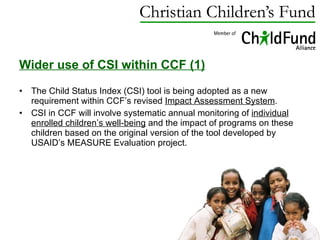
Wider use of CSI within CCF (1) The Child Status Index (CSI) tool is being adopted as a new requirement within CCF’s revised  Impact Assessment System .  CSI in CCF will involve systematic annual monitoring of  individual enrolled children’s well-being  and the impact of programs on these children based on the original version of the tool developed by USAID’s MEASURE Evaluation project.
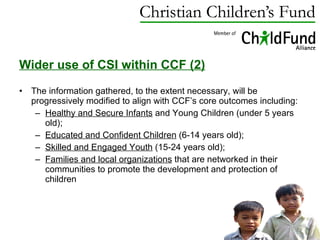
Wider use of CSI within CCF (2) The information gathered, to the extent necessary, will be progressively modified to align with CCF’s core outcomes including: Healthy and Secure Infants  and Young Children (under 5 years old);  Educated and Confident Children  (6-14 years old);  Skilled and Engaged Youth  (15-24 years old);  Families and local organizations  that are networked in their communities to promote the development and protection of children
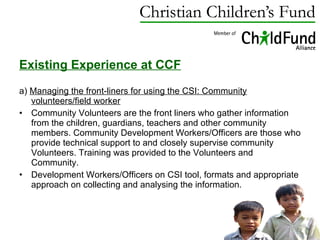
Existing Experience at CCF a)  Managing the front-liners for using the CSI: Community volunteers/field worker Community Volunteers are the front liners who gather information from the children, guardians, teachers and other community members. Community Development Workers/Officers are those who provide technical support to and closely supervise community Volunteers. Training was provided to the Volunteers and Community.  Development Workers/Officers on CSI tool, formats and appropriate approach on collecting and analysing the information.
The capacity of community volunteers and other project staff in terms of effectively gathering, analysing and reporting quality information has been developed gradually as they have been acquainted with the CSI tool. b)  CCF's experience shows that to complete collecting the information for one child, it takes, on average : 45 to 50 minutes for new beginner volunteer /field worker and if the interviewee hasn't interviewed using CSI before. 25- 30 minutes for experienced volunteer and new interviewee. 15-20 minutes for experienced volunteer who interviewed the same person before. [observation done of only at-risk children]
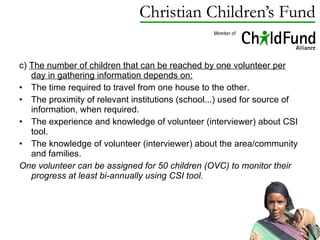
c)  The number of children that can be reached by one volunteer per day in gathering information depends on: The time required to travel from one house to the other. The proximity of relevant institutions (school...) used for source of information, when required. The experience and knowledge of volunteer (interviewer) about CSI tool. The knowledge of volunteer (interviewer) about the area/community and families. One volunteer can be assigned for 50 children (OVC) to monitor their progress at least bi-annually using CSI tool.
d)  When?   CSI will be conducted at least every 12 months.  This is the minimum frequency needed to monitor the needs of, services provided and changes to children’s well-being.  Ideally, CSI should be conducted just before the end of the fiscal year so that the findings can serve as timely input to Annual Participatory Reviews and Annual project progress reports, and be used to inform the subsequent year’s AOPBs.
Information is collected at the  initial  stage  before the beginning of service delivery-  when the OVC are enrolled using CSI tool with OVC enrolment formats- the information collected at this stage serves as baseline. Information is gathered  biannually  (every six months) to  monitor the needs of children, services provided and outcome of the program.  At the  end of the project , the information will be gathered, to be used as end survey. The result will be compared with the baseline to evaluate the OVC program - the changes/impacts on child well-being.
Developing and Using Database for the Analysis and Reporting  CCF has developed database for keeping, updating, analyzing and reporting information pertinent to its program including OVC program, though the software is not the same across all CCF country offices.
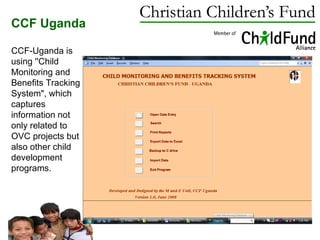
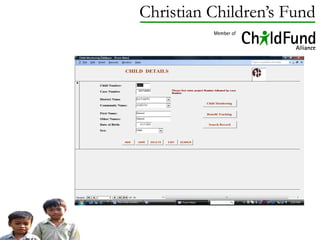
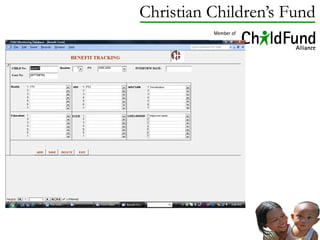
CCF Uganda CCF-Uganda is using ''Child Monitoring and Benefits Tracking System", which captures information not only related to OVC projects but also other child development programs.


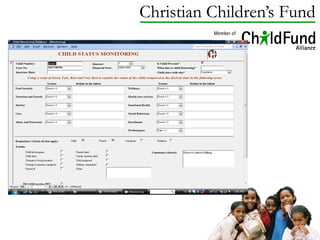
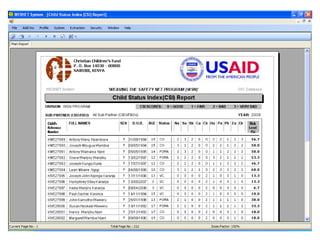
CCF Kenya CCF-Kenya is using  WESNET System (OVC Database) for ' 'Weaving the Safety Net Project “ - OVC project funded by USAID/PEPFAR   WESNET System (OVC Database): It is user friendly database with  different function The CSI Module is easily loaded Information is collected bi-annually during child follow-up/home visits done by the Community Volunteers and Community Mobilizers (Mentors)
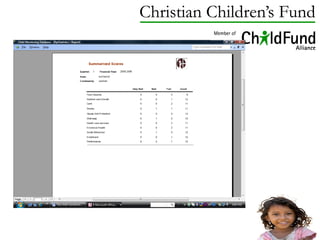
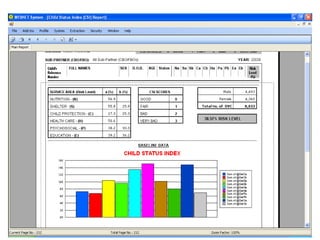
Once the information related to the profile of the children, the services (food security, health, shelter, PSS, child protection,...) is entered, the system computes the scores into percentages indicating level of risk and progress.  Example :  a child who has scored “2 -(Bad)” in eight areas and “1 – (Fair)” in two areas has 60% Risk Level.  the higher the percentage the higher the risk. CSI Results (2+2+2+2+2+2+2+2+1+1)/30*100 = 60% 30 = highest score = 100% Risk Level (This is for a child who has scored 3 in all areas)
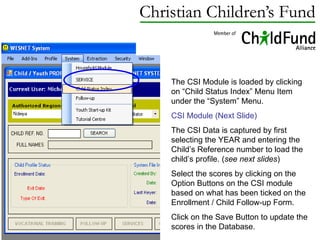
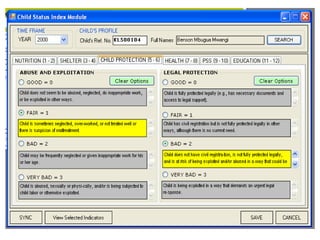
The CSI Module is loaded by clicking on “Child Status Index” Menu Item under the “System” Menu. CSI Module (Next Slide) The CSI Data is captured by first selecting the YEAR and entering the Child’s Reference number to load the child’s profile. ( see next slides ) Select the scores by clicking on the Option Buttons on the CSI module based on what has been ticked on the Enrollment / Child Follow-up Form. Click on the Save Button to update the scores in the Database.


The database is secured by a password so as to ensure data integrity; Both baseline information (during OVC Enrollment) and information gathered during follow-up/home visits is entered to  database; In Kenya, a baseline data for 8,853 OVC have been entered so far through New OVC Enrollment (from October 2007 – Dec 2008).
Quality assurance  Ensuring the comprehensiveness, consistency and accuracy/reliability of information is critical. CCF Area Managers  are responsible for ensuring that the data collected is of high quality, is accurately compiled and analyzed, is properly and confidentially stored, and is used to inform decision-making regarding program plans and responses to individual children found to be at risk.  National Office Program Managers  are responsible for compiling the CSI data across all the Area programs in the country, and submitting it to the Region and International Offices.
Training of volunteers ; giving continues feedback on collected information; regular technical support to volunteers, and close follow up on information gathering process contributes to the improvement of quality of information. Once the information is gathered from the child/caregiver by the volunteers it is  checked by Community Development Workers / Officers for its consistency and accuracy. Crosscheck information  with general situation and facts in the particular area /secondary data/information (e.g. food security status the population, school enrolment ratio, health service coverage, cultural practices in relation to child rights and child protection). To what extent collected information using CSI tool deviates from the general, existing situation of the area.
Refer the previous data  on a particular child while reviewing the present information to check its consistency.  Try to compare and contrast  the type and the extent of the services provided with the level of scores and the pace of progress against each domain indicator for a particular child. Randomly select  some proportion of collected information (10%) and make detail review. Increase the proportion of collected information to be checked as you face more errors, inconsistency, and inaccuracy. Sometimes, while checking the reliability of information the condition may urge you to make re-interview.
Commitment of each volunteer was found to be decisive factor both for gathering  quality  information and submitting the information on  time .  Having  Volunteers Administration Policy  in place and implementing it is one of the means to ensure the accountability of volunteers and motivate them to shoulder their responsibilities effectively.
Challenges/limitations in Using the CSI   Most of the indicators in CSI for rating/scoring  good, fair, bad and very bad,  are subjective and depend on the interviewer's understanding and judgement.  The information collected regarding one child by different individuals on the same day found to be slightly different, particularly in terms of rating. The difference is significant when there is wider gap on the level of understanding among the volunteers (interviewers) on the tool.
Turn over of the volunteers who collect the information contributed to additional cost for training of new volunteers, time taking to recruit/select new volunteers and enabling them be well acquainted with the tool.  Less commitment of volunteers to collect reliable (quality) information and to undertake home visits/the assessment and report timely.  Access to adequate and safe water, basic sanitation facilities and clothing are not clearly captured in the indicators for rating/scoring. Similarly, whether a child is facing exclusion (stigma and discrimination) is not clearly indicated in the CSI.
Recommendations for Improvement   There is a need to have  explanation note  for each indicators under respective score to have equal understanding on the rating among the data collectors (volunteers). It is recommended to add " safe and adequate water " under the domain of  Food Security  indicators for rating.  It is suggested to add  sanitation facilities, and clothes  under the domain of  Shelter  indicators.
Child participation at school and community levels  is one of indicators for social behaviour and to assess whether there is environment that can enhance their participation. Thus, it is recommended to incorporate the following phrase under the domain of  Psychosocial  (changes made are underlined). Social Behaviour  and Child Participation Child is cooperative and enjoys participating in activities with adults and other children  within family, school and community. Child likes to play with peers and participates in group or family  and community  activities.
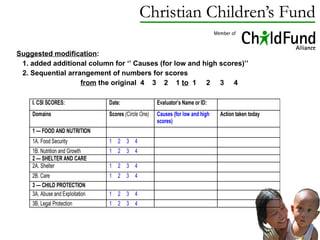
Concerning the  sequence or order of numbers for the score , it would be more  easy to use  1  2  3  4  instead of  4  3  2  1  There is a need to develop  cause recording sheet  (to record the reasons behind, internal and external factors that hindered or enhanced the achievements) for low scoring and for fast improvement on the lives of a child corresponding to CSI scores indicated in  Child Status Record .  This will help project/program implementing agency to have concrete and compete picture and substantial evidence on the status of children and effectiveness of the program to advocate for securing required resource and partnering with potential service providers.
Suggested modification :  1. added additional column for ‘’ Causes (for low and high scores)’’  2. Sequential arrangement of numbers for scores  from  the original  4  3  2  1  to   1  2  3  4
The Way forward for CCF   Propose some  modification/adaptation  on CSI tool to enable CCF to collect information related to  youth  (15-24 years old) in line with its third core outcome of the new program ( Skilled and involved youth). Undertake  field test on the modified  CSI tool A dopt the CSI tool not only for OVC related projects but also for a wider program interventions. Finalize unified database. Let us make use of this very important tool!!
Thank You!!

Child Status Index at CCF

  • 1.
    Child Status Indexat CCF A Tool for Assessing Children’s Wellbeing Regional Conference on CSI Tool March 17-19, 2009 Kigali, Rwanda
  • 2.
    Child Well-Being Status Index CCF maintains the twelve-domain structure of the Child Status Index (CSI). The domains reflect CCF’s core outcomes indicators , and yet broad enough to capture other critical dimension of child development, such as emotional health and social behaviour.
  • 3.
    Why CCF isusing CSI (1) Our commitment to individual children, their families, and to the sponsors who support them, makes it imperative that we: measure the overall impact of our programs; monitor children’s well-being and engagement in programs on an individual level.
  • 4.
    Why CCF isusing CSI (2) Regular use of the CSI has the potential to fulfil these and other key purposes for CCF: Program Decision-making Outcome Assessment Child Protection Monitoring Sponsorship Certification and Reporting
  • 5.
    Potential Merits ofthe CSI tool at Field Level Simplicity and user-friendliness of the tool (requires minimum training, currently in use in many NOs); Good alignment with CCF’s core indicators, enabling us to meet annual certification requirements and provide outcome based Child Progress Reports. It will complement (a) output information and data (PALS MIS/FIT), and (b) baseline data and 3-yearly outcome measurements of core programs (i.e. end line, impact assessments); Provides a significant and holistic understanding of the situation of all enrolled children.
  • 6.
    Wider use ofCSI within CCF (1) The Child Status Index (CSI) tool is being adopted as a new requirement within CCF’s revised Impact Assessment System . CSI in CCF will involve systematic annual monitoring of individual enrolled children’s well-being and the impact of programs on these children based on the original version of the tool developed by USAID’s MEASURE Evaluation project.
  • 7.
    Wider use ofCSI within CCF (2) The information gathered, to the extent necessary, will be progressively modified to align with CCF’s core outcomes including: Healthy and Secure Infants and Young Children (under 5 years old); Educated and Confident Children (6-14 years old); Skilled and Engaged Youth (15-24 years old); Families and local organizations that are networked in their communities to promote the development and protection of children
  • 8.
    Existing Experience atCCF a) Managing the front-liners for using the CSI: Community volunteers/field worker Community Volunteers are the front liners who gather information from the children, guardians, teachers and other community members. Community Development Workers/Officers are those who provide technical support to and closely supervise community Volunteers. Training was provided to the Volunteers and Community. Development Workers/Officers on CSI tool, formats and appropriate approach on collecting and analysing the information.
  • 9.
    The capacity ofcommunity volunteers and other project staff in terms of effectively gathering, analysing and reporting quality information has been developed gradually as they have been acquainted with the CSI tool. b) CCF's experience shows that to complete collecting the information for one child, it takes, on average : 45 to 50 minutes for new beginner volunteer /field worker and if the interviewee hasn't interviewed using CSI before. 25- 30 minutes for experienced volunteer and new interviewee. 15-20 minutes for experienced volunteer who interviewed the same person before. [observation done of only at-risk children]
  • 10.
    c) Thenumber of children that can be reached by one volunteer per day in gathering information depends on: The time required to travel from one house to the other. The proximity of relevant institutions (school...) used for source of information, when required. The experience and knowledge of volunteer (interviewer) about CSI tool. The knowledge of volunteer (interviewer) about the area/community and families. One volunteer can be assigned for 50 children (OVC) to monitor their progress at least bi-annually using CSI tool.
  • 11.
    d) When? CSI will be conducted at least every 12 months. This is the minimum frequency needed to monitor the needs of, services provided and changes to children’s well-being. Ideally, CSI should be conducted just before the end of the fiscal year so that the findings can serve as timely input to Annual Participatory Reviews and Annual project progress reports, and be used to inform the subsequent year’s AOPBs.
  • 12.
    Information is collectedat the initial stage before the beginning of service delivery- when the OVC are enrolled using CSI tool with OVC enrolment formats- the information collected at this stage serves as baseline. Information is gathered biannually (every six months) to monitor the needs of children, services provided and outcome of the program. At the end of the project , the information will be gathered, to be used as end survey. The result will be compared with the baseline to evaluate the OVC program - the changes/impacts on child well-being.
  • 13.
    Developing and UsingDatabase for the Analysis and Reporting CCF has developed database for keeping, updating, analyzing and reporting information pertinent to its program including OVC program, though the software is not the same across all CCF country offices.
  • 14.
    CCF Uganda CCF-Ugandais using ''Child Monitoring and Benefits Tracking System", which captures information not only related to OVC projects but also other child development programs.
  • 15.
  • 16.
  • 17.
  • 18.
  • 19.
    CCF Kenya CCF-Kenyais using WESNET System (OVC Database) for ' 'Weaving the Safety Net Project “ - OVC project funded by USAID/PEPFAR WESNET System (OVC Database): It is user friendly database with different function The CSI Module is easily loaded Information is collected bi-annually during child follow-up/home visits done by the Community Volunteers and Community Mobilizers (Mentors)
  • 20.
    Once the informationrelated to the profile of the children, the services (food security, health, shelter, PSS, child protection,...) is entered, the system computes the scores into percentages indicating level of risk and progress. Example : a child who has scored “2 -(Bad)” in eight areas and “1 – (Fair)” in two areas has 60% Risk Level. the higher the percentage the higher the risk. CSI Results (2+2+2+2+2+2+2+2+1+1)/30*100 = 60% 30 = highest score = 100% Risk Level (This is for a child who has scored 3 in all areas)
  • 21.
    The CSI Moduleis loaded by clicking on “Child Status Index” Menu Item under the “System” Menu. CSI Module (Next Slide) The CSI Data is captured by first selecting the YEAR and entering the Child’s Reference number to load the child’s profile. ( see next slides ) Select the scores by clicking on the Option Buttons on the CSI module based on what has been ticked on the Enrollment / Child Follow-up Form. Click on the Save Button to update the scores in the Database.
  • 22.
  • 23.
  • 24.
  • 25.
    The database issecured by a password so as to ensure data integrity; Both baseline information (during OVC Enrollment) and information gathered during follow-up/home visits is entered to database; In Kenya, a baseline data for 8,853 OVC have been entered so far through New OVC Enrollment (from October 2007 – Dec 2008).
  • 26.
    Quality assurance Ensuring the comprehensiveness, consistency and accuracy/reliability of information is critical. CCF Area Managers are responsible for ensuring that the data collected is of high quality, is accurately compiled and analyzed, is properly and confidentially stored, and is used to inform decision-making regarding program plans and responses to individual children found to be at risk. National Office Program Managers are responsible for compiling the CSI data across all the Area programs in the country, and submitting it to the Region and International Offices.
  • 27.
    Training of volunteers; giving continues feedback on collected information; regular technical support to volunteers, and close follow up on information gathering process contributes to the improvement of quality of information. Once the information is gathered from the child/caregiver by the volunteers it is checked by Community Development Workers / Officers for its consistency and accuracy. Crosscheck information with general situation and facts in the particular area /secondary data/information (e.g. food security status the population, school enrolment ratio, health service coverage, cultural practices in relation to child rights and child protection). To what extent collected information using CSI tool deviates from the general, existing situation of the area.
  • 28.
    Refer the previousdata on a particular child while reviewing the present information to check its consistency. Try to compare and contrast the type and the extent of the services provided with the level of scores and the pace of progress against each domain indicator for a particular child. Randomly select some proportion of collected information (10%) and make detail review. Increase the proportion of collected information to be checked as you face more errors, inconsistency, and inaccuracy. Sometimes, while checking the reliability of information the condition may urge you to make re-interview.
  • 29.
    Commitment of eachvolunteer was found to be decisive factor both for gathering quality information and submitting the information on time . Having Volunteers Administration Policy in place and implementing it is one of the means to ensure the accountability of volunteers and motivate them to shoulder their responsibilities effectively.
  • 30.
    Challenges/limitations in Usingthe CSI Most of the indicators in CSI for rating/scoring good, fair, bad and very bad, are subjective and depend on the interviewer's understanding and judgement. The information collected regarding one child by different individuals on the same day found to be slightly different, particularly in terms of rating. The difference is significant when there is wider gap on the level of understanding among the volunteers (interviewers) on the tool.
  • 31.
    Turn over ofthe volunteers who collect the information contributed to additional cost for training of new volunteers, time taking to recruit/select new volunteers and enabling them be well acquainted with the tool. Less commitment of volunteers to collect reliable (quality) information and to undertake home visits/the assessment and report timely. Access to adequate and safe water, basic sanitation facilities and clothing are not clearly captured in the indicators for rating/scoring. Similarly, whether a child is facing exclusion (stigma and discrimination) is not clearly indicated in the CSI.
  • 32.
    Recommendations for Improvement There is a need to have explanation note for each indicators under respective score to have equal understanding on the rating among the data collectors (volunteers). It is recommended to add " safe and adequate water " under the domain of Food Security indicators for rating. It is suggested to add sanitation facilities, and clothes under the domain of Shelter indicators.
  • 33.
    Child participation atschool and community levels is one of indicators for social behaviour and to assess whether there is environment that can enhance their participation. Thus, it is recommended to incorporate the following phrase under the domain of Psychosocial (changes made are underlined). Social Behaviour and Child Participation Child is cooperative and enjoys participating in activities with adults and other children within family, school and community. Child likes to play with peers and participates in group or family and community activities.
  • 34.
    Concerning the sequence or order of numbers for the score , it would be more easy to use 1 2 3 4 instead of 4 3 2 1 There is a need to develop cause recording sheet (to record the reasons behind, internal and external factors that hindered or enhanced the achievements) for low scoring and for fast improvement on the lives of a child corresponding to CSI scores indicated in Child Status Record . This will help project/program implementing agency to have concrete and compete picture and substantial evidence on the status of children and effectiveness of the program to advocate for securing required resource and partnering with potential service providers.
  • 35.
    Suggested modification : 1. added additional column for ‘’ Causes (for low and high scores)’’ 2. Sequential arrangement of numbers for scores from the original 4 3 2 1 to 1 2 3 4
  • 36.
    The Way forward forCCF Propose some modification/adaptation on CSI tool to enable CCF to collect information related to youth (15-24 years old) in line with its third core outcome of the new program ( Skilled and involved youth). Undertake field test on the modified CSI tool A dopt the CSI tool not only for OVC related projects but also for a wider program interventions. Finalize unified database. Let us make use of this very important tool!!
  • 37.