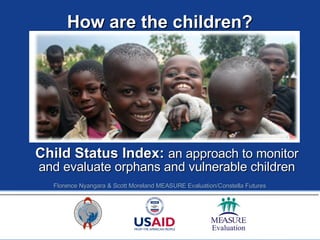
How are the children? Child Status Index:  an approach to monitor and evaluate orphans and vulnerable children Florence Nyangara & Scott Moreland MEASURE Evaluation/Constella Futures
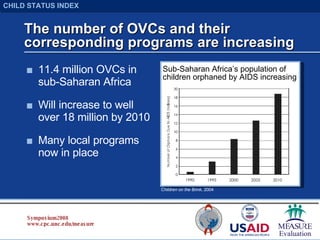
The number of OVCs and their corresponding programs are increasing 11.4 million OVCs in sub-Saharan Africa  Will increase to well over 18 million by 2010 Many local programs now in place Symposium 2008 www.cpc.unc.edu/measure Children on the Brink , 2004 Sub-Saharan Africa’s population of children orphaned by AIDS increasing CHILD STATUS INDEX
CSI was developed as a tool to help answer these questions: How are individual children faring in key outcome areas of their wellbeing? What specific services is an individual child receiving and what else does she/he need? Long-term How well is a program achieving its objectives?  What program modifications would yield even better results?  What new services could be offered? Symposium 2008 www.cpc.unc.edu/measure CHILD STATUS INDEX
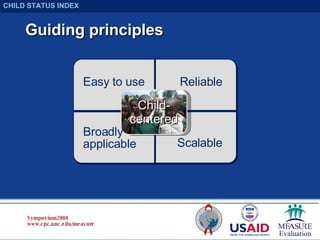
Guiding principles Symposium 2008 www.cpc.unc.edu/measure Child-centered Easy to use Reliable Broadly applicable Scalable CHILD STATUS INDEX
What does the CSI evaluate? Food and Nutrition  Shelter and Care  Protection  Health Care  Psychosocial Education and Vocational Training  Symposium 2008 www.cpc.unc.edu/measure CHILD STATUS INDEX
How was the CSI developed? Worked in partnership with the stakeholders in five communities in Kenya and Tanzania  Implemented a participatory approach  Consulted with experts Utilized existing OVC frameworks  Symposium 2008 www.cpc.unc.edu/measure CHILD STATUS INDEX
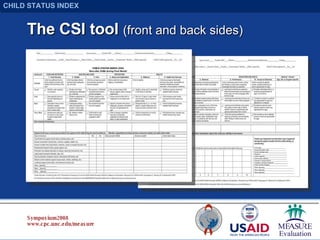
The CSI tool  (front and back sides) Symposium 2008 www.cpc.unc.edu/measure CHILD STATUS INDEX
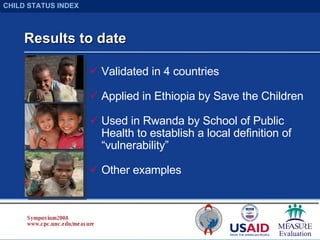
Results to date Validated in 4 countries Applied in Ethiopia by Save the Children Used in Rwanda by School of Public Health to establish a local definition of “vulnerability” Other examples Symposium 2008 www.cpc.unc.edu/measure CHILD STATUS INDEX
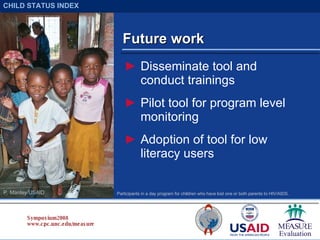
Future work Disseminate tool and conduct trainings Pilot tool for program level  monitoring Adoption of tool for low literacy users Symposium 2008 www.cpc.unc.edu/measure CHILD STATUS INDEX P. Mantey/USAID Symposium2008 www.cpc.unc.edu/measure Participants in a day program for children who have lost one or both parents to HIV/AIDS.

How are the Children?

  • 1.
    How are thechildren? Child Status Index: an approach to monitor and evaluate orphans and vulnerable children Florence Nyangara & Scott Moreland MEASURE Evaluation/Constella Futures
  • 2.
    The number ofOVCs and their corresponding programs are increasing 11.4 million OVCs in sub-Saharan Africa Will increase to well over 18 million by 2010 Many local programs now in place Symposium 2008 www.cpc.unc.edu/measure Children on the Brink , 2004 Sub-Saharan Africa’s population of children orphaned by AIDS increasing CHILD STATUS INDEX
  • 3.
    CSI was developedas a tool to help answer these questions: How are individual children faring in key outcome areas of their wellbeing? What specific services is an individual child receiving and what else does she/he need? Long-term How well is a program achieving its objectives? What program modifications would yield even better results? What new services could be offered? Symposium 2008 www.cpc.unc.edu/measure CHILD STATUS INDEX
  • 4.
    Guiding principles Symposium2008 www.cpc.unc.edu/measure Child-centered Easy to use Reliable Broadly applicable Scalable CHILD STATUS INDEX
  • 5.
    What does theCSI evaluate? Food and Nutrition Shelter and Care Protection Health Care Psychosocial Education and Vocational Training Symposium 2008 www.cpc.unc.edu/measure CHILD STATUS INDEX
  • 6.
    How was theCSI developed? Worked in partnership with the stakeholders in five communities in Kenya and Tanzania Implemented a participatory approach Consulted with experts Utilized existing OVC frameworks Symposium 2008 www.cpc.unc.edu/measure CHILD STATUS INDEX
  • 7.
    The CSI tool (front and back sides) Symposium 2008 www.cpc.unc.edu/measure CHILD STATUS INDEX
  • 8.
    Results to dateValidated in 4 countries Applied in Ethiopia by Save the Children Used in Rwanda by School of Public Health to establish a local definition of “vulnerability” Other examples Symposium 2008 www.cpc.unc.edu/measure CHILD STATUS INDEX
  • 9.
    Future work Disseminatetool and conduct trainings Pilot tool for program level monitoring Adoption of tool for low literacy users Symposium 2008 www.cpc.unc.edu/measure CHILD STATUS INDEX P. Mantey/USAID Symposium2008 www.cpc.unc.edu/measure Participants in a day program for children who have lost one or both parents to HIV/AIDS.

Editor's Notes

  • #2 “ How are the children?” is a common greeting with deep cultural meaning in Sub-Saharan Africa. Child well-being among African communities is of the highest priority and is monitored and evaluated continuously. The “Child Status Index” was developed by MEASURE Evaluation in collaboration with Duke University’s Center for Child and Family Health.