Child Safety Guide
A Checklist for New Parents
Protect your child
from fires and burns
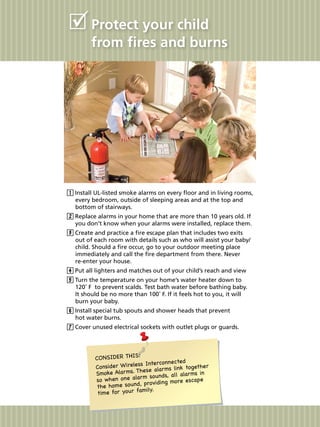
Install UL-listed smoke alarms on every floor and in living rooms,
every bedroom, outside of sleeping areas and at the top and
bottom of stairways.
Replace alarms in your home that are more than 10 years old. If
you don’t know when your alarms were installed, replace them.
Create and practice a fire escape plan that includes two exits
out of each room with details such as who will assist your baby/
child. Should a fire occur, go to your outdoor meeting place
immediately and call the fire department from there. Never
re-enter your house.
Put all lighters and matches out of your child’s reach and view
Turn the temperature on your home’s water heater down to
120˚ F to prevent scalds. Test bath water before bathing baby.
It should be no more than 100˚ F. If it feels hot to you, it will
burn your baby.
Install special tub spouts and shower heads that prevent
hot water burns.
Cover unused electrical sockets with outlet plugs or guards.
CONSIDER THIS:
Consider Wireless Interconnected
Smoke Alarms. These alarms link together
so when one alarm sounds, all alarms in
the home sound, providing more escape
time for your family.
Protect your child from
choking and suffocation
Lay babies on their backs to sleep.
Do not put pillows, blankets, or toys in the crib
with your baby.
Do not hang mobiles or other objects above the
crib that have strings or ribbons on them.
Scour the floor of every room in your home for objects
such as coins, screws, buttons, and other small items.
Read the packaging on toys and games to verify they
are age-appropriate for your child.
Do not let your child have small round food like
peanuts or hard candy.
Always cut your toddler’s food into small bites.
Cut all loops on window blind cords and make
sure they are out of your child’s reach.
CONSIDER THIS:
Any item small enough to fit through
a toilet paper tube can be a choking
hazard for your infant.
Protect your child
from falls
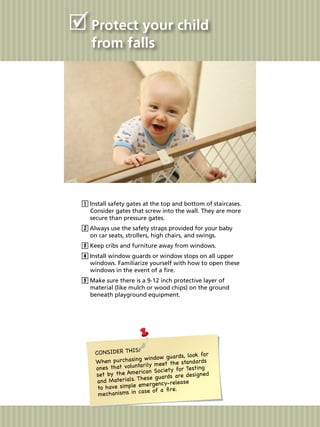
Install safety gates at the top and bottom of staircases.
Consider gates that screw into the wall. They are more
secure than pressure gates.
Always use the safety straps provided for your baby
on car seats, strollers, high chairs, and swings.
Keep cribs and furniture away from windows.
Install window guards or window stops on all upper
windows. Familiarize yourself with how to open these
windows in the event of a fire.
Make sure there is a 9-12 inch protective layer of
material (like mulch or wood chips) on the ground
beneath playground equipment.
CONSIDER THIS:
When purchasing window guards, look for
ones that voluntarily meet the standards
set by the American Society for Testing
and Materials. These guards are designed
to have simple emergency-release
mechanisms in case of a fire.
Protect your child
from poisons
Identify poisonous substances in your home by looking for words
such as “Caution,” “Warning,” or “Danger” on the packaging.
Take all medicines and medical supplies out of purses,
pockets, and drawers.
Make sure all poisons are locked up in a cabinet out of a child’s
reach and have child safety caps on all poisonous products.
Post the Poison Control Center number next to every phone
in your home. [1-800-222-1222]
Have all your gas appliances checked every year. If used
improperly or not working correctly, fuel burning appliances
can emit carbon monoxide (CO), a colorless, odorless, tasteless
gas that can be fatal to you and your baby in minutes.
Install at least one UL-listed CO alarm on each floor and near
sleeping areas. It is the only safe way to detect CO in your home.
Visit www.KnowAboutCO.com for information on CO Safety
and code requirements in your area.
CONSIDER THIS:
Install a combination smoke / CO alarm.
Kidde’s Talking Alarm includes a voice
warning that clearly announces “fire”
or “carbon monoxide,” alerting you
to the hazard in your home.
Protect your child
around water
Never leave your child unattended in the bathtub
or the pool.
Stay within reach of your child when they are in
or near water.
Install toilet lid locks on all toilets in your home.
Turn all large buckets bottom-up to prevent them
from collecting water.
Install a fence around your pool or hot tub, and
always keep the gate locked and shut.
Never rely on personal flotation devices or
swimming lessons to protect your child.
CONSIDER THIS:
Pool isolation fencing could prevent 50
to 90 percent of childhood residential
pool drownings and near drownings.
Door alarms, pool alarms and automatic
pool covers, when used correctly, may
add extra protection.
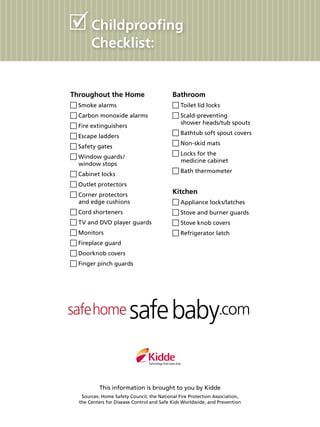
Throughout the Home
Smoke alarms
Carbon monoxide alarms
Fire extinguishers
Escape ladders
Safety gates
Window guards / 
window stops
Cabinet locks
Outlet protectors
Corner protectors
and edge cushions
Cord shorteners
TV and DVD player guards
Monitors
Fireplace guard
Doorknob covers
Finger pinch guards
Bathroom
Toilet lid locks
Scald-preventing
shower heads/tub spouts
Bathtub soft spout covers
Non-skid mats
Locks for the
medicine cabinet
Bath thermometer
Kitchen
Appliance locks/latches
Stove and burner guards
Stove knob covers
Refrigerator latch
Childproofing
Checklist:
This information is brought to you by Kidde
Sources: Home Safety Council, the National Fire Protection Association,
the Centers for Disease Control and Safe Kids Worldwide, and Prevention

Safe Baby Guide

  • 1.
    Child Safety Guide AChecklist for New Parents
  • 2.
    Protect your child fromfires and burns Install UL-listed smoke alarms on every floor and in living rooms, every bedroom, outside of sleeping areas and at the top and bottom of stairways. Replace alarms in your home that are more than 10 years old. If you don’t know when your alarms were installed, replace them. Create and practice a fire escape plan that includes two exits out of each room with details such as who will assist your baby/ child. Should a fire occur, go to your outdoor meeting place immediately and call the fire department from there. Never re-enter your house. Put all lighters and matches out of your child’s reach and view Turn the temperature on your home’s water heater down to 120˚ F to prevent scalds. Test bath water before bathing baby. It should be no more than 100˚ F. If it feels hot to you, it will burn your baby. Install special tub spouts and shower heads that prevent hot water burns. Cover unused electrical sockets with outlet plugs or guards. CONSIDER THIS: Consider Wireless Interconnected Smoke Alarms. These alarms link together so when one alarm sounds, all alarms in the home sound, providing more escape time for your family.
  • 3.
    Protect your childfrom choking and suffocation Lay babies on their backs to sleep. Do not put pillows, blankets, or toys in the crib with your baby. Do not hang mobiles or other objects above the crib that have strings or ribbons on them. Scour the floor of every room in your home for objects such as coins, screws, buttons, and other small items. Read the packaging on toys and games to verify they are age-appropriate for your child. Do not let your child have small round food like peanuts or hard candy. Always cut your toddler’s food into small bites. Cut all loops on window blind cords and make sure they are out of your child’s reach. CONSIDER THIS: Any item small enough to fit through a toilet paper tube can be a choking hazard for your infant.
  • 4.
    Protect your child fromfalls Install safety gates at the top and bottom of staircases. Consider gates that screw into the wall. They are more secure than pressure gates. Always use the safety straps provided for your baby on car seats, strollers, high chairs, and swings. Keep cribs and furniture away from windows. Install window guards or window stops on all upper windows. Familiarize yourself with how to open these windows in the event of a fire. Make sure there is a 9-12 inch protective layer of material (like mulch or wood chips) on the ground beneath playground equipment. CONSIDER THIS: When purchasing window guards, look for ones that voluntarily meet the standards set by the American Society for Testing and Materials. These guards are designed to have simple emergency-release mechanisms in case of a fire.
  • 5.
    Protect your child frompoisons Identify poisonous substances in your home by looking for words such as “Caution,” “Warning,” or “Danger” on the packaging. Take all medicines and medical supplies out of purses, pockets, and drawers. Make sure all poisons are locked up in a cabinet out of a child’s reach and have child safety caps on all poisonous products. Post the Poison Control Center number next to every phone in your home. [1-800-222-1222] Have all your gas appliances checked every year. If used improperly or not working correctly, fuel burning appliances can emit carbon monoxide (CO), a colorless, odorless, tasteless gas that can be fatal to you and your baby in minutes. Install at least one UL-listed CO alarm on each floor and near sleeping areas. It is the only safe way to detect CO in your home. Visit www.KnowAboutCO.com for information on CO Safety and code requirements in your area. CONSIDER THIS: Install a combination smoke / CO alarm. Kidde’s Talking Alarm includes a voice warning that clearly announces “fire” or “carbon monoxide,” alerting you to the hazard in your home.
  • 6.
    Protect your child aroundwater Never leave your child unattended in the bathtub or the pool. Stay within reach of your child when they are in or near water. Install toilet lid locks on all toilets in your home. Turn all large buckets bottom-up to prevent them from collecting water. Install a fence around your pool or hot tub, and always keep the gate locked and shut. Never rely on personal flotation devices or swimming lessons to protect your child. CONSIDER THIS: Pool isolation fencing could prevent 50 to 90 percent of childhood residential pool drownings and near drownings. Door alarms, pool alarms and automatic pool covers, when used correctly, may add extra protection.
  • 7.
    Throughout the Home Smokealarms Carbon monoxide alarms Fire extinguishers Escape ladders Safety gates Window guards /  window stops Cabinet locks Outlet protectors Corner protectors and edge cushions Cord shorteners TV and DVD player guards Monitors Fireplace guard Doorknob covers Finger pinch guards Bathroom Toilet lid locks Scald-preventing shower heads/tub spouts Bathtub soft spout covers Non-skid mats Locks for the medicine cabinet Bath thermometer Kitchen Appliance locks/latches Stove and burner guards Stove knob covers Refrigerator latch Childproofing Checklist: This information is brought to you by Kidde Sources: Home Safety Council, the National Fire Protection Association, the Centers for Disease Control and Safe Kids Worldwide, and Prevention