HUMAN RIGHTS 
ISSUES 
CHILD LABOUR
The change starts within each one of us, and 
ends only when all children are free to be 
children.” – Craig Kielburger 
• Families with normal lives 
and a steady income have 
parents who go to work and 
children who go to school 
and have time to play. 
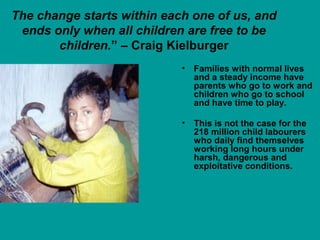
• This is not the case for the 
218 million child labourers 
who daily find themselves 
working long hours under 
harsh, dangerous and 
exploitative conditions.
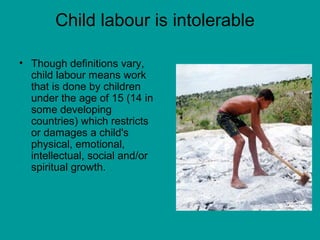
Child labour is intolerable 
• Though definitions vary, 
child labour means work 
that is done by children 
under the age of 15 (14 in 
some developing 
countries) which restricts 
or damages a child's 
physical, emotional, 
intellectual, social and/or 
spiritual growth.
Why is this a human rights issue? 
• Children who work are subsequently 
subject to abuse, both physical and 
sexual, from their employers 
• They often work under conditions that are 
both unhealthy and potentially fatal. This 
scenario cannot continue.
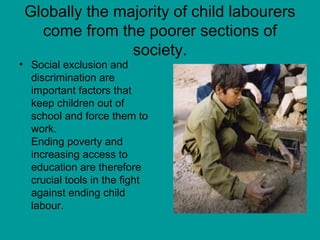
Globally the majority of child labourers 
come from the poorer sections of 
society. 
• Social exclusion and 
discrimination are 
important factors that 
keep children out of 
school and force them to 
work. 
Ending poverty and 
increasing access to 
education are therefore 
crucial tools in the fight 
against ending child 
labour.
Why should we care? 
• "Our greatest natural resource is the 
minds of our children." - Walt Disney 
Because of their unique and vulnerable 
position, children are denied the basic 
working rights and wages given to adults.
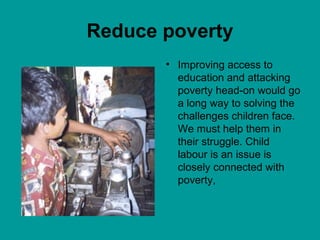
Reduce poverty 
• Improving access to 
education and attacking 
poverty head-on would go 
a long way to solving the 
challenges children face. 
We must help them in 
their struggle. Child 
labour is an issue is 
closely connected with 
poverty,
Most people agree that when we speak about child 
labour, we mean labour which is intolerable or harmful 
to children, or which denies them their right to fully 
develop, to play or to go to school. 
Child labour includes: 
• Work performed by children under the age of 15 
• Long hours of work on a regular or full-time basis 
• Abusive treatment by the employer 
• No access, or poor access, to education
What is bonded labour? 
There are 3 types of Bonded Labour: 
• The first is when a child inherits a debt carried by 
his or her parents. 
• Another form of bonded labour occurs when a child 
is used as collateral for a loan. For example, a parent 
facing an unusually large or urgent expense would 
use this method to obtain necessary money. 
• Finally, a child worker can enter into bondage to 
their employer by requesting an advance on future 
wages they expect to earn.
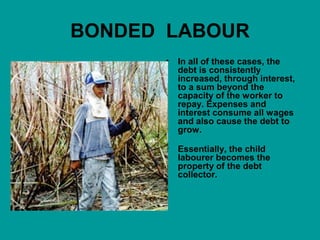
BONDED LABOUR 
• In all of these cases, the 
debt is consistently 
increased, through interest, 
to a sum beyond the 
capacity of the worker to 
repay. Expenses and 
interest consume all wages 
and also cause the debt to 
grow. 
• Essentially, the child 
labourer becomes the 
property of the debt 
collector.
• Globally, 218 million children are child labourers. 
• 126 million of these children are engaged in hazardous 
work. 
• 
• 73 million working children are less than 10 years old . 
• Every year, 22,000 children die in work-related accidents. 
• The largest number of working children-122 million-are in 
the Asia-Pacific region.
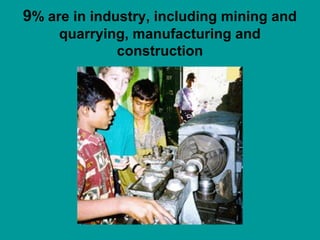
9% are in industry, including mining and 
quarrying, manufacturing and 
construction
• The highest proportion of working children 
is in sub-Saharan Africa, where nearly one 
third of the children aged 14 and under (48 
million children) are in the labour force. 
• Between 40 and 50 per cent of all forced 
labourers are children. 
• 1.2 million of these children have been 
trafficked (bought and/or sold).
Where do children work? 
Nearly 70% are in agriculture (rural children, 
especially girls, usually start working in this industry 
when they are very young, often between 5 and 7 
years of age) 
• 22% are in services, including wholesale and retail 
trade, restaurants and hotels, transport, personal 
services, etc 
• 9% are in industry, including mining and quarrying, 
manufacturing and construction
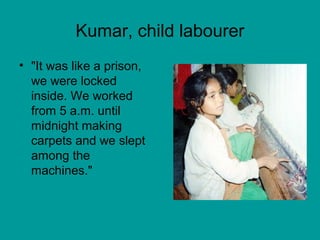
Kumar, child labourer 
• "It was like a prison, 
we were locked 
inside. We worked 
from 5 a.m. until 
midnight making 
carpets and we slept 
among the 
machines."
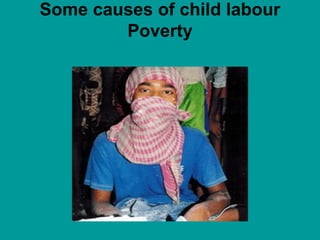
Some causes of child labour 
Poverty
Poverty 
• Poor families need to keep as many family 
members working as possible to ensure 
income security and survival. This makes 
it very difficult for poor families to invest in 
their children's education. In fact, 
educating a child can be a significant 
financial burden. 
In many instances "free" public education 
is in fact very costly to a poor family.
EDUCATION 
• Poor families are expected to purchase books, 
school supplies and uniforms, and sometimes even 
pay teachers' wages. 
• Many poor families weigh the cost of sending their 
children to school against the cost of the income 
lost by sending their children to work. 
• Many children live in areas that do not have 
adequate school facilities, so they work. Many 
countries do not have free compulsory education for 
all, which is an obstacle to sending working children 
to school.
POOR HOUSEHOLDS 
Poor households tend 
to have more 
children, and with 
large families there is 
a greater likelihood 
that children will work 
and have lower 
school attendance 
and completion. 
Some employers hire 
children because they 
can pay them less 
money. They also 
offer poor working 
conditions because 
children are less likely 
to complain.
Why not make child labour 
illegal? 
In countries all over the world, countless 
laws and policies against the exploitation 
of children already exist: the political will to 
enforce them however, does not.
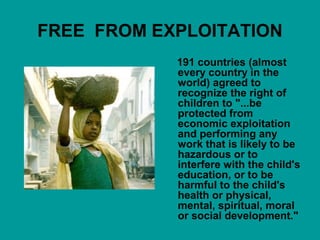
FREE FROM EXPLOITATION 
191 countries (almost 
every country in the 
world) agreed to 
recognize the right of 
children to "...be 
protected from 
economic exploitation 
and performing any 
work that is likely to be 
hazardous or to 
interfere with the child's 
education, or to be 
harmful to the child's 
health or physical, 
mental, spiritual, moral 
or social development."
What needs to be done? 
• The international community 
has the funds to provide free 
primary education-a necessary 
tool to combat child labour. 
• Better access to education 
• Social awareness and activism 
• The rehabilitation of child 
labourers. 
• Legislation and proper 
enforcement child labour laws 
• In turn, governments need to 
devote resources to education 
so that: 
• Schooling is compulsory, of 
good quality and relevance, and 
is of little or no cost to poor 
families. 
• Success Story: In 1994, Malawi 
made primary education free. 
From one academic year to the 
next, enrolment increased by 
roughly 50 percent, and more of 
the new students were female 
than male.
Some initiatives that can be effective 
in combating child labour: 
• Improving child labour 
legislation and laws 
• Enforcement of child 
labour legislation and 
laws 
• Increasing quality, 
relevance and access to 
education 
• Vocational training 
• Equality for women and 
girls 
• Replace child workers 
with adults 
• Am I wearing a child’s 
work?
How do you know if what you are 
buying was made using child 
labour? 
• Consumers should check if labels state that the 
product is union made. 
• Watch for the labels of campaigns such as Rugmark 
who is working to end child labour in the carpet 
industry and Fairtrade Mark. 
• These types of labels provide a guarantee that 
children were not involved in the production of the 
item. 
• If you don't know ...ask! The sales staff may be able 
to provide you with the information you need. Then 
contact the company explaining your concern.
The Situation Today 
• there are 28 million fewer child labourers 
than there were four years ago! 
• This means that the work being done to 
stop child labour is truly creating positive 
change. 
• But there is still much more to be done.
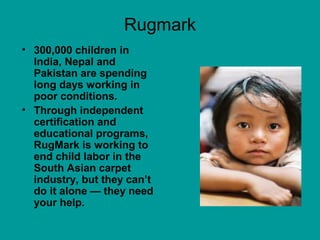
Rugmark 
• 300,000 children in 
India, Nepal and 
Pakistan are spending 
long days working in 
poor conditions. 
• Through independent 
certification and 
educational programs, 
RugMark is working to 
end child labor in the 
South Asian carpet 
industry, but they can’t 
do it alone — they need 
your help.
The Carpet Industry 
• Join a growing group of socially responsible 
consumers who are sending the powerful signal that 
they will not support products made with child labor 
or through inhumane working conditions. 
• Know someone who may be in the market for a 
handmade carpet? Tell them about the RugMark 
label- their peace of mind that no child labor was 
used to produce their carpet or rug. 
• An estimated 14 percent of children in India ages 5- 
14 are engaged in child labor activities, including 
carpet production. (The State of the World’s Children 
2006, UNICEF)
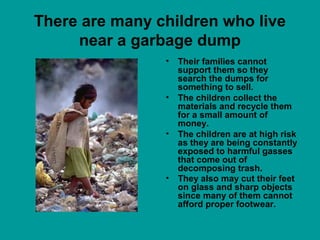
There are many children who live 
near a garbage dump 
• Their families cannot 
support them so they 
search the dumps for 
something to sell. 
• The children collect the 
materials and recycle them 
for a small amount of 
money. 
• The children are at high risk 
as they are being constantly 
exposed to harmful gasses 
that come out of 
decomposing trash. 
• They also may cut their feet 
on glass and sharp objects 
since many of them cannot 
afford proper footwear.
Agriculture 
• Of the 250 million child laborers worldwide, it 
is estimated that at least half of them work in 
agriculture alone. 
• There are many different types of agricultural 
work. One of them is picking fruits and 
vegetables. 
• The work is physically demanding because 
the children must bend down, kneel, climb 
ladders, carry heavy loads of fruit, and other 
things.
• They also are exposed to dangerous tools 
and have to use unsafe machinery they don't 
know how to operate. 
• They also are exposed to dangerous tools 
and have to use unsafe machinery they don't 
know how to operate. 
• Children who work in agriculture often 
experience back pain from bending over so 
much, and also have blistered and callused 
hands from operating machinery and using 
tools such as rakes, hoes, and shovels all 
day long.
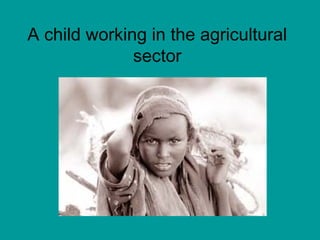
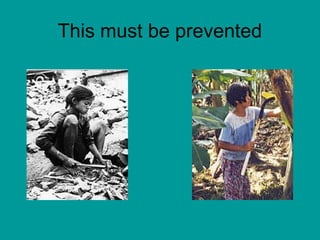
A child working in the agricultural 
sector
This must be prevented
What is to be done? 
• Creating international laws that countries can adopt in order to 
stem child labor. 
- the minimum age for employment for children. Many 
accept this is 15. 
• national laws 
- banning the import of some child-labor-made items. 
- laws that ban child labor under a certain age, 
• actually enforcing these laws. Laws do absolutely no good 
when not enforced, 
• Governments should have a “minimum family income” that 
would be used to support poor families. 
• Special Programs:
Special Programmes 
• In Mexico and Brazil, two programs give 
parents an incentive to invest in their 
child’s future. 
• by giving families money if their children 
attend school regularly instead of working 
for. 
• In Brazil, for example, families receive 
$24, and the program reaches 11.4 million 
people (a fourth of Brazil’s population).
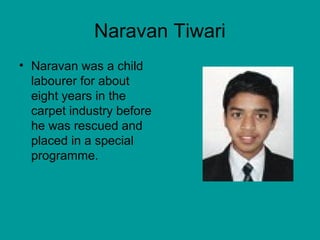
Naravan Tiwari 
• Naravan was a child 
labourer for about 
eight years in the 
carpet industry before 
he was rescued and 
placed in a special 
programme.
The achievement of human rights is 
an on-going battle. 
• Amnesty International and Human Rights Watch 
are organizations dedicated to its development. 
• but there are many more players on the local 
level. 
• For example: citizens, communities, grassroots 
organizations, and governments. 
• to prevent human rights violations, raise 
awareness of human rights and responsibilities, 
secure respect for all human rights, and promote 
international cooperation to protect human 
rights.
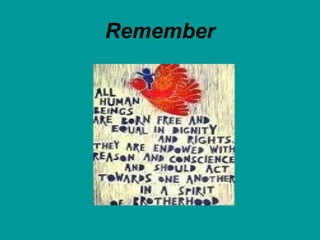
Remember

Child labour presentation

  • 1.
    HUMAN RIGHTS ISSUES CHILD LABOUR
  • 2.
    The change startswithin each one of us, and ends only when all children are free to be children.” – Craig Kielburger • Families with normal lives and a steady income have parents who go to work and children who go to school and have time to play. • This is not the case for the 218 million child labourers who daily find themselves working long hours under harsh, dangerous and exploitative conditions.
  • 3.
    Child labour isintolerable • Though definitions vary, child labour means work that is done by children under the age of 15 (14 in some developing countries) which restricts or damages a child's physical, emotional, intellectual, social and/or spiritual growth.
  • 4.
    Why is thisa human rights issue? • Children who work are subsequently subject to abuse, both physical and sexual, from their employers • They often work under conditions that are both unhealthy and potentially fatal. This scenario cannot continue.
  • 5.
    Globally the majorityof child labourers come from the poorer sections of society. • Social exclusion and discrimination are important factors that keep children out of school and force them to work. Ending poverty and increasing access to education are therefore crucial tools in the fight against ending child labour.
  • 6.
    Why should wecare? • "Our greatest natural resource is the minds of our children." - Walt Disney Because of their unique and vulnerable position, children are denied the basic working rights and wages given to adults.
  • 7.
    Reduce poverty •Improving access to education and attacking poverty head-on would go a long way to solving the challenges children face. We must help them in their struggle. Child labour is an issue is closely connected with poverty,
  • 8.
    Most people agreethat when we speak about child labour, we mean labour which is intolerable or harmful to children, or which denies them their right to fully develop, to play or to go to school. Child labour includes: • Work performed by children under the age of 15 • Long hours of work on a regular or full-time basis • Abusive treatment by the employer • No access, or poor access, to education
  • 9.
    What is bondedlabour? There are 3 types of Bonded Labour: • The first is when a child inherits a debt carried by his or her parents. • Another form of bonded labour occurs when a child is used as collateral for a loan. For example, a parent facing an unusually large or urgent expense would use this method to obtain necessary money. • Finally, a child worker can enter into bondage to their employer by requesting an advance on future wages they expect to earn.
  • 10.
    BONDED LABOUR •In all of these cases, the debt is consistently increased, through interest, to a sum beyond the capacity of the worker to repay. Expenses and interest consume all wages and also cause the debt to grow. • Essentially, the child labourer becomes the property of the debt collector.
  • 11.
    • Globally, 218million children are child labourers. • 126 million of these children are engaged in hazardous work. • • 73 million working children are less than 10 years old . • Every year, 22,000 children die in work-related accidents. • The largest number of working children-122 million-are in the Asia-Pacific region.
  • 12.
    9% are inindustry, including mining and quarrying, manufacturing and construction
  • 13.
    • The highestproportion of working children is in sub-Saharan Africa, where nearly one third of the children aged 14 and under (48 million children) are in the labour force. • Between 40 and 50 per cent of all forced labourers are children. • 1.2 million of these children have been trafficked (bought and/or sold).
  • 14.
    Where do childrenwork? Nearly 70% are in agriculture (rural children, especially girls, usually start working in this industry when they are very young, often between 5 and 7 years of age) • 22% are in services, including wholesale and retail trade, restaurants and hotels, transport, personal services, etc • 9% are in industry, including mining and quarrying, manufacturing and construction
  • 15.
    Kumar, child labourer • "It was like a prison, we were locked inside. We worked from 5 a.m. until midnight making carpets and we slept among the machines."
  • 16.
    Some causes ofchild labour Poverty
  • 17.
    Poverty • Poorfamilies need to keep as many family members working as possible to ensure income security and survival. This makes it very difficult for poor families to invest in their children's education. In fact, educating a child can be a significant financial burden. In many instances "free" public education is in fact very costly to a poor family.
  • 18.
    EDUCATION • Poorfamilies are expected to purchase books, school supplies and uniforms, and sometimes even pay teachers' wages. • Many poor families weigh the cost of sending their children to school against the cost of the income lost by sending their children to work. • Many children live in areas that do not have adequate school facilities, so they work. Many countries do not have free compulsory education for all, which is an obstacle to sending working children to school.
  • 19.
    POOR HOUSEHOLDS Poorhouseholds tend to have more children, and with large families there is a greater likelihood that children will work and have lower school attendance and completion. Some employers hire children because they can pay them less money. They also offer poor working conditions because children are less likely to complain.
  • 20.
    Why not makechild labour illegal? In countries all over the world, countless laws and policies against the exploitation of children already exist: the political will to enforce them however, does not.
  • 21.
    FREE FROM EXPLOITATION 191 countries (almost every country in the world) agreed to recognize the right of children to "...be protected from economic exploitation and performing any work that is likely to be hazardous or to interfere with the child's education, or to be harmful to the child's health or physical, mental, spiritual, moral or social development."
  • 22.
    What needs tobe done? • The international community has the funds to provide free primary education-a necessary tool to combat child labour. • Better access to education • Social awareness and activism • The rehabilitation of child labourers. • Legislation and proper enforcement child labour laws • In turn, governments need to devote resources to education so that: • Schooling is compulsory, of good quality and relevance, and is of little or no cost to poor families. • Success Story: In 1994, Malawi made primary education free. From one academic year to the next, enrolment increased by roughly 50 percent, and more of the new students were female than male.
  • 23.
    Some initiatives thatcan be effective in combating child labour: • Improving child labour legislation and laws • Enforcement of child labour legislation and laws • Increasing quality, relevance and access to education • Vocational training • Equality for women and girls • Replace child workers with adults • Am I wearing a child’s work?
  • 24.
    How do youknow if what you are buying was made using child labour? • Consumers should check if labels state that the product is union made. • Watch for the labels of campaigns such as Rugmark who is working to end child labour in the carpet industry and Fairtrade Mark. • These types of labels provide a guarantee that children were not involved in the production of the item. • If you don't know ...ask! The sales staff may be able to provide you with the information you need. Then contact the company explaining your concern.
  • 25.
    The Situation Today • there are 28 million fewer child labourers than there were four years ago! • This means that the work being done to stop child labour is truly creating positive change. • But there is still much more to be done.
  • 26.
    Rugmark • 300,000children in India, Nepal and Pakistan are spending long days working in poor conditions. • Through independent certification and educational programs, RugMark is working to end child labor in the South Asian carpet industry, but they can’t do it alone — they need your help.
  • 27.
    The Carpet Industry • Join a growing group of socially responsible consumers who are sending the powerful signal that they will not support products made with child labor or through inhumane working conditions. • Know someone who may be in the market for a handmade carpet? Tell them about the RugMark label- their peace of mind that no child labor was used to produce their carpet or rug. • An estimated 14 percent of children in India ages 5- 14 are engaged in child labor activities, including carpet production. (The State of the World’s Children 2006, UNICEF)
  • 28.
    There are manychildren who live near a garbage dump • Their families cannot support them so they search the dumps for something to sell. • The children collect the materials and recycle them for a small amount of money. • The children are at high risk as they are being constantly exposed to harmful gasses that come out of decomposing trash. • They also may cut their feet on glass and sharp objects since many of them cannot afford proper footwear.
  • 29.
    Agriculture • Ofthe 250 million child laborers worldwide, it is estimated that at least half of them work in agriculture alone. • There are many different types of agricultural work. One of them is picking fruits and vegetables. • The work is physically demanding because the children must bend down, kneel, climb ladders, carry heavy loads of fruit, and other things.
  • 30.
    • They alsoare exposed to dangerous tools and have to use unsafe machinery they don't know how to operate. • They also are exposed to dangerous tools and have to use unsafe machinery they don't know how to operate. • Children who work in agriculture often experience back pain from bending over so much, and also have blistered and callused hands from operating machinery and using tools such as rakes, hoes, and shovels all day long.
  • 31.
    A child workingin the agricultural sector
  • 32.
    This must beprevented
  • 33.
    What is tobe done? • Creating international laws that countries can adopt in order to stem child labor. - the minimum age for employment for children. Many accept this is 15. • national laws - banning the import of some child-labor-made items. - laws that ban child labor under a certain age, • actually enforcing these laws. Laws do absolutely no good when not enforced, • Governments should have a “minimum family income” that would be used to support poor families. • Special Programs:
  • 34.
    Special Programmes •In Mexico and Brazil, two programs give parents an incentive to invest in their child’s future. • by giving families money if their children attend school regularly instead of working for. • In Brazil, for example, families receive $24, and the program reaches 11.4 million people (a fourth of Brazil’s population).
  • 35.
    Naravan Tiwari •Naravan was a child labourer for about eight years in the carpet industry before he was rescued and placed in a special programme.
  • 36.
    The achievement ofhuman rights is an on-going battle. • Amnesty International and Human Rights Watch are organizations dedicated to its development. • but there are many more players on the local level. • For example: citizens, communities, grassroots organizations, and governments. • to prevent human rights violations, raise awareness of human rights and responsibilities, secure respect for all human rights, and promote international cooperation to protect human rights.
  • 37.