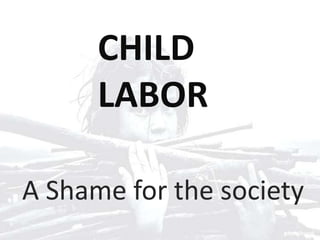


CHILD
      LABOR

A Shame for the society
AGENDA
1.Defination of child labor
2.Background
3.Legal protection
4.Child labor and education
5.Working ares of child labor
6.Resons behind child labor
7.Abuse,exploation and violence
8.Effects of child labor
9.What we can do for it?
JUST
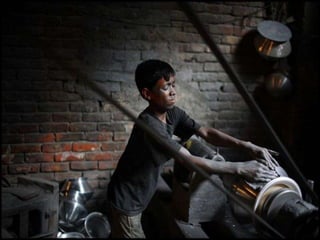
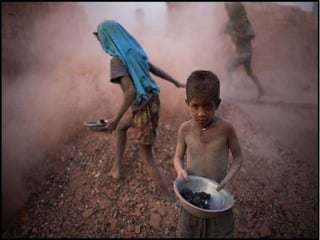
  COMPARE….
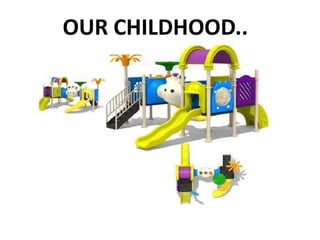
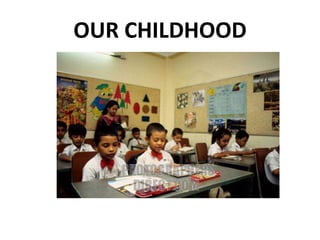
OUR CHILDHOOD..
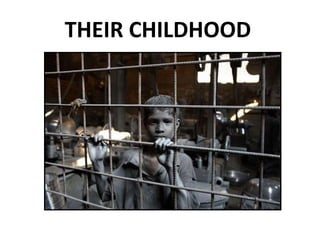
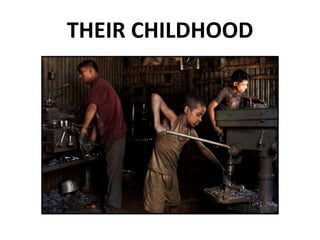
THEIR CHILDHOOD
OUR CHILDHOOD
THEIR CHILDHOOD
DON’T WE SEE THIS
        EVERYDAY
          AROUND US...?
What is child labor?
 Child labour is work that exceeds a minimum number of
 hours, depending on the age of a child and on the type
 of work. Such work is considered harmful to the child
 and should therefore be eliminated.

1. Ages 5-11: At least one hour of economic work or 28
  hours of domestic work per week.
2.Ages 12-14: At least 14 hours of economic work or 28
  hours of domestic work per week.
3.Ages 15-17: At least 43 hours of economic or domestic
  work per week.
BACKGROUND
Social norms and economic realities mean
 that child labor is widely accepted and
 very common in Bangladesh.

Child labor is a visible part of everyday life
 in Bangladesh: young children serve at
 roadside tea stalls, and weave between
 cars selling goods to motorists
Continued…
• On average, children work 28 hours a
  week and earn 222 taka (3.3 USD) a
  week.
• The UN Committee on the Rights of the
  Child expressed concern in 2009 that
  many Bangladeshi children continue to
  work in five of the worst forms of child
  labor, namely welding, auto workshops,
  road transport, battery recharging and
  tobacco factories.
Legal Protection
• Bangladesh enacted the Labor Act in
  2006, which includes a chapter on child
  labor.
• The Ministry of Labor and Employment
  has recently adopted a National Child
  Labor Elimination Policy 2010, which
  provides a framework to eradicate all
  forms of child labor by 2015
Child Labor and education
• According to the new National Education
  Policy, education is free and compulsory up to
  grade eight, however it is estimated that more
  than one million children have never been to
  school.
• About half of all child laborers' do not attend
  school at all, and among child domestic
  workers only 11 per cent attend school .
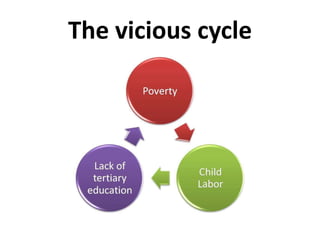
• As a result, working children get stuck in low
  paying, low-skilled jobs, thereby perpetuating
  the cycle of poverty.
Working areas of child labor
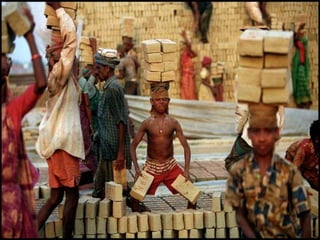
1.   brick/ stone breaking
2.   rickshaw pullers
3.   restaurants or tea stalls
4.   carpentry.
5.   Garages
6.   Farming
7.   Building and construction industry
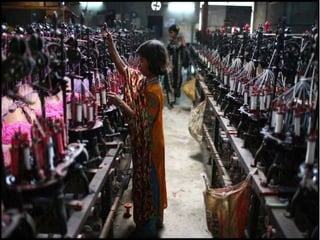
8.   Cloth printing,dying and weaving
Continued..
9.Shoe polishing
10.Tanning
11.As servents at homes
12.Coal mines
13.Street works
14.Biri making
15.Paper seller
16.Steel workshop
Reasones behind child labor
 1.poverty(in some cases 1/3 of family income
 From children).
 2.Over population
 3.Parental illiteracy and want more income
 4.Lack of schools for study
 5.High education and living cost
 6.Weak laws to protect
 7.Adult unemployment and urbanization
 8.Lack of education and exposure
 9.Wrong intention of factories
The vicious cycle
Abuse, Exploitation, and Violence
• One-quarter of all working children reported
  that they had been physically punished at
  their workplaces, according to a 2008
  children's opinion pol.
• These children participate in jobs that have
  been identified by the ILO to expose children
  to hazards including: physical, psychological or
  sexual abuse; excessive work hours; an
  unhealthy environment.
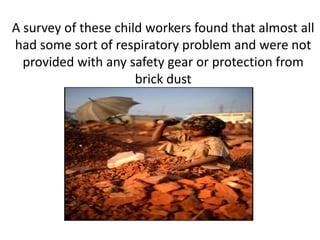
A survey of these child workers found that almost all
had some sort of respiratory problem and were not
  provided with any safety gear or protection from
                      brick dust
Trafficking and commercial sexual
            exploitation
• Working children often live away from their
  families in situations where they are exposed to
  violence, abuse and economic exploitation .
• A rapid assessment of commercially sexually
  exploited children showed that half worked in
  other sectors before being lured into sex work .
• The majority are depressed and three-quarters of
  the child sex workers were ill in the three months
  before the rapid assessment survey, many with
  sexually transmitted diseases.
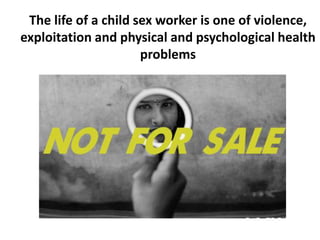
The life of a child sex worker is one of violence,
exploitation and physical and psychological health
                      problems
EFFECTS OF CHILD LABOR
1.Less Education
2.Social and economic effects
3.child’s health
4.A way for unhealthy,illiterate new generation
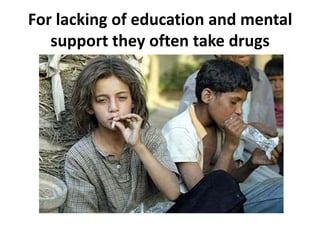
5.Increases DRUG addict.
6.Manpower becomes valueless
For lacking of education and mental
   support they often take drugs
What we can do as a person to
        stop child labor?
1.To donate fund in NGOs working for street
  children.
2.To make the rural people aware about benefits of
  education.
3.To provide free education for the orphans.
4.To contact NGOs and make them more aware.
5.To start campaign against child labour.
6.To help the government to stop child labour.
7.Strictly implementation of laws.
Child labor presantation

Child labor presantation

  • 1.
    CHILD LABOR A Shame for the society
  • 2.
    AGENDA 1.Defination of childlabor 2.Background 3.Legal protection 4.Child labor and education 5.Working ares of child labor 6.Resons behind child labor 7.Abuse,exploation and violence 8.Effects of child labor 9.What we can do for it?
  • 3.
  • 4.
  • 5.
  • 6.
  • 7.
  • 8.
    DON’T WE SEETHIS EVERYDAY AROUND US...?
  • 13.
    What is childlabor? Child labour is work that exceeds a minimum number of hours, depending on the age of a child and on the type of work. Such work is considered harmful to the child and should therefore be eliminated. 1. Ages 5-11: At least one hour of economic work or 28 hours of domestic work per week. 2.Ages 12-14: At least 14 hours of economic work or 28 hours of domestic work per week. 3.Ages 15-17: At least 43 hours of economic or domestic work per week.
  • 14.
    BACKGROUND Social norms andeconomic realities mean that child labor is widely accepted and very common in Bangladesh. Child labor is a visible part of everyday life in Bangladesh: young children serve at roadside tea stalls, and weave between cars selling goods to motorists
  • 15.
    Continued… • On average,children work 28 hours a week and earn 222 taka (3.3 USD) a week. • The UN Committee on the Rights of the Child expressed concern in 2009 that many Bangladeshi children continue to work in five of the worst forms of child labor, namely welding, auto workshops, road transport, battery recharging and tobacco factories.
  • 16.
    Legal Protection • Bangladeshenacted the Labor Act in 2006, which includes a chapter on child labor. • The Ministry of Labor and Employment has recently adopted a National Child Labor Elimination Policy 2010, which provides a framework to eradicate all forms of child labor by 2015
  • 17.
    Child Labor andeducation • According to the new National Education Policy, education is free and compulsory up to grade eight, however it is estimated that more than one million children have never been to school. • About half of all child laborers' do not attend school at all, and among child domestic workers only 11 per cent attend school . • As a result, working children get stuck in low paying, low-skilled jobs, thereby perpetuating the cycle of poverty.
  • 18.
    Working areas ofchild labor 1. brick/ stone breaking 2. rickshaw pullers 3. restaurants or tea stalls 4. carpentry. 5. Garages 6. Farming 7. Building and construction industry 8. Cloth printing,dying and weaving
  • 19.
    Continued.. 9.Shoe polishing 10.Tanning 11.As serventsat homes 12.Coal mines 13.Street works 14.Biri making 15.Paper seller 16.Steel workshop
  • 20.
    Reasones behind childlabor 1.poverty(in some cases 1/3 of family income From children). 2.Over population 3.Parental illiteracy and want more income 4.Lack of schools for study 5.High education and living cost 6.Weak laws to protect 7.Adult unemployment and urbanization 8.Lack of education and exposure 9.Wrong intention of factories
  • 21.
  • 22.
    Abuse, Exploitation, andViolence • One-quarter of all working children reported that they had been physically punished at their workplaces, according to a 2008 children's opinion pol. • These children participate in jobs that have been identified by the ILO to expose children to hazards including: physical, psychological or sexual abuse; excessive work hours; an unhealthy environment.
  • 23.
    A survey ofthese child workers found that almost all had some sort of respiratory problem and were not provided with any safety gear or protection from brick dust
  • 24.
    Trafficking and commercialsexual exploitation • Working children often live away from their families in situations where they are exposed to violence, abuse and economic exploitation . • A rapid assessment of commercially sexually exploited children showed that half worked in other sectors before being lured into sex work . • The majority are depressed and three-quarters of the child sex workers were ill in the three months before the rapid assessment survey, many with sexually transmitted diseases.
  • 25.
    The life ofa child sex worker is one of violence, exploitation and physical and psychological health problems
  • 26.
    EFFECTS OF CHILDLABOR 1.Less Education 2.Social and economic effects 3.child’s health 4.A way for unhealthy,illiterate new generation 5.Increases DRUG addict. 6.Manpower becomes valueless
  • 27.
    For lacking ofeducation and mental support they often take drugs
  • 28.
    What we cando as a person to stop child labor? 1.To donate fund in NGOs working for street children. 2.To make the rural people aware about benefits of education. 3.To provide free education for the orphans. 4.To contact NGOs and make them more aware. 5.To start campaign against child labour. 6.To help the government to stop child labour. 7.Strictly implementation of laws.