CHEST X-RAY
• Dr. ROHIT AGGARWAL
Medicine Resident
1st Year
HILAR ABNORMALITIES
HILAR ABNORMALITIES
• Superior margin of left hilum is normally
higher than the right.
• Whenever a left hilum appears lower than
right – check whether there is other evidence
suggestive of collapse of either left lower lobe
or of right upper lobe ; or enlargement of right
hilum(eg; tumor or nodes)
HILAR ABNORMALITIES
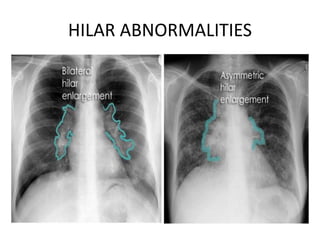
• Bilateral hilar enlargement -Enlarged lymph
nodes, or vascular enlargment.
• Unilateral enlargement : MC due to neoplasm or
infections
• such as tuberculosis and whooping cough.
• Nodes affected by lymphoma are often
asymmetrically involved.
• Bilateral involvement occurs with sarcoidosis,
silicosis and leukaemia
HILAR ABNORMALITIES
HILUM OVERLAY SIGN
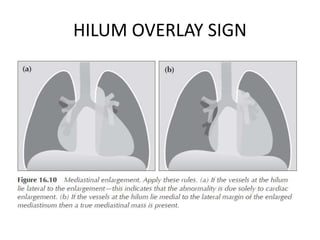
• This sign is used to distinguish between
cardiac enlargement and an anterior
mediastinal mass, as follows;
• Hilum lateral to the lateral border of the
“mass”–Cardiac enlargement.
• Hilum medial to the lateral border of mass-
Mediastinal mass.
HILUM OVERLAY SIGN
HILUM CONVERGENCE SIGN
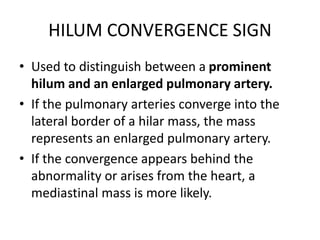
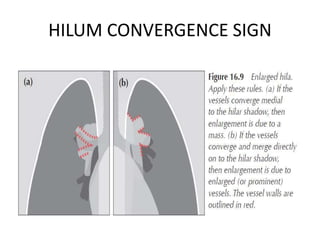
• Used to distinguish between a prominent
hilum and an enlarged pulmonary artery.
• If the pulmonary arteries converge into the
lateral border of a hilar mass, the mass
represents an enlarged pulmonary artery.
• If the convergence appears behind the
abnormality or arises from the heart, a
mediastinal mass is more likely.
HILUM CONVERGENCE SIGN
CONTINUEOUS DIAPHRAGM SIGN
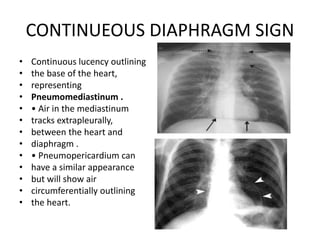
• Continuous lucency outlining
• the base of the heart,
• representing
• Pneumomediastinum .
• • Air in the mediastinum
• tracks extrapleurally,
• between the heart and
• diaphragm .
• • Pneumopericardium can
• have a similar appearance
• but will show air
• circumferentially outlining
• the heart.
LUNG PARENCYMA
LUNG PARENCHYMA
ALVEOLAR DISEASE
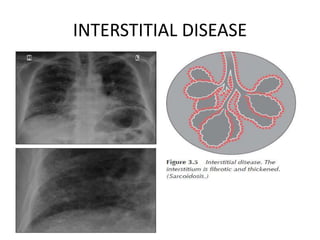
INTERSTITIAL DISEASE
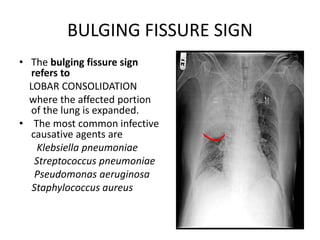
BULGING FISSURE SIGN
• The bulging fissure sign
refers to
LOBAR CONSOLIDATION
where the affected portion
of the lung is expanded.
• The most common infective
causative agents are
Klebsiella pneumoniae
Streptococcus pneumoniae
Pseudomonas aeruginosa
Staphylococcus aureus
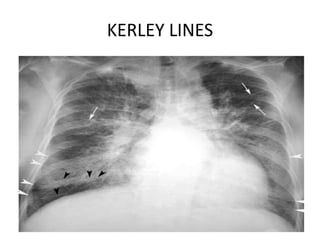
KERLEY LINES
• Kerley's A lines (arrows) :
Linear opacities extending from the periphery to the hila
Due to distention of anastomotic channels between
peripheral and central lymphatics.
• Kerley's B lines (white arrowheads) :
Short horizontal lines situated perpendicularly to the
pleural surface at the lung base Due to edema of the
interlobular septa.
• Kerley's C lines (black arrowheads): Reticular opacities at
the lung base representing superimposed Kerley's B lines.
KERLEY LINES
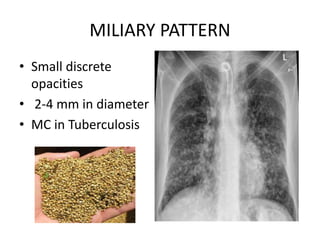
MILIARY PATTERN
• Small discrete
opacities
• 2-4 mm in diameter
• MC in Tuberculosis
D/D OF MILIARY PATTERN
• TB (HAEMATOGENOUS)(lower lobe predominant due
to more perfusion)
[Primary TB present as U/L hilar lymphadenopathy]
• SARCOIDOSIS
• SILICOSIS (upper lobe predominant)
• HISTOPLASMOSIS
• HAEMOSIDEROSIS
• ALVEOLAR MICROLITHIASIS
• FAT EMBOLISM
• METASTASIS (sometimes)
CHEST X-RAY.PPT.pptx

CHEST X-RAY.PPT.pptx

  • 1.
    CHEST X-RAY • Dr.ROHIT AGGARWAL Medicine Resident 1st Year
  • 2.
  • 3.
    HILAR ABNORMALITIES • Superiormargin of left hilum is normally higher than the right. • Whenever a left hilum appears lower than right – check whether there is other evidence suggestive of collapse of either left lower lobe or of right upper lobe ; or enlargement of right hilum(eg; tumor or nodes)
  • 4.
    HILAR ABNORMALITIES • Bilateralhilar enlargement -Enlarged lymph nodes, or vascular enlargment. • Unilateral enlargement : MC due to neoplasm or infections • such as tuberculosis and whooping cough. • Nodes affected by lymphoma are often asymmetrically involved. • Bilateral involvement occurs with sarcoidosis, silicosis and leukaemia
  • 5.
  • 6.
    HILUM OVERLAY SIGN •This sign is used to distinguish between cardiac enlargement and an anterior mediastinal mass, as follows; • Hilum lateral to the lateral border of the “mass”–Cardiac enlargement. • Hilum medial to the lateral border of mass- Mediastinal mass.
  • 7.
  • 8.
    HILUM CONVERGENCE SIGN •Used to distinguish between a prominent hilum and an enlarged pulmonary artery. • If the pulmonary arteries converge into the lateral border of a hilar mass, the mass represents an enlarged pulmonary artery. • If the convergence appears behind the abnormality or arises from the heart, a mediastinal mass is more likely.
  • 9.
  • 10.
    CONTINUEOUS DIAPHRAGM SIGN •Continuous lucency outlining • the base of the heart, • representing • Pneumomediastinum . • • Air in the mediastinum • tracks extrapleurally, • between the heart and • diaphragm . • • Pneumopericardium can • have a similar appearance • but will show air • circumferentially outlining • the heart.
  • 11.
  • 12.
  • 13.
  • 14.
  • 16.
    BULGING FISSURE SIGN •The bulging fissure sign refers to LOBAR CONSOLIDATION where the affected portion of the lung is expanded. • The most common infective causative agents are Klebsiella pneumoniae Streptococcus pneumoniae Pseudomonas aeruginosa Staphylococcus aureus
  • 17.
    KERLEY LINES • Kerley'sA lines (arrows) : Linear opacities extending from the periphery to the hila Due to distention of anastomotic channels between peripheral and central lymphatics. • Kerley's B lines (white arrowheads) : Short horizontal lines situated perpendicularly to the pleural surface at the lung base Due to edema of the interlobular septa. • Kerley's C lines (black arrowheads): Reticular opacities at the lung base representing superimposed Kerley's B lines.
  • 18.
  • 19.
    MILIARY PATTERN • Smalldiscrete opacities • 2-4 mm in diameter • MC in Tuberculosis
  • 20.
    D/D OF MILIARYPATTERN • TB (HAEMATOGENOUS)(lower lobe predominant due to more perfusion) [Primary TB present as U/L hilar lymphadenopathy] • SARCOIDOSIS • SILICOSIS (upper lobe predominant) • HISTOPLASMOSIS • HAEMOSIDEROSIS • ALVEOLAR MICROLITHIASIS • FAT EMBOLISM • METASTASIS (sometimes)