PRESENTED BY:
The chest x-ray is the most commonly
performed diagnostic x-ray examination.A
chest x-ray makes images of the heart, lungs,
airways, blood vessels and the bones of the
spine and chest.
X-rays are the oldest and most frequently
used form of medical imaging.
STANDARDVIEWS
 Erect PA
 LATERAL
INDICATIONS:
 For fit and able bodied
persons
 To diagnose any pathology
 To visualize pleural effusion
 To localize opacity
VIEWS:
 Supine AP
 Lateral decubitus view
 Expiratory view
 Penetrated PA view
INDICATIONS:
 For ill patients and those
with multiple injuries
 To visualize small effusion
 To visualize pneumothorax
 Useful for cardiac chamber
visualization and left lower
lobe visualization
 When you shine a beam of x-ray at a person and put a
film on other side a shadow is produced of the inside
of their body
 Different tissues in our body absorb x-ray at different
extent:
 Bone-high absorption(white)
 Tissue-Somewhere in middle absorption(grey)
 Air-low absorption(black)
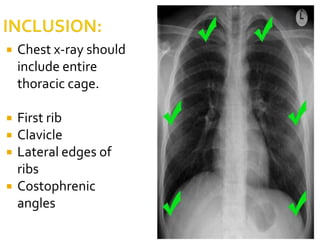
 Chest x-ray should
include entire
thoracic cage.
 First rib
 Clavicle
 Lateral edges of
ribs
 Costophrenic
angles
 Chest x-ray should not be taken with patient
rotated
 Spinous process of thoracic vertebrae should lie
in the midline.
 They should form a vertical line that lies
equidistant from the medial ends of the clavicles
 EFFECTS OF ROTATION ON RADIOGRAPH:
 Become difficult to comment accurately on
heart size.
 Changes in lung density due to asymmetry of
overlying lung tissue
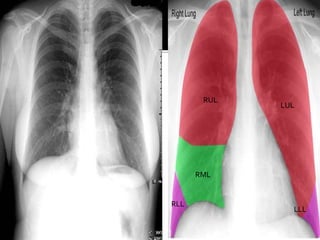
 RIGHT LUNG:
 3 LOBES
 Superior
 Middle
 Inferior
 LEFT LUNG:
 2 LOBES:
 Superior lobe
 Lingula
 Superior
 Inferior
 Inferior lobe
 The bronchopulmonary segments are the
anatomic, functional, and surgical units of the
lungs
 It has a segmental bronchus, a segmental artery,
lymph vessels, and autonomic nerves
 The segmental vein lies in the connective tissue
between adjacent bronchopulmonary segments
 Because it is a structural unit, a diseased
segment can be removed surgically
RUL
RML
LUL
LLL
RLL
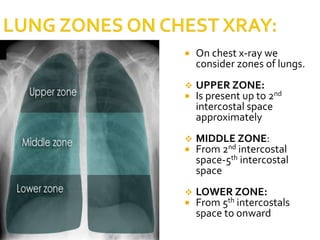
 On chest x-ray we
consider zones of lungs.
 UPPER ZONE:
 Is present up to 2nd
intercostal space
approximately
 MIDDLE ZONE:
 From 2nd intercostal
space-5th intercostal
space
 LOWER ZONE:
 From 5th intercostals
space to onward
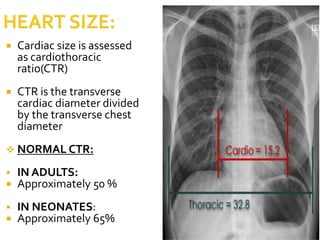
 Cardiac size is assessed
as cardiothoracic
ratio(CTR)
 CTR is the transverse
cardiac diameter divided
by the transverse chest
diameter
 NORMAL CTR:
 IN ADULTS:
 Approximately 50 %
 IN NEONATES:
 Approximately 65%
 Bones on chest x-ray
involved are:
 Clavicle
 Ribs
 spinous process
 Scapula
 Little part of humerus
IMP POINT:
 Check for any fracture any
lesion or any abnormality
sternum
Rt
ventricle
Lft atrium
Lft ventricle
Trachea
Vertebral bod
right
hemidiaphragm
ribs
ANATOMY AND HOWTO ACCESSS
 Check patient detail
 Check orientation, position
 Check quality of film
 NOW EITHER START FROM OUTSIDETO INSIDE
OR INSIDETO OUTSIDE:
 Ensure trachea is visible in midline
 Check for widened mediastinum
 Check heart size and borders
 Check aorta
 Check diaphragms
 Check lung fields
 Check bones and soft tissue
 Lobar consolidation:
 Alveolar space filled with
inflammatory exudate
 Interstitium and architecture
remain intact
 The airway is patent
 Radiologically:
 A density corresponding to a segment
or lobe
 Airbronchogram, and
 No significant loss of lung volume
 Loss of air
 Obstructive atelectasis:
 No ventilation to the lobe
beyond obstruction
 Radiologically:
 Density corresponding to a
segment or lobe
 Significant loss of volume
 Compensatory hyperinflation
of normal lungs
 Identification of abnormal shadows
 2. Localization of lesion
 3. Identification of pathological process
 4. Identification of etiology
 5. Confirmation of clinical suspension
 Complex problems
 Introduction of contrast medium
 CT chest
 MRI scan
THANKYOU
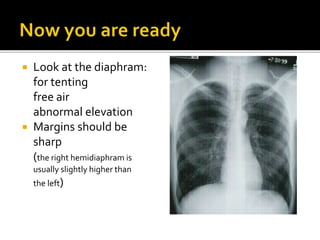
 Look at the diaphram:
for tenting
free air
abnormal elevation
 Margins should be
sharp
(the right hemidiaphram is
usually slightly higher than
the left)

chest x ray 2.pptx

  • 1.
  • 2.
    The chest x-rayis the most commonly performed diagnostic x-ray examination.A chest x-ray makes images of the heart, lungs, airways, blood vessels and the bones of the spine and chest. X-rays are the oldest and most frequently used form of medical imaging.
  • 3.
    STANDARDVIEWS  Erect PA LATERAL INDICATIONS:  For fit and able bodied persons  To diagnose any pathology  To visualize pleural effusion  To localize opacity
  • 4.
    VIEWS:  Supine AP Lateral decubitus view  Expiratory view  Penetrated PA view INDICATIONS:  For ill patients and those with multiple injuries  To visualize small effusion  To visualize pneumothorax  Useful for cardiac chamber visualization and left lower lobe visualization
  • 5.
     When youshine a beam of x-ray at a person and put a film on other side a shadow is produced of the inside of their body  Different tissues in our body absorb x-ray at different extent:  Bone-high absorption(white)  Tissue-Somewhere in middle absorption(grey)  Air-low absorption(black)
  • 6.
     Chest x-rayshould include entire thoracic cage.  First rib  Clavicle  Lateral edges of ribs  Costophrenic angles
  • 7.
     Chest x-rayshould not be taken with patient rotated  Spinous process of thoracic vertebrae should lie in the midline.  They should form a vertical line that lies equidistant from the medial ends of the clavicles  EFFECTS OF ROTATION ON RADIOGRAPH:  Become difficult to comment accurately on heart size.  Changes in lung density due to asymmetry of overlying lung tissue
  • 8.
     RIGHT LUNG: 3 LOBES  Superior  Middle  Inferior  LEFT LUNG:  2 LOBES:  Superior lobe  Lingula  Superior  Inferior  Inferior lobe
  • 9.
     The bronchopulmonarysegments are the anatomic, functional, and surgical units of the lungs  It has a segmental bronchus, a segmental artery, lymph vessels, and autonomic nerves  The segmental vein lies in the connective tissue between adjacent bronchopulmonary segments  Because it is a structural unit, a diseased segment can be removed surgically
  • 10.
  • 16.
     On chestx-ray we consider zones of lungs.  UPPER ZONE:  Is present up to 2nd intercostal space approximately  MIDDLE ZONE:  From 2nd intercostal space-5th intercostal space  LOWER ZONE:  From 5th intercostals space to onward
  • 18.
     Cardiac sizeis assessed as cardiothoracic ratio(CTR)  CTR is the transverse cardiac diameter divided by the transverse chest diameter  NORMAL CTR:  IN ADULTS:  Approximately 50 %  IN NEONATES:  Approximately 65%
  • 21.
     Bones onchest x-ray involved are:  Clavicle  Ribs  spinous process  Scapula  Little part of humerus IMP POINT:  Check for any fracture any lesion or any abnormality
  • 24.
    sternum Rt ventricle Lft atrium Lft ventricle Trachea Vertebralbod right hemidiaphragm ribs ANATOMY AND HOWTO ACCESSS
  • 25.
     Check patientdetail  Check orientation, position  Check quality of film  NOW EITHER START FROM OUTSIDETO INSIDE OR INSIDETO OUTSIDE:  Ensure trachea is visible in midline  Check for widened mediastinum  Check heart size and borders  Check aorta  Check diaphragms  Check lung fields  Check bones and soft tissue
  • 26.
     Lobar consolidation: Alveolar space filled with inflammatory exudate  Interstitium and architecture remain intact  The airway is patent  Radiologically:  A density corresponding to a segment or lobe  Airbronchogram, and  No significant loss of lung volume
  • 27.
     Loss ofair  Obstructive atelectasis:  No ventilation to the lobe beyond obstruction  Radiologically:  Density corresponding to a segment or lobe  Significant loss of volume  Compensatory hyperinflation of normal lungs
  • 28.
     Identification ofabnormal shadows  2. Localization of lesion  3. Identification of pathological process  4. Identification of etiology  5. Confirmation of clinical suspension  Complex problems  Introduction of contrast medium  CT chest  MRI scan
  • 29.
  • 30.
     Look atthe diaphram: for tenting free air abnormal elevation  Margins should be sharp (the right hemidiaphram is usually slightly higher than the left)