Chemotherapy Side Effects: What
YOU Need to Know
Our webinar will begin shortly.
WELCOME!
• Speaker: Ashley Glode, PharmD
• Archived Webinars: FightColorectalCancer.org/Webinars
• AFTER THE WEBINAR: Expect an email with links to the
material & a survey. If you fill it out, we’ll send you an “I
booty” bracelet.
• Ask a question in the panel on the RIGHT SIDE of your
screen
• Follow along via Twitter – use the hashtag #CRCWebinar
Today’s Webinar:
Resources:
Disclaimer
:
The information and services provided by Fight Colorectal
Cancer are for general informational purposes only. The
information and services are not intended to be substitutes
for professional medical advice, diagnoses or treatment.
If you are ill, or suspect that you are ill, see a doctor
immediately. In an emergency, call 911 or go to the nearest
emergency room.
Fight Colorectal Cancer never recommends or endorses any
specific physicians, products or treatments for any condition.
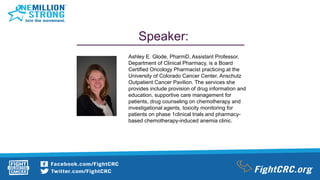
Speaker:
Ashley E. Glode, PharmD, Assistant Professor,
Department of Clinical Pharmacy, is a Board
Certified Oncology Pharmacist practicing at the
University of Colorado Cancer Center, Anschutz
Outpatient Cancer Pavilion. The services she
provides include provision of drug information and
education, supportive care management for
patients, drug counseling on chemotherapy and
investigational agents, toxicity monitoring for
patients on phase 1clinical trials and pharmacy-
based chemotherapy-induced anemia clinic.
CHEMOTHERAPY SIDE EFFECTS
WHAT YOU NEED TO KNOW
ASHLEY GLODE, PHARMD, BCOP
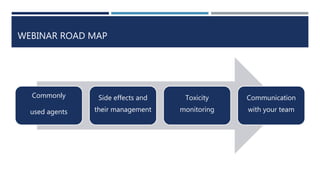
WEBINAR ROAD MAP
Commonly
used agents
Side effects and
their management
Toxicity
monitoring
Communication
with your team
COMMONLY USED AGENTS
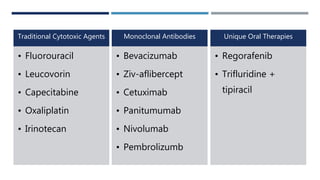
Traditional Cytotoxic Agents
• Fluorouracil
• Leucovorin
• Capecitabine
• Oxaliplatin
• Irinotecan
Monoclonal Antibodies
• Bevacizumab
• Ziv-aflibercept
• Cetuximab
• Panitumumab
• Nivolumab
• Pembrolizumb
Unique Oral Therapies
• Regorafenib
• Trifluridine +
tipiracil
TRADITIONAL CYTOTOXIC AGENTS
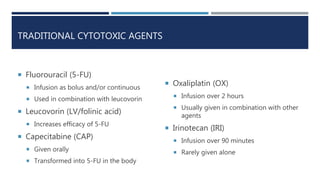
 Fluorouracil (5-FU)
 Infusion as bolus and/or continuous
 Used in combination with leucovorin
 Leucovorin (LV/folinic acid)
 Increases efficacy of 5-FU
 Capecitabine (CAP)
 Given orally
 Transformed into 5-FU in the body
 Oxaliplatin (OX)
 Infusion over 2 hours
 Usually given in combination with other
agents
 Irinotecan (IRI)
 Infusion over 90 minutes
 Rarely given alone
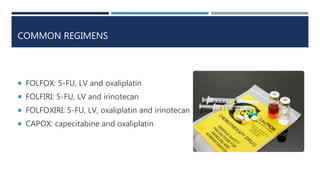
COMMON REGIMENS
 FOLFOX: 5-FU, LV and oxaliplatin
 FOLFIRI: 5-FU, LV and irinotecan
 FOLFOXIRI: 5-FU, LV, oxaliplatin and irinotecan
 CAPOX: capecitabine and oxaliplatin
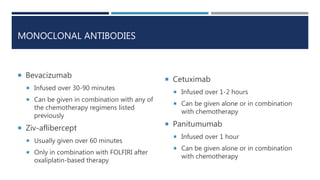
MONOCLONAL ANTIBODIES
 Bevacizumab
 Infused over 30-90 minutes
 Can be given in combination with any of
the chemotherapy regimens listed
previously
 Ziv-aflibercept
 Usually given over 60 minutes
 Only in combination with FOLFIRI after
oxaliplatin-based therapy
 Cetuximab
 Infused over 1-2 hours
 Can be given alone or in combination
with chemotherapy
 Panitumumab
 Infused over 1 hour
 Can be given alone or in combination
with chemotherapy
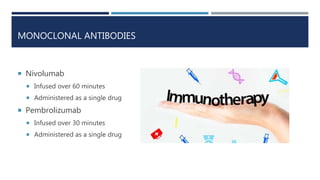
MONOCLONAL ANTIBODIES
 Nivolumab
 Infused over 60 minutes
 Administered as a single drug
 Pembrolizumab
 Infused over 30 minutes
 Administered as a single drug
UNIQUE ORAL THERAPIES
 Regorafenib
 Given orally
 Administered as a single drug
 Option for those who have failed other
treatment options
 Trifluridine + tipiracil
 Given orally
 Administered as a single drug
 Option for those who have failed other
treatment options
SIDE EFFECTS AND THEIR MANAGEMENT
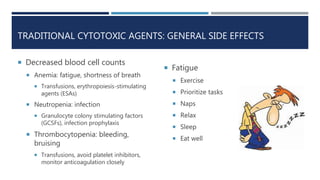
TRADITIONAL CYTOTOXIC AGENTS: GENERAL SIDE EFFECTS
 Decreased blood cell counts
 Anemia: fatigue, shortness of breath
 Transfusions, erythropoiesis-stimulating
agents (ESAs)
 Neutropenia: infection
 Granulocyte colony stimulating factors
(GCSFs), infection prophylaxis
 Thrombocytopenia: bleeding,
bruising
 Transfusions, avoid platelet inhibitors,
monitor anticoagulation closely
 Fatigue
 Exercise
 Prioritize tasks
 Naps
 Relax
 Sleep
 Eat well
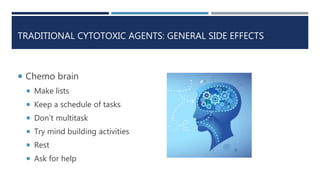
TRADITIONAL CYTOTOXIC AGENTS: GENERAL SIDE EFFECTS
 Chemo brain
 Make lists
 Keep a schedule of tasks
 Don’t multitask
 Try mind building activities
 Rest
 Ask for help
TRADITIONAL CYTOTOXIC AGENTS: GENERAL SIDE EFFECTS
 Nausea/vomiting
 Serotonin receptor antagonists:
ondansetron, granisetron
 Corticosteroids: dexamethasone
 Neurokinin-1 receptor antagonists:
aprepitant, netupitant, rolapitant
 Phenothiazines: prochlorperazine,
promethazine
 Benzodiazepines: lorazepam
 Dopamine antagonists: haloperidol,
metoclopramide
 Atypical antipsychotics: olanzapine
 Ginger
 Diet
 Hydration
 Acupuncture/acupressure
 Aromatherapy
TRADITIONAL CYTOTOXIC AGENTS: GENERAL SIDE EFFECTS
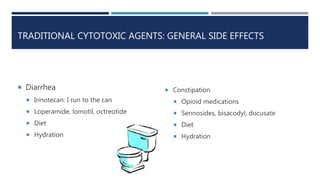
 Diarrhea
 Irinotecan: I run to the can
 Loperamide, lomotil, octreotide
 Diet
 Hydration
 Constipation
 Opioid medications
 Sennosides, bisacodyl, docusate
 Diet
 Hydration
TRADITIONAL CYTOTOXIC AGENTS: GENERAL SIDE EFFECTS
 Sore mouth or mouth ulcers
 Mouth rinses
 Diet
 Avoid alcohol and tobacco
 Taste changes
 Mint or lemon candy
 Mouth rinses
 Herbs and spices
 Plastic or wooden utensils
TRADITIONAL CYTOTOXIC AGENTS
 Fluorouracil (5-FU)
 Skin sensitivity to sunlight
 Hand foot syndrome (palmo-plantar
erythema)
 Capecitabine
 Hand foot syndrome
 Drug-drug interactions
 Oxaliplatin
 Numbness of the lips, hands or feet
 Tingling of hands or feet
 Sensitivity to cold
 Irinotecan
 Sweating
 Watery eyes
 Increased production of saliva
 Cramping stomach pain
 Diarrhea starting the day after treatment
MONOCLONAL ANTIBODIES
 Bevacizumab
 Hypertension
 Proteinuria
 Rare: arterial thrombosis, mucosal
bleeding, gastrointestinal perforation,
delayed wound healing
 Ziv-aflibercept
 Fatigue
 Liver problems
 Hypertension
 Proteinuria
 Diarrhea
 Decreased blood cell counts
 Bleeding
MONOCLONAL ANTIBODIES
 Cetuximab and Panitumumab
 Acneiform rash
 Low magnesium
 Allergic reactions
 Nivolumab and Pembrolizumab
 Rash
 Diarrhea
 Adrenal problems
 Liver problems
 Fatigue
UNIQUE ORAL THERAPIES
 Regorafenib
 Hand foot syndrome
 Skin rash
 Fatigue
 Liver problems
 Hypertension
 Proteinuria
 Diarrhea
 Bleeding
 Drug-drug interactions
 Trifluridine + tipiracil
 Fatigue
 Decreased blood cell counts
 Nausea/vomiting
 Diarrhea
MANAGEMENT OF UNIQUE SIDE EFFECTS
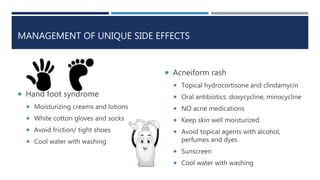
 Hand foot syndrome
 Moisturizing creams and lotions
 White cotton gloves and socks
 Avoid friction/ tight shoes
 Cool water with washing
 Acneiform rash
 Topical hydrocortisone and clindamycin
 Oral antibiotics: doxycycline, minocycline
 NO acne medications
 Keep skin well moisturized
 Avoid topical agents with alcohol,
perfumes and dyes

 Sunscreen
 Cool water with washing
MANAGEMENT OF UNIQUE SIDE EFFECTS
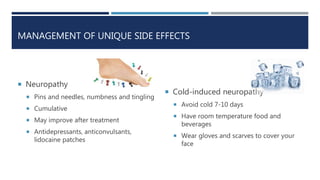
 Neuropathy
 Pins and needles, numbness and tingling
 Cumulative
 May improve after treatment
 Antidepressants, anticonvulsants,
lidocaine patches
 Cold-induced neuropathy
 Avoid cold 7-10 days
 Have room temperature food and
beverages
 Wear gloves and scarves to cover your
face
TOXICITY MONITORING
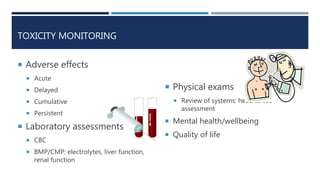
TOXICITY MONITORING
 Adverse effects
 Acute
 Delayed
 Cumulative
 Persistent
 Laboratory assessments
 CBC
 BMP/CMP: electrolytes, liver function,
renal function
 Physical exams
 Review of systems: head to toe
assessment
 Mental health/wellbeing
 Quality of life
COMMUNICATION WITH YOUR TEAM
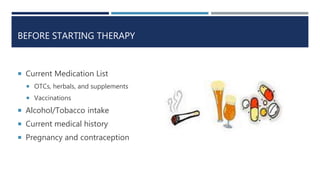
BEFORE STARTING THERAPY
 Current Medication List
 OTCs, herbals, and supplements
 Vaccinations
 Alcohol/Tobacco intake
 Current medical history
 Pregnancy and contraception
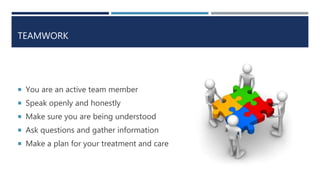
TEAMWORK
 You are an active team member
 Speak openly and honestly
 Make sure you are being understood
 Ask questions and gather information
 Make a plan for your treatment and care
MAKE SURE YOU DISCUSS…
 Treatment options
 How side effects and symptoms will be managed
 Any other issues you find important
PERSONAL INFORMATION TO SHARE WITH YOUR TEAM
 Type of work and degree of physical work or mental stress involved
 Close relatives who have had cancer and their types
 Idea of how much you know about cancer and its treatment
 How much you are affected by family problems, money problems, work-
related stress, or other issues
 Hobbies and other interests
 Goals for your quality of life during and after treatment
 Desire for children in the future
 Any important cultural beliefs
KNOW YOUR RESOURCES
 Complementary and alternative therapies
 Dietary/nutritional support
 Emotional/social support
 Financial counseling
 Physical activities
 Support groups
 Palliative care
HELPFUL RESOURCES/WEBSITES
 Fight Colorectal Cancer
 http://fightcolorectalcancer.org/fight-it/managing-side-effects/
 American Cancer Society
 http://www.cancer.org/
 Chemo Care
 http://www.chemocare.com/about/default.aspx
 National Cancer Institute: Resources for Patients
 https://www.cancer.gov/resources-for/patients
 Your health care team!
Question & Answer:
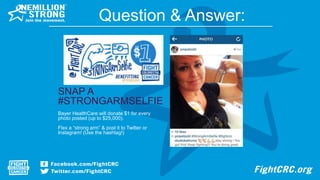
SNAP A
#STRONGARMSELFIE
Bayer HealthCare will donate $1 for every
photo posted (up to $25,000).
Flex a “strong arm” & post it to Twitter or
Instagram! (Use the hashtag!)
Contact Us!

Chemotherapy Side Effects:: Dec 2016 #CRCWebinar

  • 1.
    Chemotherapy Side Effects:What YOU Need to Know Our webinar will begin shortly. WELCOME!
  • 2.
    • Speaker: AshleyGlode, PharmD • Archived Webinars: FightColorectalCancer.org/Webinars • AFTER THE WEBINAR: Expect an email with links to the material & a survey. If you fill it out, we’ll send you an “I booty” bracelet. • Ask a question in the panel on the RIGHT SIDE of your screen • Follow along via Twitter – use the hashtag #CRCWebinar Today’s Webinar:
  • 3.
  • 4.
    Disclaimer : The information andservices provided by Fight Colorectal Cancer are for general informational purposes only. The information and services are not intended to be substitutes for professional medical advice, diagnoses or treatment. If you are ill, or suspect that you are ill, see a doctor immediately. In an emergency, call 911 or go to the nearest emergency room. Fight Colorectal Cancer never recommends or endorses any specific physicians, products or treatments for any condition.
  • 5.
    Speaker: Ashley E. Glode,PharmD, Assistant Professor, Department of Clinical Pharmacy, is a Board Certified Oncology Pharmacist practicing at the University of Colorado Cancer Center, Anschutz Outpatient Cancer Pavilion. The services she provides include provision of drug information and education, supportive care management for patients, drug counseling on chemotherapy and investigational agents, toxicity monitoring for patients on phase 1clinical trials and pharmacy- based chemotherapy-induced anemia clinic.
  • 6.
    CHEMOTHERAPY SIDE EFFECTS WHATYOU NEED TO KNOW ASHLEY GLODE, PHARMD, BCOP
  • 7.
    WEBINAR ROAD MAP Commonly usedagents Side effects and their management Toxicity monitoring Communication with your team
  • 8.
  • 9.
    Traditional Cytotoxic Agents •Fluorouracil • Leucovorin • Capecitabine • Oxaliplatin • Irinotecan Monoclonal Antibodies • Bevacizumab • Ziv-aflibercept • Cetuximab • Panitumumab • Nivolumab • Pembrolizumb Unique Oral Therapies • Regorafenib • Trifluridine + tipiracil
  • 10.
    TRADITIONAL CYTOTOXIC AGENTS Fluorouracil (5-FU)  Infusion as bolus and/or continuous  Used in combination with leucovorin  Leucovorin (LV/folinic acid)  Increases efficacy of 5-FU  Capecitabine (CAP)  Given orally  Transformed into 5-FU in the body  Oxaliplatin (OX)  Infusion over 2 hours  Usually given in combination with other agents  Irinotecan (IRI)  Infusion over 90 minutes  Rarely given alone
  • 11.
    COMMON REGIMENS  FOLFOX:5-FU, LV and oxaliplatin  FOLFIRI: 5-FU, LV and irinotecan  FOLFOXIRI: 5-FU, LV, oxaliplatin and irinotecan  CAPOX: capecitabine and oxaliplatin
  • 12.
    MONOCLONAL ANTIBODIES  Bevacizumab Infused over 30-90 minutes  Can be given in combination with any of the chemotherapy regimens listed previously  Ziv-aflibercept  Usually given over 60 minutes  Only in combination with FOLFIRI after oxaliplatin-based therapy  Cetuximab  Infused over 1-2 hours  Can be given alone or in combination with chemotherapy  Panitumumab  Infused over 1 hour  Can be given alone or in combination with chemotherapy
  • 13.
    MONOCLONAL ANTIBODIES  Nivolumab Infused over 60 minutes  Administered as a single drug  Pembrolizumab  Infused over 30 minutes  Administered as a single drug
  • 14.
    UNIQUE ORAL THERAPIES Regorafenib  Given orally  Administered as a single drug  Option for those who have failed other treatment options  Trifluridine + tipiracil  Given orally  Administered as a single drug  Option for those who have failed other treatment options
  • 15.
    SIDE EFFECTS ANDTHEIR MANAGEMENT
  • 16.
    TRADITIONAL CYTOTOXIC AGENTS:GENERAL SIDE EFFECTS  Decreased blood cell counts  Anemia: fatigue, shortness of breath  Transfusions, erythropoiesis-stimulating agents (ESAs)  Neutropenia: infection  Granulocyte colony stimulating factors (GCSFs), infection prophylaxis  Thrombocytopenia: bleeding, bruising  Transfusions, avoid platelet inhibitors, monitor anticoagulation closely  Fatigue  Exercise  Prioritize tasks  Naps  Relax  Sleep  Eat well
  • 17.
    TRADITIONAL CYTOTOXIC AGENTS:GENERAL SIDE EFFECTS  Chemo brain  Make lists  Keep a schedule of tasks  Don’t multitask  Try mind building activities  Rest  Ask for help
  • 18.
    TRADITIONAL CYTOTOXIC AGENTS:GENERAL SIDE EFFECTS  Nausea/vomiting  Serotonin receptor antagonists: ondansetron, granisetron  Corticosteroids: dexamethasone  Neurokinin-1 receptor antagonists: aprepitant, netupitant, rolapitant  Phenothiazines: prochlorperazine, promethazine  Benzodiazepines: lorazepam  Dopamine antagonists: haloperidol, metoclopramide  Atypical antipsychotics: olanzapine  Ginger  Diet  Hydration  Acupuncture/acupressure  Aromatherapy
  • 19.
    TRADITIONAL CYTOTOXIC AGENTS:GENERAL SIDE EFFECTS  Diarrhea  Irinotecan: I run to the can  Loperamide, lomotil, octreotide  Diet  Hydration  Constipation  Opioid medications  Sennosides, bisacodyl, docusate  Diet  Hydration
  • 20.
    TRADITIONAL CYTOTOXIC AGENTS:GENERAL SIDE EFFECTS  Sore mouth or mouth ulcers  Mouth rinses  Diet  Avoid alcohol and tobacco  Taste changes  Mint or lemon candy  Mouth rinses  Herbs and spices  Plastic or wooden utensils
  • 21.
    TRADITIONAL CYTOTOXIC AGENTS Fluorouracil (5-FU)  Skin sensitivity to sunlight  Hand foot syndrome (palmo-plantar erythema)  Capecitabine  Hand foot syndrome  Drug-drug interactions  Oxaliplatin  Numbness of the lips, hands or feet  Tingling of hands or feet  Sensitivity to cold  Irinotecan  Sweating  Watery eyes  Increased production of saliva  Cramping stomach pain  Diarrhea starting the day after treatment
  • 22.
    MONOCLONAL ANTIBODIES  Bevacizumab Hypertension  Proteinuria  Rare: arterial thrombosis, mucosal bleeding, gastrointestinal perforation, delayed wound healing  Ziv-aflibercept  Fatigue  Liver problems  Hypertension  Proteinuria  Diarrhea  Decreased blood cell counts  Bleeding
  • 23.
    MONOCLONAL ANTIBODIES  Cetuximaband Panitumumab  Acneiform rash  Low magnesium  Allergic reactions  Nivolumab and Pembrolizumab  Rash  Diarrhea  Adrenal problems  Liver problems  Fatigue
  • 24.
    UNIQUE ORAL THERAPIES Regorafenib  Hand foot syndrome  Skin rash  Fatigue  Liver problems  Hypertension  Proteinuria  Diarrhea  Bleeding  Drug-drug interactions  Trifluridine + tipiracil  Fatigue  Decreased blood cell counts  Nausea/vomiting  Diarrhea
  • 25.
    MANAGEMENT OF UNIQUESIDE EFFECTS  Hand foot syndrome  Moisturizing creams and lotions  White cotton gloves and socks  Avoid friction/ tight shoes  Cool water with washing  Acneiform rash  Topical hydrocortisone and clindamycin  Oral antibiotics: doxycycline, minocycline  NO acne medications  Keep skin well moisturized  Avoid topical agents with alcohol, perfumes and dyes  Sunscreen  Cool water with washing
  • 26.
    MANAGEMENT OF UNIQUESIDE EFFECTS  Neuropathy  Pins and needles, numbness and tingling  Cumulative  May improve after treatment  Antidepressants, anticonvulsants, lidocaine patches  Cold-induced neuropathy  Avoid cold 7-10 days  Have room temperature food and beverages  Wear gloves and scarves to cover your face
  • 27.
  • 28.
    TOXICITY MONITORING  Adverseeffects  Acute  Delayed  Cumulative  Persistent  Laboratory assessments  CBC  BMP/CMP: electrolytes, liver function, renal function  Physical exams  Review of systems: head to toe assessment  Mental health/wellbeing  Quality of life
  • 29.
  • 30.
    BEFORE STARTING THERAPY Current Medication List  OTCs, herbals, and supplements  Vaccinations  Alcohol/Tobacco intake  Current medical history  Pregnancy and contraception
  • 31.
    TEAMWORK  You arean active team member  Speak openly and honestly  Make sure you are being understood  Ask questions and gather information  Make a plan for your treatment and care
  • 32.
    MAKE SURE YOUDISCUSS…  Treatment options  How side effects and symptoms will be managed  Any other issues you find important
  • 33.
    PERSONAL INFORMATION TOSHARE WITH YOUR TEAM  Type of work and degree of physical work or mental stress involved  Close relatives who have had cancer and their types  Idea of how much you know about cancer and its treatment  How much you are affected by family problems, money problems, work- related stress, or other issues  Hobbies and other interests  Goals for your quality of life during and after treatment  Desire for children in the future  Any important cultural beliefs
  • 34.
    KNOW YOUR RESOURCES Complementary and alternative therapies  Dietary/nutritional support  Emotional/social support  Financial counseling  Physical activities  Support groups  Palliative care
  • 35.
    HELPFUL RESOURCES/WEBSITES  FightColorectal Cancer  http://fightcolorectalcancer.org/fight-it/managing-side-effects/  American Cancer Society  http://www.cancer.org/  Chemo Care  http://www.chemocare.com/about/default.aspx  National Cancer Institute: Resources for Patients  https://www.cancer.gov/resources-for/patients  Your health care team!
  • 36.
    Question & Answer: SNAPA #STRONGARMSELFIE Bayer HealthCare will donate $1 for every photo posted (up to $25,000). Flex a “strong arm” & post it to Twitter or Instagram! (Use the hashtag!)
  • 37.