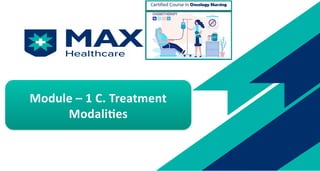
Module – 1 C. Treatment
Modalities
Pre-Test Module 1C
https://forms.gle/zFezW1tovovyDJCGA
Learning Objectives
At the end of the session participant will able to:
Describe the basic principles and clinical applications of
MRI, Radio Nuclide Imaging, and USG in the detection and
staging of cancer, differentiating between their roles in
functional, anatomical, and molecular imaging.
Demonstrate the essential steps in preparing patients for
MRI, Radio Nuclide Imaging, and USG, including patient
education on the procedure, safety precautions,
contraindications, and post-imaging care for optimal patient
outcomes.
Identify and manage potential contraindications for MRI
(e.g., presence of metal implants), Radio Nuclide Imaging (e.g.,
radiation exposure considerations), and USG, ensuring patient
safety and adherence to best practices in oncology care.
Module – 1 C.
Chemotherapy
Chemotherapy
Functional & Metabolic Imaging
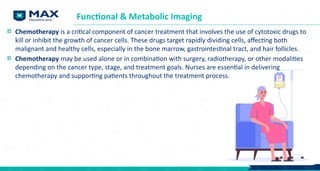
Chemotherapy is a critical component of cancer treatment that involves the use of cytotoxic drugs to
kill or inhibit the growth of cancer cells. These drugs target rapidly dividing cells, affecting both
malignant and healthy cells, especially in the bone marrow, gastrointestinal tract, and hair follicles.
Chemotherapy may be used alone or in combination with surgery, radiotherapy, or other modalities
depending on the cancer type, stage, and treatment goals. Nurses are essential in delivering
chemotherapy and supporting patients throughout the treatment process.
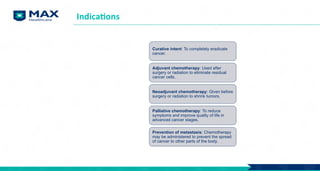
Indications
Curative intent: To completely eradicate
cancer.
Adjuvant chemotherapy: Used after
surgery or radiation to eliminate residual
cancer cells.
Neoadjuvant chemotherapy: Given before
surgery or radiation to shrink tumors.
Palliative chemotherapy: To reduce
symptoms and improve quality of life in
advanced cancer stages.
Prevention of metastasis: Chemotherapy
may be administered to prevent the spread
of cancer to other parts of the body.
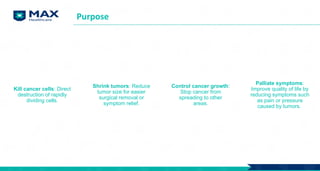
Purpose
Kill cancer cells: Direct
destruction of rapidly
dividing cells.
Shrink tumors: Reduce
tumor size for easier
surgical removal or
symptom relief.
Control cancer growth:
Stop cancer from
spreading to other
areas.
Palliate symptoms:
Improve quality of life by
reducing symptoms such
as pain or pressure
caused by tumors.
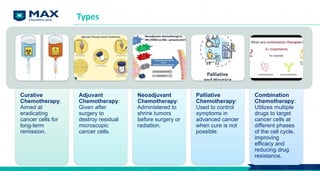
Types
Curative
Chemotherapy:
Aimed at
eradicating
cancer cells for
long-term
remission.
Adjuvant
Chemotherapy:
Given after
surgery to
destroy residual
microscopic
cancer cells.
Neoadjuvant
Chemotherapy:
Administered to
shrink tumors
before surgery or
radiation.
Palliative
Chemotherapy:
Used to control
symptoms in
advanced cancer
when cure is not
possible.
Combination
Chemotherapy:
Utilizes multiple
drugs to target
cancer cells at
different phases
of the cell cycle,
improving
efficacy and
reducing drug
resistance.
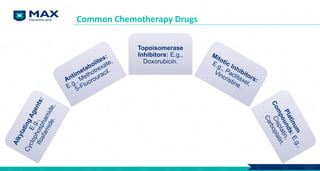
Common Chemotherapy Drugs
A
l
k
y
l
a
t
i
n
g
A
g
e
n
t
s
:
E
.
g
.
,
C
y
c
l
o
p
h
o
s
p
h
a
m
i
d
e
,
I
f
o
s
f
a
m
i
d
e
.
Antimetabolites:
E.g., Methotrexate,
5-Fluorouracil.
Topoisomerase
Inhibitors: E.g.,
Doxorubicin.
Mitotic Inhibitors:
E.g., Paclitaxel,
Vincristine.
P
l
a
t
i
n
u
m
C
o
m
p
o
u
n
d
s
:
E
.
g
.
,
C
i
s
p
l
a
t
i
n
,
C
a
r
b
o
p
l
a
t
i
n
.
Common Chemotherapy Drugs & Role of Nurse
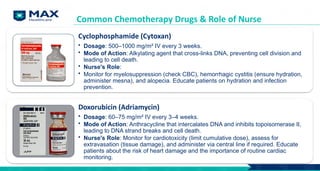
Cyclophosphamide (Cytoxan)
• Dosage: 500–1000 mg/m² IV every 3 weeks.
• Mode of Action: Alkylating agent that cross-links DNA, preventing cell division and
leading to cell death.
• Nurse's Role:
• Monitor for myelosuppression (check CBC), hemorrhagic cystitis (ensure hydration,
administer mesna), and alopecia. Educate patients on hydration and infection
prevention.
Doxorubicin (Adriamycin)
• Dosage: 60–75 mg/m² IV every 3–4 weeks.
• Mode of Action: Anthracycline that intercalates DNA and inhibits topoisomerase II,
leading to DNA strand breaks and cell death.
• Nurse's Role: Monitor for cardiotoxicity (limit cumulative dose), assess for
extravasation (tissue damage), and administer via central line if required. Educate
patients about the risk of heart damage and the importance of routine cardiac
monitoring.
Common Chemotherapy Drugs & Role of Nurse
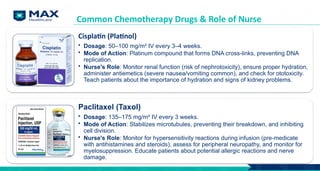
Cisplatin (Platinol)
• Dosage: 50–100 mg/m² IV every 3–4 weeks.
• Mode of Action: Platinum compound that forms DNA cross-links, preventing DNA
replication.
• Nurse's Role: Monitor renal function (risk of nephrotoxicity), ensure proper hydration,
administer antiemetics (severe nausea/vomiting common), and check for ototoxicity.
Teach patients about the importance of hydration and signs of kidney problems.
Paclitaxel (Taxol)
• Dosage: 135–175 mg/m² IV every 3 weeks.
• Mode of Action: Stabilizes microtubules, preventing their breakdown, and inhibiting
cell division.
• Nurse's Role: Monitor for hypersensitivity reactions during infusion (pre-medicate
with antihistamines and steroids), assess for peripheral neuropathy, and monitor for
myelosuppression. Educate patients about potential allergic reactions and nerve
damage.
Common Chemotherapy Drugs & Role of Nurse
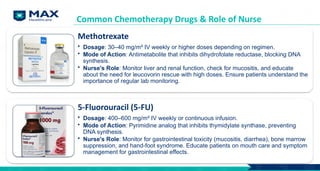
Methotrexate
• Dosage: 30–40 mg/m² IV weekly or higher doses depending on regimen.
• Mode of Action: Antimetabolite that inhibits dihydrofolate reductase, blocking DNA
synthesis.
• Nurse's Role: Monitor liver and renal function, check for mucositis, and educate
about the need for leucovorin rescue with high doses. Ensure patients understand the
importance of regular lab monitoring.
5-Fluorouracil (5-FU)
• Dosage: 400–600 mg/m² IV weekly or continuous infusion.
• Mode of Action: Pyrimidine analog that inhibits thymidylate synthase, preventing
DNA synthesis.
• Nurse's Role: Monitor for gastrointestinal toxicity (mucositis, diarrhea), bone marrow
suppression, and hand-foot syndrome. Educate patients on mouth care and symptom
management for gastrointestinal effects.
Common Chemotherapy Drugs & Role of Nurse
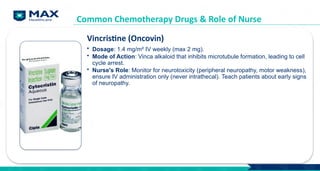
Vincristine (Oncovin)
• Dosage: 1.4 mg/m² IV weekly (max 2 mg).
• Mode of Action: Vinca alkaloid that inhibits microtubule formation, leading to cell
cycle arrest.
• Nurse's Role: Monitor for neurotoxicity (peripheral neuropathy, motor weakness),
ensure IV administration only (never intrathecal). Teach patients about early signs
of neuropathy.
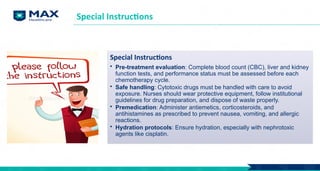
Special Instructions
• Pre-treatment evaluation: Complete blood count (CBC), liver and kidney
function tests, and performance status must be assessed before each
chemotherapy cycle.
• Safe handling: Cytotoxic drugs must be handled with care to avoid
exposure. Nurses should wear protective equipment, follow institutional
guidelines for drug preparation, and dispose of waste properly.
• Premedication: Administer antiemetics, corticosteroids, and
antihistamines as prescribed to prevent nausea, vomiting, and allergic
reactions.
• Hydration protocols: Ensure hydration, especially with nephrotoxic
agents like cisplatin.
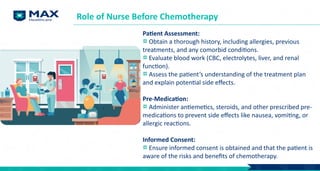
Patient Assessment:
Obtain a thorough history, including allergies, previous
treatments, and any comorbid conditions.
Evaluate blood work (CBC, electrolytes, liver, and renal
function).
Assess the patient’s understanding of the treatment plan
and explain potential side effects.
Pre-Medication:
Administer antiemetics, steroids, and other prescribed pre-
medications to prevent side effects like nausea, vomiting, or
allergic reactions.
Informed Consent:
Ensure informed consent is obtained and that the patient is
aware of the risks and benefits of chemotherapy.
Role of Nurse Before Chemotherapy
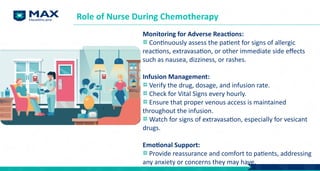
Monitoring for Adverse Reactions:
Continuously assess the patient for signs of allergic
reactions, extravasation, or other immediate side effects
such as nausea, dizziness, or rashes.
Infusion Management:
Verify the drug, dosage, and infusion rate.
Check for Vital Signs every hourly.
Ensure that proper venous access is maintained
throughout the infusion.
Watch for signs of extravasation, especially for vesicant
drugs.
Emotional Support:
Provide reassurance and comfort to patients, addressing
any anxiety or concerns they may have.
Role of Nurse During Chemotherapy
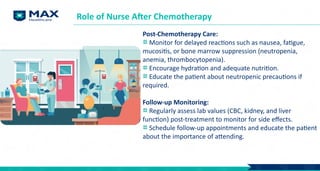
Post-Chemotherapy Care:
Monitor for delayed reactions such as nausea, fatigue,
mucositis, or bone marrow suppression (neutropenia,
anemia, thrombocytopenia).
Encourage hydration and adequate nutrition.
Educate the patient about neutropenic precautions if
required.
Follow-up Monitoring:
Regularly assess lab values (CBC, kidney, and liver
function) post-treatment to monitor for side effects.
Schedule follow-up appointments and educate the patient
about the importance of attending.
Role of Nurse After Chemotherapy
Contraindications
• Severe renal or hepatic impairment:
Chemotherapy may exacerbate organ
dysfunction.
• Severe bone marrow suppression:
Patients with low white blood cell or
platelet counts may require dose
adjustments.
• Active infections: Chemotherapy can
suppress the immune system, increasing
the risk of worsening infections.
• Pregnancy: Many chemotherapy drugs
are teratogenic and contraindicated in
pregnancy.
Contraindication
s
Health Education
Health Education
• Management of Side Effects: Educate patients on managing nausea,
mucositis, fatigue, and other common side effects.
• Infection Prevention: Teach patients about hand hygiene, avoiding
crowds, and reporting signs of infection early.
• Diet and Nutrition: Encourage a balanced diet rich in proteins and
calories to support recovery.
• Emotional and Psychological Support: Provide information about
counseling services and support groups for patients undergoing
chemotherapy.
Nursing Diagnosis: Risk for infection related to bone
marrow suppression.
Intervention: Implement neutropenic precautions and
educate the patient on infection prevention strategies.
Nursing Diagnosis: Altered nutrition, less than body
requirements related to nausea and vomiting.
Intervention: Administer prescribed antiemetics,
encourage small frequent meals, and provide dietary
counseling.
Nursing Diagnosis: Fatigue related to anemia from
chemotherapy.
Intervention: Encourage rest periods, assist with energy
conservation strategies, and monitor hemoglobin levels.
Nursing Diagnosis & Intervention
Chemotherapy is a critical component of cancer treatment, and nurses play an essential role in its
administration, monitoring, and management.
Nurses are responsible for ensuring patient safety, managing side effects, providing emotional support,
and educating patients about their treatment. As cancer treatment evolves, nurses must stay updated on
new drugs, side effect management, and supportive care interventions to provide the best possible care.
Summary
Post-Test Module 1C
https://forms.gle/DwrY6h6apD1VqnN39
Module - 1 C. Treatment Modalities.pptx max

Module - 1 C. Treatment Modalities.pptx max

  • 1.
    Module – 1C. Treatment Modalities
  • 2.
  • 3.
    Learning Objectives At theend of the session participant will able to: Describe the basic principles and clinical applications of MRI, Radio Nuclide Imaging, and USG in the detection and staging of cancer, differentiating between their roles in functional, anatomical, and molecular imaging. Demonstrate the essential steps in preparing patients for MRI, Radio Nuclide Imaging, and USG, including patient education on the procedure, safety precautions, contraindications, and post-imaging care for optimal patient outcomes. Identify and manage potential contraindications for MRI (e.g., presence of metal implants), Radio Nuclide Imaging (e.g., radiation exposure considerations), and USG, ensuring patient safety and adherence to best practices in oncology care.
  • 4.
    Module – 1C. Chemotherapy
  • 5.
  • 6.
    Functional & MetabolicImaging Chemotherapy is a critical component of cancer treatment that involves the use of cytotoxic drugs to kill or inhibit the growth of cancer cells. These drugs target rapidly dividing cells, affecting both malignant and healthy cells, especially in the bone marrow, gastrointestinal tract, and hair follicles. Chemotherapy may be used alone or in combination with surgery, radiotherapy, or other modalities depending on the cancer type, stage, and treatment goals. Nurses are essential in delivering chemotherapy and supporting patients throughout the treatment process.
  • 7.
    Indications Curative intent: Tocompletely eradicate cancer. Adjuvant chemotherapy: Used after surgery or radiation to eliminate residual cancer cells. Neoadjuvant chemotherapy: Given before surgery or radiation to shrink tumors. Palliative chemotherapy: To reduce symptoms and improve quality of life in advanced cancer stages. Prevention of metastasis: Chemotherapy may be administered to prevent the spread of cancer to other parts of the body.
  • 8.
    Purpose Kill cancer cells:Direct destruction of rapidly dividing cells. Shrink tumors: Reduce tumor size for easier surgical removal or symptom relief. Control cancer growth: Stop cancer from spreading to other areas. Palliate symptoms: Improve quality of life by reducing symptoms such as pain or pressure caused by tumors.
  • 9.
    Types Curative Chemotherapy: Aimed at eradicating cancer cellsfor long-term remission. Adjuvant Chemotherapy: Given after surgery to destroy residual microscopic cancer cells. Neoadjuvant Chemotherapy: Administered to shrink tumors before surgery or radiation. Palliative Chemotherapy: Used to control symptoms in advanced cancer when cure is not possible. Combination Chemotherapy: Utilizes multiple drugs to target cancer cells at different phases of the cell cycle, improving efficacy and reducing drug resistance.
  • 10.
    Common Chemotherapy Drugs A l k y l a t i n g A g e n t s : E . g . , C y c l o p h o s p h a m i d e , I f o s f a m i d e . Antimetabolites: E.g.,Methotrexate, 5-Fluorouracil. Topoisomerase Inhibitors: E.g., Doxorubicin. Mitotic Inhibitors: E.g., Paclitaxel, Vincristine. P l a t i n u m C o m p o u n d s : E . g . , C i s p l a t i n , C a r b o p l a t i n .
  • 11.
    Common Chemotherapy Drugs& Role of Nurse Cyclophosphamide (Cytoxan) • Dosage: 500–1000 mg/m² IV every 3 weeks. • Mode of Action: Alkylating agent that cross-links DNA, preventing cell division and leading to cell death. • Nurse's Role: • Monitor for myelosuppression (check CBC), hemorrhagic cystitis (ensure hydration, administer mesna), and alopecia. Educate patients on hydration and infection prevention. Doxorubicin (Adriamycin) • Dosage: 60–75 mg/m² IV every 3–4 weeks. • Mode of Action: Anthracycline that intercalates DNA and inhibits topoisomerase II, leading to DNA strand breaks and cell death. • Nurse's Role: Monitor for cardiotoxicity (limit cumulative dose), assess for extravasation (tissue damage), and administer via central line if required. Educate patients about the risk of heart damage and the importance of routine cardiac monitoring.
  • 12.
    Common Chemotherapy Drugs& Role of Nurse Cisplatin (Platinol) • Dosage: 50–100 mg/m² IV every 3–4 weeks. • Mode of Action: Platinum compound that forms DNA cross-links, preventing DNA replication. • Nurse's Role: Monitor renal function (risk of nephrotoxicity), ensure proper hydration, administer antiemetics (severe nausea/vomiting common), and check for ototoxicity. Teach patients about the importance of hydration and signs of kidney problems. Paclitaxel (Taxol) • Dosage: 135–175 mg/m² IV every 3 weeks. • Mode of Action: Stabilizes microtubules, preventing their breakdown, and inhibiting cell division. • Nurse's Role: Monitor for hypersensitivity reactions during infusion (pre-medicate with antihistamines and steroids), assess for peripheral neuropathy, and monitor for myelosuppression. Educate patients about potential allergic reactions and nerve damage.
  • 13.
    Common Chemotherapy Drugs& Role of Nurse Methotrexate • Dosage: 30–40 mg/m² IV weekly or higher doses depending on regimen. • Mode of Action: Antimetabolite that inhibits dihydrofolate reductase, blocking DNA synthesis. • Nurse's Role: Monitor liver and renal function, check for mucositis, and educate about the need for leucovorin rescue with high doses. Ensure patients understand the importance of regular lab monitoring. 5-Fluorouracil (5-FU) • Dosage: 400–600 mg/m² IV weekly or continuous infusion. • Mode of Action: Pyrimidine analog that inhibits thymidylate synthase, preventing DNA synthesis. • Nurse's Role: Monitor for gastrointestinal toxicity (mucositis, diarrhea), bone marrow suppression, and hand-foot syndrome. Educate patients on mouth care and symptom management for gastrointestinal effects.
  • 14.
    Common Chemotherapy Drugs& Role of Nurse Vincristine (Oncovin) • Dosage: 1.4 mg/m² IV weekly (max 2 mg). • Mode of Action: Vinca alkaloid that inhibits microtubule formation, leading to cell cycle arrest. • Nurse's Role: Monitor for neurotoxicity (peripheral neuropathy, motor weakness), ensure IV administration only (never intrathecal). Teach patients about early signs of neuropathy.
  • 15.
    Special Instructions Special Instructions •Pre-treatment evaluation: Complete blood count (CBC), liver and kidney function tests, and performance status must be assessed before each chemotherapy cycle. • Safe handling: Cytotoxic drugs must be handled with care to avoid exposure. Nurses should wear protective equipment, follow institutional guidelines for drug preparation, and dispose of waste properly. • Premedication: Administer antiemetics, corticosteroids, and antihistamines as prescribed to prevent nausea, vomiting, and allergic reactions. • Hydration protocols: Ensure hydration, especially with nephrotoxic agents like cisplatin.
  • 16.
    Patient Assessment: Obtain athorough history, including allergies, previous treatments, and any comorbid conditions. Evaluate blood work (CBC, electrolytes, liver, and renal function). Assess the patient’s understanding of the treatment plan and explain potential side effects. Pre-Medication: Administer antiemetics, steroids, and other prescribed pre- medications to prevent side effects like nausea, vomiting, or allergic reactions. Informed Consent: Ensure informed consent is obtained and that the patient is aware of the risks and benefits of chemotherapy. Role of Nurse Before Chemotherapy
  • 17.
    Monitoring for AdverseReactions: Continuously assess the patient for signs of allergic reactions, extravasation, or other immediate side effects such as nausea, dizziness, or rashes. Infusion Management: Verify the drug, dosage, and infusion rate. Check for Vital Signs every hourly. Ensure that proper venous access is maintained throughout the infusion. Watch for signs of extravasation, especially for vesicant drugs. Emotional Support: Provide reassurance and comfort to patients, addressing any anxiety or concerns they may have. Role of Nurse During Chemotherapy
  • 18.
    Post-Chemotherapy Care: Monitor fordelayed reactions such as nausea, fatigue, mucositis, or bone marrow suppression (neutropenia, anemia, thrombocytopenia). Encourage hydration and adequate nutrition. Educate the patient about neutropenic precautions if required. Follow-up Monitoring: Regularly assess lab values (CBC, kidney, and liver function) post-treatment to monitor for side effects. Schedule follow-up appointments and educate the patient about the importance of attending. Role of Nurse After Chemotherapy
  • 19.
    Contraindications • Severe renalor hepatic impairment: Chemotherapy may exacerbate organ dysfunction. • Severe bone marrow suppression: Patients with low white blood cell or platelet counts may require dose adjustments. • Active infections: Chemotherapy can suppress the immune system, increasing the risk of worsening infections. • Pregnancy: Many chemotherapy drugs are teratogenic and contraindicated in pregnancy. Contraindication s
  • 20.
    Health Education Health Education •Management of Side Effects: Educate patients on managing nausea, mucositis, fatigue, and other common side effects. • Infection Prevention: Teach patients about hand hygiene, avoiding crowds, and reporting signs of infection early. • Diet and Nutrition: Encourage a balanced diet rich in proteins and calories to support recovery. • Emotional and Psychological Support: Provide information about counseling services and support groups for patients undergoing chemotherapy.
  • 21.
    Nursing Diagnosis: Riskfor infection related to bone marrow suppression. Intervention: Implement neutropenic precautions and educate the patient on infection prevention strategies. Nursing Diagnosis: Altered nutrition, less than body requirements related to nausea and vomiting. Intervention: Administer prescribed antiemetics, encourage small frequent meals, and provide dietary counseling. Nursing Diagnosis: Fatigue related to anemia from chemotherapy. Intervention: Encourage rest periods, assist with energy conservation strategies, and monitor hemoglobin levels. Nursing Diagnosis & Intervention
  • 22.
    Chemotherapy is acritical component of cancer treatment, and nurses play an essential role in its administration, monitoring, and management. Nurses are responsible for ensuring patient safety, managing side effects, providing emotional support, and educating patients about their treatment. As cancer treatment evolves, nurses must stay updated on new drugs, side effect management, and supportive care interventions to provide the best possible care. Summary
  • 23.