SULIT 4541/1
1
1. Which of the following processes, proved the kinetic theory of matter?
A. Diffusion
B. Photosynthesis
C. Respiration
D. Neutralisation
2. Which of the following is a chemical formula of ammonium sulphate?
A. NH4SO4
B. (NH4)2SO4
C. (NH3)2SO4
D. (NH4)3(SO4)2
3. Elements in the Periodic Table are arranged according to an increase in
A. Proton number
B. Nucleon number
C. Relative atomic mass
D. Relative molecular mass
4. Which of the following substances is a covalent compound?
A. Copper
B. Ammonia
C. Lead(II) oxide
D. Sodium chloride
5. Which of the following substances is an electrolyte?
A. Hydrogen chloride in methylbenzene
B. Molten aluminium oxide
C. Glucose solution
D. Copper(II) carbonate powder
6. Which of the following statements is true about alkali?
A. Weak alkali is an alkali that undergoes high rate of ionization
B. Strong alkali has low pH value
C. Alkalis are bases that are soluble in water
D. Alkalis are not corrosive
7. Which of the following is a soluble salt?
A. Lead(II) iodide
B. Copper(II) carbonate
C. Barium sulphate
D. Sodium hypochlorite
SULIT 4541/1
2
8. The body of the car shown in the diagram below is made of alloy T.
What is alloy T?
A. Steel
B. Brass
C. Bronze
D. Duralumin
9. Which of the homologous series is correctly paired to its functional group?
Homologous series Functional groups
A. Ester
B. Alkene
C. Alcohol
D. Carboxylic acid
10. Which of the following statements correctly explains the meaning of effective collision?
A. The collision which takes place before reaction
B. The collision where its energy is less than the activation energy
C. The collision that can cause reaction
D. The collision that has the highest energy
SULIT 4541/1
3
11. The diagram below shows the molecular formula of glucose.
C6H12O6
What is the empirical formula for glucose?
A. CH2O
B. CH2O2
C. C2H4O2
D. C6H12O6
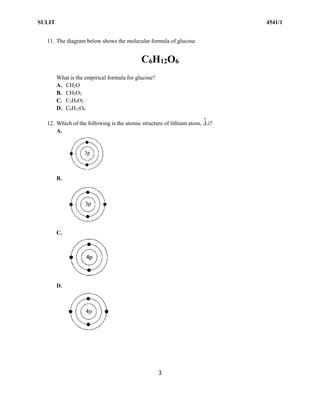
12. Which of the following is the atomic structure of lithium atom, 3Li?
A.
B.
C.
D.
7
SULIT 4541/1
4
13. The figure shows three elements in Period 3 of the Periodic Table.
Which of the following is true about the properties of oxide formed?
A. The oxide of Z is basic
B. The oxide of Y is acidic
C. The formula of oxide Y is YO
D. The oxide of X reacts with an acid to form salt and water
14. Which of the following substances is made up of ions?
A. Sulphur
B. Naphthalene
C. Sulphur trioxide
D. Potassium chloride
15. Which of the following ions are present in copper(II) sulphate solution?
A. Hydrogen ions and hydroxide ions
B. Copper(II) ions and sulphate ions
C. Copper(II) ions, hydrogen ions, sulphide ions and oxide ions
D. Copper(II) ions, hydrogen ions, sulphate ions and hydroxide ions
16. The diagram shows part of a polymer molecule.
Which is its monomer?
A.
B.
SULIT 4541/1
5
C.
D.
17. Nitric acid will change to nitrate salt when hydrogen ions are replaced by
I copper ion
II hydroxide ion
III carbonate ion
IV ammonium ion
A. I and II only
B. I and IV only
C. II and IV only
D. I, III and IV only
18. The graph shows the volume of carbon dioxide gas produced against time for the reaction of
calcium carbonate and sulphuric acid.
The gradient of the graph decreases with time because
A. Catalyst is not used
B. Volume of mixture decreases
C. Temperature of reaction decreases
D. Concentration of sulphuric acid decreases
SULIT 4541/1
6
19. The equation below shows a chemical reaction.
Based on the equation given, name the reaction.
A. Hydrogenation
B. Polymerization
C. Halogenations
D. Substitution
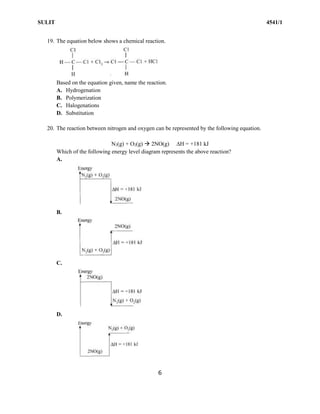
20. The reaction between nitrogen and oxygen can be represented by the following equation.
N2(g) + O2(g)  2NO(g) H = +181 kJ
Which of the following energy level diagram represents the above reaction?
A.
B.
C.
D.
SULIT 4541/1
7
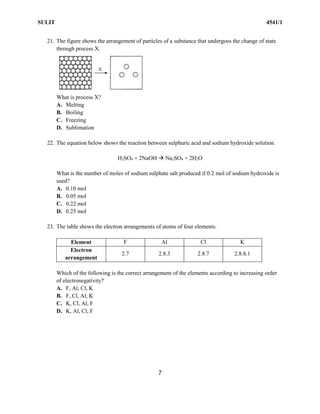
21. The figure shows the arrangement of particles of a substance that undergoes the change of state
through process X.
What is process X?
A. Melting
B. Boiling
C. Freezing
D. Sublimation
22. The equation below shows the reaction between sulphuric acid and sodium hydroxide solution.
H2SO4 + 2NaOH  Na2SO4 + 2H2O
What is the number of moles of sodium sulphate salt produced if 0.2 mol of sodium hydroxide is
used?
A. 0.10 mol
B. 0.05 mol
C. 0.22 mol
D. 0.25 mol
23. The table shows the electron arrangements of atoms of four elements.
Element F Al Cl K
Electron
arrangement
2.7 2.8.3 2.8.7 2.8.8.1
Which of the following is the correct arrangement of the elements according to increasing order
of electronegativity?
A. F, Al, Cl, K
B. F, Cl, Al, K
C. K, Cl, Al, F
D. K, Al, Cl, F
SULIT 4541/1
8
24. The number of valence electrons of atoms X and Y are 2 and 7 respectively. Which of the
following chemical formulae and type of bonding are true for the compound formed between X
and Y?
Chemical formula Type of bonding
A. XY2 Ionic
B. XY2 Covalent
C. X2Y Ionic
D. X2Y Covalent
25. The diagram below shows the set-up of the apparatus for electrolysis of concentrated solution of
sodium chloride.
What is the product formed at the anode and cathode?
Anode Cathode
A. O2 H2
B. Cl2 H2
C. Cl2 Na
D. O2 Cl2
26. The diagram below shows 5 steps for preparing a standard solution of sodium hydroxide, NaOH
but not in correct order.
P – Transfer the solid sodium hydroxide into the volumetric flask
Q – Weigh the mass of sodium hydroxide
R – Add distilled water until the graduation mark
S – Rinse the weighing bottle and pour the solution into the volumetric flask
T – Shake the volumetric flask
Which of the following steps is correct?
A. Q, S, P, R, T
B. R, Q, S, P, T
C. Q, P, S, R, T
D. R, Q, S, T, P
SULIT 4541/1
9
27.
A group of students carried out an experiment to determine the rate of reaction of zinc metal with
dilute hydrochloric acid. The diagram above shows the graph for the total volume of gas collected
against time. The average rate of reaction for the whole experiment is:
A. 0.3 cm3
/s
B. 0.25 cm3
/s
C. 0.17 cm3
/s
D. 0.13 cm3
/s
28. Which of the following isotopes is used to detect leakage in a gas pipe?
A. Carbon-14
B. Cobalt-60
C. Sodium-24
D. Iodine-131
29. 34 g of ammonia consists of
[Relative molecular mass of ammonia = 17, Avogadro constant = 6.02 x 10²³
mol-1
]
I 2 moles of nitrogen atoms
II 2 moles of ammonia molecules
III 1.204 x 1024
molecules
IV 5 moles of hydrogen atoms
A. I and II only
B. I, II and III only
C. II, III and IV only
D. I, II, III and IV
SULIT 4541/1
10
30. Professional cyclists usually fill their bicycle tyres with gas X which makes the bicycle lighter.
Which of the following elements, X, Y, W and Z, in the Periodic Table is suitable to be used in
bicycle tyres?
A. X
B. Y
C. W
D. Z
31. The diagram below shows the symbols of atoms D and E.
Atom D reacts with atom E to form a compound. Calculate the relative molecular mass for the
compound formed.
A. 21
B. 43
C. 102
D. 113
32. Calculate the volume of sodium hydroxide of concentration 0.5 mol dm-3
need to neutralize 25.0
cm3
sulphuric acid of concentration 0.20 mol dm-3
.
A. 10cm3
B. 20 cm3
C. 25 cm3
D. 50 cm3
33. The table below shows the potential difference of three simple voltaic cells.
Cell Pair of metals Potential difference/V Negative terminal
I Mg and Cu 3.0 Mg
II Mg and Zn 1.5 Mg
III Zn and Fe 0.5 Zn
What is the potential difference of a simple voltaic cell for pair of iron and copper?
A. 0.5 V
B. 1.0 V
C. 1.5 V
D. 2.5 V
SULIT 4541/1
11
34. 200 cm3
of 0.1 mol dm-3
sodium chloride solution reacts completely with excess silver nitrate.
Calculate the mass of precipitate produced.
[Relative atomic mass of: Ag, 108; Cl, 35.5]
A. 2.78 g
B. 2.87 g
C. 3.78 g
D. 3.87 g
35. Graph represents the decomposition of 25 cm3
hydrogen peroxide of 0.5 mol dm-3
with
manganese(IV) oxide as a catalyst at a temperature of 30C.
Which of the following experiments will produce graph II?
Volume of hydrogen
peroxide/cm3
Concentration of
hydrogen
peroxide/mol dm-3
Temperature of
hydrogen
peroxide/C
A. 15 0.7 30
B. 15 0.5 30
C. 40 0.7 30
D. 40 0.5 20
SULIT 4541/1
12
36. The diagram below shows the molecular formulae of two compounds A and B. Substance X is
formed when both compounds react with each other.
Which of the following sets represents substance X?
Structural formula Name
A. Ethyl propanoate
B. Ethyl propanoate
C. Propyl propanoate
D. Propyl propanoate
37. Diagram shows the stages involved in the Contact Process to produce sulphuric acid.
What is the optimum temperature and the catalyst used in stage I?
Temperature/C Catalyst
A. 450 Vanadium(V) oxide
B. 200 Vanadium(V) oxide
C. 450 Iron powder
D. 300 Iron powder
SULIT 4541/1
13
38. Which of the following compound is an organic compound?
A. Calcium carbonate, CaCO3
B. Carbonic acid, H2CO3
C. Carbon dioxide, CO2
D. Glucose, C6H12O6
39. Which of the following physical properties is true of copper(II) chloride?
A. It is a volatile substance
B. It dissolves in organic solvent
C. It conducts electricity in aqueous solution
D. It burns in oxygen to produce white fumes
40. Which of the following ions form a precipitate that dissolved in excess ammonia solution?
I Zn2+
II Al3+
III Pb2+
IV Cu2+
A. I and IV only
B. II and IV only
C. I and III only
D. I, II and III only
41. Table shows the relative atomic mass of helium, carbon, sulphur and copper.
Element Helium Carbon Sulphur Copper
Relative
atomic mass
4 12 32 64
Which of the following statements is true?
[Avogadro constant = 6.0 x 10²³
mol-1
]
A. Mass of one copper atom is 64 g
B. Mass of 1 mol of helium is 8 g
C. 32 g of sulphur contains 6.02 x 10²³
sulphur atoms
D. Mass of one sulphur atom is 32 times bigger than one carbon atom
SULIT 4541/1
14
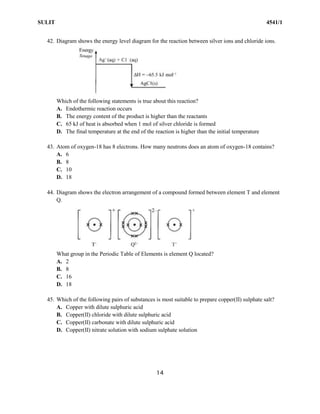
42. Diagram shows the energy level diagram for the reaction between silver ions and chloride ions.
Which of the following statements is true about this reaction?
A. Endothermic reaction occurs
B. The energy content of the product is higher than the reactants
C. 65 kJ of heat is absorbed when 1 mol of silver chloride is formed
D. The final temperature at the end of the reaction is higher than the initial temperature
43. Atom of oxygen-18 has 8 electrons. How many neutrons does an atom of oxygen-18 contains?
A. 6
B. 8
C. 10
D. 18
44. Diagram shows the electron arrangement of a compound formed between element T and element
Q.
What group in the Periodic Table of Elements is element Q located?
A. 2
B. 8
C. 16
D. 18
45. Which of the following pairs of substances is most suitable to prepare copper(II) sulphate salt?
A. Copper with dilute sulphuric acid
B. Copper(II) chloride with dilute sulphuric acid
C. Copper(II) carbonate with dilute sulphuric acid
D. Copper(II) nitrate solution with sodium sulphate solution
SULIT 4541/1
15
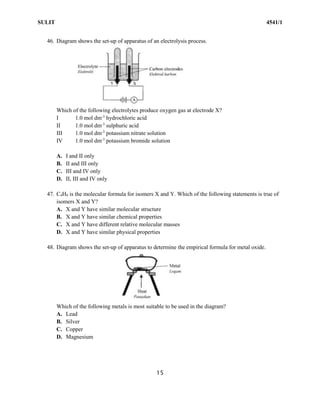
46. Diagram shows the set-up of apparatus of an electrolysis process.
Which of the following electrolytes produce oxygen gas at electrode X?
I 1.0 mol dm-3
hydrochloric acid
II 1.0 mol dm-3
sulphuric acid
III 1.0 mol dm-3
potassium nitrate solution
IV 1.0 mol dm-3
potassium bromide solution
A. I and II only
B. II and III only
C. III and IV only
D. II, III and IV only
47. C4H8 is the molecular formula for isomers X and Y. Which of the following statements is true of
isomers X and Y?
A. X and Y have similar molecular structure
B. X and Y have similar chemical properties
C. X and Y have different relative molecular masses
D. X and Y have similar physical properties
48. Diagram shows the set-up of apparatus to determine the empirical formula for metal oxide.
Which of the following metals is most suitable to be used in the diagram?
A. Lead
B. Silver
C. Copper
D. Magnesium
SULIT 4541/1
16
49. 7 g of potassium hydroxide is dissolved in distilled water to form 250 cm3
of solution. What is the
molarity of the potassium hydroxide solution?
[Relative atomic mass: H = 1, O = 16, K = 39]
A. 0.03 mol dm-3
B. 0.05 mol dm-3
C. 0.30 mol dm-3
D. 0.50 mol dm-3
50. Diagram shows the structural formula of pent-1-ene.
Which of the following are the structural formulae and names for the isomers of pent-1-ene?
I Pent-2-ene
II 3-methylbut-1-ene
III Pent-3-ene
IV 2-methylbut-2-ene
A. I and IV
B. II and III
C. I, II and IV
D. I, II, III and IV

Chemistry paper 1

  • 1.
    SULIT 4541/1 1 1. Whichof the following processes, proved the kinetic theory of matter? A. Diffusion B. Photosynthesis C. Respiration D. Neutralisation 2. Which of the following is a chemical formula of ammonium sulphate? A. NH4SO4 B. (NH4)2SO4 C. (NH3)2SO4 D. (NH4)3(SO4)2 3. Elements in the Periodic Table are arranged according to an increase in A. Proton number B. Nucleon number C. Relative atomic mass D. Relative molecular mass 4. Which of the following substances is a covalent compound? A. Copper B. Ammonia C. Lead(II) oxide D. Sodium chloride 5. Which of the following substances is an electrolyte? A. Hydrogen chloride in methylbenzene B. Molten aluminium oxide C. Glucose solution D. Copper(II) carbonate powder 6. Which of the following statements is true about alkali? A. Weak alkali is an alkali that undergoes high rate of ionization B. Strong alkali has low pH value C. Alkalis are bases that are soluble in water D. Alkalis are not corrosive 7. Which of the following is a soluble salt? A. Lead(II) iodide B. Copper(II) carbonate C. Barium sulphate D. Sodium hypochlorite
  • 2.
    SULIT 4541/1 2 8. Thebody of the car shown in the diagram below is made of alloy T. What is alloy T? A. Steel B. Brass C. Bronze D. Duralumin 9. Which of the homologous series is correctly paired to its functional group? Homologous series Functional groups A. Ester B. Alkene C. Alcohol D. Carboxylic acid 10. Which of the following statements correctly explains the meaning of effective collision? A. The collision which takes place before reaction B. The collision where its energy is less than the activation energy C. The collision that can cause reaction D. The collision that has the highest energy
  • 3.
    SULIT 4541/1 3 11. Thediagram below shows the molecular formula of glucose. C6H12O6 What is the empirical formula for glucose? A. CH2O B. CH2O2 C. C2H4O2 D. C6H12O6 12. Which of the following is the atomic structure of lithium atom, 3Li? A. B. C. D. 7
  • 4.
    SULIT 4541/1 4 13. Thefigure shows three elements in Period 3 of the Periodic Table. Which of the following is true about the properties of oxide formed? A. The oxide of Z is basic B. The oxide of Y is acidic C. The formula of oxide Y is YO D. The oxide of X reacts with an acid to form salt and water 14. Which of the following substances is made up of ions? A. Sulphur B. Naphthalene C. Sulphur trioxide D. Potassium chloride 15. Which of the following ions are present in copper(II) sulphate solution? A. Hydrogen ions and hydroxide ions B. Copper(II) ions and sulphate ions C. Copper(II) ions, hydrogen ions, sulphide ions and oxide ions D. Copper(II) ions, hydrogen ions, sulphate ions and hydroxide ions 16. The diagram shows part of a polymer molecule. Which is its monomer? A. B.
  • 5.
    SULIT 4541/1 5 C. D. 17. Nitricacid will change to nitrate salt when hydrogen ions are replaced by I copper ion II hydroxide ion III carbonate ion IV ammonium ion A. I and II only B. I and IV only C. II and IV only D. I, III and IV only 18. The graph shows the volume of carbon dioxide gas produced against time for the reaction of calcium carbonate and sulphuric acid. The gradient of the graph decreases with time because A. Catalyst is not used B. Volume of mixture decreases C. Temperature of reaction decreases D. Concentration of sulphuric acid decreases
  • 6.
    SULIT 4541/1 6 19. Theequation below shows a chemical reaction. Based on the equation given, name the reaction. A. Hydrogenation B. Polymerization C. Halogenations D. Substitution 20. The reaction between nitrogen and oxygen can be represented by the following equation. N2(g) + O2(g)  2NO(g) H = +181 kJ Which of the following energy level diagram represents the above reaction? A. B. C. D.
  • 7.
    SULIT 4541/1 7 21. Thefigure shows the arrangement of particles of a substance that undergoes the change of state through process X. What is process X? A. Melting B. Boiling C. Freezing D. Sublimation 22. The equation below shows the reaction between sulphuric acid and sodium hydroxide solution. H2SO4 + 2NaOH  Na2SO4 + 2H2O What is the number of moles of sodium sulphate salt produced if 0.2 mol of sodium hydroxide is used? A. 0.10 mol B. 0.05 mol C. 0.22 mol D. 0.25 mol 23. The table shows the electron arrangements of atoms of four elements. Element F Al Cl K Electron arrangement 2.7 2.8.3 2.8.7 2.8.8.1 Which of the following is the correct arrangement of the elements according to increasing order of electronegativity? A. F, Al, Cl, K B. F, Cl, Al, K C. K, Cl, Al, F D. K, Al, Cl, F
  • 8.
    SULIT 4541/1 8 24. Thenumber of valence electrons of atoms X and Y are 2 and 7 respectively. Which of the following chemical formulae and type of bonding are true for the compound formed between X and Y? Chemical formula Type of bonding A. XY2 Ionic B. XY2 Covalent C. X2Y Ionic D. X2Y Covalent 25. The diagram below shows the set-up of the apparatus for electrolysis of concentrated solution of sodium chloride. What is the product formed at the anode and cathode? Anode Cathode A. O2 H2 B. Cl2 H2 C. Cl2 Na D. O2 Cl2 26. The diagram below shows 5 steps for preparing a standard solution of sodium hydroxide, NaOH but not in correct order. P – Transfer the solid sodium hydroxide into the volumetric flask Q – Weigh the mass of sodium hydroxide R – Add distilled water until the graduation mark S – Rinse the weighing bottle and pour the solution into the volumetric flask T – Shake the volumetric flask Which of the following steps is correct? A. Q, S, P, R, T B. R, Q, S, P, T C. Q, P, S, R, T D. R, Q, S, T, P
  • 9.
    SULIT 4541/1 9 27. A groupof students carried out an experiment to determine the rate of reaction of zinc metal with dilute hydrochloric acid. The diagram above shows the graph for the total volume of gas collected against time. The average rate of reaction for the whole experiment is: A. 0.3 cm3 /s B. 0.25 cm3 /s C. 0.17 cm3 /s D. 0.13 cm3 /s 28. Which of the following isotopes is used to detect leakage in a gas pipe? A. Carbon-14 B. Cobalt-60 C. Sodium-24 D. Iodine-131 29. 34 g of ammonia consists of [Relative molecular mass of ammonia = 17, Avogadro constant = 6.02 x 10²³ mol-1 ] I 2 moles of nitrogen atoms II 2 moles of ammonia molecules III 1.204 x 1024 molecules IV 5 moles of hydrogen atoms A. I and II only B. I, II and III only C. II, III and IV only D. I, II, III and IV
  • 10.
    SULIT 4541/1 10 30. Professionalcyclists usually fill their bicycle tyres with gas X which makes the bicycle lighter. Which of the following elements, X, Y, W and Z, in the Periodic Table is suitable to be used in bicycle tyres? A. X B. Y C. W D. Z 31. The diagram below shows the symbols of atoms D and E. Atom D reacts with atom E to form a compound. Calculate the relative molecular mass for the compound formed. A. 21 B. 43 C. 102 D. 113 32. Calculate the volume of sodium hydroxide of concentration 0.5 mol dm-3 need to neutralize 25.0 cm3 sulphuric acid of concentration 0.20 mol dm-3 . A. 10cm3 B. 20 cm3 C. 25 cm3 D. 50 cm3 33. The table below shows the potential difference of three simple voltaic cells. Cell Pair of metals Potential difference/V Negative terminal I Mg and Cu 3.0 Mg II Mg and Zn 1.5 Mg III Zn and Fe 0.5 Zn What is the potential difference of a simple voltaic cell for pair of iron and copper? A. 0.5 V B. 1.0 V C. 1.5 V D. 2.5 V
  • 11.
    SULIT 4541/1 11 34. 200cm3 of 0.1 mol dm-3 sodium chloride solution reacts completely with excess silver nitrate. Calculate the mass of precipitate produced. [Relative atomic mass of: Ag, 108; Cl, 35.5] A. 2.78 g B. 2.87 g C. 3.78 g D. 3.87 g 35. Graph represents the decomposition of 25 cm3 hydrogen peroxide of 0.5 mol dm-3 with manganese(IV) oxide as a catalyst at a temperature of 30C. Which of the following experiments will produce graph II? Volume of hydrogen peroxide/cm3 Concentration of hydrogen peroxide/mol dm-3 Temperature of hydrogen peroxide/C A. 15 0.7 30 B. 15 0.5 30 C. 40 0.7 30 D. 40 0.5 20
  • 12.
    SULIT 4541/1 12 36. Thediagram below shows the molecular formulae of two compounds A and B. Substance X is formed when both compounds react with each other. Which of the following sets represents substance X? Structural formula Name A. Ethyl propanoate B. Ethyl propanoate C. Propyl propanoate D. Propyl propanoate 37. Diagram shows the stages involved in the Contact Process to produce sulphuric acid. What is the optimum temperature and the catalyst used in stage I? Temperature/C Catalyst A. 450 Vanadium(V) oxide B. 200 Vanadium(V) oxide C. 450 Iron powder D. 300 Iron powder
  • 13.
    SULIT 4541/1 13 38. Whichof the following compound is an organic compound? A. Calcium carbonate, CaCO3 B. Carbonic acid, H2CO3 C. Carbon dioxide, CO2 D. Glucose, C6H12O6 39. Which of the following physical properties is true of copper(II) chloride? A. It is a volatile substance B. It dissolves in organic solvent C. It conducts electricity in aqueous solution D. It burns in oxygen to produce white fumes 40. Which of the following ions form a precipitate that dissolved in excess ammonia solution? I Zn2+ II Al3+ III Pb2+ IV Cu2+ A. I and IV only B. II and IV only C. I and III only D. I, II and III only 41. Table shows the relative atomic mass of helium, carbon, sulphur and copper. Element Helium Carbon Sulphur Copper Relative atomic mass 4 12 32 64 Which of the following statements is true? [Avogadro constant = 6.0 x 10²³ mol-1 ] A. Mass of one copper atom is 64 g B. Mass of 1 mol of helium is 8 g C. 32 g of sulphur contains 6.02 x 10²³ sulphur atoms D. Mass of one sulphur atom is 32 times bigger than one carbon atom
  • 14.
    SULIT 4541/1 14 42. Diagramshows the energy level diagram for the reaction between silver ions and chloride ions. Which of the following statements is true about this reaction? A. Endothermic reaction occurs B. The energy content of the product is higher than the reactants C. 65 kJ of heat is absorbed when 1 mol of silver chloride is formed D. The final temperature at the end of the reaction is higher than the initial temperature 43. Atom of oxygen-18 has 8 electrons. How many neutrons does an atom of oxygen-18 contains? A. 6 B. 8 C. 10 D. 18 44. Diagram shows the electron arrangement of a compound formed between element T and element Q. What group in the Periodic Table of Elements is element Q located? A. 2 B. 8 C. 16 D. 18 45. Which of the following pairs of substances is most suitable to prepare copper(II) sulphate salt? A. Copper with dilute sulphuric acid B. Copper(II) chloride with dilute sulphuric acid C. Copper(II) carbonate with dilute sulphuric acid D. Copper(II) nitrate solution with sodium sulphate solution
  • 15.
    SULIT 4541/1 15 46. Diagramshows the set-up of apparatus of an electrolysis process. Which of the following electrolytes produce oxygen gas at electrode X? I 1.0 mol dm-3 hydrochloric acid II 1.0 mol dm-3 sulphuric acid III 1.0 mol dm-3 potassium nitrate solution IV 1.0 mol dm-3 potassium bromide solution A. I and II only B. II and III only C. III and IV only D. II, III and IV only 47. C4H8 is the molecular formula for isomers X and Y. Which of the following statements is true of isomers X and Y? A. X and Y have similar molecular structure B. X and Y have similar chemical properties C. X and Y have different relative molecular masses D. X and Y have similar physical properties 48. Diagram shows the set-up of apparatus to determine the empirical formula for metal oxide. Which of the following metals is most suitable to be used in the diagram? A. Lead B. Silver C. Copper D. Magnesium
  • 16.
    SULIT 4541/1 16 49. 7g of potassium hydroxide is dissolved in distilled water to form 250 cm3 of solution. What is the molarity of the potassium hydroxide solution? [Relative atomic mass: H = 1, O = 16, K = 39] A. 0.03 mol dm-3 B. 0.05 mol dm-3 C. 0.30 mol dm-3 D. 0.50 mol dm-3 50. Diagram shows the structural formula of pent-1-ene. Which of the following are the structural formulae and names for the isomers of pent-1-ene? I Pent-2-ene II 3-methylbut-1-ene III Pent-3-ene IV 2-methylbut-2-ene A. I and IV B. II and III C. I, II and IV D. I, II, III and IV