CHEMICAL EQUATIONS
JENNIFER C. VALDEZ
TEACHER
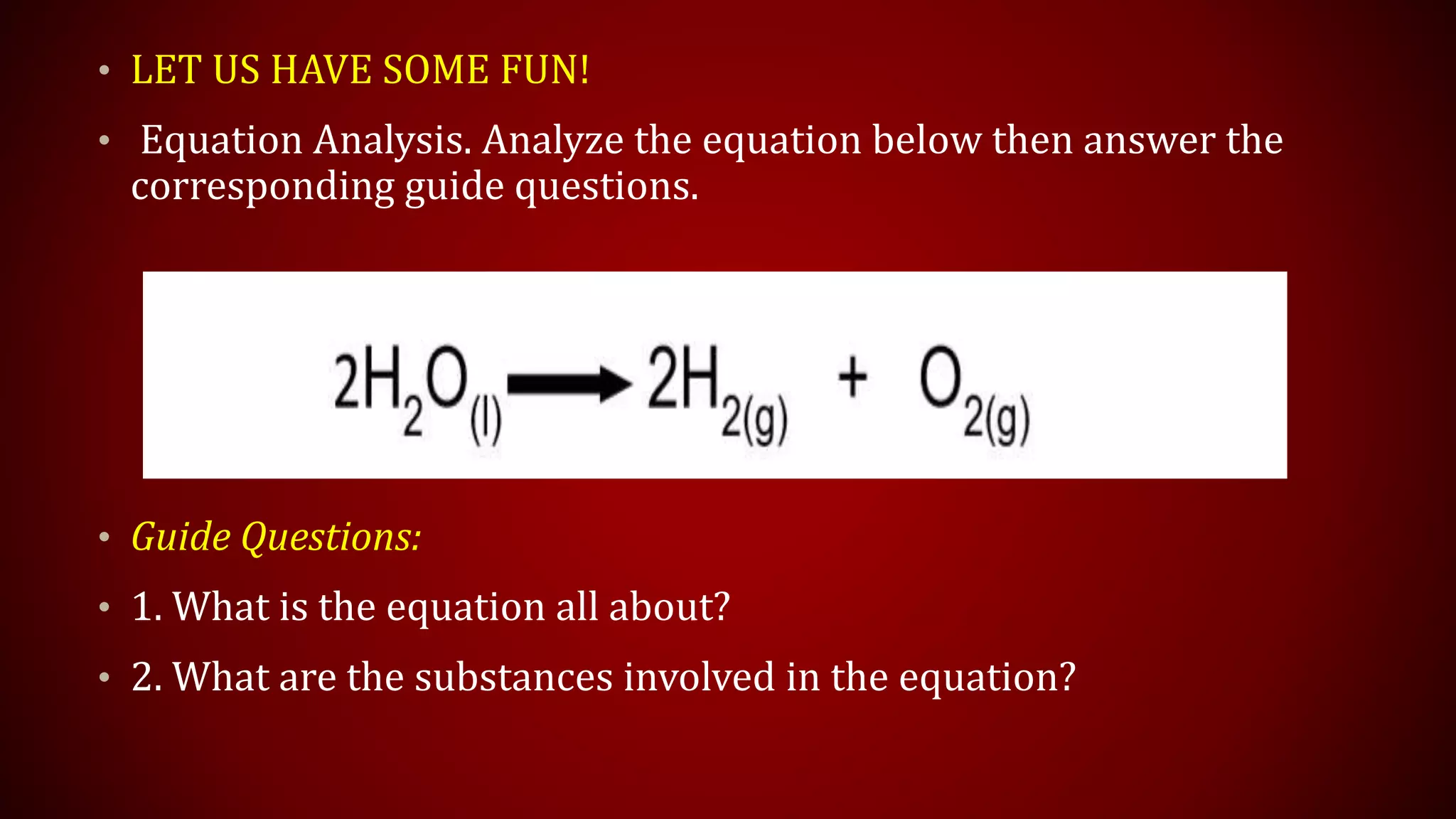
• LET US HAVE SOME FUN!
• Equation Analysis. Analyze the equation below then answer the
corresponding guide questions.
• Guide Questions:
• 1. What is the equation all about?
• 2. What are the substances involved in the equation?
• VOCABULARY WORD
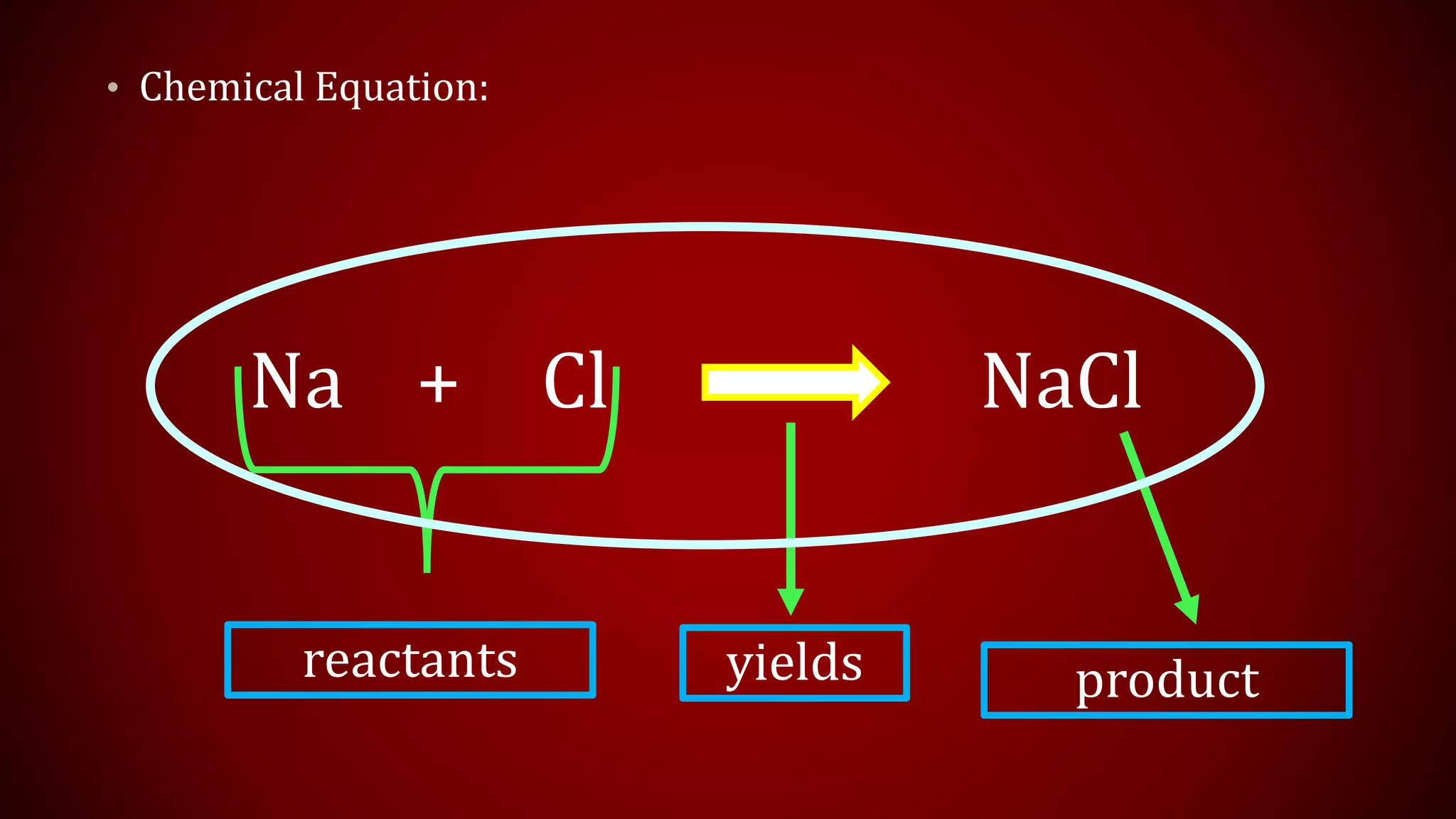
• 1. Reactants Substances involved before a chemical reaction
• 2. Product Substance produced after a chemical reaction.
Na Cl
+ NaCl
reactants product
yields
What Is Chemical Reaction And Chemical Equation?
• Chemical Reaction, Word Equation and Chemical
Equation
• Chemical Reaction is a process in which one or more
substances are changed into new substance with different
physical and chemical properties.
• Chemical Equation is the shorthand for describing the course
of chemical reaction wherein the reactants are always written
before the reaction or on the right side of the equation while
the product is on the left side of the equation.
• A word Equation describes a chemical change using the
names of the reactants and products.
• Chemical Equation:
Na Cl
+ NaCl
reactants product
yields
Types Of Chemical Reactions
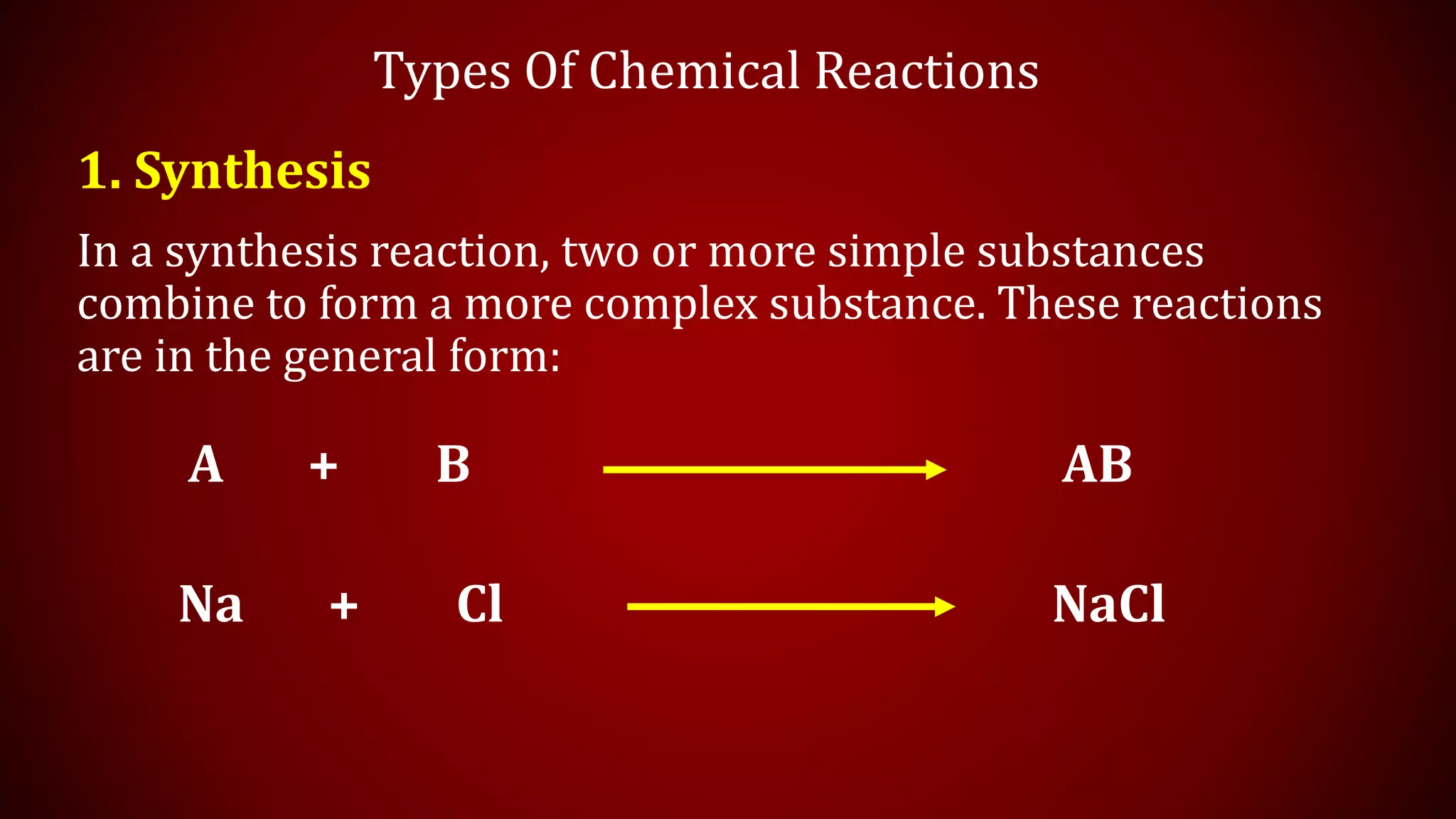
1. Synthesis
In a synthesis reaction, two or more simple substances
combine to form a more complex substance. These reactions
are in the general form:
A + B AB
Na + Cl NaCl
Types Of Chemical Reactions
2. Decomposition
A decomposition reaction is when a more complex
substance breaks down into its more simple parts. It is thus
the opposite of a synthesis reaction, and can be written as;
AB A + B
NaCl Na + Cl
Types Of Chemical Reactions
3. Single replacement
In a single replacement reaction, a single uncombined
element replaces another in a compound; in other words,
one element trades places with another element in a
compound. These reactions come in the general form of:
A + BC A C + B
Mg + 2H O Mg(OH) + H
2 2 2
Types Of Chemical Reactions
4. Double replacement
In a double replacement reaction, the anions and cations of
two compounds switch places and form two entirely
different compounds.[18] These reactions are in the general
form
AB + CD AD + CB
Pb(NO ) + 2KI PbI + 2KNO
3 2 3
2
Types Of Chemical Reactions
4. Double replacement
Explanation:
Pb + NO +
Pb + NO
Pb NO or Pb NO
Pb(NO ) + 2KI PbI + 2KNO
3 2 3
2
3
+2
3
-1
1 2
3 2 3
SUMMARY
• Synthesis
• Decomposition
• Single replacement
• Double replacement
A + B AB
AB A + B
A B + C AC + B
AB + CD AD + CB
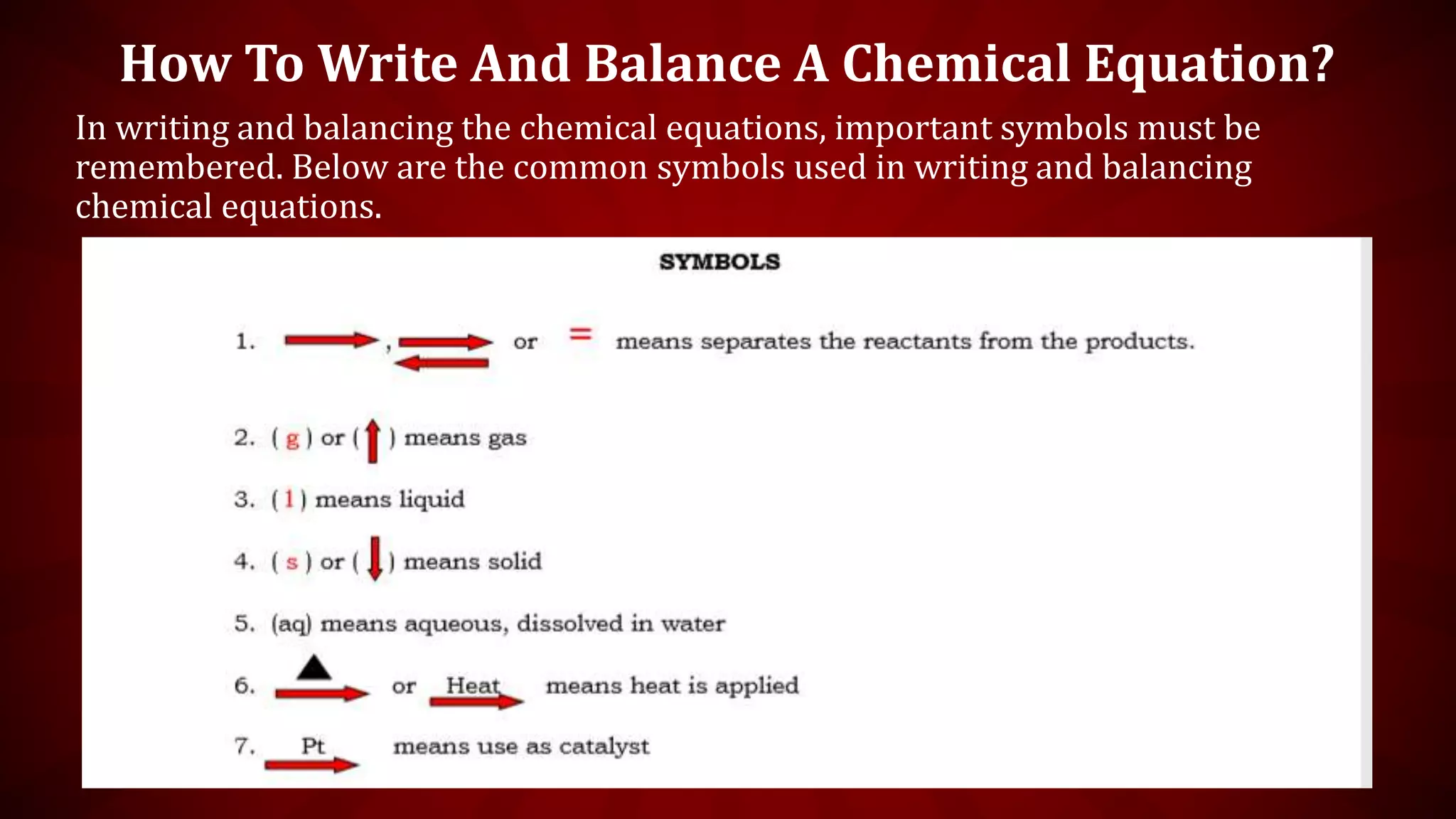
How To Write And Balance A Chemical Equation?
In writing and balancing the chemical equations, important symbols must be
remembered. Below are the common symbols used in writing and balancing
chemical equations.
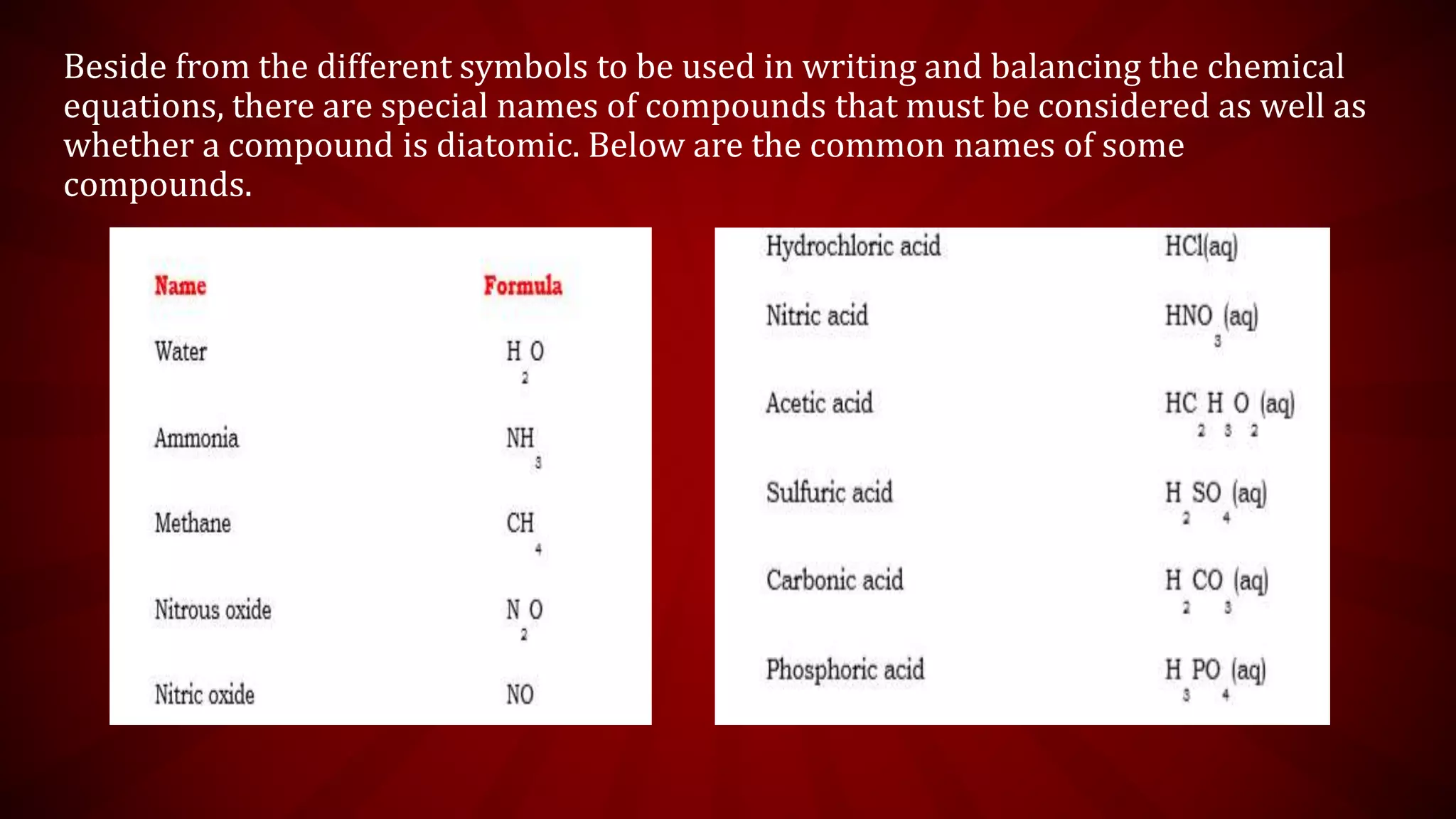
Beside from the different symbols to be used in writing and balancing the chemical
equations, there are special names of compounds that must be considered as well as
whether a compound is diatomic. Below are the common names of some
compounds.
Important steps in solving the formula mass of a compound
In writing and balancing the chemical equations, do the
following steps below. We will use the sample problem as
an example.
Nitrogen gas reacts to Hydrogen gas to produce
Ammonia.
What Is Chemical Reaction And Chemical Equation?
• Step 1. Convert the given problem into a word equation.
• Nitrogen gas + Hydrogen gas Ammonia
•
• Step 2. Convert the word equation into a chemical
equation.
N + H NH
2(g) 2(g) 3(g)
• Step 3. Balance the given chemical equation written in the
step 2 by adding coefficient after the chemical symbol or
chemical formula.
Count the number of atoms:
Reactant Element Product
2 N 1
2 H 3
N + H NH
2(g) 2(g) 3(g)
2
3
6
2
2
3 6
2
= =
=
• Step 3. Balance the given chemical equation written in the
step 2 by adding coefficient after the chemical symbol or
chemical formula.
Count the number of atoms:
Reactant Element Product
2 N 1 (2) = 2
6=(3) 2 H 3 (2) = 6
N + 3H 2NH
2(g) 2(g) 3(g)
Life is like a chemical
equation, if you are able to
balance this equation then
you will never have any
problem and your life will
become easy……
Every chemical reaction has a
transition state.
Derek Barton
Thank you for
listening..
God Bless!
Example:
ADD A SLIDE TITLE -
4
ADD A SLIDE TITLE - 5
ADD A SLIDE TITLE -
6

chemical EQUATIONS.pptx

  • 1.
  • 2.
    • LET USHAVE SOME FUN! • Equation Analysis. Analyze the equation below then answer the corresponding guide questions. • Guide Questions: • 1. What is the equation all about? • 2. What are the substances involved in the equation?
  • 3.
    • VOCABULARY WORD •1. Reactants Substances involved before a chemical reaction • 2. Product Substance produced after a chemical reaction. Na Cl + NaCl reactants product yields
  • 4.
    What Is ChemicalReaction And Chemical Equation? • Chemical Reaction, Word Equation and Chemical Equation • Chemical Reaction is a process in which one or more substances are changed into new substance with different physical and chemical properties. • Chemical Equation is the shorthand for describing the course of chemical reaction wherein the reactants are always written before the reaction or on the right side of the equation while the product is on the left side of the equation. • A word Equation describes a chemical change using the names of the reactants and products.
  • 5.
    • Chemical Equation: NaCl + NaCl reactants product yields
  • 6.
    Types Of ChemicalReactions 1. Synthesis In a synthesis reaction, two or more simple substances combine to form a more complex substance. These reactions are in the general form: A + B AB Na + Cl NaCl
  • 7.
    Types Of ChemicalReactions 2. Decomposition A decomposition reaction is when a more complex substance breaks down into its more simple parts. It is thus the opposite of a synthesis reaction, and can be written as; AB A + B NaCl Na + Cl
  • 8.
    Types Of ChemicalReactions 3. Single replacement In a single replacement reaction, a single uncombined element replaces another in a compound; in other words, one element trades places with another element in a compound. These reactions come in the general form of: A + BC A C + B Mg + 2H O Mg(OH) + H 2 2 2
  • 9.
    Types Of ChemicalReactions 4. Double replacement In a double replacement reaction, the anions and cations of two compounds switch places and form two entirely different compounds.[18] These reactions are in the general form AB + CD AD + CB Pb(NO ) + 2KI PbI + 2KNO 3 2 3 2
  • 10.
    Types Of ChemicalReactions 4. Double replacement Explanation: Pb + NO + Pb + NO Pb NO or Pb NO Pb(NO ) + 2KI PbI + 2KNO 3 2 3 2 3 +2 3 -1 1 2 3 2 3
  • 11.
    SUMMARY • Synthesis • Decomposition •Single replacement • Double replacement A + B AB AB A + B A B + C AC + B AB + CD AD + CB
  • 12.
    How To WriteAnd Balance A Chemical Equation? In writing and balancing the chemical equations, important symbols must be remembered. Below are the common symbols used in writing and balancing chemical equations.
  • 13.
    Beside from thedifferent symbols to be used in writing and balancing the chemical equations, there are special names of compounds that must be considered as well as whether a compound is diatomic. Below are the common names of some compounds.
  • 14.
    Important steps insolving the formula mass of a compound In writing and balancing the chemical equations, do the following steps below. We will use the sample problem as an example. Nitrogen gas reacts to Hydrogen gas to produce Ammonia.
  • 15.
    What Is ChemicalReaction And Chemical Equation? • Step 1. Convert the given problem into a word equation. • Nitrogen gas + Hydrogen gas Ammonia • • Step 2. Convert the word equation into a chemical equation. N + H NH 2(g) 2(g) 3(g)
  • 16.
    • Step 3.Balance the given chemical equation written in the step 2 by adding coefficient after the chemical symbol or chemical formula. Count the number of atoms: Reactant Element Product 2 N 1 2 H 3 N + H NH 2(g) 2(g) 3(g) 2 3 6 2 2 3 6 2 = = =
  • 17.
    • Step 3.Balance the given chemical equation written in the step 2 by adding coefficient after the chemical symbol or chemical formula. Count the number of atoms: Reactant Element Product 2 N 1 (2) = 2 6=(3) 2 H 3 (2) = 6 N + 3H 2NH 2(g) 2(g) 3(g)
  • 18.
    Life is likea chemical equation, if you are able to balance this equation then you will never have any problem and your life will become easy……
  • 19.
    Every chemical reactionhas a transition state. Derek Barton
  • 20.
  • 21.
  • 25.
    ADD A SLIDETITLE - 4
  • 26.
    ADD A SLIDETITLE - 5
  • 27.
    ADD A SLIDETITLE - 6