UNIT 4
CHEMICAL BONDING
AND MOLECULAR
STRUCTURE
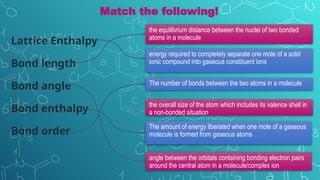
Match the following!
Lattice Enthalpy
Bond length
Bond angle
Bond enthalpy
Bond order
energy required to completely separate one mole of a solid
ionic compound into gaseous constituent ions
The number of bonds between the two atoms in a molecule
the overall size of the atom which includes its valence shell in
a non-bonded situation
The amount of energy liberated when one mole of a gaseous
molecule is formed from gaseous atoms
angle between the orbitals containing bonding electron pairs
around the central atom in a molecule/complex ion
the equilibrium distance between the nuclei of two bonded
atoms in a molecule
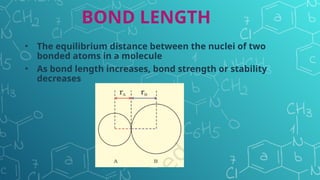
BOND LENGTH
• The equilibrium distance between the nuclei of two
bonded atoms in a molecule
• As bond length increases, bond strength or stability
decreases
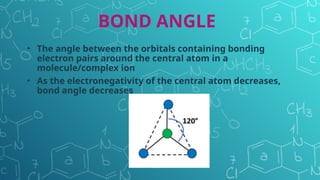
BOND ANGLE
• The angle between the orbitals containing bonding
electron pairs around the central atom in a
molecule/complex ion
• As the electronegativity of the central atom decreases,
bond angle decreases
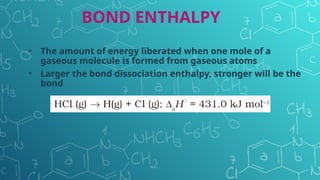
BOND ENTHALPY
• The amount of energy liberated when one mole of a
gaseous molecule is formed from gaseous atoms
• Larger the bond dissociation enthalpy, stronger will be the
bond
BOND ORDER
• The number of bonds between the two atoms in a molecule
• With increase in bond order, bond strength increases
• Isoelectronic molecules and ions have identical bond orders;
N2, CO and NO+ have bond order 3
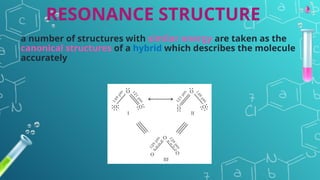
RESONANCE STRUCTURE
a number of structures with similar energy are taken as the
canonical structures of a hybrid which describes the molecule
accurately
• Resonance stabilizes the molecule as
the energy of the resonance hybrid is
less than the energy of any single
canonical structure
• Resonance averages the bond
characteristics as a whole
• The molecule as such has a single
structure which is the resonance
hybrid of the canonical forms
POLARITY OF BONDS
In reality no bond or a compound is either completely covalent or ionic!!
When covalent bond is formed between two similar atoms, the
shared pair of electrons is equally attracted by the two atoms:
nonpolar covalent bond
In case of a hetero-nuclear molecule like HF, the shared electron
pair between the two atoms gets displaced more towards fluorine.
The resultant covalent bond is a polar covalent bond
As a result of polarisation, the molecule possesses the dipole
moment (the product of the magnitude of the charge and the
distance between the centres of positive and negative charge) (µ)
Salient features
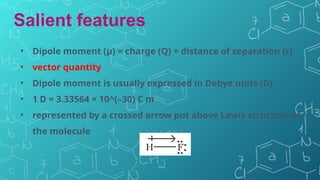
• Dipole moment (µ) = charge (Q) × distance of separation (r)
• vector quantity
• Dipole moment is usually expressed in Debye units (D)
• 1 D = 3.33564 × 10^(–30) C m
• represented by a crossed arrow put above Lewis structure of
the molecule
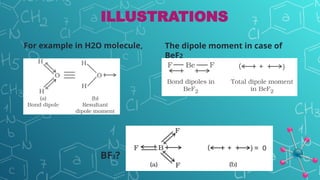
ILLUSTRATIONS
For example in H2O molecule, The dipole moment in case of
BeF2
BF3?
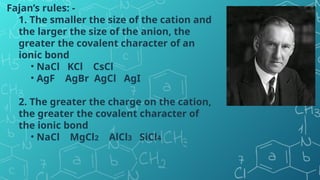
Fajan’s rules: -
1. The smaller the size of the cation and
the larger the size of the anion, the
greater the covalent character of an
ionic bond
• NaCl KCl CsCl
• AgF AgBr AgCl AgI
2. The greater the charge on the cation,
the greater the covalent character of
the ionic bond
• NaCl MgCl2 AlCl3 SiCl4
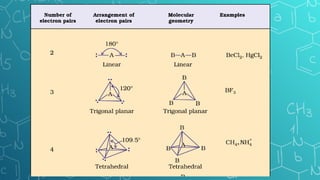
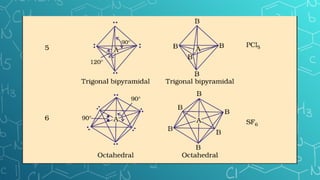
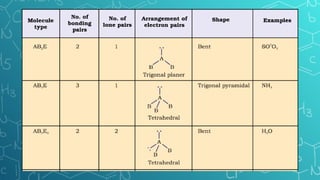
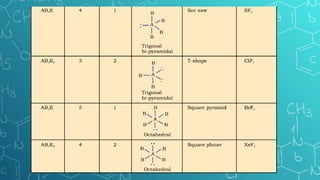
Valence Shell Electron Pair Repulsion
(VSEPR)Theory
• Sidgwick and Powell, 1940
• based on the repulsive interactions of the electron pairs in the
valence shell of the atoms
• The shape of a molecule depends upon the number of valence
shell electron pairs around the central atom
• Pairs of electrons in the valence shell repel one another. These
pairs of electrons tend to occupy such positions that minimize
repulsion and thus maximize distance between them.
• A multiple bond is treated a single super electron pair.
What can be the order of
repulsive interactions of the
electron pairs in the valence
shell of the atoms?
Which among the following have
zero dipole moment?
HCl, I2, CO2, H2S, CHCl3,
CCl4
Why is the dipole moment of NF3
less than NH3?
Chemical bonding, class XI, Bond parameters

Chemical bonding, class XI, Bond parameters

  • 1.
    UNIT 4 CHEMICAL BONDING ANDMOLECULAR STRUCTURE
  • 2.
    Match the following! LatticeEnthalpy Bond length Bond angle Bond enthalpy Bond order energy required to completely separate one mole of a solid ionic compound into gaseous constituent ions The number of bonds between the two atoms in a molecule the overall size of the atom which includes its valence shell in a non-bonded situation The amount of energy liberated when one mole of a gaseous molecule is formed from gaseous atoms angle between the orbitals containing bonding electron pairs around the central atom in a molecule/complex ion the equilibrium distance between the nuclei of two bonded atoms in a molecule
  • 3.
    BOND LENGTH • Theequilibrium distance between the nuclei of two bonded atoms in a molecule • As bond length increases, bond strength or stability decreases
  • 4.
    BOND ANGLE • Theangle between the orbitals containing bonding electron pairs around the central atom in a molecule/complex ion • As the electronegativity of the central atom decreases, bond angle decreases
  • 5.
    BOND ENTHALPY • Theamount of energy liberated when one mole of a gaseous molecule is formed from gaseous atoms • Larger the bond dissociation enthalpy, stronger will be the bond
  • 6.
    BOND ORDER • Thenumber of bonds between the two atoms in a molecule • With increase in bond order, bond strength increases • Isoelectronic molecules and ions have identical bond orders; N2, CO and NO+ have bond order 3
  • 7.
    RESONANCE STRUCTURE a numberof structures with similar energy are taken as the canonical structures of a hybrid which describes the molecule accurately
  • 8.
    • Resonance stabilizesthe molecule as the energy of the resonance hybrid is less than the energy of any single canonical structure • Resonance averages the bond characteristics as a whole • The molecule as such has a single structure which is the resonance hybrid of the canonical forms
  • 9.
    POLARITY OF BONDS Inreality no bond or a compound is either completely covalent or ionic!! When covalent bond is formed between two similar atoms, the shared pair of electrons is equally attracted by the two atoms: nonpolar covalent bond In case of a hetero-nuclear molecule like HF, the shared electron pair between the two atoms gets displaced more towards fluorine. The resultant covalent bond is a polar covalent bond As a result of polarisation, the molecule possesses the dipole moment (the product of the magnitude of the charge and the distance between the centres of positive and negative charge) (µ)
  • 10.
    Salient features • Dipolemoment (µ) = charge (Q) × distance of separation (r) • vector quantity • Dipole moment is usually expressed in Debye units (D) • 1 D = 3.33564 × 10^(–30) C m • represented by a crossed arrow put above Lewis structure of the molecule
  • 11.
    ILLUSTRATIONS For example inH2O molecule, The dipole moment in case of BeF2 BF3?
  • 12.
    Fajan’s rules: - 1.The smaller the size of the cation and the larger the size of the anion, the greater the covalent character of an ionic bond • NaCl KCl CsCl • AgF AgBr AgCl AgI 2. The greater the charge on the cation, the greater the covalent character of the ionic bond • NaCl MgCl2 AlCl3 SiCl4
  • 13.
    Valence Shell ElectronPair Repulsion (VSEPR)Theory • Sidgwick and Powell, 1940 • based on the repulsive interactions of the electron pairs in the valence shell of the atoms • The shape of a molecule depends upon the number of valence shell electron pairs around the central atom • Pairs of electrons in the valence shell repel one another. These pairs of electrons tend to occupy such positions that minimize repulsion and thus maximize distance between them. • A multiple bond is treated a single super electron pair.
  • 18.
    What can bethe order of repulsive interactions of the electron pairs in the valence shell of the atoms? Which among the following have zero dipole moment? HCl, I2, CO2, H2S, CHCl3, CCl4 Why is the dipole moment of NF3 less than NH3?