ChemE Car Stopping Mechanism:
Spring Pressure Stopping
System
UCSD 2015-16
Donovan Ly
Joanne Ly
Sean Riley
Shaocheng Hu
Alan Tam
Cheryl Chan
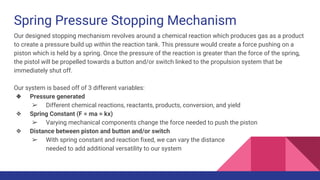
Spring Pressure Stopping Mechanism
Our designed stopping mechanism revolves around a chemical reaction which produces gas as a product
to create a pressure build up within the reaction tank. This pressure would create a force pushing on a
piston which is held by a spring. Once the pressure of the reaction is greater than the force of the spring,
the pistol will be propelled towards a button and/or switch linked to the propulsion system that be
immediately shut off.
Our system is based off of 3 different variables:
❖ Pressure generated
➢ Different chemical reactions, reactants, products, conversion, and yield
❖ Spring Constant (F = ma = kx)
➢ Varying mechanical components change the force needed to push the piston
❖ Distance between piston and button and/or switch
➢ With spring constant and reaction fixed, we can vary the distance
needed to add additional versatility to our system
Overview: Integration Within the Car
Visualization of Spring Mechanism
1. Diagram of how your system must be integrated within the car. For example, how it is hooked up electrically or mechanically
Types of Chemical Reactions
Since our design is based off of pressure, we chose the following reactions that produce gas as a product
for the pressure build up, along with taking into account material pricing and the NFPA safety rating of
each reactant and product
❖ Sulfuric Acid + Calcium Carbonate
CaCO3 (s) + H2SO4(aq) → CaSO4(aq) + H2O(l) + CO2 (g)
❖ Nitric Acid + Sodium Carbonate
2HNO3(aq)+Na2CO3(aq)→2NaNO3(aq)+CO2(g)+H2O(l)
❖ Hydrochloric Acid + Calcium Carbonate
2HCl(aq) + CaCO3(s) → CaCl2(aq) + H2CO3(aq) → CaCl2(aq) + CO2(g) + H2O(l)
❖ Acetic Acid + Sodium Bicarbonate
CH3COOH(aq) + NaHCO3(aq) → NaCH3COO(aq) + H2O(l) + CO2(g)
Sulfuric Acid & Calcium Carbonate Reaction
CaCO3 (s) + H2SO4(aq) → CaSO4(aq) + H2O(l) + CO2 (g)
❖ Procedure
1. Calcium carbonate is initially in the tank.
2. Sulfuric acid is added in by a syringe.
3. Optional: Shake tank to speed up the reaction.
❖ Reaction is rapid
➢ Saves pressure build-up time.
➢ Most likely will not have to shake the tank.
❖ Gas Produced
CO2
❖ Exothermic
Nitric Acid & Sodium Carbonate Reaction
2HNO3(aq)+Na2CO3(aq)→2NaNO3(aq)+CO2(g)+H2O(l)
❖ Procedure
1. Sodium carbonate is initially in the tank.
2. Nitric acid is added in by a syringe.
3. Optional: Shake tank to speed up the reaction.
❖ Gas Produced
CO2
❖ Reaction is rapid
➢ Saves pressure build-up time.
➢ Most likely will not have to shake tank.
Hydrochloric Acid & Calcium Carbonate Reaction
2 HCl(aq) + CaCO3(s) → CaCl2(aq) + H2CO3(aq) → CaCl2(aq) + CO2(g) + H2O(l)
❖ Procedure
1. Hydrochloric acid is initially in the tank.
2. Calcium carbonate is tipped in.
3. Optional: Shake tank to speed up the reaction.
❖ Reaction is rapid
➢ Saves pressure build-up time
❖ Gas Produced
CO2
❖ Temperature & Volume
As temperature increases, the rate of volume of gas produced increases.
❖ at 60℃, 1M HCl: 20sec: ~22mL; 40sec: ~36.5 mL; 1min: ~46.5 mL
➢ can control rate of gas produced with temperature
❖ Exothermic
Data from: http://www.123helpme.com/view.asp?id=122747
Acetic Acid & Sodium Bicarbonate Reaction
CH3COOH(aq) + NaHCO3(aq) → NaCH3COO(aq) + H2O(l) + CO2(g)
❖ Procedure
1. Sodium bicarbonate is initially in the tank.
2. Acetic acid is added in by a syringe.
3. Shake tank to speed up the reaction.
❖ Gas Produced
CO2
❖ Pressure & Temperature
Use Gassby’s data as a reference.
❖ Pro: Gassby is proof that the reaction is reliable.
❖ Con: Pressure build-up time takes too long.
❖ Endothermic
➢ poses less of a risk compared to an exothermic reaction
List of Chemicals and Cost
Materials NFPA Rating Price Seller
Sodium Nitrite 2,0,1 2 lb for $7.50 Duda Energy
Sulfamic Acid 2,1,0 1lb for $6.50 Amazon
Sulfuric Acid 3,0,2 950 mL for $12.95 Amazon
Calcium Carbonate 0,0,0 1lb for $8 Duda Energy
Acetic Acid 2,2,2 950 mL for $9.50 Walmart
Hydrochloric Acid 3,0,0 500 mL for $6 Amazon
Sodium Bicarbonate 1,0,1 1lb for $8.75 Duda Energy
Nitric Acid 3,0,0 1L for $51.95 Duda Energy
Total: $111.15
NaNO2
CaCO3
Na2CO3
Mechanical Components
Pneumatic Cylinder / (7/16 in., 0.1 lb, Bore, Single-Acting, Spring Return, Rear Pivot Mount)
Stroke Length (in.) Length (in.) Price Seller
0.5 2.64 $13.50 Automationdirect.com
1.0 3.63 $14.50 Automationdirect.com
1.5 4.57 $15.50 Automationdirect.com
2.0 5.51 $16.50 Automationdirect.com
Mount Style Bracket Nut Total Price Seller
Front Nose $2.50 $1.00 $3.50 Automationdirect.com
Rear Pivot $2.75 - $2.75 Automationdirect.com
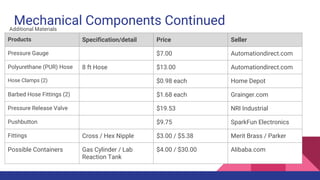
Mechanical Components ContinuedAdditional Materials
Products Specification/detail Price Seller
Pressure Gauge $7.00 Automationdirect.com
Polyurethane (PUR) Hose 8 ft Hose $13.00 Automationdirect.com
Hose Clamps (2) $0.98 each Home Depot
Barbed Hose Fittings (2) $1.68 each Grainger.com
Pressure Release Valve $19.53 NRI Industrial
Pushbutton $9.75 SparkFun Electronics
Fittings Cross / Hex Nipple $3.00 / $5.38 Merit Brass / Parker
Possible Containers Gas Cylinder / Lab
Reaction Tank
$4.00 / $30.00 Alibaba.com
Total Price of Mechanical Components
The price of the additional materials is approximately: $73.23 or $99.23
The total price will vary depending on the Pneumatic Cylinder we purchase and the reaction
container.
Additional Information about each product will be provided on a separate document due to
limited slide space.
$13.50 Cylinder $14.50 Cylinder $15.50 Cylinder $16.50 Cylinder
+ $73.23 or $99.23 + $73.23 or $99.23 + $73.23 or $99.23 + $73.23 or $99.23
Total: $86.73 - $112.73 Total: $87.73 - $113.73 Total: $88.73 - $114.73 Total: $89.73 - $115.73
Hazard Statements
CaCl2,CaSO4,CaCO3,NaCH3COO,CH3COOH,NaHCO3,Na2CO3: Causes serious eye irritation
CaSO4,HCI,NaNO3: May cause respiratory irritation
HCl,NaHSO4,H2SO4,CH3COOH,HNO3: May be corrosive to metals
HCl,NaHSO4,H2SO4,HNO3,NaNO3: Causes severe skin burns and eye damage
N2,CO2: Risk of explosion if heated under confinement
NaNO2: Toxic if swallowed
NaNO2,NaNO3: Very toxic to aquatic life
NaNO3: Harmful if swallowed
NaNO3: Suspected of causing genetic defects and cancer According to ChemWatch Review SDS
Safety Precautions Prevention
❖ Do not breathe dust/fume/gas/mist/vapours/spray
❖ Wear protective gloves/protective clothing/ eye protection/face protection
❖ Keep chemicals only in original container
❖ Wash hands and equipments thoroughly after handling
❖ Do not eat, drink or smoke when using chemicals
❖ Avoid release to the environment
❖ For hydrochloric acid, use only outdoors or in a well-ventilated area
❖ Chemicals are disposed properly based on their chemical properties and laboratory requirements
❖ Pressure gauge is used to monitor the pressure inside system
❖ Appropriately sized and set relief valve is used to prevent system from explosion
Safety Precautions Response
❖ If in eyes: Rinse cautiously with water for several times
❖ If eye irritation persists: get medical advice/attention
❖ If inhaled: Remove victim to fresh air and rest in a position comfortable for breathing
❖ If swallowed: Rinse mouth. Do not induce vomiting
❖ If on skin: Remove/Take off immediately all contaminated clothing. Rinse skin with water/shower
❖ Absorb spillage to prevent material damage
❖ Call a POISON CENTER or doctor/physician
Concerned regulation
❖ Maximum operating pressure should be no greater 90% of the MAWP
❖ Pressure greater than 500 psi is not allowed
❖ A pressure gauge that reads from 0 psig to 2 times the maximum operating pressure
❖ All components must be certified to operate at a pressure greater than the maximum operating
pressure
❖ No PVC, cPVC, PETE or PET vessels or piping used for pressurized gases are allowed.
❖ Appropriately sized relief valve is required for pressurized gas
❖ All chemicals are injected into the reactor vessels with syringes at the start of the line.
❖ Wash contaminated clothing before reuse
Proposed Research Plan
Nov. 7 – Nov. 12: Research
❖ Division of work split between each team member for independent research
➢ Safety procedures, rules, and regulations
➢ Budget
➢ Mechanical / electrical components
➢ Chemical reactions
➢ Diagram / animation for our design
End of Nov. – After system presentation: Trial and Error
❖ Purchase material to start testing of design
➢ Reaction tank
➢ Piston / spring
➢ Button / circuit switch
➢ Pressure release valve, gauge
➢ Tubing, chassis shell, etc.
Research Plan Cont.
Dec – Jan: Test different chemical reactions for specific pressure build up
❖ Vary concentrations of reactants
❖ Yield and conversion of different products
Jan - Feb:
Test different springs for different spring constants
❖ Determine amount of force necessary to move piston to button/switch
Test various distance lengths for pistol to travel in order to push button/switch
❖ Spring constant is fixed, cannot vary as much, but can vary the distance between pistol and button
❖ After deciding on a specific spring, can determine length needed for given reaction
Feb – March: Start building vessel under competition regulations, and fit design into chassis
❖ Test chassis stopping system with various other propulsion mechanisms for data
➢ Be able to be used with variety of propulsion mechanisms
➢ Account for new variables (ie. weight, momentum, friction, etc.)
Potential Issues and Troubleshooting
Potential Issues to Consider:
❖ Pressure build up can be really high and unsafe (>> 1psig); need pressure gauges to monitor the
pressure and a pressure regulator
❖ A steel container is required to withstand the pressure from gas build up; most glass containers can
only withstand less than 25psig
❖ Include a safety release valve in case the pressure goes 110% of the operating pressure in case the
regulator or piston fails
❖ Car will not go to a complete stop after switch is turned off -- we would have to work with the
propulsion team to determine the additional distance that the car will cover after the switch is
turned off
Additional Details
Recycle of data and equipment
❖ Gassby car used a similar design for propulsion system, which we can recycle old data and
equipment that is suitable for our design that will save us effort, time, and money
➢ Reactant amount and concentration
➢ Generated pressure
➢ Reaction tank, tubing, hardware, etc.
Versatility
❖ Our design system can be applied to a variety of different propulsion systems, not limited to only a
pressure system vessel
➢ button / switch can shut off circuits, turn off motors, cut off electrical currents, etc.
Thank You for Your Time
Questions?
References
Pneumatic Cylinders: Automationdirect.com

CHEM-E CAR FALL 2015 (Spring)

  • 1.
    ChemE Car StoppingMechanism: Spring Pressure Stopping System UCSD 2015-16 Donovan Ly Joanne Ly Sean Riley Shaocheng Hu Alan Tam Cheryl Chan
  • 2.
    Spring Pressure StoppingMechanism Our designed stopping mechanism revolves around a chemical reaction which produces gas as a product to create a pressure build up within the reaction tank. This pressure would create a force pushing on a piston which is held by a spring. Once the pressure of the reaction is greater than the force of the spring, the pistol will be propelled towards a button and/or switch linked to the propulsion system that be immediately shut off. Our system is based off of 3 different variables: ❖ Pressure generated ➢ Different chemical reactions, reactants, products, conversion, and yield ❖ Spring Constant (F = ma = kx) ➢ Varying mechanical components change the force needed to push the piston ❖ Distance between piston and button and/or switch ➢ With spring constant and reaction fixed, we can vary the distance needed to add additional versatility to our system
  • 3.
  • 4.
    Visualization of SpringMechanism 1. Diagram of how your system must be integrated within the car. For example, how it is hooked up electrically or mechanically
  • 5.
    Types of ChemicalReactions Since our design is based off of pressure, we chose the following reactions that produce gas as a product for the pressure build up, along with taking into account material pricing and the NFPA safety rating of each reactant and product ❖ Sulfuric Acid + Calcium Carbonate CaCO3 (s) + H2SO4(aq) → CaSO4(aq) + H2O(l) + CO2 (g) ❖ Nitric Acid + Sodium Carbonate 2HNO3(aq)+Na2CO3(aq)→2NaNO3(aq)+CO2(g)+H2O(l) ❖ Hydrochloric Acid + Calcium Carbonate 2HCl(aq) + CaCO3(s) → CaCl2(aq) + H2CO3(aq) → CaCl2(aq) + CO2(g) + H2O(l) ❖ Acetic Acid + Sodium Bicarbonate CH3COOH(aq) + NaHCO3(aq) → NaCH3COO(aq) + H2O(l) + CO2(g)
  • 6.
    Sulfuric Acid &Calcium Carbonate Reaction CaCO3 (s) + H2SO4(aq) → CaSO4(aq) + H2O(l) + CO2 (g) ❖ Procedure 1. Calcium carbonate is initially in the tank. 2. Sulfuric acid is added in by a syringe. 3. Optional: Shake tank to speed up the reaction. ❖ Reaction is rapid ➢ Saves pressure build-up time. ➢ Most likely will not have to shake the tank. ❖ Gas Produced CO2 ❖ Exothermic
  • 7.
    Nitric Acid &Sodium Carbonate Reaction 2HNO3(aq)+Na2CO3(aq)→2NaNO3(aq)+CO2(g)+H2O(l) ❖ Procedure 1. Sodium carbonate is initially in the tank. 2. Nitric acid is added in by a syringe. 3. Optional: Shake tank to speed up the reaction. ❖ Gas Produced CO2 ❖ Reaction is rapid ➢ Saves pressure build-up time. ➢ Most likely will not have to shake tank.
  • 8.
    Hydrochloric Acid &Calcium Carbonate Reaction 2 HCl(aq) + CaCO3(s) → CaCl2(aq) + H2CO3(aq) → CaCl2(aq) + CO2(g) + H2O(l) ❖ Procedure 1. Hydrochloric acid is initially in the tank. 2. Calcium carbonate is tipped in. 3. Optional: Shake tank to speed up the reaction. ❖ Reaction is rapid ➢ Saves pressure build-up time ❖ Gas Produced CO2 ❖ Temperature & Volume As temperature increases, the rate of volume of gas produced increases. ❖ at 60℃, 1M HCl: 20sec: ~22mL; 40sec: ~36.5 mL; 1min: ~46.5 mL ➢ can control rate of gas produced with temperature ❖ Exothermic Data from: http://www.123helpme.com/view.asp?id=122747
  • 9.
    Acetic Acid &Sodium Bicarbonate Reaction CH3COOH(aq) + NaHCO3(aq) → NaCH3COO(aq) + H2O(l) + CO2(g) ❖ Procedure 1. Sodium bicarbonate is initially in the tank. 2. Acetic acid is added in by a syringe. 3. Shake tank to speed up the reaction. ❖ Gas Produced CO2 ❖ Pressure & Temperature Use Gassby’s data as a reference. ❖ Pro: Gassby is proof that the reaction is reliable. ❖ Con: Pressure build-up time takes too long. ❖ Endothermic ➢ poses less of a risk compared to an exothermic reaction
  • 10.
    List of Chemicalsand Cost Materials NFPA Rating Price Seller Sodium Nitrite 2,0,1 2 lb for $7.50 Duda Energy Sulfamic Acid 2,1,0 1lb for $6.50 Amazon Sulfuric Acid 3,0,2 950 mL for $12.95 Amazon Calcium Carbonate 0,0,0 1lb for $8 Duda Energy Acetic Acid 2,2,2 950 mL for $9.50 Walmart Hydrochloric Acid 3,0,0 500 mL for $6 Amazon Sodium Bicarbonate 1,0,1 1lb for $8.75 Duda Energy Nitric Acid 3,0,0 1L for $51.95 Duda Energy Total: $111.15 NaNO2 CaCO3 Na2CO3
  • 11.
    Mechanical Components Pneumatic Cylinder/ (7/16 in., 0.1 lb, Bore, Single-Acting, Spring Return, Rear Pivot Mount) Stroke Length (in.) Length (in.) Price Seller 0.5 2.64 $13.50 Automationdirect.com 1.0 3.63 $14.50 Automationdirect.com 1.5 4.57 $15.50 Automationdirect.com 2.0 5.51 $16.50 Automationdirect.com Mount Style Bracket Nut Total Price Seller Front Nose $2.50 $1.00 $3.50 Automationdirect.com Rear Pivot $2.75 - $2.75 Automationdirect.com
  • 12.
    Mechanical Components ContinuedAdditionalMaterials Products Specification/detail Price Seller Pressure Gauge $7.00 Automationdirect.com Polyurethane (PUR) Hose 8 ft Hose $13.00 Automationdirect.com Hose Clamps (2) $0.98 each Home Depot Barbed Hose Fittings (2) $1.68 each Grainger.com Pressure Release Valve $19.53 NRI Industrial Pushbutton $9.75 SparkFun Electronics Fittings Cross / Hex Nipple $3.00 / $5.38 Merit Brass / Parker Possible Containers Gas Cylinder / Lab Reaction Tank $4.00 / $30.00 Alibaba.com
  • 13.
    Total Price ofMechanical Components The price of the additional materials is approximately: $73.23 or $99.23 The total price will vary depending on the Pneumatic Cylinder we purchase and the reaction container. Additional Information about each product will be provided on a separate document due to limited slide space. $13.50 Cylinder $14.50 Cylinder $15.50 Cylinder $16.50 Cylinder + $73.23 or $99.23 + $73.23 or $99.23 + $73.23 or $99.23 + $73.23 or $99.23 Total: $86.73 - $112.73 Total: $87.73 - $113.73 Total: $88.73 - $114.73 Total: $89.73 - $115.73
  • 14.
    Hazard Statements CaCl2,CaSO4,CaCO3,NaCH3COO,CH3COOH,NaHCO3,Na2CO3: Causesserious eye irritation CaSO4,HCI,NaNO3: May cause respiratory irritation HCl,NaHSO4,H2SO4,CH3COOH,HNO3: May be corrosive to metals HCl,NaHSO4,H2SO4,HNO3,NaNO3: Causes severe skin burns and eye damage N2,CO2: Risk of explosion if heated under confinement NaNO2: Toxic if swallowed NaNO2,NaNO3: Very toxic to aquatic life NaNO3: Harmful if swallowed NaNO3: Suspected of causing genetic defects and cancer According to ChemWatch Review SDS
  • 15.
    Safety Precautions Prevention ❖Do not breathe dust/fume/gas/mist/vapours/spray ❖ Wear protective gloves/protective clothing/ eye protection/face protection ❖ Keep chemicals only in original container ❖ Wash hands and equipments thoroughly after handling ❖ Do not eat, drink or smoke when using chemicals ❖ Avoid release to the environment ❖ For hydrochloric acid, use only outdoors or in a well-ventilated area ❖ Chemicals are disposed properly based on their chemical properties and laboratory requirements ❖ Pressure gauge is used to monitor the pressure inside system ❖ Appropriately sized and set relief valve is used to prevent system from explosion
  • 16.
    Safety Precautions Response ❖If in eyes: Rinse cautiously with water for several times ❖ If eye irritation persists: get medical advice/attention ❖ If inhaled: Remove victim to fresh air and rest in a position comfortable for breathing ❖ If swallowed: Rinse mouth. Do not induce vomiting ❖ If on skin: Remove/Take off immediately all contaminated clothing. Rinse skin with water/shower ❖ Absorb spillage to prevent material damage ❖ Call a POISON CENTER or doctor/physician
  • 17.
    Concerned regulation ❖ Maximumoperating pressure should be no greater 90% of the MAWP ❖ Pressure greater than 500 psi is not allowed ❖ A pressure gauge that reads from 0 psig to 2 times the maximum operating pressure ❖ All components must be certified to operate at a pressure greater than the maximum operating pressure ❖ No PVC, cPVC, PETE or PET vessels or piping used for pressurized gases are allowed. ❖ Appropriately sized relief valve is required for pressurized gas ❖ All chemicals are injected into the reactor vessels with syringes at the start of the line. ❖ Wash contaminated clothing before reuse
  • 18.
    Proposed Research Plan Nov.7 – Nov. 12: Research ❖ Division of work split between each team member for independent research ➢ Safety procedures, rules, and regulations ➢ Budget ➢ Mechanical / electrical components ➢ Chemical reactions ➢ Diagram / animation for our design End of Nov. – After system presentation: Trial and Error ❖ Purchase material to start testing of design ➢ Reaction tank ➢ Piston / spring ➢ Button / circuit switch ➢ Pressure release valve, gauge ➢ Tubing, chassis shell, etc.
  • 19.
    Research Plan Cont. Dec– Jan: Test different chemical reactions for specific pressure build up ❖ Vary concentrations of reactants ❖ Yield and conversion of different products Jan - Feb: Test different springs for different spring constants ❖ Determine amount of force necessary to move piston to button/switch Test various distance lengths for pistol to travel in order to push button/switch ❖ Spring constant is fixed, cannot vary as much, but can vary the distance between pistol and button ❖ After deciding on a specific spring, can determine length needed for given reaction Feb – March: Start building vessel under competition regulations, and fit design into chassis ❖ Test chassis stopping system with various other propulsion mechanisms for data ➢ Be able to be used with variety of propulsion mechanisms ➢ Account for new variables (ie. weight, momentum, friction, etc.)
  • 20.
    Potential Issues andTroubleshooting Potential Issues to Consider: ❖ Pressure build up can be really high and unsafe (>> 1psig); need pressure gauges to monitor the pressure and a pressure regulator ❖ A steel container is required to withstand the pressure from gas build up; most glass containers can only withstand less than 25psig ❖ Include a safety release valve in case the pressure goes 110% of the operating pressure in case the regulator or piston fails ❖ Car will not go to a complete stop after switch is turned off -- we would have to work with the propulsion team to determine the additional distance that the car will cover after the switch is turned off
  • 21.
    Additional Details Recycle ofdata and equipment ❖ Gassby car used a similar design for propulsion system, which we can recycle old data and equipment that is suitable for our design that will save us effort, time, and money ➢ Reactant amount and concentration ➢ Generated pressure ➢ Reaction tank, tubing, hardware, etc. Versatility ❖ Our design system can be applied to a variety of different propulsion systems, not limited to only a pressure system vessel ➢ button / switch can shut off circuits, turn off motors, cut off electrical currents, etc.
  • 22.
    Thank You forYour Time Questions?
  • 23.