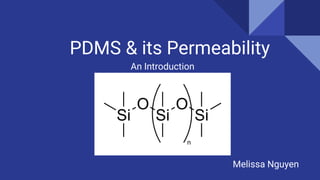
PDMS & its Permeability
Melissa Nguyen
An Introduction
PDMS
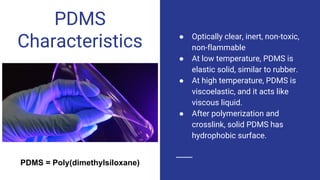
Characteristics ● Optically clear, inert, non-toxic,
non-flammable
● At low temperature, PDMS is
elastic solid, similar to rubber.
● At high temperature, PDMS is
viscoelastic, and it acts like
viscous liquid.
● After polymerization and
crosslink, solid PDMS has
hydrophobic surface.
PDMS = Poly(dimethylsiloxane)
PDMS
Applications
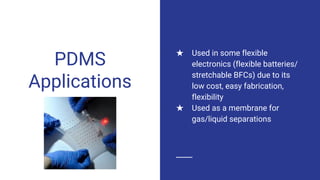
★ Used in some flexible
electronics (flexible batteries/
stretchable BFCs) due to its
low cost, easy fabrication,
flexibility
★ Used as a membrane for
gas/liquid separations
Permeability
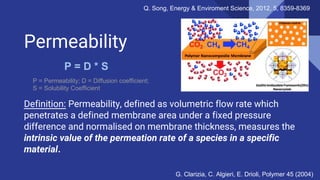
Definition: Permeability, defined as volumetric flow rate which
penetrates a defined membrane area under a fixed pressure
difference and normalised on membrane thickness, measures the
intrinsic value of the permeation rate of a species in a specific
material.
Q. Song, Energy & Enviroment Science, 2012, 5, 8359-8369
P = D * S
P = Permeability; D = Diffusion coefficient;
S = Solubility Coefficient
G. Clarizia, C. Algieri, E. Drioli, Polymer 45 (2004)
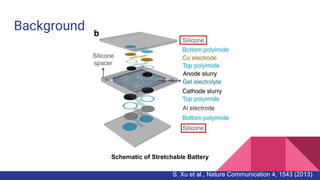
Background
S. Xu et al., Nature Communication 4, 1543 (2013)
Schematic of Stretchable Battery
Water and Gas Permeability of the device
● PDMS is porous
● 0.1-0.2 g/ day - significant
Nature Communication, 5779, S1
Supplementary Figure: Water and Gas Permeability of the device
Organic Solvents Permeability
● Loss of gel electrolyte (dimethyl carbonate and ethylene carbonate)
● Organic solvents evaporate much faster.
Nature Communication, 5779, S1
DMC - most volatile organic compounds Ethylene carbonate
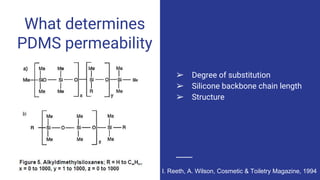
What determines
PDMS permeability
➢ Degree of substitution
➢ Silicone backbone chain length
➢ Structure
I. Reeth, A. Wilson, Cosmetic & Toiletry Magazine, 1994
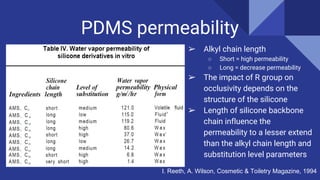
PDMS permeability
➢ Alkyl chain length
○ Short = high permeability
○ Long = decrease permeability
➢ The impact of R group on
occlusivity depends on the
structure of the silicone
➢ Length of silicone backbone
chain influence the
permeability to a lesser extend
than the alkyl chain length and
substitution level parameters
I. Reeth, A. Wilson, Cosmetic & Toiletry Magazine, 1994
Conclusion & Further Research Direction
➢ A decrease in permeability means an increase in occlusivity.
➢ The permeability of PDMS can be modified by reacting hydrocarbons of
different chain length onto the siloxane backbone.
➔ Figure out the reaction mechanisms to add more hydrocarbon chain length
Challenge: Most research papers focus on how to improve permeability (meaning
increasing permeability).
I. Reeth, A. Wilson, Cosmetic & Toiletry Magazine, 1994
Comments & Questions?

092915 PDMS Permeability

  • 1.
    PDMS & itsPermeability Melissa Nguyen An Introduction
  • 2.
    PDMS Characteristics ● Opticallyclear, inert, non-toxic, non-flammable ● At low temperature, PDMS is elastic solid, similar to rubber. ● At high temperature, PDMS is viscoelastic, and it acts like viscous liquid. ● After polymerization and crosslink, solid PDMS has hydrophobic surface. PDMS = Poly(dimethylsiloxane)
  • 3.
    PDMS Applications ★ Used insome flexible electronics (flexible batteries/ stretchable BFCs) due to its low cost, easy fabrication, flexibility ★ Used as a membrane for gas/liquid separations
  • 4.
    Permeability Definition: Permeability, definedas volumetric flow rate which penetrates a defined membrane area under a fixed pressure difference and normalised on membrane thickness, measures the intrinsic value of the permeation rate of a species in a specific material. Q. Song, Energy & Enviroment Science, 2012, 5, 8359-8369 P = D * S P = Permeability; D = Diffusion coefficient; S = Solubility Coefficient G. Clarizia, C. Algieri, E. Drioli, Polymer 45 (2004)
  • 5.
    Background S. Xu etal., Nature Communication 4, 1543 (2013) Schematic of Stretchable Battery
  • 6.
    Water and GasPermeability of the device ● PDMS is porous ● 0.1-0.2 g/ day - significant Nature Communication, 5779, S1 Supplementary Figure: Water and Gas Permeability of the device
  • 7.
    Organic Solvents Permeability ●Loss of gel electrolyte (dimethyl carbonate and ethylene carbonate) ● Organic solvents evaporate much faster. Nature Communication, 5779, S1 DMC - most volatile organic compounds Ethylene carbonate
  • 8.
    What determines PDMS permeability ➢Degree of substitution ➢ Silicone backbone chain length ➢ Structure I. Reeth, A. Wilson, Cosmetic & Toiletry Magazine, 1994
  • 9.
    PDMS permeability ➢ Alkylchain length ○ Short = high permeability ○ Long = decrease permeability ➢ The impact of R group on occlusivity depends on the structure of the silicone ➢ Length of silicone backbone chain influence the permeability to a lesser extend than the alkyl chain length and substitution level parameters I. Reeth, A. Wilson, Cosmetic & Toiletry Magazine, 1994
  • 10.
    Conclusion & FurtherResearch Direction ➢ A decrease in permeability means an increase in occlusivity. ➢ The permeability of PDMS can be modified by reacting hydrocarbons of different chain length onto the siloxane backbone. ➔ Figure out the reaction mechanisms to add more hydrocarbon chain length Challenge: Most research papers focus on how to improve permeability (meaning increasing permeability). I. Reeth, A. Wilson, Cosmetic & Toiletry Magazine, 1994
  • 11.