Flow chemistry: A useful
method for performing
hazardous chemistry in a
safer manner
László Kocsis
laszlo.kocsis@thalesnano.com
What is flow chemistry?
• Performing a reaction continuously, typically on small scale,
through either a coil or fixed bed reactor.

OR

Pump

Reactor

Collection
Where is flow chemistry applied best?
Exothermic Reactions
•Very good temperature control
•Accurate residence time control
•Efficient mixing
•Efficient mixing
•Less chance for thermal run-away
•Higher productivity per volume
•High selectivity
•High selectivity

Endothermic Reactions

Reactions with gases

Scale up
Scale up

•Accurate gas flow regulation
•Increased safety
•Increased safety
•Easy catalyst recycling
•High selectivity
•High selectivity
•Higher productivity per volume

•Increased safety
•Increased safety
•Higher productivity per volume
•Selectivity
•Selectivity
•Reproducibility
•Reproducibility

•Control over T, and residence time
•Control over T, ppand residence time
•High selectivity
•High selectivity
•Accessing new chemistry
•Higher productivity per volume
•High atom efficiency
Miniaturization: Enhanced temperature control
Large surface/volume rate
•

Microreactors have higher surface-to-volume ratio than macroreactors, heat
transfer occurs rapidly in a flow microreactor, enabling precise temperature
control.

Yoshida, Green and Sustainable Chemical Synthesis Using Flow
Microreactors, ChemSusChem, 2010
Heating Control
Batch

Flow

- Larger solvent volume.
- Lower temperature control.

- Lower reaction volume.
- Closer and uniform temperature control

Outcome:

Outcome:

-More difficult reaction control.
- Higher possibility of exotherm.

- Safer chemistry.
- Lower possibility of exotherm.
Heating Control
Lithium Bromide Exchange
Batch

Flow

• Batch experiment shows temperature increase of 40°C.
• Flow shows little increase in temperature.
Ref: Thomas Schwalbe and Gregor Wille, CPC Systems
Industry perception

Why move to flow?
Small scale:
 Making processes safer
 Accessing new chemistry
 Speed in synthesis and
analysis
 Automation

Large scale:
 Making processes safer
 Reproducibility-less batch
to batch variation
 Selectivity
What is the issue with chemical space?

500

Temperature / °C

400

Unexploited
chemistry space

300
200
100

At ThalesNano

0
100

-100

Region covered in a
conventional
laboratory

pressure / bar 200

300
Who we are, what we do?

• ThalesNano makes laboratory reactors that chemists use to
create new drugs, new aromas, new chemicals, or new
processes.
• We push the boundaries of science by giving chemists the
tools to access novel chemistry at high temperatures and
pressures safely and rapidly.
• We also make existing processes safer and more efficient.
Strategy

• Strategy: Solve chemical problems using
flow





Dangerous exothermic reactions
High temperature and pressure reactions
Reactions with gases
Highly selective reactions
Hydrogenation
• Current hydrogenation processes have many
disadvantages:








Need hydrogen cylinder-tough safety regulations
Separate laboratory needed!
Time consuming and difficult to set up
Catalyst addition and filtration is hazardous
Parr has low temperature, low pressure capability
Analytical sample obtained through invasive means.
Mixing of 3 phases inefficient - poor reaction rates
Hydrogen generator cell
 Solid Polymer Electrolyte

High-pressure regulating
valves

Water separator, flow
detector, bubble detector
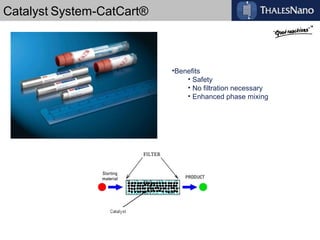
Catalyst System-CatCart®

•Benefits
• Safety
• No filtration necessary
• Enhanced phase mixing
H-Cube Pro Overview

O2N

H2N

N
H

N
H

H

•
•
•
•

HPLC pumps continuous stream of solvent
Hydrogen generated from water electrolysis
Sample heated and passed through catalyst
Up to 150°C and 100 bar. (1 bar=14.5 psi)
Decomposition of High-Energy Materials
OH
O2 N

OH

OH

NO2
9 eqv. H 2
cat

H2N

NO 2

NH2

H2 N

NH2

NH 2

Molecular Weight: 229,10

NH 2

Molecular Weight: 145,20 Molecular Weight: 139,16

Flow rate
(ml/min)
0.5

Pressure
(bar)
100 (∆p: 1)

Temperature
(oC)
100

Catalyst

Result

5% Rh/C

The starting material fully decomposed, the main
product is the desired one. MW is 145g/mol

0.5

100 (∆p: 1)

100

RaNi

The starting material fully decomposed, the main
product is the selective nitro reduced benzene
derivative. MW is 139g/mol

0.5

100 (∆p: 1)

100

10% Pd/C

The starting material fully decomposed, the main
product is the selective nitro reduced benzene
derivative. MW is 139g/mol
Reactions with
toxic gases
Toxic gases
Carbon monoxide:

4
2

4

Explosive limits: 12.5 – 74.2%
Conc: 1600ppm, death within
2 hours
Ammonia:

1
3

0

IDLH (Immediately Dangerous to Life and Health) is 300 ppm (NIOSH)
Carbonylation leading to esters
O

Fibrecat 1001:
Pd content [mmol/g]: 0.47,
Load: mmol/catcart: 0.114.
Void volume: 0.62 ml

O

I

CO, DBU
Fibercat 1001
EtOH

O

Ethanolic solution: DBU: 1.1 eq., 4iodo-anisole: 1.0 ekv,
concentration: 0.1 M - 1.0 M

O

Concentration

Liquid
Temperature Gas flow Pressure Pressure Conversion Selectivity
flow rate
(oC)
rate
(bar)
drop
(%)
(%)
(mL/min)
(ml/min)
(bar)

0.1 M
0.1 M
0.1 M
1M
1M

0.5
0.5
0.5
0.5
1

150
150
150
150
150

10
10
50
100
100

10
30
10
30
30

2
3
3
2
2

>99
>99
>99
>99
98.3

>99
>99
>99
>99
>99

Microwave reference from Nicholas Leadbeater’s lab (Org.Biomol.Chem. 2007, 65):
Concentration: 0.1M, Pressure: 10 bar, Temperature: 125oC, Reaction time: 30 min
Conversion: 90%
Flow reference from Nicholas Leadbeater’s lab (Org.Biomol.Chem. 2011, 6575):
Concentration: 1M, Pressure: 17 bar, Temperature: 120oC Residence time: 120 min
Conversion: 98%
Paal-Knorr pyrole synthesis
O

NH3

MeOH
40-110 oC

O
T /oC Conversion (%)
40
100
110
100

N
H

Phoenix with 4 ml loop
60bar, 0.5 ml/min 0.1M hexanedione, 0.5
ml/min NH3 (4 min residence time)

Batch reference (Chem.Ber. 1885, 367):
Temperature: 150oC, Reaction time: 120 min
Flow reference from Steve Ley’s lab (Org.Biomol.Chem. 2012, 5774):
Pressure: 0.1M solution, Pressure: 3.5 bar, Temperature: 0oC for dissolving
ammonia, than 110oC
Residence time: 10 min on 0oC than 110 min on 110oC
Conversion: 100%
Low Temperature
Chemistry
Set-up of the Ice Cube Modular System
Ozone Module:
generates O3 from O2 100 mL/min, 10 % O3.

Reactor Module:
2 Stage reactor. -70°C-+80°C.
Teflon tubing.

Pump Module – 2 Rotary Piston Pumps.
Excellent chemical compatibility.
Versatile: 2 options

A

C

B
-70-+80ºC
Reactor

Pre-cooler/Mixer

C
A
B

D
-70-+80ºC

-30-+80ºC

Potential Apps: Azide, Lithiation, ozonolysis, nitration, swern oxidation
Exothermic Reactions
Ozonolysis
Diazotization

Nitration

Lithiation

Swern oxidation

?

Halogenation

Azide
What is ozonolysis?
• Ozonolysis is a technique that cleaves double and
• triple C-C bonds to form a C-O bond.
R

O
H

R1

R2

R3

R4

O3

R1 O O R2
R3

R

O
R4
Ozonide

O
OH

R

• Market segments:
• Pharmaceutical, Fine chemicals, Agrochemicals
• Any organic chemistry synthesis segment.

OH
Ozonolysis in Industry
Synthesis of a Key intermediate for Indolizidine 215F

Biologically active natural product

Oxandrolone, anabolic steroid used to promote weight
gain following extensive surgery, chronic infection
S. Van Ornum et al, Chem. Rev.106, 2990-3001 (2006)
Why ozonolysis is neglected?
• Highly exothermic reaction, high risk of explosion
• Normally requires low temperature: -78°C.
• In addition, the batchwise accumulation of ozonide
is associated again with risk of explosion
• There are alternative oxidizing agents/systems:
• Sodium Periodate – Osmium Tetroxide (NaIO4-OsO4)
• Ru(VIII)O4 + NaIO4
• Jones oxidation (CrO3, H2SO4)
• Swern oxidation

• Most of the listed agents are toxic, difficult, and/or
expensive to use.
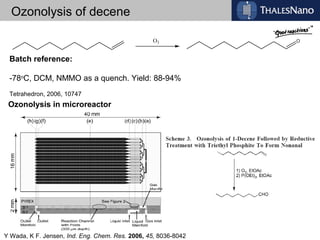
Ozonolysis of decene

Batch reference:
-78oC, DCM, NMMO as a quench. Yield: 88-94%
Tetrahedron, 2006, 10747

Ozonolysis in microreactor

Y Wada, K F. Jensen, Ind. Eng. Chem. Res. 2006, 45, 8036-8042
Ice-Cube set-up

Quench

Reactant
O-Cube™ – H-Cube® - ReactIR™
ozonolysis of decene

Ozonolysis

Quenching with
H-Cube®

React IR™

T = -30 ºC
T = -30 ºC to r.t.
CSM = 0.02 M (in EtOAc) p = 1 bar
Cat: 10 % Pd/C
O3 excess = 30 %

Ozonide eluted into cool vial under N2

ThalesNano lab based
chemistry-unpublished

O-Cube and ReactIR are trademarks of ThalesNano Inc. and Mettler Toledo
International Inc., respectively, H-Cube is registered trademark of ThalesNano Inc.
O-Cube – Ice Cube comparison

Conversion
(%)

Temperature
(oC)

97

-30

Equipment

Conc. (M)

Decene FR
(ml/min)

Ozone FR
(ml/min)

Quench FR
(ml/min)

O-Cube

0.02

1

20

0.2

Ice-Cube

0.05

Ice-Cube

0.1

Ice-Cube

0.2

81

Ice-Cube

0.5

24

Ice-Cube

0.2

1

Ice-Cube

0.2

1

100

Ice-Cube

0.1

1.5

100

Ice-Cube

0.1

3

58

Ice-Cube

0.1

5

26

100
95

1

100

0,2

100

-40

0

-20
Dialdehyde Formation
Reference

T=-78°C
40% conversion, T=-78°C
Org. Proc. Res. Dev. 2003, 7, 155-160

Chem. Rev. 2006, 106, 2990-3001

Our results

OH
O

EtOAc
O3, PPh3

T (°C)

Solvent

O

O

+

O

1

+

2

Vrea
(ml/min)

vQuen
(ml/min)

vO2
(ml/min)

Quench

3
c
(M)

O3
(%)

X (%)

OH
1
(%)

2
(%)

3
(%)

25

EtOAc

1

1

10

PPh3

0.1

16

100

80

6

14

25

EtOAc

0.5

0.5

10

PPh3

0.1

16

100

83

6

11

5

EtOAc

0.5

0.5

10

PPh3

0.1

16

100

83

6

12

25

EtOAc

0.5

0.5

20

PPh3

0.1

16

100

82

8

10
Exothermic Reactions
Ozonolysis
Diazotization

Nitration

Lithiation

Swern oxidation

?

Halogenation

Azide
Diazonium salts and diazo coupling

• Most aromatic diazonium salts are not stable at temperatures above 5°C
• The synthesis reaction to prepare the diazonium salt is typically exothermic, producing
between 65 and 150 kJ/mole and is usually run industrially at sub-ambient temperatures
• Diazonium salts decompose exothermically, producing between 160 and 180 kJ/mole
• Many diazonium salts are shock-sensitive
Azo dyes
• Azo dyes are synthetic colours that contain an azo group, -N=N-, as part of the
structure. Azo groups do not occur naturally.
• Azo dyes account for approximately 60-70% of all dyes used in food and textile
manufacture.
• Azo des used in food: E102: Tartrazine, E107: Yellow 2G, E110: Sunset Yellow,
E122: Azorubine, E123: Amaranth, E124: Ponceau 4R, E129: Allura Red, E151:
Brilliant Black, E154: Brown FK, E155: Brown HT, E180 Lithol Rubine BK

E102 : Tartrazine

E122 : Azorubin

E180 : Lithol Rubine BK
Diazotization and azo-coupling
ONH 2

N
OH

NaOH

HCl

Aniline
HCl sol.

N

N N+ Cl-

NaNO2

Pump A
Pump C

NaNO2
sol.

Pump B

Phenol
NaOH sol.

Vflow (ml/min)

T (°C)

τ (1. loop, min)

τ (2. loop, min)

FM79-1

A-B-C
0.4

Isolated Yield
(%)

0

2.12

3.33

91

FM79-2

0.9

0

0.94

1.48

91

FM79-3

0.6

0

1.42

2.22

85

FM79-4

0.9

10

0.94

1.48

85

FM79-5

1.5

10

0.56

0.88

86

FM79-6

1.5

15

0.56

0.88

98

FM79-7

1.2

15

0.71

1.11

84

FM79-8

1.8

15

0.47

0.74

86
Diazotization and azo-coupling
O-

NH2

NaNO 2

N

N N + Cl-

HCl

N

NaOH

OH

Vflow (ml/min)
A-B-C

T (°C)

τ (1. loop, min)

τ (2. loop, min)

Isolated
Yield (%)

FM81-1

0.6

0

1.42

2.22

77

FM81-2

1.5

0

0.56

0.88

99

FM81-3

1.5

15

0.56

0.88

99

Advantages of diazotization in flow:
• safe handling of the diazonium salt
• only small amount of diazonium is present at one time, determined by the size of the
first loop (1.7 ml in our case)
• Cooling is very effective, no danger of overheating and explosion
• Diazotization can be driven safely > 5°C, if the residence time in the first loop is short
enough
• pH can be kept constant during the coupling
• Residence time can be as low as 0.5-1 min, with concentrations similar to batch
conditions (0.66M solutions)
Exothermic Reactions
Ozonolysis
Diazotization

Nitration

Lithiation

Swern oxidation

?

Halogenation

Azide
Nitration
Nitration is a general class of chemical process for the introduction of a nitro
group into an organic chemical compound.
Industrial use of nitro compounds:
• Drugs
• Explosives
• Solvents
• Plastics
• Rocket propellants
Hazards of nitrations:
• Highly exothermic
• Tends to be runaway
• Sideproducts are highly poisoning
• The products are explosives
Nitration of Aromatic Alcohols

Pump A
Solution
ccHNO3
1.48g NH4NO3/15ml
ccH2SO4
1.48g NH4NO3/15ml
ccH2SO4
70% ccH2SO4 30%
ccHNO3
70% ccH2SO4 30%
ccHNO3

Flow rate
(ml/min)
0.4
0.7
0.5
0.6
0.6

Pump B
Flow rate
Solution
(ml/min)
1g Ph/15ml
ccH2SO4
0.4
1g Ph/15ml
ccH2SO4
0.5
1g Ph/15ml
ccH2SO4
0.5
1g Ph/15ml
ccH2SO4
0.5
1g Ph/15ml
ccH2SO4
0.5

Temperature Loop size Conversion
(oC)
(ml)
(%)

Selectivity (%)

5 - 10

7

100

0 (different
products)

5 - 10

13

100

100

5 - 10

13

50

80 (20% dinitro)

5 - 10

13 (3 bar)

100

100

80

70 (30% dinitro
and nitro)

5 - 10

13 (1 bar)
Selective nitrations of aromatic alcohols
OH
Ice-Cube, 10°C

Temperature
(oC)

+
NO 2
2

1

OH
NO 2

NO2
+

cc. H 2SO 4, 3.3eq HNO3
SM

OH

OH

OH

O2N

NO 2 O2N
+

+
NO 2
3

OH
NO 2

NO 2
5

4

Composition of the product (%)

Residence
time (min)

SM

1

2

3

4

5

10

5

7

80

1

7

5

0

10

1

9

56

24

5

4

0

10

0.5

10

49

28

6

5

0

10

0.25

10

50

29

5

4

0

10

0.1

13

57

19

6

5

0

0

0.5

19

48

22

6

4

0

-10

0.5

22

45

22

7

4

0
Exothermic Reactions
Ozonolysis
Diazotization

Nitration

Lithiation

Swern oxidation

?

Halogenation

Azide
Swern Oxidation

If the temperature is not kept near -78°C, mixed thioacetals may result:

Cryogenic operating conditions
(< - 60°C), limit its utility for scale up
operations in batch.

Residence
time (tR1) [s]
2.4
Microreactor
0.01
0.01
Method

Flask

Chemistry-A European Journal 2008, 7450

T [oC]
-20
0
20
-20
-70

Selectivity of
cyclohexanone [%]
88
89
88
19
83
Swern Oxidation
OH

DMSO, Oxalyl-Chloride
Quench: TEA

O

Ice-Cube Flow Reactor
Temperature (°C)

OAC Solution (ml/min)

Alcohol and DMSO Solution (ml/min)

Conversion (%)

Selectivity (%)

-30

0.96

1.9

100%

100%

-20

0.96

1.9

100%

100%

-10

0.96

1.9

100%

100%

0

0.96

1.9

100%

60%

Using TFAA as a DMSO activator seems to afford even higher temperatures.

No chloromethyl-methyl-sulfide production at higher Temps.
Exothermic Reactions
Ozonolysis
Diazotization

Nitration

Lithiation

Swern oxidation

?

Halogenation

Azide
Lithiation on Ice-Cube
OH

Br
O

BuLi
O

O

T= 0oC; 1. loop: 1.7 ml; 2. loop: 4.0 ml

Flow Rate (ml/min)

Conversion (%)

Selectivity (%)

0.8

100

60

0.5

98

71

0.3

100

75
Conclusions
• Hazardous reactions can be managed in a safer
manner using the flow methodology
• Better temperature control
• Smaller amount of reactants
• More efficient mixing

• Some exothermic reactions were shown as case
studies
•
•
•
•
•
•

Hydrogenation
Carbonylation
Ozonolysis
Diazotization
Nitration
Swen oxidation
THANK YOU FOR YOUR ATTENTION!!
ANY QUESTIONS?

ThalesNano Presentation 2013

  • 1.
    Flow chemistry: Auseful method for performing hazardous chemistry in a safer manner László Kocsis laszlo.kocsis@thalesnano.com
  • 2.
    What is flowchemistry? • Performing a reaction continuously, typically on small scale, through either a coil or fixed bed reactor. OR Pump Reactor Collection
  • 3.
    Where is flowchemistry applied best? Exothermic Reactions Exothermic Reactions •Very good temperature control •Very good temperature control •Accurate residence time control •Accurate residence time control •Efficient mixing •Efficient mixing •Less chance for thermal run-away •Less chance for thermal run-away •Higher productivity per volume •Higher productivity per volume •High selectivity •High selectivity Endothermic Reactions Endothermic Reactions Reactions with gases Reactions with gases Scale up Scale up •Accurate gas flow regulation •Accurate gas flow regulation •Increased safety •Increased safety •Easy catalyst recycling •Easy catalyst recycling •High selectivity •High selectivity •Higher productivity per volume •Higher productivity per volume •Increased safety •Increased safety •Higher productivity per volume •Higher productivity per volume •Selectivity •Selectivity •Reproducibility •Reproducibility •Control over T, and residence time •Control over T, ppand residence time •High selectivity •High selectivity •Accessing new chemistry •Accessing new chemistry •Higher productivity per volume •Higher productivity per volume •High atom efficiency •High atom efficiency
  • 4.
    Miniaturization: Enhanced temperaturecontrol Large surface/volume rate • Microreactors have higher surface-to-volume ratio than macroreactors, heat transfer occurs rapidly in a flow microreactor, enabling precise temperature control. Yoshida, Green and Sustainable Chemical Synthesis Using Flow Microreactors, ChemSusChem, 2010
  • 5.
    Heating Control Batch Flow - Largersolvent volume. - Lower temperature control. - Lower reaction volume. - Closer and uniform temperature control Outcome: Outcome: -More difficult reaction control. - Higher possibility of exotherm. - Safer chemistry. - Lower possibility of exotherm.
  • 6.
    Heating Control Lithium BromideExchange Batch Flow • Batch experiment shows temperature increase of 40°C. • Flow shows little increase in temperature. Ref: Thomas Schwalbe and Gregor Wille, CPC Systems
  • 7.
    Industry perception Why moveto flow? Small scale:  Making processes safer  Accessing new chemistry  Speed in synthesis and analysis  Automation Large scale:  Making processes safer  Reproducibility-less batch to batch variation  Selectivity
  • 8.
    What is theissue with chemical space? 500 Temperature / °C 400 Unexploited chemistry space 300 200 100 At ThalesNano 0 100 -100 Region covered in a conventional laboratory pressure / bar 200 300
  • 9.
    Who we are,what we do? • ThalesNano makes laboratory reactors that chemists use to create new drugs, new aromas, new chemicals, or new processes. • We push the boundaries of science by giving chemists the tools to access novel chemistry at high temperatures and pressures safely and rapidly. • We also make existing processes safer and more efficient.
  • 10.
    Strategy • Strategy: Solvechemical problems using flow     Dangerous exothermic reactions High temperature and pressure reactions Reactions with gases Highly selective reactions
  • 11.
  • 12.
    • Current hydrogenationprocesses have many disadvantages:        Need hydrogen cylinder-tough safety regulations Separate laboratory needed! Time consuming and difficult to set up Catalyst addition and filtration is hazardous Parr has low temperature, low pressure capability Analytical sample obtained through invasive means. Mixing of 3 phases inefficient - poor reaction rates
  • 13.
    Hydrogen generator cell Solid Polymer Electrolyte High-pressure regulating valves Water separator, flow detector, bubble detector
  • 14.
    Catalyst System-CatCart® •Benefits • Safety •No filtration necessary • Enhanced phase mixing
  • 15.
    H-Cube Pro Overview O2N H2N N H N H H • • • • HPLCpumps continuous stream of solvent Hydrogen generated from water electrolysis Sample heated and passed through catalyst Up to 150°C and 100 bar. (1 bar=14.5 psi)
  • 16.
    Decomposition of High-EnergyMaterials OH O2 N OH OH NO2 9 eqv. H 2 cat H2N NO 2 NH2 H2 N NH2 NH 2 Molecular Weight: 229,10 NH 2 Molecular Weight: 145,20 Molecular Weight: 139,16 Flow rate (ml/min) 0.5 Pressure (bar) 100 (∆p: 1) Temperature (oC) 100 Catalyst Result 5% Rh/C The starting material fully decomposed, the main product is the desired one. MW is 145g/mol 0.5 100 (∆p: 1) 100 RaNi The starting material fully decomposed, the main product is the selective nitro reduced benzene derivative. MW is 139g/mol 0.5 100 (∆p: 1) 100 10% Pd/C The starting material fully decomposed, the main product is the selective nitro reduced benzene derivative. MW is 139g/mol
  • 17.
  • 18.
    Toxic gases Carbon monoxide: 4 2 4 Explosivelimits: 12.5 – 74.2% Conc: 1600ppm, death within 2 hours Ammonia: 1 3 0 IDLH (Immediately Dangerous to Life and Health) is 300 ppm (NIOSH)
  • 19.
    Carbonylation leading toesters O Fibrecat 1001: Pd content [mmol/g]: 0.47, Load: mmol/catcart: 0.114. Void volume: 0.62 ml O I CO, DBU Fibercat 1001 EtOH O Ethanolic solution: DBU: 1.1 eq., 4iodo-anisole: 1.0 ekv, concentration: 0.1 M - 1.0 M O Concentration Liquid Temperature Gas flow Pressure Pressure Conversion Selectivity flow rate (oC) rate (bar) drop (%) (%) (mL/min) (ml/min) (bar) 0.1 M 0.1 M 0.1 M 1M 1M 0.5 0.5 0.5 0.5 1 150 150 150 150 150 10 10 50 100 100 10 30 10 30 30 2 3 3 2 2 >99 >99 >99 >99 98.3 >99 >99 >99 >99 >99 Microwave reference from Nicholas Leadbeater’s lab (Org.Biomol.Chem. 2007, 65): Concentration: 0.1M, Pressure: 10 bar, Temperature: 125oC, Reaction time: 30 min Conversion: 90% Flow reference from Nicholas Leadbeater’s lab (Org.Biomol.Chem. 2011, 6575): Concentration: 1M, Pressure: 17 bar, Temperature: 120oC Residence time: 120 min Conversion: 98%
  • 20.
    Paal-Knorr pyrole synthesis O NH3 MeOH 40-110oC O T /oC Conversion (%) 40 100 110 100 N H Phoenix with 4 ml loop 60bar, 0.5 ml/min 0.1M hexanedione, 0.5 ml/min NH3 (4 min residence time) Batch reference (Chem.Ber. 1885, 367): Temperature: 150oC, Reaction time: 120 min Flow reference from Steve Ley’s lab (Org.Biomol.Chem. 2012, 5774): Pressure: 0.1M solution, Pressure: 3.5 bar, Temperature: 0oC for dissolving ammonia, than 110oC Residence time: 10 min on 0oC than 110 min on 110oC Conversion: 100%
  • 21.
  • 22.
    Set-up of theIce Cube Modular System Ozone Module: generates O3 from O2 100 mL/min, 10 % O3. Reactor Module: 2 Stage reactor. -70°C-+80°C. Teflon tubing. Pump Module – 2 Rotary Piston Pumps. Excellent chemical compatibility.
  • 23.
  • 24.
  • 25.
    What is ozonolysis? •Ozonolysis is a technique that cleaves double and • triple C-C bonds to form a C-O bond. R O H R1 R2 R3 R4 O3 R1 O O R2 R3 R O R4 Ozonide O OH R • Market segments: • Pharmaceutical, Fine chemicals, Agrochemicals • Any organic chemistry synthesis segment. OH
  • 26.
    Ozonolysis in Industry Synthesisof a Key intermediate for Indolizidine 215F Biologically active natural product Oxandrolone, anabolic steroid used to promote weight gain following extensive surgery, chronic infection S. Van Ornum et al, Chem. Rev.106, 2990-3001 (2006)
  • 27.
    Why ozonolysis isneglected? • Highly exothermic reaction, high risk of explosion • Normally requires low temperature: -78°C. • In addition, the batchwise accumulation of ozonide is associated again with risk of explosion • There are alternative oxidizing agents/systems: • Sodium Periodate – Osmium Tetroxide (NaIO4-OsO4) • Ru(VIII)O4 + NaIO4 • Jones oxidation (CrO3, H2SO4) • Swern oxidation • Most of the listed agents are toxic, difficult, and/or expensive to use.
  • 28.
    Ozonolysis of decene Batchreference: -78oC, DCM, NMMO as a quench. Yield: 88-94% Tetrahedron, 2006, 10747 Ozonolysis in microreactor Y Wada, K F. Jensen, Ind. Eng. Chem. Res. 2006, 45, 8036-8042
  • 29.
  • 30.
    O-Cube™ – H-Cube®- ReactIR™ ozonolysis of decene Ozonolysis Quenching with H-Cube® React IR™ T = -30 ºC T = -30 ºC to r.t. CSM = 0.02 M (in EtOAc) p = 1 bar Cat: 10 % Pd/C O3 excess = 30 % Ozonide eluted into cool vial under N2 ThalesNano lab based chemistry-unpublished O-Cube and ReactIR are trademarks of ThalesNano Inc. and Mettler Toledo International Inc., respectively, H-Cube is registered trademark of ThalesNano Inc.
  • 31.
    O-Cube – IceCube comparison Conversion (%) Temperature (oC) 97 -30 Equipment Conc. (M) Decene FR (ml/min) Ozone FR (ml/min) Quench FR (ml/min) O-Cube 0.02 1 20 0.2 Ice-Cube 0.05 Ice-Cube 0.1 Ice-Cube 0.2 81 Ice-Cube 0.5 24 Ice-Cube 0.2 1 Ice-Cube 0.2 1 100 Ice-Cube 0.1 1.5 100 Ice-Cube 0.1 3 58 Ice-Cube 0.1 5 26 100 95 1 100 0,2 100 -40 0 -20
  • 32.
    Dialdehyde Formation Reference T=-78°C 40% conversion,T=-78°C Org. Proc. Res. Dev. 2003, 7, 155-160 Chem. Rev. 2006, 106, 2990-3001 Our results OH O EtOAc O3, PPh3 T (°C) Solvent O O + O 1 + 2 Vrea (ml/min) vQuen (ml/min) vO2 (ml/min) Quench 3 c (M) O3 (%) X (%) OH 1 (%) 2 (%) 3 (%) 25 EtOAc 1 1 10 PPh3 0.1 16 100 80 6 14 25 EtOAc 0.5 0.5 10 PPh3 0.1 16 100 83 6 11 5 EtOAc 0.5 0.5 10 PPh3 0.1 16 100 83 6 12 25 EtOAc 0.5 0.5 20 PPh3 0.1 16 100 82 8 10
  • 33.
  • 34.
    Diazonium salts anddiazo coupling • Most aromatic diazonium salts are not stable at temperatures above 5°C • The synthesis reaction to prepare the diazonium salt is typically exothermic, producing between 65 and 150 kJ/mole and is usually run industrially at sub-ambient temperatures • Diazonium salts decompose exothermically, producing between 160 and 180 kJ/mole • Many diazonium salts are shock-sensitive
  • 35.
    Azo dyes • Azodyes are synthetic colours that contain an azo group, -N=N-, as part of the structure. Azo groups do not occur naturally. • Azo dyes account for approximately 60-70% of all dyes used in food and textile manufacture. • Azo des used in food: E102: Tartrazine, E107: Yellow 2G, E110: Sunset Yellow, E122: Azorubine, E123: Amaranth, E124: Ponceau 4R, E129: Allura Red, E151: Brilliant Black, E154: Brown FK, E155: Brown HT, E180 Lithol Rubine BK E102 : Tartrazine E122 : Azorubin E180 : Lithol Rubine BK
  • 36.
    Diazotization and azo-coupling ONH2 N OH NaOH HCl Aniline HCl sol. N N N+ Cl- NaNO2 Pump A Pump C NaNO2 sol. Pump B Phenol NaOH sol. Vflow (ml/min) T (°C) τ (1. loop, min) τ (2. loop, min) FM79-1 A-B-C 0.4 Isolated Yield (%) 0 2.12 3.33 91 FM79-2 0.9 0 0.94 1.48 91 FM79-3 0.6 0 1.42 2.22 85 FM79-4 0.9 10 0.94 1.48 85 FM79-5 1.5 10 0.56 0.88 86 FM79-6 1.5 15 0.56 0.88 98 FM79-7 1.2 15 0.71 1.11 84 FM79-8 1.8 15 0.47 0.74 86
  • 37.
    Diazotization and azo-coupling O- NH2 NaNO2 N N N + Cl- HCl N NaOH OH Vflow (ml/min) A-B-C T (°C) τ (1. loop, min) τ (2. loop, min) Isolated Yield (%) FM81-1 0.6 0 1.42 2.22 77 FM81-2 1.5 0 0.56 0.88 99 FM81-3 1.5 15 0.56 0.88 99 Advantages of diazotization in flow: • safe handling of the diazonium salt • only small amount of diazonium is present at one time, determined by the size of the first loop (1.7 ml in our case) • Cooling is very effective, no danger of overheating and explosion • Diazotization can be driven safely > 5°C, if the residence time in the first loop is short enough • pH can be kept constant during the coupling • Residence time can be as low as 0.5-1 min, with concentrations similar to batch conditions (0.66M solutions)
  • 38.
  • 39.
    Nitration Nitration is ageneral class of chemical process for the introduction of a nitro group into an organic chemical compound. Industrial use of nitro compounds: • Drugs • Explosives • Solvents • Plastics • Rocket propellants Hazards of nitrations: • Highly exothermic • Tends to be runaway • Sideproducts are highly poisoning • The products are explosives
  • 40.
    Nitration of AromaticAlcohols Pump A Solution ccHNO3 1.48g NH4NO3/15ml ccH2SO4 1.48g NH4NO3/15ml ccH2SO4 70% ccH2SO4 30% ccHNO3 70% ccH2SO4 30% ccHNO3 Flow rate (ml/min) 0.4 0.7 0.5 0.6 0.6 Pump B Flow rate Solution (ml/min) 1g Ph/15ml ccH2SO4 0.4 1g Ph/15ml ccH2SO4 0.5 1g Ph/15ml ccH2SO4 0.5 1g Ph/15ml ccH2SO4 0.5 1g Ph/15ml ccH2SO4 0.5 Temperature Loop size Conversion (oC) (ml) (%) Selectivity (%) 5 - 10 7 100 0 (different products) 5 - 10 13 100 100 5 - 10 13 50 80 (20% dinitro) 5 - 10 13 (3 bar) 100 100 80 70 (30% dinitro and nitro) 5 - 10 13 (1 bar)
  • 41.
    Selective nitrations ofaromatic alcohols OH Ice-Cube, 10°C Temperature (oC) + NO 2 2 1 OH NO 2 NO2 + cc. H 2SO 4, 3.3eq HNO3 SM OH OH OH O2N NO 2 O2N + + NO 2 3 OH NO 2 NO 2 5 4 Composition of the product (%) Residence time (min) SM 1 2 3 4 5 10 5 7 80 1 7 5 0 10 1 9 56 24 5 4 0 10 0.5 10 49 28 6 5 0 10 0.25 10 50 29 5 4 0 10 0.1 13 57 19 6 5 0 0 0.5 19 48 22 6 4 0 -10 0.5 22 45 22 7 4 0
  • 42.
  • 43.
    Swern Oxidation If thetemperature is not kept near -78°C, mixed thioacetals may result: Cryogenic operating conditions (< - 60°C), limit its utility for scale up operations in batch. Residence time (tR1) [s] 2.4 Microreactor 0.01 0.01 Method Flask Chemistry-A European Journal 2008, 7450 T [oC] -20 0 20 -20 -70 Selectivity of cyclohexanone [%] 88 89 88 19 83
  • 44.
    Swern Oxidation OH DMSO, Oxalyl-Chloride Quench:TEA O Ice-Cube Flow Reactor Temperature (°C) OAC Solution (ml/min) Alcohol and DMSO Solution (ml/min) Conversion (%) Selectivity (%) -30 0.96 1.9 100% 100% -20 0.96 1.9 100% 100% -10 0.96 1.9 100% 100% 0 0.96 1.9 100% 60% Using TFAA as a DMSO activator seems to afford even higher temperatures. No chloromethyl-methyl-sulfide production at higher Temps.
  • 45.
  • 46.
    Lithiation on Ice-Cube OH Br O BuLi O O T=0oC; 1. loop: 1.7 ml; 2. loop: 4.0 ml Flow Rate (ml/min) Conversion (%) Selectivity (%) 0.8 100 60 0.5 98 71 0.3 100 75
  • 47.
    Conclusions • Hazardous reactionscan be managed in a safer manner using the flow methodology • Better temperature control • Smaller amount of reactants • More efficient mixing • Some exothermic reactions were shown as case studies • • • • • • Hydrogenation Carbonylation Ozonolysis Diazotization Nitration Swen oxidation
  • 48.
    THANK YOU FORYOUR ATTENTION!! ANY QUESTIONS?

Editor's Notes

  • #13 Self explanatory
  • #15 CatCarts have number of advantages. The CatCart has a filter at each end which means the catalyst stays in the CatCart so 1) no filtering 2) the catalyst can be reused 3) Easy Catalyst handling because No weighing out and easy disposal. The Catcart is disposed of in a „Deactivation Vial” (supplied with the CatCart). The deactivation vial contains 1ml of 1.0M sodium hydrogen sulfite. Once placed in the vial at the end of the experiment, the solution kills the catalyst and makes the dangerous catalysts, such as Raney Ni, safe. At 1ml/min the compound has 30 seconds residence time on the smallest CatCart. This means that reactions are less likely to react again with themselves and form side products. After 30 seconds 100% product should be formed, except in cases which are very difficult, such as aromatic heterocycle reduction, and hindered double bond saturation. The reason for the higher reaction rate over the standard batch reactors is becuase of catalyst ratios. In the case of the H-Cube, when you push the compound through the catalyst bed, the ratio of catalyst over the substrate and hydrogen is very much higher. Mass transfer rates are higher which leads to higher reaction rates with increases by orders of magnitude. In a standard batch reactor, everything is placed in a vessel and everything is reacting. In this case the ratio of the catalyst to everything els is much smaller and hence the reaction rates smaller. The catalyst should have a greater longevity in a Catcart because any product which may poison the catalyst is removed continuously from the catalyst and doesn’t hang around. In a batch reactor, the product remains with the catalyst and can lead to deactivation. For those people interested, work is under way to create enantioselective catalysts. The amounts reduced on each catalyst varies and depends on what compound is being put through the CatCart. On the smallest CatCart(CatCart30) you can react anywhere from 10mg to 10g. On average 1 g can usually be reduced, but, again, this depends on the quality and type of coumpound you put through the catalyst. The largest CatCart (CatCart70) has performed reductions up to 100g. However, this won’t be possible on all compounds. It is a best case scenario.
  • #17 Advantage: General flow advantage, better temperature control, small amount in the heated zone to avoid an explosion.
  • #28 Safety departments are considering banning the use of ozonolysis.
  • #40 Nitration is considered as one of the most hazardous industrial processes because it is highly exothermic and tends to be runaway. From the safety consideration point of view most polynitration reactions are conducted in a series of small reactors operated in a batch mode. These reactors are operated from remote location. Detonation of reaction mixture Thermal explosion Runaway of nitration and oxidation reactions Inefficient cooling,increasing reagent’s content or sulfuric acid concentration
  • #41 Nitration of Aromatic Phenol derivatives differ from other Arimatic nitrations, since it works with dilluted HNO3 as well. A synthetic reagent equvivalent could also be the NH4NO3/H2SO4 in this case then. This is how we nitrated Phenol, Resorcinol and the Phloroglucinol. Excellent heattransfer due to the elevated Specific surface area / Reaction Volume ratio. -&gt; This allows safer synthetic routines in highly exotermic reactions, just like nitration. Selectivity Control: Temperature ( Too low temperature would ‘freeze’ the nitration , too high may support oxidation -&gt; dangerous) Approprietry chosen nitro source feed (Quantitative control: molar ratio of the nitro source to the aromatic reactant ). Nature of the nitro source (Qualitative control: Nitration with NH4NO3/H2SO4 is less accelerated, then HNO3/H2SO4 -&gt; less chance for accelerating consecutive reactions, plus HNO3 does not trigger sidereactions , like oxidation) Chosen Reactor Length + Quench (Longer reactor-&gt; higher chance of the consecutive reactions to proceed. Quench: Product mixture is poored on ice and thus the reaction is ‘freezed’, the compound precipitates )
  • #45 The Problem Associated with the Swern oxidation from an industrial point of view is the formation of the ‘activated’ DMSO intermediate at low temperatures ( -50-60°C). The intermedier is not stable at or above -20°C, decomposing to afford Chloromethyl – Methyl – Sulfide. Having the ICFR utilized, we performed the Swern reaction at even -10°C , without experiencing any thioacetale byproduct formation ! In general, cryogenic synthetic techniques are pretty expansive games to play in industrial scale. Flow conditions, however, may also ease industrial applications. Besides Swern Oxidation, Lithiation and Diazotization is being investigated. Preliminary results are very promising !