Start Slide
MAPEH315
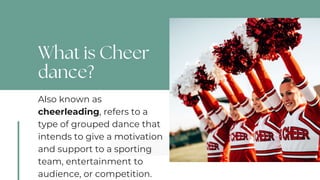
Also known as
cheerleading, refers to a
type of grouped dance that
intends to give a motivation
and support to a sporting
team, entertainment to
audience, or competition.
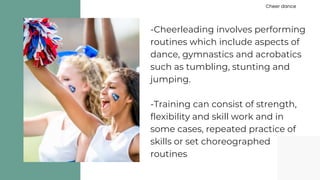
-Cheerleading involves performing
routines which include aspects of
dance, gymnastics and acrobatics
such as tumbling, stunting and
jumping.
-Training can consist of strength,
flexibility and skill work and in
some cases, repeated practice of
skills or set choreographed
routines
Cheer dance
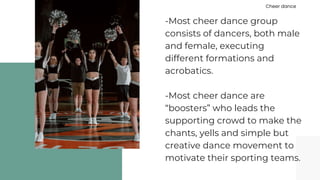
-Most cheer dance group
consists of dancers, both male
and female, executing
different formations and
acrobatics.
-Most cheer dance are
“boosters” who leads the
supporting crowd to make the
chants, yells and simple but
creative dance movement to
motivate their sporting teams.
Cheer dance
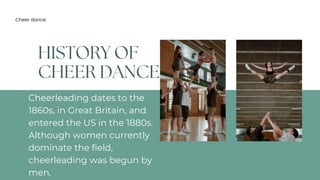
Cheerleading dates to the
1860s, in Great Britain, and
entered the US in the 1880s.
Although women currently
dominate the field,
cheerleading was begun by
men.
Cheer dance
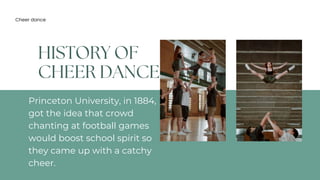
Princeton University, in 1884,
got the idea that crowd
chanting at football games
would boost school spirit so
they came up with a catchy
cheer.
Cheer dance
On November 2, 1898, U-Minnesota
student Johnny Campbell led an
organized cheer at a football game
between Minnesota and Princeton
University, so you might say he
was the first actual "cheer leader".
Cheer dance
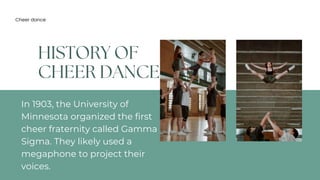
In 1903, the University of
Minnesota organized the first
cheer fraternity called Gamma
Sigma. They likely used a
megaphone to project their
voices.
Cheer dance
In the 1920s women became
involved in cheerleading. The
lady yellers sported ankle-
length skirts and varsity
sweaters.
Cheer dance
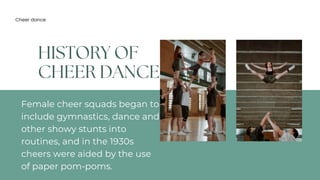
Female cheer squads began to
include gymnastics, dance and
other showy stunts into
routines, and in the 1930s
cheers were aided by the use
of paper pom-poms.
Cheer dance
By the 1940s women were
mainly leading the cheers, and
routines took on a voice their
own.
Cheer dance
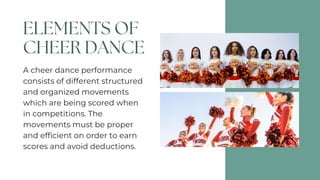
A cheer dance performance
consists of different structured
and organized movements
which are being scored when
in competitions. The
movements must be proper
and efficient on order to earn
scores and avoid deductions.
ELEMENTS OF CHEER DANCE
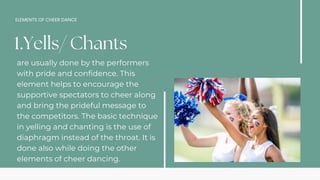
are usually done by the performers
with pride and confidence. This
element helps to encourage the
supportive spectators to cheer along
and bring the prideful message to
the competitors. The basic technique
in yelling and chanting is the use of
diaphragm instead of the throat. It is
done also while doing the other
elements of cheer dancing.
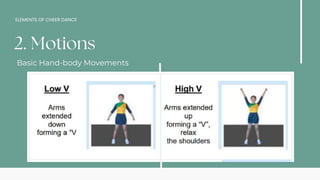
ELEMENTS OF CHEER DANCE
Basic Hand-body Movements
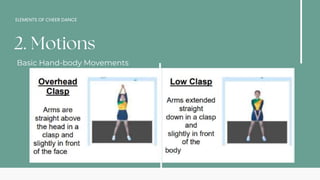
ELEMENTS OF CHEER DANCE
Basic Hand-body Movements
ELEMENTS OF CHEER DANCE
Basic Hand-body Movements
ELEMENTS OF CHEER DANCE
Basic Hand-body Movements
ELEMENTS OF CHEER DANCE
Basic Hand-body Movements
ELEMENTS OF CHEER DANCE
Basic Hand-body Movements
ELEMENTS OF CHEER DANCE
Basic Hand-body Movements
ELEMENTS OF CHEER DANCE
Basic Hand-body Movements
ELEMENTS OF CHEER DANCE
Basic Hand-body Movements
ELEMENTS OF CHEER DANCE
Basic Types of Jumps:
ELEMENTS OF CHEER DANCE
• Spread Eagle – simply swing
and jump with arms of doing
high “V” figure and legs apart.
Knees facing forward but not
toward the sky. This jump is
used as progression to learn
more advance jumps.
Basic Types of Jumps:
ELEMENTS OF CHEER DANCE
• Tuck Jump – Legs in front
while knees tucked to the
chest. Closed fist and arms
spreading forming “T” or “V”
figure.
Basic Types of Jumps:
ELEMENTS OF CHEER DANCE
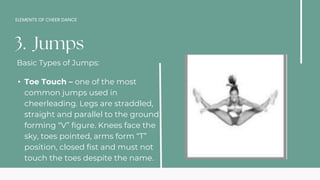
• Toe Touch – one of the most
common jumps used in
cheerleading. Legs are straddled,
straight and parallel to the ground
forming “V” figure. Knees face the
sky, toes pointed, arms form “T”
position, closed fist and must not
touch the toes despite the name.
Basic Types of Jumps:
ELEMENTS OF CHEER DANCE
• Pike- Legs are straight,
together, and parallel to the
ground. Toes are pointed,
arms are straight reaching
the front while hands are in
closed fist.
Basic Types of Jumps:
ELEMENTS OF CHEER DANCE
• Hurdle- One leg is straight
facing forward (front hurdle) or
facing outward (side hurdle)
with arms forming “T” figure.
The other leg is bent, knees
facing the ground (front
hurdle) or facing forward (side
hurdle)
Most stunts are done by flyers
(usually female) with bases
(male lifters) and spotters. It is
essential to know the proper
execution of the stunts to
secure the safety of both flyers
and lifters.
ELEMENTS OF CHEER DANCE
• Bases- These are the athletes
(usually male cheer dancers)
that hold, lift, and toss a flyer
up to the air during stunts.
Bases must be strong an alert
at all times. They make sure
that the flyer will land safely
and secured. There is no
gender requirement for a base.
ELEMENTS OF CHEER DANCE
• Flyers- are the athletes being held,
lifted, and tossed up to perform
certain stunts in height or in the air.
Female cheer dancers are usually
assigned to be the flyers. They are
usually, but not always, the smallest
person in the group. They are
flexible, and balance efficient while
being lifted up. Before performing
air stunts, flyers must learn first the
proper techniques
Stunts
• Make sure your base has their
arms locked at all times and
head up.
• The Flyer should sit on the
lower part of the base's back; if
you sit too high, you could hurt
your base.
• The Spotter should hold the
Flyer at her waist at all times.
• The Spotter should help the
Flyer get up and dismount.
Stunts
• Make sure the Flyer keeps
her arms tight in the "T"
motion.
• Make sure the Bases keep
their arms in a High
Touchdown motion.
Stunts
• Make sure the Base does a
deep side lunge for the
Flyer to sit on.
• Make sure the Flyer points
her toes and the Base
catches her leg on her calf
or ankle.
Stunts
• The Base should always
hold the thighs of the Flyer
until the Back Spot calls
for the release.
• The Base should always
hold the thighs of the Flyer
until the Back Spot calls
for the release.
Including tumbling skills in your cheer dance routine is
an excellent way to add extreme, thrill and excitement.
Safety and security must be observe at all times to avoid
injury especially tumble skill involve gravity-defying and
intense ground impact.
ELEMENTS OF CHEER DANCE
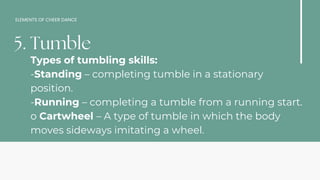
Types of tumbling skills:
-Standing – completing tumble in a stationary
position.
-Running – completing a tumble from a running start.
o Cartwheel – A type of tumble in which the body
moves sideways imitating a wheel.
• Cart Wheel
▪ To start your lunge, put your dominant leg in front and
bend it slightly. Your back leg should be straight. Your arms
should be straight above your head, near your ears.
▪ Put your hands on the ground with your hands turned 90
degrees.
▪ Kick your feet over your head one at a time. The foot that
kicks first should land first.
▪ Land in a lunge facing the opposite direction you started
from. Your arms should be over your head near your ears.
Your front leg should be slightly bent, and your back leg
should be straight.
ELEMENTS OF CHEER DANCE
Formations play a vital role in
cheer dance since most of the
cheer dance competitions are
viewed from the top by the
spectators. Formations may vary
depending on the dances and
stunts choreographed.
Ballerina Ballet.
BASIC FORMATIONS
BASIC FORMATIONS
Diagonal Staggered
Cheerdance PowerPoint presentation pdffff

Cheerdance PowerPoint presentation pdffff

  • 1.
  • 2.
    Also known as cheerleading,refers to a type of grouped dance that intends to give a motivation and support to a sporting team, entertainment to audience, or competition.
  • 3.
    -Cheerleading involves performing routineswhich include aspects of dance, gymnastics and acrobatics such as tumbling, stunting and jumping. -Training can consist of strength, flexibility and skill work and in some cases, repeated practice of skills or set choreographed routines Cheer dance
  • 4.
    -Most cheer dancegroup consists of dancers, both male and female, executing different formations and acrobatics. -Most cheer dance are “boosters” who leads the supporting crowd to make the chants, yells and simple but creative dance movement to motivate their sporting teams. Cheer dance
  • 5.
    Cheerleading dates tothe 1860s, in Great Britain, and entered the US in the 1880s. Although women currently dominate the field, cheerleading was begun by men. Cheer dance
  • 6.
    Princeton University, in1884, got the idea that crowd chanting at football games would boost school spirit so they came up with a catchy cheer. Cheer dance
  • 7.
    On November 2,1898, U-Minnesota student Johnny Campbell led an organized cheer at a football game between Minnesota and Princeton University, so you might say he was the first actual "cheer leader". Cheer dance
  • 8.
    In 1903, theUniversity of Minnesota organized the first cheer fraternity called Gamma Sigma. They likely used a megaphone to project their voices. Cheer dance
  • 9.
    In the 1920swomen became involved in cheerleading. The lady yellers sported ankle- length skirts and varsity sweaters. Cheer dance
  • 10.
    Female cheer squadsbegan to include gymnastics, dance and other showy stunts into routines, and in the 1930s cheers were aided by the use of paper pom-poms. Cheer dance
  • 11.
    By the 1940swomen were mainly leading the cheers, and routines took on a voice their own. Cheer dance
  • 12.
    A cheer danceperformance consists of different structured and organized movements which are being scored when in competitions. The movements must be proper and efficient on order to earn scores and avoid deductions.
  • 13.
    ELEMENTS OF CHEERDANCE are usually done by the performers with pride and confidence. This element helps to encourage the supportive spectators to cheer along and bring the prideful message to the competitors. The basic technique in yelling and chanting is the use of diaphragm instead of the throat. It is done also while doing the other elements of cheer dancing.
  • 14.
    ELEMENTS OF CHEERDANCE Basic Hand-body Movements
  • 15.
  • 16.
  • 17.
  • 18.
  • 19.
  • 20.
  • 21.
  • 22.
  • 23.
  • 24.
    Basic Types ofJumps: ELEMENTS OF CHEER DANCE • Spread Eagle – simply swing and jump with arms of doing high “V” figure and legs apart. Knees facing forward but not toward the sky. This jump is used as progression to learn more advance jumps.
  • 25.
    Basic Types ofJumps: ELEMENTS OF CHEER DANCE • Tuck Jump – Legs in front while knees tucked to the chest. Closed fist and arms spreading forming “T” or “V” figure.
  • 26.
    Basic Types ofJumps: ELEMENTS OF CHEER DANCE • Toe Touch – one of the most common jumps used in cheerleading. Legs are straddled, straight and parallel to the ground forming “V” figure. Knees face the sky, toes pointed, arms form “T” position, closed fist and must not touch the toes despite the name.
  • 27.
    Basic Types ofJumps: ELEMENTS OF CHEER DANCE • Pike- Legs are straight, together, and parallel to the ground. Toes are pointed, arms are straight reaching the front while hands are in closed fist.
  • 28.
    Basic Types ofJumps: ELEMENTS OF CHEER DANCE • Hurdle- One leg is straight facing forward (front hurdle) or facing outward (side hurdle) with arms forming “T” figure. The other leg is bent, knees facing the ground (front hurdle) or facing forward (side hurdle)
  • 29.
    Most stunts aredone by flyers (usually female) with bases (male lifters) and spotters. It is essential to know the proper execution of the stunts to secure the safety of both flyers and lifters. ELEMENTS OF CHEER DANCE
  • 30.
    • Bases- Theseare the athletes (usually male cheer dancers) that hold, lift, and toss a flyer up to the air during stunts. Bases must be strong an alert at all times. They make sure that the flyer will land safely and secured. There is no gender requirement for a base. ELEMENTS OF CHEER DANCE • Flyers- are the athletes being held, lifted, and tossed up to perform certain stunts in height or in the air. Female cheer dancers are usually assigned to be the flyers. They are usually, but not always, the smallest person in the group. They are flexible, and balance efficient while being lifted up. Before performing air stunts, flyers must learn first the proper techniques
  • 31.
    Stunts • Make sureyour base has their arms locked at all times and head up. • The Flyer should sit on the lower part of the base's back; if you sit too high, you could hurt your base. • The Spotter should hold the Flyer at her waist at all times. • The Spotter should help the Flyer get up and dismount.
  • 32.
    Stunts • Make surethe Flyer keeps her arms tight in the "T" motion. • Make sure the Bases keep their arms in a High Touchdown motion.
  • 33.
    Stunts • Make surethe Base does a deep side lunge for the Flyer to sit on. • Make sure the Flyer points her toes and the Base catches her leg on her calf or ankle.
  • 34.
    Stunts • The Baseshould always hold the thighs of the Flyer until the Back Spot calls for the release. • The Base should always hold the thighs of the Flyer until the Back Spot calls for the release.
  • 35.
    Including tumbling skillsin your cheer dance routine is an excellent way to add extreme, thrill and excitement. Safety and security must be observe at all times to avoid injury especially tumble skill involve gravity-defying and intense ground impact. ELEMENTS OF CHEER DANCE
  • 36.
    ELEMENTS OF CHEERDANCE Types of tumbling skills: -Standing – completing tumble in a stationary position. -Running – completing a tumble from a running start. o Cartwheel – A type of tumble in which the body moves sideways imitating a wheel.
  • 37.
    • Cart Wheel ▪To start your lunge, put your dominant leg in front and bend it slightly. Your back leg should be straight. Your arms should be straight above your head, near your ears. ▪ Put your hands on the ground with your hands turned 90 degrees. ▪ Kick your feet over your head one at a time. The foot that kicks first should land first. ▪ Land in a lunge facing the opposite direction you started from. Your arms should be over your head near your ears. Your front leg should be slightly bent, and your back leg should be straight. ELEMENTS OF CHEER DANCE
  • 38.
    Formations play avital role in cheer dance since most of the cheer dance competitions are viewed from the top by the spectators. Formations may vary depending on the dances and stunts choreographed. Ballerina Ballet.
  • 39.
  • 40.