REMINDERS!
1. Finda place which are free from any distraction.
2. BE RESPECTFUL AT ALL TIMES, use appropriate words
and be polite in giving your comments.
3. Have your learning materials like notebook, pen ready
and stay focused on our discussion and other tasks to be
given.
4. ENJOY LEARNING!
3.
PRAYER
Our HeavenlyFather ,
We thank you for the opportunity to begin our
new day. We ask that you bless the students,
participants and make our class successful and possible.
We pray that you will guide us in all ways, so that we
will seek you in everything that we do. We ask this in
the name of Jesus, our Lord Amen.
Review of theprevious lesson
What was our lesson last week?
Why do we have to organize Fitness event/s?
What are the benefits that we can get in organizing
Fitness event/s?
What is cheerdance?
Cheer dance is coined from the words: “cheer”, and
“dance.” To cheer is to shout out words or phrases that
may help motivate and boost the morale of a playing
team and perform better during a game. While, to
Dance is a physical activity where one expresses
emotions or gestures while performing bodily
movements usually in time and rhythm.
On the other hand, Cheerleading is the performance of
a routine, usually dominated by a gymnastic skill such
as jumps, tumbling skills, lifts and tosses combined
with shouting of cheers and yells to lead the crowd to
cheer for a certain team during a game or sport.
Therefore, Cheer dancing, is rooted from cheerleading.
12.
How did cheerdancing start?
Cheerleading history is linked closely
to the United States’s history of
sports, its sporting venues, as well as
the historical development of overall
crowd participation at many Athletic
events (history of cheerleading, 2015).
However, its origin can be traced as
far back as the late 19th century
where in 1860’s students from Great
Britain began to cheer and chant in
unison for their favorite athletes at
sporting events. This event eventually
reached and influenced America
(timeline of cheerleading, 2012).
13.
In thelate 1880’s the first organized recorded yell done in locomotive
style was performed in an American campus and was first seen and heard
during a college football game. However, organized all-male cheerleading
only transpired when Thomas Peebles, one of the graduates of Princeton
University, brought the yell and the football sports to the University of
Minnesota in 1884.
14.
Essentials of cheerdancing
Arms and Hands Movement for Cheer dance
1. CLASP
Strike palms together in front
Of the chest
15.
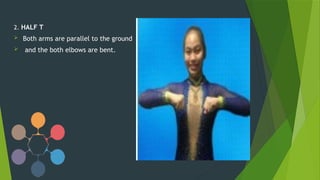
2. HALF T
Both arms are parallel to the ground
and the both elbows are bent.
16.
3. HIGH V
Both arms are raised diagonally upward;
forming “V”.
The teacher willask the following questions:
1. Why do we need to engage ourselves in different physical
activities such as cheer dancing?
2. Are there any benefits to engaging in cheer dancing?
3. What are these benefits?
26.
The teacher willask the following questions:
1. What is cheer dance?
2. What are the essentials of cheer dance?
27.
Activity: isayaw mo!
Direction:Make a simple dance routine by applying what you
have learned out from the discussion. You are given only 10
mins. to create and practice your presentation.
RUBRICS:
GROUP Mastery &
Execution
(10 pts.)
Cooperation
(10 pts.)
Synchronization
(10 pts.)
Total
(30 pts.)
1
2
3
28.
Evaluation
Direction: Provide thenames for each movement/position depicted in
the pictures, focusing on arms, hands, and feet/legs.
1. ________________________
Answers Key:
1. Clasp
2.Half T
3. High V
4. Overhead Clasp
5. T Motion
6. Cheer Stance
7. Beginning Stance
8. Side Lunge
9. Squat
10. Kneel
35.
Evaluation
Direction: Take photosof you executing different cheer dance movements
and positions and label. If you don’t have a phone camera, you may draw a
sample pose and placed it on the box.