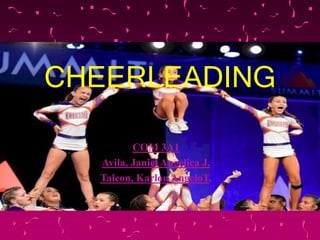
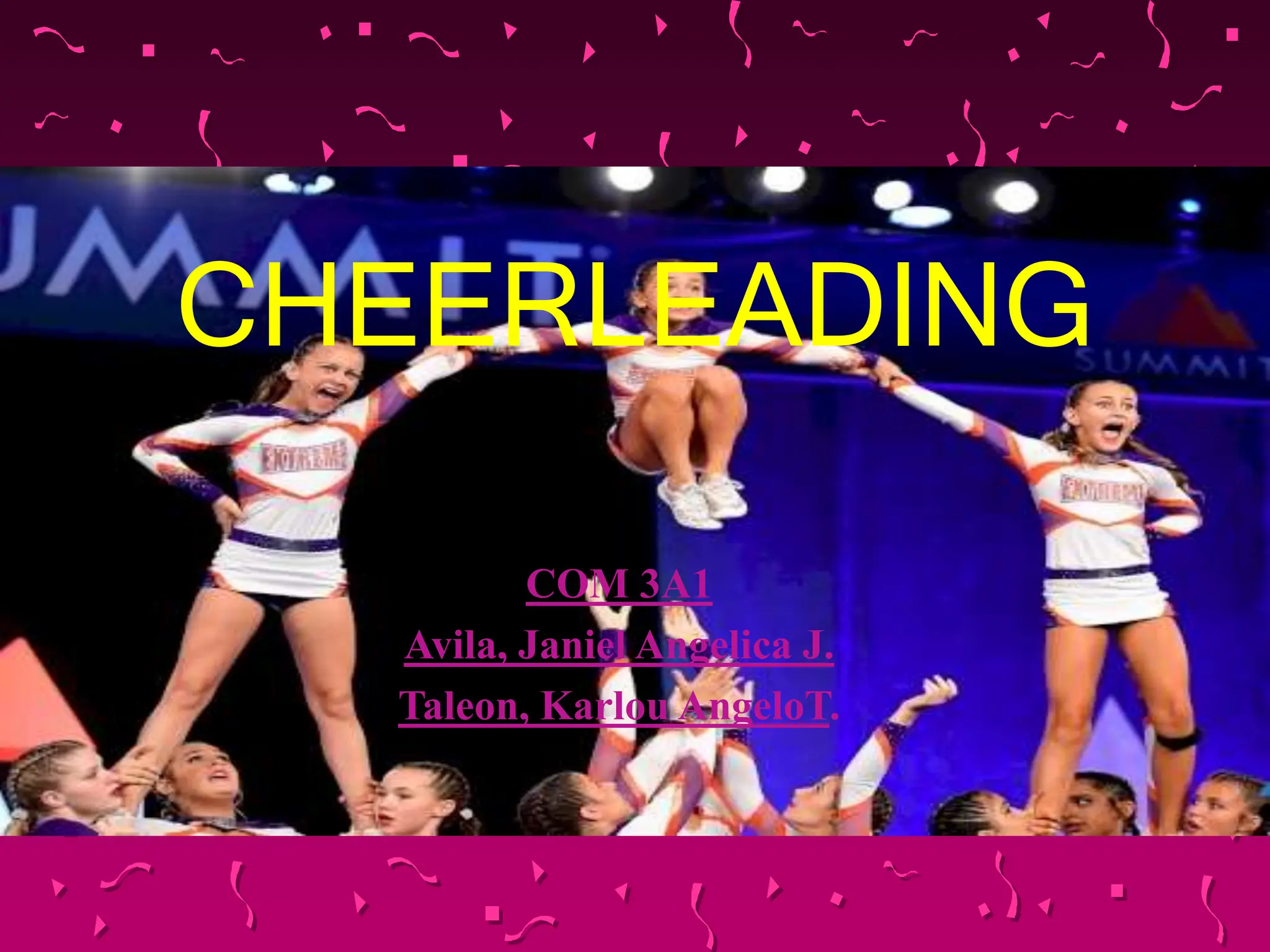
CHEERLEADING
COM 3A1
Avila, Janiel Angelica J.
Taleon, Karlou AngeloT.
LEARNING OBJECTIVES
A – Value the importance of cheerleading
dance
S – Demonstrate the basic steps in cheer
leading dance
K – Explain the literature of origin of the
interpretative dance
What is Cheerleading?
 is an activity in which the participants (called
cheerleaders) cheer for their team as a form of
encouragement. It can range from chanting
slogans to intense physical activity. It can be
performed to motivate sports teams, to
entertain the audience, or for competition.
Cheerleading routines typically range
anywhere from one to three minutes, and
contain components of tumbling, dance,
jumps, cheers, and stunting.
Cheerleading bring out the joy, emotion, and
electricity, that ultimately impacts the players
field. They are acknowledged for bringing the
community together both physically and
emotionally while improving games for an
energized atmosphere. It makes the field a more
pleasant place in which both the athletes and the
audience can have an enjoyable experience.
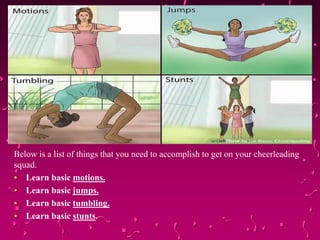
Below is a list of things that you need to accomplish to get on your cheerleading
squad.
• Learn basic motions.
• Learn basic jumps.
• Learn basic tumbling.
• Learn basic stunts.
MOTION
Basic Hand-body Movements
• BEGINNING STANCE - Feet together, hands
down by the side in blades
• CHEER STANCE - Feet more than shoulder
width apart , hands down by the side in blade.
• CLASP - Hands clasped, at the chin, elbows in
• CLAP - Hands in blades, at the chin, elbows in
• HIGH V - Arms extended up forming a “V”,
• relax the shoulders
• LOW V - Arms extended down forming a “V”
• GOALPOST (or TOUCHDOWN) - Arms
extended straight and parallel to each other, fist
facing in
• LOW CONE - Arms extended straight down,
in a clasp and slightly in front of the body
• PUNCH - One arm extended straight up, one
arm on hip, in a fist
• L MOTION - One arm extended to the side
with other arm extended in a punch motion,
(Left L shown)
• DIAGONAL - One arm extended in a high
“V” and the other arm extended in a low “V”
(Right Diagonal shown)
• T MOTION - Both arms extended straight out
to the side and parallel to the ground, relax the
shoulders
• HALF T - Both arms parallel to the ground and
bent at the elbows, fists into shoulders
• SIDE LUNGE - Lead leg bent with the knee
over the ankle, back leg straight, feet
perpendicular to each other.
• FRONT LUNGE - Lead leg bent with the
knee over the ankle, back leg straight, feet
perpendicular to each other
 JUMPS
Basic Types of Jumps:
• Spread Eagle – simply swing and jump with
arms of doing high “V” figure and legs apart.
• Tuck Jump – Legs in front while knees tucked
to the chest. Closed fist and arms spreading
forming “T” or “V” figure.
• Toe Touch – one of the most common jumps
used in cheerleading.
• Pike - Legs are straight, together, and parallel
to the ground. Toes are pointed, arms are
straight reaching the front while hands are in
closed fist
• Hurdle - One leg is straight facing forward
(fronthurdle) or facing outward (side hurdle)
with arms forming “T” figure. The other leg is
bent, knees facing the ground(front hurdle) or
facing forward (side hurdle)
STUNTS - It is essential to know the proper
execution of the stunts to secure the safety of
both flyers and lifters.
• BASES - Bases must be strong an alert at all
times.
• FLYERS - Flyers are the athletes being held,
lifted, and tossed up to perform certain stunts
in height or in the air.
• TUMBLE - is an excellent way to add
extreme, thrill and excitement.
Types of tumbling skills:
Standing – completing tumble in a stationary
position.
Running – completing a tumble from a
running start.
Cartwheel – A type of tumble in which the
body moves sideways imitating a wheel.
Round off – this tumble is similar to
cartwheel but the difference is, landing must
be in both feet together.
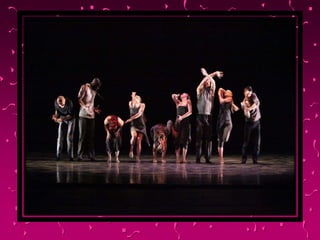
Interpretive dance
is a family of modern dance styles that
began around 1900 with Isadora Duncan. It
used classical concert music but marked a
departure from traditional concert dance.
It seeks to translate human emotions,
conditions, situations or fantasies into
movement and dramatic expression, or else
adapts traditional ethnic movements into
more modern expressions.
Dire ibutang ang 15
questionares
THE END..
THANK YOU AND GODBLESS

jel

  • 1.
    CHEERLEADING COM 3A1 Avila, JanielAngelica J. Taleon, Karlou AngeloT.
  • 2.
    LEARNING OBJECTIVES A –Value the importance of cheerleading dance S – Demonstrate the basic steps in cheer leading dance K – Explain the literature of origin of the interpretative dance
  • 3.
    What is Cheerleading? is an activity in which the participants (called cheerleaders) cheer for their team as a form of encouragement. It can range from chanting slogans to intense physical activity. It can be performed to motivate sports teams, to entertain the audience, or for competition. Cheerleading routines typically range anywhere from one to three minutes, and contain components of tumbling, dance, jumps, cheers, and stunting.
  • 4.
    Cheerleading bring outthe joy, emotion, and electricity, that ultimately impacts the players field. They are acknowledged for bringing the community together both physically and emotionally while improving games for an energized atmosphere. It makes the field a more pleasant place in which both the athletes and the audience can have an enjoyable experience.
  • 5.
    Below is alist of things that you need to accomplish to get on your cheerleading squad. • Learn basic motions. • Learn basic jumps. • Learn basic tumbling. • Learn basic stunts.
  • 6.
    MOTION Basic Hand-body Movements •BEGINNING STANCE - Feet together, hands down by the side in blades • CHEER STANCE - Feet more than shoulder width apart , hands down by the side in blade. • CLASP - Hands clasped, at the chin, elbows in • CLAP - Hands in blades, at the chin, elbows in • HIGH V - Arms extended up forming a “V”, • relax the shoulders
  • 7.
    • LOW V- Arms extended down forming a “V” • GOALPOST (or TOUCHDOWN) - Arms extended straight and parallel to each other, fist facing in • LOW CONE - Arms extended straight down, in a clasp and slightly in front of the body • PUNCH - One arm extended straight up, one arm on hip, in a fist • L MOTION - One arm extended to the side with other arm extended in a punch motion, (Left L shown)
  • 8.
    • DIAGONAL -One arm extended in a high “V” and the other arm extended in a low “V” (Right Diagonal shown) • T MOTION - Both arms extended straight out to the side and parallel to the ground, relax the shoulders • HALF T - Both arms parallel to the ground and bent at the elbows, fists into shoulders • SIDE LUNGE - Lead leg bent with the knee over the ankle, back leg straight, feet perpendicular to each other.
  • 9.
    • FRONT LUNGE- Lead leg bent with the knee over the ankle, back leg straight, feet perpendicular to each other  JUMPS Basic Types of Jumps: • Spread Eagle – simply swing and jump with arms of doing high “V” figure and legs apart. • Tuck Jump – Legs in front while knees tucked to the chest. Closed fist and arms spreading forming “T” or “V” figure.
  • 10.
    • Toe Touch– one of the most common jumps used in cheerleading. • Pike - Legs are straight, together, and parallel to the ground. Toes are pointed, arms are straight reaching the front while hands are in closed fist • Hurdle - One leg is straight facing forward (fronthurdle) or facing outward (side hurdle) with arms forming “T” figure. The other leg is bent, knees facing the ground(front hurdle) or facing forward (side hurdle)
  • 11.
    STUNTS - Itis essential to know the proper execution of the stunts to secure the safety of both flyers and lifters. • BASES - Bases must be strong an alert at all times. • FLYERS - Flyers are the athletes being held, lifted, and tossed up to perform certain stunts in height or in the air. • TUMBLE - is an excellent way to add extreme, thrill and excitement.
  • 12.
    Types of tumblingskills: Standing – completing tumble in a stationary position. Running – completing a tumble from a running start. Cartwheel – A type of tumble in which the body moves sideways imitating a wheel. Round off – this tumble is similar to cartwheel but the difference is, landing must be in both feet together.
  • 13.
    Interpretive dance is afamily of modern dance styles that began around 1900 with Isadora Duncan. It used classical concert music but marked a departure from traditional concert dance. It seeks to translate human emotions, conditions, situations or fantasies into movement and dramatic expression, or else adapts traditional ethnic movements into more modern expressions.
  • 15.
    Dire ibutang ang15 questionares
  • 16.
    THE END.. THANK YOUAND GODBLESS