CHEERDANCE
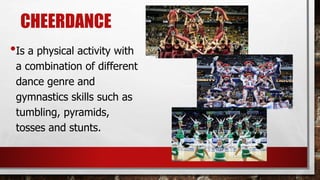
•Is a physical activity with
a combination of different
dance genre and
gymnastics skills such as
tumbling, pyramids,
tosses and stunts.
FUNDAMENTAL OF CHEERLEADING
•BASIC MOTION
•BASIC JUMPS
•BASIC STUNTS
•BASIC TUMBLING
HIGH V
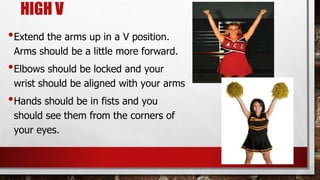
•Extend the arms up in a V position.
Arms should be a little more forward.
•Elbows should be locked and your
wrist should be aligned with your arms
•Hands should be in fists and you
should see them from the corners of
your eyes.
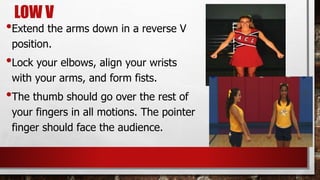
LOW V
•Extend the arms down in a reverse V
position.
•Lock your elbows, align your wrists
with your arms, and form fists.
•The thumb should go over the rest of
your fingers in all motions. The pointer
finger should face the audience.
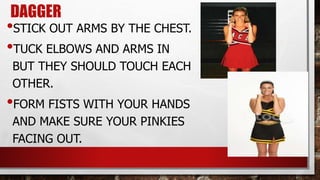
DAGGER
•STICK OUT ARMS BY THE CHEST.
•TUCK ELBOWS AND ARMS IN
BUT THEY SHOULD TOUCH EACH
OTHER.
•FORM FISTS WITH YOUR HANDS
AND MAKE SURE YOUR PINKIES
FACING OUT.
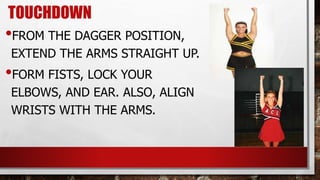
TOUCHDOWN
•FROM THE DAGGER POSITION,
EXTEND THE ARMS STRAIGHT UP.
•FORM FISTS, LOCK YOUR
ELBOWS, AND EAR. ALSO, ALIGN
WRISTS WITH THE ARMS.
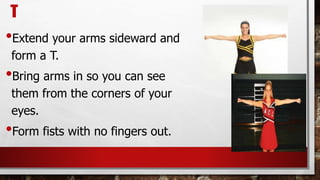
T
•Extend your arms sideward and
form a T.
•Bring arms in so you can see
them from the corners of your
eyes.
•Form fists with no fingers out.
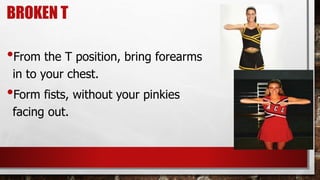
BROKEN T
•From the T position, bring forearms
in to your chest.
•Form fists, without your pinkies
facing out.
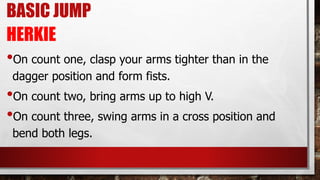
BASIC JUMP
HERKIE
•On count one, clasp your arms tighter than in the
dagger position and form fists.
•On count two, bring arms up to high V.
•On count three, swing arms in a cross position and
bend both legs.
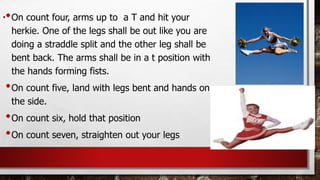
.•On count four, arms up to a T and hit your
herkie. One of the legs shall be out like you are
doing a straddle split and the other leg shall be
bent back. The arms shall be in a t position with
the hands forming fists.
•On count five, land with legs bent and hands on
the side.
•On count six, hold that position
•On count seven, straighten out your legs
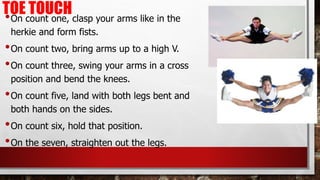
TOE TOUCH
•On count one, clasp your arms like in the
herkie and form fists.
•On count two, bring arms up to a high V.
•On count three, swing your arms in a cross
position and bend the knees.
•On count five, land with both legs bent and
both hands on the sides.
•On count six, hold that position.
•On the seven, straighten out the legs.
PIKE
•On count one, clasp arms like toe touch and form fists
•On count two, bring arms up to a rocket (high clap) and
turn 90 degrees to either side.
•On count three, swing the arms in and bend knees.
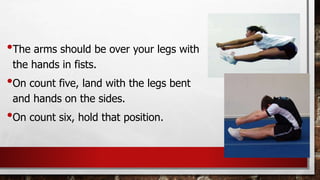
•On count four, hit pike. The legs shall be in pike position.
Extend the legs together in front, with toes pointed.
•The arms should be over your legs with
the hands in fists.
•On count five, land with the legs bent
and hands on the sides.
•On count six, hold that position.
BASIC STUNTS
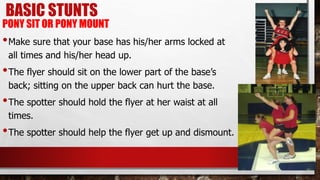
PONY SIT OR PONY MOUNT
•Make sure that your base has his/her arms locked at
all times and his/her head up.
•The flyer should sit on the lower part of the base’s
back; sitting on the upper back can hurt the base.
•The spotter should hold the flyer at her waist at all
times.
•The spotter should help the flyer get up and dismount.
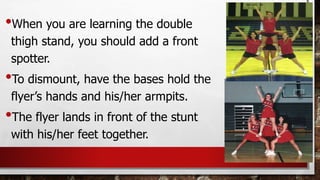
DOUBLE THIGH
•Make sure that your bases have deep lunges for the flyer to stand
on.
•Make sure that the flyer step in the “pockets” of the bases, not on
their legs.
•The flyer should start with her right foot first and climb using the
step locking-tighten method.
•Have the base hold the flyer’s legs by wrapping their arms around
the flyer’s waist.
•When you are learning the double
thigh stand, you should add a front
spotter.
•To dismount, have the bases hold the
flyer’s hands and his/her armpits.
•The flyer lands in front of the stunt
with his/her feet together.
BASIC TUMBLING
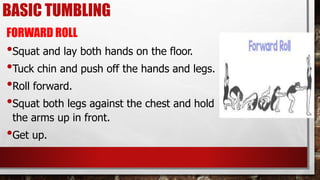
FORWARD ROLL
•Squat and lay both hands on the floor.
•Tuck chin and push off the hands and legs.
•Roll forward.
•Squat both legs against the chest and hold
the arms up in front.
•Get up.
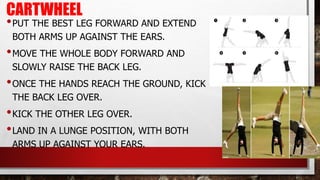
CARTWHEEL
•PUT THE BEST LEG FORWARD AND EXTEND
BOTH ARMS UP AGAINST THE EARS.
•MOVE THE WHOLE BODY FORWARD AND
SLOWLY RAISE THE BACK LEG.
•ONCE THE HANDS REACH THE GROUND, KICK
THE BACK LEG OVER.
•KICK THE OTHER LEG OVER.
•LAND IN A LUNGE POSITION, WITH BOTH
ARMS UP AGAINST YOUR EARS.
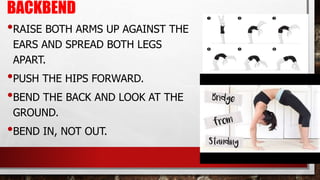
BACKBEND
•RAISE BOTH ARMS UP AGAINST THE
EARS AND SPREAD BOTH LEGS
APART.
•PUSH THE HIPS FORWARD.
•BEND THE BACK AND LOOK AT THE
GROUND.
•BEND IN, NOT OUT.
HIP-HOP
•Developed from the music style that was first introduce
during the 1970s in new york city among young
hispanic and african american communities.
•It remains to be one of the most popular dance because
it encompasses athleticism, flexibility, energy, agility,
power, and soul.
FOUR ELEMENTS OF HIP-HOP
•Deejaying, or “turnbabling”
•Rapping, also known as “Mcing” or “rhyming”
•Graffiti painting, also known as “graf”or “writing”
•B-boying which encompasses hip-hop dance, style, and
attitude.
-along with the sort of virile body language that philosopher
corner west described as “postural semantics”
HIP-HOP STYLES
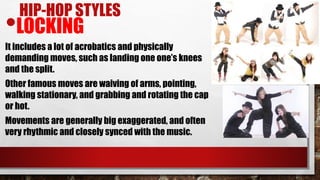
•LOCKING
It includes a lot of acrobatics and physically
demanding moves, such as landing one one’s knees
and the split.
Other famous moves are waiving of arms, pointing,
walking stationary, and grabbing and rotating the cap
or hot.
Movements are generally big exaggerated, and often
very rhythmic and closely synced with the music.
POPPING
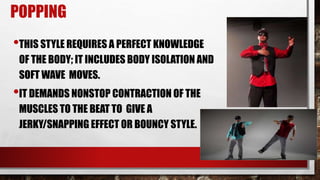
•THIS STYLE REQUIRES A PERFECT KNOWLEDGE
OF THE BODY; IT INCLUDES BODY ISOLATION AND
SOFT WAVE MOVES.
•IT DEMANDS NONSTOP CONTRACTION OF THE
MUSCLES TO THE BEAT TO GIVE A
JERKY/SNAPPING EFFECT OR BOUNCY STYLE.
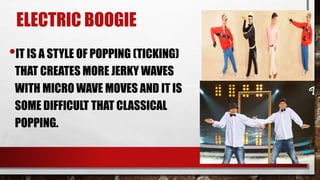
ELECTRIC BOOGIE
•IT IS A STYLE OF POPPING (TICKING)
THAT CREATES MORE JERKY WAVES
WITH MICRO WAVE MOVES AND IT IS
SOME DIFFICULT THAT CLASSICAL
POPPING.
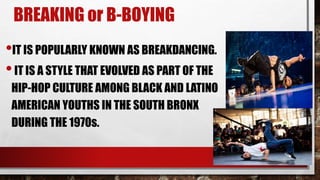
BREAKING or B-BOYING
•IT IS POPULARLY KNOWN AS BREAKDANCING.
•IT IS A STYLE THAT EVOLVED AS PART OF THE
HIP-HOP CULTURE AMONG BLACK AND LATINO
AMERICAN YOUTHS IN THE SOUTH BRONX
DURING THE 1970s.
TYPES OF B-BOYING
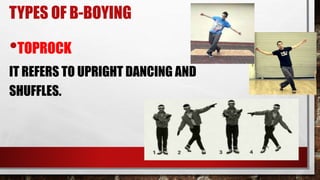
•TOPROCK
IT REFERS TO UPRIGHT DANCING AND
SHUFFLES.
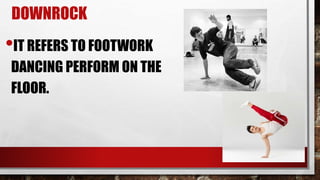
DOWNROCK
•IT REFERS TO FOOTWORK
DANCING PERFORM ON THE
FLOOR.
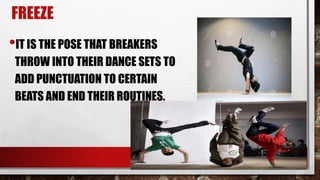
FREEZE
•IT IS THE POSE THAT BREAKERS
THROW INTO THEIR DANCE SETS TO
ADD PUNCTUATION TO CERTAIN
BEATS AND END THEIR ROUTINES.
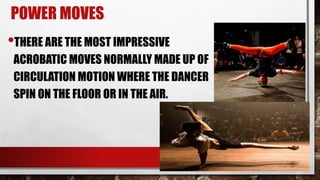
POWER MOVES
•THERE ARE THE MOST IMPRESSIVE
ACROBATIC MOVES NORMALLY MADE UP OF
CIRCULATION MOTION WHERE THE DANCER
SPIN ON THE FLOOR OR IN THE AIR.
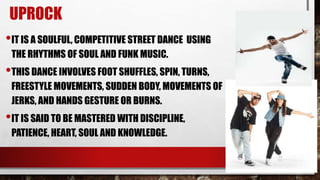
UPROCK
•IT IS A SOULFUL, COMPETITIVE STREET DANCE USING
THE RHYTHMS OF SOUL AND FUNK MUSIC.
•THIS DANCE INVOLVES FOOT SHUFFLES, SPIN, TURNS,
FREESTYLE MOVEMENTS, SUDDEN BODY, MOVEMENTS OF
JERKS, AND HANDS GESTURE OR BURNS.
•IT IS SAID TO BE MASTERED WITH DISCIPLINE,
PATIENCE, HEART, SOUL AND KNOWLEDGE.
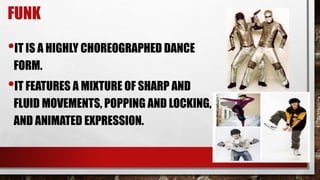
FUNK
•IT IS A HIGHLY CHOREOGRAPHED DANCE
FORM.
•IT FEATURES A MIXTURE OF SHARP AND
FLUID MOVEMENTS, POPPING AND LOCKING,
AND ANIMATED EXPRESSION.
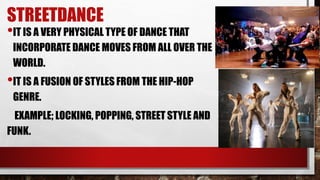
STREETDANCE
•IT IS A VERY PHYSICAL TYPE OF DANCE THAT
INCORPORATE DANCE MOVES FROM ALL OVER THE
WORLD.
•IT IS A FUSION OF STYLES FROM THE HIP-HOP
GENRE.
EXAMPLE; LOCKING, POPPING, STREET STYLE AND
FUNK.
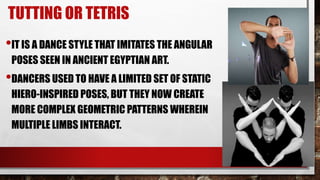
TUTTING OR TETRIS
•IT IS A DANCE STYLE THAT IMITATES THE ANGULAR
POSES SEEN IN ANCIENT EGYPTIAN ART.
•DANCERS USED TO HAVE A LIMITED SET OF STATIC
HIERO-INSPIRED POSES, BUT THEY NOW CREATE
MORE COMPLEX GEOMETRIC PATTERNS WHEREIN
MULTIPLE LIMBS INTERACT.
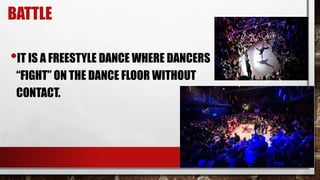
BATTLE
•IT IS A FREESTYLE DANCE WHERE DANCERS
“FIGHT” ON THE DANCE FLOOR WITHOUT
CONTACT.
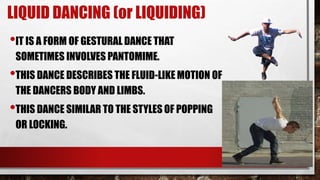
LIQUID DANCING (or LIQUIDING)
•IT IS A FORM OF GESTURAL DANCE THAT
SOMETIMES INVOLVES PANTOMIME.
•THIS DANCE DESCRIBES THE FLUID-LIKE MOTION OF
THE DANCERS BODY AND LIMBS.
•THIS DANCE SIMILAR TO THE STYLES OF POPPING
OR LOCKING.
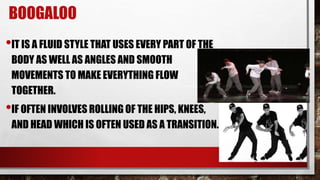
BOOGALOO
•IT IS A FLUID STYLE THAT USES EVERY PART OF THE
BODY AS WELL AS ANGLES AND SMOOTH
MOVEMENTS TO MAKE EVERYTHING FLOW
TOGETHER.
•IF OFTEN INVOLVES ROLLING OF THE HIPS, KNEES,
AND HEAD WHICH IS OFTEN USED AS A TRANSITION.
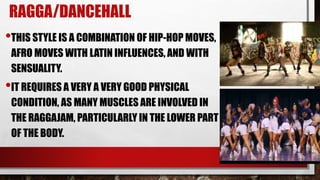
RAGGA/DANCEHALL
•THIS STYLE IS A COMBINATION OF HIP-HOP MOVES,
AFRO MOVES WITH LATIN INFLUENCES, AND WITH
SENSUALITY.
•IT REQUIRES A VERY A VERY GOOD PHYSICAL
CONDITION, AS MANY MUSCLES ARE INVOLVED IN
THE RAGGAJAM, PARTICULARLY IN THE LOWER PART
OF THE BODY.
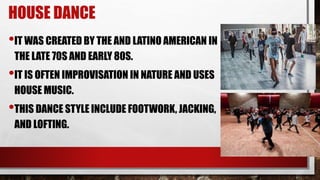
HOUSE DANCE
•IT WAS CREATED BY THE AND LATINO AMERICAN IN
THE LATE 70S AND EARLY 80S.
•IT IS OFTEN IMPROVISATION IN NATURE AND USES
HOUSE MUSIC.
•THIS DANCE STYLE INCLUDE FOOTWORK, JACKING,
AND LOFTING.
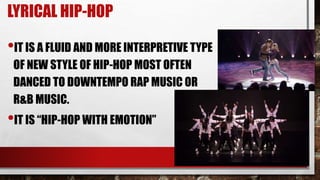
LYRICAL HIP-HOP
•IT IS A FLUID AND MORE INTERPRETIVE TYPE
OF NEW STYLE OF HIP-HOP MOST OFTEN
DANCED TO DOWNTEMPO RAP MUSIC OR
R&B MUSIC.
•IT IS “HIP-HOP WITH EMOTION”
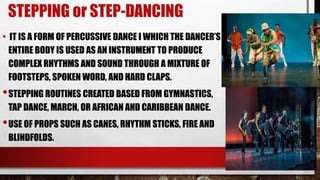
STEPPING or STEP-DANCING
• IT IS A FORM OF PERCUSSIVE DANCE I WHICH THE DANCER’S
ENTIRE BODY IS USED AS AN INSTRUMENT TO PRODUCE
COMPLEX RHYTHMS AND SOUND THROUGH A MIXTURE OF
FOOTSTEPS, SPOKEN WORD, AND HARD CLAPS.
•STEPPING ROUTINES CREATED BASED FROM GYMNASTICS,
TAP DANCE, MARCH, OR AFRICAN AND CARIBBEAN DANCE.
•USE OF PROPS SUCH AS CANES, RHYTHM STICKS, FIRE AND
BLINDFOLDS.
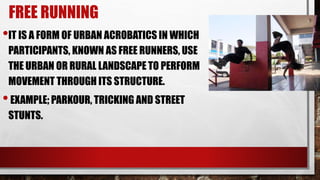
FREE RUNNING
•IT IS A FORM OF URBAN ACROBATICS IN WHICH
PARTICIPANTS, KNOWN AS FREE RUNNERS, USE
THE URBAN OR RURAL LANDSCAPE TO PERFORM
MOVEMENT THROUGH ITS STRUCTURE.
•EXAMPLE; PARKOUR, TRICKING AND STREET
STUNTS.
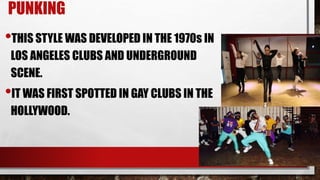
PUNKING
•THIS STYLE WAS DEVELOPED IN THE 1970s IN
LOS ANGELES CLUBS AND UNDERGROUND
SCENE.
•IT WAS FIRST SPOTTED IN GAY CLUBS IN THE
HOLLYWOOD.
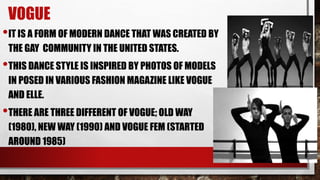
VOGUE
•IT IS A FORM OF MODERN DANCE THAT WAS CREATED BY
THE GAY COMMUNITY IN THE UNITED STATES.
•THIS DANCE STYLE IS INSPIRED BY PHOTOS OF MODELS
IN POSED IN VARIOUS FASHION MAGAZINE LIKE VOGUE
AND ELLE.
•THERE ARE THREE DIFFERENT OF VOGUE; OLD WAY
(1980), NEW WAY (1990) AND VOGUE FEM (STARTED
AROUND 1985)

Cheer dance.pptx

  • 2.
    CHEERDANCE •Is a physicalactivity with a combination of different dance genre and gymnastics skills such as tumbling, pyramids, tosses and stunts.
  • 3.
    FUNDAMENTAL OF CHEERLEADING •BASICMOTION •BASIC JUMPS •BASIC STUNTS •BASIC TUMBLING
  • 4.
    HIGH V •Extend thearms up in a V position. Arms should be a little more forward. •Elbows should be locked and your wrist should be aligned with your arms •Hands should be in fists and you should see them from the corners of your eyes.
  • 5.
    LOW V •Extend thearms down in a reverse V position. •Lock your elbows, align your wrists with your arms, and form fists. •The thumb should go over the rest of your fingers in all motions. The pointer finger should face the audience.
  • 6.
    DAGGER •STICK OUT ARMSBY THE CHEST. •TUCK ELBOWS AND ARMS IN BUT THEY SHOULD TOUCH EACH OTHER. •FORM FISTS WITH YOUR HANDS AND MAKE SURE YOUR PINKIES FACING OUT.
  • 7.
    TOUCHDOWN •FROM THE DAGGERPOSITION, EXTEND THE ARMS STRAIGHT UP. •FORM FISTS, LOCK YOUR ELBOWS, AND EAR. ALSO, ALIGN WRISTS WITH THE ARMS.
  • 8.
    T •Extend your armssideward and form a T. •Bring arms in so you can see them from the corners of your eyes. •Form fists with no fingers out.
  • 9.
    BROKEN T •From theT position, bring forearms in to your chest. •Form fists, without your pinkies facing out.
  • 10.
    BASIC JUMP HERKIE •On countone, clasp your arms tighter than in the dagger position and form fists. •On count two, bring arms up to high V. •On count three, swing arms in a cross position and bend both legs.
  • 11.
    .•On count four,arms up to a T and hit your herkie. One of the legs shall be out like you are doing a straddle split and the other leg shall be bent back. The arms shall be in a t position with the hands forming fists. •On count five, land with legs bent and hands on the side. •On count six, hold that position •On count seven, straighten out your legs
  • 12.
    TOE TOUCH •On countone, clasp your arms like in the herkie and form fists. •On count two, bring arms up to a high V. •On count three, swing your arms in a cross position and bend the knees. •On count five, land with both legs bent and both hands on the sides. •On count six, hold that position. •On the seven, straighten out the legs.
  • 13.
    PIKE •On count one,clasp arms like toe touch and form fists •On count two, bring arms up to a rocket (high clap) and turn 90 degrees to either side. •On count three, swing the arms in and bend knees. •On count four, hit pike. The legs shall be in pike position. Extend the legs together in front, with toes pointed.
  • 14.
    •The arms shouldbe over your legs with the hands in fists. •On count five, land with the legs bent and hands on the sides. •On count six, hold that position.
  • 15.
    BASIC STUNTS PONY SITOR PONY MOUNT •Make sure that your base has his/her arms locked at all times and his/her head up. •The flyer should sit on the lower part of the base’s back; sitting on the upper back can hurt the base. •The spotter should hold the flyer at her waist at all times. •The spotter should help the flyer get up and dismount.
  • 16.
    DOUBLE THIGH •Make surethat your bases have deep lunges for the flyer to stand on. •Make sure that the flyer step in the “pockets” of the bases, not on their legs. •The flyer should start with her right foot first and climb using the step locking-tighten method. •Have the base hold the flyer’s legs by wrapping their arms around the flyer’s waist.
  • 17.
    •When you arelearning the double thigh stand, you should add a front spotter. •To dismount, have the bases hold the flyer’s hands and his/her armpits. •The flyer lands in front of the stunt with his/her feet together.
  • 18.
    BASIC TUMBLING FORWARD ROLL •Squatand lay both hands on the floor. •Tuck chin and push off the hands and legs. •Roll forward. •Squat both legs against the chest and hold the arms up in front. •Get up.
  • 19.
    CARTWHEEL •PUT THE BESTLEG FORWARD AND EXTEND BOTH ARMS UP AGAINST THE EARS. •MOVE THE WHOLE BODY FORWARD AND SLOWLY RAISE THE BACK LEG. •ONCE THE HANDS REACH THE GROUND, KICK THE BACK LEG OVER. •KICK THE OTHER LEG OVER. •LAND IN A LUNGE POSITION, WITH BOTH ARMS UP AGAINST YOUR EARS.
  • 20.
    BACKBEND •RAISE BOTH ARMSUP AGAINST THE EARS AND SPREAD BOTH LEGS APART. •PUSH THE HIPS FORWARD. •BEND THE BACK AND LOOK AT THE GROUND. •BEND IN, NOT OUT.
  • 22.
    HIP-HOP •Developed from themusic style that was first introduce during the 1970s in new york city among young hispanic and african american communities. •It remains to be one of the most popular dance because it encompasses athleticism, flexibility, energy, agility, power, and soul.
  • 23.
    FOUR ELEMENTS OFHIP-HOP •Deejaying, or “turnbabling” •Rapping, also known as “Mcing” or “rhyming” •Graffiti painting, also known as “graf”or “writing” •B-boying which encompasses hip-hop dance, style, and attitude. -along with the sort of virile body language that philosopher corner west described as “postural semantics”
  • 25.
    HIP-HOP STYLES •LOCKING It includesa lot of acrobatics and physically demanding moves, such as landing one one’s knees and the split. Other famous moves are waiving of arms, pointing, walking stationary, and grabbing and rotating the cap or hot. Movements are generally big exaggerated, and often very rhythmic and closely synced with the music.
  • 26.
    POPPING •THIS STYLE REQUIRESA PERFECT KNOWLEDGE OF THE BODY; IT INCLUDES BODY ISOLATION AND SOFT WAVE MOVES. •IT DEMANDS NONSTOP CONTRACTION OF THE MUSCLES TO THE BEAT TO GIVE A JERKY/SNAPPING EFFECT OR BOUNCY STYLE.
  • 27.
    ELECTRIC BOOGIE •IT ISA STYLE OF POPPING (TICKING) THAT CREATES MORE JERKY WAVES WITH MICRO WAVE MOVES AND IT IS SOME DIFFICULT THAT CLASSICAL POPPING.
  • 28.
    BREAKING or B-BOYING •ITIS POPULARLY KNOWN AS BREAKDANCING. •IT IS A STYLE THAT EVOLVED AS PART OF THE HIP-HOP CULTURE AMONG BLACK AND LATINO AMERICAN YOUTHS IN THE SOUTH BRONX DURING THE 1970s.
  • 29.
    TYPES OF B-BOYING •TOPROCK ITREFERS TO UPRIGHT DANCING AND SHUFFLES.
  • 30.
    DOWNROCK •IT REFERS TOFOOTWORK DANCING PERFORM ON THE FLOOR.
  • 31.
    FREEZE •IT IS THEPOSE THAT BREAKERS THROW INTO THEIR DANCE SETS TO ADD PUNCTUATION TO CERTAIN BEATS AND END THEIR ROUTINES.
  • 32.
    POWER MOVES •THERE ARETHE MOST IMPRESSIVE ACROBATIC MOVES NORMALLY MADE UP OF CIRCULATION MOTION WHERE THE DANCER SPIN ON THE FLOOR OR IN THE AIR.
  • 33.
    UPROCK •IT IS ASOULFUL, COMPETITIVE STREET DANCE USING THE RHYTHMS OF SOUL AND FUNK MUSIC. •THIS DANCE INVOLVES FOOT SHUFFLES, SPIN, TURNS, FREESTYLE MOVEMENTS, SUDDEN BODY, MOVEMENTS OF JERKS, AND HANDS GESTURE OR BURNS. •IT IS SAID TO BE MASTERED WITH DISCIPLINE, PATIENCE, HEART, SOUL AND KNOWLEDGE.
  • 34.
    FUNK •IT IS AHIGHLY CHOREOGRAPHED DANCE FORM. •IT FEATURES A MIXTURE OF SHARP AND FLUID MOVEMENTS, POPPING AND LOCKING, AND ANIMATED EXPRESSION.
  • 35.
    STREETDANCE •IT IS AVERY PHYSICAL TYPE OF DANCE THAT INCORPORATE DANCE MOVES FROM ALL OVER THE WORLD. •IT IS A FUSION OF STYLES FROM THE HIP-HOP GENRE. EXAMPLE; LOCKING, POPPING, STREET STYLE AND FUNK.
  • 36.
    TUTTING OR TETRIS •ITIS A DANCE STYLE THAT IMITATES THE ANGULAR POSES SEEN IN ANCIENT EGYPTIAN ART. •DANCERS USED TO HAVE A LIMITED SET OF STATIC HIERO-INSPIRED POSES, BUT THEY NOW CREATE MORE COMPLEX GEOMETRIC PATTERNS WHEREIN MULTIPLE LIMBS INTERACT.
  • 37.
    BATTLE •IT IS AFREESTYLE DANCE WHERE DANCERS “FIGHT” ON THE DANCE FLOOR WITHOUT CONTACT.
  • 38.
    LIQUID DANCING (orLIQUIDING) •IT IS A FORM OF GESTURAL DANCE THAT SOMETIMES INVOLVES PANTOMIME. •THIS DANCE DESCRIBES THE FLUID-LIKE MOTION OF THE DANCERS BODY AND LIMBS. •THIS DANCE SIMILAR TO THE STYLES OF POPPING OR LOCKING.
  • 39.
    BOOGALOO •IT IS AFLUID STYLE THAT USES EVERY PART OF THE BODY AS WELL AS ANGLES AND SMOOTH MOVEMENTS TO MAKE EVERYTHING FLOW TOGETHER. •IF OFTEN INVOLVES ROLLING OF THE HIPS, KNEES, AND HEAD WHICH IS OFTEN USED AS A TRANSITION.
  • 40.
    RAGGA/DANCEHALL •THIS STYLE ISA COMBINATION OF HIP-HOP MOVES, AFRO MOVES WITH LATIN INFLUENCES, AND WITH SENSUALITY. •IT REQUIRES A VERY A VERY GOOD PHYSICAL CONDITION, AS MANY MUSCLES ARE INVOLVED IN THE RAGGAJAM, PARTICULARLY IN THE LOWER PART OF THE BODY.
  • 41.
    HOUSE DANCE •IT WASCREATED BY THE AND LATINO AMERICAN IN THE LATE 70S AND EARLY 80S. •IT IS OFTEN IMPROVISATION IN NATURE AND USES HOUSE MUSIC. •THIS DANCE STYLE INCLUDE FOOTWORK, JACKING, AND LOFTING.
  • 42.
    LYRICAL HIP-HOP •IT ISA FLUID AND MORE INTERPRETIVE TYPE OF NEW STYLE OF HIP-HOP MOST OFTEN DANCED TO DOWNTEMPO RAP MUSIC OR R&B MUSIC. •IT IS “HIP-HOP WITH EMOTION”
  • 43.
    STEPPING or STEP-DANCING •IT IS A FORM OF PERCUSSIVE DANCE I WHICH THE DANCER’S ENTIRE BODY IS USED AS AN INSTRUMENT TO PRODUCE COMPLEX RHYTHMS AND SOUND THROUGH A MIXTURE OF FOOTSTEPS, SPOKEN WORD, AND HARD CLAPS. •STEPPING ROUTINES CREATED BASED FROM GYMNASTICS, TAP DANCE, MARCH, OR AFRICAN AND CARIBBEAN DANCE. •USE OF PROPS SUCH AS CANES, RHYTHM STICKS, FIRE AND BLINDFOLDS.
  • 44.
    FREE RUNNING •IT ISA FORM OF URBAN ACROBATICS IN WHICH PARTICIPANTS, KNOWN AS FREE RUNNERS, USE THE URBAN OR RURAL LANDSCAPE TO PERFORM MOVEMENT THROUGH ITS STRUCTURE. •EXAMPLE; PARKOUR, TRICKING AND STREET STUNTS.
  • 45.
    PUNKING •THIS STYLE WASDEVELOPED IN THE 1970s IN LOS ANGELES CLUBS AND UNDERGROUND SCENE. •IT WAS FIRST SPOTTED IN GAY CLUBS IN THE HOLLYWOOD.
  • 46.
    VOGUE •IT IS AFORM OF MODERN DANCE THAT WAS CREATED BY THE GAY COMMUNITY IN THE UNITED STATES. •THIS DANCE STYLE IS INSPIRED BY PHOTOS OF MODELS IN POSED IN VARIOUS FASHION MAGAZINE LIKE VOGUE AND ELLE. •THERE ARE THREE DIFFERENT OF VOGUE; OLD WAY (1980), NEW WAY (1990) AND VOGUE FEM (STARTED AROUND 1985)