Observes personal safetyprotocol
to avoid dehydration, overexertion,
hypo and hyperthermia during
MVPA participation.
Objectives
Engages in moderate to vigorous
physical activities (MVPAs) for at
least 60 minutes most days of the
week in a variety of settings in- and
out-of school.
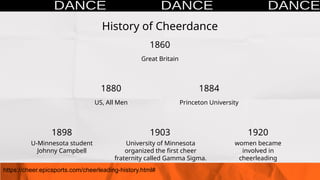
History of Cheerdance
GreatBritain
1860
US, All Men
1880
Princeton University
1884
University of Minnesota
organized the first cheer
fraternity called Gamma Sigma.
1903
U-Minnesota student
Johnny Campbell
1898
women became
involved in
cheerleading
1920
https://cheer.epicsports.com/cheerleading-history.html#
Yells and chant
Usuallydone by the
performers with pride and
confidence. This element helps to
encourage the supportive
spectators to cheer along and
bring the prideful message to the
competitors. The basic technique
in yelling and chanting is the use
of diaphragm instead of the
throat. It is done also while doing
the other elements of cheer
https://www.youtube.com/watch?v=obFUBhCx-lQ
24.
Motion
Basic Hand Movements
BEGINNINGSTANCE
Feet together, hands down
by the side in blades
CHEER STANCE
Feet more than shoulder width
apart, hands down by the side in
blade
Stunts
Most stunts aredone by
flyers (usually female) with
bases (male lifters) and
spotters. It is essential to know
the proper execution of the
stunts to secure the safety of
both flyers and lifters.
● Bases
● Flyers
34.
Tumble
Including tumbling skillsin your cheer dance routine is an
excellent way to add extreme, thrill and excitement. Safety and
security must be observe at all times to avoid injury especially
tumble skill involve gravity-defying and intense ground impact.
Types of tumbling skills:
● Standing
● Running
● Cartwheel
● Round off
35.
Basic formations
Formations playa vital role in
cheer dance since most of the cheer
dance competitions are viewed from
the top by the spectators. Formations
may vary depending on the dances
and stunts choreographed. It is
important to have creative formations
that will create excellent visual effects
to enhance the dance routine.
Synchronization must be always
observed in making formations in the
cheer dance.
http://images.gmanews.tv/
webpics/2017/12/640_20-
gma_b_1886_2017_12_03_12_51
_44_2.jpg
What characteristics/ attitudesmust a cheer dancer
possess? Explain.
With regards to your answer on Question #1, how will
those characteristics help you in dealing with your
everyday real-life situations?
39.
“Life is likea cheerdance, those long
and hard practices are what makes
you a fighter.”
—Anonymous
Assessment 1:
You willperform the different hand-body
positions and jumps of cheer dance. Each
position must be repeated twice in
different directions (left and right). You will
be given enough time to memorize the
hand-body positions and jumps. You may
choose your own music.
Show
enthusiasm in
learning the
danceby
examining
street dance
performance
objectives
Learn the
different
dance styles
of street
dance of a
certain
locality;
Improve their
timing by
performing and
creating their
own
choreography
using different
time signatures.
In opposite tomany other dance
forms, most street dances encourage
individuality and originality, and that
dancers interpret the existing moves
freely and even invent new ones to
create a personal style of their own.
Improvisation is the heart of most
street dances, though choreography
is also seen, mostly mixed with
improvisation or used for prepared
shows.
characteristics:
B-Boying
B-Boying is alsoknown as breaking
or breakdancing is the first hip-hop
dancing that originates from Black and
Puerto Rican youths in New York City
during the early 1970’s. Practitioner is
the term given to b-boy or b-girl who do
breakdancing. B-boying and breaking is
the original term for breakdance.
50.
Footwork-oriented steps
performed whilestanding
Toprock
Four Movements:
Footwork performed with both
hands and feet on the floor
Downrock
Stylish poses done on your
hands
Freezes
Comprise full-body spins and
rotations that give the illusion
of defying gravity.
Power moves
51.
popping
It is basedon the technique of
quickly contracting and relaxing
muscles to cause a jerk in a dancer’s
body. Popping forces parts of your body
outwards, similar to an explosion within
parts of your body. Popping contracts
muscles, but is followed by relaxation
that gives it the jerking appearance of
popping.
https://tenor.com/view/popping-dance-robot-dance-dance-moves-dancing-
breakdance-gif-21358347
52.
Locking
Locking was identifiedby its
distinctive stops. It is usually performed
by stopping the fast movement of the
performer, locking the body into a
position, holding it, and then
continuing the same speed before
stopping. In doing locking, dancers
hold their positions longer. Lock is the
primary move used in locking, similar to
freeze or sudden pause.
https://sites.google.com/site/1132701226v1/locking
53.
Krumping
Krumping is adance style similar to
release of anger. It is reported that
gang riots in the United States
decreased because of these krumping
style.
https://www.pinterest.com/pin/
229613280980258694/
54.
Tutting
Tutting is acreative way of making
geometric shapes forming right angle
using your body parts. The style was
originally practiced by young funk
dancers. It is derived from the positions
people were drawn in during the days
of the Ancient Egyptians. Tutting is
greatly respected move of King Tut aka
Mark Benson who made this style
popular.
https://www.pinterest.com/pin/
229613280980258694/
55.
shuffling
The Melbourne Shuffle(also
known as Rocking “The Shuffle”) is a
rave and club dance that originated in
the late 1980’s in the underground
rave music scene in Melbourne,
Australia. The basic movements of
this style are a fast heel-and toe
action with a style suitable for various
types of electronic music.
https://giphy.com/explore/girls-shuffling
56.
Waacking
It is anAfrican American form of
street dance originated in 1970’s as
disco era of underground clubs in Los
Angeles and New York City. Waacking
has a stylized posing with a fast
synchronized arm movement
following beat of the music. It is very
popular element of hip-hop
nowadays.
https://weheartit.com/ding_dong7/collections/179384969-bts
58.
Questions:
Describe the emotionsbrought
about by the dance. Describe how
you feel while watching the whole
dance performance.
What is/are styles of dance used?
Your class willbe divided into 3
or 2 groups. Each group needs
to create their own routine of
hip hop dance. The
performance must be
minimum of 3min. You can
choose your own music. Remix
music is allowed. Good Luck!
Group activity:
CREDITS: This presentationtemplate was
created by Slidesgo, including icons by
Flaticon, and infographics & images by
Freepik
THANKS!
Does anyone have any questions?
albbatioco@shc.edu.ph
09092549109
Editor's Notes
#5 identify whether the statement given is correct or not. If the statement is correct, raise your hand andanswer TRUE If not, Tell me word/phrasesthat makes the statement incorrect.
#6 identify whether the statement given is correct or not. If the statement is correct, raise your hand andanswer TRUE If not, Tell me word/phrasesthat makes the statement incorrect.
#7 identify whether the statement given is correct or not. If the statement is correct, raise your hand andanswer TRUE If not, Tell me word/phrasesthat makes the statement incorrect.
#8 identify whether the statement given is correct or not. If the statement is correct, raise your hand andanswer TRUE If not, Tell me word/phrasesthat makes the statement incorrect.
#9 identify whether the statement given is correct or not. If the statement is correct, raise your hand andanswer TRUE If not, Tell me word/phrasesthat makes the statement incorrect.
#10 identify whether the statement given is correct or not. If the statement is correct, raise your hand andanswer TRUE If not, Tell me word/phrasesthat makes the statement incorrect.
#11 identify whether the statement given is correct or not. If the statement is correct, raise your hand andanswer TRUE If not, Tell me word/phrasesthat makes the statement incorrect.
#12 identify whether the statement given is correct or not. If the statement is correct, raise your hand andanswer TRUE If not, Tell me word/phrasesthat makes the statement incorrect.
#13 identify whether the statement given is correct or not. If the statement is correct, raise your hand andanswer TRUE If not, Tell me word/phrasesthat makes the statement incorrect.
#14 identify whether the statement given is correct or not. If the statement is correct, raise your hand andanswer TRUE If not, Tell me word/phrasesthat makes the statement incorrect.
#20 Also known as cheerleading, refers to a type of grouped dance that intends to give a motivation and support to a sporting team, entertainment to audience, or competition. Most cheer dance group consists of dancers, both male and female, executing different formations and acrobatics. Most cheer dance are “boosters” who leads the supporting crowd to make the chants, yells and simple but creative dance movement to motivate their sporting teams. Cheer dance performance involves various movements that are typically precise, breath-taking which will be discussed in this session.
#21 HISTORY OF CHEER DANCE
Cheerleading dates to the 1860s, in Great Britain, and entered the US in the 1880s. Although women currently dominate the field, cheerleading was begun by men. Princeton University, in 1884, got the idea that crowd chanting at football games would boost school spirit so they came up with a catchy cheer. On November 2, 1898, U-Minnesota student Johnny Campbell led an organized cheer at a football game between Minnesota and Princeton University, so you might say he was the first actual "cheer leader". In 1903, the University of Minnesota organized the first cheer fraternity called Gamma Sigma. They likely used a megaphone to project their voices. In the 1920s women became involved in cheerleading. The lady yellers sported ankle-length skirts and varsity sweaters. Female cheer squads began to include gymnastics, dance and other showy stunts into routines, and in the 1930s cheers were aided by the use of paper pom-poms. By the 1940s women were mainly leading the cheers, and routines took on a voice their own.
#22 A cheer dance performance consists of different structured and organized movements which are being scored when in competitions. The movements must be proper and efficient on order to earn scores and avoid deductions. Here are the elements of cheer dance to consider in creating a routine:
#23 – are usually done by the performers with pride and confidence. This element helps to encourage the supportive spectators to cheer along and bring the prideful message to the competitors. The basic technique in yelling and chanting is the use of diaphragm instead of the throat. It is done also while doing the other elements of cheer dancing.
#24 – are usually done by the performers with pride and confidence. This element helps to encourage the supportive spectators to cheer along and bring the prideful message to the competitors. The basic technique in yelling and chanting is the use of diaphragm instead of the throat. It is done also while doing the other elements of cheer dancing.
#25 – are usually done by the performers with pride and confidence. This element helps to encourage the supportive spectators to cheer along and bring the prideful message to the competitors. The basic technique in yelling and chanting is the use of diaphragm instead of the throat. It is done also while doing the other elements of cheer dancing.
#26 – are usually done by the performers with pride and confidence. This element helps to encourage the supportive spectators to cheer along and bring the prideful message to the competitors. The basic technique in yelling and chanting is the use of diaphragm instead of the throat. It is done also while doing the other elements of cheer dancing.
#27 – are usually done by the performers with pride and confidence. This element helps to encourage the supportive spectators to cheer along and bring the prideful message to the competitors. The basic technique in yelling and chanting is the use of diaphragm instead of the throat. It is done also while doing the other elements of cheer dancing.
#28 – are usually done by the performers with pride and confidence. This element helps to encourage the supportive spectators to cheer along and bring the prideful message to the competitors. The basic technique in yelling and chanting is the use of diaphragm instead of the throat. It is done also while doing the other elements of cheer dancing.
#29 – are usually done by the performers with pride and confidence. This element helps to encourage the supportive spectators to cheer along and bring the prideful message to the competitors. The basic technique in yelling and chanting is the use of diaphragm instead of the throat. It is done also while doing the other elements of cheer dancing.
#30 – are usually done by the performers with pride and confidence. This element helps to encourage the supportive spectators to cheer along and bring the prideful message to the competitors. The basic technique in yelling and chanting is the use of diaphragm instead of the throat. It is done also while doing the other elements of cheer dancing.
#33 o Bases These are the athletes (usually male cheer dancers) that hold, lift, and toss a flyer up to the air during stunts. Bases must be strong an alert at all times. They make sure that the flyer will land safely and secured. There is no gender requirement for a base.
o Flyers Flyers are the athletes being held, lifted, and tossed up to perform certain stunts in height or in the air. Female cheer dancers are usually assigned to be the flyers. They are usually, but not always, the smallest person in the group. They are flexible, and balance efficient while being lifted up. Before performing air stunts, flyers must learn first the proper techniques
#34 Types of tumbling skills:
Standing – completing tumble in a stationary position.
Running – completing a tumble from a running start.
Cartwheel – A type of tumble in which the body moves sideways imitating a wheel.
Round off – this tumble is similar to cartwheel but the difference is, landing must be in both feet together
#45 It refers to dance styles that have evolved outside of dance studios. It is performed in streets, dance parties, parks, school yards, or any available space. It is often improvisational and social in nature, encouraging interaction and contact with spectators and other dancers. Hip-hop is a cultural movement best known for its impact on music in the form of the musical genre of the same name. It originates in Bronx, part of New York City during 1970’s. It was popularized by African American and was influenced by Latin Americans. The culture of Hip-hop is composed of pillars like D-Jing, rapping, breakdancing and graffiti art.
Streetdance is a distinctly Pinoy term, which is very closely related to hiphop, but rather, defined by cultural nuances and influences that, as Jungee and others of this breed have seen, have made streetdance a variation of hiphop dance that is identifiably Pinoy to the rest of the world.
#47 Generally, a street dance is based on a unique style or feels that are expressed through the dance, usually tied to certain genre of music. As new moves evolve based on this feel, the dance is under constant development, and if the feels starts to change it might give birth to a completely new dance form.
#51 Popping was popularized by Samuel Boogaloo Sam Solomon together with his crew, the Electric Boogaloos. I
#52 Locking which is also known as campbellocking, from the name of the creator of this style Don Campbellock Campbell around 1969 in Los Angeles, California. The Lockers are the crew of Don Campbell who popularized Locking
#53 Knumping is the form of dancing that was originated from African-American community of South Central Los Angeles, California and is a relatively new form of the “Urban Black dance movement. It is free, expressive and highly energetic. Most people paint their faces in different designs
#55 Some variants incorporate arm movements. Performers of this style are known as Rockers due to its rock music around 1990’s.
#56 Some variants incorporate arm movements. Performers of this style are known as Rockers due to its rock music around 1990’s.