Ecosystems:
An Overview
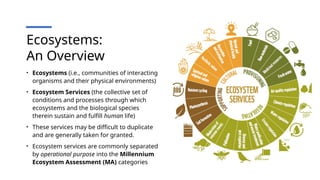
• Ecosystems(i.e., communities of interacting
organisms and their physical environments)
• Ecosystem Services (the collective set of
conditions and processes through which
ecosystems and the biological species
therein sustain and fulfill human life)
• These services may be difficult to duplicate
and are generally taken for granted.
• Ecosystem services are commonly separated
by operational purpose into the Millennium
Ecosystem Assessment (MA) categories
3.
Millennium Ecosystem
Assessment (MA)Categories
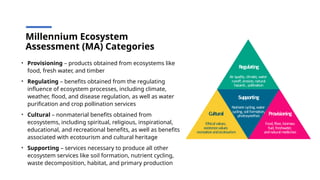
• Provisioning – products obtained from ecosystems like
food, fresh water, and timber
• Regulating – benefits obtained from the regulating
influence of ecosystem processes, including climate,
weather, flood, and disease regulation, as well as water
purification and crop pollination services
• Cultural – nonmaterial benefits obtained from
ecosystems, including spiritual, religious, inspirational,
educational, and recreational benefits, as well as benefits
associated with ecotourism and cultural heritage
• Supporting – services necessary to produce all other
ecosystem services like soil formation, nutrient cycling,
waste decomposition, habitat, and primary production
4.
"Understanding the interconnectionand
interdependence of the various plant and animal
communities within ecosystems will provide us
with critical information about how to protect them
and the services they provide us."
5.
Lab #3:
Ecosystem Services
•Google Earth (
https://earth.app.goo.gl/Xv9FAm)
- immersive web application that
allows you to travel to virtually any
location around the globe from the
comfort of your own classroom/home
- Also a powerful geospatial tool that
enables users to compare and
connect various environmental,
economic, and/or sociological
datasets to their geographic context
- The first activity pertains to an
ecosystem at the edge of the Denver
Metro area - Aurora Reservoir
6.
Final Notes
About theLab
• Notes about this lab:
• For some of the questions, you need to
read very carefully to understand the
level of detail needed to answer each
question.
• For example, part 2 asks you to identify
and describe two ecosystem services
for each MA category (in which there
are four). That’s a total of 8 components
for this question.
• There are similar nuances throughout
the lab. Be on the look-out! (Ex: Units!!)



![Polymer [ बहुलक ] Chemistry Notes PDF - Irfanullah Mehar - JJ Sir Chemistry.pdf](https://cdn.slidesharecdn.com/ss_thumbnails/polymerchemistrynotespdf-irfanullahmehar-jjsirchemistry-260210172118-3f9b37f7-thumbnail.jpg?width=640&height=640&fit=bounds)


